<?xml version="1.0" encoding="ISO-8859-1"?><article xmlns:mml="http://www.w3.org/1998/Math/MathML" xmlns:xlink="http://www.w3.org/1999/xlink" xmlns:xsi="http://www.w3.org/2001/XMLSchema-instance">
<front>
<journal-meta>
<journal-id>2182-8458</journal-id>
<journal-title><![CDATA[Tourism & Management Studies]]></journal-title>
<abbrev-journal-title><![CDATA[TMStudies]]></abbrev-journal-title>
<issn>2182-8458</issn>
<publisher>
<publisher-name><![CDATA[Escola Superior de Gestão, Hotelaria e Turismo da Universidade do Algarve]]></publisher-name>
</publisher>
</journal-meta>
<article-meta>
<article-id>S2182-84582015000100017</article-id>
<title-group>
<article-title xml:lang="en"><![CDATA[Psychographic determinants of private-label adoption: a feasibility study in the Portuguese yogurt market]]></article-title>
<article-title xml:lang="pt"><![CDATA[Determinantes psicográficos da adoção da marca do distribuidor: um estudo no mercado português de iogurtes]]></article-title>
</title-group>
<contrib-group>
<contrib contrib-type="author">
<name>
<surname><![CDATA[Brochado]]></surname>
<given-names><![CDATA[Ana Oliveira]]></given-names>
</name>
<xref ref-type="aff" rid="A01"/>
</contrib>
<contrib contrib-type="author">
<name>
<surname><![CDATA[Marques]]></surname>
<given-names><![CDATA[Susana Henriques]]></given-names>
</name>
<xref ref-type="aff" rid="A01"/>
</contrib>
<contrib contrib-type="author">
<name>
<surname><![CDATA[Mendes]]></surname>
<given-names><![CDATA[Pedro]]></given-names>
</name>
<xref ref-type="aff" rid="A01"/>
</contrib>
</contrib-group>
<aff id="A01">
<institution><![CDATA[,Lisbon University Institute ISCTE Business School Business Research Unit]]></institution>
<addr-line><![CDATA[Lisboa ]]></addr-line>
<country>Portugal</country>
</aff>
<pub-date pub-type="pub">
<day>31</day>
<month>01</month>
<year>2015</year>
</pub-date>
<pub-date pub-type="epub">
<day>31</day>
<month>01</month>
<year>2015</year>
</pub-date>
<volume>11</volume>
<numero>1</numero>
<fpage>136</fpage>
<lpage>145</lpage>
<copyright-statement/>
<copyright-year/>
<self-uri xlink:href="http://scielo.pt/scielo.php?script=sci_arttext&amp;pid=S2182-84582015000100017&amp;lng=en&amp;nrm=iso"></self-uri><self-uri xlink:href="http://scielo.pt/scielo.php?script=sci_abstract&amp;pid=S2182-84582015000100017&amp;lng=en&amp;nrm=iso"></self-uri><self-uri xlink:href="http://scielo.pt/scielo.php?script=sci_pdf&amp;pid=S2182-84582015000100017&amp;lng=en&amp;nrm=iso"></self-uri><abstract abstract-type="short" xml:lang="en"><p><![CDATA[This study seeks to point out the main psychographic determinants of private-label brand proneness in a specific industry: the Portuguese yogurt market. This is a booming industry for store brands in Portugal, which account for nearly half of the total market share. An in-depth interview was held with a sales and marketing expert of the leading yogurt company in Portugal. Next, we conducted a survey targeting consumers of yogurt. Based on the results of a Tobit regression, we conclude that consumers base their decisions about private label versus national brands on three different types of variables: price-related variables, quality-related variables and variables related to involvement with the product category. Managerial implications are also discussed.]]></p></abstract>
<abstract abstract-type="short" xml:lang="pt"><p><![CDATA[O presente trabalho tem como objetivo estudar os determinantes psicográficos da adoção da marca do distribuidor, no caso específico do mercado dos iogurtes em Portugal. Este é um setor em crescimento em Portugal, em que as marcas do distribuidor atingem quase 50% da quota de mercado total. Foi realizada uma entrevista em profundidade com o responsável pelo marketing e vendas de uma das empresas líderes neste setor. De seguida, foi administrado um questionário a consumidores de iogurtes. Com base nos resultados de um modelo de regressão Tobit, conclui-se que os consumidores baseiam as suas decisões de aquisição de marcas do distribuidor relativamente a marcas do fabricante em três tipos de variáveis: variáveis relacionadas com o preço, com a qualidade, e com o envolvimento com a categoria de produto. São igualmente discutidas as implicações para a gestão.]]></p></abstract>
<kwd-group>
<kwd lng="en"><![CDATA[Private labels]]></kwd>
<kwd lng="en"><![CDATA[psychographics]]></kwd>
<kwd lng="en"><![CDATA[Tobit regression]]></kwd>
<kwd lng="en"><![CDATA[yogurt]]></kwd>
<kwd lng="pt"><![CDATA[Marca do distribuidor]]></kwd>
<kwd lng="pt"><![CDATA[variáveis psicográficas]]></kwd>
<kwd lng="pt"><![CDATA[regressão Tobit]]></kwd>
<kwd lng="pt"><![CDATA[iogurtes]]></kwd>
</kwd-group>
</article-meta>
</front><body><![CDATA[ <p align="right"><font size="2" face="Verdana"><b>MANAGEMENT &ndash; RESEARCH PAPERS</b></b></font></p>     <p>&nbsp;</p>      <p><font size="4" face="Verdana"><b>Psychographic determinants of private-label adoption: a feasibility study in the Portuguese yogurt market</b></font></p>     <p>&nbsp;</p>     <p><font size="3" face="Verdana"><b>Determinantes   psicográficos da adoção da marca do distribuidor: um estudo no mercado português de iogurtes</b></font></p>     <p>&nbsp;</p>     <p>&nbsp;</p>     <p><font size="2" face="Verdana"><b>Ana Oliveira Brochado<sup>1</sup>; Susana Henriques Marques<sup>2</sup>; Pedro Mendes<sup>3</sup></b></font></p>     <p><font size="2" face="Verdana"><sup>1</sup>Lisbon University Institute, ISCTE Business School, Business Research Unit (BRU-IUL),   Av. Das Forças Armadas, 1649-026   Lisboa, Portugal, <a href="mailto:ana.brochado@iscte.pt">ana.brochado@iscte.pt</a>    <br>   <sup>2</sup>Lisbon University Institute, ISCTE Business School, Business Research Unit (BRU-IUL),   1649-026 Lisboa, Portugal, <a href="mailto:susana.marques@iscte.pt">susana.marques@iscte.pt</a>    ]]></body>
<body><![CDATA[<br>   <sup>3</sup>Lisbon University Institute, ISCTE Business School, 1649-026 Lisboa, Portugal   <a href="mailto:pedro_f_mendes7@hotmail.com">pedro_f_mendes7@hotmail.com</a></font></p>     <p>&nbsp;</p>     <p>&nbsp;</p> <hr noshade size="1">      <p><font size="2" face="Verdana"><b>ABSTRACT</b></font></p>     <p><font size="2" face="Verdana">This study seeks to point out the   main psychographic determinants of private-label brand proneness in a specific   industry: the Portuguese yogurt market. This is a booming industry for store   brands in Portugal, which account for nearly half of the total market share. An   in-depth interview was held with a sales and marketing expert of the leading   yogurt company in Portugal. Next, we conducted a survey targeting consumers of   yogurt. Based on the results of a Tobit regression, we conclude that consumers   base their decisions about private label versus national brands on three   different types of variables: price-related variables, quality-related   variables and variables related to involvement with the product category. Managerial implications are also discussed.</font></p>     <p><font size="2" face="Verdana"><b>Keywords</b>: Private labels, psychographics, Tobit regression, yogurt.</font></p> <hr noshade size="1">      <p><font size="2" face="Verdana"><b>RESUMO</b></font></p>     <p><font size="2" face="Verdana">O presente trabalho tem como objetivo estudar os   determinantes psicográficos da adoção da marca do distribuidor, no caso   específico do mercado dos iogurtes em Portugal. Este é um setor em crescimento   em Portugal, em que as marcas do distribuidor atingem quase 50% da quota de   mercado total. Foi realizada uma entrevista em profundidade com o responsável   pelo marketing e vendas de uma das empresas líderes neste setor. De seguida,   foi administrado um questionário a consumidores de iogurtes. Com base nos   resultados de um modelo de regressão Tobit, conclui-se que os consumidores   baseiam as suas decisões de aquisição de marcas do distribuidor relativamente a   marcas do fabricante em três tipos de variáveis: variáveis relacionadas com o   preço, com a qualidade, e com o envolvimento com a categoria de produto. São igualmente discutidas as implicações para a gestão.</font></p>     <p><font size="2" face="Verdana"><b>Palavras chave</b>: Marca do distribuidor, variáveis psicográficas, regressão Tobit, iogurtes.</font></p> <hr noshade size="1">      <p>&nbsp;</p>     ]]></body>
<body><![CDATA[<p>&nbsp;</p>     <p><font size="3" face="Verdana"><b>1. Introduction</b></font></p>     <p><font size="2" face="Verdana">Private label   brands (PLBs) are owned and distributed by retailers, while national brands are   generally owned by producers. Private labels are sold in particular retail   chains, and thus they tend to have restricted distribution as compared to national   brands. Producers tend to advertise each national brand separately while   advertising efforts by retailers are distributed across all their products. The   majority of private labels are cheaper than national brands. As PLBs hold the   potential to drive store loyalty and to maintain profitability, retailers   around the world continue to invest in private labels, which have experienced significant growth in the last two decades (Dawes &amp; Nenycz-Thiel, 2013).</font></p>     <p><font size="2" face="Verdana">Retailers use PLB to increase sales as well as to win the loyalty of   their customers. In addition, some store brands are no longer merely category   killers but instead are comparable to national brands (De Wulf,   Odekerken-Schroder, Goedertier &amp; Van Ossel, 2005). Retailers are aware that   consumers can purchase nationally branded items anywhere, but customers can   only buy retailers’ store brands in their stores (Pepe, Abratt &amp; Dion,   2011). PLBs are now integral elements of the retail landscape, having achieved   impressive penetration in all markets (Boyle &amp; Lathrop, 2013). Given their   strategic importance, identification of private-label prone shoppers’ main   characteristics has attracted the attention of both practitioners and academics (Baltas &amp; Argouslidis, 2007). </font></p>     <p><font size="2" face="Verdana">A private-label   prone shopper buys store brands more often than national brands. A large body   of literature provides evidence that private label products attract both price   and quality conscious consumers (Baltas &amp; Argouslidis, 2007). Furthermore,   the determinants of private-label proneness are known to vary across different product categories (Gonzalez-Benito &amp; Martos-Pardal, 2012).</font></p>     <p><font size="2" face="Verdana">PLBs are a   steadily growing phenomenon that has reached a large number of countries and   product categories (Cuneo, Lopez &amp; Yague, 2012). This study seeks to define   the main consumer correlates of store brand proneness in a particular industry:   the Portuguese yogurt market. The yogurt market is a booming industry for store   brands in Portugal, which hold nearly half of the total market share. Indeed,   store brands represent 45% of the market in value and 53% in volume, while the   top three national brands (Nestlé, Danone and Lactogal) together represent 50% of the market in value and 41% in volume. </font></p>     <p><font size="2" face="Verdana">The remainder of this paper proceeds as follows. The next section   presents a discussion of the variables considered in this study and a brief   description of the hypotheses. Then, our methodology is presented, which   encompassed both qualitative and quantitative approaches. The results section   analyses the contents of an interview conducted with the marketing manager of   one of the leading national brands of yogurt and the survey results. We finish with some conclusions and final remarks. </font></p>     <p>&nbsp;</p>     <p><b><font size="3" face="Verdana">2.&nbsp;&nbsp;&nbsp;&nbsp;&nbsp;&nbsp; Literature review</font></b></p>     <p><b><font size="2" face="Verdana">2.1 &nbsp;&nbsp;&nbsp; Private-label brands</font></b></p>     ]]></body>
<body><![CDATA[<p><font size="2" face="Verdana">In recent years, retailing of consumer goods   has been characterised by a proliferation of private labels (e.g. Richardson,   Jain &amp; Dick, 1996; Pauwels &amp; Srinivasan, 2004; Dobson &amp;   Chakraborty, 2009). The number of national brands, in this context, has been reduced in favour of private labels. </font></p>     <p><font size="2" face="Verdana">The evolution of private label brands has been driven by a number of benefits for retailers, as follows:</font></p> <ul>       <li><font size="2" face="Verdana">Increased bargaining power over     manufacturers (Farris &amp; Ailawadi, 1992; Pauwels &amp; Srinivasan, 2004)</font></li>       <li><font size="2" face="Verdana">Reactivation and expansion of     stagnant categories (Hauser &amp; Shugan, 1983; Scott &amp; Zettelmeyer, 2004)</font></li>       <li><font size="2" face="Verdana">Increased revenues, providing     superior margins to those delivered by manufacturers’ brands (Ailawadi &amp;     Harlam, 2002, 2004; Hoch &amp; Banerji, 1993) </font></li>       <li><font size="2" face="Verdana">Strategic benefits, such as an     improvement of store image, loyalty and differentiation (Ailawadi, Pauwels     &amp; Steenkamp, 2008; Corstjens &amp; Lal, 2000)</font></li>     </ul>     <p><font size="2" face="Verdana">From a strategic   perspective, the entry of PLBs has modified the competitive dynamics between   retailers and brand manufacturers (Hoch &amp; Banerji, 1993; Pauwels &amp;   Srinivasan, 2004) and has set new challenges for both. Retailers have to adopt   brand management practices to make their PLBs successful. Brand manufactures   have to compete against these new players, who have control over distribution   channels, and, at the same time, stay relevant to consumers. Above all,   consumers play a key role in this dispute as they can determine the success or   failure of PLBs with their choices. Hence, for retailers and brand   manufacturers, identifying key consumer level factors that drive PLB choice is a top priority (Cuneo et al., 2012).</font></p>     <p><font size="2" face="Verdana">Several studies have attempted to understand   and explain consumers’ behaviours towards private labels based both on   psychographic and socioeconomic variables, as well as social class (Baltas,   1997), homemakers’ working conditions (Zeithaml, 1985) and family size   (Richardson et al., 1996). A brief overview of these variables is provided   below. Based on the results of previous research, a set of hypotheses was formulated.</font></p>     <p><b><font size="2" face="Verdana">2.2 &nbsp;&nbsp;&nbsp;&nbsp;&nbsp;&nbsp; Psychographic determinants of PLB adoption</font></b></p>     ]]></body>
<body><![CDATA[<p><b><i><font size="2" face="Verdana">2.2.1  &nbsp;&nbsp; Price consciousness</font></i></b></p>     <p><font size="2" face="Verdana">The concept of price consciousness is defined   as the degree to which consumers focus exclusively on paying low prices   (Lichtenstein, Ridgway &amp; Richard, 1993). According to Burton, Donald,   Lichtenstein, Netemeyer &amp; Garretson (1998), consumers with positive   attitudes towards private labels are extremely price conscious and tend to   focus almost exclusively on paying low prices due to their desire to maximise   their money, which minimises other factors when evaluating brands (Miranda &amp;   Josh, 2003). Therefore, we expect that (H1) the more customers’ are sensitive to price, the higher will be their proneness to buy private labels. </font></p>     <p><b><i><font size="2" face="Verdana">2.2.2&nbsp;&nbsp;&nbsp;&nbsp; Value consciousness</font></i></b></p>     <p><font size="2" face="Verdana">Value consciousness has been defined as a   concern for paying low prices subject to some quality constraints &#8211;   relating perceived costs to perceived benefits (Lichtenstein et al., 1993).   Garretson, Fisher &amp; Burton, (2002) and Ailawadi, Nelsin &amp; Gedenk (2001)   believe that the low prices of store brands can be used as an incentive to improve   the image of stores’ products and to attract consumers who are value conscious.   Therefore, based on these studies, it is expected that (H2) perceived value has a positive influence on the purchase of private label goods. </font></p>     <p><b><i><font size="2" face="Verdana">2.2.3&nbsp;&nbsp;&nbsp;&nbsp; Price-quality association</font></i></b></p>     <p><font size="2" face="Verdana">Generally, consumers tend to impute quality   based on price (Agarwal &amp; Teas, 2002; Brucks, Zeihaml &amp; Naylor, 2000).   Rao and Monroe (1989) argued that consumers evaluate product quality using a   comparative process, so perceived differences in prices lead to relative   judgements that product quality varies significantly. Volckner and Hoffman   (2007) concluded that the perception of a price-quality relationship persists,   albeit more weakly than in the past. However, even if price-quality benefits are   present, they can vary according to whether consumers are familiar with the   product categories or whether they perceive the products to be a risky choice   (Peterson &amp; Wilson, 1985) or a prestige purchase (Brucks et al., 2000).   According to Lichtenstein et al. (1993), the perception of price-quality is   defined as the generalised belief that the level of prices is positively related with the level of quality of products in all product categories.</font></p>     <p><font size="2" face="Verdana">Hansen and Singh (2008) found that heavy buyers   of private labels tend to be attracted to new price-oriented retailers. This   relationship suggests that private label buyers are more price conscious, which   makes them more susceptible to promotional activities by retailers (Sudhir   &amp; Talukdar, 2004) and, hence, less store loyal, so they spread their purchases across retailers.</font></p>     <p><font size="2" face="Verdana">To other consumers, low prices of store brands   cause these products to be seen as less attractive, constituting a sign of low   quality. Therefore, we can expect that (H3) there will be a negative relationship   between the price-quality perception of consumers and the adoption of private labels.</font></p>     <p><b><i><font size="2" face="Verdana">2.2.4&nbsp;&nbsp;&nbsp;&nbsp; Perception of private labels</font></i></b></p>     <p><font size="2" face="Verdana">Consumers can make evaluations using a variety of information signals   associated with products. The current literature shows that,   when assessing the quality of private labels, consumers use either intrinsic   cues (Sprott &amp; Shimp, 2004) or extrinsic cues (Bao, Bao &amp; Sheng, 2011).   According to the cue utilisation theory, consumers tend to rely more on   extrinsic cues than on intrinsic cues in their evaluation of private labels   (Richardson et al., 1996). The idea that national brands are better quality than store brands is   extremely persistent in customers’ minds and is influenced by publicity and   advertising that helps to strengthen this characteristic. For this reason,   consumers feel more confident when choosing branded goods that they believe   offer them more benefits. Therefore, we expect that (H4) perceptions of private   brands are positively related with consumers’ proneness to buy private labels. </font></p>     ]]></body>
<body><![CDATA[<p><b><i><font size="2" face="Verdana">2.2.5 &nbsp;&nbsp;&nbsp; Perceptional consequences of making bad choices</font></i></b></p>     <p><font size="2" face="Verdana">Kapferer and Laurent (1985) provided some   insights into this variable in their study of product category involvement.   Other researches regarding the degree of inconvenience of making a mistake have   come to similar conclusions (Narasimhan &amp; Wilcox, 1998). The results of   making a bad choice are directly linked to consumers’ perception of risk and   the value they give to a particular product category. Consequently, we maintain   that (H5) a negative relationship is present between perceptional consequences of making bad choices and proneness to buy private labels. </font></p>     <p><b><i><font size="2" face="Verdana">2.2.6&nbsp;&nbsp;&nbsp;&nbsp; Probability of making a bad purchase</font></i></b></p>     <p><font size="2" face="Verdana">The other half of the   ‘consequences of making a mistake’ notion deals not with the actual   consequences of making a mistake but rather with the probability of doing this.   The expected value of any decision is the product of its consequences times its likelihood (Dunn, Murphy &amp; Skelly, 1986).</font></p>     <p><font size="2" face="Verdana">Narasimhan and Wilcox (1998) take the consumer’s   perspective and argue that consumers prefer national brands to PLBs if the   relative risk of purchasing within the category seems high. Therefore, the   risky nature of product categories relates to private label success. This   suggests that it is important to understand the degree of variability of   quality in particular categories. This is different from the perceived PLB   quality level, as it is variability that should create greater uncertainty and   create more perceived risk. For Richardson et al. (1996), perceived quality   variation leads to a reduced perceived value-for-money of private labels   &#8211; both directly and via perceived risk. This eventually leads to reduced   private-label brand proneness. Therefore, we expect that (H6) a negative   relationship exists between perceptional consequences of making bad purchases and proneness to buy private labels. </font></p>     <p><b><i><font size="2" face="Verdana">2.2.7&nbsp;&nbsp;&nbsp;&nbsp;  Symbolic aspect (social consciousness)</font></i></b></p>     <p><font size="2" face="Verdana">The symbolic aspect of brands is the   associations that consumers make with brands or with particular social status,   personal tastes and lifestyles. In this way, consumers purchase their products   not only for their function but also for what they represent. According to   Aaker (1992), associations with brands correspond to something that creates   links between consumers and brands. These can be situations in which products   are used, a combination of features or attributes of products or even the   sensations products or brands can provoke in consumers. In the case of store   brands, this rarely happens, since these brands have little or no publicity   that can incite customers’ associations. On this level, the adoption of private   labels tends to be low. Thus, we assume that (H7) social consciousness is negatively related with proneness to buy private labels. </font></p>     <p><b><i><font size="2" face="Verdana">2.2.8 &nbsp;&nbsp;&nbsp; Hedonic value</font></i></b></p>     <p><font size="2" face="Verdana">Consumers associate products with a utility   value or a hedonic value, taking into account the strategic objectives of   brands. Chitturi, Raghunathan &amp; Mahajan, (2008), as well as other authors,   use the term ‘hedonic benefit’ when referring to the aesthetic side of   products, as well as the practical and emotional potential they offer. Ailawadi   et al. (2001) reported that this variable is linked with intangible, experiential and affective attributes. </font></p>     <p><font size="2" face="Verdana">According to Richins (1994), while some   products are consumed for their utility (utility benefits), others are consumed   for their capacity to give pleasure (hedonic benefits). Therefore, consumers   can attribute high risk to the performance of private labels in hedonic product   categories because they fear that these brands might not provide the emotional   benefits they desire. Therefore, we expect that (H8) hedonic value negatively affects proneness to buy private labels. </font></p>     ]]></body>
<body><![CDATA[<p><b><i><font size="2" face="Verdana">2.2.9&nbsp;&nbsp;&nbsp;&nbsp;  Interest</font></i></b></p>     <p><font size="2" face="Verdana">The literature about the variable of interest   is similar to what was previously discussed for hedonic value. Consumers do not   buy products only for their utility benefits. There are other features that are   taken into consideration when making purchase decisions. Interest in certain   products or categories can attribute high risk to the performance of private   labels if consumers pay more attention to details and have more knowledge about   related topics. As a result, consumers are willing to pay higher prices for   national brands in these categories. This occurs because consumers give much   importance to these products and want to have their expectations met. From   previous studies, we expect that (H9) the importance given to a product category negatively affects the adoption of private labels.</font></p>     <p><b><i><font size="2" face="Verdana">2.2.10  Brand loyalty</font></i></b></p>     <p><font size="2" face="Verdana">&nbsp;Loyalty   to brands is the intrinsic commitment to make repeat purchases of certain   brands. In other words, brand loyalty is the degree to which clients have   positive attitudes towards brands, showing commitment and a desire to continue   buying them in the future. This is a bond created between consumers and brands,   which translates into repeat purchases of products throughout a particular   period. According to Garretson et al. (2002), consumers who are loyal to brands   exhibit a strong tendency to buy the same brands they have always bought, so it   is less likely they will make a change to a new or unknown brand. Burton et al.   (1998) also verified that attitudes towards private labels are negatively   related to consumers’ propensity to be loyal to brands in different product   categories. In the same way, Ailawadi et al. (2001) referred to how customers   who are loyal to national brands show a lesser tendency to adopt store brands,   since the cost of changing is extremely high. However, in their study, this   variable did not show high significance in the explanation of consumers’ consumption of private labels (Ailawadi et al., 2008).</font></p>     <p><font size="2" face="Verdana">One of the most important elements for private   labels is a brand’s ability to fulfil promises to its consumer base. Continual   fulfilment of promises usually results in a long-term, profitable relationship   between retailers and consumers, and it is related to utilitarian benefits   offered by brands (Carpenter, 2003). Corstjens and Lal (2000) demonstrated that   premium quality store brands play a role in building store loyalty. Guenzi,   Johnson and Castaldo (2009) found that customer trust in store brand products   has an influence on store patronage, since it positively affects customers’   trust in stores, perceived value and store loyalty intentions. In summary,   according to these authors, (H10) consumers’ position towards private labels is   negatively related with consumers’ loyalty to brands throughout different product categories.</font></p>     <p><b><i><font size="2" face="Verdana">2.2.11  Product signatureness</font></i></b></p>     <p><font size="2" face="Verdana">The concept of product signatureness refers to   the degree to which product categories are associated with stores in consumers’   minds (Bao et al., 2011). This is an external cue commonly associated with   another variable &#8211; the store image, which is also frequently used in studies on consumers’ quality evaluation of private labels. </font></p>     <p><font size="2" face="Verdana">While signatureness refers to product   categories, store image defines the global impression of retail stores. The   fact that signature products epitomise retailers’ service means expertise is   representative of the product quality associated with those stores and their   general store image. Thus, (H11) when private labels are introduced into   signature categories of stores, they need to be perceived as high quality by consumers (Bao et al., 2011). </font></p>     <p>&nbsp;</p>     <p><b><font size="3" face="Verdana">3.&nbsp;&nbsp;&nbsp;&nbsp;&nbsp;&nbsp; Methodology</font></b></p>     ]]></body>
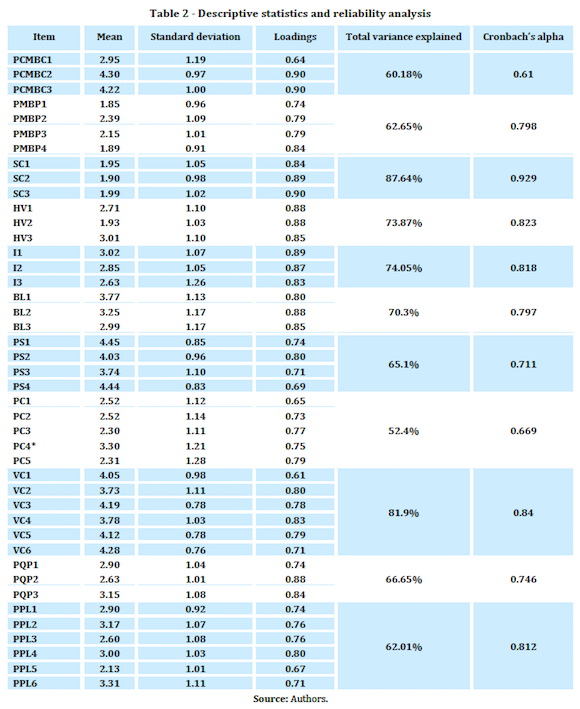
<body><![CDATA[<p><b><font size="2" face="Verdana">3.1 &nbsp;&nbsp;&nbsp; In-depth interview</font></b></p>     <p><font size="2" face="Verdana">An in-depth interview was carried out with a   sales and marketing expert of the leading yogurt company in Portugal. The   interview took place in his office and lasted for one hour. The objective of   the interview was to gather information regarding the supply side of the market   and, more specifically, about the role of private labels in this product category.</font></p>     <p><font size="2" face="Verdana">The interview guide comprised 11 questions, as   follows: 1. Do you consider private labels a threat to your business? 2. What   is the role of private labels in your product category? 3. Do you offer   discounts through retailers’ loyalty cards? If so, what is the main objective   of this sales tactic? 4. What are the main drivers of the market share increase   for national brands in your product category? 5. Do you produce any national   brands in your facilities? 6. Is there any brand love of fast moving consumer   goods (FMCG) in your product category? 7. What are the main trends for private   labels? 8. Are there still consumers loyal to brands? 9. Do you believe that   retailers look for an equilibrium between national brands and private labels in   their offer? 10. Is there a profile of consumers of private labels? 11. Do consumers plan to purchase national or private labels?</font></p>     <p><b><font size="2" face="Verdana">3.2&nbsp;&nbsp;&nbsp;&nbsp;  Survey development</font></b></p>     <p><font size="2" face="Verdana">In a second   step, a survey was conducted targeting regular consumers of yogurt. The main   objective was to identify the most important determinants in the adoption of private labels.</font></p>     <p><font size="2" face="Verdana">The information   required for this study had to come from people who come regularly in contact   with FMCG in their households, more specifically, yogurt. This includes people   who shop, consume or intervene in any stage of the decision making process. The   questionnaire was administered through face-to-face mall-intercept interviews. The fieldwork took place between December 2012 and February 2013.</font></p>     <p><font size="2" face="Verdana">The questionnaire had four main sections. The first section presented   questions focusing on general shopping behaviour and specific shopping   behaviour in the yogurt category. Respondents were asked to provide the   percentage of national and store brands they usually buy. In the second part,   all 23 questions had to do mostly with yogurt and competition between national   and store brands. This section focused on measuring individual factors within   this specific category that were adapted from a previous study (Kapferer &amp;   Laurent, 1985), such as ‘perceptional consequences of making a bad choice’   (PCMBC), ‘probability of making a bad purchase’ (PMBP), ‘social consciousness’   (SC), ‘hedonic value’ (HV) and ‘interest’ (I). The third section (20 questions)   contained a more general evaluation of the individual factors considered when   making a purchase decision. It included scales adapted from Burton et al.   (1998), Ailawadi et al. (2001) and Bao et al. (2011) related to ‘brand loyalty’   (BL), ‘product signatureness’ (PS), ‘price consciousness’ (PC), ‘value   consciousness’ (VC), ‘price-quality perception’ (PQP) and ‘perception of private   labels’ (PPL). <a href="#t1">Table 1</a> presents the respective items for each variable. In the   second and third sections, respondents had to indicate their level of agreement   with the items presented, based on a scale with one meaning ‘entirely disagree’   and five meaning ‘entirely agree’. The final part of the questionnaire was   composed of a group of seven questions with the objective of evaluating demographic and socioeconomic factors. </font></p>     <p>&nbsp;</p>     <p><a name="t1"></a></p>     <p align="center"> <img src="/img/revistas/tms/v11n1/11n1a17t1.jpg" width="580" height="779"></p>     
]]></body>
<body><![CDATA[<p>&nbsp;</p>     <p>&nbsp;</p>     <p><b><font size="3" face="Verdana">4. &nbsp;&nbsp;&nbsp;&nbsp;&nbsp; Results</font></b></p>     <p><b><font size="2" face="Verdana">4.1&nbsp;&nbsp;&nbsp;&nbsp; In-depth interview</font></b></p>     <p><font size="2" face="Verdana">In this   section, we summarise the main conclusions obtained from the interview with the   marketing manager of one of the main companies operating in Portugal in this sector, organised by question below.</font></p>     <p><font size="2" face="Verdana"><b>1</b>. Do you consider private labels a threat to your business? </font></p>     <p><font size="2" face="Verdana">The respondent   recognised that private labels have strengthened their position in the   Portuguese yogurt market. They offer new products targeting a wide range of   consumers with innovative flavours and packages (e.g. for children). Moreover,   the biggest retailers in Portugal began to use private labels to differentiate   themselves from other retailers. These possess a high brand awareness and offer   a good relationship of price to quality to consumers. In terms of a retailing   mix, retailers could assign more space in their line to private labels.   National brands did not anticipate the need for retailers to distinguish   themselves with an active retail mix. Therefore, private labels represent a threat for national brands, and they should be considered serious competitors.</font></p>     <p><font size="2" face="Verdana"><b>2.</b> What is the role of private labels in your product category?</font></p>     <p><font size="2" face="Verdana">Private labels   act as followers in the yogurt market. They offer products at a lower price and   copy the innovations of national brands. However, as private labels offer products at lower prices, they force national brands to innovate.</font></p>     <p><font size="2" face="Verdana"><b>3.</b> Do you offer discounts through retailers’ loyalty cards? If so, what is the main objective of this sales tactic?</font></p>     ]]></body>
<body><![CDATA[<p><font size="2" face="Verdana">This manager’s   company offers discounts through retailers’ loyalty cards. The main objective   is to motivate new consumers to try and adopt more products. However, for   existing products, promotional offers by national brands will only produce more sales in the short run.</font></p>     <p><font size="2" face="Verdana"><b>4.</b> What are the main drivers of the market share increase for national brands in your product category?</font></p>     <p><font size="2" face="Verdana">Price, quality,   continuous innovation, merchandising, placement of products in stores close to   national brands and effective advertisements designed to increase their brands’   equity were identified as the main drivers behind these increases in market share.</font></p>     <p><font size="2" face="Verdana"><b>5.</b> Do you produce any private labels in your facilities?</font></p>     <p><font size="2" face="Verdana">The manager   indicated that his company does not produce any private labels, but other national brands do this. </font></p>     <p><font size="2" face="Verdana"><b>6.</b> Is there any brand love of FMCG in your product category?</font></p>     <p><font size="2" face="Verdana">Although some   adults have good memories from their childhood, it is becoming more expensive   to create and to maintain brand love. The market structure has changed, and a wide range of products is offered.</font></p>     <p><font size="2" face="Verdana"><b>7.</b> What are the main trends for private labels? </font></p>     <p><font size="2" face="Verdana">The importance   of private labels will continue to increase. In this economic downturn, it is   to be expected that national brands have fewer resources to innovate and to   promote their products. As a consequence, private labels will strength their   position However, there is an upside for this increase in some categories. As   the profit margin of private labels for retailers is lower than their margin on   national brands, retailers will continue to promote national brands. During   2012 and 2013, major retailers changed their strategy to focusing on the promotion of national brands.</font></p>     <p><font size="2" face="Verdana"><b>8.</b> Are there still consumers loyal to brands? </font></p>     ]]></body>
<body><![CDATA[<p><font size="2" face="Verdana">The respondent   maintained that there is a segment of consumers loyal to specific brands of   yogurt for product categories targeted at children. The challenge for brand   managers is to find the best product mix to fulfil consumers’ needs and offer this at the right price.</font></p>     <p><font size="2" face="Verdana"><b>9.</b> Do you believe that retailers look for an equilibrium between national brands and private labels in their offer?</font></p>     <p><font size="2" face="Verdana">According to   the respondent, managing the balance between the high sales volume generated by   private labels and the high value offered by national brands is a complex task.   The retail sector is not prepared to manage private labels in order to add   value to the product category. As private labels have increased their market share,   national brands have reduced their profits. Retailers’ target margin in   specific categories should lead to an equilibrium between private labels and   national brands. Retailers should be aware that this situation could force them to reduce innovation efforts.</font></p>     <p><font size="2" face="Verdana"><b>10.</b> Is there a profile of consumers of private-label yogurt? </font></p>     <p><font size="2" face="Verdana">The same consumer can select both national and private labels. </font></p>     <p><font size="2" face="Verdana"><b>11.</b> Do consumers plan to purchase national or private labels? </font></p>     <p><font size="2" face="Verdana">The respondent   believes that the decision to buy specific brands is made either when consumers   make their shopping lists or during visits to stores. Consumers first select   the product category, then the brand and then the flavour. The decision process is different for loyal and non-loyal consumers.</font></p>     <p><b><font size="2" face="Verdana">4.2 &nbsp;&nbsp;&nbsp;&nbsp;&nbsp;&nbsp; Survey results</font></b></p>     <p><i><b><font size="2" face="Verdana">4.2.1 &nbsp;&nbsp;&nbsp; Demographic sample profile</font></b></i></p>     <p><font size="2" face="Verdana">Of the 305   respondents, 209 (68.5%) were female, and 96 (31.5%) were male. The age groups   were quite evenly distributed in the three younger categories &#8211; 18 to 25,   26 to 35 and 36 to 50 &#8211; with 72 (23.6%), 74 (24.3%) and 81 (26.6%)   respondents, respectively. The 51 to 64 group represents 15.7% of the total   sample (48 respondents), while people over 65 represent 9.8% (30 respondents).   As for the composition of the sample, in terms of marital status, the majority   of respondents are married &#8211; a total of 172 (56.4%). Single people   represent 32.1% of the total population in the study (98 respondents), while   the divorced/widowed participants represent 11.5% or 35. Twenty-nine percent of the respondents have children under 18 years old.</font></p>     ]]></body>
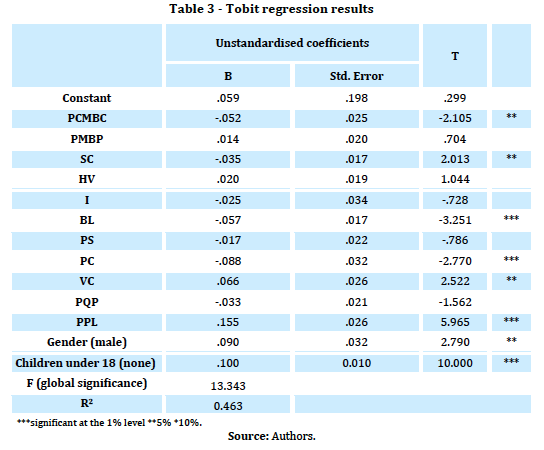
<body><![CDATA[<p><b><i><font size="2" face="Verdana">4.2.2&nbsp;&nbsp;&nbsp;&nbsp; Shopping behaviour description</font></i></b></p>     <p><font size="2" face="Verdana">The majority of   the respondents (51.5%) revealed that in their household they usually buy   yogurt once or twice a week. A further 35.7% (109 respondents) buy yogurt twice   a month, 9.5% (29 respondents) once a month and 3.3% (10 respondents) more than   twice a week. In terms of the number of types of yogurt they eat in their   household, the respondents answered mostly two (41.6%) or three (30.8%). Forty   respondents said they only ate one type (13.1%), while 44 people ate four or   more (14.4%). The mean percentage of private labels purchased in the yogurt   category was 45.7%, with a 95% confidence interval between 42.22% and 49.19%.   The median was 0.5, and the standard deviation was 0.30972. This percentage   ranged from a maximum of 100% (all types of yogurt are store brands) to 0% (all   the types of yogurt are national brands). The percentages obtained from the sample match the average national results disclosed by Nielsen.</font></p>     <p><b><i><font size="2" face="Verdana">4.2.3 &nbsp;&nbsp;&nbsp; Exploratory factor analysis</font></i></b></p>     <p><font size="2" face="Verdana">For this study,   a factor analysis using the method of principal components was performed in   order to identify a small set of uncorrelated variables to use in further   analysis, followed by an internal consistency analysis of each scale. The   Cronbach’s alpha coefficient ranged from 0.610 (PCMBC) to 0.929 (SC), revealing   adequate internal consistency (see <a href="#t2">Table 2</a> below). The primary objective of   this study is to analyse the main factors that lead consumers to adopt private   labels. Consequently, the percentage (%) of private labels bought in the yogurt   category was regressed on the mean values of the 11 scales previously defined.   Due to the nature of the dependent variable, ranging from 0 to 100, a truncated Tobit model was estimated.</font></p>     <p>&nbsp;</p>     <p><a name="t2"></a> </p>     <p align="center"> <img src="/img/revistas/tms/v11n1/11n1a17t2.jpg" width="580" height="709"></p>     
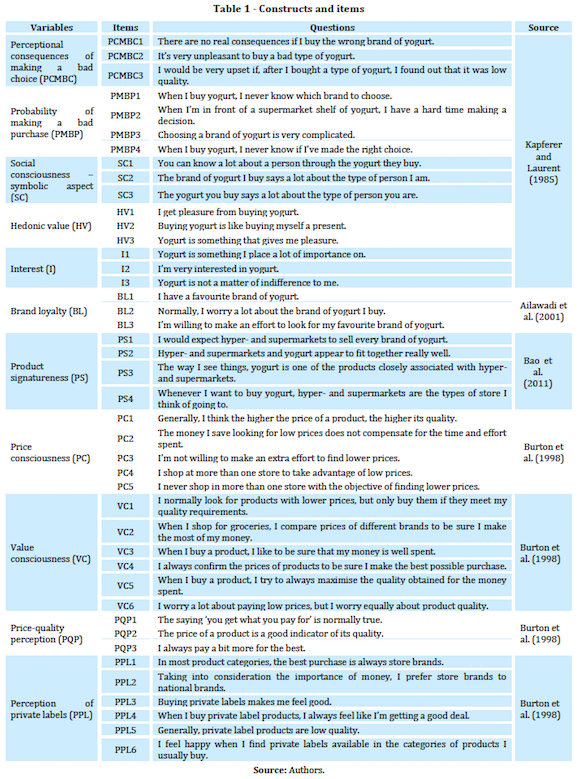
<p>&nbsp;</p>     <p><b><i><font size="2" face="Verdana">4.2.4 &nbsp;&nbsp;&nbsp; Tobit regression model results</font></i></b></p>     <p><font size="2" face="Verdana">The assumptions   for the model were examined and confirmed. The Harvey test statistic rejected   the null hypothesis of homoscedasticity, and the variance inflation factors   revealed that the correlations between the independent variables do not   jeopardise multicollinearity. Looking at the value of the R square (R&sup2;),   the model explains 46.3% of the total variance. From the 11 constructs   initially tested, six were found to have statistically significant correlation   with the dependent variable. Looking at the model results, six of the 11   hypotheses were confirmed. Looking at the values of the coefficients (B) of the   independent variables linked to psychographic determinants of PLB adoption   associated with the product category, we conclude that brand loyalty has the   strongest negative impact, followed by perceived consequences of making a bad   choice and social consciousness. The signal of the coefficient estimates was in   accordance with the theoretical expectations. Regarding the general   psychographic determinants of PLB adoption, PPL is the most significant determinant, followed by PC and PQP.</font></p>     ]]></body>
<body><![CDATA[<p><font size="2" face="Verdana">Considering   demographic variables, males buy a higher percentage of private labels as   compared to females, and the existence of children under 18 is negatively related to private-label proneness (see <a href="#t3">Table 3</a> below).</font></p>     <p>&nbsp;</p>     <p><a name="t3"></a> </p>     <p align="center"> <img src="/img/revistas/tms/v11n1/11n1a17t3.jpg" width="544" height="450"></p>     
<p>&nbsp;</p>     <p>&nbsp;</p>     <p><b><font size="3" face="Verdana">5. &nbsp;&nbsp;&nbsp;&nbsp;&nbsp; Conclusion and managerial implications</font></b></p>     <p><font size="2" face="Verdana">The growth   experienced by PLBs in recent years has not only been impressive but has also   caused important changes in the competitive dynamics of the markets in which   these brands operate. Retailers have become dominant in a large number of   countries and have pushed the development of their own brands, driven by the   high number of benefits on which they are able to capitalise (Cuneo et al.,   2012). In this study, we examined several factors that help to explain   variations in purchasing preferences for national brands of yogurt versus PLBs.   In attempting to explain these variations, several psychographic variables were tested.</font></p>     <p><font size="2" face="Verdana">Our results show that the consumers sampled base their decisions to   adopt a product on three different types of variables: price-related variables,   quality-related variables and variables related to involvement with the product   category. The price-related and quality-related variables (PPL, PC and VC) have   the most influence on consumers when selecting store brands of yogurt. These   types of variables are unlikely to vary throughout product categories because   they have to do with individual perceptions and they are indifferent to the   product type. The variables related to involvement with the product category   (BL, PCMBC and SC) are also statistically significant in explaining the dependent variable in this study.</font></p>     <p><font size="2" face="Verdana">As an increase in perceived consequences of making a wrong brand choice   is associated with a decrease in PLB adoptions, national brands could target   their advertising campaigns to increase the awareness of benefits associated   with their products. Tactically, national brands need to increase positive   brand associations and challenge perceived quality equivalence between national   brands and PLBs. One of the most interesting results regarding demographic   variables is that having children under 18 decreases private-label proneness.   This is a result anticipated by the manager of a national brand of yogurt, who   maintained that product categories targeting children command high levels of BL.   Therefore, the consumers sampled with children probably experience anxiety when   buying yogurt. This follows the arguments presented by Batra and Sinha (2010),   and this finding is in accordance with the research on children’s influence on   purchases (see Tiago and Tiago (2013) for a review). Of course, the   implications for retailers’ PLBs are the opposite. Retailers should continue to   disclose information about the yogurt they offer on package labels and reduce   the uncertainty faced by consumers. Retailers offering PLBs should be aware   that BL to national brands would limit retailers’ potential to increase their   market share. SC is also an important determinant regarding the adoption of PLBs of yogurt.</font></p>     ]]></body>
<body><![CDATA[<p><font size="2" face="Verdana">Regarding the   general constructs, the consumers sampled who are more price conscious and who   associate higher prices with higher quality would prefer national brands. PPL   and PQP are significant determinants of private label purchases. Therefore, for   those consumers that perceive PLBs as having equivalent quality when compared   with national brands, promotional offers made by national brands would probably   increase sales in the short term for these consumers. As this is a general   construct regardless of the product category, national brands managing umbrella   brands could spread the effectiveness of advertising campaigns across different product categories.</font></p>     <p><font size="2" face="Verdana">One of the   limitations that must be taken into account relates to the fact that the   sampling design was based on a convenience sampling procedure and the sample   did not have a national scope. Thus, the results obtained cannot be generalised to all Portuguese consumers.</font></p>     <p><font size="2" face="Verdana">Future research   needs to focus on more than one product category. As variables related to   involvement with the product category vary from product to product in the FMCG   industry, product categories that have retailer brands with higher and lower market shares could be compared. </font></p>     <p>&nbsp;</p>     <p><font size="3" face="Verdana"><b>References</b></font></p>     <!-- ref --><p><font size="2" face="Verdana">Aaker, D. (1992).   The value of brand equity. <i>Journal of Business Strategy</i>, 4, 27&#8211;32.    &nbsp;&nbsp;&nbsp;&nbsp;&nbsp;&nbsp;&nbsp;&nbsp;[&#160;<a href="javascript:void(0);" onclick="javascript: window.open('/scielo.php?script=sci_nlinks&ref=000138&pid=S2182-8458201500010001700001&lng=','','width=640,height=500,resizable=yes,scrollbars=1,menubar=yes,');">Links</a>&#160;]<!-- end-ref --></font></p>     <!-- ref --><p><font size="2" face="Verdana">Agarwal, S.   &amp; Teas, R. (2002). Cross-national applicability of a perceived quality   model. <i>Journal of Product &amp; Brand Management</i>, 11, 213-236.    &nbsp;&nbsp;&nbsp;&nbsp;&nbsp;&nbsp;&nbsp;&nbsp;[&#160;<a href="javascript:void(0);" onclick="javascript: window.open('/scielo.php?script=sci_nlinks&ref=000140&pid=S2182-8458201500010001700002&lng=','','width=640,height=500,resizable=yes,scrollbars=1,menubar=yes,');">Links</a>&#160;]<!-- end-ref --> </font></p>     <!-- ref --><p><font size="2" face="Verdana">Ailawadi, K.   &amp; Harlam, B. (2002). <i>The effect of store brands on retailer     profitability: an empirical analysis</i>. Working Paper No. 02-6, Tuck School of Business at Darmouth, Hanover,    &nbsp;&nbsp;&nbsp;&nbsp;&nbsp;&nbsp;&nbsp;&nbsp;[&#160;<a href="javascript:void(0);" onclick="javascript: window.open('/scielo.php?script=sci_nlinks&ref=000142&pid=S2182-8458201500010001700003&lng=','','width=640,height=500,resizable=yes,scrollbars=1,menubar=yes,');">Links</a>&#160;]<!-- end-ref --> NH. </font></p>     <!-- ref --><p><font size="2" face="Verdana">Ailawadi, K.   &amp; Harlam, B. (2004). An empirical analysis of the determinants of retail   margins: the role of store-brand share. <i>Journal of Marketing</i>, 68, 147-65.    &nbsp;&nbsp;&nbsp;&nbsp;&nbsp;&nbsp;&nbsp;&nbsp;[&#160;<a href="javascript:void(0);" onclick="javascript: window.open('/scielo.php?script=sci_nlinks&ref=000144&pid=S2182-8458201500010001700004&lng=','','width=640,height=500,resizable=yes,scrollbars=1,menubar=yes,');">Links</a>&#160;]<!-- end-ref --></font></p>     <!-- ref --><p><font size="2" face="Verdana">Ailawadi, K.,   Nelsin, S. &amp; Gedenk, K. (2001). Pursuing the value-conscious consumer: store brands versus national brand promotions. <i>Journal of Marketing</i>, 61(1), 71-89.    &nbsp;&nbsp;&nbsp;&nbsp;&nbsp;&nbsp;&nbsp;&nbsp;[&#160;<a href="javascript:void(0);" onclick="javascript: window.open('/scielo.php?script=sci_nlinks&ref=000146&pid=S2182-8458201500010001700005&lng=','','width=640,height=500,resizable=yes,scrollbars=1,menubar=yes,');">Links</a>&#160;]<!-- end-ref --></font></p>     <!-- ref --><p><font size="2" face="Verdana">Ailawadi, K.,   Neslin, S. &amp; Gedenk, K. (2001). Pursing the value-conscious consumer: store   brands versus national brand promotions. <i>Journal of Marketing</i>, 65, 71&#8211;89.    &nbsp;&nbsp;&nbsp;&nbsp;&nbsp;&nbsp;&nbsp;&nbsp;[&#160;<a href="javascript:void(0);" onclick="javascript: window.open('/scielo.php?script=sci_nlinks&ref=000148&pid=S2182-8458201500010001700006&lng=','','width=640,height=500,resizable=yes,scrollbars=1,menubar=yes,');">Links</a>&#160;]<!-- end-ref --></font></p>     <!-- ref --><p><font size="2" face="Verdana">Ailawadi, K., Pauwels, K. &amp; Steenkamp, J-B. (2008). Private-label use and store loyalty. <i>Journal of Marketing</i>, 72, 19&#8211;30.    &nbsp;&nbsp;&nbsp;&nbsp;&nbsp;&nbsp;&nbsp;&nbsp;[&#160;<a href="javascript:void(0);" onclick="javascript: window.open('/scielo.php?script=sci_nlinks&ref=000150&pid=S2182-8458201500010001700007&lng=','','width=640,height=500,resizable=yes,scrollbars=1,menubar=yes,');">Links</a>&#160;]<!-- end-ref --></font></p>     <!-- ref --><p><font size="2" face="Verdana">Araújo, C.   &amp; Loureiro, S. (2014). The effect of subjective norm, perceived control,   attitude and past experience on purchase intention of luxury clothes brands in   Brazil. <i>Tourism &amp; Management Studies</i>, 10 (Special Issue), 103-110.    &nbsp;&nbsp;&nbsp;&nbsp;&nbsp;&nbsp;&nbsp;&nbsp;[&#160;<a href="javascript:void(0);" onclick="javascript: window.open('/scielo.php?script=sci_nlinks&ref=000152&pid=S2182-8458201500010001700008&lng=','','width=640,height=500,resizable=yes,scrollbars=1,menubar=yes,');">Links</a>&#160;]<!-- end-ref --> </font></p>     <!-- ref --><p><font size="2" face="Verdana">Baltas, G.   &amp; Argouslidis, P. (2007). Consumer characteristics and demand for store   brands. <i>International Journal of Retail and Distribution Management</i>, 35, 328-341.    &nbsp;&nbsp;&nbsp;&nbsp;&nbsp;&nbsp;&nbsp;&nbsp;[&#160;<a href="javascript:void(0);" onclick="javascript: window.open('/scielo.php?script=sci_nlinks&ref=000154&pid=S2182-8458201500010001700009&lng=','','width=640,height=500,resizable=yes,scrollbars=1,menubar=yes,');">Links</a>&#160;]<!-- end-ref --></font></p>     <!-- ref --><p><font size="2" face="Verdana">Baltas, G.   (1997). Determinants of store brand choice: a behavioural analysis. <i>Journal of Product &amp; Brand Management</i>, 6(5), 315-24.    &nbsp;&nbsp;&nbsp;&nbsp;&nbsp;&nbsp;&nbsp;&nbsp;[&#160;<a href="javascript:void(0);" onclick="javascript: window.open('/scielo.php?script=sci_nlinks&ref=000156&pid=S2182-8458201500010001700010&lng=','','width=640,height=500,resizable=yes,scrollbars=1,menubar=yes,');">Links</a>&#160;]<!-- end-ref --> </font></p>     <!-- ref --><p><font size="2" face="Verdana">Bao, Y., Bao,   Y. &amp; Sheng, S. (2011). Motivating purchase of private brands: effects of   store image, product signatureness, &amp; quality variation. <i>Journal of Business Research</i>, 64(2), 220-226.    &nbsp;&nbsp;&nbsp;&nbsp;&nbsp;&nbsp;&nbsp;&nbsp;[&#160;<a href="javascript:void(0);" onclick="javascript: window.open('/scielo.php?script=sci_nlinks&ref=000158&pid=S2182-8458201500010001700011&lng=','','width=640,height=500,resizable=yes,scrollbars=1,menubar=yes,');">Links</a>&#160;]<!-- end-ref --></font></p>     <!-- ref --><p><font size="2" face="Verdana">Batra, R. and Sinha, I. (2010). Consumer-level factors moderating the   success of private label brands, <i>Journal of Retailing, </i>76 (2), 175-191.    &nbsp;&nbsp;&nbsp;&nbsp;&nbsp;&nbsp;&nbsp;&nbsp;[&#160;<a href="javascript:void(0);" onclick="javascript: window.open('/scielo.php?script=sci_nlinks&ref=000160&pid=S2182-8458201500010001700012&lng=','','width=640,height=500,resizable=yes,scrollbars=1,menubar=yes,');">Links</a>&#160;]<!-- end-ref --></font></p>     <!-- ref --><p><font size="2" face="Verdana">Boyle, P.   &amp; Lathrop, E. (2013). The value of private label brands to U.S. consumers:   an objective and subjective assessment. <i>Journal of Retailing and Consumer Services</i>, 20, 80-86.    &nbsp;&nbsp;&nbsp;&nbsp;&nbsp;&nbsp;&nbsp;&nbsp;[&#160;<a href="javascript:void(0);" onclick="javascript: window.open('/scielo.php?script=sci_nlinks&ref=000162&pid=S2182-8458201500010001700013&lng=','','width=640,height=500,resizable=yes,scrollbars=1,menubar=yes,');">Links</a>&#160;]<!-- end-ref --> </font></p>     <!-- ref --><p><font size="2" face="Verdana">Brucks, M.,   Zeihaml, V. &amp; Naylor, G. (2000). Price and brand name as indicators of   quality dimensions for consumer durables. <i>Journal of the Academy of Marketing Science</i>, 28, 359-374.    &nbsp;&nbsp;&nbsp;&nbsp;&nbsp;&nbsp;&nbsp;&nbsp;[&#160;<a href="javascript:void(0);" onclick="javascript: window.open('/scielo.php?script=sci_nlinks&ref=000164&pid=S2182-8458201500010001700014&lng=','','width=640,height=500,resizable=yes,scrollbars=1,menubar=yes,');">Links</a>&#160;]<!-- end-ref --> </font></p>     <!-- ref --><p><font size="2" face="Verdana">Burton, S.,   Donald, R. Lichtenstein, R., Netemeyer, G. &amp; Garretson, J. (1998). A scale   for measuring attitude toward private label products and an examination of its   psychological and behavioral correlates. <i>Journal of the Academy of Marketing Science</i>, 26(4), 293-306.    &nbsp;&nbsp;&nbsp;&nbsp;&nbsp;&nbsp;&nbsp;&nbsp;[&#160;<a href="javascript:void(0);" onclick="javascript: window.open('/scielo.php?script=sci_nlinks&ref=000166&pid=S2182-8458201500010001700015&lng=','','width=640,height=500,resizable=yes,scrollbars=1,menubar=yes,');">Links</a>&#160;]<!-- end-ref --></font></p>     <!-- ref --><p><font size="2" face="Verdana">Carpenter, J.   (2003). An examination of the   relationship between consumer benefits, satisfaction, and loyalty in the   purchase of retail store branded products. Unpublished doctoral dissertation, University of Tennessee, Knoxville, TN.    &nbsp;&nbsp;&nbsp;&nbsp;&nbsp;&nbsp;&nbsp;&nbsp;[&#160;<a href="javascript:void(0);" onclick="javascript: window.open('/scielo.php?script=sci_nlinks&ref=000168&pid=S2182-8458201500010001700016&lng=','','width=640,height=500,resizable=yes,scrollbars=1,menubar=yes,');">Links</a>&#160;]<!-- end-ref --></font></p>     <!-- ref --><p><font size="2" face="Verdana">Chitturi, R.,   Raghunathan, R. &amp; Mahajan, V. (2008). Delight by design: the role of hedonic versus utilitarian benefits. <i>Journal of Marketing</i>, 72(3) 48-63.    &nbsp;&nbsp;&nbsp;&nbsp;&nbsp;&nbsp;&nbsp;&nbsp;[&#160;<a href="javascript:void(0);" onclick="javascript: window.open('/scielo.php?script=sci_nlinks&ref=000170&pid=S2182-8458201500010001700017&lng=','','width=640,height=500,resizable=yes,scrollbars=1,menubar=yes,');">Links</a>&#160;]<!-- end-ref --></font></p>     <!-- ref --><p><font size="2" face="Verdana">Corstjens, M. &amp; Lal, R. (2000). Building store loyalty through store brands. <i>Journal of Market Research</i>, 37, 281-91.    &nbsp;&nbsp;&nbsp;&nbsp;&nbsp;&nbsp;&nbsp;&nbsp;[&#160;<a href="javascript:void(0);" onclick="javascript: window.open('/scielo.php?script=sci_nlinks&ref=000172&pid=S2182-8458201500010001700018&lng=','','width=640,height=500,resizable=yes,scrollbars=1,menubar=yes,');">Links</a>&#160;]<!-- end-ref --> </font></p>     <!-- ref --><p><font size="2" face="Verdana">Cuneo, A.,   Lopez, P. &amp; Yague, M. (2012). Private label brands: measuring equity across   consumer segments. <i>Journal of Product &amp; Brand Management</i>, 21(6), 428-438.    &nbsp;&nbsp;&nbsp;&nbsp;&nbsp;&nbsp;&nbsp;&nbsp;[&#160;<a href="javascript:void(0);" onclick="javascript: window.open('/scielo.php?script=sci_nlinks&ref=000174&pid=S2182-8458201500010001700019&lng=','','width=640,height=500,resizable=yes,scrollbars=1,menubar=yes,');">Links</a>&#160;]<!-- end-ref --></font></p>     <!-- ref --><p><font size="2" face="Verdana">Dawes, J.   &amp; Nenycz-Thiel, M. (2013). Analyzing the intensity of private label   competition across retailers. <i>Journal of Business Research</i>, 66, 60-66.    &nbsp;&nbsp;&nbsp;&nbsp;&nbsp;&nbsp;&nbsp;&nbsp;[&#160;<a href="javascript:void(0);" onclick="javascript: window.open('/scielo.php?script=sci_nlinks&ref=000176&pid=S2182-8458201500010001700020&lng=','','width=640,height=500,resizable=yes,scrollbars=1,menubar=yes,');">Links</a>&#160;]<!-- end-ref --></font></p>     <!-- ref --><p><font size="2" face="Verdana">De Wulf, K.,   Odekerken-Schroder, G., Goedertier, F. &amp; Van Ossel, G. (2005). Consumer perceptions of store brands versus national brands. <i>Journal of Consumer Marketing</i>, 22(4), 223-32.    &nbsp;&nbsp;&nbsp;&nbsp;&nbsp;&nbsp;&nbsp;&nbsp;[&#160;<a href="javascript:void(0);" onclick="javascript: window.open('/scielo.php?script=sci_nlinks&ref=000178&pid=S2182-8458201500010001700021&lng=','','width=640,height=500,resizable=yes,scrollbars=1,menubar=yes,');">Links</a>&#160;]<!-- end-ref --> </font></p>     <!-- ref --><p><font size="2" face="Verdana">Dobson, P.   &amp; Chakraborty, R. (2009). Private labels and branded goods: consumers’   ‘horrors’ and ‘heroes’. In: Ezrachi, A., Bernitz, U. (Eds.), Private Labels, Brands and Competition   Policy. <i>Oxford University Press, England</i>, 99-124.    &nbsp;&nbsp;&nbsp;&nbsp;&nbsp;&nbsp;&nbsp;&nbsp;[&#160;<a href="javascript:void(0);" onclick="javascript: window.open('/scielo.php?script=sci_nlinks&ref=000180&pid=S2182-8458201500010001700022&lng=','','width=640,height=500,resizable=yes,scrollbars=1,menubar=yes,');">Links</a>&#160;]<!-- end-ref --> </font></p>     <!-- ref --><p><font size="2" face="Verdana">Dunn, M.,   Murphy, P. &amp; Skelly, G. (1986). Research note: the influence of perceived risk on brand preference for supermarket products. <i>Journal of Retailing</i>, 62, 204-217.    &nbsp;&nbsp;&nbsp;&nbsp;&nbsp;&nbsp;&nbsp;&nbsp;[&#160;<a href="javascript:void(0);" onclick="javascript: window.open('/scielo.php?script=sci_nlinks&ref=000182&pid=S2182-8458201500010001700023&lng=','','width=640,height=500,resizable=yes,scrollbars=1,menubar=yes,');">Links</a>&#160;]<!-- end-ref --></font></p>     <!-- ref --><p><font size="2" face="Verdana">Farris, P. &amp; Ailawadi, K. (1992). Retail power: monster or mouse? <i>Journal of Retailing</i>, 68(4), 351-69.    &nbsp;&nbsp;&nbsp;&nbsp;&nbsp;&nbsp;&nbsp;&nbsp;[&#160;<a href="javascript:void(0);" onclick="javascript: window.open('/scielo.php?script=sci_nlinks&ref=000184&pid=S2182-8458201500010001700024&lng=','','width=640,height=500,resizable=yes,scrollbars=1,menubar=yes,');">Links</a>&#160;]<!-- end-ref --> </font></p>     <!-- ref --><p><font size="2" face="Verdana">Garretson, J.,   Fisher D. &amp; Burton, S. (2002). Antecedents of private label attitude and national brand promotion attitude: similarities and difference. <i>Journal of Retailing</i>, 78(2), 91-99.    &nbsp;&nbsp;&nbsp;&nbsp;&nbsp;&nbsp;&nbsp;&nbsp;[&#160;<a href="javascript:void(0);" onclick="javascript: window.open('/scielo.php?script=sci_nlinks&ref=000186&pid=S2182-8458201500010001700025&lng=','','width=640,height=500,resizable=yes,scrollbars=1,menubar=yes,');">Links</a>&#160;]<!-- end-ref --></font></p>     <!-- ref --><p><font size="2" face="Verdana">Gonzalez-Benito,   O., &amp; Martos-Pardal, M. (2012). Role of retailer positioning and product category on the relationship between store brand consumption and store loyalty. <i>Journal of Retailing</i>, 88(2), 236-249.    &nbsp;&nbsp;&nbsp;&nbsp;&nbsp;&nbsp;&nbsp;&nbsp;[&#160;<a href="javascript:void(0);" onclick="javascript: window.open('/scielo.php?script=sci_nlinks&ref=000188&pid=S2182-8458201500010001700026&lng=','','width=640,height=500,resizable=yes,scrollbars=1,menubar=yes,');">Links</a>&#160;]<!-- end-ref --></font></p>     <!-- ref --><p><font size="2" face="Verdana">Guenzi, P.,   Johnson, M. &amp; Castaldo, S. (2009). A comprehensive model of customer trust   in two retail stores. <i>Journal of Service Management</i>, 20(3), 290-316.    &nbsp;&nbsp;&nbsp;&nbsp;&nbsp;&nbsp;&nbsp;&nbsp;[&#160;<a href="javascript:void(0);" onclick="javascript: window.open('/scielo.php?script=sci_nlinks&ref=000190&pid=S2182-8458201500010001700027&lng=','','width=640,height=500,resizable=yes,scrollbars=1,menubar=yes,');">Links</a>&#160;]<!-- end-ref --> </font></p>     <!-- ref --><p><font size="2" face="Verdana">Hansen, K.   &amp; Singh, V. (2008). Are store brands buyers store loyal? An empirical   investigation. <i>Management Science, </i>54(10), 1828-34.    &nbsp;&nbsp;&nbsp;&nbsp;&nbsp;&nbsp;&nbsp;&nbsp;[&#160;<a href="javascript:void(0);" onclick="javascript: window.open('/scielo.php?script=sci_nlinks&ref=000192&pid=S2182-8458201500010001700028&lng=','','width=640,height=500,resizable=yes,scrollbars=1,menubar=yes,');">Links</a>&#160;]<!-- end-ref --></font></p>     <!-- ref --><p><font size="2" face="Verdana">Hauser, S. &amp; Shugan, S. (1983). Defensive marketing strategies. <i>Marketing Science</i>, 2(4), 319-60.    &nbsp;&nbsp;&nbsp;&nbsp;&nbsp;&nbsp;&nbsp;&nbsp;[&#160;<a href="javascript:void(0);" onclick="javascript: window.open('/scielo.php?script=sci_nlinks&ref=000194&pid=S2182-8458201500010001700029&lng=','','width=640,height=500,resizable=yes,scrollbars=1,menubar=yes,');">Links</a>&#160;]<!-- end-ref --> </font></p>     <!-- ref --><p><font size="2" face="Verdana">Hoch, S. &amp; Banerji, S. (1993). When do private labels succeed?. <i>Sloan Management Review</i>, 57-67.    &nbsp;&nbsp;&nbsp;&nbsp;&nbsp;&nbsp;&nbsp;&nbsp;[&#160;<a href="javascript:void(0);" onclick="javascript: window.open('/scielo.php?script=sci_nlinks&ref=000196&pid=S2182-8458201500010001700030&lng=','','width=640,height=500,resizable=yes,scrollbars=1,menubar=yes,');">Links</a>&#160;]<!-- end-ref --> </font></p>     <!-- ref --><p><font size="2" face="Verdana">Kapferer, J.   &amp; Laurent, G. (1985). Consumers’ involvement profile: new empirical   results. <i>Advances in Consumer Research</i>, 12, 290-295.    &nbsp;&nbsp;&nbsp;&nbsp;&nbsp;&nbsp;&nbsp;&nbsp;[&#160;<a href="javascript:void(0);" onclick="javascript: window.open('/scielo.php?script=sci_nlinks&ref=000198&pid=S2182-8458201500010001700031&lng=','','width=640,height=500,resizable=yes,scrollbars=1,menubar=yes,');">Links</a>&#160;]<!-- end-ref --></font></p>     <!-- ref --><p><font size="2" face="Verdana">Lichtenstein,   D., Ridgway, N. &amp; Richard G. (1993). Price perceptions and consumer   shopping behaviour: a field study. <i>Journal of Marketing Research</i>, 30, 234-245.    &nbsp;&nbsp;&nbsp;&nbsp;&nbsp;&nbsp;&nbsp;&nbsp;[&#160;<a href="javascript:void(0);" onclick="javascript: window.open('/scielo.php?script=sci_nlinks&ref=000200&pid=S2182-8458201500010001700032&lng=','','width=640,height=500,resizable=yes,scrollbars=1,menubar=yes,');">Links</a>&#160;]<!-- end-ref --></font></p>     <!-- ref --><p><font size="2" face="Verdana">Miranda, M.,   &amp; Josh, M. (2003). Australian retailers need to engage with private labels   to achieve competitive difference. <i>Asia Pacific Journal of Marketing and Logistics</i>, 15(3), 34-47.    &nbsp;&nbsp;&nbsp;&nbsp;&nbsp;&nbsp;&nbsp;&nbsp;[&#160;<a href="javascript:void(0);" onclick="javascript: window.open('/scielo.php?script=sci_nlinks&ref=000202&pid=S2182-8458201500010001700033&lng=','','width=640,height=500,resizable=yes,scrollbars=1,menubar=yes,');">Links</a>&#160;]<!-- end-ref --></font></p>     <!-- ref --><p><font size="2" face="Verdana">Narasimhan, C.   &amp; Wilcox, R. (1998). Private labels and the channel relationship:a   cross-category analysis. <i>Journal of Business,</i> 71(4), 573&#8211;600.    &nbsp;&nbsp;&nbsp;&nbsp;&nbsp;&nbsp;&nbsp;&nbsp;[&#160;<a href="javascript:void(0);" onclick="javascript: window.open('/scielo.php?script=sci_nlinks&ref=000204&pid=S2182-8458201500010001700034&lng=','','width=640,height=500,resizable=yes,scrollbars=1,menubar=yes,');">Links</a>&#160;]<!-- end-ref --></font></p>     <!-- ref --><p><font size="2" face="Verdana">Pauwels, K. &amp; Srinivasan, S. (2004). Who benefits from store brand entry? <i>Marketing Science</i>, 23(3), 364-90.    &nbsp;&nbsp;&nbsp;&nbsp;&nbsp;&nbsp;&nbsp;&nbsp;[&#160;<a href="javascript:void(0);" onclick="javascript: window.open('/scielo.php?script=sci_nlinks&ref=000206&pid=S2182-8458201500010001700035&lng=','','width=640,height=500,resizable=yes,scrollbars=1,menubar=yes,');">Links</a>&#160;]<!-- end-ref --> </font></p>     <!-- ref --><p><font size="2" face="Verdana">Pepe, M.,   Abratt, R. &amp; Dion, P. (2011). The impact of private label brands on   customer loyalty. <i>Journal of Product &amp; Brand Management</i>, 20(1), 27-36.    &nbsp;&nbsp;&nbsp;&nbsp;&nbsp;&nbsp;&nbsp;&nbsp;[&#160;<a href="javascript:void(0);" onclick="javascript: window.open('/scielo.php?script=sci_nlinks&ref=000208&pid=S2182-8458201500010001700036&lng=','','width=640,height=500,resizable=yes,scrollbars=1,menubar=yes,');">Links</a>&#160;]<!-- end-ref --> </font></p>     <p><font size="2" face="Verdana">Peterson, R.   &amp; Wilson, W. (1985). Perceived risk and price-reliance schema. In: J.   Jacoby &amp; J. Olson, (Eds.), <i>Perceived Quality </i>(pp. 247-268). Lexington, MA: Heath.</font></p>     <!-- ref --><p><font size="2" face="Verdana">Rao, A. &amp;   Monroe, K. (1989). The moderating effect of prior knowledge on cue utilisation   in product evaluations. <i>Journal of Consumer Research</i>, 15, 253-24.    &nbsp;&nbsp;&nbsp;&nbsp;&nbsp;&nbsp;&nbsp;&nbsp;[&#160;<a href="javascript:void(0);" onclick="javascript: window.open('/scielo.php?script=sci_nlinks&ref=000211&pid=S2182-8458201500010001700038&lng=','','width=640,height=500,resizable=yes,scrollbars=1,menubar=yes,');">Links</a>&#160;]<!-- end-ref --> </font></p>     ]]></body>
<body><![CDATA[<!-- ref --><p><font size="2" face="Verdana">Richardson,   P., Jain, A. &amp; Dick, A. (1994). Extrinsic and intrinsic cue effects on   perceptions of store brand quality. <i>Journal of Marketing</i>, (58), 28-36.    &nbsp;&nbsp;&nbsp;&nbsp;&nbsp;&nbsp;&nbsp;&nbsp;[&#160;<a href="javascript:void(0);" onclick="javascript: window.open('/scielo.php?script=sci_nlinks&ref=000213&pid=S2182-8458201500010001700039&lng=','','width=640,height=500,resizable=yes,scrollbars=1,menubar=yes,');">Links</a>&#160;]<!-- end-ref --></font></p>     <!-- ref --><p><font size="2" face="Verdana">Richardson,   P., Jain, A., &amp; Dick, A. (1996). Household store brand proneness: a   framework. <i>Journal of Retailing</i>, 72(2), 159-185.    &nbsp;&nbsp;&nbsp;&nbsp;&nbsp;&nbsp;&nbsp;&nbsp;[&#160;<a href="javascript:void(0);" onclick="javascript: window.open('/scielo.php?script=sci_nlinks&ref=000215&pid=S2182-8458201500010001700040&lng=','','width=640,height=500,resizable=yes,scrollbars=1,menubar=yes,');">Links</a>&#160;]<!-- end-ref --></font></p>     <!-- ref --><p><font size="2" face="Verdana">Richins, M. (1994). Valuing things: the public and private meanings of possessions,.<i>The Journal of Consumer Research</i>, 21, 504 - 521.    &nbsp;&nbsp;&nbsp;&nbsp;&nbsp;&nbsp;&nbsp;&nbsp;[&#160;<a href="javascript:void(0);" onclick="javascript: window.open('/scielo.php?script=sci_nlinks&ref=000217&pid=S2182-8458201500010001700041&lng=','','width=640,height=500,resizable=yes,scrollbars=1,menubar=yes,');">Links</a>&#160;]<!-- end-ref -->&nbsp;</font></p>     <!-- ref --><p><font size="2" face="Verdana">Scott, F.   &amp; Zettelmeyer, F. (2004). The strategic positioning of store brands in   retailer-manufactuer negotiations. <i>Review of Industrial Organisation</i>, 24(2), 161-94.    &nbsp;&nbsp;&nbsp;&nbsp;&nbsp;&nbsp;&nbsp;&nbsp;[&#160;<a href="javascript:void(0);" onclick="javascript: window.open('/scielo.php?script=sci_nlinks&ref=000219&pid=S2182-8458201500010001700042&lng=','','width=640,height=500,resizable=yes,scrollbars=1,menubar=yes,');">Links</a>&#160;]<!-- end-ref --> </font></p>     <!-- ref --><p><font size="2" face="Verdana">Sprott, D.   &amp; Shimp, T. (2004). Using product sample to augment the perceived quality   of store brands. <i>Journal of Retailing</i>, 80(4), 305-15.    &nbsp;&nbsp;&nbsp;&nbsp;&nbsp;&nbsp;&nbsp;&nbsp;[&#160;<a href="javascript:void(0);" onclick="javascript: window.open('/scielo.php?script=sci_nlinks&ref=000221&pid=S2182-8458201500010001700043&lng=','','width=640,height=500,resizable=yes,scrollbars=1,menubar=yes,');">Links</a>&#160;]<!-- end-ref --></font></p>     ]]></body>
<body><![CDATA[<!-- ref --><p><font size="2" face="Verdana">Sudhir, K.   &amp; Talukdar, D. (2004). Does store brand patronage improve store patronage. <i>Review of Industrial Organisation, </i>24, 143-160.    &nbsp;&nbsp;&nbsp;&nbsp;&nbsp;&nbsp;&nbsp;&nbsp;[&#160;<a href="javascript:void(0);" onclick="javascript: window.open('/scielo.php?script=sci_nlinks&ref=000223&pid=S2182-8458201500010001700044&lng=','','width=640,height=500,resizable=yes,scrollbars=1,menubar=yes,');">Links</a>&#160;]<!-- end-ref --></font></p>     <!-- ref --><p><font size="2" face="Verdana">Tiago, M.   &amp; Tiago, F.(2013). The influence of teenagers on a family’s vacation choices. Tourism &amp; Management Stududied, 9(1), 28-34.    &nbsp;&nbsp;&nbsp;&nbsp;&nbsp;&nbsp;&nbsp;&nbsp;[&#160;<a href="javascript:void(0);" onclick="javascript: window.open('/scielo.php?script=sci_nlinks&ref=000225&pid=S2182-8458201500010001700045&lng=','','width=640,height=500,resizable=yes,scrollbars=1,menubar=yes,');">Links</a>&#160;]<!-- end-ref --></font></p>     <!-- ref --><p><font size="2" face="Verdana">Volckner, F.   &amp; Ackerman, N. (1984). Price-quality correlations in the Japanese market. <i>Journal of Consumer Affairs,</i> 18(2), 251-265.    &nbsp;&nbsp;&nbsp;&nbsp;&nbsp;&nbsp;&nbsp;&nbsp;[&#160;<a href="javascript:void(0);" onclick="javascript: window.open('/scielo.php?script=sci_nlinks&ref=000227&pid=S2182-8458201500010001700046&lng=','','width=640,height=500,resizable=yes,scrollbars=1,menubar=yes,');">Links</a>&#160;]<!-- end-ref --> </font></p>     <!-- ref --><p><font size="2" face="Verdana">Volckner, F.   and Hofmann, J. (2007): The perceived price-quality relationship. A meta-analytic review and assessment of its determinants. <i>Marketing Letters</i>, 18 (3), 181-196.    &nbsp;&nbsp;&nbsp;&nbsp;&nbsp;&nbsp;&nbsp;&nbsp;[&#160;<a href="javascript:void(0);" onclick="javascript: window.open('/scielo.php?script=sci_nlinks&ref=000229&pid=S2182-8458201500010001700047&lng=','','width=640,height=500,resizable=yes,scrollbars=1,menubar=yes,');">Links</a>&#160;]<!-- end-ref --></font></p>     <!-- ref --><p><font size="2" face="Verdana">Zeithaml, V. (1985). The new demographics and market fragmentation. <i>Journal of Marketing</i>, 49, 64-75.    &nbsp;&nbsp;&nbsp;&nbsp;&nbsp;&nbsp;&nbsp;&nbsp;[&#160;<a href="javascript:void(0);" onclick="javascript: window.open('/scielo.php?script=sci_nlinks&ref=000231&pid=S2182-8458201500010001700048&lng=','','width=640,height=500,resizable=yes,scrollbars=1,menubar=yes,');">Links</a>&#160;]<!-- end-ref --></font></p>     ]]></body>
<body><![CDATA[<p>&nbsp;</p>     <p>&nbsp;</p>     <p><font size="2" face="Verdana"><b>Article history:</b>       <br>     <b>Received</b>:   25 May 2014          <br>     <b>Accepted</b>: 10 November 2014</font></p>      ]]></body><back>
<ref-list>
<ref id="B1">
<nlm-citation citation-type="journal">
<person-group person-group-type="author">
<name>
<surname><![CDATA[Aaker]]></surname>
<given-names><![CDATA[D.]]></given-names>
</name>
</person-group>
<article-title xml:lang="en"><![CDATA[The value of brand equity]]></article-title>
<source><![CDATA[Journal of Business Strategy]]></source>
<year>1992</year>
<numero>4</numero>
<issue>4</issue>
<page-range>27-32</page-range></nlm-citation>
</ref>
<ref id="B2">
<nlm-citation citation-type="journal">
<person-group person-group-type="author">
<name>
<surname><![CDATA[Agarwal]]></surname>
<given-names><![CDATA[S.]]></given-names>
</name>
<name>
<surname><![CDATA[Teas]]></surname>
<given-names><![CDATA[R.]]></given-names>
</name>
</person-group>
<article-title xml:lang="en"><![CDATA[Cross-national applicability of a perceived quality model]]></article-title>
<source><![CDATA[Journal of Product & Brand Management]]></source>
<year>2002</year>
<numero>11</numero>
<issue>11</issue>
<page-range>213-236</page-range></nlm-citation>
</ref>
<ref id="B3">
<nlm-citation citation-type="book">
<person-group person-group-type="author">
<name>
<surname><![CDATA[Ailawadi]]></surname>
<given-names><![CDATA[K.]]></given-names>
</name>
<name>
<surname><![CDATA[Harlam]]></surname>
<given-names><![CDATA[B.]]></given-names>
</name>
</person-group>
<article-title xml:lang="en"><![CDATA[The effect of store brands on retailer profitability: an empirical analysis]]></article-title>
<source><![CDATA[Working Paper No. 02-6]]></source>
<year>2002</year>
<publisher-loc><![CDATA[Hanover ]]></publisher-loc>
<publisher-name><![CDATA[Tuck School of Business at Darmouth]]></publisher-name>
</nlm-citation>
</ref>
<ref id="B4">
<nlm-citation citation-type="journal">
<person-group person-group-type="author">
<name>
<surname><![CDATA[Ailawadi]]></surname>
<given-names><![CDATA[K.]]></given-names>
</name>
<name>
<surname><![CDATA[Harlam]]></surname>
<given-names><![CDATA[B.]]></given-names>
</name>
</person-group>
<article-title xml:lang="en"><![CDATA[An empirical analysis of the determinants of retail margins: the role of store-brand share]]></article-title>
<source><![CDATA[Journal of Marketing]]></source>
<year>2004</year>
<numero>68</numero>
<issue>68</issue>
<page-range>147-65</page-range></nlm-citation>
</ref>
<ref id="B5">
<nlm-citation citation-type="journal">
<person-group person-group-type="author">
<name>
<surname><![CDATA[Ailawadi]]></surname>
<given-names><![CDATA[K.]]></given-names>
</name>
<name>
<surname><![CDATA[Nelsin]]></surname>
<given-names><![CDATA[S.]]></given-names>
</name>
<name>
<surname><![CDATA[Gedenk]]></surname>
<given-names><![CDATA[K.]]></given-names>
</name>
</person-group>
<article-title xml:lang="en"><![CDATA[Pursuing the value-conscious consumer: store brands versus national brand promotions]]></article-title>
<source><![CDATA[Journal of Marketing]]></source>
<year>2001</year>
<volume>61</volume>
<numero>1</numero>
<issue>1</issue>
<page-range>71-89</page-range></nlm-citation>
</ref>
<ref id="B6">
<nlm-citation citation-type="journal">
<person-group person-group-type="author">
<name>
<surname><![CDATA[Ailawadi]]></surname>
<given-names><![CDATA[K.]]></given-names>
</name>
<name>
<surname><![CDATA[Neslin]]></surname>
<given-names><![CDATA[S.]]></given-names>
</name>
<name>
<surname><![CDATA[Gedenk]]></surname>
<given-names><![CDATA[K.]]></given-names>
</name>
</person-group>
<article-title xml:lang="en"><![CDATA[Pursing the value-conscious consumer: store brands versus national brand promotions]]></article-title>
<source><![CDATA[Journal of Marketing]]></source>
<year>2001</year>
<numero>65</numero>
<issue>65</issue>
<page-range>71-89</page-range></nlm-citation>
</ref>
<ref id="B7">
<nlm-citation citation-type="journal">
<person-group person-group-type="author">
<name>
<surname><![CDATA[Ailawadi]]></surname>
<given-names><![CDATA[K.]]></given-names>
</name>
<name>
<surname><![CDATA[Pauwels]]></surname>
<given-names><![CDATA[K.]]></given-names>
</name>
<name>
<surname><![CDATA[Steenkamp]]></surname>
<given-names><![CDATA[J-B.]]></given-names>
</name>
</person-group>
<article-title xml:lang="en"><![CDATA[Private-label use and store loyalty]]></article-title>
<source><![CDATA[Journal of Marketing]]></source>
<year>2008</year>
<numero>72</numero>
<issue>72</issue>
<page-range>19-30</page-range></nlm-citation>
</ref>
<ref id="B8">
<nlm-citation citation-type="journal">
<person-group person-group-type="author">
<name>
<surname><![CDATA[Araújo]]></surname>
<given-names><![CDATA[C.]]></given-names>
</name>
<name>
<surname><![CDATA[Loureiro]]></surname>
<given-names><![CDATA[S.]]></given-names>
</name>
</person-group>
<article-title xml:lang="en"><![CDATA[The effect of subjective norm, perceived control, attitude and past experience on purchase intention of luxury clothes brands in Brazil]]></article-title>
<source><![CDATA[Tourism & Management Studies]]></source>
<year>2014</year>
<volume>10</volume>
<page-range>103-110</page-range></nlm-citation>
</ref>
<ref id="B9">
<nlm-citation citation-type="journal">
<person-group person-group-type="author">
<name>
<surname><![CDATA[Baltas]]></surname>
<given-names><![CDATA[G.]]></given-names>
</name>
<name>
<surname><![CDATA[Argouslidis]]></surname>
<given-names><![CDATA[P.]]></given-names>
</name>
</person-group>
<article-title xml:lang="en"><![CDATA[Consumer characteristics and demand for store brands]]></article-title>
<source><![CDATA[International Journal of Retail and Distribution Management]]></source>
<year>2007</year>
<numero>35</numero>
<issue>35</issue>
<page-range>328-341</page-range></nlm-citation>
</ref>
<ref id="B10">
<nlm-citation citation-type="journal">
<person-group person-group-type="author">
<name>
<surname><![CDATA[Baltas]]></surname>
<given-names><![CDATA[G.]]></given-names>
</name>
</person-group>
<article-title xml:lang="en"><![CDATA[Determinants of store brand choice: a behavioural analysis]]></article-title>
<source><![CDATA[Journal of Product & Brand Management]]></source>
<year>1997</year>
<volume>6</volume>
<numero>5</numero>
<issue>5</issue>
<page-range>315-24</page-range></nlm-citation>
</ref>
<ref id="B11">
<nlm-citation citation-type="journal">
<person-group person-group-type="author">
<name>
<surname><![CDATA[Bao]]></surname>
<given-names><![CDATA[Y.]]></given-names>
</name>
<name>
<surname><![CDATA[Bao]]></surname>
<given-names><![CDATA[Y.]]></given-names>
</name>
<name>
<surname><![CDATA[Sheng]]></surname>
<given-names><![CDATA[S.]]></given-names>
</name>
</person-group>
<article-title xml:lang="en"><![CDATA[Motivating purchase of private brands: effects of store image, product signatureness, & quality variation]]></article-title>
<source><![CDATA[Journal of Business Research]]></source>
<year>2011</year>
<volume>64</volume>
<numero>2</numero>
<issue>2</issue>
<page-range>220-226</page-range></nlm-citation>
</ref>
<ref id="B12">
<nlm-citation citation-type="journal">
<person-group person-group-type="author">
<name>
<surname><![CDATA[Batra]]></surname>
<given-names><![CDATA[R.]]></given-names>
</name>
<name>
<surname><![CDATA[Sinha]]></surname>
<given-names><![CDATA[I.]]></given-names>
</name>
</person-group>
<article-title xml:lang="en"><![CDATA[Consumer-level factors moderating the success of private label brands]]></article-title>
<source><![CDATA[Journal of Retailing]]></source>
<year>2010</year>
<volume>76</volume>
<numero>2</numero>
<issue>2</issue>
<page-range>175-191</page-range></nlm-citation>
</ref>
<ref id="B13">
<nlm-citation citation-type="journal">
<person-group person-group-type="author">
<name>
<surname><![CDATA[Boyle]]></surname>
<given-names><![CDATA[P.]]></given-names>
</name>
<name>
<surname><![CDATA[Lathrop]]></surname>
<given-names><![CDATA[E.]]></given-names>
</name>
</person-group>
<article-title xml:lang="en"><![CDATA[The value of private label brands to U.S. consumers: an objective and subjective assessment]]></article-title>
<source><![CDATA[Journal of Retailing and Consumer Services]]></source>
<year>2013</year>
<numero>20</numero>
<issue>20</issue>
<page-range>80-86</page-range></nlm-citation>
</ref>
<ref id="B14">
<nlm-citation citation-type="journal">
<person-group person-group-type="author">
<name>
<surname><![CDATA[Brucks]]></surname>
<given-names><![CDATA[M.]]></given-names>
</name>
<name>
<surname><![CDATA[Zeihaml]]></surname>
<given-names><![CDATA[V.]]></given-names>
</name>
<name>
<surname><![CDATA[Naylor]]></surname>
<given-names><![CDATA[G.]]></given-names>
</name>
</person-group>
<article-title xml:lang="en"><![CDATA[Price and brand name as indicators of quality dimensions for consumer durables]]></article-title>
<source><![CDATA[Journal of the Academy of Marketing Science]]></source>
<year>2000</year>
<numero>28</numero>
<issue>28</issue>
<page-range>359-374</page-range></nlm-citation>
</ref>
<ref id="B15">
<nlm-citation citation-type="journal">
<person-group person-group-type="author">
<name>
<surname><![CDATA[Burton]]></surname>
<given-names><![CDATA[S.]]></given-names>
</name>
<name>
<surname><![CDATA[Donald]]></surname>
<given-names><![CDATA[R.]]></given-names>
</name>
<name>
<surname><![CDATA[Lichtenstein]]></surname>
<given-names><![CDATA[R.]]></given-names>
</name>
<name>
<surname><![CDATA[Netemeyer]]></surname>
<given-names><![CDATA[G.]]></given-names>
</name>
<name>
<surname><![CDATA[Garretson]]></surname>
<given-names><![CDATA[J.]]></given-names>
</name>
</person-group>
<article-title xml:lang="en"><![CDATA[A scale for measuring attitude toward private label products and an examination of its psychological and behavioral correlates]]></article-title>
<source><![CDATA[Journal of the Academy of Marketing Science]]></source>
<year>1998</year>
<volume>26</volume>
<numero>4</numero>
<issue>4</issue>
<page-range>293-306</page-range></nlm-citation>
</ref>
<ref id="B16">
<nlm-citation citation-type="">
<person-group person-group-type="author">
<name>
<surname><![CDATA[Carpenter]]></surname>
<given-names><![CDATA[J.]]></given-names>
</name>
</person-group>
<source><![CDATA[An examination of the relationship between consumer benefits, satisfaction, and loyalty in the purchase of retail store branded products]]></source>
<year>2003</year>
</nlm-citation>
</ref>
<ref id="B17">
<nlm-citation citation-type="journal">
<person-group person-group-type="author">
<name>
<surname><![CDATA[Chitturi]]></surname>
<given-names><![CDATA[R.]]></given-names>
</name>
<name>
<surname><![CDATA[Raghunathan]]></surname>
<given-names><![CDATA[R.]]></given-names>
</name>
<name>
<surname><![CDATA[Mahajan]]></surname>
<given-names><![CDATA[V.]]></given-names>
</name>
</person-group>
<article-title xml:lang="en"><![CDATA[Delight by design: the role of hedonic versus utilitarian benefits]]></article-title>
<source><![CDATA[Journal of Marketing]]></source>
<year>2008</year>
<volume>72</volume>
<numero>3</numero>
<issue>3</issue>
<page-range>48-63</page-range></nlm-citation>
</ref>
<ref id="B18">
<nlm-citation citation-type="journal">
<person-group person-group-type="author">
<name>
<surname><![CDATA[Corstjens]]></surname>
<given-names><![CDATA[M.]]></given-names>
</name>
<name>
<surname><![CDATA[Lal]]></surname>
<given-names><![CDATA[R.]]></given-names>
</name>
</person-group>
<article-title xml:lang="en"><![CDATA[Building store loyalty through store brands]]></article-title>
<source><![CDATA[Journal of Market Research]]></source>
<year>(200</year>
<month>0</month>
<numero>37</numero>
<issue>37</issue>
<page-range>281-91</page-range></nlm-citation>
</ref>
<ref id="B19">
<nlm-citation citation-type="journal">
<person-group person-group-type="author">
<name>
<surname><![CDATA[Cuneo]]></surname>
<given-names><![CDATA[A.]]></given-names>
</name>
<name>
<surname><![CDATA[Lopez]]></surname>
<given-names><![CDATA[P.]]></given-names>
</name>
<name>
<surname><![CDATA[Yague]]></surname>
<given-names><![CDATA[M.]]></given-names>
</name>
</person-group>
<article-title xml:lang="en"><![CDATA[Private label brands: measuring equity across consumer segments]]></article-title>
<source><![CDATA[Journal of Product & Brand Management]]></source>
<year>2012</year>
<volume>21</volume>
<numero>6</numero>
<issue>6</issue>
<page-range>428-438</page-range></nlm-citation>
</ref>
<ref id="B20">
<nlm-citation citation-type="journal">
<person-group person-group-type="author">
<name>
<surname><![CDATA[Dawes]]></surname>
<given-names><![CDATA[J.]]></given-names>
</name>
<name>
<surname><![CDATA[Nenycz-Thiel]]></surname>
<given-names><![CDATA[M.]]></given-names>
</name>
</person-group>
<article-title xml:lang="en"><![CDATA[Analyzing the intensity of private label competition across retailers]]></article-title>
<source><![CDATA[Journal of Business Research]]></source>
<year>2013</year>
<numero>66</numero>
<issue>66</issue>
<page-range>60-66</page-range></nlm-citation>
</ref>
<ref id="B21">
<nlm-citation citation-type="journal">
<person-group person-group-type="author">
<name>
<surname><![CDATA[De Wulf]]></surname>
<given-names><![CDATA[K.]]></given-names>
</name>
<name>
<surname><![CDATA[Odekerken-Schroder]]></surname>
<given-names><![CDATA[G.]]></given-names>
</name>
<name>
<surname><![CDATA[Goedertier]]></surname>
<given-names><![CDATA[F.]]></given-names>
</name>
<name>
<surname><![CDATA[Van Ossel]]></surname>
<given-names><![CDATA[G.]]></given-names>
</name>
</person-group>
<article-title xml:lang="en"><![CDATA[Consumer perceptions of store brands versus national brands]]></article-title>
<source><![CDATA[Journal of Consumer Marketing]]></source>
<year>2005</year>
<volume>22</volume>
<numero>4</numero>
<issue>4</issue>
<page-range>223-32</page-range></nlm-citation>
</ref>
<ref id="B22">
<nlm-citation citation-type="book">
<person-group person-group-type="author">
<name>
<surname><![CDATA[Dobson]]></surname>
<given-names><![CDATA[P.]]></given-names>
</name>
<name>
<surname><![CDATA[Chakraborty]]></surname>
<given-names><![CDATA[R.]]></given-names>
</name>
</person-group>
<article-title xml:lang="en"><![CDATA[Private labels and branded goods: consumers’ ‘horrors’ and ‘heroes’]]></article-title>
<person-group person-group-type="editor">
<name>
<surname><![CDATA[Ezrachi]]></surname>
<given-names><![CDATA[A.]]></given-names>
</name>
<name>
<surname><![CDATA[Bernitz]]></surname>
<given-names><![CDATA[U.]]></given-names>
</name>
</person-group>
<source><![CDATA[Private Labels, Brands and Competition Policy]]></source>
<year>2009</year>
<page-range>99-124</page-range><publisher-loc><![CDATA[England ]]></publisher-loc>
<publisher-name><![CDATA[Oxford University Press]]></publisher-name>
</nlm-citation>
</ref>
<ref id="B23">
<nlm-citation citation-type="journal">
<person-group person-group-type="author">
<name>
<surname><![CDATA[Dunn]]></surname>
<given-names><![CDATA[M.]]></given-names>
</name>
<name>
<surname><![CDATA[Murphy]]></surname>
<given-names><![CDATA[P.]]></given-names>
</name>
<name>
<surname><![CDATA[Skelly]]></surname>
<given-names><![CDATA[G.]]></given-names>
</name>
</person-group>
<article-title xml:lang="en"><![CDATA[Research note: the influence of perceived risk on brand preference for supermarket products]]></article-title>
<source><![CDATA[Journal of Retailing]]></source>
<year>1986</year>
<numero>62</numero>
<issue>62</issue>
<page-range>204-217</page-range></nlm-citation>
</ref>
<ref id="B24">
<nlm-citation citation-type="journal">
<person-group person-group-type="author">
<name>
<surname><![CDATA[Farris]]></surname>
<given-names><![CDATA[P.]]></given-names>
</name>
<name>
<surname><![CDATA[Ailawadi]]></surname>
<given-names><![CDATA[K.]]></given-names>
</name>
</person-group>
<article-title xml:lang="en"><![CDATA[Retail power: monster or mouse?]]></article-title>
<source><![CDATA[Journal of Retailing]]></source>
<year>1992</year>
<volume>68</volume>
<numero>4</numero>
<issue>4</issue>
<page-range>351-69</page-range></nlm-citation>
</ref>
<ref id="B25">
<nlm-citation citation-type="journal">
<person-group person-group-type="author">
<name>
<surname><![CDATA[Garretson]]></surname>
<given-names><![CDATA[J.]]></given-names>
</name>
<name>
<surname><![CDATA[Fisher]]></surname>
<given-names><![CDATA[D.]]></given-names>
</name>
<name>
<surname><![CDATA[Burton]]></surname>
<given-names><![CDATA[S.]]></given-names>
</name>
</person-group>
<article-title xml:lang="en"><![CDATA[Antecedents of private label attitude and national brand promotion attitude: similarities and difference]]></article-title>
<source><![CDATA[Journal of Retailing]]></source>
<year>2002</year>
<volume>78</volume>
<numero>2</numero>
<issue>2</issue>
<page-range>91-99</page-range></nlm-citation>
</ref>
<ref id="B26">
<nlm-citation citation-type="journal">
<person-group person-group-type="author">
<name>
<surname><![CDATA[Gonzalez-Benito]]></surname>
<given-names><![CDATA[O.]]></given-names>
</name>
<name>
<surname><![CDATA[Martos-Pardal]]></surname>
<given-names><![CDATA[M.]]></given-names>
</name>
</person-group>
<article-title xml:lang="en"><![CDATA[Role of retailer positioning and product category on the relationship between store brand consumption and store loyalty]]></article-title>
<source><![CDATA[Journal of Retailing]]></source>
<year>2012</year>
<volume>88</volume>
<numero>2</numero>
<issue>2</issue>
<page-range>236-249</page-range></nlm-citation>
</ref>
<ref id="B27">
<nlm-citation citation-type="journal">
<person-group person-group-type="author">
<name>
<surname><![CDATA[Guenzi]]></surname>
<given-names><![CDATA[P.]]></given-names>
</name>
<name>
<surname><![CDATA[Johnson]]></surname>
<given-names><![CDATA[M.]]></given-names>
</name>
<name>
<surname><![CDATA[Castaldo]]></surname>
<given-names><![CDATA[S.]]></given-names>
</name>
</person-group>
<article-title xml:lang="en"><![CDATA[A comprehensive model of customer trust in two retail stores]]></article-title>
<source><![CDATA[Journal of Service Management]]></source>
<year>2009</year>
<volume>20</volume>
<numero>3</numero>
<issue>3</issue>
<page-range>290-316</page-range></nlm-citation>
</ref>
<ref id="B28">
<nlm-citation citation-type="journal">
<person-group person-group-type="author">
<name>
<surname><![CDATA[Hansen]]></surname>
<given-names><![CDATA[K.]]></given-names>
</name>
<name>
<surname><![CDATA[Singh]]></surname>
<given-names><![CDATA[V.]]></given-names>
</name>
</person-group>
<article-title xml:lang="en"><![CDATA[Are store brands buyers store loyal?: An empirical investigation]]></article-title>
<source><![CDATA[Management Science]]></source>
<year>2008</year>
<volume>54</volume>
<numero>10</numero>
<issue>10</issue>
<page-range>1828-34</page-range></nlm-citation>
</ref>
<ref id="B29">
<nlm-citation citation-type="journal">
<person-group person-group-type="author">
<name>
<surname><![CDATA[Hauser]]></surname>
<given-names><![CDATA[S.]]></given-names>
</name>
<name>
<surname><![CDATA[Shugan]]></surname>
<given-names><![CDATA[S.]]></given-names>
</name>
</person-group>
<article-title xml:lang="en"><![CDATA[Defensive marketing strategies]]></article-title>
<source><![CDATA[Marketing Science]]></source>
<year>1983</year>
<volume>2</volume>
<numero>4</numero>
<issue>4</issue>
<page-range>319-60</page-range></nlm-citation>
</ref>
<ref id="B30">
<nlm-citation citation-type="journal">
<person-group person-group-type="author">
<name>
<surname><![CDATA[Hoch]]></surname>
<given-names><![CDATA[S.]]></given-names>
</name>
<name>
<surname><![CDATA[Banerji]]></surname>
<given-names><![CDATA[S.]]></given-names>
</name>
</person-group>
<article-title xml:lang="en"><![CDATA[When do private labels succeed?]]></article-title>
<source><![CDATA[Sloan Management Review]]></source>
<year>1993</year>
<page-range>57-67</page-range></nlm-citation>
</ref>
<ref id="B31">
<nlm-citation citation-type="journal">
<person-group person-group-type="author">
<name>
<surname><![CDATA[Kapferer]]></surname>
<given-names><![CDATA[J.]]></given-names>
</name>
<name>
<surname><![CDATA[Laurent]]></surname>
<given-names><![CDATA[G.]]></given-names>
</name>
</person-group>
<article-title xml:lang="en"><![CDATA[Consumers’ involvement profile: new empirical results]]></article-title>
<source><![CDATA[Advances in Consumer Research]]></source>
<year>1985</year>
<numero>12</numero>
<issue>12</issue>
<page-range>290-295</page-range></nlm-citation>
</ref>
<ref id="B32">
<nlm-citation citation-type="journal">
<person-group person-group-type="author">
<name>
<surname><![CDATA[Lichtenstein]]></surname>
<given-names><![CDATA[D.]]></given-names>
</name>
<name>
<surname><![CDATA[Ridgway]]></surname>
<given-names><![CDATA[N.]]></given-names>
</name>
<name>
<surname><![CDATA[Richard]]></surname>
<given-names><![CDATA[G.]]></given-names>
</name>
</person-group>
<article-title xml:lang="en"><![CDATA[Price perceptions and consumer shopping behaviour: a field study]]></article-title>
<source><![CDATA[Journal of Marketing Research]]></source>
<year>1993</year>
<numero>30</numero>
<issue>30</issue>
<page-range>234-245</page-range></nlm-citation>
</ref>
<ref id="B33">
<nlm-citation citation-type="journal">
<person-group person-group-type="author">
<name>
<surname><![CDATA[Miranda]]></surname>
<given-names><![CDATA[M.]]></given-names>
</name>
<name>
<surname><![CDATA[Josh]]></surname>
<given-names><![CDATA[M.]]></given-names>
</name>
</person-group>
<article-title xml:lang="en"><![CDATA[Australian retailers need to engage with private labels to achieve competitive difference]]></article-title>
<source><![CDATA[Asia Pacific Journal of Marketing and Logistics]]></source>
<year>2003</year>
<volume>15</volume>
<numero>3</numero>
<issue>3</issue>
<page-range>34-47</page-range></nlm-citation>
</ref>
<ref id="B34">
<nlm-citation citation-type="journal">
<person-group person-group-type="author">
<name>
<surname><![CDATA[Narasimhan]]></surname>
<given-names><![CDATA[C.]]></given-names>
</name>
<name>
<surname><![CDATA[Wilcox]]></surname>
<given-names><![CDATA[R.]]></given-names>
</name>
</person-group>
<article-title xml:lang="en"><![CDATA[Private labels and the channel relationship: a cross-category analysis]]></article-title>
<source><![CDATA[Journal of Business]]></source>
<year>1998</year>
<volume>71</volume>
<numero>4</numero>
<issue>4</issue>
<page-range>573-600</page-range></nlm-citation>
</ref>
<ref id="B35">
<nlm-citation citation-type="journal">
<person-group person-group-type="author">
<name>
<surname><![CDATA[Pauwels]]></surname>
<given-names><![CDATA[K.]]></given-names>
</name>
<name>
<surname><![CDATA[Srinivasan]]></surname>
<given-names><![CDATA[S.]]></given-names>
</name>
</person-group>
<article-title xml:lang="en"><![CDATA[Who benefits from store brand entry?]]></article-title>
<source><![CDATA[Marketing Science]]></source>
<year>2004</year>
<volume>23</volume>
<numero>3</numero>
<issue>3</issue>
<page-range>364-90</page-range></nlm-citation>
</ref>
<ref id="B36">
<nlm-citation citation-type="journal">
<person-group person-group-type="author">
<name>
<surname><![CDATA[Pepe]]></surname>
<given-names><![CDATA[M.]]></given-names>
</name>
<name>
<surname><![CDATA[Abratt]]></surname>
<given-names><![CDATA[R.]]></given-names>
</name>
<name>
<surname><![CDATA[Dion]]></surname>
<given-names><![CDATA[P.]]></given-names>
</name>
</person-group>
<article-title xml:lang="en"><![CDATA[The impact of private label brands on customer loyalty]]></article-title>
<source><![CDATA[Journal of Product & Brand Management]]></source>
<year>2011</year>
<volume>20</volume>
<numero>1</numero>
<issue>1</issue>
<page-range>27-36</page-range></nlm-citation>
</ref>
<ref id="B37">
<nlm-citation citation-type="book">
<person-group person-group-type="author">
<name>
<surname><![CDATA[Peterson]]></surname>
<given-names><![CDATA[R.]]></given-names>
</name>
<name>
<surname><![CDATA[Wilson]]></surname>
<given-names><![CDATA[W.]]></given-names>
</name>
</person-group>
<article-title xml:lang="en"><![CDATA[Perceived risk and price-reliance schema]]></article-title>
<person-group person-group-type="editor">
<name>
<surname><![CDATA[Jacoby]]></surname>
<given-names><![CDATA[J.]]></given-names>
</name>
<name>
<surname><![CDATA[Olson]]></surname>
<given-names><![CDATA[J.]]></given-names>
</name>
</person-group>
<source><![CDATA[Perceived Quality]]></source>
<year>1985</year>
<page-range>247-268</page-range><publisher-loc><![CDATA[Lexington ]]></publisher-loc>
<publisher-name><![CDATA[Heath]]></publisher-name>
</nlm-citation>
</ref>
<ref id="B38">
<nlm-citation citation-type="journal">
<person-group person-group-type="author">
<name>
<surname><![CDATA[Rao]]></surname>
<given-names><![CDATA[A.]]></given-names>
</name>
<name>
<surname><![CDATA[Monroe]]></surname>
<given-names><![CDATA[K.]]></given-names>
</name>
</person-group>
<article-title xml:lang="en"><![CDATA[The moderating effect of prior knowledge on cue utilisation in product evaluations]]></article-title>
<source><![CDATA[Journal of Consumer Research]]></source>
<year>1989</year>
<numero>15</numero>
<issue>15</issue>
<page-range>253-24</page-range></nlm-citation>
</ref>
<ref id="B39">
<nlm-citation citation-type="journal">
<person-group person-group-type="author">
<name>
<surname><![CDATA[Richardson]]></surname>
<given-names><![CDATA[P.]]></given-names>
</name>
<name>
<surname><![CDATA[Jain]]></surname>
<given-names><![CDATA[A.]]></given-names>
</name>
<name>
<surname><![CDATA[Dick]]></surname>
<given-names><![CDATA[A.]]></given-names>
</name>
</person-group>
<article-title xml:lang="en"><![CDATA[Extrinsic and intrinsic cue effects on perceptions of store brand quality]]></article-title>
<source><![CDATA[Journal of Marketing]]></source>
<year>1994</year>
<numero>58</numero>
<issue>58</issue>
<page-range>28-36</page-range></nlm-citation>
</ref>
<ref id="B40">
<nlm-citation citation-type="journal">
<person-group person-group-type="author">
<name>
<surname><![CDATA[Richardson]]></surname>
<given-names><![CDATA[P.]]></given-names>
</name>
<name>
<surname><![CDATA[Jain]]></surname>
<given-names><![CDATA[A.]]></given-names>
</name>
<name>
<surname><![CDATA[Dick]]></surname>
<given-names><![CDATA[A.]]></given-names>
</name>
</person-group>
<article-title xml:lang="en"><![CDATA[Household store brand proneness: a framework]]></article-title>
<source><![CDATA[Journal of Retailing]]></source>
<year>1996</year>
<volume>72</volume>
<numero>2</numero>
<issue>2</issue>
<page-range>159-185</page-range></nlm-citation>
</ref>
<ref id="B41">
<nlm-citation citation-type="journal">
<person-group person-group-type="author">
<name>
<surname><![CDATA[Richins]]></surname>
<given-names><![CDATA[M.]]></given-names>
</name>
</person-group>
<article-title xml:lang="en"><![CDATA[Valuing things: the public and private meanings of possessions]]></article-title>
<source><![CDATA[The Journal of Consumer Research]]></source>
<year>1994</year>
<numero>21</numero>
<issue>21</issue>
<page-range>504 - 521</page-range></nlm-citation>
</ref>
<ref id="B42">
<nlm-citation citation-type="journal">
<person-group person-group-type="author">
<name>
<surname><![CDATA[Scott]]></surname>
<given-names><![CDATA[F.]]></given-names>
</name>
<name>
<surname><![CDATA[Zettelmeyer]]></surname>
<given-names><![CDATA[F.]]></given-names>
</name>
</person-group>
<article-title xml:lang="en"><![CDATA[The strategic positioning of store brands in retailer-manufactuer negotiations]]></article-title>
<source><![CDATA[Review of Industrial Organisation]]></source>
<year>2004</year>
<volume>24</volume>
<numero>2</numero>
<issue>2</issue>
<page-range>161-94</page-range></nlm-citation>
</ref>
<ref id="B43">
<nlm-citation citation-type="journal">
<person-group person-group-type="author">
<name>
<surname><![CDATA[Sprott]]></surname>
<given-names><![CDATA[D.]]></given-names>
</name>
<name>
<surname><![CDATA[Shimp]]></surname>
<given-names><![CDATA[T.]]></given-names>
</name>
</person-group>
<article-title xml:lang="en"><![CDATA[Using product sample to augment the perceived quality of store brands]]></article-title>
<source><![CDATA[Journal of Retailing]]></source>
<year>2004</year>
<volume>80</volume>
<numero>4</numero>
<issue>4</issue>
<page-range>305-15</page-range></nlm-citation>
</ref>
<ref id="B44">
<nlm-citation citation-type="journal">
<person-group person-group-type="author">
<name>
<surname><![CDATA[Sudhir]]></surname>
<given-names><![CDATA[K.]]></given-names>
</name>
<name>
<surname><![CDATA[Talukdar]]></surname>
<given-names><![CDATA[D.]]></given-names>
</name>
</person-group>
<article-title xml:lang="en"><![CDATA[Does store brand patronage improve store patronage]]></article-title>
<source><![CDATA[Review of Industrial Organisation]]></source>
<year>2004</year>
<numero>24</numero>
<issue>24</issue>
<page-range>143-160</page-range></nlm-citation>
</ref>
<ref id="B45">
<nlm-citation citation-type="journal">
<person-group person-group-type="author">
<name>
<surname><![CDATA[Tiago]]></surname>
<given-names><![CDATA[M.]]></given-names>
</name>
<name>
<surname><![CDATA[Tiago]]></surname>
<given-names><![CDATA[F.]]></given-names>
</name>
</person-group>
<article-title xml:lang="en"><![CDATA[The influence of teenagers on a family’s vacation choices]]></article-title>
<source><![CDATA[Tourism & Management Stududied]]></source>
<year>2013</year>
<volume>9</volume>
<numero>1</numero>
<issue>1</issue>
<page-range>28-34</page-range></nlm-citation>
</ref>
<ref id="B46">
<nlm-citation citation-type="journal">
<person-group person-group-type="author">
<name>
<surname><![CDATA[Volckner]]></surname>
<given-names><![CDATA[F.]]></given-names>
</name>
<name>
<surname><![CDATA[Ackerman]]></surname>
<given-names><![CDATA[N.]]></given-names>
</name>
</person-group>
<article-title xml:lang="en"><![CDATA[Price-quality correlations in the Japanese market]]></article-title>
<source><![CDATA[Journal of Consumer Affairs]]></source>
<year>1984</year>
<volume>18</volume>
<numero>2</numero>
<issue>2</issue>
<page-range>251-265</page-range></nlm-citation>
</ref>
<ref id="B47">
<nlm-citation citation-type="journal">
<person-group person-group-type="author">
<name>
<surname><![CDATA[Volckner]]></surname>
<given-names><![CDATA[F.]]></given-names>
</name>
<name>
<surname><![CDATA[Hofmann]]></surname>
<given-names><![CDATA[J.]]></given-names>
</name>
</person-group>
<article-title xml:lang="en"><![CDATA[The perceived price-quality relationship: A meta-analytic review and assessment of its determinants]]></article-title>
<source><![CDATA[Marketing Letters]]></source>
<year>2007</year>
<volume>18</volume>
<numero>3</numero>
<issue>3</issue>
<page-range>181-196</page-range></nlm-citation>
</ref>
<ref id="B48">
<nlm-citation citation-type="journal">
<person-group person-group-type="author">
<name>
<surname><![CDATA[Zeithaml]]></surname>
<given-names><![CDATA[V.]]></given-names>
</name>
</person-group>
<article-title xml:lang="en"><![CDATA[The new demographics and market fragmentation]]></article-title>
<source><![CDATA[Journal of Marketing]]></source>
<year>1985</year>
<numero>49</numero>
<issue>49</issue>
<page-range>64-75</page-range></nlm-citation>
</ref>
</ref-list>
</back>
</article>