<?xml version="1.0" encoding="ISO-8859-1"?><article xmlns:mml="http://www.w3.org/1998/Math/MathML" xmlns:xlink="http://www.w3.org/1999/xlink" xmlns:xsi="http://www.w3.org/2001/XMLSchema-instance">
<front>
<journal-meta>
<journal-id>2182-8458</journal-id>
<journal-title><![CDATA[Tourism & Management Studies]]></journal-title>
<abbrev-journal-title><![CDATA[TMStudies]]></abbrev-journal-title>
<issn>2182-8458</issn>
<publisher>
<publisher-name><![CDATA[Escola Superior de Gestão, Hotelaria e Turismo da Universidade do Algarve]]></publisher-name>
</publisher>
</journal-meta>
<article-meta>
<article-id>S2182-84582015000100021</article-id>
<title-group>
<article-title xml:lang="en"><![CDATA[Identification of critical success factors that maximise customers’ satisfaction: multivariate analysis]]></article-title>
<article-title xml:lang="pt"><![CDATA[Identificação de fatores críticos de sucesso que maximizam a satisfação do cliente: uma análise multivariada]]></article-title>
</title-group>
<contrib-group>
<contrib contrib-type="author">
<name>
<surname><![CDATA[Ferreira]]></surname>
<given-names><![CDATA[Hélder Pires]]></given-names>
</name>
<xref ref-type="aff" rid="A01"/>
</contrib>
<contrib contrib-type="author">
<name>
<surname><![CDATA[Fernandes]]></surname>
<given-names><![CDATA[Paula Odete]]></given-names>
</name>
<xref ref-type="aff" rid="A02"/>
</contrib>
</contrib-group>
<aff id="A01">
<institution><![CDATA[,Polytechnic Institute of Bragança School of Technology and Management ]]></institution>
<addr-line><![CDATA[Bragança ]]></addr-line>
<country>Portugal</country>
</aff>
<aff id="A02">
<institution><![CDATA[,Polytechnic Institute of Bragança School of Technology and Management Department of Economics and Management]]></institution>
<addr-line><![CDATA[Bragança ]]></addr-line>
<country>Portugal</country>
</aff>
<pub-date pub-type="pub">
<day>31</day>
<month>01</month>
<year>2015</year>
</pub-date>
<pub-date pub-type="epub">
<day>31</day>
<month>01</month>
<year>2015</year>
</pub-date>
<volume>11</volume>
<numero>1</numero>
<fpage>164</fpage>
<lpage>172</lpage>
<copyright-statement/>
<copyright-year/>
<self-uri xlink:href="http://scielo.pt/scielo.php?script=sci_arttext&amp;pid=S2182-84582015000100021&amp;lng=en&amp;nrm=iso"></self-uri><self-uri xlink:href="http://scielo.pt/scielo.php?script=sci_abstract&amp;pid=S2182-84582015000100021&amp;lng=en&amp;nrm=iso"></self-uri><self-uri xlink:href="http://scielo.pt/scielo.php?script=sci_pdf&amp;pid=S2182-84582015000100021&amp;lng=en&amp;nrm=iso"></self-uri><abstract abstract-type="short" xml:lang="en"><p><![CDATA[This study was based on the identification of critical success factors (CSFs) that maximise customer satisfaction, as well as an analysis of customers’ degree of satisfaction and the importance that they attach to CSFs. For this purpose, 225 customers of the company Futurlab were surveyed, with a sampling error of 5.8% at a significance level of 5%. To identify the CSFs, we used exploratory factor analysis and, to analyse satisfaction and importance for the CSFs, we used an importance­-satisfaction matrix. This study also sought to identify homogeneous groups of customers using cluster analysis. Based on the results, seven CSFs were identified, and, in general, customers showed satisfaction with the performance of Futurlab. The cluster analysis identified four clusters according to the importance and satisfaction attributed to the CSFs.]]></p></abstract>
<abstract abstract-type="short" xml:lang="pt"><p><![CDATA[O presente estudo teve por base a identificação de Fatores Críticos de Sucesso (FCS) que maximizam a satisfação do cliente, bem como analisar o seu grau de satisfação e qual a importância que os mesmos atribuem aos FCS. Para tal, fizeram parte da amostra 225 clientes da empresa Futurlab, tendo-se assumido um erro amostral de 5,8%, a um nível de significância de 5%. Para a identificação dos Fatores Críticos de Sucesso recorreu-se à Análise Factorial Exploratória e para a análise da Satisfação e Importância utilizou-se a Matriz Importância-Satisfação. Pretendeu-se ainda identificar grupos homogéneos de clientes tendo&#8209;se para tal utilizado a Análise de Clusters. Dos resultados obtidos foram identificados 7 FCS e de um modo geral os clientes estão satisfeitos com o desempenho da Futurlab. Pela Análise de Clusters identificaram-se 4 Clusters de acordo com a importância e satisfação atribuída aos Fatores Críticos de Sucesso.]]></p></abstract>
<kwd-group>
<kwd lng="en"><![CDATA[Importance-satisfaction matrix]]></kwd>
<kwd lng="en"><![CDATA[critical success factors]]></kwd>
<kwd lng="en"><![CDATA[customers]]></kwd>
<kwd lng="en"><![CDATA[exploratory factor analysis]]></kwd>
<kwd lng="en"><![CDATA[cluster analysis]]></kwd>
<kwd lng="pt"><![CDATA[Matriz Importância-satisfação]]></kwd>
<kwd lng="pt"><![CDATA[fatores críticos de sucesso]]></kwd>
<kwd lng="pt"><![CDATA[cliente]]></kwd>
<kwd lng="pt"><![CDATA[análise factorial]]></kwd>
<kwd lng="pt"><![CDATA[análise de clusters]]></kwd>
</kwd-group>
</article-meta>
</front><body><![CDATA[ <p align="right"><font size="2" face="Verdana"><b>MANAGEMENT &ndash; RESEARCH PAPERS</b></font></p>     <p>&nbsp;</p>     <p><font size="4" face="Verdana"><b>Identification   of critical success factors that maximise customers’ satisfaction: multivariate   analysis</b></font></p>     <p>&nbsp;</p>     <p><font size="3" face="Verdana"><b>Identificação de fatores críticos de sucesso que maximizam a satisfação do cliente: uma análise multivariada</b></font></p>     <p>&nbsp;</p>     <p>&nbsp;</p>     <p><font size="2" face="Verdana"><b>Hélder Pires Ferreira<sup>1</sup>; Paula Odete Fernandes<sup>2</sup></b></font></p>     <p><font size="2" face="Verdana"><sup>1</sup>Polytechnic Institute of Bragança (IPB), School of   Technology and Management, Campus Sta. Apolónia, 5301-857 Bragança, Portugal,   <a href="mailto:helder.pires@sapo.pt">helder.pires@sapo.pt</a>    <br>   <sup>2</sup>Polytechnic Institute of Bragança (IPB), School of   Technology and Management, Department of Economics and Management,UNIAG, NECE (UBI), 5301-857 Bragança, Portugal, <a href="mailto:pof@ipb.pt">pof@ipb.pt</a></font></p>     ]]></body>
<body><![CDATA[<p>&nbsp;</p>     <p>&nbsp;</p> <hr noshade size="1">     <p><font size="2" face="Verdana"><b>ABSTRACT</b></font></p>     <p><font size="2" face="Verdana">This study was based on the   identification of critical success factors (CSFs) that maximise customer   satisfaction, as well as an analysis of customers’ degree of satisfaction and   the importance that they attach to CSFs. For this purpose, 225 customers of the   company Futurlab were surveyed, with a sampling error of 5.8% at a significance   level of 5%. To identify the CSFs, we used exploratory factor analysis and, to   analyse satisfaction and importance for the CSFs, we used an importance&shy;-satisfaction   matrix. This study also sought to identify homogeneous groups of customers using cluster analysis.</font></p>     <p><font size="2" face="Verdana">Based on the results, seven CSFs   were identified, and, in general, customers showed satisfaction with the   performance of Futurlab. The cluster analysis identified four clusters according to the importance and satisfaction attributed to the CSFs.</font></p>     <p><font size="2" face="Verdana"><b>Keywords</b>:   Importance-satisfaction matrix, critical success factors, customers, exploratory factor analysis, cluster analysis.</font></p> <hr noshade size="1">      <p><font size="2" face="Verdana"><b>RESUMO</b></font></p>     <p><font size="2" face="Verdana">O presente estudo teve por base a identificação de   Fatores Críticos de Sucesso (FCS) que maximizam a satisfação do cliente, bem   como analisar o seu grau de satisfação e qual a importância que os mesmos   atribuem aos FCS. Para tal, fizeram parte da amostra 225 clientes da empresa   Futurlab, tendo-se assumido um erro amostral de 5,8%, a um nível de significância   de 5%. Para a identificação dos Fatores Críticos de Sucesso recorreu-se à   Análise Factorial Exploratória e para a análise da Satisfação e Importância   utilizou-se a Matriz Importância-Satisfação. Pretendeu-se ainda identificar   grupos homogéneos de clientes tendo&#8209;se para tal utilizado a Análise de Clusters.</font></p>     <p><font size="2" face="Verdana">Dos resultados obtidos foram identificados 7 FCS e de um modo geral os clientes estão satisfeitos   com o desempenho da Futurlab. Pela Análise de Clusters identificaram-se 4   Clusters de acordo com a importância e satisfação atribuída aos Fatores Críticos de Sucesso.</font></p>     <p><font size="2" face="Verdana"><b>Palavras-chave</b>:   Matriz   Importância-satisfação, fatores críticos de sucesso, cliente, análise factorial, análise de clusters.</font></p> <hr noshade size="1">       ]]></body>
<body><![CDATA[<p>&nbsp;</p>     <p>&nbsp;</p>     <p><b><font size="3" face="Verdana">1. &nbsp;&nbsp;&nbsp;&nbsp;&nbsp; Introduction</font></b></p>     <p><font size="2" face="Verdana">Marketing managers have increasingly adopted   strategies of communication such as aggressive promotional campaigns to   stimulate demand. Promotional campaigns include a wide variety of payment   plans, discounts, home delivery services and other sales promotions to attract   more customers, such as loan services with low interest rates and payment plans that benefit customers.</font></p>     <p><font size="2" face="Verdana">Companies need to provide the correct information   about their products and services to customers, since the latter are   increasingly informed at a competitive level (Fernandes &amp; Correia, 2013;   Moreno, Molina &amp; Moreno, 2013). Thus, it is necessary to have the   information to enable customers to meet their real needs and to discover the   best way to satisfy and retain customers (Fernandes &amp; Correia, 2013), as   well as to follow consumer sentiment, which can provide early warnings of market   conduct and performance (Fernandes &amp; Pimenta, 2013). Therefore, only offer   a product or service and make it available to the market is unsatisfactory to   attract new customers and retain current customers (Batista, Couto, Botelho &amp; Faias, 2014).</font></p>     <p><font size="2" face="Verdana">This study seeks to understand ways to retain   customers and to identify their levels of satisfaction with Futurlab &#8211;   Material de Laboratório, Lda (hereafter, Futurlab). The research also focused   on helping managers assess and identify the major strengths and weaknesses of   the current Critical Success Factors (CSFs) of the company and, finally,   suggesting the modification of some of these so that the company can sustain and maintain the success it has achieved in the market.</font></p>     <p><font size="2" face="Verdana">Thus, the main objective of the present study was to   identify the CSFs that maximise the satisfaction of Futurlab customers, analyse   the degree of satisfaction and importance that customers assign to these CSFs   and identify homogeneous groups of customers. For this purpose, research was   carried out on Futurlab customers. The universe consisted of a total of 1,055   customers spread across various types of companies and/or business sectors. The   data was collected between 2010 and 2012. The final sample size was 225   customers, and a sampling error of 5.8% was assumed at a significance level of 5%.</font></p>     <p><font size="2" face="Verdana">In terms of the methodology, data were collected using   a previously validated questionnaire developed by the authors Wu, Tang and Shyu   (2009). To process the data, descriptive, inferential and multivariate   statistical analyses were used. To position the CSFs identified for Futurlab,   the importance vs. satisfaction matrix adapted by Matzler, Heischmidt and   Sauerwein (2003) was used. These authors based their work on the importance vs. performance matrix developed by Martilla and James (1977). </font></p>     <p><font size="2" face="Verdana">This paper not only provides a   specific analysis of a case study but also summarises the company’s strategies   from a more practical point of view, in a real context. To this end, this paper   is structured as follows. After this introduction, the next section is a   literature review on the subject under study, which supports the empirical   phase. The subsequent section details the methodology adopted to meet the   objective of the study, followed by a presentation and discussion of results.   Finally, this paper presents the most relevant conclusions and points out some future lines of research.</font></p>     <p>&nbsp;</p>     ]]></body>
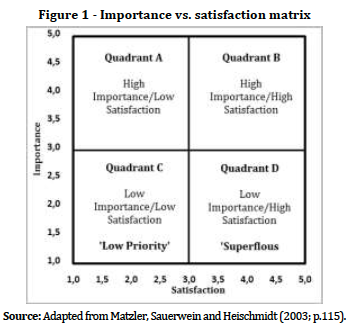
<body><![CDATA[<p><b><font size="3" face="Verdana">2. &nbsp;&nbsp;&nbsp;&nbsp;&nbsp; Literature review</font></b></p>     <p><font size="2" face="Verdana">In order to keep pace with technological, scientific   and economic developments, companies today have increasingly been required to   identify strategies that maintain their position in a competitive market, in   particular, by defining and implementing promotional campaigns to stimulate   demand. These offer payment plans, discounts, home delivery services and other   sales promotions to attract more consumers, such as the provision of loan   services with low interest rates and payment plans in instalments, among other   benefits that might, somehow, please customers and at the same time not harm the company. </font></p>     <p><font size="2" face="Verdana">Within this type of marketing, companies must identify   a limited number of practice areas where the results are satisfactory, ensuring   successful competitive performance for the organisations. According to Rockart   (1979), this includes defining which CSFs are clear indicators that can guide   businesses to success. The concept of CSFs has been used by most managers, even   if only implicitly, making it even more important to analyse CSFs in order to achieve organisational objectives.</font></p>     <p><font size="2" face="Verdana">Based on the variety of definitions found, CSFs cannot   be defined in a narrow sense, otherwise researchers quickly find, as Quintella,   Rocha and Alves (2005) point out, that CSFs are not a standardised set of   measures, unlike what are often called ‘key indicators’, which can be applied   in all departments of companies. CSFs are elements of high importance for   managers in specific sectors of organisations at specific times, as these   factors enable the successful achievement &#8211; or prevent this &#8211; of   defined objectives in maintaining companies’ position in the market (Hofer   &amp; Schendel, 1978; Leidecker &amp; Bruno, 1984; Boynton &amp; Zmud, 1984; Koenig, 1990).</font></p>     <p><font size="2" face="Verdana">Clearly, CSFs, according to the aforementioned   authors, allow companies to plan strategic initiatives directed at increasing   their success, to maintain the quality of their services and, consequently, to   satisfy their customers. This increases demand and allows companies to keep up   with the rapid pace of development in today’s economy (Bouquin, 1986; Garrette, 1993).</font></p>     <p><font size="2" face="Verdana">The factor ‘satisfaction’,   according to Crato (2010), is the satisfaction of customers with services   provided, which only happens when the customers’ evaluation of those services   is equal to or higher than what they expected. Therefore, satisfaction equals   perception minus expectations. It should be noted that consumer sentiment measures   are intended to support and help managers to assess the likelihood of consumer   spending rising or falling. In addition, these measures are more attitudinal in   nature and assist marketing managers to develop a better understanding of the   fields of satisfaction or dissatisfaction with marketing policies (Fernandes   &amp; Correia, 2013; Fernandes &amp; Pimenta, 2013). Satisfaction emerges as   one of the most important resources available to companies, allowing them   always to achieve and enhance their competitiveness and ensure long-term   success in an increasingly competitive environment, with increasingly demanding   customers (Rigopoulou, Chaniotakis, Lymperopoulos &amp; Siomkos, 2008; Fernandes &amp; Pimenta, 2013).</font></p>     <p><font size="2" face="Verdana">Comparing importance and satisfaction with certain factors allows   analysts to identify areas that are important to intervene in and focus on in   terms of performance (Martilla &amp; James, 1977; Matzler et al., 2003; Aktas,   Aksu &amp; Çizel, 2007; Abalo, Varela &amp; Manzano, 2007; Silva &amp;   Fernandes, 2010). This framework permits the use of a management tool adapted   by Matzler et al. (2003), where the authors replaced the dimension of   ‘performance’ with ‘satisfaction’ and thus constructed an importance vs.   satisfaction matrix. It needs to be noted that this matrix was based on the   instrument developed by Martilla and James (1977), with which the cited authors   measured the importance vs. performance of an organisation. This analysis uses   a representation of findings on a Cartesian coordinate system to identify the   areas where organisations should focus, reduce or maintain their efforts and   also to assess the areas where the largest deviations occur between what is important to individuals and what is receiving the most attention.</font></p>     <p><font size="2" face="Verdana">Thus, in <a href="#f1">Figure 1</a>, four quadrants on a Cartesian coordinate system allow the delineation of four distinct strategies, namely:</font></p> <ul>       <li><font size="2" face="Verdana">Quadrant A &#8211; Concentrate     efforts</font></li>       <li><font size="2" face="Verdana">Quadrant     B &#8211; Keep up the good work</font></li>       ]]></body>
<body><![CDATA[<li><font size="2" face="Verdana">Quadrant C &#8211; Low priority</font></li>       <li><font size="2" face="Verdana">Quadrant D &#8211; Superfluous     effort</font></li>     </ul>     <p>&nbsp;</p>     <p><a name="f1"></a> </p>     <p align="center"> <img src="/img/revistas/tms/v11n1/11n1a21f1.jpg" width="351" height="329"></p>     
<p>&nbsp;</p>     <p><font size="2" face="Verdana">In addition, all the variables that are being studied   can be used to measure importance vs. satisfaction, from the viewpoint of   customers. This analysis presupposes that there is linearity between importance   and satisfaction and that the intersection of the axes are averages based on   the dimensions of importance and satisfaction.</font></p>     <p><font size="2" face="Verdana">From an   analysis of the above figure, it can be said that (Martilla &amp; James, 1977; Matzler et al., 2003; Silva &amp; Fernandes, 2010):</font></p> <ul>       <li><font size="2" face="Verdana">Quadrant     A represents attributes that are extremely important, but whose level of     satisfaction is evaluated as below average. To increase global satisfaction,     the company needs to focus on these attributes.</font></li>       ]]></body>
<body><![CDATA[<li><font size="2" face="Verdana">The     attributes in Quadrant B are evaluated as of high importance and highly     satisfactory and represent opportunities to gain or maintain competitive     advantages.</font></li>       <li><font size="2" face="Verdana">The attributes in Quadrant C are     considered less important, and satisfaction levels are below average. Usually     it is not necessary to focus on these attributes.</font></li>       <li><font size="2" face="Verdana">The attributes in Quadrant D are     evaluated as highly satisfactory but low in importance. This implies that     resources committed to these attributes would be better used in other areas.     High performance in attributes considered irrelevant indicates possibly     exaggerated efforts.</font></li>     </ul>     <p>&nbsp;</p>     <p><b><font size="3" face="Verdana">3. &nbsp;&nbsp;&nbsp;&nbsp;&nbsp; Methodology and methods</font></b></p>     <p><font size="2" face="Verdana">In this   research, a previously validated questionnaire was used that was the basis of   the study by Wu et al. (2009), which aimed to identify CSFs for the E-Life Mall   Corporation (Taiwan). In the present study, individual characterisation items   were adapted for the Portuguese context, to be applied to customers of the   company Futurlab (laboratory equipment). Nonetheless, studying the Portuguese   context required also an examination of the internal consistency of data   collection for the two dimensions of importance and satisfaction. In the   present study, an analysis of importance obtained a Cronbach’s alpha of 0.898,   and satisfaction recorded a higher Cronbach’s alpha of 0.910, which, according   to the parameters, means the reliability of the instrument was good and very good for the respective dimensions.</font></p>     <p><font size="2" face="Verdana">The main   objective of the study was to identify CSFs that maximise the satisfaction of   Futurlab customers, as well as to observe the degree of their satisfaction. Therefore, the following research hypotheses were established:</font></p>     <p><font size="2" face="Verdana"><b>Research Hypothesis 1:</b> Futurlab customers are satisfied with all the CSFs.</font></p>     <p><font size="2" face="Verdana"><b>Research Hypothesis 2:</b> The CSFs are positioned in the quadrant ‘Keep up the good work’.</font></p>     ]]></body>
<body><![CDATA[<p><font size="2" face="Verdana">To this end,   data were collected using a survey with a questionnaire composed of three   parts. The first part served to collect data on the importance assigned to the   services provided by Futurlab. The second part assessed the degree of   satisfaction with the services provided by Futurlab. The third part sought to   collect sociodemographic information that characterises the client companies and their representatives.</font></p>     <p><font size="2" face="Verdana">In the first   and second part, qualitative variables   were measured on a Likert ordinal scale with five points. In the third part,   questions were presented in dichotomous, multiple-choice and open response formats.</font></p>     <p><font size="2" face="Verdana">To measure the   importance of, and satisfaction with, the services provided by Futurlab, the   Likert scale consisted of five points: 1 &#8211; Not important, 2 &#8211; A   little important, 3 &#8211; Moderately important, 4 &#8211; Very important and   5 &#8211; Extremely important. The ordinal satisfaction scale was: 1 &#8211; Very   dissatisfied, 2 &#8211; Dissatisfied, 3 &#8211; Unsure, 4 &#8211; Satisfied and 5 &#8211; Very satisfied.</font></p>     <p><font size="2" face="Verdana">In order to   meet the objective of the present study, the following analyses were carried out: </font></p> <ul>       <li><font size="2" face="Verdana">A descriptive exploratory analysis     that allowed a characterisation of the sample under study and an inferential analysis     to respond to the first research hypothesis.</font></li>       <li><font size="2" face="Verdana">An importance vs. satisfaction     matrix to respond to the second research hypothesis.</font></li>       <li><font size="2" face="Verdana">Two multivariate statistical     techniques &#8211; in an initial phase, exploratory factor analysis to observe     the inherent structures among the variables under analysis, to examine their     interrelationships and to help identify CSFs; in a second phase, clusters     analysis to identify homogeneous groups of customers (these techniques helped     respond to the research hypotheses and goal of the study).</font></li>     </ul>     <p>&nbsp;</p>     <p><b><font size="3" face="Verdana">4. &nbsp;&nbsp; Presentation of results and discussion</font></b></p>     ]]></body>
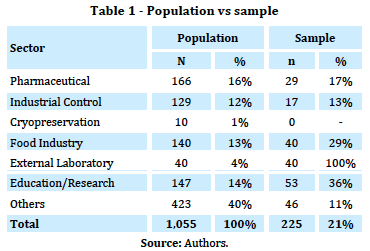
<body><![CDATA[<p><b><font size="2" face="Verdana">4.1 Population vs. sample</font></b></p>     <p><font size="2" face="Verdana">The study   population was based on the universe of customers loyal to Futurlab as a   supplier of laboratory equipment. This included, among others, respondents from   schools; external analytical laboratories of water, food and other substances   and the pharmaceutical and food industries. It is also important to note that   this study also sought to examine what function the respondents play in their   companies and what gender they are. Overall, all analyses were based on the responses of directors and managers of client companies of Futurlab. </font></p>     <p><font size="2" face="Verdana">Data were   collected between 2010 and 2012, from a total list of 1,055 Futurlab customers   who were random contacted, of which only 225 responded to the questionnaire.   This represented 21% of the study population, following the distribution analysed in <a href="#t1">Table 1</a>.</font></p>     <p>&nbsp;</p>     <p><a name="t1"></a> </p>     <p align="center"> <img src="/img/revistas/tms/v11n1/11n1a21t1.jpg" width="370" height="251"></p>     
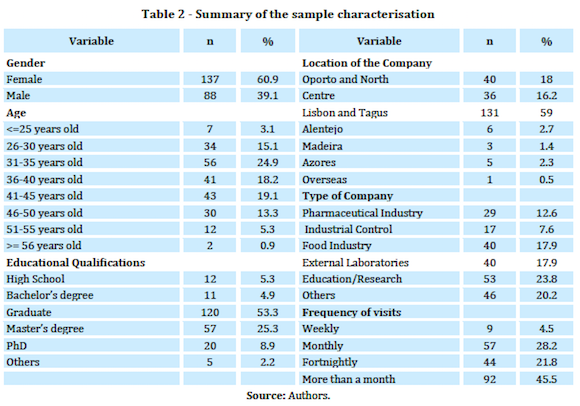
<p>&nbsp;</p>     <p><font size="2" face="Verdana">Curiously, of   the 40 external laboratories, all responded to the questionnaire. Of the 140   food companies, 40 responded to the questionnaire, representing 29% of the   sample; 17% of the sample came from the pharmaceutical industry and 36% were education institutions or research laboratories.</font></p>     <p><font size="2" face="Verdana">Through the analysis of the results in <a href="#t1">Table 1</a> and <a href="#t2">Table 2</a>, it can be said that:</font></p> <ul>       <li><font size="2" face="Verdana">The majority of Futurlab customers     are essentially education or research organisations, with 23.8% of the     responses, followed by the food industry and external laboratories with 17.9%. The pharmaceutical industry is also an important segment with 12.6%.</font></li>       ]]></body>
<body><![CDATA[<li><font size="2" face="Verdana">Most of the respondents were located     in the Lisbon and Tagus Valley Region (<i>Zona       de Lisboa e Vale do Tejo</i>) with 59% of respondents, followed by the Oporto     and North Region (<i>Zona de Porto e Norte</i>) with 18% of responses. </font></li>       <li><font size="2" face="Verdana">With regard to the gender of the     respondents, who were directors and managers of Futurlab’s client companies, it     was observed that the majority were female 61% and 39% were male. It is     interesting to find this significant percentage of females, which shows the     increasing tendency of women to work in management or to head departments.</font></li>       <li><font size="2" face="Verdana">The largest percentage of     respondents were young, belonging to the age group 31 to 35 years old,     representing 24.9% of the respondents. It can also be noted that 93.8% of the     individuals were less than or equal to 50 years old. Only 6.2% were older than     50 years. Of these respondents, only 0.9% were two individuals who were older     than 56. </font></li>       <li><font size="2" face="Verdana">The educational levels of the     respondents corresponded to mostly university graduates (53.3%), for a total of     120 respondents. A large percentage of respondents also had a master’s degree     (25.3% or 57 respondents).</font></li>     </ul>     <p>&nbsp;</p>     <p><a name="t2"></a> </p>     <p align="center"> <img src="/img/revistas/tms/v11n1/11n1a21t2.jpg" width="580" height="406"></p>     
<p>&nbsp;</p>     <p><font size="2" face="Verdana">We also   analysed the frequency of visits by Futurlab sales representatives to the   client companies surveyed (see <a href="#t2">Table 2</a>). From this analysis, it was possible to   verify that the regularity with which sales representatives visited client   companies proved to be 46% with visits spaced more than one month apart,   monthly visits for 28% and fortnightly for 22%. Notably, only 4% of respondents received weekly visits.</font></p>     ]]></body>
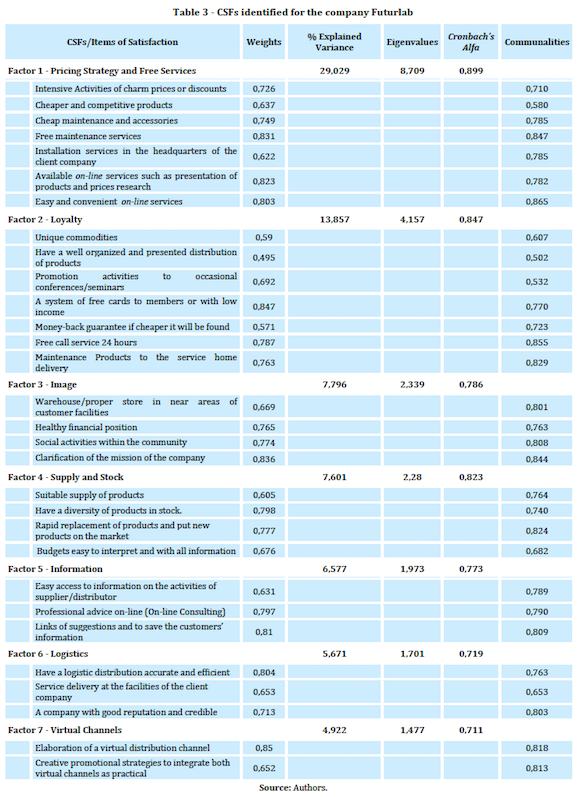
<body><![CDATA[<p><font size="2" face="Verdana"><b>4.2 &nbsp;&nbsp;&nbsp;&nbsp;&nbsp;&nbsp; Identification of CSFs of Futurlab</b></font></p>     <p><font size="2" face="Verdana">To identify   CSFs that maximise the satisfaction of Futurlab customers, an exploratory   factor analysis was carried out on the data. For this purpose, it was necessary   to analyse the latent variable of satisfaction. The value for the   Kaiser-Meyer-Olkin measure of sampling adequacy was 0.519. As this showed a   value greater than 0.5, it was acceptable to apply exploratory factor analysis.   Furthermore, Bartlett’s test of sphericity allowed the quality of the   correlations between variables to be verified, so it was decided to proceed   with the factor analysis &#8211; to meet the study’s objective. Factor 1   explains 29.029% of the data structure, proving to be the most important factor   in explaining the data analysis. The other factors are relatively less important   in summarising the original variables. Factor 2 explains 13.857% of the   variability of the data, Factor 3 corresponds to 7.796 % of the explanation,   Factor 4 explains 7.601%, Factor 5 is responsible for about 6.577% of the   explanation, Factor 6 explains 5.671% and, last, Factor 7 explains 4.922% of   the total variance. This information can be observed in <a href="#t3">Table 3</a>. As a measure   of the reliability of the grouping variables, the coefficient Cronbach’s alpha   was found for each factor. As demonstrated by the values presented in <a href="#t3">Table 3</a>,   the factors showed levels of internal consistency between average (factors 3,   5, 6 and 7) and good (factors 1, 2 and 4) (Hill &amp; Hill, 2009). It was   possible to assign explanatory factors to behaviours, given the nature of the   variables that most adequately explain each factor. <a href="#t3">Table 3</a> presents the seven CSFs identified for Futurlab. </font></p>     <p>&nbsp;</p>     <p><a name="t3"></a> </p>     <p align="center"> <img src="/img/revistas/tms/v11n1/11n1a21t3.jpg" width="580" height="797"></p>     
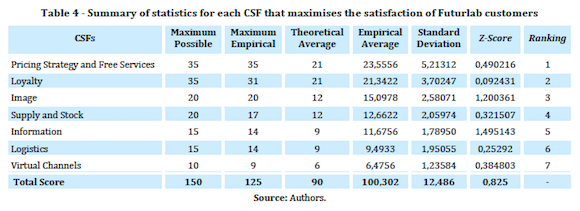
<p>&nbsp;</p>     <p><font size="2" face="Verdana">To respond to   the first research hypothesis, the following table presents the total values   for each of the CSFs that maximise the satisfaction of Futurlab customers (see   <a href="#t4">Table 4</a>). Based on these values, the results verified that the maximum values   obtained in the empirical study are quite close to the theoretical maximum   values, which is considered an extremely satisfactory outcome for the company.   In addition, comparing the values of the theoretical and empirical averages   shows that the latter registered a value of 10.302 points above the theoretical   average, which also is quite satisfactory for the company. Furthermore, the   values &#8203;&#8203;recorded for the standard deviation for each CSF showed   low values, revealing almost no variability among the answers given by   respondents. Therefore, the customers are extremely satisfied with the   following CSFs: ‘pricing strategies and free services’, ‘loyalty’ and the   company’s ‘image’. The factors that present lower satisfaction are the ‘virtual channels’ and ‘logistics’.</font></p>     <p>&nbsp;</p>     <p><a name="t4"></a> </p>     <p align="center"> <img src="/img/revistas/tms/v11n1/11n1a21t4.jpg" width="580" height="211"></p>     
]]></body>
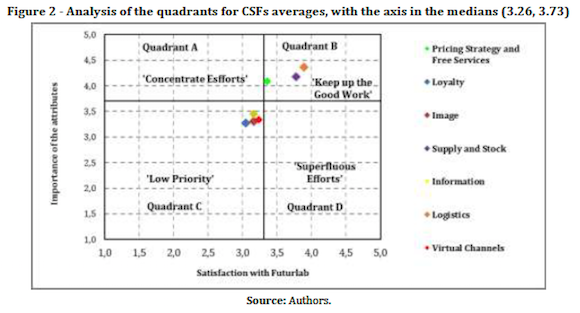
<body><![CDATA[<p>&nbsp;</p>     <p><font size="2" face="Verdana">Based on the   theoretical average of 90 points and an application of the Student’s t-test, a   value of 12,377 (224 degrees of freedom) and a p-value less than 0.001 were   obtained. Therefore, we can say that Research Hypothesis 1 was corroborated   because there is sufficient statistical evidence to argue that the average is   significantly above the theoretical average of 90 points and that Futurlab   customers are satisfied with all the CSFs, assuming a significance level of 5%.</font></p>     <p><font size="2" face="Verdana"><b>4.3 Importance vs. satisfaction analysis applied to CSFs</b></font></p>     <p><font size="2" face="Verdana">In order to   observe the positioning of the CSFs identified for Futurlab in a quarterly   analysis (to respond to Research Hypothesis 2), we used an importance vs.   satisfaction matrix (see <a href="#f2">Figure 2</a>). From this analysis, it can be seen that the factors were distributed in two quadrants (Quadrant B and Quadrant C).</font></p>     <p>&nbsp;</p>     <p><a name="f2"></a> </p>     <p align="center"> <img src="/img/revistas/tms/v11n1/11n1a21f2.jpg" width="580" height="313"></p>     
<p>&nbsp;</p>     <p><font size="2" face="Verdana">In Quadrant B,   the CSFs ‘logistics’, ‘supply and stock’ and ‘prices strategy’ and ‘free   services’ appeared. These recorded high importance and satisfaction in the   perceptions of Futurlab customers. Consequently, they are CSFs that represent   opportunities to gain or maintain competitive advantage in the market where   Futurlab operates. These factors are extremely important to customers, and they   indicate good performance, so Futurlab should continue the good work reflected   in the attributes that make up these factors. Quadrant C, representing low   importance and satisfaction, included the CSFs ‘information’, ‘virtual   channels’, ‘image’ and ‘loyalty’, so these are low priority and there is no need to focus more effort in these areas.</font></p>     <p><font size="2" face="Verdana">It should be noted that, in the analysis of importance and satisfaction,   as a measure of the intersection of the axes, median values obtained from the   results of the questionnaires were used and not the midpoint of the range. This   is because the global median values for the axes reveal the trend of the   attributes, according Lynch, Carver and Virgo (1996) and Martilla and James   (1977). According to the values presented, in the opinion of the authors of   this paper, the directors of Futurlab must set priorities and act on the   attributes that comprise the factors that appear in Quadrant C, since these CSFs present an explained variance of 33.15%. </font></p>     ]]></body>
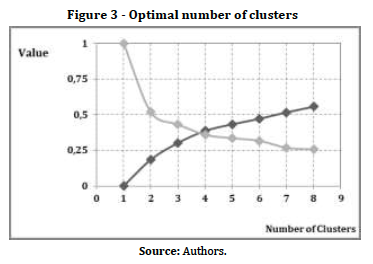
<body><![CDATA[<p><font size="2" face="Verdana">Based on the results presented above, it can be said that Research   Hypothesis 2 was not validated. In other words, only 43% of the factors are in   the quadrant ‘Keep up the good work’, and 57% are in the quadrant ‘Low priority’.</font></p>     <p><b><font size="2" face="Verdana">4.4 &nbsp;&nbsp;&nbsp; Identifying homogeneous groups of customers</font></b></p>     <p><font size="2" face="Verdana">In order to   complement this empirical study and to locate homogeneous groups of customers   based on how much importance they give to Futurlab’s CSFs, we chose to perform   a classification analysis, namely cluster analysis, where we split the initial   set of respondents &#8211; Futurlab customers &#8211; into various subsets or clusters.</font></p>     <p><font size="2" face="Verdana">A hierarchical   cluster analysis was applied using the Euclidean distance between respondents   and the method of aggregating farthest neighbours (i.e. complete linkage). In   this method, after the first cluster is composed, the distance of this to other   respondents is the largest of the distances of each of the constituent elements of this cluster to each other respondent (Marôco, 2010).</font></p>     <p><font size="2" face="Verdana">To define the   optimal number of clusters to retain, we used the <i>r</i><sup>2</sup> criterion with the support of ANOVA   one-way analysis to chart the relative distance between clusters and the   coefficient of determination (<i>r</i><sup>2</sup>).   The criterion of <i>r</i><sup>2</sup> is a   measure of the total variability that is retained in each of the possible clusters (Marôco, 2010).</font></p>     <p><font size="2" face="Verdana">Solutions of   between two and eight clusters were examined. After applying the criteria   mentioned above, an optimal solution of four clusters was chosen, as this   explains about 39% of the total variability. To help validate this information,   we used a graphical representation of the relative distances between clusters   and the coefficient of determination (see <a href="#f3">Figure 3</a>), reaching the conclusion that the optimal number of clusters is four.</font></p>     <p>&nbsp;</p>     <p><a name="f3"></a> </p>     <p align="center"> <img src="/img/revistas/tms/v11n1/11n1a21f3.jpg" width="373" height="264"></p>     
<p>&nbsp;</p>     ]]></body>
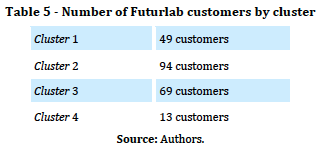
<body><![CDATA[<p><font size="2" face="Verdana">Based on the   grouping performed, the number of companies/cudtomers that fall into each cluster was extracted, which is shown in <a href="#t5">Table 5</a>.</font></p>     <p>&nbsp;</p>     <p><a name="t5"></a> </p>     <p align="center"> <img src="/img/revistas/tms/v11n1/11n1a21t5.jpg" width="323" height="150"></p>     
<p>&nbsp;</p>     <p><font size="2" face="Verdana">After an   exhaustive analysis of the distribution of different customers by the   identified homogeneous groups based on each of the attributes under study   &#8211; as well as the identified CSFs &#8211; the extracted clusters were   classified. In this classification, each of the CSFs was considered: when one was assigned to a cluster, this could not be repeated in subsequent analysis.</font></p>     <p><font size="2" face="Verdana">Within this framework, the results obtained were as follows:</font></p> <ul>       <li><font size="2" face="Verdana"><b>Analysis of Cluster 1 &#8211; Importance given to ‘information’ and     ‘loyalty’</b></font></li>     </ul>     <p><font size="2" face="Verdana">This cluster   consists of 49 clients who are directors and managers. Of these, 17 are male   and 32 female, most are aged between 26 and 35 years old, and they mostly have   university and/or master’s degrees. These are customers who are laboratory   technicians and research fellows. Their companies are teaching and/or research   and foreign laboratories located in the centre of the country, in the Lisbon/Tagus region.</font></p> <ul>       ]]></body>
<body><![CDATA[<li><font size="2" face="Verdana"><b>Analysis of Cluster 2 &#8211; Importance given to ‘image’</b></font></li>     </ul>     <p><font size="2" face="Verdana">This cluster   consists of 94 customers. Of the directors/managers who answered the   questionnaire, 34 are males and 60 females, mostly aged between 31 and 50 years   old, and they mostly have university, master’s and doctoral degrees. This is a   set of customers who are laboratory technicians, purchasing technicians and   laboratory directors. Their companies are food industry, pharmaceutical,   education and/or research organisations located in the centre of the country and in the Lisbon/Tagus and Oporto and the North regions.</font></p> <ul>       <li><font size="2" face="Verdana"><b>Analysis of Cluster 3 &#8211; Importance given to ‘supply and stock’ and     ‘virtual channels’</b></font></li>     </ul>     <p><font size="2" face="Verdana">This cluster   consists of 69 customers. Of these directors and managers, 33 are males and 36   females, most aged between 31 and 50 years old, and mostly university graduates   with master’s and doctoral degrees. This is a set of customers who are   laboratory technicians, teachers and purchasing technicians. The associated   companies are external laboratories and education and/or research organisations located in the Lisbon/Tagus and Oporto and the North regions.</font></p> <ul>       <li><font size="2" face="Verdana"><b>Analysis of Cluster 4 &#8211; Importance given to ‘pricing strategy and     free services’ and ‘logistics’</b></font></li>     </ul>     <p><font size="2" face="Verdana">This cluster   consists of 13 clients. Among these, 4 directors or managers are male and 9   female. Most are aged between 26 and 55 years old, and most have master’s   degrees. These are individuals who are research fellows and professors. The   companies are teaching and/or research organisations located in the Lisbon/Tagus area.</font></p>     <p><font size="2" face="Verdana">In order to   analyse the importance that each cluster assigned to the CSFs identified for Futurlab,   <a href="#f4">figure 4</a> was constructed. Thus, we   were able to calculate for each cluster the average of the scores obtained for each CSF based on the dimension of importance.</font></p>     ]]></body>
<body><![CDATA[<p>&nbsp;</p>     <p><a name="f4"></a> </p>     <p align="center"> <img src="/img/revistas/tms/v11n1/11n1a21f4.jpg" width="580" height="373"></p>     
<p>&nbsp;</p>     <p><font size="2" face="Verdana">From the   analysis of the values &#8203;&#8203;and information shown in the above figure   and based on the degree of importance of each CSF, the following conclusions were drawn:</font></p> <ul>       <li><font size="2" face="Verdana">CSF 1 Pricing strategy and free     services &#8211; Cluster 4 was the group with the highest average, showing that     it attributed the highest importance to this factor.</font></li>       <li><font size="2" face="Verdana">CSF 2 Loyalty &#8211; Cluster 1     attributed particular importance to this.</font></li>       <li><font size="2" face="Verdana">CSF 3 Image &#8211; Cluster 1     recorded the highest average importance for this CSF of all clusters, followed     by Clusters 2 and 4.</font></li>       <li><font size="2" face="Verdana">CSF 4 Supply and stock &#8211;     Cluster 4 gave this CSF the highest average importance, followed by Cluster 1     and Cluster 2, which appeared in third place.</font></li>       <li><font size="2" face="Verdana">CSF 5 Information &#8211; The     clusters that recorded the highest average for this CSF were Cluster 1,     followed by Clusters 2 and 3.</font></li>       ]]></body>
<body><![CDATA[<li><font size="2" face="Verdana">CSF 6 Logistics &#8211; Cluster 4     recorded the highest importance average for this CSF, followed by Clusters 1     and 2.</font></li>       <li><font size="2" face="Verdana">CSF 7 Virtual channels &#8211;     Clusters that recorded higher averages for this were Cluster 1, followed by     Clusters 3 and 2.</font></li>     </ul>     <p><font size="2" face="Verdana">From this   analysis, it can be concluded that the CSFs ‘pricing strategy and free   services’, ‘loyalty’, ‘supply and stock’ and ‘image’ are the CSFs to which   these companies attach special importance, as already noted in previous   analyses. On the other hand, those CSFs that had lower averages for their importance were ‘information’, ‘logistics’ and ‘virtual channels’.</font></p>     <p><font size="2" face="Verdana">It should also   be noted that Clusters 1 and 4 gave higher values for the majority of CSFs.   Based on these figures, it can be said that this group of lab technicians and research fellows customers are more demanding about the services provided.</font></p>     <p>&nbsp;</p>     <p><b><font size="3" face="Verdana">5. Conclusion</font></b></p>     <p><font size="2" face="Verdana">This study   sought to identify CSFs in the development of strategies that maximise customers’ satisfaction with the company Futurlab.</font></p>     <p><font size="2" face="Verdana">To assess which   dimensions are most used by customers in assessing both the importance of   certain attributes that a branch company must have and the quality of services   provided by Futurlab, CSFs were identified using an exploratory factor   analysis. Subsequently, the degree of satisfaction of Futurlab customers was   analysed by applying an importance vs. satisfaction matrix to the identified   CSFs. The results show that Futurlab has to keep up the good work in ‘pricing strategy   and free services’, ‘supply and stock’ and ‘logistics’. It needs to reformulate   its strategies in ‘loyalty’, ‘image’, ‘information’ and ‘virtual channels’,   since these are factors that are not considered important and Futurlab should   redefine these factors in order to make them more important and to improve their customers’ satisfaction.</font></p>     <p><font size="2" face="Verdana">This research   makes an important contribution in that the level of satisfaction of Futurlab   customers was identified, which had never been analysed until that time. In   addition, the attributes and dimensions related to quality of services that   influence customers’ satisfaction were found, offering an overview of the company’s ability to attract, retain and engage their customers.</font></p>     ]]></body>
<body><![CDATA[<p><font size="2" face="Verdana">In this way,   this study has also contributed to identifying CSFs that require the   intervention of Futurlab managers, noting which should be given priority and   attention, including ‘loyalty’, ‘image’, ‘information’ and ‘virtual channels’.   In the opinion of the authors of this paper, ‘image’ is extremely important for   the company’s success, since general appearance is the first impression that   customers get of companies. Therefore, it is essential that the sales network   and corporate image of the company exceed the expectations of customers in order to retain customers and win new ones.</font></p>     <p><font size="2" face="Verdana">Furthermore, based on the results presented above, it can be said that Research Hypothesis 1 was   corroborated because there is sufficient statistical evidence to argue that   Futurlab’s average is significantly above the theoretical average of 90 points   and that Futurlab customers are satisfied with all the CSFs, at a significance   level of 5%. Research Hypothesis 2 was   not validated because only 43% of the factors are in the quadrant ‘Keep up the good work’ and 57% are in the quadrant ‘Low priority’.</font></p>     <p><font size="2" face="Verdana">In the cluster   analysis, four clusters were identified according to the importance assigned to   the CSFs. These were Cluster 1 &#8211; Importance given to ‘information’ and   ‘loyalty’; Cluster 2 &#8211; Importance given to ‘image’; Cluster 3 &#8211;   Importance given to ‘supply and stock’ and ‘virtual channels’ and Cluster 4   &#8211; Importance given to ‘pricing strategy and free services’ and ‘logistics’.</font></p>     <p><font size="2" face="Verdana">In general,   customers are satisfied with the performance of Futurlab, so this company has   all the necessary conditions to provide quality services to attract new   customers and retain its current ones. Satisfied customers contribute to   loyalty to companies, returning to the companies they value for future purchases.</font></p>     <p>&nbsp;</p>     <p><font size="3" face="Verdana"><b>References</b></font></p>     <!-- ref --><p><font size="2" face="Verdana">Abalo, J.,   Varela, J., &amp; Manzano, V. (2007). Importance values for   importance-performance analysis: a formula for spreading out values derived   from preference rankings. <i>Journal of Business Research</i>, 60(2), 115-121.    &nbsp;&nbsp;&nbsp;&nbsp;&nbsp;&nbsp;&nbsp;&nbsp;[&#160;<a href="javascript:void(0);" onclick="javascript: window.open('/scielo.php?script=sci_nlinks&ref=000169&pid=S2182-8458201500010002100001&lng=','','width=640,height=500,resizable=yes,scrollbars=1,menubar=yes,');">Links</a>&#160;]<!-- end-ref --></font></p>     <!-- ref --><p><font size="2" face="Verdana">Aktas, A., Aksu, A., &amp; Çizel, B. (2007). Destination choice: an important - satisfaction analysis. <i>Quality &amp; Quality</i>, 41, 265-273.    &nbsp;&nbsp;&nbsp;&nbsp;&nbsp;&nbsp;&nbsp;&nbsp;[&#160;<a href="javascript:void(0);" onclick="javascript: window.open('/scielo.php?script=sci_nlinks&ref=000171&pid=S2182-8458201500010002100002&lng=','','width=640,height=500,resizable=yes,scrollbars=1,menubar=yes,');">Links</a>&#160;]<!-- end-ref --></font></p>     ]]></body>
<body><![CDATA[<!-- ref --><p><font size="2" face="Verdana">Batista, M., Couto, J., Botelho, D., &amp; Faias, C. (2014). Tourist   satisfaction and loyalty in the hotel business: An application to the island of   São Miguel, Azores. <i>Tourism &amp; Management Studies</i>, 10(1), 16-23.    &nbsp;&nbsp;&nbsp;&nbsp;&nbsp;&nbsp;&nbsp;&nbsp;[&#160;<a href="javascript:void(0);" onclick="javascript: window.open('/scielo.php?script=sci_nlinks&ref=000173&pid=S2182-8458201500010002100003&lng=','','width=640,height=500,resizable=yes,scrollbars=1,menubar=yes,');">Links</a>&#160;]<!-- end-ref --></font></p>     <!-- ref --><p><font size="2" face="Verdana">Bouquin, H.   (1986). <i>Le contrôle de gestion</i>. (1ére edition). Paris: Presses Universitaires de France.    &nbsp;&nbsp;&nbsp;&nbsp;&nbsp;&nbsp;&nbsp;&nbsp;[&#160;<a href="javascript:void(0);" onclick="javascript: window.open('/scielo.php?script=sci_nlinks&ref=000175&pid=S2182-8458201500010002100004&lng=','','width=640,height=500,resizable=yes,scrollbars=1,menubar=yes,');">Links</a>&#160;]<!-- end-ref --></font></p>     <!-- ref --><p><font size="2" face="Verdana">Boynton, A., &amp; Zmud, R. (1984). An assessment of critical success factors. <i>Management Review</i>, 25(4), 17-27.    &nbsp;&nbsp;&nbsp;&nbsp;&nbsp;&nbsp;&nbsp;&nbsp;[&#160;<a href="javascript:void(0);" onclick="javascript: window.open('/scielo.php?script=sci_nlinks&ref=000177&pid=S2182-8458201500010002100005&lng=','','width=640,height=500,resizable=yes,scrollbars=1,menubar=yes,');">Links</a>&#160;]<!-- end-ref --></font></p>     <!-- ref --><p><font size="2" face="Verdana">Crato, C. (2010). <i>Qualidade:   condição de competitividade</i>. Porto: SPI - Sociedade Portuguesa de Inovação Consultadoria Empresarial e Fomento da Inovação.    &nbsp;&nbsp;&nbsp;&nbsp;&nbsp;&nbsp;&nbsp;&nbsp;[&#160;<a href="javascript:void(0);" onclick="javascript: window.open('/scielo.php?script=sci_nlinks&ref=000179&pid=S2182-8458201500010002100006&lng=','','width=640,height=500,resizable=yes,scrollbars=1,menubar=yes,');">Links</a>&#160;]<!-- end-ref --></font></p>     <!-- ref --><p><font size="2" face="Verdana">Fernandes, P.,   &amp; Pimenta, R. (2013). The Portuguese consumer sentiment index toward   marketing-mix in crisis context. <i>Tourism &amp; Management Studies</i>, 9(1), 97-100.    &nbsp;&nbsp;&nbsp;&nbsp;&nbsp;&nbsp;&nbsp;&nbsp;[&#160;<a href="javascript:void(0);" onclick="javascript: window.open('/scielo.php?script=sci_nlinks&ref=000181&pid=S2182-8458201500010002100007&lng=','','width=640,height=500,resizable=yes,scrollbars=1,menubar=yes,');">Links</a>&#160;]<!-- end-ref --></font></p>     ]]></body>
<body><![CDATA[<!-- ref --><p><font size="2" face="Verdana">Fernandes, P., Correia, L. (2013). Atitudes do consumidor em   relação às práticas do marketing em Portugal. <i>Tourism &amp;   Management Studies</i>, 9(2), 86-92.    &nbsp;&nbsp;&nbsp;&nbsp;&nbsp;&nbsp;&nbsp;&nbsp;[&#160;<a href="javascript:void(0);" onclick="javascript: window.open('/scielo.php?script=sci_nlinks&ref=000183&pid=S2182-8458201500010002100008&lng=','','width=640,height=500,resizable=yes,scrollbars=1,menubar=yes,');">Links</a>&#160;]<!-- end-ref --></font></p>     <!-- ref --><p><font size="2" face="Verdana">Garrette, B.   (1993). <i>Strate&#769;gie, structure,     de&#769;cision, identite&#769;: politique ge&#769;ne&#769;rale d'entreprise</i>. 2éme edition. Paris: Interedition.    &nbsp;&nbsp;&nbsp;&nbsp;&nbsp;&nbsp;&nbsp;&nbsp;[&#160;<a href="javascript:void(0);" onclick="javascript: window.open('/scielo.php?script=sci_nlinks&ref=000185&pid=S2182-8458201500010002100009&lng=','','width=640,height=500,resizable=yes,scrollbars=1,menubar=yes,');">Links</a>&#160;]<!-- end-ref --></font></p>     <!-- ref --><p><font size="2" face="Verdana">Hill, M., &amp; Hill, A. (2009). <i>Investigação por questionário. 2ª edição</i>. Lisboa: Edições Sílabo.    &nbsp;&nbsp;&nbsp;&nbsp;&nbsp;&nbsp;&nbsp;&nbsp;[&#160;<a href="javascript:void(0);" onclick="javascript: window.open('/scielo.php?script=sci_nlinks&ref=000187&pid=S2182-8458201500010002100010&lng=','','width=640,height=500,resizable=yes,scrollbars=1,menubar=yes,');">Links</a>&#160;]<!-- end-ref --></font></p>     <p><font size="2" face="Verdana">Hofer, C.,   &amp; Schendel, D. (1978). <i>Strategy formulation: analytical concepts</i>. St. Paul, MN: West Publishing Company.</font></p>     <!-- ref --><p><font size="2" face="Verdana">Koenig, G.   (1990). <i>Management stratégique: vision, manoeuvres et tactiques</i>. Paris: Nathan.    &nbsp;&nbsp;&nbsp;&nbsp;&nbsp;&nbsp;&nbsp;&nbsp;[&#160;<a href="javascript:void(0);" onclick="javascript: window.open('/scielo.php?script=sci_nlinks&ref=000190&pid=S2182-8458201500010002100012&lng=','','width=640,height=500,resizable=yes,scrollbars=1,menubar=yes,');">Links</a>&#160;]<!-- end-ref --></font></p>     <!-- ref --><p><font size="2" face="Verdana">Leidecker, J., &amp; Bruno, A. (1984). Identifying and using critical success factors. <i>Long Range Planning</i>, 17, 23-32.    &nbsp;&nbsp;&nbsp;&nbsp;&nbsp;&nbsp;&nbsp;&nbsp;[&#160;<a href="javascript:void(0);" onclick="javascript: window.open('/scielo.php?script=sci_nlinks&ref=000192&pid=S2182-8458201500010002100013&lng=','','width=640,height=500,resizable=yes,scrollbars=1,menubar=yes,');">Links</a>&#160;]<!-- end-ref --></font></p>     <!-- ref --><p><font size="2" face="Verdana">Lynch, J.,   Carver, R., &amp; Virgo, J.&nbsp; (1996).   Quadrant analysis as a strategic planning technique in curriculum development   and program marketing. <i>Journal of Marketing for Higher Education</i>, 7(2), 17-32.    &nbsp;&nbsp;&nbsp;&nbsp;&nbsp;&nbsp;&nbsp;&nbsp;[&#160;<a href="javascript:void(0);" onclick="javascript: window.open('/scielo.php?script=sci_nlinks&ref=000194&pid=S2182-8458201500010002100014&lng=','','width=640,height=500,resizable=yes,scrollbars=1,menubar=yes,');">Links</a>&#160;]<!-- end-ref --></font></p>     <!-- ref --><p><font size="2" face="Verdana">Marôco, J. (2010). <i>Análise   Estatística com o PASW Statistics (ex-SPSS)</i>. 5ª edição. Pêro Pinheiro: Report Numbers.    &nbsp;&nbsp;&nbsp;&nbsp;&nbsp;&nbsp;&nbsp;&nbsp;[&#160;<a href="javascript:void(0);" onclick="javascript: window.open('/scielo.php?script=sci_nlinks&ref=000196&pid=S2182-8458201500010002100015&lng=','','width=640,height=500,resizable=yes,scrollbars=1,menubar=yes,');">Links</a>&#160;]<!-- end-ref --></font></p>     <!-- ref --><p><font size="2" face="Verdana">Martilla, J., &amp; James, J. (1977). Importance-performance analysis. <i>Journal of Marketing</i>, 41, 77-79.    &nbsp;&nbsp;&nbsp;&nbsp;&nbsp;&nbsp;&nbsp;&nbsp;[&#160;<a href="javascript:void(0);" onclick="javascript: window.open('/scielo.php?script=sci_nlinks&ref=000198&pid=S2182-8458201500010002100016&lng=','','width=640,height=500,resizable=yes,scrollbars=1,menubar=yes,');">Links</a>&#160;]<!-- end-ref --></font></p>     <!-- ref --><p><font size="2" face="Verdana">Matzler, K.,   Sauerwein, E., &amp; Heischmidt, K. (2003). Importance-performance analysis revisited: the role of the factor structure of customer satisfaction. <i>The Service Industries Journal</i>, 23(2), 112-129.    &nbsp;&nbsp;&nbsp;&nbsp;&nbsp;&nbsp;&nbsp;&nbsp;[&#160;<a href="javascript:void(0);" onclick="javascript: window.open('/scielo.php?script=sci_nlinks&ref=000200&pid=S2182-8458201500010002100017&lng=','','width=640,height=500,resizable=yes,scrollbars=1,menubar=yes,');">Links</a>&#160;]<!-- end-ref --></font></p>     <!-- ref --><p><font size="2" face="Verdana">Moreno, M., Molina,   C., &amp; Moreno, R. (2013) Satisfacción, lealtad y colectivismo en destinos   culturales. <i>Tourism &amp; Management Studies</i>, 9 (2), 44-49.    &nbsp;&nbsp;&nbsp;&nbsp;&nbsp;&nbsp;&nbsp;&nbsp;[&#160;<a href="javascript:void(0);" onclick="javascript: window.open('/scielo.php?script=sci_nlinks&ref=000202&pid=S2182-8458201500010002100018&lng=','','width=640,height=500,resizable=yes,scrollbars=1,menubar=yes,');">Links</a>&#160;]<!-- end-ref --></font></p>     <!-- ref --><p><font size="2" face="Verdana">Quintella, H., Rocha, H., &amp; Alves, M. (2005). Projetos de veículos automotores: fatores críticos de sucesso no lançamento. <i>Revista Produção</i>, 15(3), 334-346.    &nbsp;&nbsp;&nbsp;&nbsp;&nbsp;&nbsp;&nbsp;&nbsp;[&#160;<a href="javascript:void(0);" onclick="javascript: window.open('/scielo.php?script=sci_nlinks&ref=000204&pid=S2182-8458201500010002100019&lng=','','width=640,height=500,resizable=yes,scrollbars=1,menubar=yes,');">Links</a>&#160;]<!-- end-ref --></font></p>     <!-- ref --><p><font size="2" face="Verdana">Rigopoulou, I., Chaniotakis, I., Lymperopoulos, C., &amp;   Siomkos, G. (2008). After-sales   service quality as an antecedent of customer satisfaction: the case of   electronic appliances. <i>Managing Service Quality</i>, 18(5), 512-527.    &nbsp;&nbsp;&nbsp;&nbsp;&nbsp;&nbsp;&nbsp;&nbsp;[&#160;<a href="javascript:void(0);" onclick="javascript: window.open('/scielo.php?script=sci_nlinks&ref=000206&pid=S2182-8458201500010002100020&lng=','','width=640,height=500,resizable=yes,scrollbars=1,menubar=yes,');">Links</a>&#160;]<!-- end-ref --></font></p>     <!-- ref --><p><font size="2" face="Verdana">Rockart, J. (1979). Chief executives define their own data needs. <i>Harvard Business Review</i>, 57, 81-83.    &nbsp;&nbsp;&nbsp;&nbsp;&nbsp;&nbsp;&nbsp;&nbsp;[&#160;<a href="javascript:void(0);" onclick="javascript: window.open('/scielo.php?script=sci_nlinks&ref=000208&pid=S2182-8458201500010002100021&lng=','','width=640,height=500,resizable=yes,scrollbars=1,menubar=yes,');">Links</a>&#160;]<!-- end-ref --></font></p>     <p><font size="2" face="Verdana">Silva, F.,   &amp; Fernandes, P. (2010). <i>Using     Importance-Performance Analysis in Evaluating of Higher Education: A Case Study</i>.   ICEMT 2010 International Conference on Education and Management Technology. Cairo: IEEE. 121-123. DOI: 10.1109/ICEMT.2010.5657689.</font></p>     <!-- ref --><p><font size="2" face="Verdana">Wu, H., Tang,   T., &amp; Shyu, W. (2009). A case of applying importance-performance analysis   in identifying key success factors to develop marketing strategies. <i>Quality &amp; Quantity</i>, 44(6), 1207-1218.    &nbsp;&nbsp;&nbsp;&nbsp;&nbsp;&nbsp;&nbsp;&nbsp;[&#160;<a href="javascript:void(0);" onclick="javascript: window.open('/scielo.php?script=sci_nlinks&ref=000211&pid=S2182-8458201500010002100023&lng=','','width=640,height=500,resizable=yes,scrollbars=1,menubar=yes,');">Links</a>&#160;]<!-- end-ref --></font></p>     ]]></body>
<body><![CDATA[<p>&nbsp;</p>     <p>&nbsp;</p>     <p><font size="2" face="Verdana"><b>Article history:</b>          <br>   <b>Received</b>:   30 May 2014          <br>   <b>Accepted</b>: 20 October 2014</font></p>      ]]></body><back>
<ref-list>
<ref id="B1">
<nlm-citation citation-type="journal">
<person-group person-group-type="author">
<name>
<surname><![CDATA[Abalo]]></surname>
<given-names><![CDATA[J.]]></given-names>
</name>
<name>
<surname><![CDATA[Varela]]></surname>
<given-names><![CDATA[J.]]></given-names>
</name>
<name>
<surname><![CDATA[Manzano]]></surname>
<given-names><![CDATA[V.]]></given-names>
</name>
</person-group>
<article-title xml:lang="en"><![CDATA[Importance values for importance-performance analysis: a formula for spreading out values derived from preference rankings]]></article-title>
<source><![CDATA[Journal of Business Research]]></source>
<year>2007</year>
<volume>60</volume>
<numero>2</numero>
<issue>2</issue>
<page-range>115-121</page-range></nlm-citation>
</ref>
<ref id="B2">
<nlm-citation citation-type="journal">
<person-group person-group-type="author">
<name>
<surname><![CDATA[Aktas]]></surname>
<given-names><![CDATA[A.]]></given-names>
</name>
<name>
<surname><![CDATA[Aksu]]></surname>
<given-names><![CDATA[A.]]></given-names>
</name>
<name>
<surname><![CDATA[Çizel]]></surname>
<given-names><![CDATA[B.]]></given-names>
</name>
</person-group>
<article-title xml:lang="en"><![CDATA[Destination choice: an important - satisfaction analysis]]></article-title>
<source><![CDATA[Quality & Quality]]></source>
<year>2007</year>
<numero>41</numero>
<issue>41</issue>
<page-range>265-273</page-range></nlm-citation>
</ref>
<ref id="B3">
<nlm-citation citation-type="journal">
<person-group person-group-type="author">
<name>
<surname><![CDATA[Batista]]></surname>
<given-names><![CDATA[M.]]></given-names>
</name>
<name>
<surname><![CDATA[Couto]]></surname>
<given-names><![CDATA[J.]]></given-names>
</name>
<name>
<surname><![CDATA[Botelho]]></surname>
<given-names><![CDATA[D.]]></given-names>
</name>
<name>
<surname><![CDATA[Faias]]></surname>
<given-names><![CDATA[C.]]></given-names>
</name>
</person-group>
<article-title xml:lang="en"><![CDATA[Tourist satisfaction and loyalty in the hotel business: An application to the island of São Miguel, Azores]]></article-title>
<source><![CDATA[Tourism & Management Studies]]></source>
<year>2014</year>
<volume>10</volume>
<numero>1</numero>
<issue>1</issue>
<page-range>16-23</page-range></nlm-citation>
</ref>
<ref id="B4">
<nlm-citation citation-type="book">
<person-group person-group-type="author">
<name>
<surname><![CDATA[Bouquin]]></surname>
<given-names><![CDATA[H.]]></given-names>
</name>
</person-group>
<source><![CDATA[Le contrôle de gestion]]></source>
<year>1986</year>
<edition>1</edition>
<publisher-loc><![CDATA[Paris ]]></publisher-loc>
<publisher-name><![CDATA[Presses Universitaires de France]]></publisher-name>
</nlm-citation>
</ref>
<ref id="B5">
<nlm-citation citation-type="journal">
<person-group person-group-type="author">
<name>
<surname><![CDATA[Boynton]]></surname>
<given-names><![CDATA[A.]]></given-names>
</name>
<name>
<surname><![CDATA[Zmud]]></surname>
<given-names><![CDATA[R.]]></given-names>
</name>
</person-group>
<article-title xml:lang="en"><![CDATA[An assessment of critical success factors]]></article-title>
<source><![CDATA[Management Review]]></source>
<year>1984</year>
<volume>25</volume>
<numero>4</numero>
<issue>4</issue>
<page-range>17-27</page-range></nlm-citation>
</ref>
<ref id="B6">
<nlm-citation citation-type="book">
<person-group person-group-type="author">
<name>
<surname><![CDATA[Crato]]></surname>
<given-names><![CDATA[C.]]></given-names>
</name>
</person-group>
<source><![CDATA[Qualidade: condição de competitividade]]></source>
<year>2010</year>
<publisher-loc><![CDATA[Porto ]]></publisher-loc>
<publisher-name><![CDATA[SPI - Sociedade Portuguesa de Inovação Consultadoria Empresarial e Fomento da Inovação]]></publisher-name>
</nlm-citation>
</ref>
<ref id="B7">
<nlm-citation citation-type="journal">
<person-group person-group-type="author">
<name>
<surname><![CDATA[Fernandes]]></surname>
<given-names><![CDATA[P.]]></given-names>
</name>
<name>
<surname><![CDATA[Pimenta]]></surname>
<given-names><![CDATA[R.]]></given-names>
</name>
</person-group>
<article-title xml:lang="en"><![CDATA[The Portuguese consumer sentiment index toward marketing-mix in crisis context]]></article-title>
<source><![CDATA[Tourism & Management Studies]]></source>
<year>2013</year>
<volume>9</volume>
<numero>1</numero>
<issue>1</issue>
<page-range>97-100</page-range></nlm-citation>
</ref>
<ref id="B8">
<nlm-citation citation-type="journal">
<person-group person-group-type="author">
<name>
<surname><![CDATA[Fernandes]]></surname>
<given-names><![CDATA[P.]]></given-names>
</name>
<name>
<surname><![CDATA[Correia]]></surname>
<given-names><![CDATA[L.]]></given-names>
</name>
</person-group>
<article-title xml:lang="pt"><![CDATA[Atitudes do consumidor em relação às práticas do marketing em Portugal]]></article-title>
<source><![CDATA[Tourism & Management Studies]]></source>
<year>2013</year>
<volume>9</volume>
<numero>2</numero>
<issue>2</issue>
<page-range>86-92</page-range></nlm-citation>
</ref>
<ref id="B9">
<nlm-citation citation-type="book">
<person-group person-group-type="author">
<name>
<surname><![CDATA[Garrette]]></surname>
<given-names><![CDATA[B.]]></given-names>
</name>
</person-group>
<source><![CDATA[Strate&#769;gie, structure, de&#769;cision, identite&#769;: politique ge&#769;ne&#769;rale d'entreprise]]></source>
<year>1993</year>
<edition>2</edition>
<publisher-loc><![CDATA[Paris ]]></publisher-loc>
<publisher-name><![CDATA[Interedition]]></publisher-name>
</nlm-citation>
</ref>
<ref id="B10">
<nlm-citation citation-type="book">
<person-group person-group-type="author">
<name>
<surname><![CDATA[Hill]]></surname>
<given-names><![CDATA[M.]]></given-names>
</name>
<name>
<surname><![CDATA[Hill]]></surname>
<given-names><![CDATA[A.]]></given-names>
</name>
</person-group>
<source><![CDATA[Investigação por questionário]]></source>
<year>2009</year>
<edition>2</edition>
<publisher-loc><![CDATA[Lisboa ]]></publisher-loc>
<publisher-name><![CDATA[Edições Sílabo]]></publisher-name>
</nlm-citation>
</ref>
<ref id="B11">
<nlm-citation citation-type="book">
<person-group person-group-type="author">
<name>
<surname><![CDATA[Hofer]]></surname>
<given-names><![CDATA[C.]]></given-names>
</name>
<name>
<surname><![CDATA[Schendel]]></surname>
<given-names><![CDATA[D.]]></given-names>
</name>
</person-group>
<source><![CDATA[Strategy formulation: analytical concepts]]></source>
<year>1978</year>
<publisher-loc><![CDATA[St. Paul ]]></publisher-loc>
<publisher-name><![CDATA[West Publishing Company]]></publisher-name>
</nlm-citation>
</ref>
<ref id="B12">
<nlm-citation citation-type="book">
<person-group person-group-type="author">
<name>
<surname><![CDATA[Koenig]]></surname>
<given-names><![CDATA[G.]]></given-names>
</name>
</person-group>
<source><![CDATA[Management stratégique: vision, manoeuvres et tactiques]]></source>
<year>1990</year>
<publisher-loc><![CDATA[Paris ]]></publisher-loc>
<publisher-name><![CDATA[Nathan]]></publisher-name>
</nlm-citation>
</ref>
<ref id="B13">
<nlm-citation citation-type="journal">
<person-group person-group-type="author">
<name>
<surname><![CDATA[Leidecker]]></surname>
<given-names><![CDATA[J.]]></given-names>
</name>
<name>
<surname><![CDATA[Bruno]]></surname>
<given-names><![CDATA[A.]]></given-names>
</name>
</person-group>
<article-title xml:lang="en"><![CDATA[Identifying and using critical success factors]]></article-title>
<source><![CDATA[Long Range Planning]]></source>
<year>1984</year>
<numero>17</numero>
<issue>17</issue>
<page-range>23-32</page-range></nlm-citation>
</ref>
<ref id="B14">
<nlm-citation citation-type="journal">
<person-group person-group-type="author">
<name>
<surname><![CDATA[Lynch]]></surname>
<given-names><![CDATA[J.]]></given-names>
</name>
<name>
<surname><![CDATA[Carver]]></surname>
<given-names><![CDATA[R.]]></given-names>
</name>
<name>
<surname><![CDATA[Virgo]]></surname>
<given-names><![CDATA[J.]]></given-names>
</name>
</person-group>
<article-title xml:lang="en"><![CDATA[Quadrant analysis as a strategic planning technique in curriculum development and program marketing]]></article-title>
<source><![CDATA[Journal of Marketing for Higher Education]]></source>
<year>1996</year>
<volume>7</volume>
<numero>2</numero>
<issue>2</issue>
<page-range>17-32</page-range></nlm-citation>
</ref>
<ref id="B15">
<nlm-citation citation-type="book">
<person-group person-group-type="author">
<name>
<surname><![CDATA[Marôco]]></surname>
<given-names><![CDATA[J.]]></given-names>
</name>
</person-group>
<source><![CDATA[Análise Estatística com o PASW Statistics (ex-SPSS)]]></source>
<year>2010</year>
<edition>5</edition>
<publisher-loc><![CDATA[Pêro Pinheiro ]]></publisher-loc>
<publisher-name><![CDATA[Report Numbers]]></publisher-name>
</nlm-citation>
</ref>
<ref id="B16">
<nlm-citation citation-type="journal">
<person-group person-group-type="author">
<name>
<surname><![CDATA[Martilla]]></surname>
<given-names><![CDATA[J.]]></given-names>
</name>
<name>
<surname><![CDATA[James]]></surname>
<given-names><![CDATA[J.]]></given-names>
</name>
</person-group>
<article-title xml:lang="en"><![CDATA[Importance-performance analysis]]></article-title>
<source><![CDATA[Journal of Marketing]]></source>
<year>1977</year>
<numero>41</numero>
<issue>41</issue>
<page-range>77-79</page-range></nlm-citation>
</ref>
<ref id="B17">
<nlm-citation citation-type="journal">
<person-group person-group-type="author">
<name>
<surname><![CDATA[Matzler]]></surname>
<given-names><![CDATA[K.]]></given-names>
</name>
<name>
<surname><![CDATA[Sauerwein]]></surname>
<given-names><![CDATA[E.]]></given-names>
</name>
<name>
<surname><![CDATA[Heischmidt]]></surname>
<given-names><![CDATA[K.]]></given-names>
</name>
</person-group>
<article-title xml:lang="en"><![CDATA[Importance-performance analysis revisited: the role of the factor structure of customer satisfaction]]></article-title>
<source><![CDATA[The Service Industries Journal]]></source>
<year>2003</year>
<volume>23</volume>
<numero>2</numero>
<issue>2</issue>
<page-range>112-129</page-range></nlm-citation>
</ref>
<ref id="B18">
<nlm-citation citation-type="journal">
<person-group person-group-type="author">
<name>
<surname><![CDATA[Moreno]]></surname>
<given-names><![CDATA[M.]]></given-names>
</name>
<name>
<surname><![CDATA[Molina]]></surname>
<given-names><![CDATA[C.]]></given-names>
</name>
<name>
<surname><![CDATA[Moreno]]></surname>
<given-names><![CDATA[R.]]></given-names>
</name>
</person-group>
<article-title xml:lang="es"><![CDATA[Satisfacción, lealtad y colectivismo en destinos culturales]]></article-title>
<source><![CDATA[Tourism & Management Studies]]></source>
<year>2013</year>
<volume>9</volume>
<numero>2</numero>
<issue>2</issue>
<page-range>44-49</page-range></nlm-citation>
</ref>
<ref id="B19">
<nlm-citation citation-type="journal">
<person-group person-group-type="author">
<name>
<surname><![CDATA[Quintella]]></surname>
<given-names><![CDATA[H.]]></given-names>
</name>
<name>
<surname><![CDATA[Rocha]]></surname>
<given-names><![CDATA[H.]]></given-names>
</name>
<name>
<surname><![CDATA[Alves]]></surname>
<given-names><![CDATA[M.]]></given-names>
</name>
</person-group>
<article-title xml:lang="pt"><![CDATA[Projetos de veículos automotores: fatores críticos de sucesso no lançamento]]></article-title>
<source><![CDATA[Revista Produção]]></source>
<year>2005</year>
<volume>15</volume>
<numero>3</numero>
<issue>3</issue>
<page-range>334-346</page-range></nlm-citation>
</ref>
<ref id="B20">
<nlm-citation citation-type="journal">
<person-group person-group-type="author">
<name>
<surname><![CDATA[Rigopoulou]]></surname>
<given-names><![CDATA[I.]]></given-names>
</name>
<name>
<surname><![CDATA[Chaniotakis]]></surname>
<given-names><![CDATA[I.]]></given-names>
</name>
<name>
<surname><![CDATA[Lymperopoulos]]></surname>
<given-names><![CDATA[C.]]></given-names>
</name>
<name>
<surname><![CDATA[Siomkos]]></surname>
<given-names><![CDATA[G.]]></given-names>
</name>
</person-group>
<article-title xml:lang="en"><![CDATA[After-sales service quality as an antecedent of customer satisfaction: the case of electronic appliances]]></article-title>
<source><![CDATA[Managing Service Quality]]></source>
<year>2008</year>
<volume>18</volume>
<numero>5</numero>
<issue>5</issue>
<page-range>512-527</page-range></nlm-citation>
</ref>
<ref id="B21">
<nlm-citation citation-type="journal">
<person-group person-group-type="author">
<name>
<surname><![CDATA[Rockart]]></surname>
<given-names><![CDATA[J.]]></given-names>
</name>
</person-group>
<article-title xml:lang="en"><![CDATA[Chief executives define their own data needs]]></article-title>
<source><![CDATA[Harvard Business Review]]></source>
<year>1979</year>
<numero>57</numero>
<issue>57</issue>
<page-range>81-83</page-range></nlm-citation>
</ref>
<ref id="B22">
<nlm-citation citation-type="book">
<person-group person-group-type="author">
<name>
<surname><![CDATA[Silva]]></surname>
<given-names><![CDATA[F.]]></given-names>
</name>
<name>
<surname><![CDATA[Fernandes]]></surname>
<given-names><![CDATA[P.]]></given-names>
</name>
</person-group>
<source><![CDATA[Using Importance-Performance Analysis in Evaluating of Higher Education: Case Study]]></source>
<year>2010</year>
<publisher-loc><![CDATA[Cairo ]]></publisher-loc>
<publisher-name><![CDATA[IEEE]]></publisher-name>
</nlm-citation>
</ref>
<ref id="B23">
<nlm-citation citation-type="journal">
<person-group person-group-type="author">
<name>
<surname><![CDATA[Wu]]></surname>
<given-names><![CDATA[H.]]></given-names>
</name>
<name>
<surname><![CDATA[Tang]]></surname>
<given-names><![CDATA[T.]]></given-names>
</name>
<name>
<surname><![CDATA[Shyu]]></surname>
<given-names><![CDATA[W.]]></given-names>
</name>
</person-group>
<article-title xml:lang="en"><![CDATA[A case of applying importance-performance analysis in identifying key success factors to develop marketing strategies]]></article-title>
<source><![CDATA[Quality & Quantity]]></source>
<year>2009</year>
<volume>44</volume>
<numero>6</numero>
<issue>6</issue>
<page-range>1207-1218</page-range></nlm-citation>
</ref>
</ref-list>
</back>
</article>