<?xml version="1.0" encoding="ISO-8859-1"?><article xmlns:mml="http://www.w3.org/1998/Math/MathML" xmlns:xlink="http://www.w3.org/1999/xlink" xmlns:xsi="http://www.w3.org/2001/XMLSchema-instance">
<front>
<journal-meta>
<journal-id>2182-8458</journal-id>
<journal-title><![CDATA[Tourism & Management Studies]]></journal-title>
<abbrev-journal-title><![CDATA[TMStudies]]></abbrev-journal-title>
<issn>2182-8458</issn>
<publisher>
<publisher-name><![CDATA[Escola Superior de Gestão, Hotelaria e Turismo da Universidade do Algarve]]></publisher-name>
</publisher>
</journal-meta>
<article-meta>
<article-id>S2182-84582015000100023</article-id>
<title-group>
<article-title xml:lang="en"><![CDATA[Assessing the main determinants of entrepreneurship in Portugal]]></article-title>
<article-title xml:lang="pt"><![CDATA[Análise dos principais determinantes do empreendedorismo em Portugal]]></article-title>
</title-group>
<contrib-group>
<contrib contrib-type="author">
<name>
<surname><![CDATA[Figueiredo]]></surname>
<given-names><![CDATA[Vanessa]]></given-names>
</name>
<xref ref-type="aff" rid="A01"/>
</contrib>
<contrib contrib-type="author">
<name>
<surname><![CDATA[Ana Oliveira]]></surname>
<given-names><![CDATA[Brochado]]></given-names>
</name>
<xref ref-type="aff" rid="A02"/>
</contrib>
</contrib-group>
<aff id="A01">
<institution><![CDATA[,Lisbon University Institute Business Research Unit ]]></institution>
<addr-line><![CDATA[Lisbon ]]></addr-line>
<country>Portugal</country>
</aff>
<aff id="A02">
<institution><![CDATA[,Lisbon University Institute Operations and General Management Department Business Research Unit]]></institution>
<addr-line><![CDATA[Lisbon ]]></addr-line>
<country>Portugal</country>
</aff>
<pub-date pub-type="pub">
<day>31</day>
<month>01</month>
<year>2015</year>
</pub-date>
<pub-date pub-type="epub">
<day>31</day>
<month>01</month>
<year>2015</year>
</pub-date>
<volume>11</volume>
<numero>1</numero>
<fpage>182</fpage>
<lpage>190</lpage>
<copyright-statement/>
<copyright-year/>
<self-uri xlink:href="http://scielo.pt/scielo.php?script=sci_arttext&amp;pid=S2182-84582015000100023&amp;lng=en&amp;nrm=iso"></self-uri><self-uri xlink:href="http://scielo.pt/scielo.php?script=sci_abstract&amp;pid=S2182-84582015000100023&amp;lng=en&amp;nrm=iso"></self-uri><self-uri xlink:href="http://scielo.pt/scielo.php?script=sci_pdf&amp;pid=S2182-84582015000100023&amp;lng=en&amp;nrm=iso"></self-uri><abstract abstract-type="short" xml:lang="en"><p><![CDATA[Without question, entrepreneurship is present in all spheres of our lives, especially in economic and social areas. This field is significant in the development of societies and is also considered a useful tool in promoting innovation and job creation in many countries. For this reason, it needs to be promoted as a central component of economic growth. As a result, the creation of new businesses or projects and the promotion of self-employment have been stimulated by public and private organisations. The goal of this research is to determine what triggers individuals to be actively involved in entrepreneurial activity in the initial phases, based on a survey by Global Entrepreneurship Monitor conducted in Portugal, in 2012. The results of this analysis revealed that early-stage entrepreneurial activity is associated with younger (25-34 years old) males, who have a medium to higher level of household income, as well as diplomas. They are self-employed, and they have loose ties to other entrepreneurs. They perceive themselves as possessing entrepreneurial skills and have a low level of perceived risk and a positive personal attitude towards individual innovation.]]></p></abstract>
<abstract abstract-type="short" xml:lang="pt"><p><![CDATA[É indiscutível que o empreendedorismo está presente em todas as esferas da nossa vida, principalmente nas esferas económica e social. Esta temática é importante não apenas para o desenvolvimento das sociedades, sendo também considerada uma ferramenta útil na promoção da inovação e na criação de emprego em diferentes países. Por essa razão, é importante contribuir-se para a sua promoção como um elemento central do crescimento económico. Assim, a criação de novos negócios ou projectos e a promoção do próprio emprego têm vindo a ser estimulados por organizações públicas e privadas. O objectivo deste trabalho é determinar o que desencadeia os indivíduos a tornarem-se activamente envolvidos na actividade empreendedora numa fase inicial, com base no inquérito do Global Entrepreneurship Monitor aplicado em Portugal em 2012. Os resultados desta análise revelaram que a actividade empreendedora nascente está associada ao sexo masculino, a ser jovem (25-34 anos de idade), a possuir um rendimento familiar médio a elevado e qualificações académicas, a ser trabalhador por conta própria, a conhecer empreendedores, a apreender competências empreendedoras percebidas, a ter um baixo nível de risco percebido e a possuir uma atitude pessoal positiva face à inovação individual.]]></p></abstract>
<kwd-group>
<kwd lng="en"><![CDATA[Entrepreneurship]]></kwd>
<kwd lng="en"><![CDATA[entrepreneurial ladder]]></kwd>
<kwd lng="en"><![CDATA[Portugal]]></kwd>
<kwd lng="en"><![CDATA[determinants]]></kwd>
<kwd lng="en"><![CDATA[statistical analysis]]></kwd>
<kwd lng="pt"><![CDATA[Empreendedorismo]]></kwd>
<kwd lng="pt"><![CDATA[túnel]]></kwd>
<kwd lng="pt"><![CDATA[Portugal]]></kwd>
<kwd lng="pt"><![CDATA[determinantes]]></kwd>
<kwd lng="pt"><![CDATA[estatística]]></kwd>
</kwd-group>
</article-meta>
</front><body><![CDATA[ <p align="right"><font size="2" face="Verdana"><b>MANAGEMENT &ndash; RESEARCH PAPERS</b></font></p>     <p>&nbsp;</p>     <p><font size="4" face="Verdana"><b>Assessing the main determinants of entrepreneurship in Portugal</b></font></p>     <p>&nbsp;</p>     <p><font size="3" face="Verdana"><b>Análise dos principais determinantes do empreendedorismo em Portugal</b></font></p>     <p>&nbsp;</p>     <p>&nbsp;</p>     <p><font size="2" face="Verdana"><b>Vanessa Figueiredo<sup>1</sup>; Ana Oliveira Brochado<sup>2</sup></b></font></p>     <p><font size="2" face="Verdana"><sup>1</sup>Lisbon University Institute &#8211; ISCTE, Business Research Unit &#8211;   BRU, Forças Armadas Avenue, 1649-026, Lisbon, Portugal, <a href="mailto:vanessa_alexandra_figueiredo@iscte.pt">vanessa_alexandra_figueiredo@iscte.pt</a>    <br>   <sup>2</sup>Lisbon University Institute &#8211; ISCTE, Marketing,   Operations and General Management Department and Business Research Unit &#8211; BRU, 1649-026, Lisbon, Portugal, <a href="mailto:ana.brochado@iscte.pt">ana.brochado@iscte.pt</a></font></p>     ]]></body>
<body><![CDATA[<p>&nbsp;</p>     <p>&nbsp;</p> <hr noshade size="1">     <p><font size="2" face="Verdana"><b>ABSTRACT</b></font></p>     <p><font size="2" face="Verdana">Without question, entrepreneurship is present in all spheres of our   lives, especially in economic and social areas. This field is significant in the   development of societies and is also considered a useful tool in promoting   innovation and job creation in many countries. For this reason, it needs to be   promoted as a central component of economic growth. As a result, the creation   of new businesses or projects and the promotion of self-employment have been   stimulated by public and private organisations. The goal of this research is to   determine what triggers individuals to be actively involved in entrepreneurial   activity in the initial phases, based on a survey by Global Entrepreneurship   Monitor conducted in Portugal, in 2012. The results of this analysis revealed   that early-stage entrepreneurial activity is associated with younger   (25&#8211;34 years old) males, who have a medium to higher level of household   income, as well as diplomas. They are self-employed, and they have loose ties   to other entrepreneurs. They perceive themselves as possessing entrepreneurial   skills and have a low level of perceived risk and a positive personal attitude towards individual innovation.</font></p>     <p><font size="2" face="Verdana"><b>Keywords</b>: Entrepreneurship, entrepreneurial ladder, Portugal, determinants, statistical analysis.</font></p> <hr noshade size="1">     <p><font size="2" face="Verdana"><b>RESUMO</b></font></p>     <p><font size="2" face="Verdana">É   indiscutível que o empreendedorismo está presente em todas as esferas da nossa   vida, principalmente nas esferas económica e social. Esta temática é importante   não apenas para o desenvolvimento das sociedades, sendo também considerada uma   ferramenta útil na promoção da inovação e na criação de emprego em diferentes   países. Por essa razão, é importante contribuir-se para a sua promoção como um   elemento central do crescimento económico. Assim, a criação de novos negócios   ou projectos e a promoção do próprio emprego têm vindo a ser estimulados por   organizações públicas e privadas. O objectivo deste trabalho é determinar o que   desencadeia os indivíduos a tornarem-se activamente envolvidos na actividade   empreendedora numa fase inicial, com base no inquérito do Global   Entrepreneurship Monitor aplicado em Portugal em 2012. Os resultados desta   análise revelaram que a actividade empreendedora nascente está associada ao   sexo masculino, a ser jovem (25-34 anos de idade), a possuir um rendimento   familiar médio a elevado e qualificações académicas, a ser trabalhador por   conta própria, a conhecer empreendedores, a apreender competências   empreendedoras percebidas, a ter um baixo nível de risco percebido e a possuir uma atitude pessoal positiva face à inovação individual.</font></p>     <p><font size="2" face="Verdana"><b>Palavras-chave</b>: Empreendedorismo, túnel, Portugal, determinantes, análise estatística.</font></p> <hr noshade size="1">     <p>&nbsp;</p>     <p>&nbsp;</p>     ]]></body>
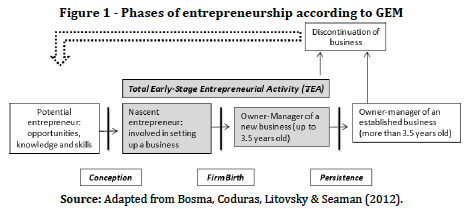
<body><![CDATA[<p><b><font size="3" face="Verdana">1. &nbsp;&nbsp;&nbsp;&nbsp;&nbsp; Introduction</font></b></p>     <p><font size="2" face="Verdana">Occupational choice theory has inspired studies about   the decision to launch new ventures. In this approach, agents seek to maximise   the expected utility of their returns when they choose one of two types of occupational   choices: self-employment versus working for others. However, this static view   has been replaced by a more dynamic one that sees business as a process comprising several steps (van der Zwan, Thurik &amp; Grilo, 2010).</font></p>     <p><font size="2" face="Verdana">Grilo and Thurik (2005) introduced the concept of   engagement levels in entrepreneurial activities &#8211; what they called ‘the   entrepreneurial ladder’. This ladder comprises several stages, from ‘I never   thought of starting a new venture’ to ‘I have had a new venture for more than   three years’ (see <a href="#f1">Figure 1</a>). Some studies have showed that the individual   determinants of entrepreneurship are different in each stage (van der Zwan et   al., 2010; Grilo &amp; Thurik, 2008; van der Zwan &amp; Verheul, 2012). In this   context, there have been several studies about nascent entrepreneurial   activities in which people are taking the first steps towards becoming   self-employed but they are not yet officially established. In this stage,   enterprises are in ‘the conception stage’ (Davidsson, 2006). Data from Global Entrepreneurship   Monitor (GEM) has also inspired interest in this specific stage of the process   (Reynolds et al., 2005). Based on data from the 2012 GEM Portugal survey, this   study seeks to identify the social, demographic and perceptual factors of   entrepreneurship in a double strand: involvement in early-stage entrepreneurial   activity and active involvement in startups. Furthermore, it seeks to compare   variables that lead to the development of an entrepreneurial attitude and the   creation of startup businesses. This paper is structured as follows. The next section presents a   synthesis of the determinants of entrepreneurship and our investigation   hypotheses. Then, we describe methodological options in terms of a description   of the database, the variables and the statistical methods used in this study.   The results and conclusions are presented in the last two sections of the paper.</font></p>     <p>&nbsp;</p>     <p><a name="f1"></a></p>     <p align="center"> <img src="/img/revistas/tms/v11n1/11n1a23f1.jpg" width="475" height="209"></p>     
<p>&nbsp;</p>     <p>&nbsp;</p>     <p><b><font size="3" face="Verdana">2. &nbsp;&nbsp;&nbsp;&nbsp;&nbsp; Individual determinants of entrepreneurship</font></b></p>     <p><font size="2" face="Verdana">Entrepreneurship   is a result of the attitudes and actions of people. In order to understand   entrepreneurial activities, it is extremely important to study why adult   populations act in particular ways and how their attitudes are expressed (van der Zwan et al., 2010).</font></p>     ]]></body>
<body><![CDATA[<p><font size="2" face="Verdana">The determinants   of entrepreneurship have been studied using several multidisciplinary   approaches (Arenius &amp; Minniti, 2005) (e.g. economics, history, psychology   and sociology). Recently, due to the fragmentation of researches that study   this type of issue, the literature has included some efforts to collate   published studies about the determinants of entrepreneurship (Bosma, 2013;   Collins, Hanges &amp; Locke, 2004; Heinrichs &amp; Walter, 2013; Rauch &amp; Frese, 2007; Zhao &amp; Seibert, 2006).</font></p>     <p><font size="2" face="Verdana">The   determinants that allow people to create new businesses can be clustered   (Arenius &amp; Minniti, 2005) into socioeconomic and demographic factors (e.g.   age, gender, occupation and level of education), perception factors (e.g. trust   in one’s own capabilities and risk aversion) and environmental and   macroeconomic factors (e.g. technology, economic and cultural development,   institutional and macroeconomic environment and access to financial resources). These determinants are shown in <a href="#f2">Figure 2</a>.</font></p>     <p>&nbsp;</p>      <p><a name="f2"></a></p>     <p align="center"> <img src="/img/revistas/tms/v11n1/11n1a23f2.jpg" width="463" height="339"></p>     
<p>&nbsp;</p>     <p><font size="2" face="Verdana">This paper does   not consider environmental variables, such as the role of organisations that   support entrepreneurship (Goés &amp; Brugni, 2014), because these variables are   more relevant in comparative studies with samples from different countries or   regions. Regarding socioeconomic, demographic and perception factors, Arenius   and Minniti (2005) concluded that perception factors are more important in   explaining entrepreneurial initiatives. Moreover, Oliveira, Silva and Araújo’s   (2013) findings revealed that perception factors are also important for the success of micro and small enterprises.</font></p>     <p><font size="2" face="Verdana">Therefore, this   study analysed the role of the following variables: gender, age, income,   occupation, level of education, perceived skills, perceived risk, relationships   with other entrepreneurs and personal attitudes towards individual innovation. The hypotheses we sought to test in this study are presented below.</font></p>     <p><b><font size="2" face="Verdana">2.1 &nbsp;&nbsp;&nbsp; Gender</font></b></p>     <p><font size="2" face="Verdana">A large number   of studies have found a low representation of women among entrepreneurs, as   compared to males (Bosma, 2013; Zhao &amp; Seibert, 2006; Davidsson &amp;   Honig, 2003). However, van der Zwan and Verheul’s (2012) results revealed that   the gender effect is higher in the early steps of entrepreneurial activities   than in the phase of startup creation. A study by Parker and Belghitar (2006)   showed that the direct effect of gender on entrepreneurial activities is   residual when other relevant variables are included in the analysis. Therefore, we assumed that:</font></p>     ]]></body>
<body><![CDATA[<p><font size="2" face="Verdana"><b>H1</b> &#8211; Involvement in entrepreneurship is higher among males.</font></p>     <p><b><font size="2" face="Verdana">2.2 &nbsp;&nbsp;&nbsp; Age</font></b></p>     <p><font size="2" face="Verdana">Previous   studies have reported a negative correlation between entrepreneurial activities   and the age of entrepreneurs (Reynolds et al., 2005; Davidsson &amp; Honig,   2003), or a nonlinear relationship, with a peak in the age group of 25 to   34-year-olds (van der Zwan &amp; Verheul, 2012). Indeed, despite older business   people’s accumulated experience and financial capital and more time available, they are also more risk adverse than younger people. Thus, we maintained that:</font></p>     <p><font size="2" face="Verdana"><b>H2</b> &#8211; The likelihood of entrepreneurial initiatives decreases with the age of entrepreneurs.</font></p>     <p><b><font size="2" face="Verdana">2.3 &nbsp;&nbsp;&nbsp; Income</font></b></p>     <p><font size="2" face="Verdana">Several studies have shown that higher levels of income increase the   likelihood of entrepreneurial activities, offering access to accurate   information and financial support (Nandamuri &amp; Gowthami, 2013). Arenius and   Minniti (2005) identified a U-shaped relationship between income and   entrepreneurial activity. While, for lower levels of income, starting a new   business represents an opportunity for employment and access to higher incomes, higher income might reduce financial barriers to starting new businesses. </font></p>     <p><font size="2" face="Verdana"><b>H3</b> &#8211; Self-employed people have a greater likelihood of participating   in entrepreneurial initiatives (van der Zwan &amp; Verheul, 2012; Heinrichs &amp; Walter, 2013).</font></p>     <p><b><font size="2" face="Verdana">2.4 &nbsp;&nbsp;&nbsp; Level of education</font></b></p>     <p><font size="2" face="Verdana">Levels of   formal education are an indicator of human capital. The findings of previous   studies have shown a positive relationship between this variable and   entrepreneurial activities (van der Zwan &amp; Verheul, 2012; Arenius &amp;   Minniti, 2005; Zhao &amp; Seibert, 2006; Heinrichs &amp; Walter, 2013;   Davidsson &amp; Honig, 2003; Reynolds, 1997). According to Davidsson and Honig   (2003), human capital enhances capabilities to perceive good market opportunities and the ability to start new businesses.</font></p>     <p><font size="2" face="Verdana">Koellinger (2008) concluded that higher education levels are associated   with more innovative entrepreneurial activities. On the other hand, van der   Sluis, van Praag and Vijverberg (2005) concluded that the relationship is not significant. In this context, the following hypothesis was established.</font></p>     ]]></body>
<body><![CDATA[<p><font size="2" face="Verdana"><b>H4</b> &#8211; Higher levels of formal education are associated with higher levels of entrepreneurial activity.</font></p>     <p><b><font size="2" face="Verdana">2.5 &nbsp;&nbsp;&nbsp; Perceived skills and experience</font></b></p>     <p><font size="2" face="Verdana">Previous   studies based on GEM data have suggested that the positive perception that   individuals have of their own skills in the creation of new businesses   increases the likelihood of entrepreneurial activities (van der Zwan &amp;   Verheul, 2012; Bosma, 2013; Arenius &amp; Minniti, 2005; Heinrichs &amp;   Walter, 2013). According to Arenius and Minniti (2005), perceived skills and   experience to start new businesses are the second most important variable in   decisions to start new businesses. Given the above, a hypothesis was defined as follows:</font></p>     <p><font size="2" face="Verdana"><b>H5</b> &#8211; Knowledge, competence and perceived experience increase the likelihood of entrepreneurial activity.</font></p>     <p><b><font size="2" face="Verdana">2.6 &nbsp;&nbsp;&nbsp; Knowing other entrepreneurs</font></b></p>     <p><font size="2" face="Verdana">Knowing other   entrepreneurs and belonging to a social network provide individuals with   contacts that might facilitate the entrepreneurial process (Hoang &amp; Antoncic, 2003; Larson &amp; Starr, 1993). Hence, we assume that:</font></p>     <p><font size="2" face="Verdana"><b>H6</b> &#8211; Knowing other entrepreneurs increases the likelihood of   entrepreneurial activity (Hoang &amp; Antoncic, 2003; Larson &amp; Starr, 1993).</font></p>     <p><b><font size="2" face="Verdana">2.7 &nbsp;&nbsp;&nbsp; Risk aversion</font></b></p>     <p><font size="2" face="Verdana">Entrepreneurs   are known to be risk takers. Therefore, risk aversion is inversely related to   entrepreneurial activity (Davidsson, 2006; Bosma, 2013; Arenius &amp; Minniti,   2005). The fear of failure in business leads many individuals to avoid engaging   in entrepreneurial activities and to look for more stable professional alternatives. Risk aversion was defined by the following hypothesis:</font></p>     <p><font size="2" face="Verdana"><b>H7</b> &#8211; Higher risk aversion decreases the probability of entrepreneurial activities.</font></p>     ]]></body>
<body><![CDATA[<p><b><font size="2" face="Verdana">2.8 &nbsp;&nbsp;&nbsp; Personal attitude towards individual innovation</font></b></p>     <p><font size="2" face="Verdana">According to   the theory of planned behaviour (Ajzen, 1991), intentions to perform particular   acts are influenced by individuals’ attitudes towards those behaviours. Hence,   as it is assumed that the importance that people assign to innovation by   individuals increases the likelihood of involvement in entrepreneurial activities, the following hypothesis was formulated.</font></p>     <p><font size="2" face="Verdana"><b>H8</b> &#8211; Giving more value to the importance of individual innovation increases the probability of entrepreneurial activity.</font></p>     <p>&nbsp;</p>      <p><b><font size="3" face="Verdana">3.&nbsp;&nbsp;&nbsp;&nbsp;&nbsp;&nbsp;  Methodology</font></b></p>     <p><b><font size="2" face="Verdana">3.1 &nbsp;&nbsp;&nbsp; Sample</font></b></p>     <p><font size="2" face="Verdana">Portugal   &#8211; known to have lower creation rates of new businesses than the European   Union average (Sarmento &amp; Nunes, 2012) &#8211; is the target of this study.   To test empirically the predictions laid out above, we employed the Adult   Population Survey database collected in 2012 under the GEM research programme.   The database has information on a sample of 2,000 Portuguese respondents. The   survey collected information from the respondents at the time they were on a specific step of the entrepreneurial ladder.</font></p>     <p><b><font size="2" face="Verdana">3.2 &nbsp;&nbsp;&nbsp; Dependent variables</font></b></p>     <p><font size="2" face="Verdana">The dependent   variables used in this analysis are Total Early-Stage Entrepreneurial Activity   (TEA) and startup businesses. The first variable assesses if individuals are   involved in early-stage entrepreneurial activity. The second variable aims to measure active involvement in startups.</font></p>     <p><font size="2" face="Verdana">The two   variables are qualitative and, as dummy variables, they were coded with the   value of 1 if the individual was involved in entrepreneurial activities (TEA or startup) and the value of 0, otherwise.</font></p>     ]]></body>
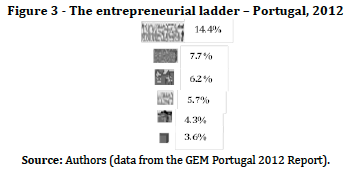
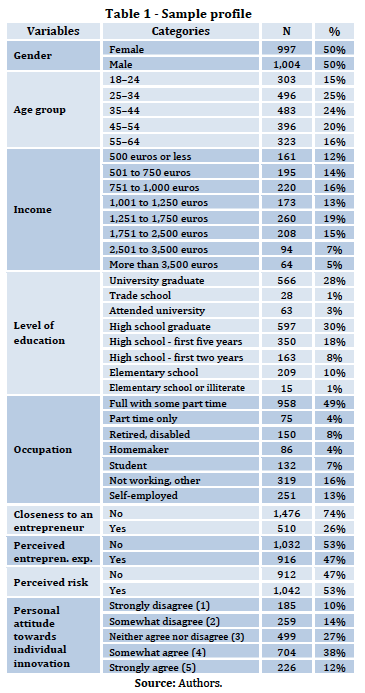
<body><![CDATA[<p><b><font size="2" face="Verdana">3.3 &nbsp;&nbsp;&nbsp; Independent variables</font></b></p>     <p><font size="2" face="Verdana">The independent variables that act as explanatory variables of entrepreneurial   attitudes and that are used in this study are: age, gender, level of income and   occupation (socio-demographic characteristics); degree of knowledge, skills and   experience of entrepreneurial activities and level of education (skills and   education); degree of risk aversion; relationships with other entrepreneurs and personal attitude towards individual innovation (tendency for innovation).</font></p>     <p><b><font size="2" face="Verdana">3.4 &nbsp;&nbsp;&nbsp; Statistical Methods</font></b></p>     <p><font size="2" face="Verdana">To produce the   statistical characterisation of the sample, absolute and relative frequency   tables, crosstabs and descriptive statistics were used. The determinants of   entrepreneurship in the Portuguese population were first defined through   chi-square tests. In a second step, logit models were estimated in order to accommodate possible interactions between the explanatory variables. </font></p>     <p>&nbsp;</p>     <p><b><font size="3" face="Verdana">4.&nbsp;&nbsp;&nbsp;&nbsp;&nbsp;&nbsp; Results</font></b></p>     <p><b><font size="2" face="Verdana">4.1 &nbsp;&nbsp;&nbsp; Sample characteristics</font></b></p>     <p><font size="2" face="Verdana">According to   the GEM 2012 data, 14.4% of the Portuguese respondents intended to start a   business within three years in Portugal, and the estimated TEA was 7.7%.   However, only 6.2% of the respondents were owner-managers of established businesses, and only 5.7% were actively involved in startup efforts.</font></p>     <p><font size="2" face="Verdana">The GEM   Portugal 2012 Report also mentioned the importance of the nascent   entrepreneurship rate and new business ownership rate to assess entrepreneurial   activities in Portugal. Therefore, this survey found that 4.3% of the   respondents were actively involved in setting up businesses they owned or   co-owned and, finally, only 3.6% of them stated that they were owner-managers   of new businesses. Based on these results, it was possible to define several   stages or levels of entrepreneurial activity &#8211; or what Grilo and Thurik   (2005) called ‘the entrepreneurial ladder’, adapting it to the specific   situation of Portugal in 2012 (see <a href="#f3">Figure 3</a>). <a href="#t1">Table 1</a> complements these results by defining the profile of the sample analysed in this paper.</font></p>     <p>&nbsp;</p>     ]]></body>
<body><![CDATA[<p><a name="f3"></a></p>     <p align="center"> <img src="/img/revistas/tms/v11n1/11n1a23f3.jpg" width="357" height="175"></p>     
<p>&nbsp;</p>     <p>&nbsp;</p>     <p><a name="t1"></a></p>     <p align="center"> <img src="/img/revistas/tms/v11n1/11n1a23t1.jpg" width="365" height="693"></p>     
<p>&nbsp;</p>     <p><font size="2" face="Verdana">As shown in   <a href="#t1">Table 1</a>, in 2012, the percentage of entrepreneurs was balanced by gender   &#8211; 50% of females (N=997) were entrepreneurs while 50% of male respondents   (N=1,004) considered themselves a professional in entrepreneurship &#8211; and   25% of entrepreneurs (N=496) fell within the age group of 25&#8211;34 years   old. Regarding the level of income, 19% of entrepreneurs (N=260) earned between   €1,251 and €1,750 per month. Furthermore, 30% (N=597) had graduated from high school, while 49% of the respondents (N=958) worked in full or part-time positions.</font></p>     <p><font size="2" face="Verdana">Given that networking, perceived entrepreneurial experience, perceived   risk and personal attitude towards individual innovation are variables that   play a key role not only in characterising the respondents of GEM’s Portugal   survey 2012 but also in studying entrepreneurship and entrepreneurial   activities, these were also considered in this study. Fully 74% of the   Portuguese respondents (N=1,476) answered that they did not know other entrepreneurs, while only 26% (N=510) reported feeling close to other entrepreneurs.</font></p>     <p><font size="2" face="Verdana">Although 53% of the respondents (N=1,032) did not think they had any   entrepreneurial experience, the same percentage of individuals (53%, N=1,042)   answered that they were aware of the risks underlying entrepreneurial   activities. As an   essential element of entrepreneurship, innovation tends to be considered   indispensable to the entrepreneurship process and to the personalities of   entrepreneurs. As evidenced by the results in <a href="#t1">Table 1</a>, 38% of the Portuguese   respondents expressed their personal position towards innovation as somewhat agreeing with the importance of this variable.</font></p>      ]]></body>
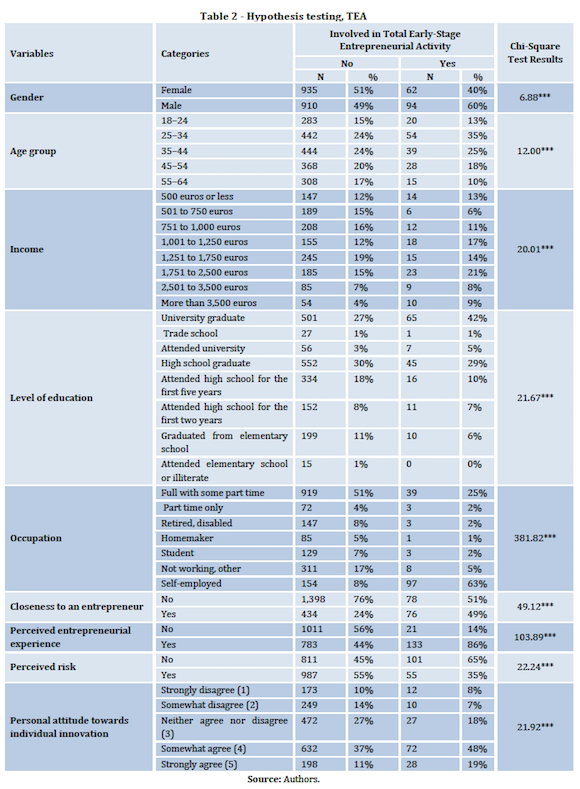
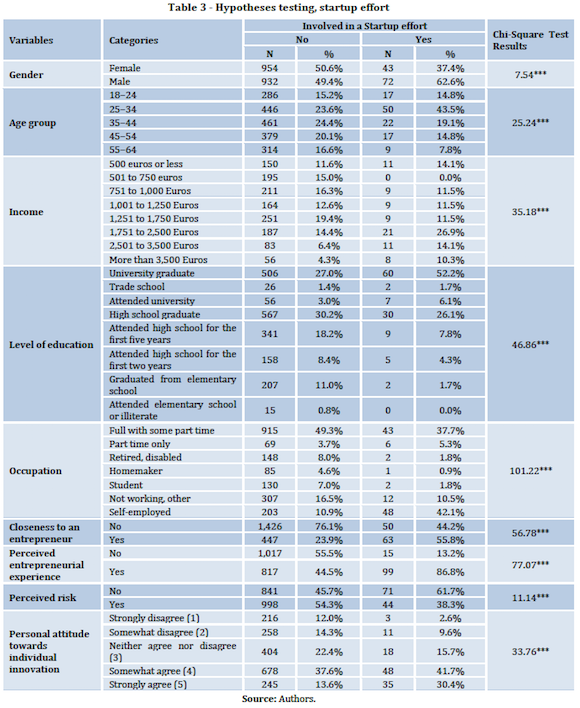
<body><![CDATA[<p><b><font size="2" face="Verdana">4.2 &nbsp;&nbsp;&nbsp; Hypotheses testing</font></b></p>     <p><font size="2" face="Verdana">In this   section, we present two tables, one for the TEA (<a href="#t2">Table 2</a>) and another for   startup efforts (<a href="#t3">Table 3</a>), which allowed us to test the hypotheses listed   earlier and to compare the differences between these two variables. In both   <a href="#t2">Table 2</a> and <a href="#t3">Table 3</a>, the results revealed that early-stage entrepreneurial   activity is higher for males than for females. There is an association between   entrepreneurial activities and the age of entrepreneurs. Indeed, the TEA is   higher for individuals between 25 and 34 years old. Furthermore, the TEA appears to increase with household income.</font></p>     <p>&nbsp;</p>     <p><a name="t2"></a></p>     <p align="center"> <img src="/img/revistas/tms/v11n1/11n1a23t2.jpg" width="580" height="789"></p>     
<p>&nbsp;</p>     <p>&nbsp;</p>     <p><a name="t3"></a></p>     <p align="center"> <img src="/img/revistas/tms/v11n1/11n1a23t3.jpg" width="580" height="708"></p>     
<p>&nbsp;</p>     ]]></body>
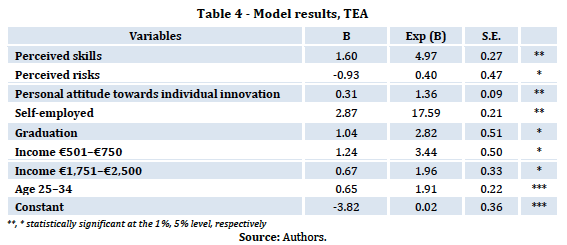
<body><![CDATA[<p><font size="2" face="Verdana">For both TEA   and startup effort, it is possible to state that the   higher the level of income, the greater the likelihood of engaging in   entrepreneurial activities. Having a diploma also increases participation in entrepreneurial activities and startup effort.</font></p>     <p><font size="2" face="Verdana">As expected,   for both TEA and startup effort, self-employed individuals are more likely to   engage in entrepreneurial activities. This result is in accordance with   previous studies and indicates that those who are self-employed acquire skills   and competencies that promote new business ideas and entrepreneurial activities.</font></p>     <p><font size="2" face="Verdana">Knowing other   entrepreneurs also increases entrepreneurial activity. Therefore, networking   with other entrepreneurs positively impacts these activities. This happens for both TEA and startup effort.</font></p>     <p><font size="2" face="Verdana">Perceived   entrepreneurial experience and skills are the most significant variables   associated with TEA. Therefore, those who are more confident about their   business skills are more likely to become entrepreneurs, which happens for both TEA and startup effort.</font></p>     <p><font size="2" face="Verdana">Portuguese entrepreneurs   appear to present a higher level of perceived risk for both TEA and startup   businesses. This result is consistent with the stereotype that an entrepreneur   is someone who is a risk taker. Finally, entrepreneurs exhibit a positive personal attitude towards entrepreneurship for both TEA and startup effort.</font></p>     <p><font size="2" face="Verdana">All the nine hypotheses were confirmed by chi-square tests as presented   in the next table. Therefore, it is possible to conclude that entrepreneurial   activity in Portugal is associated with demographic, socioeconomic and perception variables, as maintained by Arenius and Minniti (2005).</font></p>     <p><font size="2" face="Verdana"><b>4.3 Model Estimates</b></font></p>     <p><font size="2" face="Verdana">Last, in order   to account for a possible interaction between the independent variables, we estimated two logit models (see Tables <a href="#t4">4</a> and <a href="#t5">5</a>).</font></p>     <p>&nbsp;</p>     <p><a name="t4"></a></p>     ]]></body>
<body><![CDATA[<p align="center"> <img src="/img/revistas/tms/v11n1/11n1a23t4.jpg" width="567" height="245"></p>     
<p>&nbsp;</p>     <p>&nbsp;</p>     <p><a name="t5"></a></p>     <p align="center"> <img src="/img/revistas/tms/v11n1/11n1a23t5.jpg" width="571" height="212"></p>     
<p>&nbsp;</p>     <p><font size="2" face="Verdana">The first model   considers the TEA as the dependent variable, whereas the second includes the   startup variable on a set of potential determinants. The two tables above show those variables or categories of variables that are statistically significant.</font></p>     <p><font size="2" face="Verdana">The main   perception determinants of the TEA are perceived entrepreneurial skills,   perceived risks and personal attitude towards individual innovation. Age, income, level of education and occupation are also statistically significant.</font></p>     <p><font size="2" face="Verdana">When   entrepreneurs make progress in startup efforts, the perceived risk is no longer   statistically significant. However, knowing other entrepreneurs has a positive   effect on the likelihood to be involved in startup activities. Perceived   skills, attitude toward innovation and age remain statistically significant, which shows the relevant role of these variables for startup businesses.</font></p>     <p>&nbsp;</p>     ]]></body>
<body><![CDATA[<p><b><font size="3" face="Verdana">5. &nbsp;&nbsp;&nbsp;&nbsp;&nbsp; Discussion</font></b></p>     <p><font size="2" face="Verdana">In this paper,   we used occupational choice theory in order to explain why a static perspective   that advocated a single way to accomplish the maximum utility of returns   received by agents has been replaced by a more dynamic view that advocates that   business is a process whose development goes through several stages, each with   levels of engagement reflected in what Grilo and Thurik (2005) called ‘the   entrepreneurial ladder’. This ladder, a representation of entrepreneurial   activities, needs to be analysed using a set of determinants that affect this type of activity.</font></p>     <p><font size="2" face="Verdana">In order to   analyse the role of each variable (i.e. gender, age group, income, occupation,   level of education, perceived skills, perceived risk, relationships with other   entrepreneurs and personal attitude towards individual innovation) in   entrepreneurial initiatives that took place in Portugal in 2012, we defined a   set of nine hypotheses. According to chi-square test results, the first   hypothesis is confirmed, that is, early-stage entrepreneurial activity is more   common for males than for females. In terms of age, it was possible to verify   that there is an association between   entrepreneurial activities and the age of entrepreneurs. TEA is prevalent in individuals who are between 25 and 34 years old. All other variables were also confirmed by the results. </font></p>     <p><font size="2" face="Verdana">According to   the empirical results, the TEA increases with household income, while   self-employed individuals have a higher probability of engaging in   entrepreneurial activities. According to Coulter (2001), the level of income,   along with other factors, strongly influences the likelihood of being   entrepreneurial. Having a diploma is also an important step towards increasing entrepreneurial activities.</font></p>     <p><font size="2" face="Verdana">Individuals who   have entrepreneurial experience and are confident about their business skills   are more likely to become entrepreneurs. They believe that they possess the   most important characteristics needed to succeed in entrepreneurial activities.   Knowing other entrepreneurs also has a positive impact on entrepreneurial   activity. This can be explained by the fact that, as Larson and Starr (1993)   pointed out, more developed networks &#8211; in terms of the number and quality   of ties &#8211; can offer more benefits to startup businesses than less   developed networks. Their research results indicated great importance associated   with these networks. Furthermore, other authors (Coleman, 1988; Burt, 1992;   Hite &amp; Hesterley, 2001) emphasised the importance of networks in each stage   of development of entrepreneurial firms, identifying both cohesive networks and   networks that promoted structural holes, including those whose influence is   made clear in the development process of new firms. Johannisson (2000) stated   that networks are one of the most useful and powerful resources that   entrepreneurs can use because they provide access to knowledge, information, power, capital and connections to other networks.</font></p>     <p><font size="2" face="Verdana">Portuguese   respondents also presented a higher level of perceived risk. They further revealed positive personal attitudes about individual innovation.</font></p>     <p><font size="2" face="Verdana">After these   considerations, it is possible to confirm the relationship between   entrepreneurial activity and startup businesses in Portugal and demographic,   socioeconomic and perception variables (Arenius &amp; Minniti, 2005). Based on   the results of the two logit models estimated, it was possible to assess   possible interactions between the independent variables. The model results for   TEA show that the main perception determinants of early-stage entrepreneurial   activity are perceived entrepreneurial skills, perceived risks and personal   attitude towards individual innovation. Variables such as age, income, level of education and occupation are also statistically significant.</font></p>     <p><font size="2" face="Verdana">On the other   hand, model results for startup effort indicate that perceived risk is no   longer statistically significant after entrepreneurs have initiated startup   businesses, whereas knowing other entrepreneurs continues to have an important   role in startup efforts. This result is of utmost importance for policy makers   &#8211; both at the regional and national levels &#8211; who can promote the   creation and activities of entrepreneurial associations in order to enhance the social capital of entrepreneurs.</font></p>     <p>&nbsp;</p>     <p><b><font size="3" face="Verdana">6.&nbsp;&nbsp;&nbsp;&nbsp;&nbsp; Study limitations and directions for new research</font></b></p>     ]]></body>
<body><![CDATA[<p><font size="2" face="Verdana">Besides the   importance of the topic and the interesting results discussed in this paper,   there are some limitations that should be identified and that could indicate new directions for future research on entrepreneurship.</font></p>     <p><font size="2" face="Verdana">One of the   limitations is that the data analysed comprised only one year, 2012. An   analysis covering several years can make the study of this topic more   comprehensive and provide a more detailed vision of the evolution of   entrepreneurial activity in any given period. Clearly, a longitudinal study is   needed to establish causal direction for gender, age, income, occupation, level   of education, perceived skills, perceived risk, relationships with other entrepreneurs and personal attitude towards individual innovation. </font></p>     <p><font size="2" face="Verdana">In addition, it   would be interesting to include in the analysis other explanatory variables   that can complement the study of entrepreneurial activity. Expanding the scope   to include other countries would help to understand what the situation of each   country is concerning entrepreneurial activities and the determinants that influence these.</font></p>     <p>&nbsp;</p>     <p><b><font size="3" face="Verdana">7.&nbsp;&nbsp;&nbsp;&nbsp;&nbsp; Conclusions</font></b></p>     <p><font size="2" face="Verdana">Our results revealed   that early-stage entrepreneurial activities and startup businesses are   associated with younger (25&#8211;34-year-old) males, who possess a medium to   higher level of household income and have diplomas. They are self-employed and   close to other entrepreneurs, perceiving themselves as possessing   entrepreneurial skills. They have a low level of perceived risk and a positive personal attitude towards individual innovation.</font></p>     <p><font size="2" face="Verdana">However, when   we account for possible interactions between these independent variables, only   perceived skills, perceived risks, personal attitude toward innovation,   self-employment, level of education, income and age are statistically significant.</font></p>     <p><font size="2" face="Verdana">For those   entrepreneurs who reach the startup effort step, perceived risk is no longer   statistically significant. This result can be explained by their increasing   certainty regarding their business plans and projects as the entrepreneurs move   to the second step. In addition, knowing other entrepreneurs has a positive   effect on the likelihood of being involved in startup efforts. Therefore, we   must conclude that networking is of utmost importance to entrepreneurs and should be enhanced.</font></p>     <p>&nbsp;</p>     <p><font size="3" face="Verdana"><b>References</b></font></p>     ]]></body>
<body><![CDATA[<!-- ref --><p><font size="2" face="Verdana">Ajzen, I. (1991). The theory of planned   behavior. <i>Organisational Behavior and Human Decision Process</i>, 50, 179-211.    &nbsp;&nbsp;&nbsp;&nbsp;&nbsp;&nbsp;&nbsp;&nbsp;[&#160;<a href="javascript:void(0);" onclick="javascript: window.open('/scielo.php?script=sci_nlinks&ref=000143&pid=S2182-8458201500010002300001&lng=','','width=640,height=500,resizable=yes,scrollbars=1,menubar=yes,');">Links</a>&#160;]<!-- end-ref --></font></p>     <!-- ref --><p><font size="2" face="Verdana">Arenius, P. &amp; Minniti, M. (2005). Perceptual variables and nascent entrepreneurship. <i>Small Business Economics</i>, 24, 233-247.    &nbsp;&nbsp;&nbsp;&nbsp;&nbsp;&nbsp;&nbsp;&nbsp;[&#160;<a href="javascript:void(0);" onclick="javascript: window.open('/scielo.php?script=sci_nlinks&ref=000145&pid=S2182-8458201500010002300002&lng=','','width=640,height=500,resizable=yes,scrollbars=1,menubar=yes,');">Links</a>&#160;]<!-- end-ref --> </font></p>     <!-- ref --><p><font size="2" face="Verdana">Bosma, N., Coduras, A., Litovsky, Y.   &amp; Seaman, J. (2012). GEM Manual &#8211; A report on the design, data and   quality control of the Global Entrepreneurship Monitor. <i>Global Entrepreneurship Monitor</i>, 1-95. Retrieved February, 6, 2014 from <a href="http://www.gemconsortium.org/docs/download/2375" target="_blank">http://www.gemconsortium.org/docs/download/2375</a>.    &nbsp;&nbsp;&nbsp;&nbsp;&nbsp;&nbsp;&nbsp;&nbsp;[&#160;<a href="javascript:void(0);" onclick="javascript: window.open('/scielo.php?script=sci_nlinks&ref=000147&pid=S2182-8458201500010002300003&lng=','','width=640,height=500,resizable=yes,scrollbars=1,menubar=yes,');">Links</a>&#160;]<!-- end-ref --></font></p>     <!-- ref --><p><font size="2" face="Verdana">Bosma, N. (2013). The Global   Entrepreneurship Monitor (GEM) and its impact on entrepreneurship research. <i>Foundations and Trends in Entrepreneurship</i>, 9(2), 143-248.    &nbsp;&nbsp;&nbsp;&nbsp;&nbsp;&nbsp;&nbsp;&nbsp;[&#160;<a href="javascript:void(0);" onclick="javascript: window.open('/scielo.php?script=sci_nlinks&ref=000149&pid=S2182-8458201500010002300004&lng=','','width=640,height=500,resizable=yes,scrollbars=1,menubar=yes,');">Links</a>&#160;]<!-- end-ref --></font></p>     <p><font size="2" face="Verdana">Burt, R. (1992). <i>Structural holes</i>. Cambridge, MA: Harvard University Press.</font></p>     <!-- ref --><p><font size="2" face="Verdana">Coleman, J. S. (1988). Social capital in   the creation of human capital. <i>American Journal of Sociology</i>, 94, 95-120.    &nbsp;&nbsp;&nbsp;&nbsp;&nbsp;&nbsp;&nbsp;&nbsp;[&#160;<a href="javascript:void(0);" onclick="javascript: window.open('/scielo.php?script=sci_nlinks&ref=000152&pid=S2182-8458201500010002300006&lng=','','width=640,height=500,resizable=yes,scrollbars=1,menubar=yes,');">Links</a>&#160;]<!-- end-ref --></font></p>     <!-- ref --><p><font size="2" face="Verdana">Collins, C., Hanges, P. &amp; Locke, E.   (2004). The relationship of achievement motivation to entrepreneurial behavior:   a meta-analysis. <i>Human Performance</i>, 17, 95-117.    &nbsp;&nbsp;&nbsp;&nbsp;&nbsp;&nbsp;&nbsp;&nbsp;[&#160;<a href="javascript:void(0);" onclick="javascript: window.open('/scielo.php?script=sci_nlinks&ref=000154&pid=S2182-8458201500010002300007&lng=','','width=640,height=500,resizable=yes,scrollbars=1,menubar=yes,');">Links</a>&#160;]<!-- end-ref --> </font></p>     <!-- ref --><p><font size="2" face="Verdana">Coulter, M. (2001). <i>Entrepreneurship in action</i>. New Jersey, USA: Prentice Hall.    &nbsp;&nbsp;&nbsp;&nbsp;&nbsp;&nbsp;&nbsp;&nbsp;[&#160;<a href="javascript:void(0);" onclick="javascript: window.open('/scielo.php?script=sci_nlinks&ref=000156&pid=S2182-8458201500010002300008&lng=','','width=640,height=500,resizable=yes,scrollbars=1,menubar=yes,');">Links</a>&#160;]<!-- end-ref --></font></p>     <!-- ref --><p><font size="2" face="Verdana">Davidsson, P.   (2006). Nascent entrepreneurship: empirical studies and developments. <i>Foundations and Trends in Entrepreneurship</i>, 2, 1-76.    &nbsp;&nbsp;&nbsp;&nbsp;&nbsp;&nbsp;&nbsp;&nbsp;[&#160;<a href="javascript:void(0);" onclick="javascript: window.open('/scielo.php?script=sci_nlinks&ref=000158&pid=S2182-8458201500010002300009&lng=','','width=640,height=500,resizable=yes,scrollbars=1,menubar=yes,');">Links</a>&#160;]<!-- end-ref --></font></p>     <!-- ref --><p><font size="2" face="Verdana">Davidsson, P &amp; Honig, B. (2003). The   role of social and human capital among nascent entrepreneurs. <i>Journal of Business Venturing</i>, 18, 301-331.    &nbsp;&nbsp;&nbsp;&nbsp;&nbsp;&nbsp;&nbsp;&nbsp;[&#160;<a href="javascript:void(0);" onclick="javascript: window.open('/scielo.php?script=sci_nlinks&ref=000160&pid=S2182-8458201500010002300010&lng=','','width=640,height=500,resizable=yes,scrollbars=1,menubar=yes,');">Links</a>&#160;]<!-- end-ref --></font></p>     <!-- ref --><p><font size="2" face="Verdana">Góes, A. and Brugni, T. (2014).   Entrepreneurship from the perspective of small business support entities. <i>Tourism &amp; Management Studies</i>, 10, 19-25.    &nbsp;&nbsp;&nbsp;&nbsp;&nbsp;&nbsp;&nbsp;&nbsp;[&#160;<a href="javascript:void(0);" onclick="javascript: window.open('/scielo.php?script=sci_nlinks&ref=000162&pid=S2182-8458201500010002300011&lng=','','width=640,height=500,resizable=yes,scrollbars=1,menubar=yes,');">Links</a>&#160;]<!-- end-ref --></font></p>     <!-- ref --><p><font size="2" face="Verdana">Grilo, I. &amp; Thurik, R. (2005). Entrepreneurial engagement levels in the European Union. <i>International Journal of Entrepreneurship Education</i>, 3(1), 43-68.    &nbsp;&nbsp;&nbsp;&nbsp;&nbsp;&nbsp;&nbsp;&nbsp;[&#160;<a href="javascript:void(0);" onclick="javascript: window.open('/scielo.php?script=sci_nlinks&ref=000164&pid=S2182-8458201500010002300012&lng=','','width=640,height=500,resizable=yes,scrollbars=1,menubar=yes,');">Links</a>&#160;]<!-- end-ref --></font></p>     <!-- ref --><p><font size="2" face="Verdana">Grilo, I. &amp; Thurik, R. (2008).   Determinants of entrepreneurial engagement levels in Europe and the US. <i>Industrial &amp; ‘Corporate Change</i>, 17, 1113-1145.    &nbsp;&nbsp;&nbsp;&nbsp;&nbsp;&nbsp;&nbsp;&nbsp;[&#160;<a href="javascript:void(0);" onclick="javascript: window.open('/scielo.php?script=sci_nlinks&ref=000166&pid=S2182-8458201500010002300013&lng=','','width=640,height=500,resizable=yes,scrollbars=1,menubar=yes,');">Links</a>&#160;]<!-- end-ref --></font></p>     <!-- ref --><p><font size="2" face="Verdana">Heinrichs, S. &amp; Walter, S. (2013).   Who Becomes an Entrepreneur? A 30-Years-Review of Individual-Level Research and   an Agenda for Future Research. <i>Leibniz     Information Centre for Economics</i>, 1-27. Retrieved January, 12, 2014 from <a href="http://hdl.handle.net/10419/68590" target="_blank">http://hdl.handle.net/10419/68590</a>.    &nbsp;&nbsp;&nbsp;&nbsp;&nbsp;&nbsp;&nbsp;&nbsp;[&#160;<a href="javascript:void(0);" onclick="javascript: window.open('/scielo.php?script=sci_nlinks&ref=000168&pid=S2182-8458201500010002300014&lng=','','width=640,height=500,resizable=yes,scrollbars=1,menubar=yes,');">Links</a>&#160;]<!-- end-ref --> </font></p>     <!-- ref --><p><font size="2" face="Verdana">Hite, J. &amp; Hesterly, W. (2001). The   evolution of firm networks: from emergence to early growth of the firm. <i>Strategic Management Journal</i>, 22(3), 275-286.    &nbsp;&nbsp;&nbsp;&nbsp;&nbsp;&nbsp;&nbsp;&nbsp;[&#160;<a href="javascript:void(0);" onclick="javascript: window.open('/scielo.php?script=sci_nlinks&ref=000170&pid=S2182-8458201500010002300015&lng=','','width=640,height=500,resizable=yes,scrollbars=1,menubar=yes,');">Links</a>&#160;]<!-- end-ref --></font></p>     <!-- ref --><p><font size="2" face="Verdana">Hoang, H. &amp; Antoncic, B. (2003).   Network-based research in entrepreneurship. A critical review. <i>Journal of Business Venturing</i>, 18, 165-187.    &nbsp;&nbsp;&nbsp;&nbsp;&nbsp;&nbsp;&nbsp;&nbsp;[&#160;<a href="javascript:void(0);" onclick="javascript: window.open('/scielo.php?script=sci_nlinks&ref=000172&pid=S2182-8458201500010002300016&lng=','','width=640,height=500,resizable=yes,scrollbars=1,menubar=yes,');">Links</a>&#160;]<!-- end-ref --></font></p>     <!-- ref --><p><font size="2" face="Verdana">Johannisson, B. (2000). Networking and   entrepreneurial growth. In: D. L. Sexton, &amp; H. Landström (Eds.). <i>The Blackwell Handbook of Entrepreneurship</i> (368-386). Oxford: Backwell.    &nbsp;&nbsp;&nbsp;&nbsp;&nbsp;&nbsp;&nbsp;&nbsp;[&#160;<a href="javascript:void(0);" onclick="javascript: window.open('/scielo.php?script=sci_nlinks&ref=000174&pid=S2182-8458201500010002300017&lng=','','width=640,height=500,resizable=yes,scrollbars=1,menubar=yes,');">Links</a>&#160;]<!-- end-ref --></font></p>     <!-- ref --><p><font size="2" face="Verdana">Koellinger, P. (2008). Why are some   entrepreneurs more innovative than others? <i>Small Business Economics</i>, 31, 21-37.    &nbsp;&nbsp;&nbsp;&nbsp;&nbsp;&nbsp;&nbsp;&nbsp;[&#160;<a href="javascript:void(0);" onclick="javascript: window.open('/scielo.php?script=sci_nlinks&ref=000176&pid=S2182-8458201500010002300018&lng=','','width=640,height=500,resizable=yes,scrollbars=1,menubar=yes,');">Links</a>&#160;]<!-- end-ref --></font></p>     <!-- ref --><p><font size="2" face="Verdana">Larson, A. &amp; Starr, J. (1993). A   network model of organisation formation. <i>Entrepreneurship:Theory and Practice</i>, 17(2), 5-15.    &nbsp;&nbsp;&nbsp;&nbsp;&nbsp;&nbsp;&nbsp;&nbsp;[&#160;<a href="javascript:void(0);" onclick="javascript: window.open('/scielo.php?script=sci_nlinks&ref=000178&pid=S2182-8458201500010002300019&lng=','','width=640,height=500,resizable=yes,scrollbars=1,menubar=yes,');">Links</a>&#160;]<!-- end-ref --> </font></p>     <!-- ref --><p><font size="2" face="Verdana">Nandamuri, P. P. &amp; Gowthami, C. H. (2013). Household Income: Potential Entrepreneur. <i>SCMS Journal of Indian Management</i>, X (3), 75-85.    &nbsp;&nbsp;&nbsp;&nbsp;&nbsp;&nbsp;&nbsp;&nbsp;[&#160;<a href="javascript:void(0);" onclick="javascript: window.open('/scielo.php?script=sci_nlinks&ref=000180&pid=S2182-8458201500010002300020&lng=','','width=640,height=500,resizable=yes,scrollbars=1,menubar=yes,');">Links</a>&#160;]<!-- end-ref --></font></p>     <!-- ref --><p><font size="2" face="Verdana">Oliveira, J., Silva, W. &amp;   Araújo, E. (2013). Business   longevity and entrepreneurial characteristics: MSE's analysis of the Teófilo   Otoni/ Minas Gerais/Brazil microregion. <i>Tourism &amp; Management Studies</i>, 9 (2), 107-117.    &nbsp;&nbsp;&nbsp;&nbsp;&nbsp;&nbsp;&nbsp;&nbsp;[&#160;<a href="javascript:void(0);" onclick="javascript: window.open('/scielo.php?script=sci_nlinks&ref=000182&pid=S2182-8458201500010002300021&lng=','','width=640,height=500,resizable=yes,scrollbars=1,menubar=yes,');">Links</a>&#160;]<!-- end-ref --> </font></p>     <!-- ref --><p><font size="2" face="Verdana">Parker, S. &amp; Belghitar, Y. (2006). What happens to nascent entrepreneurs? An econometric analysis of the PSED. <i>Small Business Economics</i>, 27, 81-101.    &nbsp;&nbsp;&nbsp;&nbsp;&nbsp;&nbsp;&nbsp;&nbsp;[&#160;<a href="javascript:void(0);" onclick="javascript: window.open('/scielo.php?script=sci_nlinks&ref=000184&pid=S2182-8458201500010002300022&lng=','','width=640,height=500,resizable=yes,scrollbars=1,menubar=yes,');">Links</a>&#160;]<!-- end-ref --></font></p>     <!-- ref --><p><font size="2" face="Verdana">Rauch, A. &amp; Frese, M. (2007). Let’s   put the person back into entrepreneurship research: a meta-analysis on the   relationship between business owners’ personality traits, business creation,   and success. <i>European Journal of Work &amp; Organisational Psychology</i>, 16, 353-385.    &nbsp;&nbsp;&nbsp;&nbsp;&nbsp;&nbsp;&nbsp;&nbsp;[&#160;<a href="javascript:void(0);" onclick="javascript: window.open('/scielo.php?script=sci_nlinks&ref=000186&pid=S2182-8458201500010002300023&lng=','','width=640,height=500,resizable=yes,scrollbars=1,menubar=yes,');">Links</a>&#160;]<!-- end-ref --></font></p>     <!-- ref --><p><font size="2" face="Verdana">Reynolds, P. (1997). Who starts new firms? &#8211; Preliminary explorations of firms-in-gestation. <i>Small Business Economics</i>, 9, 449-462.    &nbsp;&nbsp;&nbsp;&nbsp;&nbsp;&nbsp;&nbsp;&nbsp;[&#160;<a href="javascript:void(0);" onclick="javascript: window.open('/scielo.php?script=sci_nlinks&ref=000188&pid=S2182-8458201500010002300024&lng=','','width=640,height=500,resizable=yes,scrollbars=1,menubar=yes,');">Links</a>&#160;]<!-- end-ref --> </font></p>     <!-- ref --><p><font size="2" face="Verdana">Reynolds, P., Bosma,   N., Autio, E., Hunt, S., Bono, N., Servais, I. <i>et al.</i> (2005). Global entrepreneurship monitor: data collection   design and implementation 1998-2003. <i>Small Business Economics</i>, 24, 205-231.    &nbsp;&nbsp;&nbsp;&nbsp;&nbsp;&nbsp;&nbsp;&nbsp;[&#160;<a href="javascript:void(0);" onclick="javascript: window.open('/scielo.php?script=sci_nlinks&ref=000190&pid=S2182-8458201500010002300025&lng=','','width=640,height=500,resizable=yes,scrollbars=1,menubar=yes,');">Links</a>&#160;]<!-- end-ref --> </font></p>     <!-- ref --><p><font size="2" face="Verdana">Sarmento, E. and Nunes, A. (2012).   Business creation in Portugal and Spain in the period 2000-2007: comparative   analysis based on the World Bank group entrepreneurship survey (WBGES), <i>Tourism &amp; Management Studies</i>, 8, 116-130.    &nbsp;&nbsp;&nbsp;&nbsp;&nbsp;&nbsp;&nbsp;&nbsp;[&#160;<a href="javascript:void(0);" onclick="javascript: window.open('/scielo.php?script=sci_nlinks&ref=000192&pid=S2182-8458201500010002300026&lng=','','width=640,height=500,resizable=yes,scrollbars=1,menubar=yes,');">Links</a>&#160;]<!-- end-ref --></font></p>     <!-- ref --><p><font size="2" face="Verdana">van der Sluis, J., van Praag, M. &amp; Vijverberg (2005). Entrepreneurship   selection and performance: A meta-analysis of the impact of education in   developing economies, <i>World Bank Economic Review</i>, 19, 225-261.    &nbsp;&nbsp;&nbsp;&nbsp;&nbsp;&nbsp;&nbsp;&nbsp;[&#160;<a href="javascript:void(0);" onclick="javascript: window.open('/scielo.php?script=sci_nlinks&ref=000194&pid=S2182-8458201500010002300027&lng=','','width=640,height=500,resizable=yes,scrollbars=1,menubar=yes,');">Links</a>&#160;]<!-- end-ref --></font></p>     <!-- ref --><p><font size="2" face="Verdana">van der Zwan, P., Thurik, R. &amp; Grilo, I. (2010). The entrepreneurial ladder and its determinants. <i>Applied Economics</i>, 42, 2183-2191.    &nbsp;&nbsp;&nbsp;&nbsp;&nbsp;&nbsp;&nbsp;&nbsp;[&#160;<a href="javascript:void(0);" onclick="javascript: window.open('/scielo.php?script=sci_nlinks&ref=000196&pid=S2182-8458201500010002300028&lng=','','width=640,height=500,resizable=yes,scrollbars=1,menubar=yes,');">Links</a>&#160;]<!-- end-ref --> </font></p>     <!-- ref --><p><font size="2" face="Verdana">van der Zwan,   P. &amp; Verheul, I. (2012). The entrepreneurial ladder, gender and regional development. <i>Small Business Economics</i>, 39, 627-643.    &nbsp;&nbsp;&nbsp;&nbsp;&nbsp;&nbsp;&nbsp;&nbsp;[&#160;<a href="javascript:void(0);" onclick="javascript: window.open('/scielo.php?script=sci_nlinks&ref=000198&pid=S2182-8458201500010002300029&lng=','','width=640,height=500,resizable=yes,scrollbars=1,menubar=yes,');">Links</a>&#160;]<!-- end-ref --></font></p>     <!-- ref --><p><font size="2" face="Verdana">Zhao, H. &amp; Seibert, S. (2006). The   big five personality dimensions and entrepreneurial status: a meta-analytical   review. <i>Journal of Applied Psychology</i>, 91(2), 259-271.    &nbsp;&nbsp;&nbsp;&nbsp;&nbsp;&nbsp;&nbsp;&nbsp;[&#160;<a href="javascript:void(0);" onclick="javascript: window.open('/scielo.php?script=sci_nlinks&ref=000200&pid=S2182-8458201500010002300030&lng=','','width=640,height=500,resizable=yes,scrollbars=1,menubar=yes,');">Links</a>&#160;]<!-- end-ref --></font></p>     <p>&nbsp;</p>     ]]></body>
<body><![CDATA[<p>&nbsp;</p>     <p><font size="2" face="Verdana"><b>Article history</b>:          <br>     <b>Received</b>: 20 May 2014          <br>     <b>Accepted</b>: 25 October 2014</font></p>      ]]></body><back>
<ref-list>
<ref id="B1">
<nlm-citation citation-type="journal">
<person-group person-group-type="author">
<name>
<surname><![CDATA[Ajzen]]></surname>
<given-names><![CDATA[I.]]></given-names>
</name>
</person-group>
<article-title xml:lang="en"><![CDATA[The theory of planned behavior]]></article-title>
<source><![CDATA[Organisational Behavior and Human Decision Process]]></source>
<year>1991</year>
<numero>50</numero>
<issue>50</issue>
<page-range>179-211</page-range></nlm-citation>
</ref>
<ref id="B2">
<nlm-citation citation-type="journal">
<person-group person-group-type="author">
<name>
<surname><![CDATA[Arenius]]></surname>
<given-names><![CDATA[P.]]></given-names>
</name>
<name>
<surname><![CDATA[Minniti]]></surname>
<given-names><![CDATA[M.]]></given-names>
</name>
</person-group>
<article-title xml:lang="en"><![CDATA[Perceptual variables and nascent entrepreneurship]]></article-title>
<source><![CDATA[Small Business Economics]]></source>
<year>2005</year>
<numero>24</numero>
<issue>24</issue>
<page-range>233-247</page-range></nlm-citation>
</ref>
<ref id="B3">
<nlm-citation citation-type="journal">
<person-group person-group-type="author">
<name>
<surname><![CDATA[Bosma]]></surname>
<given-names><![CDATA[N.]]></given-names>
</name>
<name>
<surname><![CDATA[Coduras]]></surname>
<given-names><![CDATA[A.]]></given-names>
</name>
<name>
<surname><![CDATA[Litovsky]]></surname>
<given-names><![CDATA[Y.]]></given-names>
</name>
<name>
<surname><![CDATA[Seaman]]></surname>
<given-names><![CDATA[J.]]></given-names>
</name>
</person-group>
<article-title xml:lang="en"><![CDATA[GEM Manual: A report on the design, data and quality control of the Global Entrepreneurship Monitor]]></article-title>
<source><![CDATA[Global Entrepreneurship Monitor]]></source>
<year>2012</year>
<page-range>1-95</page-range></nlm-citation>
</ref>
<ref id="B4">
<nlm-citation citation-type="journal">
<person-group person-group-type="author">
<name>
<surname><![CDATA[Bosma]]></surname>
<given-names><![CDATA[N.]]></given-names>
</name>
</person-group>
<article-title xml:lang="en"><![CDATA[The Global Entrepreneurship Monitor (GEM) and its impact on entrepreneurship research]]></article-title>
<source><![CDATA[Foundations and Trends in Entrepreneurship]]></source>
<year>2013</year>
<volume>9</volume>
<numero>2</numero>
<issue>2</issue>
<page-range>143-248</page-range></nlm-citation>
</ref>
<ref id="B5">
<nlm-citation citation-type="book">
<person-group person-group-type="author">
<name>
<surname><![CDATA[Burt]]></surname>
<given-names><![CDATA[R.]]></given-names>
</name>
</person-group>
<source><![CDATA[Structural holes]]></source>
<year>1992</year>
<publisher-loc><![CDATA[Cambridge ]]></publisher-loc>
<publisher-name><![CDATA[Harvard University Press]]></publisher-name>
</nlm-citation>
</ref>
<ref id="B6">
<nlm-citation citation-type="journal">
<person-group person-group-type="author">
<name>
<surname><![CDATA[Coleman]]></surname>
<given-names><![CDATA[J. S.]]></given-names>
</name>
</person-group>
<article-title xml:lang="en"><![CDATA[Social capital in the creation of human capital]]></article-title>
<source><![CDATA[American Journal of Sociology]]></source>
<year>1988</year>
<numero>94</numero>
<issue>94</issue>
<page-range>95-120</page-range></nlm-citation>
</ref>
<ref id="B7">
<nlm-citation citation-type="journal">
<person-group person-group-type="author">
<name>
<surname><![CDATA[Collins]]></surname>
<given-names><![CDATA[C.]]></given-names>
</name>
<name>
<surname><![CDATA[Hanges]]></surname>
<given-names><![CDATA[P.]]></given-names>
</name>
<name>
<surname><![CDATA[Locke]]></surname>
<given-names><![CDATA[E.]]></given-names>
</name>
</person-group>
<article-title xml:lang="en"><![CDATA[The relationship of achievement motivation to entrepreneurial behavior: a meta-analysis]]></article-title>
<source><![CDATA[Human Performance]]></source>
<year>2004</year>
<numero>17</numero>
<issue>17</issue>
<page-range>95-117</page-range></nlm-citation>
</ref>
<ref id="B8">
<nlm-citation citation-type="book">
<person-group person-group-type="author">
<name>
<surname><![CDATA[Coulter]]></surname>
<given-names><![CDATA[M.]]></given-names>
</name>
</person-group>
<source><![CDATA[Entrepreneurship in action]]></source>
<year>2001</year>
<publisher-loc><![CDATA[New Jersey ]]></publisher-loc>
<publisher-name><![CDATA[Prentice Hall]]></publisher-name>
</nlm-citation>
</ref>
<ref id="B9">
<nlm-citation citation-type="journal">
<person-group person-group-type="author">
<name>
<surname><![CDATA[Davidsson]]></surname>
<given-names><![CDATA[P.]]></given-names>
</name>
</person-group>
<article-title xml:lang="en"><![CDATA[Nascent entrepreneurship: empirical studies and developments]]></article-title>
<source><![CDATA[Foundations and Trends in Entrepreneurship]]></source>
<year>2006</year>
<numero>2</numero>
<issue>2</issue>
<page-range>1-76</page-range></nlm-citation>
</ref>
<ref id="B10">
<nlm-citation citation-type="journal">
<person-group person-group-type="author">
<name>
<surname><![CDATA[Davidsson]]></surname>
<given-names><![CDATA[P]]></given-names>
</name>
<name>
<surname><![CDATA[Honig]]></surname>
<given-names><![CDATA[B.]]></given-names>
</name>
</person-group>
<article-title xml:lang="en"><![CDATA[The role of social and human capital among nascent entrepreneurs]]></article-title>
<source><![CDATA[Journal of Business Venturing]]></source>
<year>2003</year>
<numero>18</numero>
<issue>18</issue>
<page-range>301-331</page-range></nlm-citation>
</ref>
<ref id="B11">
<nlm-citation citation-type="journal">
<person-group person-group-type="author">
<name>
<surname><![CDATA[Góes]]></surname>
<given-names><![CDATA[A.]]></given-names>
</name>
<name>
<surname><![CDATA[Brugni]]></surname>
<given-names><![CDATA[T.]]></given-names>
</name>
</person-group>
<article-title xml:lang="en"><![CDATA[Entrepreneurship from the perspective of small business support entities]]></article-title>
<source><![CDATA[Tourism & Management Studies]]></source>
<year>2014</year>
<numero>10</numero>
<issue>10</issue>
<page-range>19-25</page-range></nlm-citation>
</ref>
<ref id="B12">
<nlm-citation citation-type="journal">
<person-group person-group-type="author">
<name>
<surname><![CDATA[Grilo]]></surname>
<given-names><![CDATA[I.]]></given-names>
</name>
<name>
<surname><![CDATA[Thurik]]></surname>
<given-names><![CDATA[R.]]></given-names>
</name>
</person-group>
<article-title xml:lang="en"><![CDATA[Entrepreneurial engagement levels in the European Union]]></article-title>
<source><![CDATA[International Journal of Entrepreneurship Education]]></source>
<year>2005</year>
<volume>3</volume>
<numero>1</numero>
<issue>1</issue>
<page-range>43-68</page-range></nlm-citation>
</ref>
<ref id="B13">
<nlm-citation citation-type="journal">
<person-group person-group-type="author">
<name>
<surname><![CDATA[Grilo]]></surname>
<given-names><![CDATA[I.]]></given-names>
</name>
<name>
<surname><![CDATA[Thurik]]></surname>
<given-names><![CDATA[R.]]></given-names>
</name>
</person-group>
<article-title xml:lang="en"><![CDATA[Determinants of entrepreneurial engagement levels in Europe and the US]]></article-title>
<source><![CDATA[Industrial & ‘Corporate Change]]></source>
<year>2008</year>
<numero>17</numero>
<issue>17</issue>
<page-range>1113-1145</page-range></nlm-citation>
</ref>
<ref id="B14">
<nlm-citation citation-type="journal">
<person-group person-group-type="author">
<name>
<surname><![CDATA[Heinrichs]]></surname>
<given-names><![CDATA[S.]]></given-names>
</name>
<name>
<surname><![CDATA[Walter]]></surname>
<given-names><![CDATA[S.]]></given-names>
</name>
</person-group>
<article-title xml:lang="en"><![CDATA[Who Becomes an Entrepreneur?: A 30-Years-Review of Individual-Level Research and an Agenda for Future Research]]></article-title>
<source><![CDATA[Leibniz Information Centre for Economics]]></source>
<year>2013</year>
<page-range>1-27</page-range></nlm-citation>
</ref>
<ref id="B15">
<nlm-citation citation-type="journal">
<person-group person-group-type="author">
<name>
<surname><![CDATA[Hite]]></surname>
<given-names><![CDATA[J.]]></given-names>
</name>
<name>
<surname><![CDATA[Hesterly]]></surname>
<given-names><![CDATA[W.]]></given-names>
</name>
</person-group>
<article-title xml:lang="en"><![CDATA[The evolution of firm networks: from emergence to early growth of the firm]]></article-title>
<source><![CDATA[Strategic Management Journal]]></source>
<year>2001</year>
<volume>22</volume>
<numero>3</numero>
<issue>3</issue>
<page-range>275-286</page-range></nlm-citation>
</ref>
<ref id="B16">
<nlm-citation citation-type="journal">
<person-group person-group-type="author">
<name>
<surname><![CDATA[Hoang]]></surname>
<given-names><![CDATA[H.]]></given-names>
</name>
<name>
<surname><![CDATA[Antoncic]]></surname>
<given-names><![CDATA[B.]]></given-names>
</name>
</person-group>
<article-title xml:lang="en"><![CDATA[Network-based research in entrepreneurship: A critical review]]></article-title>
<source><![CDATA[Journal of Business Venturing]]></source>
<year>2003</year>
<numero>18</numero>
<issue>18</issue>
<page-range>165-187</page-range></nlm-citation>
</ref>
<ref id="B17">
<nlm-citation citation-type="book">
<person-group person-group-type="author">
<name>
<surname><![CDATA[Johannisson]]></surname>
<given-names><![CDATA[B.]]></given-names>
</name>
</person-group>
<article-title xml:lang="en"><![CDATA[Networking and entrepreneurial growth]]></article-title>
<person-group person-group-type="editor">
<name>
<surname><![CDATA[Sexton]]></surname>
<given-names><![CDATA[D. L.]]></given-names>
</name>
<name>
<surname><![CDATA[Landström]]></surname>
<given-names><![CDATA[H.]]></given-names>
</name>
</person-group>
<source><![CDATA[The Blackwell Handbook of Entrepreneurship]]></source>
<year>2000</year>
<page-range>368-386</page-range><publisher-loc><![CDATA[Oxford ]]></publisher-loc>
<publisher-name><![CDATA[Backwell]]></publisher-name>
</nlm-citation>
</ref>
<ref id="B18">
<nlm-citation citation-type="journal">
<person-group person-group-type="author">
<name>
<surname><![CDATA[Koellinger]]></surname>
<given-names><![CDATA[P.]]></given-names>
</name>
</person-group>
<article-title xml:lang="en"><![CDATA[Why are some entrepreneurs more innovative than others?]]></article-title>
<source><![CDATA[Small Business Economics]]></source>
<year>2008</year>
<numero>31</numero>
<issue>31</issue>
<page-range>21-37</page-range></nlm-citation>
</ref>
<ref id="B19">
<nlm-citation citation-type="journal">
<person-group person-group-type="author">
<name>
<surname><![CDATA[Larson]]></surname>
<given-names><![CDATA[A.]]></given-names>
</name>
<name>
<surname><![CDATA[Starr]]></surname>
<given-names><![CDATA[J.]]></given-names>
</name>
</person-group>
<article-title xml:lang="en"><![CDATA[A network model of organisation formation]]></article-title>
<source><![CDATA[Entrepreneurship:Theory and Practice]]></source>
<year>1993</year>
<volume>17</volume>
<numero>2</numero>
<issue>2</issue>
<page-range>5-15</page-range></nlm-citation>
</ref>
<ref id="B20">
<nlm-citation citation-type="journal">
<person-group person-group-type="author">
<name>
<surname><![CDATA[Nandamuri]]></surname>
<given-names><![CDATA[P. P.]]></given-names>
</name>
<name>
<surname><![CDATA[Gowthami]]></surname>
<given-names><![CDATA[C. H.]]></given-names>
</name>
</person-group>
<article-title xml:lang="en"><![CDATA[Household Income: Potential Entrepreneur]]></article-title>
<source><![CDATA[SCMS Journal of Indian Management]]></source>
<year>2013</year>
<volume>X</volume>
<numero>3</numero>
<issue>3</issue>
<page-range>75-85</page-range></nlm-citation>
</ref>
<ref id="B21">
<nlm-citation citation-type="journal">
<person-group person-group-type="author">
<name>
<surname><![CDATA[Oliveira]]></surname>
<given-names><![CDATA[J.]]></given-names>
</name>
<name>
<surname><![CDATA[Silva]]></surname>
<given-names><![CDATA[W.]]></given-names>
</name>
<name>
<surname><![CDATA[Araújo]]></surname>
<given-names><![CDATA[E.]]></given-names>
</name>
</person-group>
<article-title xml:lang="en"><![CDATA[Business longevity and entrepreneurial characteristics: MSE's analysis of the Teófilo Otoni/ Minas Gerais/Brazil microregion]]></article-title>
<source><![CDATA[Tourism & Management Studies]]></source>
<year>2013</year>
<volume>9</volume>
<numero>2</numero>
<issue>2</issue>
<page-range>107-117</page-range></nlm-citation>
</ref>
<ref id="B22">
<nlm-citation citation-type="journal">
<person-group person-group-type="author">
<name>
<surname><![CDATA[Parker]]></surname>
<given-names><![CDATA[S.]]></given-names>
</name>
<name>
<surname><![CDATA[Belghitar]]></surname>
<given-names><![CDATA[Y.]]></given-names>
</name>
</person-group>
<article-title xml:lang="en"><![CDATA[What happens to nascent entrepreneurs?: An econometric analysis of the PSED]]></article-title>
<source><![CDATA[Small Business Economics]]></source>
<year>2006</year>
<numero>27</numero>
<issue>27</issue>
<page-range>81-101</page-range></nlm-citation>
</ref>
<ref id="B23">
<nlm-citation citation-type="journal">
<person-group person-group-type="author">
<name>
<surname><![CDATA[Rauch]]></surname>
<given-names><![CDATA[A.]]></given-names>
</name>
<name>
<surname><![CDATA[Frese]]></surname>
<given-names><![CDATA[M.]]></given-names>
</name>
</person-group>
<article-title xml:lang="en"><![CDATA[Let’s put the person back into entrepreneurship research: a meta-analysis on the relationship between business owners’ personality traits, business creation, and success]]></article-title>
<source><![CDATA[European Journal of Work & Organisational Psychology]]></source>
<year>2007</year>
<numero>16</numero>
<issue>16</issue>
<page-range>353-385</page-range></nlm-citation>
</ref>
<ref id="B24">
<nlm-citation citation-type="journal">
<person-group person-group-type="author">
<name>
<surname><![CDATA[Reynolds]]></surname>
<given-names><![CDATA[P.]]></given-names>
</name>
</person-group>
<article-title xml:lang="en"><![CDATA[Who starts new firms?: Preliminary explorations of firms-in-gestation]]></article-title>
<source><![CDATA[Small Business Economics]]></source>
<year>1997</year>
<numero>9</numero>
<issue>9</issue>
<page-range>449-462</page-range></nlm-citation>
</ref>
<ref id="B25">
<nlm-citation citation-type="journal">
<person-group person-group-type="author">
<name>
<surname><![CDATA[Reynolds]]></surname>
<given-names><![CDATA[P.]]></given-names>
</name>
<name>
<surname><![CDATA[Bosma]]></surname>
<given-names><![CDATA[N.]]></given-names>
</name>
<name>
<surname><![CDATA[Autio]]></surname>
<given-names><![CDATA[E.]]></given-names>
</name>
<name>
<surname><![CDATA[Hunt]]></surname>
<given-names><![CDATA[S.]]></given-names>
</name>
<name>
<surname><![CDATA[Bono]]></surname>
<given-names><![CDATA[N.]]></given-names>
</name>
<name>
<surname><![CDATA[Servais]]></surname>
<given-names><![CDATA[I.]]></given-names>
</name>
</person-group>
<article-title xml:lang="en"><![CDATA[Global entrepreneurship monitor: data collection design and implementation 1998-2003]]></article-title>
<source><![CDATA[Small Business Economics]]></source>
<year>2005</year>
<numero>24</numero>
<issue>24</issue>
<page-range>205-231</page-range></nlm-citation>
</ref>
<ref id="B26">
<nlm-citation citation-type="journal">
<person-group person-group-type="author">
<name>
<surname><![CDATA[Sarmento]]></surname>
<given-names><![CDATA[E.]]></given-names>
</name>
<name>
<surname><![CDATA[Nunes]]></surname>
<given-names><![CDATA[A.]]></given-names>
</name>
</person-group>
<article-title xml:lang="en"><![CDATA[Business creation in Portugal and Spain in the period 2000-2007: comparative analysis based on the World Bank group entrepreneurship survey (WBGES)]]></article-title>
<source><![CDATA[Tourism & Management Studies]]></source>
<year>2012</year>
<numero>8</numero>
<issue>8</issue>
<page-range>116-130</page-range></nlm-citation>
</ref>
<ref id="B27">
<nlm-citation citation-type="journal">
<person-group person-group-type="author">
<name>
<surname><![CDATA[van der Sluis]]></surname>
<given-names><![CDATA[J.]]></given-names>
</name>
<name>
<surname><![CDATA[van Praag]]></surname>
<given-names><![CDATA[M.]]></given-names>
</name>
<name>
<surname><![CDATA[Vijverberg]]></surname>
</name>
</person-group>
<article-title xml:lang="en"><![CDATA[Entrepreneurship selection and performance: A meta-analysis of the impact of education in developing economies]]></article-title>
<source><![CDATA[World Bank Economic Review]]></source>
<year>2005</year>
<numero>19</numero>
<issue>19</issue>
<page-range>225-261</page-range></nlm-citation>
</ref>
<ref id="B28">
<nlm-citation citation-type="journal">
<person-group person-group-type="author">
<name>
<surname><![CDATA[van der Zwan]]></surname>
<given-names><![CDATA[P.]]></given-names>
</name>
<name>
<surname><![CDATA[Thurik]]></surname>
<given-names><![CDATA[R.]]></given-names>
</name>
<name>
<surname><![CDATA[Grilo]]></surname>
<given-names><![CDATA[I.]]></given-names>
</name>
</person-group>
<article-title xml:lang="en"><![CDATA[The entrepreneurial ladder and its determinants]]></article-title>
<source><![CDATA[Applied Economics]]></source>
<year>2010</year>
<numero>42</numero>
<issue>42</issue>
<page-range>2183-2191</page-range></nlm-citation>
</ref>
<ref id="B29">
<nlm-citation citation-type="journal">
<person-group person-group-type="author">
<name>
<surname><![CDATA[van der Zwan]]></surname>
<given-names><![CDATA[P.]]></given-names>
</name>
<name>
<surname><![CDATA[Verheul]]></surname>
<given-names><![CDATA[I.]]></given-names>
</name>
</person-group>
<article-title xml:lang="en"><![CDATA[The entrepreneurial ladder, gender and regional development]]></article-title>
<source><![CDATA[Small Business Economics]]></source>
<year>2012</year>
<numero>39</numero>
<issue>39</issue>
<page-range>627-643</page-range></nlm-citation>
</ref>
<ref id="B30">
<nlm-citation citation-type="journal">
<person-group person-group-type="author">
<name>
<surname><![CDATA[Zhao]]></surname>
<given-names><![CDATA[H.]]></given-names>
</name>
<name>
<surname><![CDATA[Seibert]]></surname>
<given-names><![CDATA[S.]]></given-names>
</name>
</person-group>
<article-title xml:lang="en"><![CDATA[The big five personality dimensions and entrepreneurial status: a meta-analytical review]]></article-title>
<source><![CDATA[Journal of Applied Psychology]]></source>
<year>2006</year>
<volume>91</volume>
<numero>2</numero>
<issue>2</issue>
<page-range>259-271</page-range></nlm-citation>
</ref>
</ref-list>
</back>
</article>