<?xml version="1.0" encoding="ISO-8859-1"?><article xmlns:mml="http://www.w3.org/1998/Math/MathML" xmlns:xlink="http://www.w3.org/1999/xlink" xmlns:xsi="http://www.w3.org/2001/XMLSchema-instance">
<front>
<journal-meta>
<journal-id>2182-8458</journal-id>
<journal-title><![CDATA[Tourism & Management Studies]]></journal-title>
<abbrev-journal-title><![CDATA[TMStudies]]></abbrev-journal-title>
<issn>2182-8458</issn>
<publisher>
<publisher-name><![CDATA[Escola Superior de Gestão, Hotelaria e Turismo da Universidade do Algarve]]></publisher-name>
</publisher>
</journal-meta>
<article-meta>
<article-id>S2182-84582016000100012</article-id>
<article-id pub-id-type="doi">10.18089/tms.2016.12112</article-id>
<title-group>
<article-title xml:lang="en"><![CDATA[Hotel employees: A systematic literature review]]></article-title>
<article-title xml:lang="pt"><![CDATA[Funcionários de hotelaria: Uma revisão sistemática da literatura]]></article-title>
</title-group>
<contrib-group>
<contrib contrib-type="author">
<name>
<surname><![CDATA[Borralha]]></surname>
<given-names><![CDATA[Sérgio]]></given-names>
</name>
<xref ref-type="aff" rid="A01"/>
</contrib>
<contrib contrib-type="author">
<name>
<surname><![CDATA[Jesus]]></surname>
<given-names><![CDATA[Saul Neves de]]></given-names>
</name>
<xref ref-type="aff" rid="A02"/>
</contrib>
<contrib contrib-type="author">
<name>
<surname><![CDATA[Pinto]]></surname>
<given-names><![CDATA[Patrícia]]></given-names>
</name>
<xref ref-type="aff" rid="A01"/>
</contrib>
</contrib-group>
<aff id="A01">
<institution><![CDATA[,University of Algarve Faculty of Economics and Research Centre for Spatial and Organizational Dynamics ]]></institution>
<addr-line><![CDATA[Faro ]]></addr-line>
<country>Portugal</country>
</aff>
<aff id="A02">
<institution><![CDATA[,University of Algarve Faculty of Human and Social Sciences Department of Psychology and Education Sciences and Research Centre for Spatial and Organizational Dynamics]]></institution>
<addr-line><![CDATA[Faro ]]></addr-line>
<country>Portugal</country>
</aff>
<pub-date pub-type="pub">
<day>00</day>
<month>03</month>
<year>2016</year>
</pub-date>
<pub-date pub-type="epub">
<day>00</day>
<month>03</month>
<year>2016</year>
</pub-date>
<volume>12</volume>
<numero>1</numero>
<fpage>120</fpage>
<lpage>126</lpage>
<copyright-statement/>
<copyright-year/>
<self-uri xlink:href="http://scielo.pt/scielo.php?script=sci_arttext&amp;pid=S2182-84582016000100012&amp;lng=en&amp;nrm=iso"></self-uri><self-uri xlink:href="http://scielo.pt/scielo.php?script=sci_abstract&amp;pid=S2182-84582016000100012&amp;lng=en&amp;nrm=iso"></self-uri><self-uri xlink:href="http://scielo.pt/scielo.php?script=sci_pdf&amp;pid=S2182-84582016000100012&amp;lng=en&amp;nrm=iso"></self-uri><abstract abstract-type="short" xml:lang="en"><p><![CDATA[With the increase of studies on hospitality professionals over the years, it is essential to perform a review on those works. This review was conducted through the databases Web of Knowledge, Web of Science (Social Sciences Index Expanded, Social Sciences Citation Index, Medline), and Science Direct. We searched for articles published between 2000 and 2014, crossing the keywords “hospitality”, “tourism”, and “hotel” with the keywords “professionals”, “employees”, and “workers”. Our aim was to identify the most studied variables on hospitality employees. The search process resulted on 3700 initial references, being selected 242. We verified that work satisfaction was studied in 51 articles and stress, burnout, and mental exhaustion in 31. For that reason, this review aggregates and analyses these results. This study has implications for the understanding of the roll of these variables in hospitality and tourism economic profitability, as well as in human resources management policies and individual well-being.]]></p></abstract>
<abstract abstract-type="short" xml:lang="pt"><p><![CDATA[Com o aumento dos estudos realizados com profissionais de hotelaria nos últimos anos, torna-se importante fazer uma revisão desses trabalhos. Esta revisão foi realizada com recurso às bases de dados Web of Knowledge, Web of Science (Social Sciences Index Expanded, Social Sciences Citation Index, Medline) e Science Direct. Pesquisámos artigos publicados entre 2000 e 2014, cruzando as palavras-chave “hospitalidade”, “turismo” e “hotel” com as palavras-chave “profissionais”, “empregados” e “trabalhadores”. Objetivámos, desta forma, identificar as variáveis mais estudadas nos profissionais de hotelaria. Da pesquisa resultaram 3700 referências iniciais, tendo sido selecionadas 242. Verificou-se que a satisfação no trabalho foi analisada em 51 estudos e o stresse, burnout e exaustão emocional em 31, pelo que esta revisão incorpora e analisa estes resultados. Este estudo possui implicações para a análise do papel destas variáveis na rentabilidade económica da hotelaria e do turismo, na gestão de recursos humanos e no bem-estar dos colaboradores.]]></p></abstract>
<kwd-group>
<kwd lng="en"><![CDATA[Systematic review]]></kwd>
<kwd lng="en"><![CDATA[hospitality]]></kwd>
<kwd lng="en"><![CDATA[professionals]]></kwd>
<kwd lng="en"><![CDATA[attitudes]]></kwd>
<kwd lng="pt"><![CDATA[Revisão sistemática]]></kwd>
<kwd lng="pt"><![CDATA[hospitalidade]]></kwd>
<kwd lng="pt"><![CDATA[profissionais]]></kwd>
<kwd lng="pt"><![CDATA[atitudes]]></kwd>
</kwd-group>
</article-meta>
</front><body><![CDATA[ <p style="text-align: right;"><b>TOURISM: SCIENTIFIC PAPERS</b></p>     <p><b>Hotel employees: A systematic literature review                                                   </b></p>     <p><b>Funcionários de hotelaria: Uma revisão sistemática da literatura</b></p>     <p><b>Sérgio Borralha<sup>1</sup>, Saul Neves de Jesus<sup>2</sup>, Patrícia Pinto<sup>3</sup>, João Viseu<sup>4 </sup></b></p>     <p>&nbsp;</p>      <p><sup>1</sup>University of Algarve, Faculty of Economics and  Research Centre for Spatial and Organizational Dynamics (CIEO), Campus de Gambelas, Edifício 9, 8005-139 Faro, Portugal.<i> E-mail:</i> <a href="mailto:sergio_borralha@hotmail.com">sergio_borralha@hotmail.com</a></p>     <p><sup>2</sup>University of Algarve, Faculty of Human and Social Sciences, Department of Psychology and Education Sciences and Research Centre for Spatial and Organizational Dynamics (CIEO), Campus de Gambelas, Edifício 9, 8005-139 Faro, Portugal. <i> E-mail:</i> <a href="mailto:snjesus@ualg.pt">snjesus@ualg.pt</a></p>     <p><sup>3</sup>University of Algarve, Faculty of Economics and  Research Centre for Spatial and Organizational Dynamics (CIEO), Campus de Gambelas, Edifício 9, 8005-139 Faro, Portugal. <i> E-mail:</i> <a href="mailto:pvalle@ualg.pt">pvalle@ualg.pt</a></p>     <p><sup>4</sup>University of Algarve, Faculty of Economics and  Research Centre for Spatial and Organizational Dynamics (CIEO), Campus de Gambelas, Edifício 9, 8005-139 Faro, Portugal.<i> E-mail:</i> <a href="mailto:joaonrviseu@gmail.com">joaonrviseu@gmail.com</a></p>     <p>&nbsp;</p>     ]]></body>
<body><![CDATA[<p><b>ABSTRACT</b></p>     <p>With the increase of studies on hospitality professionals over the years, it is essential to perform a review on those works. This review was conducted through the databases Web of Knowledge, Web of Science (Social Sciences Index Expanded, Social Sciences Citation Index, Medline), and Science Direct. We searched for articles published between 2000 and 2014, crossing the keywords “hospitality”, “tourism”, and “hotel” with the keywords “professionals”, “employees”, and “workers”. Our aim was to identify the most studied variables on hospitality employees. The search process resulted on 3700 initial references, being selected 242. We verified that work satisfaction was studied in 51 articles and stress, burnout, and mental exhaustion in 31. For that reason, this review aggregates and analyses these results. This study has implications for the understanding of the roll of these variables in hospitality and tourism economic profitability, as well as in human resources management policies and individual well-being.</p>     <p><b>Keywords:</b> Systematic review, hospitality, professionals, attitudes.</p>     <p>&nbsp;</p>     <p><b>RESUMO</b></p>     <p>Com o aumento dos estudos realizados com profissionais de hotelaria nos últimos anos, torna-se importante fazer uma revisão desses trabalhos. Esta revisão foi realizada com recurso às bases de dados Web of Knowledge, Web of Science (Social Sciences Index Expanded, Social Sciences Citation Index, Medline) e Science Direct. Pesquisámos artigos publicados entre 2000 e 2014, cruzando as palavras-chave “hospitalidade”, “turismo” e “hotel” com as palavras-chave “profissionais”, “empregados” e “trabalhadores”. Objetivámos, desta forma, identificar as variáveis mais estudadas nos profissionais de hotelaria. Da pesquisa resultaram 3700 referências iniciais, tendo sido selecionadas 242. Verificou-se que a satisfação no trabalho foi analisada em 51 estudos e o stresse, burnout e exaustão emocional em 31, pelo que esta revisão incorpora e analisa estes resultados. Este estudo possui implicações para a análise do papel destas variáveis na rentabilidade económica da hotelaria e do turismo, na gestão de recursos humanos e no bem-estar dos colaboradores.</p>     <p><b>Palavras-chave:</b> Revisão sistemática, hospitalidade, profissionais, atitudes.</p>     <p>&nbsp;</p>     <p><b>1.   Introduction</b></p>     <p>Tourism is responsible for a high number of trips around the world having a positive impact on the economy of recipient countries (Cunha, 2013; Eurostat, 2013; Santos, Ferreira, &amp; Costa, 2014). From all economic activities, tourism has the highest global growth rate. In 2012, the World Tourism Organization (UNWTO, 2012a, 2012b) predicted a drive of 285 million tourists, a 5.4% increase comparatively to 2011.</p>     ]]></body>
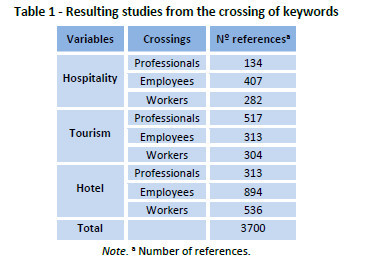
<body><![CDATA[<p> The importance of tourism in the global economic recovery was recognized, implying facilitated travel, demand stimulation, and creation of new jobs. The UNTWO (2013) predicted, for 2012, an income of €837 billion of tourism worldwide, added the cost of travel, this amount would rise to €1 trillion. In 2013 (UNWTO, 2014), 52 million more tourists travelled the world than in previous years, with an increase of 5% for 2014 and 3.8% more each year until 2020. According to the UNWTO (2013), based on the study “Tourism towards 2030”, the growth of tourism worldwide will be 3.3% per year until 2030. In Europe, between 2006 and 2010, the European Commission Statistics (Eurostat, 2012) found an average of one billion travels, this value increased 0.5% in 2011, 5 million holidays more than in 2010. Spending on holidays increased by 7% in 2011, on average €64 per night, €50 in domestic travel, and €82 in trips abroad. In 2013 (Eurostat, 2014), the number of nights spent in tourism establishments rose to 2.6 billion, an increase of 2.6% compared to 2012. The value of arrivals (UNWTO, 2013) was estimated at €356 billion. Europe (UNWTO, 2014) remains the world’s most visited region with 29 million arrivals. In Portugal (Eurostat, 2013a), in 2008, €8.82 million were spent by tourists. In 2009, 444.717 jobs were generated in the tourism sector. In 2011 (Eurostat, 2012), in comparison with 2010, there was an increase of 11096-vacation travel. In 2012, the National Statistics Institute (INE, 2012) stated that tourism revenues showed a balance of €5660 million against €5172 million in 2011, an increase of 9.4%. According to the Eurostat (2014), the number of nights spent in tourism establishments was 47.9 million, 31.1 and 16.8 for non-residents by residents. The UNWTO (2013) stated that Portugal was one of the countries that experienced the largest increase in the number of arrivals (4%). The latest report from this organization (2014) showed that in 2013 there was a growth of 52 million tourists, the number of arrivals worldwide reached a record of 1.098.700, foreseeing further growth of 4.5% for 2014 and 3.5% by 2020.</p>     <p>Hospitality, a product of tourism, is defined by the relationship between the service provider, the service itself, and the guest, being characterized by offering a range of services that include the satisfaction of physiological and psychological needs (Revés, 2011). Ariffin (2013) incorporated in this concept the social, cultural, private, and commercial context, noting that hospitality is possibly the world’s largest industry. This author stated that the key feature of hospitality is the emotional relationship established with costumers, this calls for hotels to be more competitive and for employees to create value in the development and success of companies (Ariffin, 2013). In turn, Ariffin, Maghzi, and Aziz (2011) reported that in hospitality an excellent service leads to customer satisfaction, causing an emotional sense of memorable experience, which in turn makes the guest loyal to the company, contributing to its’ robustness and financial growth.</p>     <p>The increase of studies about hospitality calls for a review on the works in this field, in order to understand the key studied variables and comprehend their relevance for individuals and hotels. Until this date there is a gap in the literature on hotel employees, since there are no reviews, that the authors are aware of, that synthesize the individual and organizational constructs that influence these professionals. With this review we aimed to assess the articles published on hotel employees and get an overview of the most studied concepts. Given that there are no other literature reviews on this issue, our study had an exploratory objective. Our approach will shed some light on this theme, which will help hotel managers to identify the factors that are related with the performance of these organizations and help improve them. This review possesses three sections. The following addresses the methods and procedures regarding the study’s selection. Subsequently, the results from the sample of studies are presented. Also in the aforementioned section, the concepts most frequently studied are underlined and the main results of the selected documents are integrated. Lastly, the conclusions of this review are presented, as well as its’ academic implications, limitations, and suggestions for future studies.</p>     <p>&nbsp;</p>     <p><b>2.   Method and procedure</b></p>     <p>In the present literature review, conducted on the Web of Knowledge, Web of Science (Social Sciences Index Expanded, Social Sciences Citation Index, Medline), and Science Direct databases, we crossed the keywords “hospitality”, “tourism”, and “hotel” with the keywords “professional”, “employees”, and “workers”. This review was performed in December 2014, for the studies published between 2000-2014. The inclusion criteria were: (a) studies analysing issues from the perspective of hospitality workers; (b) studies including hospitality workers, either as a dependent or independent variable; (c) studies where these constructs were assessed using validated questionnaires and performed in accordance with the underlying theories; (d) studies including the necessary information to be evaluated; and (e) articles that addressed work-related variables in hospitality workers. In turn, the exclusion criteria were: (a) studies with workers from other occupations; (b) studies addressing hospitality from the customer’s perspective; (c) studies that portrayed hotels as a unit without regard to workers; and (d) non empirical studies. <b></b></p>     <p>In a first phase we collected the total number of published studies. In a second phase, based on the title, abstract, and application of the inclusion and exclusion criteria, we selected the studies to be taken into account. In a third phase, based on further reading and assessment of repeated references, we selected the final sample, 242 articles.</p>     <p>&nbsp;</p>     <p><b>3.   Results and discussion</b></p>     <p>In <a href="#t1">Table 1</a> we can observe the keyword crossings and the number of studies obtained.</p>     ]]></body>
<body><![CDATA[<p>&nbsp;</p> <a name="t1"> <img src="/img/revistas/tms/v12n1/12n1a12t1.jpg"></p>     
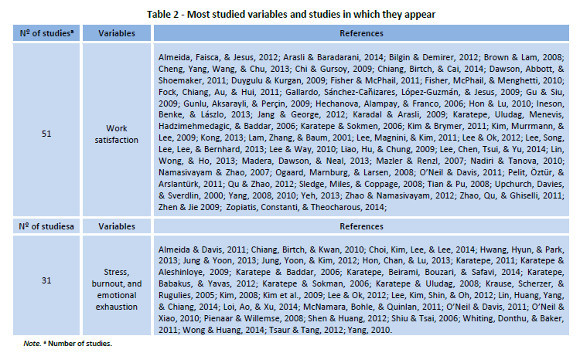
<p>&nbsp;</p>     <p>The title and abstract of the 3700 references were analysed. Of these, 450 were selected based on the inclusion and exclusion criteria. The repeated studies were subsequently removed, as well as those that checked the exclusion criteria. Thus, the final number of works was 242. These were then categorized by the authors’ name and concept addressed.</p>     <p>The following results were obtained: (a) job satisfaction (51 studies); (b) stress, burnout, and emotional exhaustion (31); (c) work involvement and performance (26); (d) intention to leave (23); (e) commitment (18); (f) conflicts (16); (g) interpersonal relations (12); (h) innovation and creativity (11); (i) general attitudes (10); (j) physical health (10); (k) life quality and well-being (9); (l) organizational citizenship behaviours (9); (m) leadership, engagement, individual characteristics, and personality (8); (n) culture and substance use (7); (o) affectivity, life satisfaction, empowerment, and career skills (6); (p) intention of staying and knowledge sharing (5); (q) coping, flexibility, emotional intelligence, wages, and employee retaining (4); (r) service and customer orientation, psychological contract, organizational support and confidence, leisure, and multiculturalism (3); (s) competence, confidence, brand awareness, and generational differences and similarities, work-life balance, team spirit, practices, feature and work results, trust, organizational cynicism, and perception of change (2); (t) competitiveness, gender, absenteeism, improper supervision, values, organizational policy, initiative, marital satisfaction, self-assessment, organizational justice, working conditions, beliefs, status, occupational health, loyalty, experience, strength and work value, seasonality, work practices, training, goal orientation, aggression, emotional dissonance, disability, learning, image, feedback, unemployment, tourism language, capacity, work integration, job control, deviant behaviours, psychological capital, entrepreneurship, personal resources, service orientation, work-family role, behavioural intention, mood, tourist involvement, alienation, counter-productivity, openness to change, career satisfaction, corporate social responsibility, productivity, harassment, and sexual discrimination (1).</p>     <p>In <a href="#t2">Table 2</a> we identify the studies related with the satisfaction of hospitality professionals, as well as stress, burnout, and emotional exhaustion. These concepts were selected given their importance to the organizational context. Job satisfaction is the most important work attitude, satisfied employees bring benefits to their organizations (Lease, 1998). The malaise factors (i.e., stress, burnout, and emotional exhaustion) may harm organizational performance, since they contribute to its decrease, so these concepts must deserve special attention from researchers and practitioners (Jesus, Miguel-Tobal, Rus, Viseu, &amp; Gamboa, 2014).</p>     <p>&nbsp;</p> <a name="t2"> <img src="/img/revistas/tms/v12n1/12n1a12t2.jpg"></p>     
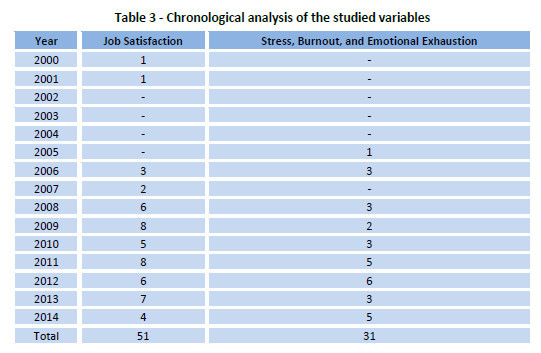
<p>&nbsp;</p>     <p>We verified, based on the results in <a href="#t2">Table 2</a> that, in the last 15 years, among the variables that were assessed, job satisfaction was the most studied variable, followed by stress, burnout, and emotional exhaustion. In <a href="#t3">Table 3</a> we present a chronological analysis of the studies. We observed that most of the studies were performed since 2010.</p>     <p>&nbsp;</p> <a name="t3"> <img src="/img/revistas/tms/v12n1/12n1a12t3.jpg"></p>     
<p>&nbsp;</p>     ]]></body>
<body><![CDATA[<p>Most studies emphasize the role of job satisfaction. We found that the variables related to satisfaction were: (a) the type of work (Sledge et al., 2008); (b) socialization (Gallardo et al., 2009; Pelit et al., 2011; Yang, 2008); (c) self-esteem, performance, independence, and initiative-taking (Gunlu et al., 2009); (d) ethical behaviour (Cheng et al., 2013; Lee et al., 2013); (e) commitment (Yeh, 2013); (f) personal satisfaction, social involvement, salaries, and benefits (Lam et al., 2001; Mazler &amp; Renzl, 2007; Qu &amp; Zhao, 2012); (g) directors entrepreneurial behaviour (Duygulu &amp; Kurgan, 2009; Kim &amp; Brymer, 2011); (h) training and support (Bilgin &amp; Demirer, 2012; Kong, 2013; Gu &amp; Siu, 2008); (i) openness to innovation (Lee et al., 2014); (j) competitiveness, self-efficacy, and effort (Karatepe et al., 2006); (k) organizational justice (Nadiri &amp; Tanova, 2010); (l) empowerment (Pelit et al., 2011); (m) growth opportunities and security (Tian &amp; Pu, 2008); (n) affective commitment, clear work roles, and autonomy (Yang, 2010; Zopiatis et al., 2014); (o) leadership (Arasli &amp; Baradarani, 2014); (p) the organization itself (Ogaard et al., 2008); and (q) age and gender (Tian &amp; Pu, 2008). Some of the factors that promote dissatisfaction were: (a) conflicts (Namasivayam &amp; Zhao, 2007; O'Neil &amp; Davis, 2011; Zhao et al., 2011; Zhao &amp; Namasivayam, 2012); (b) absence of professional training (Lam et al., 2001); (c) policies, management, and security (Sledge et al., 2008); (d) turnover (Pelit et al., 2011); (e) low wages (Gallardo et al., 2009; Pelit et al., 2011; Sledge et al., 2008); and (f) high variability in labour demand (Chiang et al., 2014.). Based on these results we can conclude that several aspects promote satisfaction and dissatisfaction among hotel employees. Hotel management must address these issues, given that there is: (a) a positive association between job satisfaction and financial performance (Fisher et al., 2010); (b) a direct link between customer satisfaction and financial performance; and (c) the existence of a relationship between customer and employee satisfaction (Chi &amp; Gursoy, 2009).</p>     <p>With regard to the second largest variable studied, stress, burnout, and emotional exhaustion, we observed that factors, such as: (a) less flexibility (Almeida &amp; Davis, 2011); (b) work responsibility, conflict, and low task control (Chiang et al., 2010; Hwang et al., 2013; Baddar &amp; Karatepe, 2006); (c) work environment (Jung &amp; Yoon, 2013); (d) reduced leisure time (Tsaur &amp; Tang, 2012); (e) interpersonal relationships and workload (O'Neil &amp; Davis, 2011); and (f) extended work schedule (Wong &amp; Huang, 2014), contributed to increased malaise. These factors weaken financial and work performance, which will have a negative impact on hotels. Intervention programs must be developed, at an individual and organizational level, to reduce the incidence of stress, burnout, and emotion exhaustion, and improve hotel functioning.</p>     <p>The obtained data demonstrated that job satisfaction is highly relevant for hotel employees. This concept has great importance both for individuals and organizations. We found that satisfaction relates to security (Fisher &amp; McPhail, 2011), work schedules, wages, and type of contract (Gallardo et al., 2009), and is decisive for financial competitiveness, satisfied employees are more productive and involved with work (Fisher, McPhail, &amp; Menghetti, 2010). Stress, burnout, and emotional exhaustion may contribute markedly to either the psychosocial discomfort or company imbalance. Some of the variables that contribute to the increased incidence of these aspects are: (a) conflicts; (b) excess of responsibility; (c) negative work environment; and (d) adverse interpersonal relationships. This situation may result in: (a) reduced employee well-being; (b) unsatisfactory service providing; and (c) low organizational competitiveness.</p>     <p>In sum, job satisfaction is associated with several work-related aspects meaning that it must be analysed meticulously. On the other hand, stress, burnout, and emotional exhaustion are aspects that impair organizational functioning. Human resource management must design strategies (e.g., intervention programs focused on individual strengths) for their elimination, these may improve employee health and, consequently, hotel performance.</p>     <p>&nbsp;</p>     <p><b>4.   Conclusions</b></p>     <p>Based on the analysed studies, job satisfaction and stress, burnout, and emotional exhaustion were the most studied variables in hotel employees. It is relevant to perform further researches on these variables, to ensure that the knowledge is adequate to the needs of hotels managers when it comes to boost employee’s performance and hotel growth, and avoid mismanagement and uncertainty. More knowledge provided from theses variables would help to implement better and new working conditions and specific staff training programs.</p>     <p>We can affirm that it is possible to increase the knowledge about the importance of satisfaction in the hotel industry to further knowledge about the mechanisms that are at its’ base, in order to promote individual and organizational satisfaction. This might promote direct and indirect growth and profitability to hotels. We suggest the study of this variable in this context to confirm the positive impact of job satisfaction in the performance and results of hotels. In terms of human resource management, studies would allow changes in the functioning and organization of services, increasing employee satisfaction and, consecutively, hotel profitability. Regarding stress, burnout, and emotional exhaustion, we suggest that an in-depth study of these variables would result in companies being able to implement a set of measures that may reduce their incidence and increase productivity and employees’ well-being. It appears, based on the studied variables, that although the tourism workers are crucial elements in the tourism context in general and hotels in particular, few studies were conducted in the last 15 years, which can lead to the occurrence of mismanagement errors and low efficiency in terms of human resources and hotel operation. Also, future studies should seek to deepen the research on the presented variables in this review, in order to determine the state of the art, by conducting a meta-analysis and equally developing studies with other relevant variables for the hotel context.</p>     <p>This review possesses some limitations worth considering. Firstly, the period of time considered. Choosing a longer time period would give a more accurate picture of the considered issues. The option for the period between 2000-2014 may have skewed our results. The selection of the most studied concepts might have excluded other variables that, although less studied, are equally relevant. However, given the lack of reviews on this subject, the authors chose to synthetize the variables with greater relevance, using the frequency of studies to assess this aspect.</p>     <p>Given the importance of maintaining a satisfied workforce and the need to reduce malaise symptoms, which will negatively affect organizational performance, hotel managers must adopt measures to promote satisfaction and reduce ill-being, these will benefit hotel bottom-line and service providing (Moura, Orgambídez-Ramos, &amp; Jesus, 2015). </p>     ]]></body>
<body><![CDATA[<p>&nbsp;</p>     <p><b>References</b></p>     <!-- ref --><p>Almeida, D., &amp; Davis, K. (2011). Workplace flexibility and daily stress processes in hotel employees and their children. <i>American Academy of Political and Social Sciences, 638</i>(1), 123-140. Doi: 10.1177/0002716211415608&nbsp;&nbsp;&nbsp;&nbsp;&nbsp;&nbsp;&nbsp;&nbsp;[&#160;<a href="javascript:void(0);" onclick="javascript: window.open('/scielo.php?script=sci_nlinks&ref=1258205&pid=S2182-8458201600010001200001&lng=','','width=640,height=500,resizable=yes,scrollbars=1,menubar=yes,');">Links</a>&#160;]<!-- end-ref --><!-- ref --><p>Almeida, M., Faisca, L., &amp; Jesus, S. (2012). Positive attitudes at work, some of its consequences and antecedents: A study with hotel professionals. <i>International Journal of Economics and Management Sciences, 6</i>(1), 71-82.    &nbsp;&nbsp;&nbsp;&nbsp;&nbsp;&nbsp;&nbsp;&nbsp;[&#160;<a href="javascript:void(0);" onclick="javascript: window.open('/scielo.php?script=sci_nlinks&ref=1258206&pid=S2182-8458201600010001200002&lng=','','width=640,height=500,resizable=yes,scrollbars=1,menubar=yes,');">Links</a>&#160;]<!-- end-ref --> </p>     <!-- ref --><p>Arasli, H., &amp; Baradarani, S. (2014). Role of job satisfaction in the relationship of business excellence and OCB: Iranian hospitality industry. <i>Procedia-Social and Behavioural Sciences, 109</i>, 1406-1415. Doi: 10.1016/j.sbspro.2013.12.644&nbsp;&nbsp;&nbsp;&nbsp;&nbsp;&nbsp;&nbsp;&nbsp;[&#160;<a href="javascript:void(0);" onclick="javascript: window.open('/scielo.php?script=sci_nlinks&ref=1258208&pid=S2182-8458201600010001200003&lng=','','width=640,height=500,resizable=yes,scrollbars=1,menubar=yes,');">Links</a>&#160;]<!-- end-ref --><!-- ref --><p>Ariffin, A. (2013). Generic dimensionality of hospitality in the hotel industry: A host-guest relationship perspective. <i>International Journal of Hospitality Management, 35</i>, 171-179. Doi: 10.1016/j.ijhm.2013.06.002&nbsp;&nbsp;&nbsp;&nbsp;&nbsp;&nbsp;&nbsp;&nbsp;[&#160;<a href="javascript:void(0);" onclick="javascript: window.open('/scielo.php?script=sci_nlinks&ref=1258209&pid=S2182-8458201600010001200004&lng=','','width=640,height=500,resizable=yes,scrollbars=1,menubar=yes,');">Links</a>&#160;]<!-- end-ref --><!-- ref --><p>Ariffin, A., Maghzi, A., &amp; Aziz, N. (2011). Understanding hotel hospitality and differences between local and foreign guests. <i>International Review of Business Research Papers, 7</i>(1)<i>,</i> 340-349.    &nbsp;&nbsp;&nbsp;&nbsp;&nbsp;&nbsp;&nbsp;&nbsp;[&#160;<a href="javascript:void(0);" onclick="javascript: window.open('/scielo.php?script=sci_nlinks&ref=1258210&pid=S2182-8458201600010001200005&lng=','','width=640,height=500,resizable=yes,scrollbars=1,menubar=yes,');">Links</a>&#160;]<!-- end-ref --></p>     <!-- ref --><p>Bilgin, N., &amp; Demirer, H. (2012). The examination of the relationship among organizational support, affective commitment and job satisfaction of hotel employees. <i>Procedia, Social and Behavioural Sciences, 51</i>, 470-473. Doi: 10.1016/j.sbspro.2012.08.191&nbsp;&nbsp;&nbsp;&nbsp;&nbsp;&nbsp;&nbsp;&nbsp;[&#160;<a href="javascript:void(0);" onclick="javascript: window.open('/scielo.php?script=sci_nlinks&ref=1258212&pid=S2182-8458201600010001200006&lng=','','width=640,height=500,resizable=yes,scrollbars=1,menubar=yes,');">Links</a>&#160;]<!-- end-ref --><!-- ref --><p>Brown, S., &amp; Lam, S. (2008). A meta-analysis of relationships linking employee satisfaction to customer responses. <i>Journal of Retailing, 84</i>(3), 243-255. Doi: 10.1016/j.jretai.2008.06.001&nbsp;&nbsp;&nbsp;&nbsp;&nbsp;&nbsp;&nbsp;&nbsp;[&#160;<a href="javascript:void(0);" onclick="javascript: window.open('/scielo.php?script=sci_nlinks&ref=1258213&pid=S2182-8458201600010001200007&lng=','','width=640,height=500,resizable=yes,scrollbars=1,menubar=yes,');">Links</a>&#160;]<!-- end-ref --><!-- ref --><p>Cheng, P., Yang, J., Wang, C., &amp; Chu, M. (2013). Ethical contexts and employee job responses in the hotel industry: The role of work values and perceived organizational support. <i>International Journal of Hospitality Management, 34</i>, 108-115. Doi: 10.1016/j.ijhm.2013.03.007&nbsp;&nbsp;&nbsp;&nbsp;&nbsp;&nbsp;&nbsp;&nbsp;[&#160;<a href="javascript:void(0);" onclick="javascript: window.open('/scielo.php?script=sci_nlinks&ref=1258214&pid=S2182-8458201600010001200008&lng=','','width=640,height=500,resizable=yes,scrollbars=1,menubar=yes,');">Links</a>&#160;]<!-- end-ref --><!-- ref --><p>Chi, C., &amp; Gursoy, D. (2009). Employee satisfaction, costumer satisfaction, and financial performance: An empirical examination.<i> International Journal of Hospitality Management</i>,<i> 28</i>(2), 245-253. Doi: 10.1016/j.ijhm.2008.08.003&nbsp;&nbsp;&nbsp;&nbsp;&nbsp;&nbsp;&nbsp;&nbsp;[&#160;<a href="javascript:void(0);" onclick="javascript: window.open('/scielo.php?script=sci_nlinks&ref=1258215&pid=S2182-8458201600010001200009&lng=','','width=640,height=500,resizable=yes,scrollbars=1,menubar=yes,');">Links</a>&#160;]<!-- end-ref --><!-- ref --><p>Chiang, F., Birtch, T., &amp; Cai, Z. (2014). Front-line service employee’s job satisfaction in the hospitality industry: The influence of job demand variability and the moderating roles of job content and job context factors. <i>Cornell Hospitality Quarterly</i>, <i>55</i>(4), 398-407. Doi: 10.1177/1938965513514628&nbsp;&nbsp;&nbsp;&nbsp;&nbsp;&nbsp;&nbsp;&nbsp;[&#160;<a href="javascript:void(0);" onclick="javascript: window.open('/scielo.php?script=sci_nlinks&ref=1258216&pid=S2182-8458201600010001200010&lng=','','width=640,height=500,resizable=yes,scrollbars=1,menubar=yes,');">Links</a>&#160;]<!-- end-ref --><!-- ref --><p>Chiang, F., Birtch, T., &amp; Kwan, H. (2010). The moderating roles of job control and work-life balance practices on employee stress in the hotel and catering industry. <i>International Journal of Hospitality Management, 29</i>(1), 25-32. Doi: 10.1016/j.ijhm.2009.04.005&nbsp;&nbsp;&nbsp;&nbsp;&nbsp;&nbsp;&nbsp;&nbsp;[&#160;<a href="javascript:void(0);" onclick="javascript: window.open('/scielo.php?script=sci_nlinks&ref=1258217&pid=S2182-8458201600010001200011&lng=','','width=640,height=500,resizable=yes,scrollbars=1,menubar=yes,');">Links</a>&#160;]<!-- end-ref --><!-- ref --><p>Choi, C., Kim, T., Lee, G., &amp; Lee, S. (2014). Testing the stressor–strain-outcome model of customer-related social stressors in predicting emotional exhaustion, customer orientation and service recovery performance. <i>International Journal of Hospitality Management, 36</i>, 272-285. Doi: 10.1016/j.ijhm.2012.09.009&nbsp;&nbsp;&nbsp;&nbsp;&nbsp;&nbsp;&nbsp;&nbsp;[&#160;<a href="javascript:void(0);" onclick="javascript: window.open('/scielo.php?script=sci_nlinks&ref=1258218&pid=S2182-8458201600010001200012&lng=','','width=640,height=500,resizable=yes,scrollbars=1,menubar=yes,');">Links</a>&#160;]<!-- end-ref --><!-- ref --><p>Cunha, L. (2013). <i>Economia e política do turismo</i>. Lisboa: Lidel.    &nbsp;&nbsp;&nbsp;&nbsp;&nbsp;&nbsp;&nbsp;&nbsp;[&#160;<a href="javascript:void(0);" onclick="javascript: window.open('/scielo.php?script=sci_nlinks&ref=1258219&pid=S2182-8458201600010001200013&lng=','','width=640,height=500,resizable=yes,scrollbars=1,menubar=yes,');">Links</a>&#160;]<!-- end-ref --></p>     <!-- ref --><p>Dawson, M., Abbott, J., &amp; Shoemaker, S. (2011). The hospitality culture scale: A measure organizational culture and personal attributes. <i>International Journal of Hospitality Management, 30</i>(2), 290-300. Doi: 10.1016/j.ijhm.2010.10.002&nbsp;&nbsp;&nbsp;&nbsp;&nbsp;&nbsp;&nbsp;&nbsp;[&#160;<a href="javascript:void(0);" onclick="javascript: window.open('/scielo.php?script=sci_nlinks&ref=1258221&pid=S2182-8458201600010001200014&lng=','','width=640,height=500,resizable=yes,scrollbars=1,menubar=yes,');">Links</a>&#160;]<!-- end-ref --><!-- ref --><p>Duygulu, E., &amp; Kurgan, O. (2009). The effect of managerial entrepreneurship on employee satisfaction: Hospitality manager’s dilemma. <i>African Journal of Business Management, 3</i>(11)<i>,</i> 715-726. Doi: 10.5897/AJBM09.235&nbsp;&nbsp;&nbsp;&nbsp;&nbsp;&nbsp;&nbsp;&nbsp;[&#160;<a href="javascript:void(0);" onclick="javascript: window.open('/scielo.php?script=sci_nlinks&ref=1258222&pid=S2182-8458201600010001200015&lng=','','width=640,height=500,resizable=yes,scrollbars=1,menubar=yes,');">Links</a>&#160;]<!-- end-ref --><!-- ref --><p>Eurostat (2012). <i>Tourism statistics</i>. Retrieved at April 22<sup>nd</sup> de 2014 from <a href="http://epp.eurostat.ec.europa.eu/statistics_explained/extensions/EurostatPDFGenerator/getfile.php?file=81.84.159.234_1398501875_34.pdf(2"target="_blank">http://epp.eurostat.ec.europa.eu/statistics_explained/extensions/EurostatPDFGenerator/getfile.php?file=81.84.159.234_1398501875_34.pdf(2</a>)&nbsp;&nbsp;&nbsp;&nbsp;&nbsp;&nbsp;&nbsp;&nbsp;[&#160;<a href="javascript:void(0);" onclick="javascript: window.open('/scielo.php?script=sci_nlinks&ref=1258223&pid=S2182-8458201600010001200016&lng=','','width=640,height=500,resizable=yes,scrollbars=1,menubar=yes,');">Links</a>&#160;]<!-- end-ref --><!-- ref --><p>Eurostat (2013a). <i>Manuals and guidelines</i>. Retrieved at April 23<sup>rd</sup> 2014 from&nbsp;&nbsp;&nbsp;&nbsp;&nbsp;&nbsp;&nbsp;&nbsp;[&#160;<a href="javascript:void(0);" onclick="javascript: window.open('/scielo.php?script=sci_nlinks&ref=1258224&pid=S2182-8458201600010001200017&lng=','','width=640,height=500,resizable=yes,scrollbars=1,menubar=yes,');">Links</a>&#160;]<!-- end-ref --><!-- ref --><p>Eurostat (2013b). <i>Tourism statistics</i>. Retrieved at April 22<sup>nd</sup> 2014 from <a href="http://epp.eurostat.ec.europa.eu/cache/ITY_OFFPUB/KS-TC-13-006/EN/KS-TC-13-006-EN.PDF(6)"target="_blank">http://epp.eurostat.ec.europa.eu/cache/ITY_OFFPUB/KS-TC-13-006/EN/KS-TC-13-006-EN.PDF(6)</a>&nbsp;&nbsp;&nbsp;&nbsp;&nbsp;&nbsp;&nbsp;&nbsp;[&#160;<a href="javascript:void(0);" onclick="javascript: window.open('/scielo.php?script=sci_nlinks&ref=1258225&pid=S2182-8458201600010001200018&lng=','','width=640,height=500,resizable=yes,scrollbars=1,menubar=yes,');">Links</a>&#160;]<!-- end-ref --><!-- ref --><p>Eurostat (2014). <i>Tourism statistics</i>. Retrieved at April 22<sup>nd</sup> 2014 from <a href="http://europa.eu/rapid/press-release_STAT-14-16_en.htm(3"target="_blank">http://europa.eu/rapid/press-release_STAT-14-16_en.htm(3</a>)&nbsp;&nbsp;&nbsp;&nbsp;&nbsp;&nbsp;&nbsp;&nbsp;[&#160;<a href="javascript:void(0);" onclick="javascript: window.open('/scielo.php?script=sci_nlinks&ref=1258226&pid=S2182-8458201600010001200019&lng=','','width=640,height=500,resizable=yes,scrollbars=1,menubar=yes,');">Links</a>&#160;]<!-- end-ref --><!-- ref --><p>Fisher, R., &amp; McPhail, R. (2011). Internal labour markets as a strategic tool: A comparative study of UK and Chinese hotels. <i>The Service Industries Journal</i>, <i>31</i>(2), 137-152. Doi: 10.1080/02642060802644942&nbsp;&nbsp;&nbsp;&nbsp;&nbsp;&nbsp;&nbsp;&nbsp;[&#160;<a href="javascript:void(0);" onclick="javascript: window.open('/scielo.php?script=sci_nlinks&ref=1258227&pid=S2182-8458201600010001200020&lng=','','width=640,height=500,resizable=yes,scrollbars=1,menubar=yes,');">Links</a>&#160;]<!-- end-ref --><!-- ref --><p>Fisher, R., McPhail, R., &amp; Menghetti, G. (2010). Linking employee attitudes and behaviours with business performance: A comparative analysis of hotels in Mexico and China. <i>International Journal of Hospitality Management, 29</i>(3), 397-404. Doi: 10.1016/j.ijhm.2009.10.021&nbsp;&nbsp;&nbsp;&nbsp;&nbsp;&nbsp;&nbsp;&nbsp;[&#160;<a href="javascript:void(0);" onclick="javascript: window.open('/scielo.php?script=sci_nlinks&ref=1258228&pid=S2182-8458201600010001200021&lng=','','width=640,height=500,resizable=yes,scrollbars=1,menubar=yes,');">Links</a>&#160;]<!-- end-ref --><!-- ref --><p>Fock, H., Chiang, F., Au, K., &amp; Hui, M. (2011). The moderating effect of collectivistic orientation in psychological empowerment and job satisfaction relationship. <i>International Journal of Hospitality Management, 30</i>(2)<i>,</i> 319-328. Doi: 10.1016/j.ijhm.2010.08.002&nbsp;&nbsp;&nbsp;&nbsp;&nbsp;&nbsp;&nbsp;&nbsp;[&#160;<a href="javascript:void(0);" onclick="javascript: window.open('/scielo.php?script=sci_nlinks&ref=1258229&pid=S2182-8458201600010001200022&lng=','','width=640,height=500,resizable=yes,scrollbars=1,menubar=yes,');">Links</a>&#160;]<!-- end-ref --><!-- ref --><p>Gallardo, E., Sánchez-Cañizares, S-M., López-Guzmán, T., &amp; Jesus, M. (2009). Employee satisfaction in the Iberian hotel industry: The case of Andalucía (Spain) and the Algarve (Portugal). <i>International Journal of Contemporary Hospitality Management</i>, <i>22</i>(3), 321-334. Doi: 10.1108/09596111011035936&nbsp;&nbsp;&nbsp;&nbsp;&nbsp;&nbsp;&nbsp;&nbsp;[&#160;<a href="javascript:void(0);" onclick="javascript: window.open('/scielo.php?script=sci_nlinks&ref=1258230&pid=S2182-8458201600010001200023&lng=','','width=640,height=500,resizable=yes,scrollbars=1,menubar=yes,');">Links</a>&#160;]<!-- end-ref --><!-- ref --><p>Gu, Z., &amp; Siu, R. (2009). Drivers of job satisfaction as related to works performance in Macao casino hotels: An investigation based on employee survey. <i>International Journal of Contemporary Hospitality Management, 21</i>(5), 561-578. Doi: 10.1108/09596110910967808&nbsp;&nbsp;&nbsp;&nbsp;&nbsp;&nbsp;&nbsp;&nbsp;[&#160;<a href="javascript:void(0);" onclick="javascript: window.open('/scielo.php?script=sci_nlinks&ref=1258231&pid=S2182-8458201600010001200024&lng=','','width=640,height=500,resizable=yes,scrollbars=1,menubar=yes,');">Links</a>&#160;]<!-- end-ref --><!-- ref --><p>Gunlu, E., Aksarayli, M., &amp; Perçin, N. S. (2009). <i>International Journal of Contemporary Hospitality Management</i>, <i>22</i>(5), 693-717. Doi: 10.1108/09596111011053819&nbsp;&nbsp;&nbsp;&nbsp;&nbsp;&nbsp;&nbsp;&nbsp;[&#160;<a href="javascript:void(0);" onclick="javascript: window.open('/scielo.php?script=sci_nlinks&ref=1258232&pid=S2182-8458201600010001200025&lng=','','width=640,height=500,resizable=yes,scrollbars=1,menubar=yes,');">Links</a>&#160;]<!-- end-ref --><!-- ref --><p>Hechanova, M. R. M., Alampay, R. B. A., &amp; Franco, E. P. (2006). Psychological empowerment, job satisfaction and performance among Filipino service workers. <i>Asian Journal of Social Psychology</i>, <i>9</i>(1), 72-78. Doi: 10.1111/j.1467-839X.2006.00177.x&nbsp;&nbsp;&nbsp;&nbsp;&nbsp;&nbsp;&nbsp;&nbsp;[&#160;<a href="javascript:void(0);" onclick="javascript: window.open('/scielo.php?script=sci_nlinks&ref=1258233&pid=S2182-8458201600010001200026&lng=','','width=640,height=500,resizable=yes,scrollbars=1,menubar=yes,');">Links</a>&#160;]<!-- end-ref --><!-- ref --><p>Hon, A., &amp; Lu, L. (2010). The mediating role of trust between expatriate procedural justice and employee outcomes in Chinese hotel industry.<i> International Journal of Hospitality Management, 29</i>(4), 669-676. Doi: 10.1016/j.ijhm.2010.01.002&nbsp;&nbsp;&nbsp;&nbsp;&nbsp;&nbsp;&nbsp;&nbsp;[&#160;<a href="javascript:void(0);" onclick="javascript: window.open('/scielo.php?script=sci_nlinks&ref=1258234&pid=S2182-8458201600010001200027&lng=','','width=640,height=500,resizable=yes,scrollbars=1,menubar=yes,');">Links</a>&#160;]<!-- end-ref --><!-- ref --><p>Hon, A., Chan, W., &amp; Lu, L. (2013). Overcoming work-related stress and promoting employee creativity in hotel industry: The role of task feedback from supervisor. <i>International Journal of Hospitality Management</i>, 33, 416-424. Doi: 10.1016/j.ijhm.2012.11.001&nbsp;&nbsp;&nbsp;&nbsp;&nbsp;&nbsp;&nbsp;&nbsp;[&#160;<a href="javascript:void(0);" onclick="javascript: window.open('/scielo.php?script=sci_nlinks&ref=1258235&pid=S2182-8458201600010001200028&lng=','','width=640,height=500,resizable=yes,scrollbars=1,menubar=yes,');">Links</a>&#160;]<!-- end-ref --><!-- ref --><p>Hwang, J., Hyun, S., &amp; Park, J. (2013). Segmentation of hotel employees by occupational stress and differences in demographic characteristics. <i>Asia Pacific Journal of Tourism Research</i>, 18(3), 241-261. Doi: 10.1080/10941665.2011.647040&nbsp;&nbsp;&nbsp;&nbsp;&nbsp;&nbsp;&nbsp;&nbsp;[&#160;<a href="javascript:void(0);" onclick="javascript: window.open('/scielo.php?script=sci_nlinks&ref=1258236&pid=S2182-8458201600010001200029&lng=','','width=640,height=500,resizable=yes,scrollbars=1,menubar=yes,');">Links</a>&#160;]<!-- end-ref --><!-- ref --><p>*Ineson, E., Benke, E., &amp; Lászlo, J. (2013). Employee loyalty in Hungarian hotels. <i>International Journal of Hospitality Management</i>, 32, 31-39. Doi: 10.1016/j.ijhm.2012.04.001&nbsp;&nbsp;&nbsp;&nbsp;&nbsp;&nbsp;&nbsp;&nbsp;[&#160;<a href="javascript:void(0);" onclick="javascript: window.open('/scielo.php?script=sci_nlinks&ref=1258237&pid=S2182-8458201600010001200030&lng=','','width=640,height=500,resizable=yes,scrollbars=1,menubar=yes,');">Links</a>&#160;]<!-- end-ref --><!-- ref --><p>Instituto Nacional de estatísticas (INE) (2012). Estatísticas do turismo 2012. Retrieved on April 22 from <a href="http://europa.eu/rapid/press-release_STAT-14-16_en.htm(3)"target="_blank">http://www.ine.pt/xportal/xmain?xpid=INE&amp;xpgid=ine_publicacoes&amp;PUBLICACOESpub_boui=143016657&amp;PUBLICACOESmodo=2</a>&nbsp;&nbsp;&nbsp;&nbsp;&nbsp;&nbsp;&nbsp;&nbsp;[&#160;<a href="javascript:void(0);" onclick="javascript: window.open('/scielo.php?script=sci_nlinks&ref=1258238&pid=S2182-8458201600010001200031&lng=','','width=640,height=500,resizable=yes,scrollbars=1,menubar=yes,');">Links</a>&#160;]<!-- end-ref --><!-- ref --><p>Jang, J., &amp; George, R. (2012). Understanding the influence of polychronicity on job satisfaction and turnover intention: A study on non-supervisory hotel employees. <i>International Journal of Hospitality Management</i>, 31(2), 588-595. Doi: 10.1016/j.ijhm.2011.08.004&nbsp;&nbsp;&nbsp;&nbsp;&nbsp;&nbsp;&nbsp;&nbsp;[&#160;<a href="javascript:void(0);" onclick="javascript: window.open('/scielo.php?script=sci_nlinks&ref=1258239&pid=S2182-8458201600010001200032&lng=','','width=640,height=500,resizable=yes,scrollbars=1,menubar=yes,');">Links</a>&#160;]<!-- end-ref --><!-- ref --><p>Jesus, S. N., Miguel-Tobal, J., Rus, C., Viseu, J., &amp; Gamboa, V. (2014). Evaluating the effectiveness of a stress management training on teachers and physicians’ stress related outcomes. <i>Clínica y Salud</i>, 25, 111-115. doi: 10.1016/j.clysa.2014.06.004&nbsp;&nbsp;&nbsp;&nbsp;&nbsp;&nbsp;&nbsp;&nbsp;[&#160;<a href="javascript:void(0);" onclick="javascript: window.open('/scielo.php?script=sci_nlinks&ref=1258240&pid=S2182-8458201600010001200033&lng=','','width=640,height=500,resizable=yes,scrollbars=1,menubar=yes,');">Links</a>&#160;]<!-- end-ref --><!-- ref --><p>Jung, H., &amp; Yoon, H. (2013). Is the individual or the organization the cause of hotel employees’ stress? A longitudinal study on differences in role stress between subjects. <i>International Journal of Hospitality Management</i>, 33, 494-499. Doi: 10.1016/j.ijhm.2012.12.005&nbsp;&nbsp;&nbsp;&nbsp;&nbsp;&nbsp;&nbsp;&nbsp;[&#160;<a href="javascript:void(0);" onclick="javascript: window.open('/scielo.php?script=sci_nlinks&ref=1258241&pid=S2182-8458201600010001200034&lng=','','width=640,height=500,resizable=yes,scrollbars=1,menubar=yes,');">Links</a>&#160;]<!-- end-ref --><!-- ref --><p>Jung, H., Yoon, H., &amp; Kim, Y. (2012). Effects of culinary employees’ role stress on burnout and turnover intention in hotel industry: Moderating effects on employees’ tenure. <i>The Service Industries Journal</i>, 32(13), 2145-2165. Doi: 10.1080/02642069.2011.574277&nbsp;&nbsp;&nbsp;&nbsp;&nbsp;&nbsp;&nbsp;&nbsp;[&#160;<a href="javascript:void(0);" onclick="javascript: window.open('/scielo.php?script=sci_nlinks&ref=1258242&pid=S2182-8458201600010001200035&lng=','','width=640,height=500,resizable=yes,scrollbars=1,menubar=yes,');">Links</a>&#160;]<!-- end-ref --><!-- ref --><p>Karadal, H., &amp; Arasli, H. (2009). The impact of superior politics on frontline employees’ behavioural and psychological outcomes. <i>Social Behaviour and Personality: An International Journal</i>, 37(2), 175-190. Doi: 10.2224/sbp.37.2.175&nbsp;&nbsp;&nbsp;&nbsp;&nbsp;&nbsp;&nbsp;&nbsp;[&#160;<a href="javascript:void(0);" onclick="javascript: window.open('/scielo.php?script=sci_nlinks&ref=1258243&pid=S2182-8458201600010001200036&lng=','','width=640,height=500,resizable=yes,scrollbars=1,menubar=yes,');">Links</a>&#160;]<!-- end-ref --><!-- ref --><p>Karatape, O., &amp; Uludag, O. (2008). Affectivity, conflicts in the work-family interface, and hotel employees outcomes. <i>International Journal of Hospitality Management</i>, 27(1), 30-41. Doi: 10.1016/j.ijhm.2007.07.001&nbsp;&nbsp;&nbsp;&nbsp;&nbsp;&nbsp;&nbsp;&nbsp;[&#160;<a href="javascript:void(0);" onclick="javascript: window.open('/scielo.php?script=sci_nlinks&ref=1258244&pid=S2182-8458201600010001200037&lng=','','width=640,height=500,resizable=yes,scrollbars=1,menubar=yes,');">Links</a>&#160;]<!-- end-ref --><!-- ref --><p>Karatepe, O. (2011). Customer aggression, emotional exhaustion, and hotel employee outcome: A study in the United Arab Emirates. <i>Journal of Travel &amp; Tourism Marketing</i>, 28(3), 279-295. Doi: 10.1080/10548408.2011.562855&nbsp;&nbsp;&nbsp;&nbsp;&nbsp;&nbsp;&nbsp;&nbsp;[&#160;<a href="javascript:void(0);" onclick="javascript: window.open('/scielo.php?script=sci_nlinks&ref=1258245&pid=S2182-8458201600010001200038&lng=','','width=640,height=500,resizable=yes,scrollbars=1,menubar=yes,');">Links</a>&#160;]<!-- end-ref --><!-- ref --><p>Karatepe, O. M., Uludag, O., Menevis, I., Hadzimehmedagic, L., &amp; Baddar, L. (2006). The effects of selected individual characteristics on frontline employee performance and job satisfaction. <i>Tourism Management</i>, 27(4), 547-560. Doi: 10.1016/j.tourman.2005.02.009&nbsp;&nbsp;&nbsp;&nbsp;&nbsp;&nbsp;&nbsp;&nbsp;[&#160;<a href="javascript:void(0);" onclick="javascript: window.open('/scielo.php?script=sci_nlinks&ref=1258246&pid=S2182-8458201600010001200039&lng=','','width=640,height=500,resizable=yes,scrollbars=1,menubar=yes,');">Links</a>&#160;]<!-- end-ref --><!-- ref --><p>Karatepe, O. M., &amp; Sokmen, A. (2006). The effects of work role and family role variables on psychological and behavioural outcomes of frontline employees. <i>Tourism Management</i>, 27(2), 255-268. Doi: 10.1016/j.tourman.2004.10.001&nbsp;&nbsp;&nbsp;&nbsp;&nbsp;&nbsp;&nbsp;&nbsp;[&#160;<a href="javascript:void(0);" onclick="javascript: window.open('/scielo.php?script=sci_nlinks&ref=1258247&pid=S2182-8458201600010001200040&lng=','','width=640,height=500,resizable=yes,scrollbars=1,menubar=yes,');">Links</a>&#160;]<!-- end-ref --><!-- ref --><p>Karatepe, O., &amp; Aleshinloye, K. (2009). Emotional dissonance and emotional exhaustion among hotel employees in Nigeria. <i>International Journal of Hospitality Management</i>, 28(3), 349-358. Doi: 10.1016/j.ijhm.2008.12.002&nbsp;&nbsp;&nbsp;&nbsp;&nbsp;&nbsp;&nbsp;&nbsp;[&#160;<a href="javascript:void(0);" onclick="javascript: window.open('/scielo.php?script=sci_nlinks&ref=1258248&pid=S2182-8458201600010001200041&lng=','','width=640,height=500,resizable=yes,scrollbars=1,menubar=yes,');">Links</a>&#160;]<!-- end-ref --><!-- ref --><p>Karatepe, O., &amp; Baddar, L. (2006). An empirical study of selected consequences of frontline employees’ work-family conflict and family-work conflict. <i>Tourism Management</i>, 27(5), 1017-1028. Doi: 10.1016/j.tourman.2005.10.024&nbsp;&nbsp;&nbsp;&nbsp;&nbsp;&nbsp;&nbsp;&nbsp;[&#160;<a href="javascript:void(0);" onclick="javascript: window.open('/scielo.php?script=sci_nlinks&ref=1258249&pid=S2182-8458201600010001200042&lng=','','width=640,height=500,resizable=yes,scrollbars=1,menubar=yes,');">Links</a>&#160;]<!-- end-ref --><!-- ref --><p>Karatepe, O., Babakus, E., &amp; Yavas, U. (2012). Affectivity and organizational politics as antecedents of burnout among frontline hotel employees. <i>International Journal of Hospitality Management</i>, 31(1), 66-75. Doi: 10.1016/j.ijhm.2011.04.003&nbsp;&nbsp;&nbsp;&nbsp;&nbsp;&nbsp;&nbsp;&nbsp;[&#160;<a href="javascript:void(0);" onclick="javascript: window.open('/scielo.php?script=sci_nlinks&ref=1258250&pid=S2182-8458201600010001200043&lng=','','width=640,height=500,resizable=yes,scrollbars=1,menubar=yes,');">Links</a>&#160;]<!-- end-ref --><!-- ref --><p>Karatepe, O., Beirami, E., Bouzari, M., &amp; Safavi, H. (2014). Does work engagement mediate the effects of challenge stressors on job outcomes? Evidence from the hotel industry. <i>International Journal of Hospitality Management</i>, 36, 14-22. Doi: 10.1016/j.ijhm.2013.08.003&nbsp;&nbsp;&nbsp;&nbsp;&nbsp;&nbsp;&nbsp;&nbsp;[&#160;<a href="javascript:void(0);" onclick="javascript: window.open('/scielo.php?script=sci_nlinks&ref=1258251&pid=S2182-8458201600010001200044&lng=','','width=640,height=500,resizable=yes,scrollbars=1,menubar=yes,');">Links</a>&#160;]<!-- end-ref --><!-- ref --><p>Kim, B., Murrmann, S., &amp; Lee, G. (2009). Moderating effect of gender and organizational level between role stress and job satisfaction among hotel employees. <i>International Journal of Hospitality Management</i>, 28(4), 612-619. Doi: 10.1016/j.ijhm.2009.04.001&nbsp;&nbsp;&nbsp;&nbsp;&nbsp;&nbsp;&nbsp;&nbsp;[&#160;<a href="javascript:void(0);" onclick="javascript: window.open('/scielo.php?script=sci_nlinks&ref=1258252&pid=S2182-8458201600010001200045&lng=','','width=640,height=500,resizable=yes,scrollbars=1,menubar=yes,');">Links</a>&#160;]<!-- end-ref --><!-- ref --><p>Kim, H. (2008). Hotel service providers’ emotional labour: The antecedents and effect on burnout. <i>International Journal of Hospitality Management</i>, 27(2), 151-161. Doi: 10.1016/j.ijhm.2007.07.019&nbsp;&nbsp;&nbsp;&nbsp;&nbsp;&nbsp;&nbsp;&nbsp;[&#160;<a href="javascript:void(0);" onclick="javascript: window.open('/scielo.php?script=sci_nlinks&ref=1258253&pid=S2182-8458201600010001200046&lng=','','width=640,height=500,resizable=yes,scrollbars=1,menubar=yes,');">Links</a>&#160;]<!-- end-ref --><!-- ref --><p>Kim, W., &amp; Brymer, R. (2011). The effects of ethical leadership on manager job satisfaction, commitment, behavioural outcomes, and firm performance. <i>International Journal of Hospitality Management</i>, 30(4), 1020-1026. Doi: 10.1016/j.ijhm.2011.03.008&nbsp;&nbsp;&nbsp;&nbsp;&nbsp;&nbsp;&nbsp;&nbsp;[&#160;<a href="javascript:void(0);" onclick="javascript: window.open('/scielo.php?script=sci_nlinks&ref=1258254&pid=S2182-8458201600010001200047&lng=','','width=640,height=500,resizable=yes,scrollbars=1,menubar=yes,');">Links</a>&#160;]<!-- end-ref --><!-- ref --><p>Kong, H. (2013). Relationship among work-family supportive supervisors, career competencies, and job involvement. <i>International Journal of Hospitality Management</i>, 33, 304-309. Doi: 10.1016/j.ijhm.2012.09.006&nbsp;&nbsp;&nbsp;&nbsp;&nbsp;&nbsp;&nbsp;&nbsp;[&#160;<a href="javascript:void(0);" onclick="javascript: window.open('/scielo.php?script=sci_nlinks&ref=1258255&pid=S2182-8458201600010001200048&lng=','','width=640,height=500,resizable=yes,scrollbars=1,menubar=yes,');">Links</a>&#160;]<!-- end-ref --><!-- ref --><p>Krause, N., Scherzer, T., &amp; Rugulies, R. (2005). Physical workload, work intensification, and prevalence of pain in low wage workers: Results from a participatory research project with hotel room cleaners in Las Vegas. <i>American Journal of Industrial Medicine</i>, 48(5), 326-337. Doi: 10.1002/ajim.20221&nbsp;&nbsp;&nbsp;&nbsp;&nbsp;&nbsp;&nbsp;&nbsp;[&#160;<a href="javascript:void(0);" onclick="javascript: window.open('/scielo.php?script=sci_nlinks&ref=1258256&pid=S2182-8458201600010001200049&lng=','','width=640,height=500,resizable=yes,scrollbars=1,menubar=yes,');">Links</a>&#160;]<!-- end-ref --><!-- ref --><p>Lam, T., Zhang, H., &amp; Baum, T. (2001). An investigation of employees’ job satisfaction: The case of hotels in Hong Kong. <i>Tourism Management</i>, 22(2), 157-165. Doi: 10.1016/S0261-5177(00)00039-X&nbsp;&nbsp;&nbsp;&nbsp;&nbsp;&nbsp;&nbsp;&nbsp;[&#160;<a href="javascript:void(0);" onclick="javascript: window.open('/scielo.php?script=sci_nlinks&ref=1258257&pid=S2182-8458201600010001200050&lng=','','width=640,height=500,resizable=yes,scrollbars=1,menubar=yes,');">Links</a>&#160;]<!-- end-ref --><!-- ref --><p>Lease, S. (1998). Annual review, 1993-1997: Work attitudes and outcomes. <i>Journal of Vocational Behavior</i>, 53, 154-183. doi: 10.1006/jvbe.1998.1662&nbsp;&nbsp;&nbsp;&nbsp;&nbsp;&nbsp;&nbsp;&nbsp;[&#160;<a href="javascript:void(0);" onclick="javascript: window.open('/scielo.php?script=sci_nlinks&ref=1258258&pid=S2182-8458201600010001200051&lng=','','width=640,height=500,resizable=yes,scrollbars=1,menubar=yes,');">Links</a>&#160;]<!-- end-ref --><!-- ref --><p>Lee, C., &amp; Way, K. (2010). Individual employment characteristics of hotel employees that play a role in employee satisfaction and work retention. <i>International Journal of Hospitality Management</i>, 29(3), 344-353. Doi: 10.1016/j.ijhm.2009.08.008&nbsp;&nbsp;&nbsp;&nbsp;&nbsp;&nbsp;&nbsp;&nbsp;[&#160;<a href="javascript:void(0);" onclick="javascript: window.open('/scielo.php?script=sci_nlinks&ref=1258259&pid=S2182-8458201600010001200052&lng=','','width=640,height=500,resizable=yes,scrollbars=1,menubar=yes,');">Links</a>&#160;]<!-- end-ref --><!-- ref --><p>Lee, C., Song, H., Lee, H., Lee, S., &amp; Bernhard, B. (2013). The impact of CSR on casino employees’ organizational trust, job satisfaction, and customer orientation: An empirical examination of responsible gambling strategies. <i>International Journal of Hospitality Management</i>, 33, 406-415. Doi: 10.1016/j.ijhm.2012.10.011&nbsp;&nbsp;&nbsp;&nbsp;&nbsp;&nbsp;&nbsp;&nbsp;[&#160;<a href="javascript:void(0);" onclick="javascript: window.open('/scielo.php?script=sci_nlinks&ref=1258260&pid=S2182-8458201600010001200053&lng=','','width=640,height=500,resizable=yes,scrollbars=1,menubar=yes,');">Links</a>&#160;]<!-- end-ref --><!-- ref --><p>Lee, C., Chen, Y., Tsui, P., &amp; Yu, T. (2014). Examining the relationship between open innovation climate and job satisfaction with a PLS path model. <i>Quality &amp; Quantity</i>, 48(3), 1705-1722. Doi: 10.1007/s11135-013-9869-6&nbsp;&nbsp;&nbsp;&nbsp;&nbsp;&nbsp;&nbsp;&nbsp;[&#160;<a href="javascript:void(0);" onclick="javascript: window.open('/scielo.php?script=sci_nlinks&ref=1258261&pid=S2182-8458201600010001200054&lng=','','width=640,height=500,resizable=yes,scrollbars=1,menubar=yes,');">Links</a>&#160;]<!-- end-ref --><!-- ref --><p>Lee, G., Kim, T., Shin, S., &amp; Oh, I. (2012). The managed heart: The structural analysis of the stress-strain relationship and costumer orientation among emotional labour workers in Korean hotels. <i>International Journal of Hospitality Management</i>, 31, 1067-1082. Doi: 10.1016/j.ijhm.2012.01.0003&nbsp;&nbsp;&nbsp;&nbsp;&nbsp;&nbsp;&nbsp;&nbsp;[&#160;<a href="javascript:void(0);" onclick="javascript: window.open('/scielo.php?script=sci_nlinks&ref=1258262&pid=S2182-8458201600010001200055&lng=','','width=640,height=500,resizable=yes,scrollbars=1,menubar=yes,');">Links</a>&#160;]<!-- end-ref --><!-- ref --><p>Lee, G., Magnini, V. P., &amp; Kim, B. (2011). Employee satisfaction with schedule flexibility: Psychological antecedents and consequences within the workplace. <i>International Journal of Hospitality Management</i>, 30(1), 22-30. Doi: 10.1016/j.ijhm.2010.03.013&nbsp;&nbsp;&nbsp;&nbsp;&nbsp;&nbsp;&nbsp;&nbsp;[&#160;<a href="javascript:void(0);" onclick="javascript: window.open('/scielo.php?script=sci_nlinks&ref=1258263&pid=S2182-8458201600010001200056&lng=','','width=640,height=500,resizable=yes,scrollbars=1,menubar=yes,');">Links</a>&#160;]<!-- end-ref --><!-- ref --><p>Lee, J., &amp; Ok, C. (2012). Reducing burnout and enhancing job satisfaction: Critical role of hotel employees’ emotional intelligence and emotional labour. <i>International Journal of Hospitality Management</i>, 31(4), 1101-1112. Doi: 10.1016/j.ijhm.2012.01.007&nbsp;&nbsp;&nbsp;&nbsp;&nbsp;&nbsp;&nbsp;&nbsp;[&#160;<a href="javascript:void(0);" onclick="javascript: window.open('/scielo.php?script=sci_nlinks&ref=1258264&pid=S2182-8458201600010001200057&lng=','','width=640,height=500,resizable=yes,scrollbars=1,menubar=yes,');">Links</a>&#160;]<!-- end-ref --><!-- ref --><p>Liao, S., Hu, D., &amp; Chung, H. (2009). The relationship between leader-member relations, job satisfaction and organizational commitment in international tourist hotels in Taiwan. <i>The International Journal of Human Resource Management</i>, 20(8), 1810-1826. Doi: 10.1080/09585190903087222&nbsp;&nbsp;&nbsp;&nbsp;&nbsp;&nbsp;&nbsp;&nbsp;[&#160;<a href="javascript:void(0);" onclick="javascript: window.open('/scielo.php?script=sci_nlinks&ref=1258265&pid=S2182-8458201600010001200058&lng=','','width=640,height=500,resizable=yes,scrollbars=1,menubar=yes,');">Links</a>&#160;]<!-- end-ref --><!-- ref --><p>Lin, J., Huang, W., Yang, C., &amp; Chiang, M. (2014). Work-leisure conflict and its associations with well-being: The roles of social support, leisure and job burnout. <i>Tourism Management</i>, 45, 244-252. Doi: 10.1016/j.tourman.2014.04.004&nbsp;&nbsp;&nbsp;&nbsp;&nbsp;&nbsp;&nbsp;&nbsp;[&#160;<a href="javascript:void(0);" onclick="javascript: window.open('/scielo.php?script=sci_nlinks&ref=1258266&pid=S2182-8458201600010001200059&lng=','','width=640,height=500,resizable=yes,scrollbars=1,menubar=yes,');">Links</a>&#160;]<!-- end-ref --><!-- ref --><p>Lin, J., Wong, J., &amp; Ho, H. (2013). Promoting frontline employees’ quality of life: Leisure benefit systems and work-to-leisure conflicts. <i>Tourism Management</i>, 36, 178-187. Doi: 10.1016/j.tourman.2012.12.009&nbsp;&nbsp;&nbsp;&nbsp;&nbsp;&nbsp;&nbsp;&nbsp;[&#160;<a href="javascript:void(0);" onclick="javascript: window.open('/scielo.php?script=sci_nlinks&ref=1258267&pid=S2182-8458201600010001200060&lng=','','width=640,height=500,resizable=yes,scrollbars=1,menubar=yes,');">Links</a>&#160;]<!-- end-ref --><!-- ref --><p>Loi, R., Ao, O., &amp; Xu, A. (2014). Perceived organizational support and co-worker support as antecedents of foreign worker’s voice and psychological stress. <i>International Journal of Hospitality Management</i>, 36, 23-30. Doi: 10.1016/j.ijhm.2013.08.001&nbsp;&nbsp;&nbsp;&nbsp;&nbsp;&nbsp;&nbsp;&nbsp;[&#160;<a href="javascript:void(0);" onclick="javascript: window.open('/scielo.php?script=sci_nlinks&ref=1258268&pid=S2182-8458201600010001200061&lng=','','width=640,height=500,resizable=yes,scrollbars=1,menubar=yes,');">Links</a>&#160;]<!-- end-ref --><!-- ref --><p>Madera, J., Dawson, M., &amp; Neal, J. (2013). Hotel managers perceived diversity and job satisfaction: The mediating effects of role ambiguity and conflict. <i>International Journal of Hospitality Management</i>, 35, 28-34. Doi: 10.1016/j.ijhm.2013.05.001&nbsp;&nbsp;&nbsp;&nbsp;&nbsp;&nbsp;&nbsp;&nbsp;[&#160;<a href="javascript:void(0);" onclick="javascript: window.open('/scielo.php?script=sci_nlinks&ref=1258269&pid=S2182-8458201600010001200062&lng=','','width=640,height=500,resizable=yes,scrollbars=1,menubar=yes,');">Links</a>&#160;]<!-- end-ref --><!-- ref --><p>Mazler, K., &amp; Renzl, B. (2007). Assessing asymmetric effects in the formation of employee satisfaction. <i>Tourism Management</i>, 28(4), 1093-1103. Doi: 10.1016/j.tourman.2006.07.009&nbsp;&nbsp;&nbsp;&nbsp;&nbsp;&nbsp;&nbsp;&nbsp;[&#160;<a href="javascript:void(0);" onclick="javascript: window.open('/scielo.php?script=sci_nlinks&ref=1258270&pid=S2182-8458201600010001200063&lng=','','width=640,height=500,resizable=yes,scrollbars=1,menubar=yes,');">Links</a>&#160;]<!-- end-ref --><!-- ref --><p>McNamara, M., Bohle, P., &amp; Quinlan, M. (2011). Precarious employment, working hours, work-life conflict and health in hotel work. <i>Applied Ergonomics</i>, 42(2), 225-232. Doi: 10.1016/j.apergo.2010.06.013&nbsp;&nbsp;&nbsp;&nbsp;&nbsp;&nbsp;&nbsp;&nbsp;[&#160;<a href="javascript:void(0);" onclick="javascript: window.open('/scielo.php?script=sci_nlinks&ref=1258271&pid=S2182-8458201600010001200064&lng=','','width=640,height=500,resizable=yes,scrollbars=1,menubar=yes,');">Links</a>&#160;]<!-- end-ref --><!-- ref --><p>Moura, D., Orgambídez-Ramos, A., &amp; Jesus, S. N. (2015). Psychological empowerment and work engagement as predictors of work satisfaction: A sample of hotel employees. <i>Journal of Spatial and Organizational Dinamics</i>, 3(2), 125-134.    &nbsp;&nbsp;&nbsp;&nbsp;&nbsp;&nbsp;&nbsp;&nbsp;[&#160;<a href="javascript:void(0);" onclick="javascript: window.open('/scielo.php?script=sci_nlinks&ref=1258272&pid=S2182-8458201600010001200065&lng=','','width=640,height=500,resizable=yes,scrollbars=1,menubar=yes,');">Links</a>&#160;]<!-- end-ref --></p>     <!-- ref --><p>Nadiri, H., &amp; Tanova, C. (2010). An investigation of the role of justice in turnover intentions, job satisfaction, and organizational citizenship behaviour in hospitality industry. <i>International Journal of Hospitality Management</i>, 29(1), 33-41. Doi: 10.1016/j.ijhm.2009.05.001&nbsp;&nbsp;&nbsp;&nbsp;&nbsp;&nbsp;&nbsp;&nbsp;[&#160;<a href="javascript:void(0);" onclick="javascript: window.open('/scielo.php?script=sci_nlinks&ref=1258274&pid=S2182-8458201600010001200066&lng=','','width=640,height=500,resizable=yes,scrollbars=1,menubar=yes,');">Links</a>&#160;]<!-- end-ref --><!-- ref --><p>Namasivayam, K., &amp; Zhao, X. (2007). An investigation of the moderating effects of organizational commitment on the relationship between work-family conflict and job satisfaction among hospitality employees in India. <i>Tourism Management</i>, 28(5), 1212-1223. Doi: 10.1016/j.ijhm.2006.09.012&nbsp;&nbsp;&nbsp;&nbsp;&nbsp;&nbsp;&nbsp;&nbsp;[&#160;<a href="javascript:void(0);" onclick="javascript: window.open('/scielo.php?script=sci_nlinks&ref=1258275&pid=S2182-8458201600010001200067&lng=','','width=640,height=500,resizable=yes,scrollbars=1,menubar=yes,');">Links</a>&#160;]<!-- end-ref --><!-- ref --><p>Ogaard, T., Marnburg, E., &amp; Larsen, S. (2008). Perceptions of organizational structure in the hospitality industry: Consequences for commitment, job performance and perceived performance. <i>Tourism Management</i>, 29(4), 661-671. Doi: 10.1016/j.tourman.2007.07.006&nbsp;&nbsp;&nbsp;&nbsp;&nbsp;&nbsp;&nbsp;&nbsp;[&#160;<a href="javascript:void(0);" onclick="javascript: window.open('/scielo.php?script=sci_nlinks&ref=1258276&pid=S2182-8458201600010001200068&lng=','','width=640,height=500,resizable=yes,scrollbars=1,menubar=yes,');">Links</a>&#160;]<!-- end-ref --><!-- ref --><p>O’Neil, J. W., &amp; Davis, K. (2011). Work stress and well-being in the hotel industry. <i>International Journal of Hospitality Management</i>, 30(2), 385-390. Doi: 10.1016/j.ijhm.2010.07.007&nbsp;&nbsp;&nbsp;&nbsp;&nbsp;&nbsp;&nbsp;&nbsp;[&#160;<a href="javascript:void(0);" onclick="javascript: window.open('/scielo.php?script=sci_nlinks&ref=1258277&pid=S2182-8458201600010001200069&lng=','','width=640,height=500,resizable=yes,scrollbars=1,menubar=yes,');">Links</a>&#160;]<!-- end-ref --><!-- ref --><p>O’Neil, J., &amp; Xiao, Q. (2010). Effects of organizational/occupational characteristics and personality traits on hotel manager exhaustion. <i>International Journal of Hospitality Management</i>, 29(4), 652-658. Doi: 10.1016/j.ijhm.2009.12.004&nbsp;&nbsp;&nbsp;&nbsp;&nbsp;&nbsp;&nbsp;&nbsp;[&#160;<a href="javascript:void(0);" onclick="javascript: window.open('/scielo.php?script=sci_nlinks&ref=1258278&pid=S2182-8458201600010001200070&lng=','','width=640,height=500,resizable=yes,scrollbars=1,menubar=yes,');">Links</a>&#160;]<!-- end-ref --><!-- ref --><p>Pelit, E., Ozturk, Y., &amp; Arslanturk, Y. (2011). The effect of employee empowerment on employee job satisfaction: A study on hotels in Turkey. <i>International Journal of Contemporary Hospitality Management</i>, 23(6), 784-802. Doi: 10.1108/09596111111153475&nbsp;&nbsp;&nbsp;&nbsp;&nbsp;&nbsp;&nbsp;&nbsp;[&#160;<a href="javascript:void(0);" onclick="javascript: window.open('/scielo.php?script=sci_nlinks&ref=1258279&pid=S2182-8458201600010001200071&lng=','','width=640,height=500,resizable=yes,scrollbars=1,menubar=yes,');">Links</a>&#160;]<!-- end-ref --><!-- ref --><p>Pienaar, J., &amp; Willemse, S. (2008). Burnout, engagement, coping and general health of service employees in the hospitality industry. <i>Tourism Management</i>, 29, 1053-1063.    &nbsp;&nbsp;&nbsp;&nbsp;&nbsp;&nbsp;&nbsp;&nbsp;[&#160;<a href="javascript:void(0);" onclick="javascript: window.open('/scielo.php?script=sci_nlinks&ref=1258280&pid=S2182-8458201600010001200072&lng=','','width=640,height=500,resizable=yes,scrollbars=1,menubar=yes,');">Links</a>&#160;]<!-- end-ref --></p>     <!-- ref --><p>Qu, H., &amp; Zhao, X. (2012). Employees’ work-family conflict moderating life and job satisfaction. <i>Journal of Business Research</i>, 65(1), 22-28. Doi: 10.1016/j.jbusres.2011.07.010&nbsp;&nbsp;&nbsp;&nbsp;&nbsp;&nbsp;&nbsp;&nbsp;[&#160;<a href="javascript:void(0);" onclick="javascript: window.open('/scielo.php?script=sci_nlinks&ref=1258282&pid=S2182-8458201600010001200073&lng=','','width=640,height=500,resizable=yes,scrollbars=1,menubar=yes,');">Links</a>&#160;]<!-- end-ref --><!-- ref --><p>Revés, P. (2011). Evolução e perspectivas das necessidades de formação turística e hoteleira na região do Alentejo. Tese de Mestrado não publicada, Universidade Lusófona de Humanidades e Tecnologias, Lisboa.    &nbsp;&nbsp;&nbsp;&nbsp;&nbsp;&nbsp;&nbsp;&nbsp;[&#160;<a href="javascript:void(0);" onclick="javascript: window.open('/scielo.php?script=sci_nlinks&ref=1258283&pid=S2182-8458201600010001200074&lng=','','width=640,height=500,resizable=yes,scrollbars=1,menubar=yes,');">Links</a>&#160;]<!-- end-ref --></p>     <!-- ref --><p>Santos, M., Ferreira, A., &amp; Costa, C. (2014). Influential facts in the competitiveness of nature tourism destinations. <i>Tourism &amp; Management</i>, 10(1), 73-81.    &nbsp;&nbsp;&nbsp;&nbsp;&nbsp;&nbsp;&nbsp;&nbsp;[&#160;<a href="javascript:void(0);" onclick="javascript: window.open('/scielo.php?script=sci_nlinks&ref=1258285&pid=S2182-8458201600010001200075&lng=','','width=640,height=500,resizable=yes,scrollbars=1,menubar=yes,');">Links</a>&#160;]<!-- end-ref --></p>     <!-- ref --><p>Shen, H., &amp; Huang, C. (2012). Domestic migrant workers in China’s hotel industry: An exploratory study of their life satisfaction and job burnout. <i>International Journal of Hospitality Management</i>, 31(4), 1283-1291. Doi: 10.1016/j.ijhm.2012.02.013&nbsp;&nbsp;&nbsp;&nbsp;&nbsp;&nbsp;&nbsp;&nbsp;[&#160;<a href="javascript:void(0);" onclick="javascript: window.open('/scielo.php?script=sci_nlinks&ref=1258287&pid=S2182-8458201600010001200076&lng=','','width=640,height=500,resizable=yes,scrollbars=1,menubar=yes,');">Links</a>&#160;]<!-- end-ref --><!-- ref --><p>Shiu, S., &amp; Tsai, M. (2006). Relationship among burnout, job involvement, and organizational citizenship behaviour. <i>The Journal of Psychology: Interdisciplinary and Applied</i>, 140(6), 517-530.    &nbsp;&nbsp;&nbsp;&nbsp;&nbsp;&nbsp;&nbsp;&nbsp;[&#160;<a href="javascript:void(0);" onclick="javascript: window.open('/scielo.php?script=sci_nlinks&ref=1258288&pid=S2182-8458201600010001200077&lng=','','width=640,height=500,resizable=yes,scrollbars=1,menubar=yes,');">Links</a>&#160;]<!-- end-ref --></p>     <!-- ref --><p>Sledge, S., Miles, A., &amp; Coppage, S. (2008). What role does culture play? A look at motivation and job satisfaction among hotel workers in Brazil. <i>The International Journal of Human Resource Management</i>, 19(9), 1667-1682. Doi: 10.1080/09585190802295157&nbsp;&nbsp;&nbsp;&nbsp;&nbsp;&nbsp;&nbsp;&nbsp;[&#160;<a href="javascript:void(0);" onclick="javascript: window.open('/scielo.php?script=sci_nlinks&ref=1258290&pid=S2182-8458201600010001200078&lng=','','width=640,height=500,resizable=yes,scrollbars=1,menubar=yes,');">Links</a>&#160;]<!-- end-ref --><!-- ref --><p>Tian, X., &amp; Pu, Y. (2008). An artificial neural network approach to hotel employee satisfaction: the case of China. <i>Social Behaviour and Personality</i>, 36(4), 467-482. Doi: 10.2224/sbp.2008.36.4.467&nbsp;&nbsp;&nbsp;&nbsp;&nbsp;&nbsp;&nbsp;&nbsp;[&#160;<a href="javascript:void(0);" onclick="javascript: window.open('/scielo.php?script=sci_nlinks&ref=1258291&pid=S2182-8458201600010001200079&lng=','','width=640,height=500,resizable=yes,scrollbars=1,menubar=yes,');">Links</a>&#160;]<!-- end-ref --><!-- ref --><p>Tsaur, S., &amp; Tang, Y. (2012). Job stress and well-being of female employees in hospitality: The role of regulatory leisure coping style. <i>International Journal of Hospitality Management</i>, 31(4), 1038-1044. Doi: 10.1016/j.ijhm.2011.12.009&nbsp;&nbsp;&nbsp;&nbsp;&nbsp;&nbsp;&nbsp;&nbsp;[&#160;<a href="javascript:void(0);" onclick="javascript: window.open('/scielo.php?script=sci_nlinks&ref=1258292&pid=S2182-8458201600010001200080&lng=','','width=640,height=500,resizable=yes,scrollbars=1,menubar=yes,');">Links</a>&#160;]<!-- end-ref --><!-- ref --><p>Upchurch, R., Davies, R., &amp; Sverdlin, O. (2000). Motivation of the Russian worker: An evolutionary process. <i>Tourism Management</i>, 21(5), 509-514. Doi: 10.1016/S0261-5177(99)00105-3&nbsp;&nbsp;&nbsp;&nbsp;&nbsp;&nbsp;&nbsp;&nbsp;[&#160;<a href="javascript:void(0);" onclick="javascript: window.open('/scielo.php?script=sci_nlinks&ref=1258293&pid=S2182-8458201600010001200081&lng=','','width=640,height=500,resizable=yes,scrollbars=1,menubar=yes,');">Links</a>&#160;]<!-- end-ref --><!-- ref --><p>Whiting, A., Donthu, N., &amp; Baker, A. (2011). Investigating the immediate and long-term effects of job stressors on frontline service employees. <i>International Journal of Research in Marketing</i>, 28(4), 319-331. Doi: 10.1016/j.ijresmar.2011.05.006&nbsp;&nbsp;&nbsp;&nbsp;&nbsp;&nbsp;&nbsp;&nbsp;[&#160;<a href="javascript:void(0);" onclick="javascript: window.open('/scielo.php?script=sci_nlinks&ref=1258294&pid=S2182-8458201600010001200082&lng=','','width=640,height=500,resizable=yes,scrollbars=1,menubar=yes,');">Links</a>&#160;]<!-- end-ref --><!-- ref --><p>Wong, S., &amp; Huang, C. (2014). A factor-cluster approach to understanding Hog Kong hotel employees’ symptom-management-related coping behaviour towards job stress. <i>Asia Pacific Journal of tourism Research</i>, 19(4), 469-491. Doi: 10.1080/10941665.2012.749929&nbsp;&nbsp;&nbsp;&nbsp;&nbsp;&nbsp;&nbsp;&nbsp;[&#160;<a href="javascript:void(0);" onclick="javascript: window.open('/scielo.php?script=sci_nlinks&ref=1258295&pid=S2182-8458201600010001200083&lng=','','width=640,height=500,resizable=yes,scrollbars=1,menubar=yes,');">Links</a>&#160;]<!-- end-ref --><!-- ref --><p>World Tourism Organization (UNWTO, 2012a). 415 million tourists expected worldwide in the May-August peak season. Retrieved April 22 2014 from <a href="http://tourlib.net/wto/UNWTO_Barometer_2012_04.pdf"target="_blank">http://tourlib.net/wto/UNWTO_Barometer_2012_04.pdf</a>&nbsp;&nbsp;&nbsp;&nbsp;&nbsp;&nbsp;&nbsp;&nbsp;[&#160;<a href="javascript:void(0);" onclick="javascript: window.open('/scielo.php?script=sci_nlinks&ref=1258296&pid=S2182-8458201600010001200084&lng=','','width=640,height=500,resizable=yes,scrollbars=1,menubar=yes,');">Links</a>&#160;]<!-- end-ref --><!-- ref --><p>World Tourism Organization (UNWTO, 2012b). International tourist arrivals up by 52 million in 2013. Retrieved April 22 2014 from <a href="http://dtxtq4w60xqpw.cloudfront.net/sites/all/files/pdf/unwto_barom14_01_jan_excerpt.pdf"target="_blank">http://dtxtq4w60xqpw.cloudfront.net/sites/all/files/pdf/unwto_barom14_01_jan_excerpt.pdf</a>&nbsp;&nbsp;&nbsp;&nbsp;&nbsp;&nbsp;&nbsp;&nbsp;[&#160;<a href="javascript:void(0);" onclick="javascript: window.open('/scielo.php?script=sci_nlinks&ref=1258297&pid=S2182-8458201600010001200085&lng=','','width=640,height=500,resizable=yes,scrollbars=1,menubar=yes,');">Links</a>&#160;]<!-- end-ref --><!-- ref --><p>World Tourism Organization (UNWTO, 2013). Tourism highlights. Retrieved April 22 2014 from <a href="http://dtxtq4w60xqpw.cloudfront.net/sites/all/files/pdf/unwto_highlights13_en_lr_0.pdf"target="_blank">http://dtxtq4w60xqpw.cloudfront.net/sites/all/files/pdf/unwto_highlights13_en_lr_0.pdf</a>&nbsp;&nbsp;&nbsp;&nbsp;&nbsp;&nbsp;&nbsp;&nbsp;[&#160;<a href="javascript:void(0);" onclick="javascript: window.open('/scielo.php?script=sci_nlinks&ref=1258298&pid=S2182-8458201600010001200086&lng=','','width=640,height=500,resizable=yes,scrollbars=1,menubar=yes,');">Links</a>&#160;]<!-- end-ref --><!-- ref --><p>World Tourism Organization (UNWTO, 2014). Annual report 2013. Retrieved September 29 2014 from <a href="http://dtxtq4w60xqpw.cloudfront.net/sites/all/files/pdf/unwto_highlights13_en_lr_0.pdf"target="_blank">http://dtxtq4w60xqpw.cloudfront.net/sites/all/files/pdf/unwto_highlights13_en_lr_0.pdf</a>&nbsp;&nbsp;&nbsp;&nbsp;&nbsp;&nbsp;&nbsp;&nbsp;[&#160;<a href="javascript:void(0);" onclick="javascript: window.open('/scielo.php?script=sci_nlinks&ref=1258299&pid=S2182-8458201600010001200087&lng=','','width=640,height=500,resizable=yes,scrollbars=1,menubar=yes,');">Links</a>&#160;]<!-- end-ref --><!-- ref --><p>Yang, J. (2008). Effects of newcomer socialization on organisational commitment, job satisfaction, and turnover intention in the hotel industry. <i>The service Industries Journal</i>, 28(4), 429-443. Doi: 10.1080/02642060801917430&nbsp;&nbsp;&nbsp;&nbsp;&nbsp;&nbsp;&nbsp;&nbsp;[&#160;<a href="javascript:void(0);" onclick="javascript: window.open('/scielo.php?script=sci_nlinks&ref=1258300&pid=S2182-8458201600010001200088&lng=','','width=640,height=500,resizable=yes,scrollbars=1,menubar=yes,');">Links</a>&#160;]<!-- end-ref --><!-- ref --><p>Yang, J. (2010). Antecedents and consequences of job satisfaction in the hotel industry. <i>International Journal of Hospitality Management</i>, 29(4), 609-619. Doi: 10.1016/j.ijhm.2009.11.002&nbsp;&nbsp;&nbsp;&nbsp;&nbsp;&nbsp;&nbsp;&nbsp;[&#160;<a href="javascript:void(0);" onclick="javascript: window.open('/scielo.php?script=sci_nlinks&ref=1258301&pid=S2182-8458201600010001200089&lng=','','width=640,height=500,resizable=yes,scrollbars=1,menubar=yes,');">Links</a>&#160;]<!-- end-ref --><!-- ref --><p>Yeh, C. (2013). Tourism involvement, work engagement and job satisfaction among frontline hotel employees. <i>Annals of Tourism Research</i>, 42, 214-239. Doi: 10.1016/j.annals.2013.02.002&nbsp;&nbsp;&nbsp;&nbsp;&nbsp;&nbsp;&nbsp;&nbsp;[&#160;<a href="javascript:void(0);" onclick="javascript: window.open('/scielo.php?script=sci_nlinks&ref=1258302&pid=S2182-8458201600010001200090&lng=','','width=640,height=500,resizable=yes,scrollbars=1,menubar=yes,');">Links</a>&#160;]<!-- end-ref --><!-- ref --><p>Zhao, X., &amp; Namasivayam, K. (2012). The relationship of chronic regulatory focus to work-family conflict and job satisfaction. <i>International Journal of Hospitality Management</i>, 31(2), 458-467. Doi: 10.1016/j.ijhm.2011.07.004&nbsp;&nbsp;&nbsp;&nbsp;&nbsp;&nbsp;&nbsp;&nbsp;[&#160;<a href="javascript:void(0);" onclick="javascript: window.open('/scielo.php?script=sci_nlinks&ref=1258303&pid=S2182-8458201600010001200091&lng=','','width=640,height=500,resizable=yes,scrollbars=1,menubar=yes,');">Links</a>&#160;]<!-- end-ref --><!-- ref --><p>Zhao, X., Qu, H., &amp; Ghiselli, R. (2011). Examining the relationship of work-family conflict to job and life satisfaction: A case of hotel sales managers. <i>International Journal of Hospitality Management</i>, 30(1), 46-54. Doi: 10.1016/j.ijhm.2010.04.010&nbsp;&nbsp;&nbsp;&nbsp;&nbsp;&nbsp;&nbsp;&nbsp;[&#160;<a href="javascript:void(0);" onclick="javascript: window.open('/scielo.php?script=sci_nlinks&ref=1258304&pid=S2182-8458201600010001200092&lng=','','width=640,height=500,resizable=yes,scrollbars=1,menubar=yes,');">Links</a>&#160;]<!-- end-ref --><!-- ref --><p>Zhen, L., &amp; Jie, J. (2009). A study on job satisfaction of hotel employees. Paper presented at the International Conference on Information Management, Innovation Management and Industrial Engineering. Department of International Business, Second Polytechnic University, Shanghai.    &nbsp;&nbsp;&nbsp;&nbsp;&nbsp;&nbsp;&nbsp;&nbsp;[&#160;<a href="javascript:void(0);" onclick="javascript: window.open('/scielo.php?script=sci_nlinks&ref=1258305&pid=S2182-8458201600010001200093&lng=','','width=640,height=500,resizable=yes,scrollbars=1,menubar=yes,');">Links</a>&#160;]<!-- end-ref --></p>     <!-- ref --><p>Zopiatis, A., Constanti, P., &amp; Theocharous, A. (2014). Job involvement, commitment and turnover: Evidence from Hotel employees in Cyprus. <i>Tourism Management</i>, 41, 129-140. Doi: 10.1016/j.tourman.2013.09.013&nbsp;&nbsp;&nbsp;&nbsp;&nbsp;&nbsp;&nbsp;&nbsp;[&#160;<a href="javascript:void(0);" onclick="javascript: window.open('/scielo.php?script=sci_nlinks&ref=1258307&pid=S2182-8458201600010001200094&lng=','','width=640,height=500,resizable=yes,scrollbars=1,menubar=yes,');">Links</a>&#160;]<!-- end-ref --><p>&nbsp;</p>     <p><b>Article history</b>:</p>     <p>Submitted: 28.04.2015</p>     <p>Received in revised form: 28.12.2015</p>     <p>Accepted: 06.01.2016</p>     ]]></body>
<body><![CDATA[ ]]></body><back>
<ref-list>
<ref id="B1">
<nlm-citation citation-type="journal">
<person-group person-group-type="author">
<name>
<surname><![CDATA[Almeida]]></surname>
<given-names><![CDATA[D.]]></given-names>
</name>
<name>
<surname><![CDATA[Davis]]></surname>
<given-names><![CDATA[K.]]></given-names>
</name>
</person-group>
<article-title xml:lang="en"><![CDATA[Workplace flexibility and daily stress processes in hotel employees and their children]]></article-title>
<source><![CDATA[American Academy of Political and Social Sciences]]></source>
<year>2011</year>
<volume>638</volume>
<numero>1</numero>
<issue>1</issue>
<page-range>123-140</page-range></nlm-citation>
</ref>
<ref id="B2">
<nlm-citation citation-type="journal">
<person-group person-group-type="author">
<name>
<surname><![CDATA[Almeida]]></surname>
<given-names><![CDATA[M.]]></given-names>
</name>
<name>
<surname><![CDATA[Faisca]]></surname>
<given-names><![CDATA[L.]]></given-names>
</name>
<name>
<surname><![CDATA[Jesus]]></surname>
<given-names><![CDATA[S.]]></given-names>
</name>
</person-group>
<article-title xml:lang="en"><![CDATA[Positive attitudes at work, some of its consequences and antecedents: A study with hotel professionals]]></article-title>
<source><![CDATA[International Journal of Economics and Management Sciences]]></source>
<year>2012</year>
<volume>6</volume>
<numero>1</numero>
<issue>1</issue>
<page-range>71-82</page-range></nlm-citation>
</ref>
<ref id="B3">
<nlm-citation citation-type="journal">
<person-group person-group-type="author">
<name>
<surname><![CDATA[Arasli]]></surname>
<given-names><![CDATA[H.]]></given-names>
</name>
<name>
<surname><![CDATA[Baradarani]]></surname>
<given-names><![CDATA[S.]]></given-names>
</name>
</person-group>
<article-title xml:lang="en"><![CDATA[Role of job satisfaction in the relationship of business excellence and OCB: Iranian hospitality industry]]></article-title>
<source><![CDATA[Procedia-Social and Behavioural Sciences]]></source>
<year>2014</year>
<volume>109</volume>
<page-range>1406-1415</page-range></nlm-citation>
</ref>
<ref id="B4">
<nlm-citation citation-type="journal">
<person-group person-group-type="author">
<name>
<surname><![CDATA[Ariffin]]></surname>
<given-names><![CDATA[A.]]></given-names>
</name>
</person-group>
<article-title xml:lang="en"><![CDATA[Generic dimensionality of hospitality in the hotel industry: A host-guest relationship perspective]]></article-title>
<source><![CDATA[International Journal of Hospitality Management]]></source>
<year>2013</year>
<volume>35</volume>
<page-range>171-179</page-range></nlm-citation>
</ref>
<ref id="B5">
<nlm-citation citation-type="journal">
<person-group person-group-type="author">
<name>
<surname><![CDATA[Ariffin]]></surname>
<given-names><![CDATA[A.]]></given-names>
</name>
<name>
<surname><![CDATA[Maghzi]]></surname>
<given-names><![CDATA[A.]]></given-names>
</name>
<name>
<surname><![CDATA[Aziz]]></surname>
<given-names><![CDATA[N.]]></given-names>
</name>
</person-group>
<article-title xml:lang="en"><![CDATA[Understanding hotel hospitality and differences between local and foreign guests]]></article-title>
<source><![CDATA[International Review of Business Research Papers]]></source>
<year>2011</year>
<volume>7</volume>
<numero>1</numero>
<issue>1</issue>
<page-range>340-349</page-range></nlm-citation>
</ref>
<ref id="B6">
<nlm-citation citation-type="journal">
<person-group person-group-type="author">
<name>
<surname><![CDATA[Bilgin]]></surname>
<given-names><![CDATA[N.]]></given-names>
</name>
<name>
<surname><![CDATA[Demirer]]></surname>
<given-names><![CDATA[H.]]></given-names>
</name>
</person-group>
<article-title xml:lang="en"><![CDATA[The examination of the relationship among organizational support, affective commitment and job satisfaction of hotel employees]]></article-title>
<source><![CDATA[Procedia, Social and Behavioural Sciences]]></source>
<year>2012</year>
<volume>51</volume>
<page-range>470-473</page-range></nlm-citation>
</ref>
<ref id="B7">
<nlm-citation citation-type="journal">
<person-group person-group-type="author">
<name>
<surname><![CDATA[Brown]]></surname>
<given-names><![CDATA[S.]]></given-names>
</name>
<name>
<surname><![CDATA[Lam]]></surname>
<given-names><![CDATA[S.]]></given-names>
</name>
</person-group>
<article-title xml:lang="en"><![CDATA[A meta-analysis of relationships linking employee satisfaction to customer responses]]></article-title>
<source><![CDATA[Journal of Retailing]]></source>
<year>2008</year>
<volume>84</volume>
<numero>3</numero>
<issue>3</issue>
<page-range>243-255</page-range></nlm-citation>
</ref>
<ref id="B8">
<nlm-citation citation-type="journal">
<person-group person-group-type="author">
<name>
<surname><![CDATA[Cheng]]></surname>
<given-names><![CDATA[P.]]></given-names>
</name>
<name>
<surname><![CDATA[Yang]]></surname>
<given-names><![CDATA[J.]]></given-names>
</name>
<name>
<surname><![CDATA[Wang]]></surname>
<given-names><![CDATA[C.]]></given-names>
</name>
<name>
<surname><![CDATA[Chu]]></surname>
<given-names><![CDATA[M.]]></given-names>
</name>
</person-group>
<article-title xml:lang="en"><![CDATA[Ethical contexts and employee job responses in the hotel industry: The role of work values and perceived organizational support]]></article-title>
<source><![CDATA[International Journal of Hospitality Management]]></source>
<year>2013</year>
<volume>34</volume>
<page-range>108-115</page-range></nlm-citation>
</ref>
<ref id="B9">
<nlm-citation citation-type="journal">
<person-group person-group-type="author">
<name>
<surname><![CDATA[Chi]]></surname>
<given-names><![CDATA[C.]]></given-names>
</name>
<name>
<surname><![CDATA[Gursoy]]></surname>
<given-names><![CDATA[D.]]></given-names>
</name>
</person-group>
<article-title xml:lang="en"><![CDATA[Employee satisfaction, costumer satisfaction, and financial performance: An empirical examination]]></article-title>
<source><![CDATA[International Journal of Hospitality Management]]></source>
<year>2009</year>
<volume>28</volume>
<numero>2</numero>
<issue>2</issue>
<page-range>245-253</page-range></nlm-citation>
</ref>
<ref id="B10">
<nlm-citation citation-type="journal">
<person-group person-group-type="author">
<name>
<surname><![CDATA[Chiang]]></surname>
<given-names><![CDATA[F.]]></given-names>
</name>
<name>
<surname><![CDATA[Birtch]]></surname>
<given-names><![CDATA[T.]]></given-names>
</name>
<name>
<surname><![CDATA[Cai]]></surname>
<given-names><![CDATA[Z.]]></given-names>
</name>
</person-group>
<article-title xml:lang="en"><![CDATA[Front-line service employee’s job satisfaction in the hospitality industry: The influence of job demand variability and the moderating roles of job content and job context factors]]></article-title>
<source><![CDATA[Cornell Hospitality Quarterly]]></source>
<year>2014</year>
<volume>55</volume><volume>4</volume>
<page-range>398-407</page-range></nlm-citation>
</ref>
<ref id="B11">
<nlm-citation citation-type="journal">
<person-group person-group-type="author">
<name>
<surname><![CDATA[Chiang]]></surname>
<given-names><![CDATA[F.]]></given-names>
</name>
<name>
<surname><![CDATA[Birtch]]></surname>
<given-names><![CDATA[T.]]></given-names>
</name>
<name>
<surname><![CDATA[Kwan]]></surname>
<given-names><![CDATA[H.]]></given-names>
</name>
</person-group>
<article-title xml:lang="en"><![CDATA[The moderating roles of job control and work-life balance practices on employee stress in the hotel and catering industry]]></article-title>
<source><![CDATA[International Journal of Hospitality Management]]></source>
<year>2010</year>
<volume>29</volume>
<numero>1</numero>
<issue>1</issue>
<page-range>25-32</page-range></nlm-citation>
</ref>
<ref id="B12">
<nlm-citation citation-type="journal">
<person-group person-group-type="author">
<name>
<surname><![CDATA[Choi]]></surname>
<given-names><![CDATA[C.]]></given-names>
</name>
<name>
<surname><![CDATA[Kim]]></surname>
<given-names><![CDATA[T.]]></given-names>
</name>
<name>
<surname><![CDATA[Lee]]></surname>
<given-names><![CDATA[G.]]></given-names>
</name>
<name>
<surname><![CDATA[Lee]]></surname>
<given-names><![CDATA[S.]]></given-names>
</name>
</person-group>
<article-title xml:lang="en"><![CDATA[Testing the stressor-strain-outcome model of customer-related social stressors in predicting emotional exhaustion, customer orientation and service recovery performance]]></article-title>
<source><![CDATA[International Journal of Hospitality Management]]></source>
<year>2014</year>
<volume>36</volume>
<page-range>272-285</page-range></nlm-citation>
</ref>
<ref id="B13">
<nlm-citation citation-type="book">
<person-group person-group-type="author">
<name>
<surname><![CDATA[Cunha]]></surname>
<given-names><![CDATA[L.]]></given-names>
</name>
</person-group>
<source><![CDATA[Economia e política do turismo]]></source>
<year>2013</year>
<publisher-loc><![CDATA[Lisboa ]]></publisher-loc>
<publisher-name><![CDATA[Lidel]]></publisher-name>
</nlm-citation>
</ref>
<ref id="B14">
<nlm-citation citation-type="journal">
<person-group person-group-type="author">
<name>
<surname><![CDATA[Dawson]]></surname>
<given-names><![CDATA[M.]]></given-names>
</name>
<name>
<surname><![CDATA[Abbott]]></surname>
<given-names><![CDATA[J.]]></given-names>
</name>
<name>
<surname><![CDATA[Shoemaker]]></surname>
<given-names><![CDATA[S.]]></given-names>
</name>
</person-group>
<article-title xml:lang="en"><![CDATA[The hospitality culture scale: A measure organizational culture and personal attributes]]></article-title>
<source><![CDATA[International Journal of Hospitality Management]]></source>
<year>2011</year>
<volume>30</volume>
<numero>2</numero>
<issue>2</issue>
<page-range>290-300</page-range></nlm-citation>
</ref>
<ref id="B15">
<nlm-citation citation-type="journal">
<person-group person-group-type="author">
<name>
<surname><![CDATA[Duygulu]]></surname>
<given-names><![CDATA[E.]]></given-names>
</name>
<name>
<surname><![CDATA[Kurgan]]></surname>
<given-names><![CDATA[O.]]></given-names>
</name>
</person-group>
<article-title xml:lang="en"><![CDATA[The effect of managerial entrepreneurship on employee satisfaction: Hospitality manager’s dilemma]]></article-title>
<source><![CDATA[African Journal of Business Management]]></source>
<year>2009</year>
<volume>3</volume>
<numero>11</numero>
<issue>11</issue>
<page-range>715-726</page-range></nlm-citation>
</ref>
<ref id="B16">
<nlm-citation citation-type="">
<collab>Eurostat</collab>
<source><![CDATA[Tourism statistics]]></source>
<year>2012</year>
</nlm-citation>
</ref>
<ref id="B17">
<nlm-citation citation-type="">
<collab>Eurostat</collab>
<source><![CDATA[Manuals and guidelines]]></source>
<year>2013</year>
</nlm-citation>
</ref>
<ref id="B18">
<nlm-citation citation-type="">
<collab>Eurostat</collab>
<source><![CDATA[Tourism statistics]]></source>
<year>2013</year>
</nlm-citation>
</ref>
<ref id="B19">
<nlm-citation citation-type="">
<collab>Eurostat</collab>
<source><![CDATA[Tourism statistics]]></source>
<year>2014</year>
</nlm-citation>
</ref>
<ref id="B20">
<nlm-citation citation-type="journal">
<person-group person-group-type="author">
<name>
<surname><![CDATA[Fisher]]></surname>
<given-names><![CDATA[R.]]></given-names>
</name>
<name>
<surname><![CDATA[McPhail]]></surname>
<given-names><![CDATA[R.]]></given-names>
</name>
</person-group>
<article-title xml:lang="en"><![CDATA[Internal labour markets as a strategic tool: A comparative study of UK and Chinese hotels]]></article-title>
<source><![CDATA[The Service Industries Journal]]></source>
<year>2011</year>
<volume>31</volume>
<numero>2</numero>
<issue>2</issue>
<page-range>137-152</page-range></nlm-citation>
</ref>
<ref id="B21">
<nlm-citation citation-type="journal">
<person-group person-group-type="author">
<name>
<surname><![CDATA[Fisher]]></surname>
<given-names><![CDATA[R.]]></given-names>
</name>
<name>
<surname><![CDATA[McPhail]]></surname>
<given-names><![CDATA[R.]]></given-names>
</name>
<name>
<surname><![CDATA[Menghetti]]></surname>
<given-names><![CDATA[G.]]></given-names>
</name>
</person-group>
<article-title xml:lang="en"><![CDATA[Linking employee attitudes and behaviours with business performance: A comparative analysis of hotels in Mexico and China]]></article-title>
<source><![CDATA[International Journal of Hospitality Management]]></source>
<year>2010</year>
<volume>29</volume>
<numero>3</numero>
<issue>3</issue>
<page-range>397-404</page-range></nlm-citation>
</ref>
<ref id="B22">
<nlm-citation citation-type="journal">
<person-group person-group-type="author">
<name>
<surname><![CDATA[Fock]]></surname>
<given-names><![CDATA[H.]]></given-names>
</name>
<name>
<surname><![CDATA[Chiang]]></surname>
<given-names><![CDATA[F.]]></given-names>
</name>
<name>
<surname><![CDATA[Au]]></surname>
<given-names><![CDATA[K.]]></given-names>
</name>
<name>
<surname><![CDATA[Hui]]></surname>
<given-names><![CDATA[M.]]></given-names>
</name>
</person-group>
<article-title xml:lang="en"><![CDATA[The moderating effect of collectivistic orientation in psychological empowerment and job satisfaction relationship]]></article-title>
<source><![CDATA[International Journal of Hospitality Management]]></source>
<year>2011</year>
<volume>30</volume>
<numero>2</numero>
<issue>2</issue>
<page-range>319-328</page-range></nlm-citation>
</ref>
<ref id="B23">
<nlm-citation citation-type="journal">
<person-group person-group-type="author">
<name>
<surname><![CDATA[Gallardo]]></surname>
<given-names><![CDATA[E.]]></given-names>
</name>
<name>
<surname><![CDATA[Sánchez-Cañizares]]></surname>
<given-names><![CDATA[S-M.]]></given-names>
</name>
<name>
<surname><![CDATA[López-Guzmán]]></surname>
<given-names><![CDATA[T.]]></given-names>
</name>
<name>
<surname><![CDATA[Jesus]]></surname>
<given-names><![CDATA[M.]]></given-names>
</name>
</person-group>
<article-title xml:lang="en"><![CDATA[Employee satisfaction in the Iberian hotel industry: The case of Andalucía (Spain) and the Algarve (Portugal)]]></article-title>
<source><![CDATA[International Journal of Contemporary Hospitality Management]]></source>
<year>2009</year>
<volume>22</volume>
<numero>3</numero>
<issue>3</issue>
<page-range>321-334</page-range></nlm-citation>
</ref>
<ref id="B24">
<nlm-citation citation-type="journal">
<person-group person-group-type="author">
<name>
<surname><![CDATA[Gu]]></surname>
<given-names><![CDATA[Z.]]></given-names>
</name>
<name>
<surname><![CDATA[Siu]]></surname>
<given-names><![CDATA[R.]]></given-names>
</name>
</person-group>
<article-title xml:lang="en"><![CDATA[Drivers of job satisfaction as related to works performance in Macao casino hotels: An investigation based on employee survey]]></article-title>
<source><![CDATA[International Journal of Contemporary Hospitality Management]]></source>
<year>2009</year>
<volume>21</volume>
<numero>5</numero>
<issue>5</issue>
<page-range>561-578</page-range></nlm-citation>
</ref>
<ref id="B25">
<nlm-citation citation-type="journal">
<person-group person-group-type="author">
<name>
<surname><![CDATA[Gunlu]]></surname>
<given-names><![CDATA[E.]]></given-names>
</name>
<name>
<surname><![CDATA[Aksarayli]]></surname>
<given-names><![CDATA[M.]]></given-names>
</name>
<name>
<surname><![CDATA[Perçin]]></surname>
<given-names><![CDATA[N. S.]]></given-names>
</name>
</person-group>
<source><![CDATA[International Journal of Contemporary Hospitality Management]]></source>
<year>2009</year>
<volume>22</volume>
<numero>5</numero>
<issue>5</issue>
<page-range>693-717</page-range></nlm-citation>
</ref>
<ref id="B26">
<nlm-citation citation-type="journal">
<person-group person-group-type="author">
<name>
<surname><![CDATA[Hechanova]]></surname>
<given-names><![CDATA[M. R. M.]]></given-names>
</name>
<name>
<surname><![CDATA[Alampay]]></surname>
<given-names><![CDATA[R. B. A.]]></given-names>
</name>
<name>
<surname><![CDATA[Franco]]></surname>
<given-names><![CDATA[E. P.]]></given-names>
</name>
</person-group>
<article-title xml:lang="en"><![CDATA[Psychological empowerment, job satisfaction and performance among Filipino service workers]]></article-title>
<source><![CDATA[Asian Journal of Social Psychology]]></source>
<year>2006</year>
<volume>9</volume>
<numero>1</numero>
<issue>1</issue>
<page-range>72-78</page-range></nlm-citation>
</ref>
<ref id="B27">
<nlm-citation citation-type="journal">
<person-group person-group-type="author">
<name>
<surname><![CDATA[Hon]]></surname>
<given-names><![CDATA[A.]]></given-names>
</name>
<name>
<surname><![CDATA[Lu]]></surname>
<given-names><![CDATA[L.]]></given-names>
</name>
</person-group>
<article-title xml:lang="en"><![CDATA[The mediating role of trust between expatriate procedural justice and employee outcomes in Chinese hotel industry]]></article-title>
<source><![CDATA[International Journal of Hospitality Management]]></source>
<year>2010</year>
<volume>29</volume>
<numero>4</numero>
<issue>4</issue>
<page-range>669-676</page-range></nlm-citation>
</ref>
<ref id="B28">
<nlm-citation citation-type="journal">
<person-group person-group-type="author">
<name>
<surname><![CDATA[Hon]]></surname>
<given-names><![CDATA[A.]]></given-names>
</name>
<name>
<surname><![CDATA[Chan]]></surname>
<given-names><![CDATA[W.]]></given-names>
</name>
<name>
<surname><![CDATA[Lu]]></surname>
<given-names><![CDATA[L.]]></given-names>
</name>
</person-group>
<article-title xml:lang="en"><![CDATA[Overcoming work-related stress and promoting employee creativity in hotel industry: The role of task feedback from supervisor]]></article-title>
<source><![CDATA[International Journal of Hospitality Management]]></source>
<year>2013</year>
<volume>33</volume>
<page-range>416-424</page-range></nlm-citation>
</ref>
<ref id="B29">
<nlm-citation citation-type="journal">
<person-group person-group-type="author">
<name>
<surname><![CDATA[Hwang]]></surname>
<given-names><![CDATA[J.]]></given-names>
</name>
<name>
<surname><![CDATA[Hyun]]></surname>
<given-names><![CDATA[S.]]></given-names>
</name>
<name>
<surname><![CDATA[Park]]></surname>
<given-names><![CDATA[J.]]></given-names>
</name>
</person-group>
<article-title xml:lang="en"><![CDATA[Segmentation of hotel employees by occupational stress and differences in demographic characteristics]]></article-title>
<source><![CDATA[Asia Pacific Journal of Tourism Research]]></source>
<year>2013</year>
<volume>18</volume>
<numero>3</numero>
<issue>3</issue>
<page-range>241-261</page-range></nlm-citation>
</ref>
<ref id="B30">
<nlm-citation citation-type="journal">
<person-group person-group-type="author">
<name>
<surname><![CDATA[Ineson]]></surname>
<given-names><![CDATA[E.]]></given-names>
</name>
<name>
<surname><![CDATA[Benke]]></surname>
<given-names><![CDATA[E.]]></given-names>
</name>
<name>
<surname><![CDATA[Lászlo]]></surname>
<given-names><![CDATA[J.]]></given-names>
</name>
</person-group>
<article-title xml:lang="en"><![CDATA[Employee loyalty in Hungarian hotels]]></article-title>
<source><![CDATA[International Journal of Hospitality Management]]></source>
<year>2013</year>
<volume>32</volume>
<page-range>31-39</page-range></nlm-citation>
</ref>
<ref id="B31">
<nlm-citation citation-type="">
<collab>Instituto Nacional de estatísticas (INE)</collab>
<source><![CDATA[Estatísticas do turismo 2012]]></source>
<year>2012</year>
</nlm-citation>
</ref>
<ref id="B32">
<nlm-citation citation-type="journal">
<person-group person-group-type="author">
<name>
<surname><![CDATA[Jang]]></surname>
<given-names><![CDATA[J.]]></given-names>
</name>
<name>
<surname><![CDATA[George]]></surname>
<given-names><![CDATA[R.]]></given-names>
</name>
</person-group>
<article-title xml:lang="en"><![CDATA[Understanding the influence of polychronicity on job satisfaction and turnover intention: A study on non-supervisory hotel employees]]></article-title>
<source><![CDATA[International Journal of Hospitality Management]]></source>
<year>2012</year>
<volume>31</volume>
<numero>2</numero>
<issue>2</issue>
<page-range>588-595</page-range></nlm-citation>
</ref>
<ref id="B33">
<nlm-citation citation-type="journal">
<person-group person-group-type="author">
<name>
<surname><![CDATA[Jesus]]></surname>
<given-names><![CDATA[S. N.]]></given-names>
</name>
<name>
<surname><![CDATA[Miguel-Tobal]]></surname>
<given-names><![CDATA[J.]]></given-names>
</name>
<name>
<surname><![CDATA[Rus]]></surname>
<given-names><![CDATA[C.]]></given-names>
</name>
<name>
<surname><![CDATA[Viseu]]></surname>
<given-names><![CDATA[J.]]></given-names>
</name>
<name>
<surname><![CDATA[Gamboa]]></surname>
<given-names><![CDATA[V.]]></given-names>
</name>
</person-group>
<article-title xml:lang="en"><![CDATA[Evaluating the effectiveness of a stress management training on teachers and physicians’ stress related outcomes]]></article-title>
<source><![CDATA[Clínica y Salud]]></source>
<year>2014</year>
<volume>25</volume>
<page-range>111-115</page-range></nlm-citation>
</ref>
<ref id="B34">
<nlm-citation citation-type="journal">
<person-group person-group-type="author">
<name>
<surname><![CDATA[Jung]]></surname>
<given-names><![CDATA[H.]]></given-names>
</name>
<name>
<surname><![CDATA[Yoon]]></surname>
<given-names><![CDATA[H.]]></given-names>
</name>
</person-group>
<article-title xml:lang="en"><![CDATA[Is the individual or the organization the cause of hotel employees’ stress?: A longitudinal study on differences in role stress between subjects]]></article-title>
<source><![CDATA[International Journal of Hospitality Management]]></source>
<year>2013</year>
<volume>33</volume>
<page-range>494-499</page-range></nlm-citation>
</ref>
<ref id="B35">
<nlm-citation citation-type="journal">
<person-group person-group-type="author">
<name>
<surname><![CDATA[Jung]]></surname>
<given-names><![CDATA[H.]]></given-names>
</name>
<name>
<surname><![CDATA[Yoon]]></surname>
<given-names><![CDATA[H.]]></given-names>
</name>
<name>
<surname><![CDATA[Kim]]></surname>
<given-names><![CDATA[Y.]]></given-names>
</name>
</person-group>
<article-title xml:lang="en"><![CDATA[Effects of culinary employees’ role stress on burnout and turnover intention in hotel industry: Moderating effects on employees’ tenure]]></article-title>
<source><![CDATA[The Service Industries Journal]]></source>
<year>2012</year>
<volume>32</volume>
<numero>13</numero>
<issue>13</issue>
<page-range>2145-2165</page-range></nlm-citation>
</ref>
<ref id="B36">
<nlm-citation citation-type="journal">
<person-group person-group-type="author">
<name>
<surname><![CDATA[Karadal]]></surname>
<given-names><![CDATA[H.]]></given-names>
</name>
<name>
<surname><![CDATA[Arasli]]></surname>
<given-names><![CDATA[H.]]></given-names>
</name>
</person-group>
<article-title xml:lang="en"><![CDATA[The impact of superior politics on frontline employees’ behavioural and psychological outcomes]]></article-title>
<source><![CDATA[Social Behaviour and Personality: An International Journal]]></source>
<year>2009</year>
<volume>37</volume>
<numero>2</numero>
<issue>2</issue>
<page-range>175-190</page-range></nlm-citation>
</ref>
<ref id="B37">
<nlm-citation citation-type="journal">
<person-group person-group-type="author">
<name>
<surname><![CDATA[Karatape]]></surname>
<given-names><![CDATA[O.]]></given-names>
</name>
<name>
<surname><![CDATA[Uludag]]></surname>
<given-names><![CDATA[O.]]></given-names>
</name>
</person-group>
<article-title xml:lang="en"><![CDATA[Affectivity, conflicts in the work-family interface, and hotel employees outcomes]]></article-title>
<source><![CDATA[International Journal of Hospitality Management]]></source>
<year>2008</year>
<volume>27</volume>
<numero>1</numero>
<issue>1</issue>
<page-range>30-41</page-range></nlm-citation>
</ref>
<ref id="B38">
<nlm-citation citation-type="journal">
<person-group person-group-type="author">
<name>
<surname><![CDATA[Karatepe]]></surname>
<given-names><![CDATA[O.]]></given-names>
</name>
</person-group>
<article-title xml:lang="en"><![CDATA[Customer aggression, emotional exhaustion, and hotel employee outcome: A study in the United Arab Emirates]]></article-title>
<source><![CDATA[Journal of Travel & Tourism Marketing]]></source>
<year>2011</year>
<volume>28</volume>
<numero>3</numero>
<issue>3</issue>
<page-range>279-295</page-range></nlm-citation>
</ref>
<ref id="B39">
<nlm-citation citation-type="journal">
<person-group person-group-type="author">
<name>
<surname><![CDATA[Karatepe]]></surname>
<given-names><![CDATA[O.]]></given-names>
</name>
<name>
<surname><![CDATA[Uludag]]></surname>
<given-names><![CDATA[O.]]></given-names>
</name>
<name>
<surname><![CDATA[Menevis]]></surname>
<given-names><![CDATA[I.]]></given-names>
</name>
<name>
<surname><![CDATA[Hadzimehmedagic]]></surname>
<given-names><![CDATA[L.]]></given-names>
</name>
<name>
<surname><![CDATA[Baddar]]></surname>
<given-names><![CDATA[L.]]></given-names>
</name>
</person-group>
<article-title xml:lang="en"><![CDATA[The effects of selected individual characteristics on frontline employee performance and job satisfaction]]></article-title>
<source><![CDATA[Tourism Management]]></source>
<year>2006</year>
<volume>27</volume>
<numero>4</numero>
<issue>4</issue>
<page-range>547-560</page-range></nlm-citation>
</ref>
<ref id="B40">
<nlm-citation citation-type="journal">
<person-group person-group-type="author">
<name>
<surname><![CDATA[Karatepe]]></surname>
<given-names><![CDATA[O. M.]]></given-names>
</name>
<name>
<surname><![CDATA[Sokmen]]></surname>
<given-names><![CDATA[A.]]></given-names>
</name>
</person-group>
<article-title xml:lang="en"><![CDATA[The effects of work role and family role variables on psychological and behavioural outcomes of frontline employees]]></article-title>
<source><![CDATA[Tourism Management]]></source>
<year>2006</year>
<volume>27</volume>
<numero>2</numero>
<issue>2</issue>
<page-range>255-268</page-range></nlm-citation>
</ref>
<ref id="B41">
<nlm-citation citation-type="journal">
<person-group person-group-type="author">
<name>
<surname><![CDATA[Karatepe]]></surname>
<given-names><![CDATA[O.]]></given-names>
</name>
<name>
<surname><![CDATA[Aleshinloye]]></surname>
<given-names><![CDATA[K.]]></given-names>
</name>
</person-group>
<article-title xml:lang="en"><![CDATA[Emotional dissonance and emotional exhaustion among hotel employees in Nigeria]]></article-title>
<source><![CDATA[International Journal of Hospitality Management]]></source>
<year>2009</year>
<volume>28</volume>
<numero>3</numero>
<issue>3</issue>
<page-range>349-358</page-range></nlm-citation>
</ref>
<ref id="B42">
<nlm-citation citation-type="journal">
<person-group person-group-type="author">
<name>
<surname><![CDATA[Karatepe]]></surname>
<given-names><![CDATA[O.]]></given-names>
</name>
<name>
<surname><![CDATA[Baddar]]></surname>
<given-names><![CDATA[L.]]></given-names>
</name>
</person-group>
<article-title xml:lang="en"><![CDATA[An empirical study of selected consequences of frontline employees’ work-family conflict and family-work conflict]]></article-title>
<source><![CDATA[Tourism Management]]></source>
<year>2006</year>
<volume>27</volume>
<numero>5</numero>
<issue>5</issue>
<page-range>1017-1028</page-range></nlm-citation>
</ref>
<ref id="B43">
<nlm-citation citation-type="journal">
<person-group person-group-type="author">
<name>
<surname><![CDATA[Karatepe]]></surname>
<given-names><![CDATA[O.]]></given-names>
</name>
<name>
<surname><![CDATA[Babakus]]></surname>
<given-names><![CDATA[E.]]></given-names>
</name>
<name>
<surname><![CDATA[Yavas]]></surname>
<given-names><![CDATA[U.]]></given-names>
</name>
</person-group>
<article-title xml:lang="en"><![CDATA[Affectivity and organizational politics as antecedents of burnout among frontline hotel employees]]></article-title>
<source><![CDATA[International Journal of Hospitality Management]]></source>
<year>2012</year>
<volume>31</volume>
<numero>1</numero>
<issue>1</issue>
<page-range>66-75</page-range></nlm-citation>
</ref>
<ref id="B44">
<nlm-citation citation-type="journal">
<person-group person-group-type="author">
<name>
<surname><![CDATA[Karatepe]]></surname>
<given-names><![CDATA[O.]]></given-names>
</name>
<name>
<surname><![CDATA[Beirami]]></surname>
<given-names><![CDATA[E.]]></given-names>
</name>
<name>
<surname><![CDATA[Bouzari]]></surname>
<given-names><![CDATA[M.]]></given-names>
</name>
<name>
<surname><![CDATA[Safavi]]></surname>
<given-names><![CDATA[H.]]></given-names>
</name>
</person-group>
<article-title xml:lang="en"><![CDATA[Does work engagement mediate the effects of challenge stressors on job outcomes?: Evidence from the hotel industry]]></article-title>
<source><![CDATA[International Journal of Hospitality Management]]></source>
<year>2014</year>
<volume>36</volume>
<page-range>14-22</page-range></nlm-citation>
</ref>
<ref id="B45">
<nlm-citation citation-type="journal">
<person-group person-group-type="author">
<name>
<surname><![CDATA[Kim]]></surname>
<given-names><![CDATA[B.]]></given-names>
</name>
<name>
<surname><![CDATA[Murrmann]]></surname>
<given-names><![CDATA[S.]]></given-names>
</name>
<name>
<surname><![CDATA[Lee]]></surname>
<given-names><![CDATA[G.]]></given-names>
</name>
</person-group>
<article-title xml:lang="en"><![CDATA[Moderating effect of gender and organizational level between role stress and job satisfaction among hotel employees]]></article-title>
<source><![CDATA[International Journal of Hospitality Management]]></source>
<year>2009</year>
<volume>28</volume>
<numero>4</numero>
<issue>4</issue>
<page-range>612-619</page-range></nlm-citation>
</ref>
<ref id="B46">
<nlm-citation citation-type="journal">
<person-group person-group-type="author">
<name>
<surname><![CDATA[Kim]]></surname>
<given-names><![CDATA[H.]]></given-names>
</name>
</person-group>
<article-title xml:lang="en"><![CDATA[Hotel service providers’ emotional labour: The antecedents and effect on burnout]]></article-title>
<source><![CDATA[International Journal of Hospitality Management]]></source>
<year>2008</year>
<volume>27</volume>
<numero>2</numero>
<issue>2</issue>
<page-range>151-161</page-range></nlm-citation>
</ref>
<ref id="B47">
<nlm-citation citation-type="journal">
<person-group person-group-type="author">
<name>
<surname><![CDATA[Kim]]></surname>
<given-names><![CDATA[W.]]></given-names>
</name>
<name>
<surname><![CDATA[Brymer]]></surname>
<given-names><![CDATA[R.]]></given-names>
</name>
</person-group>
<article-title xml:lang="en"><![CDATA[The effects of ethical leadership on manager job satisfaction, commitment, behavioural outcomes, and firm performance]]></article-title>
<source><![CDATA[International Journal of Hospitality Management]]></source>
<year>2011</year>
<volume>30</volume>
<numero>4</numero>
<issue>4</issue>
<page-range>1020-1026</page-range></nlm-citation>
</ref>
<ref id="B48">
<nlm-citation citation-type="journal">
<person-group person-group-type="author">
<name>
<surname><![CDATA[Kong]]></surname>
<given-names><![CDATA[H.]]></given-names>
</name>
</person-group>
<article-title xml:lang="en"><![CDATA[Relationship among work-family supportive supervisors, career competencies, and job involvement]]></article-title>
<source><![CDATA[International Journal of Hospitality Management]]></source>
<year>2013</year>
<volume>33</volume>
<page-range>304-309</page-range></nlm-citation>
</ref>
<ref id="B49">
<nlm-citation citation-type="journal">
<person-group person-group-type="author">
<name>
<surname><![CDATA[Krause]]></surname>
<given-names><![CDATA[N.]]></given-names>
</name>
<name>
<surname><![CDATA[Scherzer]]></surname>
<given-names><![CDATA[T.]]></given-names>
</name>
<name>
<surname><![CDATA[Rugulies]]></surname>
<given-names><![CDATA[R.]]></given-names>
</name>
</person-group>
<article-title xml:lang="en"><![CDATA[Physical workload, work intensification, and prevalence of pain in low wage workers: Results from a participatory research project with hotel room cleaners in Las Vegas]]></article-title>
<source><![CDATA[American Journal of Industrial Medicine]]></source>
<year>2005</year>
<volume>48</volume>
<numero>5</numero>
<issue>5</issue>
<page-range>326-337</page-range></nlm-citation>
</ref>
<ref id="B50">
<nlm-citation citation-type="journal">
<person-group person-group-type="author">
<name>
<surname><![CDATA[Lam]]></surname>
<given-names><![CDATA[T.]]></given-names>
</name>
<name>
<surname><![CDATA[Zhang]]></surname>
<given-names><![CDATA[H.]]></given-names>
</name>
<name>
<surname><![CDATA[Baum]]></surname>
<given-names><![CDATA[T.]]></given-names>
</name>
</person-group>
<article-title xml:lang="en"><![CDATA[An investigation of employees’ job satisfaction: The case of hotels in Hong Kong]]></article-title>
<source><![CDATA[Tourism Management]]></source>
<year>2001</year>
<volume>22</volume>
<numero>2</numero>
<issue>2</issue>
<page-range>157-165</page-range></nlm-citation>
</ref>
<ref id="B51">
<nlm-citation citation-type="journal">
<person-group person-group-type="author">
<name>
<surname><![CDATA[Lease]]></surname>
<given-names><![CDATA[S.]]></given-names>
</name>
</person-group>
<article-title xml:lang="en"><![CDATA[Annual review, 1993-1997: Work attitudes and outcomes]]></article-title>
<source><![CDATA[Journal of Vocational Behavior]]></source>
<year>1998</year>
<volume>53</volume>
<page-range>154-183</page-range></nlm-citation>
</ref>
<ref id="B52">
<nlm-citation citation-type="journal">
<person-group person-group-type="author">
<name>
<surname><![CDATA[Lee]]></surname>
<given-names><![CDATA[C.]]></given-names>
</name>
<name>
<surname><![CDATA[Way]]></surname>
<given-names><![CDATA[K.]]></given-names>
</name>
</person-group>
<article-title xml:lang="en"><![CDATA[Individual employment characteristics of hotel employees that play a role in employee satisfaction and work retention]]></article-title>
<source><![CDATA[International Journal of Hospitality Management]]></source>
<year>2010</year>
<volume>29</volume>
<numero>3</numero>
<issue>3</issue>
<page-range>344-353</page-range></nlm-citation>
</ref>
<ref id="B53">
<nlm-citation citation-type="journal">
<person-group person-group-type="author">
<name>
<surname><![CDATA[Lee]]></surname>
<given-names><![CDATA[C.]]></given-names>
</name>
<name>
<surname><![CDATA[Song]]></surname>
<given-names><![CDATA[H.]]></given-names>
</name>
<name>
<surname><![CDATA[Lee]]></surname>
<given-names><![CDATA[H.]]></given-names>
</name>
<name>
<surname><![CDATA[Lee]]></surname>
<given-names><![CDATA[S.]]></given-names>
</name>
<name>
<surname><![CDATA[Bernhard]]></surname>
<given-names><![CDATA[B.]]></given-names>
</name>
</person-group>
<article-title xml:lang="en"><![CDATA[The impact of CSR on casino employees’ organizational trust, job satisfaction, and customer orientation: An empirical examination of responsible gambling strategies]]></article-title>
<source><![CDATA[International Journal of Hospitality Management]]></source>
<year>2013</year>
<volume>33</volume>
<page-range>406-415</page-range></nlm-citation>
</ref>
<ref id="B54">
<nlm-citation citation-type="journal">
<person-group person-group-type="author">
<name>
<surname><![CDATA[Lee]]></surname>
<given-names><![CDATA[C.]]></given-names>
</name>
<name>
<surname><![CDATA[Chen]]></surname>
<given-names><![CDATA[Y.]]></given-names>
</name>
<name>
<surname><![CDATA[Tsui]]></surname>
<given-names><![CDATA[P.]]></given-names>
</name>
<name>
<surname><![CDATA[Yu]]></surname>
<given-names><![CDATA[T.]]></given-names>
</name>
</person-group>
<article-title xml:lang="en"><![CDATA[Examining the relationship between open innovation climate and job satisfaction with a PLS path model]]></article-title>
<source><![CDATA[Quality & Quantity]]></source>
<year>2014</year>
<volume>48</volume>
<numero>3</numero>
<issue>3</issue>
<page-range>1705-1722</page-range></nlm-citation>
</ref>
<ref id="B55">
<nlm-citation citation-type="journal">
<person-group person-group-type="author">
<name>
<surname><![CDATA[Lee]]></surname>
<given-names><![CDATA[G.]]></given-names>
</name>
<name>
<surname><![CDATA[Kim]]></surname>
<given-names><![CDATA[T.]]></given-names>
</name>
<name>
<surname><![CDATA[Shin]]></surname>
<given-names><![CDATA[S.]]></given-names>
</name>
<name>
<surname><![CDATA[Oh]]></surname>
<given-names><![CDATA[I.]]></given-names>
</name>
</person-group>
<article-title xml:lang="en"><![CDATA[The managed heart: The structural analysis of the stress-strain relationship and costumer orientation among emotional labour workers in Korean hotels]]></article-title>
<source><![CDATA[International Journal of Hospitality Management]]></source>
<year>2012</year>
<volume>31</volume>
<page-range>1067-1082</page-range></nlm-citation>
</ref>
<ref id="B56">
<nlm-citation citation-type="journal">
<person-group person-group-type="author">
<name>
<surname><![CDATA[Lee]]></surname>
<given-names><![CDATA[G.]]></given-names>
</name>
<name>
<surname><![CDATA[Magnini]]></surname>
<given-names><![CDATA[V. P.]]></given-names>
</name>
<name>
<surname><![CDATA[Kim]]></surname>
<given-names><![CDATA[B.]]></given-names>
</name>
</person-group>
<article-title xml:lang="en"><![CDATA[Employee satisfaction with schedule flexibility: Psychological antecedents and consequences within the workplace]]></article-title>
<source><![CDATA[International Journal of Hospitality Management]]></source>
<year>2011</year>
<volume>30</volume>
<numero>1</numero>
<issue>1</issue>
<page-range>22-30</page-range></nlm-citation>
</ref>
<ref id="B57">
<nlm-citation citation-type="journal">
<person-group person-group-type="author">
<name>
<surname><![CDATA[Lee]]></surname>
<given-names><![CDATA[J.]]></given-names>
</name>
<name>
<surname><![CDATA[Ok]]></surname>
<given-names><![CDATA[C.]]></given-names>
</name>
</person-group>
<article-title xml:lang="en"><![CDATA[Reducing burnout and enhancing job satisfaction: Critical role of hotel employees’ emotional intelligence and emotional labour]]></article-title>
<source><![CDATA[International Journal of Hospitality Management]]></source>
<year>2012</year>
<volume>31</volume>
<numero>4</numero>
<issue>4</issue>
<page-range>1101-1112</page-range></nlm-citation>
</ref>
<ref id="B58">
<nlm-citation citation-type="journal">
<person-group person-group-type="author">
<name>
<surname><![CDATA[Liao]]></surname>
<given-names><![CDATA[S.]]></given-names>
</name>
<name>
<surname><![CDATA[Hu]]></surname>
<given-names><![CDATA[D.]]></given-names>
</name>
<name>
<surname><![CDATA[Chung]]></surname>
<given-names><![CDATA[H.]]></given-names>
</name>
</person-group>
<article-title xml:lang="en"><![CDATA[The relationship between leader-member relations, job satisfaction and organizational commitment in international tourist hotels in Taiwan]]></article-title>
<source><![CDATA[The International Journal of Human Resource Management]]></source>
<year>2009</year>
<volume>20</volume>
<numero>8</numero>
<issue>8</issue>
<page-range>1810-1826</page-range></nlm-citation>
</ref>
<ref id="B59">
<nlm-citation citation-type="journal">
<person-group person-group-type="author">
<name>
<surname><![CDATA[Lin]]></surname>
<given-names><![CDATA[J.]]></given-names>
</name>
<name>
<surname><![CDATA[Huang]]></surname>
<given-names><![CDATA[W.]]></given-names>
</name>
<name>
<surname><![CDATA[Yang]]></surname>
<given-names><![CDATA[C.]]></given-names>
</name>
<name>
<surname><![CDATA[Chiang]]></surname>
<given-names><![CDATA[M.]]></given-names>
</name>
</person-group>
<article-title xml:lang="en"><![CDATA[Work-leisure conflict and its associations with well-being: The roles of social support, leisure and job burnout]]></article-title>
<source><![CDATA[Tourism Management]]></source>
<year>2014</year>
<volume>45</volume>
<page-range>244-252</page-range></nlm-citation>
</ref>
<ref id="B60">
<nlm-citation citation-type="journal">
<person-group person-group-type="author">
<name>
<surname><![CDATA[Lin]]></surname>
<given-names><![CDATA[J.]]></given-names>
</name>
<name>
<surname><![CDATA[Wong]]></surname>
<given-names><![CDATA[J.]]></given-names>
</name>
<name>
<surname><![CDATA[Ho]]></surname>
<given-names><![CDATA[H.]]></given-names>
</name>
</person-group>
<article-title xml:lang="en"><![CDATA[Promoting frontline employees’ quality of life: Leisure benefit systems and work-to-leisure conflicts]]></article-title>
<source><![CDATA[Tourism Management]]></source>
<year>2013</year>
<volume>36</volume>
<page-range>178-187</page-range></nlm-citation>
</ref>
<ref id="B61">
<nlm-citation citation-type="journal">
<person-group person-group-type="author">
<name>
<surname><![CDATA[Loi]]></surname>
<given-names><![CDATA[R.]]></given-names>
</name>
<name>
<surname><![CDATA[Ao]]></surname>
<given-names><![CDATA[O.]]></given-names>
</name>
<name>
<surname><![CDATA[Xu]]></surname>
<given-names><![CDATA[A.]]></given-names>
</name>
</person-group>
<article-title xml:lang="en"><![CDATA[Perceived organizational support and co-worker support as antecedents of foreign worker’s voice and psychological stress]]></article-title>
<source><![CDATA[International Journal of Hospitality Management]]></source>
<year>2014</year>
<volume>36</volume>
<page-range>23-30</page-range></nlm-citation>
</ref>
<ref id="B62">
<nlm-citation citation-type="journal">
<person-group person-group-type="author">
<name>
<surname><![CDATA[Madera]]></surname>
<given-names><![CDATA[J.]]></given-names>
</name>
<name>
<surname><![CDATA[Dawson]]></surname>
<given-names><![CDATA[M.]]></given-names>
</name>
<name>
<surname><![CDATA[Neal]]></surname>
<given-names><![CDATA[J.]]></given-names>
</name>
</person-group>
<article-title xml:lang="en"><![CDATA[Hotel managers perceived diversity and job satisfaction: The mediating effects of role ambiguity and conflict]]></article-title>
<source><![CDATA[International Journal of Hospitality Management]]></source>
<year>2013</year>
<volume>35</volume>
<page-range>28-34</page-range></nlm-citation>
</ref>
<ref id="B63">
<nlm-citation citation-type="journal">
<person-group person-group-type="author">
<name>
<surname><![CDATA[Mazler]]></surname>
<given-names><![CDATA[K.]]></given-names>
</name>
<name>
<surname><![CDATA[Renzl]]></surname>
<given-names><![CDATA[B.]]></given-names>
</name>
</person-group>
<article-title xml:lang="en"><![CDATA[Assessing asymmetric effects in the formation of employee satisfaction]]></article-title>
<source><![CDATA[Tourism Management]]></source>
<year>2007</year>
<volume>28</volume>
<numero>4</numero>
<issue>4</issue>
<page-range>1093-1103</page-range></nlm-citation>
</ref>
<ref id="B64">
<nlm-citation citation-type="journal">
<person-group person-group-type="author">
<name>
<surname><![CDATA[McNamara]]></surname>
<given-names><![CDATA[M.]]></given-names>
</name>
<name>
<surname><![CDATA[Bohle]]></surname>
<given-names><![CDATA[P.]]></given-names>
</name>
<name>
<surname><![CDATA[Quinlan]]></surname>
<given-names><![CDATA[M.]]></given-names>
</name>
</person-group>
<article-title xml:lang="en"><![CDATA[Precarious employment, working hours, work-life conflict and health in hotel work]]></article-title>
<source><![CDATA[Applied Ergonomics]]></source>
<year>2011</year>
<volume>42</volume>
<numero>2</numero>
<issue>2</issue>
<page-range>225-232</page-range></nlm-citation>
</ref>
<ref id="B65">
<nlm-citation citation-type="journal">
<person-group person-group-type="author">
<name>
<surname><![CDATA[Moura]]></surname>
<given-names><![CDATA[D.]]></given-names>
</name>
<name>
<surname><![CDATA[Orgambídez-Ramos]]></surname>
<given-names><![CDATA[A.]]></given-names>
</name>
<name>
<surname><![CDATA[Jesus]]></surname>
<given-names><![CDATA[S. N.]]></given-names>
</name>
</person-group>
<article-title xml:lang="en"><![CDATA[Psychological empowerment and work engagement as predictors of work satisfaction: A sample of hotel employees]]></article-title>
<source><![CDATA[Journal of Spatial and Organizational Dinamics]]></source>
<year>2015</year>
<volume>3</volume>
<numero>2</numero>
<issue>2</issue>
<page-range>125-134</page-range></nlm-citation>
</ref>
<ref id="B66">
<nlm-citation citation-type="journal">
<person-group person-group-type="author">
<name>
<surname><![CDATA[Nadiri]]></surname>
<given-names><![CDATA[H.]]></given-names>
</name>
<name>
<surname><![CDATA[Tanova]]></surname>
<given-names><![CDATA[C.]]></given-names>
</name>
</person-group>
<article-title xml:lang="en"><![CDATA[An investigation of the role of justice in turnover intentions, job satisfaction, and organizational citizenship behaviour in hospitality industry]]></article-title>
<source><![CDATA[International Journal of Hospitality Management]]></source>
<year>2010</year>
<volume>29</volume>
<numero>1</numero>
<issue>1</issue>
<page-range>33-41</page-range></nlm-citation>
</ref>
<ref id="B67">
<nlm-citation citation-type="journal">
<person-group person-group-type="author">
<name>
<surname><![CDATA[Namasivayam]]></surname>
<given-names><![CDATA[K.]]></given-names>
</name>
<name>
<surname><![CDATA[Zhao]]></surname>
<given-names><![CDATA[X.]]></given-names>
</name>
</person-group>
<article-title xml:lang="en"><![CDATA[An investigation of the moderating effects of organizational commitment on the relationship between work-family conflict and job satisfaction among hospitality employees in India]]></article-title>
<source><![CDATA[Tourism Management]]></source>
<year>2007</year>
<volume>28</volume>
<numero>5</numero>
<issue>5</issue>
<page-range>1212-1223</page-range></nlm-citation>
</ref>
<ref id="B68">
<nlm-citation citation-type="journal">
<person-group person-group-type="author">
<name>
<surname><![CDATA[Ogaard]]></surname>
<given-names><![CDATA[T.]]></given-names>
</name>
<name>
<surname><![CDATA[Marnburg]]></surname>
<given-names><![CDATA[E.]]></given-names>
</name>
<name>
<surname><![CDATA[Larsen]]></surname>
<given-names><![CDATA[S.]]></given-names>
</name>
</person-group>
<article-title xml:lang="en"><![CDATA[Perceptions of organizational structure in the hospitality industry: Consequences for commitment, job performance and perceived performance]]></article-title>
<source><![CDATA[Tourism Management]]></source>
<year>2008</year>
<volume>29</volume>
<numero>4</numero>
<issue>4</issue>
<page-range>661-671</page-range></nlm-citation>
</ref>
<ref id="B69">
<nlm-citation citation-type="journal">
<person-group person-group-type="author">
<name>
<surname><![CDATA[O’Neil]]></surname>
<given-names><![CDATA[J. W.]]></given-names>
</name>
<name>
<surname><![CDATA[Davis]]></surname>
<given-names><![CDATA[K.]]></given-names>
</name>
</person-group>
<article-title xml:lang="en"><![CDATA[Work stress and well-being in the hotel industry]]></article-title>
<source><![CDATA[International Journal of Hospitality Management]]></source>
<year>2011</year>
<volume>30</volume>
<numero>2</numero>
<issue>2</issue>
<page-range>385-390</page-range></nlm-citation>
</ref>
<ref id="B70">
<nlm-citation citation-type="journal">
<person-group person-group-type="author">
<name>
<surname><![CDATA[O’Neil]]></surname>
<given-names><![CDATA[J.]]></given-names>
</name>
<name>
<surname><![CDATA[Xiao]]></surname>
<given-names><![CDATA[Q.]]></given-names>
</name>
</person-group>
<article-title xml:lang="en"><![CDATA[Effects of organizational/occupational characteristics and personality traits on hotel manager exhaustion]]></article-title>
<source><![CDATA[International Journal of Hospitality Management]]></source>
<year>2010</year>
<volume>29</volume>
<numero>4</numero>
<issue>4</issue>
<page-range>652-658</page-range></nlm-citation>
</ref>
<ref id="B71">
<nlm-citation citation-type="journal">
<person-group person-group-type="author">
<name>
<surname><![CDATA[Pelit]]></surname>
<given-names><![CDATA[E.]]></given-names>
</name>
<name>
<surname><![CDATA[Ozturk]]></surname>
<given-names><![CDATA[Y.]]></given-names>
</name>
<name>
<surname><![CDATA[Arslanturk]]></surname>
<given-names><![CDATA[Y.]]></given-names>
</name>
</person-group>
<article-title xml:lang="en"><![CDATA[The effect of employee empowerment on employee job satisfaction: A study on hotels in Turkey]]></article-title>
<source><![CDATA[International Journal of Contemporary Hospitality Management]]></source>
<year>2011</year>
<volume>23</volume>
<numero>6</numero>
<issue>6</issue>
<page-range>784-802</page-range></nlm-citation>
</ref>
<ref id="B72">
<nlm-citation citation-type="journal">
<person-group person-group-type="author">
<name>
<surname><![CDATA[Pienaar]]></surname>
<given-names><![CDATA[J.]]></given-names>
</name>
<name>
<surname><![CDATA[Willemse]]></surname>
<given-names><![CDATA[S.]]></given-names>
</name>
</person-group>
<article-title xml:lang="en"><![CDATA[Burnout, engagement, coping and general health of service employees in the hospitality industry]]></article-title>
<source><![CDATA[Tourism Management]]></source>
<year>2008</year>
<volume>29</volume>
<page-range>1053-1063</page-range></nlm-citation>
</ref>
<ref id="B73">
<nlm-citation citation-type="journal">
<person-group person-group-type="author">
<name>
<surname><![CDATA[Qu]]></surname>
<given-names><![CDATA[H.]]></given-names>
</name>
<name>
<surname><![CDATA[Zhao]]></surname>
<given-names><![CDATA[X.]]></given-names>
</name>
</person-group>
<article-title xml:lang="en"><![CDATA[Employees’ work-family conflict moderating life and job satisfaction]]></article-title>
<source><![CDATA[Journal of Business Research]]></source>
<year>2012</year>
<volume>65</volume>
<numero>1</numero>
<issue>1</issue>
<page-range>22-28</page-range></nlm-citation>
</ref>
<ref id="B74">
<nlm-citation citation-type="book">
<person-group person-group-type="author">
<name>
<surname><![CDATA[Revés]]></surname>
<given-names><![CDATA[P.]]></given-names>
</name>
</person-group>
<source><![CDATA[Evolução e perspectivas das necessidades de formação turística e hoteleira na região do Alentejo]]></source>
<year>2011</year>
<publisher-loc><![CDATA[Lisboa ]]></publisher-loc>
<publisher-name><![CDATA[Universidade Lusófona de Humanidades e Tecnologias]]></publisher-name>
</nlm-citation>
</ref>
<ref id="B75">
<nlm-citation citation-type="journal">
<person-group person-group-type="author">
<name>
<surname><![CDATA[Santos]]></surname>
<given-names><![CDATA[M.]]></given-names>
</name>
<name>
<surname><![CDATA[Ferreira]]></surname>
<given-names><![CDATA[A.]]></given-names>
</name>
<name>
<surname><![CDATA[Costa]]></surname>
<given-names><![CDATA[C.]]></given-names>
</name>
</person-group>
<article-title xml:lang="en"><![CDATA[Influential facts in the competitiveness of nature tourism destinations]]></article-title>
<source><![CDATA[Tourism & Management]]></source>
<year>2014</year>
<volume>10</volume>
<numero>1</numero>
<issue>1</issue>
<page-range>73-81</page-range></nlm-citation>
</ref>
<ref id="B76">
<nlm-citation citation-type="journal">
<person-group person-group-type="author">
<name>
<surname><![CDATA[Shen]]></surname>
<given-names><![CDATA[H.]]></given-names>
</name>
<name>
<surname><![CDATA[Huang]]></surname>
<given-names><![CDATA[C.]]></given-names>
</name>
</person-group>
<article-title xml:lang="en"><![CDATA[Domestic migrant workers in China’s hotel industry: An exploratory study of their life satisfaction and job burnout]]></article-title>
<source><![CDATA[International Journal of Hospitality Management]]></source>
<year>2012</year>
<volume>31</volume>
<numero>4</numero>
<issue>4</issue>
<page-range>1283-1291</page-range></nlm-citation>
</ref>
<ref id="B77">
<nlm-citation citation-type="journal">
<person-group person-group-type="author">
<name>
<surname><![CDATA[Shiu]]></surname>
<given-names><![CDATA[S.]]></given-names>
</name>
<name>
<surname><![CDATA[Tsai]]></surname>
<given-names><![CDATA[M.]]></given-names>
</name>
</person-group>
<article-title xml:lang="en"><![CDATA[Relationship among burnout, job involvement, and organizational citizenship behaviour]]></article-title>
<source><![CDATA[The Journal of Psychology: Interdisciplinary and Applied]]></source>
<year>2006</year>
<volume>140</volume>
<numero>6</numero>
<issue>6</issue>
<page-range>517-530</page-range></nlm-citation>
</ref>
<ref id="B78">
<nlm-citation citation-type="journal">
<person-group person-group-type="author">
<name>
<surname><![CDATA[Sledge]]></surname>
<given-names><![CDATA[S.]]></given-names>
</name>
<name>
<surname><![CDATA[Miles]]></surname>
<given-names><![CDATA[A.]]></given-names>
</name>
<name>
<surname><![CDATA[Coppage]]></surname>
<given-names><![CDATA[S.]]></given-names>
</name>
</person-group>
<article-title xml:lang="en"><![CDATA[What role does culture play?: A look at motivation and job satisfaction among hotel workers in Brazil]]></article-title>
<source><![CDATA[The International Journal of Human Resource Management]]></source>
<year>2008</year>
<volume>19</volume>
<numero>9</numero>
<issue>9</issue>
<page-range>1667-1682</page-range></nlm-citation>
</ref>
<ref id="B79">
<nlm-citation citation-type="journal">
<person-group person-group-type="author">
<name>
<surname><![CDATA[Tian]]></surname>
<given-names><![CDATA[X.]]></given-names>
</name>
<name>
<surname><![CDATA[Pu]]></surname>
<given-names><![CDATA[Y.]]></given-names>
</name>
</person-group>
<article-title xml:lang="en"><![CDATA[An artificial neural network approach to hotel employee satisfaction: the case of China]]></article-title>
<source><![CDATA[Social Behaviour and Personality]]></source>
<year>2008</year>
<volume>36</volume>
<numero>4</numero>
<issue>4</issue>
<page-range>467-482</page-range></nlm-citation>
</ref>
<ref id="B80">
<nlm-citation citation-type="journal">
<person-group person-group-type="author">
<name>
<surname><![CDATA[Tsaur]]></surname>
<given-names><![CDATA[S.]]></given-names>
</name>
<name>
<surname><![CDATA[Tang]]></surname>
<given-names><![CDATA[Y.]]></given-names>
</name>
</person-group>
<article-title xml:lang="en"><![CDATA[Job stress and well-being of female employees in hospitality: The role of regulatory leisure coping style]]></article-title>
<source><![CDATA[International Journal of Hospitality Management]]></source>
<year>2012</year>
<volume>31</volume>
<numero>4</numero>
<issue>4</issue>
<page-range>1038-1044</page-range></nlm-citation>
</ref>
<ref id="B81">
<nlm-citation citation-type="journal">
<person-group person-group-type="author">
<name>
<surname><![CDATA[Upchurch]]></surname>
<given-names><![CDATA[R.]]></given-names>
</name>
<name>
<surname><![CDATA[Davies]]></surname>
<given-names><![CDATA[R.]]></given-names>
</name>
<name>
<surname><![CDATA[Sverdlin]]></surname>
<given-names><![CDATA[O.]]></given-names>
</name>
</person-group>
<article-title xml:lang="en"><![CDATA[Motivation of the Russian worker: An evolutionary process]]></article-title>
<source><![CDATA[Tourism Management]]></source>
<year>2000</year>
<volume>21</volume>
<numero>5</numero>
<issue>5</issue>
<page-range>509-514</page-range></nlm-citation>
</ref>
<ref id="B82">
<nlm-citation citation-type="journal">
<person-group person-group-type="author">
<name>
<surname><![CDATA[Whiting]]></surname>
<given-names><![CDATA[A.]]></given-names>
</name>
<name>
<surname><![CDATA[Donthu]]></surname>
<given-names><![CDATA[N.]]></given-names>
</name>
<name>
<surname><![CDATA[Baker]]></surname>
<given-names><![CDATA[A.]]></given-names>
</name>
</person-group>
<article-title xml:lang="en"><![CDATA[Investigating the immediate and long-term effects of job stressors on frontline service employees]]></article-title>
<source><![CDATA[International Journal of Research in Marketing]]></source>
<year>2011</year>
<volume>28</volume>
<numero>4</numero>
<issue>4</issue>
<page-range>319-331</page-range></nlm-citation>
</ref>
<ref id="B83">
<nlm-citation citation-type="journal">
<person-group person-group-type="author">
<name>
<surname><![CDATA[Wong]]></surname>
<given-names><![CDATA[S.]]></given-names>
</name>
<name>
<surname><![CDATA[Huang]]></surname>
<given-names><![CDATA[C.]]></given-names>
</name>
</person-group>
<article-title xml:lang="en"><![CDATA[A factor-cluster approach to understanding Hog Kong hotel employees’ symptom-management-related coping behaviour towards job stress]]></article-title>
<source><![CDATA[Asia Pacific Journal of tourism Research]]></source>
<year>2014</year>
<volume>19</volume>
<numero>4</numero>
<issue>4</issue>
<page-range>469-491</page-range></nlm-citation>
</ref>
<ref id="B84">
<nlm-citation citation-type="">
<collab>World Tourism Organization</collab>
<source><![CDATA[415 million tourists expected worldwide in the May-August peak seasonhttp://tourlib.net/wto/UNWTO_Barometer_2012_04.pdf]]></source>
<year>2012</year>
</nlm-citation>
</ref>
<ref id="B85">
<nlm-citation citation-type="">
<collab>World Tourism Organization</collab>
<source><![CDATA[International tourist arrivals up by 52 million in 2013]]></source>
<year>2012</year>
</nlm-citation>
</ref>
<ref id="B86">
<nlm-citation citation-type="">
<collab>World Tourism Organization</collab>
<source><![CDATA[Tourism highlights]]></source>
<year>2013</year>
</nlm-citation>
</ref>
<ref id="B87">
<nlm-citation citation-type="">
<collab>World Tourism Organization</collab>
<source><![CDATA[Annual report 2013]]></source>
<year>2014</year>
</nlm-citation>
</ref>
<ref id="B88">
<nlm-citation citation-type="journal">
<person-group person-group-type="author">
<name>
<surname><![CDATA[Yang]]></surname>
<given-names><![CDATA[J.]]></given-names>
</name>
</person-group>
<article-title xml:lang="en"><![CDATA[Effects of newcomer socialization on organisational commitment, job satisfaction, and turnover intention in the hotel industry]]></article-title>
<source><![CDATA[The service Industries Journal]]></source>
<year>2008</year>
<volume>28</volume>
<numero>4</numero>
<issue>4</issue>
<page-range>429-443</page-range></nlm-citation>
</ref>
<ref id="B89">
<nlm-citation citation-type="journal">
<person-group person-group-type="author">
<name>
<surname><![CDATA[Yang]]></surname>
<given-names><![CDATA[J.]]></given-names>
</name>
</person-group>
<article-title xml:lang="en"><![CDATA[Antecedents and consequences of job satisfaction in the hotel industry]]></article-title>
<source><![CDATA[International Journal of Hospitality Management]]></source>
<year>2010</year>
<volume>29</volume>
<numero>4</numero>
<issue>4</issue>
<page-range>609-619</page-range></nlm-citation>
</ref>
<ref id="B90">
<nlm-citation citation-type="journal">
<person-group person-group-type="author">
<name>
<surname><![CDATA[Yeh]]></surname>
<given-names><![CDATA[C.]]></given-names>
</name>
</person-group>
<article-title xml:lang="en"><![CDATA[Tourism involvement, work engagement and job satisfaction among frontline hotel employees]]></article-title>
<source><![CDATA[Annals of Tourism Research]]></source>
<year>2013</year>
<volume>42</volume>
<page-range>214-239</page-range></nlm-citation>
</ref>
<ref id="B91">
<nlm-citation citation-type="journal">
<person-group person-group-type="author">
<name>
<surname><![CDATA[Zhao]]></surname>
<given-names><![CDATA[X.]]></given-names>
</name>
<name>
<surname><![CDATA[Namasivayam]]></surname>
<given-names><![CDATA[K.]]></given-names>
</name>
</person-group>
<article-title xml:lang="en"><![CDATA[The relationship of chronic regulatory focus to work-family conflict and job satisfaction]]></article-title>
<source><![CDATA[International Journal of Hospitality Management]]></source>
<year>2012</year>
<volume>31</volume>
<numero>2</numero>
<issue>2</issue>
<page-range>458-467</page-range></nlm-citation>
</ref>
<ref id="B92">
<nlm-citation citation-type="journal">
<person-group person-group-type="author">
<name>
<surname><![CDATA[Zhao]]></surname>
<given-names><![CDATA[X.]]></given-names>
</name>
<name>
<surname><![CDATA[Qu]]></surname>
<given-names><![CDATA[H.]]></given-names>
</name>
<name>
<surname><![CDATA[Ghiselli]]></surname>
<given-names><![CDATA[R.]]></given-names>
</name>
</person-group>
<article-title xml:lang="en"><![CDATA[Examining the relationship of work-family conflict to job and life satisfaction: A case of hotel sales managers]]></article-title>
<source><![CDATA[International Journal of Hospitality Management]]></source>
<year>2011</year>
<volume>30</volume>
<numero>1</numero>
<issue>1</issue>
<page-range>46-54</page-range></nlm-citation>
</ref>
<ref id="B93">
<nlm-citation citation-type="confpro">
<person-group person-group-type="author">
<name>
<surname><![CDATA[Zhen]]></surname>
<given-names><![CDATA[L.]]></given-names>
</name>
<name>
<surname><![CDATA[Jie]]></surname>
<given-names><![CDATA[J.]]></given-names>
</name>
</person-group>
<source><![CDATA[A study on job satisfaction of hotel employees]]></source>
<year>2009</year>
<conf-name><![CDATA[ International Conference on Information Management, Innovation Management and Industrial Engineering]]></conf-name>
<conf-loc> </conf-loc>
<publisher-loc><![CDATA[Shanghai ]]></publisher-loc>
<publisher-name><![CDATA[Department of International Business, Second Polytechnic University]]></publisher-name>
</nlm-citation>
</ref>
<ref id="B94">
<nlm-citation citation-type="journal">
<person-group person-group-type="author">
<name>
<surname><![CDATA[Zopiatis]]></surname>
<given-names><![CDATA[A.]]></given-names>
</name>
<name>
<surname><![CDATA[Constanti]]></surname>
<given-names><![CDATA[P.]]></given-names>
</name>
<name>
<surname><![CDATA[Theocharous]]></surname>
<given-names><![CDATA[A.]]></given-names>
</name>
</person-group>
<article-title xml:lang="en"><![CDATA[Job involvement, commitment and turnover: Evidence from Hotel employees in Cyprus]]></article-title>
<source><![CDATA[Tourism Management]]></source>
<year>2014</year>
<volume>41</volume>
<page-range>129-140</page-range></nlm-citation>
</ref>
</ref-list>
</back>
</article>