<?xml version="1.0" encoding="ISO-8859-1"?><article xmlns:mml="http://www.w3.org/1998/Math/MathML" xmlns:xlink="http://www.w3.org/1999/xlink" xmlns:xsi="http://www.w3.org/2001/XMLSchema-instance">
<front>
<journal-meta>
<journal-id>2182-8458</journal-id>
<journal-title><![CDATA[Tourism & Management Studies]]></journal-title>
<abbrev-journal-title><![CDATA[TMStudies]]></abbrev-journal-title>
<issn>2182-8458</issn>
<publisher>
<publisher-name><![CDATA[Escola Superior de Gestão, Hotelaria e Turismo da Universidade do Algarve]]></publisher-name>
</publisher>
</journal-meta>
<article-meta>
<article-id>S2182-84582018000100003</article-id>
<article-id pub-id-type="doi">10.18089/tms.2018.14103</article-id>
<title-group>
<article-title xml:lang="en"><![CDATA[Tourism Sector Competitiveness in Portugal: applying Porter's Diamond]]></article-title>
<article-title xml:lang="pt"><![CDATA[A competitividade do setor do turismo em Portugal: aplicando o diamante de Porter]]></article-title>
</title-group>
<contrib-group>
<contrib contrib-type="author">
<name>
<surname><![CDATA[Estevão]]></surname>
<given-names><![CDATA[Cristina]]></given-names>
</name>
<xref ref-type="aff" rid="A1"/>
</contrib>
<contrib contrib-type="author">
<name>
<surname><![CDATA[Nunes]]></surname>
<given-names><![CDATA[Sara]]></given-names>
</name>
<xref ref-type="aff" rid="A1"/>
</contrib>
<contrib contrib-type="author">
<name>
<surname><![CDATA[Ferreira]]></surname>
<given-names><![CDATA[João]]></given-names>
</name>
<xref ref-type="aff" rid="A2"/>
</contrib>
<contrib contrib-type="author">
<name>
<surname><![CDATA[Fernandes]]></surname>
<given-names><![CDATA[Cristina]]></given-names>
</name>
<xref ref-type="aff" rid="A1"/>
</contrib>
</contrib-group>
<aff id="AA1">
<institution><![CDATA[,Instituto Politécnico de Castelo Branco Escola Superior de Gestão ]]></institution>
<addr-line><![CDATA[Idanha-a-Nova ]]></addr-line>
<country>Portugal</country>
</aff>
<aff id="AA2">
<institution><![CDATA[,Universidade da Beira Interior Department of Management and Economics ]]></institution>
<addr-line><![CDATA[Covilhã ]]></addr-line>
<country>Portugal</country>
</aff>
<pub-date pub-type="pub">
<day>00</day>
<month>03</month>
<year>2018</year>
</pub-date>
<pub-date pub-type="epub">
<day>00</day>
<month>03</month>
<year>2018</year>
</pub-date>
<volume>14</volume>
<numero>1</numero>
<fpage>30</fpage>
<lpage>44</lpage>
<copyright-statement/>
<copyright-year/>
<self-uri xlink:href="http://scielo.pt/scielo.php?script=sci_arttext&amp;pid=S2182-84582018000100003&amp;lng=en&amp;nrm=iso"></self-uri><self-uri xlink:href="http://scielo.pt/scielo.php?script=sci_abstract&amp;pid=S2182-84582018000100003&amp;lng=en&amp;nrm=iso"></self-uri><self-uri xlink:href="http://scielo.pt/scielo.php?script=sci_pdf&amp;pid=S2182-84582018000100003&amp;lng=en&amp;nrm=iso"></self-uri><abstract abstract-type="short" xml:lang="en"><p><![CDATA[The tourism sector has stood out for its enormous capacity for growth on a global scale and holding a relevant role both as a tool for the competitiveness and as a driver of regional development. This profile stems not only from its multiplier effects but also the opportunities susceptible to identification within the scope of offsetting regional disparities in growth and prosperity. The objective of this research consists of evaluating the competitiveness of the regional areas and directorates of tourism in Portugal. We have used primary data (a sample of 446 companies), through a questionnaire aimed at companies displaying the activities characteristic of the World Tourism Organisation satellite account. Through the application of Porter&rsquo;s Diamond Model, we attained at a conceptual model through recourse to the Partial Least Square - Path Modelling technique with the objective of analysing the relationships unfolding among the determinant variables to competitiveness in the tourism sector. Despite the results returned proving clear, we also verify that encapsulating competitiveness proves no easy task given how Portugal reports regions with simultaneously very varied and very specific characteristics.]]></p></abstract>
<abstract abstract-type="short" xml:lang="pt"><p><![CDATA[O sector do turismo destaca-se pela enorme capacidade de crescimento a nível mundial, desempenhando um papel relevante tanto como ferramenta para a competitividade como enquanto motor do desenvolvimento regional. Este perfil decorre não apenas dos seus efeitos multiplicadores, mas também das oportunidades suscetíveis de identificação no âmbito da compensação das disparidades regionais no crescimento e prosperidade. O objetivo desta investigação consiste em avaliar a competitividade das áreas regionais e direções do turismo em Portugal. Utilizamos dados primários (uma amostra de 446 empresas), através de um questionário destinado a empresas que exibem as atividades características da conta satélite da Organização Mundial de Turismo. Através da aplicação do Modelo de Diamante de Porter, alcançamos um modelo conceitual através do recurso à técnica de Partial Least Square - Path Modelling com o objetivo de analisar as relações que se desdobram entre as variáveis determinantes para a competitividade no setor de turismo. Apesar de os resultados retornados serem claros, verificamos também que o encapsulamento da competitividade não se revela uma tarefa fácil, dado o fato de Portugal englobar regiões com características simultaneamente muito variadas e muito específicas.]]></p></abstract>
<kwd-group>
<kwd lng="en"><![CDATA[Tourism]]></kwd>
<kwd lng="en"><![CDATA[competitiveness]]></kwd>
<kwd lng="en"><![CDATA[Porter&rsquo;s diamond]]></kwd>
<kwd lng="en"><![CDATA[regional tourism area]]></kwd>
<kwd lng="en"><![CDATA[Portugal]]></kwd>
<kwd lng="pt"><![CDATA[Turismo]]></kwd>
<kwd lng="pt"><![CDATA[competitividade]]></kwd>
<kwd lng="pt"><![CDATA[diamante de Porter]]></kwd>
<kwd lng="pt"><![CDATA[área regional de turismo]]></kwd>
<kwd lng="pt"><![CDATA[Portugal]]></kwd>
</kwd-group>
</article-meta>
</front><body><![CDATA[ <p align="right"><font size="2"><b>TOURISM: SCIENTIFIC PAPERS</b></font></p>     <p><font size="4"><b>Tourism Sector Competitiveness in Portugal: applying Porter's    Diamond</b></font></p>     <p><font size="3"><b>A competitividade do setor do turismo em Portugal: aplicando    o diamante de Porter</b></font></p>     <p><b>Cristina Estevão*, Sara Nunes**, Jo&atilde;o Ferreira***, Cristina Fernandes****</b></p>     <p>* Instituto Politécnico de Castelo Branco - Escola Superior de Gestão, Largo    do Município 6060-163 Idanha-a-Nova, Portugal, <a href="mailto:cristina.estevao@ipcb.pt">cristina.estevao@ipcb.pt</a></p>     <p>** Instituto Politécnico de Castelo Branco - Escola Superior de Gestão, Portugal,    <a href="mailto:sara@ipcb.pt">sara@ipcb.pt</a></p>     <p>*** Universidade da Beira Interior, Department of Management and Economics,    R. Marquês de Ávila e Bolama, 6201-001 Covilhã, Portugal, <a href="mailto:jjmf@ubi.pt">jjmf@ubi.pt</a></p>     <p>**** Instituto Politécnico de Castelo Branco - Escola Superior de Gestão, Portugal,    <a href="mailto:cristina.fernandes@ipcb.pt">cristina.fernandes@ipcb.pt</a></p> <hr/>     <p>&nbsp;</p>     <p><b>ABSTRACT</b></p>     ]]></body>
<body><![CDATA[<p>The tourism sector has stood out for its enormous capacity for growth on a    global scale and holding a relevant role both as a tool for the competitiveness    and as a driver of regional development. This profile stems not only from its    multiplier effects but also the opportunities susceptible to identification    within the scope of offsetting regional disparities in growth and prosperity.    The objective of this research consists of evaluating the competitiveness of    the regional areas and directorates of tourism in Portugal. We have used primary    data (a sample of 446 companies), through a questionnaire aimed at companies    displaying the activities characteristic of the World Tourism Organisation satellite    account. Through the application of Porter&rsquo;s Diamond Model, we attained    at a conceptual model through recourse to the Partial Least Square – Path Modelling    technique with the objective of analysing the relationships unfolding among    the determinant variables to competitiveness in the tourism sector. Despite    the results returned proving clear, we also verify that encapsulating competitiveness    proves no easy task given how Portugal reports regions with simultaneously very    varied and very specific characteristics.</p>     <p><b>Keywords</b>: Tourism, competitiveness, Porter&rsquo;s diamond, regional    tourism area, Portugal.</p> <hr/>     <p>&nbsp;</p>     <p><b>RESUMO</b></p>     <p>O sector do turismo destaca-se pela enorme capacidade de crescimento a nível    mundial, desempenhando um papel relevante tanto como ferramenta para a competitividade    como enquanto motor do desenvolvimento regional. Este perfil decorre não apenas    dos seus efeitos multiplicadores, mas também das oportunidades suscetíveis de    identificação no âmbito da compensação das disparidades regionais no crescimento    e prosperidade. O objetivo desta investigação consiste em avaliar a competitividade    das áreas regionais e direções do turismo em Portugal. Utilizamos dados primários    (uma amostra de 446 empresas), através de um questionário destinado a empresas    que exibem as atividades características da conta satélite da Organização Mundial    de Turismo. Através da aplicação do Modelo de Diamante de Porter, alcançamos    um modelo conceitual através do recurso à técnica de Partial Least Square –    Path Modelling com o objetivo de analisar as relações que se desdobram entre    as variáveis determinantes para a competitividade no setor de turismo. Apesar    de os resultados retornados serem claros, verificamos também que o encapsulamento    da competitividade não se revela uma tarefa fácil, dado o fato de Portugal englobar    regiões com características simultaneamente muito variadas e muito específicas.</p>     <p><b>Palavras-chave:</b> Turismo, competitividade, diamante de Porter, área regional    de turismo, Portugal.</p> <hr/>     <p>&nbsp;</p>     <p>1. Introduction</p>     <p>Tourism is a growing industry and expanding its importance not only in developed    countries but also in their developing counterparts (Chao, Hazari, Laffargue,    Sgro, &amp; Yu, 2005; Sinclair- Maragh &amp; Gursoy, 2015; Zaman Shahbaz, Loganathan,    &amp; Raza, 2016), duly recognised as one of the most relevant of contemporary    economic and social trends and driving a motor of economic growth with extremely    significant national impacts (Sharpley, 2002; Chao et al., 2005). Additionally,    whilst the importance of tourism at the national levels is clear, this sector    provides an essential tool to development and economic growth at the regional    level, identified as a &ldquo;tool&rdquo; for avoiding desertification and economic stagnation    in regions, especially those located inland (Jackson, 2006). What is still furthermore,    tourism also constitutes a prodigious source of creation of both value and employment    (Botti, Camprubi, &amp; Torrès, 2008).</p>     <p>However, the success of tourism destinations in global markets gets influenced    by relative competitiveness (Enright &amp; Newton, 2005). Thus, the competitiveness    of tourism destination proves of increasing importance to countries seeking    to control a larger proportion of the tourism market and of corresponding relevance    to those who greatly depend on the tourism and travel industry sectors (Echtner    &amp; Ritchie, 2003; Navickas &amp; Malakauskaite, 2009). Crouch and Ritchie    (1999) and Dwyer and Kim (2003) unanimously affirm that the development of the    tourism potential of any country or region depends substantially on its capacity    to retain competitive advantages in the supply of goods and services to visitors    and that the competitiveness of a tourism destination interrelates with its    abilities to provide its tourists with goods and services better than the competition.</p>     ]]></body>
<body><![CDATA[<p>According to Navickas and Malakauskaite (2009), tourism competitiveness has    been a fairly common target for study with many scientifically identifying and    analysing development models and general theories of tourism destination competitiveness    (Porter, 1990; Crouch &amp; Ritchie, 1999; Dwyer &amp; Kim, 2003; Malakauskaite    &amp; Navickas, 2010), even while only a few studies empirically operationalise    these models.</p>     <p>In keeping with the recent Law no. 33/2013 of 16 May, which established a new    juridical regime for the regional tourism areas of mainland Portugal, including    all of the areas making up the five units constituting the NUTS II level – the    Nomenclature for Territorial Units for Statistical Purposes - and the only incipient    research focused on the empirical validation of the models of competition applied    to Portugal in general and its tourism regions in particular, it proves especially    pertinent to study the factors contributing to the competitiveness of these    destinations. Thus, the present research takes the following structure: we initially    set out a theoretical framework regarding the importance of tourism to regional    development and tourism competitiveness before going on to detail the geographic    area of study as well as the methodology applied in the research. Finally, we    present the analysis, discuss the results and their respective conclusions.</p>     <p>2. Theoretical framework</p>     <p>2.1 Tourism as an actor in regional development</p>     <p>Tourism gets ranked as one of the most important of all sectors worldwide with    the literature returning a broad reaching consensus as to the core role played    in the development and competitiveness of many regions (Alberti &amp; Giusti,    2012; Zhang, 2016). According to UNWTO (2015) the tourism annual turnover more    than $ 3.5 trillion and is also a sector the fastest growing in the world.</p>     <p>Regional development derives from the integration of the spatial variable into    the study of development which thus appears bound up with a concrete spatial    reference – the region (Alberto, 2008; Komppula, 2014). Throughout many years,    the tourism sector would express regret that governments and populations in    general systematically ignored its economic and social importance. However,    these &quot;oversights&quot; have been corrected and governments have increasingly    recognised the economic importance of tourism (Crouch &amp; Ritchie, 1999).    Currently, tourism has been demonstrated as a prodigious source of value and    employment creation (Botti et al., 2008).</p>     <p>Tourism is an extremely important economic activity and susceptible of playing    a decisive role in terms of the development of specific regions, where there    may on occasion be no other alternatives for attaining such objectives, and    correspondingly leveraging the national and historical-cultural potential of    the most backward regions (Cabugueira, 2005). An ever-increasing number of destinations    worldwide have opened up to, and invested in tourism, turning it into a key    driver of socio-economic progress through the creation of jobs and enterprises,    export revenues, and infrastructure development (UNWTO, 2015). The tourism sector    also represents     activities     characterised     by     the    enormous    possibilities generated in terms of the direct, indirect and induced effects    on an economy whether through employment or through the dynamics of other locally    located companies. Campos, Mendes and Albino (2006) add that tourism constitutes    a sector of activity with a progressively rising level of importance and value    to the national and regional economies and fundamentally developed through the    provision of services stemming from the needs, expectations, demands and desires    of tourist clients in conjunction with the activities ongoing at the respective    destination.</p>     <p>According to Jackson and Murphy (2002), the governments themselves identify    tourism as a feasible means of attaining economic development given the scarcity    of employment in the traditional sectors of activity. The same authors also    state that developing tourism inherently involves the production of an integrated    territorial destination (scenario, environment), capable of attracting and coping    with the level of demand the attraction may bring in the future. This thus means    developing all the human and relational capacities which, associated with the    capacities endowed by the natural and built resources present, enable the nurturing    of a visitor-friendly environment and ensuring they feel comfortable when benefitting    from a different scenario to their regular surroundings.</p>     <p>From the perspective of Cabugueira (2005), the majority of activities and services    constituting a tourism product are, as a general rule, interlinked with a natural    or a cultural attraction. This set of activities enables the proposition of    the respective tourism product through productive service activities. In this    way, the natural and cultural goods get rendered directly productive and contribute    towards the general expansion of the economy.</p>     <p>Rodrigues (2003) refers to how, in other economic activities, it is the product    that travels to market, in tourism precisely the opposite takes place. To ensure    the effective consumption of the tourism product, the tourist has to travel    to the site of the support structure: the tourism destination. The author also    affirms that there is no scope for disentangling any approach to the tourism    product from the tourist destination itself given that the latter amounts to    a central feature to tourism activities. Tourism also generates multiplier effects    for economic activities, which reflect not only on important added value but    also on capacity through driving the development of other sectors of economic    activity (Cabugueira, 2005). According to Botti et al. (2008), geographic proximity    plays a relevant role in the perception as to the performance of tourism organisations    within the scope of maintaining the sustainability of tourism firms and contributing    towards enhancing the competitiveness of the tourism sector.</p>     ]]></body>
<body><![CDATA[<p>2.2 Tourism Competitiveness</p>     <p>The concept of competitiveness would seem simple at first sight even while    its complexity becomes clear when seeking to define and analyse competitiveness    according to its various components in the literature (Porter, 1994; Cooke &amp;    Morgan, 1998; Desrochers &amp; Suatet, 2004). Porter (1990) argues that its    very ambiguity represents a consequence of the enormous variety in the definitions    and the different perspectives held on competitiveness rendering any exhaustive    or conclusive and consensual definition difficult. In turn, Croes and Kubickova    (2013) convey how the main contrasts in the current literature on the imprecision    of this concept reflect a multiplicity of meanings and to the extent of challenging    any meaningful application as a concept. Costa, Rita &amp; Águas (2004) defend    how competitiveness constitutes a transversal concern spanning all contemporary    societies. In every activity, and not only in business, there is a drive for    competitiveness. Being competitive thus becomes a designation and condition    for every proposed objective. Crouch and Ritchie (1999) furthermore state that    the competitiveness of a particular industry amounts to a crucial determinant    to its performance in the world market.</p>     <p>According to Casadesus-Masanell and Ricart (2010), the bulk of the literature    on competitiveness concentrates on the geographic unit - region, country or    even cluster and has in various ways served to nurture the founding and development    of virtuous circles enabling companies to develop strengths that may subsequently    be deployed to maintain its international competitiveness. Competitiveness thus    becomes understood as the capacity of an organisation, public or private, profit    generating or otherwise, to obtain and maintain the comparative advantages that    enable it to attain, retain and build on a specific position within the socioeconomic    environment (Olmos, 2012).</p>     <p>Meanwhile, Dimoska and Trimcevb (2012) describe how closely interrelated competitiveness    is to the notion of competition and generally expressing the capacity of persons,    companies, economies or regions to remain in competition locally and internationally    and correspondingly mutually benefitting. The same authors attribute competitiveness    with the meaning of productivity, perceived as an aggregate value, dynamic in    nature and thereby forcing companies to abdicate from inertia and strive for    innovation.</p>     <p>To a large extent, competitiveness has contributed towards the construction    of social, cultural and economic variables that shape the performance of a country    operating in international markets. The creation of wealth remains the motor    of economic growth and important leverage of innovation (Dwyer &amp; Kim, 2003).    From the perspective of Dwyer, Mellor, Levaic, Edwards and Kim (2004), the competitiveness    of a nation does not encapsulate a result in itself but rather constitutes a    means to attain an end within the scope of the final industrial development    objective of boosting the wealth of populations. In each and every sector of    activity, whether or not profit driven, there is a search for competitiveness.    Being competitive represents a catchphrase and a condition for every set objective.    Casadesus-Masanell and Ricart (2010) agree that competitiveness proves a concern    common to many countries and regions before also affirming how the concept also     stands as a means of accelerating development and reaching out to international    markets.</p>     <p>According to Alberti and Giusti (2012), tourism is one of the most important    sectors on the global scale and correspondingly playing a key role in the development    and competitiveness of many regions. In recent years, competitiveness has become    one of the most commonly applied concepts for describing the approach to the    sustainable development of the travel and tourism industry as well as of tourism    destinations themselves. This duly takes into consideration a set of factors    referencing the most important facets to this industry, such as the business    environment, infrastructures, laws and regulations and the resources available    (B&#259;lan, Baluarte &amp; Veghes, 2009).</p>     <p>The respective competitiveness of tourism destinations remains a complex and    relative concept with a proportion of this complexity stemming from the inherent    nature of that suggested for the definition of a tourism destination, perceived    whether as a place or as a type of real or fictional border, for example, the    physical limitations of an island, political boundaries or even those established    by a market (Kotler, Bowen &amp; Markens, 2006). Competitiveness in the tourism    sector incorporates the capacity of tourism companies to attract visitors –    national and  international – who undertake expenditure in the tourism destination    that serves to offset the development costs of the activity as well as remunerating    the capital invested either equal to or above the opportunity cost prevailing    (Dominguez, 2001). Dwyer and Kim (2003) maintain the competitiveness of a tourism    destination stems from its ability to provide tourists with goods and services    at a better standard than its competitors. Ritchie and Crouch (2010) define    tourism competitiveness as the capacity to boost expenditure on tourism, attracting    rising visitor numbers, providing them with satisfaction and memorable experiences    and all the while doing so in a profitable manner that simultaneously reinforces    the wellbeing of both residents and the destination thus preserving its natural    capital for future generations. The competitiveness of a tourism system consequently    derives from the respective competitiveness of its constituent companies. Tourism    firms and companies become competitive whenever able to maintain or improve    on their competitive positioning in a market, in competition with other companies    and returning appropriate profitability rates. To their managers, our results    indicate that even while the tourism market in which the company operates may    influence their competitiveness, providing financed public services (infrastructures,    the environment and land planning, economic and socio-political stability, training    and education, etcetera), under ideal conditions, the competitive success or    failure of any tourism company ultimately depends on its own inherent capacities    and their ability to absorb market changes (Camisón &amp; Forés, 2015).</p>     <p>The competitiveness of the tourism sector involves many other factors such    as the natural environment (geographic location, landscapes, climate, etcetera…),    the built surrounding environment (tourism transport facilities, supply chain    infrastructures  for  leisure  and  entertainment,  services,  retail stores,    hotel chains) and the globalisation of markets (Navickas &amp; Malakauskaite,    2009). According to Malakauskaite and Navickas (2010), tourism sector competitiveness    makes a significant contribution to economic development and stems from the    synergies emerging out of the natural and human factors established by the tourism    destination resources in turn determined by the capacities of tourism companies    to attract new visitors and raise levels of expenditure through the provision    of quality goods and services alongside valued experiences.</p>     <p>To grasp the competitiveness of tourism destinations, we should both consider    the basic factors to competitive advantage as well as the more advanced aspects    to competitive advantage (Omerzel, 2006). The comparative advantages constitute    the resources available to a destination with the competitive advantages conveying    the capacity a destination displays in efficiently applying these resources    over the long term.</p>     <p>Wang and Krakover (2008) add that the long term competitiveness of a tourism    destination to a large extent depends on the equilibrium between cooperation    and competition among businesses in the tourism industry. Furthermore, the process    of branding a tourism destination remains crucial to its long term competitiveness    (Boo, Bussel &amp; Baloglu, 2009). The growing interest in tourism destination    competitiveness reflects in the proliferation of the literature on this field    (Vila, Darcy &amp; Elisa, 2015). Many of these research projects set out with    the objective of identifying the competitiveness of specific destinations, including    the United States of America (Ahmed &amp; Krohn 1990), Las Vegas (Chon &amp;    Mayer, 1995), European cities (Mazanec, 1995), Southeast Asia (Pearce, 1997),    Sun/Lost City in South Africa (Botha, Crompton &amp; Kim, 1999), Southern Australia    (Faulkner, Opperman &amp; Fredline, 1999), a United States casino resort (D'Hauteserre,    2000), cultural tourism in Toronto (Carmichael, 2002), Mediterranean resorts    (Papatheodorou, 2002), Australia (Dwyer et al., 2004), South Korea and Australia    (Kim &amp; Dwyer 2003), Spain and Turkey (Kozak 2003), a ski resort in Canada    (Hudson, Ritchie &amp; Timur, 2004), Asia-Pacific (Enright &amp; Newton 2005),    Slovenia (Omerzel, 2006), the Caribbean (ECLAC, 2009), Brazil (Ritchie &amp;    Crouch, 2010) and Portugal (Estevão &amp; Ferreira, 2014, Estevão &amp; Ferreira,    2015).</p>     ]]></body>
<body><![CDATA[<p>Other research projects focused on particular facets of destination competitiveness,    including its positioning (Pike, 2012; Claveria &amp; Poluzzi, 2016), management    systems (Baker, Hayzelden &amp; Sussmann, 1996; Arbulú, Lozano &amp; Rey-Maquiera,    2016), destination commercial profile (Buhalis, 2000; Osman, Johns &amp; Lugosi,    2014), pricing competitiveness (Dwyer, Forsyth &amp; Rao, 2002; Seetaram, Forsyth    &amp; Dwyer, 2016), quality management (Assaf &amp; Tsionas, 2015), the environment    (Tang, 2015; Cao et al., 2016), nature based tourism (Tirasattayapitak, Chaiyasain,    &amp; Beeton, 2015; Rahayuningsih, Muntasib, &amp; Prasetyo, 2016), strategic    management (Phillips &amp; Moutinho, 2014; Evans, 2016), and organised circuits/routes    (Rodríguez, Molina, Pérez, &amp; Caballero, 2012; Manhas, Kour, &amp; Bhagata,    2014).</p>     <p>Furthermore, there is also the group of studies concentrating on  measuring      the   competitiveness   of  tourism destinations (Cracolici &amp; Nijkamp, 2009;    Cores, 2011; Croes &amp; Kubickova, 2013) research based on the development    of models and general theories as to destination competitiveness (Porter, 1990;    Crouch &amp; Ritchie, 1999; Dwyer &amp; Kim, 2003; Malakauskaite &amp; Navickas,    2010; Estevão &amp; Ferreira, 2014, Estevão &amp; Ferreira, 2015).</p>     <p>2.3 The Porter Diamond</p>     <p>Porter (1990) proposed that the success of any specific company or sector interrelates    with the national conditions prevailing in the country of origin given how these    drive and enable the adoption of appropriate strategies based upon contexts    beneficial to progress. The success of the company and the sectors, based upon    these favourable factors, in turn, constitute the competitive advantage of a    country. Porter (1990) points out how it is companies and not countries that    compete in the international market even while the success of those companies    may be attributable to the prevailing economic environment, government institutions    and policies. This correspondingly means that the competitiveness of a nation    or a region gets built on the success companies attain in international markets.    According to Porter (1990), analysis should incorporate specific industries    or segments of industry and focus not on the economy as a whole as it is unthinkable    for competitive advantage to exist in every sector. His model adopts four determinants    as decisive factors in the competitive advantage of a nation, region or cluster.    These determinants are: (i) the factor conditions: the endowment of a country    with factors of production such as the specialist labour skills or infrastructures    necessary to the ongoing competitive activities of a specific industry; (ii)    the strategic structure and business rivalries: conditions that nationally regulate    the founding, organisation and management of firms and companies and the nature    of their internal rivalries; (iii) The demand conditions: the characteristics    of the internal demand for a specific good or service, especially the presence    of sophisticated and demanding clients; (iv) the existence of related and support    industries: the existence or otherwise of supply sectors and/or related chains    that attain international market competitive standards. This determinant incorporates    issues related to economies of scale and agglomeration and their effect on competitiveness.</p>     <p>To these attributes, Porter (1990) added the action of government and the role    of chance (events beyond the scope of control of companies) and he thus defined    the Competitive Diamond. There have been a series of studies adopting this model    for their research projects (Moon, Rugman, &amp; Verbeke, 1998; Mann &amp; Byun,    2011; Ozer, Latif, Sarusik, &amp; Ergun, 2012; Estevão and Ferreira, 2014),    spanning various sectors of activity and especially tourism.</p>     <p>3. Methodology</p>     <p>3.1 Geographic area of study and unit of analysis</p>     <p>Portugal is an excellent tourism destination both for arrivals from  other     parts  of  the  globe  and  for  national  residents themselves. The favourable    climate, a welcoming population and the ease in communication and transport,    the potential diversity in the tourism range, the extent and variety in the    coastal regions and river systems represent some of the factors contributing    towards the success and evolution of this sector. Portugal also holds in its    advantage a particularly wide physiographic diversity, with landscapes, gastronomy,    heritage, ambiences and cultures able to respond to different motivations. Political    stability and integration into the European Union and the Euro, associated with    an image as a safe destination have also aided in deepening the attractiveness    of Portugal (Albuquerque &amp; Agostinho, 2001). According to the Strategic    Plan for Tourism – Horizon 2013-2015, Portugal should join those European destinations    with growth most closely aligned with principles of sustainable development,    leveraging a value proposals backed up by the distinctive and innovative characteristics    of the country.</p>     <p>The present study focused on the regional tourism areas defined in Law no.    33/2013 of 16 May, which established a new juridical regime for the regional    tourism areas of mainland Portugal, which include those covered by each one    of the respective five units constituting NUTS level II – the Nomenclature for    Territorial Units for Statistical Purposes on mainland Portugal and the two    Regional Directorates of Tourism – Madeira and the Azores.</p>     <p>In each of the regional tourism areas, a regional tourism entity was set up    to operate as the managing entity structured as a collective person of territorial    scope in public law, endowed with administrative and financial autonomy and    its own asset base. Law no. 33/2013 of 16 May served to regulate the reorganisation    of diverse regional tourism entities, which were abolished through merger into    the regional tourism entities, tourism development poles, succeeding those with    such hitherto attributions in accordance with the following: the Regional Tourism    Entity of Porto and Norte taking over the attributions formerly held by the    Douro development pole; the Regional Tourism Entity of Centro following on from    the Serra da Estrela, Leiria-Fátima and Oeste tourism development poles and    the Regional Tourism Entity of the Alentejo assuming the mantle hitherto attributed    to the poles of Alqueva and Alentejo Litoral.</p>     ]]></body>
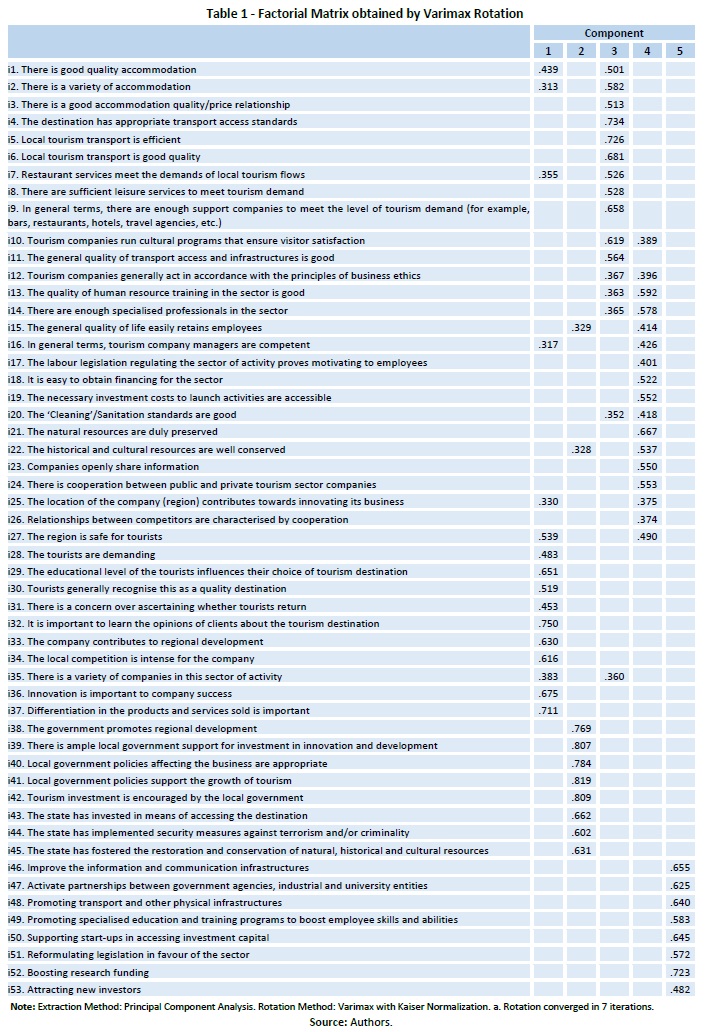
<body><![CDATA[<p>These regional tourism entities hold competences for tourism development in    their respective regions, seeking the sustained leveraging of its tourism resources    and within the framework of the tourism policy guidelines and directives defined    by the government and the multi-year plans of central and local administrations.</p>     <p>The geographic area of study thus encapsulates the Regional Tourism Areas of    Portugal as defined in Law no. 33/2013 of 16 May. The research unit of analysis    thus derives from companies with activities characteristic of the WTO (2001)    satellite account to a total five decimal points.</p>     <p>3.2 Data, Methods and Variables</p>     <p>The methodology adopted by this research for the data collection phase required    recourse to primary data, such as that</p>     <p>returned by the questionnaire research tool and delivered to senior managers    at the 4,560 companies. We have obtained a final sample with 446 responses.</p>     <p>The instrument applied was structured according to Porter&rsquo;s Diamond Model    (1990) resulting in a questionnaire containing 55 items measured on a 5-point    Likert scale on which one represents the lowest level of importance or agreement    and five the maximum level of importance or agreement. These items evaluate    aspects related with the determinants of the Diamond, especially: the conditions    of the factors and the demand, the strategy, structure and business rivalries,    the existence of related and support industries and the government. The questionnaire    was provided by the Monitor Group of Council on Competitiveness and used in    the investigation of Porter (2001).</p>     <p>3.3 Sample Characteristics</p>     <p>Of the 446 companies surveyed, the majority belong to either the Centro (23.1%)    or the Lisbon (22.9%) Regional Tourism Districts. The hotel sector predominates    in the study sample (65.2%). In particular, Hotels and Restaurants were the    most common CAE typology among respondents with some 132 companies (29.6%),    followed by Accommodation with Restaurants and Traditional Type Restaurants    on 6.7% and Rural Tourism on 6%. The number of respondent company employees    varied from 1 to 527 with an average of 21 and a median of 10 members of staff    with almost a majority employing at least 10 staff (47.9%) and therefore micro-companies,    or between 10 and 50 members of staff (44.9%). In relation to their legal structures,    almost three-quarters of the sample (73.6%) are private limited companies. As    regards their year of foundation, 42.6% began after 1999. Over 60% of questionnaire    respondents worked primarily in management posts with a majority holding higher    education qualifications (55.9%) following by professional training and secondary    school qualifications with 20.30% and 19.90% respectively. The main respondent    age groups were the following: between 30 and 39 (29.20%), 40 and 49 (28.5%)    and between 50 and 64 years of age (25.70%), with only 58 respondents found    in the 20 to 29 age range.</p>     <p>4. Analysis and Discussion of the Results</p>     <p>A first phase carried out Factorial Analysis on the 55 items under study. The    analysis of internal consistency indices obtained led to the exclusion of two    items and thus significantly improving scale reliability. The 53 items were    then again subject to Factorial Analysis techniques to obtain a result of 0.807    for the KMO and a value of p&lt;0.001 in accordance with the Bartlett Test and    demonstrating the appropriateness of the analysis model applied to the study    sample. To extract the axes, we made recourse to Principal Component Analysis    before then determining the number of axes to retain through Cattell&rsquo;s    Scree Plot. The five axes retained explain 46.5% of total variance. Following    Varimax rotation, we obtained the distribution of the items in accordance with    the factors and as presented in <a href="/img/revistas/tms/v14n1/14n1a03t1.jpg" target="_blank">Table    1</a>. In order to facilitate interpretation, we removed all factorial loads    below 0.3.</p>     
]]></body>
<body><![CDATA[<p align="center"><a href="/img/revistas/tms/v14n1/14n1a03t1.jpg" target="_blank"><img src="/img/revistas/tms/v14n1/14n1a03t1.jpg" width="300" height="167"/><br />   (clique para ampliar ! click to enlarge)</a></p>     
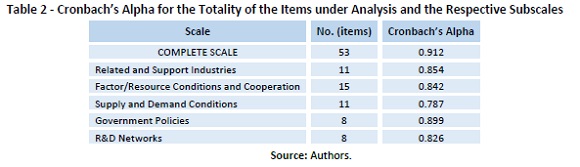
<p>&nbsp;</p>     <p></p> The factorial structure obtained displays how Factor 1 gathered the items relative  to &ldquo;Supply and Demand Conditions&rdquo;, Factor 2 interrelates with &ldquo;Government Policies&rdquo;,  Factor 3 concentrates information on &ldquo;Related and Support Industries&rdquo;, whilst  Factor 4 focuses on &ldquo;Factor/Resource Conditions and Cooperation&rdquo; with Factor 5  approaching &ldquo;R&amp;D Networks&rdquo;.      <p>In order to measure internal consistency, we applied Cronbach&rsquo;s Alpha    (<a href="#t2">Table 2</a>), reporting satisfactory levels ranging between 0.787    (Supply and Demand Conditions) and 0.912 (Complete Scale).</p>     <p>      <p align="center"><a name="t2"></a><img src="/img/revistas/tms/v14n1/14n1a03t2.jpg"/></p>     
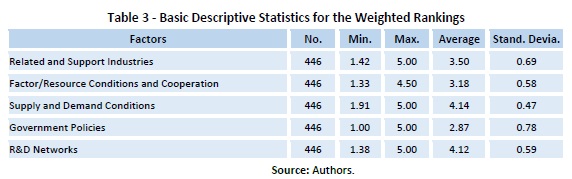
<p>In order to assess the results obtained, we proceeded with the calculation    of the rankings received by each of the dimensions. To ensure result compatibility,    the ranks were weighted by the number of items contained by each dimension and    to this end assuming one as the minimum value and five as the maximum. </p>     <p>The missing data were replaced by the average attributed to the corresponding    dimension, which corresponds to approximately 5% of the total data. <a href="#t3">Table    3</a> reports on the basic descriptive statistics reported for each of the dimensions.</p>     <p>      <p align="center"><a name="t3"></a><img src="/img/revistas/tms/v14n1/14n1a03t3.jpg"/></p>     
]]></body>
<body><![CDATA[<p>&nbsp;</p>     <p></p> We would note that the &ldquo;Supply and Demand Conditions&rdquo; and &ldquo;R&amp;D Networks&rdquo; dimensions  receive the highest values from respondents whilst &ldquo;Government Policies&rdquo; constitutes  the dimension returning the lowest average result. The &ldquo;Supply and Demand Conditions&rdquo;  dimension, in turn, generates the greatest consensus among respondents. Furthermore,  the &ldquo;Government      <p>Policies&rdquo; dimension records the most homogeneous responses.</p>     <p>Analysis of the average weightings returned by the different dimensions approached    in accordance with the location of the company in its regional tourism area    (<a href="#f1">Figure 1</a>) results in the following:</p>     <p>      <p align="center"><a name="f1"></a><img src="/img/revistas/tms/v14n1/14n1a03f1.jpg"/></p>     
<p>• In the case of Related and Support Industries, they register their highest    average weighting in Madeira and their lowest in Centro;</p>     <p>• As regards the case of Factor Conditions/Resources and Cooperation, the highest    average weighting occurs in Madeira and the lowest in Lisbon;</p>     <p>• Regarding Supply and Demand Conditions, their average weighting peaks in    Madeira with the Alentejo accounting for the lowest level;</p>     <p>• In terms of Government Policies, these receive their highest average weightings    in the Azores followed by Madeira and their lowest in the Alentejo;</p>     ]]></body>
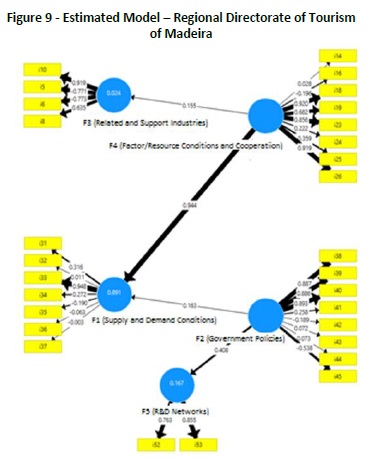
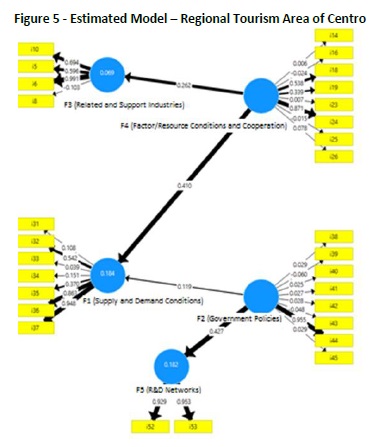
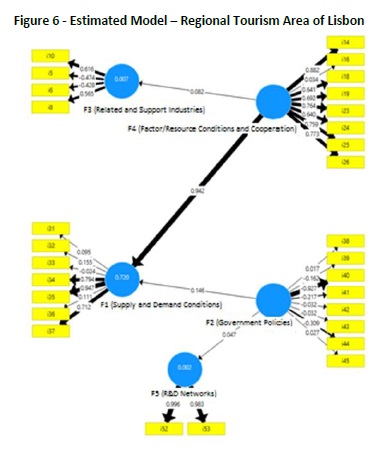
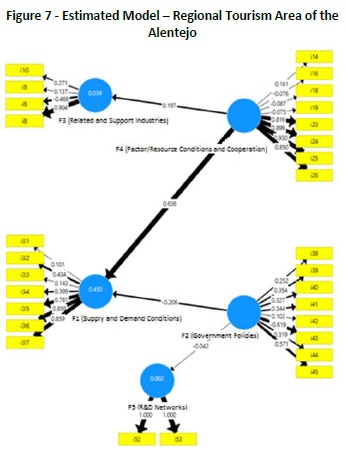
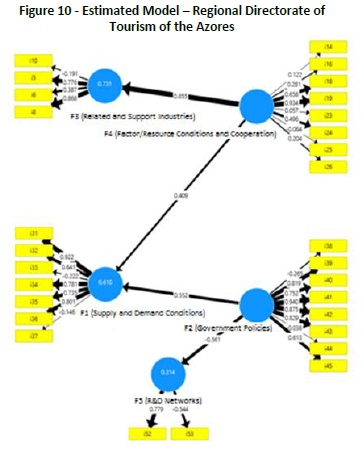
<body><![CDATA[<p>• Finally, the R&amp;D Networks item records its highest average ranking in    Madeira followed by Lisbon whilst returning its lowest level in the Azores.</p>     <p>The dimensions obtained from the model put forward in <a href="#f2">Figure    2</a> follow recourse to the PLS (Partial Least Squares) approach through the    application of Smart PLS 3.0 software (Ringle, Wende, &amp; Becker, 2015). The    criteria applied in the construction of the final model presented here stem    from establishing and eliminating the relationships between variables so as    to return a higher level of reliability and model measurement validity through,    in accordance with the theoretical foundations, eliminating all the items with    coefficients of below 0.3.</p>     <p>&nbsp;</p>     <p align="center"><a name="f2"></a><img src="/img/revistas/tms/v14n1/14n1a03f2.jpg"/></p>     
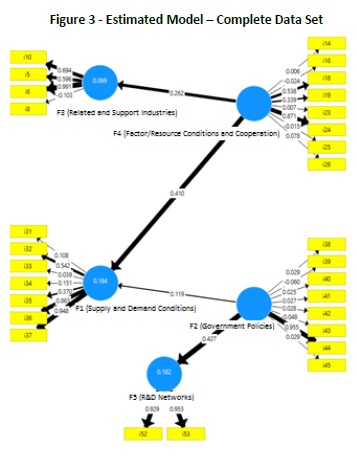
<p>&nbsp;</p>     <p>In addition to carrying out model estimations for the data set as a whole,    we also calculated the models for each of the respective   tourism   regions.      <a href="#f3">Figures 3</a>   to   <a href="#f10">10</a>   display  the estimated    models for the entire data set and each of the tourism regions under analysis.</p>     <p>&nbsp;</p>     <p align="center"><a name="f3"></a><img src="/img/revistas/tms/v14n1/14n1a03f3.jpg"/></p>     
<p>&nbsp;</p>     <p align="center"><a name="f4"></a><img src="/img/revistas/tms/v14n1/14n1a03f4.jpg"/></p>     
]]></body>
<body><![CDATA[<p>&nbsp;</p>     <p align="center"><a name="f5"></a><img src="/img/revistas/tms/v14n1/14n1a03f5.jpg"/></p>     
<p>&nbsp;</p>     <p align="center"><a name="f6"></a><img src="/img/revistas/tms/v14n1/14n1a03f6.jpg"/></p>     
<p>&nbsp;</p>     <p align="center"><a name="f7"></a><img src="/img/revistas/tms/v14n1/14n1a03f7.jpg"/></p>     
<p></p>     <p></p>     <p align="center"><a name="f8"></a><img src="/img/revistas/tms/v14n1/14n1a03f8.jpg"/></p>     
<p>&nbsp;</p>     ]]></body>
<body><![CDATA[<p align="center"><a name="f9"></a><img src="/img/revistas/tms/v14n1/14n1a03f9.jpg"/></p>     
<p>&nbsp;</p>     <p align="center"><a name="f10"></a><img src="/img/revistas/tms/v14n1/14n1a03f10.jpg"/></p>     
<p>&nbsp;</p>     <p><a href="/img/revistas/tms/v14n1/14n1a03t4.jpg" target="_blank">Table    4</a> displays the results stemming from the Estimated Coefficients (Path Coefficients    and Outer Loadings), Determinant  Coefficients  (R2), Composite  Reliability     ()c) and Average Variance Extracted (AVE) for the analytical models estimated    for the complete data set and for each tourism region.</p>     
<p>&nbsp;</p>     <p align="center"><a href="/img/revistas/tms/v14n1/14n1a03t4.jpg" target="_blank"><img src="/img/revistas/tms/v14n1/14n1a03t4.jpg" width="300" height="167"/><br />   (clique para ampliar ! click to enlarge)</a></p>     
<p>&nbsp;</p>     <p>Henseler, Ringle, &amp;Sinkovics, (2009) and Hair, Sarstedt, Ringle, &amp;    Mena, (2012) recommend composite reliability ((c) results of greater than 0.7    with AVE results in excess of 0.5. Considering the complete set of data, the    adjusted model displays  c results almost always above 0.7 while the AVE results    prove below the level of 0.5 for the majority of the items. The constructs under    analysis return moderate values for R2 (ranging from 0.002 to 0.936, indicating    the proportion of the variability of the latent variable which is explained    by the analysis items). </p>     <p>Analysis of the standardised coefficients enables analysis of the relationships    underlying the constructs. In order to test whether the estimated coefficients    differ significantly from zero,  we   applied   the   t-value  and   their     respective p-value calculations through recourse to bootstrap. For the complete    set of data, the analysis demonstrates that only the relationships &ldquo;F4 (Factor    Conditions/Resources and Cooperation) &#8594; F1 (Supply and Demand Conditions)&rdquo;    and &ldquo;F4 (Factor Conditions/Resources and Cooperation) &#8594; F3 (Related and    Support Industries)&rdquo; hold statistical significance.</p>     ]]></body>
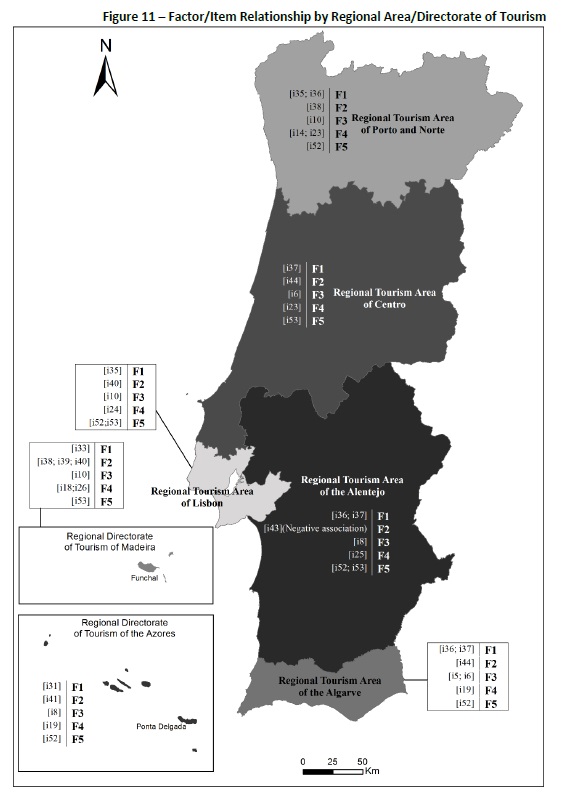
<body><![CDATA[<p>Undertaking more detailed analysis of each model adjusted to each Regional    Area/Directorate of Tourism, we report that the relationships between the factors    under study take on different levels of importance relative to each different    tourism area/directorate. In <a href="#f11">Figure 11</a>, we detail the most    important items in each factor for each respective tourism area/directorate:</p>     <p>&nbsp;</p>     <p>      <p align="center"><a name="f11"></a><img src="/img/revistas/tms/v14n1/14n1a03f11.jpg"/></p>     
<p>&nbsp;</p>     <p>We may thus report how item 35 – &ldquo;There is a variety of companies in your sector    of activity&rdquo; takes on great importance in the Regional Tourism Areas of Porto    and Norte and Lisbon and undoubtedly in large part due to their hosting the    largest cities in the country and hence with clearly more diverse ranges of    supply. </p>     <p>In relation to item 36 – &ldquo;Innovation is important to company success&rdquo;, this    stands to the fore in the Regional Areas of Porto and Norte, the Alentejo and    the Algarve representing a solution in demand among companies in these regions    within the scope of their meeting new sources and types of demand.</p>     <p>Item 38 – &ldquo;The government promotes regional development&rdquo; plays a relevant role    in the Regional Tourism Area of Porto and</p>     <p>Norte and in the Directorate of Tourism of Madeira whilst item 37 – &ldquo;Differentiation    in terms of the products and services sold is important&rdquo; stands out in the Tourism    Areas of Centro, the Alentejo and the Algarve, which derives from the diversity    of tourism products provided to tourists in recent years in order to counter    seasonality and capitalise on the varied tourism resources in existence and    that were broadly unknown to both national and international tourists until    relatively quite recently.</p>     <p>The regional areas of Porto and Norte, Lisbon and Madeira emphasise item 10    – &ldquo;Tourism companies run cultural programs to provide visitor satisfaction&rdquo;,    reflected in the cultural agendas ongoing in the cities of Porto, Lisbon and    Funchal.</p>     ]]></body>
<body><![CDATA[<p>There is clear importance attributed by the Regional Tourism Areas of Porto    and Norte and of Lisbon to item 14 – &ldquo;There are enough specialised professionals    in the sector of activity&rdquo; primarily due to good professionals preferring to    be in environments that endow them with professional visibility. Despite only    respondents from the Areas of Porto and Norte and Centro considering &ldquo;Companies    openly share information&rdquo;– item 23, this conveys how managers and owners remain    closed in upon themselves and do not yet perceive such sharing as a means of    obtaining joint objectives.</p>     <p>In relation to the R&amp;D Networks factor, there is a broad consensus surrounding    &ldquo;Raising funds for research&rdquo; – item 52, with only the Regional Directorate of    Madeira not valuing this item. This proves the relevance awarded to the studies    made by national universities and polytechnics as a means of boosting regional    development.</p>     <p>Centro and the Algarve are unanimous in recognising how &ldquo;The state has undertaken    security measures against terrorism and/or criminality&rdquo; – item 44 and with this    latter regional area hosting the most tourists and from everywhere in the world,    with correspondingly different ethnic, racial and religious backgrounds and    hence the concern over security and the protecting of this image as a safe tourism    destination.</p>     <p>Item 53 – &ldquo;Attracting new investors&rdquo; constitutes one of the concerns of the    areas of Centro, Lisbon, the Alentejo and Madeira stemming from how such proves    necessary to advancing with the major projects already planned and that would    drive the potential of the respective tourism destinations.</p>     <p>We would highlight the fact that only companies in the Regional Directorate    of Tourism of Madeira attribute recognition to the value of item 33 - &ldquo;Your    company contributes towards regional development&rdquo; – and item 26 – &ldquo;Your relationship    with the competition is characterised by cooperation&rdquo;, as this region mostly    &ldquo;lives off&rdquo; the tourism sector and, whether despite or because of its displacement    from the mainland, grasps the importance of cooperation with the competition    as a means of becoming stronger.</p>     <p>5. Conclusions</p>     <p>This research allowed to identify the existence of various factors that are    determinant to the competitiveness of the regional areas/directorates of tourism    of Portugal – F1 - &ldquo;Supply and Demand Conditions&rdquo;, F2 - &ldquo;Government Policies&rdquo;,    F3 - &ldquo;Related  and  Support  Industries&rdquo;,  F4  -  &ldquo;Factor  Conditions/Resources    and Cooperation&rdquo; and F5 - &ldquo;R&amp;D Networks&rdquo; with distinct weightings. These    factors in turn highlight items interrelated with concerns over the variety    in existing tourism companies, the competition and innovation as a factor of    success. We furthermore verified that only two areas attributed recognition    to the role played by the government in the promotion of regional development    and encapsulating the lack of belief managers and entrepreneurs hold in central    and local government on the one hand whilst differentiation was deemed to play    a leading role in the competitiveness of a particular tourism destination (Estevão    &amp; Ferreira, 2015). We would also state that having comparative advantages    does not prove sufficient to any destination that instead requires competitive    advantages (Crouch &amp; Ritchie, 1999) and this duly reflects in the value    placed on cultural programs designed to ensure visitor satisfaction. We also    report that in general terms these companies do not either share information    or openly cooperate as these ae not perceived as the best paths towards obtaining    objectives, which in tourism tend to be very similar. We also ascertained how    higher education has begun to gain recognition as a means of attaining the competitiveness    of regions.</p>     <p>Given the incidences of terrorism that have shocked Europe, all the regions    should take on additional concerns over implementing security actions especially    as while Portugal remains considered as a safe destination, the country is increasingly    sought out by tourists from all around the world. Through this research, we    verify how competitiveness does not constitute any easy task and especially    as Portugal hosts regions with such varied and very specific characteristics.    Thus, we hope that the results returned by this research project may establish    the framework necessary to managers engaging in the development of strategic    actions able to foster and nurture competitive advantages and attain the much    sought after competitiveness. Porter (1990) duly posits how companies and not    countries compete in international markets and hence the competitiveness of    a nation or a region stems from the success its companies attain in international    markets.</p>     <p>The major limitation of this study derives from the lack uniformity in the    responses provided in regional terms. We would suggest future research applies    a longitudinal study so as to enable the identification of trends in tourism    competitiveness taking place in the respective regions.</p>     <p>&nbsp;</p>     ]]></body>
<body><![CDATA[<p><b>REFERENCES</b></p>     <!-- ref --><p>Ahmed, Z. &amp; Krohn, F. (1990). Reversing the United States declining competitiveness    in the marketing of international tourism: a perspective on future policy. Journal    of Travel Research, 29(2), 23-29.    &nbsp;&nbsp;&nbsp;&nbsp;&nbsp;&nbsp;&nbsp;&nbsp;[&#160;<a href="javascript:void(0);" onclick="javascript: window.open('/scielo.php?script=sci_nlinks&ref=1271350&pid=S2182-8458201800010000300001&lng=','','width=640,height=500,resizable=yes,scrollbars=1,menubar=yes,');">Links</a>&#160;]<!-- end-ref --></p>     <!-- ref --><p>Alberti, F. &amp; Giusti, J. (2012). Cultural heritage, tourism and regional    competitiveness: the motor valley cluster. City, Culture and Society, 3, 261–273.    &nbsp;&nbsp;&nbsp;&nbsp;&nbsp;&nbsp;&nbsp;&nbsp;[&#160;<a href="javascript:void(0);" onclick="javascript: window.open('/scielo.php?script=sci_nlinks&ref=1271352&pid=S2182-8458201800010000300002&lng=','','width=640,height=500,resizable=yes,scrollbars=1,menubar=yes,');">Links</a>&#160;]<!-- end-ref --></p>     <!-- ref --><p>Alberto, D. (2008). Modelos de desenvolvimento regional, in Leitão, J., Ferreira,    J. &amp; Azevedo, S., Dimensões competitivas de Portugal – contributos dos territórios,    sectores, empresas e logística. Vila Nova de Famalicão: Centro Atlântico.    &nbsp;&nbsp;&nbsp;&nbsp;&nbsp;&nbsp;&nbsp;&nbsp;[&#160;<a href="javascript:void(0);" onclick="javascript: window.open('/scielo.php?script=sci_nlinks&ref=1271354&pid=S2182-8458201800010000300003&lng=','','width=640,height=500,resizable=yes,scrollbars=1,menubar=yes,');">Links</a>&#160;]<!-- end-ref --></p>     <!-- ref --><p>Albuquerque, M. &amp; Godinho, C. (2001). Turismo - diagnóstico prospectivo,    GEPE – Gabinete de Estudos e Prospectiva Económica. Lisboa: Ministério da Economia.    &nbsp;&nbsp;&nbsp;&nbsp;&nbsp;&nbsp;&nbsp;&nbsp;[&#160;<a href="javascript:void(0);" onclick="javascript: window.open('/scielo.php?script=sci_nlinks&ref=1271356&pid=S2182-8458201800010000300004&lng=','','width=640,height=500,resizable=yes,scrollbars=1,menubar=yes,');">Links</a>&#160;]<!-- end-ref --></p>     <!-- ref --><p>Arbulú, W., Lozano, J. &amp; Rey-Maquiera, J. (2016). The challenges of municipal    solid waste management systems provided by public-private partnerships in mature    tourist destinations: the case of Mallorca. Waste Management, 51(May), 252-258.    &nbsp;&nbsp;&nbsp;&nbsp;&nbsp;&nbsp;&nbsp;&nbsp;[&#160;<a href="javascript:void(0);" onclick="javascript: window.open('/scielo.php?script=sci_nlinks&ref=1271358&pid=S2182-8458201800010000300005&lng=','','width=640,height=500,resizable=yes,scrollbars=1,menubar=yes,');">Links</a>&#160;]<!-- end-ref --></p>     <!-- ref --><p>Assaf, A. &amp; Tsionas, E. (2015). Incorporating destination quality into    the measurement of tourism performance: a Bayesian approach. Tourism Management,    49(August), 58-71.    &nbsp;&nbsp;&nbsp;&nbsp;&nbsp;&nbsp;&nbsp;&nbsp;[&#160;<a href="javascript:void(0);" onclick="javascript: window.open('/scielo.php?script=sci_nlinks&ref=1271360&pid=S2182-8458201800010000300006&lng=','','width=640,height=500,resizable=yes,scrollbars=1,menubar=yes,');">Links</a>&#160;]<!-- end-ref --></p>     <!-- ref --><p>Baker, M., Hayzelden, C. &amp; Sussmann, S. (1996). Can destination management    systems provide competitive advantage? A discussion of the factors affecting    the survival and success of destination management systems. Progress in Tourism    and Hospitality Research, 2, 1-13.    &nbsp;&nbsp;&nbsp;&nbsp;&nbsp;&nbsp;&nbsp;&nbsp;[&#160;<a href="javascript:void(0);" onclick="javascript: window.open('/scielo.php?script=sci_nlinks&ref=1271362&pid=S2182-8458201800010000300007&lng=','','width=640,height=500,resizable=yes,scrollbars=1,menubar=yes,');">Links</a>&#160;]<!-- end-ref --></p>     <!-- ref --><p>B&#259;lan, D., Balaure, V. &amp; Veghes, C. (2009). Travel and tourism competitiveness    of the world‘s top tourism destinations: an exploratory assessment. Annales    Universitatis Apulensis Series Oeconomica, 11(2), 979-987.    &nbsp;&nbsp;&nbsp;&nbsp;&nbsp;&nbsp;&nbsp;&nbsp;[&#160;<a href="javascript:void(0);" onclick="javascript: window.open('/scielo.php?script=sci_nlinks&ref=1271364&pid=S2182-8458201800010000300008&lng=','','width=640,height=500,resizable=yes,scrollbars=1,menubar=yes,');">Links</a>&#160;]<!-- end-ref --></p>     <!-- ref --><p>Beladi, H., Chao, C. Ee, M. &amp; Hollas, D. (2015). Medical tourism and health    worker migration in developing countries. Economic Modelling, 46(April), 391-396.    &nbsp;&nbsp;&nbsp;&nbsp;&nbsp;&nbsp;&nbsp;&nbsp;[&#160;<a href="javascript:void(0);" onclick="javascript: window.open('/scielo.php?script=sci_nlinks&ref=1271366&pid=S2182-8458201800010000300009&lng=','','width=640,height=500,resizable=yes,scrollbars=1,menubar=yes,');">Links</a>&#160;]<!-- end-ref --></p>     <!-- ref --><p>Boo, S., Busser, J. &amp; Baloglu, S. (2009). A model of customer-based brand    equity and its application to multiple destinations. Tourism Management, 30,    219-231.    &nbsp;&nbsp;&nbsp;&nbsp;&nbsp;&nbsp;&nbsp;&nbsp;[&#160;<a href="javascript:void(0);" onclick="javascript: window.open('/scielo.php?script=sci_nlinks&ref=1271368&pid=S2182-8458201800010000300010&lng=','','width=640,height=500,resizable=yes,scrollbars=1,menubar=yes,');">Links</a>&#160;]<!-- end-ref --></p>     <!-- ref --><p>Botha, C., Crompton, J. &amp; Kim, S. (1999). Developing a revised competitive    position for Sun/Lost City, South Africa. Journal of Travel Research, 37(4),    341-352.    &nbsp;&nbsp;&nbsp;&nbsp;&nbsp;&nbsp;&nbsp;&nbsp;[&#160;<a href="javascript:void(0);" onclick="javascript: window.open('/scielo.php?script=sci_nlinks&ref=1271370&pid=S2182-8458201800010000300011&lng=','','width=640,height=500,resizable=yes,scrollbars=1,menubar=yes,');">Links</a>&#160;]<!-- end-ref --></p>     <!-- ref --><p>Botti, L., Camprubi, R. &amp; Torrès, O. (2008). Tourism and regional development:    small bussinesses and social network for competitiveness, research entrepreneurship    and small business XXII. Covilhã: Universidade da Beira Interior.    &nbsp;&nbsp;&nbsp;&nbsp;&nbsp;&nbsp;&nbsp;&nbsp;[&#160;<a href="javascript:void(0);" onclick="javascript: window.open('/scielo.php?script=sci_nlinks&ref=1271372&pid=S2182-8458201800010000300012&lng=','','width=640,height=500,resizable=yes,scrollbars=1,menubar=yes,');">Links</a>&#160;]<!-- end-ref --></p>     <!-- ref --><p>Buhalis, D. (2000). Marketing the competitive destination of the future. Tourism    Management, 21(1), 97-116.    &nbsp;&nbsp;&nbsp;&nbsp;&nbsp;&nbsp;&nbsp;&nbsp;[&#160;<a href="javascript:void(0);" onclick="javascript: window.open('/scielo.php?script=sci_nlinks&ref=1271374&pid=S2182-8458201800010000300013&lng=','','width=640,height=500,resizable=yes,scrollbars=1,menubar=yes,');">Links</a>&#160;]<!-- end-ref --></p>     <!-- ref --><p>Cabugueira, A. (2005). A importância económica do turismo. Revista Turismo    e Desenvolvimento, 2(2), 97-104.    &nbsp;&nbsp;&nbsp;&nbsp;&nbsp;&nbsp;&nbsp;&nbsp;[&#160;<a href="javascript:void(0);" onclick="javascript: window.open('/scielo.php?script=sci_nlinks&ref=1271376&pid=S2182-8458201800010000300014&lng=','','width=640,height=500,resizable=yes,scrollbars=1,menubar=yes,');">Links</a>&#160;]<!-- end-ref --></p>     <!-- ref --><p>Camisón, C. &amp; Forés (2015). Is tourism firm competitiveness driven by different    internal or external specific factors? New emprirical evidence from Spain. Tourism    Management, 477-499.    &nbsp;&nbsp;&nbsp;&nbsp;&nbsp;&nbsp;&nbsp;&nbsp;[&#160;<a href="javascript:void(0);" onclick="javascript: window.open('/scielo.php?script=sci_nlinks&ref=1271378&pid=S2182-8458201800010000300015&lng=','','width=640,height=500,resizable=yes,scrollbars=1,menubar=yes,');">Links</a>&#160;]<!-- end-ref --></p>     <!-- ref --><p>Campos, A., Mendes, J. &amp; Albino, J. (2006). Para uma cultura da qualidade    total no destino turístico: métodos de diagnóstico e estratégias de desenvolvimento.    Revista Turismo e Desenvolvimento, 5, 21-40.    &nbsp;&nbsp;&nbsp;&nbsp;&nbsp;&nbsp;&nbsp;&nbsp;[&#160;<a href="javascript:void(0);" onclick="javascript: window.open('/scielo.php?script=sci_nlinks&ref=1271380&pid=S2182-8458201800010000300016&lng=','','width=640,height=500,resizable=yes,scrollbars=1,menubar=yes,');">Links</a>&#160;]<!-- end-ref --></p>     <p>Cao, Y., Wang, B., Zhang, J., Wang, L., Pan, et al. (2016), Lake macroinvertebrate    assemblages and relationship with natural environment and tourism stress in    Jiuzhaigou Natural Reserve, China. Ecological Indicators, 62(March), 182-190.</p>     <!-- ref --><p>Carmichael, B. (2002). Global competitiveness and special events in cultural    tourism: the example of the Barnes exhibit at the Art Gallery of Ontario, Toronto.    The Canadian Geographer, 46(4), 310-325.    &nbsp;&nbsp;&nbsp;&nbsp;&nbsp;&nbsp;&nbsp;&nbsp;[&#160;<a href="javascript:void(0);" onclick="javascript: window.open('/scielo.php?script=sci_nlinks&ref=1271383&pid=S2182-8458201800010000300018&lng=','','width=640,height=500,resizable=yes,scrollbars=1,menubar=yes,');">Links</a>&#160;]<!-- end-ref --></p>     <!-- ref --><p>Casadesus-Masanell, R. &amp; Ricart, J. (2010). Competitiveness: business model    reconfiguration for innovation and internationalization. Management Research:    The Journal of the Iberoamerican Academy of Management, 8(2), 123-149.    &nbsp;&nbsp;&nbsp;&nbsp;&nbsp;&nbsp;&nbsp;&nbsp;[&#160;<a href="javascript:void(0);" onclick="javascript: window.open('/scielo.php?script=sci_nlinks&ref=1271385&pid=S2182-8458201800010000300019&lng=','','width=640,height=500,resizable=yes,scrollbars=1,menubar=yes,');">Links</a>&#160;]<!-- end-ref --></p>     <!-- ref --><p>Chao, C., Hazari, B., Laffargue, J., Sgro, P. &amp; Yu, E. (2005). Tourism,    jobs, capital accumulation and economy: a dynamic analysis. Paris-Jourdan Science    Economiques, Working Paper 2005-16.    &nbsp;&nbsp;&nbsp;&nbsp;&nbsp;&nbsp;&nbsp;&nbsp;[&#160;<a href="javascript:void(0);" onclick="javascript: window.open('/scielo.php?script=sci_nlinks&ref=1271387&pid=S2182-8458201800010000300020&lng=','','width=640,height=500,resizable=yes,scrollbars=1,menubar=yes,');">Links</a>&#160;]<!-- end-ref --></p>     ]]></body>
<body><![CDATA[<!-- ref --><p>Chon, K. &amp; Mayer, K. (1995). Destination competitiveness models in tourism    and their application to Las Vegas. Journal of Tourism Systems and Quality Management,    1(2/3/4), 227-246.    &nbsp;&nbsp;&nbsp;&nbsp;&nbsp;&nbsp;&nbsp;&nbsp;[&#160;<a href="javascript:void(0);" onclick="javascript: window.open('/scielo.php?script=sci_nlinks&ref=1271389&pid=S2182-8458201800010000300021&lng=','','width=640,height=500,resizable=yes,scrollbars=1,menubar=yes,');">Links</a>&#160;]<!-- end-ref --></p>     <p>Claveria, O. &amp; Poluzzi, A. (2016). Positioning and clustering of the world&rsquo;s    top tourist destinations by means of dimensionality reduction techniques for    categorical data. Journal of Destination Marketing &amp; Management, Available    online 12 February 2016.</p>     <!-- ref --><p>Croes, R. &amp; Kubickova, M. (2013). From potential to ability to compete:    towards a performance - based tourism competitiveness index. Journal of Destination    Marketing &amp; Management, 2, 146–154.    &nbsp;&nbsp;&nbsp;&nbsp;&nbsp;&nbsp;&nbsp;&nbsp;[&#160;<a href="javascript:void(0);" onclick="javascript: window.open('/scielo.php?script=sci_nlinks&ref=1271392&pid=S2182-8458201800010000300023&lng=','','width=640,height=500,resizable=yes,scrollbars=1,menubar=yes,');">Links</a>&#160;]<!-- end-ref --></p>     <!-- ref --><p>Cooke, P. &amp; Morgan, K. (1998). The associational economy: firms, regions    and innovation. Oxford: OUP.    &nbsp;&nbsp;&nbsp;&nbsp;&nbsp;&nbsp;&nbsp;&nbsp;[&#160;<a href="javascript:void(0);" onclick="javascript: window.open('/scielo.php?script=sci_nlinks&ref=1271394&pid=S2182-8458201800010000300024&lng=','','width=640,height=500,resizable=yes,scrollbars=1,menubar=yes,');">Links</a>&#160;]<!-- end-ref --></p>     <!-- ref --><p>Costa, C., Rita, P. &amp; Águas, P. (2004). Tendências internacionais em turismo,    2ª Edição. Lisboa: Grupo Lidel.    &nbsp;&nbsp;&nbsp;&nbsp;&nbsp;&nbsp;&nbsp;&nbsp;[&#160;<a href="javascript:void(0);" onclick="javascript: window.open('/scielo.php?script=sci_nlinks&ref=1271396&pid=S2182-8458201800010000300025&lng=','','width=640,height=500,resizable=yes,scrollbars=1,menubar=yes,');">Links</a>&#160;]<!-- end-ref --></p>     <!-- ref --><p>Cores, R. (2011). Measuring and explaining competitiveness in the context of    small island destinations. Journal of Travel Research, 50(4), 431-442.    &nbsp;&nbsp;&nbsp;&nbsp;&nbsp;&nbsp;&nbsp;&nbsp;[&#160;<a href="javascript:void(0);" onclick="javascript: window.open('/scielo.php?script=sci_nlinks&ref=1271398&pid=S2182-8458201800010000300026&lng=','','width=640,height=500,resizable=yes,scrollbars=1,menubar=yes,');">Links</a>&#160;]<!-- end-ref --></p>     <!-- ref --><p>Cracolici, M. F. &amp; Nijkamp, P. (2009). The attractiveness and competitiveness    of tourist destination: a study of Southern Italian regions. Tourism Management,    30(3), 336-344.    &nbsp;&nbsp;&nbsp;&nbsp;&nbsp;&nbsp;&nbsp;&nbsp;[&#160;<a href="javascript:void(0);" onclick="javascript: window.open('/scielo.php?script=sci_nlinks&ref=1271400&pid=S2182-8458201800010000300027&lng=','','width=640,height=500,resizable=yes,scrollbars=1,menubar=yes,');">Links</a>&#160;]<!-- end-ref --></p>     <!-- ref --><p>Croes, R. &amp; Kubickova, M. (2013). From potential to ability to compete:    towards a performance - based tourism competitiveness index. Journal of Destination    Marketing &amp; Management, 2, 146–154.    &nbsp;&nbsp;&nbsp;&nbsp;&nbsp;&nbsp;&nbsp;&nbsp;[&#160;<a href="javascript:void(0);" onclick="javascript: window.open('/scielo.php?script=sci_nlinks&ref=1271402&pid=S2182-8458201800010000300028&lng=','','width=640,height=500,resizable=yes,scrollbars=1,menubar=yes,');">Links</a>&#160;]<!-- end-ref --></p>     <!-- ref --><p>Crouch, G. &amp; Ritchie, J. (1999). Tourism, competitiveness, and societal    prosperity. Journal of Business Research, 44, 137-152.    &nbsp;&nbsp;&nbsp;&nbsp;&nbsp;&nbsp;&nbsp;&nbsp;[&#160;<a href="javascript:void(0);" onclick="javascript: window.open('/scielo.php?script=sci_nlinks&ref=1271404&pid=S2182-8458201800010000300029&lng=','','width=640,height=500,resizable=yes,scrollbars=1,menubar=yes,');">Links</a>&#160;]<!-- end-ref --></p>     <!-- ref --><p>Desrochers, P. &amp; Sautet, F. (2004). Cluster-based economic strategy, facilitation    policy and the market process. Review of Austrian Economics, 17(2-3), 233-245.    &nbsp;&nbsp;&nbsp;&nbsp;&nbsp;&nbsp;&nbsp;&nbsp;[&#160;<a href="javascript:void(0);" onclick="javascript: window.open('/scielo.php?script=sci_nlinks&ref=1271406&pid=S2182-8458201800010000300030&lng=','','width=640,height=500,resizable=yes,scrollbars=1,menubar=yes,');">Links</a>&#160;]<!-- end-ref --></p>     <!-- ref --><p>D‘Hauteserre, A. (2000). Lessons in managed destination competitiveness: the    case of Foxwoods Casino Resort. Tourism Management, 21(1), 23-32.    &nbsp;&nbsp;&nbsp;&nbsp;&nbsp;&nbsp;&nbsp;&nbsp;[&#160;<a href="javascript:void(0);" onclick="javascript: window.open('/scielo.php?script=sci_nlinks&ref=1271408&pid=S2182-8458201800010000300031&lng=','','width=640,height=500,resizable=yes,scrollbars=1,menubar=yes,');">Links</a>&#160;]<!-- end-ref --></p>     <!-- ref --><p>Dimoska, T. &amp; Trimcevb, B. (2012). Competitiveness strategies for supporting    economic development of the touristic destination. Procedia- Social and Behavioral    Sciences, 44, 279- 288.    &nbsp;&nbsp;&nbsp;&nbsp;&nbsp;&nbsp;&nbsp;&nbsp;[&#160;<a href="javascript:void(0);" onclick="javascript: window.open('/scielo.php?script=sci_nlinks&ref=1271410&pid=S2182-8458201800010000300032&lng=','','width=640,height=500,resizable=yes,scrollbars=1,menubar=yes,');">Links</a>&#160;]<!-- end-ref --></p>     <!-- ref --><p>Dominguez, M. (2001). competitividade e análise estratéxica do sector turístico:    unha primeira aproximación á potential creación dun cluster institucional para    a mellora competitiva da zona Rías Baixas, Tese Doutoramento, Universidade de    Santiago de Compostela,    &nbsp;&nbsp;&nbsp;&nbsp;&nbsp;&nbsp;&nbsp;&nbsp;[&#160;<a href="javascript:void(0);" onclick="javascript: window.open('/scielo.php?script=sci_nlinks&ref=1271412&pid=S2182-8458201800010000300033&lng=','','width=640,height=500,resizable=yes,scrollbars=1,menubar=yes,');">Links</a>&#160;]<!-- end-ref --> Espanha.</p>     <!-- ref --><p>Dwyer, L. &amp; Kim, C. (2003). Destination competitiveness: determinants and    indicators. Current Issues in Tourism, 6(5), 369-414.    &nbsp;&nbsp;&nbsp;&nbsp;&nbsp;&nbsp;&nbsp;&nbsp;[&#160;<a href="javascript:void(0);" onclick="javascript: window.open('/scielo.php?script=sci_nlinks&ref=1271414&pid=S2182-8458201800010000300034&lng=','','width=640,height=500,resizable=yes,scrollbars=1,menubar=yes,');">Links</a>&#160;]<!-- end-ref --></p>     <!-- ref --><p>Dwyer, L., Forsyth, P. &amp; Rao, P. (2002). Destination price competitiveness:    exchange rate changes versus domestic inflation. Journal of Travel Research,    40(Feb), 328-336.    &nbsp;&nbsp;&nbsp;&nbsp;&nbsp;&nbsp;&nbsp;&nbsp;[&#160;<a href="javascript:void(0);" onclick="javascript: window.open('/scielo.php?script=sci_nlinks&ref=1271416&pid=S2182-8458201800010000300035&lng=','','width=640,height=500,resizable=yes,scrollbars=1,menubar=yes,');">Links</a>&#160;]<!-- end-ref --></p>     <!-- ref --><p>Dwyer, L., Mellor, R., Livaic, Z., Edwards, D. &amp; Kim, C. (2004). Attributes    of destination competiviveness: a factor analysis. Tourism Analysis, 9, 91-101.    &nbsp;&nbsp;&nbsp;&nbsp;&nbsp;&nbsp;&nbsp;&nbsp;[&#160;<a href="javascript:void(0);" onclick="javascript: window.open('/scielo.php?script=sci_nlinks&ref=1271418&pid=S2182-8458201800010000300036&lng=','','width=640,height=500,resizable=yes,scrollbars=1,menubar=yes,');">Links</a>&#160;]<!-- end-ref --></p>     <!-- ref --><p>Echtner, C. &amp; Ritchie, J. (2003). The meaning and measurement of destination    image. The Journal of Tourism Studies, 14(1), 37-48.    &nbsp;&nbsp;&nbsp;&nbsp;&nbsp;&nbsp;&nbsp;&nbsp;[&#160;<a href="javascript:void(0);" onclick="javascript: window.open('/scielo.php?script=sci_nlinks&ref=1271420&pid=S2182-8458201800010000300037&lng=','','width=640,height=500,resizable=yes,scrollbars=1,menubar=yes,');">Links</a>&#160;]<!-- end-ref --></p>     <!-- ref --><p>ECLAC (2009). An econometric study of the determinants of tourism competitiveness    in the Caribbean. Economic Commission for Latin America and the Caribbean, United    Nations.    &nbsp;&nbsp;&nbsp;&nbsp;&nbsp;&nbsp;&nbsp;&nbsp;[&#160;<a href="javascript:void(0);" onclick="javascript: window.open('/scielo.php?script=sci_nlinks&ref=1271422&pid=S2182-8458201800010000300038&lng=','','width=640,height=500,resizable=yes,scrollbars=1,menubar=yes,');">Links</a>&#160;]<!-- end-ref --></p>     <!-- ref --><p>Enright, M. &amp; Newton, J. (2005). Determinants of tourism destination competitiveness    in Asia Pacific: comprehensiveness and universality. Journal of Travel Research,    43(4), 339-350.    &nbsp;&nbsp;&nbsp;&nbsp;&nbsp;&nbsp;&nbsp;&nbsp;[&#160;<a href="javascript:void(0);" onclick="javascript: window.open('/scielo.php?script=sci_nlinks&ref=1271424&pid=S2182-8458201800010000300039&lng=','','width=640,height=500,resizable=yes,scrollbars=1,menubar=yes,');">Links</a>&#160;]<!-- end-ref --></p>     <!-- ref --><p>Estevão, C., Nunes, S. &amp; Ferreira, J. (2014). Fatores de competitividade    no sector hoteleiro em portugal: aplicação do Diamante de Porter. In Serra,    F., Afonso, C. &amp; Santos, José António C. (2014). TMS Conference Series (2014)    - Abordagens Contemporâneas em Hotelaria e Restauração, (pp. 5-20). Faro: Universidade    do Algarve.    &nbsp;&nbsp;&nbsp;&nbsp;&nbsp;&nbsp;&nbsp;&nbsp;[&#160;<a href="javascript:void(0);" onclick="javascript: window.open('/scielo.php?script=sci_nlinks&ref=1271426&pid=S2182-8458201800010000300040&lng=','','width=640,height=500,resizable=yes,scrollbars=1,menubar=yes,');">Links</a>&#160;]<!-- end-ref --></p>     <p>Estevão, C. &amp; Ferreira, J. (2015). A competitividade no sector do turismo:    contributos, desafios e implicações. Editora Edioteque.</p>     ]]></body>
<body><![CDATA[<!-- ref --><p>Faulkner, B., Oppermann, M. &amp; Fredline, E. (1999). Destination competitiveness:    an exploratory examination of South Australia's core attractions. Journal of    Vacation Marketing, 5(2), 125-39.    &nbsp;&nbsp;&nbsp;&nbsp;&nbsp;&nbsp;&nbsp;&nbsp;[&#160;<a href="javascript:void(0);" onclick="javascript: window.open('/scielo.php?script=sci_nlinks&ref=1271429&pid=S2182-8458201800010000300042&lng=','','width=640,height=500,resizable=yes,scrollbars=1,menubar=yes,');">Links</a>&#160;]<!-- end-ref --></p>     <!-- ref --><p>Evans, N. (2016). Sustainable competitive advantage in tourism organizations:    a strategic model applying service dominant logic and tourism's defining characteristics.    Tourism Management Perspectives, 18(April), 14-25.    &nbsp;&nbsp;&nbsp;&nbsp;&nbsp;&nbsp;&nbsp;&nbsp;[&#160;<a href="javascript:void(0);" onclick="javascript: window.open('/scielo.php?script=sci_nlinks&ref=1271431&pid=S2182-8458201800010000300043&lng=','','width=640,height=500,resizable=yes,scrollbars=1,menubar=yes,');">Links</a>&#160;]<!-- end-ref --></p>     <!-- ref --><p>Hair, J., Sarstedt, M., Ringle, C. &amp; Mena, J. (2012). An Assessment of    the use of partial least squares structural eequation modeling in marketing    research. Journal of the Academy of Marketing Science, 40(3), 414-433.    &nbsp;&nbsp;&nbsp;&nbsp;&nbsp;&nbsp;&nbsp;&nbsp;[&#160;<a href="javascript:void(0);" onclick="javascript: window.open('/scielo.php?script=sci_nlinks&ref=1271433&pid=S2182-8458201800010000300044&lng=','','width=640,height=500,resizable=yes,scrollbars=1,menubar=yes,');">Links</a>&#160;]<!-- end-ref --></p>     <!-- ref --><p>Henseler, J., Ringle, C. &amp; Sinkovics, R. (2009). The use of partial least    squares path modeling in international marketing. Advances in International    Marketing, 20, 277–320.    &nbsp;&nbsp;&nbsp;&nbsp;&nbsp;&nbsp;&nbsp;&nbsp;[&#160;<a href="javascript:void(0);" onclick="javascript: window.open('/scielo.php?script=sci_nlinks&ref=1271435&pid=S2182-8458201800010000300045&lng=','','width=640,height=500,resizable=yes,scrollbars=1,menubar=yes,');">Links</a>&#160;]<!-- end-ref --></p>     <!-- ref --><p>Jackson, J. &amp; Murphy, P. (2002). Tourism destinations as clusters: analytical    experiences from the new world. Tourism and Hospitality Research, 4(1), 36-52.    &nbsp;&nbsp;&nbsp;&nbsp;&nbsp;&nbsp;&nbsp;&nbsp;[&#160;<a href="javascript:void(0);" onclick="javascript: window.open('/scielo.php?script=sci_nlinks&ref=1271437&pid=S2182-8458201800010000300046&lng=','','width=640,height=500,resizable=yes,scrollbars=1,menubar=yes,');">Links</a>&#160;]<!-- end-ref --></p>     ]]></body>
<body><![CDATA[<!-- ref --><p>Jackson, J. (2006). Developing regional tourism in china: the potential for    activating business clusters in a socialist market economy. Tourism Management,    27, 695–706.    &nbsp;&nbsp;&nbsp;&nbsp;&nbsp;&nbsp;&nbsp;&nbsp;[&#160;<a href="javascript:void(0);" onclick="javascript: window.open('/scielo.php?script=sci_nlinks&ref=1271439&pid=S2182-8458201800010000300047&lng=','','width=640,height=500,resizable=yes,scrollbars=1,menubar=yes,');">Links</a>&#160;]<!-- end-ref --></p>     <!-- ref --><p>Hudson, S., Ritchie, J. &amp; Timur, S. (2004). Measuring destination competitiveness:    an empirical study of Canadian ski resorts. Tourism Hospitality Planning and    Development, 1(1), 79-94.    &nbsp;&nbsp;&nbsp;&nbsp;&nbsp;&nbsp;&nbsp;&nbsp;[&#160;<a href="javascript:void(0);" onclick="javascript: window.open('/scielo.php?script=sci_nlinks&ref=1271441&pid=S2182-8458201800010000300048&lng=','','width=640,height=500,resizable=yes,scrollbars=1,menubar=yes,');">Links</a>&#160;]<!-- end-ref --></p>     <!-- ref --><p>Keegan, S. &amp; Lucas, R. (2005). Hospitality to hostility: dealing with low    response rates in postal surveys. International Journal of Hospitality Management,    24(2), 157-169.    &nbsp;&nbsp;&nbsp;&nbsp;&nbsp;&nbsp;&nbsp;&nbsp;[&#160;<a href="javascript:void(0);" onclick="javascript: window.open('/scielo.php?script=sci_nlinks&ref=1271443&pid=S2182-8458201800010000300049&lng=','','width=640,height=500,resizable=yes,scrollbars=1,menubar=yes,');">Links</a>&#160;]<!-- end-ref --></p>     <!-- ref --><p>Kim, C. &amp; Dwyer, L. (2003). Destination competitiveness and bilateral flows    between Australia and Korea. Journal of Tourism Studies, 14(2), 54-67.    &nbsp;&nbsp;&nbsp;&nbsp;&nbsp;&nbsp;&nbsp;&nbsp;[&#160;<a href="javascript:void(0);" onclick="javascript: window.open('/scielo.php?script=sci_nlinks&ref=1271445&pid=S2182-8458201800010000300050&lng=','','width=640,height=500,resizable=yes,scrollbars=1,menubar=yes,');">Links</a>&#160;]<!-- end-ref --></p>     <p>Komppula, R. 82014). The role of individual entrepreneurs in the development    of competitiveness for a rural tourism destination – a case study. Tourism Management,    40(February), 361-371.</p>     <!-- ref --><p>Kotler, P., Bowen, J. &amp; Markens, J. (2006). Marketing for hospitality and    tourism. New Jersey: Pearson Prentice Hall International Edition.    &nbsp;&nbsp;&nbsp;&nbsp;&nbsp;&nbsp;&nbsp;&nbsp;[&#160;<a href="javascript:void(0);" onclick="javascript: window.open('/scielo.php?script=sci_nlinks&ref=1271448&pid=S2182-8458201800010000300052&lng=','','width=640,height=500,resizable=yes,scrollbars=1,menubar=yes,');">Links</a>&#160;]<!-- end-ref --></p>     <!-- ref --><p>Kozak, M. (2003). Measuring competitive destination performance: a study of    Spain and Turkey. Journal of Travel and Tourism Marketing, 13(3), 83-110.    &nbsp;&nbsp;&nbsp;&nbsp;&nbsp;&nbsp;&nbsp;&nbsp;[&#160;<a href="javascript:void(0);" onclick="javascript: window.open('/scielo.php?script=sci_nlinks&ref=1271450&pid=S2182-8458201800010000300053&lng=','','width=640,height=500,resizable=yes,scrollbars=1,menubar=yes,');">Links</a>&#160;]<!-- end-ref --></p>     <p>Law n.º 33/2013 of 16 May.</p>     <!-- ref --><p>Lucas, R. (1999). Survey research. In B. Brotherton (Ed.). The Handbook of    Contemporary Hospitality Management Research, Chichester: Wiley.    &nbsp;&nbsp;&nbsp;&nbsp;&nbsp;&nbsp;&nbsp;&nbsp;[&#160;<a href="javascript:void(0);" onclick="javascript: window.open('/scielo.php?script=sci_nlinks&ref=1271453&pid=S2182-8458201800010000300054&lng=','','width=640,height=500,resizable=yes,scrollbars=1,menubar=yes,');">Links</a>&#160;]<!-- end-ref --></p>     <!-- ref --><p>Malakauskaite, A. &amp; Navickas, V. (2010). The role of clusters in the formation    process of tourism sector competitiveness: conceptual novelties. Economics and    Management, 149-154.    &nbsp;&nbsp;&nbsp;&nbsp;&nbsp;&nbsp;&nbsp;&nbsp;[&#160;<a href="javascript:void(0);" onclick="javascript: window.open('/scielo.php?script=sci_nlinks&ref=1271455&pid=S2182-8458201800010000300055&lng=','','width=640,height=500,resizable=yes,scrollbars=1,menubar=yes,');">Links</a>&#160;]<!-- end-ref --></p>     <!-- ref --><p>Manhas, P., Kour, P., Bhagata, A. (2014). Silk Route in the light of circuit    tourism: an avenue of tourism internationalization. Procedia - Social and Behavioral    Sciences, 144(August), 143-150.    &nbsp;&nbsp;&nbsp;&nbsp;&nbsp;&nbsp;&nbsp;&nbsp;[&#160;<a href="javascript:void(0);" onclick="javascript: window.open('/scielo.php?script=sci_nlinks&ref=1271457&pid=S2182-8458201800010000300056&lng=','','width=640,height=500,resizable=yes,scrollbars=1,menubar=yes,');">Links</a>&#160;]<!-- end-ref --></p>     ]]></body>
<body><![CDATA[<!-- ref --><p>Mann, M. &amp; Byun, S. (2011). Accessing opportunities in apparel retail sectors    in India: Porter's Diamond approach. Journal of Fashion Marketing and Management:    An International Journal, 15(2), 194-210.    &nbsp;&nbsp;&nbsp;&nbsp;&nbsp;&nbsp;&nbsp;&nbsp;[&#160;<a href="javascript:void(0);" onclick="javascript: window.open('/scielo.php?script=sci_nlinks&ref=1271459&pid=S2182-8458201800010000300057&lng=','','width=640,height=500,resizable=yes,scrollbars=1,menubar=yes,');">Links</a>&#160;]<!-- end-ref --></p>     <!-- ref --><p>Mazanec, J. (1995). Competition among European tourist cities: a comparative    analysis with multidimensional scaling and self-organizing maps. Tourism Economics,    1(3), 283-302.    &nbsp;&nbsp;&nbsp;&nbsp;&nbsp;&nbsp;&nbsp;&nbsp;[&#160;<a href="javascript:void(0);" onclick="javascript: window.open('/scielo.php?script=sci_nlinks&ref=1271461&pid=S2182-8458201800010000300058&lng=','','width=640,height=500,resizable=yes,scrollbars=1,menubar=yes,');">Links</a>&#160;]<!-- end-ref --></p>     <!-- ref --><p>Moon, H., Rugman, A. &amp; Verbeke, A. (1998). A generalized double diamond    approach to the global competitiveness of Korea and Singapore. International    Business Review, 7, 135–150.    &nbsp;&nbsp;&nbsp;&nbsp;&nbsp;&nbsp;&nbsp;&nbsp;[&#160;<a href="javascript:void(0);" onclick="javascript: window.open('/scielo.php?script=sci_nlinks&ref=1271463&pid=S2182-8458201800010000300059&lng=','','width=640,height=500,resizable=yes,scrollbars=1,menubar=yes,');">Links</a>&#160;]<!-- end-ref --></p>     <!-- ref --><p>Navickas, V. &amp; Malakauskaite A. (2009). The possibilities for the identification    and evaluation of tourism sector competitiveness factors. The Economic Conditions    of Enterprise Functioning, 1(61), 3744.    &nbsp;&nbsp;&nbsp;&nbsp;&nbsp;&nbsp;&nbsp;&nbsp;[&#160;<a href="javascript:void(0);" onclick="javascript: window.open('/scielo.php?script=sci_nlinks&ref=1271465&pid=S2182-8458201800010000300060&lng=','','width=640,height=500,resizable=yes,scrollbars=1,menubar=yes,');">Links</a>&#160;]<!-- end-ref --></p>     <!-- ref --><p>Omerzel, D. (2006). Competitiveness of Slovenia as a tourist destination. Managing    Global Transitions, 4(2), 167–189.    &nbsp;&nbsp;&nbsp;&nbsp;&nbsp;&nbsp;&nbsp;&nbsp;[&#160;<a href="javascript:void(0);" onclick="javascript: window.open('/scielo.php?script=sci_nlinks&ref=1271467&pid=S2182-8458201800010000300061&lng=','','width=640,height=500,resizable=yes,scrollbars=1,menubar=yes,');">Links</a>&#160;]<!-- end-ref --></p>     ]]></body>
<body><![CDATA[<!-- ref --><p>Papatheodorou, A. (2002). Exploring competitiveness in Mediterranean resorts.    Tourism Economics, 8(2), 133-150.    &nbsp;&nbsp;&nbsp;&nbsp;&nbsp;&nbsp;&nbsp;&nbsp;[&#160;<a href="javascript:void(0);" onclick="javascript: window.open('/scielo.php?script=sci_nlinks&ref=1271469&pid=S2182-8458201800010000300062&lng=','','width=640,height=500,resizable=yes,scrollbars=1,menubar=yes,');">Links</a>&#160;]<!-- end-ref --></p>     <!-- ref --><p>Pearce, D. (1997). Competitive destination analysis in Southeast Asia. Journal    of Travel Research, 35(4), 16-25.    &nbsp;&nbsp;&nbsp;&nbsp;&nbsp;&nbsp;&nbsp;&nbsp;[&#160;<a href="javascript:void(0);" onclick="javascript: window.open('/scielo.php?script=sci_nlinks&ref=1271471&pid=S2182-8458201800010000300063&lng=','','width=640,height=500,resizable=yes,scrollbars=1,menubar=yes,');">Links</a>&#160;]<!-- end-ref --></p>     <!-- ref --><p>Plano Estratégico Nacional do Turismo (PENT) – Horizonte 2013-2015, aprovado    pela Resolução do Conselho de Ministros n.º 53/2007,    &nbsp;&nbsp;&nbsp;&nbsp;&nbsp;&nbsp;&nbsp;&nbsp;[&#160;<a href="javascript:void(0);" onclick="javascript: window.open('/scielo.php?script=sci_nlinks&ref=1271473&pid=S2182-8458201800010000300064&lng=','','width=640,height=500,resizable=yes,scrollbars=1,menubar=yes,');">Links</a>&#160;]<!-- end-ref --> de 15 de fevereiro.</p>     <!-- ref --><p>Phillips, P. &amp; Moutinho, L. (2014). Critical review of strategic planning    research in hospitality and tourism. Annals of Tourism Research, 48(September),    96-120.    &nbsp;&nbsp;&nbsp;&nbsp;&nbsp;&nbsp;&nbsp;&nbsp;[&#160;<a href="javascript:void(0);" onclick="javascript: window.open('/scielo.php?script=sci_nlinks&ref=1271475&pid=S2182-8458201800010000300065&lng=','','width=640,height=500,resizable=yes,scrollbars=1,menubar=yes,');">Links</a>&#160;]<!-- end-ref --></p>     <!-- ref --><p>Pike, S. (2012). Destination positioning opportunities using personal values:    elicited through the repertory test with laddering analysis. Tourism Management,    33(1), 100-107.    &nbsp;&nbsp;&nbsp;&nbsp;&nbsp;&nbsp;&nbsp;&nbsp;[&#160;<a href="javascript:void(0);" onclick="javascript: window.open('/scielo.php?script=sci_nlinks&ref=1271477&pid=S2182-8458201800010000300066&lng=','','width=640,height=500,resizable=yes,scrollbars=1,menubar=yes,');">Links</a>&#160;]<!-- end-ref --></p>     ]]></body>
<body><![CDATA[<p>Porter, M. (1990). The competitive advantage of nations, New York, NY: Free    Pass.</p>     <!-- ref --><p>Porter, M. (1994). Construir as vantagens competitivas de Portugal, fórum para    a competitividade, Lisboa: 1ª Edição.    &nbsp;&nbsp;&nbsp;&nbsp;&nbsp;&nbsp;&nbsp;&nbsp;[&#160;<a href="javascript:void(0);" onclick="javascript: window.open('/scielo.php?script=sci_nlinks&ref=1271480&pid=S2182-8458201800010000300068&lng=','','width=640,height=500,resizable=yes,scrollbars=1,menubar=yes,');">Links</a>&#160;]<!-- end-ref --></p>     <!-- ref --><p>Porter, M. (2001). Clusters of innovation: regional foundations of u.s. competitiveness.    Monitor Group. Council on Competitiveness.    &nbsp;&nbsp;&nbsp;&nbsp;&nbsp;&nbsp;&nbsp;&nbsp;[&#160;<a href="javascript:void(0);" onclick="javascript: window.open('/scielo.php?script=sci_nlinks&ref=1271482&pid=S2182-8458201800010000300069&lng=','','width=640,height=500,resizable=yes,scrollbars=1,menubar=yes,');">Links</a>&#160;]<!-- end-ref --></p>     <!-- ref --><p>Ringle, C., Wende, S. &amp; Becker, J. (2015). &quot;SmartPLS 3.&quot; Boenningstedt:    SmartPLS GmbH, <a href="http://www.smartpls.com" target="_blank">http://www.smartpls.com</a>.    &nbsp;&nbsp;&nbsp;&nbsp;&nbsp;&nbsp;&nbsp;&nbsp;[&#160;<a href="javascript:void(0);" onclick="javascript: window.open('/scielo.php?script=sci_nlinks&ref=1271484&pid=S2182-8458201800010000300070&lng=','','width=640,height=500,resizable=yes,scrollbars=1,menubar=yes,');">Links</a>&#160;]<!-- end-ref --></p>     <!-- ref --><p>Ritchie, J. &amp; Crouch, G. (2010). A model of destination competitiveness/sustainability:    Brazilian perspectives. Brazilian Public Administration Review, 5(5), 1049-1066.    &nbsp;&nbsp;&nbsp;&nbsp;&nbsp;&nbsp;&nbsp;&nbsp;[&#160;<a href="javascript:void(0);" onclick="javascript: window.open('/scielo.php?script=sci_nlinks&ref=1271486&pid=S2182-8458201800010000300071&lng=','','width=640,height=500,resizable=yes,scrollbars=1,menubar=yes,');">Links</a>&#160;]<!-- end-ref --></p>     <!-- ref --><p>Rodrigues, A. (2003). A engenharia turística como factor de desenvolvimento    regional: alguns conceitos e aplicações, Nova Economia e Desenvolvimento Regional,    Actas do IX Encontro Nacional da APDR, 1, 671-692.    &nbsp;&nbsp;&nbsp;&nbsp;&nbsp;&nbsp;&nbsp;&nbsp;[&#160;<a href="javascript:void(0);" onclick="javascript: window.open('/scielo.php?script=sci_nlinks&ref=1271488&pid=S2182-8458201800010000300072&lng=','','width=640,height=500,resizable=yes,scrollbars=1,menubar=yes,');">Links</a>&#160;]<!-- end-ref --></p>     <!-- ref --><p>Seetaram, N, Forsyth &amp; Dwyer, L. (2016). Measuring price elasticities of    demand for outbound tourism using competitiveness indices. Annals of Tourism    Research, 56(January), 65-79.    &nbsp;&nbsp;&nbsp;&nbsp;&nbsp;&nbsp;&nbsp;&nbsp;[&#160;<a href="javascript:void(0);" onclick="javascript: window.open('/scielo.php?script=sci_nlinks&ref=1271490&pid=S2182-8458201800010000300073&lng=','','width=640,height=500,resizable=yes,scrollbars=1,menubar=yes,');">Links</a>&#160;]<!-- end-ref --></p>     <!-- ref --><p>Sharpley, R. (2002). The challenges of economic diversification through tourism:    the case of Abu Dhabi. International Journal Tourism Research, 4, 221-235.    &nbsp;&nbsp;&nbsp;&nbsp;&nbsp;&nbsp;&nbsp;&nbsp;[&#160;<a href="javascript:void(0);" onclick="javascript: window.open('/scielo.php?script=sci_nlinks&ref=1271492&pid=S2182-8458201800010000300074&lng=','','width=640,height=500,resizable=yes,scrollbars=1,menubar=yes,');">Links</a>&#160;]<!-- end-ref --></p>     <!-- ref --><p>Sinclair-Maragh, G. &amp; Gursoy, D. (2015). Imperialism and tourism: the case    of developing island countries. Annals of Tourism Research, 50(January), 143-158.    &nbsp;&nbsp;&nbsp;&nbsp;&nbsp;&nbsp;&nbsp;&nbsp;[&#160;<a href="javascript:void(0);" onclick="javascript: window.open('/scielo.php?script=sci_nlinks&ref=1271494&pid=S2182-8458201800010000300075&lng=','','width=640,height=500,resizable=yes,scrollbars=1,menubar=yes,');">Links</a>&#160;]<!-- end-ref --></p>     <!-- ref --><p>Smit, A. (2010). The competitive advantage of nations: is Porter's Diamond    frame-work a new theory that explains the international competitiveness of countries?    Southern African Business Review, 14(1), 105–130.    &nbsp;&nbsp;&nbsp;&nbsp;&nbsp;&nbsp;&nbsp;&nbsp;[&#160;<a href="javascript:void(0);" onclick="javascript: window.open('/scielo.php?script=sci_nlinks&ref=1271496&pid=S2182-8458201800010000300076&lng=','','width=640,height=500,resizable=yes,scrollbars=1,menubar=yes,');">Links</a>&#160;]<!-- end-ref --></p>     <!-- ref --><p>Tang, Z. (2015). An integrated approach to evaluating the coupling coordination    between tourism and the environment. Tourism Management, 46(February), 11-19.    &nbsp;&nbsp;&nbsp;&nbsp;&nbsp;&nbsp;&nbsp;&nbsp;[&#160;<a href="javascript:void(0);" onclick="javascript: window.open('/scielo.php?script=sci_nlinks&ref=1271498&pid=S2182-8458201800010000300077&lng=','','width=640,height=500,resizable=yes,scrollbars=1,menubar=yes,');">Links</a>&#160;]<!-- end-ref --></p>     <!-- ref --><p>Olmos, G. (2012). Hospitality competitiveness measurement system. Journal of    Global Business and Technology, 2(8), 29-37.    &nbsp;&nbsp;&nbsp;&nbsp;&nbsp;&nbsp;&nbsp;&nbsp;[&#160;<a href="javascript:void(0);" onclick="javascript: window.open('/scielo.php?script=sci_nlinks&ref=1271500&pid=S2182-8458201800010000300078&lng=','','width=640,height=500,resizable=yes,scrollbars=1,menubar=yes,');">Links</a>&#160;]<!-- end-ref --></p>     <!-- ref --><p>Omerzel, D. (2006). Competitiveness of Slovenia as a tourist destination. Managing    Global Transitions, 4(2), 167–189.    &nbsp;&nbsp;&nbsp;&nbsp;&nbsp;&nbsp;&nbsp;&nbsp;[&#160;<a href="javascript:void(0);" onclick="javascript: window.open('/scielo.php?script=sci_nlinks&ref=1271502&pid=S2182-8458201800010000300079&lng=','','width=640,height=500,resizable=yes,scrollbars=1,menubar=yes,');">Links</a>&#160;]<!-- end-ref --></p>     <!-- ref --><p>Osman, H., Johns, N. &amp; Lugosi, P. (2014). Commercial hospitality in destination    experiences: McDonald's and tourists' consumption of space. Tourism Management,    42(June), 238-247.    &nbsp;&nbsp;&nbsp;&nbsp;&nbsp;&nbsp;&nbsp;&nbsp;[&#160;<a href="javascript:void(0);" onclick="javascript: window.open('/scielo.php?script=sci_nlinks&ref=1271504&pid=S2182-8458201800010000300080&lng=','','width=640,height=500,resizable=yes,scrollbars=1,menubar=yes,');">Links</a>&#160;]<!-- end-ref --></p>     <!-- ref --><p>Ozer, K., Latif, H., Sarusik, M. &amp; Ergun, O. (2012). International competitive    advantage of Turkish tourism industry: a comperative analyse of Turkey and Spain    by using the diamond model of M. Porter. Procedia - Social and Behavioral Sciences,    58, 1064-1076.    &nbsp;&nbsp;&nbsp;&nbsp;&nbsp;&nbsp;&nbsp;&nbsp;[&#160;<a href="javascript:void(0);" onclick="javascript: window.open('/scielo.php?script=sci_nlinks&ref=1271506&pid=S2182-8458201800010000300081&lng=','','width=640,height=500,resizable=yes,scrollbars=1,menubar=yes,');">Links</a>&#160;]<!-- end-ref --></p>     <!-- ref --><p>Rahayuningsih, T., Muntasib, E. &amp; Prasetyo, L. (2016). Nature based tourism    resources assessment using geographic information system (GIS): case study in    Bogor. Procedia Environmental Sciences, 33, 365-375.    &nbsp;&nbsp;&nbsp;&nbsp;&nbsp;&nbsp;&nbsp;&nbsp;[&#160;<a href="javascript:void(0);" onclick="javascript: window.open('/scielo.php?script=sci_nlinks&ref=1271508&pid=S2182-8458201800010000300082&lng=','','width=640,height=500,resizable=yes,scrollbars=1,menubar=yes,');">Links</a>&#160;]<!-- end-ref --></p>     <!-- ref --><p>Rodríguez, B., Molina, J., Pérez, F. &amp; Caballero, R. (2012). Interactive    design of personalised tourism routes. Tourism Management, 33(4), 926-940.    &nbsp;&nbsp;&nbsp;&nbsp;&nbsp;&nbsp;&nbsp;&nbsp;[&#160;<a href="javascript:void(0);" onclick="javascript: window.open('/scielo.php?script=sci_nlinks&ref=1271510&pid=S2182-8458201800010000300083&lng=','','width=640,height=500,resizable=yes,scrollbars=1,menubar=yes,');">Links</a>&#160;]<!-- end-ref --></p>     <!-- ref --><p>Tirasattayapitak, S., Chaiyasain, C. &amp; Beeton, R. (2015). The impacts of    nature-based adventure tourism on children in a Thai village. Tourism Management    Perspectives, 15(July), 122-127.    &nbsp;&nbsp;&nbsp;&nbsp;&nbsp;&nbsp;&nbsp;&nbsp;[&#160;<a href="javascript:void(0);" onclick="javascript: window.open('/scielo.php?script=sci_nlinks&ref=1271512&pid=S2182-8458201800010000300084&lng=','','width=640,height=500,resizable=yes,scrollbars=1,menubar=yes,');">Links</a>&#160;]<!-- end-ref --></p>     <!-- ref --><p>Vila, T., Darcy, S. &amp; Elisa, A. (2015). Competing for the disability tourism    market - a comparative exploration of the factors of accessible tourism competitiveness    in Spain and Australia. Tourism Management, 47, 61-272.    &nbsp;&nbsp;&nbsp;&nbsp;&nbsp;&nbsp;&nbsp;&nbsp;[&#160;<a href="javascript:void(0);" onclick="javascript: window.open('/scielo.php?script=sci_nlinks&ref=1271514&pid=S2182-8458201800010000300085&lng=','','width=640,height=500,resizable=yes,scrollbars=1,menubar=yes,');">Links</a>&#160;]<!-- end-ref --></p>     <!-- ref --><p>Wang, Y. &amp; Krakover, S. (2008). Destination marketing: competition, cooperation    or coopetition? International Journal of Contemporary Hospitality Management,    20(2), 126-141.    &nbsp;&nbsp;&nbsp;&nbsp;&nbsp;&nbsp;&nbsp;&nbsp;[&#160;<a href="javascript:void(0);" onclick="javascript: window.open('/scielo.php?script=sci_nlinks&ref=1271516&pid=S2182-8458201800010000300086&lng=','','width=640,height=500,resizable=yes,scrollbars=1,menubar=yes,');">Links</a>&#160;]<!-- end-ref --></p>     <p>WTO, OECD, Uniteds Nation and Comission of the European Communities (2001).    Tourism Satellite Account: recommended methodological framework, OECD Publishing.</p>     ]]></body>
<body><![CDATA[<p>UNWTO, World Tourism Organization (2015). Tourism highlights, 2015 Edition,    accessed on 17/06/2016 in <a href="https://www.e-unwto.org/doi/pdf/10.18111/9789284416899" target="_blank">https://www.e-unwto.org/doi/pdf/10.18111/9789284416899</a>.</p>     <!-- ref --><p>Zaman, K., Shahbaz, M., Loganathan, N. &amp; Raza, S. (2016). Tourism development,    energy consumption and environmental Kuznets curve: trivariate analysis in the    panel of developed and developing countries. Tourism Management, 54(June), 275-283.    &nbsp;&nbsp;&nbsp;&nbsp;&nbsp;&nbsp;&nbsp;&nbsp;[&#160;<a href="javascript:void(0);" onclick="javascript: window.open('/scielo.php?script=sci_nlinks&ref=1271520&pid=S2182-8458201800010000300089&lng=','','width=640,height=500,resizable=yes,scrollbars=1,menubar=yes,');">Links</a>&#160;]<!-- end-ref --></p>     <!-- ref --><p>Zhang, J. (2016). Weighing and realizing the environmental, economic and social    goals of tourism development using an analytic network process-goal programming    approach. Journal of Cleaner Production, 127(July), 262-273.    &nbsp;&nbsp;&nbsp;&nbsp;&nbsp;&nbsp;&nbsp;&nbsp;[&#160;<a href="javascript:void(0);" onclick="javascript: window.open('/scielo.php?script=sci_nlinks&ref=1271522&pid=S2182-8458201800010000300090&lng=','','width=640,height=500,resizable=yes,scrollbars=1,menubar=yes,');">Links</a>&#160;]<!-- end-ref --></p>     <p>&nbsp;</p>     <p>Received: 10 January 2017</p>     <p>Revisions required: 15 May 2017</p>     <p>Accepted: 26 October 2017</p>      ]]></body><back>
<ref-list>
<ref id="B1">
<nlm-citation citation-type="journal">
<person-group person-group-type="author">
<name>
<surname><![CDATA[Ahmed]]></surname>
<given-names><![CDATA[Z.]]></given-names>
</name>
<name>
<surname><![CDATA[Krohn]]></surname>
<given-names><![CDATA[F.]]></given-names>
</name>
</person-group>
<article-title xml:lang="en"><![CDATA[Reversing the United States declining competitiveness in the marketing of international tourism: a perspective on future policy]]></article-title>
<source><![CDATA[Journal of Travel Research]]></source>
<year>1990</year>
<volume>29</volume>
<numero>2</numero>
<issue>2</issue>
<page-range>23-29</page-range></nlm-citation>
</ref>
<ref id="B2">
<nlm-citation citation-type="journal">
<person-group person-group-type="author">
<name>
<surname><![CDATA[Alberti]]></surname>
<given-names><![CDATA[F.]]></given-names>
</name>
<name>
<surname><![CDATA[Giusti]]></surname>
<given-names><![CDATA[J.]]></given-names>
</name>
</person-group>
<article-title xml:lang="en"><![CDATA[Cultural heritage, tourism and regional competitiveness: the motor valley cluster]]></article-title>
<source><![CDATA[City Culture and Society]]></source>
<year>2012</year>
<volume>3</volume>
<page-range>261-273</page-range></nlm-citation>
</ref>
<ref id="B3">
<nlm-citation citation-type="book">
<person-group person-group-type="author">
<name>
<surname><![CDATA[Alberto]]></surname>
<given-names><![CDATA[D.]]></given-names>
</name>
</person-group>
<article-title xml:lang="pt"><![CDATA[Modelos de desenvolvimento regional]]></article-title>
<person-group person-group-type="editor">
<name>
<surname><![CDATA[Leitão]]></surname>
<given-names><![CDATA[J.]]></given-names>
</name>
<name>
<surname><![CDATA[Ferreira]]></surname>
<given-names><![CDATA[J.]]></given-names>
</name>
<name>
<surname><![CDATA[Azevedo]]></surname>
<given-names><![CDATA[S.]]></given-names>
</name>
</person-group>
<source><![CDATA[Dimensões competitivas de Portugal: contributos dos territórios, sectores, empresas e logística]]></source>
<year>2008</year>
<publisher-loc><![CDATA[Vila Nova de Famalicão ]]></publisher-loc>
<publisher-name><![CDATA[Centro Atlântico]]></publisher-name>
</nlm-citation>
</ref>
<ref id="B4">
<nlm-citation citation-type="book">
<person-group person-group-type="author">
<name>
<surname><![CDATA[Albuquerque]]></surname>
<given-names><![CDATA[M.]]></given-names>
</name>
<name>
<surname><![CDATA[Godinho]]></surname>
<given-names><![CDATA[C.]]></given-names>
</name>
</person-group>
<source><![CDATA[Turismo - diagnóstico prospectivo, GEPE - Gabinete de Estudos e Prospectiva Económica]]></source>
<year>2001</year>
<publisher-loc><![CDATA[Lisboa ]]></publisher-loc>
<publisher-name><![CDATA[Ministério da Economia]]></publisher-name>
</nlm-citation>
</ref>
<ref id="B5">
<nlm-citation citation-type="journal">
<person-group person-group-type="author">
<name>
<surname><![CDATA[Arbulú]]></surname>
<given-names><![CDATA[W.]]></given-names>
</name>
<name>
<surname><![CDATA[Lozano]]></surname>
<given-names><![CDATA[J.]]></given-names>
</name>
<name>
<surname><![CDATA[Rey-Maquiera]]></surname>
<given-names><![CDATA[J.]]></given-names>
</name>
</person-group>
<article-title xml:lang="en"><![CDATA[The challenges of municipal solid waste management systems provided by public-private partnerships in mature tourist destinations: the case of Mallorca]]></article-title>
<source><![CDATA[Waste Management]]></source>
<year>2016</year>
<volume>51</volume>
<numero>May</numero>
<issue>May</issue>
<page-range>252-258</page-range></nlm-citation>
</ref>
<ref id="B6">
<nlm-citation citation-type="journal">
<person-group person-group-type="author">
<name>
<surname><![CDATA[Assaf]]></surname>
<given-names><![CDATA[A.]]></given-names>
</name>
<name>
<surname><![CDATA[Tsionas]]></surname>
<given-names><![CDATA[E.]]></given-names>
</name>
</person-group>
<article-title xml:lang="en"><![CDATA[Incorporating destination quality into the measurement of tourism performance: a Bayesian approach]]></article-title>
<source><![CDATA[Tourism Management]]></source>
<year>2015</year>
<volume>49</volume>
<numero>August</numero>
<issue>August</issue>
<page-range>58-71</page-range></nlm-citation>
</ref>
<ref id="B7">
<nlm-citation citation-type="journal">
<person-group person-group-type="author">
<name>
<surname><![CDATA[Baker]]></surname>
<given-names><![CDATA[M.]]></given-names>
</name>
<name>
<surname><![CDATA[Hayzelden]]></surname>
<given-names><![CDATA[C.]]></given-names>
</name>
<name>
<surname><![CDATA[Sussmann]]></surname>
<given-names><![CDATA[S.]]></given-names>
</name>
</person-group>
<article-title xml:lang="en"><![CDATA[Can destination management systems provide competitive advantage?: A discussion of the factors affecting the survival and success of destination management systems]]></article-title>
<source><![CDATA[Progress in Tourism and Hospitality Research]]></source>
<year>1996</year>
<volume>2</volume>
<page-range>1-13</page-range></nlm-citation>
</ref>
<ref id="B8">
<nlm-citation citation-type="journal">
<person-group person-group-type="author">
<name>
<surname><![CDATA[B&#259;lan]]></surname>
<given-names><![CDATA[D.]]></given-names>
</name>
<name>
<surname><![CDATA[Balaure]]></surname>
<given-names><![CDATA[V.]]></given-names>
</name>
<name>
<surname><![CDATA[Veghes]]></surname>
<given-names><![CDATA[C.]]></given-names>
</name>
</person-group>
<article-title xml:lang="en"><![CDATA[Travel and tourism competitiveness of the world‘s top tourism destinations: an exploratory assessment]]></article-title>
<source><![CDATA[Annales Universitatis Apulensis Series Oeconomica]]></source>
<year>2009</year>
<volume>11</volume>
<numero>2</numero>
<issue>2</issue>
<page-range>979-987</page-range></nlm-citation>
</ref>
<ref id="B9">
<nlm-citation citation-type="journal">
<person-group person-group-type="author">
<name>
<surname><![CDATA[Beladi]]></surname>
<given-names><![CDATA[H.]]></given-names>
</name>
<name>
<surname><![CDATA[Chao]]></surname>
<given-names><![CDATA[C.]]></given-names>
</name>
<name>
<surname><![CDATA[Ee]]></surname>
<given-names><![CDATA[M.]]></given-names>
</name>
<name>
<surname><![CDATA[Hollas]]></surname>
<given-names><![CDATA[D.]]></given-names>
</name>
</person-group>
<article-title xml:lang="en"><![CDATA[Medical tourism and health worker migration in developing countries]]></article-title>
<source><![CDATA[Economic Modelling]]></source>
<year>2015</year>
<volume>46</volume>
<numero>April</numero>
<issue>April</issue>
<page-range>391-396</page-range></nlm-citation>
</ref>
<ref id="B10">
<nlm-citation citation-type="journal">
<person-group person-group-type="author">
<name>
<surname><![CDATA[Boo]]></surname>
<given-names><![CDATA[S.]]></given-names>
</name>
<name>
<surname><![CDATA[Busser]]></surname>
<given-names><![CDATA[J.]]></given-names>
</name>
<name>
<surname><![CDATA[Baloglu]]></surname>
<given-names><![CDATA[S.]]></given-names>
</name>
</person-group>
<article-title xml:lang="en"><![CDATA[A model of customer-based brand equity and its application to multiple destinations]]></article-title>
<source><![CDATA[Tourism Management]]></source>
<year>2009</year>
<volume>30</volume>
<page-range>219-231</page-range></nlm-citation>
</ref>
<ref id="B11">
<nlm-citation citation-type="journal">
<person-group person-group-type="author">
<name>
<surname><![CDATA[Botha]]></surname>
<given-names><![CDATA[C.]]></given-names>
</name>
<name>
<surname><![CDATA[Crompton]]></surname>
<given-names><![CDATA[J.]]></given-names>
</name>
<name>
<surname><![CDATA[Kim]]></surname>
<given-names><![CDATA[S.]]></given-names>
</name>
</person-group>
<article-title xml:lang="en"><![CDATA[Developing a revised competitive position for Sun/Lost City, South Africa]]></article-title>
<source><![CDATA[Journal of Travel Research]]></source>
<year>1999</year>
<volume>37</volume>
<numero>4</numero>
<issue>4</issue>
<page-range>341-352</page-range></nlm-citation>
</ref>
<ref id="B12">
<nlm-citation citation-type="book">
<person-group person-group-type="author">
<name>
<surname><![CDATA[Botti]]></surname>
<given-names><![CDATA[L.]]></given-names>
</name>
<name>
<surname><![CDATA[Camprubi]]></surname>
<given-names><![CDATA[R.]]></given-names>
</name>
<name>
<surname><![CDATA[Torrès]]></surname>
<given-names><![CDATA[O.]]></given-names>
</name>
</person-group>
<source><![CDATA[Tourism and regional development: small bussinesses and social network for competitiveness, research entrepreneurship and small business XXII]]></source>
<year>2008</year>
<publisher-loc><![CDATA[Covilhã ]]></publisher-loc>
<publisher-name><![CDATA[Universidade da Beira Interior]]></publisher-name>
</nlm-citation>
</ref>
<ref id="B13">
<nlm-citation citation-type="journal">
<person-group person-group-type="author">
<name>
<surname><![CDATA[Buhalis]]></surname>
<given-names><![CDATA[D.]]></given-names>
</name>
</person-group>
<article-title xml:lang="en"><![CDATA[Marketing the competitive destination of the future]]></article-title>
<source><![CDATA[Tourism Management]]></source>
<year>2000</year>
<volume>21</volume>
<numero>1</numero>
<issue>1</issue>
<page-range>97-116</page-range></nlm-citation>
</ref>
<ref id="B14">
<nlm-citation citation-type="journal">
<person-group person-group-type="author">
<name>
<surname><![CDATA[Cabugueira]]></surname>
<given-names><![CDATA[A.]]></given-names>
</name>
</person-group>
<article-title xml:lang="pt"><![CDATA[A importância económica do turismo]]></article-title>
<source><![CDATA[Revista Turismo e Desenvolvimento]]></source>
<year>2005</year>
<volume>2</volume>
<numero>2</numero>
<issue>2</issue>
<page-range>97-104</page-range></nlm-citation>
</ref>
<ref id="B15">
<nlm-citation citation-type="journal">
<person-group person-group-type="author">
<name>
<surname><![CDATA[Camisón]]></surname>
<given-names><![CDATA[C.]]></given-names>
</name>
<name>
<surname><![CDATA[Forés]]></surname>
</name>
</person-group>
<article-title xml:lang="en"><![CDATA[Is tourism firm competitiveness driven by different internal or external specific factors?: New emprirical evidence from Spain]]></article-title>
<source><![CDATA[Tourism Management]]></source>
<year>2015</year>
<page-range>477-499</page-range></nlm-citation>
</ref>
<ref id="B16">
<nlm-citation citation-type="journal">
<person-group person-group-type="author">
<name>
<surname><![CDATA[Campos]]></surname>
<given-names><![CDATA[A.]]></given-names>
</name>
<name>
<surname><![CDATA[Mendes]]></surname>
<given-names><![CDATA[J.]]></given-names>
</name>
<name>
<surname><![CDATA[Albino]]></surname>
<given-names><![CDATA[J.]]></given-names>
</name>
</person-group>
<article-title xml:lang="pt"><![CDATA[Para uma cultura da qualidade total no destino turístico: métodos de diagnóstico e estratégias de desenvolvimento]]></article-title>
<source><![CDATA[Revista Turismo e Desenvolvimento]]></source>
<year>2006</year>
<volume>5</volume>
<page-range>21-40</page-range></nlm-citation>
</ref>
<ref id="B17">
<nlm-citation citation-type="journal">
<person-group person-group-type="author">
<name>
<surname><![CDATA[Cao]]></surname>
<given-names><![CDATA[Y.]]></given-names>
</name>
<name>
<surname><![CDATA[Wang]]></surname>
<given-names><![CDATA[B.]]></given-names>
</name>
<name>
<surname><![CDATA[Zhang]]></surname>
<given-names><![CDATA[J.]]></given-names>
</name>
<name>
<surname><![CDATA[Wang]]></surname>
<given-names><![CDATA[L.]]></given-names>
</name>
<name>
<surname><![CDATA[Pan]]></surname>
<given-names><![CDATA[L.]]></given-names>
</name>
</person-group>
<article-title xml:lang="en"><![CDATA[Lake macroinvertebrate assemblages and relationship with natural environment and tourism stress in Jiuzhaigou Natural Reserve, China]]></article-title>
<source><![CDATA[Ecological Indicators]]></source>
<year>2016</year>
<volume>62</volume>
<numero>March</numero>
<issue>March</issue>
<page-range>182-190</page-range></nlm-citation>
</ref>
<ref id="B18">
<nlm-citation citation-type="journal">
<person-group person-group-type="author">
<name>
<surname><![CDATA[Carmichael]]></surname>
<given-names><![CDATA[B.]]></given-names>
</name>
</person-group>
<article-title xml:lang="en"><![CDATA[Global competitiveness and special events in cultural tourism: the example of the Barnes exhibit at the Art Gallery of Ontario, Toronto]]></article-title>
<source><![CDATA[The Canadian Geographer]]></source>
<year>2002</year>
<volume>46</volume>
<numero>4</numero>
<issue>4</issue>
<page-range>310-325</page-range></nlm-citation>
</ref>
<ref id="B19">
<nlm-citation citation-type="journal">
<person-group person-group-type="author">
<name>
<surname><![CDATA[Casadesus-Masanell]]></surname>
<given-names><![CDATA[R.]]></given-names>
</name>
<name>
<surname><![CDATA[Ricart]]></surname>
<given-names><![CDATA[J.]]></given-names>
</name>
</person-group>
<article-title xml:lang="en"><![CDATA[Competitiveness: business model reconfiguration for innovation and internationalization]]></article-title>
<source><![CDATA[Management Research: The Journal of the Iberoamerican Academy of Management]]></source>
<year>2010</year>
<volume>8</volume>
<numero>2</numero>
<issue>2</issue>
<page-range>123-149</page-range></nlm-citation>
</ref>
<ref id="B20">
<nlm-citation citation-type="journal">
<person-group person-group-type="author">
<name>
<surname><![CDATA[Chao]]></surname>
<given-names><![CDATA[C.]]></given-names>
</name>
<name>
<surname><![CDATA[Hazari]]></surname>
<given-names><![CDATA[B.]]></given-names>
</name>
<name>
<surname><![CDATA[Laffargue]]></surname>
<given-names><![CDATA[J.]]></given-names>
</name>
<name>
<surname><![CDATA[Sgro]]></surname>
<given-names><![CDATA[P.]]></given-names>
</name>
<name>
<surname><![CDATA[Yu]]></surname>
<given-names><![CDATA[E.]]></given-names>
</name>
</person-group>
<article-title xml:lang="en"><![CDATA[Tourism, jobs, capital accumulation and economy: a dynamic analysis]]></article-title>
<source><![CDATA[Paris-Jourdan Science Economiques, Working Paper]]></source>
<year>2005</year>
<page-range>2005-16</page-range></nlm-citation>
</ref>
<ref id="B21">
<nlm-citation citation-type="journal">
<person-group person-group-type="author">
<name>
<surname><![CDATA[Chon]]></surname>
<given-names><![CDATA[K.]]></given-names>
</name>
<name>
<surname><![CDATA[Mayer]]></surname>
<given-names><![CDATA[K.]]></given-names>
</name>
</person-group>
<article-title xml:lang="en"><![CDATA[Destination competitiveness models in tourism and their application to Las Vegas]]></article-title>
<source><![CDATA[Journal of Tourism Systems and Quality Management]]></source>
<year>1995</year>
<volume>1</volume>
<numero>2/3/4</numero>
<issue>2/3/4</issue>
<page-range>227-246</page-range></nlm-citation>
</ref>
<ref id="B22">
<nlm-citation citation-type="journal">
<person-group person-group-type="author">
<name>
<surname><![CDATA[Claveria]]></surname>
<given-names><![CDATA[O.]]></given-names>
</name>
<name>
<surname><![CDATA[Poluzzi]]></surname>
<given-names><![CDATA[A.]]></given-names>
</name>
</person-group>
<article-title xml:lang="en"><![CDATA[Positioning and clustering of the world&rsquo;s top tourist destinations by means of dimensionality reduction techniques for categorical data]]></article-title>
<source><![CDATA[Journal of Destination Marketing & Management]]></source>
<year>2016</year>
</nlm-citation>
</ref>
<ref id="B23">
<nlm-citation citation-type="journal">
<person-group person-group-type="author">
<name>
<surname><![CDATA[Croes]]></surname>
<given-names><![CDATA[R.]]></given-names>
</name>
<name>
<surname><![CDATA[Kubickova]]></surname>
<given-names><![CDATA[M.]]></given-names>
</name>
</person-group>
<article-title xml:lang="en"><![CDATA[From potential to ability to compete: towards a performance - based tourism competitiveness index]]></article-title>
<source><![CDATA[Journal of Destination Marketing & Management]]></source>
<year>2013</year>
<volume>2</volume>
<page-range>146-154</page-range></nlm-citation>
</ref>
<ref id="B24">
<nlm-citation citation-type="book">
<person-group person-group-type="author">
<name>
<surname><![CDATA[Cooke]]></surname>
<given-names><![CDATA[P.]]></given-names>
</name>
<name>
<surname><![CDATA[Morgan]]></surname>
<given-names><![CDATA[K.]]></given-names>
</name>
</person-group>
<source><![CDATA[The associational economy: firms, regions and innovation]]></source>
<year>1998</year>
<publisher-loc><![CDATA[Oxford ]]></publisher-loc>
<publisher-name><![CDATA[OUP]]></publisher-name>
</nlm-citation>
</ref>
<ref id="B25">
<nlm-citation citation-type="book">
<person-group person-group-type="author">
<name>
<surname><![CDATA[Costa]]></surname>
<given-names><![CDATA[C.]]></given-names>
</name>
<name>
<surname><![CDATA[Rita]]></surname>
<given-names><![CDATA[P.]]></given-names>
</name>
<name>
<surname><![CDATA[Águas]]></surname>
<given-names><![CDATA[P.]]></given-names>
</name>
</person-group>
<source><![CDATA[Tendências internacionais em turismo]]></source>
<year>2004</year>
<edition>2</edition>
<publisher-loc><![CDATA[Lisboa ]]></publisher-loc>
<publisher-name><![CDATA[Grupo Lidel]]></publisher-name>
</nlm-citation>
</ref>
<ref id="B26">
<nlm-citation citation-type="journal">
<person-group person-group-type="author">
<name>
<surname><![CDATA[Cores]]></surname>
<given-names><![CDATA[R.]]></given-names>
</name>
</person-group>
<article-title xml:lang="en"><![CDATA[Measuring and explaining competitiveness in the context of small island destinations]]></article-title>
<source><![CDATA[Journal of Travel Research]]></source>
<year>2011</year>
<volume>50</volume>
<numero>4</numero>
<issue>4</issue>
<page-range>431-442</page-range></nlm-citation>
</ref>
<ref id="B27">
<nlm-citation citation-type="journal">
<person-group person-group-type="author">
<name>
<surname><![CDATA[Cracolici]]></surname>
<given-names><![CDATA[M. F.]]></given-names>
</name>
<name>
<surname><![CDATA[Nijkamp]]></surname>
<given-names><![CDATA[P.]]></given-names>
</name>
</person-group>
<article-title xml:lang="en"><![CDATA[The attractiveness and competitiveness of tourist destination: a study of Southern Italian regions]]></article-title>
<source><![CDATA[Tourism Management]]></source>
<year>2009</year>
<volume>30</volume>
<numero>3</numero>
<issue>3</issue>
<page-range>336-344</page-range></nlm-citation>
</ref>
<ref id="B28">
<nlm-citation citation-type="journal">
<person-group person-group-type="author">
<name>
<surname><![CDATA[Croes]]></surname>
<given-names><![CDATA[R.]]></given-names>
</name>
<name>
<surname><![CDATA[Kubickova]]></surname>
<given-names><![CDATA[M.]]></given-names>
</name>
</person-group>
<article-title xml:lang="en"><![CDATA[From potential to ability to compete: towards a performance - based tourism competitiveness index]]></article-title>
<source><![CDATA[Journal of Destination Marketing & Management]]></source>
<year>2013</year>
<volume>2</volume>
<page-range>146-154</page-range></nlm-citation>
</ref>
<ref id="B29">
<nlm-citation citation-type="journal">
<person-group person-group-type="author">
<name>
<surname><![CDATA[Crouch]]></surname>
<given-names><![CDATA[G.]]></given-names>
</name>
<name>
<surname><![CDATA[Ritchie]]></surname>
<given-names><![CDATA[J.]]></given-names>
</name>
</person-group>
<article-title xml:lang="en"><![CDATA[Tourism, competitiveness, and societal prosperity]]></article-title>
<source><![CDATA[Journal of Business Research]]></source>
<year>1999</year>
<volume>44</volume>
<page-range>137-152</page-range></nlm-citation>
</ref>
<ref id="B30">
<nlm-citation citation-type="journal">
<person-group person-group-type="author">
<name>
<surname><![CDATA[Desrochers]]></surname>
<given-names><![CDATA[P.]]></given-names>
</name>
<name>
<surname><![CDATA[Sautet]]></surname>
<given-names><![CDATA[F.]]></given-names>
</name>
</person-group>
<article-title xml:lang="en"><![CDATA[Cluster-based economic strategy, facilitation policy and the market process]]></article-title>
<source><![CDATA[Review of Austrian Economics]]></source>
<year>2004</year>
<volume>17</volume>
<numero>2-3</numero>
<issue>2-3</issue>
<page-range>233-245</page-range></nlm-citation>
</ref>
<ref id="B31">
<nlm-citation citation-type="journal">
<person-group person-group-type="author">
<name>
<surname><![CDATA[D‘Hauteserre]]></surname>
<given-names><![CDATA[A.]]></given-names>
</name>
</person-group>
<article-title xml:lang="en"><![CDATA[Lessons in managed destination competitiveness: the case of Foxwoods Casino Resort]]></article-title>
<source><![CDATA[Tourism Management]]></source>
<year>2000</year>
<volume>21</volume>
<numero>1</numero>
<issue>1</issue>
<page-range>23-32</page-range></nlm-citation>
</ref>
<ref id="B32">
<nlm-citation citation-type="journal">
<person-group person-group-type="author">
<name>
<surname><![CDATA[Dimoska]]></surname>
<given-names><![CDATA[T.]]></given-names>
</name>
<name>
<surname><![CDATA[Trimcevb]]></surname>
<given-names><![CDATA[B.]]></given-names>
</name>
</person-group>
<article-title xml:lang="en"><![CDATA[Competitiveness strategies for supporting economic development of the touristic destination]]></article-title>
<source><![CDATA[Procedia- Social and Behavioral Sciences]]></source>
<year>2012</year>
<volume>44</volume>
<page-range>279- 288</page-range></nlm-citation>
</ref>
<ref id="B33">
<nlm-citation citation-type="">
<person-group person-group-type="author">
<name>
<surname><![CDATA[Dominguez]]></surname>
<given-names><![CDATA[M.]]></given-names>
</name>
</person-group>
<source><![CDATA[competitividade e análise estratéxica do sector turístico: unha primeira aproximación á potential creación dun cluster institucional para a mellora competitiva da zona Rías Baixas]]></source>
<year>2001</year>
</nlm-citation>
</ref>
<ref id="B34">
<nlm-citation citation-type="journal">
<person-group person-group-type="author">
<name>
<surname><![CDATA[Dwyer]]></surname>
<given-names><![CDATA[L.]]></given-names>
</name>
<name>
<surname><![CDATA[Kim]]></surname>
<given-names><![CDATA[C.]]></given-names>
</name>
</person-group>
<article-title xml:lang="en"><![CDATA[Destination competitiveness: determinants and indicators]]></article-title>
<source><![CDATA[Current Issues in Tourism]]></source>
<year>2003</year>
<volume>6</volume>
<numero>5</numero>
<issue>5</issue>
<page-range>369-414</page-range></nlm-citation>
</ref>
<ref id="B35">
<nlm-citation citation-type="journal">
<person-group person-group-type="author">
<name>
<surname><![CDATA[Dwyer]]></surname>
<given-names><![CDATA[L.]]></given-names>
</name>
<name>
<surname><![CDATA[Forsyth]]></surname>
<given-names><![CDATA[P.]]></given-names>
</name>
<name>
<surname><![CDATA[Rao]]></surname>
<given-names><![CDATA[P.]]></given-names>
</name>
</person-group>
<article-title xml:lang="en"><![CDATA[Destination price competitiveness: exchange rate changes versus domestic inflation]]></article-title>
<source><![CDATA[Journal of Travel Research]]></source>
<year>2002</year>
<volume>40</volume>
<numero>Feb</numero>
<issue>Feb</issue>
<page-range>328-336</page-range></nlm-citation>
</ref>
<ref id="B36">
<nlm-citation citation-type="journal">
<person-group person-group-type="author">
<name>
<surname><![CDATA[Dwyer]]></surname>
<given-names><![CDATA[L.]]></given-names>
</name>
<name>
<surname><![CDATA[Mellor]]></surname>
<given-names><![CDATA[R.]]></given-names>
</name>
<name>
<surname><![CDATA[Livaic]]></surname>
<given-names><![CDATA[Z.]]></given-names>
</name>
<name>
<surname><![CDATA[Edwards]]></surname>
<given-names><![CDATA[D.]]></given-names>
</name>
<name>
<surname><![CDATA[Kim]]></surname>
<given-names><![CDATA[C.]]></given-names>
</name>
</person-group>
<article-title xml:lang="en"><![CDATA[Attributes of destination competiviveness: a factor analysis]]></article-title>
<source><![CDATA[Tourism Analysis]]></source>
<year>2004</year>
<volume>9</volume>
<page-range>91-101</page-range></nlm-citation>
</ref>
<ref id="B37">
<nlm-citation citation-type="journal">
<person-group person-group-type="author">
<name>
<surname><![CDATA[Echtner]]></surname>
<given-names><![CDATA[C.]]></given-names>
</name>
<name>
<surname><![CDATA[Ritchie]]></surname>
<given-names><![CDATA[J.]]></given-names>
</name>
</person-group>
<article-title xml:lang="en"><![CDATA[The meaning and measurement of destination image]]></article-title>
<source><![CDATA[The Journal of Tourism Studies]]></source>
<year>2003</year>
<volume>14</volume>
<numero>1</numero>
<issue>1</issue>
<page-range>37-48</page-range></nlm-citation>
</ref>
<ref id="B38">
<nlm-citation citation-type="book">
<collab>ECLAC</collab>
<source><![CDATA[An econometric study of the determinants of tourism competitiveness in the Caribbean]]></source>
<year>2009</year>
<publisher-name><![CDATA[Economic Commission for Latin America and the Caribbean, United Nations]]></publisher-name>
</nlm-citation>
</ref>
<ref id="B39">
<nlm-citation citation-type="journal">
<person-group person-group-type="author">
<name>
<surname><![CDATA[Enright]]></surname>
<given-names><![CDATA[M.]]></given-names>
</name>
<name>
<surname><![CDATA[Newton]]></surname>
<given-names><![CDATA[J.]]></given-names>
</name>
</person-group>
<article-title xml:lang="en"><![CDATA[Determinants of tourism destination competitiveness in Asia Pacific: comprehensiveness and universality]]></article-title>
<source><![CDATA[Journal of Travel Research]]></source>
<year>2005</year>
<volume>43</volume>
<numero>4</numero>
<issue>4</issue>
<page-range>339-350</page-range></nlm-citation>
</ref>
<ref id="B40">
<nlm-citation citation-type="book">
<person-group person-group-type="author">
<name>
<surname><![CDATA[Estevão]]></surname>
<given-names><![CDATA[C.]]></given-names>
</name>
<name>
<surname><![CDATA[Nunes]]></surname>
<given-names><![CDATA[S.]]></given-names>
</name>
<name>
<surname><![CDATA[Ferreira]]></surname>
<given-names><![CDATA[J.]]></given-names>
</name>
</person-group>
<article-title xml:lang="pt"><![CDATA[Fatores de competitividade no sector hoteleiro em portugal: aplicação do Diamante de Porter]]></article-title>
<person-group person-group-type="editor">
<name>
<surname><![CDATA[Serra]]></surname>
<given-names><![CDATA[F.]]></given-names>
</name>
<name>
<surname><![CDATA[Afonso]]></surname>
<given-names><![CDATA[C.]]></given-names>
</name>
<name>
<surname><![CDATA[Santos]]></surname>
<given-names><![CDATA[José António C.]]></given-names>
</name>
</person-group>
<source><![CDATA[TMS Conference Series (2014): Abordagens Contemporâneas em Hotelaria e Restauração]]></source>
<year>2014</year>
<month>20</month>
<day>14</day>
<page-range>5-20</page-range><publisher-loc><![CDATA[Faro ]]></publisher-loc>
<publisher-name><![CDATA[Universidade do Algarve]]></publisher-name>
</nlm-citation>
</ref>
<ref id="B41">
<nlm-citation citation-type="book">
<person-group person-group-type="author">
<name>
<surname><![CDATA[Estevão]]></surname>
<given-names><![CDATA[C.]]></given-names>
</name>
<name>
<surname><![CDATA[Ferreira]]></surname>
<given-names><![CDATA[J.]]></given-names>
</name>
</person-group>
<source><![CDATA[A competitividade no sector do turismo: contributos, desafios e implicações]]></source>
<year>2015</year>
<publisher-loc><![CDATA[Lisboa ]]></publisher-loc>
<publisher-name><![CDATA[Editora Edioteque]]></publisher-name>
</nlm-citation>
</ref>
<ref id="B42">
<nlm-citation citation-type="journal">
<person-group person-group-type="author">
<name>
<surname><![CDATA[Faulkner]]></surname>
<given-names><![CDATA[B.]]></given-names>
</name>
<name>
<surname><![CDATA[Oppermann]]></surname>
<given-names><![CDATA[M.]]></given-names>
</name>
<name>
<surname><![CDATA[Fredline]]></surname>
<given-names><![CDATA[E.]]></given-names>
</name>
</person-group>
<article-title xml:lang="en"><![CDATA[Destination competitiveness: an exploratory examination of South Australia's core attractions]]></article-title>
<source><![CDATA[Journal of Vacation Marketing]]></source>
<year>1999</year>
<volume>5</volume>
<numero>2</numero>
<issue>2</issue>
<page-range>125-39</page-range></nlm-citation>
</ref>
<ref id="B43">
<nlm-citation citation-type="journal">
<person-group person-group-type="author">
<name>
<surname><![CDATA[Evans]]></surname>
<given-names><![CDATA[N.]]></given-names>
</name>
</person-group>
<article-title xml:lang="en"><![CDATA[Sustainable competitive advantage in tourism organizations: a strategic model applying service dominant logic and tourism's defining characteristics]]></article-title>
<source><![CDATA[Tourism Management Perspectives]]></source>
<year>2016</year>
<volume>18</volume>
<numero>April</numero>
<issue>April</issue>
<page-range>14-25</page-range></nlm-citation>
</ref>
<ref id="B44">
<nlm-citation citation-type="journal">
<person-group person-group-type="author">
<name>
<surname><![CDATA[Hair]]></surname>
<given-names><![CDATA[J.]]></given-names>
</name>
<name>
<surname><![CDATA[Sarstedt]]></surname>
<given-names><![CDATA[M.]]></given-names>
</name>
<name>
<surname><![CDATA[Ringle]]></surname>
<given-names><![CDATA[C.]]></given-names>
</name>
<name>
<surname><![CDATA[Mena]]></surname>
<given-names><![CDATA[J.]]></given-names>
</name>
</person-group>
<article-title xml:lang="en"><![CDATA[An Assessment of the use of partial least squares structural eequation modeling in marketing research]]></article-title>
<source><![CDATA[Journal of the Academy of Marketing Science]]></source>
<year>2012</year>
<volume>40</volume>
<numero>3</numero>
<issue>3</issue>
<page-range>414-433</page-range></nlm-citation>
</ref>
<ref id="B45">
<nlm-citation citation-type="journal">
<person-group person-group-type="author">
<name>
<surname><![CDATA[Henseler]]></surname>
<given-names><![CDATA[J.]]></given-names>
</name>
<name>
<surname><![CDATA[Ringle]]></surname>
<given-names><![CDATA[C.]]></given-names>
</name>
<name>
<surname><![CDATA[Sinkovics]]></surname>
<given-names><![CDATA[R.]]></given-names>
</name>
</person-group>
<article-title xml:lang="en"><![CDATA[The use of partial least squares path modeling in international marketing]]></article-title>
<source><![CDATA[Advances in International Marketing]]></source>
<year>2009</year>
<volume>20</volume>
<page-range>277-320</page-range></nlm-citation>
</ref>
<ref id="B46">
<nlm-citation citation-type="journal">
<person-group person-group-type="author">
<name>
<surname><![CDATA[Jackson]]></surname>
<given-names><![CDATA[J.]]></given-names>
</name>
<name>
<surname><![CDATA[Murphy]]></surname>
<given-names><![CDATA[P.]]></given-names>
</name>
</person-group>
<article-title xml:lang="en"><![CDATA[Tourism destinations as clusters: analytical experiences from the new world]]></article-title>
<source><![CDATA[Tourism and Hospitality Research]]></source>
<year>2002</year>
<volume>4</volume>
<numero>1</numero>
<issue>1</issue>
<page-range>36-52</page-range></nlm-citation>
</ref>
<ref id="B47">
<nlm-citation citation-type="journal">
<person-group person-group-type="author">
<name>
<surname><![CDATA[Jackson]]></surname>
<given-names><![CDATA[J.]]></given-names>
</name>
</person-group>
<article-title xml:lang="en"><![CDATA[Developing regional tourism in china: the potential for activating business clusters in a socialist market economy]]></article-title>
<source><![CDATA[Tourism Management]]></source>
<year>2006</year>
<volume>27</volume>
<page-range>695-706</page-range></nlm-citation>
</ref>
<ref id="B48">
<nlm-citation citation-type="journal">
<person-group person-group-type="author">
<name>
<surname><![CDATA[Hudson]]></surname>
<given-names><![CDATA[S.]]></given-names>
</name>
<name>
<surname><![CDATA[Ritchie]]></surname>
<given-names><![CDATA[J.]]></given-names>
</name>
<name>
<surname><![CDATA[Timur]]></surname>
<given-names><![CDATA[S.]]></given-names>
</name>
</person-group>
<article-title xml:lang="en"><![CDATA[Measuring destination competitiveness: an empirical study of Canadian ski resorts]]></article-title>
<source><![CDATA[Tourism Hospitality Planning and Development]]></source>
<year>2004</year>
<volume>1</volume>
<numero>1</numero>
<issue>1</issue>
<page-range>79-94</page-range></nlm-citation>
</ref>
<ref id="B49">
<nlm-citation citation-type="journal">
<person-group person-group-type="author">
<name>
<surname><![CDATA[Keegan]]></surname>
<given-names><![CDATA[S.]]></given-names>
</name>
<name>
<surname><![CDATA[Lucas]]></surname>
<given-names><![CDATA[R.]]></given-names>
</name>
</person-group>
<article-title xml:lang="en"><![CDATA[Hospitality to hostility: dealing with low response rates in postal surveys]]></article-title>
<source><![CDATA[International Journal of Hospitality Management]]></source>
<year>2005</year>
<volume>24</volume>
<numero>2</numero>
<issue>2</issue>
<page-range>157-169</page-range></nlm-citation>
</ref>
<ref id="B50">
<nlm-citation citation-type="journal">
<person-group person-group-type="author">
<name>
<surname><![CDATA[Kim]]></surname>
<given-names><![CDATA[C.]]></given-names>
</name>
<name>
<surname><![CDATA[Dwyer]]></surname>
<given-names><![CDATA[L.]]></given-names>
</name>
</person-group>
<article-title xml:lang="en"><![CDATA[Destination competitiveness and bilateral flows between Australia and Korea]]></article-title>
<source><![CDATA[Journal of Tourism Studies]]></source>
<year>2003</year>
<volume>14</volume>
<numero>2</numero>
<issue>2</issue>
<page-range>54-67</page-range></nlm-citation>
</ref>
<ref id="B51">
<nlm-citation citation-type="journal">
<person-group person-group-type="author">
<name>
<surname><![CDATA[Komppula]]></surname>
<given-names><![CDATA[R.]]></given-names>
</name>
</person-group>
<article-title xml:lang="en"><![CDATA[The role of individual entrepreneurs in the development of competitiveness for a rural tourism destination - a case study]]></article-title>
<source><![CDATA[Tourism Management]]></source>
<year>2014</year>
<volume>40</volume>
<numero>February</numero>
<issue>February</issue>
<page-range>361-371</page-range></nlm-citation>
</ref>
<ref id="B52">
<nlm-citation citation-type="book">
<person-group person-group-type="author">
<name>
<surname><![CDATA[Kotler]]></surname>
<given-names><![CDATA[P.]]></given-names>
</name>
<name>
<surname><![CDATA[Bowen]]></surname>
<given-names><![CDATA[J.]]></given-names>
</name>
<name>
<surname><![CDATA[Markens]]></surname>
<given-names><![CDATA[J.]]></given-names>
</name>
</person-group>
<source><![CDATA[Marketing for hospitality and tourism]]></source>
<year>2006</year>
<publisher-loc><![CDATA[New Jersey ]]></publisher-loc>
<publisher-name><![CDATA[Pearson Prentice Hall International Edition]]></publisher-name>
</nlm-citation>
</ref>
<ref id="B53">
<nlm-citation citation-type="journal">
<person-group person-group-type="author">
<name>
<surname><![CDATA[Kozak]]></surname>
<given-names><![CDATA[M.]]></given-names>
</name>
</person-group>
<article-title xml:lang="en"><![CDATA[Measuring competitive destination performance: a study of Spain and Turkey]]></article-title>
<source><![CDATA[Journal of Travel and Tourism Marketing]]></source>
<year>2003</year>
<volume>13</volume>
<numero>3</numero>
<issue>3</issue>
<page-range>83-110</page-range></nlm-citation>
</ref>
<ref id="B54">
<nlm-citation citation-type="book">
<person-group person-group-type="author">
<name>
<surname><![CDATA[Lucas]]></surname>
<given-names><![CDATA[R.]]></given-names>
</name>
</person-group>
<article-title xml:lang="en"><![CDATA[Survey research]]></article-title>
<person-group person-group-type="editor">
<name>
<surname><![CDATA[Brotherton]]></surname>
<given-names><![CDATA[B.]]></given-names>
</name>
</person-group>
<source><![CDATA[The Handbook of Contemporary Hospitality Management Research]]></source>
<year>1999</year>
<publisher-loc><![CDATA[Chichester ]]></publisher-loc>
<publisher-name><![CDATA[Wiley]]></publisher-name>
</nlm-citation>
</ref>
<ref id="B55">
<nlm-citation citation-type="journal">
<person-group person-group-type="author">
<name>
<surname><![CDATA[Malakauskaite]]></surname>
<given-names><![CDATA[A.]]></given-names>
</name>
<name>
<surname><![CDATA[Navickas]]></surname>
<given-names><![CDATA[V.]]></given-names>
</name>
</person-group>
<article-title xml:lang="en"><![CDATA[The role of clusters in the formation process of tourism sector competitiveness: conceptual novelties]]></article-title>
<source><![CDATA[Economics and Management]]></source>
<year>2010</year>
<page-range>149-154</page-range></nlm-citation>
</ref>
<ref id="B56">
<nlm-citation citation-type="journal">
<person-group person-group-type="author">
<name>
<surname><![CDATA[Manhas]]></surname>
<given-names><![CDATA[P.]]></given-names>
</name>
<name>
<surname><![CDATA[Kour]]></surname>
<given-names><![CDATA[P.]]></given-names>
</name>
<name>
<surname><![CDATA[Bhagata]]></surname>
<given-names><![CDATA[A.]]></given-names>
</name>
</person-group>
<article-title xml:lang="en"><![CDATA[Silk Route in the light of circuit tourism: an avenue of tourism internationalization]]></article-title>
<source><![CDATA[Procedia - Social and Behavioral Sciences]]></source>
<year>2014</year>
<volume>144</volume>
<numero>August</numero>
<issue>August</issue>
<page-range>143-150</page-range></nlm-citation>
</ref>
<ref id="B57">
<nlm-citation citation-type="journal">
<person-group person-group-type="author">
<name>
<surname><![CDATA[Mann]]></surname>
<given-names><![CDATA[M.]]></given-names>
</name>
<name>
<surname><![CDATA[Byun]]></surname>
<given-names><![CDATA[S.]]></given-names>
</name>
</person-group>
<article-title xml:lang="en"><![CDATA[Accessing opportunities in apparel retail sectors in India: Porter's Diamond approach]]></article-title>
<source><![CDATA[Journal of Fashion Marketing and Management: An International Journal]]></source>
<year>2011</year>
<volume>15</volume>
<numero>2</numero>
<issue>2</issue>
<page-range>194-210</page-range></nlm-citation>
</ref>
<ref id="B58">
<nlm-citation citation-type="journal">
<person-group person-group-type="author">
<name>
<surname><![CDATA[Mazanec]]></surname>
<given-names><![CDATA[J.]]></given-names>
</name>
</person-group>
<article-title xml:lang="en"><![CDATA[Competition among European tourist cities: a comparative analysis with multidimensional scaling and self-organizing maps]]></article-title>
<source><![CDATA[Tourism Economics]]></source>
<year>1995</year>
<volume>1</volume>
<numero>3</numero>
<issue>3</issue>
<page-range>283-302</page-range></nlm-citation>
</ref>
<ref id="B59">
<nlm-citation citation-type="journal">
<person-group person-group-type="author">
<name>
<surname><![CDATA[Moon]]></surname>
<given-names><![CDATA[H.]]></given-names>
</name>
<name>
<surname><![CDATA[Rugman]]></surname>
<given-names><![CDATA[A.]]></given-names>
</name>
<name>
<surname><![CDATA[Verbeke]]></surname>
<given-names><![CDATA[A.]]></given-names>
</name>
</person-group>
<article-title xml:lang="en"><![CDATA[A generalized double diamond approach to the global competitiveness of Korea and Singapore]]></article-title>
<source><![CDATA[International Business Review]]></source>
<year>1998</year>
<volume>7</volume>
<page-range>135-150</page-range></nlm-citation>
</ref>
<ref id="B60">
<nlm-citation citation-type="journal">
<person-group person-group-type="author">
<name>
<surname><![CDATA[Navickas]]></surname>
<given-names><![CDATA[V.]]></given-names>
</name>
<name>
<surname><![CDATA[Malakauskaite]]></surname>
<given-names><![CDATA[A.]]></given-names>
</name>
</person-group>
<article-title xml:lang="en"><![CDATA[The possibilities for the identification and evaluation of tourism sector competitiveness factors]]></article-title>
<source><![CDATA[The Economic Conditions of Enterprise Functioning]]></source>
<year>2009</year>
<volume>1</volume>
<numero>61</numero>
<issue>61</issue>
<page-range>3744</page-range></nlm-citation>
</ref>
<ref id="B61">
<nlm-citation citation-type="journal">
<person-group person-group-type="author">
<name>
<surname><![CDATA[Omerzel]]></surname>
<given-names><![CDATA[D.]]></given-names>
</name>
</person-group>
<article-title xml:lang="en"><![CDATA[Competitiveness of Slovenia as a tourist destination]]></article-title>
<source><![CDATA[Managing Global Transitions]]></source>
<year>2006</year>
<volume>4</volume>
<numero>2</numero>
<issue>2</issue>
<page-range>167-189</page-range></nlm-citation>
</ref>
<ref id="B62">
<nlm-citation citation-type="journal">
<person-group person-group-type="author">
<name>
<surname><![CDATA[Papatheodorou]]></surname>
<given-names><![CDATA[A.]]></given-names>
</name>
</person-group>
<article-title xml:lang="en"><![CDATA[Exploring competitiveness in Mediterranean resorts]]></article-title>
<source><![CDATA[Tourism Economics]]></source>
<year>2002</year>
<volume>8</volume>
<numero>2</numero>
<issue>2</issue>
<page-range>133-150</page-range></nlm-citation>
</ref>
<ref id="B63">
<nlm-citation citation-type="journal">
<person-group person-group-type="author">
<name>
<surname><![CDATA[Pearce]]></surname>
<given-names><![CDATA[D.]]></given-names>
</name>
</person-group>
<article-title xml:lang="en"><![CDATA[Competitive destination analysis in Southeast Asia]]></article-title>
<source><![CDATA[Journal of Travel Research]]></source>
<year>1997</year>
<volume>35</volume>
<numero>4</numero>
<issue>4</issue>
<page-range>16-25</page-range></nlm-citation>
</ref>
<ref id="B64">
<nlm-citation citation-type="">
<source><![CDATA[Plano Estratégico Nacional do Turismo (PENT): Horizonte 2013-2015]]></source>
<year></year>
</nlm-citation>
</ref>
<ref id="B65">
<nlm-citation citation-type="journal">
<person-group person-group-type="author">
<name>
<surname><![CDATA[Phillips]]></surname>
<given-names><![CDATA[P.]]></given-names>
</name>
<name>
<surname><![CDATA[Moutinho]]></surname>
<given-names><![CDATA[L.]]></given-names>
</name>
</person-group>
<article-title xml:lang="en"><![CDATA[Critical review of strategic planning research in hospitality and tourism]]></article-title>
<source><![CDATA[Annals of Tourism Research]]></source>
<year>2014</year>
<volume>48</volume>
<numero>September</numero>
<issue>September</issue>
<page-range>96-120</page-range></nlm-citation>
</ref>
<ref id="B66">
<nlm-citation citation-type="journal">
<person-group person-group-type="author">
<name>
<surname><![CDATA[Pike]]></surname>
<given-names><![CDATA[S.]]></given-names>
</name>
</person-group>
<article-title xml:lang="en"><![CDATA[Destination positioning opportunities using personal values: elicited through the repertory test with laddering analysis]]></article-title>
<source><![CDATA[Tourism Management]]></source>
<year>2012</year>
<volume>33</volume>
<numero>1</numero>
<issue>1</issue>
<page-range>100-107</page-range></nlm-citation>
</ref>
<ref id="B67">
<nlm-citation citation-type="book">
<person-group person-group-type="author">
<name>
<surname><![CDATA[Porter]]></surname>
<given-names><![CDATA[M.]]></given-names>
</name>
</person-group>
<source><![CDATA[The competitive advantage of nations]]></source>
<year>1990</year>
<publisher-loc><![CDATA[New York ]]></publisher-loc>
<publisher-name><![CDATA[Free Pass]]></publisher-name>
</nlm-citation>
</ref>
<ref id="B68">
<nlm-citation citation-type="book">
<person-group person-group-type="author">
<name>
<surname><![CDATA[Porter]]></surname>
<given-names><![CDATA[M.]]></given-names>
</name>
</person-group>
<source><![CDATA[Construir as vantagens competitivas de Portugal, fórum para a competitividade]]></source>
<year>1994</year>
<publisher-loc><![CDATA[Lisboa ]]></publisher-loc>
<publisher-name><![CDATA[1ª Edição]]></publisher-name>
</nlm-citation>
</ref>
<ref id="B69">
<nlm-citation citation-type="book">
<person-group person-group-type="author">
<name>
<surname><![CDATA[Porter]]></surname>
<given-names><![CDATA[M.]]></given-names>
</name>
</person-group>
<source><![CDATA[Clusters of innovation: regional foundations of US competitiveness. Monitor Group]]></source>
<year>2001</year>
<publisher-name><![CDATA[Council on Competitiveness]]></publisher-name>
</nlm-citation>
</ref>
<ref id="B70">
<nlm-citation citation-type="">
<person-group person-group-type="author">
<name>
<surname><![CDATA[Ringle]]></surname>
<given-names><![CDATA[C.]]></given-names>
</name>
<name>
<surname><![CDATA[Wende]]></surname>
<given-names><![CDATA[S.]]></given-names>
</name>
<name>
<surname><![CDATA[Becker]]></surname>
<given-names><![CDATA[J.]]></given-names>
</name>
</person-group>
<source><![CDATA["SmartPLS 3." Boenningstedt: SmartPLS GmbH]]></source>
<year>2015</year>
</nlm-citation>
</ref>
<ref id="B71">
<nlm-citation citation-type="journal">
<person-group person-group-type="author">
<name>
<surname><![CDATA[Ritchie]]></surname>
<given-names><![CDATA[J.]]></given-names>
</name>
<name>
<surname><![CDATA[Crouch]]></surname>
<given-names><![CDATA[G.]]></given-names>
</name>
</person-group>
<article-title xml:lang="en"><![CDATA[A model of destination competitiveness/sustainability: Brazilian perspectives]]></article-title>
<source><![CDATA[Brazilian Public Administration Review]]></source>
<year>2010</year>
<volume>5</volume>
<numero>5</numero>
<issue>5</issue>
<page-range>1049-1066</page-range></nlm-citation>
</ref>
<ref id="B72">
<nlm-citation citation-type="journal">
<person-group person-group-type="author">
<name>
<surname><![CDATA[Rodrigues]]></surname>
<given-names><![CDATA[A.]]></given-names>
</name>
</person-group>
<article-title xml:lang="pt"><![CDATA[A engenharia turística como factor de desenvolvimento regional: alguns conceitos e aplicações, Nova Economia e Desenvolvimento Regional]]></article-title>
<source><![CDATA[Actas do IX Encontro Nacional da APDR]]></source>
<year>2003</year>
<volume>1</volume>
<page-range>671-692</page-range></nlm-citation>
</ref>
<ref id="B73">
<nlm-citation citation-type="journal">
<person-group person-group-type="author">
<name>
<surname><![CDATA[Seetaram]]></surname>
<given-names><![CDATA[N Forsyth]]></given-names>
</name>
<name>
<surname><![CDATA[Dwyer]]></surname>
<given-names><![CDATA[L.]]></given-names>
</name>
</person-group>
<article-title xml:lang="en"><![CDATA[Measuring price elasticities of demand for outbound tourism using competitiveness indices]]></article-title>
<source><![CDATA[Annals of Tourism Research]]></source>
<year>2016</year>
<volume>56</volume>
<numero>January</numero>
<issue>January</issue>
<page-range>65-79</page-range></nlm-citation>
</ref>
<ref id="B74">
<nlm-citation citation-type="journal">
<person-group person-group-type="author">
<name>
<surname><![CDATA[Sharpley]]></surname>
<given-names><![CDATA[R.]]></given-names>
</name>
</person-group>
<article-title xml:lang="en"><![CDATA[The challenges of economic diversification through tourism: the case of Abu Dhabi]]></article-title>
<source><![CDATA[International Journal Tourism Research]]></source>
<year>2002</year>
<volume>4</volume>
<page-range>221-235</page-range></nlm-citation>
</ref>
<ref id="B75">
<nlm-citation citation-type="journal">
<person-group person-group-type="author">
<name>
<surname><![CDATA[Sinclair-Maragh]]></surname>
<given-names><![CDATA[G.]]></given-names>
</name>
<name>
<surname><![CDATA[Gursoy]]></surname>
<given-names><![CDATA[D.]]></given-names>
</name>
</person-group>
<article-title xml:lang="en"><![CDATA[Imperialism and tourism: the case of developing island countries]]></article-title>
<source><![CDATA[Annals of Tourism Research]]></source>
<year>2015</year>
<volume>50</volume>
<numero>January</numero>
<issue>January</issue>
<page-range>143-158</page-range></nlm-citation>
</ref>
<ref id="B76">
<nlm-citation citation-type="journal">
<person-group person-group-type="author">
<name>
<surname><![CDATA[Smit]]></surname>
<given-names><![CDATA[A.]]></given-names>
</name>
</person-group>
<article-title xml:lang="en"><![CDATA[The competitive advantage of nations: is Porter's Diamond frame-work a new theory that explains the international competitiveness of countries?]]></article-title>
<source><![CDATA[Southern African Business Review]]></source>
<year>2010</year>
<volume>14</volume>
<numero>1</numero>
<issue>1</issue>
<page-range>105-130</page-range></nlm-citation>
</ref>
<ref id="B77">
<nlm-citation citation-type="journal">
<person-group person-group-type="author">
<name>
<surname><![CDATA[Tang]]></surname>
<given-names><![CDATA[Z.]]></given-names>
</name>
</person-group>
<article-title xml:lang="en"><![CDATA[An integrated approach to evaluating the coupling coordination between tourism and the environment]]></article-title>
<source><![CDATA[Tourism Management]]></source>
<year>2015</year>
<volume>46</volume>
<numero>February</numero>
<issue>February</issue>
<page-range>11-19</page-range></nlm-citation>
</ref>
<ref id="B78">
<nlm-citation citation-type="journal">
<person-group person-group-type="author">
<name>
<surname><![CDATA[Olmos]]></surname>
<given-names><![CDATA[G.]]></given-names>
</name>
</person-group>
<article-title xml:lang="en"><![CDATA[Hospitality competitiveness measurement system]]></article-title>
<source><![CDATA[Journal of Global Business and Technology]]></source>
<year>2012</year>
<volume>2</volume>
<numero>8</numero>
<issue>8</issue>
<page-range>29-37</page-range></nlm-citation>
</ref>
<ref id="B79">
<nlm-citation citation-type="journal">
<person-group person-group-type="author">
<name>
<surname><![CDATA[Omerzel]]></surname>
<given-names><![CDATA[D.]]></given-names>
</name>
</person-group>
<article-title xml:lang="en"><![CDATA[Competitiveness of Slovenia as a tourist destination]]></article-title>
<source><![CDATA[Managing Global Transitions]]></source>
<year>2006</year>
<volume>4</volume>
<numero>2</numero>
<issue>2</issue>
<page-range>167-189</page-range></nlm-citation>
</ref>
<ref id="B80">
<nlm-citation citation-type="journal">
<person-group person-group-type="author">
<name>
<surname><![CDATA[Osman]]></surname>
<given-names><![CDATA[H.]]></given-names>
</name>
<name>
<surname><![CDATA[Johns]]></surname>
<given-names><![CDATA[N.]]></given-names>
</name>
<name>
<surname><![CDATA[Lugosi]]></surname>
<given-names><![CDATA[P.]]></given-names>
</name>
</person-group>
<article-title xml:lang="en"><![CDATA[Commercial hospitality in destination experiences: McDonald's and tourists' consumption of space]]></article-title>
<source><![CDATA[Tourism Management]]></source>
<year>2014</year>
<volume>42</volume>
<numero>June</numero>
<issue>June</issue>
<page-range>238-247</page-range></nlm-citation>
</ref>
<ref id="B81">
<nlm-citation citation-type="journal">
<person-group person-group-type="author">
<name>
<surname><![CDATA[Ozer]]></surname>
<given-names><![CDATA[K.]]></given-names>
</name>
<name>
<surname><![CDATA[Latif]]></surname>
<given-names><![CDATA[H.]]></given-names>
</name>
<name>
<surname><![CDATA[Sarusik]]></surname>
<given-names><![CDATA[M.]]></given-names>
</name>
<name>
<surname><![CDATA[Ergun]]></surname>
<given-names><![CDATA[O.]]></given-names>
</name>
</person-group>
<article-title xml:lang="en"><![CDATA[International competitive advantage of Turkish tourism industry: a comperative analyse of Turkey and Spain by using the diamond model of M Porter]]></article-title>
<source><![CDATA[Procedia - Social and Behavioral Sciences]]></source>
<year>2012</year>
<volume>58</volume>
<page-range>1064-1076</page-range></nlm-citation>
</ref>
<ref id="B82">
<nlm-citation citation-type="journal">
<person-group person-group-type="author">
<name>
<surname><![CDATA[Rahayuningsih]]></surname>
<given-names><![CDATA[T.]]></given-names>
</name>
<name>
<surname><![CDATA[Muntasib]]></surname>
<given-names><![CDATA[E.]]></given-names>
</name>
<name>
<surname><![CDATA[Prasetyo]]></surname>
<given-names><![CDATA[L.]]></given-names>
</name>
</person-group>
<article-title xml:lang="en"><![CDATA[Nature based tourism resources assessment using geographic information system (GIS): case study in Bogor]]></article-title>
<source><![CDATA[Procedia Environmental Sciences]]></source>
<year>2016</year>
<volume>33</volume>
<page-range>365-375</page-range></nlm-citation>
</ref>
<ref id="B83">
<nlm-citation citation-type="journal">
<person-group person-group-type="author">
<name>
<surname><![CDATA[Rodríguez]]></surname>
<given-names><![CDATA[B.]]></given-names>
</name>
<name>
<surname><![CDATA[Molina]]></surname>
<given-names><![CDATA[J.]]></given-names>
</name>
<name>
<surname><![CDATA[Pérez]]></surname>
<given-names><![CDATA[F.]]></given-names>
</name>
<name>
<surname><![CDATA[Caballero]]></surname>
<given-names><![CDATA[R.]]></given-names>
</name>
</person-group>
<article-title xml:lang="en"><![CDATA[Interactive design of personalised tourism routes]]></article-title>
<source><![CDATA[Tourism Management]]></source>
<year>2012</year>
<volume>33</volume>
<numero>4</numero>
<issue>4</issue>
<page-range>926-940</page-range></nlm-citation>
</ref>
<ref id="B84">
<nlm-citation citation-type="journal">
<person-group person-group-type="author">
<name>
<surname><![CDATA[Tirasattayapitak]]></surname>
<given-names><![CDATA[S.]]></given-names>
</name>
<name>
<surname><![CDATA[Chaiyasain]]></surname>
<given-names><![CDATA[C.]]></given-names>
</name>
<name>
<surname><![CDATA[Beeton]]></surname>
<given-names><![CDATA[R.]]></given-names>
</name>
</person-group>
<article-title xml:lang="en"><![CDATA[The impacts of nature-based adventure tourism on children in a Thai village]]></article-title>
<source><![CDATA[Tourism Management Perspectives]]></source>
<year>2015</year>
<volume>15</volume>
<numero>July</numero>
<issue>July</issue>
<page-range>122-127</page-range></nlm-citation>
</ref>
<ref id="B85">
<nlm-citation citation-type="journal">
<person-group person-group-type="author">
<name>
<surname><![CDATA[Vila]]></surname>
<given-names><![CDATA[T.]]></given-names>
</name>
<name>
<surname><![CDATA[Darcy]]></surname>
<given-names><![CDATA[S.]]></given-names>
</name>
<name>
<surname><![CDATA[Elisa]]></surname>
<given-names><![CDATA[A.]]></given-names>
</name>
</person-group>
<article-title xml:lang="en"><![CDATA[Competing for the disability tourism market - a comparative exploration of the factors of accessible tourism competitiveness in Spain and Australia]]></article-title>
<source><![CDATA[Tourism Management]]></source>
<year>2015</year>
<volume>47</volume>
<page-range>61-272</page-range></nlm-citation>
</ref>
<ref id="B86">
<nlm-citation citation-type="journal">
<person-group person-group-type="author">
<name>
<surname><![CDATA[Wang]]></surname>
<given-names><![CDATA[Y.]]></given-names>
</name>
<name>
<surname><![CDATA[Krakover]]></surname>
<given-names><![CDATA[S.]]></given-names>
</name>
</person-group>
<article-title xml:lang="en"><![CDATA[Destination marketing: competition, cooperation or coopetition?]]></article-title>
<source><![CDATA[International Journal of Contemporary Hospitality Management]]></source>
<year>2008</year>
<volume>20</volume>
<numero>2</numero>
<issue>2</issue>
<page-range>126-141</page-range></nlm-citation>
</ref>
<ref id="B87">
<nlm-citation citation-type="book">
<collab>WTO</collab>
<collab>OECD</collab>
<collab>Uniteds Nations</collab>
<collab>Comission of the European Communities</collab>
<source><![CDATA[Tourism Satellite Account: recommended methodological framework]]></source>
<year>2001</year>
<publisher-name><![CDATA[OECD Publishing]]></publisher-name>
</nlm-citation>
</ref>
<ref id="B88">
<nlm-citation citation-type="">
<collab>UNWTO</collab>
<collab>World Tourism Organization</collab>
<source><![CDATA[Tourism highlights, 2015 Edition]]></source>
<year>2015</year>
</nlm-citation>
</ref>
<ref id="B89">
<nlm-citation citation-type="journal">
<person-group person-group-type="author">
<name>
<surname><![CDATA[Zaman]]></surname>
<given-names><![CDATA[K.]]></given-names>
</name>
<name>
<surname><![CDATA[Shahbaz]]></surname>
<given-names><![CDATA[M.]]></given-names>
</name>
<name>
<surname><![CDATA[Loganathan]]></surname>
<given-names><![CDATA[N.]]></given-names>
</name>
<name>
<surname><![CDATA[Raza]]></surname>
<given-names><![CDATA[S.]]></given-names>
</name>
</person-group>
<article-title xml:lang="en"><![CDATA[Tourism development, energy consumption and environmental Kuznets curve: trivariate analysis in the panel of developed and developing countries]]></article-title>
<source><![CDATA[Tourism Management]]></source>
<year>2016</year>
<volume>54</volume>
<numero>June</numero>
<issue>June</issue>
<page-range>275-283</page-range></nlm-citation>
</ref>
<ref id="B90">
<nlm-citation citation-type="journal">
<person-group person-group-type="author">
<name>
<surname><![CDATA[Zhang]]></surname>
<given-names><![CDATA[J.]]></given-names>
</name>
</person-group>
<article-title xml:lang="en"><![CDATA[Weighing and realizing the environmental, economic and social goals of tourism development using an analytic network process-goal programming approach]]></article-title>
<source><![CDATA[Journal of Cleaner Production]]></source>
<year>2016</year>
<volume>127</volume>
<numero>July</numero>
<issue>July</issue>
<page-range>262-273</page-range></nlm-citation>
</ref>
</ref-list>
</back>
</article>