<?xml version="1.0" encoding="ISO-8859-1"?><article xmlns:mml="http://www.w3.org/1998/Math/MathML" xmlns:xlink="http://www.w3.org/1999/xlink" xmlns:xsi="http://www.w3.org/2001/XMLSchema-instance">
<front>
<journal-meta>
<journal-id>2182-8458</journal-id>
<journal-title><![CDATA[Tourism & Management Studies]]></journal-title>
<abbrev-journal-title><![CDATA[TMStudies]]></abbrev-journal-title>
<issn>2182-8458</issn>
<publisher>
<publisher-name><![CDATA[Escola Superior de Gestão, Hotelaria e Turismo da Universidade do Algarve]]></publisher-name>
</publisher>
</journal-meta>
<article-meta>
<article-id>S2182-84582018000100005</article-id>
<article-id pub-id-type="doi">10.18089/tms.2018.14105</article-id>
<title-group>
<article-title xml:lang="en"><![CDATA[Destination image, satisfaction and destination loyalty in cruise tourism: the case of Malaga (Spain)]]></article-title>
<article-title xml:lang="es"><![CDATA[Imagen del destino, satifacción del crucerista y lealtad al destino en el turismo de cruceros: el caso de Málaga (España)]]></article-title>
</title-group>
<contrib-group>
<contrib contrib-type="author">
<name>
<surname><![CDATA[Ruiz]]></surname>
<given-names><![CDATA[Elena Cruz]]></given-names>
</name>
<xref ref-type="aff" rid="A1"/>
</contrib>
<contrib contrib-type="author">
<name>
<surname><![CDATA[González]]></surname>
<given-names><![CDATA[Guillermo Bermúdez]]></given-names>
</name>
<xref ref-type="aff" rid="A1"/>
</contrib>
<contrib contrib-type="author">
<name>
<surname><![CDATA[Zamora]]></surname>
<given-names><![CDATA[Dolores Tous]]></given-names>
</name>
<xref ref-type="aff" rid="A1"/>
</contrib>
</contrib-group>
<aff id="AA1">
<institution><![CDATA[,University of Malaga Faculty of Economics and Business Department of Business Management]]></institution>
<addr-line><![CDATA[Malaga ]]></addr-line>
<country>Spain</country>
</aff>
<pub-date pub-type="pub">
<day>00</day>
<month>03</month>
<year>2018</year>
</pub-date>
<pub-date pub-type="epub">
<day>00</day>
<month>03</month>
<year>2018</year>
</pub-date>
<volume>14</volume>
<numero>1</numero>
<fpage>58</fpage>
<lpage>68</lpage>
<copyright-statement/>
<copyright-year/>
<self-uri xlink:href="http://scielo.pt/scielo.php?script=sci_arttext&amp;pid=S2182-84582018000100005&amp;lng=en&amp;nrm=iso"></self-uri><self-uri xlink:href="http://scielo.pt/scielo.php?script=sci_abstract&amp;pid=S2182-84582018000100005&amp;lng=en&amp;nrm=iso"></self-uri><self-uri xlink:href="http://scielo.pt/scielo.php?script=sci_pdf&amp;pid=S2182-84582018000100005&amp;lng=en&amp;nrm=iso"></self-uri><abstract abstract-type="short" xml:lang="en"><p><![CDATA[Over the past decades, cruise tourism is a sector that has experienced a tremendous growth around the globe. The relations that are established between the different agents that interact in this industry, passengers, crew and residents are crucial for visitor satisfaction and the success of the tourist destination. The study has analyzed the different types of cruise passengers who landed at the port of Malaga and their perception of the city through destination image, satisfaction and destination loyalty. A cluster analysis identified the existence of four different groups of passengers whose opinions can give a specific answer to the consolidation of Malaga as a quality tourist destination. From a practical point of view, recommendations about the adequate management of the destination´s attractions for the cruise industry are discussed in the conclusions.]]></p></abstract>
<abstract abstract-type="short" xml:lang="es"><p><![CDATA[El turismo de cruceros es un sector que ha experimentado un enorme desarrollo en el mundo en las últimas décadas. Las relaciones que se producen entre los diferentes agentes que interactúan en esta industria, pasajeros, tripulación y residentes, son cruciales para la satisfacción de los visitantes y para el éxito del destino turístico. El estudio ha analizado las diferentes tipologías de cruceristas que arriban al puerto de Málaga y su percepción de la ciudad a través de la imagen del destino, la satisfacción y la lealtad al destino. Un análisis cluster demostró la existencia de cuatro grupos de pasajeros claramente diferenciados, cuyas opiniones pueden dar una respuesta específica, para avanzar en la consolidación de Málaga como destino turístico de calidad. Desde un punto de vista práctico, discutiremos en las conclusiones las recomendaciones para la adecuada gestión de las atracciones turísticas dedicadas al sector de los cruceros.]]></p></abstract>
<kwd-group>
<kwd lng="en"><![CDATA[Cluster analysis]]></kwd>
<kwd lng="en"><![CDATA[destination image]]></kwd>
<kwd lng="en"><![CDATA[cruise passengers satisfaction]]></kwd>
<kwd lng="en"><![CDATA[destination loyalty]]></kwd>
<kwd lng="en"><![CDATA[cruise tourism]]></kwd>
<kwd lng="es"><![CDATA[Análisis cluster]]></kwd>
<kwd lng="es"><![CDATA[Imagen del destino]]></kwd>
<kwd lng="es"><![CDATA[Satisfacción del crucerista]]></kwd>
<kwd lng="es"><![CDATA[Lealtad al destino]]></kwd>
<kwd lng="es"><![CDATA[Turismo de cruceros]]></kwd>
</kwd-group>
</article-meta>
</front><body><![CDATA[ <p align="right"><font size="2"><b>TOURISM: SCIENTIFIC PAPERS</b></font></p>     <p><font size="4"><b>Destination image, satisfaction and destination loyalty in    cruise tourism: the case of Malaga (Spain)</b></font></p>     <p><font size="3"><b>Imagen del destino, satifacción del crucerista y lealtad    al destino en el turismo de cruceros: el caso de Málaga (España)</b></font></p>     <p><b>Elena Cruz Ruiz*, Guillermo Berm&uacute;dez Gonz&aacute;lez**, Dolores Tous    Zamora***</b></p>     <p>* University of Malaga, Faculty of Economics and Business, Department of Business    Management, Campus El Ejido, 29013 Malaga (Spain), <a href="mailto:ecruz@uma.es">ecruz@uma.es</a></p>     <p>** University of Malaga, Faculty of Economics and Business, Department of Business    Management, Campus El Ejido, 29013 Malaga (Spain), <a href="mailto:jbermudez@uma.es">jbermudez@uma.es</a></p>     <p>*** University of Malaga, Faculty of Economics and Business, Department of    Business Organization, Campus El Ejido, 29013 Malaga (Spain), <a href="mailto:dtous@uma.es">dtous@uma.es</a></p> <hr/>     <p>&nbsp;</p>     <p><b>ABSTRACT</b></p>     <p>Over the past decades, cruise tourism is a sector that has experienced a tremendous    growth around the globe. The relations that are established between the different    agents that interact in this industry, passengers, crew and residents are crucial    for visitor satisfaction and the success of the tourist destination. The study    has analyzed the different types of cruise passengers who landed at the port    of Malaga and their perception of the city through destination image, satisfaction    and destination loyalty. A cluster analysis identified the existence of four    different groups of passengers whose opinions can give a specific answer to    the consolidation of Malaga as a quality tourist destination. From a practical    point of view, recommendations about the adequate management of the destination´s    attractions for the cruise industry are discussed in the conclusions.</p>     ]]></body>
<body><![CDATA[<p><b>Keywords:</b> Cluster analysis, destination image, cruise passengers satisfaction,    destination loyalty, cruise tourism.</p> <hr/>     <p>&nbsp;</p>     <p><b>RESUMEN</b></p>     <p>El turismo de cruceros es un sector que ha experimentado un enorme desarrollo    en el mundo en las últimas décadas. Las relaciones que se producen entre los    diferentes agentes que interactúan en esta industria, pasajeros, tripulación    y residentes, son cruciales para la satisfacción de los visitantes y para el    éxito del destino turístico. El estudio ha analizado las diferentes tipologías    de cruceristas que arriban al puerto de Málaga y su percepción de la ciudad    a través de la imagen del destino, la satisfacción y la lealtad al destino.    Un análisis cluster demostró la existencia de cuatro grupos de pasajeros claramente    diferenciados, cuyas opiniones pueden dar una respuesta específica, para avanzar    en la consolidación de Málaga como destino turístico de calidad. Desde un punto    de vista práctico, discutiremos en las conclusiones las recomendaciones para    la adecuada gestión de las atracciones turísticas dedicadas al sector de los    cruceros.</p>     <p><b>Palabras clave</b>: Análisis cluster, Imagen del destino, Satisfacción del    crucerista, Lealtad al destino, Turismo de cruceros.</p> <hr/>     <p>&nbsp;</p>     <p>1. Introduction</p>     <p>A tourist destination comprises a set of resources and attractions where business    organizations and institutions are working together in order to offer visitors    an attractive image of the city and its experiences, understanding satisfaction    that will be achieved by potential consumers (cruise tourists) through each    and every one of the elements found in the environment (Ejarque, 2005).</p>     <p>In recent decades, the massive expansion of cruise tourism has become an interesting    topic in cities such Malaga, whose tourist activity in the sector constitutes    an important source of income.</p>     <p>Destination management depends on the ability of the agents to promote their    own destination and also about how they perform their different roles and establish    together a tourism development model, whose proper implementation will encourage    progress over time (Valls, 2004).</p>     ]]></body>
<body><![CDATA[<p>We hypothesize that there are different segments of cruise passengers in relation    to their perceptions about destination image, satisfaction and loyalty to the    city of Malaga. We use a cluster analysis in order to identify cruise passengers    in different groups according to their comments about the city.</p>     <p>Malaga is nowadays living a special evolution, becoming day by day more cosmopolitan    and a relevant destination in Europe. This city is not only the perfect destination    for those in search of sun and sand at any time of year but also it is a cultural    city concerns about the quality of the services and its image.</p>     <p>In this sense, the added value of this investigation is to offer a suitable    basis about cruise passengers to the city of Malaga and to its institutions    and companies with the aim of encouraging and promoting new touristic policies    that develop a better tourist offer.</p>     <p>The intention has been to continue with the studies of other researchers who    have analyzed the same variables in other parts of the world. In addition, the    measuring instrument used (IDSL CRUISES-79) with all its variables can help    us to analyze the image, satisfaction and loyalty of cruise passengers arriving    at other ports around the world.</p>     <p>The selection of destinations has strong ties with the attributes and attractions    that passengers can find on the cruise ship, so the intention of buying a product    is determined by the itinerary and services offered on board (Xie, Kerstetter    &amp; Mattila, 2012).</p>     <p>A thorough review of the literature has been undertaken, which has served to    recognize the factors that define the quality and success of a destination,    developing a measuring instrument that allows us to analyze the different profiles    of cruise passengers.</p>     <p>2. Literature review</p>     <p>The image of the destination is defined differently in academic literature    and is a complex task that has evolved over time, (Lawson &amp; Baud-Bovy, 1977).    Destination image was defined as an expression of knowledge, impressions, prejudices,    imagination and emotion an individual has of a specific place. In terms of impressions,    with reference to the fact that they may be true or false, real or imagined,    we could quote Barich &amp; Kotler (1991). According to Tasci, Gartner &amp;    Cavusgil (2007), destination image is an interactive system of thoughts and    opinions and even the intentions with respect to a destiny.</p>     <p>As brought into evidence by numerous studies, destination image has been one    of the key areas of tourism research for more than four decades, although, over    time, theoretical elements were offered by other approaches (Stepchenkova &amp;    Mills, 2010). Hunt was one of the pioneers in highlighting the importance of    the destination image as a tool to increase the number of visitors to a place,    noting that this variable is so important because it affects the choice of destination    and individual tourist decisions. (Hunt, 1975)</p>     <p>From the point of view of tourism marketing, some researchers have attempted    to clarify the nature of destination as a product, incorporating into their    analysis the services that are demanded by tourists, describing them as multiple    attributes of the destination that interact with travelers during their visit.    For this reason, the tourist destination is considered as the market where,    demand and supply of services, coexist together.</p>     ]]></body>
<body><![CDATA[<p>The tourist product should be seen in relation to the requirements and expectations    of the customers, the tourists buy the total experience from when they leave    home until they come back, therefore, it is defined as an array of services    that constitute the entire tourism experience (Medlik &amp; Middleton, 1973).</p>     <p>The tourism product is a conjunction of natural, human and artificial elements    and the tourist destination can be seen as the mixture of all the offers of    services received by tourists, forming an entire tourism experience of the visited    destination (Murphy, Pritchard &amp; Smith, 2000).</p>     <p>In relation to the aforementioned, there are researchers who have used different    attributes to measure the image of a tourist destination, (Echtner &amp; Ritchie,    2003; Sonmez &amp; Sriakaya, 2002). Other experts have categorized the attributes    that describe the variable into nine dimensions; natural resources, tourist     leisure  and  recreation,  natural  environment, general infrastructure, culture,    history and art, social environment, tourism infrastructure; and political and    economic factors. (Beerli &amp; Martin, 2004).</p>     <p>In recent research, the authors Chi &amp; Qu are relevant because their studies    are of great interest to our analysis; we are particularly interested in the    analysis of the existing structural relations between the destination image,    the satisfaction of cruise passengers and loyalty. It shows the impact of the    destination image on the satisfaction experienced by the tourist. Regarding    the variable, destination image, Chi &amp; Qu, analyze it contemplating nine    aspects; travel environment, natural attractions, entertainment and events,    historical attractions, infrastructure, accessibility, relaxation, outdoor activities    and price and value (Chi &amp; Qu, 2008).</p>     <p>Many researchers agree that the image is generally formed by two key forces:    stimulus or external factors and internal personal factors (Baloglu &amp; McCleary,    1999). The formers refer to the quantity and diverse nature of the sources of    information, to which individuals are exposed, including destination information    acquired as a result of having visited.</p>     <p>Among the latter the motivation, personality and lifestyle, socio- demographic    characteristics and geographical and cultural origin of tourists are included    (Beerli &amp; Martin, 2004). Age, education level, country of origin, marital    status, income, among others, are aspects considered to constitute a profile.    A variety of authors have taken them into account in their valuations. (Tasci,    Gartner &amp; Cavusgil, 2007; Ferreira Lopes, 2011).</p>     <p>Based on these approaches and on the variable `destination image´, this research    aims to analyze the tourists´ appreciation of the city of Malaga. To do this,    the study proposes contrasting the following hypothesis:</p>     <p>• H1: In the Malaga context, regarding the perception of the destination image,    there are different categories of cruise passengers.</p>     <p>In addition, in recent years, academic literature has focused much attention    on satisfaction because it is understood as an antecedent of customer loyalty    and, since the beginning of marketing; it has also been considered the determining    factor of success in markets.</p>     <p>Tourist satisfaction is considered one of the main variables to ensure company    competitiveness in the tourism industry, as it affects the choice of destination    and consumption of goods and services (Kozak &amp; Rimmington, 2000). Several    authors have defined this concept as the result derived from the comparison    made by the consumer, between their expectations and perceived performance (Oliver,    1997). Others define satisfaction as personal feelings of pleasure or disappointment,    resulting from comparing how the product is perceived in relation to their expectations    (Giese &amp; Cote, 2000).</p>     ]]></body>
<body><![CDATA[<p>Kim &amp; Richardson, (2003) consider that customer satisfaction is an after-purchase     attitude,  formed by a mental  comparison  of product quality and service that    a client expects to receive in an exchange.</p>     <p>Theories and approaches to the study of satisfaction are multiple because it    is a complex concept that depends on several variables, in which many aspects    of the consumer, such as cultural, economic, motivational, previous experiences    and those relating to the product or service, their features, attributes, quality    and costs are involved. So, it is considered that the level of satisfaction    depends on two key factors: the human factor and the valuation of the ease and    accessibility of services. The first is the one that exerted the greatest influence    on satisfaction (Devesa &amp; Palacios, 2005).</p>     <p>The visitor satisfaction may generate positive  consequences for companies    in the tourism sector and for agencies in charge of promoting and tourism policies    because they create a positive image of the city when they share their experiences    with their environment.</p>     <p>A large number of researchers have devoted their studies to examine how the    expectations were satisfied through attributes such as accommodation, dining,    attractions, accessibility, commerce, services and leisure and the environment    (Chi &amp; Qu, 2008).</p>     <p>In relation to the circumstances that may be taken into account to measure    satisfaction, we could cite numerous authors who have recently done extensive    research on certain attributes as a method to approach this topic. Relaxation,    safety and infrastructure, cultural attractions and shops, tourist attractions,    environment, variety and accessibility (Prayag, 2008).</p>     <p>Destination image, attitude, motivation, natural landscape, service and recreational    facilities were attributes which affect tourist satisfaction (Lee, 2009).</p>     <p>Attributes like travel environment, price or value, accessibility and natural    attractions as elements which influence tourist satisfaction (Alqurneh, Md Isa,    &amp; Rahim, 2010). Accessibility, attractions and basic services in so far    as they affect tourist satisfaction (Eusebio &amp; Vieira, 2011). Destination    image, personal involvement, place attachment and overall satisfaction influence    satisfaction of tourists (Prayag &amp; Ryan, 2012). Tourist attractions, basic    facilities, cultural attractions, touristy substructures and accessibility,    natural environment, variety and affordability influence tourist satisfaction    (Coban, 2012).</p>     <p>In relation to the variable of satisfaction of cruise passengers, the following    hypothesis has been considered:</p>     <p>• H2: There are different categories of cruise passengers regarding the variable    of satisfaction in their perception of the city of Malaga.</p>     <p>In the review of the recent literature it is well known that it is of little    use to have a satisfied tourist with the services offered or with the attributes    of a destination, if the tourists do not have  the  intention  of  demanding     again  these  products  or services or revisiting the destination or recommending    it to others.</p>     ]]></body>
<body><![CDATA[<p>Market success will be influenced by the analysis of destination loyalty and    its interaction with tourist satisfaction and destination image. Satisfaction    with travel experiences contribute to destination loyalty. In addition, this    loyalty is reflected in consumer intentions to revisit and in the willingness    to recommend the destination.</p>     <p>The pursuit of loyalty as long as it stimulates future benefits, which the    tourist activity reports, as the effect of the repetition of the visit and recommendations    of satisfied tourists, is a line which can be perceived in consolidated or mature    destinations (Fyall, Callod &amp; Edward, 2003; Shirazy &amp; Som, 2011).</p>     <p>In the field of tourism, we can realize that, in recent years, researchers    have also incorporated the concept of consumer loyalty in relation to tourism    products, and destination can be considered as such, tourists can return and/or    recommend them to their closer environment (Chi &amp; Qu, 2008; Prayag &amp;    Ryan, 2012).</p>     <p>Thus, positive experiences of tourists, word of mouth and recommendations from    previous visits are the main sources of creating destination loyalty. In fact,    the expert authors on the subject affirm that recommendations are one of the    most sought types of information by people interested in traveling (Yoon &amp;    Uysal, 2005).</p>     <p>Regarding the loyalty destination variable, the following hypothesis has been    raised:</p>     <p>• H3: There are different categories of cruise passengers with respect to destination    loyalty in Malaga.</p>     <p>In this respect, loyalty to a particular destination has generally been seen    as positive in the literature of marketing and tourism because it implies that    we have satisfied tourists and that marketing campaigns works properly. The    disclosure of the excellences of a destination affects promotion costs and at    the same time when the tourist profile is known, marketing costs will be lower.</p>     <p>We could highlight other studies according to the relationship between these    variables. In one of the recent research it has been analyzed the influence    of cruise passengers' image of a Mediterranean port of call on visit satisfaction    and future behavioral intentions, and the moderating role of culture in causal    relationships among these constructs. (Sanz &amp; Carvajal- Trujillo, 2014).</p>     <p>The results showed that image has a direct influence on satisfaction and satisfaction    has a direct effect on future behavioral intention.</p>     <p>Also, the mentioned authors (Carvajal-Trujillo &amp; Sanz, 2015), have analyzes    the process of image formation and the influence that image and cruise passenger    satisfaction has on future behavioral  intentions.  This  study  showed  that     gender,  age, education, and experience have a moderating influence on the image    of ports of call, on cruise passengers&rsquo; satisfaction, and on future behavioral    intentions derived from cruise passengers&rsquo; satisfaction.</p>     ]]></body>
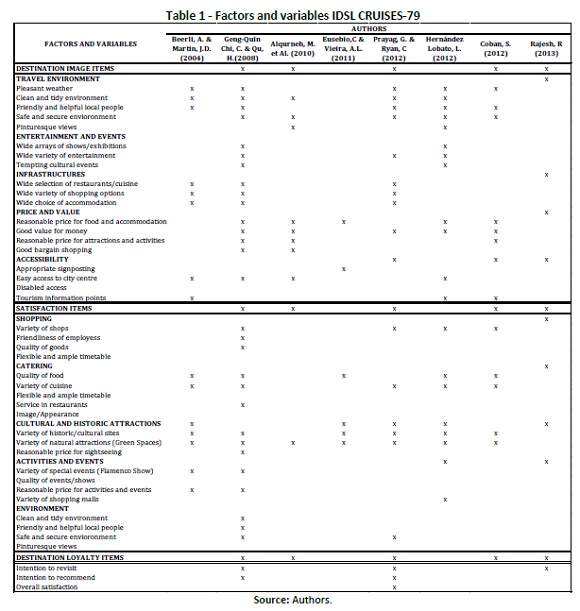
<body><![CDATA[<p>3. Methodology</p>     <p>The study used a stratified probability sampling technique, whose main objective    is to understand the behavior of tourists who arrive via cruise ship at the    port of Malaga and their perception of the city. A questionnaire was prepared    with a number of variables that are intended to describe and publish the profile    of cruise passengers, determining the overall satisfaction that they show and    also the perception of the destination image and consequently if they will repeat    the visit to the city in the future.</p>     <p>The structured or multi-attribute approach technique for the construction of    the questionnaire was used. It consists of the grouping of attributes set in    advance, collecting the perception that cruise passengers have for each attribute    through a Likert scale; psychometric scale commonly used in questionnaires,    most widely used in research surveys (Echtner &amp; Ritchie, 2003).</p>     <p>The questionnaire is named IDSL CRUISES-79, taking in to consideration the    first letters of the concepts studied in English, destination image, satisfaction    of cruise passengers and destination loyalty, annexed to the basic appellation    of our research &quot;cruises&quot; and the number 79, which includes a combination    of issues that we raised. It is divided into 2 parts: the variables of the theoretical    model and the provision of services and aspects of the cruise passenger profile.</p>     <p>The first block of the questionnaire IDSL CRUISES-79 consists of the three    concepts under study, the destination image, the satisfaction of cruise passengers    and destination loyalty, following previous analysis by other researchers and    adapting the variables to the circumstances of the analyzed context. Each concept    has been studied subdivided into several factors and, in turn, each factor is    represented by several variables or items. (Chi &amp; Qu, 2009; Jamaludin, Johari,    Aziz, Kayat, &amp; Yusof, 2012; Prayag &amp; Ryan, 2012; Zeithaml, Berry &amp;    Parasuraman, 1996; Cater &amp; Zabkar, 2009; Chi, Xiaoxia, &amp; Honggang, 2013).    The development of the questionnaire was based on an exhaustive review of the    literature, as shown in <a href="#t1">Table 1</a>.</p>     <p>&nbsp;</p>     <p align="center"><a name="t1"></a><img src="/img/revistas/tms/v14n1/14n1a05t1.jpg"/></p>     
<p>&nbsp;</p>     <p>3.1 Measuring instruments</p>     <p>(1) Destination image:</p>     ]]></body>
<body><![CDATA[<p>Based on the most important tourist literature, significant factors were selected    to evaluate the destination image: Environment (5 variables), entertainment    and recreation (3 variables), Infrastructure (3 variables), price and value    (4 variables) and accessibility (4 variables).</p>     <p>IDSL CRUISES-79 includes a total of 19 variables and the variable &quot;Disabled    Access&quot; has been included. A Likert scale of 7 values has been used, specifying    the level of agreement or disagreement with the statement (variables).</p>     <p>It has followed the following priority: 1= Strongly Disagree, 2= Disagree,    3= Slightly Disagree, 4= Undecided, 5= Slightly Agree, 6= Agree and 7= Strongly    Agree.</p>     <p>(2) Satisfaction of cruise passenger:</p>     <p>Regarding satisfaction of cruise passengers five factors have been selected:    Shopping (4 variables), Catering (5 variables), Historical and cultural attractions    (3 variables), and Leisure activities (4 variables) and Environment (4 variables).    Three variables are given to the proposed model &quot;Flexible and ample timetable&quot;    for Shopping and Catering and the &quot;Image and Appearance&quot; of this latter    factor.</p>     <p>A 7-point Likert scale has been used, demonstrating the level of satisfaction    or dissatisfaction with the statement (variable or items), which has followed    the following priority: 1= Fully dissatisfied, 2= Dissatisfied, 3= Slightly    dissatisfied, 4= Neutral or indifference, 5= Slightly satisfied, 6= Satisfied    and 7= Fully satisfied.</p>     <p>(3) Destination loyalty:</p>     <p>In this study, destination loyalty contemplated for its analysis 3 factors,    repetition of destination, recommendation of the destination and overall satisfaction    of the visit, with a 7-point Likert scale being 1= Fully dissatisfied, 2= Dissatisfied,    3= Slightly dissatisfied, 4= Neutral or indifference, 5= Slightly satisfied,    6= Satisfied and 7= Fully satisfied.</p>     <p>Finally, the questionnaire consists of socio-demographic characterization of    survey respondents who contribute to the classification of the sample: nationality,    age ranges, gender and traveler profile.</p>     <p>3.2 Reliability of the scale</p>     ]]></body>
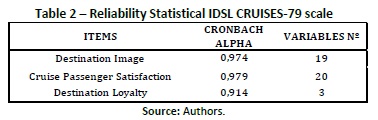
<body><![CDATA[<p>An analysis of the reliability of the scales was carried out through Cronbach    Alpha, which allows estimating the reliability of a measuring instrument, through    a set of items, which are expected to measure the same construct or theoretical    dimension (Nunnally &amp; Bernstein, 1994). The measure of reliability by this    indicator assumes that the items (Likert scale measured) measure the same construct    and are highly correlated. The closer the value of the Alfa is within 1, higher    the internal consistency of the items analyzed.</p>     <p>In our study, the reliability of the scale is reflected in <a href="#t2">Table    2</a>:</p>     <p>&nbsp;</p>     <p align="center"><a name="t2"></a><img src="/img/revistas/tms/v14n1/14n1a05t2.jpg"/></p>     
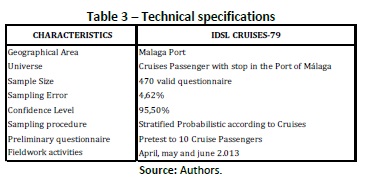
<p>&nbsp;</p>     <p>Reliability levels obtained with Cronbach Alpha method into each of the dimensions,    ranged from 0.914 and 0.979. These results reflect a high level of internal    consistency in the questionnaire IDSL CRUISES-79, scales the destination image,    cruise passenger&rsquo;s satisfaction and destination loyalty were reliable,    as Cronbach Alphas were greater than 0.9. An alpha of 0.7 or above is acceptable    considered as a good indication of reliability (Nunnally &amp; Bernstein, 1994).</p>     <p>3.3 Sampling</p>     <p>We chose cruise ship of different nationalities, companies and sizes. We selected    cruise passengers after visiting Malaga at the entrance of Malaga Port.</p>     <p>After collecting and debugging the information, aimed at cruise passengers    calling at the port of Malaga, a total of 470 valid questionnaires were validated.    An error of 4.62% for a confidence level of 95.5% was obtained (p = q = 0.5).    As indicated, the fieldwork was conducted during the months of April, May and    June 2013.</p>     <p>In our study, sampling is reflected in <a href="#t3">Table 3</a>:</p>     ]]></body>
<body><![CDATA[<p>&nbsp;</p>     <p align="center"><a name="t3"></a><img src="/img/revistas/tms/v14n1/14n1a05t3.jpg"/></p>     
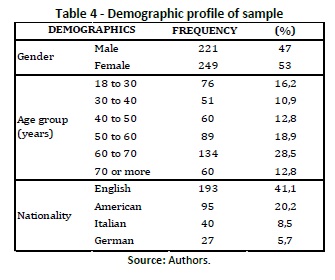
<p>&nbsp;</p>     <p>Data were analyzed with the Statistical Package Software SPSS version 21.0.    A cluster analysis applied to the cruise sector has allowed the assessment of    whether the data obtained from the sample, can be related in any significant    way, which leads us to define certain segments in order to identify different    types of cruise passengers.</p>     <p>3.4    Demographic profile of cruise passengers</p>     <p>The demographic profile of visitors to the city of Malaga via cruise ship indicated    a greater influx of female passengers (53.0%), compared with male (47.0%). Slightly    less than half of the samples (47.4%) were between 50 to 70 years old. The main    nationalities of interviewees were: English (41.1%), American (20.2%), Italian    (8.5%) and German (5.7%).</p>     <p>&nbsp;</p>     <p align="center"><a name="t4"></a><img src="/img/revistas/tms/v14n1/14n1a05t4.jpg"/></p>     
<p>&nbsp;</p>     <p>4. Results</p>     ]]></body>
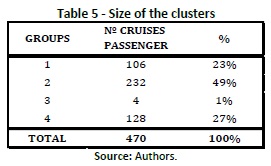
<body><![CDATA[<p>Cluster analysis was used to identify groups of cruise passengers distinguished    by the fact that they express different assessments of the variables analyzed    in our theoretical framework.</p>     <p>Cluster description</p>     <p>A cluster of K-media analysis was carried out in order to optimize the homogeneity    of the groups of cruise passengers. In our case, the K-media algorithm was equal    to 4, establishing four distinct groups of cruise passengers.</p>     <p><a href="#t5">Table 5</a> shows the number of passengers who have obtained    in each cluster.</p>     <p align="center"><a name="t5"></a><img src="/img/revistas/tms/v14n1/14n1a05t5.jpg"/></p>     
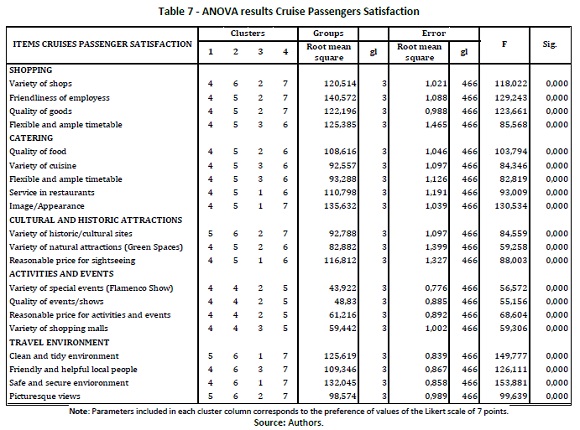
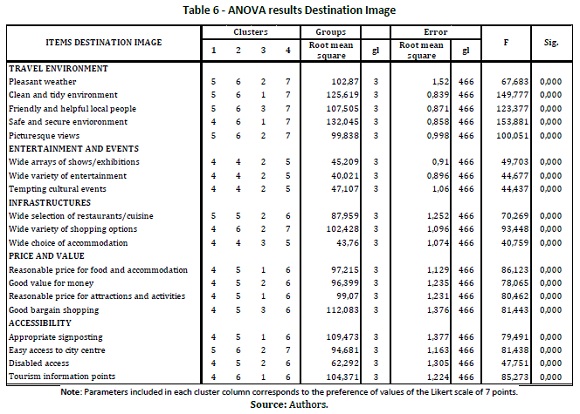
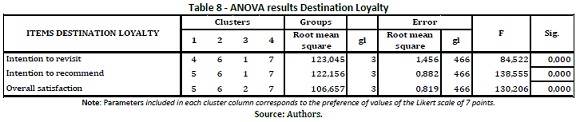
<p>&nbsp;</p>     <p>In order to identify the main differences between groups, an ANOVA test for    variables IDSL CRUISES-79 was performed. The results are presented in <a href="#t6">Table    6</a>, <a href="#t7">Table 7</a> and <a href="#t8">Table 8</a>. It can be seen    that the degree of significance for all variables is less than or equal to 0.05,    so that there are significant differences between groups.</p>     <p>&nbsp;</p>     <p align="center"><a name="t6"></a><img src="/img/revistas/tms/v14n1/14n1a05t6.jpg"/></p>     
<p>&nbsp;</p>     ]]></body>
<body><![CDATA[<p align="center"><a name="t7"></a><img src="/img/revistas/tms/v14n1/14n1a05t7.jpg"/></p>     
<p>&nbsp;</p>     <p align="center"><a name="t8"></a><img src="/img/revistas/tms/v14n1/14n1a05t8.jpg"/></p>     
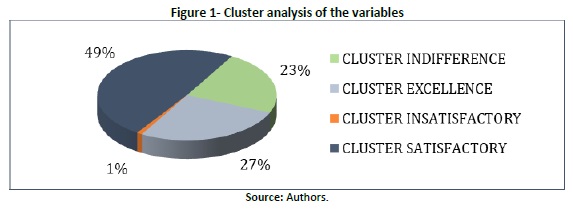
<p>&nbsp;</p>     <p>We highlight the cluster group 2, which represents 49 per cent of the total    sample. In the <a href="#f1">Figure 1</a>, two rather different conglomerates    are observed, on the one hand, group 1 represented by 23 per cent of interviewees,    who qualified as &quot;CLUSTER INDIFFERENCE&quot;, segment of cruise passengers    mainly indifferent to the issues raised, so their level satisfaction is relative.</p>     <p>&nbsp;</p>     <p align="center"><a name="f1"></a><img src="/img/revistas/tms/v14n1/14n1a05f1.jpg"/></p>     
<p>&nbsp;</p>     <p>&nbsp;</p>     <p>On the other hand, the conglomerate group 4, comprising 27 per cent of cruise    passengers collected the most satisfied passengers   and   consequently,   the      best   scores   on   the questionnaire, a total of 19 out of 42 variables scored    with a 7 on the scale Likert. This group has been denominated &quot;CLUSTER    EXCELENCE&quot;.</p>     ]]></body>
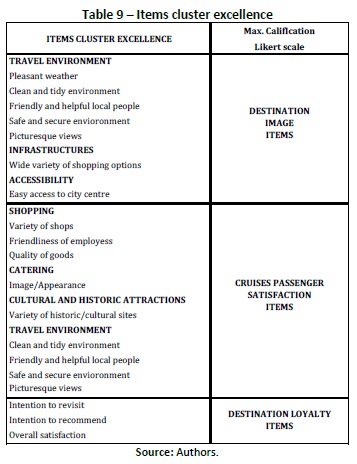
<body><![CDATA[<p>Group 3 cluster consists of passenger manifest &quot;strongly disagree&quot;    showing their dissatisfaction in many of the elements of the model variables,    specifically in 21 of the 42 items, representing 50 per cent. This cluster has    been called &quot;CLUSTER INSATISFACTORY &quot; This segment represents only    1 per cent of the total sample so this information is not relevant.</p>     <p>49 per cent of survey respondents are collected in cluster group 2. It is the    most important group; this is the reason why we need to bear in mind their findings,    both with regard to their good ratings and those aspects that may be susceptible    to improvement. This cluster has been called &quot;CLUSTER SATISFACTORY&quot;.</p>     <p>If we focus on the more numerous groups or clusters (group 2 and 4) we can    highlight the following:</p>     <p>CLUSTER EXCELLENCE (group 4)</p>     <p>The group of cruise passengers grouped in the CLUSTER EXCELLENCE expressed    greatest satisfaction, scoring with the highest rating all the items listed    in <a href="#t9">Table 9</a> relating to the three concepts of the theoretical    model. Also, it must be explained that other items not annexed in the above    table, are also highly valued.</p>     <p>&nbsp;</p>     <p align="center"><a name="t9"></a><img src="/img/revistas/tms/v14n1/14n1a05t9.jpg"/></p>     
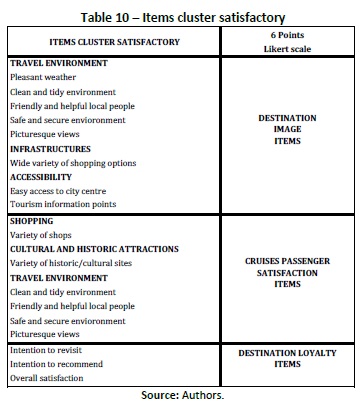
<p>&nbsp;</p>     <p>CLUSTER SATISFACTORY (group 2)</p>     <p>The group of cruise passengers grouped in CLUSTER SATISFACTORY, expressed great    satisfaction grading a 6 on the Likert scale. The elements annexed in <a href="#t10">Table10</a>    and the remaining elements would be either well appreciated or simply indifferent.</p>     ]]></body>
<body><![CDATA[<p>&nbsp;</p>     <p align="center"><a name="t10"></a><img src="/img/revistas/tms/v14n1/14n1a05t10.jpg"/></p>     
<p>&nbsp;</p>     <p>In this regard, we consider that the findings of this important segment of    passengers are of vital interest to our research, providing us valuable information    about the general satisfaction of tourists who are arriving in the city of Malaga    via cruise ship. Special emphasis has also been placed on those variables with    very good valuations; we will have to take them into account to empower them    and promote the marketing campaigns of the city.</p>     <p>5. Conclusions, discussion and recommendations</p>     <p>After the cluster analysis the following conclusions, taking into account the    hypothesis involved at the time have been reached.</p>     <p>First, in relation to hypothesis 1:</p>     <p>• H1: Are there different segments of cruise passengers, regarding the perception    of destination image of Malaga?</p>     <p>We conclude that there are different segments of cruise passengers, regarding    the perception of the image of the destination Malaga. It is noted that of all    the factors that describe the destination image, those related to Environment    and Accessibility have been the highest rated.</p>     <p>In particular, we highlight the interest shown in the great views of the city    of Malaga and its picturesque icons and, regarding the Environment factor, cleanliness    and safety of the Historical Centre.</p>     ]]></body>
<body><![CDATA[<p>The new port infrastructures have provided the tourist sector with a greater    ease of access to the city from the cruise terminal, reflected in the satisfactory    appreciations of cruise passengers, improving the destination image. Also, it    has been stated that there is a large segment of passengers that also feel satisfied    with safety, cleanliness and hospitality.</p>     <p>In connection with the Price and value factor, cruise passengers have expressed    an opinion not so satisfactory in variables like good value for money in relation    to the services and activities offered by the city, whether commercial, recreational    or even historical-cultural.</p>     <p>Similarly, the reasonable price variable for tourism activities has been one    of the worst rated by cruise passengers, along with great shopping opportunities.</p>     <p>In relation to passenger satisfaction, we can test hypothesis 2:</p>     <p>• H2: Are there different segments of cruise passengers regarding the satisfaction    variable, in their perception of the city of Malaga?</p>     <p>It is concluded that we do perceive the existence of different categories of    cruise passengers regarding their perceptions of the city of Malaga.</p>     <p>The most valued factor by cruise passengers has been precisely that related    to the Historical-cultural importance, which the city of Malaga has to do this    day.</p>     <p>Of the three variables that describe this factor the indicator has certainly    been &ldquo;Malaga has a great cultural offer&rdquo;, which has been highlighted over others.    It has also been reflected in this study that cruise passengers are very satisfied    with the cultural offer of the capital, the visits to monuments and museums.    So we can state that the historical and cultural attractions are a tourist attraction    for the cruise passengers who are visiting the city of Malaga.</p>     <p>Regarding hypothesis 3:</p>     <p>• H3: Are there different segments of cruise passengers, regarding the destination    loyalty variable in the context of Malaga?</p>     ]]></body>
<body><![CDATA[<p>We conclude that we do have different segments of cruise passengers with respect    to destination loyalty. It is appreciated that a very high percentage of cruise    passengers have expressed a high destination loyalty and the recommendation    of this city to their environment.</p>     <p>The analysis of socio-demographic characteristics reveals the existence of    differences concerning gender. In almost all factor variables of the levels    of appreciation of the female sex prevailed over the male.</p>     <p>In addition, the more demanding age range has been between 50 to 60 years of    age and regarding the study of nationalities it should be clear the figure of    the American passenger, who has expressed better valuations than other survey    respondents, according to the ratings in IDSL CRUISES-79.</p>     <p>The conclusions obtained in the research lead us to bring a set of recommendations    which; we understand are significant to improving cruise tourism in the city    of Malaga.</p>     <p>The data obtained from this research have so many practical implications. On    one hand we consider that both public and</p>     <p>private institutions could use this information and implement policies in order    to improve the services which are offered to cruise passengers.</p>     <p>We understand that public institutions and traders need to reflect on the connection    between the quality and price of services and activities, because if this assessment    is not excellent, as we argued, it may affect the destination image of the city    and in addition, may condition the intention of repeating the visit.</p>     <p>The strengthening of Malaga as a cultural top-rated destination is consolidated    with the opening of two new museums, the Centre Pompidou Malaga, which opened    its doors in the spring of 2015 and the Collection of Saint Petersburg the Russian    Museum in the capital, thus expanding cultural roots.</p>     <p>We think that the facilities offered by `Muelle Uno´, could become a perfect    combination of culture, commerce and gastronomy, linking the visit to the new    Pompidou, located next to the food court and shops, especially for cruise passengers    arriving at dock 2. Passengers with a high level of income, with options to    frequent the most exclusive shops and restaurants of the zone.</p>     <p>In terms of scarcity, we think that the information points need to professionalize    their services to a greater extent because in some of the interviews with both    cruise passengers and staff on board, there were indicators to the importance    of these points when visiting Malaga for the first time.</p>     ]]></body>
<body><![CDATA[<p>In line with this idea we emphasize that an association of tour guides has    recently formed, who stand around &quot;Cultural Malaga AGP&quot;. They aim    to expose the cultural keys of Malaga in search of a higher quality service.</p>     <p>The emblematic symbol of `Malaga marinera´ (Maritime Malaga), which is `La    Farola´ (a lighthouse), is going to waste, above all if we take into account    its situation at the entrance of `Muelle Uno´, near the cruise terminals, it    could be remodeled and used for a different purpose. On the one hand, it could    be used for attending to tourist cruises, with staff ready to exercise as genuine    cicerones of the city. It would benefit the quality of the information service    provided to cruise passengers.</p>     <p>On the other, it could also serve as a meeting point where the agents involved    in the business could contact the tourists, explaining all itineraries and routes    that can be followed on the visit to the city and in any event, encourage business    lines, which aim to strengthen links between shipping companies and cruise tourism    in Malaga.</p>     <p>Raising the image of Malaga and the increasing variety of gastronomical option    in the old town have been perceived satisfactorily by the collective of passengers,    due to this, we believe that cruise passengers are satisfied with the options    offered and in turn, this circumstance improves the image of the city.</p>     <p>Although the factors and selected variables for measuring the image of the    destination and cruise passenger satisfaction were chosen following a rigorous    review of the literature, the study has some limitations.</p>     <p>On the one hand, we recognize that there are other attributes that could have    been studied and are not included in the model; among them we can mention emotions,    authenticity, tourist expectations prior to the visit or the quest for novelty.    All of them are factors that many authors have collected in their models to    measure variables; we could consider them potential factors. As suggested, a    modification of the theoretical model proposed for future research.</p>     <p>In addition, the study is geographically limited to a region of southern Spain;    consequently, this limits the possibility of a broader view of the results and    also, the possibility of having a larger sample size. In this sense, the research    could also be repeated elsewhere to verify if there are differences in other    destinations.</p>     <p>Finally, the longitudinal approach gives us results referring to a certain    point of time, one where the data was obtained, so that in a later context,    the findings and/or results of the cluster analysis may be modified.</p>     <p>Lastly, through the cluster analysis we were able to verify the different profiles    of cruise passengers arriving in Malaga and identify what the strengths are    and how they can be improved.</p>     <p>The data obtained are mostly positive, 76 per cent of the sample (360 passengers    out of a total of 470 passengers); grouped in the CLUSTER EXCELLENCE and CLUSTER    SATISFACTORY, expressing great satisfaction with the issues raised in the IDSL    CRUISES-79.</p>     ]]></body>
<body><![CDATA[<p>In short, we can also say that this research has provided a better understanding    of the qualities and excellences of the city of Malaga through the eyes of the    cruise passenger, who was shown to be faithful to destination. Their future    recommendations provide us with a return of passengers which is of interest    for the economy of the city.</p>     <p>&nbsp;</p>     <p><b>REFERENCES</b></p>     <p>Alqurneh, M., Md Isa, F. &amp; Rahim, A. (2010). Tourism destination image,    satisfaction and loyalty: A study of the Dead Sea in Jordanian curative tourism.    Paper presented at The Third International Conference on International Studies    (ICIS 2010), Hotel Istana Kuala Lumpur. College of Law. Government and International    Studies, University Utara Malaysia. Sintok, 1-10.</p>     <!-- ref --><p>Baloglu, S. &amp; McCleary, K.W. (1999). A model of destination image formation.    Annals of Tourism Research, 4(26), 868-897.    &nbsp;&nbsp;&nbsp;&nbsp;&nbsp;&nbsp;&nbsp;&nbsp;[&#160;<a href="javascript:void(0);" onclick="javascript: window.open('/scielo.php?script=sci_nlinks&ref=1272067&pid=S2182-8458201800010000500002&lng=','','width=640,height=500,resizable=yes,scrollbars=1,menubar=yes,');">Links</a>&#160;]<!-- end-ref --></p>     <!-- ref --><p>Barich, H. &amp; Kotler, P. (1991). A framework for marketing image management.    Sloan Management Review, 32, 94-104.    &nbsp;&nbsp;&nbsp;&nbsp;&nbsp;&nbsp;&nbsp;&nbsp;[&#160;<a href="javascript:void(0);" onclick="javascript: window.open('/scielo.php?script=sci_nlinks&ref=1272069&pid=S2182-8458201800010000500003&lng=','','width=640,height=500,resizable=yes,scrollbars=1,menubar=yes,');">Links</a>&#160;]<!-- end-ref --></p>     <!-- ref --><p>Beerli, A. &amp; Martin, J. D. (2004). Factors influencing destination image.    Annals of Tourism Research, 3(31), 657-681.    &nbsp;&nbsp;&nbsp;&nbsp;&nbsp;&nbsp;&nbsp;&nbsp;[&#160;<a href="javascript:void(0);" onclick="javascript: window.open('/scielo.php?script=sci_nlinks&ref=1272071&pid=S2182-8458201800010000500004&lng=','','width=640,height=500,resizable=yes,scrollbars=1,menubar=yes,');">Links</a>&#160;]<!-- end-ref --></p>     ]]></body>
<body><![CDATA[<!-- ref --><p>Carvajal-Trujillo, E &amp; Sanz, S. (2015). The moderating effects of personal    and situational characteristics on the image, satisfaction and future behavioral    intention with ports of calls. In: 2nd International Symposium on Partial Least    Squares Path Modeling - The Conference for PLS Users.    &nbsp;&nbsp;&nbsp;&nbsp;&nbsp;&nbsp;&nbsp;&nbsp;[&#160;<a href="javascript:void(0);" onclick="javascript: window.open('/scielo.php?script=sci_nlinks&ref=1272073&pid=S2182-8458201800010000500005&lng=','','width=640,height=500,resizable=yes,scrollbars=1,menubar=yes,');">Links</a>&#160;]<!-- end-ref -->, 16 June 2015 - 19 June    2015, Seville, Spain</p>     <!-- ref --><p>Cater, B. &amp; Zabkar, V. (2009). Antecedents and consequences of commitment    in marketing research services: The client´s perspective. Industrial Marketing    Management, 38(7), 785-797.    &nbsp;&nbsp;&nbsp;&nbsp;&nbsp;&nbsp;&nbsp;&nbsp;[&#160;<a href="javascript:void(0);" onclick="javascript: window.open('/scielo.php?script=sci_nlinks&ref=1272075&pid=S2182-8458201800010000500006&lng=','','width=640,height=500,resizable=yes,scrollbars=1,menubar=yes,');">Links</a>&#160;]<!-- end-ref --></p>     <!-- ref --><p>Coban, S. (2012). The effects of the image of destination on tourist satisfaction    and loyalty: the case of Cappadocia, European Journal of Social Science, 2(29),    222-232.    &nbsp;&nbsp;&nbsp;&nbsp;&nbsp;&nbsp;&nbsp;&nbsp;[&#160;<a href="javascript:void(0);" onclick="javascript: window.open('/scielo.php?script=sci_nlinks&ref=1272077&pid=S2182-8458201800010000500007&lng=','','width=640,height=500,resizable=yes,scrollbars=1,menubar=yes,');">Links</a>&#160;]<!-- end-ref --></p>     <!-- ref --><p>Devesa Fernández, M. &amp; Palacios Picos, A. (2005). Predicciones en el nivel    de satisfacción percibida por los turistas a partir de variables motivacionales    y de valoración de la visita. Información Comercial española: Tribuna de Economía,    821, 241-255.    &nbsp;&nbsp;&nbsp;&nbsp;&nbsp;&nbsp;&nbsp;&nbsp;[&#160;<a href="javascript:void(0);" onclick="javascript: window.open('/scielo.php?script=sci_nlinks&ref=1272079&pid=S2182-8458201800010000500008&lng=','','width=640,height=500,resizable=yes,scrollbars=1,menubar=yes,');">Links</a>&#160;]<!-- end-ref --></p>     <!-- ref --><p>Echtner, C.M. &amp; Ritchie, J.R. (2003). The meaning and measurement of destination    image. The Journal of Tourism Studies, 14(1), 37-48.    &nbsp;&nbsp;&nbsp;&nbsp;&nbsp;&nbsp;&nbsp;&nbsp;[&#160;<a href="javascript:void(0);" onclick="javascript: window.open('/scielo.php?script=sci_nlinks&ref=1272081&pid=S2182-8458201800010000500009&lng=','','width=640,height=500,resizable=yes,scrollbars=1,menubar=yes,');">Links</a>&#160;]<!-- end-ref --></p>     ]]></body>
<body><![CDATA[<!-- ref --><p>Ejarque, J. (2005). Destinos turísticos de éxito: Diseño, creación, gestión    y marketing. Madrid: Piramide.    &nbsp;&nbsp;&nbsp;&nbsp;&nbsp;&nbsp;&nbsp;&nbsp;[&#160;<a href="javascript:void(0);" onclick="javascript: window.open('/scielo.php?script=sci_nlinks&ref=1272083&pid=S2182-8458201800010000500010&lng=','','width=640,height=500,resizable=yes,scrollbars=1,menubar=yes,');">Links</a>&#160;]<!-- end-ref --></p>     <p>Eusebio, C. &amp; Vieira, A.L. (2011). Destination attributes&rsquo; evaluation,    satisfaction and behavioural intentions: a structural modelling approach. International    Journal of Tourism Research, 15(1), 66-80.</p>     <!-- ref --><p>Ferreira Lopes, S.D. (2011). Destination image: origins, developments and implications.    Revista de Turismo y Patrimonio Cultural, 2(9), 305-315.    &nbsp;&nbsp;&nbsp;&nbsp;&nbsp;&nbsp;&nbsp;&nbsp;[&#160;<a href="javascript:void(0);" onclick="javascript: window.open('/scielo.php?script=sci_nlinks&ref=1272086&pid=S2182-8458201800010000500012&lng=','','width=640,height=500,resizable=yes,scrollbars=1,menubar=yes,');">Links</a>&#160;]<!-- end-ref --></p>     <!-- ref --><p>Fyall, A., Callod, C. &amp; Edwards, B. (2003). Relationship marketing. The    challenge for destinations. Annals of Tourism Research, 30(3), 644-659.    &nbsp;&nbsp;&nbsp;&nbsp;&nbsp;&nbsp;&nbsp;&nbsp;[&#160;<a href="javascript:void(0);" onclick="javascript: window.open('/scielo.php?script=sci_nlinks&ref=1272088&pid=S2182-8458201800010000500013&lng=','','width=640,height=500,resizable=yes,scrollbars=1,menubar=yes,');">Links</a>&#160;]<!-- end-ref --></p>     <!-- ref --><p>Geng-Quin Chi, C. &amp; Qu, H. (2008). Examining the structural relationships    of destination image, tourist satisfaction and destination loyalty: an integrated    approach. Tourism Management, 29(4), 624-636.    &nbsp;&nbsp;&nbsp;&nbsp;&nbsp;&nbsp;&nbsp;&nbsp;[&#160;<a href="javascript:void(0);" onclick="javascript: window.open('/scielo.php?script=sci_nlinks&ref=1272090&pid=S2182-8458201800010000500014&lng=','','width=640,height=500,resizable=yes,scrollbars=1,menubar=yes,');">Links</a>&#160;]<!-- end-ref --></p>     <p>Geng-Quin Chi, C. &amp; Qu, H. (2009). Examining the relationship between tourist&rsquo;s    attribute satisfaction and overall satisfaction. Journal of Hospitality Marketing    &amp; Management, 18, 4-25.</p>     ]]></body>
<body><![CDATA[<!-- ref --><p>Geng-Quin Chi, C., Xiaoxia, S. &amp; Honggang, X. (2013). Developing destination    loyalty: the case of Hainan Island. Annals of Tourism Research, 43, 547-577.    &nbsp;&nbsp;&nbsp;&nbsp;&nbsp;&nbsp;&nbsp;&nbsp;[&#160;<a href="javascript:void(0);" onclick="javascript: window.open('/scielo.php?script=sci_nlinks&ref=1272093&pid=S2182-8458201800010000500016&lng=','','width=640,height=500,resizable=yes,scrollbars=1,menubar=yes,');">Links</a>&#160;]<!-- end-ref --></p>     <!-- ref --><p>Giese, J.L. &amp; Cote, J. A. (2000). Defining consumer satisfaction. Academy    of Marketing Science Review, 1, 1-24.    &nbsp;&nbsp;&nbsp;&nbsp;&nbsp;&nbsp;&nbsp;&nbsp;[&#160;<a href="javascript:void(0);" onclick="javascript: window.open('/scielo.php?script=sci_nlinks&ref=1272095&pid=S2182-8458201800010000500017&lng=','','width=640,height=500,resizable=yes,scrollbars=1,menubar=yes,');">Links</a>&#160;]<!-- end-ref --></p>     <!-- ref --><p>Hunt, J.D. (1975). Image as a factor in tourism development, Journal of Travel    Research, 13, 1-7.    &nbsp;&nbsp;&nbsp;&nbsp;&nbsp;&nbsp;&nbsp;&nbsp;[&#160;<a href="javascript:void(0);" onclick="javascript: window.open('/scielo.php?script=sci_nlinks&ref=1272097&pid=S2182-8458201800010000500018&lng=','','width=640,height=500,resizable=yes,scrollbars=1,menubar=yes,');">Links</a>&#160;]<!-- end-ref --></p>     <!-- ref --><p>Jamaludin, M., Johari, S., Aziz, A., Kayat, K. &amp; Yusof, A. R. M. (2012).    Examining Structural Relationship between Destination Image, Tourist Satisfaction    and Destination Loyalty. International Journal of Independent Research and Studies,    1(3), 89-96.    &nbsp;&nbsp;&nbsp;&nbsp;&nbsp;&nbsp;&nbsp;&nbsp;[&#160;<a href="javascript:void(0);" onclick="javascript: window.open('/scielo.php?script=sci_nlinks&ref=1272099&pid=S2182-8458201800010000500019&lng=','','width=640,height=500,resizable=yes,scrollbars=1,menubar=yes,');">Links</a>&#160;]<!-- end-ref --></p>     <!-- ref --><p>Kim, H. &amp; Richardson, S. L. (2003). Motion picture impacts on destination    images. Annals of Tourism Research, 30(1), 216-237.    &nbsp;&nbsp;&nbsp;&nbsp;&nbsp;&nbsp;&nbsp;&nbsp;[&#160;<a href="javascript:void(0);" onclick="javascript: window.open('/scielo.php?script=sci_nlinks&ref=1272101&pid=S2182-8458201800010000500020&lng=','','width=640,height=500,resizable=yes,scrollbars=1,menubar=yes,');">Links</a>&#160;]<!-- end-ref --></p>     ]]></body>
<body><![CDATA[<!-- ref --><p>Kozak, M. &amp; Rimmington, M. (2000). Tourist satisfaction with Mallorca,    Spain, as an off-season holiday destination. Journal of Travel Research, 3(38),    260-269.    &nbsp;&nbsp;&nbsp;&nbsp;&nbsp;&nbsp;&nbsp;&nbsp;[&#160;<a href="javascript:void(0);" onclick="javascript: window.open('/scielo.php?script=sci_nlinks&ref=1272103&pid=S2182-8458201800010000500021&lng=','','width=640,height=500,resizable=yes,scrollbars=1,menubar=yes,');">Links</a>&#160;]<!-- end-ref --></p>     <!-- ref --><p>Lawson, F. &amp; Baud-Bovy, M. (1977). Tourist and recreational development.    London: Architectural Press.    &nbsp;&nbsp;&nbsp;&nbsp;&nbsp;&nbsp;&nbsp;&nbsp;[&#160;<a href="javascript:void(0);" onclick="javascript: window.open('/scielo.php?script=sci_nlinks&ref=1272105&pid=S2182-8458201800010000500022&lng=','','width=640,height=500,resizable=yes,scrollbars=1,menubar=yes,');">Links</a>&#160;]<!-- end-ref --></p>     <p>Lee, T.H. (2009). A structural model for examining how destination image and    interpretation services affect future visitatio nbehavior: a case study of Taiwan&rsquo;s    Taomi eco-village. Journal of Sustainable Tourism, 6 (17), 727-745</p>     <!-- ref --><p>Medlik, S. &amp; Middleton, V.T.C. (1973). The tourist product and its marketing    implications. International Tourism Quarterly, 3(1), 28–35.    &nbsp;&nbsp;&nbsp;&nbsp;&nbsp;&nbsp;&nbsp;&nbsp;[&#160;<a href="javascript:void(0);" onclick="javascript: window.open('/scielo.php?script=sci_nlinks&ref=1272108&pid=S2182-8458201800010000500024&lng=','','width=640,height=500,resizable=yes,scrollbars=1,menubar=yes,');">Links</a>&#160;]<!-- end-ref --></p>     <!-- ref --><p>Murphy, P., Pritchard, M.P. &amp; Smith, B. (2000). The destination product    and its impact on traveler perceptions. Tourism Management, 21(1), 43-52.    &nbsp;&nbsp;&nbsp;&nbsp;&nbsp;&nbsp;&nbsp;&nbsp;[&#160;<a href="javascript:void(0);" onclick="javascript: window.open('/scielo.php?script=sci_nlinks&ref=1272110&pid=S2182-8458201800010000500025&lng=','','width=640,height=500,resizable=yes,scrollbars=1,menubar=yes,');">Links</a>&#160;]<!-- end-ref --></p>     <!-- ref --><p>Nunnally, J. C., &amp; Bernstein, I. H. (1994). Psychometric theory (3rd ed.).    New York: McGraw-Hill.    &nbsp;&nbsp;&nbsp;&nbsp;&nbsp;&nbsp;&nbsp;&nbsp;[&#160;<a href="javascript:void(0);" onclick="javascript: window.open('/scielo.php?script=sci_nlinks&ref=1272112&pid=S2182-8458201800010000500026&lng=','','width=640,height=500,resizable=yes,scrollbars=1,menubar=yes,');">Links</a>&#160;]<!-- end-ref --></p>     <!-- ref --><p>Oliver, Richard L. (1997). Satisfaction: a behavioral perspective on the consumer.    New York: Irwin/McGraw-Hill.    &nbsp;&nbsp;&nbsp;&nbsp;&nbsp;&nbsp;&nbsp;&nbsp;[&#160;<a href="javascript:void(0);" onclick="javascript: window.open('/scielo.php?script=sci_nlinks&ref=1272114&pid=S2182-8458201800010000500027&lng=','','width=640,height=500,resizable=yes,scrollbars=1,menubar=yes,');">Links</a>&#160;]<!-- end-ref --></p>     <!-- ref --><p>Prayag, G. (2008). Image, satisfaction and loyalty – the case of Cape Town.    Anatolia: An International Journal of Tourism and Hospitality Research, 19(2),    205-224.    &nbsp;&nbsp;&nbsp;&nbsp;&nbsp;&nbsp;&nbsp;&nbsp;[&#160;<a href="javascript:void(0);" onclick="javascript: window.open('/scielo.php?script=sci_nlinks&ref=1272116&pid=S2182-8458201800010000500028&lng=','','width=640,height=500,resizable=yes,scrollbars=1,menubar=yes,');">Links</a>&#160;]<!-- end-ref --></p>     <p>Prayag, G. &amp; Ryan, C. (2012). Antecedents of tourists&rsquo; loyalty to    Mauritius:   the   role   and   influence   of   destination   image,   place    attachment, personal involvement, and satisfaction. Journal of Travel Research,    51(3), 342-356.</p>     <!-- ref --><p>Rajesh, R. (2013). Impact of tourist perceptions, destination image and tourist    satisfaction on destination loyalty: a conceptual model. PASOS, 11(3), 67-78.    &nbsp;&nbsp;&nbsp;&nbsp;&nbsp;&nbsp;&nbsp;&nbsp;[&#160;<a href="javascript:void(0);" onclick="javascript: window.open('/scielo.php?script=sci_nlinks&ref=1272119&pid=S2182-8458201800010000500030&lng=','','width=640,height=500,resizable=yes,scrollbars=1,menubar=yes,');">Links</a>&#160;]<!-- end-ref --></p>     <!-- ref --><p>Sanz, S &amp; Carvajal-Trujillo, E. (2014). The case study of Valencia. Ocean    &amp; Coastal Management,  102,(A), 307–16.    &nbsp;&nbsp;&nbsp;&nbsp;&nbsp;&nbsp;&nbsp;&nbsp;[&#160;<a href="javascript:void(0);" onclick="javascript: window.open('/scielo.php?script=sci_nlinks&ref=1272121&pid=S2182-8458201800010000500031&lng=','','width=640,height=500,resizable=yes,scrollbars=1,menubar=yes,');">Links</a>&#160;]<!-- end-ref --></p>     ]]></body>
<body><![CDATA[<!-- ref --><p>Shirazi, S. F. M. &amp; Som, A. P. M. (2011). Destination management and relationship    marketing: two major factors to achieve competitive advantage. Journal of Relationship    Marketing, 10(2), 76-87.    &nbsp;&nbsp;&nbsp;&nbsp;&nbsp;&nbsp;&nbsp;&nbsp;[&#160;<a href="javascript:void(0);" onclick="javascript: window.open('/scielo.php?script=sci_nlinks&ref=1272123&pid=S2182-8458201800010000500032&lng=','','width=640,height=500,resizable=yes,scrollbars=1,menubar=yes,');">Links</a>&#160;]<!-- end-ref --></p>     <!-- ref --><p>Sonmez, S. &amp; Sriakaya, E. (2002). A distorted destination image? The case    of Turkey. Journal of Travel Research, 41, 185-196.    &nbsp;&nbsp;&nbsp;&nbsp;&nbsp;&nbsp;&nbsp;&nbsp;[&#160;<a href="javascript:void(0);" onclick="javascript: window.open('/scielo.php?script=sci_nlinks&ref=1272125&pid=S2182-8458201800010000500033&lng=','','width=640,height=500,resizable=yes,scrollbars=1,menubar=yes,');">Links</a>&#160;]<!-- end-ref --></p>     <!-- ref --><p>Stepchenkova, S. &amp; Mills, J.E. (2010). Destination image: a meta-analysis    of 2000-2007 research. Journal of Hospitality Marketing &amp; Management, 19(6),    575-609.    &nbsp;&nbsp;&nbsp;&nbsp;&nbsp;&nbsp;&nbsp;&nbsp;[&#160;<a href="javascript:void(0);" onclick="javascript: window.open('/scielo.php?script=sci_nlinks&ref=1272127&pid=S2182-8458201800010000500034&lng=','','width=640,height=500,resizable=yes,scrollbars=1,menubar=yes,');">Links</a>&#160;]<!-- end-ref --></p>     <!-- ref --><p>Tasci, A., Gartner, W. &amp; Cavusgil, S. (2007). Measurement of destination    brand bias using a quasi-experimental design. Tourism Management, 28, 1529-1540.    &nbsp;&nbsp;&nbsp;&nbsp;&nbsp;&nbsp;&nbsp;&nbsp;[&#160;<a href="javascript:void(0);" onclick="javascript: window.open('/scielo.php?script=sci_nlinks&ref=1272129&pid=S2182-8458201800010000500035&lng=','','width=640,height=500,resizable=yes,scrollbars=1,menubar=yes,');">Links</a>&#160;]<!-- end-ref --></p>     <!-- ref --><p>Valls, J.F. (2004). Gestión de destinos turísticos sostenibles. Ediciones Gestión    2000.    &nbsp;&nbsp;&nbsp;&nbsp;&nbsp;&nbsp;&nbsp;&nbsp;[&#160;<a href="javascript:void(0);" onclick="javascript: window.open('/scielo.php?script=sci_nlinks&ref=1272131&pid=S2182-8458201800010000500036&lng=','','width=640,height=500,resizable=yes,scrollbars=1,menubar=yes,');">Links</a>&#160;]<!-- end-ref --></p>     ]]></body>
<body><![CDATA[<!-- ref --><p>Xie, H. J., Kerstetter, D. L., &amp; Mattila, A. S. (2012). The attributes    of a cruise ship that influence the decision making of cruisers and potential    cruisers. International Journal of Hospitality Management, 31(1), 152-159.    &nbsp;&nbsp;&nbsp;&nbsp;&nbsp;&nbsp;&nbsp;&nbsp;[&#160;<a href="javascript:void(0);" onclick="javascript: window.open('/scielo.php?script=sci_nlinks&ref=1272133&pid=S2182-8458201800010000500037&lng=','','width=640,height=500,resizable=yes,scrollbars=1,menubar=yes,');">Links</a>&#160;]<!-- end-ref --></p>     <!-- ref --><p>Yoon, Y. &amp; Uysal, M. (2005). An examination of the effects of motivation    and satisfaction on destination loyalty: a structural model. Journal of Tourism    Management, 26(1), 45-56.    &nbsp;&nbsp;&nbsp;&nbsp;&nbsp;&nbsp;&nbsp;&nbsp;[&#160;<a href="javascript:void(0);" onclick="javascript: window.open('/scielo.php?script=sci_nlinks&ref=1272135&pid=S2182-8458201800010000500038&lng=','','width=640,height=500,resizable=yes,scrollbars=1,menubar=yes,');">Links</a>&#160;]<!-- end-ref --></p>     <!-- ref --><p>Zeithaml, V.A., Berry, L.L., &amp; Parasuraman, A. (1996). The behavioural    consequences of service quality. Journal of Marketing, 60(2), 31-46.    &nbsp;&nbsp;&nbsp;&nbsp;&nbsp;&nbsp;&nbsp;&nbsp;[&#160;<a href="javascript:void(0);" onclick="javascript: window.open('/scielo.php?script=sci_nlinks&ref=1272137&pid=S2182-8458201800010000500039&lng=','','width=640,height=500,resizable=yes,scrollbars=1,menubar=yes,');">Links</a>&#160;]<!-- end-ref --></p>     <p>&nbsp;</p>     <p>Received: 13 May 2016</p>     <p>Revisions required: 27 January 2017</p>     <p>Accepted: 14 April 2017</p>     ]]></body>
<body><![CDATA[ ]]></body><back>
<ref-list>
<ref id="B1">
<nlm-citation citation-type="book">
<person-group person-group-type="author">
<name>
<surname><![CDATA[Alqurneh]]></surname>
<given-names><![CDATA[M.]]></given-names>
</name>
<name>
<surname><![CDATA[Md Isa]]></surname>
<given-names><![CDATA[F.]]></given-names>
</name>
<name>
<surname><![CDATA[Rahim]]></surname>
<given-names><![CDATA[A.]]></given-names>
</name>
</person-group>
<article-title xml:lang="en"><![CDATA[Tourism destination image, satisfaction and loyalty: A study of the Dead Sea in Jordanian curative tourism]]></article-title>
<source><![CDATA[]]></source>
<year>2010</year>
<page-range>1-10</page-range><publisher-loc><![CDATA[Sintok ]]></publisher-loc>
<publisher-name><![CDATA[Government and International StudiesUniversity Utara Malaysia]]></publisher-name>
</nlm-citation>
</ref>
<ref id="B2">
<nlm-citation citation-type="journal">
<person-group person-group-type="author">
<name>
<surname><![CDATA[Baloglu]]></surname>
<given-names><![CDATA[S.]]></given-names>
</name>
<name>
<surname><![CDATA[McCleary]]></surname>
<given-names><![CDATA[K.W.]]></given-names>
</name>
</person-group>
<article-title xml:lang="en"><![CDATA[A model of destination image formation]]></article-title>
<source><![CDATA[Annals of Tourism Research]]></source>
<year>1999</year>
<volume>4</volume>
<numero>26</numero>
<issue>26</issue>
<page-range>868-897</page-range></nlm-citation>
</ref>
<ref id="B3">
<nlm-citation citation-type="journal">
<person-group person-group-type="author">
<name>
<surname><![CDATA[Barich]]></surname>
<given-names><![CDATA[H.]]></given-names>
</name>
<name>
<surname><![CDATA[Kotler]]></surname>
<given-names><![CDATA[P.]]></given-names>
</name>
</person-group>
<article-title xml:lang="en"><![CDATA[A framework for marketing image management]]></article-title>
<source><![CDATA[Sloan Management Review]]></source>
<year>1991</year>
<volume>32</volume>
<page-range>94-104</page-range></nlm-citation>
</ref>
<ref id="B4">
<nlm-citation citation-type="journal">
<person-group person-group-type="author">
<name>
<surname><![CDATA[Beerli]]></surname>
<given-names><![CDATA[A.]]></given-names>
</name>
<name>
<surname><![CDATA[Martin]]></surname>
<given-names><![CDATA[J. D.]]></given-names>
</name>
</person-group>
<article-title xml:lang="en"><![CDATA[Factors influencing destination image]]></article-title>
<source><![CDATA[Annals of Tourism Research]]></source>
<year>2004</year>
<volume>3</volume>
<numero>31</numero>
<issue>31</issue>
<page-range>657-681</page-range></nlm-citation>
</ref>
<ref id="B5">
<nlm-citation citation-type="">
<person-group person-group-type="author">
<name>
<surname><![CDATA[Carvajal-Trujillo]]></surname>
<given-names><![CDATA[E]]></given-names>
</name>
<name>
<surname><![CDATA[Sanz]]></surname>
<given-names><![CDATA[S.]]></given-names>
</name>
</person-group>
<article-title xml:lang="en"><![CDATA[The moderating effects of personal and situational characteristics on the image, satisfaction and future behavioral intention with ports of calls]]></article-title>
<source><![CDATA[]]></source>
<year>2015</year>
</nlm-citation>
</ref>
<ref id="B6">
<nlm-citation citation-type="journal">
<person-group person-group-type="author">
<name>
<surname><![CDATA[Cater]]></surname>
<given-names><![CDATA[B.]]></given-names>
</name>
<name>
<surname><![CDATA[Zabkar]]></surname>
<given-names><![CDATA[V.]]></given-names>
</name>
</person-group>
<article-title xml:lang="en"><![CDATA[Antecedents and consequences of commitment in marketing research services: The client´s perspective]]></article-title>
<source><![CDATA[Industrial Marketing Management]]></source>
<year>2009</year>
<volume>38</volume>
<numero>7</numero>
<issue>7</issue>
<page-range>785-797</page-range></nlm-citation>
</ref>
<ref id="B7">
<nlm-citation citation-type="journal">
<person-group person-group-type="author">
<name>
<surname><![CDATA[Coban]]></surname>
<given-names><![CDATA[S.]]></given-names>
</name>
</person-group>
<article-title xml:lang="en"><![CDATA[The effects of the image of destination on tourist satisfaction and loyalty: the case of Cappadocia]]></article-title>
<source><![CDATA[European Journal of Social Science]]></source>
<year>2012</year>
<volume>2</volume>
<numero>29</numero>
<issue>29</issue>
<page-range>222-232</page-range></nlm-citation>
</ref>
<ref id="B8">
<nlm-citation citation-type="journal">
<person-group person-group-type="author">
<name>
<surname><![CDATA[Devesa Fernández]]></surname>
<given-names><![CDATA[M.]]></given-names>
</name>
<name>
<surname><![CDATA[Palacios Picos]]></surname>
<given-names><![CDATA[A.]]></given-names>
</name>
</person-group>
<article-title xml:lang="es"><![CDATA[Predicciones en el nivel de satisfacción percibida por los turistas a partir de variables motivacionales y de valoración de la visita]]></article-title>
<source><![CDATA[Información Comercial española: Tribuna de Economía]]></source>
<year>2005</year>
<volume>821</volume>
<page-range>241-255</page-range></nlm-citation>
</ref>
<ref id="B9">
<nlm-citation citation-type="journal">
<person-group person-group-type="author">
<name>
<surname><![CDATA[Echtner]]></surname>
<given-names><![CDATA[C.M.]]></given-names>
</name>
<name>
<surname><![CDATA[Ritchie]]></surname>
<given-names><![CDATA[J.R.]]></given-names>
</name>
</person-group>
<article-title xml:lang="en"><![CDATA[The meaning and measurement of destination image]]></article-title>
<source><![CDATA[The Journal of Tourism Studies]]></source>
<year>2003</year>
<volume>14</volume>
<numero>1</numero>
<issue>1</issue>
<page-range>37-48</page-range></nlm-citation>
</ref>
<ref id="B10">
<nlm-citation citation-type="book">
<person-group person-group-type="author">
<name>
<surname><![CDATA[Ejarque]]></surname>
<given-names><![CDATA[J.]]></given-names>
</name>
</person-group>
<source><![CDATA[Destinos turísticos de éxito: Diseño, creación, gestión y marketing]]></source>
<year>2005</year>
<publisher-loc><![CDATA[Madrid ]]></publisher-loc>
<publisher-name><![CDATA[Piramide]]></publisher-name>
</nlm-citation>
</ref>
<ref id="B11">
<nlm-citation citation-type="journal">
<person-group person-group-type="author">
<name>
<surname><![CDATA[Eusebio]]></surname>
<given-names><![CDATA[C.]]></given-names>
</name>
<name>
<surname><![CDATA[Vieira]]></surname>
<given-names><![CDATA[A.L.]]></given-names>
</name>
</person-group>
<article-title xml:lang="en"><![CDATA[Destination attributes&rsquo; evaluation, satisfaction and behavioural intentions: a structural modelling approach]]></article-title>
<source><![CDATA[International Journal of Tourism Research]]></source>
<year>2011</year>
<volume>15</volume>
<numero>1</numero>
<issue>1</issue>
<page-range>66-80</page-range></nlm-citation>
</ref>
<ref id="B12">
<nlm-citation citation-type="journal">
<person-group person-group-type="author">
<name>
<surname><![CDATA[Ferreira Lopes]]></surname>
<given-names><![CDATA[S.D.]]></given-names>
</name>
</person-group>
<article-title xml:lang="en"><![CDATA[Destination image: origins, developments and implications]]></article-title>
<source><![CDATA[Revista de Turismo y Patrimonio Cultural]]></source>
<year>2011</year>
<volume>2</volume>
<numero>9</numero>
<issue>9</issue>
<page-range>305-315</page-range></nlm-citation>
</ref>
<ref id="B13">
<nlm-citation citation-type="journal">
<person-group person-group-type="author">
<name>
<surname><![CDATA[Fyall]]></surname>
<given-names><![CDATA[A.]]></given-names>
</name>
<name>
<surname><![CDATA[Callod]]></surname>
<given-names><![CDATA[C.]]></given-names>
</name>
<name>
<surname><![CDATA[Edwards]]></surname>
<given-names><![CDATA[B.]]></given-names>
</name>
</person-group>
<article-title xml:lang="en"><![CDATA[Relationship marketing: The challenge for destinations]]></article-title>
<source><![CDATA[Annals of Tourism Research]]></source>
<year>2003</year>
<volume>30</volume>
<numero>3</numero>
<issue>3</issue>
<page-range>644-659</page-range></nlm-citation>
</ref>
<ref id="B14">
<nlm-citation citation-type="journal">
<person-group person-group-type="author">
<name>
<surname><![CDATA[Geng-Quin Chi]]></surname>
<given-names><![CDATA[C.]]></given-names>
</name>
<name>
<surname><![CDATA[Qu]]></surname>
<given-names><![CDATA[H.]]></given-names>
</name>
</person-group>
<article-title xml:lang="en"><![CDATA[Examining the structural relationships of destination image, tourist satisfaction and destination loyalty: an integrated approach]]></article-title>
<source><![CDATA[Tourism Management]]></source>
<year>2008</year>
<volume>29</volume>
<numero>4</numero>
<issue>4</issue>
<page-range>624-636</page-range></nlm-citation>
</ref>
<ref id="B15">
<nlm-citation citation-type="journal">
<person-group person-group-type="author">
<name>
<surname><![CDATA[Geng-Quin Chi]]></surname>
<given-names><![CDATA[C.]]></given-names>
</name>
<name>
<surname><![CDATA[Qu]]></surname>
<given-names><![CDATA[H.]]></given-names>
</name>
</person-group>
<article-title xml:lang="en"><![CDATA[Examining the relationship between tourist&rsquo;s attribute satisfaction and overall satisfaction]]></article-title>
<source><![CDATA[Journal of Hospitality Marketing & Management]]></source>
<year>2009</year>
<volume>18</volume>
<page-range>4-25</page-range></nlm-citation>
</ref>
<ref id="B16">
<nlm-citation citation-type="journal">
<person-group person-group-type="author">
<name>
<surname><![CDATA[Geng-Quin Chi]]></surname>
<given-names><![CDATA[C.]]></given-names>
</name>
<name>
<surname><![CDATA[Xiaoxia]]></surname>
<given-names><![CDATA[S.]]></given-names>
</name>
<name>
<surname><![CDATA[Honggang]]></surname>
<given-names><![CDATA[X.]]></given-names>
</name>
</person-group>
<article-title xml:lang="en"><![CDATA[Developing destination loyalty: the case of Hainan Island]]></article-title>
<source><![CDATA[Annals of Tourism Research]]></source>
<year>2013</year>
<volume>43</volume>
<page-range>547-577</page-range></nlm-citation>
</ref>
<ref id="B17">
<nlm-citation citation-type="journal">
<person-group person-group-type="author">
<name>
<surname><![CDATA[Giese]]></surname>
<given-names><![CDATA[J.L.]]></given-names>
</name>
<name>
<surname><![CDATA[Cote]]></surname>
<given-names><![CDATA[J. A.]]></given-names>
</name>
</person-group>
<article-title xml:lang="en"><![CDATA[Defining consumer satisfaction]]></article-title>
<source><![CDATA[Academy of Marketing Science Review]]></source>
<year>2000</year>
<volume>1</volume>
<page-range>1-24</page-range></nlm-citation>
</ref>
<ref id="B18">
<nlm-citation citation-type="journal">
<person-group person-group-type="author">
<name>
<surname><![CDATA[Hunt]]></surname>
<given-names><![CDATA[J.D.]]></given-names>
</name>
</person-group>
<article-title xml:lang="en"><![CDATA[Image as a factor in tourism development]]></article-title>
<source><![CDATA[Journal of Travel Research]]></source>
<year>1975</year>
<volume>13</volume>
<page-range>1-7</page-range></nlm-citation>
</ref>
<ref id="B19">
<nlm-citation citation-type="journal">
<person-group person-group-type="author">
<name>
<surname><![CDATA[Jamaludin]]></surname>
<given-names><![CDATA[M.]]></given-names>
</name>
<name>
<surname><![CDATA[Johari]]></surname>
<given-names><![CDATA[S.]]></given-names>
</name>
<name>
<surname><![CDATA[Aziz]]></surname>
<given-names><![CDATA[A.]]></given-names>
</name>
<name>
<surname><![CDATA[Kayat]]></surname>
<given-names><![CDATA[K.]]></given-names>
</name>
<name>
<surname><![CDATA[Yusof]]></surname>
<given-names><![CDATA[A. R. M.]]></given-names>
</name>
</person-group>
<article-title xml:lang="en"><![CDATA[Examining Structural Relationship between Destination Image, Tourist Satisfaction and Destination Loyalty]]></article-title>
<source><![CDATA[International Journal of Independent Research and Studies]]></source>
<year>2012</year>
<volume>1</volume>
<numero>3</numero>
<issue>3</issue>
<page-range>89-96</page-range></nlm-citation>
</ref>
<ref id="B20">
<nlm-citation citation-type="journal">
<person-group person-group-type="author">
<name>
<surname><![CDATA[Kim]]></surname>
<given-names><![CDATA[H.]]></given-names>
</name>
<name>
<surname><![CDATA[Richardson]]></surname>
<given-names><![CDATA[S. L.]]></given-names>
</name>
</person-group>
<article-title xml:lang="en"><![CDATA[Motion picture impacts on destination images]]></article-title>
<source><![CDATA[Annals of Tourism Research]]></source>
<year>2003</year>
<volume>30</volume>
<numero>1</numero>
<issue>1</issue>
<page-range>216-237</page-range></nlm-citation>
</ref>
<ref id="B21">
<nlm-citation citation-type="journal">
<person-group person-group-type="author">
<name>
<surname><![CDATA[Kozak]]></surname>
<given-names><![CDATA[M.]]></given-names>
</name>
<name>
<surname><![CDATA[Rimmington]]></surname>
<given-names><![CDATA[M.]]></given-names>
</name>
</person-group>
<article-title xml:lang="en"><![CDATA[Tourist satisfaction with Mallorca, Spain, as an off-season holiday destination]]></article-title>
<source><![CDATA[Journal of Travel Research]]></source>
<year>2000</year>
<volume>3</volume>
<numero>38</numero>
<issue>38</issue>
<page-range>260-269</page-range></nlm-citation>
</ref>
<ref id="B22">
<nlm-citation citation-type="book">
<person-group person-group-type="author">
<name>
<surname><![CDATA[Lawson]]></surname>
<given-names><![CDATA[F.]]></given-names>
</name>
<name>
<surname><![CDATA[Baud-Bovy]]></surname>
<given-names><![CDATA[M.]]></given-names>
</name>
</person-group>
<source><![CDATA[Tourist and recreational development]]></source>
<year>1977</year>
<publisher-loc><![CDATA[London ]]></publisher-loc>
<publisher-name><![CDATA[Architectural Press]]></publisher-name>
</nlm-citation>
</ref>
<ref id="B23">
<nlm-citation citation-type="journal">
<person-group person-group-type="author">
<name>
<surname><![CDATA[Lee]]></surname>
<given-names><![CDATA[T.H.]]></given-names>
</name>
</person-group>
<article-title xml:lang="en"><![CDATA[A structural model for examining how destination image and interpretation services affect future visitation behavior: a case study of Taiwan&rsquo;s Taomi eco-village]]></article-title>
<source><![CDATA[Journal of Sustainable Tourism]]></source>
<year>2009</year>
<volume>6</volume>
<numero>17</numero>
<issue>17</issue>
<page-range>727-745</page-range></nlm-citation>
</ref>
<ref id="B24">
<nlm-citation citation-type="journal">
<person-group person-group-type="author">
<name>
<surname><![CDATA[Medlik]]></surname>
<given-names><![CDATA[S.]]></given-names>
</name>
<name>
<surname><![CDATA[Middleton]]></surname>
<given-names><![CDATA[V.T.C.]]></given-names>
</name>
</person-group>
<article-title xml:lang="en"><![CDATA[The tourist product and its marketing implications]]></article-title>
<source><![CDATA[International Tourism Quarterly]]></source>
<year>1973</year>
<volume>3</volume>
<numero>1</numero>
<issue>1</issue>
<page-range>28-35</page-range></nlm-citation>
</ref>
<ref id="B25">
<nlm-citation citation-type="journal">
<person-group person-group-type="author">
<name>
<surname><![CDATA[Murphy]]></surname>
<given-names><![CDATA[P.]]></given-names>
</name>
<name>
<surname><![CDATA[Pritchard]]></surname>
<given-names><![CDATA[M.P.]]></given-names>
</name>
<name>
<surname><![CDATA[Smith]]></surname>
<given-names><![CDATA[B.]]></given-names>
</name>
</person-group>
<article-title xml:lang="en"><![CDATA[The destination product and its impact on traveler perceptions]]></article-title>
<source><![CDATA[Tourism Management]]></source>
<year>2000</year>
<volume>21</volume>
<numero>1</numero>
<issue>1</issue>
<page-range>43-52</page-range></nlm-citation>
</ref>
<ref id="B26">
<nlm-citation citation-type="book">
<person-group person-group-type="author">
<name>
<surname><![CDATA[Nunnally]]></surname>
<given-names><![CDATA[J. C.]]></given-names>
</name>
<name>
<surname><![CDATA[Bernstein]]></surname>
<given-names><![CDATA[I. H.]]></given-names>
</name>
</person-group>
<source><![CDATA[Psychometric theory]]></source>
<year>1994</year>
<edition>3</edition>
<publisher-loc><![CDATA[New York ]]></publisher-loc>
<publisher-name><![CDATA[McGraw-Hill]]></publisher-name>
</nlm-citation>
</ref>
<ref id="B27">
<nlm-citation citation-type="book">
<person-group person-group-type="author">
<name>
<surname><![CDATA[Oliver]]></surname>
<given-names><![CDATA[Richard L.]]></given-names>
</name>
</person-group>
<source><![CDATA[Satisfaction: a behavioral perspective on the consumer]]></source>
<year>1997</year>
<publisher-loc><![CDATA[New York ]]></publisher-loc>
<publisher-name><![CDATA[Irwin/McGraw-Hill]]></publisher-name>
</nlm-citation>
</ref>
<ref id="B28">
<nlm-citation citation-type="journal">
<person-group person-group-type="author">
<name>
<surname><![CDATA[Prayag]]></surname>
<given-names><![CDATA[G.]]></given-names>
</name>
</person-group>
<article-title xml:lang="en"><![CDATA[Image, satisfaction and loyalty - the case of Cape Town]]></article-title>
<source><![CDATA[Anatolia: An International Journal of Tourism and Hospitality Research]]></source>
<year>2008</year>
<volume>19</volume>
<numero>2</numero>
<issue>2</issue>
<page-range>205-224</page-range></nlm-citation>
</ref>
<ref id="B29">
<nlm-citation citation-type="journal">
<person-group person-group-type="author">
<name>
<surname><![CDATA[Prayag]]></surname>
<given-names><![CDATA[G.]]></given-names>
</name>
<name>
<surname><![CDATA[Ryan]]></surname>
<given-names><![CDATA[C.]]></given-names>
</name>
</person-group>
<article-title xml:lang="en"><![CDATA[Antecedents of tourists&rsquo; loyalty to Mauritius: the role and influence of destination image, place attachment, personal involvement, and satisfaction]]></article-title>
<source><![CDATA[Journal of Travel Research]]></source>
<year>2012</year>
<volume>51</volume>
<numero>3</numero>
<issue>3</issue>
<page-range>342-356</page-range></nlm-citation>
</ref>
<ref id="B30">
<nlm-citation citation-type="journal">
<person-group person-group-type="author">
<name>
<surname><![CDATA[Rajesh]]></surname>
<given-names><![CDATA[R.]]></given-names>
</name>
</person-group>
<article-title xml:lang="en"><![CDATA[Impact of tourist perceptions, destination image and tourist satisfaction on destination loyalty: a conceptual model]]></article-title>
<source><![CDATA[PASOS]]></source>
<year>2013</year>
<volume>11</volume>
<numero>3</numero>
<issue>3</issue>
<page-range>67-78</page-range></nlm-citation>
</ref>
<ref id="B31">
<nlm-citation citation-type="journal">
<person-group person-group-type="author">
<name>
<surname><![CDATA[Sanz]]></surname>
<given-names><![CDATA[S.]]></given-names>
</name>
<name>
<surname><![CDATA[Carvajal-Trujillo]]></surname>
<given-names><![CDATA[E.]]></given-names>
</name>
</person-group>
<article-title xml:lang="en"><![CDATA[The case study of Valencia]]></article-title>
<source><![CDATA[Ocean & Coastal Management]]></source>
<year>2014</year>
<volume>102</volume>
<numero>A</numero>
<issue>A</issue>
<page-range>307-16</page-range></nlm-citation>
</ref>
<ref id="B32">
<nlm-citation citation-type="journal">
<person-group person-group-type="author">
<name>
<surname><![CDATA[Shirazi]]></surname>
<given-names><![CDATA[S. F. M.]]></given-names>
</name>
<name>
<surname><![CDATA[Som]]></surname>
<given-names><![CDATA[A. P. M.]]></given-names>
</name>
</person-group>
<article-title xml:lang="en"><![CDATA[Destination management and relationship marketing: two major factors to achieve competitive advantage]]></article-title>
<source><![CDATA[Journal of Relationship Marketing]]></source>
<year>2011</year>
<volume>10</volume>
<numero>2</numero>
<issue>2</issue>
<page-range>76-87</page-range></nlm-citation>
</ref>
<ref id="B33">
<nlm-citation citation-type="journal">
<person-group person-group-type="author">
<name>
<surname><![CDATA[Sonmez]]></surname>
<given-names><![CDATA[S.]]></given-names>
</name>
<name>
<surname><![CDATA[Sriakaya]]></surname>
<given-names><![CDATA[E.]]></given-names>
</name>
</person-group>
<article-title xml:lang="en"><![CDATA[A distorted destination image? The case of Turkey]]></article-title>
<source><![CDATA[Journal of Travel Research]]></source>
<year>2002</year>
<volume>41</volume>
<page-range>185-196</page-range></nlm-citation>
</ref>
<ref id="B34">
<nlm-citation citation-type="journal">
<person-group person-group-type="author">
<name>
<surname><![CDATA[Stepchenkova]]></surname>
<given-names><![CDATA[S.]]></given-names>
</name>
<name>
<surname><![CDATA[Mills]]></surname>
<given-names><![CDATA[J.E.]]></given-names>
</name>
</person-group>
<article-title xml:lang="en"><![CDATA[Destination image: a meta-analysis of 2000-2007 research]]></article-title>
<source><![CDATA[Journal of Hospitality Marketing & Management]]></source>
<year>2010</year>
<volume>19</volume>
<numero>6</numero>
<issue>6</issue>
<page-range>575-609</page-range></nlm-citation>
</ref>
<ref id="B35">
<nlm-citation citation-type="journal">
<person-group person-group-type="author">
<name>
<surname><![CDATA[Tasci]]></surname>
<given-names><![CDATA[A.]]></given-names>
</name>
<name>
<surname><![CDATA[Gartner]]></surname>
<given-names><![CDATA[W.]]></given-names>
</name>
<name>
<surname><![CDATA[Cavusgil]]></surname>
<given-names><![CDATA[S.]]></given-names>
</name>
</person-group>
<article-title xml:lang="en"><![CDATA[Measurement of destination brand bias using a quasi-experimental design]]></article-title>
<source><![CDATA[Tourism Management]]></source>
<year>2007</year>
<volume>28</volume>
<page-range>1529-1540</page-range></nlm-citation>
</ref>
<ref id="B36">
<nlm-citation citation-type="book">
<person-group person-group-type="author">
<name>
<surname><![CDATA[Valls]]></surname>
<given-names><![CDATA[J.F.]]></given-names>
</name>
</person-group>
<source><![CDATA[Gestión de destinos turísticos sostenibles]]></source>
<year>2004</year>
<publisher-name><![CDATA[Ediciones Gestión 2000]]></publisher-name>
</nlm-citation>
</ref>
<ref id="B37">
<nlm-citation citation-type="journal">
<person-group person-group-type="author">
<name>
<surname><![CDATA[Xie]]></surname>
<given-names><![CDATA[H. J.]]></given-names>
</name>
<name>
<surname><![CDATA[Kerstetter]]></surname>
<given-names><![CDATA[D. L.]]></given-names>
</name>
<name>
<surname><![CDATA[Mattila]]></surname>
<given-names><![CDATA[A. S.]]></given-names>
</name>
</person-group>
<article-title xml:lang="en"><![CDATA[The attributes of a cruise ship that influence the decision making of cruisers and potential cruisers]]></article-title>
<source><![CDATA[International Journal of Hospitality Management]]></source>
<year>2012</year>
<volume>31</volume>
<numero>1</numero>
<issue>1</issue>
<page-range>152-159</page-range></nlm-citation>
</ref>
<ref id="B38">
<nlm-citation citation-type="journal">
<person-group person-group-type="author">
<name>
<surname><![CDATA[Yoon]]></surname>
<given-names><![CDATA[Y.]]></given-names>
</name>
<name>
<surname><![CDATA[Uysal]]></surname>
<given-names><![CDATA[M.]]></given-names>
</name>
</person-group>
<article-title xml:lang="en"><![CDATA[An examination of the effects of motivation and satisfaction on destination loyalty: a structural model]]></article-title>
<source><![CDATA[Journal of Tourism Management]]></source>
<year>2005</year>
<volume>26</volume>
<numero>1</numero>
<issue>1</issue>
<page-range>45-56</page-range></nlm-citation>
</ref>
<ref id="B39">
<nlm-citation citation-type="journal">
<person-group person-group-type="author">
<name>
<surname><![CDATA[Zeithaml]]></surname>
<given-names><![CDATA[V.A.]]></given-names>
</name>
<name>
<surname><![CDATA[Berry]]></surname>
<given-names><![CDATA[L.L.]]></given-names>
</name>
<name>
<surname><![CDATA[Parasuraman]]></surname>
<given-names><![CDATA[A.]]></given-names>
</name>
</person-group>
<article-title xml:lang="en"><![CDATA[The behavioural consequences of service quality]]></article-title>
<source><![CDATA[Journal of Marketing]]></source>
<year>1996</year>
<volume>60</volume>
<numero>2</numero>
<issue>2</issue>
<page-range>31-46</page-range></nlm-citation>
</ref>
</ref-list>
</back>
</article>