<?xml version="1.0" encoding="ISO-8859-1"?><article xmlns:mml="http://www.w3.org/1998/Math/MathML" xmlns:xlink="http://www.w3.org/1999/xlink" xmlns:xsi="http://www.w3.org/2001/XMLSchema-instance">
<front>
<journal-meta>
<journal-id>2182-8458</journal-id>
<journal-title><![CDATA[Tourism & Management Studies]]></journal-title>
<abbrev-journal-title><![CDATA[TMStudies]]></abbrev-journal-title>
<issn>2182-8458</issn>
<publisher>
<publisher-name><![CDATA[Escola Superior de Gestão, Hotelaria e Turismo da Universidade do Algarve]]></publisher-name>
</publisher>
</journal-meta>
<article-meta>
<article-id>S2182-84582018000400002</article-id>
<article-id pub-id-type="doi">10.18089/tms.2018.14402</article-id>
<title-group>
<article-title xml:lang="en"><![CDATA[Memorable Tourism Experience (MTE): a scale proposal and test]]></article-title>
<article-title xml:lang="pt"><![CDATA[Experiência Turística Memorável: proposição e teste de escala]]></article-title>
</title-group>
<contrib-group>
<contrib contrib-type="author">
<name>
<surname><![CDATA[Coelho]]></surname>
<given-names><![CDATA[Mariana de Freitas]]></given-names>
</name>
<xref ref-type="aff" rid="A1"/>
</contrib>
<contrib contrib-type="author">
<name>
<surname><![CDATA[Gosling]]></surname>
<given-names><![CDATA[Marlusa de Sevilha]]></given-names>
</name>
<xref ref-type="aff" rid="A2"/>
</contrib>
</contrib-group>
<aff id="AA1">
<institution><![CDATA[,Universidade Anhembi Morumbi  ]]></institution>
<addr-line><![CDATA[ ]]></addr-line>
<country>Brazil</country>
</aff>
<aff id="AA2">
<institution><![CDATA[,Federal University of Minas Gerais  ]]></institution>
<addr-line><![CDATA[ ]]></addr-line>
<country>Brazil</country>
</aff>
<pub-date pub-type="pub">
<day>00</day>
<month>12</month>
<year>2018</year>
</pub-date>
<pub-date pub-type="epub">
<day>00</day>
<month>12</month>
<year>2018</year>
</pub-date>
<volume>14</volume>
<numero>4</numero>
<fpage>15</fpage>
<lpage>24</lpage>
<copyright-statement/>
<copyright-year/>
<self-uri xlink:href="http://scielo.pt/scielo.php?script=sci_arttext&amp;pid=S2182-84582018000400002&amp;lng=en&amp;nrm=iso"></self-uri><self-uri xlink:href="http://scielo.pt/scielo.php?script=sci_abstract&amp;pid=S2182-84582018000400002&amp;lng=en&amp;nrm=iso"></self-uri><self-uri xlink:href="http://scielo.pt/scielo.php?script=sci_pdf&amp;pid=S2182-84582018000400002&amp;lng=en&amp;nrm=iso"></self-uri><abstract abstract-type="short" xml:lang="en"><p><![CDATA[This paper aims to propose and test a scale to assess Memorable Tourism Experiences (MTE). It presents an instrument initially containing 49 tested items, organised into 12 dimensions: Environment, Culture, Relationship with Companions, Relationship with Tourists, Relationship with Local Agents (residents and service providers), Novelty, Emotions, Dream, Meaningfulness, Refreshment, Hedonism and Involvement. Data collection included a survey of 1,193 Brazilians with regular travel habits, aged from 18 years old. Data were analysed quantitatively via Structural Equation Modelling. Statistical tests of Exploratory Factor Analysis (EFA) followed the Confirmatory Factor Analysis (CFA). The results indicate that the scale is reliable and valid for the study of MTEs, at least for the studied sample. It attests to the multidimensionality of MTE construct, but Hedonism and Involvement are not appropriate dimensions. Thus, it confirmed the validity of the new MTE scale consisting of 35 items and ten dimensions of the second- order construct.]]></p></abstract>
<abstract abstract-type="short" xml:lang="pt"><p><![CDATA[O objetivo desse artigo foi propor e testar uma escala destinada a avaliar Experiências Turísticas Memoráveis (MTE). Elaborou-se um instrumento inicialmente contendo 49 itens testados, organizados em 12 dimensões: Ambiente, Cultura, Relacionamento com Acompanhante, Relacionamento com Turistas, Relacionamento com pessoas Locais, Novidade, Emoções, Sonho, Significância, Renovação, Hedonismo e Envolvimento. A coleta de dados incluiu um survey com 1193 brasileiros com hábito de viagem e idade superior a 18 anos. Os dados foram analisados quantitativamente via Modelagem de Equações Estruturais. A Análise Fatorial Exploratória foi seguida de testes estatísticos da Análise Fatorial Confirmatória. Os resultados indicam que a escala demonstra-se confiável e válida para o estudo de MTEs para a amostra estudada. Comprovou-se a multidimensionalidade da MTE, mas Hedonismo e Envolvimento não são dimensões apropriadas, ao menos no estudo proposto. Logo, confirmou-se a validade de uma nova escala de MTE composta por 35 itens e 10 dimensões que são relativas ao construto de segunda ordem.]]></p></abstract>
<kwd-group>
<kwd lng="en"><![CDATA[Dimensions of the memorable tourism experience]]></kwd>
<kwd lng="en"><![CDATA[environment and culture]]></kwd>
<kwd lng="en"><![CDATA[interpersonal relationships]]></kwd>
<kwd lng="en"><![CDATA[psychological dimension]]></kwd>
<kwd lng="en"><![CDATA[confirmatory factorial analysis]]></kwd>
<kwd lng="pt"><![CDATA[Dimensões da experiência turística memorável]]></kwd>
<kwd lng="pt"><![CDATA[ambiente e cultura]]></kwd>
<kwd lng="pt"><![CDATA[relações interpessoais]]></kwd>
<kwd lng="pt"><![CDATA[dimensão psicológica]]></kwd>
<kwd lng="pt"><![CDATA[análise fatorial confirmatória]]></kwd>
</kwd-group>
</article-meta>
</front><body><![CDATA[ <p align="right"><font size="2"><b>TOURISM: SCIENTIFIC PAPERS</b></font></p>     <p><font size="4"><b>Memorable Tourism Experience (MTE): a scale proposal and    test</b></font></p>     <p><font size="3"><b>Experiência Turística Memorável: proposição e teste de escala</b></font></p>     <p><b>Mariana de Freitas Coelho<sup>1</sup>, Marlusa de Sevilha Gosling<sup>2</sup></b></p>     <p><sup>1</sup>Universidade Anhembi Morumbi, Brazil, <a href="mailto:marifcoelho@gmail.com">marifcoelho@gmail.com</a></p>     <p><sup>2</sup>Federal University of Minas Gerais, Brazil, <a href="mailto:mg.ufmg@gmail.com">mg.ufmg@gmail.com</a></p> <hr/>     <p>&nbsp;</p>     <p><b>ABSTRACT</b></p>     <p>This paper aims to propose and test a scale to assess Memorable Tourism Experiences    (MTE). It presents an instrument initially containing 49 tested items, organised    into 12 dimensions: Environment, Culture, Relationship with Companions, Relationship    with Tourists, Relationship with Local Agents (residents and service providers),    Novelty, Emotions, Dream, Meaningfulness, Refreshment, Hedonism and Involvement.    Data collection included a survey of 1,193 Brazilians with regular travel habits,    aged from 18 years old. Data were analysed quantitatively via Structural Equation    Modelling. Statistical tests of Exploratory Factor Analysis (EFA) followed the    Confirmatory Factor Analysis (CFA). The results indicate that the scale is reliable    and valid for the study of MTEs, at least for the studied sample. It attests    to the multidimensionality of MTE construct, but Hedonism and Involvement are    not appropriate dimensions. Thus, it confirmed the validity of the new MTE scale    consisting of 35 items and ten dimensions of the second- order construct.</p>     <p><b>Keywords: </b>Dimensions of the memorable tourism experience, environment    and culture, interpersonal relationships, psychological dimension, confirmatory    factorial analysis.</p> <hr/>     ]]></body>
<body><![CDATA[<p>&nbsp;</p>     <p><b>RESUMO</b></p>     <p>O objetivo desse artigo foi propor e testar uma escala destinada a avaliar    Experiências Turísticas Memoráveis (MTE). Elaborou-se um instrumento inicialmente    contendo 49 itens testados, organizados em 12 dimensões: Ambiente, Cultura,    Relacionamento com Acompanhante, Relacionamento com Turistas, Relacionamento    com pessoas Locais, Novidade, Emoções, Sonho, Significância, Renovação, Hedonismo    e Envolvimento. A coleta de dados incluiu um survey com 1193 brasileiros com    hábito de viagem e idade superior a 18 anos. Os dados foram analisados quantitativamente    via Modelagem de Equações Estruturais. A Análise Fatorial Exploratória foi seguida    de testes estatísticos da Análise Fatorial Confirmatória. Os resultados indicam    que a escala demonstra-se confiável e válida para o estudo de MTEs para a amostra    estudada. Comprovou-se a multidimensionalidade da MTE, mas Hedonismo e Envolvimento    não são dimensões apropriadas, ao menos no estudo proposto. Logo, confirmou-se    a validade de uma nova escala de MTE composta por 35 itens e 10 dimensões que    são relativas ao construto de segunda ordem.</p>     <p><b>Palavras-chave: </b>Dimensões da experiência turística memorável, ambiente    e cultura, relações interpessoais, dimensão psicológica, análise fatorial confirmatória.</p> <hr/>     <p>&nbsp;</p>     <p>1. Introduction</p>     <p>Memorable Tourism Experience (MTE) requires the individual evaluation of the    tourism experience (Kim, Ritchie &amp; McCormick, 2012). MTE refers to the memory    of visitors, particularly their feelings and emotions experienced during a tourism    activity (Lee, 2015).</p>     <p>Based on the fact that both the tourism experience and the process of memory    generation are the basis of MTEs (Coelho, 2017), not every tourism experience    is memorable. MTEs seem to relate to individual choices, which tourists feel    their activities are worth (Morgan, 2010). There are also indications that MTEs    highlight, above all, positive experiences (Tung &amp; Ritchie, 2011a).</p>     <p>Whether in qualitative or quantitative studies, MTE is a complex and multidimensional    phenomenon, which is composed of several representative dimensions for the tourism    experience. Several studies have proposed and measured the dimensions of MTE,    such as Aroeira, Dantas, and Gosling (2016); Kim (2012, 2014); Kim and Ritchie    (2014); and Kim et al. (2012) attesting to the multidimensionality of MTE. However,    until then, MTE scales were ruled, especially in psychological characteristics    of the tourism experience, such as Kim, Ritchie, and McCormick (2012), Kim and    Ritchie (2014), Aroeira et al. (2016) and Tsai (2016).</p>     <p>Thus, the contribution of this study involves the proposition and test of an    MTE scale that addresses the phenomenon more holistically. Theoretical models    of tourism experiences not memorable experiences - such as Quinlan-Cutler and    Carmichael (2010) and Walls, Okumus, Wang, and Kwun (2011) help on the proposed    scale. It confirms that in addition to psychological factors (novelty, dream,    emotions, refreshment and meaningfulness), cultural and environmental factors    (local culture, attractions), as well as inter-relational factors (tourist-local    agents, tourist-tourists and tourist-travel companions) also determine the memorability    of the tourism experience. The study aims to propose and test a scale to assess    MTEs in the Brazilian context, which addresses psychological factors alongside    cultural, environmental and interrelational factors of MTE.</p>     ]]></body>
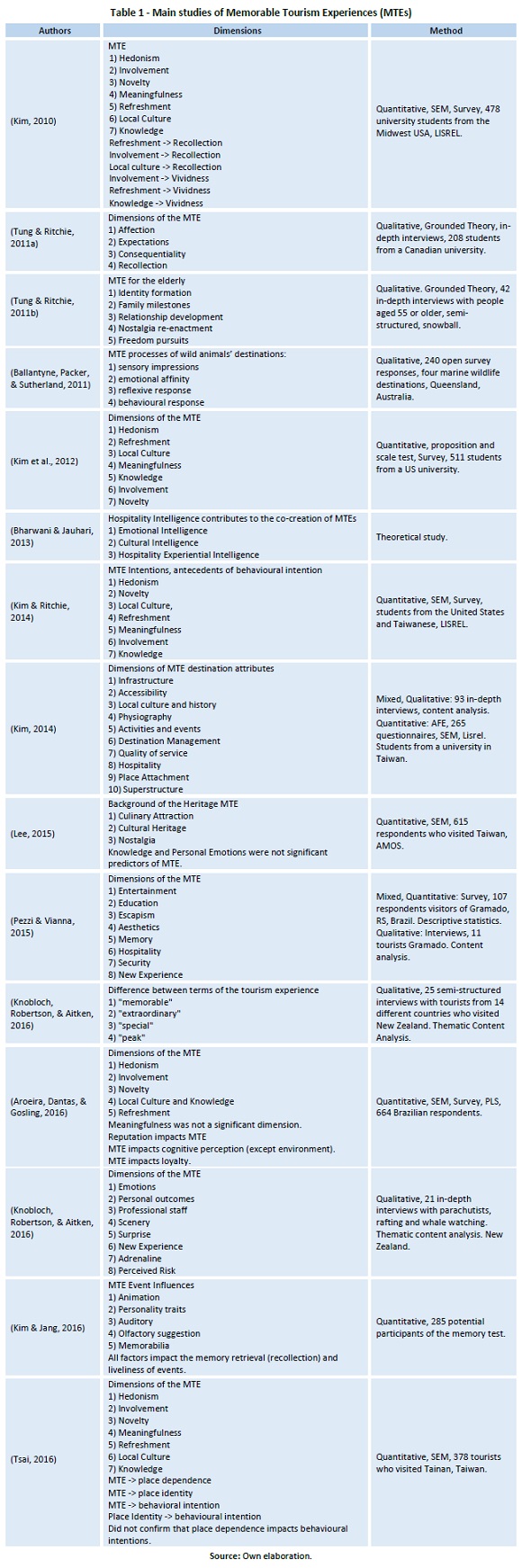
<body><![CDATA[<p>2. Literature Review</p>     <p><b>2.1 </b><b>Memorable Tourism Experience (MTE)</b></p>     <p>Several authors have studied the MTE as a complex subject; in general, these    authors indicate a plurality of dimensions inherent to it. Qualitative studies    include the different categories of the MTE. Meanwhile, scales and theoretical    models also follow similar directions. Nevertheless, there is no consensus among    authors on what really makes some experiences more memorable than others.</p>     <p>Pioneers in the study of MTEs were Tung and Ritchie (2011a), who proposed a    qualitative study in four dimensions of the memorable trip: affection, expectations,    consequentiality and recollection. Affection includes positive emotions like    happiness and excitement; in other words, critical components of the memorable    experience. Expectations involve unexpected events and surprises for tourists.    Consequentiality refers to trip outcomes perceived as important, such as progress    in social relations, intellectual development and personal discovery. Recollection    involves memories, photographs and stories to remember the trip. In the study    of Tung and Ritchie (2011a), affection and expectations can be included in the    psychological dimension of MTE, recollection is related to the memorability    of the experience, and consequentiality can be seen as one of the MTE outcomes.</p>     <p>By studying the antecedents and consequences of the tourism experience with    wild marine animals in Australia, Ballantyne, Packer, and Sutherland (2011,    p. 770) sought to understand what led the tourists to have memorable experiences    in these places. Four themes from the experience of visitors identified by the    authors implied four processes: &ldquo;1) what visitors actually saw and heard (sensory    impressions), 2) what they felt (emotional affinity), 3) thought (reflexive    response), and finally, 4) what they did about it (behavioural response)&rdquo;. In    this sense, the authors also focused mainly on the psychological dimension of    MTE (sensory impressions, emotional affinity and thoughts), but also considered    an MTE outcome (behavioural response).</p>     <p>From the perspective of quantitative studies, there are those grounded on the    four domains of the experience of Pine and Gilmore (2011), assuming that the    MTE is based at least on entertainment, escapism, aesthetics and education (e.g.,    Manthiou, Kang, Chiang, &amp; Tang, 2016; Oh, Fiore, &amp; Jeoung, 2007; Pezzi    &amp; Vianna, 2015; Song, Lee, Park, Hwang, &amp; Reisinger, 2015).</p>     <p>There is also a widely used MTE scale by Kim et al. (2012), composed of 24    items and seven dimensions, which is based on Kim&rsquo;s (2010) studies. Similarly,    Kim and Ritchie (2014) developed a cross-country study (the USA and Taiwan)    and assessed that hedonism, novelty, local culture, refreshment, meaningfulness,    involvement and knowledge are dimensions of the MTE intention, preceding behavioural    intention, which is the intention to recommend the destination or to revisit    it. Kim (2014) shows the relationship between the attributes of a tourism destination    and the MTE.</p>     <p>In the Brazilian context, Aroeira et al. (2016) point out that hedonism, involvement,    novelty, local culture and knowledge, and refreshment are dimensions of the    MTE. Thus, the proposed scale from the studies of Kim et al. (2012) demonstrated    a fusion of the local culture dimension with the knowledge dimension, and meaningfulness    was not considered significant in the Brazilian study.</p>     <p>Lee (2015) found out that culinary attraction, cultural inheritance and nostalgia    impact MTE of visitors of the Tainan Railway Station in Taiwan. Knowledge learning    and personal emotions were not significant predictors of MTE in the studies    of Lee (2015), which demonstrates the need for further studies on the antecedents    of MTE in specific contexts. <a href="#t1">Table 1</a> lists the leading studies    on MTE with a summary of the dimensions, as well as the adopted method of each    study.</p>     <p>&nbsp;</p>     ]]></body>
<body><![CDATA[<p align="center"><a name="t1"></a><img src="/img/revistas/tms/v14n4/14n4a02t1.jpg"/></p>     
<p>&nbsp;</p>     <p><a href="#t1">Table 1</a> demonstrates how researchers commonly address MTE    as a multidimensional construct. Also, there are qualitative and quantitative    studies on the subject, with an advance in proposals and tests of scales in    the last eight years. In some cases, the proposed dimensions present similarities.    However, it is necessary to discuss the interdependence of the environmental,    cultural, social and personal factors of the tourism experience, although they    are recurrent factors in the literature of (broader) tourism experiences.</p>     <p>For example, Arnould and Price (1993) associate satisfaction of rafting adventure    experiences with the connection to nature (environment), connection with others    (interpersonal relationships) and self-refreshment (psychological and individual    dimensions). Thus, the tourism experience associates with multiple interpretations,    which permeate the environment, social relationships, and other components of    the activity (Tussyadiah &amp; Fesenmaier, 2009).</p>     <p>Finally, recent studies point to the prospect of finding the antecedents and    consequences of the MTE. Therefore, the scale proposed in this study incorporates    the dimensions as being interdependent and connected to the MTE. Moreover, it    also tests the environmental, cultural, social and personal factors of the MTE,    which is still a gap in MTE scales.</p>     <p>3. Method</p>     <p>The study aimed to propose and test a scale to assess MTEs. Therefore, we adopted    a quantitative approach based on multivariate data analysis. Data were analysed    using structural equation modelling software in Amos Graphics (CB-SEM), which    involved a set of techniques and statistical tests aimed at proposing an exploratory    model (Kline, 2011). The research universe is formed by Brazilians who have    participated in at least one MTE in their life.</p>     <p>3.1 Sample </p>     <p>The sample consisted of 1,187 valid questionnaires and was nonprobabilistic,    with some criteria set by the researchers. The criteria for voluntary participation    in the study involved the need to be: a) Brazilian, over 18 years of age; b)    have travelled at least once for leisure in the 24 months prior to data collection,    and c) remember a memorable trip the respondent had already made to any national    or international destination.</p>     <p>The sample complied with the recommendation of Hair, Anderson, Tatham, and    Black (2005) to collect at least five times more observations than the number    of variables to be analysed. The proportion of cases per variable in the study    was 24.2, higher than the recommended number in the literature.</p>     ]]></body>
<body><![CDATA[<p>3.2 Instrument</p>     <p>This research assumes that the MTE is a second-order, multidimensional construct,    according to studies indicated in the literature review. The research instrument    is based on the study of Coelho (2017), which was supported by both qualitative    studies and tested scales, already adapted to the Brazilian context. For the    author, MTEs relates to tourists&rsquo; experiences with the environment, culture,    interpersonal relationships and psychological perceptions. Besides, part of    the scale, which included the dimensions Hedonism, Refreshment, Meaningfulness,    and Involvement, had already been translated from the studies of Kim et al.    (2012) and tested in the national context by Aroeira et al. (2016). A part of    the items of the culture and novelty scales was translated by Aroeira et al.    (2016), and other items were proposed and tested by Coelho (2017), such as Dream,    Emotions, Relationship with Companions, Relationship with Tourists, and Relationship    with Local Agents.</p>     <p>The knowledge dimension was excluded from the MTE scale based on studies by    Aroeira et al. (2016), which indicated the merge of knowledge and local culture    dimensions, indicating contextual features. The survey instrument also went    through a pre-test, conducted with nine experts in tourism and marketing, which    indicated, in writing, corrections and suggestions set out in the variables    and pre-textual elements of the questionnaire. Also, 1,249 individuals responded    to a pilot survey with the objective of scale refinement, as well as the test    of the measurement model, confirming the exclusion of knowledge as an MTE dimension.    Therefore, the final data collection (topic 3.3) took place without the knowledge    dimension.</p>     <p>A 7-point Likert scale anchored all items. In other words, the respondents    had a choice ranging from 1 to 7, with 1 being &lsquo;strongly disagree&rsquo; and 7 &lsquo;strongly    agree&rsquo;. The operation of each construct follows the guidelines of authors such    as Hair et al. (2005) and Malhotra (2006) for research conduction, using multivariate    data analysis. All scales were forced, without the response option &lsquo;do not know&rsquo;,    in order to verify the perception of respondents about their trips.</p>     <p>3.3 Data Collection</p>     <p>The sample was non-probabilistic, collected through a survey according to the    accessibility to the respondents. It took place online for three months of 2017    and used Google Docs. More than 3,000 emails were sent to educational institutions    and included education and research centres, universities and colleges from    all degrees. There was no restriction on the type of course or area of study.    We requested that the contacts of educational institutions disseminate the research    internally, either for employees, students or alumni.</p>     <p>The questionnaires were self-report and the survey guaranteed responses from    residents of all five Brazilian regions, and from each of the 27 federative    units of the country. Brazilians who live abroad were also considered and could    respond to the questionnaire. This strategy was evaluated as positive because    it was able to reach people who go beyond the personal contact of authors and/or    students of a single educational institution, which is usually an emphasis of    academic research. Thus, the data collection process has optimised the distribution    of the questionnaire and fulfilled the goal to generate a variability of respondents.</p>     <p>Questionnaires have gone through a rigorous procedure of answer review. We    removed any evidence of questionnaires with duplication problems, unique responses    and fraud. The sample had 1,193 answers and six excluded cases, totalling 1,187    valid answers. A Google Docs feature required every questionnaire response,    eliminating missing data from the data collection.</p>     <p>3.4 Data Analysis</p>     <p>The Structural Equation Modelling is suitable for situations to test large-scale    relationships (Hair et al., 2005). Besides Structural Equations Modelling, data    analysis was supported by the software Microsoft Excel, SPSS and Amos. Data    analysis had four distinct stages. First, after database preparation, the assumptions    of the multivariate analysis were tested (Hair et al., 2005).</p>     ]]></body>
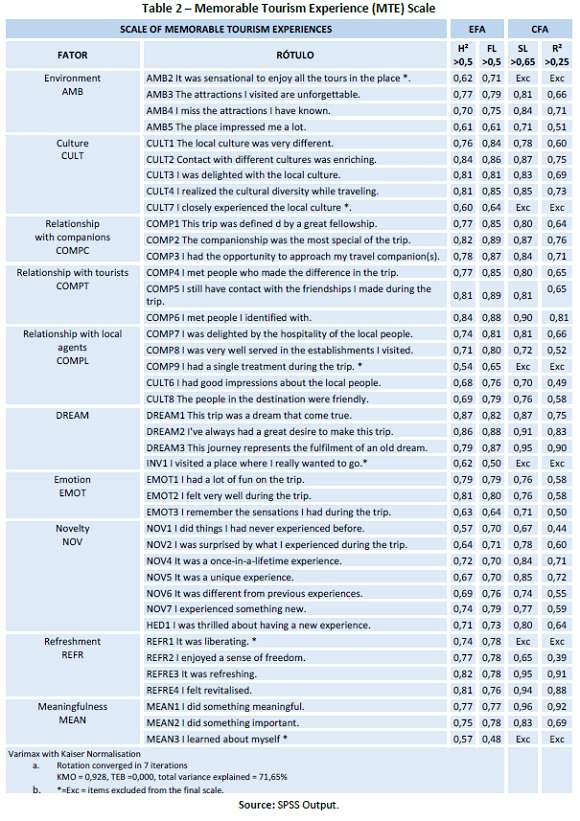
<body><![CDATA[<p>In a second stage, an Exploratory Factor Analysis (EFA) aimed at verifying    the MTE factors and reducing the number of indicators (questionnaire items).    The third procedure involved a Confirmatory Factor Analysis (CFA), and enabled    the validation of the proposed scale, as shown in the results.</p>     <p>4. Results</p>     <p><b>4.1 </b><b>Assumptions of Multivariate Analysis</b></p>     <p>Some tests were performed aiming to adapt the data to the general linear model,    according to recommendations of Hair et al. (2005). Database presented no multicollinearity    and singularity problems. Outlier analysis indicated 95 univariate atypical    cells were identified. Following the recommendation of Hair et al. (2005), all    cases were maintained, since none was very different from the rest of the sample.    That is, no case (set of responses of each who answered the questionnaire) presented    more than eight cells of atypical observations. This action is also important    for increasing the generalisation capacity of the model, although non-probabilistic    sampling is a limitation of this research.</p>     <p>We used the criterion of kurtosis and skewness for assessing the normality,    whose values should be less than 3 for skewness and less than 10 for kurtosis    (Kline, 2011). All skewness values were negative and significant, with variations    between -0.526 and -2.427. The kurtosis values ranged from -1.616 to 7.236.    Thus, these tests ensured the data were adequate for the use of SEM and the    proceed with the EFA.</p>     <p>4.2 Exploratory Factor Analysis (EFA)</p>     <p>EFA has two central purposes in the study: the first is the verification if    the latent variables are unidimensional. That means that each construct used    in the model has been tested for the number of dimensions which specify it.</p>     <p>The second is the removal of observed variables (questionnaire items) that    did not add to the scale composition. Thus, EFA reduces the number of variables    in a database, in order to maximise the explanatory power of a set of variables    (Hair et al., 2005).</p>     <p>MTE is a complex variable and has already been studied as a multifactorial    construct in previous studies. Hence, initially, we expected 12 factors adjacent    to the MTE, but only 10 were confirmed. The factorial solution presented in    <a href="#t2">Table 2</a> demonstrates the existence of 10 factors, with Hedonism    and Involvement having a different pattern from that proposed by Kim et al.    (2012). <a href="#t2">Table 2</a> shows that the MTE construct is multidimensional    and composed of 10 distinct dimensions, whose names were proposed by the authors.    It also shows the labels, commonalities (H²) and Factorial Loadings (FL) of    each of the construct&rsquo;s items, divided into factors. All values are within the    recommended in the literature, which ensures the presented factorial solution.    The table also presents data from the CFA of the standardised loadings (SL)    and squared multiple correlations (R²) of the items maintained in the scale.</p>     <p>&nbsp;</p>     ]]></body>
<body><![CDATA[<p align="center"><a name="t2"></a><img src="/img/revistas/tms/v14n4/14n4a02t2.jpg"/></p>     
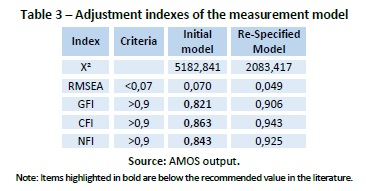
<p>&nbsp;</p>     <p>We used the extracting method of principal components and varimax rotation    method. The principal component analysis is preferable when seeking to summarise    the variance in a minimum number of factors (Hair et al., 2005). The varimax    rotation is orthogonal, which is suitable when the research aims to reduce the    number of original variables (Hair et al., 2005). The KMO test showed the excellent    suitability of the sample for the application of EFA, based on the value greater    than 0.9.</p>     <p>Thus, the result of the factorial solution showed a reduction of 12 initial    MTE factors to 10 factors, a reduction from 49 to 41 items and a total variance    explained of 71.65%. The hedonism dimension was excluded from the study, because    the items hed1, hed2, and hed3 were removed for not aggregating in the analysis.    Moreover, the items amb1 and cult5 nov3 were removed by low commonality (0.44    and 0.45, 0.38 respectively). Moreover, inv1 and inv2 have been removed in the    pre-test for model adequacy of index adjustment.</p>     <p>4.3 Confirmatory Factor Analysis (CFA)</p>     <p>To evaluate the reliability and validity of the measurement model, we run the    CFA. The CFA is used to ensure the quality of the adjustment of a theoretical    measurement model to the correlation structure between the items (Marôco, 2014).</p>     <p>The CFA was performed with the statistical package Amos (v.21.0). We chose    to use the input matrix as ML (Maximum Likelihood), in which the estimates maximise    the probability of the data being withdrawn from the population. Therefore,    this method presents estimates that are efficient and consistent in large samples    as long as both the statistical requirements and the model are correctly specified    (Kline, 2011, p. 155).</p>     <p>After the theoretical model estimation, we performed the validity test and    scale adjustments. A first activity necessary to evaluate the measurement model    involves ascertaining the adjustment indexes of the model. The adjustment test    of the proposed model was based on the analysis of the data of the fit indexes    of Table</p>     <p>3. The evaluation of the index of adjustments of the initial model indicated    the need to continue with the model refinement, according to the literature    guidelines (<a href="#t3">Table 3</a>). In order to improve the adjustments    of the initial model, we followed a two- step analysis procedure. Firstly, we    evaluated the standardised loading and the R² of the observed variables (items)    of the model according to Marôco (2014), R² values lower than 0.25 indicate    possible adjustment problems with this variable, given the ability to explain    less than 25% of it. The variables amb2, comp9, cult7, inv1 and refr1 were extracted    due to the standardised loadings below 0.65 (0.64, 0.6, 0.64, 0.575, 0.64).</p>     <p>&nbsp;</p>     ]]></body>
<body><![CDATA[<p align="center"><a name="t3"></a><img src="/img/revistas/tms/v14n4/14n4a02t3.jpg"/></p>     
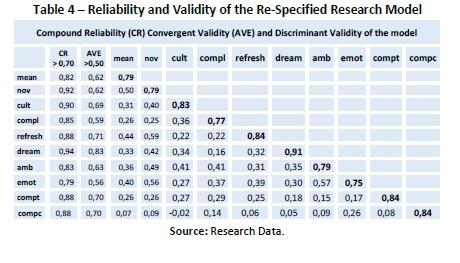
<p>&nbsp;</p>     <p>Modification indexes (MI) of the model were also used to correlate the errors    with values of MI above 20 when in the same variable. Therefore, the model re-specification    extracted five variables and added 10 correlations among errors of items of    the novelty construct and another three correlations between errors of the relationship    with local agents construct. With this, we obtained a significant improvement    in the adjustment indexes of the re-specified model, concerning the data obtained    in the initial model. The values of the RMSEA, CFI, NFI and GFI indices of the    re-specified model are above the value recommended by the literature, according    to <a href="#t3">Table 3</a>. Also, <a href="#t2">Table 2</a> shows the factor    loadings and squared multiple correlations coefficients of each item of the    final model, all loadings being statistically significant.</p>     <p>Among the tests, the composite reliability is responsible for measuring the    extent to which there is internal consistency between the variables. That is,    it evaluates the reliability of each model of the construct as its consistency    replication capacity (Marôco, 2014). The convergent validity contributes to    the degree of explanation of the indicators sharing constructs converge or variances    (Hair et al., 2005). It shows when the constructs present positive and elevated    correlations among themselves (Marôco, 2014). Moreover, the discriminant validity    is necessary to demonstrate the degree to which a construct differs from the    other constructs of the model, i.e., if they are different or similar (Hair    et al., 2005).</p>     <p><a href="#t4">Table 4</a> presents the results of the composite reliability    (CR) and convergent validity (AVE) and discriminant validity of the re- specified    research model, indicating validity and reliability in the model.</p>     <p>&nbsp;</p>     <p align="center"><a name="t4"></a><img src="/img/revistas/tms/v14n4/14n4a02t4.jpg"/></p>     
<p>&nbsp;</p>     <p>Notes: CR values were above 0.70, AVE values were greater than 0.50. The values    in bold are higher than the other items in the column, which indicates discriminant    validity.</p>     <p>Thus, the MTE scale presented is formed by 10 factors (Environment, Culture,    Relationship with Companions, Relationship with Tourists, Relationship with    Local Agents, Novelty, Emotions, Dream, Meaningfulness, and Refreshment) and    35 items of the MTE, a second-order and multifactorial construct.</p>     ]]></body>
<body><![CDATA[<p>5. Discussion</p>     <p>The results reinforce the need to address the MTE from a broader perspective,    as by looking for tourism experience studies. One of the dimensions addressed    in tourism experience study is the physical environment, including the natural    and built environment and the tourist attractions of the tourism destination.    Pine and Gilmore (2011) and Oh et al. (2007) highlight the importance of the    aesthetic dimension of experience, which involves all aspects of the environment    perceived by tourists and hasn&rsquo;t been evoked in previous scales such as those    of Kim et al. (2012). The involvement of tourists in the experiences comes from    the observation of the environment and the sensations and feelings arising from    external stimuli (digital objects, non-digital objects, music, etc.) (Tung,    Lin, Zhang Qiu, &amp; Zhao, 2016).</p>     <p>The immersive and non-routine experience allows for the unfolding of the relationship    between an individual and the environment, enabling the development of meaningful    interactions between the two parties (Davis, 2016). Tourist environmental aspects    include various natural and man-made elements as the geographical dimension    (space and place) (Pearce, 2014), servicescape, hardware, and service systems    (Komppula, Ilves, &amp; Airey, 2016), design attractiveness, layout/ease of    navigation, upkeep and physiological ambience (Walls, 2013), signs and visual    communication (Tussyadiah &amp; Fesenmaier, 2009).</p>     <p>The environment was also the most critical dimension for hotel guest experiences,    according to Walls (2013). The environmental attributes allied to management    decisions are mediators of the destination experience, besides the destination    choice present a significant influence on the likelihood of a satisfying experience    (Breejen, 2007). Relationships between tourists and the environment are built    through attachment and feeling of belonging to a place (Davis, 2016).</p>     <p>The cultural dimension is longer as discussed and demonstrated significant    in MTE studies. Cultural considerations and local activities as well as previous    experiences of clients impact on the way in which individuals perceive the experience    (Pine &amp; Gilmore, 2011). Visitors who interact with local culture build a    unique and memorable travel experience (Kim &amp; Ritchie, 2014).</p>     <p>It is also known that the degree of empathy and shared cultural proximity between    travellers and employees influence the delivery of the tourism experience (Bharwani    &amp; Jauhari, 2013). Bharwani and Jauhari (2013) suggest that the cultural    orientation between the employee and the client can be very distinct, demanding    employees who are sensitive to the values and expectations of global consumers.    Thus, to experience the local culture, whether, through cooking, crafts, dance,    language, a way of life, values and other cultural expressions can impact on    the tourism experience.</p>     <p>The study highlights the interpersonal dimension, which incorporates the relationship    between people. Tourism experience literature refers to the interpersonal influences,    but this is less explored in MTE studies. Schmitt (2000) considers that one    of the providers of experience is attributed to the contact or observation of    other individuals. To Tussyadiah and Fesenmaier (2009), the involvement between    people usually works as a mediator of the tourism experience, allowing the interpretation,    sharing and re-signification of the trip.</p>     <p>Schmitt (2000) emphasises that interpersonal interaction can be positive or    negative and is highly recommended in complex services such as tourism. Findings    of Jennings et al. (2007) suggest that the key elements for the quality of adventure    experiences for young people lie precisely in the interaction between people,    either in an individualised or social perspective.</p>     <p>Several authors have stressed the importance of people to the tourism experience    (Caru &amp; Cova, 2003; Komppula et al., 2016; Quinlan-Cutler &amp; Carmichael,    2010; Walls, 2013), but this study shows that for a tourism experience to be    memorable, at least the relationships between tourist-local agents, tourist-tourists    and tourist-companions are significant.</p>     <p>Studies have shown that personal characteristics, past experiences and previous    motives can affect the results of the experience. Among the MTE scales, the    most outstanding items of the authors affecting memorability of experience are    precisely the psychological factors of who lived it. Six of the seven dimensions    of MTE proposed by Kim et al. (2012) and Kim and Ritchie (2014) refer to the    psychological, personal and cognitive aspects of the tourists: novelty, involvement,    refreshment, meaningfulness, hedonism and knowledge. Besides psychological factors,    the only culture is evaluated as significant for a memorable experience on their    scale. On the one hand, this demonstrates the importance of individual factors    to tourism experiences. On the other, it reinforces the need to incorporate    new dimensions in MTE studies.</p>     ]]></body>
<body><![CDATA[<p>The scale tested here goes beyond the psychological dimension attested in previous    studies and confirms the following dimensions/factors: 1) traveller&rsquo;s emotions    and 2) dream or desire to visit a tourist destination. Emotions are the focus    of discussions of experience studies (Matos, 2014). Emotions are emotional states    generated by specific stimuli (Schmitt, 2000). The emotion in tourism experiences    in parks was also measured by Andreu, Gnoth, and Bigne (2005), demonstrating    that it is composed of two dimensions: pleasure and enthusiasm (excitement).    The authors also proved that emotions impact on visitor satisfaction and loyalty.</p>     <p>Finally, dreams are part of the activities that can lead people to grow and    lead a happy life (Sirgy, 2012) and can be one of the travel motivations (Damijani&#263;    &amp; Sergo, 2013). To visit a tourist destination, in particular, can be seen    as the fulfilment of a dream or old wish (Matteucci &amp; Filep, 2015), sometimes    not realised due to constraints such as time and financial resources (Karl,    Reintinger, &amp; Schmude, 2015). Diverse tourism experiences such as parachute    jumping, whale watching and river rafting can be the great fulfilment of a dream,    or just part of a spontaneous activity that affects the individual experience    (Knobloch et al., 2016). Thus, MTEs are known to be multidimensional and complex,    requiring further investigation.</p>     <p>6. Conclusion</p>     <p>This work attests to the multidimensionality of MTE, proving that the dimensions    of previous scales can be refined and some aspects previously neglected in MTE    studies as the physical environment; relationship with companions, tourists,    and local agents; as well as dreams and emotions are dimensions of the MTE.    The scale proposed in this study goes beyond the psychological dimension proposed    in previous studies and covers environmental, cultural and interrelational factors    as necessary to the memorability of tourism experiences.</p>     <p>Because it is an exploratory model and tested only in a non- probabilistic    sample with Brazilians, it is still possible to improve this scale and improve    the fit indexes. One of the concerns is related to dimensions already proven    in other studies such as Hedonism and Involvement, which did not add to the    study sample, demonstrating possible cultural factors that interfere with MTEs.    Moreover, the factor of meaningfulness is composed of only two indicators, which    is not desirable and deserves further investigation. Future studies can perform    tests with the proposed scale in different cultural contexts and cross- country    studies in order to contribute to the refinement and validation of the scale.</p>     <p>Finally, the MTE studies can contribute to improving the quality of tourism    services once an essential indication of the study is the need for managers    to identify the tourist&rsquo;s dreams and provide innovative products/service. To    establish possible points of interaction between customers and local people    should also be considered in the manager&rsquo;s strategies. Providing information    and highlighting local cultural aspects such as history, arts, slangs, souvenirs    and cuisine could enhance tourist experience and place attachment. Such actions    can provide more remarkable experiences to tourists and could generate intentions    to recommend and return to the destination.</p>     <p>For travellers, this study can help with destination planning and choice. Tourists    should be aware of their dreams and emotions before and during their travel    experience, once they can evoke memorable experiences. Travellers should reflect    on their past experiences and do at least minor research about destination culture    and environment before choosing a destination. The closer an experience might    be to a previous one, less novelty will unfold, providing a rather ordinary    experience instead of a memorable one. Also, not only will their companionship    affect their trips, but the contact with local agents and tourists might underlie    remarkable moments that might become meaningful for their lives.</p>     <p>&nbsp;</p>     <p><b>REFERENCES</b></p>     <!-- ref --><p>Andreu, L., Gnoth, J., &amp; Bigne, J. E. (2005). The theme park experience:    An analysis of pleasure, arousal and satisfaction. <i>Tourism Management, 26</i>(6),    833-844. <a href="http://doi.org/10.1016/j.tourman.2004.05.006" target="_blank">http://doi.org/10.1016/j.tourman.2004.05.006</a>&nbsp;&nbsp;&nbsp;&nbsp;&nbsp;&nbsp;&nbsp;&nbsp;[&#160;<a href="javascript:void(0);" onclick="javascript: window.open('/scielo.php?script=sci_nlinks&ref=1278247&pid=S2182-8458201800040000200001&lng=','','width=640,height=500,resizable=yes,scrollbars=1,menubar=yes,');">Links</a>&#160;]<!-- end-ref --><!-- ref --><p>Arnould, E. J. &amp; Price, L. L. (1993). River magic: Extraordinary experience    and the extended service encounter. <i>Journal of Consumer Research, 20</i>(1),    24. <a href="http://doi.org/10.1086/209331" target="_blank">http://doi.org/10.1086/209331</a>&nbsp;&nbsp;&nbsp;&nbsp;&nbsp;&nbsp;&nbsp;&nbsp;[&#160;<a href="javascript:void(0);" onclick="javascript: window.open('/scielo.php?script=sci_nlinks&ref=1278248&pid=S2182-8458201800040000200002&lng=','','width=640,height=500,resizable=yes,scrollbars=1,menubar=yes,');">Links</a>&#160;]<!-- end-ref --><!-- ref --><p>Aroeira, T., Dantas, A. C., &amp; Gosling, M. (2016). Experiência Turística    Memorável, Percepção Cognitiva, Reputação E Lealdade Ao Destino&#8239;: Um Modelo    Empírico. <i>Revista Turismo Visão e Ação, 18</i>(3), 584-610.    &nbsp;&nbsp;&nbsp;&nbsp;&nbsp;&nbsp;&nbsp;&nbsp;[&#160;<a href="javascript:void(0);" onclick="javascript: window.open('/scielo.php?script=sci_nlinks&ref=1278249&pid=S2182-8458201800040000200003&lng=','','width=640,height=500,resizable=yes,scrollbars=1,menubar=yes,');">Links</a>&#160;]<!-- end-ref --></p>     <p>Ballantyne, R., Packer, J., &amp; Sutherland, L. A. (2011). Visitors&rsquo; memories    of wildlife tourism&#8239;: Implications for the design of powerful interpretive    experiences. <i>Tourism Management, 32</i>(4), 770-779. <a href="http://doi.org/10.1016/j.tourman.2010.06.012" target="_blank">http://doi.org/10.1016/j.tourman.2010.06.012</a></p>     <!-- ref --><p>Bharwani, S. &amp; Jauhari, V. (2013). An exploratory study of competencies    required to co-create memorable customer experiences in the hospitality industry.    <i>International Journal of Contemporary Hospitality Management, 25</i>(6),    823-843. <a href="http://doi.org/10.1108/IJCHM-05-2012-0065" target="_blank">http://doi.org/10.1108/IJCHM-05-2012-0065</a>&nbsp;&nbsp;&nbsp;&nbsp;&nbsp;&nbsp;&nbsp;&nbsp;[&#160;<a href="javascript:void(0);" onclick="javascript: window.open('/scielo.php?script=sci_nlinks&ref=1278252&pid=S2182-8458201800040000200005&lng=','','width=640,height=500,resizable=yes,scrollbars=1,menubar=yes,');">Links</a>&#160;]<!-- end-ref --><!-- ref --><p>Breejen, L. D. (2007). The experiences of long distance walking: A case study    of the West Highland Way in Scotland. <i>Tourism Management, 28</i>(6), 1417-1427.    <a href="http://doi.org/10.1016/j.tourman.2006.12.004" target="_blank">http://doi.org/10.1016/j.tourman.2006.12.004</a>&nbsp;&nbsp;&nbsp;&nbsp;&nbsp;&nbsp;&nbsp;&nbsp;[&#160;<a href="javascript:void(0);" onclick="javascript: window.open('/scielo.php?script=sci_nlinks&ref=1278253&pid=S2182-8458201800040000200006&lng=','','width=640,height=500,resizable=yes,scrollbars=1,menubar=yes,');">Links</a>&#160;]<!-- end-ref --><!-- ref --><p>Carù, A. &amp; Cova, B. (2003). Revisiting consumption experience: A more humble    but complete view of the concept. <i>Marketing Theory, 3</i>(2), 267- 286. <a href="http://doi.org/10.1177/14705931030032004" target="_blank">http://doi.org/10.1177/14705931030032004</a>&nbsp;&nbsp;&nbsp;&nbsp;&nbsp;&nbsp;&nbsp;&nbsp;[&#160;<a href="javascript:void(0);" onclick="javascript: window.open('/scielo.php?script=sci_nlinks&ref=1278254&pid=S2182-8458201800040000200007&lng=','','width=640,height=500,resizable=yes,scrollbars=1,menubar=yes,');">Links</a>&#160;]<!-- end-ref --><p>Coelho, M. de F. (2017). Viagens De Brasileiros: Um Modelo De Relações Entre    Experiência Turística Memorável, Mindfulness, Transformações Pessoais E Bem-Estar    Subjetivo. Universidade Federal de Minas Gerais.</p>     <!-- ref --><p>Coelho, M. F., Gosling, M. S., &amp; Berbel, G. (2016). Atratividade de destino    turístico: a percepção dos atores locais de Ouro Preto, MG , Brasil. P<i>ASOS</i><i>-    Revista de Turismo e Patrimônio Cultural, 14</i>(4), 929-947.    &nbsp;&nbsp;&nbsp;&nbsp;&nbsp;&nbsp;&nbsp;&nbsp;[&#160;<a href="javascript:void(0);" onclick="javascript: window.open('/scielo.php?script=sci_nlinks&ref=1278256&pid=S2182-8458201800040000200009&lng=','','width=640,height=500,resizable=yes,scrollbars=1,menubar=yes,');">Links</a>&#160;]<!-- end-ref --></p>     ]]></body>
<body><![CDATA[<p>Damijani&#263;, A. T. &amp; Šergo, Z. (2013). Determining travel motivations    of wellness tourism. <i>Ekonomska misao i praksa, 1</i>, 3-20.</p>     <!-- ref --><p>Davis, A. (2016). Experiential places or places of experience? Place identity    and place attachment as mechanisms for creating festival environment. <i>Tourism    Management, 55, </i>49-61. <a href="http://doi.org/10.1016/j.tourman.2016.01.006" target="_blank">http://doi.org/10.1016/j.tourman.2016.01.006</a>&nbsp;&nbsp;&nbsp;&nbsp;&nbsp;&nbsp;&nbsp;&nbsp;[&#160;<a href="javascript:void(0);" onclick="javascript: window.open('/scielo.php?script=sci_nlinks&ref=1278259&pid=S2182-8458201800040000200011&lng=','','width=640,height=500,resizable=yes,scrollbars=1,menubar=yes,');">Links</a>&#160;]<!-- end-ref --><!-- ref --><p>Hair, j. F. J., Anderson, r. E., Tatham, r. L., &amp; Black, W. (2005). Análise    Multivariada de Dados. Porto Alegre: Bookman.    &nbsp;&nbsp;&nbsp;&nbsp;&nbsp;&nbsp;&nbsp;&nbsp;[&#160;<a href="javascript:void(0);" onclick="javascript: window.open('/scielo.php?script=sci_nlinks&ref=1278260&pid=S2182-8458201800040000200012&lng=','','width=640,height=500,resizable=yes,scrollbars=1,menubar=yes,');">Links</a>&#160;]<!-- end-ref --></p>     <p>Jennings, G.R., Lee, Y-S., Ayling, A., Ollenburg, C., Carter, C. and Lunny,B.    (2007). What do Quality Adventura Tourism Experiences Mean for Adventure Travelers    and Providers? An Industry Report to the Gold Coast Adventure Travel Group.</p>     <!-- ref --><p>Karl, M., Reintinger, C., &amp; Schmude, J. (2015). Reject or select: Mapping    destination choice. <i>Annals of Tourism Research, 54</i>, 48-64. <a href="http://doi.org/10.1016/j.annals.2015.06.003" target="_blank">http://doi.org/10.1016/j.annals.2015.06.003</a>&nbsp;&nbsp;&nbsp;&nbsp;&nbsp;&nbsp;&nbsp;&nbsp;[&#160;<a href="javascript:void(0);" onclick="javascript: window.open('/scielo.php?script=sci_nlinks&ref=1278263&pid=S2182-8458201800040000200014&lng=','','width=640,height=500,resizable=yes,scrollbars=1,menubar=yes,');">Links</a>&#160;]<!-- end-ref --><!-- ref --><p>Kim, J.-H. (2010). Determining the factors affecting the memorable nature of    travel experiences. <i>Journal of Travel &amp; Tourism Marketing, 27</i>(8),    780-796. <a href="http://doi.org/10.1080/10548408.2010.526897" target="_blank">http://doi.org/10.1080/10548408.2010.526897</a>&nbsp;&nbsp;&nbsp;&nbsp;&nbsp;&nbsp;&nbsp;&nbsp;[&#160;<a href="javascript:void(0);" onclick="javascript: window.open('/scielo.php?script=sci_nlinks&ref=1278264&pid=S2182-8458201800040000200015&lng=','','width=640,height=500,resizable=yes,scrollbars=1,menubar=yes,');">Links</a>&#160;]<!-- end-ref --><!-- ref --><p>Kim, J.-H. (2014). The antecedents of memorable tourism experiences: The development    of a scale to measure the destination attributes associated with memorable experiences.    <i>Tourism Management, 44</i>, 34-45. <a href="http://doi.org/10.1016/j.tourman.2014.02.007" target="_blank">http://doi.org/10.1016/j.tourman.2014.02.007</a>&nbsp;&nbsp;&nbsp;&nbsp;&nbsp;&nbsp;&nbsp;&nbsp;[&#160;<a href="javascript:void(0);" onclick="javascript: window.open('/scielo.php?script=sci_nlinks&ref=1278265&pid=S2182-8458201800040000200016&lng=','','width=640,height=500,resizable=yes,scrollbars=1,menubar=yes,');">Links</a>&#160;]<!-- end-ref --><!-- ref --><p>Kim, J.-H., &amp; Ritchie, J. R. B. (2014). Cross-cultural validation of a    memorable tourism experience scale (MTES). <i>Journal of Travel Research, 53</i>(3),    323-335. <a href="http://doi.org/10.1177/0047287513496468" target="_blank">http://doi.org/10.1177/0047287513496468</a>&nbsp;&nbsp;&nbsp;&nbsp;&nbsp;&nbsp;&nbsp;&nbsp;[&#160;<a href="javascript:void(0);" onclick="javascript: window.open('/scielo.php?script=sci_nlinks&ref=1278266&pid=S2182-8458201800040000200017&lng=','','width=640,height=500,resizable=yes,scrollbars=1,menubar=yes,');">Links</a>&#160;]<!-- end-ref --><!-- ref --><p>Kim, J. H. (2012). Development of a scale to measure memorable tourism experiences.    <i>European Journal of Tourism Research, 3</i>(2), 123- 126. <a href="http://doi.org/10.1177/0047287510385467" target="_blank">http://doi.org/10.1177/0047287510385467</a>&nbsp;&nbsp;&nbsp;&nbsp;&nbsp;&nbsp;&nbsp;&nbsp;[&#160;<a href="javascript:void(0);" onclick="javascript: window.open('/scielo.php?script=sci_nlinks&ref=1278267&pid=S2182-8458201800040000200018&lng=','','width=640,height=500,resizable=yes,scrollbars=1,menubar=yes,');">Links</a>&#160;]<!-- end-ref --><!-- ref --><p>Kim, J., Ritchie, J. R. B., &amp; McCormick, B. (2012). Development of a scale    to measure memorable tourism experiences. <i>Journal of Travel Research, 51</i>(1),    12-25. <a href="http://doi.org/10.1177/0047287510385467" target="_blank">http://doi.org/10.1177/0047287510385467</a>&nbsp;&nbsp;&nbsp;&nbsp;&nbsp;&nbsp;&nbsp;&nbsp;[&#160;<a href="javascript:void(0);" onclick="javascript: window.open('/scielo.php?script=sci_nlinks&ref=1278268&pid=S2182-8458201800040000200019&lng=','','width=640,height=500,resizable=yes,scrollbars=1,menubar=yes,');">Links</a>&#160;]<!-- end-ref --><!-- ref --><p>Kline, R. B. (2011). Principles and practice of structural equation modeling.    New York: The Guilford Press.    &nbsp;&nbsp;&nbsp;&nbsp;&nbsp;&nbsp;&nbsp;&nbsp;[&#160;<a href="javascript:void(0);" onclick="javascript: window.open('/scielo.php?script=sci_nlinks&ref=1278269&pid=S2182-8458201800040000200020&lng=','','width=640,height=500,resizable=yes,scrollbars=1,menubar=yes,');">Links</a>&#160;]<!-- end-ref --></p>     <!-- ref --><p>Knobloch, U., Robertson, K., &amp; Aitken, R. (2016). Experience, emotion,    and eudaimonia: A consideration of tourist experiences and well-being. <i>Journal    of Travel Research</i>, 1-12. <a href="http://doi.org/10.1177/0047287516650937" target="_blank">http://doi.org/10.1177/0047287516650937</a>&nbsp;&nbsp;&nbsp;&nbsp;&nbsp;&nbsp;&nbsp;&nbsp;[&#160;<a href="javascript:void(0);" onclick="javascript: window.open('/scielo.php?script=sci_nlinks&ref=1278271&pid=S2182-8458201800040000200021&lng=','','width=640,height=500,resizable=yes,scrollbars=1,menubar=yes,');">Links</a>&#160;]<!-- end-ref --><!-- ref --><p>Komppula, R., Ilves, R., &amp; Airey, D. (2016). Social holidays as a tourist    experience in Finland. <i>Tourism Management, 52</i>, 521-532. <a href="http://doi.org/10.1016/j.tourman.2015.07.016" target="_blank">http://doi.org/10.1016/j.tourman.2015.07.016</a>&nbsp;&nbsp;&nbsp;&nbsp;&nbsp;&nbsp;&nbsp;&nbsp;[&#160;<a href="javascript:void(0);" onclick="javascript: window.open('/scielo.php?script=sci_nlinks&ref=1278272&pid=S2182-8458201800040000200022&lng=','','width=640,height=500,resizable=yes,scrollbars=1,menubar=yes,');">Links</a>&#160;]<!-- end-ref --><!-- ref --><p>Lee, Y. (2015). Creating memorable experiences in a reuse heritage site.<i>Annals    of Tourism Research, 55</i>, 155-170. <a href="http://doi.org/10.1016/j.annals.2015.09.009" target="_blank">http://doi.org/10.1016/j.annals.2015.09.009</a>&nbsp;&nbsp;&nbsp;&nbsp;&nbsp;&nbsp;&nbsp;&nbsp;[&#160;<a href="javascript:void(0);" onclick="javascript: window.open('/scielo.php?script=sci_nlinks&ref=1278273&pid=S2182-8458201800040000200023&lng=','','width=640,height=500,resizable=yes,scrollbars=1,menubar=yes,');">Links</a>&#160;]<!-- end-ref --><p>Manthiou, A., Kang, J., Chiang, L., &amp; Tang, L. (Rebecca). (2016). Investigating    the effects of memorable experiences: An extended model of script theory. <i>Journal    of Travel &amp; Tourism Marketing, 33</i>(3), 362-379. <a href="http://doi.org/10.1080/10548408.2015.1064055" target="_blank">http://doi.org/10.1080/10548408.2015.1064055</a></p>     <!-- ref --><p>Marôco, J. (2014). Análise de Equações Estruturais: Fundamentos Teóricos, Software    &amp; Aplicações. Pêro Ribeiro: CAFILESA.    &nbsp;&nbsp;&nbsp;&nbsp;&nbsp;&nbsp;&nbsp;&nbsp;[&#160;<a href="javascript:void(0);" onclick="javascript: window.open('/scielo.php?script=sci_nlinks&ref=1278275&pid=S2182-8458201800040000200025&lng=','','width=640,height=500,resizable=yes,scrollbars=1,menubar=yes,');">Links</a>&#160;]<!-- end-ref --></p>     <!-- ref --><p>Malhotra, N. K. (2006). Pesquisa de Marketing: Uma Orientação Aplicada. Porto    Alegre: <i>Bookman</i>.    &nbsp;&nbsp;&nbsp;&nbsp;&nbsp;&nbsp;&nbsp;&nbsp;[&#160;<a href="javascript:void(0);" onclick="javascript: window.open('/scielo.php?script=sci_nlinks&ref=1278277&pid=S2182-8458201800040000200026&lng=','','width=640,height=500,resizable=yes,scrollbars=1,menubar=yes,');">Links</a>&#160;]<!-- end-ref --></p>     <!-- ref --><p>Matos, N. M. S. (2014). The impacts of tourism in the destination image. A    marketing perspective. PhD Thesis, University of Algarve.    &nbsp;&nbsp;&nbsp;&nbsp;&nbsp;&nbsp;&nbsp;&nbsp;[&#160;<a href="javascript:void(0);" onclick="javascript: window.open('/scielo.php?script=sci_nlinks&ref=1278279&pid=S2182-8458201800040000200027&lng=','','width=640,height=500,resizable=yes,scrollbars=1,menubar=yes,');">Links</a>&#160;]<!-- end-ref --></p>     <!-- ref --><p>Matteucci, X. &amp; Filep, S. (2015). Eudaimonic tourist experiences: The case    of flamenco. <i>Leisure Studies</i>, 4367(October), 1-14. <a href="http://doi.org/10.1080/02614367.2015.1085590" target="_blank">http://doi.org/10.1080/02614367.2015.1085590</a>&nbsp;&nbsp;&nbsp;&nbsp;&nbsp;&nbsp;&nbsp;&nbsp;[&#160;<a href="javascript:void(0);" onclick="javascript: window.open('/scielo.php?script=sci_nlinks&ref=1278281&pid=S2182-8458201800040000200028&lng=','','width=640,height=500,resizable=yes,scrollbars=1,menubar=yes,');">Links</a>&#160;]<!-- end-ref --><!-- ref --><p>Morgan, M. (2010). The experience economy: 10 years on: Where next for experience    management? In M. Morgan, P. Lugosi, &amp; J. R. Brent Ritchie (Orgs.), <i>The    Tourism and Leisure Experienc</i>e (pp. 63-77). Bristol: Channel View Publications.    &nbsp;&nbsp;&nbsp;&nbsp;&nbsp;&nbsp;&nbsp;&nbsp;[&#160;<a href="javascript:void(0);" onclick="javascript: window.open('/scielo.php?script=sci_nlinks&ref=1278282&pid=S2182-8458201800040000200029&lng=','','width=640,height=500,resizable=yes,scrollbars=1,menubar=yes,');">Links</a>&#160;]<!-- end-ref --></p>     <!-- ref --><p>Oh, H., Fiore, a. M., &amp; Jeoung, M. (2007). Measuring experience economy    concepts: Tourism applications. <i>Journal of Travel Research, 46</i>(2), 119-132.    <a href="http://doi.org/10.1177/0047287507304039" target="_blank">http://doi.org/10.1177/0047287507304039</a>&nbsp;&nbsp;&nbsp;&nbsp;&nbsp;&nbsp;&nbsp;&nbsp;[&#160;<a href="javascript:void(0);" onclick="javascript: window.open('/scielo.php?script=sci_nlinks&ref=1278284&pid=S2182-8458201800040000200030&lng=','','width=640,height=500,resizable=yes,scrollbars=1,menubar=yes,');">Links</a>&#160;]<!-- end-ref --><!-- ref --><p>Pearce, D. G. (2014). Toward an integrative conceptual framework of destinations.    <i>Journal of Travel Research, 53</i>(2), 141-153. <a href="http://doi.org/10.1177/0047287513491334" target="_blank">http://doi.org/10.1177/0047287513491334</a>&nbsp;&nbsp;&nbsp;&nbsp;&nbsp;&nbsp;&nbsp;&nbsp;[&#160;<a href="javascript:void(0);" onclick="javascript: window.open('/scielo.php?script=sci_nlinks&ref=1278285&pid=S2182-8458201800040000200031&lng=','','width=640,height=500,resizable=yes,scrollbars=1,menubar=yes,');">Links</a>&#160;]<!-- end-ref --><!-- ref --><p>Pezzi, E. &amp; Vianna, S. L. G. (2015). A Experiência Turística e o Turismo    de Experiência&#8239;: um estudo sobre as dimensões da experiência memorável.    <i>Turismo em Análise, 26</i>(1), 165-187.    &nbsp;&nbsp;&nbsp;&nbsp;&nbsp;&nbsp;&nbsp;&nbsp;[&#160;<a href="javascript:void(0);" onclick="javascript: window.open('/scielo.php?script=sci_nlinks&ref=1278286&pid=S2182-8458201800040000200032&lng=','','width=640,height=500,resizable=yes,scrollbars=1,menubar=yes,');">Links</a>&#160;]<!-- end-ref --></p>     ]]></body>
<body><![CDATA[<!-- ref --><p>Pine, B. J. P. &amp; Gilmore, J. H. (2011). The experience economy. Boston:    Harvard Business Review Press.    &nbsp;&nbsp;&nbsp;&nbsp;&nbsp;&nbsp;&nbsp;&nbsp;[&#160;<a href="javascript:void(0);" onclick="javascript: window.open('/scielo.php?script=sci_nlinks&ref=1278288&pid=S2182-8458201800040000200033&lng=','','width=640,height=500,resizable=yes,scrollbars=1,menubar=yes,');">Links</a>&#160;]<!-- end-ref --></p>     <!-- ref --><p>Quinlan-Cutler, S. &amp; Carmichael, B. (2010). The dimensions of customer    experience. In B. Morgan, M.; Lugosi, P., Ritchie (Org.), The tourism in leisure    experience: Consumer and managerial perspectives. (pp. 3-26). Bristol: Aspects    of Tourism. Recuperado de <a href="http://books.google.com.br/books/about/The_Tourism_and_Leisure_Experience.html?id=52ReGta3HDIC&pgis=1" target="_blank">http://books.google.com.br/books/about/The_Tourism_and_Leisure_Experience.html?id=52ReGta3HDIC&amp;pgis=1</a>&nbsp;&nbsp;&nbsp;&nbsp;&nbsp;&nbsp;&nbsp;&nbsp;[&#160;<a href="javascript:void(0);" onclick="javascript: window.open('/scielo.php?script=sci_nlinks&ref=1278290&pid=S2182-8458201800040000200034&lng=','','width=640,height=500,resizable=yes,scrollbars=1,menubar=yes,');">Links</a>&#160;]<!-- end-ref --><!-- ref --><p>Schmitt, B. (2000). O modelo das experiências. <i>HSM Management, 4</i>(23).    &nbsp;&nbsp;&nbsp;&nbsp;&nbsp;&nbsp;&nbsp;&nbsp;[&#160;<a href="javascript:void(0);" onclick="javascript: window.open('/scielo.php?script=sci_nlinks&ref=1278291&pid=S2182-8458201800040000200035&lng=','','width=640,height=500,resizable=yes,scrollbars=1,menubar=yes,');">Links</a>&#160;]<!-- end-ref --></p>     <!-- ref --><p>Sirgy, M. J. (2012). The psychology of quality of life: Hedonic well-being,    life satisfaction, and eudaimonia. New York: Springer.    &nbsp;&nbsp;&nbsp;&nbsp;&nbsp;&nbsp;&nbsp;&nbsp;[&#160;<a href="javascript:void(0);" onclick="javascript: window.open('/scielo.php?script=sci_nlinks&ref=1278293&pid=S2182-8458201800040000200036&lng=','','width=640,height=500,resizable=yes,scrollbars=1,menubar=yes,');">Links</a>&#160;]<!-- end-ref --></p>     <!-- ref --><p>Song, H. J., Lee, C.-K., Park, J. A., Hwang, Y. H., &amp; Reisinger, Y. (2015).    The influence of tourist Experience on perceived value and satisfaction with    temple stays: The experience economy theory. <i>Journal of Travel &amp; Tourism    Marketing, 32</i>(4), 401-415. <a href="http://doi.org/10.1080/10548408.2014.898606" target="_blank">http://doi.org/10.1080/10548408.2014.898606</a>&nbsp;&nbsp;&nbsp;&nbsp;&nbsp;&nbsp;&nbsp;&nbsp;[&#160;<a href="javascript:void(0);" onclick="javascript: window.open('/scielo.php?script=sci_nlinks&ref=1278295&pid=S2182-8458201800040000200037&lng=','','width=640,height=500,resizable=yes,scrollbars=1,menubar=yes,');">Links</a>&#160;]<!-- end-ref --><!-- ref --><p>Tsai, C. S. (2016). Memorable tourist experiences and place attachment when    consuming local food. <i>International Journal of Tourism Research, </i>548(January),    536-548. <a href="https://doi.org/10.1002/jtr.2070" target="_blank">http://doi.org/10.1002/jtr</a>&nbsp;&nbsp;&nbsp;&nbsp;&nbsp;&nbsp;&nbsp;&nbsp;[&#160;<a href="javascript:void(0);" onclick="javascript: window.open('/scielo.php?script=sci_nlinks&ref=1278296&pid=S2182-8458201800040000200038&lng=','','width=640,height=500,resizable=yes,scrollbars=1,menubar=yes,');">Links</a>&#160;]<!-- end-ref --><!-- ref --><p>Tung, V. W. S., Lin, P., Qiu Zhang, H., &amp; Zhao, A. (2016). A framework    of memory management and tourism experiences. <i>Journal of Travel &amp; Tourism    Marketing, 00</i>(00), 1-14. <a href="http://doi.org/10.1080/10548408.2016.1260521" target="_blank">http://doi.org/10.1080/10548408.2016.1260521</a>&nbsp;&nbsp;&nbsp;&nbsp;&nbsp;&nbsp;&nbsp;&nbsp;[&#160;<a href="javascript:void(0);" onclick="javascript: window.open('/scielo.php?script=sci_nlinks&ref=1278297&pid=S2182-8458201800040000200039&lng=','','width=640,height=500,resizable=yes,scrollbars=1,menubar=yes,');">Links</a>&#160;]<!-- end-ref --><p>Tung, V. W. S. &amp; Ritchie, J. R. B. (2011a). Exploring the essence of memorable    tourism experiences. <i>Annals of Tourism Research, 38</i>(4), 1367-1386.</p>     <p>Tung, V. W. S. &amp; Ritchie, J. R. B. (2011b). Investigating the memorable    experiences of the senior travel market: An examination of the reminiscence    bump. J<i>ournal of Travel &amp; Tourism Marketing, </i>28 (March 2015), 331-343.    <a href="http://doi.org/10.1080/10548408.2011.563168" target="_blank">http://doi.org/10.1080/10548408.2011.563168</a></p>     <!-- ref --><p>Tussyadiah, I. P. &amp; Fesenmaier, D. R. (2009). Mediating tourist experiences.    Access to places via shared videos. <i>Annals of Tourism Research, 36</i>(1),    24-40. <a href="http://doi.org/10.1016/j.annals.2008.10.001" target="_blank">http://doi.org/10.1016/j.annals.2008.10.001</a>&nbsp;&nbsp;&nbsp;&nbsp;&nbsp;&nbsp;&nbsp;&nbsp;[&#160;<a href="javascript:void(0);" onclick="javascript: window.open('/scielo.php?script=sci_nlinks&ref=1278300&pid=S2182-8458201800040000200042&lng=','','width=640,height=500,resizable=yes,scrollbars=1,menubar=yes,');">Links</a>&#160;]<!-- end-ref --><!-- ref --><p>Walls, A. R., Okumus, F., Wang, Y. R., &amp; Kwun, D. J. W. (2011). An epistemological    view of consumer experiences. <i>International Journal of Hospitality Management,    30</i>(1), 10-21.<a href="http://doi.org/10.1016/j.ijhm.2010.03.008" target="_blank"> http://doi.org/10.1016/j.ijhm.2010.03.008</a>&nbsp;&nbsp;&nbsp;&nbsp;&nbsp;&nbsp;&nbsp;&nbsp;[&#160;<a href="javascript:void(0);" onclick="javascript: window.open('/scielo.php?script=sci_nlinks&ref=1278301&pid=S2182-8458201800040000200043&lng=','','width=640,height=500,resizable=yes,scrollbars=1,menubar=yes,');">Links</a>&#160;]<!-- end-ref --><!-- ref --><p>Walls, A. R. (2013). A cross-sectional examination of hotel consumer experience    and relative effects on consumer values. <i>International Journal of Hospitality    Management, 32</i>(1), 179-192.<a href="http://doi.org/10.1016/j.ijhm.2012.04.009" target="_blank">http://doi.org/10.1016/j.ijhm.2012.04.009</a>&nbsp;&nbsp;&nbsp;&nbsp;&nbsp;&nbsp;&nbsp;&nbsp;[&#160;<a href="javascript:void(0);" onclick="javascript: window.open('/scielo.php?script=sci_nlinks&ref=1278302&pid=S2182-8458201800040000200044&lng=','','width=640,height=500,resizable=yes,scrollbars=1,menubar=yes,');">Links</a>&#160;]<!-- end-ref --><p>&nbsp;</p>     <p>Received: 15.05.2018</p>     <p>Revisions required: 28.07.2018</p>     <p>Accepted: 16.10.2018</p>      ]]></body><back>
<ref-list>
<ref id="B1">
<nlm-citation citation-type="journal">
<person-group person-group-type="author">
<name>
<surname><![CDATA[Andreu]]></surname>
<given-names><![CDATA[L.]]></given-names>
</name>
<name>
<surname><![CDATA[Gnoth]]></surname>
<given-names><![CDATA[J.]]></given-names>
</name>
<name>
<surname><![CDATA[Bigne]]></surname>
<given-names><![CDATA[J. E.]]></given-names>
</name>
</person-group>
<article-title xml:lang="en"><![CDATA[The theme park experience: An analysis of pleasure, arousal and satisfaction]]></article-title>
<source><![CDATA[Tourism Management]]></source>
<year>2005</year>
<volume>26</volume>
<numero>6</numero>
<issue>6</issue>
<page-range>833-844</page-range></nlm-citation>
</ref>
<ref id="B2">
<nlm-citation citation-type="journal">
<person-group person-group-type="author">
<name>
<surname><![CDATA[Arnould]]></surname>
<given-names><![CDATA[E. J.]]></given-names>
</name>
<name>
<surname><![CDATA[Price]]></surname>
<given-names><![CDATA[L. L.]]></given-names>
</name>
</person-group>
<article-title xml:lang="en"><![CDATA[River magic: Extraordinary experience and the extended service encounter]]></article-title>
<source><![CDATA[Journal of Consumer Research]]></source>
<year>1993</year>
<volume>20</volume>
<numero>1</numero>
<issue>1</issue>
<page-range>24</page-range></nlm-citation>
</ref>
<ref id="B3">
<nlm-citation citation-type="journal">
<person-group person-group-type="author">
<name>
<surname><![CDATA[Aroeira]]></surname>
<given-names><![CDATA[T.]]></given-names>
</name>
<name>
<surname><![CDATA[Dantas]]></surname>
<given-names><![CDATA[A. C.]]></given-names>
</name>
<name>
<surname><![CDATA[Gosling]]></surname>
<given-names><![CDATA[M.]]></given-names>
</name>
</person-group>
<article-title xml:lang="pt"><![CDATA[Experiência Turística Memorável, Percepção Cognitiva, Reputação E Lealdade Ao Destino?: Um Modelo Empírico]]></article-title>
<source><![CDATA[Revista Turismo Visão e Ação]]></source>
<year>2016</year>
<volume>18</volume>
<numero>3</numero>
<issue>3</issue>
<page-range>584-610</page-range></nlm-citation>
</ref>
<ref id="B4">
<nlm-citation citation-type="journal">
<person-group person-group-type="author">
<name>
<surname><![CDATA[Ballantyne]]></surname>
<given-names><![CDATA[R.]]></given-names>
</name>
<name>
<surname><![CDATA[Packer]]></surname>
<given-names><![CDATA[J.]]></given-names>
</name>
<name>
<surname><![CDATA[Sutherland]]></surname>
<given-names><![CDATA[L. A.]]></given-names>
</name>
</person-group>
<article-title xml:lang="en"><![CDATA[Visitors’ memories of wildlife tourism?: Implications for the design of powerful interpretive experiences]]></article-title>
<source><![CDATA[Tourism Management]]></source>
<year>2011</year>
<volume>32</volume>
<numero>4</numero>
<issue>4</issue>
<page-range>770-779</page-range></nlm-citation>
</ref>
<ref id="B5">
<nlm-citation citation-type="journal">
<person-group person-group-type="author">
<name>
<surname><![CDATA[Bharwani]]></surname>
<given-names><![CDATA[S.]]></given-names>
</name>
<name>
<surname><![CDATA[Jauhari]]></surname>
<given-names><![CDATA[V.]]></given-names>
</name>
</person-group>
<article-title xml:lang="en"><![CDATA[An exploratory study of competencies required to co-create memorable customer experiences in the hospitality industry]]></article-title>
<source><![CDATA[International Journal of Contemporary Hospitality Management]]></source>
<year>2013</year>
<volume>25</volume>
<numero>6</numero>
<issue>6</issue>
<page-range>823-843</page-range></nlm-citation>
</ref>
<ref id="B6">
<nlm-citation citation-type="journal">
<person-group person-group-type="author">
<name>
<surname><![CDATA[Breejen]]></surname>
<given-names><![CDATA[L. D.]]></given-names>
</name>
</person-group>
<article-title xml:lang="en"><![CDATA[The experiences of long distance walking: A case study of the West Highland Way in Scotland]]></article-title>
<source><![CDATA[Tourism Management]]></source>
<year>2007</year>
<volume>28</volume>
<numero>6</numero>
<issue>6</issue>
<page-range>1417-1427</page-range></nlm-citation>
</ref>
<ref id="B7">
<nlm-citation citation-type="journal">
<person-group person-group-type="author">
<name>
<surname><![CDATA[Carù]]></surname>
<given-names><![CDATA[A.]]></given-names>
</name>
<name>
<surname><![CDATA[Cova]]></surname>
<given-names><![CDATA[B.]]></given-names>
</name>
</person-group>
<article-title xml:lang="en"><![CDATA[Revisiting consumption experience: A more humble but complete view of the concept]]></article-title>
<source><![CDATA[Marketing Theory]]></source>
<year>2003</year>
<volume>3</volume>
<numero>2</numero>
<issue>2</issue>
<page-range>267- 286</page-range></nlm-citation>
</ref>
<ref id="B8">
<nlm-citation citation-type="book">
<person-group person-group-type="author">
<name>
<surname><![CDATA[Coelho]]></surname>
<given-names><![CDATA[M. de F.]]></given-names>
</name>
</person-group>
<source><![CDATA[Viagens De Brasileiros: Um Modelo De Relações Entre Experiência Turística Memorável, Mindfulness, Transformações Pessoais E Bem-Estar Subjetivo]]></source>
<year>2017</year>
<publisher-loc><![CDATA[Belo Horizonte ]]></publisher-loc>
<publisher-name><![CDATA[Universidade Federal de Minas Gerais]]></publisher-name>
</nlm-citation>
</ref>
<ref id="B9">
<nlm-citation citation-type="journal">
<person-group person-group-type="author">
<name>
<surname><![CDATA[Coelho]]></surname>
<given-names><![CDATA[M. F.]]></given-names>
</name>
<name>
<surname><![CDATA[Gosling]]></surname>
<given-names><![CDATA[M. S.]]></given-names>
</name>
<name>
<surname><![CDATA[Berbel]]></surname>
<given-names><![CDATA[G.]]></given-names>
</name>
</person-group>
<article-title xml:lang="pt"><![CDATA[Atratividade de destino turístico: a percepção dos atores locais de Ouro Preto, MG , Brasil]]></article-title>
<source><![CDATA[PASOS- Revista de Turismo e Patrimônio Cultural]]></source>
<year>2016</year>
<volume>14</volume>
<numero>4</numero>
<issue>4</issue>
<page-range>929-947</page-range></nlm-citation>
</ref>
<ref id="B10">
<nlm-citation citation-type="journal">
<person-group person-group-type="author">
<name>
<surname><![CDATA[Damijanic]]></surname>
<given-names><![CDATA[A. T.]]></given-names>
</name>
<name>
<surname><![CDATA[Šergo]]></surname>
<given-names><![CDATA[Z.]]></given-names>
</name>
</person-group>
<article-title xml:lang="en"><![CDATA[Determining travel motivations of wellness tourism]]></article-title>
<source><![CDATA[Ekonomska misao i praksa]]></source>
<year>2013</year>
<volume>1</volume>
<page-range>3-20</page-range></nlm-citation>
</ref>
<ref id="B11">
<nlm-citation citation-type="journal">
<person-group person-group-type="author">
<name>
<surname><![CDATA[Davis]]></surname>
<given-names><![CDATA[A.]]></given-names>
</name>
</person-group>
<article-title xml:lang="en"><![CDATA[Experiential places or places of experience? Place identity and place attachment as mechanisms for creating festival environment]]></article-title>
<source><![CDATA[Tourism Management]]></source>
<year>2016</year>
<volume>55</volume>
<page-range>49-61</page-range></nlm-citation>
</ref>
<ref id="B12">
<nlm-citation citation-type="book">
<person-group person-group-type="author">
<name>
<surname><![CDATA[Hair]]></surname>
<given-names><![CDATA[j. F. J.]]></given-names>
</name>
<name>
<surname><![CDATA[Anderson]]></surname>
<given-names><![CDATA[r. E.]]></given-names>
</name>
<name>
<surname><![CDATA[Tatham]]></surname>
<given-names><![CDATA[r. L.]]></given-names>
</name>
<name>
<surname><![CDATA[Black]]></surname>
<given-names><![CDATA[W.]]></given-names>
</name>
</person-group>
<source><![CDATA[Análise Multivariada de Dados]]></source>
<year>2005</year>
<publisher-loc><![CDATA[Porto Alegre ]]></publisher-loc>
<publisher-name><![CDATA[Bookman]]></publisher-name>
</nlm-citation>
</ref>
<ref id="B13">
<nlm-citation citation-type="">
<person-group person-group-type="author">
<name>
<surname><![CDATA[Jennings]]></surname>
<given-names><![CDATA[G.R.]]></given-names>
</name>
<name>
<surname><![CDATA[Lee]]></surname>
<given-names><![CDATA[Y-S.]]></given-names>
</name>
<name>
<surname><![CDATA[Ayling]]></surname>
<given-names><![CDATA[A.]]></given-names>
</name>
<name>
<surname><![CDATA[Ollenburg]]></surname>
<given-names><![CDATA[C.]]></given-names>
</name>
<name>
<surname><![CDATA[Carter]]></surname>
<given-names><![CDATA[C.]]></given-names>
</name>
<name>
<surname><![CDATA[Lunny]]></surname>
<given-names><![CDATA[B.]]></given-names>
</name>
</person-group>
<source><![CDATA[What do Quality Adventura Tourism Experiences Mean for Adventure Travelers and Providers?: An Industry Report to the Gold Coast Adventure Travel Group]]></source>
<year>2007</year>
</nlm-citation>
</ref>
<ref id="B14">
<nlm-citation citation-type="journal">
<person-group person-group-type="author">
<name>
<surname><![CDATA[Karl]]></surname>
<given-names><![CDATA[M.]]></given-names>
</name>
<name>
<surname><![CDATA[Reintinger]]></surname>
<given-names><![CDATA[C.]]></given-names>
</name>
<name>
<surname><![CDATA[Schmude]]></surname>
<given-names><![CDATA[J.]]></given-names>
</name>
</person-group>
<article-title xml:lang="en"><![CDATA[Reject or select: Mapping destination choice]]></article-title>
<source><![CDATA[Annals of Tourism Research]]></source>
<year>2015</year>
<volume>54</volume>
<page-range>48-64</page-range></nlm-citation>
</ref>
<ref id="B15">
<nlm-citation citation-type="journal">
<person-group person-group-type="author">
<name>
<surname><![CDATA[Kim]]></surname>
<given-names><![CDATA[J.-H.]]></given-names>
</name>
</person-group>
<article-title xml:lang="en"><![CDATA[Determining the factors affecting the memorable nature of travel experiences]]></article-title>
<source><![CDATA[Journal of Travel & Tourism Marketing]]></source>
<year>2010</year>
<volume>27</volume>
<numero>8</numero>
<issue>8</issue>
<page-range>780-796</page-range></nlm-citation>
</ref>
<ref id="B16">
<nlm-citation citation-type="journal">
<person-group person-group-type="author">
<name>
<surname><![CDATA[Kim]]></surname>
<given-names><![CDATA[J.-H.]]></given-names>
</name>
</person-group>
<article-title xml:lang="en"><![CDATA[The antecedents of memorable tourism experiences: The development of a scale to measure the destination attributes associated with memorable experiences]]></article-title>
<source><![CDATA[Tourism Management]]></source>
<year>2014</year>
<volume>44</volume>
<page-range>34-45</page-range></nlm-citation>
</ref>
<ref id="B17">
<nlm-citation citation-type="journal">
<person-group person-group-type="author">
<name>
<surname><![CDATA[Kim]]></surname>
<given-names><![CDATA[J.-H.]]></given-names>
</name>
<name>
<surname><![CDATA[Ritchie]]></surname>
<given-names><![CDATA[J. R. B.]]></given-names>
</name>
</person-group>
<article-title xml:lang="en"><![CDATA[Cross-cultural validation of a memorable tourism experience scale (MTES)]]></article-title>
<source><![CDATA[Journal of Travel Research]]></source>
<year>2014</year>
<volume>53</volume>
<numero>3</numero>
<issue>3</issue>
<page-range>323-335</page-range></nlm-citation>
</ref>
<ref id="B18">
<nlm-citation citation-type="journal">
<person-group person-group-type="author">
<name>
<surname><![CDATA[Kim]]></surname>
<given-names><![CDATA[J. H.]]></given-names>
</name>
</person-group>
<article-title xml:lang="en"><![CDATA[Development of a scale to measure memorable tourism experiences]]></article-title>
<source><![CDATA[European Journal of Tourism Research]]></source>
<year>2012</year>
<volume>3</volume>
<numero>2</numero>
<issue>2</issue>
<page-range>123- 126</page-range></nlm-citation>
</ref>
<ref id="B19">
<nlm-citation citation-type="journal">
<person-group person-group-type="author">
<name>
<surname><![CDATA[Kim]]></surname>
<given-names><![CDATA[J.]]></given-names>
</name>
<name>
<surname><![CDATA[Ritchie]]></surname>
<given-names><![CDATA[J. R. B.]]></given-names>
</name>
<name>
<surname><![CDATA[McCormick]]></surname>
<given-names><![CDATA[B.]]></given-names>
</name>
</person-group>
<article-title xml:lang="en"><![CDATA[Development of a scale to measure memorable tourism experiences]]></article-title>
<source><![CDATA[Journal of Travel Research]]></source>
<year>2012</year>
<volume>51</volume>
<numero>1</numero>
<issue>1</issue>
<page-range>12-25</page-range></nlm-citation>
</ref>
<ref id="B20">
<nlm-citation citation-type="book">
<person-group person-group-type="author">
<name>
<surname><![CDATA[Kline]]></surname>
<given-names><![CDATA[R. B.]]></given-names>
</name>
</person-group>
<source><![CDATA[Principles and practice of structural equation modeling]]></source>
<year>2011</year>
<publisher-loc><![CDATA[New York ]]></publisher-loc>
<publisher-name><![CDATA[The Guilford Press]]></publisher-name>
</nlm-citation>
</ref>
<ref id="B21">
<nlm-citation citation-type="journal">
<person-group person-group-type="author">
<name>
<surname><![CDATA[Knobloch]]></surname>
<given-names><![CDATA[U.]]></given-names>
</name>
<name>
<surname><![CDATA[Robertson]]></surname>
<given-names><![CDATA[K.]]></given-names>
</name>
<name>
<surname><![CDATA[Aitken]]></surname>
<given-names><![CDATA[R.]]></given-names>
</name>
</person-group>
<article-title xml:lang="en"><![CDATA[Experience, emotion, and eudaimonia: A consideration of tourist experiences and well-being]]></article-title>
<source><![CDATA[Journal of Travel Research]]></source>
<year>2016</year>
<page-range>1-12</page-range></nlm-citation>
</ref>
<ref id="B22">
<nlm-citation citation-type="journal">
<person-group person-group-type="author">
<name>
<surname><![CDATA[Komppula]]></surname>
<given-names><![CDATA[R.]]></given-names>
</name>
<name>
<surname><![CDATA[Ilves]]></surname>
<given-names><![CDATA[R.]]></given-names>
</name>
<name>
<surname><![CDATA[Airey]]></surname>
<given-names><![CDATA[D.]]></given-names>
</name>
</person-group>
<article-title xml:lang="en"><![CDATA[Social holidays as a tourist experience in Finland]]></article-title>
<source><![CDATA[Tourism Management]]></source>
<year>2016</year>
<volume>52</volume>
<page-range>521-532</page-range></nlm-citation>
</ref>
<ref id="B23">
<nlm-citation citation-type="journal">
<person-group person-group-type="author">
<name>
<surname><![CDATA[Lee]]></surname>
<given-names><![CDATA[Y.]]></given-names>
</name>
</person-group>
<article-title xml:lang="en"><![CDATA[Creating memorable experiences in a reuse heritage site]]></article-title>
<source><![CDATA[Annals of Tourism Research]]></source>
<year>2015</year>
<volume>55</volume>
<page-range>155-170</page-range></nlm-citation>
</ref>
<ref id="B24">
<nlm-citation citation-type="journal">
<person-group person-group-type="author">
<name>
<surname><![CDATA[Manthiou]]></surname>
<given-names><![CDATA[A.]]></given-names>
</name>
<name>
<surname><![CDATA[Kang]]></surname>
<given-names><![CDATA[J.]]></given-names>
</name>
<name>
<surname><![CDATA[Chiang]]></surname>
<given-names><![CDATA[L.]]></given-names>
</name>
<name>
<surname><![CDATA[Tang]]></surname>
<given-names><![CDATA[L.]]></given-names>
</name>
</person-group>
<article-title xml:lang="en"><![CDATA[Investigating the effects of memorable experiences: An extended model of script theory]]></article-title>
<source><![CDATA[Journal of Travel & Tourism Marketing]]></source>
<year>2016</year>
<volume>33</volume>
<numero>3</numero>
<issue>3</issue>
<page-range>362-379</page-range></nlm-citation>
</ref>
<ref id="B25">
<nlm-citation citation-type="book">
<person-group person-group-type="author">
<name>
<surname><![CDATA[Marôco]]></surname>
<given-names><![CDATA[J.]]></given-names>
</name>
</person-group>
<source><![CDATA[Análise de Equações Estruturais: Fundamentos Teóricos, Software & Aplicações]]></source>
<year>2014</year>
<publisher-loc><![CDATA[Pêro Ribeiro ]]></publisher-loc>
<publisher-name><![CDATA[CAFILESA]]></publisher-name>
</nlm-citation>
</ref>
<ref id="B26">
<nlm-citation citation-type="book">
<person-group person-group-type="author">
<name>
<surname><![CDATA[Malhotra]]></surname>
<given-names><![CDATA[N. K.]]></given-names>
</name>
</person-group>
<source><![CDATA[Pesquisa de Marketing: Uma Orientação Aplicada]]></source>
<year>2006</year>
<publisher-loc><![CDATA[Porto Alegre ]]></publisher-loc>
<publisher-name><![CDATA[Bookman]]></publisher-name>
</nlm-citation>
</ref>
<ref id="B27">
<nlm-citation citation-type="">
<person-group person-group-type="author">
<name>
<surname><![CDATA[Matos]]></surname>
<given-names><![CDATA[N. M. S.]]></given-names>
</name>
</person-group>
<source><![CDATA[The impacts of tourism in the destination image: A marketing perspective]]></source>
<year>2014</year>
</nlm-citation>
</ref>
<ref id="B28">
<nlm-citation citation-type="journal">
<person-group person-group-type="author">
<name>
<surname><![CDATA[Matteucci]]></surname>
<given-names><![CDATA[X.]]></given-names>
</name>
<name>
<surname><![CDATA[Filep]]></surname>
<given-names><![CDATA[S.]]></given-names>
</name>
</person-group>
<article-title xml:lang="en"><![CDATA[Eudaimonic tourist experiences: The case of flamenco]]></article-title>
<source><![CDATA[Leisure Studies]]></source>
<year>2015</year>
<volume>4367</volume>
<numero>October</numero>
<issue>October</issue>
<page-range>1-14</page-range></nlm-citation>
</ref>
<ref id="B29">
<nlm-citation citation-type="book">
<person-group person-group-type="author">
<name>
<surname><![CDATA[Morgan]]></surname>
<given-names><![CDATA[M.]]></given-names>
</name>
</person-group>
<article-title xml:lang="en"><![CDATA[The experience economy: 10 years on: Where next for experience management?]]></article-title>
<person-group person-group-type="editor">
<name>
<surname><![CDATA[Morgan]]></surname>
<given-names><![CDATA[M.]]></given-names>
</name>
<name>
<surname><![CDATA[Lugosi]]></surname>
<given-names><![CDATA[P.]]></given-names>
</name>
<name>
<surname><![CDATA[Ritchie]]></surname>
<given-names><![CDATA[J. R. Brent]]></given-names>
</name>
</person-group>
<source><![CDATA[The Tourism and Leisure Experience]]></source>
<year>2010</year>
<page-range>63-77</page-range><publisher-loc><![CDATA[Bristol ]]></publisher-loc>
<publisher-name><![CDATA[Channel View Publications]]></publisher-name>
</nlm-citation>
</ref>
<ref id="B30">
<nlm-citation citation-type="journal">
<person-group person-group-type="author">
<name>
<surname><![CDATA[Oh]]></surname>
<given-names><![CDATA[H.]]></given-names>
</name>
<name>
<surname><![CDATA[Fiore]]></surname>
<given-names><![CDATA[A. M.]]></given-names>
</name>
<name>
<surname><![CDATA[Jeoung]]></surname>
<given-names><![CDATA[M.]]></given-names>
</name>
</person-group>
<article-title xml:lang="en"><![CDATA[Measuring experience economy concepts: Tourism applications]]></article-title>
<source><![CDATA[Journal of Travel Research]]></source>
<year>2007</year>
<volume>46</volume>
<numero>2</numero>
<issue>2</issue>
<page-range>119-132</page-range></nlm-citation>
</ref>
<ref id="B31">
<nlm-citation citation-type="journal">
<person-group person-group-type="author">
<name>
<surname><![CDATA[Pearce]]></surname>
<given-names><![CDATA[D. G.]]></given-names>
</name>
</person-group>
<article-title xml:lang="en"><![CDATA[Toward an integrative conceptual framework of destinations]]></article-title>
<source><![CDATA[Journal of Travel Research]]></source>
<year>2014</year>
<volume>53</volume>
<numero>2</numero>
<issue>2</issue>
<page-range>141-153</page-range></nlm-citation>
</ref>
<ref id="B32">
<nlm-citation citation-type="journal">
<person-group person-group-type="author">
<name>
<surname><![CDATA[Pezzi]]></surname>
<given-names><![CDATA[E.]]></given-names>
</name>
<name>
<surname><![CDATA[Vianna]]></surname>
<given-names><![CDATA[S. L. G.]]></given-names>
</name>
</person-group>
<article-title xml:lang="pt"><![CDATA[A Experiência Turística e o Turismo de Experiência?: um estudo sobre as dimensões da experiência memorável]]></article-title>
<source><![CDATA[Turismo em Análise]]></source>
<year>2015</year>
<volume>26</volume>
<numero>1</numero>
<issue>1</issue>
<page-range>165-187</page-range></nlm-citation>
</ref>
<ref id="B33">
<nlm-citation citation-type="book">
<person-group person-group-type="author">
<name>
<surname><![CDATA[Pine]]></surname>
<given-names><![CDATA[B. J. P.]]></given-names>
</name>
<name>
<surname><![CDATA[Gilmore]]></surname>
<given-names><![CDATA[J. H.]]></given-names>
</name>
</person-group>
<source><![CDATA[The experience economy]]></source>
<year>2011</year>
<publisher-loc><![CDATA[Boston ]]></publisher-loc>
<publisher-name><![CDATA[Harvard Business Review Press]]></publisher-name>
</nlm-citation>
</ref>
<ref id="B34">
<nlm-citation citation-type="book">
<person-group person-group-type="author">
<name>
<surname><![CDATA[Quinlan-Cutler]]></surname>
<given-names><![CDATA[S.]]></given-names>
</name>
<name>
<surname><![CDATA[Carmichael]]></surname>
<given-names><![CDATA[B.]]></given-names>
</name>
</person-group>
<article-title xml:lang="en"><![CDATA[The dimensions of customer experience]]></article-title>
<person-group person-group-type="editor">
<name>
<surname><![CDATA[Morgan]]></surname>
<given-names><![CDATA[B.]]></given-names>
</name>
<name>
<surname><![CDATA[Lugosi]]></surname>
<given-names><![CDATA[M.]]></given-names>
</name>
<name>
<surname><![CDATA[Ritchie]]></surname>
<given-names><![CDATA[P.]]></given-names>
</name>
</person-group>
<source><![CDATA[The tourism in leisure experience: Consumer and managerial perspectives]]></source>
<year>2010</year>
<page-range>3-26</page-range><publisher-loc><![CDATA[Bristol ]]></publisher-loc>
<publisher-name><![CDATA[Aspects of Tourism]]></publisher-name>
</nlm-citation>
</ref>
<ref id="B35">
<nlm-citation citation-type="journal">
<person-group person-group-type="author">
<name>
<surname><![CDATA[Schmitt]]></surname>
<given-names><![CDATA[B.]]></given-names>
</name>
</person-group>
<article-title xml:lang="pt"><![CDATA[O modelo das experiências]]></article-title>
<source><![CDATA[HSM Management]]></source>
<year>2000</year>
<volume>4</volume>
<numero>23</numero>
<issue>23</issue>
</nlm-citation>
</ref>
<ref id="B36">
<nlm-citation citation-type="book">
<person-group person-group-type="author">
<name>
<surname><![CDATA[Sirgy]]></surname>
<given-names><![CDATA[M. J.]]></given-names>
</name>
</person-group>
<source><![CDATA[The psychology of quality of life: Hedonic well-being, life satisfaction, and eudaimonia]]></source>
<year>2012</year>
<publisher-loc><![CDATA[New York ]]></publisher-loc>
<publisher-name><![CDATA[Springer]]></publisher-name>
</nlm-citation>
</ref>
<ref id="B37">
<nlm-citation citation-type="journal">
<person-group person-group-type="author">
<name>
<surname><![CDATA[Song]]></surname>
<given-names><![CDATA[H. J.]]></given-names>
</name>
<name>
<surname><![CDATA[Lee]]></surname>
<given-names><![CDATA[C.-K.]]></given-names>
</name>
<name>
<surname><![CDATA[Park]]></surname>
<given-names><![CDATA[J. A.]]></given-names>
</name>
<name>
<surname><![CDATA[Hwang]]></surname>
<given-names><![CDATA[Y. H.]]></given-names>
</name>
<name>
<surname><![CDATA[Reisinger]]></surname>
<given-names><![CDATA[Y.]]></given-names>
</name>
</person-group>
<article-title xml:lang="en"><![CDATA[The influence of tourist Experience on perceived value and satisfaction with temple stays: The experience economy theory]]></article-title>
<source><![CDATA[Journal of Travel & Tourism Marketing]]></source>
<year>2015</year>
<volume>32</volume>
<numero>4</numero>
<issue>4</issue>
<page-range>401-415</page-range></nlm-citation>
</ref>
<ref id="B38">
<nlm-citation citation-type="journal">
<person-group person-group-type="author">
<name>
<surname><![CDATA[Tsai]]></surname>
<given-names><![CDATA[C. S.]]></given-names>
</name>
</person-group>
<article-title xml:lang="en"><![CDATA[Memorable tourist experiences and place attachment when consuming local food]]></article-title>
<source><![CDATA[International Journal of Tourism Research]]></source>
<year>2016</year>
<volume>548</volume>
<numero>January</numero>
<issue>January</issue>
<page-range>536-548</page-range></nlm-citation>
</ref>
<ref id="B39">
<nlm-citation citation-type="journal">
<person-group person-group-type="author">
<name>
<surname><![CDATA[Tung]]></surname>
<given-names><![CDATA[V. W. S.]]></given-names>
</name>
<name>
<surname><![CDATA[Lin]]></surname>
<given-names><![CDATA[P.]]></given-names>
</name>
<name>
<surname><![CDATA[Qiu Zhang]]></surname>
<given-names><![CDATA[H.]]></given-names>
</name>
<name>
<surname><![CDATA[Zhao]]></surname>
<given-names><![CDATA[A.]]></given-names>
</name>
</person-group>
<article-title xml:lang="en"><![CDATA[A framework of memory management and tourism experiences]]></article-title>
<source><![CDATA[Journal of Travel & Tourism Marketing]]></source>
<year>2016</year>
<volume>00</volume>
<numero>00</numero>
<issue>00</issue>
<page-range>1-14</page-range></nlm-citation>
</ref>
<ref id="B40">
<nlm-citation citation-type="journal">
<person-group person-group-type="author">
<name>
<surname><![CDATA[Tung]]></surname>
<given-names><![CDATA[V. W. S.]]></given-names>
</name>
<name>
<surname><![CDATA[Ritchie]]></surname>
<given-names><![CDATA[J. R. B.]]></given-names>
</name>
</person-group>
<article-title xml:lang="en"><![CDATA[Exploring the essence of memorable tourism experiences]]></article-title>
<source><![CDATA[Annals of Tourism Research]]></source>
<year>2011</year>
<volume>38</volume>
<numero>4</numero>
<issue>4</issue>
<page-range>1367-1386</page-range></nlm-citation>
</ref>
<ref id="B41">
<nlm-citation citation-type="journal">
<person-group person-group-type="author">
<name>
<surname><![CDATA[Tung]]></surname>
<given-names><![CDATA[V. W. S.]]></given-names>
</name>
<name>
<surname><![CDATA[Ritchie]]></surname>
<given-names><![CDATA[J. R. B.]]></given-names>
</name>
</person-group>
<article-title xml:lang="en"><![CDATA[Investigating the memorable experiences of the senior travel market: An examination of the reminiscence bump]]></article-title>
<source><![CDATA[Journal of Travel & Tourism Marketing]]></source>
<year>2011</year>
<volume>28</volume>
<numero>March 2015</numero>
<issue>March 2015</issue>
<page-range>331-343</page-range></nlm-citation>
</ref>
<ref id="B42">
<nlm-citation citation-type="journal">
<person-group person-group-type="author">
<name>
<surname><![CDATA[Tussyadiah]]></surname>
<given-names><![CDATA[I. P.]]></given-names>
</name>
<name>
<surname><![CDATA[Fesenmaier]]></surname>
<given-names><![CDATA[D. R.]]></given-names>
</name>
</person-group>
<article-title xml:lang="en"><![CDATA[Mediating tourist experiences]]></article-title>
<source><![CDATA[Access to places via shared videos. Annals of Tourism Research]]></source>
<year>2009</year>
<volume>36</volume>
<numero>1</numero>
<issue>1</issue>
<page-range>24-40</page-range></nlm-citation>
</ref>
<ref id="B43">
<nlm-citation citation-type="journal">
<person-group person-group-type="author">
<name>
<surname><![CDATA[Walls]]></surname>
<given-names><![CDATA[A. R.]]></given-names>
</name>
<name>
<surname><![CDATA[Okumus]]></surname>
<given-names><![CDATA[F.]]></given-names>
</name>
<name>
<surname><![CDATA[Wang]]></surname>
<given-names><![CDATA[Y. R.]]></given-names>
</name>
<name>
<surname><![CDATA[Kwun]]></surname>
<given-names><![CDATA[D. J. W.]]></given-names>
</name>
</person-group>
<article-title xml:lang="en"><![CDATA[An epistemological view of consumer experiences]]></article-title>
<source><![CDATA[International Journal of Hospitality Management]]></source>
<year>2011</year>
<volume>30</volume>
<numero>1</numero>
<issue>1</issue>
<page-range>10-21</page-range></nlm-citation>
</ref>
<ref id="B44">
<nlm-citation citation-type="journal">
<person-group person-group-type="author">
<name>
<surname><![CDATA[Walls]]></surname>
<given-names><![CDATA[A. R.]]></given-names>
</name>
</person-group>
<article-title xml:lang="en"><![CDATA[A cross-sectional examination of hotel consumer experience and relative effects on consumer values]]></article-title>
<source><![CDATA[International Journal of Hospitality Management]]></source>
<year>2013</year>
<volume>32</volume>
<numero>1</numero>
<issue>1</issue>
<page-range>179-192</page-range></nlm-citation>
</ref>
</ref-list>
</back>
</article>