<?xml version="1.0" encoding="ISO-8859-1"?><article xmlns:mml="http://www.w3.org/1998/Math/MathML" xmlns:xlink="http://www.w3.org/1999/xlink" xmlns:xsi="http://www.w3.org/2001/XMLSchema-instance">
<front>
<journal-meta>
<journal-id>2182-8458</journal-id>
<journal-title><![CDATA[Tourism & Management Studies]]></journal-title>
<abbrev-journal-title><![CDATA[TMStudies]]></abbrev-journal-title>
<issn>2182-8458</issn>
<publisher>
<publisher-name><![CDATA[Escola Superior de Gestão, Hotelaria e Turismo da Universidade do Algarve]]></publisher-name>
</publisher>
</journal-meta>
<article-meta>
<article-id>S2182-84582018000400006</article-id>
<article-id pub-id-type="doi">10.18089/tms.2018.14406</article-id>
<title-group>
<article-title xml:lang="en"><![CDATA[Sense and sensibility: consumers and technological brand experience]]></article-title>
<article-title xml:lang="pt"><![CDATA[Razão e sensibilidade: consumidores e experiência de marcas tecnológicas]]></article-title>
</title-group>
<contrib-group>
<contrib contrib-type="author">
<name>
<surname><![CDATA[Nobre]]></surname>
<given-names><![CDATA[Liana Holanda Nepomuceno]]></given-names>
</name>
<xref ref-type="aff" rid="A1"/>
</contrib>
<contrib contrib-type="author">
<name>
<surname><![CDATA[Macêdo]]></surname>
<given-names><![CDATA[Álvaro Fabiano Pereira de]]></given-names>
</name>
<xref ref-type="aff" rid="A1"/>
</contrib>
<contrib contrib-type="author">
<name>
<surname><![CDATA[Brito]]></surname>
<given-names><![CDATA[Simone Gurgel de]]></given-names>
</name>
<xref ref-type="aff" rid="A2"/>
</contrib>
<contrib contrib-type="author">
<name>
<surname><![CDATA[Siqueira Filho]]></surname>
<given-names><![CDATA[Valdemar]]></given-names>
</name>
<xref ref-type="aff" rid="A1"/>
</contrib>
</contrib-group>
<aff id="AA1">
<institution><![CDATA[,Universidade Federal Rural do Semi-Arido  ]]></institution>
<addr-line><![CDATA[ ]]></addr-line>
<country>Brazil</country>
</aff>
<aff id="AA2">
<institution><![CDATA[,Universidade Estadual do Rio Grande do Norte  ]]></institution>
<addr-line><![CDATA[ ]]></addr-line>
<country>Brazil</country>
</aff>
<pub-date pub-type="pub">
<day>00</day>
<month>12</month>
<year>2018</year>
</pub-date>
<pub-date pub-type="epub">
<day>00</day>
<month>12</month>
<year>2018</year>
</pub-date>
<volume>14</volume>
<numero>4</numero>
<fpage>67</fpage>
<lpage>71</lpage>
<copyright-statement/>
<copyright-year/>
<self-uri xlink:href="http://scielo.pt/scielo.php?script=sci_arttext&amp;pid=S2182-84582018000400006&amp;lng=en&amp;nrm=iso"></self-uri><self-uri xlink:href="http://scielo.pt/scielo.php?script=sci_abstract&amp;pid=S2182-84582018000400006&amp;lng=en&amp;nrm=iso"></self-uri><self-uri xlink:href="http://scielo.pt/scielo.php?script=sci_pdf&amp;pid=S2182-84582018000400006&amp;lng=en&amp;nrm=iso"></self-uri><abstract abstract-type="short" xml:lang="en"><p><![CDATA[In the brand management field, studies on brand experience - considering cognitive and behavioral dimensions - analyse consumer relations with brands. The current paper analyses consumer brand experiences aiming at identifying whether the consumption of technological brands was different from that of non-technological brands. A quantitative analysis was conducted, and data were analysed by Confirmatory Factor Analysis and Variance Analysis (ANOVA). Four dimensions of brand experience were tested: sensorial, affective, behavioral, and intellectual. Ten selected brands were analysed, among technological and non-technological ones. The population for this study was composed of 230 university students from the business area of a Brazilian university. Results indicate that consumers perceive a difference in their experience with technological and non-technological brands, which is primarily based on the performance of the sensorial dimensions, regarding feelings, and that of intellectual ones, regarding cognitive capacity, creativity, and problem-solving performance, which are stronger in the experience with technological brands.]]></p></abstract>
<abstract abstract-type="short" xml:lang="pt"><p><![CDATA[No campo da gestão da marca, estudos sobre a experiência da marca - considerando as dimensões cognitivas e comportamentais - analisam as relações do consumidor com as marcas. O presente artigo analisa experiências de marca visando identificar se o consumo de marcas tecnológicas é diferente do de marcas não tecnológicas. Uma análise quantitativa foi realizada, e os dados foram analisados pela Análise de Fator de Confirmação e Análise de Variância (ANOVA). Foram testadas quatro dimensões da experiência da marca: sensorial, afetivo, comportamental e intelectual. Foram analisadas dez marcas selecionadas, entre tecnológicas e não tecnológicas. A população desse estudo foi composta por 230 universitários da área de negócios de uma universidade brasileira. Os resultados indicam que os consumidores percebem diferenças na sua experiência com marcas tecnológicas e não tecnológicas, que se baseiam principalmente nas dimensões sensorial, que se refere aos sentimentos, e intelectual, em relação à capacidade cognitiva, criatividade e desempenho de resolução de problemas, que são mais fortes na experiência com marcas tecnológicas.]]></p></abstract>
<kwd-group>
<kwd lng="en"><![CDATA[Brand experience]]></kwd>
<kwd lng="en"><![CDATA[technological brands]]></kwd>
<kwd lng="en"><![CDATA[consumer behavior]]></kwd>
<kwd lng="pt"><![CDATA[Experiência de marca]]></kwd>
<kwd lng="pt"><![CDATA[marcas tecnológicas]]></kwd>
<kwd lng="pt"><![CDATA[comportamento do consumidor]]></kwd>
</kwd-group>
</article-meta>
</front><body><![CDATA[ <p align="right"><font size="2"><b>MANAGEMENT: SCIENTIFIC PAPERS</b></font></p>     <p><font size="4"><b>Sense and sensibility: consumers and technological brand    experience</b></font></p>     <p><font size="3"><b>Razão e sensibilidade: consumidores e experiência de marcas    tecnológicas</b></font></p>     <p><b>Liana Holanda Nepomuceno Nobre<sup>1</sup>, Álvaro Fabiano Pereira de Macêdo<sup>2</sup>,    Simone Gurgel de Brito<sup>3</sup>, Valdemar Siqueira Filho<sup>4</sup></b></p>     <p><sup>1</sup>Universidade Federal Rural do Semi-Arido (UFERSA), Brazil, <a href="mailto:liananobre@ufersa.edu.br">liananobre@ufersa.edu.br</a></p>     <p><sup>2</sup>Universidade Federal Rural do Semi-Arido (UFERSA), Brazil, <a href="mailto:alvarofabiano@ufersa.edu.br">alvarofabiano@ufersa.edu.br</a></p>     <p><sup>3</sup>Universidade Estadual do Rio Grande do Norte (UERN), Brazil, <a href="mailto:simonegurgel@uern.br">simonegurgel@uern.br</a></p>     <p><sup>4</sup>Universidade Federal Rural do Semi-Arido (UFERSA), Brazil, <a href="mailto:dema@ufersa.edu.br">dema@ufersa.edu.br</a></p> <hr/>     <p>&nbsp;</p>     <p><b>ABSTRACT</b></p>     ]]></body>
<body><![CDATA[<p>In the brand management field, studies on brand experience - considering cognitive    and behavioral dimensions - analyse consumer relations with brands. The current    paper analyses consumer brand experiences aiming at identifying whether the    consumption of technological brands was different from that of non-technological    brands. A quantitative analysis was conducted, and data were analysed by Confirmatory    Factor Analysis and Variance Analysis (ANOVA). Four dimensions of brand experience    were tested: sensorial, affective, behavioral, and intellectual. Ten selected    brands were analysed, among technological and non-technological ones. The population    for this study was composed of 230 university students from the business area    of a Brazilian university. Results indicate that consumers perceive a difference    in their experience with technological and non-technological brands, which is    primarily based on the performance of the sensorial dimensions, regarding feelings,    and that of intellectual ones, regarding cognitive capacity, creativity, and    problem-solving performance, which are stronger in the experience with technological    brands.</p>     <p><b>Keywords: </b>Brand experience, technological brands, consumer behavior.</p> <hr/>     <p>&nbsp;</p>     <p><b>RESUMO</b></p>     <p>No campo da gestão da marca, estudos sobre a experiência da marca - considerando    as dimensões cognitivas e comportamentais - analisam as relações do consumidor    com as marcas. O presente artigo analisa experiências de marca visando identificar    se o consumo de marcas tecnológicas é diferente do de marcas não tecnológicas.    Uma análise quantitativa foi realizada, e os dados foram analisados pela Análise    de Fator de Confirmação e Análise de Variância (ANOVA). Foram testadas quatro    dimensões da experiência da marca: sensorial, afetivo, comportamental e intelectual.    Foram analisadas dez marcas selecionadas, entre tecnológicas e não tecnológicas.    A população desse estudo foi composta por 230 universitários da área de negócios    de uma universidade brasileira. Os resultados indicam que os consumidores percebem    diferenças na sua experiência com marcas tecnológicas e não tecnológicas, que    se baseiam principalmente nas dimensões sensorial, que se refere aos sentimentos,    e intelectual, em relação à capacidade cognitiva, criatividade e desempenho    de resolução de problemas, que são mais fortes na experiência com marcas tecnológicas.</p>     <p><b>Palavras-chave: </b>Experiência de marca, marcas tecnológicas, comportamento    do consumidor.</p> <hr/>     <p>&nbsp;</p>     <p>1. Introduction</p>     <p>The evolution of the communication process and the speed of technological change    are promoting important advances in the defining of strategies for brand management.    The analysis of aspects of the relationship between brands and consumers may    generate indicators for planning marketing actions geared toward the competitive    differentiation of products and services. Fournier (1998) defended the premise    that people relate to brands in the same way that they relate to people. That    relationship brings meaning to peoples&rsquo; lives and may promote the creation of    bonds with, or loyalty to, certain brands.</p>     <p>According to Breivik and Thorbjørnsen (2008), studies on brand relations help    us to better understand a few indicators of loyalty, learn about consumer needs,    as well as help with product development and improve corporate marketing activities.    Meanwhile, even though relevant theoretical models are found in the literature    (Fournier, 1998; Rusbult, 1980), few empirical studies help us understand the    relationship between consumers and brands.</p>     ]]></body>
<body><![CDATA[<p>Consumer relations with a brand may be affected by the brand experience. Brakus,    Schmitt and Zarantonello (2009) define brand experience as an internal subjective    response by the consumer (sensorial and cognitive feeling), which can occur    in the most varied of environments, and which involves consumers in search of,    purchasing, gaining, or consuming products or services. Understanding how consumer    brand experiences occur is considered critical in developing marketing strategies.    Brakus et al. (2009) proposed a tool for measuring brand experience composed    of four dimensions-sensorial, affective, behavioral, and intellectual-when developing    new studies and improving marketing actions. For the current consumer market,    brands related to technological products are excessively present in consumers&rsquo;    routines. Thus, considering the four dimensions of the tool proposed by Brakus    et al. (2009), there may be differences in consumer experience with technological    and non-technological brands. With the aim of identifying any differences in    brand experience with technological and non-technological brand consumption    and using the tool proposed by Brakus et al. (2009), the current paper analyses    consumer experience with brands of different product categories. This goal was    identified as a key research and management question (Schmitt, Brakus, &amp;    Zarantonello, 2014) as it highlights which setting of brand dimensions may impact    on brand experiences. This study answers the call of Khan and Rahman (2015)    by providing a brand experience research in emerging economies with a big consumer    market. Furthermore, this article presents a review of literature that encompasses    concepts and studies on the relational approach, brand experience, and technological    brands. In the following text, methods of collecting and statistically processing    data are presented, and in conclusion, the obtained results are described and    analysed.</p>     <p>2. Theoretical background</p>     <p>Given the large volume of investment in planning and implementing brands, brand    management has attracted the attention of managers and researchers alike since    the mid-1980s. Heding, Knudtzen and Bjerre (2009) organised several perceptions    of brands into seven approaches that vary from the economic approach, which    consider the brand to be an element of the traditional marketing mix, to the    cultural approach, which considers the brand to be a part of a complex cultural    context. The other approaches suggested by the authors are as follows: the brand    identity approach, brand image, consumer-based approach, personality approach,    relational approach, and brand communities. This paper uses the prerequisites    of the relational approach that considers the brand to be a partner of the consumer.    According to that perspective, Stone and Woodcock (1998) highlight consumers&rsquo;    deep knowledge as a determining factor for developing perceptions and attitudes    related to a product or service, thus transforming itself into positive behavior    regarding that brand. This perspective indicates that the focus has shifted    to the relationship of individuals with brands.</p>     <p>2.1 Relational approach</p>     <p>The relational approach originated in Fournier&rsquo;s (1998) study, which took a    phenomenological approach to identify how consumers experimented with brand    relations. The study identified fifteen different forms of relationships, which    are quite similar to human relationships (Heding et al., 2009). Considering    that the durability and quality of relations may influence the consumer&rsquo;s evaluation,    Fournier (1998) proposed a construct known as Brand Relation Quality, which    comprises six relational factors: love/passion, auto-connection, interdependence,    compromise, intimacy, and partnership. That study led the academic community    to investigate beyond the mere identification of existing relationship forms-to    go on and show that those relationships may influence brand evaluation by consumers.</p>     <p>Before the appearance of the relational approach, however, some research considering    aspects of brand relations was already being developed: Zaichkowisky (1994),    while analysing consumer involvement with brands, noted the relationship between    an individual and an object that is based on inherent needs, values, and interests.    Those characteristics are elements of the relational approach, and according    to Kinard and Capella (2006), this approach comprises the characteristics of    services and the personal involvement of individuals.</p>     <p>Relationships are the primary goal of most corporations (Aaker, Fournier, &amp;    Brasel, 2008), and research has shown that relationships are influenced by the    personality of the parties involved. Prado (2004) decomposed two significant    components in the evaluation of the brand relationship from a consumer&rsquo;s perspective:    global satisfaction, that involves perceived quality, affectivity and benefits    generated by long relationships; and relationship quality, that involves trust,    commitment, loyalty and relationship intensity (frequency and variety of products).    Those elements, when jointly analysed, make up the type of achieved relationship    between the consumer and the brand, resulting in a range of possibilities for    brand identification, since extremely negative relationships to positive ones.</p>     <p>Further studies show the personification of the brand (Aaker, 1997; Aaker,    Benet-Martínez, &amp; Garolera, 2001): consumers imagine that brands exist in    a continuum that is equivalent to human relationships, from intimacy to awkwardness    and from nurture to animosity (Sherry, 2006); thus, brands could be perceived    to be friendly, strange, adverse, among others. Aaker et al. (2008) list three    characteristics as being the most influential ones in strengthening this relationship-status,    enthusiasm, and vitality-furthermore, they also make an analogy of brand relationships    with personal relationships. More recently, Gorbaniuk, Razmus, Firlej, Lebiedowicz    and Leszczy&#324;skig (2017) findings show four dimensions for that personification    of corporations and brands: innovativeness, that reflects the idea of dynamism    and resourcefulness of the brand; openness to others, that contemplates the    idea of interaction; stability says how resilient and how persistent the brand    is; and Machiavellianism, that involves negative adjectives associated to the    brand or corporation.</p>     <p>Finally, studies allude to brands as helping consumers to reach their goals,    serving social integration, providing self-esteem, and allowing the individual    to shine uniquely or as part of a specific community (Escalas &amp; Bettman,    2005). These ideas are corroborated by Fournier (2009), who, ten years after    her seminal work, states that brand relationships are loaded with meaning that    help people carry on with their lives. Fournier (2009) noted that many brand    relationships are considered functional as they concentrate mostly on extracting    greater exchange value for the company and the brand. However, Fournier (2009)    indicates that people are more interested in new social interaction derived    from brand relationships than they are in brand relationships themselves.</p>     <p>2.2 Brand experience</p>     ]]></body>
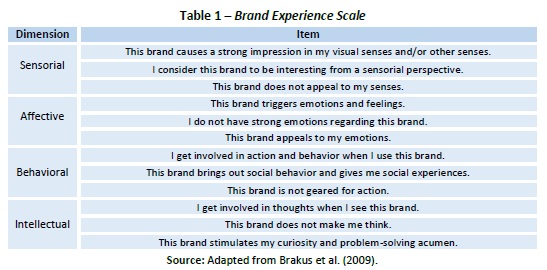
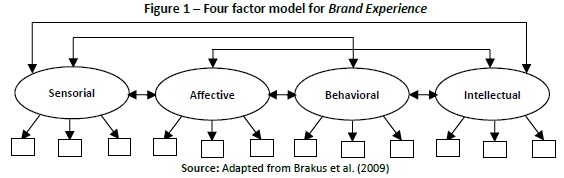
<body><![CDATA[<p>The concept of brand experience was introduced in marketing literature by Holbrook    and Hirschman (1982). They examined the theme by taking into account the irrational    and emotional aspects of consumer behavior. A few years later, Pine and Gilmore    (1998) examined the concept of experience from the economic and value- adding    aspect, beginning with a projection of memorable experiences with the products    or services supplied to the consumer. Fournier (1998), in her study on brand    relationships, suggested that those relationships are valid depending on the    level of the experiences lived by consumers. Accordingly, the author concluded    that consumers do not buy just because they like the brand or because it works    well but also due to the meaning that the brand adds to their lives.</p>     <p>Prahalad and Ramaswamy (2004) noted that the corporation must create an environment    geared toward consumer interaction, where consumers may co-create unique experiences    and develop their value base, thus not being solely influenced by corporate    marketing actions. The idea that brand experience is reinforced by interactions    is also provided by several authors, as for them those interactions with company&rsquo;s    brands evoke subjective and internal responses in consumers that trigger memorable    experiences (Gentile, Spiller, &amp; Noci, 2007; Khan &amp; Rahman, 2016). Thus,    it is a strictly personal experience that implies consumer involvement at different    levels (rational, emotional, sensorial, physical, and spiritual). Brakus et    al. (2009) stated that experience comes in many forms-whether it is indirect,    as with consumer exposure to intangible aspects of marketing communication,    or direct, when the consumer searches, buys or consumes products.</p>     <p>Gentile et al. (2007) stated that while many studies explore the brand experience    theme from a theoretical perspective, tools aimed at supporting marketing managers    in composing the right stimuli to promote an excellent customer experience are    still rare.</p>     <p>2.2.1 A scale for brand experience</p>     <p>During the past few years, with the technological environment being favorable    to consumer-corporation relationships, studies that involve brand experience    were once again conducted in force (Brakus et al. 2009; Lee &amp; Kang, 2012;    Shamim &amp; Butt, 2013; Morgan-Thomas &amp; Veloutsu, 2013). That literature    shows that theoretical and empirical advances in brand experience consist of    means to understand and create value-adding experiences as much as they consist    of proposals for measures to evaluate experience results and define competitive    business strategies.</p>     <p>One of the most relevant studies in that field was presented by Brakus et al.    (2009), who first defined a scale for measuring brand experience (Khan &amp;    Rahman, 2015). In that study, the moments at which experiences occur were empirically    analysed, as well as how they affect consumers&rsquo; attitudes and judgment, along    with other aspects of their behavior. The brand experience dimensions were defined    based on a wide- ranging, multidisciplinary bibliographical review, encompassing    studies from the fields of psychology and cognitive science and studies applied    to experimental marketing and management. By way of confirmatory factor analysis,    the best model for the brand experience construct consisted of four factors    (sensorial, affective, behavioral, and intellectual) as shown in <a href="#f1">Figure    1</a>.</p>     <p>&nbsp;</p>     <p align="center"><a name="f1"></a><img src="/img/revistas/tms/v14n4/14n4a06f1.jpg"/></p>     
<p>&nbsp;</p>     <p>The scale proposed by Brakus et al. (2009) went through validity and accuracy    tests, as well as discrimination analysis, regarding other scales from brands    present in the literature. After five study stages, the final model consisted    of twelve items distributed among factors as shown in <a href="#t1">Table 1</a>.</p>     ]]></body>
<body><![CDATA[<p>&nbsp;</p>     <p align="center"><a name="t1"></a><img src="/img/revistas/tms/v14n4/14n4a06t1.jpg"/></p>     
<p>&nbsp;</p>     <p>The sensorial dimension involves stimuli aimed at consumers&rsquo; senses, such as    sight, smell, touch, taste, and hearing. According to Pontes (2012), there are    several situations in which organisations may develop such stimuli, for instance,    the products and their packaging, staff uniforms, establishment environment    and architecture, and publicity stunts, among other related things.</p>     <p>The affective dimension involves elements linked with humor, feelings, and    emotions that affect the individual (Semprebom, 2011). The intensity of emotional    experiences changes according to the consumer&rsquo;s state of mind and the consumption    situation. According to Pontes (2012), the temperament and emotional availability    of an individual upon entering the experience affect the mood and intensity    of their feelings.</p>     <p>The behavioral dimension is linked to values and beliefs of individuals according    to their lifestyles and behavior. Schmitt (2009) mentioned several categories    that are linked to action: physical aspects, motor actions, body signs, influence    from the environment on physical desire, nonverbal behavior, lifestyle, behavioral    changes, self-awareness, and induction from unplanned actions. This category    is divided into two broad groups: actions linked to the body and actions linked    to lifestyle.</p>     <p>Finally, the intellectual dimension is linked to experiences that stimulate    the client to think, arousing their creativity and curiosity, as well as stimulating    debate and generating controversy (Sabiote &amp; Ballester, 2011). This is a    dimension that involves experiences that mentally affect the consumer. According    to Pontes (2012), an example of such a dimension is an experience with advertising    backup that enables the consumer to think and has them thinking about the usefulness    of the product to them, whether the information on the product leaflet is real    or mere trickery to induce them to make the purchase. The current study uses    the Brand Experience Scale developed by Brakus et al. (2009) to measure brand    experience as presented in the next section.</p>     <p>2.3 Technological brands</p>     <p>The speed with which new products and services are being launched in the market    in a highly competitive environment has motivated the increase in the number    of studies that identify and explain the determining factors for consumer choice.    Seetharaman et al. (2005) presented a comprehensive review of studies on experiences    that may interfere with consumer choice regarding categories or multicategories    of products. Different econometric and multidimensional analysis techniques    are presented. Among the existing product categories, technological products    are unavoidable in modern life. Despite this, few scientific studies analyse    the relationship or consumer experience in particular for the category of technological    products and brands. Among these studies, one work that comes to mind is that    of Mick and Fournier (1998), who conducted empirical research with interviewees    and developed a theoretical framework that is based on the analysis of peoples&rsquo;    perspectives, meaning, and behavior regarding technological products, their    purchase, or the ownership of technological products. The qualitative study    resulted in a concept chart on the paradoxes of technological products and their    influence on emotional reactions and behavioral strategies.</p>     <p>Sriram, Chintagunta and Agarwal (2010) presented a theoretical framework for    modeling consumer purchasing behavior regarding the technological product category    (digital cameras, personal computers, and printers). Aspects linked to the fall    in prices of these products through time, their durability, their quality, and    their complementarity to other technological brands are elements of the model    proposed for analysing consumers&rsquo; purchasing behavior regarding the selected    technological products.</p>     ]]></body>
<body><![CDATA[<p>Human bodily functions are used as metaphors to analyse the communication strategy    of technological brands in the study by Buchanan-Oliver, Cruz and Schroeder    (2010). The authors examine the impact of image and cultural elements in the    consumer&rsquo;s responses to concepts and technological brand experiences. In this    case, a modern marketing strategy involves the use of images and experiences    that associate technological brands with some aspects of a group or individual    identity. This theory extrapolates the traditional market view of finding proof    in the functional benefits of the products besides leading to the discussion    by Mick and Fournier (1998) on the positive and negative aspects of consumers&rsquo;    relationship with technology.</p>     <p>Internet experiences have been an innovative tool-of strategic use-in motivating    research in the field of consumer behavior and brand management. Using three    search engines, Google, Yahoo, and MSN, Morgan-Thomas and Veloutsou (2013) developed    a model for rating brand experiences online. The study showed that positive    experiences generate satisfaction, new interactions, and emotional ties with    the brand. Still, the experiences depend on perceptions of utility, trust, and    brand reputation.</p>     <p>Studies that involve technological brands have shown that emotional and cognitive    aspects interfere with the perception of value attributed to the brand by the    consumer. However, no studies were available that would indicate any difference    in brand experience between consuming technological and non- technological brands.</p>     <p>3. Methodology</p>     <p>Quantitative and descriptive research was conducted for identifying any differences    in brand experience between consuming technological and non-technological brands.    The primary goals were the identification and analysis of the studied phenomena    (Gil, 2002). The proposed temporal slicing was a transversal study that collects    information from any sample of participants only once (Hair Jr., Black, Babin,    Anderson, &amp; Tatham., 2005; Malhotra, 2001).</p>     <p>The model used for measuring brand experience was adapted from Brakus et al.    (2009). The authors developed this model from a study conducted in five stages.    A result of the work by the authors was a questionnaire composed of twelve items,    which were allocated in four dimensions: sensorial, affective, behavioral, and    intellectual.</p>     <p>The data collection instrument was a structured questionnaire, the application    was done in person, and the media was a computer. The questionnaire was developed    and applied using <i>Qualtrics </i>software. Thus, the questions used in the    current study are those extracted from the work done by Brakus et al. (2009)    and were translated by resorting to back translation, a technique that guarantees    a precise and trustworthy translation of the instrument. Ten brands were selected    and submitted to a content validity check; then, they were categorised into    technological and non-technological brands. The technological brands that were    tested are Apple, Google, Microsoft, Motorola, and Samsung; the non-technological    brands that were tested are Coca-Cola, Colgate, Gillette, Havaianas, and Nestlé.    The scale used in the questionnaire is the same as the one used by Brakus et    al. (2009): an adapted 7-point Likert scale that varies from &ldquo;disagree completely&rdquo;    to &ldquo;agree completely.&rdquo;</p>     <p>The population analysed in the current study includes college students from    Business Management, Accounting, and Marketing from a Brazilian university.    Two hundred and thirty students aged from 16 to 48 took part in the research    (58.8% were women), with 48.8% of participants aged between 20 and 25 years.    Taking part in the study was voluntary, and respondents did not receive any    compensation for it. Each respondent would randomly select a link for one of    the available questionnaires and would then analyse two brands. This process    generated 460 observations, distributed in the brands as follows: Apple (48);    Coca-Cola (50); Colgate (45); Gilette (48); Google (47); Havaianas (40); Microsoft    (50); Motorola (45); Nestlé (47) and Samsung (40).</p>     <p>The collected data was used to test the convergent and discriminant validity    of the model&rsquo;s latent variables, as well as to evaluate the trustworthiness    of these constructs by using Confirmatory Factor Analysis.</p>     <p>4. Results and discussion</p>     ]]></body>
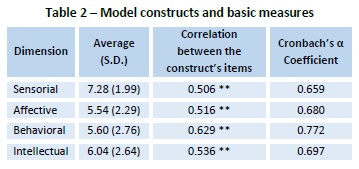
<body><![CDATA[<p>An exploratory analysis was conducted and no outliers or missing values were    found. Before any analyses were performed, the ANOVA assumptions of homoscedasticity    and normality were evaluated using Levene's test and the Shapiro- Wilkes test,    respectively, with SPSS®. The model&rsquo;s constructs are unidimensional, and each    of them is formed by two indicators since the items of the reverse scale were    taken from the model following the Semprebom (2011) model. The constructs and    basic measures are detailed in <a href="#t2">Table 2</a>.</p>     <p>&nbsp;</p>     <p align="center"><a name="t2"></a><img src="/img/revistas/tms/v14n4/14n4a06t2.jpg"/></p>     
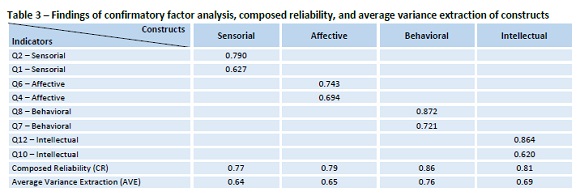
<p>&nbsp;</p>     <p>The average obtained values and their respective dispersion measures indicate    a positive perception around the sensorial, affective, behavioral, and intellectual    dimensions of the analysed brands, whereas the two highest-scoring dimensions    were the sensorial and the intellectual ones. The bivariate correlations of    indicators for all the latent variables were positive and significant (p &lt;    0.000). Cronbach&rsquo;s alpha coefficients for the constructs prove their trustworthiness    (Hair Jr. et al., 2005).</p>     <p>To verify the constructs that compose the proposed model, the Confirmatory    Factor Analysis was adopted. The process used was the method of maximum probability    estimation. The tested model had four dimensions, a sample of 460 observations,    and presented good adjustment quality (&#967;2/gl = 2.799***; CFI = 0.977; IFI    = 0.977; RMSEA = 0.043).</p>     <p>When analysing the validity and trustworthiness of the model, first the adjustment    level of indicators to the proposed dimensions was verified using a Composed    Reliability indicator. This indicator allows for the testing of consistency    in the model&rsquo;s variables. To test the convergent validity, Average Variance    Extraction (AVE) was performed, using Amos®. The findings are shown in <a href="#t3">Table    3</a>.</p>     <p>&nbsp;</p>     <p align="center"><a name="t3"></a><img src="/img/revistas/tms/v14n4/14n4a06t3.jpg"/></p>     
<p>&nbsp;</p>     ]]></body>
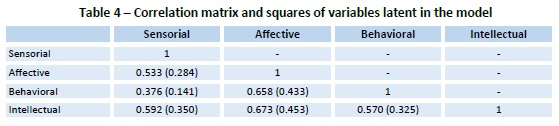
<body><![CDATA[<p>The composed factor reliability was considered satisfactory as these values    were higher than 0.70. The values obtained for AVE, which represents convergent    factor validity, were satisfactory, presenting values greater than 0.5.</p>     <p>Discriminatory validity indicates that the model&rsquo;s constructs consider different    factors (Marôco, 2010). To test this validity, the correlations between latent    variables were verified in pairs. The findings are shown in <a href="#t4">Table    4</a>.</p>     <p>&nbsp;</p>     <p align="center"><a name="t4"></a><img src="/img/revistas/tms/v14n4/14n4a06t4.jpg"/></p>     
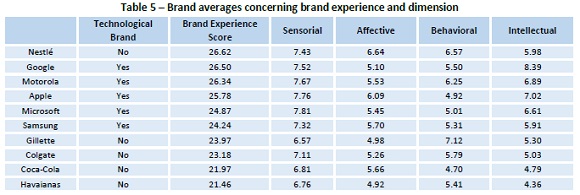
<p>&nbsp;</p>     <p>For Marôco (2010), the discriminant validity may be rated by comparing the    square of the correlation between factors and the AVE for each construct: in    case the AVE of factors is greater than the square of the correlation between    them, one may state that there is no overlapping of constructs. Thus, the square    of the correlation between the sensorial and the affective dimensions is 0.284,    which is less than the AVEs of the sensorial (0.64) and affective (0.65) factors.    The remaining constructs of the model were tested so as to be sure that the    model did not have overlapping factors.</p>     <p>The model in the current paper presented good adjustment indices in all requisites,    as well as good convergent and divergent validity scores and construct reliability.    Thus, after analysing the general model, the brands were ranked in terms of    general average and average by construct as shown in <a href="#t5">Table 5</a>.</p>     <p>&nbsp;</p>     <p align="center"><a name="t5"></a><img src="/img/revistas/tms/v14n4/14n4a06t5.jpg"/></p>     
<p>&nbsp;</p>     ]]></body>
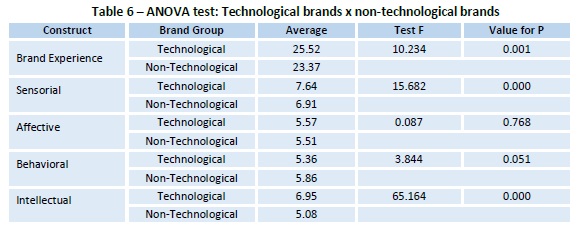
<body><![CDATA[<p>Nestlé presented the highest score for brand experience, whereas the Havaianas    brand presented the lowest brand experience score among the tested brands. Nestlé&rsquo;s    good performance is justified by its high averages in all of the model&rsquo;s constructs,    except for the intellectual dimension. The brands following Nestlé with the    next highest scores are all technological brands, with Google leading the pack    and reaching the highest average among all brands for the intellectual dimension    (8.39). The low averages for the affective dimension go against most studies    done on brand experience: Fournier (2009), in her research, framed the Apple    and Coca- Cola brands in the same quadrant: strong and intense experience, with    a high degree of perceived social and emotional rewards. Apple obtained the    second greatest average for the affective dimension, lagging behind only the    Nestlé brand. However, these averages were indeed lower than those for other    dimensions in this research. In the current study, these same brands did not    present the same performance-with regard to neither the high degree of brand    experience nor the affective dimension. Considering a group categorization between    technological and non-technological brands, ANOVA was estimated to test for    any significant statistical differences among brand experience and its group    dimension: technological and non-technological brands. Findings of these estimates    are detailed in <a href="#t6">Table 6</a>.</p>     <p>&nbsp;</p>     <p align="center"><a name="t6"></a><img src="/img/revistas/tms/v14n4/14n4a06t6.jpg"/></p>     
<p>&nbsp;</p>     <p>According to the data in <a href="#t6">Table 6</a>, consumers have a more relevant    brand experience with technological brands than that with non-technological    brands. One can also perceive that there is a statistically significant difference    among groups when it comes to the sensorial dimension, which is linked to the    individual&rsquo;s sensations regarding the tested brands, and the intellectual dimension,    which is linked to the brand&rsquo;s capacity to challenge the consumer to search    for solutions to his problems. In both dimensions, averages for technological    brands were greater than averages for non-technological brands. Results suggest    that brand experience for technology brands settles mainly on sensorial and    intellectual dimensions. Therefore, efforts on multimedia will improve this    experience as they enact how the brand interacts with each consumer Those results    seem to answer an insight proposed by Brakus, Schmitt and Zarantonello (2014)    that digital media, which are highly associated with technology brands, evoke    more rational and intellectual appeal.</p>     <p>The behavioral dimension, which is linked to lifestyle, presented a higher    average for technological brands; this difference was statistically significant    with a 10% significance level. Thus, one cannot state that this dimension is    useful for differentiating brand experience among groups in the same way as    previous dimensions. Finally, the affective dimension, which is linked to emotions    concerning the consumption situation, was the only dimension to present a superior    average in the non- technological brands group. The averages among groups came    very close, which shows that this dimension is not useful for differentiating    groups when it comes to brand experience.</p>     <p>Comparing the findings from this study with those of Morgan- Thomas and Veloutsu    (2013), which used a specific scale to measure technological brand experience,    one notes the discrepancy when it comes to the importance of the emotional dimension:    they highlight the growth of importance of the affective/emotional dimensions    in the relationship with technological brands. In the model by Morgan-Thomas    and Veloutsu, however, one notes that they obtained a high coefficient for perceived    usability, a characteristic that is linked to the cognitive dimension and that    presented the second greatest average in the current study. The findings of    the current research also corroborates with Rose, Hair and Clark (2011) and    Schmitt, Brakus and Zarantanello (2015), concerning to that consumers purchase    (technological) brands for the experience, as it involves both rational and    goal-orientated responses to the brand, and emotional processing of the total    brand experience.</p>     <p>5. Conclusion</p>     <p>The goal of the current article was to identify any differences in brand experience    between consuming technological and non- technological brands, beginning with    a scale developed by Brakus et al. (2009). The tested model was validated and    the differences between groups were analyzed.</p>     <p>Results from the research show that consumers have a greater brand experience    with the tested technological brands than that with the non-technological brands.    This relationship with brands is established on the basis of two of the four    factors that form the brand experience construct: the sensorial dimension that    involves the senses and accurately reflects the consumer experience with the    product or service and the intellectual dimension that links the technological    brand user&rsquo;s cognitive capacity with his creative capacity and problem-solving    skills. In both dimensions, technological brands obtained greater averages than    the non-technological brands, demonstrating the importance of these dimensions    when it comes to the technological brand experience.</p>     ]]></body>
<body><![CDATA[<p>The behavioral dimension, which involves the change in behavior provided by    brand experiences, presented low discriminant power among groups due to its    low averages regarding previous dimensions, as well as due to the significance    level (10%) given by ANOVA. The affective dimension, which is linked to emotions    in consumption situations of products or services, was the only dimension without    group discriminant ability.</p>     <p>About empirical implications, the study presents some light on policies for    advertising and developing a relationship with consumers, based on the nature    of the brands. Considering that consumers incorporate the brand into their self-concepts    (van der Westhuizen, 2018), and that technological sophistication is an important    value-adding aspect for companies; CEOs of such companies should focus more    on anchoring a relationship on sensorial and intellectual aspects of technological    products in order to achieve enhanced financial performance.</p>     <p>The present study has limitations specifically regarding the student sample,    which is the characteristic of methodology that may have impacted the interpretation    of the findings. Authors have reported young consumers&rsquo; need for connectedness    (Behairy, Mukherjee, &amp; Venkatesh, 2006) and technological products are being    evaluated by their &ldquo;coolness&rdquo;, which includes characteristics such as trendiness,    uniqueness, rebelliousness, genuineness and utility (Sundar, Tamul, &amp; Wu,    2014). Those findings related to youth might have an impact on the results achieved    by the current research, once that it refers to a sample of higher education    students. Further research is needed to test the current hypotheses considering    a broader sample, considering a variety of generations. Besides, while analysis    of data from members of one institution reduces generalizability, it increases    correspondence to reality. Therefore, other contributions could also test how    those dimensions are related in different contexts.</p>     <p>Finally, the results of this paper widen the field of research in brand management,    thus offering a new approach in the context of technological brands. Thus, it    helps in understanding the determinants that favor positive experiences it helps    in understanding the determinants that favor positive experiences, reinforcing    that the basis for a long-lasting brand relationship lies on its intensiveness,    on its intellectual and sensorial challenging.</p>     <p>&nbsp;</p>     <p><b>REFERENCES</b></p>     <!-- ref --><p>Aaker, J.L. (1997). Dimensions of brand personality. <i>Journal of Marketing    Research</i>, 34(3), 347-356.    &nbsp;&nbsp;&nbsp;&nbsp;&nbsp;&nbsp;&nbsp;&nbsp;[&#160;<a href="javascript:void(0);" onclick="javascript: window.open('/scielo.php?script=sci_nlinks&ref=1279216&pid=S2182-8458201800040000600001&lng=','','width=640,height=500,resizable=yes,scrollbars=1,menubar=yes,');">Links</a>&#160;]<!-- end-ref --></p>     <!-- ref --><p>Aaker, J.L., Benet-Martínez, V., &amp; Garolera, J. (2001). Consumption symbols    as carriers of culture: A study of Japanese and Spanish brand personality constructs.    <i>Journal of Personality &amp; Social Psychology</i>, 81(3), 492-508.    &nbsp;&nbsp;&nbsp;&nbsp;&nbsp;&nbsp;&nbsp;&nbsp;[&#160;<a href="javascript:void(0);" onclick="javascript: window.open('/scielo.php?script=sci_nlinks&ref=1279218&pid=S2182-8458201800040000600002&lng=','','width=640,height=500,resizable=yes,scrollbars=1,menubar=yes,');">Links</a>&#160;]<!-- end-ref --></p>     ]]></body>
<body><![CDATA[<!-- ref --><p>Aaker, J.L., Fournier, S., &amp; Brasel, A.D. (2008). When good brands do bad.    <i>Journal of Consumer Research</i>, 31, 1-17.    &nbsp;&nbsp;&nbsp;&nbsp;&nbsp;&nbsp;&nbsp;&nbsp;[&#160;<a href="javascript:void(0);" onclick="javascript: window.open('/scielo.php?script=sci_nlinks&ref=1279220&pid=S2182-8458201800040000600003&lng=','','width=640,height=500,resizable=yes,scrollbars=1,menubar=yes,');">Links</a>&#160;]<!-- end-ref --></p>     <!-- ref --><p>Behairy, N., Mukherjee, S., &amp; Venkatesh, B. E. (2006). Technology-based    communication patterns of youth. <i>ACR North American Advances</i>, 33, 304-305.    &nbsp;&nbsp;&nbsp;&nbsp;&nbsp;&nbsp;&nbsp;&nbsp;[&#160;<a href="javascript:void(0);" onclick="javascript: window.open('/scielo.php?script=sci_nlinks&ref=1279222&pid=S2182-8458201800040000600004&lng=','','width=640,height=500,resizable=yes,scrollbars=1,menubar=yes,');">Links</a>&#160;]<!-- end-ref --></p>     <!-- ref --><p>Brakus, J. J., Schmitt, B.H., &amp; Zarantonello, L. (2009). Brand Experience:    What Is It? How Is It Measured? Does It Affect Loyalty? <i>Journal of Marketing,    </i>73(3), 52-68.    &nbsp;&nbsp;&nbsp;&nbsp;&nbsp;&nbsp;&nbsp;&nbsp;[&#160;<a href="javascript:void(0);" onclick="javascript: window.open('/scielo.php?script=sci_nlinks&ref=1279224&pid=S2182-8458201800040000600005&lng=','','width=640,height=500,resizable=yes,scrollbars=1,menubar=yes,');">Links</a>&#160;]<!-- end-ref --></p>     <!-- ref --><p>Breivik, E., &amp; Thorbjørnsen, H. (2008). Consumer brand relationships: an    investigation of two alternative models. <i>Journal of the Academy of Marketing    Science</i>, 36(4), 443-472.    &nbsp;&nbsp;&nbsp;&nbsp;&nbsp;&nbsp;&nbsp;&nbsp;[&#160;<a href="javascript:void(0);" onclick="javascript: window.open('/scielo.php?script=sci_nlinks&ref=1279226&pid=S2182-8458201800040000600006&lng=','','width=640,height=500,resizable=yes,scrollbars=1,menubar=yes,');">Links</a>&#160;]<!-- end-ref --></p>     <!-- ref --><p>Buchanan-Oliver, M., Cruz, A., &amp; Schroeder, J.E. (2010). Shaping the body    and technology: discursive implications for the strategic communication of technological    brands. <i>European Journal of Marketing, </i>44(5), 635-652.    &nbsp;&nbsp;&nbsp;&nbsp;&nbsp;&nbsp;&nbsp;&nbsp;[&#160;<a href="javascript:void(0);" onclick="javascript: window.open('/scielo.php?script=sci_nlinks&ref=1279228&pid=S2182-8458201800040000600007&lng=','','width=640,height=500,resizable=yes,scrollbars=1,menubar=yes,');">Links</a>&#160;]<!-- end-ref --></p>     ]]></body>
<body><![CDATA[<!-- ref --><p>Escalas, J.E., &amp; Bettman, J.R. (2005). Self-Construal, Reference Groups,    and Brand Meaning. <i>Journal of Consumer Research</i>, 32, 378-389.    &nbsp;&nbsp;&nbsp;&nbsp;&nbsp;&nbsp;&nbsp;&nbsp;[&#160;<a href="javascript:void(0);" onclick="javascript: window.open('/scielo.php?script=sci_nlinks&ref=1279230&pid=S2182-8458201800040000600008&lng=','','width=640,height=500,resizable=yes,scrollbars=1,menubar=yes,');">Links</a>&#160;]<!-- end-ref --></p>     <p>Fournier, S. (2009). Lessons learned about consumers' relationships with their    brands. In D. J. MacInnis, C. W. Park, &amp; J. R. Priester (Eds.), Handbook    of brand relationships (pp. 5-23). Armonk, NY, US: M E Sharpe.</p>     <!-- ref --><p>Fournier, S. (1998). Consumers and their brands: developing relationship theory    in consumer research. <i>Journal of Consumer Research</i>, 24(4), 343-373.    &nbsp;&nbsp;&nbsp;&nbsp;&nbsp;&nbsp;&nbsp;&nbsp;[&#160;<a href="javascript:void(0);" onclick="javascript: window.open('/scielo.php?script=sci_nlinks&ref=1279233&pid=S2182-8458201800040000600010&lng=','','width=640,height=500,resizable=yes,scrollbars=1,menubar=yes,');">Links</a>&#160;]<!-- end-ref --></p>     <!-- ref --><p>Gentile, C., Spiller, N., &amp; Noci, G. (2007). How to Sustain the Customer    Experience: <i>European Management Journal</i>, 25(5), 395-410.    &nbsp;&nbsp;&nbsp;&nbsp;&nbsp;&nbsp;&nbsp;&nbsp;[&#160;<a href="javascript:void(0);" onclick="javascript: window.open('/scielo.php?script=sci_nlinks&ref=1279235&pid=S2182-8458201800040000600011&lng=','','width=640,height=500,resizable=yes,scrollbars=1,menubar=yes,');">Links</a>&#160;]<!-- end-ref --></p>     <!-- ref --><p>Gil, A.C. (2002). <i>Como escrever projetos de pesquisa</i>. São Paulo: Atlas.    &nbsp;&nbsp;&nbsp;&nbsp;&nbsp;&nbsp;&nbsp;&nbsp;[&#160;<a href="javascript:void(0);" onclick="javascript: window.open('/scielo.php?script=sci_nlinks&ref=1279237&pid=S2182-8458201800040000600012&lng=','','width=640,height=500,resizable=yes,scrollbars=1,menubar=yes,');">Links</a>&#160;]<!-- end-ref --></p>     <p>Gorbaniuk, O., Razmus, W., Firlej, K. Lebiedowicz, A., &amp; Leszczy&#324;skig,    M. (2017). Measuring corporate personality: A critical review and new insights.    <i>Journal of Brand Management</i>, 24 (5), 423-438.</p>     ]]></body>
<body><![CDATA[<!-- ref --><p>Hair Jr., J.F., Black, W.C., Babin, B.J., Anderson, R.E., &amp; Tatham, R.L.    (2005). <i>Multivariate Data Analysis</i>. Porto Alegre: Bookman.    &nbsp;&nbsp;&nbsp;&nbsp;&nbsp;&nbsp;&nbsp;&nbsp;[&#160;<a href="javascript:void(0);" onclick="javascript: window.open('/scielo.php?script=sci_nlinks&ref=1279240&pid=S2182-8458201800040000600014&lng=','','width=640,height=500,resizable=yes,scrollbars=1,menubar=yes,');">Links</a>&#160;]<!-- end-ref --></p>     <!-- ref --><p>Heding, T., Knudtzen, C., &amp; Bjerre, M. (2009). <i>Brand Management</i>.    Routledge.    &nbsp;&nbsp;&nbsp;&nbsp;&nbsp;&nbsp;&nbsp;&nbsp;[&#160;<a href="javascript:void(0);" onclick="javascript: window.open('/scielo.php?script=sci_nlinks&ref=1279242&pid=S2182-8458201800040000600015&lng=','','width=640,height=500,resizable=yes,scrollbars=1,menubar=yes,');">Links</a>&#160;]<!-- end-ref --></p>     <!-- ref --><p>Holbrook, M.B., &amp; Hirschman, E.C. (1982). The experiential aspects of consumption:    consumer fantasies, feelings, and fun. <i>Journal of Consumer Research, </i>9(2),    132-140.    &nbsp;&nbsp;&nbsp;&nbsp;&nbsp;&nbsp;&nbsp;&nbsp;[&#160;<a href="javascript:void(0);" onclick="javascript: window.open('/scielo.php?script=sci_nlinks&ref=1279244&pid=S2182-8458201800040000600016&lng=','','width=640,height=500,resizable=yes,scrollbars=1,menubar=yes,');">Links</a>&#160;]<!-- end-ref --></p>     <!-- ref --><p>Khan, I., &amp; Rahman, Z. (2015). A review and future directions of brand    experience research. <i>International Strategic Management Review</i>, 3(1-    2), 1-14.    &nbsp;&nbsp;&nbsp;&nbsp;&nbsp;&nbsp;&nbsp;&nbsp;[&#160;<a href="javascript:void(0);" onclick="javascript: window.open('/scielo.php?script=sci_nlinks&ref=1279246&pid=S2182-8458201800040000600017&lng=','','width=640,height=500,resizable=yes,scrollbars=1,menubar=yes,');">Links</a>&#160;]<!-- end-ref --></p>     <!-- ref --><p>Khan, I., &amp; Rahman, Z. (2016). Retail brand experience: scale development    and validation. <i>Journal of Product &amp; Brand Management</i>, 25(5), 435-451.    &nbsp;&nbsp;&nbsp;&nbsp;&nbsp;&nbsp;&nbsp;&nbsp;[&#160;<a href="javascript:void(0);" onclick="javascript: window.open('/scielo.php?script=sci_nlinks&ref=1279248&pid=S2182-8458201800040000600018&lng=','','width=640,height=500,resizable=yes,scrollbars=1,menubar=yes,');">Links</a>&#160;]<!-- end-ref --></p>     ]]></body>
<body><![CDATA[<!-- ref --><p>Kinard, B.R., &amp; Capella, M.L. (2006). Relationship marketing: the influence    of consumer involvement on perceived service benefits. <i>Journal of Services    Marketing</i>, 20(6), 359-368.    &nbsp;&nbsp;&nbsp;&nbsp;&nbsp;&nbsp;&nbsp;&nbsp;[&#160;<a href="javascript:void(0);" onclick="javascript: window.open('/scielo.php?script=sci_nlinks&ref=1279250&pid=S2182-8458201800040000600019&lng=','','width=640,height=500,resizable=yes,scrollbars=1,menubar=yes,');">Links</a>&#160;]<!-- end-ref --></p>     <!-- ref --><p>Lee, H.J., &amp; Kang, M.S. (2012). The effect of brand experience on brand    relationship quality. <i>Academy </i><i>of Marketing Studies Journal</i>, 16(1):    87-98.    &nbsp;&nbsp;&nbsp;&nbsp;&nbsp;&nbsp;&nbsp;&nbsp;[&#160;<a href="javascript:void(0);" onclick="javascript: window.open('/scielo.php?script=sci_nlinks&ref=1279252&pid=S2182-8458201800040000600020&lng=','','width=640,height=500,resizable=yes,scrollbars=1,menubar=yes,');">Links</a>&#160;]<!-- end-ref --></p>     <!-- ref --><p>Malhotra, N.K. (2001). <i>Pesquisa de Marketing</i>. Porto Alegre: Bookman.    &nbsp;&nbsp;&nbsp;&nbsp;&nbsp;&nbsp;&nbsp;&nbsp;[&#160;<a href="javascript:void(0);" onclick="javascript: window.open('/scielo.php?script=sci_nlinks&ref=1279254&pid=S2182-8458201800040000600021&lng=','','width=640,height=500,resizable=yes,scrollbars=1,menubar=yes,');">Links</a>&#160;]<!-- end-ref --></p>     <!-- ref --><p>Marôco, J. (2010). <i>Análise De Equações Estruturais - Fundamentos Teóricos,    Software &amp; Aplicações</i>. Pêro Pinheiro: Report Number, Lda.    &nbsp;&nbsp;&nbsp;&nbsp;&nbsp;&nbsp;&nbsp;&nbsp;[&#160;<a href="javascript:void(0);" onclick="javascript: window.open('/scielo.php?script=sci_nlinks&ref=1279256&pid=S2182-8458201800040000600022&lng=','','width=640,height=500,resizable=yes,scrollbars=1,menubar=yes,');">Links</a>&#160;]<!-- end-ref --></p>     <!-- ref --><p>Morgan-Thomas, A., &amp; Veloutsou, C. (2013). Beyond technology acceptance:    Brand relationships and online brand experience. <i>Journal of Business Research</i>,    66(1), 21-27.    &nbsp;&nbsp;&nbsp;&nbsp;&nbsp;&nbsp;&nbsp;&nbsp;[&#160;<a href="javascript:void(0);" onclick="javascript: window.open('/scielo.php?script=sci_nlinks&ref=1279258&pid=S2182-8458201800040000600023&lng=','','width=640,height=500,resizable=yes,scrollbars=1,menubar=yes,');">Links</a>&#160;]<!-- end-ref --></p>     ]]></body>
<body><![CDATA[<!-- ref --><p>Mick, D.G., &amp; Fournier, S. (1998). Paradoxes of technology: consumer cognizance,    emotions, and coping strategies. <i>Journal of Consumer Research</i>, 25(2),    123-143.    &nbsp;&nbsp;&nbsp;&nbsp;&nbsp;&nbsp;&nbsp;&nbsp;[&#160;<a href="javascript:void(0);" onclick="javascript: window.open('/scielo.php?script=sci_nlinks&ref=1279260&pid=S2182-8458201800040000600024&lng=','','width=640,height=500,resizable=yes,scrollbars=1,menubar=yes,');">Links</a>&#160;]<!-- end-ref --></p>     <!-- ref --><p>Pine, B. J., &amp; James H. G. (1998). Welcome to the experience economy. <i>Harvard    Business Review</i>, 76, 97-105.    &nbsp;&nbsp;&nbsp;&nbsp;&nbsp;&nbsp;&nbsp;&nbsp;[&#160;<a href="javascript:void(0);" onclick="javascript: window.open('/scielo.php?script=sci_nlinks&ref=1279262&pid=S2182-8458201800040000600025&lng=','','width=640,height=500,resizable=yes,scrollbars=1,menubar=yes,');">Links</a>&#160;]<!-- end-ref --></p>     <!-- ref --><p>Pontes, M.C. (2012). <i>Marketing experiencial ou o uso da experiência no marketing?    Estudo de caso em hotéis 5 estrelas da cidade de São Paulo</i>. (Unpublished    doctoral dissertation), Universidade de São Paulo, São Paulo,    &nbsp;&nbsp;&nbsp;&nbsp;&nbsp;&nbsp;&nbsp;&nbsp;[&#160;<a href="javascript:void(0);" onclick="javascript: window.open('/scielo.php?script=sci_nlinks&ref=1279264&pid=S2182-8458201800040000600026&lng=','','width=640,height=500,resizable=yes,scrollbars=1,menubar=yes,');">Links</a>&#160;]<!-- end-ref --> Brasil.</p>     <!-- ref --><p>Prado, P.H.M. (2004). <i>A avaliação do relacionamento sob a ótica do cliente:    um estudo em bancos do varejo</i>. (Unpublished doctoral dissertation), Fundação    Getúlio Vargas, São Paulo,    &nbsp;&nbsp;&nbsp;&nbsp;&nbsp;&nbsp;&nbsp;&nbsp;[&#160;<a href="javascript:void(0);" onclick="javascript: window.open('/scielo.php?script=sci_nlinks&ref=1279266&pid=S2182-8458201800040000600027&lng=','','width=640,height=500,resizable=yes,scrollbars=1,menubar=yes,');">Links</a>&#160;]<!-- end-ref --> Brasil.</p>     <!-- ref --><p>Prahalad, C.K., &amp; Ramaswamy, V. (2004). Co-creation experiences: The next    practice in value creation. <i>Journal of Interactive Marketing</i>, 18(3),    5-14.    &nbsp;&nbsp;&nbsp;&nbsp;&nbsp;&nbsp;&nbsp;&nbsp;[&#160;<a href="javascript:void(0);" onclick="javascript: window.open('/scielo.php?script=sci_nlinks&ref=1279268&pid=S2182-8458201800040000600028&lng=','','width=640,height=500,resizable=yes,scrollbars=1,menubar=yes,');">Links</a>&#160;]<!-- end-ref --></p>     ]]></body>
<body><![CDATA[<!-- ref --><p>Rose, S., Hair, N., &amp; Clark, M. (2011). Online customer experience: A review    of the business-to-consumer online purchase context. <i>International Journal    of Management Reviews</i>, 13(1), 24-39.    &nbsp;&nbsp;&nbsp;&nbsp;&nbsp;&nbsp;&nbsp;&nbsp;[&#160;<a href="javascript:void(0);" onclick="javascript: window.open('/scielo.php?script=sci_nlinks&ref=1279270&pid=S2182-8458201800040000600029&lng=','','width=640,height=500,resizable=yes,scrollbars=1,menubar=yes,');">Links</a>&#160;]<!-- end-ref --></p>     <!-- ref --><p>Rusbult, C.E. (1980). Commitment and satisfaction in romantic associations:    A test of the investment model. <i>Journal of Experimental Social Psychology,    </i>16(2), 172-186.    &nbsp;&nbsp;&nbsp;&nbsp;&nbsp;&nbsp;&nbsp;&nbsp;[&#160;<a href="javascript:void(0);" onclick="javascript: window.open('/scielo.php?script=sci_nlinks&ref=1279272&pid=S2182-8458201800040000600030&lng=','','width=640,height=500,resizable=yes,scrollbars=1,menubar=yes,');">Links</a>&#160;]<!-- end-ref --></p>     <!-- ref --><p>Sabiote, E.F., &amp; Ballester, M.E.D. (2011). Marcas de experiencia: marcando    la diferencia. <i>Estudios Gerenciales, </i>27 (121), 59-77.    &nbsp;&nbsp;&nbsp;&nbsp;&nbsp;&nbsp;&nbsp;&nbsp;[&#160;<a href="javascript:void(0);" onclick="javascript: window.open('/scielo.php?script=sci_nlinks&ref=1279274&pid=S2182-8458201800040000600031&lng=','','width=640,height=500,resizable=yes,scrollbars=1,menubar=yes,');">Links</a>&#160;]<!-- end-ref --></p>     <!-- ref --><p>Schmitt, B. (2009). The concept of brand experience. <i>Journal of Brand Management,    </i>16, 417-419.    &nbsp;&nbsp;&nbsp;&nbsp;&nbsp;&nbsp;&nbsp;&nbsp;[&#160;<a href="javascript:void(0);" onclick="javascript: window.open('/scielo.php?script=sci_nlinks&ref=1279276&pid=S2182-8458201800040000600032&lng=','','width=640,height=500,resizable=yes,scrollbars=1,menubar=yes,');">Links</a>&#160;]<!-- end-ref --></p>     <!-- ref --><p>Schmitt, B.H., Brakus, J.J., &amp; Zarantonello, L. (2014). The current state    and future of brand experience. <i>Journal </i><i>of Brand Management</i>, 21(9),    727-733.    &nbsp;&nbsp;&nbsp;&nbsp;&nbsp;&nbsp;&nbsp;&nbsp;[&#160;<a href="javascript:void(0);" onclick="javascript: window.open('/scielo.php?script=sci_nlinks&ref=1279278&pid=S2182-8458201800040000600033&lng=','','width=640,height=500,resizable=yes,scrollbars=1,menubar=yes,');">Links</a>&#160;]<!-- end-ref --></p>     ]]></body>
<body><![CDATA[<!-- ref --><p>Schmitt, B. H., Brakus, J. J., &amp; Zarantonello, L. (2015). From experiential    psychology to consumer experience. <i>Journal of Consumer Psychology</i>, 25(1),    166-171.    &nbsp;&nbsp;&nbsp;&nbsp;&nbsp;&nbsp;&nbsp;&nbsp;[&#160;<a href="javascript:void(0);" onclick="javascript: window.open('/scielo.php?script=sci_nlinks&ref=1279280&pid=S2182-8458201800040000600034&lng=','','width=640,height=500,resizable=yes,scrollbars=1,menubar=yes,');">Links</a>&#160;]<!-- end-ref --></p>     <!-- ref --><p>Seetharaman, P.B., Chib, S., Ainslie, A., Boatwright, P., Chan, T., Gupta,    S., Mehta, N., Rao, V., &amp; Strijnev, A. (2005). Models of Multi-Category    Choice Behavior. <i>Marketing Letters</i>, 16(3-4), 239-254.    &nbsp;&nbsp;&nbsp;&nbsp;&nbsp;&nbsp;&nbsp;&nbsp;[&#160;<a href="javascript:void(0);" onclick="javascript: window.open('/scielo.php?script=sci_nlinks&ref=1279282&pid=S2182-8458201800040000600035&lng=','','width=640,height=500,resizable=yes,scrollbars=1,menubar=yes,');">Links</a>&#160;]<!-- end-ref --></p>     <p>Semprebom, E. (2010). <i>A influência da experiência de consumo na qualidade    de relacionamento dos universitários com suas marcas</i>. (Unpublished master&rsquo;s    thesis). Universidade Federal do Paraná, Curitiba, Brasil.</p>     <p>Semprebom, E. (2011, September). Experiência com Marca: validação da escala    no contexto universitário. <i>Proceedings of XXXV Encontro Anual da Associação    Nacional de Pesquisa e Pós-Graduação em Administração</i>, Rio de Janeiro, RJ,    Brasil.</p>     <!-- ref --><p>Shamim, A., &amp; Butt, M.M. (2013). A critical model of brand experience consequences.    <i>Asia Pacific Journal of Marketing and Logistics</i>, 25(1), 102-117.    &nbsp;&nbsp;&nbsp;&nbsp;&nbsp;&nbsp;&nbsp;&nbsp;[&#160;<a href="javascript:void(0);" onclick="javascript: window.open('/scielo.php?script=sci_nlinks&ref=1279286&pid=S2182-8458201800040000600038&lng=','','width=640,height=500,resizable=yes,scrollbars=1,menubar=yes,');">Links</a>&#160;]<!-- end-ref --></p>     <!-- ref --><p>Sherry Jr., J.F. (2006). Significado da Marca. In A.M. Tybout &amp; T. Calkins    (Eds.) <i>Branding: fundamentos, estratégias e alavancagem de marcas; implementação,    modelagem e checklists; experiências de líderes de mercado </i>(pp. 40-69).    São Paulo: Atlas.    &nbsp;&nbsp;&nbsp;&nbsp;&nbsp;&nbsp;&nbsp;&nbsp;[&#160;<a href="javascript:void(0);" onclick="javascript: window.open('/scielo.php?script=sci_nlinks&ref=1279288&pid=S2182-8458201800040000600039&lng=','','width=640,height=500,resizable=yes,scrollbars=1,menubar=yes,');">Links</a>&#160;]<!-- end-ref --></p>     ]]></body>
<body><![CDATA[<!-- ref --><p>Sriram, S., Chintagunta, P.K., &amp; Agarwal, M.K. (2010). Investigating Consumer    Purchase Behavior in Related Technology Product Categories. <i>Marketing Science</i>,    29(2), 291-314.    &nbsp;&nbsp;&nbsp;&nbsp;&nbsp;&nbsp;&nbsp;&nbsp;[&#160;<a href="javascript:void(0);" onclick="javascript: window.open('/scielo.php?script=sci_nlinks&ref=1279290&pid=S2182-8458201800040000600040&lng=','','width=640,height=500,resizable=yes,scrollbars=1,menubar=yes,');">Links</a>&#160;]<!-- end-ref --></p>     <!-- ref --><p>Stone, M., &amp; Woodcock, N. (1998). <i>Marketing de Relacionamento</i>. São    Paulo: Littera Mundi.    &nbsp;&nbsp;&nbsp;&nbsp;&nbsp;&nbsp;&nbsp;&nbsp;[&#160;<a href="javascript:void(0);" onclick="javascript: window.open('/scielo.php?script=sci_nlinks&ref=1279292&pid=S2182-8458201800040000600041&lng=','','width=640,height=500,resizable=yes,scrollbars=1,menubar=yes,');">Links</a>&#160;]<!-- end-ref --></p>     <p>Sundar, S. S., Tamul, D. J., &amp; Wu, M. (2014). Capturing &ldquo;cool&rdquo;: Measures    for assessing coolness of technological products. <i>International Journal of    Human-Computer Studies</i>, 72(2), 169-180.</p>     <!-- ref --><p>van der Westhuizen, L. M. (2018). Brand loyalty: exploring self-brand connection    and brand experience. <i>Journal of Product &amp; Brand Management</i>, 27(2),    172-184.    &nbsp;&nbsp;&nbsp;&nbsp;&nbsp;&nbsp;&nbsp;&nbsp;[&#160;<a href="javascript:void(0);" onclick="javascript: window.open('/scielo.php?script=sci_nlinks&ref=1279295&pid=S2182-8458201800040000600043&lng=','','width=640,height=500,resizable=yes,scrollbars=1,menubar=yes,');">Links</a>&#160;]<!-- end-ref --></p>     <!-- ref --><p>Zaichkowsky, J.L. (1994). The personal involvement inventory: reduction, revision    and application to advertising. <i>Journal of Advertising</i>, 23, 59-70.    &nbsp;&nbsp;&nbsp;&nbsp;&nbsp;&nbsp;&nbsp;&nbsp;[&#160;<a href="javascript:void(0);" onclick="javascript: window.open('/scielo.php?script=sci_nlinks&ref=1279297&pid=S2182-8458201800040000600044&lng=','','width=640,height=500,resizable=yes,scrollbars=1,menubar=yes,');">Links</a>&#160;]<!-- end-ref --></p>     <p>&nbsp;</p>     ]]></body>
<body><![CDATA[<p>Received: 25.05.2018</p>     <p>Revisions required: 28.07.2018</p>     <p>Accepted: 12.08.2018</p>      ]]></body><back>
<ref-list>
<ref id="B1">
<nlm-citation citation-type="journal">
<person-group person-group-type="author">
<name>
<surname><![CDATA[Aaker]]></surname>
<given-names><![CDATA[J.L.]]></given-names>
</name>
</person-group>
<article-title xml:lang="en"><![CDATA[Dimensions of brand personality]]></article-title>
<source><![CDATA[Journal of Marketing Research]]></source>
<year>1997</year>
<volume>34</volume>
<numero>3</numero>
<issue>3</issue>
<page-range>347-356</page-range></nlm-citation>
</ref>
<ref id="B2">
<nlm-citation citation-type="journal">
<person-group person-group-type="author">
<name>
<surname><![CDATA[Aaker]]></surname>
<given-names><![CDATA[J.L.]]></given-names>
</name>
<name>
<surname><![CDATA[Benet-Martínez]]></surname>
<given-names><![CDATA[V.]]></given-names>
</name>
<name>
<surname><![CDATA[Garolera]]></surname>
<given-names><![CDATA[J.]]></given-names>
</name>
</person-group>
<article-title xml:lang="en"><![CDATA[Consumption symbols as carriers of culture: A study of Japanese and Spanish brand personality constructs]]></article-title>
<source><![CDATA[Journal of Personality & Social Psychology]]></source>
<year>2001</year>
<volume>81</volume>
<numero>3</numero>
<issue>3</issue>
<page-range>492-508</page-range></nlm-citation>
</ref>
<ref id="B3">
<nlm-citation citation-type="journal">
<person-group person-group-type="author">
<name>
<surname><![CDATA[Aaker]]></surname>
<given-names><![CDATA[J.L.]]></given-names>
</name>
<name>
<surname><![CDATA[Fournier]]></surname>
<given-names><![CDATA[S.]]></given-names>
</name>
<name>
<surname><![CDATA[Brasel]]></surname>
<given-names><![CDATA[A.D.]]></given-names>
</name>
</person-group>
<article-title xml:lang="en"><![CDATA[When good brands do bad]]></article-title>
<source><![CDATA[Journal of Consumer Research]]></source>
<year>2008</year>
<volume>31</volume>
<page-range>1-17</page-range></nlm-citation>
</ref>
<ref id="B4">
<nlm-citation citation-type="journal">
<person-group person-group-type="author">
<name>
<surname><![CDATA[Behairy]]></surname>
<given-names><![CDATA[N.]]></given-names>
</name>
<name>
<surname><![CDATA[Mukherjee]]></surname>
<given-names><![CDATA[S.]]></given-names>
</name>
<name>
<surname><![CDATA[Venkatesh]]></surname>
<given-names><![CDATA[B. E.]]></given-names>
</name>
</person-group>
<article-title xml:lang="en"><![CDATA[Technology-based communication patterns of youth]]></article-title>
<source><![CDATA[ACR North American Advances]]></source>
<year>2006</year>
<volume>33</volume>
<page-range>304-305</page-range></nlm-citation>
</ref>
<ref id="B5">
<nlm-citation citation-type="journal">
<person-group person-group-type="author">
<name>
<surname><![CDATA[Brakus]]></surname>
<given-names><![CDATA[J. J.]]></given-names>
</name>
<name>
<surname><![CDATA[Schmitt]]></surname>
<given-names><![CDATA[B.H.]]></given-names>
</name>
<name>
<surname><![CDATA[Zarantonello]]></surname>
<given-names><![CDATA[L.]]></given-names>
</name>
</person-group>
<article-title xml:lang="en"><![CDATA[Brand Experience: What Is It? How Is It Measured? Does It Affect Loyalty?]]></article-title>
<source><![CDATA[Journal of Marketing]]></source>
<year>2009</year>
<volume>73</volume>
<numero>3</numero>
<issue>3</issue>
<page-range>52-68</page-range></nlm-citation>
</ref>
<ref id="B6">
<nlm-citation citation-type="journal">
<person-group person-group-type="author">
<name>
<surname><![CDATA[Breivik]]></surname>
<given-names><![CDATA[E.]]></given-names>
</name>
<name>
<surname><![CDATA[Thorbjørnsen]]></surname>
<given-names><![CDATA[H.]]></given-names>
</name>
</person-group>
<article-title xml:lang="en"><![CDATA[Consumer brand relationships: an investigation of two alternative models]]></article-title>
<source><![CDATA[Journal of the Academy of Marketing Science]]></source>
<year>2008</year>
<volume>36</volume>
<numero>4</numero>
<issue>4</issue>
<page-range>443-472</page-range></nlm-citation>
</ref>
<ref id="B7">
<nlm-citation citation-type="journal">
<person-group person-group-type="author">
<name>
<surname><![CDATA[Buchanan-Oliver]]></surname>
<given-names><![CDATA[M.]]></given-names>
</name>
<name>
<surname><![CDATA[Cruz]]></surname>
<given-names><![CDATA[A.]]></given-names>
</name>
<name>
<surname><![CDATA[Schroeder]]></surname>
<given-names><![CDATA[J.E.]]></given-names>
</name>
</person-group>
<article-title xml:lang="en"><![CDATA[Shaping the body and technology: discursive implications for the strategic communication of technological brands]]></article-title>
<source><![CDATA[European Journal of Marketing]]></source>
<year>2010</year>
<volume>44</volume>
<numero>5</numero>
<issue>5</issue>
<page-range>635-652</page-range></nlm-citation>
</ref>
<ref id="B8">
<nlm-citation citation-type="journal">
<person-group person-group-type="author">
<name>
<surname><![CDATA[Escalas]]></surname>
<given-names><![CDATA[J.E.]]></given-names>
</name>
<name>
<surname><![CDATA[Bettman]]></surname>
<given-names><![CDATA[J.R.]]></given-names>
</name>
</person-group>
<article-title xml:lang="en"><![CDATA[Self-Construal, Reference Groups, and Brand Meaning]]></article-title>
<source><![CDATA[Journal of Consumer Research]]></source>
<year>2005</year>
<volume>32</volume>
<page-range>378-389</page-range></nlm-citation>
</ref>
<ref id="B9">
<nlm-citation citation-type="book">
<person-group person-group-type="author">
<name>
<surname><![CDATA[Fournier]]></surname>
<given-names><![CDATA[S.]]></given-names>
</name>
</person-group>
<article-title xml:lang="en"><![CDATA[Lessons learned about consumers' relationships with their brands]]></article-title>
<person-group person-group-type="editor">
<name>
<surname><![CDATA[MacInnis]]></surname>
<given-names><![CDATA[D. J.]]></given-names>
</name>
<name>
<surname><![CDATA[Park]]></surname>
<given-names><![CDATA[C. W.]]></given-names>
</name>
<name>
<surname><![CDATA[Priester]]></surname>
<given-names><![CDATA[J. R.]]></given-names>
</name>
</person-group>
<source><![CDATA[Handbook of brand relationships]]></source>
<year>2009</year>
<page-range>5-23</page-range><publisher-loc><![CDATA[Armonk ]]></publisher-loc>
<publisher-name><![CDATA[M E Sharpe]]></publisher-name>
</nlm-citation>
</ref>
<ref id="B10">
<nlm-citation citation-type="journal">
<person-group person-group-type="author">
<name>
<surname><![CDATA[Fournier]]></surname>
<given-names><![CDATA[S.]]></given-names>
</name>
</person-group>
<article-title xml:lang="en"><![CDATA[Consumers and their brands: developing relationship theory in consumer research]]></article-title>
<source><![CDATA[Journal of Consumer Research]]></source>
<year>1998</year>
<volume>24</volume>
<numero>4</numero>
<issue>4</issue>
<page-range>343-373</page-range></nlm-citation>
</ref>
<ref id="B11">
<nlm-citation citation-type="journal">
<person-group person-group-type="author">
<name>
<surname><![CDATA[Gentile]]></surname>
<given-names><![CDATA[C.]]></given-names>
</name>
<name>
<surname><![CDATA[Spiller]]></surname>
<given-names><![CDATA[N.]]></given-names>
</name>
<name>
<surname><![CDATA[Noci]]></surname>
<given-names><![CDATA[G.]]></given-names>
</name>
</person-group>
<article-title xml:lang="en"><![CDATA[How to Sustain the Customer Experience]]></article-title>
<source><![CDATA[European Management Journal]]></source>
<year>2007</year>
<volume>25</volume>
<numero>5</numero>
<issue>5</issue>
<page-range>395-410</page-range></nlm-citation>
</ref>
<ref id="B12">
<nlm-citation citation-type="book">
<person-group person-group-type="author">
<name>
<surname><![CDATA[Gil]]></surname>
<given-names><![CDATA[A.C.]]></given-names>
</name>
</person-group>
<source><![CDATA[Como escrever projetos de pesquisa]]></source>
<year>2002</year>
<publisher-loc><![CDATA[São Paulo ]]></publisher-loc>
<publisher-name><![CDATA[Atlas]]></publisher-name>
</nlm-citation>
</ref>
<ref id="B13">
<nlm-citation citation-type="journal">
<person-group person-group-type="author">
<name>
<surname><![CDATA[Gorbaniuk]]></surname>
<given-names><![CDATA[O.]]></given-names>
</name>
<name>
<surname><![CDATA[Razmus]]></surname>
<given-names><![CDATA[W.]]></given-names>
</name>
<name>
<surname><![CDATA[Firlej]]></surname>
<given-names><![CDATA[K.]]></given-names>
</name>
<name>
<surname><![CDATA[Lebiedowicz]]></surname>
<given-names><![CDATA[A.]]></given-names>
</name>
<name>
<surname><![CDATA[Leszczynskig]]></surname>
<given-names><![CDATA[M.]]></given-names>
</name>
</person-group>
<article-title xml:lang="en"><![CDATA[Measuring corporate personality: A critical review and new insights]]></article-title>
<source><![CDATA[Journal of Brand Management]]></source>
<year>2017</year>
<volume>24</volume>
<numero>5</numero>
<issue>5</issue>
<page-range>423-438</page-range></nlm-citation>
</ref>
<ref id="B14">
<nlm-citation citation-type="book">
<person-group person-group-type="author">
<name>
<surname><![CDATA[Hair Jr.]]></surname>
<given-names><![CDATA[J.F.]]></given-names>
</name>
<name>
<surname><![CDATA[Black]]></surname>
<given-names><![CDATA[W.C.]]></given-names>
</name>
<name>
<surname><![CDATA[Babin]]></surname>
<given-names><![CDATA[B.J.]]></given-names>
</name>
<name>
<surname><![CDATA[Anderson]]></surname>
<given-names><![CDATA[R.E.]]></given-names>
</name>
<name>
<surname><![CDATA[Tatham]]></surname>
<given-names><![CDATA[R.L.]]></given-names>
</name>
</person-group>
<source><![CDATA[Multivariate Data Analysis]]></source>
<year>2005</year>
<publisher-loc><![CDATA[Porto Alegre ]]></publisher-loc>
<publisher-name><![CDATA[Bookman]]></publisher-name>
</nlm-citation>
</ref>
<ref id="B15">
<nlm-citation citation-type="book">
<person-group person-group-type="author">
<name>
<surname><![CDATA[Heding]]></surname>
<given-names><![CDATA[T.]]></given-names>
</name>
<name>
<surname><![CDATA[Knudtzen]]></surname>
<given-names><![CDATA[C.]]></given-names>
</name>
<name>
<surname><![CDATA[Bjerre]]></surname>
<given-names><![CDATA[M.]]></given-names>
</name>
</person-group>
<source><![CDATA[Brand Management]]></source>
<year>2009</year>
<publisher-name><![CDATA[Routledge]]></publisher-name>
</nlm-citation>
</ref>
<ref id="B16">
<nlm-citation citation-type="journal">
<person-group person-group-type="author">
<name>
<surname><![CDATA[Holbrook]]></surname>
<given-names><![CDATA[M.B.]]></given-names>
</name>
<name>
<surname><![CDATA[Hirschman]]></surname>
<given-names><![CDATA[E.C.]]></given-names>
</name>
</person-group>
<article-title xml:lang="en"><![CDATA[The experiential aspects of consumption: consumer fantasies, feelings, and fun]]></article-title>
<source><![CDATA[Journal of Consumer Research]]></source>
<year>1982</year>
<volume>9</volume>
<numero>2</numero>
<issue>2</issue>
<page-range>132-140</page-range></nlm-citation>
</ref>
<ref id="B17">
<nlm-citation citation-type="journal">
<person-group person-group-type="author">
<name>
<surname><![CDATA[Khan]]></surname>
<given-names><![CDATA[I.]]></given-names>
</name>
<name>
<surname><![CDATA[Rahman]]></surname>
<given-names><![CDATA[Z.]]></given-names>
</name>
</person-group>
<article-title xml:lang="en"><![CDATA[A review and future directions of brand experience research]]></article-title>
<source><![CDATA[International Strategic Management Review]]></source>
<year>2015</year>
<volume>3</volume>
<numero>1- 2</numero>
<issue>1- 2</issue>
<page-range>1-14</page-range></nlm-citation>
</ref>
<ref id="B18">
<nlm-citation citation-type="journal">
<person-group person-group-type="author">
<name>
<surname><![CDATA[Khan]]></surname>
<given-names><![CDATA[I.]]></given-names>
</name>
<name>
<surname><![CDATA[Rahman]]></surname>
<given-names><![CDATA[Z.]]></given-names>
</name>
</person-group>
<article-title xml:lang="en"><![CDATA[Retail brand experience: scale development and validation]]></article-title>
<source><![CDATA[Journal of Product & Brand Management]]></source>
<year>2016</year>
<volume>25</volume>
<numero>5</numero>
<issue>5</issue>
<page-range>435-451</page-range></nlm-citation>
</ref>
<ref id="B19">
<nlm-citation citation-type="journal">
<person-group person-group-type="author">
<name>
<surname><![CDATA[Kinard]]></surname>
<given-names><![CDATA[B.R.]]></given-names>
</name>
<name>
<surname><![CDATA[Capella]]></surname>
<given-names><![CDATA[M.L.]]></given-names>
</name>
</person-group>
<article-title xml:lang="en"><![CDATA[Relationship marketing: the influence of consumer involvement on perceived service benefits]]></article-title>
<source><![CDATA[Journal of Services Marketing]]></source>
<year>2006</year>
<volume>20</volume>
<numero>6</numero>
<issue>6</issue>
<page-range>359-368</page-range></nlm-citation>
</ref>
<ref id="B20">
<nlm-citation citation-type="book">
<person-group person-group-type="author">
<name>
<surname><![CDATA[Lee]]></surname>
<given-names><![CDATA[H.J.]]></given-names>
</name>
<name>
<surname><![CDATA[Kang]]></surname>
<given-names><![CDATA[M.S.]]></given-names>
</name>
</person-group>
<source><![CDATA[The effect of brand experience on brand relationship quality]]></source>
<year>2012</year>
<publisher-loc><![CDATA[Academy of Marketing Studies Journal, 16(1) ]]></publisher-loc>
<publisher-name><![CDATA[87-98]]></publisher-name>
</nlm-citation>
</ref>
<ref id="B21">
<nlm-citation citation-type="book">
<person-group person-group-type="author">
<name>
<surname><![CDATA[Malhotra]]></surname>
<given-names><![CDATA[N.K.]]></given-names>
</name>
</person-group>
<source><![CDATA[Pesquisa de Marketing]]></source>
<year>2001</year>
<publisher-loc><![CDATA[Porto Alegre ]]></publisher-loc>
<publisher-name><![CDATA[Bookman]]></publisher-name>
</nlm-citation>
</ref>
<ref id="B22">
<nlm-citation citation-type="book">
<person-group person-group-type="author">
<name>
<surname><![CDATA[Marôco]]></surname>
<given-names><![CDATA[J.]]></given-names>
</name>
</person-group>
<source><![CDATA[Análise De Equações Estruturais: Fundamentos Teóricos, Software & Aplicações]]></source>
<year>2010</year>
<publisher-loc><![CDATA[Pêro Pinheiro ]]></publisher-loc>
<publisher-name><![CDATA[Report Number, Lda]]></publisher-name>
</nlm-citation>
</ref>
<ref id="B23">
<nlm-citation citation-type="journal">
<person-group person-group-type="author">
<name>
<surname><![CDATA[Morgan-Thomas]]></surname>
<given-names><![CDATA[A.]]></given-names>
</name>
<name>
<surname><![CDATA[Veloutsou]]></surname>
<given-names><![CDATA[C.]]></given-names>
</name>
</person-group>
<article-title xml:lang="en"><![CDATA[Beyond technology acceptance: Brand relationships and online brand experience]]></article-title>
<source><![CDATA[Journal of Business Research]]></source>
<year>2013</year>
<volume>66</volume>
<numero>1</numero>
<issue>1</issue>
<page-range>21-27</page-range></nlm-citation>
</ref>
<ref id="B24">
<nlm-citation citation-type="journal">
<person-group person-group-type="author">
<name>
<surname><![CDATA[Mick]]></surname>
<given-names><![CDATA[D.G.]]></given-names>
</name>
<name>
<surname><![CDATA[Fournier]]></surname>
<given-names><![CDATA[S.]]></given-names>
</name>
</person-group>
<article-title xml:lang="en"><![CDATA[Paradoxes of technology: consumer cognizance, emotions, and coping strategies]]></article-title>
<source><![CDATA[Journal of Consumer Research]]></source>
<year>1998</year>
<volume>25</volume>
<numero>2</numero>
<issue>2</issue>
<page-range>123-143</page-range></nlm-citation>
</ref>
<ref id="B25">
<nlm-citation citation-type="journal">
<person-group person-group-type="author">
<name>
<surname><![CDATA[Pine]]></surname>
<given-names><![CDATA[B. J.]]></given-names>
</name>
<name>
<surname><![CDATA[James]]></surname>
<given-names><![CDATA[H. G.]]></given-names>
</name>
</person-group>
<article-title xml:lang="en"><![CDATA[Welcome to the experience economy]]></article-title>
<source><![CDATA[Harvard Business Review]]></source>
<year>1998</year>
<volume>76</volume>
<page-range>97-105</page-range></nlm-citation>
</ref>
<ref id="B26">
<nlm-citation citation-type="">
<person-group person-group-type="author">
<name>
<surname><![CDATA[Pontes]]></surname>
<given-names><![CDATA[M.C.]]></given-names>
</name>
</person-group>
<source><![CDATA[Marketing experiencial ou o uso da experiência no marketing?: Estudo de caso em hotéis 5 estrelas da cidade de São Paulo]]></source>
<year>2012</year>
</nlm-citation>
</ref>
<ref id="B27">
<nlm-citation citation-type="">
<person-group person-group-type="author">
<name>
<surname><![CDATA[Prado]]></surname>
<given-names><![CDATA[P.H.M.]]></given-names>
</name>
</person-group>
<source><![CDATA[A avaliação do relacionamento sob a ótica do cliente: um estudo em bancos do varejo]]></source>
<year>2004</year>
</nlm-citation>
</ref>
<ref id="B28">
<nlm-citation citation-type="journal">
<person-group person-group-type="author">
<name>
<surname><![CDATA[Prahalad]]></surname>
<given-names><![CDATA[C.K.]]></given-names>
</name>
<name>
<surname><![CDATA[Ramaswamy]]></surname>
<given-names><![CDATA[V.]]></given-names>
</name>
</person-group>
<article-title xml:lang="pt"><![CDATA[Co-creation experiences: The next practice in value creation]]></article-title>
<source><![CDATA[Journal of Interactive Marketing]]></source>
<year>2004</year>
<volume>18</volume>
<numero>3</numero>
<issue>3</issue>
<page-range>5-14</page-range></nlm-citation>
</ref>
<ref id="B29">
<nlm-citation citation-type="journal">
<person-group person-group-type="author">
<name>
<surname><![CDATA[Rose]]></surname>
<given-names><![CDATA[S.]]></given-names>
</name>
<name>
<surname><![CDATA[Hair]]></surname>
<given-names><![CDATA[N.]]></given-names>
</name>
<name>
<surname><![CDATA[Clark]]></surname>
<given-names><![CDATA[M.]]></given-names>
</name>
</person-group>
<article-title xml:lang="en"><![CDATA[Online customer experience: A review of the business-to-consumer online purchase context]]></article-title>
<source><![CDATA[International Journal of Management Reviews]]></source>
<year>2011</year>
<volume>13</volume>
<numero>1</numero>
<issue>1</issue>
<page-range>24-39</page-range></nlm-citation>
</ref>
<ref id="B30">
<nlm-citation citation-type="journal">
<person-group person-group-type="author">
<name>
<surname><![CDATA[Rusbult]]></surname>
<given-names><![CDATA[C.E.]]></given-names>
</name>
</person-group>
<article-title xml:lang="en"><![CDATA[Commitment and satisfaction in romantic associations: A test of the investment model]]></article-title>
<source><![CDATA[Journal of Experimental Social Psychology]]></source>
<year>1980</year>
<volume>16</volume>
<numero>2</numero>
<issue>2</issue>
<page-range>172-186</page-range></nlm-citation>
</ref>
<ref id="B31">
<nlm-citation citation-type="journal">
<person-group person-group-type="author">
<name>
<surname><![CDATA[Sabiote]]></surname>
<given-names><![CDATA[E.F.]]></given-names>
</name>
<name>
<surname><![CDATA[Ballester]]></surname>
<given-names><![CDATA[M.E.D.]]></given-names>
</name>
</person-group>
<article-title xml:lang="pt"><![CDATA[Marcas de experiencia: marcando la diferencia]]></article-title>
<source><![CDATA[Estudios Gerenciales]]></source>
<year>2011</year>
<volume>27</volume>
<numero>121</numero>
<issue>121</issue>
<page-range>59-77</page-range></nlm-citation>
</ref>
<ref id="B32">
<nlm-citation citation-type="journal">
<person-group person-group-type="author">
<name>
<surname><![CDATA[Schmitt]]></surname>
<given-names><![CDATA[B.]]></given-names>
</name>
</person-group>
<article-title xml:lang="en"><![CDATA[The concept of brand experience]]></article-title>
<source><![CDATA[Journal of Brand Management]]></source>
<year>2009</year>
<volume>16</volume>
<page-range>417-419</page-range></nlm-citation>
</ref>
<ref id="B33">
<nlm-citation citation-type="journal">
<person-group person-group-type="author">
<name>
<surname><![CDATA[Schmitt]]></surname>
<given-names><![CDATA[B.H.]]></given-names>
</name>
<name>
<surname><![CDATA[Brakus]]></surname>
<given-names><![CDATA[J.J.]]></given-names>
</name>
<name>
<surname><![CDATA[Zarantonello]]></surname>
<given-names><![CDATA[L.]]></given-names>
</name>
</person-group>
<article-title xml:lang="en"><![CDATA[The current state and future of brand experience]]></article-title>
<source><![CDATA[Journal of Brand Management]]></source>
<year>2014</year>
<volume>21</volume>
<numero>9</numero>
<issue>9</issue>
<page-range>727-733</page-range></nlm-citation>
</ref>
<ref id="B34">
<nlm-citation citation-type="journal">
<person-group person-group-type="author">
<name>
<surname><![CDATA[Schmitt]]></surname>
<given-names><![CDATA[B. H.]]></given-names>
</name>
<name>
<surname><![CDATA[Brakus]]></surname>
<given-names><![CDATA[J. J.]]></given-names>
</name>
<name>
<surname><![CDATA[Zarantonello]]></surname>
<given-names><![CDATA[L.]]></given-names>
</name>
</person-group>
<article-title xml:lang="en"><![CDATA[From experiential psychology to consumer experience]]></article-title>
<source><![CDATA[Journal of Consumer Psychology]]></source>
<year>2015</year>
<volume>25</volume>
<numero>1</numero>
<issue>1</issue>
<page-range>166-171</page-range></nlm-citation>
</ref>
<ref id="B35">
<nlm-citation citation-type="journal">
<person-group person-group-type="author">
<name>
<surname><![CDATA[Seetharaman]]></surname>
<given-names><![CDATA[P.B.]]></given-names>
</name>
<name>
<surname><![CDATA[Chib]]></surname>
<given-names><![CDATA[S.]]></given-names>
</name>
<name>
<surname><![CDATA[Ainslie]]></surname>
<given-names><![CDATA[A.]]></given-names>
</name>
<name>
<surname><![CDATA[Boatwright]]></surname>
<given-names><![CDATA[P.]]></given-names>
</name>
<name>
<surname><![CDATA[Chan]]></surname>
<given-names><![CDATA[T.]]></given-names>
</name>
<name>
<surname><![CDATA[Gupta]]></surname>
<given-names><![CDATA[S.]]></given-names>
</name>
<name>
<surname><![CDATA[Mehta]]></surname>
<given-names><![CDATA[N.]]></given-names>
</name>
<name>
<surname><![CDATA[Rao]]></surname>
<given-names><![CDATA[V.]]></given-names>
</name>
<name>
<surname><![CDATA[Strijnev]]></surname>
<given-names><![CDATA[A.]]></given-names>
</name>
</person-group>
<article-title xml:lang="en"><![CDATA[Models of Multi-Category Choice Behavior]]></article-title>
<source><![CDATA[Marketing Letters]]></source>
<year>2005</year>
<volume>16</volume>
<numero>3-4</numero>
<issue>3-4</issue>
<page-range>239-254</page-range></nlm-citation>
</ref>
<ref id="B36">
<nlm-citation citation-type="">
<person-group person-group-type="author">
<name>
<surname><![CDATA[Semprebom]]></surname>
<given-names><![CDATA[E.]]></given-names>
</name>
</person-group>
<source><![CDATA[A influência da experiência de consumo na qualidade de relacionamento dos universitários com suas marcas]]></source>
<year>2010</year>
</nlm-citation>
</ref>
<ref id="B37">
<nlm-citation citation-type="">
<person-group person-group-type="author">
<name>
<surname><![CDATA[Semprebom]]></surname>
<given-names><![CDATA[E.]]></given-names>
</name>
</person-group>
<article-title xml:lang="pt"><![CDATA[Experiência com Marca: validação da escala no contexto universitário]]></article-title>
<source><![CDATA[Proceedings of XXXV Encontro Anual da Associação Nacional de Pesquisa e Pós-Graduação em Administração]]></source>
<year>2011</year>
<publisher-loc><![CDATA[Rio de Janeiro ]]></publisher-loc>
</nlm-citation>
</ref>
<ref id="B38">
<nlm-citation citation-type="journal">
<person-group person-group-type="author">
<name>
<surname><![CDATA[Shamim]]></surname>
<given-names><![CDATA[A.]]></given-names>
</name>
<name>
<surname><![CDATA[Butt]]></surname>
<given-names><![CDATA[M.M.]]></given-names>
</name>
</person-group>
<article-title xml:lang="en"><![CDATA[A critical model of brand experience consequences]]></article-title>
<source><![CDATA[Asia Pacific Journal of Marketing and Logistics]]></source>
<year>2013</year>
<volume>25</volume>
<numero>1</numero>
<issue>1</issue>
<page-range>102-117</page-range></nlm-citation>
</ref>
<ref id="B39">
<nlm-citation citation-type="book">
<person-group person-group-type="author">
<name>
<surname><![CDATA[Sherry Jr.]]></surname>
<given-names><![CDATA[J.F.]]></given-names>
</name>
</person-group>
<article-title xml:lang="pt"><![CDATA[Significado da Marca]]></article-title>
<person-group person-group-type="editor">
<name>
<surname><![CDATA[Tybout]]></surname>
<given-names><![CDATA[A.M.]]></given-names>
</name>
<name>
<surname><![CDATA[Calkins]]></surname>
<given-names><![CDATA[T.]]></given-names>
</name>
</person-group>
<source><![CDATA[Branding: fundamentos, estratégias e alavancagem de marcas; implementação, modelagem e checklists; experiências de líderes de mercado]]></source>
<year>2006</year>
<page-range>40-69</page-range><publisher-loc><![CDATA[São Paulo ]]></publisher-loc>
<publisher-name><![CDATA[Atlas]]></publisher-name>
</nlm-citation>
</ref>
<ref id="B40">
<nlm-citation citation-type="journal">
<person-group person-group-type="author">
<name>
<surname><![CDATA[Sriram]]></surname>
<given-names><![CDATA[S.]]></given-names>
</name>
<name>
<surname><![CDATA[Chintagunta]]></surname>
<given-names><![CDATA[P.K.]]></given-names>
</name>
<name>
<surname><![CDATA[Agarwal]]></surname>
<given-names><![CDATA[M.K.]]></given-names>
</name>
</person-group>
<article-title xml:lang="en"><![CDATA[Investigating Consumer Purchase Behavior in Related Technology Product Categories]]></article-title>
<source><![CDATA[Marketing Science]]></source>
<year>2010</year>
<volume>29</volume>
<numero>2</numero>
<issue>2</issue>
<page-range>291-314</page-range></nlm-citation>
</ref>
<ref id="B41">
<nlm-citation citation-type="book">
<person-group person-group-type="author">
<name>
<surname><![CDATA[Stone]]></surname>
<given-names><![CDATA[M.]]></given-names>
</name>
<name>
<surname><![CDATA[Woodcock]]></surname>
<given-names><![CDATA[N.]]></given-names>
</name>
</person-group>
<source><![CDATA[Marketing de Relacionamento]]></source>
<year>1998</year>
<publisher-loc><![CDATA[São Paulo ]]></publisher-loc>
<publisher-name><![CDATA[Littera Mundi]]></publisher-name>
</nlm-citation>
</ref>
<ref id="B42">
<nlm-citation citation-type="journal">
<person-group person-group-type="author">
<name>
<surname><![CDATA[Sundar]]></surname>
<given-names><![CDATA[S. S.]]></given-names>
</name>
<name>
<surname><![CDATA[Tamul]]></surname>
<given-names><![CDATA[D. J.]]></given-names>
</name>
<name>
<surname><![CDATA[Wu]]></surname>
<given-names><![CDATA[M.]]></given-names>
</name>
</person-group>
<article-title xml:lang="en"><![CDATA[Capturing “cool”: Measures for assessing coolness of technological products]]></article-title>
<source><![CDATA[International Journal of Human-Computer Studies]]></source>
<year>2014</year>
<volume>72</volume>
<numero>2</numero>
<issue>2</issue>
<page-range>169-180</page-range></nlm-citation>
</ref>
<ref id="B43">
<nlm-citation citation-type="journal">
<person-group person-group-type="author">
<name>
<surname><![CDATA[van der Westhuizen]]></surname>
<given-names><![CDATA[L. M.]]></given-names>
</name>
</person-group>
<article-title xml:lang="en"><![CDATA[Brand loyalty: exploring self-brand connection and brand experience]]></article-title>
<source><![CDATA[Journal of Product & Brand Management]]></source>
<year>2018</year>
<volume>27</volume>
<numero>2</numero>
<issue>2</issue>
<page-range>172-184</page-range></nlm-citation>
</ref>
<ref id="B44">
<nlm-citation citation-type="journal">
<person-group person-group-type="author">
<name>
<surname><![CDATA[Zaichkowsky]]></surname>
<given-names><![CDATA[J.L.]]></given-names>
</name>
</person-group>
<article-title xml:lang="en"><![CDATA[The personal involvement inventory: reduction, revision and application to advertising]]></article-title>
<source><![CDATA[Journal of Advertising]]></source>
<year>1994</year>
<volume>23</volume>
<page-range>59-70</page-range></nlm-citation>
</ref>
</ref-list>
</back>
</article>