<?xml version="1.0" encoding="ISO-8859-1"?><article xmlns:mml="http://www.w3.org/1998/Math/MathML" xmlns:xlink="http://www.w3.org/1999/xlink" xmlns:xsi="http://www.w3.org/2001/XMLSchema-instance">
<front>
<journal-meta>
<journal-id>2182-8458</journal-id>
<journal-title><![CDATA[Tourism & Management Studies]]></journal-title>
<abbrev-journal-title><![CDATA[TMStudies]]></abbrev-journal-title>
<issn>2182-8458</issn>
<publisher>
<publisher-name><![CDATA[Escola Superior de Gestão, Hotelaria e Turismo da Universidade do Algarve]]></publisher-name>
</publisher>
</journal-meta>
<article-meta>
<article-id>S2182-84582018000400007</article-id>
<article-id pub-id-type="doi">10.18089/tms.2018.14407</article-id>
<title-group>
<article-title xml:lang="en"><![CDATA[Burnout and retaliatory attitudes: a study with young Brazilian workers]]></article-title>
<article-title xml:lang="pt"><![CDATA[Burnout e atitudes retaliatórias: um estudo com jovens trabalhadores brasileiros]]></article-title>
</title-group>
<contrib-group>
<contrib contrib-type="author">
<name>
<surname><![CDATA[Paiva]]></surname>
<given-names><![CDATA[Kely César Martins de]]></given-names>
</name>
<xref ref-type="aff" rid="A1"/>
</contrib>
<contrib contrib-type="author">
<name>
<surname><![CDATA[Torres]]></surname>
<given-names><![CDATA[Thais Pinto da Rocha]]></given-names>
</name>
<xref ref-type="aff" rid="A1"/>
</contrib>
<contrib contrib-type="author">
<name>
<surname><![CDATA[Pereira]]></surname>
<given-names><![CDATA[Jefferson Rodrigues]]></given-names>
</name>
<xref ref-type="aff" rid="A1"/>
</contrib>
<contrib contrib-type="author">
<name>
<surname><![CDATA[Silveira]]></surname>
<given-names><![CDATA[Victor Natanael Schwetter]]></given-names>
</name>
<xref ref-type="aff" rid="A1"/>
</contrib>
</contrib-group>
<aff id="AA1">
<institution><![CDATA[,Universidade Federal de Minas Gerais Centro de Pós-Graduação e Pesquisa em Administração ]]></institution>
<addr-line><![CDATA[Belo Horizonte MG]]></addr-line>
<country>Brazil</country>
</aff>
<pub-date pub-type="pub">
<day>00</day>
<month>12</month>
<year>2018</year>
</pub-date>
<pub-date pub-type="epub">
<day>00</day>
<month>12</month>
<year>2018</year>
</pub-date>
<volume>14</volume>
<numero>4</numero>
<fpage>72</fpage>
<lpage>83</lpage>
<copyright-statement/>
<copyright-year/>
<self-uri xlink:href="http://scielo.pt/scielo.php?script=sci_arttext&amp;pid=S2182-84582018000400007&amp;lng=en&amp;nrm=iso"></self-uri><self-uri xlink:href="http://scielo.pt/scielo.php?script=sci_abstract&amp;pid=S2182-84582018000400007&amp;lng=en&amp;nrm=iso"></self-uri><self-uri xlink:href="http://scielo.pt/scielo.php?script=sci_pdf&amp;pid=S2182-84582018000400007&amp;lng=en&amp;nrm=iso"></self-uri><abstract abstract-type="short" xml:lang="en"><p><![CDATA[This study aimed to analyse how burnout variables and retaliatory attitudes are related in young workers. A descriptive case study was conducted with a quantitative approach, focusing on young people in two Brazilian capitals (Curitiba/PR and Porto Alegre/RS). A three-part questionnaire was applied, and the sample contained 526 valid answers. For the analysis of the data, exploratory factorial analysis and structural equation modelling were conducted. Emotional exhaustion is related to the feeling of indignation at perceived injustices and the perception of justice. Low personal accomplishment is negatively related to the judgment of retaliation. This article contributed to the literature, as there are still not many articles that link the two constructs. In addition, organisations can use the results to better deal with younger workers and their peculiarities regarding burnout and retaliatory attitudes, improving the quality of life at work for their workers in general, and young people in particular.]]></p></abstract>
<abstract abstract-type="short" xml:lang="pt"><p><![CDATA[Este estudo teve como objetivo analisar como variáveis de burnout e atitudes retaliatórias estão relacionadas em jovens trabalhadores. Trata- se de um estudo de caso descritivo, com abordagem quantitativa, com foco em jovens de duas capitais brasileiras (Curitiba / PR e Porto Alegre / RS). Um questionário de três partes foi aplicado, e a amostra continha 526 respostas válidas. Para a análise dos dados, foram realizadas análises fatoriais exploratórias e modelagem de equações estruturais. O esgotamento emocional está relacionado ao sentimento de indignação diante das injustiças percebidas e da perceção de justiça. A baixa realização pessoal está negativamente relacionada ao julgamento de retaliação. Este artigo contribuiu para a literatura, pois ainda não existem muitos artigos que liguem os dois construtos. Além disso, as organizações podem usar os resultados para lidar melhor com os trabalhadores mais jovens e suas peculiaridades em relação às atitudes de burnout e retaliação, melhorando a qualidade de vida no trabalho para seus trabalhadores em geral e para os jovens em particular.]]></p></abstract>
<kwd-group>
<kwd lng="en"><![CDATA[Burnout]]></kwd>
<kwd lng="en"><![CDATA[retaliatory attitudes]]></kwd>
<kwd lng="en"><![CDATA[young workers]]></kwd>
<kwd lng="en"><![CDATA[perceived injustice]]></kwd>
<kwd lng="en"><![CDATA[emotional exhaustion]]></kwd>
<kwd lng="pt"><![CDATA[Burnout]]></kwd>
<kwd lng="pt"><![CDATA[atitudes retaliatórias]]></kwd>
<kwd lng="pt"><![CDATA[jovens trabalhadores]]></kwd>
<kwd lng="pt"><![CDATA[injustiça percebida]]></kwd>
<kwd lng="pt"><![CDATA[exaustão emocional]]></kwd>
</kwd-group>
</article-meta>
</front><body><![CDATA[ <p align="right"><font size="2"><b>MANAGEMENT: SCIENTIFIC PAPERS</b></font></p>     <p><font size="4"><b>Burnout and retaliatory attitudes: a study with young Brazilian    workers</b></font></p>     <p><font size="3"><b>Burnout e atitudes retaliatórias: um estudo com jovens trabalhadores    brasileiros</b></font></p>     <p><b>Kely César Martins de Paiva<sup>1</sup>, Thais Pinto da Rocha Torres<sup>2</sup>,    Jefferson Rodrigues Pereira<sup>3</sup>, Victor Natanael Schwetter Silveira<sup>4</sup></b></p>     <p><sup>1</sup>Universidade Federal de Minas Gerais (UFMG), Centro de Pós-Graduação    e Pesquisa em Administração (CEPEAD), Avenida Antônio Carlos, 6627, Prédio FACE,    Campus Pampulha, 31270-901, Belo Horizonte, MG, Brazil, <a href="mailto:kelypaiva@face.ufmg.br">kelypaiva@face.ufmg.br</a></p>     <p><sup>2</sup>Universidade Federal de Minas Gerais (UFMG), Centro de Pós-Graduação    e Pesquisa em Administração (CEPEAD), Brazil, <a href="mailto:thaisrtorres@hotmail.com">thaisrtorres@hotmail.com</a></p>     <p><sup>3</sup>Universidade Federal de Minas Gerais (UFMG), Centro de Pós-Graduação    e Pesquisa em Administração (CEPEAD), Brazil, <a href="mailto:jeffersonrodrigues@live.com">jeffersonrodrigues@live.com</a></p>     <p><sup>4</sup>Universidade Federal de Minas Gerais (UFMG), Centro de Pós-Graduação    e Pesquisa em Administração (CEPEAD), Brazil, <a href="mailto:victornssilveira@gmail.com">victornssilveira@gmail.com</a></p> <hr/>     <p>&nbsp;</p>     <p><b>ABSTRACT</B></p>     ]]></body>
<body><![CDATA[<p>This study aimed to analyse how burnout variables and retaliatory attitudes    are related in young workers. A descriptive case study was conducted with a    quantitative approach, focusing on young people in two Brazilian capitals (Curitiba/PR    and Porto Alegre/RS). A three-part questionnaire was applied, and the sample    contained 526 valid answers. For the analysis of the data, exploratory factorial    analysis and structural equation modelling were conducted. Emotional exhaustion    is related to the feeling of indignation at perceived injustices and the perception    of justice. Low personal accomplishment is negatively related to the judgment    of retaliation. This article contributed to the literature, as there are still    not many articles that link the two constructs. In addition, organisations can    use the results to better deal with younger workers and their peculiarities    regarding burnout and retaliatory attitudes, improving the quality of life at    work for their workers in general, and young people in particular.</p>     <p><b>Keywords: </b>Burnout, retaliatory attitudes, young workers, perceived injustice,    emotional exhaustion.</p> <hr/>     <p>&nbsp;</p>     <p><b>RESUMO</b></p>     <p>Este estudo teve como objetivo analisar como variáveis de <i>burnout </i>e    atitudes retaliatórias estão relacionadas em jovens trabalhadores. Trata- se    de um estudo de caso descritivo, com abordagem quantitativa, com foco em jovens    de duas capitais brasileiras (Curitiba / PR e Porto Alegre / RS). Um questionário    de três partes foi aplicado, e a amostra continha 526 respostas válidas. Para    a análise dos dados, foram realizadas análises fatoriais exploratórias e modelagem    de equações estruturais. O esgotamento emocional está relacionado ao sentimento    de indignação diante das injustiças percebidas e da perceção de justiça. A baixa    realização pessoal está negativamente relacionada ao julgamento de retaliação.    Este artigo contribuiu para a literatura, pois ainda não existem muitos artigos    que liguem os dois construtos. Além disso, as organizações podem usar os resultados    para lidar melhor com os trabalhadores mais jovens e suas peculiaridades em    relação às atitudes de <i>burnout </i>e retaliação, melhorando a qualidade de    vida no trabalho para seus trabalhadores em geral e para os jovens em particular.</p>     <p><b>Palavras-chave: </b>Burnout, atitudes retaliatórias, jovens trabalhadores,    injustiça percebida, exaustão emocional.</p> <hr/>     <p>&nbsp;</p>     <p>1. Introduction</p>     <p>Over the years, profound changes have been observed in the working world that    permeate globalization, greater competitiveness and a reduction in the number    of jobs. Such changes have a significant impact on labour relations (Mendonça    &amp; Mendes, 2005). Complementarily, Souza, Trigueiro, Almeida, and Oliveira    (2010) stated that increased stress levels is a complicated reality to avoid    in the modern world. Workers in the complex organisational environment suffer    impacts that can cause damage to their physical and mental health, and therefore    burnout syndrome. Thus, the present article sought to analyse the relationship    between burnout and retaliatory attitudes, which may emerge in response to the    context of pressure and stress of the globalised world of work, especially with    young workers who have particularities in dealing with the pressures of the    current labour market.</p>     <p>Burnout is a psychological syndrome that emerges in response to persistent    experiences of interpersonal stress at work. It is characterized by exhaustion,    which refers to the exhaustion of physical and emotional resources, the feeling    of cynicism (or depersonalization), which represents negative or totally detached    attitudes towards the various aspects of work, and the feeling of ineffectiveness    and lack of personal fulfilment, where the individual considers himself/herself    incompetent and unproductive (Maslach, Schaufeli, &amp; Leiter, 2001).</p>     ]]></body>
<body><![CDATA[<p>In this sense, organisations pressured to adapt to the competitive environment    can direct their actions so that the stress level of workers increases as they    face injustice and suffering, and this process can trigger the development of    counterproductive attitudes by workers, such as retaliation (Mendonça &amp;    Mendes, 2005).</p>     <p>According to Mendonça and Tamayo (2004), the organisational context is a prime    factor in leading individuals to retaliation. Retaliation is seen in various    spheres of society; however, in the organisational context, it is conceptualised    as a reaction to the injustices experienced by workers.</p>     <p>These issues may manifest themselves differently among groups of workers, according    to aspects of diversity, such as gender, skin colour, religious orientation,    sexual orientation, and generations, among others. In the present study, the    target groups are young workers. Conceptually, the term &lsquo;young workers&rsquo; characterises    workers in the 15&#8722;24 age range (Tucker &amp; Loughlin, 2006). This group    of workers is seen as a &lsquo;special population&rsquo; (Barling, Kelloway, &amp; Frone,    2005), a paradigmatic study case, mainly because of its idiosyncrasies (Barling    et al., 2005; Tucker &amp; Loughlin, 2006) and the precarious working contexts    in which they generally operate (Tucker &amp; Loughlin, 2006). Younger groups    should be studied separately because of the different reality they experience    in the labour market in relation to previous generations.</p>     <p>Given the above, the question that guided the research presented in this article    was: &lsquo;What are the relations between the dimensions of Burnout Syndrome and    the retaliatory attitudes of young workers?&rsquo; The objective of this study was    to analyse the relationship between burnout and retaliatory attitudes of young    Brazilian workers, specifically those assisted by the Professional Social Teaching    Association (Espro) in Curitiba (PR) and Porto Alegre (RS). To achieve this    main goal, the specific goals defined were: 1) to describe how the variables    of burnout and the retaliation attitudes of young workers are configured; for    that, exploratory factor analyses were carried out in both scales and, posteriorly,    the descriptive data of the samples were presented; 2) to describe the results    of the structural equation modelling performed with the data set, indicating    the observed relations of causality.</p>     <p>Studies on burnout have become important because they can support possible    preventive interventions in relation to mental health, through the promotion    of quality of life at work, generating both individual gains and gains for organisations    as a whole (Bernd &amp; Beuren, 2017). With regard to retaliatory attitudes,    empirical studies in the organisational sphere have neglected retaliatory behaviour,    with more studies being about injustice at work (Mendonça &amp; Tamayo, 2004).    However, retaliatory attitudes increase costs for organisations and yet the    number of studies on the subject remains low (Maia &amp; Bastos, 2011).</p>     <p>In addition, young workers present peculiar behavioural characteristics in    the performance of their work activities and are prone to exposure to the damage    caused by stressful factors that, if persistent, lead to burnout syndrome (Souza,    Helal, &amp; Paiva, 2017). Whereas there are few studies involving young workers,    this study intends to contribute by increasing the knowledge regarding them,    mainly by relating both phenomena (burnout and retaliatory attitudes), in an    integrated way, since no such articles were found in the two main Brazilian    bases of articles in the field of management (ANPAD and SPELL).</p>     <p>Moreover, the data can contribute to a knowledge of this reality, enabling    its recognition by the social actors involved (Espro, companies and the young    people themselves) and the development of strategies to deal with possible impacts    of the phenomena in focus, aiming to contribute to the well-being of the youth    observed and to the effectiveness of the organizations for whom they work.</p>     <p>2. Burnout Syndrome</p>     <p>Burnout syndrome was first studied by Freudenberger (1974) in a clinical perspective    and in its conception, burnout means to wear out or to be exhausted due to excessive    demands of energy, strength or resources and the individual becomes inoperative    in the organisational context. &lsquo;Burnout is an expression originated in the English    language and means &ldquo;to burn&rdquo; or &ldquo;to destroy by fire from the outside in&rdquo; (Gianasi    &amp; Borges, 2009, p. 298); it refers to what has ceased to function due to    absolute lack of energy.</p>     <p>Burnout syndrome has become a worldwide disease that affects workers and entails    costs to companies in terms of decreased productivity, poor performance and    impacts on physical and mental health (Tourigny, Baba, Han, &amp; Wang, 2013).    With the intent to evaluate burnout syndrome in workers, Maslach and Jackson    (1981) developed the Maslach Burnout Inventory (MBI), an instrument in which    the following dimensions were identified: emotional exhaustion; depersonalization;    and reduction of personal fulfilment.</p>     ]]></body>
<body><![CDATA[<p>Emotional exhaustion refers to the feeling of overload and depletion of emotional    resources. Such a dimension is considered basic in relation to burnout stress    since the individual does not have the strength to face day-to-day work. In    turn, the depersonalization dimension is a negative attitude that is insensitive    or detached regarding other people. It usually arises in response to the overload    of emotional exhaustion, and initially is a form of self-protection. Depersonalization    is related to the interpersonal component of burnout. Finally, the reduction    of personal fulfilment refers to the decrease in the individual's perception    of his or her own competence and productivity. The individual feels unable to    attend to clients and demands, and self-imposes failure. This component represents    the self-assessment dimension of burnout (Maslach &amp; Goldberg, 1998).</p>     <p>In Brazil, Carlotto and Câmara (2007) analysed the reliability and validity    of the Maslach Burnout Inventory. For that, a study was conducted with 655 workers.    The results of the factorial analysis were significant and confirmed the three    dimensions obtained in the original inventory, which explained 55.69% of the    total variance of the responses. The authors concluded that the Brazilian version    of the instrument presented adequacy in terms of consistency and factorial validity.</p>     <p>In the literature, there are several studies about burnout, and many seek to    analyse the syndrome in the field of education, both in relation to the employees    of the sector and in relation to the students.</p>     <p>In the case of higher education teachers, Jeunon, Correa, Duarte, and Guimarães    (2017) found a low level of propensity for the development of burnout syndrome,    since the teachers studied feel overloaded, but not to the point of developing    the syndrome. Only 2% of the sample showed a considerable level of exhaustion.    With regards to teachers in the public and private high school network, there    was a medium level of feelings of depersonalization, emotional exhaustion and    professional achievement, and comparatively, private school teachers presented    lower levels of burnout than teachers of public schools, however, the difference    was not statistically significant (Almeida, Silva, Centurion, &amp; Chiuzi,    2011).</p>     <p>Using a version of the Maslach Burnout Inventory specified for educators, Szigeti,    Balázs, Bikfalvi e Urbán (2016) analysed the relationship between burnout and    symptoms of depression in teachers. The authors performed several confirmatory    factor analyses in eight models. However, the most suitable was bifactorial,    with general burnout and, on the other hand, three specific factors: emotional    exhaustion; depersonalization; and personal accomplishment. The analysis showed    that gender and age were not related to burnout, but depressive symptoms and    excessive commitment were significantly related to it, and excessive commitment    was related to emotional exhaustion.</p>     <p>The relationship between burnout and quality of life in the work of preschool    teachers was studied by Koulierakis et al. (2018), who found from the data collected    elevated levels of burnout and the most significant factor was emotional exhaustion.    The highest levels of burnout were observed in people with permanent and open-ended    work contracts, widows, the eldest, the most experienced and educated and those    with health issues. In addition, the low quality of life at work is linked to    a higher burnout level.</p>     <p>In another study with students of a master's degree in administration, it was    noticed that the women tend to present a greater sensation of physical and mental    exhaustion. Individuals in the age group of 21 to 25 years of age seem to feel    the effects of emotional exhaustion more than others. Possibly this fact is    due to the difficulty of youth in dealing with situations of stress. In the    personal fulfilment dimension, those who are married, of male gender and older    individuals were more accomplished in their personal lives and studies (Souza    et al., 2010).</p>     <p>A study accomplished with employees of a federal public institution verified    the negative, moderate and significant relationship between burnout and the    perception of levels of organisational justice. The relationship verified between    the perception of injustice and burnout syndrome leads individuals to feel discouraged    about being in the organisation, so they find in the retraction a defence of    the tension mechanisms that may be physical or emotional (Schuster, Dias, &amp;    Battistella, 2014).</p>     <p>Another traditional research agenda on burnout is about health profession,    especially nursing. According to Lima, Farah and Bustamente-Teixeira (2018),    this is due to the fact that such a group of workers are more prone to the syndrome    because they deal in their daily lives with people and suffering.</p>     <p>Primary health-care professionals were analysed and the prevalence of the syndrome    was identified in 51% of the sample, emphasising that the index was higher among    nursing professionals.</p>     ]]></body>
<body><![CDATA[<p>From the perspective of nursing students, Martins et al. (2017) aimed to identify    situations inducing stress and burnout in nursing students in clinical teaching    and to analyse the influence of sociodemographic and academic variables in both    constructs. The results showed that nurses are vulnerable to stress. However,    the burnout rates were low. The academic and sociodemographic variables with    statistical significance in burnout were gender, age and room class time.</p>     <p>Thus, the study by Ayaz-Alkaya et al. (2018) aimed to analyse the effect of    nursing internship on professional commitment and burnout of senior nursing    students. After the nursing internship, 77.2% were satisfied with studying nursing,    83.2% were satisfied being a senior student, 55.4% did not have any intention    to change their profession, 81.2% wanted to work as nurses, 34.7% were found    to experience burnout before the internship and 43.6% after the nursing internship.    The study showed that after the nursing internship, burnout and professional    commitment levels of the students increased.</p>     <p>Analysing another group of workers, Bernd and Beuren (2017) found that audit    professionals feel greater impact in relation to the symptoms of emotional exhaustion    and depersonalization than professional achievement when subjected to constant    stress situations. The authors indicated the need for greater attention to situations    that lead to emotional exhaustion, since this factor is considered as the main    element in the development of the syndrome and the research showed moderate-    and high-level tendencies in burnout.</p>     <p>Specifically in the case of young workers in China, results have shown that    the job variety has a negative relation with job burnout; job authority has    a negative relation with job burnout; job variety has a positive relation with    job performance; job authority has a positive relation with job performance;    job burnout has a negative relation with job performance (Nie &amp; Zhang, 2011,    p. 212). The authors concluded that most of the young people participating in    the study are service industry employees and are at the entry level of organizations,    so their work does not change much and they do not have much authority to make    decisions. Usually, they must face repetitive tasks in their daily work and    accept orders from their superiors without much freedom to decide work arrangements.    Because of the job characteristics of young employees, they will feel dissatisfied    with their jobs (Nie &amp; Zhang, 2011).</p>     <p>When the individual perceives injustice in the work environment, they tire    in such a way that they become aggravated to the point of it causing exhaustion    and emotional depletion, impacting on physical and psychological health. Under    these conditions, the worker experiences suffering to a certain extent, since    it is mediated by many strategies, one of which is retaliation (Mendonça &amp;    Mendes, 2005).</p>     <p>3. Retaliatory Attitudes</p>     <p>In general, research in the area of organisational behaviour advocates positive    and well-considered actions in the dynamics of organisations and neglects studies    on dysfunctional behaviours including retaliation (Mendonça, Flauzino, Tamayo,    &amp; Paz, 2004).</p>     <p>The classic concept of retaliation refers, therefore, to the law of retaliation,    the old popular saying of &lsquo;an eye for an eye, a tooth for a tooth&rsquo;, which means    revenge, i.e., what goes around comes around (Mendonça &amp; Tamayo, 2004, p.    118). Organisational retaliation refers to reactions on the part of workers    as opposed to perceived injustice at work (Skarlicki &amp; Folger, 1997; Mendonça    &amp; Tamayo, 2004).</p>     <p>In the present study, two organizational retaliation measures will be used:    Scale of Perception and Judgment of the Organizational Retaliation (EPJR), constructed    and validated by Mendonça et al. (2004) and the Attitude Measurement in Relation    to the Organizational Retaliation (MARO), constructed and validated by Mendonça    and Tamayo (2003). Such measures have contributed by encompassing perceptual,    evaluative, affective and conative dimensions of retaliation and by emphasising    the need to consider the context in which retaliatory attitudes take place.    The EPJR consists of 15 items and has two subscales: the perception of retaliation    and the judgment of retaliation. In turn, the MARO scale has an attitudinal    perspective, where a situation is presented and the respondent should position    himself/herself in relation to the case described. In this measurement, two    factors are evaluated: the affective component and the conative component (Mendonça,    2008).</p>     <p>In a study developed by Maia and Bastos (2011), the most frequent retaliatory    behaviours found were: &lsquo;to produce below their capacity&rsquo;, &lsquo;to spend more time    in recess than allowed&rsquo; and &lsquo;to drag one&rsquo;s feet&rsquo;. On the other hand, the less    recurrent ones were: &lsquo;doing the service badly on purpose&rsquo;, &lsquo;changing the way    of doing things in order to harm the organisation&rsquo; and &lsquo;deliberately disrupting    the workplace&rsquo;. In addition, it has been observed that more experienced individuals    tend to perceive retaliatory behaviours less frequently.</p>     ]]></body>
<body><![CDATA[<p>Already young workers feel indignant at perceived injustices, they are not    prone to retaliate and most do not observe retaliatory actions against injustices,    and beyond that, they find it very unfair when retaliation occurs (Paiva, Fujihara,    &amp; Reis, 2017). This result is predictable due to the agreement of this group    of individuals in relation to the values in the analysed levels, and because    they are young people, a public that generally has little experience in the    labour market and in life.</p>     <p>Still in the case of the young workers, Paiva and Rocha (2016) found evidence    that the perception of retaliatory attitudes impacts the affective and normative    levels of commitment, so it can be inferred that a compromised individual would    be less likely to present retaliatory attitudes against the organization and    simultaneously the perception of unjust situations diminishes their commitment,    especially in the affective dimension, and the propensity to react with a retaliatory    attitude when observing a situation of injustice increases.</p>     <p>In the international literature, articles deal with retaliation in the face    of aggression, such as the study by Copeland-Linder et al. (2012), which aimed    to estimate the effect of retaliatory attitudes on subsequent violent behaviour    and combat-related injuries in young people who were treated in an emergency    department with aggression injuries. Retaliation was measured using the retaliation    subscale of the Children's Perceptions of Environmental Violence, and the results    showed that higher retaliatory attitudes were related to more aggression and    higher frequency of fighting over time.</p>     <p>Retaliatory attitudes can be observed in several aspects, including in response    to problematic behaviours on the part of the clients. Madupalli and Poddar (2014)    analysed this aspect in customer service employees and observed that negative    emotional reactions are impacted by higher emotional dissonance and exhaustion    levels and consequently increase employees' retaliation.</p>     <p>4. Methodology</p>     <p>In order to achieve the proposed goal, a case study was carried out, which    refers to a group of people (Vergara, 2009), who were young workers assisted    by the Professional Social Teaching Association (Espro) at the time of the gathering    of data, in Curitiba (PR) and Porto Alegre (RS), two Brazilian capitals.</p>     <p>The research was descriptive (Vergara, 2009) with a quantitative approach (Hair-Junior,    Babin, Anderson, &amp; Tatham, 2009).</p>     <p>The analysis units of the research were the two units of Espro, referenced    above. The criterion used to select the Espro as well as the young workers assisted    by it was accessibility, given Espro approved the study, and the young people    agreed to complete the questionnaire.</p>     <p>This instrument was composed of three parts. The first one contained personal    and professional data with the purpose of characterising the respondents. In    the second part, a scale to evaluate burnout was presented based on the Maslach    Burnout Inventory model, which evaluates the three dimensions of the construct    &#8722; emotional exhaustion, depersonalization and personal and professional    fulfilment &#8722; and is available in Carlotto and Câmara (2007). The last    part was composed of the Scale of Perception and Judgment of the Organizational    Retaliation (EPJR) and the Attitude Measurement in Relation to the Organizational    Retaliation (MARO), both available in Mendonça (2008).</p>     <p>After the exclusion of questionnaires with missing data, a total of 526 valid    questionnaires were obtained, and the descriptive data presented according to    the valid questionnaires, of which 136 correspond to Porto Alegre respondents    and 390 to respondents from Curitiba.</p>     ]]></body>
<body><![CDATA[<p>For the data analysis, the research was based on the uni- and multivariate    statistics. Exploratory factor analyses (EFAs) were performed in both scales.    Hair-Junior et al. (2009) point out the usefulness of EFA to extract database    information by grouping variables in order to simplify sequential analysis.    Subsequently, the descriptive data of the samples and their set were presented.    Then, the results of the structural equation modelling performed with the data    set were presented, indicating the observed causality relations. This was done    with the aid of spreadsheets (Excel) and statistical software SPSS version 22    and SmartPLS version 2.0.</p>     <p>5. Presentation and Analysis of Data</p>     <p>This section is subdivided into four parts: the first contains the description    of the demographic and professional data of the sample. The second and third    present the results of the exploratory factor analysis of the constructs addressed    in the study (Burnout Syndrome and Retaliatory Attitudes). The last part presents    the results of structural equation modelling.</p>     <p>5.1 Descriptive data of samples</p>     <p>Regarding the demographic data, it is observed that the number of female respondents    (57%) was higher than the number of men (43%). The majority of the young workers    surveyed are in the age range of 16 to 20 years old (84%). The lowest proportion    was young people up to 15 years old (2.9%), and also young people over 21 years    old did not present expressive numbers (13.1%). Regarding the colour of the    skin, the majority consider themselves white (63.1%), followed by light brown    (17.3%), brown (14.8%), 4.4% black and only 0.4% yellow. The young workers studied    are predominantly single (92.8%). The others are subdivided into: married (3.4%),    divorced (0.6%), in a stable union (2.3%) and others (1%). It is noted that    none of the respondents indicated the widowed option.</p>     <p>In terms of educational level, three groups stood out: young workers with incomplete    high school education (21.9%), complete high school education (45.4%) and incomplete    higher education (27.4%), comprising 94.7% of the respondents. The lowest proportions    are young people with incomplete middle school education (0.8%), complete middle    school education (2.7%) and complete higher education (1.9%). The parents of    the youth surveyed mostly had a high school education (35.9%) and incomplete    middle school education (21.1%). Regarding the mothers&rsquo; educational level, the    same scenario exists, with a predominance of complete high school education    (37.6%) and incomplete middle school education (17.9%).</p>     <p>The professional information reveals that a large part of the young workers    had been working for less than six months (36.7%) and between six months to    one year (29.5%). The lowest percentages are observed in the groups with the    longest working time: 1.1 to 2 years (11.6%), 2.1 to 3 years (7.4%), 3.1 to    5 years (10.6%), more than 5 years (4.2%). The time in the current company was    also asked about and 47.7% said they had been working for less than six months    in the current company, followed by those working from six months to one year    (43%), results that converge somewhat with those of the total time category    of work, as well as with how long they had held the same position, the result    of which was less than 6 months (47.7%) and six months to one year (41.6%).</p>     <p>Young people work in different sectors. The results are: 24% of the young people    work in industry; 22.4% work in banks, financial institutions or credit agencies;    13.9% work in the service or public administration sector; 10.1% marked the    option others; 9.9% work in health ; 9.5% in commerce; ; 3.8% in the transportation    and communication sectors; 3% in hospitality or restaurant ; 1.7% education;    1% in construction; 0.8% in mining, agriculture or animal breeding ; and none    work in domestic services.</p>     <p>When it comes to the financial aspect, the vast majority receive a scholarship    aid or income in their current employment (80.6%). Of the total family income,    27.8% are in the range of 2 to 3 minimum wages, 17.3% from 1 to 2 minimum wages    and 18.8% are 3 to 4 minimum wages, in other words, 63.9% are in the income    range of 1 to 4 minimum wages.</p>     <p>Finally, analysing the data on social and professional behaviour, it is observed    that 76.4% of the young people had not sought work or internship in the last    30 days, that is they wished to remain in the work area in which they are. In    addition, 64.6% indicated the option &lsquo;never&rsquo; for the question about whether    they had thought of resigning from work lately. On the other hand, 23.8% indicated    the option &lsquo;rarely&rsquo;, &lsquo;often&rsquo; (10.5%) and &lsquo;always&rsquo; (1.1%). This result can be    explained by the difficulty for young people in entering the labour market,    so most do not think about resigning. Moreover, it can be inferred that most    young people feel satisfied with the work they do and have no intention of looking    for new opportunities at the moment.</p>     ]]></body>
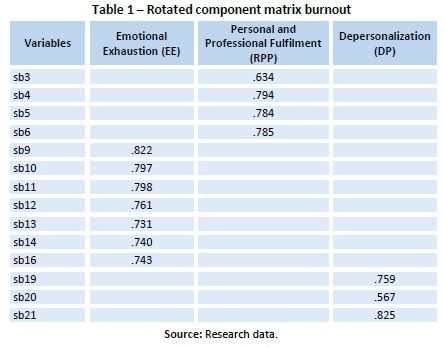
<body><![CDATA[<p>5.2 Results of the exploratory factor analysis of burnout data</p>     <p>Firstly, the commonalities of the variables were observed, obeying the recommendation    that variables with values below 0.500 should be excluded (Malhotra, 2001).    In relation to the variables maintained by the mentioned criterion, it can be    concluded that the part of each variable explained by the factorial solution    is superior to the unexplained part (Hair- Junior, Babin, Money, &amp; Samouel,    2005).</p>     <p>The Kaiser&#8722;Meyer&#8722;Oklin (KMO) test was used to measure the appropriateness    of the application of the EFA in the obtained data. The result was 0.893; therefore,    the use of such statistical technique is considered adequate (Hair-Junior et    al., 2005).</p>     <p>The Bartlett sphericity test was also performed, obtaining a p- value of less    than 0.050; that is, assuming a 95% confidence level, there are statistically    significant correlations between the variables that are to be grouped (Hair-Junior    et al., 2005).</p>     <p>Three factors were obtained: Emotional Exhaustion (EE), Personal and Professional    Fulfilment (RPP) and Depersonalization (DP), from which it is possible to explain    63.26% of the variance of the original data, which shows high explanatory power    of the factorial solution, according to Hair Junior et al. (2005). The factors    resulting from the Factor Analysis, as well as the factor loads associated with    each variable, can be visualised in <a href="#t1">Table 01</a>.</p>     <p>&nbsp;</p>     <p align="center"><a name="t1"></a><img src="/img/revistas/tms/v14n4/14n4a07t1.jpg"/></p>     
<p>&nbsp;</p>     <p>To measure the reliability of the data, the Cronbach&rsquo;s alpha that ranges from    0 to 1 was analysed, and the acceptable minimum limit adopted was 0.700 or 0.600    (Figuereido-Filho &amp; Silva-Júnior, 2010). The Emotional Exhaustion factor    presented a Cronbach&rsquo;s alpha of 0.906 with 7 items; the factor Personal and    Professional Fulfilment 0.753 with 4 items; and the Depersonalization factor    0.686 with 3 items. Thus, a minimum of 0.600 was adopted due to the relatively    small number of variables, because according to Hair-Junior et al. (2009) the    more variables, the higher the alpha.</p>     <p>5.3 Results of the exploratory factor analysis of retaliatory attitudes data</p>     ]]></body>
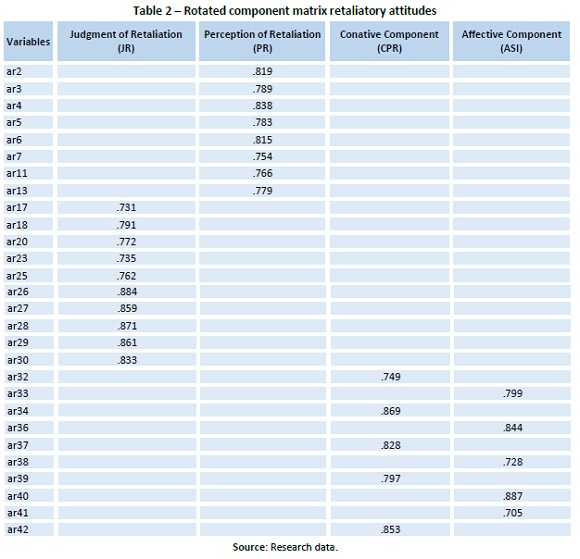
<body><![CDATA[<p>The same parameters of the previous construct were analysed so that the variables    with commonalities above 0.500 were maintained (Malhotra, 2001).</p>     <p>The KMO test was 0.918, so the use of the exploratory factor analysis is considered    appropriate (Hair-Junior et al., 2005). Bartlett's sphericity test showed that    there are statistically significant correlations between the variables to be    grouped, with a confidence level of 95% (Hair-Junior et al., 2005).</p>     <p>Four factors were obtained: Judgment of Retaliation (JR), Perception of Retaliation    (PR), Conative Component (CPR) and Affective Component (ASI), from which it    is possible to explain 66.99% of the variance of the original data, showing    high explanatory power of the factorial solution, according to Hair- Junior    et al. (2005). The factors resulting from the factor analysis, as well as the    factor loads associated with each variable, can be visualised in <a href="#t2">Table    02</a>.</p>     <p>&nbsp;</p>     <p align="center"><a name="t2"></a><img src="/img/revistas/tms/v14n4/14n4a07t2.jpg"/></p>     
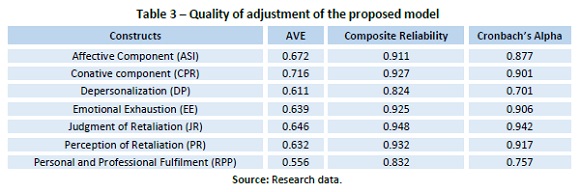
<p>&nbsp;</p>     <p>In relation to Cronbach&rsquo;s alpha, the Judgment of Retaliation presented a score    of 0.942 with 10 items; the Perception of Retaliation 0.916 with 8 items; the    Conative Component 0.899 with 5 items and the Affective Component 0.878 with    5 items. Thus, all factors met the minimum criteria. Therefore, the reliability    of the data was observed (Hair-Junior et al., 2005).</p>     <p>5.4 Results of the structural equation modelling</p>     <p>In order to analyse the model, the convergent validity was first verified,    obtained by means of the calculation of average variance extracted (AVE). Acceptable    values are those equal to or greater than 0.500 (Henseler, Ringle, &amp; Sinkovics,    2009). This criterion was met for all constructs, as shown in <a href="#t3">Table    3</a>.</p>     <p>&nbsp;</p>     ]]></body>
<body><![CDATA[<p align="center"><a name="t3"></a><img src="/img/revistas/tms/v14n4/14n4a07t3.jpg"/></p>     
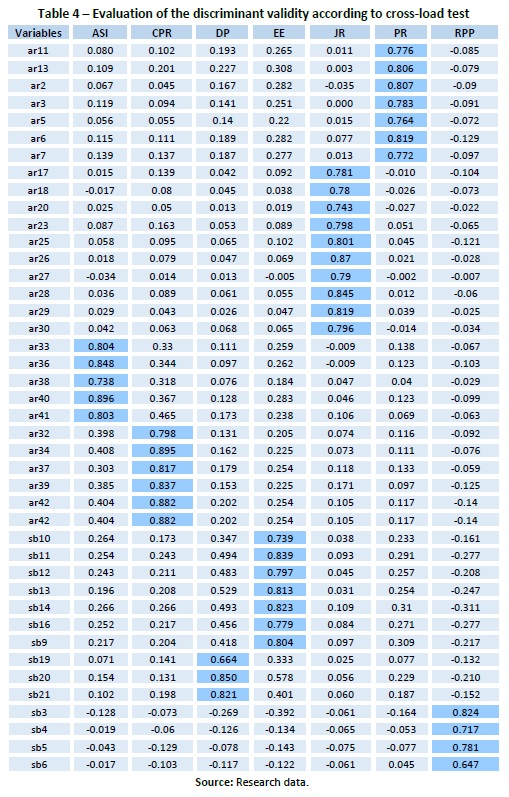
<p>&nbsp;</p>     <p>The reliability of the model was analysed by Cronbach&rsquo;s alpha and composite    reliability. According to Hair-Junior, Hult, Ringle and Sarstedt (2014), for    both, the acceptable minimum is 0.700 (AC&gt; 0.700 and CC&gt; 0.700). As shown    in <a href="#t3">Table 3</a>, all constructs presented values above the recommended    values.</p>     <p>Afterwards, the discriminant validity was analysed through cross loads &#8722;    cross-loading (Chin, 1998), in which the highest factorial loads should be in    their respective constructs. The validity by means of this criterion was observed,    according to <a href="#t4">Table 4</a> below.</p>     <p>&nbsp;</p>     <p align="center"><a name="t4"></a><img src="/img/revistas/tms/v14n4/14n4a07t4.jpg"/></p>     
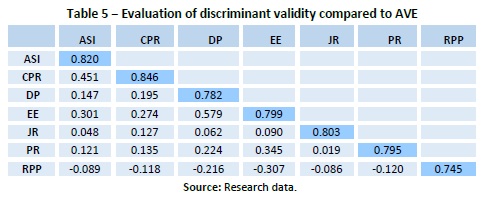
<p>&nbsp;</p>     <p>Still with the intention to analyse the discriminant validity, the Fornell    and Larcker (1981) criterion, which compares the square roots of AVEs, was observed,    and in this case, each construct should present a higher value in comparison    to the correlations of the other constructs. <a href="#t5">Table 5</a> demonstrates    that this criterion was met.</p>     <p>&nbsp;</p>     <p align="center"><a name="t5"></a><img src="/img/revistas/tms/v14n4/14n4a07t5.jpg"/></p>     
]]></body>
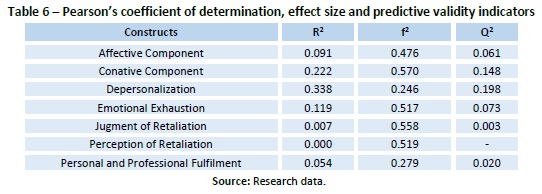
<body><![CDATA[<p>&nbsp;</p>     <p>The Pearson&rsquo;s coefficient of determination (R²) evaluation considers the part    of the variance of the endogenous variables that is explained by the model.    For the social sciences, when R2 = 2% it is considered a small effect; when    R2 = 13% it is considered as average; and when R2 = 26% it is considered as    a large effect (Cohen, 1988). It can be observed, based on <a href="#t6">Table    6</a>, that only two constructs present a small effect, one presented a great    effect and the other constructs, average effects. The construct Perception of    Retaliation presented a value equal to zero, since it is an exogenous construct.</p>     <p>&nbsp;</p>     <p align="center"><a name="t6"></a><img src="/img/revistas/tms/v14n4/14n4a07t6.jpg"/></p>     
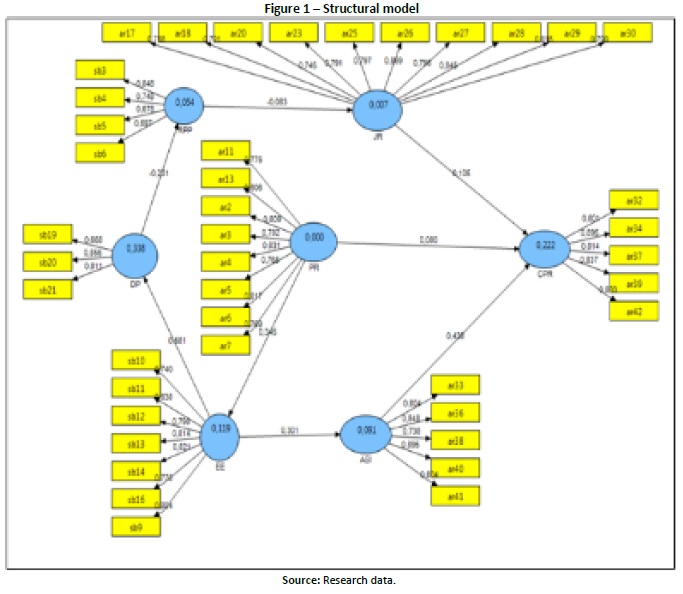
<p>&nbsp;</p>     <p>The effect size (f²) &#8722; or Cohen's indicator &#8722; identifies how much    each exogenous construct contributes to the explanation of the variance of the    endogenous construct. Thus, values of 0.020 are considered small; 0.150 average;    and 0.350 large (Hair-Junior et al., 2014). In <a href="#t6">Table 6</a>, it    is observed that all the constructs presented average or large values, which    is satisfactory.</p>     <p>Predictive validity (Q²) &#8722; or Stone-Geisser indicator &#8722; analyses    the conformity of the adjusted model and, according to Hair- Junior et al. (2014),    must be greater than zero (Q²&gt; 0). In <a href="#t6">Table 6</a>, the values    of Q² are presented, all of which met the minimum acceptable value, except the    construct Perception of Retaliation, which did not contribute to the partial    prediction of the model, due to the fact that it is a construct antecedent to    other constructs.</p>     <p>Given the observation of the necessary criteria to ascertain the adequacy of    the model, the structural model proposed for this study is presented in <a href="#f1">Figure    1</a>.</p>     <p>&nbsp;</p>     <p align="center"><a name="f1"></a><img src="/img/revistas/tms/v14n4/14n4a07f1.jpg"/></p>     
]]></body>
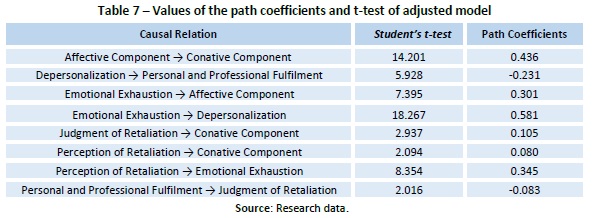
<body><![CDATA[<p>&nbsp;</p>     <p>After the evaluation of the model adjustment, the significance of the correlations    was analysed using the Student&rsquo;s t-test, which, according to Hair-Junior et    al. (2014), is acceptable when equal to or greater than 1.96, so that all relations    of the proposed model have been validated. In addition, the path coefficients,    which evaluate the causal relationships between the constructs, were analysed.    The values are shown in <a href="#t7">Table 7</a>.</p>     <p>&nbsp;</p>     <p align="center"><a name="t7"></a><img src="/img/revistas/tms/v14n4/14n4a07t7.jpg"/></p>     
<p>&nbsp;</p>     <p>The influence of the dimensions of the burnout syndrome was found among itself,    which is a relevant finding since there are still few studies that investigate    the relations between the emotional exhaustion, depersonalization and personal    fulfilment dimensions, since most studies consider several variables antecedent    and consequent (Bernd &amp; Beuren, 2017).</p>     <p>The Emotional Exhaustion (EE) dimension showed a significant and positive correlation    with Depersonalization (DP). Therefore, it can be inferred, that the increase    in the physical and emotional exhaustion of young workers leads to an increase    in detachment in relation to their work. Such result contrasts the findings    of Almeida et al. (2011), who observed the inverse relation so that the more    the individual becomes depersonalised, the more he or she feels depletion, with    low energy in his or her day-to-day work.</p>     <p>On the other hand, the Depersonalization (DP) dimension is significantly and    negatively correlated with Personal and Professional Fulfilment (RPP). Thus,    the increase in the feeling of detachment and cynicism diminishes the achievement    of young workers at work. Again, this result was the inverse of that of Almeida    et al. (2011), who found a negative correlation between Personal Fulfilment    and Depersonalization, in a way that individuals who feel professionally fulfilled    are those who do not tend to treat their peers, clients and organisation as    objects.</p>     <p>Regarding the Retaliatory Attitudes, the Affective Component (ASI) showed a    positive and significant correlation with the Conative Component (CPR). The    affective component deals with the capacity of the individual to be indignant    with the situations that occur unjustly, and the conative component demonstrates    the tendency to present retaliation in this context. That is, the younger workers    feel anger and approve retaliatory attitudes towards injustices, so they tend    to exhibit such behaviour. Such result converges with the correlations found    by Rios, Leal and Dutra (2016) and Paiva et al. (2017).</p>     <p>The Judgment of Retaliation and the Perception of Retaliation showed a significant    and positive correlation with the Conative Component. It can be assumed that    the younger workers perceive and judge retaliation, so they tend to act consciously    in the same way. Again, such results are corroborated by the findings of Paiva    et al. (2017) regarding the correlation between such dimensions.</p>     ]]></body>
<body><![CDATA[<p>Emotional Exhaustion presented a positive correlation with the Affective Component.    Such a finding suggests that the more they are emotionally exhausted, the younger    people become indignant over perceived injustices. In addition, when injustices    are perceived in the workplace, young people tend to show signs of emotional    exhaustion: the correlation was significant and positive between the two constructs    (PR and EE). Finally, Personal and Professional Fulfilment (RPP) obtained a    significant and negative correlation with the Judgment of Retaliation (JR);    thus, the lower the youth satisfaction in their daily life at work, the more    easily they judge the behaviours of retaliation.</p>     <p>6. Final Considerations</p>     <p>The general objective of the present study was to analyse the influence of    burnout dimensions in relation to the retaliatory attitudes of young workers    assisted by Espro, in Curitiba (PR) and Porto Alegre (RS). For that, the theoretical    framework was structured, covering the key concepts of each construct, as well    as some more current studies on the themes. The research was characterised by    being a descriptive case study with a quantitative approach. A questionnaire    was applied, and then the exploratory factor analysis was carried out for each    construct and finally the structural equation modelling.</p>     <p>The relations found between burnout and retaliatory attitudes have shown that    the emotional exhaustion of young workers leads to more outbursts of anger towards    the perceived injustices at work. On the other hand, continually realising the    retaliation tends to lead to the feeling of emotional exhaustion; this can be    explained as being due to the fact that an environment where injustice occurs    &#8722; and consequently retaliation &#8722; can become displeasing and unpleasant,    leading to emotional depletion. Also, when they do not feel accomplished at    work, they tend to judge retaliation as more correct.</p>     <p>This study contributed primarily to the field of studies on human behaviour    in organisations by relating the two constructs and verifying significant relations    between them, given that no Brazilian studies were found that achieved such    an accomplishment. In the academic field, this article contributes to bringing    to the fore considerations about burnout that directly impact on the physical    and mental health of workers, and retaliatory attitudes, which are detrimental    to organisations, as well as to increase the literature about young workers.</p>     <p>In addition, for organisations dealing with young workers, it is extremely    important to investigate the behaviour of this group, which has several peculiarities,    so that the policies and practices of human management are directed in an appropriate    and specific way. Organisations should deal better with young workers in their    psychological health so that emotional exhaustion does not occur, since the    more exhausted they are, the more they become indignant at the perceived injustices    in the workplace. Injustices must also be minimised because, when they occur,    they can generate retaliatory attitudes, which are counterproductive and harmful    to organisations. The results showed that the perceptions of retaliation lead    to emotional exhaustion, and workers with exhaustion fail to deliver satisfactory    results in support of the organisation&rsquo;s goals. In addition, low achievement    leads to a judgment of retaliation as being correct. In this sense, it is necessary    to consider the wishes of the younger workers who wish to strengthen their professional    achievement in their work.</p>     <p>As a suggestion for future research, it is considered that there is a need    for more studies with young workers, including the incorporation of other cities    and regions of Brazil in the investigations, as well as the accomplishment of    qualitative research addressing these topics, in an effort to understand them    in more depth and the interconnections between them with other constructs.</p>     <p>&nbsp;</p>     <p><b>REFERENCES</b></p>     <!-- ref --><p>Almeida, C. V., Silva, C., Centurion, P., &amp; Chiuzi, R. M. (2011) Síndrome    de <i>Burnout </i>em professores: um estudo comparativo na região do Grande    ABC paulista. <i>Revista Eletrônica Gestão e Serviços</i>, 2(1), 276-291.    &nbsp;&nbsp;&nbsp;&nbsp;&nbsp;&nbsp;&nbsp;&nbsp;[&#160;<a href="javascript:void(0);" onclick="javascript: window.open('/scielo.php?script=sci_nlinks&ref=1279480&pid=S2182-8458201800040000700001&lng=','','width=640,height=500,resizable=yes,scrollbars=1,menubar=yes,');">Links</a>&#160;]<!-- end-ref --></p>     <p>Ayaz-Alkaya, S., Yaman-Sözbir, &#350;., Bayrak-Kahraman, B. (2018) The effect    of nursing internship program on burnout and professional commitment. <i>Nurse    Education Today</i>, 68, 19-22.</p>     <p>Barling, J., Kelloway, E. K., &amp; Frone, M. R. (2005) Editor´s Overviews:    special populations. In: J. Barling, E. K. Kelloway, &amp; M. R.; Frone, M.    R. (Eds.). <i>Handbook of work stress </i>(pp. 401-404). Thousand Oaks: Sage.</p>     <!-- ref --><p>Bernd, D. C., &amp; Beuren, I. M. (2017) A síndrome de <i>Burnout </i>está    associada ao trabalho dos auditores internos? <i>Gestão &amp; Regionalidade</i>,    33(99), 146-169.    &nbsp;&nbsp;&nbsp;&nbsp;&nbsp;&nbsp;&nbsp;&nbsp;[&#160;<a href="javascript:void(0);" onclick="javascript: window.open('/scielo.php?script=sci_nlinks&ref=1279484&pid=S2182-8458201800040000700004&lng=','','width=640,height=500,resizable=yes,scrollbars=1,menubar=yes,');">Links</a>&#160;]<!-- end-ref --></p>     <!-- ref --><p>Carlotto, M. S., &amp; Câmara, S. G. (2007) Propriedades psicométricas do Maslach    <i>Burnout </i>Inventory em uma amostra multifuncional. <i>Estudos de Psicologia</i>,    24(3), 325-332.    &nbsp;&nbsp;&nbsp;&nbsp;&nbsp;&nbsp;&nbsp;&nbsp;[&#160;<a href="javascript:void(0);" onclick="javascript: window.open('/scielo.php?script=sci_nlinks&ref=1279486&pid=S2182-8458201800040000700005&lng=','','width=640,height=500,resizable=yes,scrollbars=1,menubar=yes,');">Links</a>&#160;]<!-- end-ref --></p>     <!-- ref --><p>Chin, W. W. (1998) The partial least squares approach for structural equation    modeling. In G. A. Marcoulides (Ed.). <i>Modern methods for business research    </i>(pp. 295-236). London: Lawrence Erlbaum Associates.    &nbsp;&nbsp;&nbsp;&nbsp;&nbsp;&nbsp;&nbsp;&nbsp;[&#160;<a href="javascript:void(0);" onclick="javascript: window.open('/scielo.php?script=sci_nlinks&ref=1279488&pid=S2182-8458201800040000700006&lng=','','width=640,height=500,resizable=yes,scrollbars=1,menubar=yes,');">Links</a>&#160;]<!-- end-ref --></p>     <!-- ref --><p>Cohen, J. (1988) <i>Statistical power analysis for the behavioral sciences</i>.    New York: Psychology Press.    &nbsp;&nbsp;&nbsp;&nbsp;&nbsp;&nbsp;&nbsp;&nbsp;[&#160;<a href="javascript:void(0);" onclick="javascript: window.open('/scielo.php?script=sci_nlinks&ref=1279490&pid=S2182-8458201800040000700007&lng=','','width=640,height=500,resizable=yes,scrollbars=1,menubar=yes,');">Links</a>&#160;]<!-- end-ref --></p>     <!-- ref --><p>Copeland-Linder, N., Johnson, S. B., Haynie, D. L., Chung, S., &amp; Cheng,    T. L. (2012) Retaliatory Attitudes and Violent Behaviors Among Assault- Injured    Youth<i>. Journal of Adolescent Health</i>, 50, 215-220.    &nbsp;&nbsp;&nbsp;&nbsp;&nbsp;&nbsp;&nbsp;&nbsp;[&#160;<a href="javascript:void(0);" onclick="javascript: window.open('/scielo.php?script=sci_nlinks&ref=1279492&pid=S2182-8458201800040000700008&lng=','','width=640,height=500,resizable=yes,scrollbars=1,menubar=yes,');">Links</a>&#160;]<!-- end-ref --></p>     <!-- ref --><p>Figueiredo-Filho, D. B., &amp; Silva-Júnior, J. A. (2010) Visão além do alcance:    uma introdução à análise fatorial. <i>Opinião Pública</i>, 16(1), 160-185.    &nbsp;&nbsp;&nbsp;&nbsp;&nbsp;&nbsp;&nbsp;&nbsp;[&#160;<a href="javascript:void(0);" onclick="javascript: window.open('/scielo.php?script=sci_nlinks&ref=1279494&pid=S2182-8458201800040000700009&lng=','','width=640,height=500,resizable=yes,scrollbars=1,menubar=yes,');">Links</a>&#160;]<!-- end-ref --></p>     <!-- ref --><p>Fornell, C., &amp; Larcker, D. F. (1981) Evaluating structural equation models    with unobservable variables and measurement error. <i>Journal of Marketing Research,    </i>18(1), 39-50.    &nbsp;&nbsp;&nbsp;&nbsp;&nbsp;&nbsp;&nbsp;&nbsp;[&#160;<a href="javascript:void(0);" onclick="javascript: window.open('/scielo.php?script=sci_nlinks&ref=1279496&pid=S2182-8458201800040000700010&lng=','','width=640,height=500,resizable=yes,scrollbars=1,menubar=yes,');">Links</a>&#160;]<!-- end-ref --></p>     <!-- ref --><p>Freudenberger, H. J. (1974) Staff Burnout. <i>Journal of Social Issues</i>,    30(1), 159-165.    &nbsp;&nbsp;&nbsp;&nbsp;&nbsp;&nbsp;&nbsp;&nbsp;[&#160;<a href="javascript:void(0);" onclick="javascript: window.open('/scielo.php?script=sci_nlinks&ref=1279498&pid=S2182-8458201800040000700011&lng=','','width=640,height=500,resizable=yes,scrollbars=1,menubar=yes,');">Links</a>&#160;]<!-- end-ref --></p>     <!-- ref --><p>Gianasi, L. B. S., &amp; Borges, L. O. (2009) Síndrome de <i>Burnout </i>no    setor de transporte de Natal. <i>Psicologia: Teoria e Pesquisa</i>, 25(3), 297-305.    &nbsp;&nbsp;&nbsp;&nbsp;&nbsp;&nbsp;&nbsp;&nbsp;[&#160;<a href="javascript:void(0);" onclick="javascript: window.open('/scielo.php?script=sci_nlinks&ref=1279500&pid=S2182-8458201800040000700012&lng=','','width=640,height=500,resizable=yes,scrollbars=1,menubar=yes,');">Links</a>&#160;]<!-- end-ref --></p>     <!-- ref --><p>Hair-Junior, J. F., Babin, B., Money, A. R., &amp; Samouel, P. (2005) <i>Fundamentos    de métodos de pesquisa em administração</i>. Porto Alegre: Bookman.    &nbsp;&nbsp;&nbsp;&nbsp;&nbsp;&nbsp;&nbsp;&nbsp;[&#160;<a href="javascript:void(0);" onclick="javascript: window.open('/scielo.php?script=sci_nlinks&ref=1279502&pid=S2182-8458201800040000700013&lng=','','width=640,height=500,resizable=yes,scrollbars=1,menubar=yes,');">Links</a>&#160;]<!-- end-ref --></p>     <!-- ref --><p>Hair-Junior, J. F., Black, W. C., Babin, B. J., Anderson, R. E., &amp; Tatham,    R. L. (2009) <i>Análise multivariada de dados</i>. Porto Alegre: Bookman.    &nbsp;&nbsp;&nbsp;&nbsp;&nbsp;&nbsp;&nbsp;&nbsp;[&#160;<a href="javascript:void(0);" onclick="javascript: window.open('/scielo.php?script=sci_nlinks&ref=1279504&pid=S2182-8458201800040000700014&lng=','','width=640,height=500,resizable=yes,scrollbars=1,menubar=yes,');">Links</a>&#160;]<!-- end-ref --></p>     <!-- ref --><p>Hair-Junior, J. F., Hult, G. T. M., Ringle, C., &amp; Sarstedt, M. (2014) <i>A    primer on partial least squares structural equation modeling (PLS-SEM)</i>.    Los Angeles: Sage.    &nbsp;&nbsp;&nbsp;&nbsp;&nbsp;&nbsp;&nbsp;&nbsp;[&#160;<a href="javascript:void(0);" onclick="javascript: window.open('/scielo.php?script=sci_nlinks&ref=1279506&pid=S2182-8458201800040000700015&lng=','','width=640,height=500,resizable=yes,scrollbars=1,menubar=yes,');">Links</a>&#160;]<!-- end-ref --></p>     <!-- ref --><p>Henseler, J., Ringle, C. M., &amp; Sinkovics, R. R. (2009) The use of partial    least squares path modeling in international marketing. <i>Advances in International    Marketing</i>, 20, 277-319.    &nbsp;&nbsp;&nbsp;&nbsp;&nbsp;&nbsp;&nbsp;&nbsp;[&#160;<a href="javascript:void(0);" onclick="javascript: window.open('/scielo.php?script=sci_nlinks&ref=1279508&pid=S2182-8458201800040000700016&lng=','','width=640,height=500,resizable=yes,scrollbars=1,menubar=yes,');">Links</a>&#160;]<!-- end-ref --></p>     <!-- ref --><p>Jeunon, E. E., Correa, L. A. S., Duarte, L. C., &amp; Guimarães, E. H. R. (2017)    <i>Burnout </i>Syndrome: a study with professors at a public university in Maranhão.    <i>Revista Gestão &amp; Tecnologia</i>, 17(2), 252-268.    &nbsp;&nbsp;&nbsp;&nbsp;&nbsp;&nbsp;&nbsp;&nbsp;[&#160;<a href="javascript:void(0);" onclick="javascript: window.open('/scielo.php?script=sci_nlinks&ref=1279510&pid=S2182-8458201800040000700017&lng=','','width=640,height=500,resizable=yes,scrollbars=1,menubar=yes,');">Links</a>&#160;]<!-- end-ref --></p>     <!-- ref --><p>Koulierakis, G., Daglas, G., Grudzien, A., &amp; Kosifidis, I. (2018) Burnout    and quality of life among Greek municipal preschool and kindergarten teaching    staff. <i>Education</i>, 3-13.    &nbsp;&nbsp;&nbsp;&nbsp;&nbsp;&nbsp;&nbsp;&nbsp;[&#160;<a href="javascript:void(0);" onclick="javascript: window.open('/scielo.php?script=sci_nlinks&ref=1279512&pid=S2182-8458201800040000700018&lng=','','width=640,height=500,resizable=yes,scrollbars=1,menubar=yes,');">Links</a>&#160;]<!-- end-ref --></p>     <!-- ref --><p>Lima, A. S., Farah, B. F., &amp; Bustamante-Teixeira, M. T. (2018) Análise    da prevalência da síndrome de Burnout em profissionais da atenção primária em    saúde. <i>Trabalho, Educação e Saúde</i>, 16(1), 283-304.    &nbsp;&nbsp;&nbsp;&nbsp;&nbsp;&nbsp;&nbsp;&nbsp;[&#160;<a href="javascript:void(0);" onclick="javascript: window.open('/scielo.php?script=sci_nlinks&ref=1279514&pid=S2182-8458201800040000700019&lng=','','width=640,height=500,resizable=yes,scrollbars=1,menubar=yes,');">Links</a>&#160;]<!-- end-ref --></p>     <!-- ref --><p>Maia, L. G., &amp; Bastos, A. V. B. (2011) Comprometimento calculativo e retaliação:    visão integrada dos conceitos em uma organização pública. <i>Revista de Administração    da UFSM</i>, 4(3), 390-405.    &nbsp;&nbsp;&nbsp;&nbsp;&nbsp;&nbsp;&nbsp;&nbsp;[&#160;<a href="javascript:void(0);" onclick="javascript: window.open('/scielo.php?script=sci_nlinks&ref=1279516&pid=S2182-8458201800040000700020&lng=','','width=640,height=500,resizable=yes,scrollbars=1,menubar=yes,');">Links</a>&#160;]<!-- end-ref --></p>     <!-- ref --><p>Malhotra, N. K. (2001) <i>Pesquisa de marketing: uma orientação aplicada</i>.    Porto Alegre: Bookman.    &nbsp;&nbsp;&nbsp;&nbsp;&nbsp;&nbsp;&nbsp;&nbsp;[&#160;<a href="javascript:void(0);" onclick="javascript: window.open('/scielo.php?script=sci_nlinks&ref=1279518&pid=S2182-8458201800040000700021&lng=','','width=640,height=500,resizable=yes,scrollbars=1,menubar=yes,');">Links</a>&#160;]<!-- end-ref --></p>     <!-- ref --><p>Madupalli, R. K., &amp; Poddar, A. (2014) Problematic customers and customer    service employee retaliation. <i>Journal of Services Marketing</i>, 28(3), 244-255.    &nbsp;&nbsp;&nbsp;&nbsp;&nbsp;&nbsp;&nbsp;&nbsp;[&#160;<a href="javascript:void(0);" onclick="javascript: window.open('/scielo.php?script=sci_nlinks&ref=1279520&pid=S2182-8458201800040000700022&lng=','','width=640,height=500,resizable=yes,scrollbars=1,menubar=yes,');">Links</a>&#160;]<!-- end-ref --></p>     <!-- ref --><p>Martins, C., Campos, S., Duarte, J., Martins, R., Moreira, T., &amp; Chaves,    C. (2017) Situações indutoras de stress e burnout em estudantes de enfermagem    nos ensinos clínicos. <i>Revista Portuguesa de Enfermagem de Saúde Mental</i>,    Edição Especial (5), 25-32.    &nbsp;&nbsp;&nbsp;&nbsp;&nbsp;&nbsp;&nbsp;&nbsp;[&#160;<a href="javascript:void(0);" onclick="javascript: window.open('/scielo.php?script=sci_nlinks&ref=1279522&pid=S2182-8458201800040000700023&lng=','','width=640,height=500,resizable=yes,scrollbars=1,menubar=yes,');">Links</a>&#160;]<!-- end-ref --></p>     <!-- ref --><p>Maslach, C., &amp; Goldberg, J. (1998) Prevention of <i>Burnout</i>: New Perspectives.    <i>Applied &amp; Preventive Psychology</i>, 7, 63-74.    &nbsp;&nbsp;&nbsp;&nbsp;&nbsp;&nbsp;&nbsp;&nbsp;[&#160;<a href="javascript:void(0);" onclick="javascript: window.open('/scielo.php?script=sci_nlinks&ref=1279524&pid=S2182-8458201800040000700024&lng=','','width=640,height=500,resizable=yes,scrollbars=1,menubar=yes,');">Links</a>&#160;]<!-- end-ref --></p>     <!-- ref --><p>Maslach, C., &amp; Jackson, S. E. (1981) The measurement of experienced <i>Burnout</i>.    <i>Journal of Occupational Behaviour</i>, 2, 99-113.    &nbsp;&nbsp;&nbsp;&nbsp;&nbsp;&nbsp;&nbsp;&nbsp;[&#160;<a href="javascript:void(0);" onclick="javascript: window.open('/scielo.php?script=sci_nlinks&ref=1279526&pid=S2182-8458201800040000700025&lng=','','width=640,height=500,resizable=yes,scrollbars=1,menubar=yes,');">Links</a>&#160;]<!-- end-ref --></p>     <!-- ref --><p>Maslach, C., Schaufeli, W. B., &amp; Leiter, M. P. (2001) Job Burnout. <i>Annual    Review of Psychology</i>, 52, 397-422.    &nbsp;&nbsp;&nbsp;&nbsp;&nbsp;&nbsp;&nbsp;&nbsp;[&#160;<a href="javascript:void(0);" onclick="javascript: window.open('/scielo.php?script=sci_nlinks&ref=1279528&pid=S2182-8458201800040000700026&lng=','','width=640,height=500,resizable=yes,scrollbars=1,menubar=yes,');">Links</a>&#160;]<!-- end-ref --></p>     <!-- ref --><p>Mendonça, H. (2008) Atitudes Retaliatórias. In: M. M. M. Siqueira (Cols.) <i>Medidas    do comportamento organizacional: ferramentas de diagnóstico e de gestão </i>(pp.    249-263). Porto Alegre: Artmed.    &nbsp;&nbsp;&nbsp;&nbsp;&nbsp;&nbsp;&nbsp;&nbsp;[&#160;<a href="javascript:void(0);" onclick="javascript: window.open('/scielo.php?script=sci_nlinks&ref=1279530&pid=S2182-8458201800040000700027&lng=','','width=640,height=500,resizable=yes,scrollbars=1,menubar=yes,');">Links</a>&#160;]<!-- end-ref --></p>     <!-- ref --><p>Mendonça, H., &amp; Mendes, A. M. (2005) Experiências de injustiça, sofrimento    e retaliação no contexto de uma organização pública do estado de Goiás. <i>Psicologia    em Estudo</i>, 10(3), 489-498.    &nbsp;&nbsp;&nbsp;&nbsp;&nbsp;&nbsp;&nbsp;&nbsp;[&#160;<a href="javascript:void(0);" onclick="javascript: window.open('/scielo.php?script=sci_nlinks&ref=1279532&pid=S2182-8458201800040000700028&lng=','','width=640,height=500,resizable=yes,scrollbars=1,menubar=yes,');">Links</a>&#160;]<!-- end-ref --></p>     <!-- ref --><p>Mendonça, H., &amp; Tamayo, A. (2003). Construção e validação de um instrumento    para a Medida de Atitude em Relação à Retaliação Organizacional (MARO). <i>Avaliação    Psicológica</i>, 2(2), 147-153.    &nbsp;&nbsp;&nbsp;&nbsp;&nbsp;&nbsp;&nbsp;&nbsp;[&#160;<a href="javascript:void(0);" onclick="javascript: window.open('/scielo.php?script=sci_nlinks&ref=1279534&pid=S2182-8458201800040000700029&lng=','','width=640,height=500,resizable=yes,scrollbars=1,menubar=yes,');">Links</a>&#160;]<!-- end-ref --></p>     <!-- ref --><p>Mendonça, H., &amp; Tamayo, A. (2004) Percepção de justiça e reações retaliatórias    nas organizações: Análise empírica de um modelo atitudinal. <i>Revista </i><i>de    Administração Contemporânea - RAC</i>, 8(2), 117-135.    &nbsp;&nbsp;&nbsp;&nbsp;&nbsp;&nbsp;&nbsp;&nbsp;[&#160;<a href="javascript:void(0);" onclick="javascript: window.open('/scielo.php?script=sci_nlinks&ref=1279536&pid=S2182-8458201800040000700030&lng=','','width=640,height=500,resizable=yes,scrollbars=1,menubar=yes,');">Links</a>&#160;]<!-- end-ref --></p>     <!-- ref --><p>Mendonça, H., Flauzino, D. P., Tamayo, A., &amp; Paz, M. G. T. (2004) Percepção    e julgamento da retaliação organizacional: construção e validação fatorial de    um instrumento. <i>Estudos de Psicologia</i>, 9(3), 543-551.    &nbsp;&nbsp;&nbsp;&nbsp;&nbsp;&nbsp;&nbsp;&nbsp;[&#160;<a href="javascript:void(0);" onclick="javascript: window.open('/scielo.php?script=sci_nlinks&ref=1279538&pid=S2182-8458201800040000700031&lng=','','width=640,height=500,resizable=yes,scrollbars=1,menubar=yes,');">Links</a>&#160;]<!-- end-ref --></p>     <!-- ref --><p>Nie, T., &amp; Zang, L. (2011) The Impact of Job Characteristics on Job Burnout    and Work Performance of Young Employees. <i>International Conference on Business    Management and Electronic Information</i>, 3, 209-212.    &nbsp;&nbsp;&nbsp;&nbsp;&nbsp;&nbsp;&nbsp;&nbsp;[&#160;<a href="javascript:void(0);" onclick="javascript: window.open('/scielo.php?script=sci_nlinks&ref=1279540&pid=S2182-8458201800040000700032&lng=','','width=640,height=500,resizable=yes,scrollbars=1,menubar=yes,');">Links</a>&#160;]<!-- end-ref --></p>     <!-- ref --><p>Paiva, K. C. M., &amp; Rocha, M. S. (2016) Justiça organizacional, atitudes    retaliatórias e o comprometimento organizacional: Um estudo comparativo longitudinal    com jovens trabalhadores. In <i>Anais do IV Congresso Brasileiro de Estudos    Organizacionais</i>, Porto Alegre, Brasil.    &nbsp;&nbsp;&nbsp;&nbsp;&nbsp;&nbsp;&nbsp;&nbsp;[&#160;<a href="javascript:void(0);" onclick="javascript: window.open('/scielo.php?script=sci_nlinks&ref=1279542&pid=S2182-8458201800040000700033&lng=','','width=640,height=500,resizable=yes,scrollbars=1,menubar=yes,');">Links</a>&#160;]<!-- end-ref --></p>     <!-- ref --><p>Paiva, K. C. M., Fujihara, R. K., &amp; Reis, J. F. (2017) Valores organizacionais,    valores do trabalho e atitudes retaliatórias: Um estudo com jovens aprendizes    em uma empresa pública. <i>Teoria e Prática em Administração</i>, 7(1), 54-78.    &nbsp;&nbsp;&nbsp;&nbsp;&nbsp;&nbsp;&nbsp;&nbsp;[&#160;<a href="javascript:void(0);" onclick="javascript: window.open('/scielo.php?script=sci_nlinks&ref=1279544&pid=S2182-8458201800040000700034&lng=','','width=640,height=500,resizable=yes,scrollbars=1,menubar=yes,');">Links</a>&#160;]<!-- end-ref --></p>     <!-- ref --><p>Rios, J. E., Leal, C., &amp; Dutra, M. R. S. (2016) Justiça no trabalho e atitudes    retaliatórias: Um estudo com jovens trabalhadores. In <i>Anais do IV Congresso    Brasileiro de Estudos Organizacionais</i>, Porto Alegre, Brasil.    &nbsp;&nbsp;&nbsp;&nbsp;&nbsp;&nbsp;&nbsp;&nbsp;[&#160;<a href="javascript:void(0);" onclick="javascript: window.open('/scielo.php?script=sci_nlinks&ref=1279546&pid=S2182-8458201800040000700035&lng=','','width=640,height=500,resizable=yes,scrollbars=1,menubar=yes,');">Links</a>&#160;]<!-- end-ref --></p>     <!-- ref --><p>Schuster, M. S., Dias, V. V., &amp; Battistella, L. F. (2014) <i>Burnout </i>e    justiça organizacional: Um estudo em servidores públicos federais. <i>Revista    de Administração IMED</i>, 4(3), 330-342.    &nbsp;&nbsp;&nbsp;&nbsp;&nbsp;&nbsp;&nbsp;&nbsp;[&#160;<a href="javascript:void(0);" onclick="javascript: window.open('/scielo.php?script=sci_nlinks&ref=1279548&pid=S2182-8458201800040000700036&lng=','','width=640,height=500,resizable=yes,scrollbars=1,menubar=yes,');">Links</a>&#160;]<!-- end-ref --></p>     <!-- ref --><p>Skarlicki, D. P., &amp; Folger, R. (1997) Retaliation in the workplace: The    roles of distributive, procedural, and interactional justice. <i>Journal of    Applied Psychology</i>, 82(3), 434-443.    &nbsp;&nbsp;&nbsp;&nbsp;&nbsp;&nbsp;&nbsp;&nbsp;[&#160;<a href="javascript:void(0);" onclick="javascript: window.open('/scielo.php?script=sci_nlinks&ref=1279550&pid=S2182-8458201800040000700037&lng=','','width=640,height=500,resizable=yes,scrollbars=1,menubar=yes,');">Links</a>&#160;]<!-- end-ref --></p>     <!-- ref --><p>Souza, M. B. C. A., Helal, D. H., &amp; Paiva, K. C. M. (2017) <i>Burnout </i>e    jovens trabalhadores. <i>Cadernos Brasileiros de Terapia Ocupacional</i>, 25(4),    751-763.    &nbsp;&nbsp;&nbsp;&nbsp;&nbsp;&nbsp;&nbsp;&nbsp;[&#160;<a href="javascript:void(0);" onclick="javascript: window.open('/scielo.php?script=sci_nlinks&ref=1279552&pid=S2182-8458201800040000700038&lng=','','width=640,height=500,resizable=yes,scrollbars=1,menubar=yes,');">Links</a>&#160;]<!-- end-ref --></p>     <!-- ref --><p>Souza, R. S., Trigueiro, R. P. C., Almeida, T. N. V., &amp; Oliveira, J. A.    (2010) A pós-graduação e a síndrome de <i>Burnout</i>: estudo com alunos de    mestrado em administração. <i>Revista Pensamento Contemporâneo em Administração</i>,    4(3), 12-21.    &nbsp;&nbsp;&nbsp;&nbsp;&nbsp;&nbsp;&nbsp;&nbsp;[&#160;<a href="javascript:void(0);" onclick="javascript: window.open('/scielo.php?script=sci_nlinks&ref=1279554&pid=S2182-8458201800040000700039&lng=','','width=640,height=500,resizable=yes,scrollbars=1,menubar=yes,');">Links</a>&#160;]<!-- end-ref --></p>     <!-- ref --><p>Szigeti, R., Balázs, N., Bikfalvi, R., &amp; Urbán, R. (2017). Burnout and    depressive symptoms in teachers: Factor structure and construct validity of    the Maslach Burnout inventory-educators survey among elementary and secondary    school teachers in Hungary. <i>Stress and Health</i>, 33(5), 530-539.    &nbsp;&nbsp;&nbsp;&nbsp;&nbsp;&nbsp;&nbsp;&nbsp;[&#160;<a href="javascript:void(0);" onclick="javascript: window.open('/scielo.php?script=sci_nlinks&ref=1279556&pid=S2182-8458201800040000700040&lng=','','width=640,height=500,resizable=yes,scrollbars=1,menubar=yes,');">Links</a>&#160;]<!-- end-ref --></p>     <!-- ref --><p>Tourigny, L., Baba, V. V., Han, J., &amp; Wang, X. (2013) Emotional exhaustion    and job performance: the mediating role of organizational commitment. <i>The    International Journal of Human Resource Management</i>, 24(3), 514-532.    &nbsp;&nbsp;&nbsp;&nbsp;&nbsp;&nbsp;&nbsp;&nbsp;[&#160;<a href="javascript:void(0);" onclick="javascript: window.open('/scielo.php?script=sci_nlinks&ref=1279558&pid=S2182-8458201800040000700041&lng=','','width=640,height=500,resizable=yes,scrollbars=1,menubar=yes,');">Links</a>&#160;]<!-- end-ref --></p>     <!-- ref --><p>Tucker, S., &amp; Loughlin, C. (2006) Young workers. In: E. K. Kelloway, J.    Barling, &amp; J. Hurrell (Eds.). <i>Handbook of workplace violence </i>(pp.    417- 444). Thousand Oaks: Sage.    &nbsp;&nbsp;&nbsp;&nbsp;&nbsp;&nbsp;&nbsp;&nbsp;[&#160;<a href="javascript:void(0);" onclick="javascript: window.open('/scielo.php?script=sci_nlinks&ref=1279560&pid=S2182-8458201800040000700042&lng=','','width=640,height=500,resizable=yes,scrollbars=1,menubar=yes,');">Links</a>&#160;]<!-- end-ref --></p>     <!-- ref --><p>Vergara, S. C. (2009) <i>Projetos e relatórios de pesquisa em administração</i>.    São Paulo: Atlas.    &nbsp;&nbsp;&nbsp;&nbsp;&nbsp;&nbsp;&nbsp;&nbsp;[&#160;<a href="javascript:void(0);" onclick="javascript: window.open('/scielo.php?script=sci_nlinks&ref=1279562&pid=S2182-8458201800040000700043&lng=','','width=640,height=500,resizable=yes,scrollbars=1,menubar=yes,');">Links</a>&#160;]<!-- end-ref --></p>     <p>&nbsp;</p>     <p>Received: 23.05.2018</p>     <p>Revisions required: 16.07.2018</p>     <p>Accepted: 15.09.2018</p>      ]]></body><back>
<ref-list>
<ref id="B1">
<nlm-citation citation-type="journal">
<person-group person-group-type="author">
<name>
<surname><![CDATA[Almeida]]></surname>
<given-names><![CDATA[C. V.]]></given-names>
</name>
<name>
<surname><![CDATA[Silva]]></surname>
<given-names><![CDATA[C.]]></given-names>
</name>
<name>
<surname><![CDATA[Centurion]]></surname>
<given-names><![CDATA[P.]]></given-names>
</name>
<name>
<surname><![CDATA[Chiuzi]]></surname>
<given-names><![CDATA[R. M.]]></given-names>
</name>
</person-group>
<article-title xml:lang="pt"><![CDATA[Síndrome de Burnout em professores: um estudo comparativo na região do Grande ABC paulista]]></article-title>
<source><![CDATA[Revista Eletrônica Gestão e Serviços]]></source>
<year>2011</year>
<volume>2</volume>
<numero>1</numero>
<issue>1</issue>
<page-range>276-291</page-range></nlm-citation>
</ref>
<ref id="B2">
<nlm-citation citation-type="journal">
<person-group person-group-type="author">
<name>
<surname><![CDATA[Ayaz-Alkaya]]></surname>
<given-names><![CDATA[S.]]></given-names>
</name>
<name>
<surname><![CDATA[Yaman-Sözbir]]></surname>
<given-names><![CDATA[S.]]></given-names>
</name>
<name>
<surname><![CDATA[Bayrak-Kahraman]]></surname>
<given-names><![CDATA[B.]]></given-names>
</name>
</person-group>
<article-title xml:lang="en"><![CDATA[The effect of nursing internship program on burnout and professional commitment]]></article-title>
<source><![CDATA[Nurse Education Today]]></source>
<year>2018</year>
<volume>68</volume>
<page-range>19-22</page-range></nlm-citation>
</ref>
<ref id="B3">
<nlm-citation citation-type="book">
<person-group person-group-type="author">
<name>
<surname><![CDATA[Barling]]></surname>
<given-names><![CDATA[J.]]></given-names>
</name>
<name>
<surname><![CDATA[Kelloway]]></surname>
<given-names><![CDATA[E. K.]]></given-names>
</name>
<name>
<surname><![CDATA[Frone]]></surname>
<given-names><![CDATA[M. R.]]></given-names>
</name>
</person-group>
<article-title xml:lang="en"><![CDATA[Editor´s Overviews: special populations]]></article-title>
<person-group person-group-type="editor">
<name>
<surname><![CDATA[Barling]]></surname>
<given-names><![CDATA[J.]]></given-names>
</name>
<name>
<surname><![CDATA[Kelloway]]></surname>
<given-names><![CDATA[E. K.]]></given-names>
</name>
<name>
<surname><![CDATA[Frone]]></surname>
<given-names><![CDATA[M. R.]]></given-names>
</name>
</person-group>
<source><![CDATA[Handbook of work stress]]></source>
<year>2005</year>
<page-range>401-404</page-range><publisher-loc><![CDATA[Thousand Oaks ]]></publisher-loc>
<publisher-name><![CDATA[Sage]]></publisher-name>
</nlm-citation>
</ref>
<ref id="B4">
<nlm-citation citation-type="journal">
<person-group person-group-type="author">
<name>
<surname><![CDATA[Bernd]]></surname>
<given-names><![CDATA[D. C.]]></given-names>
</name>
<name>
<surname><![CDATA[Beuren]]></surname>
<given-names><![CDATA[I. M.]]></given-names>
</name>
</person-group>
<article-title xml:lang="pt"><![CDATA[A síndrome de Burnout está associada ao trabalho dos auditores internos?]]></article-title>
<source><![CDATA[Gestão & Regionalidade]]></source>
<year>2017</year>
<volume>33</volume>
<numero>99</numero>
<issue>99</issue>
<page-range>146-169</page-range></nlm-citation>
</ref>
<ref id="B5">
<nlm-citation citation-type="journal">
<person-group person-group-type="author">
<name>
<surname><![CDATA[Carlotto]]></surname>
<given-names><![CDATA[M. S.]]></given-names>
</name>
<name>
<surname><![CDATA[Câmara]]></surname>
<given-names><![CDATA[S. G.]]></given-names>
</name>
</person-group>
<article-title xml:lang="pt"><![CDATA[Propriedades psicométricas do Maslach Burnout Inventory em uma amostra multifuncional]]></article-title>
<source><![CDATA[Estudos de Psicologia]]></source>
<year>2007</year>
<volume>24</volume>
<numero>3</numero>
<issue>3</issue>
<page-range>325-332</page-range></nlm-citation>
</ref>
<ref id="B6">
<nlm-citation citation-type="book">
<person-group person-group-type="author">
<name>
<surname><![CDATA[Chin]]></surname>
<given-names><![CDATA[W. W.]]></given-names>
</name>
</person-group>
<article-title xml:lang="en"><![CDATA[The partial least squares approach for structural equation modeling]]></article-title>
<person-group person-group-type="editor">
<name>
<surname><![CDATA[Marcoulides]]></surname>
<given-names><![CDATA[G. A.]]></given-names>
</name>
</person-group>
<source><![CDATA[Modern methods for business research]]></source>
<year>1998</year>
<page-range>295-236</page-range><publisher-loc><![CDATA[London ]]></publisher-loc>
<publisher-name><![CDATA[Lawrence Erlbaum Associates]]></publisher-name>
</nlm-citation>
</ref>
<ref id="B7">
<nlm-citation citation-type="book">
<person-group person-group-type="author">
<name>
<surname><![CDATA[Cohen]]></surname>
<given-names><![CDATA[J.]]></given-names>
</name>
</person-group>
<source><![CDATA[Statistical power analysis for the behavioral sciences]]></source>
<year>1988</year>
<publisher-loc><![CDATA[New York ]]></publisher-loc>
<publisher-name><![CDATA[Psychology Press]]></publisher-name>
</nlm-citation>
</ref>
<ref id="B8">
<nlm-citation citation-type="journal">
<person-group person-group-type="author">
<name>
<surname><![CDATA[Copeland-Linder]]></surname>
<given-names><![CDATA[N.]]></given-names>
</name>
<name>
<surname><![CDATA[Johnson]]></surname>
<given-names><![CDATA[S. B.]]></given-names>
</name>
<name>
<surname><![CDATA[Haynie]]></surname>
<given-names><![CDATA[D. L.]]></given-names>
</name>
<name>
<surname><![CDATA[Chung]]></surname>
<given-names><![CDATA[S.]]></given-names>
</name>
<name>
<surname><![CDATA[Cheng]]></surname>
<given-names><![CDATA[T. L.]]></given-names>
</name>
</person-group>
<article-title xml:lang="en"><![CDATA[Retaliatory Attitudes and Violent Behaviors Among Assault- Injured Youth]]></article-title>
<source><![CDATA[Journal of Adolescent Health]]></source>
<year>2012</year>
<volume>50</volume>
<page-range>215-220</page-range></nlm-citation>
</ref>
<ref id="B9">
<nlm-citation citation-type="journal">
<person-group person-group-type="author">
<name>
<surname><![CDATA[Figueiredo-Filho]]></surname>
<given-names><![CDATA[D. B.]]></given-names>
</name>
<name>
<surname><![CDATA[Silva-Júnior]]></surname>
<given-names><![CDATA[J. A.]]></given-names>
</name>
</person-group>
<article-title xml:lang="en"><![CDATA[Visão além do alcance: uma introdução à análise fatorial]]></article-title>
<source><![CDATA[Opinião Pública]]></source>
<year>2010</year>
<volume>16</volume>
<numero>1</numero>
<issue>1</issue>
<page-range>160-185</page-range></nlm-citation>
</ref>
<ref id="B10">
<nlm-citation citation-type="journal">
<person-group person-group-type="author">
<name>
<surname><![CDATA[Fornell]]></surname>
<given-names><![CDATA[C.]]></given-names>
</name>
<name>
<surname><![CDATA[Larcker]]></surname>
<given-names><![CDATA[D. F.]]></given-names>
</name>
</person-group>
<article-title xml:lang="en"><![CDATA[Evaluating structural equation models with unobservable variables and measurement error]]></article-title>
<source><![CDATA[Journal of Marketing Research]]></source>
<year>1981</year>
<volume>18</volume>
<numero>1</numero>
<issue>1</issue>
<page-range>39-50</page-range></nlm-citation>
</ref>
<ref id="B11">
<nlm-citation citation-type="journal">
<person-group person-group-type="author">
<name>
<surname><![CDATA[Freudenberger]]></surname>
<given-names><![CDATA[H. J.]]></given-names>
</name>
</person-group>
<article-title xml:lang="en"><![CDATA[Staff Burnout]]></article-title>
<source><![CDATA[Journal of Social Issues]]></source>
<year>1974</year>
<volume>30</volume>
<numero>1</numero>
<issue>1</issue>
<page-range>159-165</page-range></nlm-citation>
</ref>
<ref id="B12">
<nlm-citation citation-type="journal">
<person-group person-group-type="author">
<name>
<surname><![CDATA[Gianasi]]></surname>
<given-names><![CDATA[L. B. S.]]></given-names>
</name>
<name>
<surname><![CDATA[Borges]]></surname>
<given-names><![CDATA[L. O.]]></given-names>
</name>
</person-group>
<article-title xml:lang="pt"><![CDATA[Síndrome de Burnout no setor de transporte de Natal]]></article-title>
<source><![CDATA[Psicologia: Teoria e Pesquisa]]></source>
<year>2009</year>
<volume>25</volume>
<numero>3</numero>
<issue>3</issue>
<page-range>297-305</page-range></nlm-citation>
</ref>
<ref id="B13">
<nlm-citation citation-type="book">
<person-group person-group-type="author">
<name>
<surname><![CDATA[Hair-Junior]]></surname>
<given-names><![CDATA[J. F.]]></given-names>
</name>
<name>
<surname><![CDATA[Babin]]></surname>
<given-names><![CDATA[B.]]></given-names>
</name>
<name>
<surname><![CDATA[Money]]></surname>
<given-names><![CDATA[A. R.]]></given-names>
</name>
<name>
<surname><![CDATA[Samouel]]></surname>
<given-names><![CDATA[P.]]></given-names>
</name>
</person-group>
<source><![CDATA[Fundamentos de métodos de pesquisa em administração]]></source>
<year>2005</year>
<publisher-loc><![CDATA[Porto Alegre ]]></publisher-loc>
<publisher-name><![CDATA[Bookman]]></publisher-name>
</nlm-citation>
</ref>
<ref id="B14">
<nlm-citation citation-type="book">
<person-group person-group-type="author">
<name>
<surname><![CDATA[Hair-Junior]]></surname>
<given-names><![CDATA[J. F.]]></given-names>
</name>
<name>
<surname><![CDATA[Black]]></surname>
<given-names><![CDATA[W. C.]]></given-names>
</name>
<name>
<surname><![CDATA[Babin]]></surname>
<given-names><![CDATA[B. J.]]></given-names>
</name>
<name>
<surname><![CDATA[Anderson]]></surname>
<given-names><![CDATA[R. E.]]></given-names>
</name>
<name>
<surname><![CDATA[Tatham]]></surname>
<given-names><![CDATA[R. L.]]></given-names>
</name>
</person-group>
<source><![CDATA[Análise multivariada de dados]]></source>
<year>2009</year>
<publisher-loc><![CDATA[Porto Alegre ]]></publisher-loc>
<publisher-name><![CDATA[Bookman]]></publisher-name>
</nlm-citation>
</ref>
<ref id="B15">
<nlm-citation citation-type="book">
<person-group person-group-type="author">
<name>
<surname><![CDATA[Hair-Junior]]></surname>
<given-names><![CDATA[J. F.]]></given-names>
</name>
<name>
<surname><![CDATA[Hult]]></surname>
<given-names><![CDATA[G. T. M.]]></given-names>
</name>
<name>
<surname><![CDATA[Ringle]]></surname>
<given-names><![CDATA[C.]]></given-names>
</name>
<name>
<surname><![CDATA[Sarstedt]]></surname>
<given-names><![CDATA[M.]]></given-names>
</name>
</person-group>
<source><![CDATA[A primer on partial least squares structural equation modeling (PLS-SEM)]]></source>
<year>2014</year>
<publisher-loc><![CDATA[Los Angeles ]]></publisher-loc>
<publisher-name><![CDATA[Sage]]></publisher-name>
</nlm-citation>
</ref>
<ref id="B16">
<nlm-citation citation-type="journal">
<person-group person-group-type="author">
<name>
<surname><![CDATA[Henseler]]></surname>
<given-names><![CDATA[J.]]></given-names>
</name>
<name>
<surname><![CDATA[Ringle]]></surname>
<given-names><![CDATA[C. M.]]></given-names>
</name>
<name>
<surname><![CDATA[Sinkovics]]></surname>
<given-names><![CDATA[R. R.]]></given-names>
</name>
</person-group>
<article-title xml:lang="en"><![CDATA[The use of partial least squares path modeling in international marketing]]></article-title>
<source><![CDATA[Advances in International Marketing]]></source>
<year>2009</year>
<volume>20</volume>
<page-range>277-319</page-range></nlm-citation>
</ref>
<ref id="B17">
<nlm-citation citation-type="journal">
<person-group person-group-type="author">
<name>
<surname><![CDATA[Jeunon]]></surname>
<given-names><![CDATA[E. E.]]></given-names>
</name>
<name>
<surname><![CDATA[Correa]]></surname>
<given-names><![CDATA[L. A. S.]]></given-names>
</name>
<name>
<surname><![CDATA[Duarte]]></surname>
<given-names><![CDATA[L. C.]]></given-names>
</name>
<name>
<surname><![CDATA[Guimarães]]></surname>
<given-names><![CDATA[E. H. R.]]></given-names>
</name>
</person-group>
<article-title xml:lang="en"><![CDATA[Burnout Syndrome: a study with professors at a public university in Maranhão]]></article-title>
<source><![CDATA[Revista Gestão & Tecnologia]]></source>
<year>2017</year>
<volume>17</volume>
<numero>2</numero>
<issue>2</issue>
<page-range>252-268</page-range></nlm-citation>
</ref>
<ref id="B18">
<nlm-citation citation-type="journal">
<person-group person-group-type="author">
<name>
<surname><![CDATA[Koulierakis]]></surname>
<given-names><![CDATA[G.]]></given-names>
</name>
<name>
<surname><![CDATA[Daglas]]></surname>
<given-names><![CDATA[G.]]></given-names>
</name>
<name>
<surname><![CDATA[Grudzien]]></surname>
<given-names><![CDATA[A.]]></given-names>
</name>
<name>
<surname><![CDATA[Kosifidis]]></surname>
<given-names><![CDATA[I.]]></given-names>
</name>
</person-group>
<article-title xml:lang="en"><![CDATA[Burnout and quality of life among Greek municipal preschool and kindergarten teaching staff]]></article-title>
<source><![CDATA[Education]]></source>
<year>2018</year>
<page-range>3-13</page-range></nlm-citation>
</ref>
<ref id="B19">
<nlm-citation citation-type="journal">
<person-group person-group-type="author">
<name>
<surname><![CDATA[Lima]]></surname>
<given-names><![CDATA[A. S.]]></given-names>
</name>
<name>
<surname><![CDATA[Farah]]></surname>
<given-names><![CDATA[B. F.]]></given-names>
</name>
<name>
<surname><![CDATA[Bustamante-Teixeira]]></surname>
<given-names><![CDATA[M. T.]]></given-names>
</name>
</person-group>
<article-title xml:lang="pt"><![CDATA[Análise da prevalência da síndrome de Burnout em profissionais da atenção primária em saúde]]></article-title>
<source><![CDATA[Trabalho, Educação e Saúde]]></source>
<year>2018</year>
<volume>16</volume>
<numero>1</numero>
<issue>1</issue>
<page-range>283-304</page-range></nlm-citation>
</ref>
<ref id="B20">
<nlm-citation citation-type="journal">
<person-group person-group-type="author">
<name>
<surname><![CDATA[Maia]]></surname>
<given-names><![CDATA[L. G.]]></given-names>
</name>
<name>
<surname><![CDATA[Bastos]]></surname>
<given-names><![CDATA[A. V. B.]]></given-names>
</name>
</person-group>
<article-title xml:lang="pt"><![CDATA[Comprometimento calculativo e retaliação: visão integrada dos conceitos em uma organização pública]]></article-title>
<source><![CDATA[Revista de Administração da UFSM]]></source>
<year>2011</year>
<volume>4</volume>
<numero>3</numero>
<issue>3</issue>
<page-range>390-405</page-range></nlm-citation>
</ref>
<ref id="B21">
<nlm-citation citation-type="book">
<person-group person-group-type="author">
<name>
<surname><![CDATA[Malhotra]]></surname>
<given-names><![CDATA[N. K.]]></given-names>
</name>
</person-group>
<source><![CDATA[Pesquisa de marketing: uma orientação aplicada]]></source>
<year>2001</year>
<publisher-loc><![CDATA[Porto Alegre ]]></publisher-loc>
<publisher-name><![CDATA[Bookman]]></publisher-name>
</nlm-citation>
</ref>
<ref id="B22">
<nlm-citation citation-type="journal">
<person-group person-group-type="author">
<name>
<surname><![CDATA[Madupalli]]></surname>
<given-names><![CDATA[R. K.]]></given-names>
</name>
<name>
<surname><![CDATA[Poddar]]></surname>
<given-names><![CDATA[A.]]></given-names>
</name>
</person-group>
<article-title xml:lang="en"><![CDATA[Problematic customers and customer service employee retaliation]]></article-title>
<source><![CDATA[Journal of Services Marketing]]></source>
<year>2014</year>
<volume>28</volume>
<numero>3</numero>
<issue>3</issue>
<page-range>244-255</page-range></nlm-citation>
</ref>
<ref id="B23">
<nlm-citation citation-type="journal">
<person-group person-group-type="author">
<name>
<surname><![CDATA[Martins]]></surname>
<given-names><![CDATA[C.]]></given-names>
</name>
<name>
<surname><![CDATA[Campos]]></surname>
<given-names><![CDATA[S.]]></given-names>
</name>
<name>
<surname><![CDATA[Duarte]]></surname>
<given-names><![CDATA[J.]]></given-names>
</name>
<name>
<surname><![CDATA[Martins]]></surname>
<given-names><![CDATA[R.]]></given-names>
</name>
<name>
<surname><![CDATA[Moreira]]></surname>
<given-names><![CDATA[T.]]></given-names>
</name>
<name>
<surname><![CDATA[Chaves]]></surname>
<given-names><![CDATA[C.]]></given-names>
</name>
</person-group>
<article-title xml:lang="pt"><![CDATA[Situações indutoras de stress e burnout em estudantes de enfermagem nos ensinos clínicos]]></article-title>
<source><![CDATA[Revista Portuguesa de Enfermagem de Saúde Mental]]></source>
<year>2017</year>
<volume>Edição Especial</volume>
<numero>5</numero>
<issue>5</issue>
<page-range>25-32</page-range></nlm-citation>
</ref>
<ref id="B24">
<nlm-citation citation-type="journal">
<person-group person-group-type="author">
<name>
<surname><![CDATA[Maslach]]></surname>
<given-names><![CDATA[C.]]></given-names>
</name>
<name>
<surname><![CDATA[Goldberg]]></surname>
<given-names><![CDATA[J.]]></given-names>
</name>
</person-group>
<article-title xml:lang="en"><![CDATA[Prevention of Burnout: New Perspectives]]></article-title>
<source><![CDATA[Applied & Preventive Psychology]]></source>
<year>1998</year>
<volume>7</volume>
<page-range>63-74</page-range></nlm-citation>
</ref>
<ref id="B25">
<nlm-citation citation-type="journal">
<person-group person-group-type="author">
<name>
<surname><![CDATA[Maslach]]></surname>
<given-names><![CDATA[C.]]></given-names>
</name>
<name>
<surname><![CDATA[Jackson]]></surname>
<given-names><![CDATA[S. E.]]></given-names>
</name>
</person-group>
<article-title xml:lang="en"><![CDATA[The measurement of experienced Burnout]]></article-title>
<source><![CDATA[Journal of Occupational Behaviour]]></source>
<year>1981</year>
<volume>2</volume>
<page-range>99-113</page-range></nlm-citation>
</ref>
<ref id="B26">
<nlm-citation citation-type="journal">
<person-group person-group-type="author">
<name>
<surname><![CDATA[Maslach]]></surname>
<given-names><![CDATA[C.]]></given-names>
</name>
<name>
<surname><![CDATA[Schaufeli]]></surname>
<given-names><![CDATA[W. B.]]></given-names>
</name>
<name>
<surname><![CDATA[Leiter]]></surname>
<given-names><![CDATA[M. P.]]></given-names>
</name>
</person-group>
<article-title xml:lang="en"><![CDATA[Job Burnout]]></article-title>
<source><![CDATA[Annual Review of Psychology]]></source>
<year>2001</year>
<volume>52</volume>
<page-range>397-422</page-range></nlm-citation>
</ref>
<ref id="B27">
<nlm-citation citation-type="book">
<person-group person-group-type="author">
<name>
<surname><![CDATA[Mendonça]]></surname>
<given-names><![CDATA[H.]]></given-names>
</name>
</person-group>
<article-title xml:lang="pt"><![CDATA[Atitudes Retaliatórias]]></article-title>
<person-group person-group-type="editor">
<name>
<surname><![CDATA[Siqueira]]></surname>
<given-names><![CDATA[M. M. M.]]></given-names>
</name>
</person-group>
<source><![CDATA[Medidas do comportamento organizacional: ferramentas de diagnóstico e de gestão]]></source>
<year>2008</year>
<page-range>249-263</page-range><publisher-loc><![CDATA[Porto Alegre ]]></publisher-loc>
<publisher-name><![CDATA[Artmed]]></publisher-name>
</nlm-citation>
</ref>
<ref id="B28">
<nlm-citation citation-type="journal">
<person-group person-group-type="author">
<name>
<surname><![CDATA[Mendonça]]></surname>
<given-names><![CDATA[H.]]></given-names>
</name>
<name>
<surname><![CDATA[Mendes]]></surname>
<given-names><![CDATA[A. M.]]></given-names>
</name>
</person-group>
<article-title xml:lang="pt"><![CDATA[Experiências de injustiça, sofrimento e retaliação no contexto de uma organização pública do estado de Goiás]]></article-title>
<source><![CDATA[Psicologia em Estudo]]></source>
<year>2005</year>
<volume>10</volume>
<numero>3</numero>
<issue>3</issue>
<page-range>489-498</page-range></nlm-citation>
</ref>
<ref id="B29">
<nlm-citation citation-type="journal">
<person-group person-group-type="author">
<name>
<surname><![CDATA[Mendonça]]></surname>
<given-names><![CDATA[H.]]></given-names>
</name>
<name>
<surname><![CDATA[Tamayo]]></surname>
<given-names><![CDATA[A.]]></given-names>
</name>
</person-group>
<article-title xml:lang="pt"><![CDATA[Construção e validação de um instrumento para a Medida de Atitude em Relação à Retaliação Organizacional (MARO)]]></article-title>
<source><![CDATA[Avaliação Psicológica]]></source>
<year>2003</year>
<volume>2</volume>
<numero>2</numero>
<issue>2</issue>
<page-range>147-153</page-range></nlm-citation>
</ref>
<ref id="B30">
<nlm-citation citation-type="journal">
<person-group person-group-type="author">
<name>
<surname><![CDATA[Mendonça]]></surname>
<given-names><![CDATA[H.]]></given-names>
</name>
<name>
<surname><![CDATA[Tamayo]]></surname>
<given-names><![CDATA[A.]]></given-names>
</name>
</person-group>
<article-title xml:lang="pt"><![CDATA[Percepção de justiça e reações retaliatórias nas organizações: Análise empírica de um modelo atitudinal]]></article-title>
<source><![CDATA[Revista de Administração Contemporânea - RAC]]></source>
<year>2004</year>
<volume>8</volume>
<numero>2</numero>
<issue>2</issue>
<page-range>117-135</page-range></nlm-citation>
</ref>
<ref id="B31">
<nlm-citation citation-type="journal">
<person-group person-group-type="author">
<name>
<surname><![CDATA[Mendonça]]></surname>
<given-names><![CDATA[H.]]></given-names>
</name>
<name>
<surname><![CDATA[Flauzino]]></surname>
<given-names><![CDATA[D. P.]]></given-names>
</name>
<name>
<surname><![CDATA[Tamayo]]></surname>
<given-names><![CDATA[A.]]></given-names>
</name>
<name>
<surname><![CDATA[Paz]]></surname>
<given-names><![CDATA[M. G. T.]]></given-names>
</name>
</person-group>
<article-title xml:lang="pt"><![CDATA[Percepção e julgamento da retaliação organizacional: construção e validação fatorial de um instrumento]]></article-title>
<source><![CDATA[Estudos de Psicologia]]></source>
<year>2004</year>
<volume>9</volume>
<numero>3</numero>
<issue>3</issue>
<page-range>543-551</page-range></nlm-citation>
</ref>
<ref id="B32">
<nlm-citation citation-type="journal">
<person-group person-group-type="author">
<name>
<surname><![CDATA[Nie]]></surname>
<given-names><![CDATA[T.]]></given-names>
</name>
<name>
<surname><![CDATA[Zang]]></surname>
<given-names><![CDATA[L.]]></given-names>
</name>
</person-group>
<article-title xml:lang="en"><![CDATA[The Impact of Job Characteristics on Job Burnout and Work Performance of Young Employees]]></article-title>
<source><![CDATA[International Conference on Business Management and Electronic Information]]></source>
<year>2011</year>
<volume>3</volume>
<page-range>209-212</page-range></nlm-citation>
</ref>
<ref id="B33">
<nlm-citation citation-type="">
<person-group person-group-type="author">
<name>
<surname><![CDATA[Paiva]]></surname>
<given-names><![CDATA[K. C. M.]]></given-names>
</name>
<name>
<surname><![CDATA[Rocha]]></surname>
<given-names><![CDATA[M. S.]]></given-names>
</name>
</person-group>
<article-title xml:lang="pt"><![CDATA[Justiça organizacional, atitudes retaliatórias e o comprometimento organizacional: Um estudo comparativo longitudinal com jovens trabalhadores]]></article-title>
<source><![CDATA[Anais do IV Congresso Brasileiro de Estudos Organizacionais]]></source>
<year>2016</year>
<publisher-loc><![CDATA[Porto Alegre ]]></publisher-loc>
</nlm-citation>
</ref>
<ref id="B34">
<nlm-citation citation-type="journal">
<person-group person-group-type="author">
<name>
<surname><![CDATA[Paiva]]></surname>
<given-names><![CDATA[K. C. M.]]></given-names>
</name>
<name>
<surname><![CDATA[Fujihara]]></surname>
<given-names><![CDATA[R. K.]]></given-names>
</name>
<name>
<surname><![CDATA[Reis]]></surname>
<given-names><![CDATA[J. F.]]></given-names>
</name>
</person-group>
<article-title xml:lang="pt"><![CDATA[Valores organizacionais, valores do trabalho e atitudes retaliatórias: Um estudo com jovens aprendizes em uma empresa pública]]></article-title>
<source><![CDATA[Teoria e Prática em Administração]]></source>
<year>2017</year>
<volume>7</volume>
<numero>1</numero>
<issue>1</issue>
<page-range>54-78</page-range></nlm-citation>
</ref>
<ref id="B35">
<nlm-citation citation-type="">
<person-group person-group-type="author">
<name>
<surname><![CDATA[Rios]]></surname>
<given-names><![CDATA[J. E.]]></given-names>
</name>
<name>
<surname><![CDATA[Leal]]></surname>
<given-names><![CDATA[C.]]></given-names>
</name>
<name>
<surname><![CDATA[Dutra]]></surname>
<given-names><![CDATA[M. R. S.]]></given-names>
</name>
</person-group>
<article-title xml:lang="pt"><![CDATA[Justiça no trabalho e atitudes retaliatórias: Um estudo com jovens trabalhadores]]></article-title>
<source><![CDATA[Anais do IV Congresso Brasileiro de Estudos Organizacionais]]></source>
<year>2016</year>
<publisher-loc><![CDATA[Porto Alegre ]]></publisher-loc>
</nlm-citation>
</ref>
<ref id="B36">
<nlm-citation citation-type="journal">
<person-group person-group-type="author">
<name>
<surname><![CDATA[Schuster]]></surname>
<given-names><![CDATA[M. S.]]></given-names>
</name>
<name>
<surname><![CDATA[Dias]]></surname>
<given-names><![CDATA[V. V.]]></given-names>
</name>
<name>
<surname><![CDATA[Battistella]]></surname>
<given-names><![CDATA[L. F.]]></given-names>
</name>
</person-group>
<article-title xml:lang="pt"><![CDATA[Burnout e justiça organizacional: Um estudo em servidores públicos federais]]></article-title>
<source><![CDATA[Revista de Administração IMED]]></source>
<year>2014</year>
<volume>4</volume>
<numero>3</numero>
<issue>3</issue>
<page-range>330-342</page-range></nlm-citation>
</ref>
<ref id="B37">
<nlm-citation citation-type="journal">
<person-group person-group-type="author">
<name>
<surname><![CDATA[Skarlicki]]></surname>
<given-names><![CDATA[D. P.]]></given-names>
</name>
<name>
<surname><![CDATA[Folger]]></surname>
<given-names><![CDATA[R.]]></given-names>
</name>
</person-group>
<article-title xml:lang="en"><![CDATA[Retaliation in the workplace: The roles of distributive, procedural, and interactional justice]]></article-title>
<source><![CDATA[Journal of Applied Psychology]]></source>
<year>1997</year>
<volume>82</volume>
<numero>3</numero>
<issue>3</issue>
<page-range>434-443</page-range></nlm-citation>
</ref>
<ref id="B38">
<nlm-citation citation-type="journal">
<person-group person-group-type="author">
<name>
<surname><![CDATA[Souza]]></surname>
<given-names><![CDATA[M. B. C. A.]]></given-names>
</name>
<name>
<surname><![CDATA[Helal]]></surname>
<given-names><![CDATA[D. H.]]></given-names>
</name>
<name>
<surname><![CDATA[Paiva]]></surname>
<given-names><![CDATA[K. C. M.]]></given-names>
</name>
</person-group>
<article-title xml:lang="pt"><![CDATA[Burnout e jovens trabalhadores]]></article-title>
<source><![CDATA[Cadernos Brasileiros de Terapia Ocupacional]]></source>
<year>2017</year>
<volume>25</volume>
<numero>4</numero>
<issue>4</issue>
<page-range>751-763</page-range></nlm-citation>
</ref>
<ref id="B39">
<nlm-citation citation-type="journal">
<person-group person-group-type="author">
<name>
<surname><![CDATA[Souza]]></surname>
<given-names><![CDATA[R. S.]]></given-names>
</name>
<name>
<surname><![CDATA[Trigueiro]]></surname>
<given-names><![CDATA[R. P. C.]]></given-names>
</name>
<name>
<surname><![CDATA[Almeida]]></surname>
<given-names><![CDATA[T. N. V.]]></given-names>
</name>
<name>
<surname><![CDATA[Oliveira]]></surname>
<given-names><![CDATA[J. A.]]></given-names>
</name>
</person-group>
<article-title xml:lang="pt"><![CDATA[A pós-graduação e a síndrome de Burnout: estudo com alunos de mestrado em administração]]></article-title>
<source><![CDATA[Revista Pensamento Contemporâneo em Administração]]></source>
<year>2010</year>
<volume>4</volume>
<numero>3</numero>
<issue>3</issue>
<page-range>12-21</page-range></nlm-citation>
</ref>
<ref id="B40">
<nlm-citation citation-type="journal">
<person-group person-group-type="author">
<name>
<surname><![CDATA[Szigeti]]></surname>
<given-names><![CDATA[R.]]></given-names>
</name>
<name>
<surname><![CDATA[Balázs]]></surname>
<given-names><![CDATA[N.]]></given-names>
</name>
<name>
<surname><![CDATA[Bikfalvi]]></surname>
<given-names><![CDATA[R.]]></given-names>
</name>
<name>
<surname><![CDATA[Urbán]]></surname>
<given-names><![CDATA[R.]]></given-names>
</name>
</person-group>
<article-title xml:lang="en"><![CDATA[Burnout and depressive symptoms in teachers: Factor structure and construct validity of the Maslach Burnout inventory-educators survey among elementary and secondary school teachers in Hungary]]></article-title>
<source><![CDATA[Stress and Health]]></source>
<year>2017</year>
<volume>33</volume>
<numero>5</numero>
<issue>5</issue>
<page-range>530-539</page-range></nlm-citation>
</ref>
<ref id="B41">
<nlm-citation citation-type="journal">
<person-group person-group-type="author">
<name>
<surname><![CDATA[Tourigny]]></surname>
<given-names><![CDATA[L.]]></given-names>
</name>
<name>
<surname><![CDATA[Baba]]></surname>
<given-names><![CDATA[V. V.]]></given-names>
</name>
<name>
<surname><![CDATA[Han]]></surname>
<given-names><![CDATA[J.]]></given-names>
</name>
<name>
<surname><![CDATA[Wang]]></surname>
<given-names><![CDATA[X.]]></given-names>
</name>
</person-group>
<article-title xml:lang="en"><![CDATA[Emotional exhaustion and job performance: the mediating role of organizational commitment]]></article-title>
<source><![CDATA[The International Journal of Human Resource Management]]></source>
<year>2013</year>
<volume>24</volume>
<numero>3</numero>
<issue>3</issue>
<page-range>514-532</page-range></nlm-citation>
</ref>
<ref id="B42">
<nlm-citation citation-type="book">
<person-group person-group-type="author">
<name>
<surname><![CDATA[Tucker]]></surname>
<given-names><![CDATA[S.]]></given-names>
</name>
<name>
<surname><![CDATA[Loughlin]]></surname>
<given-names><![CDATA[C.]]></given-names>
</name>
</person-group>
<article-title xml:lang="en"><![CDATA[Young workers]]></article-title>
<person-group person-group-type="editor">
<name>
<surname><![CDATA[Kelloway]]></surname>
<given-names><![CDATA[E. K.]]></given-names>
</name>
<name>
<surname><![CDATA[Barling]]></surname>
<given-names><![CDATA[J.]]></given-names>
</name>
<name>
<surname><![CDATA[Hurrell]]></surname>
<given-names><![CDATA[J.]]></given-names>
</name>
</person-group>
<source><![CDATA[Handbook of workplace violence]]></source>
<year>2006</year>
<page-range>417- 444</page-range><publisher-loc><![CDATA[Thousand Oaks ]]></publisher-loc>
<publisher-name><![CDATA[Sage]]></publisher-name>
</nlm-citation>
</ref>
<ref id="B43">
<nlm-citation citation-type="book">
<person-group person-group-type="author">
<name>
<surname><![CDATA[Vergara]]></surname>
<given-names><![CDATA[S. C.]]></given-names>
</name>
</person-group>
<source><![CDATA[Projetos e relatórios de pesquisa em administração]]></source>
<year>2009</year>
<publisher-loc><![CDATA[São Paulo ]]></publisher-loc>
<publisher-name><![CDATA[Atlas]]></publisher-name>
</nlm-citation>
</ref>
</ref-list>
</back>
</article>