<?xml version="1.0" encoding="ISO-8859-1"?><article xmlns:mml="http://www.w3.org/1998/Math/MathML" xmlns:xlink="http://www.w3.org/1999/xlink" xmlns:xsi="http://www.w3.org/2001/XMLSchema-instance">
<front>
<journal-meta>
<journal-id>2182-8458</journal-id>
<journal-title><![CDATA[Tourism & Management Studies]]></journal-title>
<abbrev-journal-title><![CDATA[TMStudies]]></abbrev-journal-title>
<issn>2182-8458</issn>
<publisher>
<publisher-name><![CDATA[Escola Superior de Gestão, Hotelaria e Turismo da Universidade do Algarve]]></publisher-name>
</publisher>
</journal-meta>
<article-meta>
<article-id>S2182-84582018000500001</article-id>
<article-id pub-id-type="doi">10.18089/tms.2018.14SI101</article-id>
<title-group>
<article-title xml:lang="en"><![CDATA[A proposal for measuring hotels’ managerial responses to User-Generated-Content Reviews]]></article-title>
<article-title xml:lang="es"><![CDATA[Una propuesta de medida de la gestión de los hoteles de las valoraciones generadas por el usuario]]></article-title>
</title-group>
<contrib-group>
<contrib contrib-type="author">
<name>
<surname><![CDATA[Perez-Aranda]]></surname>
<given-names><![CDATA[Javier]]></given-names>
</name>
<xref ref-type="aff" rid="A1"/>
</contrib>
<contrib contrib-type="author">
<name>
<surname><![CDATA[Vallespín]]></surname>
<given-names><![CDATA[María]]></given-names>
</name>
<xref ref-type="aff" rid="A1"/>
</contrib>
<contrib contrib-type="author">
<name>
<surname><![CDATA[Molinillo]]></surname>
<given-names><![CDATA[Sebastian]]></given-names>
</name>
<xref ref-type="aff" rid="A1"/>
</contrib>
</contrib-group>
<aff id="AA1">
<institution><![CDATA[,University of Malaga Faculty of Economics and Business Department of Business Management]]></institution>
<addr-line><![CDATA[Málaga ]]></addr-line>
<country>Spain</country>
</aff>
<pub-date pub-type="pub">
<day>00</day>
<month>00</month>
<year>2018</year>
</pub-date>
<pub-date pub-type="epub">
<day>00</day>
<month>00</month>
<year>2018</year>
</pub-date>
<volume>14</volume>
<numero>Especial</numero>
<fpage>7</fpage>
<lpage>16</lpage>
<copyright-statement/>
<copyright-year/>
<self-uri xlink:href="http://scielo.pt/scielo.php?script=sci_arttext&amp;pid=S2182-84582018000500001&amp;lng=en&amp;nrm=iso"></self-uri><self-uri xlink:href="http://scielo.pt/scielo.php?script=sci_abstract&amp;pid=S2182-84582018000500001&amp;lng=en&amp;nrm=iso"></self-uri><self-uri xlink:href="http://scielo.pt/scielo.php?script=sci_pdf&amp;pid=S2182-84582018000500001&amp;lng=en&amp;nrm=iso"></self-uri><abstract abstract-type="short" xml:lang="en"><p><![CDATA[Despite the fact that User-Generated-Content (UGC) has emerged as a widely implemented practice in many disciplines and industries, including tourism and hospitality, academic research lacks a measurement method for hotels’ managerial responses to UGC- Reviews (UGC-R). Based on data from a survey of 335 hotels, this article validates a 32-item UGC-Review scale that, through a battery of exploratory factorial analysis tests, comprises 6 constructs: identification of the reputation landscape; assessment of changes in the company´s ratings and rankings over time; determination of the publication reach; comparison with industry competitors; review and comparison of ranking methodologies and increased reputational scores. The results show that the proposal scale demonstrates reliability and dimensionality. The proposed UGC-R scale is a strategic tool for business managers aiming to improve their marketing strategies and to gain insights into the competitive advantage of reputation management.]]></p></abstract>
<abstract abstract-type="short" xml:lang="es"><p><![CDATA[Aunque el Contenido Generado por el Usuario (UGC) ha emergido como una práctica ampliamente implementada en muchas disciplinas e industrias, incluyendo el turismo, la investigación académica carece de un método de medición de la gestión de los hoteleros de las valoraciones generadas por el usuario (UGC-R). Basándonos en datos de una encuesta de 335 hoteles, este artículo valida una escala de gestión del contenido generado por el usuario (UGC-Review) de 32 ítems que, a través de una batería de pruebas basadas en el análisis factorial exploratorio, comprende 6 constructos: identificación del panorama de reputación; evaluación de los cambios en las calificaciones y clasificaciones de la empresa a lo largo del tiempo; determinación del alcance de la publicación; comparación con los competidores de la industria; revisión y comparación de las metodologías de clasificación y aumento de la reputación. Los resultados muestran que la escala propuesta presenta confiabilidad y dimensionalidad. La escala UGC-R propuesta es una herramienta util para gerentes de negocio que pretendan mejorar sus estrategias de marketing y obtener información sobre la gestión de la reputación como ventaja competitiva.]]></p></abstract>
<kwd-group>
<kwd lng="en"><![CDATA[eWOM]]></kwd>
<kwd lng="en"><![CDATA[User-generated-content]]></kwd>
<kwd lng="en"><![CDATA[review sites]]></kwd>
<kwd lng="en"><![CDATA[ranking]]></kwd>
<kwd lng="en"><![CDATA[hotel]]></kwd>
<kwd lng="es"><![CDATA[Boca a boca electrónico]]></kwd>
<kwd lng="es"><![CDATA[contenido generado por el usuario]]></kwd>
<kwd lng="es"><![CDATA[plataforma de valoración]]></kwd>
<kwd lng="es"><![CDATA[ranking]]></kwd>
<kwd lng="es"><![CDATA[hotel]]></kwd>
</kwd-group>
</article-meta>
</front><body><![CDATA[ <p align="right"><font size="2"><b>HOSPITALITY MANAGEMENT: SCIENTIFIC PAPERS</b></font></p>     <p><font size="4"><b>A proposal for measuring hotels&rsquo; managerial responses to    User-Generated-Content Reviews</b></font></p>     <p><font size="3"><b>Una propuesta de medida de la gestión de los hoteles de las    valoraciones generadas por el usuario</b></font></p>     <p><b>Javier Perez-Aranda<sup>1</sup>, María Vallespín<sup>2</sup>, Sebastian    Molinillo<sup>3</sup></b></p>     <p><sup>1</sup>University of Malaga, Faculty of Economics and Business, Department    of Business Management, Campus de Teatinos, 29071 Málaga, Spain, <a href="mailto:jpereza@uma.es">jpereza@uma.es</a></p>     <p><sup>2</sup>University of Malaga, Faculty of Economics and Business, Department    of Business Management, Campus de Teatinos, 29071 Málaga, Spain, <a href="mailto:mvallespin@uma.es">mvallespin@uma.es</a></p>     <p><sup>3</sup>University of Malaga, Faculty of Economics and Business, Department    of Business Management, Campus El Ejido, 29013 Málaga, Spain, <a href="mailto:smolinillo@uma.es">smolinillo@uma.es</a></p> <hr/>     <p>&nbsp;</p>     <p><b>ABSTRACT</b></p>     <p>Despite the fact that User-Generated-Content (UGC) has emerged as a widely    implemented practice in many disciplines and industries, including tourism and    hospitality, academic research lacks a measurement method for hotels&rsquo; managerial    responses to UGC- Reviews (UGC-R). Based on data from a survey of 335 hotels,    this article validates a 32-item UGC-Review scale that, through a battery of    exploratory factorial analysis tests, comprises 6 constructs: identification    of the reputation landscape; assessment of changes in the company´s ratings    and rankings over time; determination of the publication reach; comparison with    industry competitors; review and comparison of ranking methodologies and increased    reputational scores. The results show that the proposal scale demonstrates reliability    and dimensionality. The proposed UGC-R scale is a strategic tool for business    managers aiming to improve their marketing strategies and to gain insights into    the competitive advantage of reputation management.</p>     ]]></body>
<body><![CDATA[<p><b>Keywords: </b>eWOM, User-generated-content, review sites, ranking, hotel.</p> <hr/>     <p>&nbsp;</p>     <p><b>RESUMEN</b></p>     <p>Aunque el Contenido Generado por el Usuario (UGC) ha emergido como una práctica    ampliamente implementada en muchas disciplinas e industrias, incluyendo el turismo,    la investigación académica carece de un método de medición de la gestión de    los hoteleros de las valoraciones generadas por el usuario (UGC-R). Basándonos    en datos de una encuesta de 335 hoteles, este artículo valida una escala de    gestión del contenido generado por el usuario (UGC-Review) de 32 ítems que,    a través de una batería de pruebas basadas en el análisis factorial exploratorio,    comprende 6 constructos: identificación del panorama de reputación; evaluación    de los cambios en las calificaciones y clasificaciones de la empresa a lo largo    del tiempo; determinación del alcance de la publicación; comparación con los    competidores de la industria; revisión y comparación de las metodologías de    clasificación y aumento de la reputación. Los resultados muestran que la escala    propuesta presenta confiabilidad y dimensionalidad. La escala UGC-R propuesta    es una herramienta util para gerentes de negocio que pretendan mejorar sus estrategias    de marketing y obtener información sobre la gestión de la reputación como ventaja    competitiva.</p>     <p><b>Palabras clave: </b>Boca a boca electrónico, contenido generado por el usuario,    plataforma de valoración, ranking, hotel.</p> <hr/>     <p>&nbsp;</p>     <p><b>1. Introduction</b></p>     <p>According to Weilin &amp; Svetlana (2015), User-Generated-Content (UGC) is    defined as creative content published on accessible websites and created without    a direct link to monetary profit or other interests (e.g., commercial). Since    their initial beginnings, UGC websites have evolved into a variety of formats,    such as virtual communities (e.g., Lonely Planet), consumer reviews (e.g., TripAdvisor),    personal stand-alone blogs (Tumblr), social networks (e.g., Facebook), media    sharing tools (e.g., Flickr, YouTube), and wikis (e.g., Wikitravel) (Xiang &amp;    Gretzel, 2010). The amount of digital data accumulated from countries and industries    doubles every 1.2 years (Weilin &amp; Svetlana, 2015).</p>     <p>The development of UGC is a result of the explosion of the Internet and mobile    technologies, allowing customers to review products and services, document travel    experiences, and upload photos and videos or other information such us complaints.    UGC is widely used by consumers in the tourism sector, in particular, to share    information and as an information source to help them make decisions (Gretzel    &amp; Yoo, 2008). Due to the intensity and speed of growth of UGC in the tourism    sector, reputation management has been given priority in organizations&rsquo; day-to-day    operations (Baka, 2016).</p>     <p>UGC-based articles in the tourism literature are, firstly, largely concerned    with issues of customer satisfaction, complaint behavior, and service failure    and recovery. A large amount of studies examine customer reviews from TripAdvisor    and other similar websites as their source of UGC. Most of these studies have    been conducted within the context of accommodations, rather than other areas    such as airline companies, travel agencies or restaurants. Secondly, UGC research    in the field of tourism is mostly concerned with applications that explore the    various aspects of service quality, destination image and reputation, experiences    and behavior, the persuasive power of UGC such as eWOM, as well as tourist mobility    patterns. Textual UGC and content analysis are, respectively, the leading types    of data and research methods used. The overall trend, however, is to expand    the repertoire of analytical and computational procedures, with an increasing    number of studies using specialized software to manage the big data dimension    of UGC (Weilin &amp; Svetlana, 2015).</p>     ]]></body>
<body><![CDATA[<p>Although many studies target UGC, none have focused on measuring the managerial    response to UGC-R, especially within the context of hotel accommodations. Thus,    our objective here is to develop a multidimensional UGC-Review scale. In particular,    this article contributes to the literature by providing an analysis of the UGC-R    process within the context of tourist accommodations, by proposing a scale to    effectively measure the degree of UGC-R response from tourist accommodations    organizations. The study population is Spanish tourist accommodations that are    posted on TripAdvisor.</p>     <p>The proposed scale could serve as an important tool for managers and hoteliers    wishing to measure their organizations&rsquo; UGC-R strategy and the impact of their    review strategies on performance. In order to shed light on this topic, this    paper contributes to UGC research in the hotel industry by proposing a scale    for measuring the hotels&rsquo; response strategies in regard to UGC-Reviews. This    exploratory study allows for an initial practical application of the literature&rsquo;s    theoretical criteria.</p>     <p>The article&rsquo;s structure, as recommended by Santos and Custodio (2015), is as    follows: the first section establishes a theoretical framework, reviewing prior    research on the concept of UGC-R, and proposes the conceptualization of an UGC-Review    response scale consisting of 6 different dimensions; the second section analyzes    the proposed UGC-R response scale; and finally, the paper concludes with a discussion    of the intended contributions, implications for theory and management, limitations,    and suggestions for future lines of research.</p>     <p><b>2. Literature review</b></p>     <p><b>2.1 User-Generated-Content</b></p>     <p>UGC has been defined as an electronic communication phenomenon enabled by Web    2.0, varying from travel blogs and social networking sites to travel wikis and    forums (Baka &amp; Scott, 2009). These tools allow people to collaborate and    share information online (Cox, Burgess, Sellitto, &amp; Buultjens, 2009) based    on any form of media ranging from video, wikis, blogs, recommendations, social    networking, forums, and message boards. Therefore, due to the experiential nature    of tourism products, and the fact that the prior quality of said products cannot    be determined a posteriori, potential tourists highly rely on UGC to form an    image of the product (Gretzel, Yoo, &amp; Purifoy, 2007; Pan, MacLaurin, &amp;    Crotts, 2007; Cox <i>et al</i>., 2009). Consequently, UGC serves as an information    source for potential tourists (Ye, Gu, Chen, &amp; Law, 2008). Due to the high    credibility of UGC, it can help tourists and travelers form an image of a tourist    destination.</p>     <p>Since the emergence of this phenomenon, there has been an exponential increase    in UGC literature and, in particular, studies that examine online reviews. In    recent years, UGC reviews have been extensively studied in regard to service    quality (Li, Ye, &amp; Law, 2012; Magnini, Crotts, &amp; Zehrer, 2011), experiences    and behavior (Axup &amp; Viller 2005; Berger &amp; Greenspan, 2008; Pan et al.,    2007; Marine-Roig &amp; Anton, 2015; Marchiori &amp; Cantoni, 2015;</p>     <p>Paris &amp; Rubin 2013), destination image and reputation (Choi, Lehto, &amp;    Morrison, 2007; Dwivedi, Yadav, &amp; Patel, 2009; Law &amp; Cheung, 2010; Schmallegger    &amp; Carson, 2009; Wenger, 2008), influence on travel decisions (Arsal, Wosnam,    Baldwin, &amp; Backman, 2010; Baka, 2016; Cheng &amp; Loi, 2014; Magnini et    al., 2011; Duffy, 2015; Filieri &amp; McLeay, 2013; Hvass &amp; Munar, 2012;    Herrero, Martin, &amp; Hernandez, 2015; Jin &amp; Phua, 2016; Leung, Schuckert,    &amp; Yeung, 2013; Liu, 2012; Jani, Jeong, &amp; Hwang, 2011; Kwok &amp; Yu,    2013; Lu &amp; Stepchenkova, 2012; O&rsquo;Connor, 2011; Sparks, Perkins, &amp; Buckley,    2013; Xiang &amp; Gretzel, 2010) and mobility patterns (Ardizzone, Di Miceli,    La Cascia, &amp; Mazzola, 2012; Girardin, Dal Fiore, Blat, &amp; Ratti, 2007;    Girardin, Calabrese, Fiore, Ratti, &amp; Blat, 2008; Kurashima, Tezuka, &amp;    Tanaka, 2005; Lu, Wang, Yang, Pang, &amp; Zhang, 2010). In terms of the methodology    used in these studies, the most frequently used analytical procedure in most    areas is content analysis and the dominant data type is text (Weilin &amp; Svetlana,    2015).</p>     <p>According to Hoffman and Fodor (2010), word-of-mouth (WOM) is created in a    different manner in the most common social media applications. WOM in blogs    is based on: the number of references to blogs in other media, the number of    reblogs, and the number of badge items displayed on other sites. WOM in microblogs    (i.e. twitter) is based on the number of retweets and likes. For product reviews    (i.e. Amazon and TripAdvisor) is based on: the number of reviews posted, the    review balance (ratio of positive to negative reviews), the number and balance    of other users&rsquo; responses to reviews, the number of references to reviews on    other sites, the number of visits to a review site page, the number of times    a product is included in users´ lists. For social networks (i.e. Facebook, LinkedIn):    the frequency of appearances in friends&rsquo; timelines, the number of post on a    Wall, the number of reposts/shares, and the number of responses to friend referral    invitations. For video and photo sharing (i.e. Flickr and YouTube): the number    of times it is embedded, the number of incoming links, the number of references    in mock-ups or derived work, the number of items republished in other social    media, and the number of &ldquo;likes&rdquo;.</p>     <p>Regarding to review responses, some authors&rsquo; studying reviews of hospitality    organizations only focus on the different approaches to online review responses    used by hotels. For instance, scholars have concluded that some hotels respond    to every single review while others rarely or never respond online, while others    respond to every review for a short period of time and then go silent again    (Park &amp; Allen, 2013), providing incentives for both positive and negative    eWOM (Kim, Naylor, Sivadas, &amp; Sugumaran, 2015). Along these lines, Park    and Allen (2013) focus on how hotels, even within the same brand families, have    different responses, including active follow-up, apology, appreciation, compensation,    correction, explanation, passive follow-up, and requests for future patronage    (Levy, Duan, &amp; Boo, 2013).</p>     ]]></body>
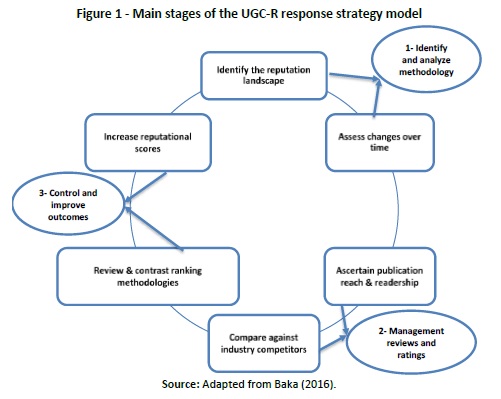
<body><![CDATA[<p><b>2.2 User-Generated-Content in Tourism</b></p>     <p>According to Lu and Stepchenkova (2015), the widespread use of social media    combined with developments in software instruments is drawing the attention    of researchers towards using UGC as a form of research in tourism and hospitality    applications. In their review work in tourism science, Lu and Stepchenkova have    concluded that UGC research is focused on service quality, destination image    and reputation, experiences and behavior, the persuasive power of UGC as eWOM,    and tourist mobility patterns.</p>     <p>The study entitled &ldquo;Social Media Use in European Hotels&rdquo; by Garrido-Moreno    and Lockett (2016) shows a compilation of social media tools used in tourism    and its significance. According to these authors, review sites such as TripAdvisor    are the most widely used of all social media tools, therefore making it necessary    to further study how managers can manage reviews. Moreover, the use of review    sites such as TripAdvisor in the tourism sector is becoming crucial as they    are known to have an influence on over US$10 billion of online travel purchases    made every year (Ye, Law, Gu, &amp; Chen, 2011). According to the organization&rsquo;s    2016 fact sheet, over 340 million visitors visit the site every month. TripAdvisor    offers over 320 million traveler reviews of 1,000,000 hotels and 4,000,000 restaurants    (TripAdvisor, 2016).</p>     <p>TripAdvisor, in particular, which is the most popular site for tourists to    evaluate accommodations, has a clearly influence on the travel industry and    popular culture (Jeacle &amp; Carter, 2011). The content generated on TripAdvisor's    website has transformed reputation into a highly contested issue with critical    implications. Reviews have provided the basis for travelers to make conclusions    about the legitimacy and reputation of hotels (Baka, 2016). TripAdvisor is a    website that offers travel advice to users, with the following purpose (Tripadvisor,    2016):</p>     <p>&ldquo;TripAdvisor is the world's largest travel site, enabling travelers to plan    and book the perfect trip. TripAdvisor offers advice from millions of travelers    and a wide variety of travel choices and planning features with seamless links    to booking tools that check hundreds of websites to find the best hotel prices.    TripAdvisor branded sites make up the largest travel community in the world,    reaching 350 million unique monthly visitors, and 320 million reviews and opinions    covering more than 6.2 million accommodations, restaurants and attractions.    The sites operate in 48 markets worldwide.&rdquo;</p>     <p>In addition to identifying the hotel identification and the user, a typical    TripAdvisor review includes: an overall score (from 1 to 5 stars), a title (maximum    120 letters), and a review text (minimum 100 letters). In addition to this information,    users can choose to specify what they liked and disliked about the hotel and    provide sub-scores for various aspects of the hotel (i.e. rooms, cleanliness,    service, etc.). Furthermore, users can provide personal information and details    regarding the date and purpose of their visit (i.e. travel dates, age range,    etc.). To finish the review, users can answer some questions about their recommendations    (O´Mahony &amp; Smyth, 2010). From the perspective of hotel organizations, hotel    managers are now including the task of checking the reviews about their hotel    on TripAdvisor as part of their daily routine. Major hotel brands have established    new strategies designed to respond to potential reputation crises triggered    by TripAdvisor ranking and reviews (Baka, 2016). TripAdvisor has therefore been    selected as the review site in this study in order to develop and propose a    scale for UGC-R response strategy.</p>     <p><b>2.3 User-Generated-Content Review (UGC-R) in tourism</b></p>     <p>Baka (2016) proposes a conceptual model for managing online reputation management    as a way of conceptualizing the transformation process in reputation development    in the travel industry. She argues that reviews on websites, infomediaries and    social networks with several rating mechanisms and specific areas for comments    open up communication channels with customers, while also leading managers to    develop reputation management strategies.</p>     <p>According to Baka, UGC introduces a different form of representation, which    is arguably more akin to word-of-mouth. More importantly though, the emergence    of social media and electronic WOM (eWOM) has influenced traditional practices    ranging from the dissemination of information to feedback management. Nowadays,    managers can use analytics to study where visitors come from and where they    &ldquo;go&rdquo; after they interact with any initiative they introduce on their websites    or social networks (such as offers and discounts). Being aware of the channels    that bring more traffic and reservations, managers are better informed of where    they should focus their efforts. Baka highlights some online practices in the    era of social media, such as: online monitoring and tracking traffic; performance    measurement using Google analytics, web analyzers and other sophisticated tools;    the use of social media to advertise campaigns and offers; YouTube channels    for uploading videos and featuring destinations; free widgets and screensavers    that users can download and use (some of which allow direct booking); exclusive    benefits for a channel&rsquo;s fans and followers (discounts offered only to Twitter    or Facebook fans); Facebook like and share buttons and groups on Facebook, LinkedIn,    Twitter, etc.; correlating information on various platforms to identify who    the customers are (for instance TripAdvisor reviews with reservation records);    bonuses and promotions based on social media feedback; and user-generated &ldquo;inspections&rdquo;.</p>     <p>Baka&rsquo;s methodology is based on a netnographic approach including 21 hoteliers,    5 hostel owners, 4 travel bloggers, 2 travel community founders, and 49 users,    through online engagement to the TripAdvisor community. The empirical material    used to demonstrate how UGC is challenging existing reputation management strategies    was collected on TripAdvisor. Baka proposed a model based on specific steps    for reputation tracking in the era of lists and rankings from Fombrun&rsquo;s work    (2007). The 6 steps used by Baka adapted from Fombrun are: 1. identify the reputation    landscape; 2. assess changes in the company&rsquo;s ratings and rankings over time;    3. determine publication reach and readership; 4. compare with industry competitors;    5. review and compare ranking methodologies; 6. improve reputational scores.    The model seems to modulate in three main stages (as seen in <a href="#f1">Figure    1</a>): firstly, through the identification and analysis of position methodology    (including identifying the reputation landscape and assessing changes in the    company&rsquo;s ratings and rankings over time); secondly, through management reviews    and ratings (determining publication reach and readership; comparing with industry    competitors); and thirdly, controlling and improving outcomes (reviewing and    comparing ranking methodologies and improving reputational scores).</p>     ]]></body>
<body><![CDATA[<p>&nbsp;</p>     <p align="center"><a name="f1"></a><img src="/img/revistas/tms/v14nespecial/14nespeciala01f1.jpg"/></p>     
<p>&nbsp;</p>     <p>Therefore, based on the idea that UGC-R is a tool for boosting hotels&rsquo; reputational    impact, this study proposes measuring UGC-R response strategy according to Baka&rsquo;s    dimensions. Since each dimension seems to work for a different target, the dimensions    will be analyzed to see if they can be aggregated based on a common objective:    identifying the reputation landscape and assessing changes in the company&rsquo;s    ratings and rankings over time were aggregated in &ldquo;methodology identification    and analysis&rdquo;; determining the publication reach and readership and comparing    it with industry competitors were aggregated in &ldquo;management reviews and ratings&rdquo;;    and reviewing and comparing ranking methodologies and improving reputational    scores were aggregated in &ldquo;improving outcomes&rdquo;.</p>     <p><b>3. Methodology</b></p>     <p><b>3.1 Data collection</b></p>     <p>This section focuses on explaining the steps taken to achieve our objective    of analyzing the intensity of using UGC-R for Spanish hotels posted on TripAdvisor,    categorizing the hotels into different groups and validating a measurement scale    for UGC-R response strategy. Empirical research started with a qualitative phase    focused on developing the scale. The designed scale was therefore presented    to hotel managers, marketing professionals and academics. Interviews were conducted    with 6 tourism experts, 5 marketing professionals and 4 academic experts. As    a result of this process some questions were added, others were eliminated and    the text and expression of some of them changed for the better understanding    of the respondent.</p>     <p>To collect the information, it was followed the key-informant methodology,    choosing the hotel managers as informants. <a href="#t1">Table 1</a> shows the    technical specifications of fieldwork conducted. From a directory of 1978 Spanish    hotels posted on TripAdvisor in March 2016, the information regarding this target    population was collected using systematic random sampling, with the first element    chosen at random from said population and other elements selected at regular    intervals (i.e. systematizing item selection using a lift coefficient). In this    case, the assumed margin of error was 5%, so a sample of 332 participants was    selected, so 1978/332 = 5.9 (lift coefficient). The fieldwork data was collected    in Spain. Five interviewers conducted a telephone survey in April and May of    2016. For details see <a href="#t1">table 1</a>.</p>     <p>&nbsp;</p>     <p align="center"><a name="t1"></a><img src="/img/revistas/tms/v14nespecial/14nespeciala01t1.jpg"/></p>     
]]></body>
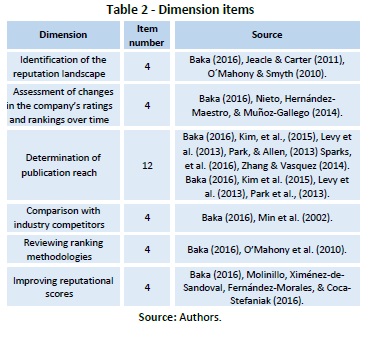
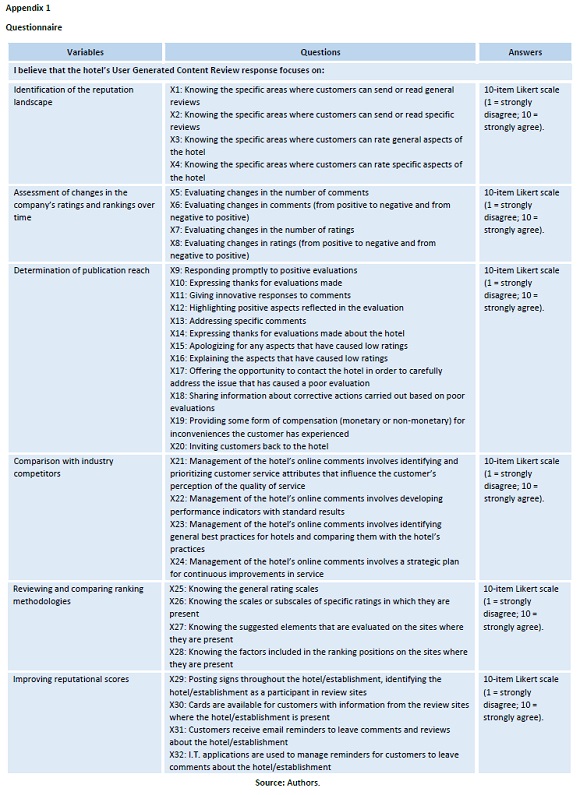
<body><![CDATA[<p>&nbsp;</p>     <p><b>3.2 Variable dimensions</b></p>     <p>The questionnaire is structured in two sections, with a total of 44 questions.    The first section deals with classification variables including: the hotel category,    size by number of beds, size by number of employees, ownership of the establishment,    the use of review sites, ability to use review sites, and commitment to the    review sites. The second section consists of 32 questions classified according    to six dimensions, following the model proposed by Baka (2016). <a href="#t2">Table    2</a> shows the main features of the scale, each dimension and the sources.    In this case, the variables are measured according to a 10-point Likert scale,    from 1 (strongly disagree) to 10 (totally agree). The measurement instrument,    obtained after discussing the pre- test technique, is shown in <a href="#a1">Appendix    1</a><a name="topa1"></a>.</p>     <p>&nbsp;</p>     <p align="center"><a name="t2"></a><img src="/img/revistas/tms/v14nespecial/14nespeciala01t2.jpg"/></p>     
<p>&nbsp;</p>     <p><b>4. Results</b></p>     <p>In order to evaluate the measurement scale for UGC-Review response strategy,    the underlying structure and the latent constructs of the data have been analyzed.    Principal Component Analysis (PCA) with Varimax rotation has been performed    for each of the three main stages of reputation tracking.</p>     <p>The number of factors to be extracted was selected based on our own discretion.    Two phases are expected for each stage. Regarding the results of the three PCA,    the value of the Kaiser- Meyer-Olkin (KMO) index was greater than 0.8 and Bartlett's    test of sphericity was always significant, demonstrating the correlation structure.    Furthermore, the extracted communalities and factor loadings exceeded 0.7 in    all cases. Lastly, reliability was assessed with Cronbach´s alpha and values    over 0.7 were obtained, as required in exploratory phases.</p>     <p><b>4.1 Identifying and analyzing the applicable methodology</b></p>     ]]></body>
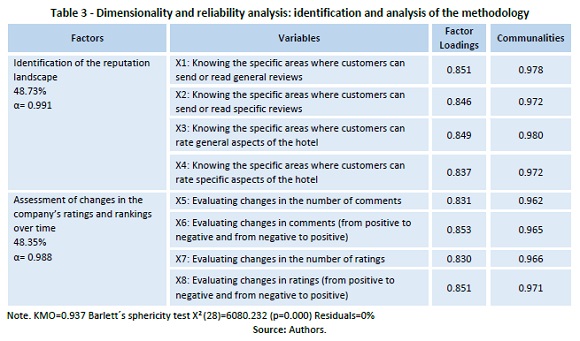
<body><![CDATA[<p>In the first stage, two factors were extracted, explaining 97.082% of the total    variance (see <a href="#t3">Table 3</a>). The first factor consists of 4 items    associated with the identification of the reputation landscape, which explains    48.73% of the variance. The second factor combines 4 items related to the assessment    of changes in the company&rsquo;s ratings and rankings over time, which explains 48.35%    of the variance.</p>     <p>&nbsp;</p>     <p align="center"><a name="t3"></a><img src="/img/revistas/tms/v14nespecial/14nespeciala01t3.jpg"/></p>     
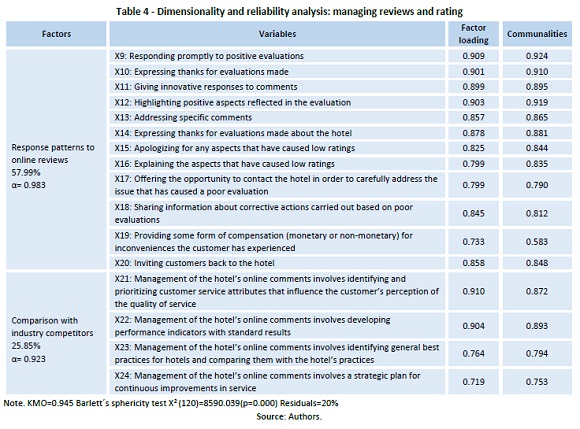
<p>&nbsp;</p>     <p><b>4. 2. Managing reviews and rating</b></p>     <p>In the second phase, two factors are also shown that explain 83.853% of the    variance. The first factor combines 12 items related to the response patterns    to online reviews, explaining 57.99% of the variance. The second factor consists    of 4 items explaining 25.85% of the variance (see <a href="#t4">table 4</a>).</p>     <p>&nbsp;</p>     <p align="center"><a name="t4"></a><img src="/img/revistas/tms/v14nespecial/14nespeciala01t4.jpg"/></p>     
<p>&nbsp;</p>     <p><b>4. 3 Controlling and improving outcomes</b></p>     ]]></body>
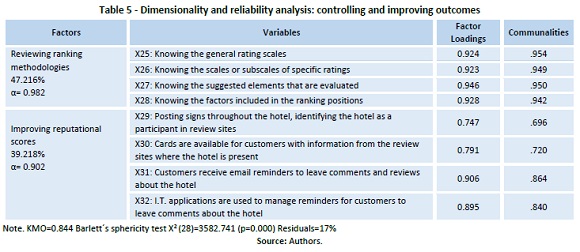
<body><![CDATA[<p>In the third phase, as shown in <a href="#t5">table 5</a>, two factors have    been established to control and improve outcomes. The first factor consists    of 4 items related to review ranking methodologies, which explains 47.21% of    the variance. The second factor combines 4 items related to improve reputational    scores, which explains 39.21% of the variance.</p>     <p>&nbsp;</p>     <p align="center"><a name="t5"></a><img src="/img/revistas/tms/v14nespecial/14nespeciala01t5.jpg"/></p>     
<p>&nbsp;</p>     <p><b>5. Conclusion</b></p>     <p>This research presents the findings of a field study focused on hotels&rsquo; UGC-R    response strategies. Prior studies have highlighted the need for further research    on UGC-R strategies (e.g., Baka, 2016; Cheng et al., 2014; Kim et al., 2015;    Molinillo et al., 2016; Levy et al., 2013; Park et al., 2013). Thus, certain    areas have been identified that require further research, such as how to manage    the identification and analysis of UGC-R, how to manage reviews and ratings,    and how to control and improve results. This paper proposes a scale for measuring    UGC-R response strategies and offers key relevant information, contributing    to filling the gap in the literature by offering a quantitative tool to study    the phenomenon.</p>     <p>Regarding UGC-R, the emergence of UGC has prompted hotels to manage their respective    reputations, but there is a general lack of indications regarding applicable    procedures. In order to achieve our research objectives, we confirmed the relationship    between the 6 dimensions of Baka&rsquo;s UGC-R model (2016), in accordance with the    literature: identifying the reputation landscape; assessing changes in the company&rsquo;s    ratings and rankings over time; determining the publication reach and readership;    comparing with industry competitors; reviewing and comparing ranking methodologies;    and improving of reputational scores. Since each dimension seems to work for    a different target, the dimensions were analyzed to see if they could be aggregated    based on a common objective: identifying the reputation landscape and assessing    changes in the company&rsquo;s ratings and rankings over time were aggregated in &ldquo;methodology    identification and analysis&rdquo;; determining the publication reach and readership    and comparing it with industry competitors were aggregated in &ldquo;management reviews    and ratings&rdquo;; and reviewing and comparing ranking methodologies and improving    reputational scores were aggregated in &ldquo;improving outcomes&rdquo;.</p>     <p>The study&rsquo;s findings shed light on the UGC-R phenomenon. The relevance of the    theoretical work and exploratory empirical analysis carried out in this research    can be summarized in the following contributions: firstly, a measurement instrument    was proposed for a UGC-R response strategy; secondly, three main criteria were    identified in accordance with the literature and verified with the UGC-R model;    thirdly, a reference theoretical framework was developed in order to focus the    content and meaning of each of the identified criteria. These three exploratory    factor analyses of the collected data constitute an initial approach to validating    the existence of an underlying organization for each of the identified criteria.    The findings confirm the existence of a practical framework that backs up the    theoretical proposal.</p>     <p>Some limitations and areas for future research were identified during the research    process. Firstly, as we only offer an exploratory analysis approximation for    the three proposed main dimensions in the UGC-R model, future research should    focus on analyzing these criteria changes as measurement models and their possible    inclusion in a structural model, related to the criteria used, as well as assessing    their impact on the tourism industry. Secondly, since our study is based on    data from multiple hotels and key informants, it would be interesting to compare    results from the perspectives of employees or managers or other tourism organizations    participating in review sites, such us tourist destinations and restaurants.    Thirdly, other review sites could be considered in future research.</p>     <p>Finally, considering that research into UGC-R requires more attention and the    aforementioned research limitations, the following recommendations are suggested:    future research should study quantitative methodologies for measuring UGC-R,    how to adapt the culture of the organization to UGC-R, and how to measure objectives    obtained from applicable UGC-R.</p>     ]]></body>
<body><![CDATA[<p>&nbsp;</p>     <p><b>REFERENCES</b></p>     <!-- ref --><p>Arsal, I., Woosnam, K. M., Baldwin, E. D., &amp; Backman, S. J. (2010). Residents    as travel destination information providers: An online community perspective.    <i>Journal of Travel Research</i>, 49(4), 400-413.    &nbsp;&nbsp;&nbsp;&nbsp;&nbsp;&nbsp;&nbsp;&nbsp;[&#160;<a href="javascript:void(0);" onclick="javascript: window.open('/scielo.php?script=sci_nlinks&ref=1279698&pid=S2182-8458201800050000100001&lng=','','width=640,height=500,resizable=yes,scrollbars=1,menubar=yes,');">Links</a>&#160;]<!-- end-ref --></p>     <p>Ardizzone, E., Di Miceli, F., La Cascia, M., &amp; Mazzola, G. (2012). Extracting    touristic information from online image collections. In Signal Image Technology    and Internet Based Systems (SITIS), 2012 Eighth International Conference on    25-29 Nov. 2012 (pp. 482-488). Retrieved March 6, 2016 from <a href="http://ieeexplore.ieee.org/xpls/abs_all.jsp?arnumber=6395133" target="_blank">http://ieeexplore.ieee.org/xpls/abs_all.jsp?arnumber=6395133</a>.</p>     <!-- ref --><p>Axup, J., &amp; Viller, S. (2005). Augmenting travel gossip: Design for mobile    communities. In Proceedings of the 17th Australia conference on Computer-Human    Interaction: Citizens Online: Considerations for Today and the Future (pp. 1-4).    Retrieved March 6, 2016 from <a href="http://dl.acm.org/citation.cfm?id=1108436" target="_blank">http://dl.acm.org/citation.cfm?id=1108436</a>.    &nbsp;&nbsp;&nbsp;&nbsp;&nbsp;&nbsp;&nbsp;&nbsp;[&#160;<a href="javascript:void(0);" onclick="javascript: window.open('/scielo.php?script=sci_nlinks&ref=1279701&pid=S2182-8458201800050000100003&lng=','','width=640,height=500,resizable=yes,scrollbars=1,menubar=yes,');">Links</a>&#160;]<!-- end-ref --></p>     <!-- ref --><p>Baka, V. (2016). The becoming of user-generated-reviews: looking at the past    to understand the future of managing reputation in the travel sector. <i>Tourism    Management</i>, 53, 148-162, DOI: <a href="http://dx.doi.org/10.1016/j.tourman.2015.09.004" target="_blank">10.1016/j.tourman.2015.09.004</a>.    &nbsp;&nbsp;&nbsp;&nbsp;&nbsp;&nbsp;&nbsp;&nbsp;[&#160;<a href="javascript:void(0);" onclick="javascript: window.open('/scielo.php?script=sci_nlinks&ref=1279703&pid=S2182-8458201800050000100004&lng=','','width=640,height=500,resizable=yes,scrollbars=1,menubar=yes,');">Links</a>&#160;]<!-- end-ref --></p>     <p>Baka, V., &amp; Scott, S. V. (2009). Web 2.0 and user-generated-content in    the travel industry-next step, or current reality? In International conference    in tourism. 4 international scientific conference, &ldquo;Planning for the future    e Learning from the Past: Contemporary developments in tourism, travel &amp;    hospitality&rdquo;. Rhodes Island, Greece.</p>     ]]></body>
<body><![CDATA[<!-- ref --><p>Berger, I. E., &amp; Greenspan, I. (2008). High (on) technology: Producing    tourist identities through technologized adventure. <i>Journal of Sport &amp;    Tourism</i>, 13(2), 89-114.    &nbsp;&nbsp;&nbsp;&nbsp;&nbsp;&nbsp;&nbsp;&nbsp;[&#160;<a href="javascript:void(0);" onclick="javascript: window.open('/scielo.php?script=sci_nlinks&ref=1279706&pid=S2182-8458201800050000100006&lng=','','width=640,height=500,resizable=yes,scrollbars=1,menubar=yes,');">Links</a>&#160;]<!-- end-ref --></p>     <!-- ref --><p>Chan, N., &amp; Denizci-Guillet, B. (2011). Investigation of social media marketing:    how does the hotel industry in Hong Knog perform in marketing on social media    websites? <i>Journal of Travel and Tourism Marketing</i>, 28(4), 345-368.    &nbsp;&nbsp;&nbsp;&nbsp;&nbsp;&nbsp;&nbsp;&nbsp;[&#160;<a href="javascript:void(0);" onclick="javascript: window.open('/scielo.php?script=sci_nlinks&ref=1279708&pid=S2182-8458201800050000100007&lng=','','width=640,height=500,resizable=yes,scrollbars=1,menubar=yes,');">Links</a>&#160;]<!-- end-ref --></p>     <!-- ref --><p>Cheng, V. T. P., &amp; Loi, M. K. (2014). Handling negative online customer    reviews: the effects of elaboration likelihood model and distributive justice.    <i>Journal of Travel &amp; Tourism Marketing</i>, 31(1), 1-15.    &nbsp;&nbsp;&nbsp;&nbsp;&nbsp;&nbsp;&nbsp;&nbsp;[&#160;<a href="javascript:void(0);" onclick="javascript: window.open('/scielo.php?script=sci_nlinks&ref=1279710&pid=S2182-8458201800050000100008&lng=','','width=640,height=500,resizable=yes,scrollbars=1,menubar=yes,');">Links</a>&#160;]<!-- end-ref --></p>     <!-- ref --><p>Choi, S., Lehto, X. Y., &amp; Morrison, A. M. (2007). Destination image representation    on the web: Content analysis of Macau travel related websites. <i>Tourism Management</i>,    28(1), 118-129.    &nbsp;&nbsp;&nbsp;&nbsp;&nbsp;&nbsp;&nbsp;&nbsp;[&#160;<a href="javascript:void(0);" onclick="javascript: window.open('/scielo.php?script=sci_nlinks&ref=1279712&pid=S2182-8458201800050000100009&lng=','','width=640,height=500,resizable=yes,scrollbars=1,menubar=yes,');">Links</a>&#160;]<!-- end-ref --></p>     <p>Cox, C., Burgess, S., Sellitto, C., &amp; Buultjens, J. (2009). The role of    user- generated content in tourists&rsquo; travel planning behavior. <i>Journal of    Hospitality Marketing &amp; Management</i>, 18(8), 743-764.</p>     <!-- ref --><p>Duffy, A. (2015). The road more travelled: how user-generated-content can lead    to homogenized travel journalism. <i>Journal of Media &amp; Cultural Studies</i>,    29(6), 821-832, DOI: <a href="https://dx.doi.org/10.1080/10304312.2015.1073686" target="_blank">10.1080/10304312.2015.1073686</a>    .    &nbsp;&nbsp;&nbsp;&nbsp;&nbsp;&nbsp;&nbsp;&nbsp;[&#160;<a href="javascript:void(0);" onclick="javascript: window.open('/scielo.php?script=sci_nlinks&ref=1279715&pid=S2182-8458201800050000100011&lng=','','width=640,height=500,resizable=yes,scrollbars=1,menubar=yes,');">Links</a>&#160;]<!-- end-ref --></p>     <!-- ref --><p>Dwivedi, M., Yadav, A., &amp; Patel, V. R. (2009). The online destination image    of Goa. <i>Worldwide Hospitality and Tourism Themes</i>, 1(1), 25-39.    &nbsp;&nbsp;&nbsp;&nbsp;&nbsp;&nbsp;&nbsp;&nbsp;[&#160;<a href="javascript:void(0);" onclick="javascript: window.open('/scielo.php?script=sci_nlinks&ref=1279717&pid=S2182-8458201800050000100012&lng=','','width=640,height=500,resizable=yes,scrollbars=1,menubar=yes,');">Links</a>&#160;]<!-- end-ref --></p>     <p>Filieri, R., &amp; McLeay, F. (2014). E-WOM and accommodation: An analysis    of the factors that influence travelers&rsquo; adoption of information from online    reviews. <i>Journal of Travel Research</i>, 53(1), 44-57.</p>     <!-- ref --><p>Fombrun, C. J. (2007). List of lists: a compilation of international corporate    reputation ratings. <i>Corporate Reputation Review</i>, 10(2), 144- 153.    &nbsp;&nbsp;&nbsp;&nbsp;&nbsp;&nbsp;&nbsp;&nbsp;[&#160;<a href="javascript:void(0);" onclick="javascript: window.open('/scielo.php?script=sci_nlinks&ref=1279720&pid=S2182-8458201800050000100014&lng=','','width=640,height=500,resizable=yes,scrollbars=1,menubar=yes,');">Links</a>&#160;]<!-- end-ref --></p>     <!-- ref --><p>Garrido-Moreno, A. &amp; Lockett, N. (2016). Social Media Use in European Hotels:    Benefits and Mani Challenges. <i>Tourism &amp; Management Studies</i>, 12(1),    172-179.    &nbsp;&nbsp;&nbsp;&nbsp;&nbsp;&nbsp;&nbsp;&nbsp;[&#160;<a href="javascript:void(0);" onclick="javascript: window.open('/scielo.php?script=sci_nlinks&ref=1279722&pid=S2182-8458201800050000100015&lng=','','width=640,height=500,resizable=yes,scrollbars=1,menubar=yes,');">Links</a>&#160;]<!-- end-ref --></p>     <!-- ref --><p>Girardin, F., Calabrese, F., Fiore, F. D., Ratti, C., &amp; Blat, J. (2008).    Digital footprinting: Uncovering tourists with user-generated content. <i>Pervasive    Computing</i>, IEEE, 7(4), 36-43.    &nbsp;&nbsp;&nbsp;&nbsp;&nbsp;&nbsp;&nbsp;&nbsp;[&#160;<a href="javascript:void(0);" onclick="javascript: window.open('/scielo.php?script=sci_nlinks&ref=1279724&pid=S2182-8458201800050000100016&lng=','','width=640,height=500,resizable=yes,scrollbars=1,menubar=yes,');">Links</a>&#160;]<!-- end-ref --></p>     ]]></body>
<body><![CDATA[<!-- ref --><p>Girardin, F., Dal Fiore, F., Blat, J., &amp; Ratti, C. (2007). Understanding    of tourist dynamics from explicitly disclosed location information. Retrieved    March 3, 2016 from <a href="http://senseable.mit.edu/papers/pdf/2007_Girardin_et_al_Tourist_dynamics_LBS-TC.pdf" target="_blank">http://senseable.mit.edu/papers/pdf/2007_Girardin_et_al_Tourist_dynamics_LBS-TC.pdf</a>.    &nbsp;&nbsp;&nbsp;&nbsp;&nbsp;&nbsp;&nbsp;&nbsp;[&#160;<a href="javascript:void(0);" onclick="javascript: window.open('/scielo.php?script=sci_nlinks&ref=1279726&pid=S2182-8458201800050000100017&lng=','','width=640,height=500,resizable=yes,scrollbars=1,menubar=yes,');">Links</a>&#160;]<!-- end-ref --></p>     <p>Gretzel, U., &amp; Yoo, K. H. (2008). Use and impact of online travel reviews.    In P. O&rsquo;Connor, W. Höpken, &amp; U. Gretzel (Eds.), <i>Information and communication    technologies in tourism 2008 </i>(pp. 35-46). Vienna: Springer.</p>     <!-- ref --><p>Gretzel, U., Yoo, K. H., &amp; Purifoy, M. (2007, February). Online travel    review study: Role &amp; impact of online travel reviews. Retrieved March 3,    2016 from <a href="http://www.tripadvisor.com/pdfs/OnlineTravelReviewReport.pdf" target="_blank">http://www.tripadvisor.com/pdfs/OnlineTravelReviewReport.pdf</a>.    &nbsp;&nbsp;&nbsp;&nbsp;&nbsp;&nbsp;&nbsp;&nbsp;[&#160;<a href="javascript:void(0);" onclick="javascript: window.open('/scielo.php?script=sci_nlinks&ref=1279729&pid=S2182-8458201800050000100019&lng=','','width=640,height=500,resizable=yes,scrollbars=1,menubar=yes,');">Links</a>&#160;]<!-- end-ref --></p>     <!-- ref --><p>Herrero, A., Marin, HS, Hernandez, JM. (2015): How online search behabior is    influenced by user-generated content on review websites and hotel interactive    websites. <i>International Journal of Contemporary Hospitality Management</i>,    27(7), 1573-1597. Doi: <a href="https://dx.doi.org/10.1108/IJCHM-05-2014-0255" target="_blank">10.1108/IJCHM-05-2014-0255</a>.    &nbsp;&nbsp;&nbsp;&nbsp;&nbsp;&nbsp;&nbsp;&nbsp;[&#160;<a href="javascript:void(0);" onclick="javascript: window.open('/scielo.php?script=sci_nlinks&ref=1279731&pid=S2182-8458201800050000100020&lng=','','width=640,height=500,resizable=yes,scrollbars=1,menubar=yes,');">Links</a>&#160;]<!-- end-ref --></p>     <p>Hoffman, D. &amp; Fodor, M. (2010, fall). Can you measire the ROI of Your Social    Media Marketing? <i>MITSloan Management Review</i>, 52(1), 41-49. Retrieved    March 3, 2016 from: <a href="https://www.researchgate.net/publication/228237594_Can_You_Measure_the_ROI_of_Your_Social_Media_Marketing" target="_blank">https://www.researchgate.net/publication/228237594_Can_You_Measure_the_ROI_of_Your_Social_Media_Marketing</a>.</p>     <!-- ref --><p>Hvass, K. A., &amp; Munar, A. M. (2012). The takeoff of social media in tourism.    <i>Journal of Vacation Marketing</i>, 18(2), 93-103.    &nbsp;&nbsp;&nbsp;&nbsp;&nbsp;&nbsp;&nbsp;&nbsp;[&#160;<a href="javascript:void(0);" onclick="javascript: window.open('/scielo.php?script=sci_nlinks&ref=1279734&pid=S2182-8458201800050000100022&lng=','','width=640,height=500,resizable=yes,scrollbars=1,menubar=yes,');">Links</a>&#160;]<!-- end-ref --></p>     ]]></body>
<body><![CDATA[<!-- ref --><p>Hwang, Y. H., Jani, D., &amp; Jeong, H. K. (2013). Analyzing international    tourists' functional information needs: A comparative analysis of inquiries    in an on-line travel forum. <i>Journal of Business Research</i>, 66(6), 700-705.    &nbsp;&nbsp;&nbsp;&nbsp;&nbsp;&nbsp;&nbsp;&nbsp;[&#160;<a href="javascript:void(0);" onclick="javascript: window.open('/scielo.php?script=sci_nlinks&ref=1279736&pid=S2182-8458201800050000100023&lng=','','width=640,height=500,resizable=yes,scrollbars=1,menubar=yes,');">Links</a>&#160;]<!-- end-ref --></p>     <!-- ref --><p>Jeacle, I. &amp; Carter, C. (2011): In TripAdvisor we trust: Rankings, calculative    regimes and abstract systems. <i>Accounting, Organizations and Society</i>,    36, 293-309.    &nbsp;&nbsp;&nbsp;&nbsp;&nbsp;&nbsp;&nbsp;&nbsp;[&#160;<a href="javascript:void(0);" onclick="javascript: window.open('/scielo.php?script=sci_nlinks&ref=1279738&pid=S2182-8458201800050000100024&lng=','','width=640,height=500,resizable=yes,scrollbars=1,menubar=yes,');">Links</a>&#160;]<!-- end-ref --></p>     <!-- ref --><p>Jin, SV &amp; Phua, J. (2016). Making reservations online: The impact of consumer-written    and system-aggregated user-generated content (UGC) in traver booking websites    on consumers´behavioral ntentions. <i>Journal of travel &amp; tourism marketing</i>,    33(1), 101-117. Doi: <a href="https://dx.doi.org/10.1080/10548408.2015.1038419" target="_blank">10.1080/10548408.2015.1038419</a>    .    &nbsp;&nbsp;&nbsp;&nbsp;&nbsp;&nbsp;&nbsp;&nbsp;[&#160;<a href="javascript:void(0);" onclick="javascript: window.open('/scielo.php?script=sci_nlinks&ref=1279740&pid=S2182-8458201800050000100025&lng=','','width=640,height=500,resizable=yes,scrollbars=1,menubar=yes,');">Links</a>&#160;]<!-- end-ref --></p>     <!-- ref --><p>Kim, J., Naylor, G. Sivadas, E., &amp; Sugumaran, V. (2015). The unrealized    value of incentivized eWOM recommendations. <i>Marketing Letters</i>, online    publication. Doi: <a href="https://dx.doi.org/10.1007/s11002-015-9360-3" target="_blank">10.1007/s11002-015-9360-3</a>.    &nbsp;&nbsp;&nbsp;&nbsp;&nbsp;&nbsp;&nbsp;&nbsp;[&#160;<a href="javascript:void(0);" onclick="javascript: window.open('/scielo.php?script=sci_nlinks&ref=1279742&pid=S2182-8458201800050000100026&lng=','','width=640,height=500,resizable=yes,scrollbars=1,menubar=yes,');">Links</a>&#160;]<!-- end-ref --></p>     <!-- ref --><p>Kurashima, T., Tezuka, T., &amp; Tanaka, K. (2005). Blog map of experiences:    Extracting and geographically mapping visitor experiences from urban blogs.    In A. H. H. Ngu, M. Kitsuregawa, E. J. Neuhold, J.-Y. Chung, &amp; Q. Z. Sheng    (Eds.), <i>Web Information Systems Engineering-WISE 2005 </i>(pp. 496-503).    Berlin, Germany: Springer Berlin Heidelberg.    &nbsp;&nbsp;&nbsp;&nbsp;&nbsp;&nbsp;&nbsp;&nbsp;[&#160;<a href="javascript:void(0);" onclick="javascript: window.open('/scielo.php?script=sci_nlinks&ref=1279744&pid=S2182-8458201800050000100027&lng=','','width=640,height=500,resizable=yes,scrollbars=1,menubar=yes,');">Links</a>&#160;]<!-- end-ref --></p>     ]]></body>
<body><![CDATA[<!-- ref --><p>Kwok, L., &amp; Yu, B. (2013). Spreading social media messages on Facebook:    An analysis of restaurant business-to-consumer communications. <i>Cornell Hospitality    Quarterly</i>, 54(1), 84-94.    &nbsp;&nbsp;&nbsp;&nbsp;&nbsp;&nbsp;&nbsp;&nbsp;[&#160;<a href="javascript:void(0);" onclick="javascript: window.open('/scielo.php?script=sci_nlinks&ref=1279746&pid=S2182-8458201800050000100028&lng=','','width=640,height=500,resizable=yes,scrollbars=1,menubar=yes,');">Links</a>&#160;]<!-- end-ref --></p>     <!-- ref --><p>Law, R., &amp; Cheung, S. (2010). The perceived destination image of Hong Kong    as revealed in the travel blogs of mainland Chinese tourists. <i>International    Journal of Hospitality &amp; Tourism Administration</i>, 11(4), 303-327.    &nbsp;&nbsp;&nbsp;&nbsp;&nbsp;&nbsp;&nbsp;&nbsp;[&#160;<a href="javascript:void(0);" onclick="javascript: window.open('/scielo.php?script=sci_nlinks&ref=1279748&pid=S2182-8458201800050000100029&lng=','','width=640,height=500,resizable=yes,scrollbars=1,menubar=yes,');">Links</a>&#160;]<!-- end-ref --></p>     <!-- ref --><p>Leung, D., Law, R., van Hoof, H., &amp; Buhalis, D. (2013). Social media in    tourism and hospitality: A literature review. <i>Journal of Travel &amp; Tourism    Marketing</i>, 30(1/2), 3-22.    &nbsp;&nbsp;&nbsp;&nbsp;&nbsp;&nbsp;&nbsp;&nbsp;[&#160;<a href="javascript:void(0);" onclick="javascript: window.open('/scielo.php?script=sci_nlinks&ref=1279750&pid=S2182-8458201800050000100030&lng=','','width=640,height=500,resizable=yes,scrollbars=1,menubar=yes,');">Links</a>&#160;]<!-- end-ref --></p>     <p>Leung, R., Schuckert, M., &amp; Yeung, E. (2013). <i>Attracting user social    media engagement: A study of three budget airlines Facebook pages </i>(pp. 195-206).    Springer Berlin Heidelberg.</p>     <!-- ref --><p>Levy, S., Duan, W., &amp; Boo, S. (2013). An Analysis of One-Star Online Reviews    and Responses in the Washington, D.C., Lodging Market. <i>Cornell Hospitality    Quarterly</i>, 54(1) 49-63.    &nbsp;&nbsp;&nbsp;&nbsp;&nbsp;&nbsp;&nbsp;&nbsp;[&#160;<a href="javascript:void(0);" onclick="javascript: window.open('/scielo.php?script=sci_nlinks&ref=1279753&pid=S2182-8458201800050000100032&lng=','','width=640,height=500,resizable=yes,scrollbars=1,menubar=yes,');">Links</a>&#160;]<!-- end-ref --></p>     <!-- ref --><p>Li, H., Ye, Q., &amp; Law, R. (2012). Determinants of customer satisfaction    in the hotel industry: An application of online review analysis. Retrieved March    1, 2016 from <a href="http://www.tandfonline.com/doi/abs/10.1080/10941665.2012.708351" target="_blank">http://www.tandfonline.com/doi/abs/10.1080/10941665.2012.708351</a>.    &nbsp;&nbsp;&nbsp;&nbsp;&nbsp;&nbsp;&nbsp;&nbsp;[&#160;<a href="javascript:void(0);" onclick="javascript: window.open('/scielo.php?script=sci_nlinks&ref=1279755&pid=S2182-8458201800050000100033&lng=','','width=640,height=500,resizable=yes,scrollbars=1,menubar=yes,');">Links</a>&#160;]<!-- end-ref --></p>     <!-- ref --><p>Liu, Y. (2012). The influence factors to the enterprise microblogs: A research    of the restaurant enterprise microblogs on Weibo.com. In Computing Technology    and Information Management (ICCM), 2012 8th International Conference on Apr.    24-26, 2012 (Vol. 2, pp. 590-595). Retrieved March 2, 2016 from <a href="http://ieeexplore.ieee.org/xpls/abs_all.jsp?arnumber=6268568" target="_blank">http://ieeexplore.ieee.org/xpls/abs_all.jsp?arnumber=6268568</a>.    &nbsp;&nbsp;&nbsp;&nbsp;&nbsp;&nbsp;&nbsp;&nbsp;[&#160;<a href="javascript:void(0);" onclick="javascript: window.open('/scielo.php?script=sci_nlinks&ref=1279757&pid=S2182-8458201800050000100034&lng=','','width=640,height=500,resizable=yes,scrollbars=1,menubar=yes,');">Links</a>&#160;]<!-- end-ref --></p>     <!-- ref --><p>Lu, X., Wang, C., Yang, J. M., Pang, Y., &amp; Zhang, L. (2010). Photo2Trip:    Generating travel routes from geo-tagged photos for trip planning Proceedings    of the international conference on multimedia (pp. 143- 152). Retrieved March    3, 2016 from <a href="http://dl.acm.org/citation.cfm?id=1873972" target="_blank">http://dl.acm.org/citation.cfm?id=1873972</a>.    &nbsp;&nbsp;&nbsp;&nbsp;&nbsp;&nbsp;&nbsp;&nbsp;[&#160;<a href="javascript:void(0);" onclick="javascript: window.open('/scielo.php?script=sci_nlinks&ref=1279759&pid=S2182-8458201800050000100035&lng=','','width=640,height=500,resizable=yes,scrollbars=1,menubar=yes,');">Links</a>&#160;]<!-- end-ref --></p>     <!-- ref --><p>Lu, W., &amp; Stepchenkova, S. (2012). Ecotourism experiences reported online:    Classification of satisfaction attributes. <i>Tourism Management, 33</i>(3),    702-712.    &nbsp;&nbsp;&nbsp;&nbsp;&nbsp;&nbsp;&nbsp;&nbsp;[&#160;<a href="javascript:void(0);" onclick="javascript: window.open('/scielo.php?script=sci_nlinks&ref=1279761&pid=S2182-8458201800050000100036&lng=','','width=640,height=500,resizable=yes,scrollbars=1,menubar=yes,');">Links</a>&#160;]<!-- end-ref --></p>     <!-- ref --><p>Lu, W., &amp; Stepchenkova, S. (2015). User-generated content as a research    mode in tourism and hospitality applications: Topics, methods, and software.    <i>Journal of Hospitality Marketing &amp; Management, 24</i>(2), 119-154.    &nbsp;&nbsp;&nbsp;&nbsp;&nbsp;&nbsp;&nbsp;&nbsp;[&#160;<a href="javascript:void(0);" onclick="javascript: window.open('/scielo.php?script=sci_nlinks&ref=1279763&pid=S2182-8458201800050000100037&lng=','','width=640,height=500,resizable=yes,scrollbars=1,menubar=yes,');">Links</a>&#160;]<!-- end-ref --></p>     <!-- ref --><p>Magnini, V. P., Crotts, J. C., &amp; Zehrer, A. (2011). Understanding customer    delight: An application of travel blog analysis. <i>Journal of Travel Research</i>,    50 (5), 535-545.    &nbsp;&nbsp;&nbsp;&nbsp;&nbsp;&nbsp;&nbsp;&nbsp;[&#160;<a href="javascript:void(0);" onclick="javascript: window.open('/scielo.php?script=sci_nlinks&ref=1279765&pid=S2182-8458201800050000100038&lng=','','width=640,height=500,resizable=yes,scrollbars=1,menubar=yes,');">Links</a>&#160;]<!-- end-ref --></p>     <!-- ref --><p>Marine-Roig, E. &amp; Anton, S. (2015): Tourism analytics with massive user-    generated content: A case study of Barcelona. <i>Journal of Destination Marketing    &amp; Management</i>, 4(3), 162-172.    &nbsp;&nbsp;&nbsp;&nbsp;&nbsp;&nbsp;&nbsp;&nbsp;[&#160;<a href="javascript:void(0);" onclick="javascript: window.open('/scielo.php?script=sci_nlinks&ref=1279767&pid=S2182-8458201800050000100039&lng=','','width=640,height=500,resizable=yes,scrollbars=1,menubar=yes,');">Links</a>&#160;]<!-- end-ref --></p>     <!-- ref --><p>Marchiori, E. &amp; Cantoni, L. (2015): The role of prior experience in the    perception of a tourism destination in user-generated-content. <i>Journal of    Destination Marketing &amp; Management, 4</i>(3), 194-201.    &nbsp;&nbsp;&nbsp;&nbsp;&nbsp;&nbsp;&nbsp;&nbsp;[&#160;<a href="javascript:void(0);" onclick="javascript: window.open('/scielo.php?script=sci_nlinks&ref=1279769&pid=S2182-8458201800050000100040&lng=','','width=640,height=500,resizable=yes,scrollbars=1,menubar=yes,');">Links</a>&#160;]<!-- end-ref --></p>     <!-- ref --><p>Molinillo, S., Fernández-Morales, A., Ximénez-de-Sandoval, J.L. &amp; Coca-    Stefaniak, A. (2016). Hotel Assessment through Social Media - TripAdvisor Case    Study. <i>Tourism &amp; Management Studies</i>, 12 (1), 15-24. Doi: <a href="https://dx.doi.org/10.18089/tms.2016.12102" target="_blank">10.18089/tms.2016.12102</a>.    &nbsp;&nbsp;&nbsp;&nbsp;&nbsp;&nbsp;&nbsp;&nbsp;[&#160;<a href="javascript:void(0);" onclick="javascript: window.open('/scielo.php?script=sci_nlinks&ref=1279771&pid=S2182-8458201800050000100041&lng=','','width=640,height=500,resizable=yes,scrollbars=1,menubar=yes,');">Links</a>&#160;]<!-- end-ref --></p>     <!-- ref --><p>Nieto, J., Hernández-Maestro, R. &amp; Muñoz-Gallego, P. (2014). Marketing    decisions, customer reviews, and business permormance: The use of the Toprural    website by Spanish rural lodging establishments. <i>Tourism Managment, </i>45(1),    115-123.    &nbsp;&nbsp;&nbsp;&nbsp;&nbsp;&nbsp;&nbsp;&nbsp;[&#160;<a href="javascript:void(0);" onclick="javascript: window.open('/scielo.php?script=sci_nlinks&ref=1279773&pid=S2182-8458201800050000100042&lng=','','width=640,height=500,resizable=yes,scrollbars=1,menubar=yes,');">Links</a>&#160;]<!-- end-ref --></p>     <!-- ref --><p>O Connor, P. (2011). An analysis of the use of Facebook by international hotel    chains. Retrieved from <a href="http://scholarworks.umass.edu/refereed/ICHRIE_2011/Wednesday/9/" target="_blank">http://scholarworks.umass.edu/refereed/ICHRIE_2011/Wednesday/9/</a>.    &nbsp;&nbsp;&nbsp;&nbsp;&nbsp;&nbsp;&nbsp;&nbsp;[&#160;<a href="javascript:void(0);" onclick="javascript: window.open('/scielo.php?script=sci_nlinks&ref=1279775&pid=S2182-8458201800050000100043&lng=','','width=640,height=500,resizable=yes,scrollbars=1,menubar=yes,');">Links</a>&#160;]<!-- end-ref --></p>     <!-- ref --><p>O&rsquo; Mahony, M.P. &amp; Smyth, B. (2010): A classification-based review recommender.    <i>Knowledge-based Systems</i>, 23, 323-329.    &nbsp;&nbsp;&nbsp;&nbsp;&nbsp;&nbsp;&nbsp;&nbsp;[&#160;<a href="javascript:void(0);" onclick="javascript: window.open('/scielo.php?script=sci_nlinks&ref=1279777&pid=S2182-8458201800050000100044&lng=','','width=640,height=500,resizable=yes,scrollbars=1,menubar=yes,');">Links</a>&#160;]<!-- end-ref --></p>     <!-- ref --><p>Organisation for Economic Co-operation and Development. (2001). Understanding    the digital divide. Retrieved March 3, 2016 from <a href="http://www.oecd.org/dataoecd/38/57/1888451.pdf" target="_blank">http://www.oecd.org/dataoecd/38/57/1888451.pdf</a>.    &nbsp;&nbsp;&nbsp;&nbsp;&nbsp;&nbsp;&nbsp;&nbsp;[&#160;<a href="javascript:void(0);" onclick="javascript: window.open('/scielo.php?script=sci_nlinks&ref=1279779&pid=S2182-8458201800050000100045&lng=','','width=640,height=500,resizable=yes,scrollbars=1,menubar=yes,');">Links</a>&#160;]<!-- end-ref --></p>     <!-- ref --><p>Pan, B., MacLaurin, T., &amp; Crotts, J. C. (2007). Travel blogs and the implications    for destination marketing. <i>Journal of Travel Research</i>, 46(1), 35-45.    &nbsp;&nbsp;&nbsp;&nbsp;&nbsp;&nbsp;&nbsp;&nbsp;[&#160;<a href="javascript:void(0);" onclick="javascript: window.open('/scielo.php?script=sci_nlinks&ref=1279781&pid=S2182-8458201800050000100046&lng=','','width=640,height=500,resizable=yes,scrollbars=1,menubar=yes,');">Links</a>&#160;]<!-- end-ref --></p>     <!-- ref --><p>Paris, C. M., &amp; Rubin, S. (2013). Backpacking, social media, and crises:    A discussion of online social convergence. In Information and Communication    Technologies in Tourism 2013 (pp. 207-217). Retrieved February 5, 2016 from    <a href="http://link.springer.com/chapter/10.1007/978-3-642-36309-2_18" target="_blank">http://link.springer.com/chapter/10.1007/978-3-642-36309-2_18</a>.    &nbsp;&nbsp;&nbsp;&nbsp;&nbsp;&nbsp;&nbsp;&nbsp;[&#160;<a href="javascript:void(0);" onclick="javascript: window.open('/scielo.php?script=sci_nlinks&ref=1279783&pid=S2182-8458201800050000100047&lng=','','width=640,height=500,resizable=yes,scrollbars=1,menubar=yes,');">Links</a>&#160;]<!-- end-ref --></p>     <!-- ref --><p>Park, S. &amp; Allen, J. (2013). Responding to Online Reviews: Problem Solving    and Engagement in Hotels. <i>Cornell Hospitality Quarterly, </i>54(1) 64-73.    &nbsp;&nbsp;&nbsp;&nbsp;&nbsp;&nbsp;&nbsp;&nbsp;[&#160;<a href="javascript:void(0);" onclick="javascript: window.open('/scielo.php?script=sci_nlinks&ref=1279785&pid=S2182-8458201800050000100048&lng=','','width=640,height=500,resizable=yes,scrollbars=1,menubar=yes,');">Links</a>&#160;]<!-- end-ref --></p>     <!-- ref --><p>Schmallegger, D., &amp; Carson, D. (2009). Destination image projection on    consumergenerated content websites: A case study of the flinders ranges. <i>Information    Technology &amp; Tourism</i>, 11(2), 111-127. Doi: <a href="https://dx.doi.org/10.3727/109830509789994838" target="_blank">10.3727/109830509789994838</a>.    &nbsp;&nbsp;&nbsp;&nbsp;&nbsp;&nbsp;&nbsp;&nbsp;[&#160;<a href="javascript:void(0);" onclick="javascript: window.open('/scielo.php?script=sci_nlinks&ref=1279787&pid=S2182-8458201800050000100049&lng=','','width=640,height=500,resizable=yes,scrollbars=1,menubar=yes,');">Links</a>&#160;]<!-- end-ref --></p>     <!-- ref --><p>Sparks, B. A., Perkins, H. E., &amp; Buckley, R. (2013). Online travel reviews    as persuasive communication: the effects of content type, source, and certification    logos on consumer behavior. <i>Tourism Management</i>, 39(0), 1-9.    &nbsp;&nbsp;&nbsp;&nbsp;&nbsp;&nbsp;&nbsp;&nbsp;[&#160;<a href="javascript:void(0);" onclick="javascript: window.open('/scielo.php?script=sci_nlinks&ref=1279789&pid=S2182-8458201800050000100050&lng=','','width=640,height=500,resizable=yes,scrollbars=1,menubar=yes,');">Links</a>&#160;]<!-- end-ref --></p>     <!-- ref --><p>TripAdvisor. 2016. Fact sheet. <a href="http://www.tripadvisor.com/PressCenter-c4-Fact_Sheet.html" target="_blank">http://www.tripadvisor.com/PressCenter-c4-Fact_Sheet.html</a>    (accessed Abril 15, 2016).    &nbsp;&nbsp;&nbsp;&nbsp;&nbsp;&nbsp;&nbsp;&nbsp;[&#160;<a href="javascript:void(0);" onclick="javascript: window.open('/scielo.php?script=sci_nlinks&ref=1279791&pid=S2182-8458201800050000100051&lng=','','width=640,height=500,resizable=yes,scrollbars=1,menubar=yes,');">Links</a>&#160;]<!-- end-ref --></p>     <!-- ref --><p>Weilin L., &amp; Svetlana S. (2015) User-Generated Content as a Research Mode    in Tourism and Hospitality Applications: Topics, Methods, and Software. <i>Journal    of Hospitality Marketing &amp; Management</i>, 24(2), 119- 154, DOI: <a href="https://dx.doi.org/10.1080/19368623.2014.907758" target="_blank">10.1080/19368623.2014.907758</a>.    &nbsp;&nbsp;&nbsp;&nbsp;&nbsp;&nbsp;&nbsp;&nbsp;[&#160;<a href="javascript:void(0);" onclick="javascript: window.open('/scielo.php?script=sci_nlinks&ref=1279793&pid=S2182-8458201800050000100052&lng=','','width=640,height=500,resizable=yes,scrollbars=1,menubar=yes,');">Links</a>&#160;]<!-- end-ref --></p>     <p>Wenger, A. (2008). Analysis of travel bloggers&rsquo; characteristics and their communication    about Austria as a tourism destination. <i>Journal of Vacation Marketing</i>,    14(2), 169-176.</p>     ]]></body>
<body><![CDATA[<!-- ref --><p>Xiang, Z., &amp; Gretzel, U. (2010). Role of social media in online travel    information search. <i>Tourism Management</i>, 31(2), 179-188.    &nbsp;&nbsp;&nbsp;&nbsp;&nbsp;&nbsp;&nbsp;&nbsp;[&#160;<a href="javascript:void(0);" onclick="javascript: window.open('/scielo.php?script=sci_nlinks&ref=1279796&pid=S2182-8458201800050000100054&lng=','','width=640,height=500,resizable=yes,scrollbars=1,menubar=yes,');">Links</a>&#160;]<!-- end-ref --></p>     <!-- ref --><p>Ye, Q., Gu, B., Chen, W., &amp; Law, R. (2008). Measuring the value of managerial    responses to online reviews: A natural experiment of two online travel agencies.    In ICIS 2008 Proceedings (Paper 115). Retrieved April 13, 2016 from <a href="http://aisel.aisnet.org/icis2008/115" target="_blank">http://aisel.aisnet.org/icis2008/115</a>.    &nbsp;&nbsp;&nbsp;&nbsp;&nbsp;&nbsp;&nbsp;&nbsp;[&#160;<a href="javascript:void(0);" onclick="javascript: window.open('/scielo.php?script=sci_nlinks&ref=1279798&pid=S2182-8458201800050000100055&lng=','','width=640,height=500,resizable=yes,scrollbars=1,menubar=yes,');">Links</a>&#160;]<!-- end-ref --></p>     <!-- ref --><p>Ye, Q., Law, R, Gu, B. &amp; Chen, W. (2011). The influence of user- generated    content on traveler behavior: An empirical investigation on the effects of e-word-of-mouth    to hotel online bookings. <i>Computers in Human Behavior</i>, 27(2), 634-639.    &nbsp;&nbsp;&nbsp;&nbsp;&nbsp;&nbsp;&nbsp;&nbsp;[&#160;<a href="javascript:void(0);" onclick="javascript: window.open('/scielo.php?script=sci_nlinks&ref=1279800&pid=S2182-8458201800050000100056&lng=','','width=640,height=500,resizable=yes,scrollbars=1,menubar=yes,');">Links</a>&#160;]<!-- end-ref --></p>     <p>Zhang Y. &amp; Vásquez (2014). Hotels´responses to online reviews: managing    consumer dissatisfaction. <i>Discourse, Context and Media</i>, 6, 54-64.</p>     <p>&nbsp;</p>     <p>Received: 16 February 2017</p>     <p>Revisions required: 25 July 2017</p>     ]]></body>
<body><![CDATA[<p>Accepted: 10 September 2017</p>     <p>&nbsp;</p>     <p align="center"><a name="a1"></a><img src="/img/revistas/tms/v14nespecial/14nespeciala01a1.jpg"/></p>     
<p>&nbsp;</p>      ]]></body><back>
<ref-list>
<ref id="B1">
<nlm-citation citation-type="journal">
<person-group person-group-type="author">
<name>
<surname><![CDATA[Arsal]]></surname>
<given-names><![CDATA[I.]]></given-names>
</name>
<name>
<surname><![CDATA[Woosnam]]></surname>
<given-names><![CDATA[K. M.]]></given-names>
</name>
<name>
<surname><![CDATA[Baldwin]]></surname>
<given-names><![CDATA[E. D.]]></given-names>
</name>
<name>
<surname><![CDATA[Backman]]></surname>
<given-names><![CDATA[S. J.]]></given-names>
</name>
</person-group>
<article-title xml:lang="en"><![CDATA[Residents as travel destination information providers: An online community perspective]]></article-title>
<source><![CDATA[Journal of Travel Research]]></source>
<year>2010</year>
<volume>49</volume>
<numero>4</numero>
<issue>4</issue>
<page-range>400-413</page-range></nlm-citation>
</ref>
<ref id="B2">
<nlm-citation citation-type="">
<person-group person-group-type="author">
<name>
<surname><![CDATA[Ardizzone]]></surname>
<given-names><![CDATA[E.]]></given-names>
</name>
<name>
<surname><![CDATA[Di Miceli]]></surname>
<given-names><![CDATA[F.]]></given-names>
</name>
<name>
<surname><![CDATA[La Cascia]]></surname>
<given-names><![CDATA[M.]]></given-names>
</name>
<name>
<surname><![CDATA[Mazzola]]></surname>
<given-names><![CDATA[G.]]></given-names>
</name>
</person-group>
<article-title xml:lang="en"><![CDATA[Extracting touristic information from online image collections]]></article-title>
<source><![CDATA[Signal Image Technology and Internet Based Systems]]></source>
<year>2012</year>
</nlm-citation>
</ref>
<ref id="B3">
<nlm-citation citation-type="">
<person-group person-group-type="author">
<name>
<surname><![CDATA[Axup]]></surname>
<given-names><![CDATA[J.]]></given-names>
</name>
<name>
<surname><![CDATA[Viller]]></surname>
<given-names><![CDATA[S.]]></given-names>
</name>
</person-group>
<article-title xml:lang="en"><![CDATA[Augmenting travel gossip: Design for mobile communities]]></article-title>
<source><![CDATA[Proceedings of the 17th Australia conference on Computer-Human Interaction: Citizens Online: Considerations for Today and the Future]]></source>
<year>2005</year>
<page-range>1-4</page-range></nlm-citation>
</ref>
<ref id="B4">
<nlm-citation citation-type="journal">
<person-group person-group-type="author">
<name>
<surname><![CDATA[Baka]]></surname>
<given-names><![CDATA[V.]]></given-names>
</name>
</person-group>
<article-title xml:lang="en"><![CDATA[The becoming of user-generated-reviews: looking at the past to understand the future of managing reputation in the travel sector]]></article-title>
<source><![CDATA[Tourism Management]]></source>
<year>2016</year>
<volume>53</volume>
<page-range>148-162</page-range></nlm-citation>
</ref>
<ref id="B5">
<nlm-citation citation-type="">
<person-group person-group-type="author">
<name>
<surname><![CDATA[Baka]]></surname>
<given-names><![CDATA[V.]]></given-names>
</name>
<name>
<surname><![CDATA[Scott]]></surname>
<given-names><![CDATA[S. V.]]></given-names>
</name>
</person-group>
<article-title xml:lang="en"><![CDATA[Web 2.0 and user-generated-content in the travel industry-next step, or current reality?]]></article-title>
<source><![CDATA[Planning for the future e Learning from the Past:: Contemporary developments in tourism, travel & hospitality]]></source>
<year>2009</year>
<publisher-loc><![CDATA[Rhodes Island ]]></publisher-loc>
</nlm-citation>
</ref>
<ref id="B6">
<nlm-citation citation-type="journal">
<person-group person-group-type="author">
<name>
<surname><![CDATA[Berger]]></surname>
<given-names><![CDATA[I. E.]]></given-names>
</name>
<name>
<surname><![CDATA[Greenspan]]></surname>
<given-names><![CDATA[I.]]></given-names>
</name>
</person-group>
<article-title xml:lang="en"><![CDATA[High (on) technology: Producing tourist identities through technologized adventure]]></article-title>
<source><![CDATA[Journal of Sport & Tourism]]></source>
<year>2008</year>
<volume>13</volume>
<numero>2</numero>
<issue>2</issue>
<page-range>89-114</page-range></nlm-citation>
</ref>
<ref id="B7">
<nlm-citation citation-type="journal">
<person-group person-group-type="author">
<name>
<surname><![CDATA[Chan]]></surname>
<given-names><![CDATA[N.]]></given-names>
</name>
<name>
<surname><![CDATA[Denizci-Guillet]]></surname>
<given-names><![CDATA[B.]]></given-names>
</name>
</person-group>
<article-title xml:lang="en"><![CDATA[Investigation of social media marketing: how does the hotel industry in Hong Knog perform in marketing on social media websites?]]></article-title>
<source><![CDATA[Journal of Travel and Tourism Marketing]]></source>
<year>2011</year>
<volume>28</volume>
<numero>4</numero>
<issue>4</issue>
<page-range>345-368</page-range></nlm-citation>
</ref>
<ref id="B8">
<nlm-citation citation-type="journal">
<person-group person-group-type="author">
<name>
<surname><![CDATA[Cheng]]></surname>
<given-names><![CDATA[V. T. P.]]></given-names>
</name>
<name>
<surname><![CDATA[Loi]]></surname>
<given-names><![CDATA[M. K.]]></given-names>
</name>
</person-group>
<article-title xml:lang="en"><![CDATA[Handling negative online customer reviews: the effects of elaboration likelihood model and distributive justice]]></article-title>
<source><![CDATA[Journal of Travel & Tourism Marketing]]></source>
<year>2014</year>
<volume>31</volume>
<numero>1</numero>
<issue>1</issue>
<page-range>1-15</page-range></nlm-citation>
</ref>
<ref id="B9">
<nlm-citation citation-type="journal">
<person-group person-group-type="author">
<name>
<surname><![CDATA[Choi]]></surname>
<given-names><![CDATA[S.]]></given-names>
</name>
<name>
<surname><![CDATA[Lehto]]></surname>
<given-names><![CDATA[X. Y.]]></given-names>
</name>
<name>
<surname><![CDATA[Morrison]]></surname>
<given-names><![CDATA[A. M.]]></given-names>
</name>
</person-group>
<article-title xml:lang="en"><![CDATA[Destination image representation on the web: Content analysis of Macau travel related websites]]></article-title>
<source><![CDATA[Tourism Management]]></source>
<year>2007</year>
<volume>28</volume>
<numero>1</numero>
<issue>1</issue>
<page-range>118-129</page-range></nlm-citation>
</ref>
<ref id="B10">
<nlm-citation citation-type="journal">
<person-group person-group-type="author">
<name>
<surname><![CDATA[Cox]]></surname>
<given-names><![CDATA[C.]]></given-names>
</name>
<name>
<surname><![CDATA[Burgess]]></surname>
<given-names><![CDATA[S.]]></given-names>
</name>
<name>
<surname><![CDATA[Sellitto]]></surname>
<given-names><![CDATA[C.]]></given-names>
</name>
<name>
<surname><![CDATA[Buultjens]]></surname>
<given-names><![CDATA[J.]]></given-names>
</name>
</person-group>
<article-title xml:lang="en"><![CDATA[The role of user- generated content in tourists’ travel planning behavior]]></article-title>
<source><![CDATA[Journal of Hospitality Marketing & Management]]></source>
<year>2009</year>
<volume>18</volume>
<numero>8</numero>
<issue>8</issue>
<page-range>743-764</page-range></nlm-citation>
</ref>
<ref id="B11">
<nlm-citation citation-type="journal">
<person-group person-group-type="author">
<name>
<surname><![CDATA[Duffy]]></surname>
<given-names><![CDATA[A.]]></given-names>
</name>
</person-group>
<article-title xml:lang="en"><![CDATA[The road more travelled: how user-generated-content can lead to homogenized travel journalism]]></article-title>
<source><![CDATA[Journal of Media & Cultural Studies]]></source>
<year>2015</year>
<volume>29</volume>
<numero>6</numero>
<issue>6</issue>
<page-range>821-832</page-range></nlm-citation>
</ref>
<ref id="B12">
<nlm-citation citation-type="journal">
<person-group person-group-type="author">
<name>
<surname><![CDATA[Dwivedi]]></surname>
<given-names><![CDATA[M.]]></given-names>
</name>
<name>
<surname><![CDATA[Yadav]]></surname>
<given-names><![CDATA[A.]]></given-names>
</name>
<name>
<surname><![CDATA[Patel]]></surname>
<given-names><![CDATA[V. R.]]></given-names>
</name>
</person-group>
<article-title xml:lang="en"><![CDATA[The online destination image of Goa]]></article-title>
<source><![CDATA[Worldwide Hospitality and Tourism Themes]]></source>
<year>2009</year>
<volume>1</volume>
<numero>1</numero>
<issue>1</issue>
<page-range>25-39</page-range></nlm-citation>
</ref>
<ref id="B13">
<nlm-citation citation-type="journal">
<person-group person-group-type="author">
<name>
<surname><![CDATA[Filieri]]></surname>
<given-names><![CDATA[R.]]></given-names>
</name>
<name>
<surname><![CDATA[McLeay]]></surname>
<given-names><![CDATA[F.]]></given-names>
</name>
</person-group>
<article-title xml:lang="en"><![CDATA[E-WOM and accommodation: An analysis of the factors that influence travelers’ adoption of information from online reviews]]></article-title>
<source><![CDATA[Journal of Travel Research]]></source>
<year>2014</year>
<volume>53</volume>
<numero>1</numero>
<issue>1</issue>
<page-range>44-57</page-range></nlm-citation>
</ref>
<ref id="B14">
<nlm-citation citation-type="journal">
<person-group person-group-type="author">
<name>
<surname><![CDATA[Fombrun]]></surname>
<given-names><![CDATA[C. J.]]></given-names>
</name>
</person-group>
<article-title xml:lang="en"><![CDATA[List of lists: a compilation of international corporate reputation ratings]]></article-title>
<source><![CDATA[Corporate Reputation Review]]></source>
<year>2007</year>
<volume>10</volume>
<numero>2</numero>
<issue>2</issue>
<page-range>144- 153</page-range></nlm-citation>
</ref>
<ref id="B15">
<nlm-citation citation-type="journal">
<person-group person-group-type="author">
<name>
<surname><![CDATA[Garrido-Moreno]]></surname>
<given-names><![CDATA[A.]]></given-names>
</name>
<name>
<surname><![CDATA[Lockett]]></surname>
<given-names><![CDATA[N.]]></given-names>
</name>
</person-group>
<article-title xml:lang="en"><![CDATA[Social Media Use in European Hotels: Benefits and Mani Challenges]]></article-title>
<source><![CDATA[Tourism & Management Studies]]></source>
<year>2016</year>
<volume>12</volume>
<numero>1</numero>
<issue>1</issue>
<page-range>172-179</page-range></nlm-citation>
</ref>
<ref id="B16">
<nlm-citation citation-type="journal">
<person-group person-group-type="author">
<name>
<surname><![CDATA[Girardin]]></surname>
<given-names><![CDATA[F.]]></given-names>
</name>
<name>
<surname><![CDATA[Calabrese]]></surname>
<given-names><![CDATA[F.]]></given-names>
</name>
<name>
<surname><![CDATA[Fiore]]></surname>
<given-names><![CDATA[F. D.]]></given-names>
</name>
<name>
<surname><![CDATA[Ratti]]></surname>
<given-names><![CDATA[C.]]></given-names>
</name>
<name>
<surname><![CDATA[Blat]]></surname>
<given-names><![CDATA[J.]]></given-names>
</name>
</person-group>
<article-title xml:lang="en"><![CDATA[Digital footprinting: Uncovering tourists with user-generated content]]></article-title>
<source><![CDATA[Pervasive Computing IEEE]]></source>
<year>2008</year>
<volume>7</volume>
<numero>4</numero>
<issue>4</issue>
<page-range>36-43</page-range></nlm-citation>
</ref>
<ref id="B17">
<nlm-citation citation-type="">
<person-group person-group-type="author">
<name>
<surname><![CDATA[Girardin]]></surname>
<given-names><![CDATA[F.]]></given-names>
</name>
<name>
<surname><![CDATA[Dal Fiore]]></surname>
<given-names><![CDATA[F.]]></given-names>
</name>
<name>
<surname><![CDATA[Blat]]></surname>
<given-names><![CDATA[J.]]></given-names>
</name>
<name>
<surname><![CDATA[Ratti]]></surname>
<given-names><![CDATA[C.]]></given-names>
</name>
</person-group>
<source><![CDATA[Understanding of tourist dynamics from explicitly disclosed location information]]></source>
<year>2007</year>
</nlm-citation>
</ref>
<ref id="B18">
<nlm-citation citation-type="book">
<person-group person-group-type="author">
<name>
<surname><![CDATA[Gretzel]]></surname>
<given-names><![CDATA[U.]]></given-names>
</name>
<name>
<surname><![CDATA[Yoo]]></surname>
<given-names><![CDATA[K. H.]]></given-names>
</name>
</person-group>
<article-title xml:lang="en"><![CDATA[Use and impact of online travel reviews]]></article-title>
<person-group person-group-type="editor">
<name>
<surname><![CDATA[O’Connor]]></surname>
<given-names><![CDATA[P.]]></given-names>
</name>
<name>
<surname><![CDATA[Höpken]]></surname>
<given-names><![CDATA[W.]]></given-names>
</name>
<name>
<surname><![CDATA[Gretzel]]></surname>
<given-names><![CDATA[U.]]></given-names>
</name>
</person-group>
<source><![CDATA[Information and communication technologies in tourism 2008]]></source>
<year>2008</year>
<page-range>35-46</page-range><publisher-loc><![CDATA[Vienna ]]></publisher-loc>
<publisher-name><![CDATA[Springer]]></publisher-name>
</nlm-citation>
</ref>
<ref id="B19">
<nlm-citation citation-type="">
<person-group person-group-type="author">
<name>
<surname><![CDATA[Gretzel]]></surname>
<given-names><![CDATA[U.]]></given-names>
</name>
<name>
<surname><![CDATA[Yoo]]></surname>
<given-names><![CDATA[K. H.]]></given-names>
</name>
<name>
<surname><![CDATA[Purifoy]]></surname>
<given-names><![CDATA[M.]]></given-names>
</name>
</person-group>
<source><![CDATA[Online travel review study: Role & impact of online travel reviews]]></source>
<year>2007</year>
</nlm-citation>
</ref>
<ref id="B20">
<nlm-citation citation-type="journal">
<person-group person-group-type="author">
<name>
<surname><![CDATA[Herrero]]></surname>
<given-names><![CDATA[A.]]></given-names>
</name>
<name>
<surname><![CDATA[Marin]]></surname>
<given-names><![CDATA[HS]]></given-names>
</name>
<name>
<surname><![CDATA[Hernandez]]></surname>
<given-names><![CDATA[JM.]]></given-names>
</name>
</person-group>
<article-title xml:lang="en"><![CDATA[How online search behabior is influenced by user-generated content on review websites and hotel interactive websites]]></article-title>
<source><![CDATA[International Journal of Contemporary Hospitality Management]]></source>
<year>2015</year>
<volume>27</volume>
<numero>7</numero>
<issue>7</issue>
<page-range>1573-1597</page-range></nlm-citation>
</ref>
<ref id="B21">
<nlm-citation citation-type="journal">
<person-group person-group-type="author">
<name>
<surname><![CDATA[Hoffman]]></surname>
<given-names><![CDATA[D.]]></given-names>
</name>
<name>
<surname><![CDATA[Fodor]]></surname>
<given-names><![CDATA[M.]]></given-names>
</name>
</person-group>
<article-title xml:lang="en"><![CDATA[Can you measire the ROI of Your Social Media Marketing?]]></article-title>
<source><![CDATA[MITSloan Management Review]]></source>
<year>2010</year>
<volume>52</volume>
<numero>1</numero>
<issue>1</issue>
<page-range>41-49</page-range></nlm-citation>
</ref>
<ref id="B22">
<nlm-citation citation-type="journal">
<person-group person-group-type="author">
<name>
<surname><![CDATA[Hvass]]></surname>
<given-names><![CDATA[K. A.]]></given-names>
</name>
<name>
<surname><![CDATA[Munar]]></surname>
<given-names><![CDATA[A. M.]]></given-names>
</name>
</person-group>
<article-title xml:lang="en"><![CDATA[The takeoff of social media in tourism]]></article-title>
<source><![CDATA[Journal of Vacation Marketing]]></source>
<year>2012</year>
<volume>18</volume>
<numero>2</numero>
<issue>2</issue>
<page-range>93-103</page-range></nlm-citation>
</ref>
<ref id="B23">
<nlm-citation citation-type="journal">
<person-group person-group-type="author">
<name>
<surname><![CDATA[Hwang]]></surname>
<given-names><![CDATA[Y. H.]]></given-names>
</name>
<name>
<surname><![CDATA[Jani]]></surname>
<given-names><![CDATA[D.]]></given-names>
</name>
<name>
<surname><![CDATA[Jeong]]></surname>
<given-names><![CDATA[H. K.]]></given-names>
</name>
</person-group>
<article-title xml:lang="en"><![CDATA[Analyzing international tourists' functional information needs: A comparative analysis of inquiries in an on-line travel forum]]></article-title>
<source><![CDATA[Journal of Business Research]]></source>
<year>2013</year>
<volume>66</volume>
<numero>6</numero>
<issue>6</issue>
<page-range>700-705</page-range></nlm-citation>
</ref>
<ref id="B24">
<nlm-citation citation-type="journal">
<person-group person-group-type="author">
<name>
<surname><![CDATA[Jeacle]]></surname>
<given-names><![CDATA[I.]]></given-names>
</name>
<name>
<surname><![CDATA[Carter]]></surname>
<given-names><![CDATA[C.]]></given-names>
</name>
</person-group>
<article-title xml:lang="en"><![CDATA[In TripAdvisor we trust: Rankings, calculative regimes and abstract systems]]></article-title>
<source><![CDATA[Accounting]]></source>
<year>2011</year>
<volume>Organizations and Society</volume>
<page-range>36, 293-309</page-range></nlm-citation>
</ref>
<ref id="B25">
<nlm-citation citation-type="journal">
<person-group person-group-type="author">
<name>
<surname><![CDATA[Jin]]></surname>
<given-names><![CDATA[SV.]]></given-names>
</name>
<name>
<surname><![CDATA[Phua]]></surname>
<given-names><![CDATA[J.]]></given-names>
</name>
</person-group>
<article-title xml:lang="en"><![CDATA[Making reservations online: The impact of consumer-written and system-aggregated user-generated content (UGC) in traver booking websites on consumers´behavioral ntentions]]></article-title>
<source><![CDATA[Journal of travel & tourism marketing]]></source>
<year>2016</year>
<volume>33</volume>
<numero>1</numero>
<issue>1</issue>
<page-range>101-117</page-range></nlm-citation>
</ref>
<ref id="B26">
<nlm-citation citation-type="journal">
<person-group person-group-type="author">
<name>
<surname><![CDATA[Kim]]></surname>
<given-names><![CDATA[J.]]></given-names>
</name>
<name>
<surname><![CDATA[Naylor]]></surname>
<given-names><![CDATA[G.]]></given-names>
</name>
<name>
<surname><![CDATA[Sivadas]]></surname>
<given-names><![CDATA[E.]]></given-names>
</name>
<name>
<surname><![CDATA[Sugumaran]]></surname>
<given-names><![CDATA[V.]]></given-names>
</name>
</person-group>
<article-title xml:lang="en"><![CDATA[The unrealized value of incentivized eWOM recommendations]]></article-title>
<source><![CDATA[Marketing Letters]]></source>
<year>2015</year>
</nlm-citation>
</ref>
<ref id="B27">
<nlm-citation citation-type="book">
<person-group person-group-type="author">
<name>
<surname><![CDATA[Kurashima]]></surname>
<given-names><![CDATA[T.]]></given-names>
</name>
<name>
<surname><![CDATA[Tezuka]]></surname>
<given-names><![CDATA[T.]]></given-names>
</name>
<name>
<surname><![CDATA[Tanaka]]></surname>
<given-names><![CDATA[K.]]></given-names>
</name>
</person-group>
<article-title xml:lang="en"><![CDATA[Blog map of experiences: Extracting and geographically mapping visitor experiences from urban blogs]]></article-title>
<person-group person-group-type="editor">
<name>
<surname><![CDATA[Ngu]]></surname>
<given-names><![CDATA[A. H. H.]]></given-names>
</name>
<name>
<surname><![CDATA[Kitsuregawa]]></surname>
<given-names><![CDATA[M.]]></given-names>
</name>
<name>
<surname><![CDATA[Neuhold]]></surname>
<given-names><![CDATA[E. J.]]></given-names>
</name>
<name>
<surname><![CDATA[Chung]]></surname>
<given-names><![CDATA[J.-Y.]]></given-names>
</name>
<name>
<surname><![CDATA[Sheng]]></surname>
<given-names><![CDATA[Q. Z.]]></given-names>
</name>
</person-group>
<source><![CDATA[Web Information Systems Engineering-WISE 2005]]></source>
<year>2005</year>
<page-range>496-503</page-range><publisher-loc><![CDATA[Berlin ]]></publisher-loc>
<publisher-name><![CDATA[Springer Berlin Heidelberg]]></publisher-name>
</nlm-citation>
</ref>
<ref id="B28">
<nlm-citation citation-type="journal">
<person-group person-group-type="author">
<name>
<surname><![CDATA[Kwok]]></surname>
<given-names><![CDATA[L.]]></given-names>
</name>
<name>
<surname><![CDATA[Yu]]></surname>
<given-names><![CDATA[B.]]></given-names>
</name>
</person-group>
<article-title xml:lang="en"><![CDATA[Spreading social media messages on Facebook: An analysis of restaurant business-to-consumer communications]]></article-title>
<source><![CDATA[Cornell Hospitality Quarterly]]></source>
<year>2013</year>
<volume>54</volume>
<numero>1</numero>
<issue>1</issue>
<page-range>84-94</page-range></nlm-citation>
</ref>
<ref id="B29">
<nlm-citation citation-type="journal">
<person-group person-group-type="author">
<name>
<surname><![CDATA[Law]]></surname>
<given-names><![CDATA[R.]]></given-names>
</name>
<name>
<surname><![CDATA[Cheung]]></surname>
<given-names><![CDATA[S.]]></given-names>
</name>
</person-group>
<article-title xml:lang="en"><![CDATA[The perceived destination image of Hong Kong as revealed in the travel blogs of mainland Chinese tourists]]></article-title>
<source><![CDATA[International Journal of Hospitality & Tourism Administration]]></source>
<year>2010</year>
<volume>11</volume>
<numero>4</numero>
<issue>4</issue>
<page-range>303-327</page-range></nlm-citation>
</ref>
<ref id="B30">
<nlm-citation citation-type="journal">
<person-group person-group-type="author">
<name>
<surname><![CDATA[Leung]]></surname>
<given-names><![CDATA[D.]]></given-names>
</name>
<name>
<surname><![CDATA[Law]]></surname>
<given-names><![CDATA[R.]]></given-names>
</name>
<name>
<surname><![CDATA[van Hoof]]></surname>
<given-names><![CDATA[H.]]></given-names>
</name>
<name>
<surname><![CDATA[Buhalis]]></surname>
<given-names><![CDATA[D.]]></given-names>
</name>
</person-group>
<article-title xml:lang="en"><![CDATA[Social media in tourism and hospitality: A literature review]]></article-title>
<source><![CDATA[Journal of Travel & Tourism Marketing]]></source>
<year>2013</year>
<volume>30</volume>
<numero>1/2</numero>
<issue>1/2</issue>
<page-range>3-22</page-range></nlm-citation>
</ref>
<ref id="B31">
<nlm-citation citation-type="book">
<person-group person-group-type="author">
<name>
<surname><![CDATA[Leung]]></surname>
<given-names><![CDATA[R.]]></given-names>
</name>
<name>
<surname><![CDATA[Schuckert]]></surname>
<given-names><![CDATA[M.]]></given-names>
</name>
<name>
<surname><![CDATA[Yeung]]></surname>
<given-names><![CDATA[E.]]></given-names>
</name>
</person-group>
<source><![CDATA[Attracting user social media engagement: A study of three budget airlines Facebook pages]]></source>
<year>2013</year>
<publisher-name><![CDATA[Springer Berlin Heidelberg]]></publisher-name>
</nlm-citation>
</ref>
<ref id="B32">
<nlm-citation citation-type="journal">
<person-group person-group-type="author">
<name>
<surname><![CDATA[Levy]]></surname>
<given-names><![CDATA[S.]]></given-names>
</name>
<name>
<surname><![CDATA[Duan]]></surname>
<given-names><![CDATA[W.]]></given-names>
</name>
<name>
<surname><![CDATA[Boo]]></surname>
<given-names><![CDATA[S.]]></given-names>
</name>
</person-group>
<article-title xml:lang="en"><![CDATA[An Analysis of One-Star Online Reviews and Responses in the Washington, DC, Lodging Market]]></article-title>
<source><![CDATA[Cornell Hospitality Quarterly]]></source>
<year>2013</year>
<volume>54</volume>
<numero>1</numero>
<issue>1</issue>
<page-range>49-63</page-range></nlm-citation>
</ref>
<ref id="B33">
<nlm-citation citation-type="">
<person-group person-group-type="author">
<name>
<surname><![CDATA[Li]]></surname>
<given-names><![CDATA[H.]]></given-names>
</name>
<name>
<surname><![CDATA[Ye]]></surname>
<given-names><![CDATA[Q.]]></given-names>
</name>
<name>
<surname><![CDATA[Law]]></surname>
<given-names><![CDATA[R.]]></given-names>
</name>
</person-group>
<source><![CDATA[Determinants of customer satisfaction in the hotel industry: An application of online review analysis]]></source>
<year>2012</year>
</nlm-citation>
</ref>
<ref id="B34">
<nlm-citation citation-type="">
<person-group person-group-type="author">
<name>
<surname><![CDATA[Liu]]></surname>
<given-names><![CDATA[Y.]]></given-names>
</name>
</person-group>
<article-title xml:lang="en"><![CDATA[The influence factors to the enterprise microblogs: A research of the restaurant enterprise microblogs on Weibo.com]]></article-title>
<source><![CDATA[Computing Technology and Information Management: 2012 8th International Conference on]]></source>
<year>2012</year>
<page-range>590-595</page-range></nlm-citation>
</ref>
<ref id="B35">
<nlm-citation citation-type="">
<person-group person-group-type="author">
<name>
<surname><![CDATA[Lu]]></surname>
<given-names><![CDATA[X.]]></given-names>
</name>
<name>
<surname><![CDATA[Wang]]></surname>
<given-names><![CDATA[C.]]></given-names>
</name>
<name>
<surname><![CDATA[Yang]]></surname>
<given-names><![CDATA[J. M.]]></given-names>
</name>
<name>
<surname><![CDATA[Pang]]></surname>
<given-names><![CDATA[Y.]]></given-names>
</name>
<name>
<surname><![CDATA[Zhang]]></surname>
<given-names><![CDATA[L.]]></given-names>
</name>
</person-group>
<article-title xml:lang="en"><![CDATA[Photo2Trip: Generating travel routes from geo-tagged photos for trip planning]]></article-title>
<source><![CDATA[Proceedings of the international conference on multimedia]]></source>
<year>2010</year>
<page-range>143- 152</page-range></nlm-citation>
</ref>
<ref id="B36">
<nlm-citation citation-type="journal">
<person-group person-group-type="author">
<name>
<surname><![CDATA[Lu]]></surname>
<given-names><![CDATA[W.]]></given-names>
</name>
<name>
<surname><![CDATA[Stepchenkova]]></surname>
<given-names><![CDATA[S.]]></given-names>
</name>
</person-group>
<article-title xml:lang="en"><![CDATA[Ecotourism experiences reported online: Classification of satisfaction attributes]]></article-title>
<source><![CDATA[Tourism Management]]></source>
<year>2012</year>
<volume>33</volume>
<numero>3</numero>
<issue>3</issue>
<page-range>702-712</page-range></nlm-citation>
</ref>
<ref id="B37">
<nlm-citation citation-type="journal">
<person-group person-group-type="author">
<name>
<surname><![CDATA[Lu]]></surname>
<given-names><![CDATA[W.]]></given-names>
</name>
<name>
<surname><![CDATA[Stepchenkova]]></surname>
<given-names><![CDATA[S.]]></given-names>
</name>
</person-group>
<article-title xml:lang="en"><![CDATA[User-generated content as a research mode in tourism and hospitality applications: Topics, methods, and software]]></article-title>
<source><![CDATA[Journal of Hospitality Marketing & Management]]></source>
<year>2015</year>
<volume>24</volume>
<numero>2</numero>
<issue>2</issue>
<page-range>119-154</page-range></nlm-citation>
</ref>
<ref id="B38">
<nlm-citation citation-type="journal">
<person-group person-group-type="author">
<name>
<surname><![CDATA[Magnini]]></surname>
<given-names><![CDATA[V. P.]]></given-names>
</name>
<name>
<surname><![CDATA[Crotts]]></surname>
<given-names><![CDATA[J. C.]]></given-names>
</name>
<name>
<surname><![CDATA[Zehrer]]></surname>
<given-names><![CDATA[A.]]></given-names>
</name>
</person-group>
<article-title xml:lang="en"><![CDATA[Understanding customer delight: An application of travel blog analysis]]></article-title>
<source><![CDATA[Journal of Travel Research]]></source>
<year>2011</year>
<volume>50</volume>
<numero>5</numero>
<issue>5</issue>
<page-range>535-545</page-range></nlm-citation>
</ref>
<ref id="B39">
<nlm-citation citation-type="journal">
<person-group person-group-type="author">
<name>
<surname><![CDATA[Marine-Roig]]></surname>
<given-names><![CDATA[E.]]></given-names>
</name>
<name>
<surname><![CDATA[Anton]]></surname>
<given-names><![CDATA[S.]]></given-names>
</name>
</person-group>
<article-title xml:lang="en"><![CDATA[Tourism analytics with massive user- generated content: A case study of Barcelona]]></article-title>
<source><![CDATA[Journal of Destination Marketing & Management]]></source>
<year>2015</year>
<volume>4</volume>
<numero>3</numero>
<issue>3</issue>
<page-range>162-172</page-range></nlm-citation>
</ref>
<ref id="B40">
<nlm-citation citation-type="journal">
<person-group person-group-type="author">
<name>
<surname><![CDATA[Marchiori]]></surname>
<given-names><![CDATA[E.]]></given-names>
</name>
<name>
<surname><![CDATA[Cantoni]]></surname>
<given-names><![CDATA[L.]]></given-names>
</name>
</person-group>
<article-title xml:lang="en"><![CDATA[The role of prior experience in the perception of a tourism destination in user-generated-content]]></article-title>
<source><![CDATA[Journal of Destination Marketing & Management]]></source>
<year>2015</year>
<volume>4</volume>
<numero>3</numero>
<issue>3</issue>
<page-range>194-201</page-range></nlm-citation>
</ref>
<ref id="B41">
<nlm-citation citation-type="journal">
<person-group person-group-type="author">
<name>
<surname><![CDATA[Molinillo]]></surname>
<given-names><![CDATA[S.]]></given-names>
</name>
<name>
<surname><![CDATA[Fernández-Morales]]></surname>
<given-names><![CDATA[A.]]></given-names>
</name>
<name>
<surname><![CDATA[Ximénez-de-Sandoval]]></surname>
<given-names><![CDATA[J.L.]]></given-names>
</name>
<name>
<surname><![CDATA[Coca- Stefaniak]]></surname>
<given-names><![CDATA[A.]]></given-names>
</name>
</person-group>
<article-title xml:lang="en"><![CDATA[Hotel Assessment through Social Media - TripAdvisor Case Study]]></article-title>
<source><![CDATA[Tourism & Management Studies]]></source>
<year>2016</year>
<volume>12</volume>
<numero>1</numero>
<issue>1</issue>
<page-range>15-24</page-range></nlm-citation>
</ref>
<ref id="B42">
<nlm-citation citation-type="journal">
<person-group person-group-type="author">
<name>
<surname><![CDATA[Nieto]]></surname>
<given-names><![CDATA[J.]]></given-names>
</name>
<name>
<surname><![CDATA[Hernández-Maestro]]></surname>
<given-names><![CDATA[R.]]></given-names>
</name>
<name>
<surname><![CDATA[Muñoz-Gallego]]></surname>
<given-names><![CDATA[P.]]></given-names>
</name>
</person-group>
<article-title xml:lang="en"><![CDATA[Marketing decisions, customer reviews, and business permormance: The use of the Toprural website by Spanish rural lodging establishments]]></article-title>
<source><![CDATA[Tourism Managment]]></source>
<year>2014</year>
<volume>45</volume>
<numero>1</numero>
<issue>1</issue>
<page-range>115-123</page-range></nlm-citation>
</ref>
<ref id="B43">
<nlm-citation citation-type="">
<person-group person-group-type="author">
<name>
<surname><![CDATA[O Connor]]></surname>
<given-names><![CDATA[P.]]></given-names>
</name>
</person-group>
<source><![CDATA[An analysis of the use of Facebook by international hotel chains]]></source>
<year>2011</year>
</nlm-citation>
</ref>
<ref id="B44">
<nlm-citation citation-type="journal">
<person-group person-group-type="author">
<name>
<surname><![CDATA[O’ Mahony]]></surname>
<given-names><![CDATA[M.P.]]></given-names>
</name>
<name>
<surname><![CDATA[Smyth]]></surname>
<given-names><![CDATA[B.]]></given-names>
</name>
</person-group>
<article-title xml:lang="en"><![CDATA[A classification-based review recommender]]></article-title>
<source><![CDATA[Knowledge-based Systems]]></source>
<year>2010</year>
<volume>23</volume>
<page-range>323-329</page-range></nlm-citation>
</ref>
<ref id="B45">
<nlm-citation citation-type="">
<collab>Organisation for Economic Co-operation and Development</collab>
<source><![CDATA[Understanding the digital divide]]></source>
<year>2001</year>
</nlm-citation>
</ref>
<ref id="B46">
<nlm-citation citation-type="journal">
<person-group person-group-type="author">
<name>
<surname><![CDATA[Pan]]></surname>
<given-names><![CDATA[B.]]></given-names>
</name>
<name>
<surname><![CDATA[MacLaurin]]></surname>
<given-names><![CDATA[T.]]></given-names>
</name>
<name>
<surname><![CDATA[Crotts]]></surname>
<given-names><![CDATA[J. C.]]></given-names>
</name>
</person-group>
<article-title xml:lang="en"><![CDATA[Travel blogs and the implications for destination marketing]]></article-title>
<source><![CDATA[Journal of Travel Research]]></source>
<year>2007</year>
<volume>46</volume>
<numero>1</numero>
<issue>1</issue>
<page-range>35-45</page-range></nlm-citation>
</ref>
<ref id="B47">
<nlm-citation citation-type="">
<person-group person-group-type="author">
<name>
<surname><![CDATA[Paris]]></surname>
<given-names><![CDATA[C. M.]]></given-names>
</name>
<name>
<surname><![CDATA[Rubin]]></surname>
<given-names><![CDATA[S.]]></given-names>
</name>
</person-group>
<article-title xml:lang="en"><![CDATA[Backpacking, social media, and crises: A discussion of online social convergence]]></article-title>
<source><![CDATA[Information and Communication Technologies in Tourism 2013]]></source>
<year>2013</year>
<page-range>207-217</page-range></nlm-citation>
</ref>
<ref id="B48">
<nlm-citation citation-type="journal">
<person-group person-group-type="author">
<name>
<surname><![CDATA[Park]]></surname>
<given-names><![CDATA[S.]]></given-names>
</name>
<name>
<surname><![CDATA[Allen]]></surname>
<given-names><![CDATA[J.]]></given-names>
</name>
</person-group>
<article-title xml:lang="en"><![CDATA[Responding to Online Reviews: Problem Solving and Engagement in Hotels]]></article-title>
<source><![CDATA[Cornell Hospitality Quarterly]]></source>
<year>2013</year>
<volume>54</volume>
<numero>1</numero>
<issue>1</issue>
<page-range>64-73</page-range></nlm-citation>
</ref>
<ref id="B49">
<nlm-citation citation-type="journal">
<person-group person-group-type="author">
<name>
<surname><![CDATA[Schmallegger]]></surname>
<given-names><![CDATA[D.]]></given-names>
</name>
<name>
<surname><![CDATA[Carson]]></surname>
<given-names><![CDATA[D.]]></given-names>
</name>
</person-group>
<article-title xml:lang="en"><![CDATA[Destination image projection on consumergenerated content websites: A case study of the flinders ranges]]></article-title>
<source><![CDATA[Information Technology & Tourism]]></source>
<year>2009</year>
<volume>11</volume>
<numero>2</numero>
<issue>2</issue>
<page-range>111-127</page-range></nlm-citation>
</ref>
<ref id="B50">
<nlm-citation citation-type="journal">
<person-group person-group-type="author">
<name>
<surname><![CDATA[Sparks]]></surname>
<given-names><![CDATA[B. A.]]></given-names>
</name>
<name>
<surname><![CDATA[Perkins]]></surname>
<given-names><![CDATA[H. E.]]></given-names>
</name>
<name>
<surname><![CDATA[Buckley]]></surname>
<given-names><![CDATA[R.]]></given-names>
</name>
</person-group>
<article-title xml:lang="en"><![CDATA[Online travel reviews as persuasive communication: the effects of content type, source, and certification logos on consumer behavior]]></article-title>
<source><![CDATA[Tourism Management]]></source>
<year>2013</year>
<volume>39</volume>
<numero>0</numero>
<issue>0</issue>
<page-range>1-9</page-range></nlm-citation>
</ref>
<ref id="B51">
<nlm-citation citation-type="">
<collab>TripAdvisor</collab>
<source><![CDATA[Fact sheet]]></source>
<year>2016</year>
</nlm-citation>
</ref>
<ref id="B52">
<nlm-citation citation-type="journal">
<person-group person-group-type="author">
<name>
<surname><![CDATA[Weilin]]></surname>
<given-names><![CDATA[L]]></given-names>
</name>
<name>
<surname><![CDATA[Svetlana]]></surname>
<given-names><![CDATA[S.]]></given-names>
</name>
</person-group>
<article-title xml:lang="en"><![CDATA[User-Generated Content as a Research Mode in Tourism and Hospitality Applications: Topics, Methods, and Software]]></article-title>
<source><![CDATA[Journal of Hospitality Marketing & Management]]></source>
<year>2015</year>
<volume>24</volume>
<numero>2</numero>
<issue>2</issue>
<page-range>119- 154</page-range></nlm-citation>
</ref>
<ref id="B53">
<nlm-citation citation-type="journal">
<person-group person-group-type="author">
<name>
<surname><![CDATA[Wenger]]></surname>
<given-names><![CDATA[A.]]></given-names>
</name>
</person-group>
<article-title xml:lang="en"><![CDATA[Analysis of travel bloggers’ characteristics and their communication about Austria as a tourism destination]]></article-title>
<source><![CDATA[Journal of Vacation Marketing]]></source>
<year>2008</year>
<volume>14</volume>
<numero>2</numero>
<issue>2</issue>
<page-range>169-176</page-range></nlm-citation>
</ref>
<ref id="B54">
<nlm-citation citation-type="journal">
<person-group person-group-type="author">
<name>
<surname><![CDATA[Xiang]]></surname>
<given-names><![CDATA[Z.]]></given-names>
</name>
<name>
<surname><![CDATA[Gretzel]]></surname>
<given-names><![CDATA[U.]]></given-names>
</name>
</person-group>
<article-title xml:lang="en"><![CDATA[Role of social media in online travel information search]]></article-title>
<source><![CDATA[Tourism Management]]></source>
<year>2010</year>
<volume>31</volume>
<numero>2</numero>
<issue>2</issue>
<page-range>179-188</page-range></nlm-citation>
</ref>
<ref id="B55">
<nlm-citation citation-type="">
<person-group person-group-type="author">
<name>
<surname><![CDATA[Ye]]></surname>
<given-names><![CDATA[Q.]]></given-names>
</name>
<name>
<surname><![CDATA[Gu]]></surname>
<given-names><![CDATA[B.]]></given-names>
</name>
<name>
<surname><![CDATA[Chen]]></surname>
<given-names><![CDATA[W.]]></given-names>
</name>
<name>
<surname><![CDATA[Law]]></surname>
<given-names><![CDATA[R.]]></given-names>
</name>
</person-group>
<article-title xml:lang="en"><![CDATA[Measuring the value of managerial responses to online reviews: A natural experiment of two online travel agencies]]></article-title>
<source><![CDATA[ICIS 2008 Proceedings: Paper 115]]></source>
<year>2008</year>
</nlm-citation>
</ref>
<ref id="B56">
<nlm-citation citation-type="journal">
<person-group person-group-type="author">
<name>
<surname><![CDATA[Ye]]></surname>
<given-names><![CDATA[Q.]]></given-names>
</name>
<name>
<surname><![CDATA[Law]]></surname>
<given-names><![CDATA[R]]></given-names>
</name>
<name>
<surname><![CDATA[Gu]]></surname>
<given-names><![CDATA[B.]]></given-names>
</name>
<name>
<surname><![CDATA[Chen]]></surname>
<given-names><![CDATA[W.]]></given-names>
</name>
</person-group>
<article-title xml:lang="en"><![CDATA[The influence of user- generated content on traveler behavior: An empirical investigation on the effects of e-word-of-mouth to hotel online bookings]]></article-title>
<source><![CDATA[Computers in Human Behavior]]></source>
<year>2011</year>
<volume>27</volume>
<numero>2</numero>
<issue>2</issue>
<page-range>634-639</page-range></nlm-citation>
</ref>
<ref id="B57">
<nlm-citation citation-type="journal">
<person-group person-group-type="author">
<name>
<surname><![CDATA[Zhang]]></surname>
<given-names><![CDATA[Y.]]></given-names>
</name>
</person-group>
<article-title xml:lang="en"><![CDATA[Hotels´responses to online reviews: managing consumer dissatisfaction]]></article-title>
<source><![CDATA[Discourse]]></source>
<year>2014</year>
<volume>Context and Media</volume>
<page-range>6, 54-64</page-range></nlm-citation>
</ref>
</ref-list>
</back>
</article>