<?xml version="1.0" encoding="ISO-8859-1"?><article xmlns:mml="http://www.w3.org/1998/Math/MathML" xmlns:xlink="http://www.w3.org/1999/xlink" xmlns:xsi="http://www.w3.org/2001/XMLSchema-instance">
<front>
<journal-meta>
<journal-id>2182-8458</journal-id>
<journal-title><![CDATA[Tourism & Management Studies]]></journal-title>
<abbrev-journal-title><![CDATA[TMStudies]]></abbrev-journal-title>
<issn>2182-8458</issn>
<publisher>
<publisher-name><![CDATA[Escola Superior de Gestão, Hotelaria e Turismo da Universidade do Algarve]]></publisher-name>
</publisher>
</journal-meta>
<article-meta>
<article-id>S2182-84582018000500004</article-id>
<article-id pub-id-type="doi">10.18089/tms.2018.14SI104</article-id>
<title-group>
<article-title xml:lang="en"><![CDATA[Internal marketing and job satisfaction in hotels in Via Costeira, Natal, Brazil]]></article-title>
<article-title xml:lang="pt"><![CDATA[Marketing interno e satisfação laboral em hotéis da Via Costeira, Natal, Brasil]]></article-title>
</title-group>
<contrib-group>
<contrib contrib-type="author">
<name>
<surname><![CDATA[Marques]]></surname>
<given-names><![CDATA[Carlos Peixeira]]></given-names>
</name>
<xref ref-type="aff" rid="A1"/>
</contrib>
<contrib contrib-type="author">
<name>
<surname><![CDATA[Leal]]></surname>
<given-names><![CDATA[Carmem Teresa]]></given-names>
</name>
<xref ref-type="aff" rid="A1"/>
</contrib>
<contrib contrib-type="author">
<name>
<surname><![CDATA[Marques]]></surname>
<given-names><![CDATA[Carla Susana]]></given-names>
</name>
<xref ref-type="aff" rid="A1"/>
</contrib>
<contrib contrib-type="author">
<name>
<surname><![CDATA[Cabral]]></surname>
<given-names><![CDATA[Breno Fernando Tinoco]]></given-names>
</name>
<xref ref-type="aff" rid="A2"/>
</contrib>
</contrib-group>
<aff id="AA1">
<institution><![CDATA[,University of Trás-os-Montes and Alto Douro CETRAD - The Centre for Transdisciplinary Development Studies ]]></institution>
<addr-line><![CDATA[Vila Real ]]></addr-line>
<country>Portugal</country>
</aff>
<aff id="AA2">
<institution><![CDATA[,State University of Rio Grande do Norte Faculty of Economics ]]></institution>
<addr-line><![CDATA[Natal RN]]></addr-line>
<country>Brasil</country>
</aff>
<pub-date pub-type="pub">
<day>00</day>
<month>00</month>
<year>2018</year>
</pub-date>
<pub-date pub-type="epub">
<day>00</day>
<month>00</month>
<year>2018</year>
</pub-date>
<volume>14</volume>
<numero>Especial</numero>
<fpage>36</fpage>
<lpage>42</lpage>
<copyright-statement/>
<copyright-year/>
<self-uri xlink:href="http://scielo.pt/scielo.php?script=sci_arttext&amp;pid=S2182-84582018000500004&amp;lng=en&amp;nrm=iso"></self-uri><self-uri xlink:href="http://scielo.pt/scielo.php?script=sci_abstract&amp;pid=S2182-84582018000500004&amp;lng=en&amp;nrm=iso"></self-uri><self-uri xlink:href="http://scielo.pt/scielo.php?script=sci_pdf&amp;pid=S2182-84582018000500004&amp;lng=en&amp;nrm=iso"></self-uri><abstract abstract-type="short" xml:lang="en"><p><![CDATA[Organisations currently face multifaceted challenges, such as increasing productivity and coping with the pressure to manage human resources efficiently and effectively. This involves management practices focused on training and keeping the best employees. In this context, the present study sought to assess the impact of internal marketing practices in hotels of superior quality in a city in Brazil’s Northeast Region on internal customers’ commitment and satisfaction. Measures of internal market orientation, organisational commitment and job satisfaction were collected for a sample of 138 intermediate/lower managers from four hotels. The results from a structural equation model confirm the positive influence of internal marketing on organisational commitment and job satisfaction but fail to confirm the expected relationship between commitment and satisfaction.]]></p></abstract>
<abstract abstract-type="short" xml:lang="pt"><p><![CDATA[Atualmente as organizações enfrentam desafios multifacetados, como aumentar a produtividade e lidar com a pressão de gerir os recursos humanos de forma eficiente e eficaz, implicando práticas de gestão centradas na formação e retenção dos melhores colaboradores. Neste contexto, este artigo pretende avaliar o impacto de práticas de marketing interno no comprometimento e na satisfação dos trabalhadores de hotéis de qualidade superior numa cidade do Nordeste do Brasil. Foram recolhidas medidas da orientação para o marketing interno, comprometimento organizacional e satisfação laboral de 138 gestores operacionais e intermédios de quatro hotéis. Os resultados do modelo de equações estruturais confirmam o efeito positivo do marketing interno sobre o comprometimento e a satisfação, mas não confirmam a esperada relação entre comprometimento e satisfação.]]></p></abstract>
<kwd-group>
<kwd lng="en"><![CDATA[Internal marketing]]></kwd>
<kwd lng="en"><![CDATA[organisational commitment]]></kwd>
<kwd lng="en"><![CDATA[job satisfaction]]></kwd>
<kwd lng="en"><![CDATA[hospitality]]></kwd>
<kwd lng="pt"><![CDATA[Marketing interno]]></kwd>
<kwd lng="pt"><![CDATA[comprometimento organizacional]]></kwd>
<kwd lng="pt"><![CDATA[satisfação laboral]]></kwd>
<kwd lng="pt"><![CDATA[hotelaria]]></kwd>
</kwd-group>
</article-meta>
</front><body><![CDATA[ <p align="right"><font size="2"><b>HOSPITALITY MANAGEMENT: SCIENTIFIC PAPERS</b></font></p>     <p><font size="4"><b>Internal marketing and job satisfaction in hotels in Via    Costeira, Natal, Brazil</b></font></p>     <p><font size="3"><b>Marketing interno e satisfação laboral em hotéis da Via Costeira,    Natal, Brasil</b></font></p>     <p><b>Carlos Peixeira Marques<sup>1</sup>, Carmem Teresa Leal<sup>2</sup>, Carla    Susana Marques<sup>3</sup>, Breno Fernando Tinoco Cabral<sup>4</sup></b></p>     <p><sup>1</sup>CETRAD - The Centre for Transdisciplinary Development Studies,    University of Trás-os-Montes and Alto Douro, Quinta de Prados, 5000-801 Vila    Real, Portugal, <a href="mailto:cmarques@utad.pt">cmarques@utad.pt</a></p>     <p><sup>2</sup>CETRAD - The Centre for Transdisciplinary Development Studies,    University of Trás-os-Montes and Alto Douro, Quinta de Prados, 5000-801 Vila    Real, Portugal, <a href="mailto:cleal@utad.pt">cleal@utad.pt</a></p>     <p><sup>3</sup>CETRAD - The Centre for Transdisciplinary Development Studies,    University of Trás-os-Montes and Alto Douro, Quinta de Prados, 5000-801 Vila    Real, Portugal, <a href="mailto:smarques@utad.pt">smarques@utad.pt</a></p>     <p><sup>4</sup>Faculty of Economics, State University of Rio Grande do Norte,    Avenida Ayrton Senna, 4241, Capim Macio, 59080100 - Natal, RN - Brasil, <a href="mailto:brenotinoco@uern.br">brenotinoco@uern.br</a></p> <hr/>     <p>&nbsp;</p>     <p><b>ABSTRACT</b></p>     ]]></body>
<body><![CDATA[<p>Organisations currently face multifaceted challenges, such as increasing productivity    and coping with the pressure to manage human resources efficiently and effectively.    This involves management practices focused on training and keeping the best    employees. In this context, the present study sought to assess the impact of    internal marketing practices in hotels of superior quality in a city in Brazil&rsquo;s    Northeast Region on internal customers&rsquo; commitment and satisfaction. Measures    of internal market orientation, organisational commitment and job satisfaction    were collected for a sample of 138 intermediate/lower managers from four hotels.    The results from a structural equation model confirm the positive influence    of internal marketing on organisational commitment and job satisfaction but    fail to confirm the expected relationship between commitment and satisfaction.</p>     <p><b>Keywords: </b>Internal marketing, organisational commitment, job satisfaction,    hospitality.</p> <hr/>     <p>&nbsp;</p>     <p><b>RESUMO</b></p>     <p>Atualmente as organizações enfrentam desafios multifacetados, como aumentar    a produtividade e lidar com a pressão de gerir os recursos humanos de forma    eficiente e eficaz, implicando práticas de gestão centradas na formação e retenção    dos melhores colaboradores. Neste contexto, este artigo pretende avaliar o impacto    de práticas de marketing interno no comprometimento e na satisfação dos trabalhadores    de hotéis de qualidade superior numa cidade do Nordeste do Brasil. Foram recolhidas    medidas da orientação para o marketing interno, comprometimento organizacional    e satisfação laboral de 138 gestores operacionais e intermédios de quatro hotéis.    Os resultados do modelo de equações estruturais confirmam o efeito positivo    do marketing interno sobre o comprometimento e a satisfação, mas não confirmam    a esperada relação entre comprometimento e satisfação.</p>     <p><b>Palavras-chave: </b>Marketing interno, comprometimento organizacional, satisfação    laboral, hotelaria.</p> <hr/>     <p>&nbsp;</p>     <p><b>1. Introduction</b></p>     <p>Currently, tourism is extremely important in the growth and development of    a variety of regions. According to the World Tourism Organisation (UNWTO, 2015),    tourism has developed into a major promoter of economic recovery, creating jobs    and opportunities in many parts of the world. According to the cited source,    tourism has continually expanded and diversified over the last six decades,    becoming one of the largest and fastest growing economic sectors worldwide.</p>     <p>Carvalho and Sarkar (2014) characterise the hospitality sector as highly heterogeneous,    given that a region can have both luxury hotels with golf courses and small    family-managed restaurants or guest houses. The hospitality industry is especially    concerned about providing the best level of service, as excellent service meets    the needs of the ‘new&rsquo;, more informed and demanding guests of today. Therefore,    hotels constantly need to adapt their management practices. This adaptation    can involve management guiding employees in their use of new paths and tools    (Pechlaner, Kozak &amp; Volgger, 2014). Pereira-Moliner, Claver-Cortés, Molina-Azorín    and José Tarí (2012) argue that management practices related to leadership,    motivation of human resources and guidance of stakeholders can lead to better    performance, resulting in high quality services and customers&rsquo; deep satisfaction    with tourism experiences.</p>     ]]></body>
<body><![CDATA[<p>The present study, thus, sought to develop a structural model for the hospitality    industry and evaluate the basis of employee satisfaction, focusing, in particular,    on the importance of internal marketing within these firms. In this context,    this research applies a measure of internal marketing orientation that was previously    validated with a sample of hotel employees. This approach was used to evaluate    the impact of internal marketing practices on top quality hotels in a city in    north- eastern Brazil, in terms of the commitment and satisfaction levels of    internal customers.</p>     <p><b>2. Literature review</b></p>     <p><b>2.1 </b><b>Internal marketing</b></p>     <p>The concept of internal marketing was introduced by Berry, Hensel and Burke,    1976. Later on, Berry (1981, p. 34) defined it as ‘viewing employees as internal    customers, viewing jobs as internal products, and then endeavouring to offer    internal products that satisfy the needs and wants of these internal customers    while addressing the objectives of the organization&rsquo;. According to Lings and    Greenley (2010), internal marketing implies a perspective centred around human    resources management, based on the conceptualisation of individuals&rsquo; work as    the main component of firms&rsquo; final products. For the cited authors, investment    in internal marketing practices has a positive influence on the behaviour of    staff, particularly with regard to their market orientation. Lings and Greenley    (2010) add that both dimensions of marketing (i.e. internal and external) must    therefore be balanced, without subordinating the needs and expectations of employees    at the expense of the wishes of managers or shareholders. Hee Yoon, Beatty and    Suh (2001) present similar conclusions, pointing out that, in the service sector,    some internal marketing practices can positively and directly affect employees&rsquo;    behaviours and satisfaction levels, which then influence customer perceptions    of quality of service.</p>     <p>Seen from another angle, a changed perspective on the relationship between    employees and their organisations (Tag- Eldeen &amp; El-Said, 2011) suggests    that employees can participate in decision making and enhance management&rsquo;s knowledge    of their companies&rsquo; current state of affairs, motivating staff to work more    actively towards their companies&rsquo; goals. This approach also makes the importance    of internal marketing more obvious, primarily in the formation of more committed    and motivated employees who can provide quality services and thus establish    competitive advantages in the service sector. With regard to front office staff,    this relevance is even more apparent, as these employees are critical success    factors for companies since staff are responsible for how customers evaluate    services and employees contribute to clients&rsquo; satisfaction and retention (Lovelock    &amp; Wirtz, 2004; Wu, Tsai &amp; Zhou, 2011).</p>     <p><b>2.2 Organisational commitment</b></p>     <p>Organisational commitment is commonly defined as a psychological link between    employees and their organisation, which can reduce the likelihood of employees    voluntarily leaving the organisation (Meyer &amp; Allen, 1991). In Mukerjee's    (2014) opinion, organisational commitment should be a key concern for managers    because of its close relationship with outcomes such as attitude and job satisfaction,    which are associated with performance and quality of work (Hackett, Bycio &amp;    Hausdorf, 1991). Mowday, Steers and Porter (1979) report that definitions of    organisational commitment can vary considerably, including relationship bonds    or behaviours that exceed formal expectations or regulations. A clear conceptualisation    must separate what is a staff function and what goes beyond that function. Allen    and Meyer (1996) define organisational commitment as a key factor in motivation,    retention and of employees&rsquo; satisfaction, resulting in a quite complex, multidimensional    concept. It can also be explained as employee identification with the relevant    organisation (Mathieu &amp; Zajac, 1990), in the sense that staff believe in    their company&rsquo;s values, goals and mission (Lee, Park &amp; Yoo, 1999).</p>     <p><b>2.3 Relationship between internal marketing and organisational commitment</b></p>     <p>Lings and Greenley (2010) observe that the establishment of internal marketing    practices involves generating and disseminating information that meets the needs    of employees, in addition to reflecting a strategic orientation of companies    that includes caring about employee well-being. By using internal communication    channels to disseminate their vision and goals, organisations define what they    expect from their employees. This kind of collaborative management involves    all employees in the process of identifying and defining company goals and values    through internal communication channels, which can be understood as a way of    stimulating organisational commitment (Locke &amp; Latham, 2002; Mowday et al.,    1979; Sahai &amp; Srivastava, 2012). In line with these findings, Wu et al.    (2011) and Kim, Leong and Lee&rsquo;s (2005) research highlights that the greater    the investment in internal marketing practices, the stronger employees&rsquo; organisational    commitment will be. However, some authors, such as Cascio, Mariadoss and Mouri    (2010) and Clark, Hartline and Jones (2008), found an indirect relationship    between internal marketing and organisational commitment, which was mediated    by job satisfaction. Taking into account the literature review conducted, we    chose to test the following research hypothesis:</p>     <p><b>H1: </b>Internal marketing has a positive influence on organisational commitment.</p>     ]]></body>
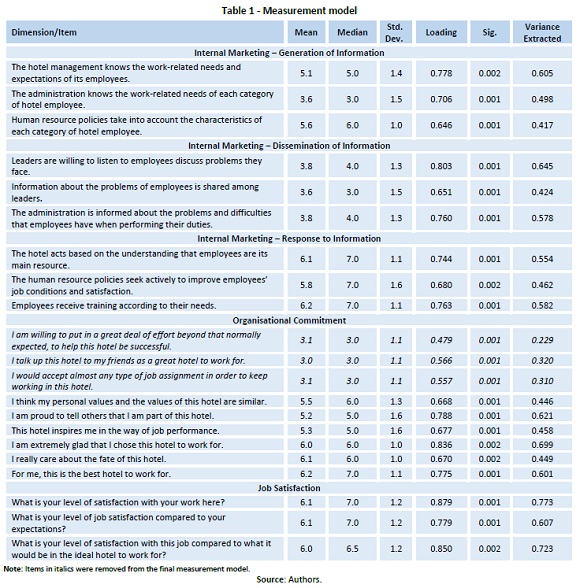
<body><![CDATA[<p><b>2.4 Job satisfaction</b></p>     <p>In general, job satisfaction is defined as a set of affective reactions or    attitudinal evaluations of a job or specific aspects of a job (Spector, 1985).    According to the cited author, besides an overall feeling of satisfaction, there    is also a perceptual- cognitive disconfirmation of certain job features, compared    to worker expectations. In the service sector, these perceptions are particularly    relevant due to their empirically confirmed connection to organisational results    (e.g. employee turnover rate). Job satisfaction thus affects how individuals    perceive various aspects directly or indirectly related to their work, resulting    in ‘potential effects&rsquo; on organisational and professional performance, individual    behaviour and workers&rsquo; physical and psychological well-being. Satisfaction influences    behaviours such as turnover and absenteeism and several work-related attitudes    that, in turn, influence the productivity and competitiveness of hotels (Davy,    Kinicki &amp; Scheck, 1991; Susskind, Borchgrevink, Michele Kacmar &amp; Brymer,    2000).</p>     <p><b>2.5 Relationship between internal marketing and job satisfaction</b></p>     <p>For authors such as Huang and Rundle-Thiele (2014), internal marketing practices    have a strong positive influence on job satisfaction, particularly in the hospitality    industry (Yang, 2010). Lee and Way&rsquo;s (2010) study, which was conducted in about    400 hotel units, revealed that hotel employees are more sensitive to communication    and trust within their work team and in relationships with their leaders, than    to financial compensation. Based on these findings, we defined the second hypothesis    to be tested as:</p>     <p><b>H2: </b>Internal marketing has a positive influence on job satisfaction.</p>     <p><b>2.6 Relationship between commitment and job satisfaction</b></p>     <p>A positive impact on job satisfaction is an intrinsic characteristic of the    original conceptual definition of organisational commitment (Mowday et al.,    1979). Along these lines, numerous academic studies have shown satisfaction    to be a result of commitment. Even though the inverse relationship is also common    in the literature (Eslami &amp; Gharakhani, 2012; Peters, Lau &amp; Ng, 2014;    Yang, 2010), we chose to test the following hypothesis:</p>     <p><b>H3: </b>Commitment has a positive influence on job satisfaction.</p>     <p><b>3. Methodology</b></p>     <p>This study sought to develop a structural model to evaluate the importance    of internal marketing on employee satisfaction within the hospitality industry.    The model used (see <a href="#f1">Figure 1</a>) involves the constructs of internal    marketing, organisational commitment and job satisfaction and displays their    relationships as defined by the hypotheses set out in the previous section.</p>     ]]></body>
<body><![CDATA[<p>&nbsp;</p>     <p align="center"><a name="f1"></a><img src="/img/revistas/tms/v14nespecial/14nespeciala04f1.jpg"/></p>     
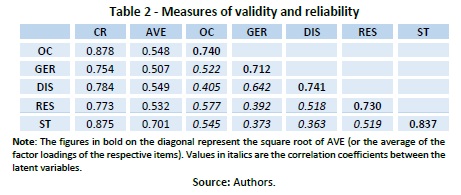
<p>&nbsp;</p> The data collection instrument was a questionnaire distributed to intermediate/lower  managers of four five-star hotels in Via Costeira, in the city of Natal, Rio Grande  do Norte, Brazil. The first section included background variables in order to  profile the employees (i.e. job tenure and function, sex, age, education and income),  while the second section consisted of items that measure employees&rsquo; commitment  and satisfaction, as well as their beliefs about their hotel&rsquo;s internal marketing  orientation. In addition, the survey included questions about the perceived quality  of service, a variable that is not directly discussed in this paper.      <p>To measure internal marketing, a traditional model of three dimensions was    adopted: information generation, dissemination of internal information and management    responses to internal marketing information. Items were taken from a scale validated    by García Rodríguez, Álvarez and Vijande (2011) with a sample of hotel managers.    Organisational commitment was measured with nine questions validated in Portugal    by Gomes (2006) , based on the scale developed by Mowday et al. (1979). The    satisfaction items were adapted to a work context (i.e. by considering the job/work,    instead of services, as the object of satisfaction) from the Portuguese version    of the European Customer Satisfaction Index (Fornell, Johnson, Anderson, Cha,    &amp; Bryant, 1996). All items were evaluated on a seven-point Likert scale.    Internal marketing and commitment were measured on an agreement scale (1 = ‘strongly    disagree&rsquo;, 7 = ‘strongly agree&rsquo;). Job satisfaction used a dis/satisfaction scale    (1 = ‘completely dissatisfied&rsquo;, 7 = ‘completely satisfied&rsquo;).</p>     <p>The target population of this study consisted of 245 employees from the selected    hotels - SERHS, Pestana, Ocean Palace and Pyramid. The sample was obtained by    applying a non- probability method, resulting in a total of 138 participants.    The sample profile is gender balanced, with 51% males, but it is mostly composed    by young (62% between 20 and 40 years old) well educated (69% with tertiary    education) professionals, working at supervision (47%) or co-ordination (44%)    positions. The survey was conducted between 21 January and 7 April, 2013.</p>     <p>To evaluate the proposed model, the measurements were first validated through    confirmatory factor analysis. According to Hair, Black, Babin and Anderson&rsquo;s    (2010) guidelines for how to apply Fornell and Larcker&rsquo;s (1981) propositions,    measures of latent variables can be accepted if the composite reliability (CR)    is greater than 0.7, the average variance extracted (AVE) is greater than 50%    and the average of items&rsquo; factor loadings is higher than any correlation between    this variable and every other latent variable. Since it was necessary to assess    whether organisational commitment mediates the relationship between internal    marketing and job satisfaction, the present study&rsquo;s structural analysis followed    the procedures proposed by Shrout and Bolger (2002) for mediation analysis.</p>     <p><b>4. Results</b></p>     <p>Internal marketing involves the generation and dissemination of information    and the design and implementation of management&rsquo;s appropriate responses to employees&rsquo;    needs and wants. <a href="#t1">Table 1</a> shows that, among the three dimensions    of internal marketing, dissemination of information has the lowest rating from    the participating employees. These results indicate that the hotels selected    are failing to disseminate information concerning problems and difficulties    faced by employees when performing their duties. Nevertheless, staff do believe    that the administration is effectively managing their responses to the information,    offering appropriate training and keeping the best human resources.</p>     <p>&nbsp;</p>     <p align="center"><a name="t1"></a><img src="/img/revistas/tms/v14nespecial/14nespeciala04t1.jpg"/></p>     
]]></body>
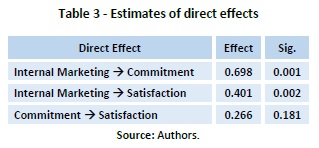
<body><![CDATA[<p>&nbsp;</p>     <p>The construct of satisfaction has the best rating of all the factors that make    up the proposed theoretical model, obtaining an average of 6.1 out of seven    points possible. This assessment may indicate that, in general, employees believe    an appropriate relationship exists between what they expect of their work and    what they perceive they have experienced.</p>     <p>Regarding organisational commitment, the ratings suggest that employees are    affectively attached to their hotel and satisfied with the decision to work    there, but they do not want to keep their job at any price, that is, they are    not willing to exert much more effort than they do now to guarantee their hotel&rsquo;s    success and, ultimately, their best job performance. The items with the smallest    scores (i.e. in italics) have smaller correlations than the rest of the scale,    resulting in poor factor loadings and high measurement error. These items, thus,    were excluded from further analyses.</p>     <p>After withdrawing these three items, the latent variable of organisational    commitment now presents convergent validity (AVE = 0.548), while maintaining    a high CR value (0.878) (see <a href="#t2">Table 2</a>). Items of all other    latent variables have satisfactory values of variance extracted, thus providing    an AVE greater than 0.5 for all variables, which attests to the model&rsquo;s convergent    validity. The CR also is higher than 0.7 in all cases. As can be seen in <a href="#t2">Table    2</a>, the averages of factor loadings are higher than the correlation coefficients,    which is why, although related, all these latent variables represent discriminated    concepts or dimensions. Measures of goodness of fit reinforce the confidence    on the measurements&rsquo; validity: &#967;2/d.f. = 1.438; CFI = 0.95; RMSEA = 0.057;    p(RMSEA) &#8804; 0.05 = 0.271.</p>     <p>&nbsp;</p>     <p align="center"><a name="t2"></a><img src="/img/revistas/tms/v14nespecial/14nespeciala04t2.jpg"/></p>     
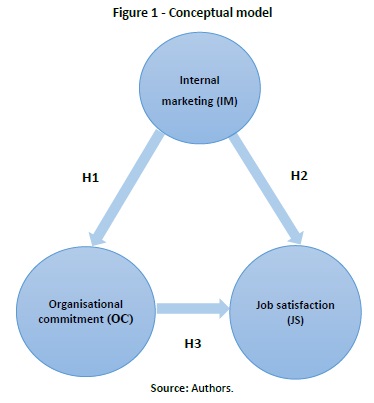
<p>&nbsp;</p>     <p>After the measurement model was validated by confirming that its constructs    are reliable and valid, the structural model was evaluated by analysing the    structural relationships between the latent variables presented in the aforementioned    hypotheses (see <a href="#f1">Figure 1</a> above). Since internal marketing    is conceptualised as a second-order variable, the direct effects of the three    proposed relationships, estimated using bootstrapping, are presented in <a href="#t3">Table    3</a> below. Given that the relationship between commitment and satisfaction    is shown to be statistically non-significant, the indirect effect of internal    marketing on satisfaction also is non-significant. The model has an acceptable    goodness of fit, as indicated by the statistics: &#967;2/d.f. = 1.504; CFI =    0.941; RMSEA = 0.061; p(RMSEA) &#8804; 0.05 = 0.158.</p>     <p>&nbsp;</p>     <p align="center"><a name="t3"></a><img src="/img/revistas/tms/v14nespecial/14nespeciala04t3.jpg"/></p>     
]]></body>
<body><![CDATA[<p>&nbsp;</p>     <p>Based on <a href="#t3">Table 3</a> and an analysis of the significance levels,    hypotheses H1 (i.e. internal marketing has a positive influence on organisational    commitment) and H2 (i.e. internal marketing has a positive influence on job    satisfaction) can be considered verified. However, the third hypothesis (i.e.    H3: organisational commitment has a positive influence on job satisfaction)    could not be confirmed (Sig. = 0.181).</p>     <p><b>5. Conclusions</b></p>     <p>Organisations currently face multi-faceted challenges in how not only to increase    productivity but also to deal with the pressure to manage their human resources    efficiently and effectively, including training and keeping their best employees.    Management practices and policies, therefore, must seek to overcome these challenges.    In this context, the present study sought to analyse the contribution of internal    marketing to workers&rsquo; satisfaction levels in top category hotels.</p>     <p>To this end, a conceptual model was validated using structural equation modelling    to analyse the role of internal marketing and organisational commitment in workers&rsquo;    job satisfaction for hotels in Via Costeira, in the city of Natal, Rio Grande    do Norte, Brazil. The results show a positive and statistically significant    relationship between organisational commitment and the latent variable of internal    marketing orientation. This means that, when a system of internal marketing    is correctly implemented, this has a positive influence on organisational commitment.    The results also confirm that a positive and statistically significant relationship    exists between internal marketing and workers&rsquo; satisfaction. These findings    highlight the importance of internal marketing when management seeks to create    a positive image of the workplace in employees&rsquo; minds.</p>     <p>However, the results do not confirm a statistically significant relationship    between organisational commitment and job satisfaction, a finding that is in    agreement with some studies that found an ambiguous and inconsistent relationship    between these dimensions (Moynihan, Boswell &amp; Boudreau, 2000). Nonetheless,    the use of a measure of satisfaction adapted for consumer surveys, instead of    a measure specifically focused on job satisfaction, may help to explain the    present results.</p>     <p>The current study provides evidence of internal marketing&rsquo;s crucial importance    in hotel management, since this practice affects workers&rsquo; job satisfaction and    commitment to their hotel. In this way, management must acknowledge that employees    are internal clients of their hotel firms, which then allows managers to apply    marketing tools and techniques in this context. It also unveils the need to    further explore why respondents consider that the organization is responsive    to employees&rsquo; needs, despite the ineffective flow of information regarding the    same employees.</p>     <p>Some methodological limitations need to be considered when interpreting the    above results. Although the sample collected was adequate for the purposes of    this study, the sample cannot be considered representative of the general population.    Sampling was limited to one single Brazilian city and extracted only from top-quality    large hotels, which partially limits the generalisability of the results. Furthermore,    this study did not test for the existence of a relationship between workers&rsquo;    satisfaction and performance levels, as suggested in the literature (Ahearne,    Jelinek &amp; Rapp, 2005; Williams &amp; Anderson, 1991).</p>     <p>These limitations suggest several future avenues of research. First, new studies    can expand this research geographically. Second, the model&rsquo;s applicability can    be tested for other patterns and segments of the hospitality industry. In future    research, the results also can be divided by categories of employees and hotels.    Third, researchers can study the direct relationships between dependent variables    and the three dimensions of internal marketing (i.e. information generation,    internal dissemination of information and management responses). And last, employees&rsquo;    turnover intentions and perceptions of service delivery may be considered as    dependent variables.</p>     <p>In conclusion, the above findings indicate that hotel managers need to focus    more directly on developing their employees&rsquo; competencies in order to improve    quality of service, job satisfaction, best employee retention and worker performance,    as well as reducing turnover. In this way, hotels can achieve high standards    of quality and develop distinctive services that can satisfy the needs of a    patronage that is increasingly well informed and demanding, thus allowing hotels    to reach a strategic level of differentiation in the market.</p>     ]]></body>
<body><![CDATA[<p>&nbsp;</p>     <p><b>REFERENCES</B></p>     <!-- ref --><p>Ahearne, M., Jelinek, R., &amp; Rapp, A. (2005). Moving beyond the direct effect    of SFA adoption on salesperson performance: Training and support as key moderating    factors. <i>Industrial Marketing Management</i>, <i>34</i>(4 SPEC ISS.), 379-388.    DOI: <a href="https://dx.doi.org/10.1016/j.indmarman.2004.09.020" target="_blank">10.1016/j.indmarman.2004.09.020</a>.    &nbsp;&nbsp;&nbsp;&nbsp;&nbsp;&nbsp;&nbsp;&nbsp;[&#160;<a href="javascript:void(0);" onclick="javascript: window.open('/scielo.php?script=sci_nlinks&ref=1280432&pid=S2182-8458201800050000400001&lng=','','width=640,height=500,resizable=yes,scrollbars=1,menubar=yes,');">Links</a>&#160;]<!-- end-ref --></p>     <!-- ref --><p>Allen, N. J., &amp; Meyer, J. P. (1996). Affective, Continuance, and Normative    Commitment to the Organization: An Examination of Construct Validity. <i>Journal    of Vocational Behavior</i>, <i>49</i>(3), 252-276. DOI: <a href="https://dx.doi.org/10.1006/jvbe.1996.0043" target="_blank">10.1006/jvbe.1996.0043</a>.    &nbsp;&nbsp;&nbsp;&nbsp;&nbsp;&nbsp;&nbsp;&nbsp;[&#160;<a href="javascript:void(0);" onclick="javascript: window.open('/scielo.php?script=sci_nlinks&ref=1280434&pid=S2182-8458201800050000400002&lng=','','width=640,height=500,resizable=yes,scrollbars=1,menubar=yes,');">Links</a>&#160;]<!-- end-ref --></p>     <!-- ref --><p>Berry, L. L. (1981). The Employee as Customer. <i>Journal of Retail Banking</i>,    <i>III</i>(1), 33-40.    &nbsp;&nbsp;&nbsp;&nbsp;&nbsp;&nbsp;&nbsp;&nbsp;[&#160;<a href="javascript:void(0);" onclick="javascript: window.open('/scielo.php?script=sci_nlinks&ref=1280436&pid=S2182-8458201800050000400003&lng=','','width=640,height=500,resizable=yes,scrollbars=1,menubar=yes,');">Links</a>&#160;]<!-- end-ref --></p>     <p>Berry, L. L., Hensel, J. S., &amp; Burke, M. C. (1976). Improving retailer    capability for effective consumerism response. <i>Journal of Retailing</i>,    <i>52</i>(3).</p>     <!-- ref --><p>Carvalho, L. M. C., &amp; Sarkar, S. (2014). Market structures, strategy and    innovation in tourism sector. <i>International Journal of Culture, Tourism and    Hospitality Research</i>, <i>8</i>(2), 153-172. DOI: <a href="https://dx.doi.org/10.1108/IJCTHR-05-2013-0031" target="_blank">10.1108/IJCTHR-05-2013-0031</a>.    &nbsp;&nbsp;&nbsp;&nbsp;&nbsp;&nbsp;&nbsp;&nbsp;[&#160;<a href="javascript:void(0);" onclick="javascript: window.open('/scielo.php?script=sci_nlinks&ref=1280439&pid=S2182-8458201800050000400005&lng=','','width=640,height=500,resizable=yes,scrollbars=1,menubar=yes,');">Links</a>&#160;]<!-- end-ref --></p>     <p>Cascio, R., Mariadoss, B. J., &amp; Mouri, N. (2010). The impact of management    commitment alignment on salespersons&rsquo; adoption of sales force automation technologies:    An empirical investigation. <i>Industrial Marketing Management</i>, <i>39</i>(7),    1088-1096. DOI: <a href="https://dx.doi.org/ 10.1016/j.indmarman.2009.12.010" target="_blank"> 10.1016/j.indmarman.2009.12.010</a>.</p>     <p>Clark, R. A., Hartline, M. D., &amp; Jones, K. C. (2008). The Effects of Leadership    Style on Hotel Employees&rsquo; Commitment to Service Quality. <i>Cornell Hospitality    Quarterly</i>, <i>50</i>(2), 209-231. DOI: <a href="https://dx.doi.org/10.1177/1938965508315371" target="_blank">10.1177/1938965508315371</a>.</p>     <!-- ref --><p>Davy, J. A., Kinicki, A. J., &amp; Scheck, C. L. (1991). Developing and testing    a model of survivor responses to layoffs. <i>Journal of Vocational Behavior</i>,    <i>38</i>(3), 302-317. DOI: <a href="https://dx.doi.org/10.1016/0001-8791(91)90032-H" target="_blank">10.1016/0001-8791(91)90032-H</a>.    &nbsp;&nbsp;&nbsp;&nbsp;&nbsp;&nbsp;&nbsp;&nbsp;[&#160;<a href="javascript:void(0);" onclick="javascript: window.open('/scielo.php?script=sci_nlinks&ref=1280443&pid=S2182-8458201800050000400008&lng=','','width=640,height=500,resizable=yes,scrollbars=1,menubar=yes,');">Links</a>&#160;]<!-- end-ref --></p>     <!-- ref --><p>Eslami, J., &amp; Gharakhani, D. (2012). Organizational Commitment and Job    Satisfaction. <i>Journal of Science and Technology</i>, <i>2</i>(2), 85-91.    &nbsp;&nbsp;&nbsp;&nbsp;&nbsp;&nbsp;&nbsp;&nbsp;[&#160;<a href="javascript:void(0);" onclick="javascript: window.open('/scielo.php?script=sci_nlinks&ref=1280445&pid=S2182-8458201800050000400009&lng=','','width=640,height=500,resizable=yes,scrollbars=1,menubar=yes,');">Links</a>&#160;]<!-- end-ref --></p>     <!-- ref --><p>Fornell, C., Johnson, M. D., Anderson, E. W., Cha, J., &amp; Bryant, B. E.    (1996). The American Customer Satisfaction Index: Nature, Purpose, and Findings.    <i>Journal of Marketing</i>, <i>60</i>(4), 7. DOI: <a href="https://dx.doi.org/10.2307/1251898" target="_blank">10.2307/1251898</a>.    &nbsp;&nbsp;&nbsp;&nbsp;&nbsp;&nbsp;&nbsp;&nbsp;[&#160;<a href="javascript:void(0);" onclick="javascript: window.open('/scielo.php?script=sci_nlinks&ref=1280447&pid=S2182-8458201800050000400010&lng=','','width=640,height=500,resizable=yes,scrollbars=1,menubar=yes,');">Links</a>&#160;]<!-- end-ref --></p>     <!-- ref --><p>Fornell, C., &amp; Larcker, D. (1981). Evaluating structural equation models    with unobservable variables and measurement error. <i>Journal of Marketing Research</i>,    <i>18</i>(3), 39-50. DOI: <a href="https://dx.doi.org/10.2307/3151312" target="_blank">10.2307/3151312</a>.    &nbsp;&nbsp;&nbsp;&nbsp;&nbsp;&nbsp;&nbsp;&nbsp;[&#160;<a href="javascript:void(0);" onclick="javascript: window.open('/scielo.php?script=sci_nlinks&ref=1280449&pid=S2182-8458201800050000400011&lng=','','width=640,height=500,resizable=yes,scrollbars=1,menubar=yes,');">Links</a>&#160;]<!-- end-ref --></p>     <!-- ref --><p>García Rodríguez, N., Álvarez, B., &amp; Vijande, M. . L. S. (2011). Aplicación    de la Lógica Dominante del servicio (LDS) en el sector turístico: el marketing    interno como antecedente de la cultura de co-creación de innovaciones con clientes    y empleados. <i>Cuadernos de Gestión</i>, <i>11</i>(2), 53-75. Retrieved from    <a href="http://www.redalyc.org/articulo.oa?id=274320119003" target="_blank">http://www.redalyc.org/articulo.oa?id=274320119003</a>&nbsp;&nbsp;&nbsp;&nbsp;&nbsp;&nbsp;&nbsp;&nbsp;[&#160;<a href="javascript:void(0);" onclick="javascript: window.open('/scielo.php?script=sci_nlinks&ref=1280451&pid=S2182-8458201800050000400012&lng=','','width=640,height=500,resizable=yes,scrollbars=1,menubar=yes,');">Links</a>&#160;]<!-- end-ref --><!-- ref --><p>Gomes. (2006). <i>Escala de comprometimento organizacional (ECO) - Versão para    investigação. </i>Universidade do Minho.    &nbsp;&nbsp;&nbsp;&nbsp;&nbsp;&nbsp;&nbsp;&nbsp;[&#160;<a href="javascript:void(0);" onclick="javascript: window.open('/scielo.php?script=sci_nlinks&ref=1280452&pid=S2182-8458201800050000400013&lng=','','width=640,height=500,resizable=yes,scrollbars=1,menubar=yes,');">Links</a>&#160;]<!-- end-ref --></p>     <p>Hackett, Rick D.; Bycio, Peter; Hausdorf, P. A. (1991). Further assessments    of Meyer and Allen&rsquo;s (1991) three-component model of organizational commitment.    <i>Human Resource Management Review</i>, <i>1</i>(1), 61-89.</p>     <!-- ref --><p>Hair, J. F., Black, W. C., Babin, B. J., &amp; Anderson, R. E. (2010). Multivariate    Data Analysis. <i>Vectors</i>. DOI: <a href="https://dx.doi.org/ 10.1016/j.ijpharm.2011.02.019" target="_blank"> 10.1016/j.ijpharm.2011.02.019</a>.    &nbsp;&nbsp;&nbsp;&nbsp;&nbsp;&nbsp;&nbsp;&nbsp;[&#160;<a href="javascript:void(0);" onclick="javascript: window.open('/scielo.php?script=sci_nlinks&ref=1280455&pid=S2182-8458201800050000400015&lng=','','width=640,height=500,resizable=yes,scrollbars=1,menubar=yes,');">Links</a>&#160;]<!-- end-ref --></p>     <!-- ref --><p>Huang, Y.-T., &amp; Rundle-Thiele, S. (2014). The moderating effect of cultural    congruence on the internal marketing practice and employee satisfaction relationship:    An empirical examination of Australian and Taiwanese born tourism employees.    <i>Tourism Management</i>, <i>42</i>, 196-206. DOI: <a href="https://dx.doi.org/ 10.1016/j.tourman.2013.12.005" target="_blank"> 10.1016/j.tourman.2013.12.005</a>.    &nbsp;&nbsp;&nbsp;&nbsp;&nbsp;&nbsp;&nbsp;&nbsp;[&#160;<a href="javascript:void(0);" onclick="javascript: window.open('/scielo.php?script=sci_nlinks&ref=1280457&pid=S2182-8458201800050000400016&lng=','','width=640,height=500,resizable=yes,scrollbars=1,menubar=yes,');">Links</a>&#160;]<!-- end-ref --></p>     <!-- ref --><p>Kim, W. G., Leong, J. K., &amp; Lee, Y. K. (2005). Effect of service orientation    on job satisfaction, organizational commitment, and intention of leaving in    a casual dining chain restaurant. <i>International Journal of Hospitality Management</i>,    <i>24</i>(2), 171-193. DOI: <a href="https://dx.doi.org/ 10.1016/j.ijhm.2004.05.004" target="_blank"> 10.1016/j.ijhm.2004.05.004</a>.    &nbsp;&nbsp;&nbsp;&nbsp;&nbsp;&nbsp;&nbsp;&nbsp;[&#160;<a href="javascript:void(0);" onclick="javascript: window.open('/scielo.php?script=sci_nlinks&ref=1280459&pid=S2182-8458201800050000400017&lng=','','width=640,height=500,resizable=yes,scrollbars=1,menubar=yes,');">Links</a>&#160;]<!-- end-ref --></p>     <!-- ref --><p>Lee, C., &amp; Way, K. (2010). Individual employment characteristics of hotel    employees that play a role in employee satisfaction and work retention. <i>International    Journal of Hospitality Management</i>, <i>29</i>(3), 344-353. DOI: <a href="https://dx.doi.org/10.1016/j.ijhm.2009.08.008" target="_blank">10.1016/j.ijhm.2009.08.008</a>.    &nbsp;&nbsp;&nbsp;&nbsp;&nbsp;&nbsp;&nbsp;&nbsp;[&#160;<a href="javascript:void(0);" onclick="javascript: window.open('/scielo.php?script=sci_nlinks&ref=1280461&pid=S2182-8458201800050000400018&lng=','','width=640,height=500,resizable=yes,scrollbars=1,menubar=yes,');">Links</a>&#160;]<!-- end-ref --></p>     <!-- ref --><p>Lee, Y. K., Park, D. H., &amp; Yoo, D. K. (1999). The structural relationships    between service orientation, mediators, and business performance in Korean hotel    firms. <i>Asia Pacific Journal of Tourism Research</i>, <i>4</i>(1), 59-70.    DOI: <a href="https://dx.doi.org/10.1080/10941669908722031" target="_blank">10.1080/10941669908722031</a>.    &nbsp;&nbsp;&nbsp;&nbsp;&nbsp;&nbsp;&nbsp;&nbsp;[&#160;<a href="javascript:void(0);" onclick="javascript: window.open('/scielo.php?script=sci_nlinks&ref=1280463&pid=S2182-8458201800050000400019&lng=','','width=640,height=500,resizable=yes,scrollbars=1,menubar=yes,');">Links</a>&#160;]<!-- end-ref --></p>     <!-- ref --><p>Lings, I. N., &amp; Greenley, G. E. (2010). Internal market orientation and    market- oriented behaviours. <i>Journal of Service Management</i>, <i>21</i>(3),    321-343. DOI: <a href="https://dx.doi.org/ 10.1108/09564231011050788" target="_blank"> 10.1108/09564231011050788</a>.    &nbsp;&nbsp;&nbsp;&nbsp;&nbsp;&nbsp;&nbsp;&nbsp;[&#160;<a href="javascript:void(0);" onclick="javascript: window.open('/scielo.php?script=sci_nlinks&ref=1280465&pid=S2182-8458201800050000400020&lng=','','width=640,height=500,resizable=yes,scrollbars=1,menubar=yes,');">Links</a>&#160;]<!-- end-ref --></p>     <!-- ref --><p>Locke, E., &amp; Latham, G. (2002). Building a practically useful theory of    goal setting and task motivation. A 35-year odyssey. <i>The American Psychologist</i>,    <i>57</i>(9), 705- 717. DOI: <a href="https://dx.doi.org/ 10.1037/0003-066X.57.9.705" target="_blank"> 10.1037/0003-066X.57.9.705</a>.    &nbsp;&nbsp;&nbsp;&nbsp;&nbsp;&nbsp;&nbsp;&nbsp;[&#160;<a href="javascript:void(0);" onclick="javascript: window.open('/scielo.php?script=sci_nlinks&ref=1280467&pid=S2182-8458201800050000400021&lng=','','width=640,height=500,resizable=yes,scrollbars=1,menubar=yes,');">Links</a>&#160;]<!-- end-ref --></p>     <!-- ref --><p>Lovelock, C., &amp; Wirtz, J. (2004). Services Marketing: People, Technology,    Strategy, (January 2011).    &nbsp;&nbsp;&nbsp;&nbsp;&nbsp;&nbsp;&nbsp;&nbsp;[&#160;<a href="javascript:void(0);" onclick="javascript: window.open('/scielo.php?script=sci_nlinks&ref=1280469&pid=S2182-8458201800050000400022&lng=','','width=640,height=500,resizable=yes,scrollbars=1,menubar=yes,');">Links</a>&#160;]<!-- end-ref --></p>     <!-- ref --><p>Mathieu, J. E., &amp; Zajac, D. M. (1990). A review and meta-analysis of the    antecedents, correlates, and consequences of organizational commitment. <i>Psychological    Bulletin</i>, <i>108</i>(2), 171-194.    &nbsp;&nbsp;&nbsp;&nbsp;&nbsp;&nbsp;&nbsp;&nbsp;[&#160;<a href="javascript:void(0);" onclick="javascript: window.open('/scielo.php?script=sci_nlinks&ref=1280471&pid=S2182-8458201800050000400023&lng=','','width=640,height=500,resizable=yes,scrollbars=1,menubar=yes,');">Links</a>&#160;]<!-- end-ref --></p>     <!-- ref --><p>Meyer, J. P., &amp; Allen, N. J. (1991). A three-component conceptualization    of organizational commitment. <i>Human Resource Management Review</i>, <i>1</i>(1),    61-89. DOI: <a href="https://dx.doi.org/ 10.1016/1053-4822(91)90011-Z" target="_blank"> 10.1016/1053-4822(91)90011-Z</a>.    &nbsp;&nbsp;&nbsp;&nbsp;&nbsp;&nbsp;&nbsp;&nbsp;[&#160;<a href="javascript:void(0);" onclick="javascript: window.open('/scielo.php?script=sci_nlinks&ref=1280473&pid=S2182-8458201800050000400024&lng=','','width=640,height=500,resizable=yes,scrollbars=1,menubar=yes,');">Links</a>&#160;]<!-- end-ref --></p>     <!-- ref --><p>Mowday, R. T., Steers, R. M., &amp; Porter, L. W. (1979). The measurement of    organizational commitment. <i>Journal of Vocational Behavior</i>, <i>14</i>(2),    224-247. DOI: <a href="https://dx.doi.org/ 10.1016/0001-8791(79)90072-1" target="_blank"> 10.1016/0001-8791(79)90072-1</a>.    &nbsp;&nbsp;&nbsp;&nbsp;&nbsp;&nbsp;&nbsp;&nbsp;[&#160;<a href="javascript:void(0);" onclick="javascript: window.open('/scielo.php?script=sci_nlinks&ref=1280475&pid=S2182-8458201800050000400025&lng=','','width=640,height=500,resizable=yes,scrollbars=1,menubar=yes,');">Links</a>&#160;]<!-- end-ref --></p>     <p>Moynihan, L.M., Boswell, W.R., &amp; Boudreau, J. W. (2000). <i>The influence    of job satisfaction and organizational commitment on executive withdrawal and    performance. </i>(CAHRS Working Paper 00-16). Ithaca, NY: Cornell University.</p>     <!-- ref --><p>Mukerjee, K. (2014). Fostering employee engagement in organisations: a conceptual    framework. <i>International Journal of Management Practice</i>, <i>7</i>(2),    160- 176. DOI: <a href="https://dx.doi.org/ 10.1504/IJMP.2014.061476" target="_blank"> 10.1504/IJMP.2014.061476</a>.    &nbsp;&nbsp;&nbsp;&nbsp;&nbsp;&nbsp;&nbsp;&nbsp;[&#160;<a href="javascript:void(0);" onclick="javascript: window.open('/scielo.php?script=sci_nlinks&ref=1280478&pid=S2182-8458201800050000400027&lng=','','width=640,height=500,resizable=yes,scrollbars=1,menubar=yes,');">Links</a>&#160;]<!-- end-ref --></p>     ]]></body>
<body><![CDATA[<!-- ref --><p>Pechlaner, H., Kozak, M., &amp; Volgger, M. (2014). Destination leadership:    a new paradigm for tourist destinations? <i>Tourism Review</i>, <i>69</i>(1),    1-9. DOI: <a href="https://dx.doi.org/10.1108/TR-09-2013-0053" target="_blank">10.1108/TR-09-2013-0053</a>.    &nbsp;&nbsp;&nbsp;&nbsp;&nbsp;&nbsp;&nbsp;&nbsp;[&#160;<a href="javascript:void(0);" onclick="javascript: window.open('/scielo.php?script=sci_nlinks&ref=1280480&pid=S2182-8458201800050000400028&lng=','','width=640,height=500,resizable=yes,scrollbars=1,menubar=yes,');">Links</a>&#160;]<!-- end-ref --></p>     <!-- ref --><p>Pereira-Moliner, J., Claver-Cortés, E., Molina-Azorín, J. F., &amp; José Tarí,    J. (2012). Quality management, environmental management and firm performance:    direct and mediating effects in the hotel industry. <i>Journal of Cleaner Production</i>,    <i>37</i>, 82- 92. DOI: <a href="https://dx.doi.org/10.1016/j.jclepro.2012.06.010" target="_blank">10.1016/j.jclepro.2012.06.010</a>.    &nbsp;&nbsp;&nbsp;&nbsp;&nbsp;&nbsp;&nbsp;&nbsp;[&#160;<a href="javascript:void(0);" onclick="javascript: window.open('/scielo.php?script=sci_nlinks&ref=1280482&pid=S2182-8458201800050000400029&lng=','','width=640,height=500,resizable=yes,scrollbars=1,menubar=yes,');">Links</a>&#160;]<!-- end-ref --></p>     <p>Peters, S., Lau, T.-C., &amp; Ng, C.-Y. (2014). Determinants of job satisfaction    and ethical behaviour towards organisational commitment-a review. <i>&hellip; Journal    of Academic Research in Business &hellip;</i>, <i>4</i>(7), 573-592. DOI: <a href="https://dx.doi.org/10.6007/IJARBSS/v4-i7/1052" target="_blank">10.6007/IJARBSS/v4-i7/1052</a>.</p>     <!-- ref --><p>Sahai, S., &amp; Srivastava, A. K. (2012). Goal / target Setting and Performance    Assessment as Tool for Talent Management. <i>Procedia - Social and Behavioral    Sciences</i>, <i>37</i>, 241-246. DOI: <a href="https://dx.doi.org/ 10.1016/j.sbspro.2012.03.290" target="_blank"> 10.1016/j.sbspro.2012.03.290</a>.    &nbsp;&nbsp;&nbsp;&nbsp;&nbsp;&nbsp;&nbsp;&nbsp;[&#160;<a href="javascript:void(0);" onclick="javascript: window.open('/scielo.php?script=sci_nlinks&ref=1280485&pid=S2182-8458201800050000400031&lng=','','width=640,height=500,resizable=yes,scrollbars=1,menubar=yes,');">Links</a>&#160;]<!-- end-ref --></p>     <!-- ref --><p>Shrout, P. E., &amp; Bolger, N. (2002). Mediation in experimental and nonexperimental    studies: new procedures and recommendations. <i>Psychological Methods</i>, <i>7</i>(4),    422. DOI: <a href="https://dx.doi.org/10.1037//1082-989x.7.4.422" target="_blank">10.1037//1082-989x.7.4.422</a>.    &nbsp;&nbsp;&nbsp;&nbsp;&nbsp;&nbsp;&nbsp;&nbsp;[&#160;<a href="javascript:void(0);" onclick="javascript: window.open('/scielo.php?script=sci_nlinks&ref=1280487&pid=S2182-8458201800050000400032&lng=','','width=640,height=500,resizable=yes,scrollbars=1,menubar=yes,');">Links</a>&#160;]<!-- end-ref --></p>     <!-- ref --><p>Spector, P. E. (1985). Measurement of Human Service Staff Satisfaction: Development    of the Job Satisfaction Survey. <i>American Journal of Community Psychology</i>,    <i>13</i>(6), 693.    &nbsp;&nbsp;&nbsp;&nbsp;&nbsp;&nbsp;&nbsp;&nbsp;[&#160;<a href="javascript:void(0);" onclick="javascript: window.open('/scielo.php?script=sci_nlinks&ref=1280489&pid=S2182-8458201800050000400033&lng=','','width=640,height=500,resizable=yes,scrollbars=1,menubar=yes,');">Links</a>&#160;]<!-- end-ref --></p>     <p>Susskind, A. M., Borchgrevink, C. P., Michele Kacmar, K., &amp; Brymer, R.    A. (2000). Customer service employees&rsquo; behavioral intentions and attitudes:    an examination of construct validity and a path model. <i>International Journal    of Hospitality Management</i>, <i>19</i>(1), 53-77. DOI: <a href="https://dx.doi.org/10.1016/S0278-4319(99)00030-4" target="_blank">10.1016/S0278-4319(99)00030-4</a>.</p>     <!-- ref --><p>Tag-Eldeen, A., &amp; El-Said, O. A. (2011). Implementation of internal marketing    on a sample of Egyptian five-star hotels. <i>Anatolia</i>, <i>22</i>(2), 153-167.    DOI: <a href="https://dx.doi.org/ 10.1080/13032917.2011.597931" target="_blank"> 10.1080/13032917.2011.597931</a>.    &nbsp;&nbsp;&nbsp;&nbsp;&nbsp;&nbsp;&nbsp;&nbsp;[&#160;<a href="javascript:void(0);" onclick="javascript: window.open('/scielo.php?script=sci_nlinks&ref=1280492&pid=S2182-8458201800050000400035&lng=','','width=640,height=500,resizable=yes,scrollbars=1,menubar=yes,');">Links</a>&#160;]<!-- end-ref --></p>     <!-- ref --><p>UNWTO. (2015). 21 million more international tourists in the first half of    2015 | World Tourism Organization UNWTO. Retrieved May 26, 2016, from <a href="http://media.unwto.org/" target="_blank">http://media.unwto.org</a>&nbsp;&nbsp;&nbsp;&nbsp;&nbsp;&nbsp;&nbsp;&nbsp;[&#160;<a href="javascript:void(0);" onclick="javascript: window.open('/scielo.php?script=sci_nlinks&ref=1280494&pid=S2182-8458201800050000400036&lng=','','width=640,height=500,resizable=yes,scrollbars=1,menubar=yes,');">Links</a>&#160;]<!-- end-ref --><!-- ref --><p>Williams, L. J., &amp; Anderson, S. E. (1991). Job satisfaction and organizational    commitment as predictors of organizational citizenship and in-role behaviors.    <i>Journal of Management</i>. DOI: <a href="https://dx.doi.org/10.1177/014920639101700305" target="_blank">10.1177/014920639101700305</a>.    &nbsp;&nbsp;&nbsp;&nbsp;&nbsp;&nbsp;&nbsp;&nbsp;[&#160;<a href="javascript:void(0);" onclick="javascript: window.open('/scielo.php?script=sci_nlinks&ref=1280495&pid=S2182-8458201800050000400037&lng=','','width=640,height=500,resizable=yes,scrollbars=1,menubar=yes,');">Links</a>&#160;]<!-- end-ref --></p>     <!-- ref --><p>Wu, J., Tsai, H., &amp; Zhou, Z. (2011). Improving efficiency in international    tourist hotels in Taipei using a non-radial DEA model. <i>International Journal    of Contemporary Hospitality Management</i>, <i>23</i>(1), 66-83. DOI: <a href="https://dx.doi.org/10.1108/09596111111101670" target="_blank">10.1108/09596111111101670</a>.    &nbsp;&nbsp;&nbsp;&nbsp;&nbsp;&nbsp;&nbsp;&nbsp;[&#160;<a href="javascript:void(0);" onclick="javascript: window.open('/scielo.php?script=sci_nlinks&ref=1280497&pid=S2182-8458201800050000400038&lng=','','width=640,height=500,resizable=yes,scrollbars=1,menubar=yes,');">Links</a>&#160;]<!-- end-ref --></p>     <!-- ref --><p>Yang, J. Te. (2010). Antecedents and consequences of job satisfaction in the    hotel industry. <i>International Journal of Hospitality Management</i>, <i>29</i>(4),    609-619. DOI: <a href="https://dx.doi.org/ 10.1016/j.ijhm.2009.11.002" target="_blank"> 10.1016/j.ijhm.2009.11.002</a>.    &nbsp;&nbsp;&nbsp;&nbsp;&nbsp;&nbsp;&nbsp;&nbsp;[&#160;<a href="javascript:void(0);" onclick="javascript: window.open('/scielo.php?script=sci_nlinks&ref=1280499&pid=S2182-8458201800050000400039&lng=','','width=640,height=500,resizable=yes,scrollbars=1,menubar=yes,');">Links</a>&#160;]<!-- end-ref --></p>     <p>&nbsp;</p>     <p><b>Acknowledgments</b></p>     <p>This work is partially supported by the European Structural and Investment    Funds&rsquo; FEDER component, through the Operational Competitiveness and Internationalization    Program (COMPETE 2020) (Project No. 006971 [UID/SOC/04011]), and national funds,    through the FCT-Portuguese Foundation for Science and Technology through the    UID/SOC/04011/2013 project.</p>     <p>&nbsp;</p>     <p>Received: 15 February 2017</p>     <p>Revisions required: 14 May 2017</p>     <p>Accepted: 18 July 2017</p>      ]]></body><back>
<ref-list>
<ref id="B1">
<nlm-citation citation-type="journal">
<person-group person-group-type="author">
<name>
<surname><![CDATA[Ahearne]]></surname>
<given-names><![CDATA[M.]]></given-names>
</name>
<name>
<surname><![CDATA[Jelinek]]></surname>
<given-names><![CDATA[R.]]></given-names>
</name>
<name>
<surname><![CDATA[Rapp]]></surname>
<given-names><![CDATA[A.]]></given-names>
</name>
</person-group>
<article-title xml:lang="en"><![CDATA[Moving beyond the direct effect of SFA adoption on salesperson performance: Training and support as key moderating factors]]></article-title>
<source><![CDATA[Industrial Marketing Management]]></source>
<year>2005</year>
<volume>34</volume>
<numero>4 SPEC ISS.</numero>
<issue>4 SPEC ISS.</issue>
<page-range>379-388</page-range></nlm-citation>
</ref>
<ref id="B2">
<nlm-citation citation-type="journal">
<person-group person-group-type="author">
<name>
<surname><![CDATA[Allen]]></surname>
<given-names><![CDATA[N. J.]]></given-names>
</name>
<name>
<surname><![CDATA[Meyer]]></surname>
<given-names><![CDATA[J. P.]]></given-names>
</name>
</person-group>
<article-title xml:lang="en"><![CDATA[Affective, Continuance, and Normative Commitment to the Organization: An Examination of Construct Validity]]></article-title>
<source><![CDATA[Journal of Vocational Behavior]]></source>
<year>1996</year>
<volume>49</volume>
<numero>3</numero>
<issue>3</issue>
<page-range>252-276</page-range></nlm-citation>
</ref>
<ref id="B3">
<nlm-citation citation-type="journal">
<person-group person-group-type="author">
<name>
<surname><![CDATA[Berry]]></surname>
<given-names><![CDATA[L. L.]]></given-names>
</name>
</person-group>
<article-title xml:lang="en"><![CDATA[The Employee as Customer]]></article-title>
<source><![CDATA[Journal of Retail Banking]]></source>
<year>1981</year>
<volume>III</volume>
<numero>1</numero>
<issue>1</issue>
<page-range>33-40</page-range></nlm-citation>
</ref>
<ref id="B4">
<nlm-citation citation-type="journal">
<person-group person-group-type="author">
<name>
<surname><![CDATA[Berry]]></surname>
<given-names><![CDATA[L. L.]]></given-names>
</name>
<name>
<surname><![CDATA[Hensel]]></surname>
<given-names><![CDATA[J. S.]]></given-names>
</name>
<name>
<surname><![CDATA[Burke]]></surname>
<given-names><![CDATA[M. C.]]></given-names>
</name>
</person-group>
<article-title xml:lang="en"><![CDATA[Improving retailer capability for effective consumerism response]]></article-title>
<source><![CDATA[Journal of Retailing]]></source>
<year>1976</year>
<volume>52</volume>
<numero>3</numero>
<issue>3</issue>
<page-range>0</page-range></nlm-citation>
</ref>
<ref id="B5">
<nlm-citation citation-type="journal">
<person-group person-group-type="author">
<name>
<surname><![CDATA[Carvalho]]></surname>
<given-names><![CDATA[L. M. C.]]></given-names>
</name>
<name>
<surname><![CDATA[Sarkar]]></surname>
<given-names><![CDATA[S.]]></given-names>
</name>
</person-group>
<article-title xml:lang="en"><![CDATA[Market structures, strategy and innovation in tourism sector]]></article-title>
<source><![CDATA[International Journal of Culture]]></source>
<year>2014</year>
<volume>Tourism and Hospitality Research, 8</volume>
<numero>2</numero>
<issue>2</issue>
<page-range>153-172</page-range></nlm-citation>
</ref>
<ref id="B6">
<nlm-citation citation-type="journal">
<person-group person-group-type="author">
<name>
<surname><![CDATA[Cascio]]></surname>
<given-names><![CDATA[R.]]></given-names>
</name>
<name>
<surname><![CDATA[Mariadoss]]></surname>
<given-names><![CDATA[B. J.]]></given-names>
</name>
<name>
<surname><![CDATA[Mouri]]></surname>
<given-names><![CDATA[N.]]></given-names>
</name>
</person-group>
<article-title xml:lang="en"><![CDATA[The impact of management commitment alignment on salespersons’ adoption of sales force automation technologies: An empirical investigation]]></article-title>
<source><![CDATA[Industrial Marketing Management]]></source>
<year>2010</year>
<volume>39</volume>
<numero>7</numero>
<issue>7</issue>
<page-range>1088-1096</page-range></nlm-citation>
</ref>
<ref id="B7">
<nlm-citation citation-type="journal">
<person-group person-group-type="author">
<name>
<surname><![CDATA[Clark]]></surname>
<given-names><![CDATA[R. A.]]></given-names>
</name>
<name>
<surname><![CDATA[Hartline]]></surname>
<given-names><![CDATA[M. D.]]></given-names>
</name>
<name>
<surname><![CDATA[Jones]]></surname>
<given-names><![CDATA[K. C.]]></given-names>
</name>
</person-group>
<article-title xml:lang="en"><![CDATA[The Effects of Leadership Style on Hotel Employees’ Commitment to Service Quality]]></article-title>
<source><![CDATA[Cornell Hospitality Quarterly]]></source>
<year>2008</year>
<volume>50</volume>
<numero>2</numero>
<issue>2</issue>
<page-range>209-231</page-range></nlm-citation>
</ref>
<ref id="B8">
<nlm-citation citation-type="journal">
<person-group person-group-type="author">
<name>
<surname><![CDATA[Davy]]></surname>
<given-names><![CDATA[J. A.]]></given-names>
</name>
<name>
<surname><![CDATA[Kinicki]]></surname>
<given-names><![CDATA[A. J.]]></given-names>
</name>
<name>
<surname><![CDATA[Scheck]]></surname>
<given-names><![CDATA[C. L.]]></given-names>
</name>
</person-group>
<article-title xml:lang="en"><![CDATA[Developing and testing a model of survivor responses to layoffs]]></article-title>
<source><![CDATA[Journal of Vocational Behavior]]></source>
<year>1991</year>
<volume>38</volume>
<numero>3</numero>
<issue>3</issue>
<page-range>302-317</page-range></nlm-citation>
</ref>
<ref id="B9">
<nlm-citation citation-type="journal">
<person-group person-group-type="author">
<name>
<surname><![CDATA[Eslami]]></surname>
<given-names><![CDATA[J.]]></given-names>
</name>
<name>
<surname><![CDATA[Gharakhani]]></surname>
<given-names><![CDATA[D.]]></given-names>
</name>
</person-group>
<article-title xml:lang="en"><![CDATA[Organizational Commitment and Job Satisfaction]]></article-title>
<source><![CDATA[Journal of Science and Technology]]></source>
<year>2012</year>
<volume>2</volume>
<numero>2</numero>
<issue>2</issue>
<page-range>85-91</page-range></nlm-citation>
</ref>
<ref id="B10">
<nlm-citation citation-type="journal">
<person-group person-group-type="author">
<name>
<surname><![CDATA[Fornell]]></surname>
<given-names><![CDATA[C.]]></given-names>
</name>
<name>
<surname><![CDATA[Johnson]]></surname>
<given-names><![CDATA[M. D.]]></given-names>
</name>
<name>
<surname><![CDATA[Anderson]]></surname>
<given-names><![CDATA[E. W.]]></given-names>
</name>
<name>
<surname><![CDATA[Cha]]></surname>
<given-names><![CDATA[J.]]></given-names>
</name>
<name>
<surname><![CDATA[Bryant]]></surname>
<given-names><![CDATA[B. E.]]></given-names>
</name>
</person-group>
<article-title xml:lang="en"><![CDATA[The American Customer Satisfaction Index: Nature, Purpose, and Findings]]></article-title>
<source><![CDATA[Journal of Marketing]]></source>
<year>1996</year>
<volume>60</volume>
<numero>4</numero>
<issue>4</issue>
<page-range>7</page-range></nlm-citation>
</ref>
<ref id="B11">
<nlm-citation citation-type="journal">
<person-group person-group-type="author">
<name>
<surname><![CDATA[Fornell]]></surname>
<given-names><![CDATA[C.]]></given-names>
</name>
<name>
<surname><![CDATA[Larcker]]></surname>
<given-names><![CDATA[D.]]></given-names>
</name>
</person-group>
<article-title xml:lang="en"><![CDATA[Evaluating structural equation models with unobservable variables and measurement error]]></article-title>
<source><![CDATA[Journal of Marketing Research]]></source>
<year>1981</year>
<volume>18</volume>
<numero>3</numero>
<issue>3</issue>
<page-range>39-50</page-range></nlm-citation>
</ref>
<ref id="B12">
<nlm-citation citation-type="journal">
<person-group person-group-type="author">
<name>
<surname><![CDATA[García Rodríguez]]></surname>
<given-names><![CDATA[N.]]></given-names>
</name>
<name>
<surname><![CDATA[Álvarez]]></surname>
<given-names><![CDATA[B.]]></given-names>
</name>
<name>
<surname><![CDATA[Vijande]]></surname>
<given-names><![CDATA[M. . L. S.]]></given-names>
</name>
</person-group>
<article-title xml:lang="en"><![CDATA[Aplicación de la Lógica Dominante del servicio (LDS) en el sector turístico: el marketing interno como antecedente de la cultura de co-creación de innovaciones con clientes y empleados]]></article-title>
<source><![CDATA[Cuadernos de Gestión]]></source>
<year>2011</year>
<volume>11</volume>
<numero>2</numero>
<issue>2</issue>
<page-range>53-75</page-range></nlm-citation>
</ref>
<ref id="B13">
<nlm-citation citation-type="book">
<collab>Gomes.</collab>
<source><![CDATA[Escala de comprometimento organizacional (ECO) - Versão para investigação]]></source>
<year>2006</year>
<publisher-name><![CDATA[Universidade do Minho]]></publisher-name>
</nlm-citation>
</ref>
<ref id="B14">
<nlm-citation citation-type="journal">
<person-group person-group-type="author">
<name>
<surname><![CDATA[Hackett]]></surname>
<given-names><![CDATA[R. D.]]></given-names>
</name>
<name>
<surname><![CDATA[Bycio]]></surname>
<given-names><![CDATA[P.]]></given-names>
</name>
<name>
<surname><![CDATA[Hausdorf]]></surname>
<given-names><![CDATA[P. A.]]></given-names>
</name>
</person-group>
<article-title xml:lang="en"><![CDATA[Further assessments of Meyer and Allen’s (1991) three-component model of organizational commitment]]></article-title>
<source><![CDATA[Human Resource Management Review]]></source>
<year>1991</year>
<volume>1</volume>
<numero>1</numero>
<issue>1</issue>
<page-range>61-89</page-range></nlm-citation>
</ref>
<ref id="B15">
<nlm-citation citation-type="journal">
<person-group person-group-type="author">
<name>
<surname><![CDATA[Hair]]></surname>
<given-names><![CDATA[J. F.]]></given-names>
</name>
<name>
<surname><![CDATA[Black]]></surname>
<given-names><![CDATA[W. C.]]></given-names>
</name>
<name>
<surname><![CDATA[Babin]]></surname>
<given-names><![CDATA[B. J.]]></given-names>
</name>
<name>
<surname><![CDATA[Anderson]]></surname>
<given-names><![CDATA[R. E.]]></given-names>
</name>
</person-group>
<article-title xml:lang="en"><![CDATA[Multivariate Data Analysis]]></article-title>
<source><![CDATA[Vectors]]></source>
<year>2010</year>
</nlm-citation>
</ref>
<ref id="B16">
<nlm-citation citation-type="journal">
<person-group person-group-type="author">
<name>
<surname><![CDATA[Huang]]></surname>
<given-names><![CDATA[Y.-T.]]></given-names>
</name>
<name>
<surname><![CDATA[Rundle-Thiele]]></surname>
<given-names><![CDATA[S.]]></given-names>
</name>
</person-group>
<article-title xml:lang="en"><![CDATA[The moderating effect of cultural congruence on the internal marketing practice and employee satisfaction relationship: An empirical examination of Australian and Taiwanese born tourism employees]]></article-title>
<source><![CDATA[Tourism Management]]></source>
<year>2014</year>
<volume>42</volume>
<page-range>196-206</page-range></nlm-citation>
</ref>
<ref id="B17">
<nlm-citation citation-type="journal">
<person-group person-group-type="author">
<name>
<surname><![CDATA[Kim]]></surname>
<given-names><![CDATA[W. G.]]></given-names>
</name>
<name>
<surname><![CDATA[Leong]]></surname>
<given-names><![CDATA[J. K.]]></given-names>
</name>
<name>
<surname><![CDATA[Lee]]></surname>
<given-names><![CDATA[Y. K.]]></given-names>
</name>
</person-group>
<article-title xml:lang="en"><![CDATA[Effect of service orientation on job satisfaction, organizational commitment, and intention of leaving in a casual dining chain restaurant]]></article-title>
<source><![CDATA[International Journal of Hospitality Management]]></source>
<year>2005</year>
<volume>24</volume>
<numero>2</numero>
<issue>2</issue>
<page-range>171-193</page-range></nlm-citation>
</ref>
<ref id="B18">
<nlm-citation citation-type="journal">
<person-group person-group-type="author">
<name>
<surname><![CDATA[Lee]]></surname>
<given-names><![CDATA[C.]]></given-names>
</name>
<name>
<surname><![CDATA[Way]]></surname>
<given-names><![CDATA[K.]]></given-names>
</name>
</person-group>
<article-title xml:lang="en"><![CDATA[Individual employment characteristics of hotel employees that play a role in employee satisfaction and work retention]]></article-title>
<source><![CDATA[International Journal of Hospitality Management]]></source>
<year>2010</year>
<volume>29</volume>
<numero>3</numero>
<issue>3</issue>
<page-range>344-353</page-range></nlm-citation>
</ref>
<ref id="B19">
<nlm-citation citation-type="journal">
<person-group person-group-type="author">
<name>
<surname><![CDATA[Lee]]></surname>
<given-names><![CDATA[Y. K.]]></given-names>
</name>
<name>
<surname><![CDATA[Park]]></surname>
<given-names><![CDATA[D. H.]]></given-names>
</name>
<name>
<surname><![CDATA[Yoo]]></surname>
<given-names><![CDATA[D. K.]]></given-names>
</name>
</person-group>
<article-title xml:lang="en"><![CDATA[The structural relationships between service orientation, mediators, and business performance in Korean hotel firms]]></article-title>
<source><![CDATA[Asia Pacific Journal of Tourism Research]]></source>
<year>1999</year>
<volume>4</volume>
<numero>1</numero>
<issue>1</issue>
<page-range>59-70</page-range></nlm-citation>
</ref>
<ref id="B20">
<nlm-citation citation-type="journal">
<person-group person-group-type="author">
<name>
<surname><![CDATA[Lings]]></surname>
<given-names><![CDATA[I. N.]]></given-names>
</name>
<name>
<surname><![CDATA[Greenley]]></surname>
<given-names><![CDATA[G. E.]]></given-names>
</name>
</person-group>
<article-title xml:lang="en"><![CDATA[Internal market orientation and market- oriented behaviours]]></article-title>
<source><![CDATA[Journal of Service Management]]></source>
<year>2010</year>
<volume>21</volume>
<numero>3</numero>
<issue>3</issue>
<page-range>321-343</page-range></nlm-citation>
</ref>
<ref id="B21">
<nlm-citation citation-type="journal">
<person-group person-group-type="author">
<name>
<surname><![CDATA[Locke]]></surname>
<given-names><![CDATA[E.]]></given-names>
</name>
<name>
<surname><![CDATA[Latham]]></surname>
<given-names><![CDATA[G.]]></given-names>
</name>
</person-group>
<article-title xml:lang="en"><![CDATA[Building a practically useful theory of goal setting and task motivation]]></article-title>
<source><![CDATA[A 35-year odyssey. The American Psychologist]]></source>
<year>2002</year>
<volume>57</volume>
<numero>9</numero>
<issue>9</issue>
<page-range>705- 717</page-range></nlm-citation>
</ref>
<ref id="B22">
<nlm-citation citation-type="">
<person-group person-group-type="author">
<name>
<surname><![CDATA[Lovelock]]></surname>
<given-names><![CDATA[C.]]></given-names>
</name>
<name>
<surname><![CDATA[Wirtz]]></surname>
<given-names><![CDATA[J.]]></given-names>
</name>
</person-group>
<source><![CDATA[Services Marketing: People, Technology, Strategy, (January 2011)]]></source>
<year>2004</year>
</nlm-citation>
</ref>
<ref id="B23">
<nlm-citation citation-type="journal">
<person-group person-group-type="author">
<name>
<surname><![CDATA[Mathieu]]></surname>
<given-names><![CDATA[J. E.]]></given-names>
</name>
<name>
<surname><![CDATA[Zajac]]></surname>
<given-names><![CDATA[D. M.]]></given-names>
</name>
</person-group>
<article-title xml:lang="en"><![CDATA[A review and meta-analysis of the antecedents, correlates, and consequences of organizational commitment]]></article-title>
<source><![CDATA[Psychological Bulletin]]></source>
<year>1990</year>
<volume>108</volume>
<numero>2</numero>
<issue>2</issue>
<page-range>171-194</page-range></nlm-citation>
</ref>
<ref id="B24">
<nlm-citation citation-type="journal">
<person-group person-group-type="author">
<name>
<surname><![CDATA[Meyer]]></surname>
<given-names><![CDATA[J. P.]]></given-names>
</name>
<name>
<surname><![CDATA[Allen]]></surname>
<given-names><![CDATA[N. J.]]></given-names>
</name>
</person-group>
<article-title xml:lang="en"><![CDATA[A three-component conceptualization of organizational commitment]]></article-title>
<source><![CDATA[Human Resource Management Review]]></source>
<year>1991</year>
<volume>1</volume>
<numero>1</numero>
<issue>1</issue>
<page-range>61-89</page-range></nlm-citation>
</ref>
<ref id="B25">
<nlm-citation citation-type="journal">
<person-group person-group-type="author">
<name>
<surname><![CDATA[Mowday]]></surname>
<given-names><![CDATA[R. T.]]></given-names>
</name>
<name>
<surname><![CDATA[Steers]]></surname>
<given-names><![CDATA[R. M.]]></given-names>
</name>
<name>
<surname><![CDATA[Porter]]></surname>
<given-names><![CDATA[L. W.]]></given-names>
</name>
</person-group>
<article-title xml:lang="en"><![CDATA[The measurement of organizational commitment]]></article-title>
<source><![CDATA[Journal of Vocational Behavior]]></source>
<year>1979</year>
<volume>14</volume>
<numero>2</numero>
<issue>2</issue>
<page-range>224-247</page-range></nlm-citation>
</ref>
<ref id="B26">
<nlm-citation citation-type="book">
<person-group person-group-type="author">
<name>
<surname><![CDATA[Moynihan]]></surname>
<given-names><![CDATA[L.M.]]></given-names>
</name>
<name>
<surname><![CDATA[Boswell]]></surname>
<given-names><![CDATA[W.R.]]></given-names>
</name>
<name>
<surname><![CDATA[Boudreau]]></surname>
<given-names><![CDATA[J. W.]]></given-names>
</name>
</person-group>
<source><![CDATA[The influence of job satisfaction and organizational commitment on executive withdrawal and performance]]></source>
<year>2000</year>
<publisher-loc><![CDATA[Ithaca ]]></publisher-loc>
<publisher-name><![CDATA[Cornell University]]></publisher-name>
</nlm-citation>
</ref>
<ref id="B27">
<nlm-citation citation-type="journal">
<person-group person-group-type="author">
<name>
<surname><![CDATA[Mukerjee]]></surname>
<given-names><![CDATA[K.]]></given-names>
</name>
</person-group>
<article-title xml:lang="en"><![CDATA[Fostering employee engagement in organisations: a conceptual framework]]></article-title>
<source><![CDATA[International Journal of Management Practice]]></source>
<year>2014</year>
<volume>7</volume>
<numero>2</numero>
<issue>2</issue>
<page-range>160- 176</page-range></nlm-citation>
</ref>
<ref id="B28">
<nlm-citation citation-type="journal">
<person-group person-group-type="author">
<name>
<surname><![CDATA[Pechlaner]]></surname>
<given-names><![CDATA[H.]]></given-names>
</name>
<name>
<surname><![CDATA[Kozak]]></surname>
<given-names><![CDATA[M.]]></given-names>
</name>
<name>
<surname><![CDATA[Volgger]]></surname>
<given-names><![CDATA[M.]]></given-names>
</name>
</person-group>
<article-title xml:lang="en"><![CDATA[Destination leadership: a new paradigm for tourist destinations?]]></article-title>
<source><![CDATA[Tourism Review]]></source>
<year>2014</year>
<volume>69</volume>
<numero>1</numero>
<issue>1</issue>
<page-range>1-9</page-range></nlm-citation>
</ref>
<ref id="B29">
<nlm-citation citation-type="journal">
<person-group person-group-type="author">
<name>
<surname><![CDATA[Pereira-Moliner]]></surname>
<given-names><![CDATA[J.]]></given-names>
</name>
<name>
<surname><![CDATA[Claver-Cortés]]></surname>
<given-names><![CDATA[E.]]></given-names>
</name>
<name>
<surname><![CDATA[Molina-Azorín]]></surname>
<given-names><![CDATA[J. F.]]></given-names>
</name>
<name>
<surname><![CDATA[José Tarí]]></surname>
<given-names><![CDATA[J.]]></given-names>
</name>
</person-group>
<article-title xml:lang="en"><![CDATA[Quality management, environmental management and firm performance: direct and mediating effects in the hotel industry]]></article-title>
<source><![CDATA[Journal of Cleaner Production]]></source>
<year>2012</year>
<volume>37</volume>
<page-range>82- 92</page-range></nlm-citation>
</ref>
<ref id="B30">
<nlm-citation citation-type="journal">
<person-group person-group-type="author">
<name>
<surname><![CDATA[Peters]]></surname>
<given-names><![CDATA[S.]]></given-names>
</name>
<name>
<surname><![CDATA[Lau]]></surname>
<given-names><![CDATA[T.-C.]]></given-names>
</name>
<name>
<surname><![CDATA[Ng]]></surname>
<given-names><![CDATA[C.-Y.]]></given-names>
</name>
</person-group>
<article-title xml:lang="en"><![CDATA[Determinants of job satisfaction and ethical behaviour towards organisational commitment-a review]]></article-title>
<source><![CDATA[Journal of Academic Research in Business]]></source>
<year>2014</year>
<volume>4</volume>
<numero>7</numero>
<issue>7</issue>
<page-range>573-592</page-range></nlm-citation>
</ref>
<ref id="B31">
<nlm-citation citation-type="journal">
<person-group person-group-type="author">
<name>
<surname><![CDATA[Sahai]]></surname>
<given-names><![CDATA[S.]]></given-names>
</name>
<name>
<surname><![CDATA[Srivastava]]></surname>
<given-names><![CDATA[A. K.]]></given-names>
</name>
</person-group>
<article-title xml:lang="en"><![CDATA[Goal / target Setting and Performance Assessment as Tool for Talent Management]]></article-title>
<source><![CDATA[Procedia - Social and Behavioral Sciences]]></source>
<year>2012</year>
<volume>37</volume>
<page-range>241-246</page-range></nlm-citation>
</ref>
<ref id="B32">
<nlm-citation citation-type="journal">
<person-group person-group-type="author">
<name>
<surname><![CDATA[Shrout]]></surname>
<given-names><![CDATA[P. E.]]></given-names>
</name>
<name>
<surname><![CDATA[Bolger]]></surname>
<given-names><![CDATA[N.]]></given-names>
</name>
</person-group>
<article-title xml:lang="en"><![CDATA[Mediation in experimental and nonexperimental studies: new procedures and recommendations]]></article-title>
<source><![CDATA[Psychological Methods]]></source>
<year>2002</year>
<volume>7</volume>
<numero>4</numero>
<issue>4</issue>
<page-range>422</page-range></nlm-citation>
</ref>
<ref id="B33">
<nlm-citation citation-type="journal">
<person-group person-group-type="author">
<name>
<surname><![CDATA[Spector]]></surname>
<given-names><![CDATA[P. E.]]></given-names>
</name>
</person-group>
<article-title xml:lang="en"><![CDATA[Measurement of Human Service Staff Satisfaction: Development of the Job Satisfaction Survey]]></article-title>
<source><![CDATA[American Journal of Community Psychology]]></source>
<year>1985</year>
<volume>13</volume>
<numero>6</numero>
<issue>6</issue>
<page-range>693</page-range></nlm-citation>
</ref>
<ref id="B34">
<nlm-citation citation-type="journal">
<person-group person-group-type="author">
<name>
<surname><![CDATA[Susskind]]></surname>
<given-names><![CDATA[A. M.]]></given-names>
</name>
<name>
<surname><![CDATA[Borchgrevink]]></surname>
<given-names><![CDATA[C. P.]]></given-names>
</name>
<name>
<surname><![CDATA[Michele Kacmar]]></surname>
<given-names><![CDATA[K.]]></given-names>
</name>
<name>
<surname><![CDATA[Brymer]]></surname>
<given-names><![CDATA[R. A.]]></given-names>
</name>
</person-group>
<article-title xml:lang="en"><![CDATA[Customer service employees’ behavioral intentions and attitudes: an examination of construct validity and a path model]]></article-title>
<source><![CDATA[International Journal of Hospitality Management]]></source>
<year>2000</year>
<volume>19</volume>
<numero>1</numero>
<issue>1</issue>
<page-range>53-77</page-range></nlm-citation>
</ref>
<ref id="B35">
<nlm-citation citation-type="journal">
<person-group person-group-type="author">
<name>
<surname><![CDATA[Tag-Eldeen]]></surname>
<given-names><![CDATA[A.]]></given-names>
</name>
<name>
<surname><![CDATA[El-Said]]></surname>
<given-names><![CDATA[O. A.]]></given-names>
</name>
</person-group>
<article-title xml:lang="en"><![CDATA[Implementation of internal marketing on a sample of Egyptian five-star hotels]]></article-title>
<source><![CDATA[Anatolia]]></source>
<year>2011</year>
<volume>22</volume>
<numero>2</numero>
<issue>2</issue>
<page-range>153-167</page-range></nlm-citation>
</ref>
<ref id="B36">
<nlm-citation citation-type="">
<collab>UNWTO</collab>
<source><![CDATA[21 million more international tourists in the first half of 2015: World Tourism Organization UNWTO]]></source>
<year>2015</year>
</nlm-citation>
</ref>
<ref id="B37">
<nlm-citation citation-type="journal">
<person-group person-group-type="author">
<name>
<surname><![CDATA[Williams]]></surname>
<given-names><![CDATA[L. J.]]></given-names>
</name>
<name>
<surname><![CDATA[Anderson]]></surname>
<given-names><![CDATA[S. E.]]></given-names>
</name>
</person-group>
<article-title xml:lang="en"><![CDATA[Job satisfaction and organizational commitment as predictors of organizational citizenship and in-role behaviors]]></article-title>
<source><![CDATA[Journal of Management]]></source>
<year>1991</year>
</nlm-citation>
</ref>
<ref id="B38">
<nlm-citation citation-type="journal">
<person-group person-group-type="author">
<name>
<surname><![CDATA[Wu]]></surname>
<given-names><![CDATA[J.]]></given-names>
</name>
<name>
<surname><![CDATA[Tsai]]></surname>
<given-names><![CDATA[H.]]></given-names>
</name>
<name>
<surname><![CDATA[Zhou]]></surname>
<given-names><![CDATA[Z.]]></given-names>
</name>
</person-group>
<article-title xml:lang="en"><![CDATA[Improving efficiency in international tourist hotels in Taipei using a non-radial DEA model]]></article-title>
<source><![CDATA[International Journal of Contemporary Hospitality Management]]></source>
<year>2011</year>
<volume>23</volume>
<numero>1</numero>
<issue>1</issue>
<page-range>66-83</page-range></nlm-citation>
</ref>
<ref id="B39">
<nlm-citation citation-type="journal">
<person-group person-group-type="author">
<name>
<surname><![CDATA[Yang]]></surname>
<given-names><![CDATA[J. Te.]]></given-names>
</name>
</person-group>
<article-title xml:lang="en"><![CDATA[Antecedents and consequences of job satisfaction in the hotel industry]]></article-title>
<source><![CDATA[International Journal of Hospitality Management]]></source>
<year>2010</year>
<volume>29</volume>
<numero>4</numero>
<issue>4</issue>
<page-range>609-619</page-range></nlm-citation>
</ref>
</ref-list>
</back>
</article>