<?xml version="1.0" encoding="ISO-8859-1"?><article xmlns:mml="http://www.w3.org/1998/Math/MathML" xmlns:xlink="http://www.w3.org/1999/xlink" xmlns:xsi="http://www.w3.org/2001/XMLSchema-instance">
<front>
<journal-meta>
<journal-id>2182-8458</journal-id>
<journal-title><![CDATA[Tourism & Management Studies]]></journal-title>
<abbrev-journal-title><![CDATA[TMStudies]]></abbrev-journal-title>
<issn>2182-8458</issn>
<publisher>
<publisher-name><![CDATA[Escola Superior de Gestão, Hotelaria e Turismo da Universidade do Algarve]]></publisher-name>
</publisher>
</journal-meta>
<article-meta>
<article-id>S2182-84582018000500005</article-id>
<article-id pub-id-type="doi">10.18089/tms.2018.14SI105</article-id>
<title-group>
<article-title xml:lang="en"><![CDATA[Validation of the Hospitality Culture Scale in the context of hotel industry]]></article-title>
<article-title xml:lang="pt"><![CDATA[Validação da Escala da Cultura da Hospitalidade no contexto da indústria da hotelaria]]></article-title>
</title-group>
<contrib-group>
<contrib contrib-type="author">
<name>
<surname><![CDATA[Fernandes]]></surname>
<given-names><![CDATA[Adriana]]></given-names>
</name>
<xref ref-type="aff" rid="A1"/>
</contrib>
<contrib contrib-type="author">
<name>
<surname><![CDATA[Alturas]]></surname>
<given-names><![CDATA[Bráulio]]></given-names>
</name>
<xref ref-type="aff" rid="A1"/>
</contrib>
<contrib contrib-type="author">
<name>
<surname><![CDATA[Laureano]]></surname>
<given-names><![CDATA[Raul]]></given-names>
</name>
<xref ref-type="aff" rid="A1"/>
</contrib>
</contrib-group>
<aff id="AA1">
<institution><![CDATA[,ISCTE-IUL Business School ]]></institution>
<addr-line><![CDATA[Lisboa ]]></addr-line>
<country>Portugal</country>
</aff>
<pub-date pub-type="pub">
<day>00</day>
<month>00</month>
<year>2018</year>
</pub-date>
<pub-date pub-type="epub">
<day>00</day>
<month>00</month>
<year>2018</year>
</pub-date>
<volume>14</volume>
<numero>Especial</numero>
<fpage>43</fpage>
<lpage>52</lpage>
<copyright-statement/>
<copyright-year/>
<self-uri xlink:href="http://scielo.pt/scielo.php?script=sci_arttext&amp;pid=S2182-84582018000500005&amp;lng=en&amp;nrm=iso"></self-uri><self-uri xlink:href="http://scielo.pt/scielo.php?script=sci_abstract&amp;pid=S2182-84582018000500005&amp;lng=en&amp;nrm=iso"></self-uri><self-uri xlink:href="http://scielo.pt/scielo.php?script=sci_pdf&amp;pid=S2182-84582018000500005&amp;lng=en&amp;nrm=iso"></self-uri><abstract abstract-type="short" xml:lang="en"><p><![CDATA[This study aims to validate the final factors for the Organizational Culture of the Hospitality Culture Scale which consists of the following four dimensions: management principles, customer relationships, job variety, and job satisfaction in the context of hotel industry organizations both in Brazil and Portugal. To this end, a confirmatory factor analysis (CFA) was performed, where two hundred and fifty-nine hotel industry professionals were rated. The presented results support a structure with three factors and eighteen items. It was concluded that the factor "job satisfaction" does not contribute to the formation of the Organizational Culture construct. It is understood that an appropriate Organizational Culture to the hospitality environment can make employees feel valued, which can impact job satisfaction, but job satisfaction cannot be considered part of the values shared by members of an organization.]]></p></abstract>
<abstract abstract-type="short" xml:lang="pt"><p><![CDATA[Este estudo tem como objetivo validar os fatores finais da Escala da Cultura da Hospitalidade, referente a Cultura Organizacional, composta pelas seguintes dimensões: princípios de gestão, relacionamento com clientes, variedade no trabalho e satisfação no trabalho, no contexto das organizações da indústria da hotelaria no Brasil e em Portugal. Para tal foi realizada uma Análise Fatorial Confirmatória (AFC) com duzentos e cinquenta e nove profissionais dessa indústria. Os resultados apresentados apoiam uma estrutura de com três fatores e dezoito itens. Concluiu-se que o fator “satisfação no trabalho” não contribui para a formação do construto Cultura Organizacional. Entende-se que uma Cultura Organizacional adequada ao ambiente da hospitalidade pode fazer com que os profissionais se sintam valorizados, o que pode impactar a satisfação no trabalho, entretanto a satisfação no trabalho não pode ser considerada parte dos valores compartilhados pelos membros de uma organização.]]></p></abstract>
<kwd-group>
<kwd lng="en"><![CDATA[Organizational culture]]></kwd>
<kwd lng="en"><![CDATA[hospitality culture]]></kwd>
<kwd lng="en"><![CDATA[hotel industry]]></kwd>
<kwd lng="en"><![CDATA[confirmatory factor analysis]]></kwd>
<kwd lng="pt"><![CDATA[Cultura organizacional]]></kwd>
<kwd lng="pt"><![CDATA[cultura da hospitalidade]]></kwd>
<kwd lng="pt"><![CDATA[indústria da hotelaria]]></kwd>
<kwd lng="pt"><![CDATA[análise fatorial confirmatória]]></kwd>
</kwd-group>
</article-meta>
</front><body><![CDATA[ <p align="right"><font size="2"><b>HOSPITALITY MANAGEMENT: SCIENTIFIC PAPERS</b></font></p>     <p><font size="4"><b>Validation of the Hospitality Culture Scale in the context    of hotel industry</b></font></p>     <p><font size="3"><b>Validação da Escala da Cultura da Hospitalidade no contexto    da indústria da hotelaria</b></font></p>     <p><b>Adriana Fernandes<sup>1</sup>, Bráulio Alturas<sup>2</sup>, Raul Laureano<sup>3</sup></b></p>     <p><sup>1</sup>Business School of the ISCTE-IUL, Av. Das Forças Armadas, 1649-026,    Lisboa, Portugal, <a href="mailto:adriana.fernandes@iscte.pt">adriana.fernandes@iscte.pt</a></p>     <p><sup>2</sup>Business School of the ISCTE-IUL, Av. Das Forças Armadas, 1649-026,    Lisboa, Portugal, <a href="mailto:braulio.alturas@iscte.pt">braulio.alturas@iscte.pt</a></p>     <p><sup>3</sup>Business School of the ISCTE-IUL, Av. Das Forças Armadas, 1649-026,    Lisboa, Portugal, <a href="mailto:raul.laureano@iscte.pt">raul.laureano@iscte.pt</a></p> <hr/>     <p>&nbsp;</p>     <p><b>ABSTRACT</B></p>     <p>This study aims to validate the final factors for the Organizational Culture    of the Hospitality Culture Scale which consists of the following four dimensions:    management principles, customer relationships, job variety, and job satisfaction    in the context of hotel industry organizations both in Brazil and Portugal.    To this end, a confirmatory factor analysis (CFA) was performed, where two hundred    and fifty-nine hotel industry professionals were rated. The presented results    support a structure with three factors and eighteen items. It was concluded    that the factor &quot;job satisfaction&quot; does not contribute to the formation    of the Organizational Culture construct. It is understood that an appropriate    Organizational Culture to the hospitality environment can make employees feel    valued, which can impact job satisfaction, but job satisfaction cannot be considered    part of the values shared by members of an organization.</p>     ]]></body>
<body><![CDATA[<p><b>Keywords: </b>Organizational culture, hospitality culture, hotel industry,    confirmatory factor analysis.</p> <hr/>     <p>&nbsp;</p>     <p><b>RESUMO</b></p>     <p>Este estudo tem como objetivo validar os fatores finais da Escala da Cultura    da Hospitalidade, referente a Cultura Organizacional, composta pelas seguintes    dimensões: princípios de gestão, relacionamento com clientes, variedade no trabalho    e satisfação no trabalho, no contexto das organizações da indústria da hotelaria    no Brasil e em Portugal. Para tal foi realizada uma Análise Fatorial Confirmatória    (AFC) com duzentos e cinquenta e nove profissionais dessa indústria. Os resultados    apresentados apoiam uma estrutura de com três fatores e dezoito itens. Concluiu-se    que o fator &ldquo;satisfação no trabalho&rdquo; não contribui para a formação do construto    Cultura Organizacional. Entende-se que uma Cultura Organizacional adequada ao    ambiente da hospitalidade pode fazer com que os profissionais se sintam valorizados,    o que pode impactar a satisfação no trabalho, entretanto a satisfação no trabalho    não pode ser considerada parte dos valores compartilhados pelos membros de uma    organização.</p>     <p><b>Palavras-chave: </b>Cultura organizacional, cultura da hospitalidade, indústria    da hotelaria, análise fatorial confirmatória.</p> <hr/>     <p>&nbsp;</p>     <p><b>1. Introduction</b></p>     <p>The hospitality industry could be seen as the heart of the tourism industry    (Claver-Cortés, Molina-Azorín, &amp; Pereira- Moliner, 2006; Rogerson &amp;    Kotze, 2011; Kokt &amp; Ramarumo, 2015). It consists of a wide range of service    industries including hotels, food service, casinos, clubs and corporate events    and tourism (Brotherton &amp; Wood, 2008). In countries like Brazil and Portugal    it represents a significant share of Gross Domestic Product (GDP), and contributes    to creating jobs and stimulating the economy (Deng, 2011; Kokt &amp; Ramarumo,    2015).</p>     <p>This industry has a unique and specific Organizational Culture (OC) that has    been little studied in literature Dawson et al. (2011). It is well documented    that a favourable OC creates an environment where employees feel valued and    appreciated, moreover, it is what allows individuals to understand the behaviour    patterns suitable and acceptable to the organization. In the hospitality industry,    values and cultural characteristics also define how the employee delivers the    principal product of this industry, hospitality, and it is this behaviour that    will determine customer satisfaction (Dawson &amp; Abbott, 2011). In this sense,    studying, understanding and adapting the OC becomes essential to stimulate the    appropriate employee behaviour, leading to improvement in their responsiveness    which in turn has a favourable impact on the organization&rsquo;s results (Asree,    Zain, &amp; Razalli, 2010; Kokt &amp; Ramarumo, 2015).</p>     <p>In addition, the study of the OC is associated with the establishment of competitive    advantage, innovation, organizational performance, improvement of the organizational    learning process and to facilitate the implementation of new technologies (Blomme,    Van Rheede, &amp; Tromp, 2010; Wang &amp; Chen; 2013; Kokt &amp; Ramarumo, 2015).    But, to understand the relationship between the OC and the organizational results    it is essential to study the instruments that measure these relationships and    understand whether the instruments are actually able to measure the constructs    and their relationships (Heritage, Pollock, &amp; Roberts, 2014).</p>     ]]></body>
<body><![CDATA[<p>Thus, the present study examines the validity of the OC measurement model proposed    for Hospitality Culture Scale (HCS), developed by Dawson et al. (2011), in order    to measure the characteristics and values of OC in the hospitality companies.    The scale has not been validated in other studies and further study and development    of the survey dimensions and items that make up the scale are necessary. Furthermore,    Dawson et al. (2011) did not realize the construct validity, which is the attempt    to reflect to what extent a measurement behaves in the same way as the target    concept, compared with existing measurements for other concepts (Hair, Black,    Babin, &amp; Anderson, 2010). In this study the convergent validity and discriminant    validity are going to operationalize construct validity. As stated by Kokt and    Ramarumo (2015), and as the authors of the scale suggest, more investigations    are needed in the design and validation of a robust measure to gauge OC in the    hospitality industry.</p>     <p>In summary, this paper aims to deliver two main contributions to the literature    on OC in hospitality industry. First a valid scale that reflects the theoretical    complexity of the concept of OC, and second, a valid Portuguese version of the    scale. Another important aspect of this study is the fact that it was operated    in hotels in Brazil and Portugal, therefore offering evidence of a different    scenario from the usual Anglo-American. Bellou (2010) points out that globalization    widened our need to study and understand important organizational phenomena    in other countries simply because changes are likely to exist. It argues that    more data from various national contexts is needed before safely building general    theoretical models.</p>     <p><b>2. Organizational Culture and Hospitality Culture</b></p>     <p>The OC has been recognized as an influential factor in organizational analysis    in various contexts. Studies on the importance of this factor to establish competitive    advantages (Barney, 1986; Cameron &amp; Quinn, 1999) and its impact on organizational    performance (Wilkins &amp; Ouchi, 1983; Gordon &amp; DiTomaso, 1992) have been    widely discussed in the last three decades and they form an important part of    the literature regarding the OC (Heritage et al., 2014).</p>     <p>The interest in the OC’s conceptual understanding emerged in the 1980s, in    a time when productivity and competitiveness of North American companies were    declining while Japanese companies experienced a rise, and received more attention    from management scholars for being seen as a determinant factor of business    success (Ornelas &amp; Nogueira, 2014). Since then it has been used to explain    issues such as performance differences, the globalization of markets, and the    behaviour of organizational members, among others (Hofstede, Neuijen, Ohayv,    &amp; Sanders, 1990). Moreover, OC is regarded as one of the most significant    factors in achieving organizational change and providing better service levels    (Kloot &amp; Martin, 2007; Kokt &amp; Ramarumo, 2015).</p>     <p>Despite the many studies already carried out, and the efforts by researchers,    there is still no clear consensus regarding the OC’s definition (Gregory, Harris,    Armenakis, &amp; Shook, 2009; Dawson et al., 2011). However, there is a strong    consensus on the fact that the OC affects people who make up an organization,    regarding both the health of employees as well as their productivity (Baltieri    &amp; Peçanha, 2011).</p>     <p>In this study we adopt a functionalist perspective, and assume that the OC    is a set of basic assumptions that certain groups have created, discovered or    developed to deal with their problems of external adaptation and internal integration,    transferring them to new members as being the correct way of perceiving, thinking    and feeling in relation to these problems (Schein, 1996).</p>     <p>Several studies, such as Hofstede et al. (1990), Calori and Sarnin (1991),    and Cameron and Quinn (1999), established quantitative models for measuring    OC, however, just as there is no consensus on the definition, there is no consensus    on the most appropriate methodology to be used in research that aims to identify    or measure OC.</p>     <p>Gordon and DiTomaso (1992) argue that the OC is strongly influenced by the    characteristics of the industry in which the company operates. The authors believe    that within industries, certain cultural characteristics are shared between    the organizations, and these are likely to be quite different from those found    in other industries.</p>     <p>The OC of the hospitality industry, named only Hospitality Culture, is a fairly    recent issue (Dawson et al., 2011; Kokt &amp; Ramarumo, 2015). It is considered    quite peculiar, because the product &quot;hospitality&quot; is not a physical    product, it’s the way in which the employee renders the hospitality service    that is critical to overall customer satisfaction with the &quot;experience&quot;    that is being purchased. Thus, the performance of front-line employees will    drastically affect the quality of service and customer satisfaction (Dawson    et al., 2011).</p>     ]]></body>
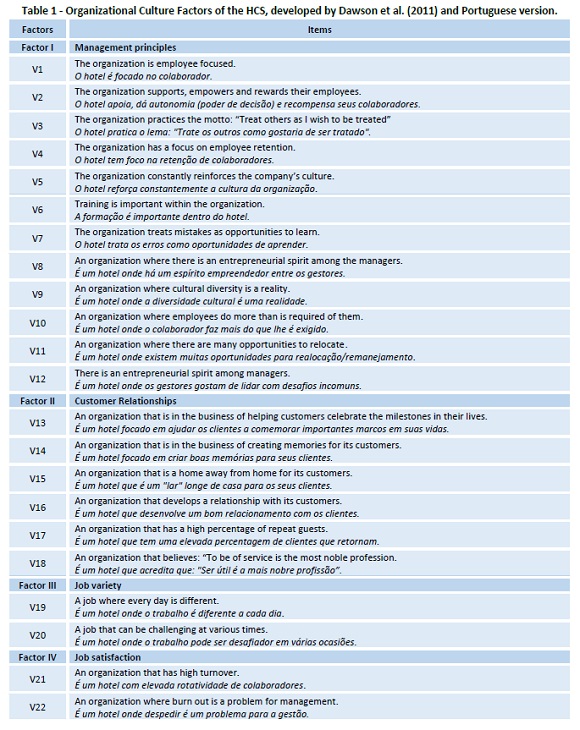
<body><![CDATA[<p>The main characteristics of this industry are defined by a sense of well-being,    of making the guest feel happy, feel &quot;at home&quot;, of exceeding expectations,    rewarding innovation, putting the guest’s needs first, it’s in the spirit of    serving others, and was characterized as &quot;the Smile Factory&quot; in studies    by Kemp and Dwyer (2001). At the same time, low wages, low job security, long    working hours, limited development opportunities and seasonality characterize    this industry (Dawson et al., 2011). These issues lead to high staff turnover    and therefore difficulty in hiring and retaining employees who can assimilate    hospitality culture and provide the &quot;experience&quot; desired by customers.</p>     <p>Some attempts have been made to develop scales for accurately measuring the    OC of this industry, such as Hospitality Industry Culture Profile (HICP) of    Tepeci &amp; Bartlett (2002) that assesses organizational culture (perceived    culture) and individual values (preferred culture), and the Hospitality Culture    Scale (HCS) of Dawson et al. (2011), the latter being the object of our study.</p>     <p><b>3. The original Hospitality Culture Scale</b></p>     <p>The Hospitality Culture Scale proposed by Dawson et al. (2011), was built from    studies done on the hospitality industry companies (e.g. Marriot and Ritz Carlton)    and from the literature regarding the attributes of hospitality managers, e.g.    Hospitality Industry Culture Profile (HICP) of Tepeci and Bartlett (2002). The    scale has two parts. The first related to the unique attributes of hospitality    organizations, e.g. the culture of hospitality, and a second part identifies    the characteristics and values of a person who would be successful in a work    environment that exhibited this culture.</p>     <p>The proposal of the authors was to create a quantitative measure that the human    resource personnel could use as a recruitment, selection, and training tool    in order to make a potential employee suitable for the organizational culture    of the hospitality industry companies. However, this study refers only to the    part of the instrument that measures the OC of hospitality organizations, and    that will be called Hospitality Culture Scale here, in order to provide researchers    and managers with tools for the analysis of the hospitality culture and its    relationship with other organizational variables.</p>     <p>This scale has a structure of four factors and 22 items, as follows: Factor    I, management principles, with 12 items, associated with the principles relating    to the management of employees. Factor II, customer relationship, with 6 items    related to the employee&rsquo;s conduct towards the hotel customer, the service and    hospitality. Factor III, job variety, with 2 items related to the changes in    the employee&rsquo;s work routine. And Factor IV, job satisfaction, with 2 items,    presents aspects of work that are usually negatively associated with the hospitality    industry such as high turnover and burn out. The 22 items are shown in <a href="#t1">Table    1</a>.</p>     <p>&nbsp;</p>     <p align="center"><a name="t1"></a><img src="/img/revistas/tms/v14nespecial/14nespeciala05t1.jpg"/></p>     
<p>&nbsp;</p>     <p>The factor’s loads of this solution ranged from 0.41 to 0.82, indicating great    consistency of factors extracted from the analysis procedure. Regarding the    reliability indexes (Cronbach&rsquo;s alpha), all the factors obtained an alpha greater    than 0.60, which is the minimum considered acceptable for instruments under    development, with the exception of Factor IV, job satisfaction, which obtained    an Alpha of 0.536. This factor was maintained by researchers that consider that    &quot;high turnover&quot; and &quot;burn-out&quot; are negative features, but    also striking in the hospitality industry, and important in the construction    of the hospitality culture concept (Dawson et al., 2011).</p>     ]]></body>
<body><![CDATA[<p>However, several authors, such as Bellou (2010) and Kokt and Ramarumo (2015),    do not understand job satisfaction as part of the OC, but as a construct affected    by it. Consequently, OC is seen as a predictor of job satisfaction. The types    of OC or dimensions that comprise it are influential factors in job satisfaction.    Bellou (2010) points out in her study that employees recognize certain cultural    traits (i.e. equity, opportunities for growth, enthusiasm for work and good    reputation) as satisfaction amplifiers at work. Moreover, there are cultural    characteristics (i.e. aggressiveness) that seem to confine job satisfaction.    These questions can, somehow, explain the low value of the Cronbach’s Alpha    for the job satisfaction factor.</p>     <p>Dawson et al. (2011), with the 22 statements that describes the components    of hospitality culture, developed an on-line survey instrument. The statements    were classified in a Likert scale with seven points, varying from (1) &ldquo;Strongly    disagree&rdquo; to (7) &ldquo;Strongly agree&rdquo;. The 22 items are positively drafted (i.e.    &quot; The hotel is employee focused&rdquo;). The HCS creates a baseline to indicate    if the OC is suitable for the hospitality industry’s context and shows that    organizations with a score of 5,23 and higher are adequate for the context.</p>     <p>After a bibliographic review, it was concluded that there were no studies that    performed a validation of the measurement model or tested this scale in other    contexts. Regarding limitations, the study does not analyse the construct’s    reliability when referring to the consistency of property and reproducibility    of measurement (Hair et al., 2010) or the construct’s validity in relation to    the instrument’s property to measure or to operationalize the construct or the    latent variable to be assessed (Hair et al., 2010). These are issues to be analysed    in this study.</p>     <p><b>4. Methodology</b></p>     <p>This study was divided into two phases. At first, the instrument was translated    into Portuguese and its content was validated. In the second phase, we held    a Confirmatory Factor Analysis (CFA) to confirm the structural patterns and    assess the validity of the proposed measurement models.</p>     <p><b>4.1 Development of the Validation Version</b></p>     <p>In the first phase of the study, special attention was given to translating    the original version of the scale into Portuguese to capture their linguistic    nuances (Beaton, Bombardier, Guillemin, &amp; Ferraz, 2000). Three different    translators, officially proficient in English, firstly translated the scale    into Portuguese. Then the contents of the translations were analysed and compared    by the researchers (two Portuguese and one Brazilian) and from that, a single    consensus version in Portuguese was produced that was the closest to the original    content, semantically.</p>     <p>A fourth translator who did not know the scale translated this version back    into the original language. The back-translation was then compared with the    original scale in English by one of the authors and a professional expert in    linguistics in order to ascertain that the meaning of the questions was kept.    This analysis led to several fixes related to linguistic and semantic equivalence.    Subsequently, the scale was adapted to the context of the hotel industry taking    the first version of HCS scale in Portuguese to this industry.</p>     <p>This version of the scale underwent a content validation regarding hotel industry.    It was analysed by a director of a Portuguese hotel group, a hospitality industry    consultant in Brazil, a manager of the Associação Brasileira da Indústria de    Hotéis (ABIH) and a manager of the Associação da Hotelaria, Restauração e Similares    de Portugal (AHRESP). The aim was to ensure that the scale items were relevant    and generalizable to all hotel industries, so after some adjustments, the second    version of the HCS scale was obtained.</p>     <p>Once the content’s validation was accomplished, the needed steps were taken    to create a pilot study with employees from 10 hotels in order to assess the    language and the form of the instrument’s content. Once again, the items of    the scale suffered adjustments so that all individuals were able to fully understand    the statements that made up the scale.</p>     ]]></body>
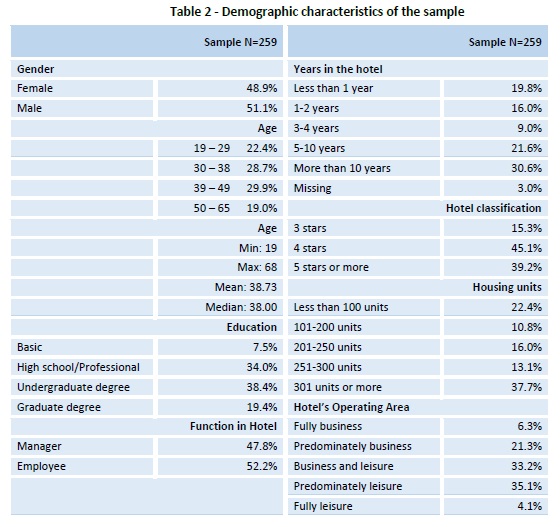
<body><![CDATA[<p>The final item pool was therefore used to make the validation of the survey    instrument that also consisted of 22 items distributed in the 4 cultural dimensions    - management principles, customer relationships, job variety and job satisfaction    - as proposed in the original scale. Responses were also classified in a Likert    scale of seven points ranging from (1) &quot;Strongly disagree&quot; to (7)    &quot;Strongly agree&quot;.</p>     <p><b>4.2 Sample and data collection</b></p>     <p>With respect to the sample selection criteria the study considered hotels with    3 stars or more, according to the Brazilian (Portaria no100, de 16 de junho    2011 do Ministério do Turismo, 2011) and Portuguese (Portaria n.o 309/2015 de    25 de setembro do Ministérios da Economia e do Ambiente, Ordenamento do Território    e Energia, 2015) classification.</p>     <p>The list of hotels was provided by ABIH in Brazil and by Associação da Hotelaria    de Portugal (AHP) in Portugal. The managers of the hotels were contacted by    telephone and later an email was sent with a request for authorization for the    study and the questionnaire. After receiving the afore-mentioned authorization,    a meeting was scheduled to explain the purpose of the study and what procedures    would be followed.</p>     <p>The questionnaires were administered to 855 employees and managers. The online    questionnaires were sent to professionals through a link after the acceptance    from the general managers of the hotels to provide the employee&rsquo;s emails. Of    the 855 questionnaires sent, only 321 were filled. Of these, 53 questionnaires    were excluded from the sample for inadequacy or incomplete filling. Thus the    effective sample size was 268 participants. During the CFA, data was purified    again and the final sample size was 259 participants. This sample satisfied    the minimum requirement of power by at least 5 to 10 times the amount indicated    in the CFA model (MacCallum, Browne, &amp; Sugawara, 1996; Heritage et al.,    2014). The demographic characteristics of the sample are shown in <a href="#t2">Table    2</a>.</p>     <p>&nbsp;</p>     <p align="center"><a name="t2"></a><img src="/img/revistas/tms/v14nespecial/14nespeciala05t2.jpg"/></p>     
<p>&nbsp;</p>     <p>The sample is mainly composed of employees (52.2%), of the male gender (51.1%)    with a mean age of 38.73 years and with some kind of university degree (57.8%).    Moreover, it is important to note that 52.2% of the sample has more than five    years of work in the hotels, an important factor for assimilation of the OC    of these companies, and 81.3% have some kind of contact with customers, a factor    that characterizes the OC of the hospitality industry’s companies.</p>     <p>Regarding the characteristics of the studied hotels, the sample is mainly formed    by hotels that operate predominantly in the leisure activities (39.2%) have    4 stars or more (84.3%), with more than 251 housing units (50.8 %), which feature    large hotels. These statistical analyses were performed with the statistical    package software SPSS version 23.0 for windows.</p>     ]]></body>
<body><![CDATA[<p><b>5. Confirmatory Factor Analysis</b></p>     <p>Seeking not only to confirm the factor’s structure of HCS, but also to show    evidence of the construct’s validity, a confirmatory factor analysis (CFA) was    conducted (Heritage et al., 2014). This analysis aims to refine the results    derived from exploratory factor analysis (EFA), performed by Dawson et al. (2011),    and provide an appropriate parameter to allow comparisons between different    predefined models and between the data collected. This analysis was performed    using AMOS version 23.0 for windows.</p>     <p>Initially, the existence of multivariate outliers was visible using the Mahalanobis    distance (Byrne, 2010). In total, nine outlier cases were therefore removed    from the upcoming analysis due to the possibility of compromising the internal    consistency of the scale and the fact that having no outliers is a basic prerequisite    for the use of the CFA. The normality of the variables was evaluated by the    uni- and multivariate asymmetry (Sk) and kurtosis (Ku) coefficients. No variable    showed Sk and Ku values that indicated a severe violation of the normal distribution    | Sk | &lt;3 and | Ku | &lt;10 (Finney &amp; DiStefano, 2006).</p>     <p>Three models were examined. Model 1 tested the structure proposed by Dawson    et al. (2011) with four factors and twenty- two items. Model 2 tested the scale    without factor IV, considering that in the original scale this factor presented    reliability problems (Cronbach’s Alpha &#945; = 0.536), although the authors    consider that this factor characterizes the hospitality industry’s organizations.    Model 3 showed a structure of a single factor for HCS, the OC, with 22 items.    The model’s adjustments were made from the modification indexes (greater than    11; p&lt;0.001) produced by AMOS 23.0 and based on theoretical considerations.</p>     <p>Due to the fact that there is no other accepted universal index besides chi-square    test to evaluate the goodness of fit of each model, the following measures of    model-data fit, with the minimum recommended values in parentheses, were used:    &#967;2 / df (p&gt; 0.05), Comparative Fit Index (CFI&gt; 0.90), Goodness of    Fit Index (GFI&gt; 0.90), Root Mean Square Error of Approximation (RMSEA &lt;=    0.05 or &lt;0 08 acceptable), Modified Expected Cross- Validation Index (MECVI    the lower the better), Standard Resting Metabolic Rate (StdRMR &lt;0.05) and    Resting Metabolic Rate (RMR &lt;0.05) (Byrne, 2010). <a href="#t3">Table 3</a>    shows adjustment indexes produced by the CFA on the three models.</p>     <p>&nbsp;</p>     <p align="center"><a name="t3"></a><img src="/img/revistas/tms/v14nespecial/14nespeciala05t3.jpg"/></p>     
<p>&nbsp;</p>     <p>Model 1 tested the structure originally proposed by Dawson et al. (2011). The    RMSEA, Std RMR and CFI indexes fit the data poorly, and the AMOS adjustment    indexes suggested the removal of item 10 (&quot;An organization where employees    do more than is required of them&quot;) of factor I, because when assessing    the individual reliability of the items through the weights of the factor’s    loads, it was found that all the items saturated in their respective factors    with a magnitude greater than 0.50 (p &lt;0.001), except the aforementioned    item that had a factor load of 0.21. The problem with this item was not assigned    to translation problems because the translation process has been rigorously    conducted to ensure equivalence between languages. Alternatively, it is believed    that this may be a result of this item not being representative of the hotel    industry.</p>     <p>Item 12 (There is an entrepreneurial spirit among managers) was also removed    from the analysis for saturating at different factors from those suggested in    the original version, factor III, according to the modification indexes. In    addition, item 12 and item 20 (The job can be challenging at various times)    have very similar contents, when thought about in terms of facing challenges,    which may be the cause of this cross saturation. This item should be further    investigated in studies with different samples.</p>     ]]></body>
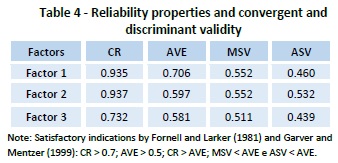
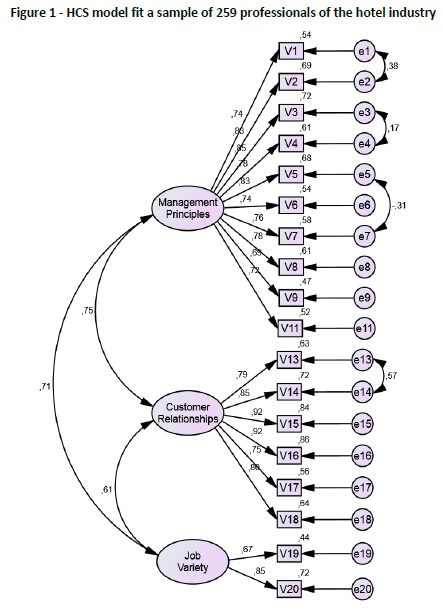
<body><![CDATA[<p>After this, measurement errors of items 1, 2, 7, 8, 9 and 11 of factor I and    13 and 14 of factor II were correlated, and the revised model was re-evaluated,    with an acceptable adjustment of the indexes.</p>     <p>Model 2 tested a structure with three factors. In assessing the reliability    of individual items, it was proven one more time that all items saturated in    their respective factors with a magnitude greater than 0.50 (p &lt;0.001), with    the exception of item 10, which presented factor loads of 0.22, and was, again,    removed from the analysis. Item 12 was also removed once more for saturating    a factor different from the one suggested in the original version. After correlating    the measurement errors of items 1, 2, 3, 4, 5 and 7 of factor I and 13 and 14    of factor II, suggested by the modification indexes, a good adjustment was obtained,    with visible improvements when compared to the original model. The Std RMR,    RMR, RMSEA and MECVI showed decreasing values compared to other models and GFI    and CFI showed higher values, demonstrating a better adaptation of the model.</p>     <p>In the third model, the structure of a single factor HCS was tested, with 22    items. On evaluating the reliability of individual items, it was found that    the items 10, 21 and 22 had a factor load of 0.235, -0.056 and -0.031, respectively,    and for this reason were removed from the analysis. After correlating the measurement    errors of the items 1, 2, 11, 12, 13, 14, 19 and 20, the adjustment model obtained    was still considered poor.</p>     <p>In view of these results, it was considered necessary to use the chi-square    test to evaluate the difference between the first (four factors) and second    (three factors) models. The third model was not considered because, as can be    observed, this model fit the data poorly.</p>     <p>The chi-square test was highly significant. The chi-square difference between    the first and second model was statistically different (&#916;&#967;2 = 83.819,    &#916;df = 34; p &lt;0.05), proving that model 2 is better than model 1, leading    to the rejection of the null hypothesis that the models have the same quality    adjustment. Moreover, it is important to note that the second model simplified    shows a small MECVI, indicating that this model fits the data better.</p>     <p>Upon having demonstrated the suitability of the factor’s structure proposed    on the sample under study, it is necessary to evaluate the composite reliability    (CR), which according to Fornell and Larcker (1981) is a measure that estimates    the internal consistency of the reflective factor items, indicating the extent    to which these items are consistent manifestations of the latent factor (CF&gt;    = 0.7). The CR of factors proved to be adequate. The values are 0.935 for factor    I (Management Principles), 0.937 for factor II (Customer Relationships) and    0.732 for factor III (Job Variety).</p>     <p>The scale’s construct validity was also verified to check if it actually measured    or operationalized the assessed construct.</p>     <p>This was measured through the convergent and discriminant validity of the constructs    (Fornell &amp; Larcker, 1981; Garver &amp; Mentzer, 1999), <a href="#t4">Table    4</a>.</p>     <p>&nbsp;</p>     <p align="center"><a name="t4"></a><img src="/img/revistas/tms/v14nespecial/14nespeciala05t4.jpg"/></p>     
]]></body>
<body><![CDATA[<p>&nbsp;</p>     <p>The convergent validity assesses the level of correlation between two items    that reflect the same factor. To evaluate the validity, the analysis of extracted    variance average (AVE) was used, so that values above 0.50 were considered suitable    convergent validity indicators (Hair et al., 2010). The AVE proved to be suitable    for all factors (factor I = 0.706, factor II = 0.597 and factor III = 0.581).    <a href="#f1">Figure 1</a> presents the standardized values of the factor’s    weights and the individual reliability of each of the items for model 3 which    is considered superior.</p>     <p>&nbsp;</p>     <p align="center"><a name="f1"></a><img src="/img/revistas/tms/v14nespecial/14nespeciala05f1.jpg"/></p>     
<p>&nbsp;</p>     <p>The discriminant validity of factors, which occurs when the construct under    study is not correlated with constructs that operationalize latent variables    different from the one operationalized by the construct under study (Anderson    &amp; Gerbing, 1988), was evaluated by comparing the AVE with the Maximum Shared    Squared Variance (MSV) and Average Shared Square Variance (ASV). We can then    say that there is discriminant validity for all the factors, given that the    MSV and ASV of the analysed factors are smaller than the AVE of each factor.</p>     <p>Subsequently, the configurational invariance of the structure and of the scale    parameters between Brazil and Portugal were analysed, which is to ask: to what    extent is the structure of the scale plausible for all groups that are being    analysed by multi- group analysis (Sass, 2011). This factor model was evaluated    with adequacy ratios setting patterns to AFC (&#967;2 / df = 2.057; CFI = 0.927;    TLI = 0.912; NFI = 0.868, RMSEA = 0.064; SRMR = 0.51 ), showing good adjustment    in Brazil and Portugal simultaneously, therefore evidencing configurational    invariance.</p>     <p>The condition of configurational invariance was assessed in both groups by    comparing the free model with a constrained model where the factor’s weights    and the variance / covariance were determined for the two groups. The statistical    significance of the difference of the two models was made with the chi- square    test (Brown, 2006; Hair et al., 2010). The constricted model showed an adjustment    significantly worse than the model with free parameters (&#916;&#967;2&#955;    (15) = 22.139, p &lt;0.104; &#916;&#967;2i (18) = 117.367; p &lt;0.000; &#916;&#967;2cov    (6) = 17.164; p &lt;0.009). Only the factor’s weights did not differ significantly    between Brazil and Portugal, so it is assumed that the model has a weak invariance    measure.</p>     <p><b>6. Conclusions</b></p>     <p><b>6.1 </b><b>Discussion</b></p>     ]]></body>
<body><![CDATA[<p>This study represents the first evaluation of HCS measurement model in the    context of hotel industry in Brazil and Portugal. The results brought some disagreement    regarding the original scale. Initially, the translation of the instrument into    the Portuguese language and adaptation to the hotel industry was performed.    The content of the instrument was validated by experts and through a pilot study    with employees from 10 hotels. The resulting instrument was composed of 22 items    distributed in 4 dimensions - principles of management, customer relationship,    work variety and job satisfaction - as proposed in the original scale.</p>     <p>Following the study, in order to confirm the factor structure of HSC a CFA    was performed. The analysis was conducted with 259 professionals from the hotel    industry. Three models were tested and the results presented according to model    2 had the best fit, in addition presented good convergent and divergent validity,    and adequate composite reliability.</p>     <p>This model consisted of three factors and eighteen items, as follows: Factor    I, Principles of Management, with ten items; Factor II, Customer Relationships    with six items; and Factor III, Job Variety, with two items. In this solution,    factor IV, Job satisfaction, was removed, for two reasons: the first being the    solution originally produced by Dawson et al. (2011) presenting a value for    Cronbach&rsquo;s alpha (&#945; = 0.536) too low for this factor, which encouraged    future researchers to test the model without it, and the second being that in    test model 1 that factor had a low correlation with the rest of the scale.</p>     <p>The results showed that, when models were compared, the model with three factors    was significantly more appropriate for the four-factors model originally proposed,    which can lead to the conclusion that factor IV does not contribute significantly    to the construction of organizational culture of the hospitality industry.</p>     <p>It is believed that, despite this factor being composed of important items    to the underlying theory of this industry, job satisfaction is not part of the    OC, but is affected by it, as proposed by Bellou (2010) and Kokt and Ramarumo    (2015). The OC, by developing a common way of thinking and understanding, can    influence the interpretation of reality by creating an organizational environment    that makes employees feel valued, which can impact job satisfaction. However,    job satisfaction cannot be considered part of the values shared by members of    an organization, because it is linked to each individual employee&rsquo;s belief regarding    working conditions.</p>     <p>The configurational invariance of the structure and of the scale parameters    between Brazil and Portugal was also verified for the three-factor model. The    constrained model showed significantly worse adjustment than the model with    free parameters. Only the factor’s weights did not differ significantly between    groups, assuming that the model has a weak invariance measure. This result shows    that there are inconsistencies that need to be better tested and understood    for the improvement of the scale.</p>     <p><b>6.2 Implications</b></p>     <p>In this study the validity of the dimensionality of the HCS, for the hotel    industry, is believed to be the main contribution. Another contribution delivered    in this study is a valid Portuguese version of the scale. However, future researchers    who intend to develop studies on the OC, particularly in the hospitality industry,    should pay attention to the factors which measure the OC. Since there are factors    that are related to the concept of OC, although they are not part of it, such    as job satisfaction, it is a construct affected by OC. In this study OC is seen    as a predictor of job satisfaction. The types of OC, or dimensions that comprise    it, are influential factors in job satisfaction. They can act as satisfaction    amplifiers at work or limiters for job satisfaction.</p>     <p>Moreover, in recent decades the hospitality industry’s companies increased    considerable information technology (IT) investments, especially those related    to electronic commerce. This lead to an increase in participation, particularly    of small and medium enterprises, due to an ease of access, aligned with transparency    in transactions, which gave more confidence to the consumer. Numerous studies    have also been conducted about the relationship between the OC and the IT (Leidner    and Kayworth, 2006) that explain the role of OC in management processes that    can, directly or indirectly, influence the success of the implementation and    use of IT. However, most of these studies are theoretical. The instrument validated    here could provide an operational measure that can be used in future studies    to verify the relationship between the OC and IT in the hospitality industry.</p>     <p>For professionals that want to create a suitable environment for employees,    to reproduce a behaviour that favours delivery of the main product of this industry,    &quot;hospitality&quot;, determining customer satisfaction, identifying the    weak dimensions of OC is necessary. To this end, having a global scale that    measures and reflects the dimensions the OC is essential to devising strategies    to correct the weak dimensions that interfere with productivity.</p>     ]]></body>
<body><![CDATA[<p><b>6.3 Limitations and Recommendations for Future Research</b></p>     <p>Although the instrument developed here has been tested in different countries,    the achieved results do not point to a general conclusion. Ideally, an investigation    of this nature must include other countries in order to provide a generalized    model. In addition, the scale has been validated only in the hotel industry,    an extensive validation in other organizations of the hospitality industry are    necessary for the generalization of the findings in this research. Further analysis    of the structure and of wide validity of the measure is encouraged.</p>     <p>&nbsp;</p>     <p><b>REFERENCES</b></p>     <!-- ref --><p>Anderson, J., &amp; Gerbing, D. (1988). Structural equation modeling in practice:    a review and recommended two-step approach. <i>Psychological Bulletin</i>, 103(3),    411-423. DOI: <a href="https://dx.doi.org/10.1037/0033-2909.103.3.411" target="_blank">10.1037/0033-2909.103.3.411</a>.    &nbsp;&nbsp;&nbsp;&nbsp;&nbsp;&nbsp;&nbsp;&nbsp;[&#160;<a href="javascript:void(0);" onclick="javascript: window.open('/scielo.php?script=sci_nlinks&ref=1280655&pid=S2182-8458201800050000500001&lng=','','width=640,height=500,resizable=yes,scrollbars=1,menubar=yes,');">Links</a>&#160;]<!-- end-ref --></p>     <!-- ref --><p>Asree, S., Zain, M., &amp; Razalli, M. R. (2010). Influence of leadership competency    and organizational culture on responsiveness and performance of firms. <i>International    Journal of Contemporary Hospitality Management</i>, 22(4), 500-516.    &nbsp;&nbsp;&nbsp;&nbsp;&nbsp;&nbsp;&nbsp;&nbsp;[&#160;<a href="javascript:void(0);" onclick="javascript: window.open('/scielo.php?script=sci_nlinks&ref=1280657&pid=S2182-8458201800050000500002&lng=','','width=640,height=500,resizable=yes,scrollbars=1,menubar=yes,');">Links</a>&#160;]<!-- end-ref --></p>     <!-- ref --><p>Baltieri, M. A. T., &amp; Peçanha, D. L. (2011). A cultura organizacional em    um empreendimento hoteleiro. Bol. Acad. Paulista de Psicologia. São paulo, Brasil.    Retrieved from <a href="http://www.redalyc.org/articulo.oa?id=94622747016" target="_blank">http://www.redalyc.org/articulo.oa?id=94622747016</a>&nbsp;&nbsp;&nbsp;&nbsp;&nbsp;&nbsp;&nbsp;&nbsp;[&#160;<a href="javascript:void(0);" onclick="javascript: window.open('/scielo.php?script=sci_nlinks&ref=1280659&pid=S2182-8458201800050000500003&lng=','','width=640,height=500,resizable=yes,scrollbars=1,menubar=yes,');">Links</a>&#160;]<!-- end-ref --><!-- ref --><p>Barney, J. B. (1986). Organizational culture: can it be a source of sustained    competitive advantage? <i>Academy of Management Review</i>, 11(3), 656-665.    DOI: <a href="https://dx.doi.org/10.2307/258317" target="_blank">10.2307/258317</a>.    &nbsp;&nbsp;&nbsp;&nbsp;&nbsp;&nbsp;&nbsp;&nbsp;[&#160;<a href="javascript:void(0);" onclick="javascript: window.open('/scielo.php?script=sci_nlinks&ref=1280660&pid=S2182-8458201800050000500004&lng=','','width=640,height=500,resizable=yes,scrollbars=1,menubar=yes,');">Links</a>&#160;]<!-- end-ref --></p>     <!-- ref --><p>Beaton, D. E., Bombardier, C., Guillemin, F., &amp; Ferraz, M. B. (2000). Guidelines    for the process of cross-cultural adaptation of self-report measures. <i>Spine</i>,    25(24), 3186-3191. DOI: <a href="https://dx.doi.org/10.1097/00007632-200012150-00014" target="_blank">10.1097/00007632-200012150-00014</a>.    &nbsp;&nbsp;&nbsp;&nbsp;&nbsp;&nbsp;&nbsp;&nbsp;[&#160;<a href="javascript:void(0);" onclick="javascript: window.open('/scielo.php?script=sci_nlinks&ref=1280662&pid=S2182-8458201800050000500005&lng=','','width=640,height=500,resizable=yes,scrollbars=1,menubar=yes,');">Links</a>&#160;]<!-- end-ref --></p>     <!-- ref --><p>Bellou, V. (2010). Organizational culture as a predictor of job satisfaction:    the role of gender and age. <i>Career Development International</i>, 15(1),    4-19. DOI: <a href="https://dx.doi.org/10.1108/13620431011020862" target="_blank">10.1108/13620431011020862</a>.    &nbsp;&nbsp;&nbsp;&nbsp;&nbsp;&nbsp;&nbsp;&nbsp;[&#160;<a href="javascript:void(0);" onclick="javascript: window.open('/scielo.php?script=sci_nlinks&ref=1280664&pid=S2182-8458201800050000500006&lng=','','width=640,height=500,resizable=yes,scrollbars=1,menubar=yes,');">Links</a>&#160;]<!-- end-ref --></p>     <!-- ref --><p>Blomme, R. J., Van Rheede, A., &amp; Tromp, D. M. (2010). Work-family conflict    as a cause for turnover intentions in the hospitality industry. <i>Tourism and    Hospitality Research</i>, 10(4), 269-285. DOI: <a href="https://dx.doi.org/10.1057/thr.2010.15" target="_blank">10.1057/thr.2010.15</a>.    &nbsp;&nbsp;&nbsp;&nbsp;&nbsp;&nbsp;&nbsp;&nbsp;[&#160;<a href="javascript:void(0);" onclick="javascript: window.open('/scielo.php?script=sci_nlinks&ref=1280666&pid=S2182-8458201800050000500007&lng=','','width=640,height=500,resizable=yes,scrollbars=1,menubar=yes,');">Links</a>&#160;]<!-- end-ref --></p>     <p>Brotherton, B., &amp; Wood, R. T. C. (2008). The nature and meanings of &ldquo;hospitality.&rdquo;    In <i>The Sage Handbook of Hospitality Management </i>(pp. 37- 62). London,    UK: Sage.</p>     <p>Brown, T. A. (2006). <i>Confirmatory factor analysis for applied research</i>.    New York, NY: Guilford Press.</p>     <!-- ref --><p>Calori, R., &amp; Sarnin, P. (1991). Corporate culture and economic performance:    A French study. <i>Organization Studies</i>, 12(1), 049-74. DOI: <a href="https://dx.doi.org/10.1177/017084069101200104" target="_blank">10.1177/017084069101200104</a>.    &nbsp;&nbsp;&nbsp;&nbsp;&nbsp;&nbsp;&nbsp;&nbsp;[&#160;<a href="javascript:void(0);" onclick="javascript: window.open('/scielo.php?script=sci_nlinks&ref=1280670&pid=S2182-8458201800050000500010&lng=','','width=640,height=500,resizable=yes,scrollbars=1,menubar=yes,');">Links</a>&#160;]<!-- end-ref --></p>     <p>Cameron, K. S., &amp; Quinn, R. E. (1999). Diagnosing and changing organizational    culture (Revised ed.). San Francisco, CA: Jossey-Bass Business &amp; Management    Series.</p>     <!-- ref --><p>Claver-cortés, E., Molina-Azorín, J. F., &amp; Pereira-Moliner, J. (2006).    Strategic groups in the hospitality industry: Intergroup and intragroup performance    differences in Alicante, Spain. <i>Tourism Management</i>, 27(6), 1101-1116.    &nbsp;&nbsp;&nbsp;&nbsp;&nbsp;&nbsp;&nbsp;&nbsp;[&#160;<a href="javascript:void(0);" onclick="javascript: window.open('/scielo.php?script=sci_nlinks&ref=1280673&pid=S2182-8458201800050000500012&lng=','','width=640,height=500,resizable=yes,scrollbars=1,menubar=yes,');">Links</a>&#160;]<!-- end-ref --></p>     <!-- ref --><p>Dawson, M., &amp; Abbott, J. (2011). Hospitality culture and climate: a proposed    model for retaining employees and creating competitive advantage. <i>International    Journal of Hospitality &amp; Tourism Administration</i>, 12(4), 289-304. DOI:    <a href="https://dx.doi.org/10.1080/15256480.2011.614533" target="_blank">10.1080/15256480.2011.614533</a>.    &nbsp;&nbsp;&nbsp;&nbsp;&nbsp;&nbsp;&nbsp;&nbsp;[&#160;<a href="javascript:void(0);" onclick="javascript: window.open('/scielo.php?script=sci_nlinks&ref=1280675&pid=S2182-8458201800050000500013&lng=','','width=640,height=500,resizable=yes,scrollbars=1,menubar=yes,');">Links</a>&#160;]<!-- end-ref --></p>     <!-- ref --><p>Dawson, M., Abbott, J., &amp; Shoemaker, S. (2011). The Hospitality culture    scale: a measure organizational culture and personal attributes. <i>International    Journal of Hospitality Management</i>, 30(2), 290-300. DOI: <a href="https://dx.doi.org/10.1016/j.ijhm.2010.10.002" target="_blank">10.1016/j.ijhm.2010.10.002</a>.    &nbsp;&nbsp;&nbsp;&nbsp;&nbsp;&nbsp;&nbsp;&nbsp;[&#160;<a href="javascript:void(0);" onclick="javascript: window.open('/scielo.php?script=sci_nlinks&ref=1280677&pid=S2182-8458201800050000500014&lng=','','width=640,height=500,resizable=yes,scrollbars=1,menubar=yes,');">Links</a>&#160;]<!-- end-ref --></p>     <!-- ref --><p>Deng, W.-J. (2011). Development of the hospitality quality management culture    scale: a pilot study. <i>The Business Review</i>, 18, 205-211.    &nbsp;&nbsp;&nbsp;&nbsp;&nbsp;&nbsp;&nbsp;&nbsp;[&#160;<a href="javascript:void(0);" onclick="javascript: window.open('/scielo.php?script=sci_nlinks&ref=1280679&pid=S2182-8458201800050000500015&lng=','','width=640,height=500,resizable=yes,scrollbars=1,menubar=yes,');">Links</a>&#160;]<!-- end-ref --></p>     ]]></body>
<body><![CDATA[<!-- ref --><p>Finney, S. J., &amp; DiStefano, C. (2006). Non-normal and categorical data    in structural equation modeling. In C. Müller &amp; R. Ptak (Eds.), Structural    equation modeling: A second course (pp. 269-314). Bertrams Print on Demand.    DOI: <a href="https://dx.doi.org/10.1002/car.1158" target="_blank">10.1002/car.1158</a>.    &nbsp;&nbsp;&nbsp;&nbsp;&nbsp;&nbsp;&nbsp;&nbsp;[&#160;<a href="javascript:void(0);" onclick="javascript: window.open('/scielo.php?script=sci_nlinks&ref=1280681&pid=S2182-8458201800050000500016&lng=','','width=640,height=500,resizable=yes,scrollbars=1,menubar=yes,');">Links</a>&#160;]<!-- end-ref --></p>     <!-- ref --><p>Fornell, C., &amp; Larcker, D. F. (1981). Evaluating structural equation models    with unobservable variables and measurement error. <i>Journal of Marketing Research</i>,    18(1), 39-50.    &nbsp;&nbsp;&nbsp;&nbsp;&nbsp;&nbsp;&nbsp;&nbsp;[&#160;<a href="javascript:void(0);" onclick="javascript: window.open('/scielo.php?script=sci_nlinks&ref=1280683&pid=S2182-8458201800050000500017&lng=','','width=640,height=500,resizable=yes,scrollbars=1,menubar=yes,');">Links</a>&#160;]<!-- end-ref --></p>     <!-- ref --><p>Garver, M. S., &amp; Mentzer, J. T. (1999). Logistics research methods: employing    structural equation modeling to test for construct validity. <i>Journal of Business    Logistics</i>, 20(1), 33-57.    &nbsp;&nbsp;&nbsp;&nbsp;&nbsp;&nbsp;&nbsp;&nbsp;[&#160;<a href="javascript:void(0);" onclick="javascript: window.open('/scielo.php?script=sci_nlinks&ref=1280685&pid=S2182-8458201800050000500018&lng=','','width=640,height=500,resizable=yes,scrollbars=1,menubar=yes,');">Links</a>&#160;]<!-- end-ref --></p>     <!-- ref --><p>Gordon, G. G., &amp; DiTomaso, N. (1992). Predicting corporate performance    from organizational culture. <i>Journal of Management Studies</i>, 29(6), 783-798.    DOI: <a href="https://dx.doi.org/10.1111/j.1467-6486.1992.tb00689.x" target="_blank">10.1111/j.1467-6486.1992.tb00689.x</a>.    &nbsp;&nbsp;&nbsp;&nbsp;&nbsp;&nbsp;&nbsp;&nbsp;[&#160;<a href="javascript:void(0);" onclick="javascript: window.open('/scielo.php?script=sci_nlinks&ref=1280687&pid=S2182-8458201800050000500019&lng=','','width=640,height=500,resizable=yes,scrollbars=1,menubar=yes,');">Links</a>&#160;]<!-- end-ref --></p>     <!-- ref --><p>Gregory, B. T., Harris, S. G., Armenakis, A. A., &amp; Shook, C. L. (2009).    Organizational culture and effectiveness: A study of values, attitudes, and    organizational outcomes. <i>Journal of Business Research</i>, 62(7), 673- 679.    &nbsp;&nbsp;&nbsp;&nbsp;&nbsp;&nbsp;&nbsp;&nbsp;[&#160;<a href="javascript:void(0);" onclick="javascript: window.open('/scielo.php?script=sci_nlinks&ref=1280689&pid=S2182-8458201800050000500020&lng=','','width=640,height=500,resizable=yes,scrollbars=1,menubar=yes,');">Links</a>&#160;]<!-- end-ref --></p>     ]]></body>
<body><![CDATA[<p>Hair, J. F., Black, W. C., Babin, B. J. &amp; Anderson, R. E. (2010). <i>Multivariate    data analysis: A global perspective</i>. (7th ed.). Upper Saddle River, NJ:    Pearson.</p>     <!-- ref --><p>Heritage, B., Pollock, C., &amp; Roberts, L. (2014). Validation of the organizational    culture assessment instrument. <i>PLoS ONE</i>, 9(3), 1-10. DOI: <a href="https://dx.doi.org/10.1371/journal.pone.0092879" target="_blank">10.1371/journal.pone.0092879</a>.    &nbsp;&nbsp;&nbsp;&nbsp;&nbsp;&nbsp;&nbsp;&nbsp;[&#160;<a href="javascript:void(0);" onclick="javascript: window.open('/scielo.php?script=sci_nlinks&ref=1280692&pid=S2182-8458201800050000500022&lng=','','width=640,height=500,resizable=yes,scrollbars=1,menubar=yes,');">Links</a>&#160;]<!-- end-ref --></p>     <!-- ref --><p>Hofstede, G., Neuijen, B., Ohayv, D. D., &amp; Sanders, G. (1990). Measuring    organizational cultures: a qualitative and quantitative study across twenty    cases. <i>Administrative Science Quarterly</i>, 35(2), 286-316.    &nbsp;&nbsp;&nbsp;&nbsp;&nbsp;&nbsp;&nbsp;&nbsp;[&#160;<a href="javascript:void(0);" onclick="javascript: window.open('/scielo.php?script=sci_nlinks&ref=1280694&pid=S2182-8458201800050000500023&lng=','','width=640,height=500,resizable=yes,scrollbars=1,menubar=yes,');">Links</a>&#160;]<!-- end-ref --></p>     <!-- ref --><p>Kemp, S., &amp; Dwyer, L. (2001). An examination of organisational culture    - the Regent Hotel, Sydney. <i>International Journal of Hospitality Management</i>,    20(1), 77-93.    &nbsp;&nbsp;&nbsp;&nbsp;&nbsp;&nbsp;&nbsp;&nbsp;[&#160;<a href="javascript:void(0);" onclick="javascript: window.open('/scielo.php?script=sci_nlinks&ref=1280696&pid=S2182-8458201800050000500024&lng=','','width=640,height=500,resizable=yes,scrollbars=1,menubar=yes,');">Links</a>&#160;]<!-- end-ref --></p>     <!-- ref --><p>Kloot, L., &amp; Martin, J. (2007). Public sector change, organisational culture    and financial information: A study of local government. <i>Australian Journal    of Public Administration</i>, 66(4), 485-497.    &nbsp;&nbsp;&nbsp;&nbsp;&nbsp;&nbsp;&nbsp;&nbsp;[&#160;<a href="javascript:void(0);" onclick="javascript: window.open('/scielo.php?script=sci_nlinks&ref=1280698&pid=S2182-8458201800050000500025&lng=','','width=640,height=500,resizable=yes,scrollbars=1,menubar=yes,');">Links</a>&#160;]<!-- end-ref --></p>     <!-- ref --><p>Kokt, D., &amp; Ramarumo, R. (2015). Impact of organisational culture on job    stress and burnout in graded accommodation establishments in the Free State    province, South Africa. <i>International Journal of Contemporary Hospitality    Management</i>, 27(6), 1198-1213.    &nbsp;&nbsp;&nbsp;&nbsp;&nbsp;&nbsp;&nbsp;&nbsp;[&#160;<a href="javascript:void(0);" onclick="javascript: window.open('/scielo.php?script=sci_nlinks&ref=1280700&pid=S2182-8458201800050000500026&lng=','','width=640,height=500,resizable=yes,scrollbars=1,menubar=yes,');">Links</a>&#160;]<!-- end-ref --></p>     <p>Leidner, D.E. and Kayworth, T. (2006). Review: A Review of Culture in Information    System Research: Toward a Theory of Information Technology Culture Conflict.    <i>MIS Quarterly</i>, 30 (2), 357-399.</p>     <!-- ref --><p>MacCallum, R. C., Browne, M. W., &amp; Sugawara, H. M. (1996). Power analysis    and determination of sample size for covariance structure modeling. <i>Psychological    Methods</i>, 1(2), 130-149.    &nbsp;&nbsp;&nbsp;&nbsp;&nbsp;&nbsp;&nbsp;&nbsp;[&#160;<a href="javascript:void(0);" onclick="javascript: window.open('/scielo.php?script=sci_nlinks&ref=1280703&pid=S2182-8458201800050000500028&lng=','','width=640,height=500,resizable=yes,scrollbars=1,menubar=yes,');">Links</a>&#160;]<!-- end-ref --></p>     <!-- ref --><p>Ornelas, A. L., &amp; Nogueira, H. G. P. (2014). Cultura Organizacional Brasileira:    Antigos Dilemas e Novas Perspectivas. In VIII Encontro Nacional de Estudos Organizacionais    (pp. 1-16). Gramado: ANPAD.    &nbsp;&nbsp;&nbsp;&nbsp;&nbsp;&nbsp;&nbsp;&nbsp;[&#160;<a href="javascript:void(0);" onclick="javascript: window.open('/scielo.php?script=sci_nlinks&ref=1280705&pid=S2182-8458201800050000500029&lng=','','width=640,height=500,resizable=yes,scrollbars=1,menubar=yes,');">Links</a>&#160;]<!-- end-ref --></p>     <p>Portaria n.o 309/2015 de 25 de setembro do Ministérios da Economia e do Ambiente,    Ordenamento do Território e Energia. Pub. L. No. Diário da República: 1.a série,    N.o 188 (2015). Portugal. Retrieved from <a href="http://www.dre.pt/" target="_blank">www.dre.pt</a></p>     <p>Portaria no100, de 16 de Junho 2011 do Ministério do Turismo. , Pub. L. No.    Diário Oficial da União (2011). Brasil. Retrieved from <a href="http://www.turismo.gov.br/legislacao/?p=175" target="_blank">http://www.turismo.gov.br/legislacao/?p=175</a></p>     <!-- ref --><p>Rogerson, J. M., &amp; Kotze, N. (2011). Market segmentation and the changing    South African hotel industry (1990 to 2010). <i>African Journal of Business    Management</i>, 5(35), 13523-13533. DOI: <a href="https://dx.doi.org/10.5897/AJBMX11.030" target="_blank">10.5897/AJBMX11.030</a>.    &nbsp;&nbsp;&nbsp;&nbsp;&nbsp;&nbsp;&nbsp;&nbsp;[&#160;<a href="javascript:void(0);" onclick="javascript: window.open('/scielo.php?script=sci_nlinks&ref=1280709&pid=S2182-8458201800050000500032&lng=','','width=640,height=500,resizable=yes,scrollbars=1,menubar=yes,');">Links</a>&#160;]<!-- end-ref --></p>     ]]></body>
<body><![CDATA[<!-- ref --><p>Sass, D. A. (2011). Testing measurement invariance and comparing latent factor    means within a confirmatory factor analysis framework. <i>Journal of Psychoeducational    Assessment</i>, 29(4), 347-363.    &nbsp;&nbsp;&nbsp;&nbsp;&nbsp;&nbsp;&nbsp;&nbsp;[&#160;<a href="javascript:void(0);" onclick="javascript: window.open('/scielo.php?script=sci_nlinks&ref=1280711&pid=S2182-8458201800050000500033&lng=','','width=640,height=500,resizable=yes,scrollbars=1,menubar=yes,');">Links</a>&#160;]<!-- end-ref --></p>     <!-- ref --><p>Schein, E. H. (1996). Culture: The missing concept in organization studies.    <i>Administrative Science Quarterly</i>, 41(2), 229.    &nbsp;&nbsp;&nbsp;&nbsp;&nbsp;&nbsp;&nbsp;&nbsp;[&#160;<a href="javascript:void(0);" onclick="javascript: window.open('/scielo.php?script=sci_nlinks&ref=1280713&pid=S2182-8458201800050000500034&lng=','','width=640,height=500,resizable=yes,scrollbars=1,menubar=yes,');">Links</a>&#160;]<!-- end-ref --></p>     <!-- ref --><p>Tepeci, M., &amp; Bartlett, A. L. B. (2002). The hospitality industry culture    profile: a measure of individual values, organizational culture, and person-organization    fit as predictors of job satisfaction and behavioral intentions. <i>International    Journal of Hospitality Management</i>, 21(2), 151-170. DOI: <a href="https://dx.doi.org/10.1016/S0278-4319(01)00035-4" target="_blank">10.1016/S0278-4319(01)00035-4</a>.    &nbsp;&nbsp;&nbsp;&nbsp;&nbsp;&nbsp;&nbsp;&nbsp;[&#160;<a href="javascript:void(0);" onclick="javascript: window.open('/scielo.php?script=sci_nlinks&ref=1280715&pid=S2182-8458201800050000500035&lng=','','width=640,height=500,resizable=yes,scrollbars=1,menubar=yes,');">Links</a>&#160;]<!-- end-ref --></p>     <!-- ref --><p>Wang, M., &amp; Chen, H. C. (2013). Social presence for different tasks and    perceived learning in online hospitality culture exchange. Australasian <i>Journal    of Educational Technology</i>, 29(5), 667-684.    &nbsp;&nbsp;&nbsp;&nbsp;&nbsp;&nbsp;&nbsp;&nbsp;[&#160;<a href="javascript:void(0);" onclick="javascript: window.open('/scielo.php?script=sci_nlinks&ref=1280717&pid=S2182-8458201800050000500036&lng=','','width=640,height=500,resizable=yes,scrollbars=1,menubar=yes,');">Links</a>&#160;]<!-- end-ref --></p>     <!-- ref --><p>Wilkins, A. L., &amp; Ouchi, W. G. (1983). Efficient Cultures: Exploring the    Relationship Between Culture and Organizational Performance. <i>Administrative    Science Quarterly</i>, 28(3), 468-481.    &nbsp;&nbsp;&nbsp;&nbsp;&nbsp;&nbsp;&nbsp;&nbsp;[&#160;<a href="javascript:void(0);" onclick="javascript: window.open('/scielo.php?script=sci_nlinks&ref=1280719&pid=S2182-8458201800050000500037&lng=','','width=640,height=500,resizable=yes,scrollbars=1,menubar=yes,');">Links</a>&#160;]<!-- end-ref --></p>     ]]></body>
<body><![CDATA[<p>&nbsp;</p>     <p>Received: 17 February 2017</p>     <p>Revisions required: 20 April 2017</p>     <p>Accepted: 20 July 2017</p>      ]]></body><back>
<ref-list>
<ref id="B1">
<nlm-citation citation-type="journal">
<person-group person-group-type="author">
<name>
<surname><![CDATA[Anderson]]></surname>
<given-names><![CDATA[J.]]></given-names>
</name>
<name>
<surname><![CDATA[Gerbing]]></surname>
<given-names><![CDATA[D.]]></given-names>
</name>
</person-group>
<article-title xml:lang="en"><![CDATA[Structural equation modeling in practice: a review and recommended two-step approach]]></article-title>
<source><![CDATA[Psychological Bulletin]]></source>
<year>1988</year>
<volume>103</volume>
<numero>3</numero>
<issue>3</issue>
<page-range>411-423</page-range></nlm-citation>
</ref>
<ref id="B2">
<nlm-citation citation-type="journal">
<person-group person-group-type="author">
<name>
<surname><![CDATA[Asree]]></surname>
<given-names><![CDATA[S.]]></given-names>
</name>
<name>
<surname><![CDATA[Zain]]></surname>
<given-names><![CDATA[M.]]></given-names>
</name>
<name>
<surname><![CDATA[Razalli]]></surname>
<given-names><![CDATA[M. R.]]></given-names>
</name>
</person-group>
<article-title xml:lang="en"><![CDATA[Influence of leadership competency and organizational culture on responsiveness and performance of firms]]></article-title>
<source><![CDATA[International Journal of Contemporary Hospitality Management]]></source>
<year>2010</year>
<volume>22</volume>
<numero>4</numero>
<issue>4</issue>
<page-range>500-516</page-range></nlm-citation>
</ref>
<ref id="B3">
<nlm-citation citation-type="book">
<person-group person-group-type="author">
<name>
<surname><![CDATA[Baltieri]]></surname>
<given-names><![CDATA[M. A. T.]]></given-names>
</name>
<name>
<surname><![CDATA[Peçanha]]></surname>
<given-names><![CDATA[D. L.]]></given-names>
</name>
</person-group>
<source><![CDATA[A cultura organizacional em um empreendimento hoteleiro]]></source>
<year>2011</year>
<publisher-loc><![CDATA[São paulo ]]></publisher-loc>
<publisher-name><![CDATA[Bol. Acad. Paulista de Psicologia]]></publisher-name>
</nlm-citation>
</ref>
<ref id="B4">
<nlm-citation citation-type="journal">
<person-group person-group-type="author">
<name>
<surname><![CDATA[Barney]]></surname>
<given-names><![CDATA[J. B.]]></given-names>
</name>
</person-group>
<article-title xml:lang="en"><![CDATA[Organizational culture: can it be a source of sustained competitive advantage?]]></article-title>
<source><![CDATA[Academy of Management Review]]></source>
<year>1986</year>
<volume>11</volume>
<numero>3</numero>
<issue>3</issue>
<page-range>656-665</page-range></nlm-citation>
</ref>
<ref id="B5">
<nlm-citation citation-type="journal">
<person-group person-group-type="author">
<name>
<surname><![CDATA[Beaton]]></surname>
<given-names><![CDATA[D. E.]]></given-names>
</name>
<name>
<surname><![CDATA[Bombardier]]></surname>
<given-names><![CDATA[C.]]></given-names>
</name>
<name>
<surname><![CDATA[Guillemin]]></surname>
<given-names><![CDATA[F.]]></given-names>
</name>
<name>
<surname><![CDATA[Ferraz]]></surname>
<given-names><![CDATA[M. B.]]></given-names>
</name>
</person-group>
<article-title xml:lang="en"><![CDATA[Guidelines for the process of cross-cultural adaptation of self-report measures]]></article-title>
<source><![CDATA[Spine]]></source>
<year>2000</year>
<volume>25</volume>
<numero>24</numero>
<issue>24</issue>
<page-range>3186-3191</page-range></nlm-citation>
</ref>
<ref id="B6">
<nlm-citation citation-type="journal">
<person-group person-group-type="author">
<name>
<surname><![CDATA[Bellou]]></surname>
<given-names><![CDATA[V.]]></given-names>
</name>
</person-group>
<article-title xml:lang="en"><![CDATA[Organizational culture as a predictor of job satisfaction: the role of gender and age]]></article-title>
<source><![CDATA[Career Development International]]></source>
<year>2010</year>
<volume>15</volume>
<numero>1</numero>
<issue>1</issue>
<page-range>4-19</page-range></nlm-citation>
</ref>
<ref id="B7">
<nlm-citation citation-type="journal">
<person-group person-group-type="author">
<name>
<surname><![CDATA[Blomme]]></surname>
<given-names><![CDATA[R. J.]]></given-names>
</name>
<name>
<surname><![CDATA[Van Rheede]]></surname>
<given-names><![CDATA[A.]]></given-names>
</name>
<name>
<surname><![CDATA[Tromp]]></surname>
<given-names><![CDATA[D. M.]]></given-names>
</name>
</person-group>
<article-title xml:lang="en"><![CDATA[Work-family conflict as a cause for turnover intentions in the hospitality industry]]></article-title>
<source><![CDATA[Tourism and Hospitality Research]]></source>
<year>2010</year>
<volume>10</volume>
<numero>4</numero>
<issue>4</issue>
<page-range>269-285</page-range></nlm-citation>
</ref>
<ref id="B8">
<nlm-citation citation-type="book">
<person-group person-group-type="author">
<name>
<surname><![CDATA[Brotherton]]></surname>
<given-names><![CDATA[B.]]></given-names>
</name>
<name>
<surname><![CDATA[Wood]]></surname>
<given-names><![CDATA[R. T. C.]]></given-names>
</name>
</person-group>
<article-title xml:lang="en"><![CDATA[The nature and meanings of “hospitality”]]></article-title>
<source><![CDATA[The Sage Handbook of Hospitality Management]]></source>
<year>2008</year>
<page-range>37- 62</page-range><publisher-loc><![CDATA[London ]]></publisher-loc>
<publisher-name><![CDATA[Sage]]></publisher-name>
</nlm-citation>
</ref>
<ref id="B9">
<nlm-citation citation-type="book">
<person-group person-group-type="author">
<name>
<surname><![CDATA[Brown]]></surname>
<given-names><![CDATA[T. A.]]></given-names>
</name>
</person-group>
<source><![CDATA[Confirmatory factor analysis for applied research]]></source>
<year>2006</year>
<publisher-loc><![CDATA[New York ]]></publisher-loc>
<publisher-name><![CDATA[Guilford Press]]></publisher-name>
</nlm-citation>
</ref>
<ref id="B10">
<nlm-citation citation-type="journal">
<person-group person-group-type="author">
<name>
<surname><![CDATA[Calori]]></surname>
<given-names><![CDATA[R.]]></given-names>
</name>
<name>
<surname><![CDATA[Sarnin]]></surname>
<given-names><![CDATA[P.]]></given-names>
</name>
</person-group>
<article-title xml:lang="en"><![CDATA[Corporate culture and economic performance: A French study]]></article-title>
<source><![CDATA[Organization Studies]]></source>
<year>1991</year>
<volume>12</volume>
<numero>1</numero>
<issue>1</issue>
<page-range>049-74</page-range></nlm-citation>
</ref>
<ref id="B11">
<nlm-citation citation-type="book">
<person-group person-group-type="author">
<name>
<surname><![CDATA[Cameron]]></surname>
<given-names><![CDATA[K. S.]]></given-names>
</name>
<name>
<surname><![CDATA[Quinn]]></surname>
<given-names><![CDATA[R. E.]]></given-names>
</name>
</person-group>
<source><![CDATA[Diagnosing and changing organizational culture]]></source>
<year>1999</year>
<publisher-loc><![CDATA[San Francisco ]]></publisher-loc>
<publisher-name><![CDATA[Jossey-Bass Business & Management Series]]></publisher-name>
</nlm-citation>
</ref>
<ref id="B12">
<nlm-citation citation-type="journal">
<person-group person-group-type="author">
<name>
<surname><![CDATA[Claver-cortés]]></surname>
<given-names><![CDATA[E.]]></given-names>
</name>
<name>
<surname><![CDATA[Molina-Azorín]]></surname>
<given-names><![CDATA[J. F.]]></given-names>
</name>
<name>
<surname><![CDATA[Pereira-Moliner]]></surname>
<given-names><![CDATA[J.]]></given-names>
</name>
</person-group>
<article-title xml:lang="en"><![CDATA[Strategic groups in the hospitality industry: Intergroup and intragroup performance differences in Alicante, Spain]]></article-title>
<source><![CDATA[Tourism Management]]></source>
<year>2006</year>
<volume>27</volume>
<numero>6</numero>
<issue>6</issue>
<page-range>1101-1116</page-range></nlm-citation>
</ref>
<ref id="B13">
<nlm-citation citation-type="journal">
<person-group person-group-type="author">
<name>
<surname><![CDATA[Dawson]]></surname>
<given-names><![CDATA[M.]]></given-names>
</name>
<name>
<surname><![CDATA[Abbott]]></surname>
<given-names><![CDATA[J.]]></given-names>
</name>
</person-group>
<article-title xml:lang="en"><![CDATA[Hospitality culture and climate: a proposed model for retaining employees and creating competitive advantage]]></article-title>
<source><![CDATA[International Journal of Hospitality & Tourism Administration]]></source>
<year>2011</year>
<volume>12</volume>
<numero>4</numero>
<issue>4</issue>
<page-range>289-304</page-range></nlm-citation>
</ref>
<ref id="B14">
<nlm-citation citation-type="journal">
<person-group person-group-type="author">
<name>
<surname><![CDATA[Dawson]]></surname>
<given-names><![CDATA[M.]]></given-names>
</name>
<name>
<surname><![CDATA[Abbott]]></surname>
<given-names><![CDATA[J.]]></given-names>
</name>
<name>
<surname><![CDATA[Shoemaker]]></surname>
<given-names><![CDATA[S.]]></given-names>
</name>
</person-group>
<article-title xml:lang="en"><![CDATA[The Hospitality culture scale: a measure organizational culture and personal attributes]]></article-title>
<source><![CDATA[International Journal of Hospitality Management]]></source>
<year>2011</year>
<volume>30</volume>
<numero>2</numero>
<issue>2</issue>
<page-range>290-300</page-range></nlm-citation>
</ref>
<ref id="B15">
<nlm-citation citation-type="journal">
<person-group person-group-type="author">
<name>
<surname><![CDATA[Deng]]></surname>
<given-names><![CDATA[W.-J.]]></given-names>
</name>
</person-group>
<article-title xml:lang="en"><![CDATA[Development of the hospitality quality management culture scale: a pilot study]]></article-title>
<source><![CDATA[The Business Review]]></source>
<year>2011</year>
<volume>18</volume>
<page-range>205-211</page-range></nlm-citation>
</ref>
<ref id="B16">
<nlm-citation citation-type="book">
<person-group person-group-type="author">
<name>
<surname><![CDATA[Finney]]></surname>
<given-names><![CDATA[S. J.]]></given-names>
</name>
<name>
<surname><![CDATA[DiStefano]]></surname>
<given-names><![CDATA[C.]]></given-names>
</name>
</person-group>
<article-title xml:lang="en"><![CDATA[Non-normal and categorical data in structural equation modeling]]></article-title>
<person-group person-group-type="editor">
<name>
<surname><![CDATA[Müller]]></surname>
<given-names><![CDATA[C.]]></given-names>
</name>
<name>
<surname><![CDATA[Ptak]]></surname>
<given-names><![CDATA[R.]]></given-names>
</name>
</person-group>
<source><![CDATA[Structural equation modeling: A second course]]></source>
<year>2006</year>
<page-range>269-314</page-range><publisher-name><![CDATA[Bertrams Print on Demand]]></publisher-name>
</nlm-citation>
</ref>
<ref id="B17">
<nlm-citation citation-type="journal">
<person-group person-group-type="author">
<name>
<surname><![CDATA[Fornell]]></surname>
<given-names><![CDATA[C.]]></given-names>
</name>
<name>
<surname><![CDATA[Larcker]]></surname>
<given-names><![CDATA[D. F.]]></given-names>
</name>
</person-group>
<article-title xml:lang="en"><![CDATA[Evaluating structural equation models with unobservable variables and measurement error]]></article-title>
<source><![CDATA[Journal of Marketing Research]]></source>
<year>1981</year>
<volume>18</volume>
<numero>1</numero>
<issue>1</issue>
<page-range>39-50</page-range></nlm-citation>
</ref>
<ref id="B18">
<nlm-citation citation-type="journal">
<person-group person-group-type="author">
<name>
<surname><![CDATA[Garver]]></surname>
<given-names><![CDATA[M. S.]]></given-names>
</name>
<name>
<surname><![CDATA[Mentzer]]></surname>
<given-names><![CDATA[J. T.]]></given-names>
</name>
</person-group>
<article-title xml:lang="en"><![CDATA[Logistics research methods: employing structural equation modeling to test for construct validity]]></article-title>
<source><![CDATA[Journal of Business Logistics]]></source>
<year>1999</year>
<volume>20</volume>
<numero>1</numero>
<issue>1</issue>
<page-range>33-57</page-range></nlm-citation>
</ref>
<ref id="B19">
<nlm-citation citation-type="journal">
<person-group person-group-type="author">
<name>
<surname><![CDATA[Gordon]]></surname>
<given-names><![CDATA[G. G.]]></given-names>
</name>
<name>
<surname><![CDATA[DiTomaso]]></surname>
<given-names><![CDATA[N.]]></given-names>
</name>
</person-group>
<article-title xml:lang="en"><![CDATA[Predicting corporate performance from organizational culture]]></article-title>
<source><![CDATA[Journal of Management Studies]]></source>
<year>1992</year>
<volume>29</volume>
<numero>6</numero>
<issue>6</issue>
<page-range>783-798</page-range></nlm-citation>
</ref>
<ref id="B20">
<nlm-citation citation-type="journal">
<person-group person-group-type="author">
<name>
<surname><![CDATA[Gregory]]></surname>
<given-names><![CDATA[B. T.]]></given-names>
</name>
<name>
<surname><![CDATA[Harris]]></surname>
<given-names><![CDATA[S. G.]]></given-names>
</name>
<name>
<surname><![CDATA[Armenakis]]></surname>
<given-names><![CDATA[A. A.]]></given-names>
</name>
<name>
<surname><![CDATA[Shook]]></surname>
<given-names><![CDATA[C. L.]]></given-names>
</name>
</person-group>
<article-title xml:lang="en"><![CDATA[Organizational culture and effectiveness: A study of values, attitudes, and organizational outcomes]]></article-title>
<source><![CDATA[Journal of Business Research]]></source>
<year>2009</year>
<volume>62</volume>
<numero>7</numero>
<issue>7</issue>
<page-range>673- 679</page-range></nlm-citation>
</ref>
<ref id="B21">
<nlm-citation citation-type="book">
<person-group person-group-type="author">
<name>
<surname><![CDATA[Hair]]></surname>
<given-names><![CDATA[J. F.]]></given-names>
</name>
<name>
<surname><![CDATA[Black]]></surname>
<given-names><![CDATA[W. C.]]></given-names>
</name>
<name>
<surname><![CDATA[Babin]]></surname>
<given-names><![CDATA[B. J.]]></given-names>
</name>
<name>
<surname><![CDATA[Anderson]]></surname>
<given-names><![CDATA[R. E.]]></given-names>
</name>
</person-group>
<source><![CDATA[Multivariate data analysis: A global perspective]]></source>
<year>2010</year>
<edition>7</edition>
<publisher-loc><![CDATA[Upper Saddle River ]]></publisher-loc>
<publisher-name><![CDATA[Pearson]]></publisher-name>
</nlm-citation>
</ref>
<ref id="B22">
<nlm-citation citation-type="journal">
<person-group person-group-type="author">
<name>
<surname><![CDATA[Heritage]]></surname>
<given-names><![CDATA[B.]]></given-names>
</name>
<name>
<surname><![CDATA[Pollock]]></surname>
<given-names><![CDATA[C.]]></given-names>
</name>
<name>
<surname><![CDATA[Roberts]]></surname>
<given-names><![CDATA[L.]]></given-names>
</name>
</person-group>
<article-title xml:lang="en"><![CDATA[Validation of the organizational culture assessment instrument]]></article-title>
<source><![CDATA[PLoS ONE]]></source>
<year>2014</year>
<volume>9</volume>
<numero>3</numero>
<issue>3</issue>
<page-range>1-10</page-range></nlm-citation>
</ref>
<ref id="B23">
<nlm-citation citation-type="journal">
<person-group person-group-type="author">
<name>
<surname><![CDATA[Hofstede]]></surname>
<given-names><![CDATA[G.]]></given-names>
</name>
<name>
<surname><![CDATA[Neuijen]]></surname>
<given-names><![CDATA[B.]]></given-names>
</name>
<name>
<surname><![CDATA[Ohayv]]></surname>
<given-names><![CDATA[D. D.]]></given-names>
</name>
<name>
<surname><![CDATA[Sanders]]></surname>
<given-names><![CDATA[G.]]></given-names>
</name>
</person-group>
<article-title xml:lang="en"><![CDATA[Measuring organizational cultures: a qualitative and quantitative study across twenty cases]]></article-title>
<source><![CDATA[Administrative Science Quarterly]]></source>
<year>1990</year>
<volume>35</volume>
<numero>2</numero>
<issue>2</issue>
<page-range>286-316</page-range></nlm-citation>
</ref>
<ref id="B24">
<nlm-citation citation-type="journal">
<person-group person-group-type="author">
<name>
<surname><![CDATA[Kemp]]></surname>
<given-names><![CDATA[S.]]></given-names>
</name>
<name>
<surname><![CDATA[Dwyer]]></surname>
<given-names><![CDATA[L.]]></given-names>
</name>
</person-group>
<article-title xml:lang="en"><![CDATA[An examination of organisational culture - the Regent Hotel, Sydney]]></article-title>
<source><![CDATA[International Journal of Hospitality Management]]></source>
<year>2001</year>
<volume>20</volume>
<numero>1</numero>
<issue>1</issue>
<page-range>77-93</page-range></nlm-citation>
</ref>
<ref id="B25">
<nlm-citation citation-type="journal">
<person-group person-group-type="author">
<name>
<surname><![CDATA[Kloot]]></surname>
<given-names><![CDATA[L.]]></given-names>
</name>
<name>
<surname><![CDATA[Martin]]></surname>
<given-names><![CDATA[J.]]></given-names>
</name>
</person-group>
<article-title xml:lang="en"><![CDATA[Public sector change, organisational culture and financial information: A study of local government]]></article-title>
<source><![CDATA[Australian Journal of Public Administration]]></source>
<year>2007</year>
<volume>66</volume>
<numero>4</numero>
<issue>4</issue>
<page-range>485-497</page-range></nlm-citation>
</ref>
<ref id="B26">
<nlm-citation citation-type="journal">
<person-group person-group-type="author">
<name>
<surname><![CDATA[Kokt]]></surname>
<given-names><![CDATA[D.]]></given-names>
</name>
<name>
<surname><![CDATA[Ramarumo]]></surname>
<given-names><![CDATA[R.]]></given-names>
</name>
</person-group>
<article-title xml:lang="en"><![CDATA[Impact of organisational culture on job stress and burnout in graded accommodation establishments in the Free State province, South Africa]]></article-title>
<source><![CDATA[International Journal of Contemporary Hospitality Management]]></source>
<year>2015</year>
<volume>27</volume>
<numero>6</numero>
<issue>6</issue>
<page-range>1198-1213</page-range></nlm-citation>
</ref>
<ref id="B27">
<nlm-citation citation-type="journal">
<person-group person-group-type="author">
<name>
<surname><![CDATA[Leidner]]></surname>
<given-names><![CDATA[D.E.]]></given-names>
</name>
<name>
<surname><![CDATA[Kayworth]]></surname>
<given-names><![CDATA[T.]]></given-names>
</name>
</person-group>
<article-title xml:lang="en"><![CDATA[Review: A Review of Culture in Information System Research: Toward a Theory of Information Technology Culture Conflict]]></article-title>
<source><![CDATA[MIS Quarterly]]></source>
<year>2006</year>
<volume>30</volume>
<numero>2</numero>
<issue>2</issue>
<page-range>357-399</page-range></nlm-citation>
</ref>
<ref id="B28">
<nlm-citation citation-type="journal">
<person-group person-group-type="author">
<name>
<surname><![CDATA[MacCallum]]></surname>
<given-names><![CDATA[R. C.]]></given-names>
</name>
<name>
<surname><![CDATA[Browne]]></surname>
<given-names><![CDATA[M. W.]]></given-names>
</name>
<name>
<surname><![CDATA[Sugawara]]></surname>
<given-names><![CDATA[H. M.]]></given-names>
</name>
</person-group>
<article-title xml:lang="en"><![CDATA[Power analysis and determination of sample size for covariance structure modeling]]></article-title>
<source><![CDATA[Psychological Methods]]></source>
<year>1996</year>
<volume>1</volume>
<numero>2</numero>
<issue>2</issue>
<page-range>130-149</page-range></nlm-citation>
</ref>
<ref id="B29">
<nlm-citation citation-type="book">
<person-group person-group-type="author">
<name>
<surname><![CDATA[Ornelas]]></surname>
<given-names><![CDATA[A. L.]]></given-names>
</name>
<name>
<surname><![CDATA[Nogueira]]></surname>
<given-names><![CDATA[H. G. P.]]></given-names>
</name>
</person-group>
<article-title xml:lang="pt"><![CDATA[Cultura Organizacional Brasileira: Antigos Dilemas e Novas Perspectivas]]></article-title>
<source><![CDATA[VIII Encontro Nacional de Estudos Organizacionais]]></source>
<year>2014</year>
<page-range>1-16</page-range><publisher-loc><![CDATA[Gramado ]]></publisher-loc>
<publisher-name><![CDATA[ANPAD]]></publisher-name>
</nlm-citation>
</ref>
<ref id="B30">
<nlm-citation citation-type="">
<source><![CDATA[Portaria n.o 309/2015 de 25 de setembro do Ministérios da Economia e do Ambiente, Ordenamento do Território e Energia: Pub. L. No. Diário da República: 1.a série, N.o 188]]></source>
<year></year>
</nlm-citation>
</ref>
<ref id="B31">
<nlm-citation citation-type="">
<source><![CDATA[Portaria no100, de 16 de Junho 2011 do Ministério do Turismo: Pub. L. No. Diário Oficial da União]]></source>
<year></year>
</nlm-citation>
</ref>
<ref id="B32">
<nlm-citation citation-type="journal">
<person-group person-group-type="author">
<name>
<surname><![CDATA[Rogerson]]></surname>
<given-names><![CDATA[J. M.]]></given-names>
</name>
<name>
<surname><![CDATA[Kotze]]></surname>
<given-names><![CDATA[N.]]></given-names>
</name>
</person-group>
<article-title xml:lang="en"><![CDATA[Market segmentation and the changing South African hotel industry (1990 to 2010)]]></article-title>
<source><![CDATA[African Journal of Business Management]]></source>
<year>2011</year>
<volume>5</volume>
<numero>35</numero>
<issue>35</issue>
<page-range>13523-13533</page-range></nlm-citation>
</ref>
<ref id="B33">
<nlm-citation citation-type="journal">
<person-group person-group-type="author">
<name>
<surname><![CDATA[Sass]]></surname>
<given-names><![CDATA[D. A.]]></given-names>
</name>
</person-group>
<article-title xml:lang="en"><![CDATA[Testing measurement invariance and comparing latent factor means within a confirmatory factor analysis framework]]></article-title>
<source><![CDATA[Journal of Psychoeducational Assessment]]></source>
<year>2011</year>
<volume>29</volume>
<numero>4</numero>
<issue>4</issue>
<page-range>347-363</page-range></nlm-citation>
</ref>
<ref id="B34">
<nlm-citation citation-type="journal">
<person-group person-group-type="author">
<name>
<surname><![CDATA[Schein]]></surname>
<given-names><![CDATA[E. H.]]></given-names>
</name>
</person-group>
<article-title xml:lang="en"><![CDATA[Culture: The missing concept in organization studies]]></article-title>
<source><![CDATA[Administrative Science Quarterly]]></source>
<year>1996</year>
<volume>41</volume>
<numero>2</numero>
<issue>2</issue>
<page-range>229</page-range></nlm-citation>
</ref>
<ref id="B35">
<nlm-citation citation-type="journal">
<person-group person-group-type="author">
<name>
<surname><![CDATA[Tepeci]]></surname>
<given-names><![CDATA[M.]]></given-names>
</name>
<name>
<surname><![CDATA[Bartlett]]></surname>
<given-names><![CDATA[A. L. B.]]></given-names>
</name>
</person-group>
<article-title xml:lang="en"><![CDATA[The hospitality industry culture profile: a measure of individual values, organizational culture, and person-organization fit as predictors of job satisfaction and behavioral intentions]]></article-title>
<source><![CDATA[International Journal of Hospitality Management]]></source>
<year>2002</year>
<volume>21</volume>
<numero>2</numero>
<issue>2</issue>
<page-range>151-170</page-range></nlm-citation>
</ref>
<ref id="B36">
<nlm-citation citation-type="journal">
<person-group person-group-type="author">
<name>
<surname><![CDATA[Wang]]></surname>
<given-names><![CDATA[M.]]></given-names>
</name>
<name>
<surname><![CDATA[Chen]]></surname>
<given-names><![CDATA[H. C.]]></given-names>
</name>
</person-group>
<article-title xml:lang="en"><![CDATA[Social presence for different tasks and perceived learning in online hospitality culture exchange]]></article-title>
<source><![CDATA[Australasian Journal of Educational Technology]]></source>
<year>2013</year>
<volume>29</volume>
<numero>5</numero>
<issue>5</issue>
<page-range>667-684</page-range></nlm-citation>
</ref>
<ref id="B37">
<nlm-citation citation-type="journal">
<person-group person-group-type="author">
<name>
<surname><![CDATA[Wilkins]]></surname>
<given-names><![CDATA[A. L.]]></given-names>
</name>
<name>
<surname><![CDATA[Ouchi]]></surname>
<given-names><![CDATA[W. G.]]></given-names>
</name>
</person-group>
<article-title xml:lang="en"><![CDATA[Efficient Cultures: Exploring the Relationship Between Culture and Organizational Performance]]></article-title>
<source><![CDATA[Administrative Science Quarterly]]></source>
<year>1983</year>
<volume>28</volume>
<numero>3</numero>
<issue>3</issue>
<page-range>468-481</page-range></nlm-citation>
</ref>
</ref-list>
</back>
</article>