<?xml version="1.0" encoding="ISO-8859-1"?><article xmlns:mml="http://www.w3.org/1998/Math/MathML" xmlns:xlink="http://www.w3.org/1999/xlink" xmlns:xsi="http://www.w3.org/2001/XMLSchema-instance">
<front>
<journal-meta>
<journal-id>2182-8458</journal-id>
<journal-title><![CDATA[Tourism & Management Studies]]></journal-title>
<abbrev-journal-title><![CDATA[TMStudies]]></abbrev-journal-title>
<issn>2182-8458</issn>
<publisher>
<publisher-name><![CDATA[Escola Superior de Gestão, Hotelaria e Turismo da Universidade do Algarve]]></publisher-name>
</publisher>
</journal-meta>
<article-meta>
<article-id>S2182-84582018000500007</article-id>
<article-id pub-id-type="doi">10.18089/tms.2018.14SI107</article-id>
<title-group>
<article-title xml:lang="en"><![CDATA[Online hotel ratings and its influence on hotel room rates: the case of Lisbon, Portugal]]></article-title>
<article-title xml:lang="pt"><![CDATA[Online hotel ratings e a sua influência nos preços dos hotéis: o caso de Lisboa, Portugal]]></article-title>
</title-group>
<contrib-group>
<contrib contrib-type="author">
<name>
<surname><![CDATA[Castro]]></surname>
<given-names><![CDATA[Conceição]]></given-names>
</name>
<xref ref-type="aff" rid="A1"/>
</contrib>
<contrib contrib-type="author">
<name>
<surname><![CDATA[Ferreira]]></surname>
<given-names><![CDATA[Fernanda A.]]></given-names>
</name>
<xref ref-type="aff" rid="A2"/>
</contrib>
</contrib-group>
<aff id="AA1">
<institution><![CDATA[,Polytechnic Institute of Porto Porto Accounting and Business School CEOS.PP]]></institution>
<addr-line><![CDATA[S. Mamede de Infesta ]]></addr-line>
<country>Portugal</country>
</aff>
<aff id="AA2">
<institution><![CDATA[,Polytechnic Institute of Porto School of Hospitality and Tourism CITH/P]]></institution>
<addr-line><![CDATA[Vila do Conde ]]></addr-line>
<country>Portugal</country>
</aff>
<pub-date pub-type="pub">
<day>00</day>
<month>00</month>
<year>2018</year>
</pub-date>
<pub-date pub-type="epub">
<day>00</day>
<month>00</month>
<year>2018</year>
</pub-date>
<volume>14</volume>
<numero>Especial</numero>
<fpage>63</fpage>
<lpage>72</lpage>
<copyright-statement/>
<copyright-year/>
<self-uri xlink:href="http://scielo.pt/scielo.php?script=sci_arttext&amp;pid=S2182-84582018000500007&amp;lng=en&amp;nrm=iso"></self-uri><self-uri xlink:href="http://scielo.pt/scielo.php?script=sci_abstract&amp;pid=S2182-84582018000500007&amp;lng=en&amp;nrm=iso"></self-uri><self-uri xlink:href="http://scielo.pt/scielo.php?script=sci_pdf&amp;pid=S2182-84582018000500007&amp;lng=en&amp;nrm=iso"></self-uri><abstract abstract-type="short" xml:lang="en"><p><![CDATA[Lisbon is one of the European Union cities that has one of the highest growth in the number of hotels. With the digital revolution, travelers can easily not only compare prices but also get information about the experience of other guests which can influence prices. The aim of this paper is to analyze how prices for a hotel stay can be influenced by some quality signaling factors, as star rating and online consumer’s ratings (location, cleanliness, comfort, facilities, staff and value for money, available on Booking.com), the volume of consumer’s comments and the availability of rooms in Lisbon. For 151 hotels in Lisbon, from 3 to 5 stars, through a multiple regression model, the results suggest that hotel category, location and facilities ratings have a positive influence on hotel room rates, but higher trade-off between what clients pay and the guest hotel stay experience has a negative impact on the consumer’s willingness to pay, as well as the number of comments. Among different hotel categories, the influent factors are different. Our main findings provide signs to hoteliers to take corrective actions towards the attributes most valuable for consumers and that can provide a higher room rate premium.]]></p></abstract>
<abstract abstract-type="short" xml:lang="pt"><p><![CDATA[Lisboa é uma das cidades da União Europeia onde o número de hotéis tem tido uma das maiores taxas de crescimento. Com a revolução digital os turistas podem facilmente comparar preços bem como obter informações acerca da experiência dos hóspedes, o que pode influenciar os preços. O objetivo deste artigo é o de analisar de que forma os preços podem ser influenciados por fatores sinalizadores de qualidade, como a categoria (número de estrelas), avaliações online (localização, limpeza, conforto, comodidades, funcionários e relação qualidade/preço, disponíveis no booking.com), o número de comentários dos hóspedes e a disponibilidade de quartos em Lisboa. Para 151 hotéis, de 3 a 5 estrelas, através de um modelo de regressão múltipla, os resultados sugerem que a categoria do hotel, os ratings de localização e comodidades têm uma influência positiva no preço, mas um maior trade-off entre o que os clientes pagam e a experiência que usufruem tem um impacto negativo na vontade de pagar, assim como o número de comentários. Verifica-se, ainda, que os fatores influentes diferem entre hotéis com diferentes categorias. Os resultados fornecem pistas para os hoteleiros promoverem ações corretivas relativamente aos atributos mais valorizados e que podem proporcionar um maior prémio no preço dos quartos.]]></p></abstract>
<kwd-group>
<kwd lng="en"><![CDATA[Online hotel ratings]]></kwd>
<kwd lng="en"><![CDATA[hedonic prices]]></kwd>
<kwd lng="en"><![CDATA[Lisbon hotels]]></kwd>
<kwd lng="en"><![CDATA[Booking.com]]></kwd>
<kwd lng="pt"><![CDATA[Online hotel ratings]]></kwd>
<kwd lng="pt"><![CDATA[preços hedónicos]]></kwd>
<kwd lng="pt"><![CDATA[hotéis de Lisboa]]></kwd>
<kwd lng="pt"><![CDATA[Booking.com]]></kwd>
</kwd-group>
</article-meta>
</front><body><![CDATA[ <p align="right"><font size="2"><b>HOSPITALITY MANAGEMENT: SCIENTIFIC PAPERS</b></font></p>     <p><font size="4"><b>Online hotel ratings and its influence on hotel room rates:    the case of Lisbon, Portugal</b></font></p>     <p><font size="3"><b>Online hotel ratings e a sua influência nos preços dos hotéis:    o caso de Lisboa, Portugal</b></font></p>     <p><b>Conceição Castro<sup>1</sup>, Fernanda A. Ferreira<sup>2</sup></b></p>     <p><sup>1</sup>Polytechnic Institute of Porto, Porto Accounting and Business School,    CEOS.PP, CEPESE, Rua Jaime Lopes Amorim, 4465-004 S. Mamede de Infesta, Portugal,    <a href="mailto:mariacastro@iscap.ipp.pt">mariacastro@iscap.ipp.pt</a></p>     <p><sup>2</sup>Polytechnic Institute of Porto, School of Hospitality and Tourism,    CITH/P.Porto, Applied Management Research Unit (UNIAG), Rua D. Sancho I, 981,    4480-876 Vila do Conde, Portugal, <a href="mailto:faf@esht.ipp.pt">faf@esht.ipp.pt</a></p> <hr/>     <p>&nbsp;</p>     <p><b>ABSTRACT</b></p>     <p>Lisbon is one of the European Union cities that has one of the highest growth    in the number of hotels. With the digital revolution, travelers can easily not    only compare prices but also get information about the experience of other guests    which can influence prices. The aim of this paper is to analyze how prices for    a hotel stay can be influenced by some quality signaling factors, as star rating    and online consumer&rsquo;s ratings (location, cleanliness, comfort, facilities, staff    and value for money, available on Booking.com), the volume of consumer&rsquo;s comments    and the availability of rooms in Lisbon. For 151 hotels in Lisbon, from 3 to    5 stars, through a multiple regression model, the results suggest that hotel    category, location and facilities ratings have a positive influence on hotel    room rates, but higher trade-off between what clients pay and the guest hotel    stay experience has a negative impact on the consumer&rsquo;s willingness to pay,    as well as the number of comments. Among different hotel categories, the influent    factors are different. Our main findings provide signs to hoteliers to take    corrective actions towards the attributes most valuable for consumers and that    can provide a higher room rate premium.</p>     <p><b>Keywords: </b>Online hotel ratings, hedonic prices, Lisbon hotels, Booking.com.</p> <hr/>     ]]></body>
<body><![CDATA[<p>&nbsp;</p>     <p><b>RESUMO</b></p>     <p>Lisboa é uma das cidades da União Europeia onde o número de hotéis tem tido    uma das maiores taxas de crescimento. Com a revolução digital os turistas podem    facilmente comparar preços bem como obter informações acerca da experiência    dos hóspedes, o que pode influenciar os preços. O objetivo deste artigo é o    de analisar de que forma os preços podem ser influenciados por fatores sinalizadores    de qualidade, como a categoria (número de estrelas), avaliações online (localização,    limpeza, conforto, comodidades, funcionários e relação qualidade/preço, disponíveis    no booking.com), o número de comentários dos hóspedes e a disponibilidade de    quartos em Lisboa. Para 151 hotéis, de 3 a 5 estrelas, através de um modelo    de regressão múltipla, os resultados sugerem que a categoria do hotel, os ratings    de localização e comodidades têm uma influência positiva no preço, mas um maior    <i>trade-off </i>entre o que os clientes pagam e a experiência que usufruem    tem um impacto negativo na vontade de pagar, assim como o número de comentários.    Verifica-se, ainda, que os fatores influentes diferem entre hotéis com diferentes    categorias. Os resultados fornecem pistas para os hoteleiros promoverem ações    corretivas relativamente aos atributos mais valorizados e que podem proporcionar    um maior prémio no preço dos quartos.</p>     <p><b>Palavras-chave: </b>Online hotel ratings, preços hedónicos, hotéis de Lisboa,    Booking.com.</p> <hr/>     <p>&nbsp;</p>     <p><b>1. Introduction</b></p>     <p>In recent years we have witnessed a global expansion of the hotel industry    and an increased mobility of international travelers, and Lisbon, the capital    of Portugal, was one of the European cities that experienced a greater increase    in international arrivals. Lisbon is an ideal place for tourism, since it gathers    a variety of characteristics in a relatively small area, which is especially    useful to cover a larger number of visitors with different types of objectives    and budgets (Castro, Ferreira &amp; Vasconcelos, 2015). From heritage monuments,    historic districts as Alfama, Mouraria, Bairro Alto and Chiado, sports, beaches,    natural parks, cafes and terraces, <i>movida</i>, gastronomy, luxury hotels    and the Fado, recognized as intangible world heritage by UNESCO, the city has    provoked the attention of more visitants as well as investors.</p>     <p>Nowadays hotels have the difficult assignment of provide quality for clients    that are more quality conscious but also practice reasonable prices at a time    that travelers have greater price-sensibility (Smith &amp; Spencer, 2011). Most    hoteliers claim that highly satisfied guests are much more likely to return    to the property and spend more time during future stays than guests who are    indifferent or displeased. As Taleb Rifai, Secretary- General of the World Tourism    Organization, said &ldquo;Tourism is about experiences&rdquo; (UNWTO, 2014, p. 1) and with    the proliferation of the use of smartphones, tablets and other mobile internet    devices, travelers have more opportunities to share experiences and influence    others.</p>     <p>The digital revolution has changed the way consumers book and research travel.    According to UNWTO (2014, p. 6) &ldquo;Before making an online hotel reservation,    consumers visit on average almost 14 different travel-related sites with about    three visits per site, and carry out nine travel-related searches on search    engines&rdquo;. Besides that, travelers have the opportunity to share their points    of view about their experiences, serving also as a recommendation (Zhang, Ye    &amp; Law, 2011) and according to PhoCusWright, a global travel market research    organization, 50% of global travelers do not book a room until they have read    reviews online. Websites prominently display consumers' product ratings, which    influence consumers' buying decisions and willingness to pay. Prior research    has indicated that the impacts caused by online reviews influences the decision    making process of hotel customers (Serra Cantallops &amp; Salvi, 2014).</p>     <p>Online reviews provide useful information about customers&rsquo; satisfaction. Some    attributes such as the room facilities, the value for money, the location, the    service and staff were identified as a key attributes from the internet reviews    that underpin customer satisfaction (Chaves, Gomes &amp; Pedron, 2011; O&rsquo;Connor,    2010; Zhou, Ye, Pearce &amp; Wu, 2014). Furthermore, recent research has revealed    that the online reviews have impact on hotel business performance. Xie, Zhang    &amp; Zhang (2014), for example, showed significant associations with hotel    performance in focusing upon the effect of online reviews for certain hotel    attributes (i.e., services, location, price, room, and cleanliness). More specifically,    they found that ratings for purchase value are negatively associated with performance.</p>     ]]></body>
<body><![CDATA[<p>Phillips, Barnes, Zigan &amp; Schegg (2016) propose a model that helps to explain    which aspects of visitor experience, as voiced through social media, have the    greatest impact on hotel demand (measured by percent Room Occupancy) and subsequently    revenue (measured by RevPAR, a ratio that reflects the amount of revenue per    available guest room).</p>     <p>Previous literature has studied the determinants of hotel room rates, which    are determined by a set of characteristics and attributes of the hotel. The    online ratings can be seen as the consumer&rsquo;s perceived quality for the service    or attribute and are likely to influence hotel room rates.</p>     <p>The aim of this paper is to analyze how the quality of a variety of hotel attributes,    measure by several consumer online ratings, star rating, and the availability    of rooms influence room rates of hotels in Lisbon, as a whole and for different    hotel categories. This paper is expected to make contributions to the current    body of literature, since represents one of the first effort to investigate    the determinants of hotel room prices in Lisbon based on quality signaling factors.    The results of this study may also contribute to hoteliers to improve their    strategy on prices based on guest satisfaction of a variety of attributes.</p>     <p>The article is organized as follows. Section 2. outlines the literature review;    Section 3. outlines the research objectives, model and covering the data source;    followed by Section 4. which exhibits the analysis and results. Finally, Section    5. summarizes the main conclusions and present the limitations of the current    work, and also outlines directions for future research.</p>     <p><b>2. Literature review</b></p>     <p>Many studies on the determinants of hotel room rates have adopted the hedonic    price model, in which the price of a good or service is the sum of unobserved    or implicit prices (since they are not traded individually on the market) of    the set of its attributes or characteristics. The idea behind this method is    that the presence or absence of these attributes or characteristics influence    the hotel quality and so the costumer&rsquo;s willingness to pay for the stay in the    hotel. Empirically, the coefficients estimated from the hedonic price model    for each characteristic provide information about the consumer willingness to    pay in the presence of it and so how businesses can increase the price by including    particular characteristics (Yang, Mueller &amp; Croes, 2016). Some empirical    studies in tourism and hospitality have been conducted using the hedonic price    model.</p>     <p>There are several hotel attributes, identified in literature, that may affect    hotel room rates: reputational attributes, as star rating which is a quality    signal creating a premium price (Abrate, Capriello &amp; Fraquelli, 2011; Abrate,    Fraquelli &amp; Viglia, 2012; Andersson, 2010; Castro &amp; Ferreira, 2015;    Castro et al., 2015; Espinet, Saez, Coenders &amp; Fluvià, 2003; Schamel, 2012;    Thrane, 2007; Zhang, Zhang, Cheng &amp; Zhang, 2011) and consumers ratings (Andersson,    2010; Castro &amp; Ferreira, 2015; Castro et al., 2015; Herrmann &amp; Herrmann,    2014; Schamel, 2012); location attributes that determine the proximity to attractions    for guests, as the distance to city centers or beaches (Espinet, Saez, Coenders,    &amp; Fluvià, 2003; Herrmann &amp; Herrmann, 2014; Hung, Shang and Wang, 2010;    Rigall-I-Torrent, Fluvià, Ballester, Ariza &amp; Espinet, 2011; Schamel, 2012);    facilities of the hotel: swimming pool (Chen &amp; Rothschild, 2010; Espinet    et al., 2003; Thrane, 2007), fitness centre or sport facilities (Andersson,    2010; Chen &amp; Rothschild, 2010; Espinet et al., 2003), business or conference    centre (Chen &amp; Rothschild, 2010; Schamel, 2012), restaurant (Thrane, 2007),    bar (Chen &amp; Rothschild, 2010; Schamel, 2012), garden or terrace (Espinet    et al., 2003), internet access (Chen &amp; Rothschild, 2010; Schamel, 2012),    shuttle (Chen &amp; Rothschild, 2010), parking place (Espinet et al., 2003;    Thrane, 2007); facilities and amenities in the room: mini- bar (Abrate et al.,    2011; Schamel, 2012), air conditioning (Abrate et al., 2011), room service (Schamel,    2012; Thrane, 2007); among others. The number of available rooms is also important    to the definition of pricing policies (Badinelli, 2000; Gallego &amp; Ryzin,    1994; White &amp; Mulligan, 2002), as the prices tend to increase with the scarcity    of hotels available to book (Abrate et al., 2012).</p>     <p>With the advance in technology, travelers changed their behaviour, namely the    purchasing process, due to the availability of information. A study by Google/IPSOS    OTX 2011, indicates that more and more people are sharing their own experiences    in the internet in order to guide prospective customers and 45% make personal    travel plans and 54% make business travel plans based on the online reviews.    In fact, nowadays, travelers spend some time searching online information when    they are planning a trip. Consumers may choose one hotel due to the price, location,    services provided, the quality of the services and other attributes of the hotel.    The services provided by a hotel include not only the lodging services but also    a set of supplementary services and attributes that increase the experience    of the customers. Although room rates can be easily compared, the purchase of    a hotel stay still has a high level of uncertainty because consumers cannot    judge the quality of these attributes and facilities before buying it. This    can be reduced by gathering more information about the hotel before buying it,    trying to compare what they can know about the experience of other guests with    the price they must pay (Zhang, Ye &amp; Law, 2011). Online reviews and ratings    have an important role in the decision-making process, reducing uncertainty.    The positive and negative evaluations posted by other customers help travelers    to make their choice, and the digital revolution has boosted this process. When    a potential client reads a positive (negative) review it increases (decreases)    his booking intention (Park &amp; Lee, 2008; Tsao, Hsieh, Shih &amp; Lin, 2015).    They act as quality signals reducing &ldquo;the information asymmetries in the market    by offering buyers information on the quality of products they intend to purchase&rdquo;    (Yang et al., 2016, p. 42).</p>     <p>Some authors claim that it is not only the customer rating level or online    reviews that influence customer&rsquo;s choice and hotels performance, but also the    quantity of discuss about the attribute (Cheung &amp; Thadani, 2012; Blal &amp;    Sturman, 2014). Large number of reviews can make those reviews seem more trustworthy    (Zhu &amp; Zang, 2010; Xie et al., 2014) and reinforce the idea that customers    should book a hotel stay that was booked by many others (Xie et al., 2014).    According to Molinillo, Ximénez-de-Sandoval, Fernández-Morales &amp; Coca-Stefaniak    (2016), the hotel&rsquo;s credibility can be higher when the number of customer reviews    posted online increases, although it can be related to the size of the hotel.    Using the ratio number of reviews per number of rooms, they conclude that this    ratio decline as the hotel size increases and has a positive relationship with    a hotel&rsquo;s overall customer rating. Another important conclusion of this article    is that as the size of hotels increases the number of high scores decreases.</p>     <p>Although most of the literature focus on the impact of online reviews or ratings    on the making-decision process, there are some studies that analyze the influence    of these quality signaling factors as an attribute influencing hotel room rates    (Abrate et al., 2011; Andersson, 2010; Ö&#287;üt &amp; Ta&#351;, 2012; Yang    et al., 2016; Zhang, Ye &amp; Law, 2011).</p>     ]]></body>
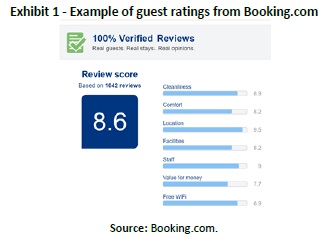
<body><![CDATA[<p>Zhang, Ye &amp; Law (2011), using a hedonic price model, studied the variations    of hotel room rates in New York city through the influence of the star rating,    number of reviews and guest ratings for the quality of the room, location, cleanliness    and service disposable on Tripadviser. For the whole sample star rating, room    quality and location are significant predictors of room prices. Neverheless    theses atributes differ between lodging segments. While in economy hotels the    quality of the rooms is statisticaly significant in explainning the variance    in the room rates, in midlescale segments, besides the quality of the room,    the convenient location is also important, and for luxury hotels are location    and the quality of the services. On the contrary Borges, Pereira, Matos &amp;    Borchardt (2015), using panel data for hotels in 25 different countries, on    the period from July to September 2013, concluded that guest ratings from Booking.com    for location, confort, cleanliness, services, staff and value for money, plus    room avaliability and number of evaluations from guest aren&rsquo;t predictors of    customers&rsquo; willingness to pay for a stay in those hotels.</p>     <p>Anderson (2012) using data from three different sources shows that a 1% improvement    in reviews score translates into a 1% gain in RevPAR and theses gains are higher    for midle class hotels than for luxury hotels in seven cities in the USA. Besides    that, this study also indicates that the probably of a consumer book a hotel    increases 1.142 if their Travelocity Review Score increases by one point. In    consequence, a one-point gain on online reputation creates an 11% gain in price    (when the hotel chooses to increase prices) and still mantains its occupancy    rate.</p>     <p><b>3. Research design, model and data</b></p>     <p>In Lisbon, hotels with 3, 4 and 5 stars accommodated 74% of total guests in    2014, and they represent 68% of the lodging capacity (hotels, apartment hotels,    <i>Pousadas</i>, tourist villages, tourist apartments and others), while more    than half is on hotels with 4 and 5 stars (INE, 2016a, 2016b). The net room    occupancy rate of bedrooms in hotel establishments was 60.2% in 2014, the highest    of Portuguese NUTS II regions, preceded by the Autonomous Region of the Madeira    (Eurostat, 2016).</p>     <p>For the purpose of this study we selected one of the most important online    hotel booking platforms with global reach: Booking.com. The reviews in this    online travel agency may be written only by a customer who has actually stayed    in the reviewed hotel booked through the Booking.com website. These reviews    and ratings should be considered as more objective, and subject to less manipulation    compared with others. Booking.com is the world leader in booking accommodations    online and provides attribute evaluations for all the hotels, although the number    of customers that rate each hotel is different (see <a href="#f1">Exhibit 1</a>).</p>     <p>&nbsp;</p>     <p align="center"><a name="f1"></a><img src="/img/revistas/tms/v14nespecial/14nespeciala07f1.jpg"/></p>     
<p>&nbsp;</p>     <p>As suggested in prior literature we selected the guest ratings and star rating    as quality signals, the number of comments and room availability to examine    if they influence and how the willingness to pay a stay in a hotel.</p>     <p>In order to attain our research objective, we conducted a quantitative study    and analyzed the 151 hotels with three to five stars in Lisbon, according to    the Nomenclature of Territorial Units for Statistics (NUTs II) using the following    methodology: we gathered the names of all hotels in the Lisbon region registered    up to March 31, 2016 in the website <a href="http://www.booking.com/" target="_blank">www.booking.com</a>,    and using this website, we collected the room rate for a one night stay in a    standard double room with breakfast included and free cancellation (the booking    was made <i>n </i><i>p</i> four months in advance), the customers reviews scores    about Cleanliness, Location, Staff, Comfort, Facilities and Value for money,    the Number of comments from each hotel and the number of available rooms in    the moment of booking. It wasn&rsquo;t including the consumer rating Free Wifi due    to the fact that Wifi is also considered in Facilities.</p>     ]]></body>
<body><![CDATA[<p>The data analysis prosecuted, using SPSS, consisted on the following methods.    First, some descriptive statistics were calculated to describe the basic features    of the data studied, namely the main measures of central tendency and dispersion.    A cluster analysis was performed in order to aggregate the variables in homogeneous    groups. The dendrogram was draw, displaying the rescaled distance cluster combine.    Lastly, the Ordinary Least Square (OLS) regression analysis was applied to a    hedonic price model to find which variables could explain differences in the    hotel room rates in Lisbon as a whole and for hotels with different star ratings.    Court (1939, in Goodman, 1998) and Rosen (1974), advises semilog (or log-linear)    specification for the pricing function instead of the linear specification.    This is mainly because semilog specification gives &ldquo;more nearly linear and higher    sample correlations&rdquo; (Court, 1939, p. 110 in Goodman, 1998).</p>     <p>It is assumed that the functional relationship is constant in time and cross    hotels, although the influence of each attribute may differ from hotel to hotel    (Espinet et al., 2003). The hedonic price model is:</p>     <p>&nbsp;</p>     <p align="center"><a name="e1"></a><img src="/img/revistas/tms/v14nespecial/14nespeciala07e1.jpg"/></p>     
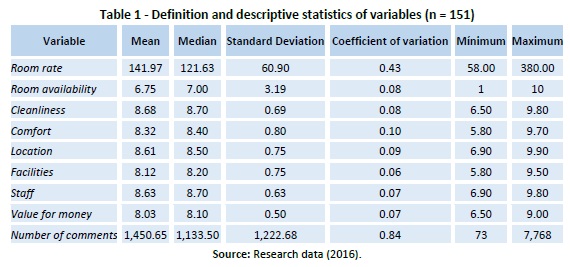
<p>&nbsp;</p>     <p>where <i>X </i><i>i </i>is the vector of quality signals and includes: guest    ratings - the hotel online guest ratings, which captures the electronic word    of mouth gathered from the travel review website, Booking.com (on a scale from    1.0 to 10.0) which are disaggregated in the following scores: Staff, Location,    Facilities, Comfort, Cleanliness and Value for money; and star rating - an official    indicator of the hotel quality, which ranges from one to five. Since we only    had three different hotel&rsquo;s category (three, four and five star hotels), it    was created two dummy variables (<i>5_Star </i>and <i>4_Star</i>) defined as:    <i>5_Star</i>= &ldquo;1&rdquo; if the hotel has a five-star rating, &ldquo;0&rdquo; otherwise; <i>4_Star</i>=    &ldquo;1&rdquo; if the hotel has a four-star rating, &ldquo;0&rdquo; otherwise. <i>Y</i><i>j </i>is    a vector of other variables selected from the literature review: room availability    - the number of rooms available on the moment of booking; and number of comments    - the number of reviews online posted by guest on the website Booking.com.</p>     <p><b>4. Results and discussion </b></p>     <p><b>4.1 Statistics Descriptive statistics and multivariate analysis</b></p>     <p><a href="#t1">Table 1</a> presents the descriptive statistics of the variables    used in the empirical analysis.</p>     <p>&nbsp;</p>     ]]></body>
<body><![CDATA[<p align="center"><a name="t1"></a><img src="/img/revistas/tms/v14nespecial/14nespeciala07t1.jpg"/></p>     
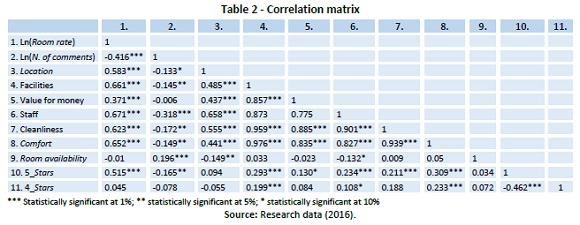
<p>&nbsp;</p>     <p>There were 151 hotels, 15.9% of which have 5 stars, 54.3% with 4 stars and    29.8% with 3 stars. For the total sample, the medium price was €141.97 with    a standard deviation of €60.90. The minimum price was €58.00 and the maximum    €380.00. Its observable a lag between the minimum (73) and the maximum (7,768)    in the number of comments from clients. The ratings for the indexes of satisfaction    are all higher than 8.03 (in a scale of 1-10) which reflect favourable experiences    during the hotel stay, and the coefficients of variation for the mean are low.    The higher coefficient of variation on the consumer&rsquo;s ratings is 0.10 and concerns    to the variable <i>Comfort</i>. Among all the variables, the higher coefficient    of variation is 0.84 and concerns to the variable <i>Number of comments</i>.</p>     <p>The results of the bivariate Pearson correlation coefficients among the various    Booking.com ratings of hotels, the <i>Room availability</i>, <i>Number of comments,    </i>and <i>Room rates </i>are presented in <a href="#t2">Table 2</a>.</p>     <p>&nbsp;</p>     <p align="center"><a name="t2"></a><img src="/img/revistas/tms/v14nespecial/14nespeciala07t2.jpg"/></p>     
<p>&nbsp;</p>     <p>According to the results, <i>Facilities </i>are strong and positively correlated    with <i>Value for money</i>, <i>Staff</i>, <i>Cleanliness </i>and <i>Comfort</i>;    <i>Value for money </i>with <i>Cleanliness</i>, and <i>Comfort</i>; <i>Staff    </i>with <i>Cleanliness </i>and <i>Comfort</i>; <i>Cleanliness </i>with <i>Comfort</i>.    It is also observable the correlation between hotel room rates and <i>Staff</i>,    <i>Facilities</i>, <i>Comfort</i>, <i>Cleanliness</i>, <i>Location</i>, 5-star    <i>rating</i>, Ln of the <i>Number of comments </i>and <i>Value for money</i>,    all statistically significant at 1%.</p>     <p>The very high correlations among the partial ratings are suggestive that hotel    guests might have the tendency to generalize and experience ‘halo effect&rsquo; -    if they evaluate the hotel highly on one of the attributes they might be more    generous on the others as well. The reverse might be also true - if they evaluate    the hotel very low on one of the ratings, customers might tend to depress their    score for the other ratings as well.</p>     <p><b>4.2 Cluster analysis</b></p>     ]]></body>
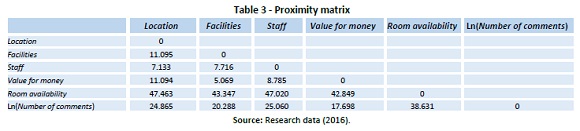
<body><![CDATA[<p>The goal of this cluster analysis is to identify homogeneous groups of variables.    We will look to the variables, indicators of the customer level of satisfaction    after their stay in destinations, considering the whole sample and analyze the    average scores for these variables: <i>Cleanliness</i>, <i>Comfort</i>, <i>Location</i>,    <i>Service</i>, <i>Staff </i>and <i>Value for money</i>. We also consider the    variables <i>Room availability </i>and the Ln (<i>Number of comments</i>). We    apply a hierarchical cluster analysis based on Euclidean distances, using the    single linkage method. Before we start with the clustering process, we have    to examine the variables for substantial collinearity. There are several variables    that have high correlations, as we saw in <a href="#t2">Table 2</a>. We should    reduce variables, for example, by omitting <i>Cleanliness</i><i> </i>and <i>Comfort</i>.    The remaining few variables still provide a sound basis for carrying out cluster    analysis.</p>     <p>The hierarchical method was used for the selection of the final cluster solution    to group variables. Using the Euclidean distance that is suitable for only continuous    variables, for measuring similarity or distance, we obtain the results reported    in <a href="#t3">Table 3</a>. The smallest difference is between <i>Facilities    </i>and <i>Value for Money </i>(5.07) and the largest distance (47.46) occurs    between <i>Location </i>and <i>Room availability </i>(<a href="#t3">Table 3</a>).</p>     <p>&nbsp;</p>     <p align="center"><a name="t3"></a><img src="/img/revistas/tms/v14nespecial/14nespeciala07t3.jpg"/></p>     
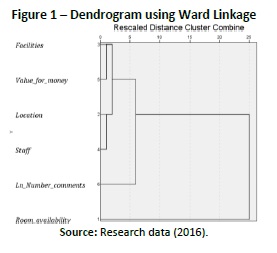
<p>&nbsp;</p>     <p>Using the <i>Ward</i>&rsquo;s hierarchical procedure, because equally sized clusters    are expected and no outliers are present, and examining the dendrogram we have    a four-cluster solution for the online review ratings, and for each cluster,    the means for all variables were calculated. Then, for each case, the squared    Euclidean distance to the cluster means is calculated. As it can be seen in    the dendrogram that <i>Location </i>and <i>Staff </i>ratings were classified    into the same cluster (cluster 1) by the hierarchical procedure, while the second    cluster (cluster 2) associates <i>Value for money </i>and <i>Facilities </i>ratings.    <i>Room availability </i>and Ln (<i>Number of comments</i>) were set apart (of    the cluster analysis) of the previous ratings, and considered as the third and    fourth clusters (<a href="#f2">Figure 1</a>).</p>     <p>&nbsp;</p>     <p align="center"><a name="f2"></a><img src="/img/revistas/tms/v14nespecial/14nespeciala07f2.jpg"/></p>     
<p>&nbsp;</p>     <p><b>4.3 Regression analysis</b></p>     ]]></body>
<body><![CDATA[<p><b>4.3.1 </b><b>Room rates determinants for the overall hotels with 3 to 5    stars</b></p>     <p>In the next step we run the regression based on the hedonic price model (eq.    [1]) that can be expressed as follows:</p>     <p>&nbsp;</p>     <p align="center"><a name="e2"></a><img src="/img/revistas/tms/v14nespecial/14nespeciala07e2.jpg"/></p>     
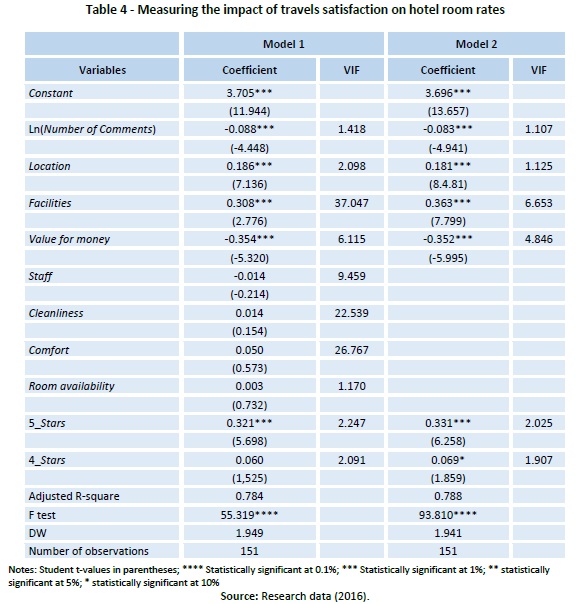
<p>&nbsp;</p>     <p>Dependent variable: Logarithm of hotel room rates (<a href="#t4">Table 4</a>).</p>     <p>&nbsp;</p>     <p align="center"><a name="t4"></a><img src="/img/revistas/tms/v14nespecial/14nespeciala07t4.jpg"/></p>     
<p>&nbsp;</p>     <p>The first model (Model 1) includes all tested variables. On this model some    of the variables of quality signals - <i>Staff</i>, <i>Cleanliness </i>and <i>Comfort    </i>are not statistically significant. Although <i>Facilities </i>is significant,    the high variance in&#64258;ation factor (VIF) denotes high collinearity, as    does <i>Cleanlinesss </i>and <i>Comfort </i>ratings and this warns that they    can&rsquo;t be all included in the same model. This high collinearity may result from    the fact that guests usually tend to evaluate the different attributes on the    same way: positively if they had a positive experience or negatively if the    experience was negative - the ‘halo&rsquo; effect (Borges et al., 2015). So, the second    model, is the result of the use of the Backward method, where all the variables    are significant at or better than 0.10 confidence levels.</p>     ]]></body>
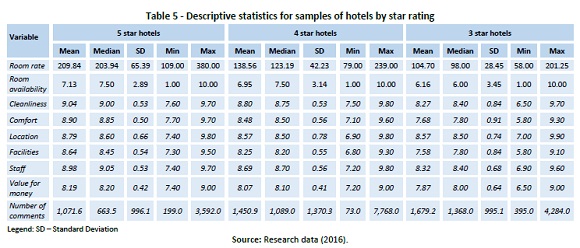
<body><![CDATA[<p>Based on the regression results (<a href="#t4">Table 4</a>), the estimated    equation for the model 2, after transforming the estimated coefficients, can    be presented as follows:</p>     <p><i>Room rate </i>= 39.286 + 0.198 <i>Location </i>+ 0.438 <i>Facilities </i>-    0.297<i>Value for money </i>+ 0.392 <i>5_Stars </i>+ 0.071 <i>4_Stars </i>-    0.083 Ln(<i>Number of comments</i>)</p>     <p>The model 2, as measured by the adjusted R-squared, shows that 78.8% of the    variance in Ln(<i>Room rates</i>) are explained by the variables included in    the analysis. The F-ratio is signi&#64257;cant at the 0.01 level. This provides    evidence of the existence of a linear relationship between the Ln (<i>Room rates</i>)    and the explanatory variables. All VIF are below the cut-off point of 10, so    multicollinearity does not seem to be a problem in our model. The t-statistic    test was used for testing whether the independent variables contribute to the    predicator of the dependent variable.</p>     <p>The online quality signaling factors - <i>Facilities </i>and <i>Location</i><i>    </i>- are significant and positive. An incremental point in the <i>Facilities    </i>score is associated with hotels price premium of 43.8%. Our results also    suggest that the higher is the evaluation of guest satisfaction with the <i>Location    </i>the higher are the room rates on Booking.com. &ldquo;The notion has been that    the typical tourist wants to be within walking distance of tourist attractions&rdquo;    (Arbel &amp; Pizam, 1977, p. 18). In Lisbon, the centre is a fairly compact    area, and the average and median distance of the hotels to the centre - Rossio    Square - are 2.5km and 2km, respectively, with a standard deviation of 2km.    Although Lisbon is equipped with a good public transport, comprising both underground    and surface, and the distance to the hotels to public transports (bus and metro)    is not far (0.5km in average), the proximity to access points for public transport    should also be considered. Regarding all these aspects and according to our    results it seems that consumers are willing to pay more 19.8% for a stay when    there is one incremental point in the <i>Location </i>score.</p>     <p>On the contrary <i>Value for money </i>rating has a negative and significant    impact on room rates. Value for money, in tourism, is a concept that &ldquo;captures    both price and quality in one construct&rdquo; (Smith &amp; Spencer, 2011, p. 96)    and measures the trade-off between the price paid and the hotel stay experience.    Supposing imperfect information, the negative impact of <i>Value for money </i>may    reflect that expectations of customers were higher and haven&rsquo;t been fulfilled    considering the price charged, or the price was too high for the services offered.    This result is consistent with Xie et al. (2014) and Borges et al. (2015) although    in this work <i>Value for money </i>is not statistically significant.</p>     <p>The star rating dummies are significant and the transformed estimated coefficients    evaluate the average price premium that consumers are willing to pay with respect    to a three-star hotel. Accordingly, predicted room rates for hotels with four    stars are 7.1% higher than those with three stars, and, similarly, five star    hotels charge 39.2% higher room rates than those with three stars, <i>ceteris    paribus</i>. We can see the increase in predict room rates as the number of    stars increases, mainly in hotels of five stars.</p>     <p>The results also suggest that the number of online customer reviews per hotel    room has a direct but negative impact in room rates.</p>     <p><b>4.3.2 Room rates determinants for each category of hotels</b></p>     <p>The results for the overall hotels in Lisbon with 3, 4 and 5 stars suggested    that only some quality signaling factors have an impact on prices. Since customers    have different expectations and usually they are higher when prices are higher    (Zhang, Ye and Law, 2011; Blal &amp; Sturman, 2014), next we examine if the    willingness to pay a stay in a hotel with different category (star rating) is    determined by different quality attributes, the volume of customers online reviews    and room availability.</p>     <p><a href="#t5">Table 5</a> reports the descriptive statistics for the three    segments, according to the star rating. As was expected hotels with 5 stars    practice the highest prices but also have the highest coefficient of variation.    The consumer ratings for each attribute, in average, decrease as the category    of the hotel decreases, which indicates that consumer ratings reflect the hotel    service quality (Riegner, 2007). Guests of 5 and 4 star hotels give the highest    scores for <i>Cleanliness </i>and <i>Staff</i>, in average, and for 3 star hotels    the highest scores are for <i>Location </i>followed by <i>Staff</i>. For these    attributes the rating for <i>Comfort </i>are most dispersive in 3 star hotels    and <i>Location </i>in 4 and 5 star hotels. 3 star hotels have a larger volume    of consumer reviews in average.</p>     ]]></body>
<body><![CDATA[<p>&nbsp;</p>     <p align="center"><a name="t5"></a><img src="/img/revistas/tms/v14nespecial/14nespeciala07t5.jpg"/></p>     
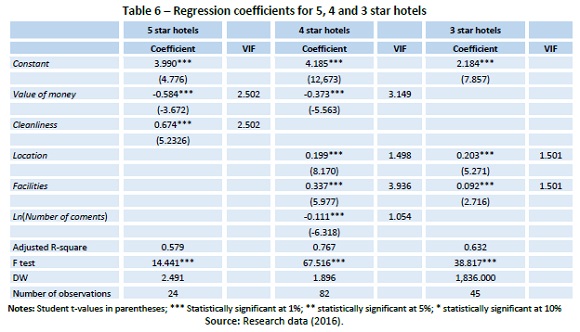
<p>&nbsp;</p>     <p>The results for each category (<a href="#t6">Table 6</a>) show differences    in the determinants of room rates.</p>     <p>&nbsp;</p>     <p align="center"><a name="t6"></a><img src="/img/revistas/tms/v14nespecial/14nespeciala07t6.jpg"/></p>     
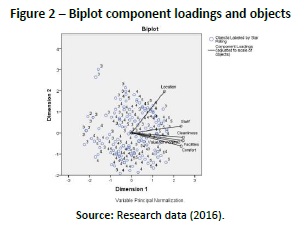
<p>&nbsp;</p>     <p><i>Cleanliness </i>quality is the factor that has the higher impact on predictable    prices in 5 star hotels, but only in this category of hotels. Considering that    this type of hotels has higher quality of services and facilities, and, in Lisbon,    are mostly located near the center (see <a href="#f3">Figure 2</a>), it means    that consumers are willing to pay more if the <i>Cleanliness </i>has higher    ratings. <i>Value for money </i>is a quality attribute common to 5 and 4 stars    and with a negative and significant impact on room rates, mainly in 5 star hotels.    This can mean that customers had higher expectations than they get to the price    they pay, or the price is too high, which has a negative impact on the consumer&rsquo;s    willingness to pay for a stay.</p>     <p>&nbsp;</p>     <p align="center"><a name="f3"></a><img src="/img/revistas/tms/v14nespecial/14nespeciala07f3.jpg"/></p>     
]]></body>
<body><![CDATA[<p>&nbsp;</p>     <p>In both 4 and 3 stars the guest ratings that potentially impact positively    room rates are those related with <i>Location </i>and <i>Facilities</i>. An    increase of one point on the <i>Facilities </i>score increases prices about    40% in 4 star hotels and 9.6% in 3 star hotels, while the impact of one point    on the <i>Location </i>score increases price about 22% in either those two categories    of hotels. This may result from the fact that hotels with 3 and 4 stars have    a higher dispersion in physical location, as can be seen in <a href="#f3">Figure    2</a>, and so, consumers are willing to pay more for a convenient location.    The volume of online reviews only impacts negatively room rates on 4 star hotels.</p>     <p>The increase of mobile devices for making hotel bookings enhances the importance    of online reviews and ratings, which are the result of experiences of previous    guests. Even if consumers don&rsquo;t book the hotel online, they take into account    these reviews and scores in the hotel selection process. Online reviews and    ratings are quality signals for travelers and if these signals are of high quality,    consumers are willing to pay more for a stay in the hotel. Beyond the official    star rating, that is consensually an important determinant of room rates, and    also a quality signaling factor, the scores resulting from guest&rsquo;s opinions    can be seen as quality attributes of the hotel and, according to the hedonic    price model, determinants of room rates. Those reviews and scores can&rsquo;t be seen    as a threat for the hoteliers, but rather can be used to improve the business    performance and guest loyalty. In this sense, the present investigation on the    determinants of room prices in Lisbon, based mainly on quality signal factors,    may provide clues to hoteliers in identify and take corrective actions towards    the attributes most valuable for consumers and that can provide a higher room    rate premium.</p>     <p>The website Booking.com discloses, for each hotel, ratings for <i>Staff</i>,    <i>Cleanliness</i>, <i>Comfort</i>, <i>Facilities</i>, <i>Location </i>and <i>Value    for money</i>. Our cluster analysis suggests four clusters for these ratings,    <i>Number of comments </i>and <i>Room availability. </i>Guests punctuate in    a similar way <i>Staff </i>and <i>Location</i>, forming a cluster, <i>Value    for money </i>and <i>Facilities </i>forming another homogeneous group. The other    variables, <i>Number of comments </i>and <i>Room availability </i>compose two    different clusters.</p>     <p>The results of the regression analyses suggest that the consumer&rsquo;s willingness    to pay a stay in a hotel in Lisbon increases with the star rating, convenient    location and facilities provided. The negative impact of the rating for value    for money on room rates suggest the &ldquo;low price may make good purchase value    for money&rdquo; (Xie et al., 2014, p. 8) while it may also reduce room prices. Nevertheless,    the relevance of the quality signalling factors differs among hotels with different    categories. In five star hotels, the quality of cleanliness and value for money    are significant in explaining the variance in room prices. This suggest that    hoteliers of this segment should invest in the cleanliness in order to enhance    guest ratings. They also should improve what customers get from the experience    regarding the price they pay. In four star hotels, besides the negative impact    of value for money, there are two more quality signalling factors that may influence    room prices, and that are common with three star hotels: facilities and location.    So, on these segments, managers should focus on facilities in order to enhance    guest ratings. In four star hotels the hoteliers should also improve the value    of guest experience.</p>     <p>As any piece of research, this work presents some limitations. Other quality    signaling factors as chain and quality certification could be included in our    analysis.</p>     <p>In future research, besides the inclusion of the omitted quality factors, and    also following Booking.com&rsquo;s rating system it could be analyzed the impact of    attributes ratings on hotel room rates capturing different preferences among    customer segments and between domestic and foreign costumer ratings.</p>     <p>&nbsp;</p>     <p><b>REFERENCES</b></p>     <!-- ref --><p>Abrate, G., Capriello, A. &amp; Fraquelli, G. (2011). When quality signals    talk: Evidence from the Turin hotel industry. <i>Tourism Management</i>, 32(4),    912-921.    &nbsp;&nbsp;&nbsp;&nbsp;&nbsp;&nbsp;&nbsp;&nbsp;[&#160;<a href="javascript:void(0);" onclick="javascript: window.open('/scielo.php?script=sci_nlinks&ref=1281100&pid=S2182-8458201800050000700001&lng=','','width=640,height=500,resizable=yes,scrollbars=1,menubar=yes,');">Links</a>&#160;]<!-- end-ref --></p>     <!-- ref --><p>Abrate, G., Fraquelli, G. &amp; Viglia, G. (2012). Dynamic pricing strategies:    Evidence from European hotels. <i>International Journal of Hospitality Management</i>,    31, 160-168.    &nbsp;&nbsp;&nbsp;&nbsp;&nbsp;&nbsp;&nbsp;&nbsp;[&#160;<a href="javascript:void(0);" onclick="javascript: window.open('/scielo.php?script=sci_nlinks&ref=1281102&pid=S2182-8458201800050000700002&lng=','','width=640,height=500,resizable=yes,scrollbars=1,menubar=yes,');">Links</a>&#160;]<!-- end-ref --></p>     <!-- ref --><p>Anderson, C. K. (2012). The Impact of Social Media on Lodging Performance.    <i>Center for Hospitality Research Report</i>, 12 (15).    &nbsp;&nbsp;&nbsp;&nbsp;&nbsp;&nbsp;&nbsp;&nbsp;[&#160;<a href="javascript:void(0);" onclick="javascript: window.open('/scielo.php?script=sci_nlinks&ref=1281104&pid=S2182-8458201800050000700003&lng=','','width=640,height=500,resizable=yes,scrollbars=1,menubar=yes,');">Links</a>&#160;]<!-- end-ref --></p>     <p>Andersson, D.E. (2010). Hotel attributes and hedonic prices: an analysis of    internet-based transactions in Singapore&rsquo;s market for hotel rooms. <i>The Annals    of Regional Science</i>, 44, 229-240.</p>     <!-- ref --><p>Arbel, A. &amp; Pizam, A. (1977) Some Determinants of Urban Hotel Location:    The Tourists' Inclinations. <i>Journal of Travel Research</i>, 15(3): 18-22.    DOI: <a href="https://dx.doi.org/10.1177/004728757701500305" target="_blank">10.1177/004728757701500305</a>.    &nbsp;&nbsp;&nbsp;&nbsp;&nbsp;&nbsp;&nbsp;&nbsp;[&#160;<a href="javascript:void(0);" onclick="javascript: window.open('/scielo.php?script=sci_nlinks&ref=1281107&pid=S2182-8458201800050000700005&lng=','','width=640,height=500,resizable=yes,scrollbars=1,menubar=yes,');">Links</a>&#160;]<!-- end-ref --></p>     <!-- ref --><p>Badinelli, R. (2000). An optimal, dynamic policy for hotel yield management.    <i>European Journal of Operational Research</i>, 121, 476-503.    &nbsp;&nbsp;&nbsp;&nbsp;&nbsp;&nbsp;&nbsp;&nbsp;[&#160;<a href="javascript:void(0);" onclick="javascript: window.open('/scielo.php?script=sci_nlinks&ref=1281109&pid=S2182-8458201800050000700006&lng=','','width=640,height=500,resizable=yes,scrollbars=1,menubar=yes,');">Links</a>&#160;]<!-- end-ref --></p>     ]]></body>
<body><![CDATA[<!-- ref --><p>Blal, I. &amp; Sturman, M. C. (2014). The differential effects of the quality    and quantity of online reviews on hotel room sales. <i>Cornell Hospitality Quarterly</i>,    55(4), 365-375.    &nbsp;&nbsp;&nbsp;&nbsp;&nbsp;&nbsp;&nbsp;&nbsp;[&#160;<a href="javascript:void(0);" onclick="javascript: window.open('/scielo.php?script=sci_nlinks&ref=1281111&pid=S2182-8458201800050000700007&lng=','','width=640,height=500,resizable=yes,scrollbars=1,menubar=yes,');">Links</a>&#160;]<!-- end-ref --></p>     <!-- ref --><p>Borges, I., Pereira, G., Matos, C. &amp; Borchardt, M. (2015). Análise da relação    entre a satisfação dos consumidores e os preços ofertados no sítio booking.com.    <i>Tourism &amp; Management Studies</i>, 11(2), 64-70.    &nbsp;&nbsp;&nbsp;&nbsp;&nbsp;&nbsp;&nbsp;&nbsp;[&#160;<a href="javascript:void(0);" onclick="javascript: window.open('/scielo.php?script=sci_nlinks&ref=1281113&pid=S2182-8458201800050000700008&lng=','','width=640,height=500,resizable=yes,scrollbars=1,menubar=yes,');">Links</a>&#160;]<!-- end-ref --></p>     <!-- ref --><p>Castro, C. &amp; Ferreira, F. A. (2015). Effects of Hotel Characteristics on    Room Rates in Porto: a Hedonic Price Approach, AIP Conference Proceedings 1648,    070002.    &nbsp;&nbsp;&nbsp;&nbsp;&nbsp;&nbsp;&nbsp;&nbsp;[&#160;<a href="javascript:void(0);" onclick="javascript: window.open('/scielo.php?script=sci_nlinks&ref=1281115&pid=S2182-8458201800050000700009&lng=','','width=640,height=500,resizable=yes,scrollbars=1,menubar=yes,');">Links</a>&#160;]<!-- end-ref --></p>     <!-- ref --><p>Castro, C., Ferreira, F. A. &amp; Vasconcelos, L. (2015). Effects of hotel    characteristics on room rates in Lisbon: A hedonic price approach. In Vânia    Costa (Ed.) <i>Tourism for the 21</i><i>st </i><i>Century. Proceeding of the    CIT 2015 </i>(pp. 1153-1165), Guimarães: Instituto Politécnico do Cávado e do    Ave.    &nbsp;&nbsp;&nbsp;&nbsp;&nbsp;&nbsp;&nbsp;&nbsp;[&#160;<a href="javascript:void(0);" onclick="javascript: window.open('/scielo.php?script=sci_nlinks&ref=1281117&pid=S2182-8458201800050000700010&lng=','','width=640,height=500,resizable=yes,scrollbars=1,menubar=yes,');">Links</a>&#160;]<!-- end-ref --></p>     <!-- ref --><p>Chaves, M., Gomes, R. &amp; Pedron, C. (2011). Analysing reviews in the Web    2.0: Small and medium hotels in Portugal. <i>Tourism Management</i>, 33(5),    1286-1287.    &nbsp;&nbsp;&nbsp;&nbsp;&nbsp;&nbsp;&nbsp;&nbsp;[&#160;<a href="javascript:void(0);" onclick="javascript: window.open('/scielo.php?script=sci_nlinks&ref=1281119&pid=S2182-8458201800050000700011&lng=','','width=640,height=500,resizable=yes,scrollbars=1,menubar=yes,');">Links</a>&#160;]<!-- end-ref --></p>     ]]></body>
<body><![CDATA[<!-- ref --><p>Chen, C. &amp; Rothschild, R. (2010). An application of hedonic pricing analysis    to the case of hotel rooms in Taipei. <i>Tourism Economics</i>, 16(3), 685-694.    &nbsp;&nbsp;&nbsp;&nbsp;&nbsp;&nbsp;&nbsp;&nbsp;[&#160;<a href="javascript:void(0);" onclick="javascript: window.open('/scielo.php?script=sci_nlinks&ref=1281121&pid=S2182-8458201800050000700012&lng=','','width=640,height=500,resizable=yes,scrollbars=1,menubar=yes,');">Links</a>&#160;]<!-- end-ref --></p>     <!-- ref --><p>Cheung, C. &amp; Thadani, D. (2012). The impact of electronic word-of- mouth    communication: A literature analysis and integrative model. <i>Decision Support    Systems</i>, 54 (1), 461-70.    &nbsp;&nbsp;&nbsp;&nbsp;&nbsp;&nbsp;&nbsp;&nbsp;[&#160;<a href="javascript:void(0);" onclick="javascript: window.open('/scielo.php?script=sci_nlinks&ref=1281123&pid=S2182-8458201800050000700013&lng=','','width=640,height=500,resizable=yes,scrollbars=1,menubar=yes,');">Links</a>&#160;]<!-- end-ref --></p>     <p>Espinet, J. M., Saez, M., Coenders, G. &amp; Fluvià, M. (2003). Effects on    Prices of the Attributes of Holiday Hotels: A Hedonic Prices Approach. <i>Tourism    Economics</i>, vol. 9(2), 165-177.</p>     <!-- ref --><p>Eurostat (2016). Net occupancy rate of bed-places and bedrooms in hotels and    similar accommodation (NACE Rev. 2, I, 55.1) by NUTS 2 regions (from 2012 onwards)    [Database]. Retrieved April 30, 2016, from <a href="http://appsso.eurostat.ec.europa.eu/nui/submitViewTableAction.do" target="_blank">http://appsso.eurostat.ec.europa.eu/nui/submitViewTableAction.do</a>&nbsp;&nbsp;&nbsp;&nbsp;&nbsp;&nbsp;&nbsp;&nbsp;[&#160;<a href="javascript:void(0);" onclick="javascript: window.open('/scielo.php?script=sci_nlinks&ref=1281126&pid=S2182-8458201800050000700015&lng=','','width=640,height=500,resizable=yes,scrollbars=1,menubar=yes,');">Links</a>&#160;]<!-- end-ref --><!-- ref --><p>INE (2016a). Guests (No.) in hotel establishments by Geographic localization    (NUTS - 2013) and Type (hotel establishment); Annual [Statistical data]. Retrieved    April, 30, 2016 from <a href="https://www.ine.pt/xportal/xmain?xpid=INE&xpgid=ine_indicadores&indOcorrCod=0008577&contexto=bd&selTab=tab2" target="_blank">https://www.ine.pt/xportal/xmain?xpid=INE&amp;xpgid=ine_indicadores&amp;indOcorrCod=0008577&amp;contexto=bd&amp;selTab=tab2</a>&nbsp;&nbsp;&nbsp;&nbsp;&nbsp;&nbsp;&nbsp;&nbsp;[&#160;<a href="javascript:void(0);" onclick="javascript: window.open('/scielo.php?script=sci_nlinks&ref=1281127&pid=S2182-8458201800050000700016&lng=','','width=640,height=500,resizable=yes,scrollbars=1,menubar=yes,');">Links</a>&#160;]<!-- end-ref --><!-- ref --><p>INE (2016b). Lodging capacity (No.) in hotel establishments by Geographic localization    (NUTS - 2013) and Type (hotel establishment; Annual [Statistical data]. Retrieved    April, 30, 2016 from <a href="https://www.ine.pt/xportal/xmain?xpid=INE&xpgid=ine_indicadores&indOcorrCod=0008574&contexto=bd&selTab=tab2" target="_blank">https://www.ine.pt/xportal/xmain?xpid=INE&amp;xpgid=ine_indicadores&amp;indOcorrCod=0008574&amp;contexto=bd&amp;selTab=tab2</a>&nbsp;&nbsp;&nbsp;&nbsp;&nbsp;&nbsp;&nbsp;&nbsp;[&#160;<a href="javascript:void(0);" onclick="javascript: window.open('/scielo.php?script=sci_nlinks&ref=1281128&pid=S2182-8458201800050000700017&lng=','','width=640,height=500,resizable=yes,scrollbars=1,menubar=yes,');">Links</a>&#160;]<!-- end-ref --><!-- ref --><p>Gallego, G. &amp; Ryzin, G. (1994). Optimal dynamic pricing of inventories    with stochastic demand over &#64257;nite horizons. <i>Management Science, </i>40,    999-1020.    &nbsp;&nbsp;&nbsp;&nbsp;&nbsp;&nbsp;&nbsp;&nbsp;[&#160;<a href="javascript:void(0);" onclick="javascript: window.open('/scielo.php?script=sci_nlinks&ref=1281129&pid=S2182-8458201800050000700018&lng=','','width=640,height=500,resizable=yes,scrollbars=1,menubar=yes,');">Links</a>&#160;]<!-- end-ref --></p>     ]]></body>
<body><![CDATA[<!-- ref --><p>Goodman, A. C. (1998). Andrew Court and the Invention of Hedonic Price Analysis.    <i>Journal of Urban Economics</i>, 44, 291-298.    &nbsp;&nbsp;&nbsp;&nbsp;&nbsp;&nbsp;&nbsp;&nbsp;[&#160;<a href="javascript:void(0);" onclick="javascript: window.open('/scielo.php?script=sci_nlinks&ref=1281131&pid=S2182-8458201800050000700019&lng=','','width=640,height=500,resizable=yes,scrollbars=1,menubar=yes,');">Links</a>&#160;]<!-- end-ref --></p>     <!-- ref --><p>Google/IPSOS OTX. MediaTraveler's Road to Decision 2011. Retrieved May 5, 2016,    from <a href="http://www.gstatic.com/ads/research/en/2011_TravelersRoadtoDecision2011.pdf" target="_blank">http://www.gstatic.com/ads/research/en/2011_TravelersRoadtoDecision2011.pdf</a>.    &nbsp;&nbsp;&nbsp;&nbsp;&nbsp;&nbsp;&nbsp;&nbsp;[&#160;<a href="javascript:void(0);" onclick="javascript: window.open('/scielo.php?script=sci_nlinks&ref=1281133&pid=S2182-8458201800050000700020&lng=','','width=640,height=500,resizable=yes,scrollbars=1,menubar=yes,');">Links</a>&#160;]<!-- end-ref --></p>     <!-- ref --><p>Herrmann, R. &amp; Herrmann, O. (2014). Hotel room rates under the influence    of a large event: The Oktoberfest in Munich 2012. <i>International Journal of    Hospitality Management</i>, 39, 21-28.    &nbsp;&nbsp;&nbsp;&nbsp;&nbsp;&nbsp;&nbsp;&nbsp;[&#160;<a href="javascript:void(0);" onclick="javascript: window.open('/scielo.php?script=sci_nlinks&ref=1281135&pid=S2182-8458201800050000700021&lng=','','width=640,height=500,resizable=yes,scrollbars=1,menubar=yes,');">Links</a>&#160;]<!-- end-ref --></p>     <!-- ref --><p>Hung, W., Shang, J. &amp; Wang, F. (2010). Pricing determinants in the hotel    industry: Quantile regression analysis. <i>International Journal of Hospitality    Management</i>, 29, 378-384.    &nbsp;&nbsp;&nbsp;&nbsp;&nbsp;&nbsp;&nbsp;&nbsp;[&#160;<a href="javascript:void(0);" onclick="javascript: window.open('/scielo.php?script=sci_nlinks&ref=1281137&pid=S2182-8458201800050000700022&lng=','','width=640,height=500,resizable=yes,scrollbars=1,menubar=yes,');">Links</a>&#160;]<!-- end-ref --></p>     <!-- ref --><p>Molinillo, S., Ximénez-de-Sandoval, J., Fernández-Morales, A. &amp; Coca- Stefaniak,    A. (2016). Hotel Assessment through Social Media: The case of TripAdvisor. <i>Tourism    &amp; Management Studies</i>, 12(1), 15-24. DOI: <a href="https://dx.doi.org/10.18089/tms.2016.12102" target="_blank">10.18089/tms.2016.12102</a>.    &nbsp;&nbsp;&nbsp;&nbsp;&nbsp;&nbsp;&nbsp;&nbsp;[&#160;<a href="javascript:void(0);" onclick="javascript: window.open('/scielo.php?script=sci_nlinks&ref=1281139&pid=S2182-8458201800050000700023&lng=','','width=640,height=500,resizable=yes,scrollbars=1,menubar=yes,');">Links</a>&#160;]<!-- end-ref --></p>     ]]></body>
<body><![CDATA[<p>O&rsquo;Connor, P. (2010). Managing a hotel&rsquo;s image on TripAdvisor. <i>Journal of    Hospitality Marketing &amp; Management</i>, 19(7), 754-772.</p>     <p>Ö&#287;üt, H. &amp; Ta&#351;, B. (2012). The influence of internet customer    reviews on the online sales and prices in hotel industry. <i>The Service Industries    Journal</i>, 32 (2), 197-214.</p>     <!-- ref --><p>Park, D. &amp; Lee, J. (2008). eWOM overload and its effect on consumer behavioral    intention depending on consumer involvement. <i>Electronic Commerce Research    and Applications</i>,7 (4), 386-398.    &nbsp;&nbsp;&nbsp;&nbsp;&nbsp;&nbsp;&nbsp;&nbsp;[&#160;<a href="javascript:void(0);" onclick="javascript: window.open('/scielo.php?script=sci_nlinks&ref=1281143&pid=S2182-8458201800050000700026&lng=','','width=640,height=500,resizable=yes,scrollbars=1,menubar=yes,');">Links</a>&#160;]<!-- end-ref --></p>     <!-- ref --><p>Phillips, P., Barnes, S., Zigan, K. &amp; Schegg, R. (2016). Understanding    the Impact of Online Reviews on Hotel Performance: <i>An Empirical Analysis.    Journal of Travel Research</i>. DOI: <a href="https://dx.doi.org/10.1177/0047287516636481" target="_blank">10.1177/0047287516636481</a>.    &nbsp;&nbsp;&nbsp;&nbsp;&nbsp;&nbsp;&nbsp;&nbsp;[&#160;<a href="javascript:void(0);" onclick="javascript: window.open('/scielo.php?script=sci_nlinks&ref=1281145&pid=S2182-8458201800050000700027&lng=','','width=640,height=500,resizable=yes,scrollbars=1,menubar=yes,');">Links</a>&#160;]<!-- end-ref --></p>     <!-- ref --><p>Riegner, C. (2007). Word of mouth on the web: the impact of Web 2.0 on consumer    purchase decisions. <i>Journal of Advertising Research</i>, 47(4), 436-447.    &nbsp;&nbsp;&nbsp;&nbsp;&nbsp;&nbsp;&nbsp;&nbsp;[&#160;<a href="javascript:void(0);" onclick="javascript: window.open('/scielo.php?script=sci_nlinks&ref=1281147&pid=S2182-8458201800050000700028&lng=','','width=640,height=500,resizable=yes,scrollbars=1,menubar=yes,');">Links</a>&#160;]<!-- end-ref --></p>     <!-- ref --><p>Rigall-I-Torrent, R., Fluvià, M., Ballester, R., Saló, A., Ariza, E. &amp;    Espinet, J. M. (2011). The effects of beach characteristics and location with    respect to hotel prices. <i>Tourism Management</i>, 32, 1150-1158.    &nbsp;&nbsp;&nbsp;&nbsp;&nbsp;&nbsp;&nbsp;&nbsp;[&#160;<a href="javascript:void(0);" onclick="javascript: window.open('/scielo.php?script=sci_nlinks&ref=1281149&pid=S2182-8458201800050000700029&lng=','','width=640,height=500,resizable=yes,scrollbars=1,menubar=yes,');">Links</a>&#160;]<!-- end-ref --></p>     ]]></body>
<body><![CDATA[<!-- ref --><p>Rosen, S. (1974). Hedonic Prices and Implicit Markets: Product Differentiation    in Pure Competition. <i>Journal of Political Economy</i>, 82(1), 34-55.    &nbsp;&nbsp;&nbsp;&nbsp;&nbsp;&nbsp;&nbsp;&nbsp;[&#160;<a href="javascript:void(0);" onclick="javascript: window.open('/scielo.php?script=sci_nlinks&ref=1281151&pid=S2182-8458201800050000700030&lng=','','width=640,height=500,resizable=yes,scrollbars=1,menubar=yes,');">Links</a>&#160;]<!-- end-ref --></p>     <!-- ref --><p>Schamel, G. (2012).Weekend vs. midweek stays: Modelling hotel room rates in    a small market. <i>International Journal of Hospitality</i> <i>Management</i>,    31 (4), 1113-1118.    &nbsp;&nbsp;&nbsp;&nbsp;&nbsp;&nbsp;&nbsp;&nbsp;[&#160;<a href="javascript:void(0);" onclick="javascript: window.open('/scielo.php?script=sci_nlinks&ref=1281153&pid=S2182-8458201800050000700031&lng=','','width=640,height=500,resizable=yes,scrollbars=1,menubar=yes,');">Links</a>&#160;]<!-- end-ref --></p>     <!-- ref --><p>Serra Cantallops, A. &amp; Salvi, F. (2014). New consumer behavior: A review    of research on eWOM and hotels. <i>International Journal of Hospitality Management</i>,    36, 41-51.    &nbsp;&nbsp;&nbsp;&nbsp;&nbsp;&nbsp;&nbsp;&nbsp;[&#160;<a href="javascript:void(0);" onclick="javascript: window.open('/scielo.php?script=sci_nlinks&ref=1281155&pid=S2182-8458201800050000700032&lng=','','width=640,height=500,resizable=yes,scrollbars=1,menubar=yes,');">Links</a>&#160;]<!-- end-ref --></p>     <!-- ref --><p>Smith, T. &amp; Spencer, A. (2011). Predictors of Value for Money in Jamaican    All-Inclusive Hotels. <i>International Journal of Humanities and Social Science</i>,    1(4), 93-102.    &nbsp;&nbsp;&nbsp;&nbsp;&nbsp;&nbsp;&nbsp;&nbsp;[&#160;<a href="javascript:void(0);" onclick="javascript: window.open('/scielo.php?script=sci_nlinks&ref=1281157&pid=S2182-8458201800050000700033&lng=','','width=640,height=500,resizable=yes,scrollbars=1,menubar=yes,');">Links</a>&#160;]<!-- end-ref --></p>     <!-- ref --><p>Thrane, C. (2007). Examining the determinants of room rates for hotels in capital    cities: The Oslo experience. <i>Journal of Revenue and Pricing Management</i>,    5(4), 315-323.    &nbsp;&nbsp;&nbsp;&nbsp;&nbsp;&nbsp;&nbsp;&nbsp;[&#160;<a href="javascript:void(0);" onclick="javascript: window.open('/scielo.php?script=sci_nlinks&ref=1281159&pid=S2182-8458201800050000700034&lng=','','width=640,height=500,resizable=yes,scrollbars=1,menubar=yes,');">Links</a>&#160;]<!-- end-ref --></p>     ]]></body>
<body><![CDATA[<!-- ref --><p>Tsao, W-C., Hsieh, M-T., Shih, L-W. &amp; Lin, T. (2015). Compliance with eWOM:    The in&#64258;uence of hotel reviews on booking intention from the perspective    of consumer conformity. <i>International Journal of Hospitality Management</i>,    46, 99-111.    &nbsp;&nbsp;&nbsp;&nbsp;&nbsp;&nbsp;&nbsp;&nbsp;[&#160;<a href="javascript:void(0);" onclick="javascript: window.open('/scielo.php?script=sci_nlinks&ref=1281161&pid=S2182-8458201800050000700035&lng=','','width=640,height=500,resizable=yes,scrollbars=1,menubar=yes,');">Links</a>&#160;]<!-- end-ref --></p>     <!-- ref --><p>White, P. &amp; Mulligan, G. (2002). Hedonic Estimates of Lodging Rates in    the Four Corners Region. <i>The Professional Geographer</i>, 54 (4), 533-543.    &nbsp;&nbsp;&nbsp;&nbsp;&nbsp;&nbsp;&nbsp;&nbsp;[&#160;<a href="javascript:void(0);" onclick="javascript: window.open('/scielo.php?script=sci_nlinks&ref=1281163&pid=S2182-8458201800050000700036&lng=','','width=640,height=500,resizable=yes,scrollbars=1,menubar=yes,');">Links</a>&#160;]<!-- end-ref --></p>     <p>World Tourism Organization (UNWTO) (2014). <i>Online Guest Reviews and Hotel    Classification Systems - An Integrated Approach</i>. Madrid: UNWTO.</p>     <!-- ref --><p>Xie, K., Zhang, Z. &amp; Zhang, Z. (2014). The business value of online consumer    reviews and management response to hotel performance. <i>International Journal    of Hospitality Management</i>, 43, 1-12.    &nbsp;&nbsp;&nbsp;&nbsp;&nbsp;&nbsp;&nbsp;&nbsp;[&#160;<a href="javascript:void(0);" onclick="javascript: window.open('/scielo.php?script=sci_nlinks&ref=1281166&pid=S2182-8458201800050000700038&lng=','','width=640,height=500,resizable=yes,scrollbars=1,menubar=yes,');">Links</a>&#160;]<!-- end-ref --></p>     <!-- ref --><p>Yang, Y., Mueller, N. &amp; Croes, R. (2016). Market accessibility and hotel    prices in the Caribbean: The moderating effect of quality-signaling factors.    <i>Tourism Management</i>, 56, 40-51.    &nbsp;&nbsp;&nbsp;&nbsp;&nbsp;&nbsp;&nbsp;&nbsp;[&#160;<a href="javascript:void(0);" onclick="javascript: window.open('/scielo.php?script=sci_nlinks&ref=1281168&pid=S2182-8458201800050000700039&lng=','','width=640,height=500,resizable=yes,scrollbars=1,menubar=yes,');">Links</a>&#160;]<!-- end-ref --></p>     <!-- ref --><p>Zhang, H., Zhang, J., Lu, S., Cheng, S. &amp; Zhang, J. (2011). Modeling hotel    room price with geographically weighted regression. <i>International Journal    of Hospitality Management</i>, 30, 1036-1043.    &nbsp;&nbsp;&nbsp;&nbsp;&nbsp;&nbsp;&nbsp;&nbsp;[&#160;<a href="javascript:void(0);" onclick="javascript: window.open('/scielo.php?script=sci_nlinks&ref=1281170&pid=S2182-8458201800050000700040&lng=','','width=640,height=500,resizable=yes,scrollbars=1,menubar=yes,');">Links</a>&#160;]<!-- end-ref --></p>     <!-- ref --><p>Zhang, Z., Ye, Q. &amp; Law, R. (2011). Determinants of hotel room price: An    exploration of travelers' hierarchy of accommodation needs&quot;. <i>International    Journal of Contemporary Hospitality Management</i>, 23(7), 972-981.    &nbsp;&nbsp;&nbsp;&nbsp;&nbsp;&nbsp;&nbsp;&nbsp;[&#160;<a href="javascript:void(0);" onclick="javascript: window.open('/scielo.php?script=sci_nlinks&ref=1281172&pid=S2182-8458201800050000700041&lng=','','width=640,height=500,resizable=yes,scrollbars=1,menubar=yes,');">Links</a>&#160;]<!-- end-ref --></p>     <!-- ref --><p>Zhou, L., Ye, S., Pearce, P.L. &amp; Wu, M.-Y. (2014). Refreshing hotel satisfaction    studies by reconfiguring customer review data. <i>International Journal of Hospitality    Management</i>, 38, 1-10.    &nbsp;&nbsp;&nbsp;&nbsp;&nbsp;&nbsp;&nbsp;&nbsp;[&#160;<a href="javascript:void(0);" onclick="javascript: window.open('/scielo.php?script=sci_nlinks&ref=1281174&pid=S2182-8458201800050000700042&lng=','','width=640,height=500,resizable=yes,scrollbars=1,menubar=yes,');">Links</a>&#160;]<!-- end-ref --></p>     <!-- ref --><p>Zhu, F. &amp; Zhang, X. (2010). Impact of online consumer reviews on sales:    the moderating role of product and consumer characteristics. <i>Journal of Market</i>,    74(2), 133-148.    &nbsp;&nbsp;&nbsp;&nbsp;&nbsp;&nbsp;&nbsp;&nbsp;[&#160;<a href="javascript:void(0);" onclick="javascript: window.open('/scielo.php?script=sci_nlinks&ref=1281176&pid=S2182-8458201800050000700043&lng=','','width=640,height=500,resizable=yes,scrollbars=1,menubar=yes,');">Links</a>&#160;]<!-- end-ref --></p>     <p>&nbsp;</p>     <p><b>Acknowledgments</b></p>     <p>UNIAG, R&amp;D unit funded by the FCT - Portuguese Foundation for the Development    of Science and Technology, Ministry of Science, Technology and Higher Education,    under the Project UID/GES/04752/2016.</p>     ]]></body>
<body><![CDATA[<p>&nbsp;</p>     <p>Received: 20 March 2017</p>     <p>Revisions required: 23 May 2017</p>     <p>Accepted: 20 July 2017</p>      ]]></body><back>
<ref-list>
<ref id="B1">
<nlm-citation citation-type="journal">
<person-group person-group-type="author">
<name>
<surname><![CDATA[Abrate]]></surname>
<given-names><![CDATA[G.]]></given-names>
</name>
<name>
<surname><![CDATA[Capriello]]></surname>
<given-names><![CDATA[A.]]></given-names>
</name>
<name>
<surname><![CDATA[Fraquelli]]></surname>
<given-names><![CDATA[G.]]></given-names>
</name>
</person-group>
<article-title xml:lang="en"><![CDATA[When quality signals talk: Evidence from the Turin hotel industry]]></article-title>
<source><![CDATA[Tourism Management]]></source>
<year>2011</year>
<volume>32</volume>
<numero>4</numero>
<issue>4</issue>
<page-range>912-921</page-range></nlm-citation>
</ref>
<ref id="B2">
<nlm-citation citation-type="journal">
<person-group person-group-type="author">
<name>
<surname><![CDATA[Abrate]]></surname>
<given-names><![CDATA[G.]]></given-names>
</name>
<name>
<surname><![CDATA[Fraquelli]]></surname>
<given-names><![CDATA[G.]]></given-names>
</name>
<name>
<surname><![CDATA[Viglia]]></surname>
<given-names><![CDATA[G.]]></given-names>
</name>
</person-group>
<article-title xml:lang="en"><![CDATA[Dynamic pricing strategies: Evidence from European hotels]]></article-title>
<source><![CDATA[International Journal of Hospitality Management]]></source>
<year>2012</year>
<volume>31</volume>
<page-range>160-168</page-range></nlm-citation>
</ref>
<ref id="B3">
<nlm-citation citation-type="journal">
<person-group person-group-type="author">
<name>
<surname><![CDATA[Anderson]]></surname>
<given-names><![CDATA[C. K.]]></given-names>
</name>
</person-group>
<article-title xml:lang="en"><![CDATA[The Impact of Social Media on Lodging Performance]]></article-title>
<source><![CDATA[Center for Hospitality Research Report]]></source>
<year>2012</year>
<volume>12</volume>
<numero>15</numero>
<issue>15</issue>
</nlm-citation>
</ref>
<ref id="B4">
<nlm-citation citation-type="journal">
<person-group person-group-type="author">
<name>
<surname><![CDATA[Andersson]]></surname>
<given-names><![CDATA[D.E.]]></given-names>
</name>
</person-group>
<article-title xml:lang="en"><![CDATA[Hotel attributes and hedonic prices: an analysis of internet-based transactions in Singapore’s market for hotel rooms]]></article-title>
<source><![CDATA[The Annals of Regional Science]]></source>
<year>2010</year>
<volume>44</volume>
<page-range>229-240</page-range></nlm-citation>
</ref>
<ref id="B5">
<nlm-citation citation-type="book">
<person-group person-group-type="author">
<name>
<surname><![CDATA[Arbel]]></surname>
<given-names><![CDATA[A.]]></given-names>
</name>
<name>
<surname><![CDATA[Pizam]]></surname>
<given-names><![CDATA[A.]]></given-names>
</name>
</person-group>
<source><![CDATA[Some Determinants of Urban Hotel Location: The Tourists' Inclinations]]></source>
<year>1977</year>
<publisher-loc><![CDATA[Journal of Travel Research, 15(3) ]]></publisher-loc>
<publisher-name><![CDATA[18-22]]></publisher-name>
</nlm-citation>
</ref>
<ref id="B6">
<nlm-citation citation-type="journal">
<person-group person-group-type="author">
<name>
<surname><![CDATA[Badinelli]]></surname>
<given-names><![CDATA[R.]]></given-names>
</name>
</person-group>
<article-title xml:lang="en"><![CDATA[An optimal, dynamic policy for hotel yield management]]></article-title>
<source><![CDATA[European Journal of Operational Research]]></source>
<year>2000</year>
<volume>121</volume>
<page-range>476-503</page-range></nlm-citation>
</ref>
<ref id="B7">
<nlm-citation citation-type="journal">
<person-group person-group-type="author">
<name>
<surname><![CDATA[Blal]]></surname>
<given-names><![CDATA[I.]]></given-names>
</name>
<name>
<surname><![CDATA[Sturman]]></surname>
<given-names><![CDATA[M. C.]]></given-names>
</name>
</person-group>
<article-title xml:lang="en"><![CDATA[The differential effects of the quality and quantity of online reviews on hotel room sales]]></article-title>
<source><![CDATA[Cornell Hospitality Quarterly]]></source>
<year>2014</year>
<volume>55</volume>
<numero>4</numero>
<issue>4</issue>
<page-range>365-375</page-range></nlm-citation>
</ref>
<ref id="B8">
<nlm-citation citation-type="journal">
<person-group person-group-type="author">
<name>
<surname><![CDATA[Borges]]></surname>
<given-names><![CDATA[I.]]></given-names>
</name>
<name>
<surname><![CDATA[Pereira]]></surname>
<given-names><![CDATA[G.]]></given-names>
</name>
<name>
<surname><![CDATA[Matos]]></surname>
<given-names><![CDATA[C.]]></given-names>
</name>
<name>
<surname><![CDATA[Borchardt]]></surname>
<given-names><![CDATA[M.]]></given-names>
</name>
</person-group>
<article-title xml:lang="pt"><![CDATA[Análise da relação entre a satisfação dos consumidores e os preços ofertados no sítio booking.com]]></article-title>
<source><![CDATA[Tourism & Management Studies]]></source>
<year>2015</year>
<volume>11</volume>
<numero>2</numero>
<issue>2</issue>
<page-range>64-70</page-range></nlm-citation>
</ref>
<ref id="B9">
<nlm-citation citation-type="">
<person-group person-group-type="author">
<name>
<surname><![CDATA[Castro]]></surname>
<given-names><![CDATA[C.]]></given-names>
</name>
<name>
<surname><![CDATA[Ferreira]]></surname>
<given-names><![CDATA[F. A.]]></given-names>
</name>
</person-group>
<article-title xml:lang="en"><![CDATA[Effects of Hotel Characteristics on Room Rates in Porto: a Hedonic Price Approach]]></article-title>
<source><![CDATA[AIP Conference Proceedings]]></source>
<year>2015</year>
<page-range>1648</page-range></nlm-citation>
</ref>
<ref id="B10">
<nlm-citation citation-type="book">
<person-group person-group-type="author">
<name>
<surname><![CDATA[Castro]]></surname>
<given-names><![CDATA[C.]]></given-names>
</name>
<name>
<surname><![CDATA[Ferreira]]></surname>
<given-names><![CDATA[F. A.]]></given-names>
</name>
<name>
<surname><![CDATA[Vasconcelos]]></surname>
<given-names><![CDATA[L.]]></given-names>
</name>
</person-group>
<article-title xml:lang="en"><![CDATA[Effects of hotel characteristics on room rates in Lisbon: A hedonic price approach]]></article-title>
<person-group person-group-type="editor">
<name>
<surname><![CDATA[Costa]]></surname>
<given-names><![CDATA[Vânia]]></given-names>
</name>
</person-group>
<source><![CDATA[Tourism for the 21st Century: Proceeding of the CIT 2015]]></source>
<year>2015</year>
<page-range>1153-1165</page-range><publisher-loc><![CDATA[Guimarães ]]></publisher-loc>
<publisher-name><![CDATA[Instituto Politécnico do Cávado e do Ave]]></publisher-name>
</nlm-citation>
</ref>
<ref id="B11">
<nlm-citation citation-type="journal">
<person-group person-group-type="author">
<name>
<surname><![CDATA[Chaves]]></surname>
<given-names><![CDATA[M.]]></given-names>
</name>
<name>
<surname><![CDATA[Gomes]]></surname>
<given-names><![CDATA[R.]]></given-names>
</name>
<name>
<surname><![CDATA[Pedron]]></surname>
<given-names><![CDATA[C.]]></given-names>
</name>
</person-group>
<article-title xml:lang="en"><![CDATA[Analysing reviews in the Web 2.0: Small and medium hotels in Portugal]]></article-title>
<source><![CDATA[Tourism Management]]></source>
<year>2011</year>
<volume>33</volume>
<numero>5</numero>
<issue>5</issue>
<page-range>1286-1287</page-range></nlm-citation>
</ref>
<ref id="B12">
<nlm-citation citation-type="journal">
<person-group person-group-type="author">
<name>
<surname><![CDATA[Chen]]></surname>
<given-names><![CDATA[C.]]></given-names>
</name>
<name>
<surname><![CDATA[Rothschild]]></surname>
<given-names><![CDATA[R.]]></given-names>
</name>
</person-group>
<article-title xml:lang="en"><![CDATA[An application of hedonic pricing analysis to the case of hotel rooms in Taipei]]></article-title>
<source><![CDATA[Tourism Economics]]></source>
<year>2010</year>
<volume>16</volume>
<numero>3</numero>
<issue>3</issue>
<page-range>685-694</page-range></nlm-citation>
</ref>
<ref id="B13">
<nlm-citation citation-type="journal">
<person-group person-group-type="author">
<name>
<surname><![CDATA[Cheung]]></surname>
<given-names><![CDATA[C.]]></given-names>
</name>
<name>
<surname><![CDATA[Thadani]]></surname>
<given-names><![CDATA[D.]]></given-names>
</name>
</person-group>
<article-title xml:lang="en"><![CDATA[The impact of electronic word-of- mouth communication: A literature analysis and integrative model]]></article-title>
<source><![CDATA[Decision Support Systems]]></source>
<year>2012</year>
<volume>54</volume>
<numero>1</numero>
<issue>1</issue>
<page-range>461-70</page-range></nlm-citation>
</ref>
<ref id="B14">
<nlm-citation citation-type="journal">
<person-group person-group-type="author">
<name>
<surname><![CDATA[Espinet]]></surname>
<given-names><![CDATA[J. M.]]></given-names>
</name>
<name>
<surname><![CDATA[Saez]]></surname>
<given-names><![CDATA[M.]]></given-names>
</name>
<name>
<surname><![CDATA[Coenders]]></surname>
<given-names><![CDATA[G.]]></given-names>
</name>
<name>
<surname><![CDATA[Fluvià]]></surname>
<given-names><![CDATA[M.]]></given-names>
</name>
</person-group>
<article-title xml:lang="en"><![CDATA[Effects on Prices of the Attributes of Holiday Hotels: A Hedonic Prices Approach]]></article-title>
<source><![CDATA[Tourism Economics]]></source>
<year>2003</year>
<volume>9</volume>
<numero>2</numero>
<issue>2</issue>
<page-range>165-177</page-range></nlm-citation>
</ref>
<ref id="B15">
<nlm-citation citation-type="">
<collab>Eurostat</collab>
<source><![CDATA[Net occupancy rate of bed-places and bedrooms in hotels and similar accommodation (NACE Rev. 2, I, 55.1) by NUTS 2 regions (from 2012 onwards]]></source>
<year>2016</year>
</nlm-citation>
</ref>
<ref id="B16">
<nlm-citation citation-type="">
<collab>INE</collab>
<source><![CDATA[Guests (No.) in hotel establishments by Geographic localization (NUTS - 2013) and Type (hotel establishment); Annual [Statistical data]]]></source>
<year>2016</year>
</nlm-citation>
</ref>
<ref id="B17">
<nlm-citation citation-type="">
<collab>INE</collab>
<source><![CDATA[Lodging capacity (No.) in hotel establishments by Geographic localization (NUTS - 2013) and Type (hotel establishment; Annual [Statistical data]]]></source>
<year>2016</year>
</nlm-citation>
</ref>
<ref id="B18">
<nlm-citation citation-type="journal">
<person-group person-group-type="author">
<name>
<surname><![CDATA[Gallego]]></surname>
<given-names><![CDATA[G.]]></given-names>
</name>
<name>
<surname><![CDATA[Ryzin]]></surname>
<given-names><![CDATA[G.]]></given-names>
</name>
</person-group>
<article-title xml:lang="en"><![CDATA[Optimal dynamic pricing of inventories with stochastic demand over ?nite horizons]]></article-title>
<source><![CDATA[Management Science]]></source>
<year>1994</year>
<volume>40</volume>
<page-range>999-1020</page-range></nlm-citation>
</ref>
<ref id="B19">
<nlm-citation citation-type="journal">
<person-group person-group-type="author">
<name>
<surname><![CDATA[Goodman]]></surname>
<given-names><![CDATA[A. C.]]></given-names>
</name>
</person-group>
<article-title xml:lang="en"><![CDATA[Andrew Court and the Invention of Hedonic Price Analysis]]></article-title>
<source><![CDATA[Journal of Urban Economics]]></source>
<year>1998</year>
<volume>44</volume>
<page-range>291-298</page-range></nlm-citation>
</ref>
<ref id="B20">
<nlm-citation citation-type="">
<collab>Google</collab>
<collab>IPSOS OTX</collab>
<source><![CDATA[MediaTraveler's Road to Decision 2011]]></source>
<year></year>
</nlm-citation>
</ref>
<ref id="B21">
<nlm-citation citation-type="journal">
<person-group person-group-type="author">
<name>
<surname><![CDATA[Herrmann]]></surname>
<given-names><![CDATA[R.]]></given-names>
</name>
<name>
<surname><![CDATA[Herrmann]]></surname>
<given-names><![CDATA[O.]]></given-names>
</name>
</person-group>
<article-title xml:lang="en"><![CDATA[Hotel room rates under the influence of a large event: The Oktoberfest in Munich 2012]]></article-title>
<source><![CDATA[International Journal of Hospitality Management]]></source>
<year>2014</year>
<volume>39</volume>
<page-range>21-28</page-range></nlm-citation>
</ref>
<ref id="B22">
<nlm-citation citation-type="journal">
<person-group person-group-type="author">
<name>
<surname><![CDATA[Hung]]></surname>
<given-names><![CDATA[W.]]></given-names>
</name>
<name>
<surname><![CDATA[Shang]]></surname>
<given-names><![CDATA[J.]]></given-names>
</name>
<name>
<surname><![CDATA[Wang]]></surname>
<given-names><![CDATA[F.]]></given-names>
</name>
</person-group>
<article-title xml:lang="en"><![CDATA[Pricing determinants in the hotel industry: Quantile regression analysis]]></article-title>
<source><![CDATA[International Journal of Hospitality Management]]></source>
<year>2010</year>
<volume>29</volume>
<page-range>378-384</page-range></nlm-citation>
</ref>
<ref id="B23">
<nlm-citation citation-type="journal">
<person-group person-group-type="author">
<name>
<surname><![CDATA[Molinillo]]></surname>
<given-names><![CDATA[S.]]></given-names>
</name>
<name>
<surname><![CDATA[Ximénez-de-Sandoval]]></surname>
<given-names><![CDATA[J.]]></given-names>
</name>
<name>
<surname><![CDATA[Fernández-Morales]]></surname>
<given-names><![CDATA[A.]]></given-names>
</name>
<name>
<surname><![CDATA[Coca- Stefaniak]]></surname>
<given-names><![CDATA[A.]]></given-names>
</name>
</person-group>
<article-title xml:lang="en"><![CDATA[Hotel Assessment through Social Media: The case of TripAdvisor]]></article-title>
<source><![CDATA[Tourism & Management Studies]]></source>
<year>2016</year>
<volume>12</volume>
<numero>1</numero>
<issue>1</issue>
<page-range>15-24</page-range></nlm-citation>
</ref>
<ref id="B24">
<nlm-citation citation-type="journal">
<person-group person-group-type="author">
<name>
<surname><![CDATA[O’Connor]]></surname>
<given-names><![CDATA[P.]]></given-names>
</name>
</person-group>
<article-title xml:lang="en"><![CDATA[Managing a hotel’s image on TripAdvisor]]></article-title>
<source><![CDATA[Journal of Hospitality Marketing & Management]]></source>
<year>2010</year>
<volume>19</volume>
<numero>7</numero>
<issue>7</issue>
<page-range>754-772</page-range></nlm-citation>
</ref>
<ref id="B25">
<nlm-citation citation-type="journal">
<person-group person-group-type="author">
<name>
<surname><![CDATA[Ögüt]]></surname>
<given-names><![CDATA[H.]]></given-names>
</name>
<name>
<surname><![CDATA[Tas]]></surname>
<given-names><![CDATA[B.]]></given-names>
</name>
</person-group>
<article-title xml:lang="en"><![CDATA[The influence of internet customer reviews on the online sales and prices in hotel industry]]></article-title>
<source><![CDATA[The Service Industries Journal]]></source>
<year>2012</year>
<volume>32</volume>
<numero>2</numero>
<issue>2</issue>
<page-range>197-214</page-range></nlm-citation>
</ref>
<ref id="B26">
<nlm-citation citation-type="journal">
<person-group person-group-type="author">
<name>
<surname><![CDATA[Park]]></surname>
<given-names><![CDATA[D.]]></given-names>
</name>
<name>
<surname><![CDATA[Lee]]></surname>
<given-names><![CDATA[J.]]></given-names>
</name>
</person-group>
<article-title xml:lang="en"><![CDATA[eWOM overload and its effect on consumer behavioral intention depending on consumer involvement]]></article-title>
<source><![CDATA[Electronic Commerce Research and Applications]]></source>
<year>2008</year>
<volume>7</volume>
<numero>4</numero>
<issue>4</issue>
<page-range>386-398</page-range></nlm-citation>
</ref>
<ref id="B27">
<nlm-citation citation-type="journal">
<person-group person-group-type="author">
<name>
<surname><![CDATA[Phillips]]></surname>
<given-names><![CDATA[P.]]></given-names>
</name>
<name>
<surname><![CDATA[Barnes]]></surname>
<given-names><![CDATA[S.]]></given-names>
</name>
<name>
<surname><![CDATA[Zigan]]></surname>
<given-names><![CDATA[K.]]></given-names>
</name>
<name>
<surname><![CDATA[Schegg]]></surname>
<given-names><![CDATA[R.]]></given-names>
</name>
</person-group>
<article-title xml:lang="en"><![CDATA[Understanding the Impact of Online Reviews on Hotel Performance: An Empirical Analysis]]></article-title>
<source><![CDATA[Journal of Travel Research]]></source>
<year>2016</year>
</nlm-citation>
</ref>
<ref id="B28">
<nlm-citation citation-type="journal">
<person-group person-group-type="author">
<name>
<surname><![CDATA[Riegner]]></surname>
<given-names><![CDATA[C.]]></given-names>
</name>
</person-group>
<article-title xml:lang="en"><![CDATA[Word of mouth on the web: the impact of Web 2.0 on consumer purchase decisions]]></article-title>
<source><![CDATA[Journal of Advertising Research]]></source>
<year>2007</year>
<volume>47</volume>
<numero>4</numero>
<issue>4</issue>
<page-range>436-447</page-range></nlm-citation>
</ref>
<ref id="B29">
<nlm-citation citation-type="journal">
<person-group person-group-type="author">
<name>
<surname><![CDATA[Rigall-I-Torrent]]></surname>
<given-names><![CDATA[R.]]></given-names>
</name>
<name>
<surname><![CDATA[Fluvià]]></surname>
<given-names><![CDATA[M.]]></given-names>
</name>
<name>
<surname><![CDATA[Ballester]]></surname>
<given-names><![CDATA[R.]]></given-names>
</name>
<name>
<surname><![CDATA[Saló]]></surname>
<given-names><![CDATA[A.]]></given-names>
</name>
<name>
<surname><![CDATA[Ariza]]></surname>
<given-names><![CDATA[E.]]></given-names>
</name>
<name>
<surname><![CDATA[Espinet]]></surname>
<given-names><![CDATA[J. M.]]></given-names>
</name>
</person-group>
<article-title xml:lang="en"><![CDATA[The effects of beach characteristics and location with respect to hotel prices]]></article-title>
<source><![CDATA[Tourism Management]]></source>
<year>2011</year>
<volume>32</volume>
<page-range>1150-1158</page-range></nlm-citation>
</ref>
<ref id="B30">
<nlm-citation citation-type="journal">
<person-group person-group-type="author">
<name>
<surname><![CDATA[Rosen]]></surname>
<given-names><![CDATA[S.]]></given-names>
</name>
</person-group>
<article-title xml:lang="en"><![CDATA[Hedonic Prices and Implicit Markets: Product Differentiation in Pure Competition]]></article-title>
<source><![CDATA[Journal of Political Economy]]></source>
<year>1974</year>
<volume>82</volume>
<numero>1</numero>
<issue>1</issue>
<page-range>34-55</page-range></nlm-citation>
</ref>
<ref id="B31">
<nlm-citation citation-type="journal">
<person-group person-group-type="author">
<name>
<surname><![CDATA[Schamel]]></surname>
<given-names><![CDATA[G.]]></given-names>
</name>
</person-group>
<article-title xml:lang="en"><![CDATA[Weekend vs midweek stays: Modelling hotel room rates in a small market]]></article-title>
<source><![CDATA[International Journal of Hospitality Management]]></source>
<year>2012</year>
<volume>31</volume>
<numero>4</numero>
<issue>4</issue>
<page-range>1113-1118</page-range></nlm-citation>
</ref>
<ref id="B32">
<nlm-citation citation-type="journal">
<person-group person-group-type="author">
<name>
<surname><![CDATA[Serra Cantallops]]></surname>
<given-names><![CDATA[A.]]></given-names>
</name>
<name>
<surname><![CDATA[Salvi]]></surname>
<given-names><![CDATA[F.]]></given-names>
</name>
</person-group>
<article-title xml:lang="en"><![CDATA[New consumer behavior: A review of research on eWOM and hotels]]></article-title>
<source><![CDATA[International Journal of Hospitality Management]]></source>
<year>2014</year>
<volume>36</volume>
<page-range>41-51</page-range></nlm-citation>
</ref>
<ref id="B33">
<nlm-citation citation-type="journal">
<person-group person-group-type="author">
<name>
<surname><![CDATA[Smith]]></surname>
<given-names><![CDATA[T.]]></given-names>
</name>
<name>
<surname><![CDATA[Spencer]]></surname>
<given-names><![CDATA[A.]]></given-names>
</name>
</person-group>
<article-title xml:lang="en"><![CDATA[Predictors of Value for Money in Jamaican All-Inclusive Hotels]]></article-title>
<source><![CDATA[International Journal of Humanities and Social Science]]></source>
<year>2011</year>
<volume>1</volume>
<numero>4</numero>
<issue>4</issue>
<page-range>93-102</page-range></nlm-citation>
</ref>
<ref id="B34">
<nlm-citation citation-type="journal">
<person-group person-group-type="author">
<name>
<surname><![CDATA[Thrane]]></surname>
<given-names><![CDATA[C.]]></given-names>
</name>
</person-group>
<article-title xml:lang="en"><![CDATA[Examining the determinants of room rates for hotels in capital cities: The Oslo experience]]></article-title>
<source><![CDATA[Journal of Revenue and Pricing Management]]></source>
<year>2007</year>
<volume>5</volume>
<numero>4</numero>
<issue>4</issue>
<page-range>315-323</page-range></nlm-citation>
</ref>
<ref id="B35">
<nlm-citation citation-type="journal">
<person-group person-group-type="author">
<name>
<surname><![CDATA[Tsao]]></surname>
<given-names><![CDATA[W-C.]]></given-names>
</name>
<name>
<surname><![CDATA[Hsieh]]></surname>
<given-names><![CDATA[M-T.]]></given-names>
</name>
<name>
<surname><![CDATA[Shih]]></surname>
<given-names><![CDATA[L-W.]]></given-names>
</name>
<name>
<surname><![CDATA[Lin]]></surname>
<given-names><![CDATA[T.]]></given-names>
</name>
</person-group>
<article-title xml:lang="en"><![CDATA[Compliance with eWOM: The in?uence of hotel reviews on booking intention from the perspective of consumer conformity]]></article-title>
<source><![CDATA[International Journal of Hospitality Management]]></source>
<year>2015</year>
<volume>46</volume>
<page-range>99-111</page-range></nlm-citation>
</ref>
<ref id="B36">
<nlm-citation citation-type="journal">
<person-group person-group-type="author">
<name>
<surname><![CDATA[White]]></surname>
<given-names><![CDATA[P.]]></given-names>
</name>
<name>
<surname><![CDATA[Mulligan]]></surname>
<given-names><![CDATA[G.]]></given-names>
</name>
</person-group>
<article-title xml:lang="en"><![CDATA[Hedonic Estimates of Lodging Rates in the Four Corners Region]]></article-title>
<source><![CDATA[The Professional Geographer]]></source>
<year>2002</year>
<volume>54</volume>
<numero>4</numero>
<issue>4</issue>
<page-range>533-543</page-range></nlm-citation>
</ref>
<ref id="B37">
<nlm-citation citation-type="book">
<collab>World Tourism Organization</collab>
<source><![CDATA[Online Guest Reviews and Hotel Classification Systems - An Integrated Approach]]></source>
<year>2014</year>
<publisher-loc><![CDATA[Madrid ]]></publisher-loc>
<publisher-name><![CDATA[UNWTO]]></publisher-name>
</nlm-citation>
</ref>
<ref id="B38">
<nlm-citation citation-type="journal">
<person-group person-group-type="author">
<name>
<surname><![CDATA[Xie]]></surname>
<given-names><![CDATA[K.]]></given-names>
</name>
<name>
<surname><![CDATA[Zhang]]></surname>
<given-names><![CDATA[Z.]]></given-names>
</name>
<name>
<surname><![CDATA[Zhang]]></surname>
<given-names><![CDATA[Z.]]></given-names>
</name>
</person-group>
<article-title xml:lang="en"><![CDATA[The business value of online consumer reviews and management response to hotel performance]]></article-title>
<source><![CDATA[International Journal of Hospitality Management]]></source>
<year>2014</year>
<volume>43</volume>
<page-range>1-12</page-range></nlm-citation>
</ref>
<ref id="B39">
<nlm-citation citation-type="journal">
<person-group person-group-type="author">
<name>
<surname><![CDATA[Yang]]></surname>
<given-names><![CDATA[Y.]]></given-names>
</name>
<name>
<surname><![CDATA[Mueller]]></surname>
<given-names><![CDATA[N.]]></given-names>
</name>
<name>
<surname><![CDATA[Croes]]></surname>
<given-names><![CDATA[R.]]></given-names>
</name>
</person-group>
<article-title xml:lang="en"><![CDATA[Market accessibility and hotel prices in the Caribbean: The moderating effect of quality-signaling factors]]></article-title>
<source><![CDATA[Tourism Management]]></source>
<year>2016</year>
<volume>56</volume>
<page-range>40-51</page-range></nlm-citation>
</ref>
<ref id="B40">
<nlm-citation citation-type="journal">
<person-group person-group-type="author">
<name>
<surname><![CDATA[Zhang]]></surname>
<given-names><![CDATA[H.]]></given-names>
</name>
<name>
<surname><![CDATA[Zhang]]></surname>
<given-names><![CDATA[J.]]></given-names>
</name>
<name>
<surname><![CDATA[Lu]]></surname>
<given-names><![CDATA[S.]]></given-names>
</name>
<name>
<surname><![CDATA[Cheng]]></surname>
<given-names><![CDATA[S.]]></given-names>
</name>
<name>
<surname><![CDATA[Zhang]]></surname>
<given-names><![CDATA[J.]]></given-names>
</name>
</person-group>
<article-title xml:lang="en"><![CDATA[Modeling hotel room price with geographically weighted regression]]></article-title>
<source><![CDATA[International Journal of Hospitality Management]]></source>
<year>2011</year>
<volume>30</volume>
<page-range>1036-1043</page-range></nlm-citation>
</ref>
<ref id="B41">
<nlm-citation citation-type="journal">
<person-group person-group-type="author">
<name>
<surname><![CDATA[Zhang]]></surname>
<given-names><![CDATA[Z.]]></given-names>
</name>
<name>
<surname><![CDATA[Ye]]></surname>
<given-names><![CDATA[Q.]]></given-names>
</name>
<name>
<surname><![CDATA[Law]]></surname>
<given-names><![CDATA[R.]]></given-names>
</name>
</person-group>
<article-title xml:lang="en"><![CDATA[Determinants of hotel room price: An exploration of travelers' hierarchy of accommodation needs"]]></article-title>
<source><![CDATA[International Journal of Contemporary Hospitality Management]]></source>
<year>2011</year>
<volume>23</volume>
<numero>7</numero>
<issue>7</issue>
<page-range>972-981</page-range></nlm-citation>
</ref>
<ref id="B42">
<nlm-citation citation-type="journal">
<person-group person-group-type="author">
<name>
<surname><![CDATA[Zhou]]></surname>
<given-names><![CDATA[L.]]></given-names>
</name>
<name>
<surname><![CDATA[Ye]]></surname>
<given-names><![CDATA[S.]]></given-names>
</name>
<name>
<surname><![CDATA[Pearce]]></surname>
<given-names><![CDATA[P.L.]]></given-names>
</name>
<name>
<surname><![CDATA[Wu]]></surname>
<given-names><![CDATA[M.-Y.]]></given-names>
</name>
</person-group>
<article-title xml:lang="en"><![CDATA[Refreshing hotel satisfaction studies by reconfiguring customer review data]]></article-title>
<source><![CDATA[International Journal of Hospitality Management]]></source>
<year>2014</year>
<volume>38</volume>
<page-range>1-10</page-range></nlm-citation>
</ref>
<ref id="B43">
<nlm-citation citation-type="journal">
<person-group person-group-type="author">
<name>
<surname><![CDATA[Zhu]]></surname>
<given-names><![CDATA[F.]]></given-names>
</name>
<name>
<surname><![CDATA[Zhang]]></surname>
<given-names><![CDATA[X.]]></given-names>
</name>
</person-group>
<article-title xml:lang="en"><![CDATA[Impact of online consumer reviews on sales: the moderating role of product and consumer characteristics]]></article-title>
<source><![CDATA[Journal of Market]]></source>
<year>2010</year>
<volume>74</volume>
<numero>2</numero>
<issue>2</issue>
<page-range>133-148</page-range></nlm-citation>
</ref>
</ref-list>
</back>
</article>