<?xml version="1.0" encoding="ISO-8859-1"?><article xmlns:mml="http://www.w3.org/1998/Math/MathML" xmlns:xlink="http://www.w3.org/1999/xlink" xmlns:xsi="http://www.w3.org/2001/XMLSchema-instance">
<front>
<journal-meta>
<journal-id>2183-5462</journal-id>
<journal-title><![CDATA[Media & Jornalismo]]></journal-title>
<abbrev-journal-title><![CDATA[Media & Jornalismo]]></abbrev-journal-title>
<issn>2183-5462</issn>
<publisher>
<publisher-name><![CDATA[Centro de Investigação Media e JornalismoFaculdade de Ciências Sociais e Humanas/Universidade Nova de Lisboa]]></publisher-name>
</publisher>
</journal-meta>
<article-meta>
<article-id>S2183-54622019000100014</article-id>
<article-id pub-id-type="doi">10.14195/2183-5462_34_14</article-id>
<title-group>
<article-title xml:lang="en"><![CDATA[Personal traits behind the intention to Donate Blood]]></article-title>
<article-title xml:lang="pt"><![CDATA[Traços pessoais por detrás da intenção de Doar Sangue]]></article-title>
</title-group>
<contrib-group>
<contrib contrib-type="author">
<name>
<surname><![CDATA[Barreto]]></surname>
<given-names><![CDATA[Ana Margarida]]></given-names>
</name>
<xref ref-type="aff" rid="A1"/>
</contrib>
</contrib-group>
<aff id="AA1">
<institution><![CDATA[,Universidade Nova de Lisboa Faculdade de Ciências Sociais e Humanas Instituto de Comunicação da NOVA]]></institution>
<addr-line><![CDATA[Lisboa ]]></addr-line>
</aff>
<pub-date pub-type="pub">
<day>00</day>
<month>06</month>
<year>2019</year>
</pub-date>
<pub-date pub-type="epub">
<day>00</day>
<month>06</month>
<year>2019</year>
</pub-date>
<volume>19</volume>
<numero>34</numero>
<fpage>193</fpage>
<lpage>206</lpage>
<copyright-statement/>
<copyright-year/>
<self-uri xlink:href="http://scielo.pt/scielo.php?script=sci_arttext&amp;pid=S2183-54622019000100014&amp;lng=en&amp;nrm=iso"></self-uri><self-uri xlink:href="http://scielo.pt/scielo.php?script=sci_abstract&amp;pid=S2183-54622019000100014&amp;lng=en&amp;nrm=iso"></self-uri><self-uri xlink:href="http://scielo.pt/scielo.php?script=sci_pdf&amp;pid=S2183-54622019000100014&amp;lng=en&amp;nrm=iso"></self-uri><abstract abstract-type="short" xml:lang="en"><p><![CDATA[Understanding the impact of personal traits on prosocial behavior becomes vital for the development of effective advertising messages to the target audience. Hence, this exploratory study was developed to contribute to a better understanding of the motivations of actual and potential blood donors, by analyzing and comparing the effect of some of the most prominent personal traits for predicting or explaining prosocial behavior (blood donation). 125 participants from generation Y answered an online survey that besides asking about their blood donation intention also pertained to establish a relation with their personality traits by considering: attribution theory, self-image, social responsibility, altruism, social influence, and empathy. We also take into consideration the possible effect of framing. According to our findings, blood donors are positively influenced to donate blood by self-image and internal attribution. On the other hand, nondonors are only positively influenced by self-image.]]></p></abstract>
<abstract abstract-type="short" xml:lang="pt"><p><![CDATA[A compreensão do impacto dos traços pessoais no comportamento pró-social torna-se vital para o desenvolvimento de mensagens publicitárias eficazes junto do público-alvo. Este estudo exploratório foi por isso desenvolvido com o fim de contribuir para uma melhor compreensão sobre as motivações dos dadores de sangue actuais e potenciais, analisando e comparando o efeito de algumas das características pessoais mais proeminentes na previsão ou explicação do comportamento pró-social (doar sangue). 125 participantes da geração Y responderam a um inquérito on-line que, além de questionar sobre a sua intenção de doar sangue também estabelecia uma relação com os seus traços de personalidade considerando: teoria da atribuição, auto-imagem, responsabilidade social, altruísmo, influência social e empatia. Também foi tida em consideração o possível efeito do enquadramento da mensagem. De acordo com os nossos resultados, os dadores de sangue são influenciados positivamente pela auto-imagem e pela atribuição interna. Por outro lado, os não dadores de sangue são positivamente influenciados apenas pela auto-imagem.]]></p></abstract>
<kwd-group>
<kwd lng="en"><![CDATA[blood donation]]></kwd>
<kwd lng="en"><![CDATA[prosocial behavior]]></kwd>
<kwd lng="en"><![CDATA[motivators]]></kwd>
<kwd lng="pt"><![CDATA[doação de sangue]]></kwd>
<kwd lng="pt"><![CDATA[comportamento pró-social]]></kwd>
<kwd lng="pt"><![CDATA[motivações]]></kwd>
</kwd-group>
</article-meta>
</front><body><![CDATA[ <p align="right"><font size="2"><b>ARTIGO</b></font></p>     <p><font size="4"><b>Personal traits behind the intention to Donate Blood</b></font></p>     <p><font size="3"><b>Traços pessoais por detrás da intenção de Doar Sangue</b></font></p>     <p><b>Ana Margarida Barreto*</b>    <br>   <img src="/img/revistas/id_orcid.gif"> <a href="https://orcid.org/0000-0002-7465-327X">https://orcid.org/0000-0002-7465-327X</a></p>     
<p>*Universidade Nova de Lisboa, Faculdade de Ciências Sociais e Humanas. Instituto    de Comunicação da NOVA</p> <hr/>     <p>&nbsp;</p>     <p><b>ABSTRACT</b></p>     <p>Understanding the impact of personal traits on prosocial behavior becomes vital    for the development of effective advertising messages to the target audience.    Hence, this exploratory study was developed to contribute to a better understanding    of the motivations of actual and potential blood donors, by analyzing and comparing    the effect of some of the most prominent personal traits for predicting or explaining    prosocial behavior (blood donation). </p>     <p>125 participants from generation Y answered an online survey that besides asking    about their blood donation intention also pertained to establish a relation    with their personality traits by considering: attribution theory, self-image,    social responsibility, altruism, social influence, and empathy. We also take    into consideration the possible effect of framing.</p>     ]]></body>
<body><![CDATA[<p>According to our findings, blood donors are positively influenced to donate    blood by self-image and internal attribution. On the other hand, nondonors are    only positively influenced by self-image. </p>     <p><b>Keywords</b>: blood donation; prosocial behavior; motivators</p> <hr/>     <p>&nbsp;</p>     <p><b>RESUMO</b></p>     <p>A compreensão do impacto dos traços pessoais no comportamento pró-social torna-se    vital para o desenvolvimento de mensagens publicitárias eficazes junto do público-alvo.    Este estudo exploratório foi por isso desenvolvido com o fim de contribuir para    uma melhor compreensão sobre as motivações dos dadores de sangue actuais e potenciais,    analisando e comparando o efeito de algumas das características pessoais mais    proeminentes na previsão ou explicação do comportamento pró-social (doar sangue).  </p>     <p>125 participantes da geração Y responderam a um inquérito on-line que, além    de questionar sobre a sua intenção de doar sangue também estabelecia uma relação    com os seus traços de personalidade considerando: teoria da atribuição, auto-imagem,    responsabilidade social, altruísmo, influência social e empatia. Também foi    tida em consideração o possível efeito do enquadramento da mensagem.</p>     <p>De acordo com os nossos resultados, os dadores de sangue são influenciados    positivamente pela auto-imagem e pela atribuição interna. Por outro lado, os    não dadores de sangue são positivamente influenciados apenas pela auto-imagem.</p>     <p><b>Palavras-chave: </b>doação de sangue; comportamento pró-social; motivações  </p> <hr/>     <p>&nbsp;</p>     <p><b>Introduction</b></p>     ]]></body>
<body><![CDATA[<p>Despite an increase of reported blood donations in recent years, a severe shortage    of donated blood remains a critical issue (World Health Organization, June 2017).    In many countries more than 50% of blood supply is collected from family/replacement    or paid donors, which is why recently the World Health Organization, the International    Federation of Red Cross and the Red Crescent Societies have set the ambitious    aim to achieve 100% voluntary blood donation.</p>     <p>Particular consideration is necessary to increase the percentage of voluntary,    or un-paid, donations, as currently only represents 30% of the global blood    supply. This is a key issue because for every donation of blood three lives    can be saved<a href="#1"><sup>[1]</sup></a><a name="top1"></a>. Understanding    motivations is central to understanding, and consequently influencing, voluntary    behavior change (Ryan &amp; Deci, 2000). Accordingly, the purpose of this paper    is to further elucidate the internal motivations for donating blood as a means    to developing more effective campaigns. We particularly focus our research on    students. Previous research identified younger donors, chiefly donors pertaining    to &ldquo;Gen Y&rdquo;, as a particularly difficult segment who are difficult to acquire    and exhibit low retention rates (Russell-Bennett, Hartel, Russell, &amp; Previte,    2012). It is therefore appropriate to focus specifically on this segment. </p>     <p><b>Increasing Blood Donations as an Issue in Social Marketing </b></p>     <p>While an important topic for health professionals, blood donation has been    a relatively minor topic in social marketing, with only a small number of papers    examining ways of increasing the behavior from a social marketing perspective    (Truong, 2014). Of these, Polonsky et al (2015) examined blood donation from    migrant populations, a analogously hard to reach and motivate population as    Gen Y. Their findings highlighted the importance of removing barriers as a &ldquo;hygiene    factor&rdquo; for increasing blood donations, though noted that this alone is not    sufficient to motivate people to donate. Previously, Russel-Bennet et. al. (2013)    suggested improvements in service quality as a means to increase blood donations,    while Beerli-Palacio and Martín-Santana (2009) suggested that providing information    is key to increase the disposition to donate blood. Kidwell and Jewell (2003)    studied blood donation amongst university students as an example of the applicability    of the Theory of Planned Behaviour (TPB), and highlighted internal control factors    as the most likely to influence behaviour. Contradicting the importance of TPB,    Holdershaw et al (2011) find that TPB is a poor predictor of actual behaviour.    The gap between intention and actual behaviour has also been highlighted by    Griffin et al. (2014), with a call for more research focusing on motivational    factors. However, it should be noted that previous experience with blood donations    has been consistently noted to be a contributor to future blood donations by    the aforementioned studies. </p>     <p>Apart from internal factors, external rewards, have also been studied. In their    Cochrane review, Mortimer et al. (2013) find that, although public financial    incentives (PFI) show a positive impact on blood donations, such impact on future    donations is negative where PFIs are withdrawn.</p>     <p>Few studies have analyzed blood donation from the social marketing and social    promotion/advertising perspective so far. One recent exception is the work of    Healy &amp; Murphy&rsquo;s (2017) on social marketing advertising messages to increase    the supply of blood among young donors and non-donors. The authors found that    young people found most effective advertising messages that stressed the altruistic    nature of donating blood. While to non-donors the advertisements that could    be more effective were the rational-based fear advertisements that challenged    their excuses and complacency to donate. On the other hand, Ferguson and Lawrence    (2016) found that blood donation is not pure altruism (caring about the welfare    of others at personal expense) but rather a mixture of warm-glow giving (finding    the act of donation emotionally rewarding) and reluctant altruism (cooperation    in the face of free-riding rather than punishment of free-riders). For Kolins    &amp; Herron (2003) the way to achieve growth in blood donor numbers lies with    a market-type approach with targeted marketing campaigns aiming young people.  </p>     <p>Hence, the contribution this paper makes is therefore two-fold: Firstly, by    focusing on the personality traits as a guide to developing promotional material,    we further contribute to the literature on the subject of blood donations. Secondly,    by researching motivations of Gen Y blood donors, we contribute to an understanding    of this hard to reach, and hard to motivate target group, which seems to be    more prompt to express their individuality through practices that resemble sharing    rather than giving (Urbain et al., 2013). </p>     <p><b>Establishing the Personality Traits</b></p>     <p>As the aim of this paper is to understand the effect of some personality traits    on blood donation intention of Gen Y blood donors, we decided to test six potential    motivating factors (empathy, altruism, social responsibility, social influence,    self-image, attribution) with a view to providing social marketers with assistance    in order to develop potentially successful social marketing campaigns, and more    specifically promotional campaigns designed to encourage Gen Y blood donors.  </p>     <p><i>Empathy</i>, or the &ldquo;affective response that stems from the apprehension    or comprehension of another&rsquo;s emotional state or condition, (&hellip;) similar to what    the other person is feeling or would be expected to feel&rdquo; (Eisenberg, 2010,    p.1) has been discussed as a possible factor influencing prosocial behavior    (Einolf, 2008), but very few studies have tried to understand if and how it    impacts blood donation behavior or donation intention. One example is Karacan    et al (2013) study that showed that empathic concern had no effect as a predictor    for blood donation motivation.</p>     ]]></body>
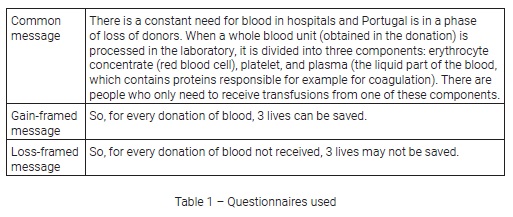
<body><![CDATA[<p>Within the blood donation literature, <i>altruism</i> has been traditionally    highlighted as not having a strong effect on blood donation (c.f. Evans &amp;    Ferguson, 2014). However, this finding is not consensual, since it contradicts    a recent study that highlighted that altruism is the biggest reason why young    people donate blood (Healy &amp; Murphy, 2017).</p>     <p><i>Social responsibility</i>, or &ldquo;feelings of moral obligation to act pro-socially&rdquo;    (De Groot &amp; Steg, 2009, p. 443), have also been associated with increasing    intentions to perform a range of prosocial behaviors, including blood donations    (<i>Ibid</i>.). However, as it happens with empathy, there is still no sufficient    empirical evidences in the literature on the impact of social responsibility    on blood donation behavior. In fact, while this motivator has traditionally    been linked with prosocial behaviors, Griffin, Grace and O'Cass (2014) study    actually points out that individuals may be socially responsible, may find the    blood donation issue important, may evaluate the issue positively, and yet,    be non-donors.</p>     <p>According to Sojka and Sojka (2008) study, <i>social influence</i> has been    one of the most frequently reported reasons for giving blood the <i>first time    </i>(47.2% of donors were influenced by a friend), while the most commonly reported    motive for donating blood (among general reasons/motives with highest ranking    of importance) were ‘general altruism&rsquo; (40.3%), ‘social responsibility/obligation&rsquo;    (19.7%) and ‘influence from friends&rsquo; (17.9%). These findings are in line with    the ones from Griffin, Grace and O'Cass (2014). Focused on comparing individual    characteristics, attitudes, and feelings of blood donors and nondonors, the    authors found that the relationship between susceptibility to interpersonal    influence and attitude towards the issue was significant only for donors, but    it was a negative relationship, supporting the view that donors are less likely    to be influenced by social pressure.</p>     <p><i>Self-image</i>, or the totality of internalized images and ideas a person    holds about themselves, also plays an important part when guiding behavior,    a relationship that has a longstanding tradition within the marketing literature    and is considered fundamental when designing persuasive marketing strategies    (Sirgy, 1982). For example, people who consider themselves as moral consumers,    tend to look for and respond more favorably to marketing strategies emphasizing    principles aligned to their values. </p>     <p>According to <i>attribution theory</i>, the perception that a person may have    about who asks for help can be crucial in deciding whether to assist or not.    This theory explains that in this situations people make a kind of judgment,    the &quot;attribution&quot;, internal (ability, effort) or external (task difficulty,    luck), on the behavior of others or themselves, attributing causes to events.    Attributions can be directed to the fact that a person is in need or can be    made on the character of the person who helps (Heider, 1958, and Jones and Davis,    1965, cited by Batson and Powell, 2003). For instance, in Decety et al. (2010)    study participants were significantly more sensitive to the pain of individuals    who had contracted AIDS as the result of a blood transfusion as compared to    individuals who had contracted AIDS as the result of their drug addiction. In    Conner et al. (2013) study perceived behavioral control, combined with anticipated    negative affective reactions, cognitive attitude, anticipated positive affective    reactions and subjective norms, was found to be a significant predictor of intentions    to donate blood. In short, the perception that the benefactor has about the    person or institution asking for help can sometimes be decisive in the decision    to help or not.</p>     <p><b>Methodology </b></p>     <p>In order to better understand the motivational factors that should be used    to guide social marketing, especially social advertising campaigns a survey    was developed and administered to 125 undergraduate students at a Portuguese    university. </p>     <p>The survey started with a brief introductory text about blood donations. In    order to avoid framing effects, the text concluded with either a gain-framed    or loss-framed message (see <a href="#t1">Table 1</a>). Respondents were randomly    assigned to see either a loss- or a gain-framed conclusion message (gain-frame:    70 students; loss-frame: 55 students).</p>     <p>&nbsp;</p>     <p align="center"><a name="t1"></a><img src="/img/revistas/mj/v19n34/19n34a14t1.jpg"/></p>     
]]></body>
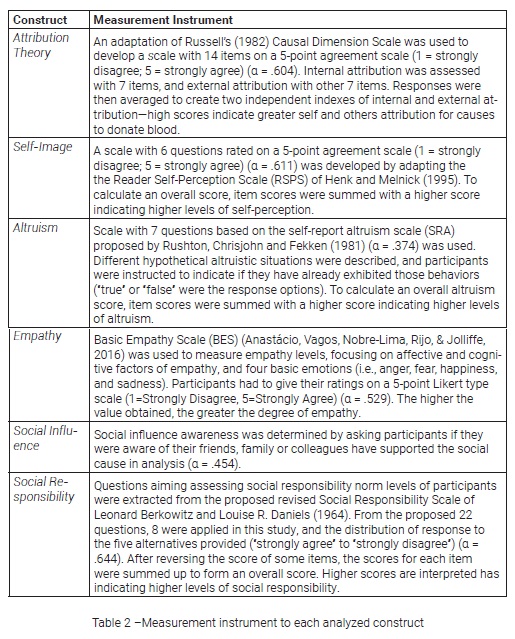
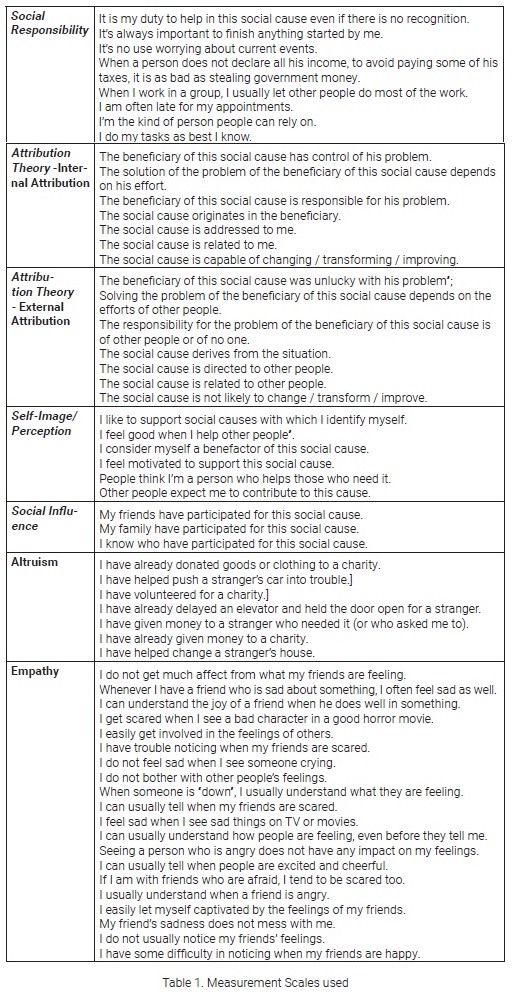
<body><![CDATA[<p>&nbsp;</p>     <p>Following on from this, the respondents were asked about their blood donation    intention and if they had previously given blood. This was followed by questions    designed to measure their motivational factors in a randomized order (<a href="#a1">see    attachment</a><a name="topa1"></a>). The questions used for this were based    on the sources given in <a href="#t2">Table 2</a>. All questions used can be    found on <a href="#t1">Table 1</a> in <a href="#a1">Attachments</a><a name="topa1"></a>.</p>     <p>&nbsp;</p>     <p align="center"><a name="t2"></a><img src="/img/revistas/mj/v19n34/19n34a14t2.jpg"/></p>     
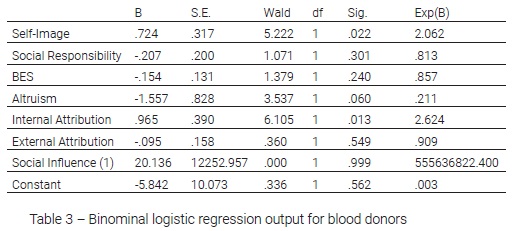
<p>&nbsp;</p>     <p><b>Results</b></p>     <p><b>4. Results:</b> </p>     <p>Of all participants, 88.8 per cent expressed a donation intention, despite    the fact that the majority have not donated blood before (72 per cent). Moreover,    the majority of both groups exposed to a gain-framed message (87 per cent) and    to a loss-framed message (91 per cent) agreed on donating blood. Not surprisingly,    the ANOVA showed no significant main effect of the gain-and loss-framed messages    on the intention scores (<i>p</i> = .511). </p>     <p>In order to evaluate the possible impact of personality traits with respect    to each the already mentioned theories on blood donation intention two binominal    logistic regression model were employed (for current donors and non-donors)    that included blood donation intention as dependent variable, social influence    index, self-concept score, social responsibility score, internal and external    attribution scores, and empathy and altruism scores as predictors (independent    variables). </p>     <p>For current donors, the explained variation in the dependent variable based    on this binominal logistic regression model ranges from 36.7% to 68.5% (Cox    &amp; Snell R2 and Nagelkerke R2 methods, respectively). The Hosmer &amp; Lemeshow    test of the goodness of fit suggests the model is a good fit to the data, that    is, the estimated values are close to the values observed, so the model fits    the data with a Chi- square value of 1.420 (8) and p=0.994 (&gt;.05).</p>     ]]></body>
<body><![CDATA[<p>Our data suggest that for current blood donor&rsquo;s self-image (b = .725, <i>p</i>    = .022) and internal attribution (b = .965, <i>p</i> = .013) added significantly    to the model/prediction, but the remaining variables did not add. Moreover,    internal attribution seems to be the variable that most significantly impact    the depended variable (donation intention), positively (<a href="#t3">Table    3</a>). </p>     <p>&nbsp;</p>     <p align="center"><a name="t3"></a><img src="/img/revistas/mj/v19n34/19n34a14t3.jpg"/></p>     
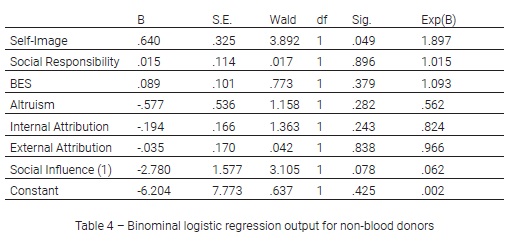
<p>&nbsp;</p>     <p>For non-donors, the explained variation in the dependent variable based on    this logistic regression model ranges from 13.6% to 29.9% (Cox &amp; Snell R2    and Nagelkerke R2 methods, respectively). The Hosmer &amp; Lemeshow test of    the goodness of fit suggests the model is a good fit to the data, that is, the    estimated values are close to the values observed, so the model fits the data    with a Chi- square value of 6.056 (7) and p=0.533 (&gt;.05).</p>     <p>Our data suggest that for this group self-image (b = .640, <i>p</i> = .049)    added significantly to the model/prediction, but the remaining variables did    not add significantly to the model/prediction (<a href="#t4">Table 4</a>). </p>     <p>&nbsp;</p>     <p align="center"><a name="t4"></a><img src="/img/revistas/mj/v19n34/19n34a14t4.jpg"/></p>     
<p>&nbsp;</p>     <p><b>5. Discussion of Results</b></p>     ]]></body>
<body><![CDATA[<p>The main purpose of this study was to contribute to a better understanding    of actual and potential blood donors&rsquo; motivations by analyzing and comparing    the effect of some of the most prominent personal traits for predicting or explaining    intention to donate blood (attribution theory, self-image, social responsibility    norm, altruism, social influence and empathy), as well as the effect of framing    on the decision to be (or not) a blood donor. </p>     <p>According to our findings, actual blood donors are positively influenced by    both internal attribution and self-image, while potential donors (who have not    donated blood) seem to be (positively) influenced only by self-image. </p>     <p>According to the theory of self-perception, people act prosocially for the    happiness they expect to feel when helping others. When people reflect on experiences    of donations, they tend to see themselves as benefactors, rather than seeing    themselves as beneficiaries, developing prosocial behavior, fulfilling and affirming    the desire to help (Freedman and Fraser, 1966; Daryl Bem, 1972). This perception    contributes to strength their values &#8203;&#8203;and their identities as careful,    attentive, and prosocial individuals. So, by seeing themselves as benefactors,    people feel happier and more motivated to help (Verplanken and Holland, 2002).  </p>     <p>We interpret our own actions the way we interpret others&rsquo; actions, and our    actions are often socially influenced and not produced out of our own free will,    as we might expect (Bem, 1972). So, when we talk about self-image or self-perception    it is almost impossible to neglect the role of social influence in one&rsquo;s mind.    Moreover, previous studies (Reid and Wood, 2008; Nook et al., 2016) have concluded    that social influence has an impact on participants&rsquo; blood donation intention    and that this influence could be affected by prior experience (Sojka and Sojka,    2008). Interestingly, our data suggests that social influence has no effect    on donation intention.</p>     <p>It is worth mention that this data comes from a self-report survey. Despite    the fact that answers were collected anonymously, it is plausible that our participants    may wanted to show a version of themselves aligned with what society expects    from them or approves. Yet, the gap between attitude and action (when what people    say and what they do are different) is well known in the literature applied    to social domains (see for instance Carrington et al, 2010). As Carrington et    al (2010) proposes, many of us do intend to act more ethically than we end up    actually doing, being hampered by various constraints and competing demands    before we perform as we would like. </p>     <p>People tend to see cause and effect relationships. Apparently, past donors    when they assign the cause of a behavior to internal characteristics, rather    than to outside forces show higher blood donation intention. On the other hand,    situational or environment features of the event (external attribution) seem    not to affect donation intention. In other words, when the attribution of causality    or causal locus is perceived as internal seems to trigger an emotional state    that lead to help (Weiner, 1980). </p>     <p>Altruism, empathy, and social responsibility had no effect on blood donation    intention. Although at first glance counter-intuitive, this observation confirms    previous findings from the literature. Griffin, Grace and O'Cass (2014) concluded    that individuals may be socially responsible, may find the blood donation issue    important, may evaluate the issue positively, and yet, be nondonors. In addition,    previous literature suggested that, in the context of blood donation, altruism    is multifaceted and complex and does not reflect pure altruism (Evans and Ferguson,    2014). Previous studies have also suggested that empathic concern may not be    an important motivator for planned helping decisions and decisions to help others    who are not immediately present (Einolf, 2008; Forgiarini et al., 2011; Decety    and Cowell, 2015; Melloni et al., 2014).</p>     <p>Finally, our data also suggest that message frames (gain vs. loss) had no main    effect on donation intention. Again, intuitively surprising, this observation    contradicts the findings from other researchers (Reinhart, Marshall, Feeley,    and Tutzauer, 2007; Cao, 2016), so it should be taken consciously. Perhaps the    lengthy framing rather than a small quick and easy message may have contributed    to this result and little attention has been paid by participants to the second    part of the message with either a gain-framed or loss-framed.</p>     <p><b>6. Conclusion and Research Agenda </b></p>     <p>Understanding personality traits is vital when developing advertising messages    that resonate with the target audience. Historically, blood donation campaigns    tend to appeal to altruistic motives for giving blood, such as &ldquo;give the gift    of blood&rdquo; or &ldquo;save a life, give blood&rdquo;. However, for Gen Y donors, this type    of motivational appeal may not be suitable, as neither existing nor potentially    new donors appear to be motivated by altruism. Instead, based on these findings,    future campaigns should be more focused on the self-image of the donor and less    on the victim, as well on internal attribution in the case of actual donors.</p>     ]]></body>
<body><![CDATA[<p>Hence, following McVittie, Harris, and Tiliopoulos (2006) call for a better    understanding of blood donation intentions, this paper contributes to the debate    by highlighting the vital role of self-image (for both donors and non-donors)    and internal attribution (donors), while at the same time opening up avenues    for future research. </p>     <p>This study has some limitations, yet it stills contributes to the debate. The    most prominent finding of the study is that self-perception /image has a stronger    and positive impact on pro-social behavior (blood donation intention) than other    motivators, such as social influence, social responsibility norm, altruism,    social learning and empathy. As mentioned before, to our knowledge no previous    study attempted to understand the relation between self-image and blood donation    behavior or intention among donors and no donors. Hence, by confirming the positive    relation between both variables in both conditions we believe we are promoting    the need for more empirical evidences in this domain. </p>     <p>The dependent variable (donation intention) is dichotomous. Future studies    could benefit from a continuous measure, which could deal with the ceiling effect    found in this study (90% of the participants responded positively). Also, several    scenarios are needed to increase the accuracy of the measurements. Hence, more    studies are needed that can shed more light on the effects of social influence    on the analyzed domain, as well as understanding the negative impact of altruism    and social responsibility perception warrants examination. For instance, could    the type of relation between the sender and the receiver determine the effectiveness    of a social campaign? </p>     <p>It has been argued that, with repeated performance, past behavior can also    be a predictor of intentions and behavior (e.g., Conner &amp; Armitage, 1998;    Conner, Warren, Close, &amp; Sparks, 1999; Conner et al., 2002). We have asked    participants if they have donated, but we did not ask them how many times. </p>     <p>Also, participants were primed with a particular framing, but our data suggest    that message frames (gain vs. loss) had no main effect on donation intention,    contradicting past observations (Reinhart, Marshall, Feeley, and Tutzauer, 2007;    Cao, 2016). Hence, future research should look to how long framing effect last.</p>     <p>Finally, one should bear in mind the difference between intention and action,    which stress the need for new studies that can confirm or reduce this attitude-action    gap on blood donation.</p>     <p>&nbsp;</p>     <p><b>REFERENCES</b></p>     <!-- ref --><p>Anastácio, S., Vagos, P., Nobre-Lima, L., Rijo, D., &amp; Jolliffe, D. (2016).    The Portuguese version of the Basic Empathy Scale (BES): Dimensionality and    measurement invariance in a community adolescent sample. <i>European Journal    of Developmental Psychology</i>, <i>13</i>(5), 614-623. <a href="https://doi.org/10.1080/17405629.2016.1167681" target="_blank">https://doi.org/10.1080/17405629.2016.1167681</a>  &nbsp;&nbsp;&nbsp;&nbsp;&nbsp;&nbsp;&nbsp;&nbsp;[&#160;<a href="javascript:void(0);" onclick="javascript: window.open('/scielo.php?script=sci_nlinks&ref=1904808&pid=S2183-5462201900010001400001&lng=','','width=640,height=500,resizable=yes,scrollbars=1,menubar=yes,');">Links</a>&#160;]<!-- end-ref --><!-- ref --><p>Batson, C. D., &amp; Powell, A. A. (2003). <i>Altruism and Prosocial Behavior</i>.    In T. Millon, &amp; J. M. Lerner, <i>Handbook of Psychology</i> (pp. 463-484).    New Jersey: John Wiley &amp; Sons, Inc., Hoboken.    &nbsp;&nbsp;&nbsp;&nbsp;&nbsp;&nbsp;&nbsp;&nbsp;[&#160;<a href="javascript:void(0);" onclick="javascript: window.open('/scielo.php?script=sci_nlinks&ref=1904809&pid=S2183-5462201900010001400002&lng=','','width=640,height=500,resizable=yes,scrollbars=1,menubar=yes,');">Links</a>&#160;]<!-- end-ref --></p>     <!-- ref --><p>Beerli-Palacio, A., &amp; Martín-Santana, J. D. (2009). Model explaining the    predisposition to donate blood from the social marketing perspective. <i>International    Journal of Nonprofit and Voluntary Sector Marketing</i>, <i>14</i>(3), 205-214.    <a href="https://doi.org/10.1002/nvsm.352" target="_blank">https://doi.org/10.1002/nvsm.352</a>  &nbsp;&nbsp;&nbsp;&nbsp;&nbsp;&nbsp;&nbsp;&nbsp;[&#160;<a href="javascript:void(0);" onclick="javascript: window.open('/scielo.php?script=sci_nlinks&ref=1904811&pid=S2183-5462201900010001400003&lng=','','width=640,height=500,resizable=yes,scrollbars=1,menubar=yes,');">Links</a>&#160;]<!-- end-ref --><!-- ref --><p>Bem, D. J. (1972). Self-perception theory. <i>Advances in experimental social    psychology</i>, 6, 1-62.    &nbsp;&nbsp;&nbsp;&nbsp;&nbsp;&nbsp;&nbsp;&nbsp;[&#160;<a href="javascript:void(0);" onclick="javascript: window.open('/scielo.php?script=sci_nlinks&ref=1904812&pid=S2183-5462201900010001400004&lng=','','width=640,height=500,resizable=yes,scrollbars=1,menubar=yes,');">Links</a>&#160;]<!-- end-ref --></p>     <!-- ref --><p>Cao, X. (2016). Framing charitable appeals: the effect of message framing and    perceived susceptibility to the negative consequences of inaction on donation    intention. International <i>Journal of Nonprofit and Voluntary Sector Marketing</i>,    <i>21</i>(1), 3-12.    &nbsp;&nbsp;&nbsp;&nbsp;&nbsp;&nbsp;&nbsp;&nbsp;[&#160;<a href="javascript:void(0);" onclick="javascript: window.open('/scielo.php?script=sci_nlinks&ref=1904814&pid=S2183-5462201900010001400005&lng=','','width=640,height=500,resizable=yes,scrollbars=1,menubar=yes,');">Links</a>&#160;]<!-- end-ref --> </p>     <!-- ref --><p>Conner, M., &amp; Armitage, C. (1998). Extending the theory of planned behavior:    A review and avenues for further research. <i>Journal of Applied Social Psychology</i>,    28, 1429-1464.    &nbsp;&nbsp;&nbsp;&nbsp;&nbsp;&nbsp;&nbsp;&nbsp;[&#160;<a href="javascript:void(0);" onclick="javascript: window.open('/scielo.php?script=sci_nlinks&ref=1904816&pid=S2183-5462201900010001400006&lng=','','width=640,height=500,resizable=yes,scrollbars=1,menubar=yes,');">Links</a>&#160;]<!-- end-ref --></p>     <!-- ref --><p>Conner, M., Godin, G., Sheeran, P., &amp; Germain, M. (2013). Some feelings    are more important: Cognitive attitudes, affective attitudes, anticipated affect,    and blood donation. <i>Health Psychology</i>, <i>32</i>(3), 264.    &nbsp;&nbsp;&nbsp;&nbsp;&nbsp;&nbsp;&nbsp;&nbsp;[&#160;<a href="javascript:void(0);" onclick="javascript: window.open('/scielo.php?script=sci_nlinks&ref=1904818&pid=S2183-5462201900010001400007&lng=','','width=640,height=500,resizable=yes,scrollbars=1,menubar=yes,');">Links</a>&#160;]<!-- end-ref --></p>     ]]></body>
<body><![CDATA[<!-- ref --><p>Conner, M., Norman, P., &amp; Bell, R. (2002). The theory of planned behaviour    and healthy eating. <i>Health Psychology</i>, 21, 195-201.    &nbsp;&nbsp;&nbsp;&nbsp;&nbsp;&nbsp;&nbsp;&nbsp;[&#160;<a href="javascript:void(0);" onclick="javascript: window.open('/scielo.php?script=sci_nlinks&ref=1904820&pid=S2183-5462201900010001400008&lng=','','width=640,height=500,resizable=yes,scrollbars=1,menubar=yes,');">Links</a>&#160;]<!-- end-ref --></p>     <!-- ref --><p>Conner, M., Warren, R., Close, S., &amp; Sparks, P. (1999). Alcohol consumption    and the theory of planned behavior: An examination of the cognitive mediation    of past behavior. <i>Journal of Applied Social Psychology</i>, <i>29</i>(8),    1676-1704.    &nbsp;&nbsp;&nbsp;&nbsp;&nbsp;&nbsp;&nbsp;&nbsp;[&#160;<a href="javascript:void(0);" onclick="javascript: window.open('/scielo.php?script=sci_nlinks&ref=1904822&pid=S2183-5462201900010001400009&lng=','','width=640,height=500,resizable=yes,scrollbars=1,menubar=yes,');">Links</a>&#160;]<!-- end-ref --></p>     <!-- ref --><p>De Groot, J. I. M., &amp; Steg, L. (2009). Morality and Prosocial Behavior:    The Role of Awareness, Responsibility, and Norms in the Norm Activation Model.    <i>The Journal of Social Psychology</i>, <i>149</i>(4), 425-449. <a href="https://doi.org/10.3200/SOCP.149.4.425-449" target="_blank">https://doi.org/10.3200/SOCP.149.4.425-449</a>  &nbsp;&nbsp;&nbsp;&nbsp;&nbsp;&nbsp;&nbsp;&nbsp;[&#160;<a href="javascript:void(0);" onclick="javascript: window.open('/scielo.php?script=sci_nlinks&ref=1904824&pid=S2183-5462201900010001400010&lng=','','width=640,height=500,resizable=yes,scrollbars=1,menubar=yes,');">Links</a>&#160;]<!-- end-ref --><!-- ref --><p>Decety J, Cowell JM. (2015) Empathy, justice, and moral behavior. <i>AJOB Neuroscience</i>.    6, 3-14. <a href="https://doi.org/10.1080/21507740.2015.1047055" target="_blank">https://doi.org/10.1080/21507740.2015.1047055</a>  &nbsp;&nbsp;&nbsp;&nbsp;&nbsp;&nbsp;&nbsp;&nbsp;[&#160;<a href="javascript:void(0);" onclick="javascript: window.open('/scielo.php?script=sci_nlinks&ref=1904825&pid=S2183-5462201900010001400011&lng=','','width=640,height=500,resizable=yes,scrollbars=1,menubar=yes,');">Links</a>&#160;]<!-- end-ref --><!-- ref --><p>Decety J, Echols S, Correll J. (2010) The blame game: the effect of responsibility    and social stigma on empathy for pain. <i>J. Cogn. Neurosci</i>. 22, 985-997.    <a href="https://doi.org/10.1162/jocn.2009.21266" target="_blank">https://doi.org/10.1162/jocn.2009.21266</a>  &nbsp;&nbsp;&nbsp;&nbsp;&nbsp;&nbsp;&nbsp;&nbsp;[&#160;<a href="javascript:void(0);" onclick="javascript: window.open('/scielo.php?script=sci_nlinks&ref=1904826&pid=S2183-5462201900010001400012&lng=','','width=640,height=500,resizable=yes,scrollbars=1,menubar=yes,');">Links</a>&#160;]<!-- end-ref --><!-- ref --><p>Einolf, C. J. (2008). Empathic concern and prosocial behaviors: A test of experimental    results using survey data. <i>Social Science Research</i>, <i>37</i>(4), 1267-1279.    &nbsp;&nbsp;&nbsp;&nbsp;&nbsp;&nbsp;&nbsp;&nbsp;[&#160;<a href="javascript:void(0);" onclick="javascript: window.open('/scielo.php?script=sci_nlinks&ref=1904827&pid=S2183-5462201900010001400013&lng=','','width=640,height=500,resizable=yes,scrollbars=1,menubar=yes,');">Links</a>&#160;]<!-- end-ref --></p>     <p>Eisenberg, N. (2010). Empathy-related responding: Links with self-regulation,    moral judgment, and moral behavior. Pr<i>osocial motives, emotions, and behavior:    The better angels of our nature</i>, 129-148.</p>     ]]></body>
<body><![CDATA[<!-- ref --><p>Evans, R., &amp; Ferguson, E. (2014). Defining and measuring blood donor altruism:    a theoretical approach from biology, economics and psychology. <i>Vox Sanguinis</i>,    <i>106</i>(2), 118-126. <a href="https://doi.org/10.1111/vox.12080" target="_blank">https://doi.org/10.1111/vox.12080</a>  &nbsp;&nbsp;&nbsp;&nbsp;&nbsp;&nbsp;&nbsp;&nbsp;[&#160;<a href="javascript:void(0);" onclick="javascript: window.open('/scielo.php?script=sci_nlinks&ref=1904830&pid=S2183-5462201900010001400015&lng=','','width=640,height=500,resizable=yes,scrollbars=1,menubar=yes,');">Links</a>&#160;]<!-- end-ref --><!-- ref --><p>Ferguson, E., &amp; Lawrence, C. (2016). Blood donation and altruism: the mechanisms    of altruism approach. <i>ISBT Science Series</i>, <i>11</i>(S1), 148-157.    &nbsp;&nbsp;&nbsp;&nbsp;&nbsp;&nbsp;&nbsp;&nbsp;[&#160;<a href="javascript:void(0);" onclick="javascript: window.open('/scielo.php?script=sci_nlinks&ref=1904831&pid=S2183-5462201900010001400016&lng=','','width=640,height=500,resizable=yes,scrollbars=1,menubar=yes,');">Links</a>&#160;]<!-- end-ref --></p>     <!-- ref --><p>Forgiarini, M., Gallucci, M., &amp; Maravita, A. (2011). Racism and the empathy    for pain on our skin. <i>Frontiers in psychology</i>, 2, 108.    &nbsp;&nbsp;&nbsp;&nbsp;&nbsp;&nbsp;&nbsp;&nbsp;[&#160;<a href="javascript:void(0);" onclick="javascript: window.open('/scielo.php?script=sci_nlinks&ref=1904833&pid=S2183-5462201900010001400017&lng=','','width=640,height=500,resizable=yes,scrollbars=1,menubar=yes,');">Links</a>&#160;]<!-- end-ref --></p>     <!-- ref --><p>Freedman, J. L., &amp; Fraser, S. C. (1966). Compliance without pressure: the    foot-in-the-door technique. <i>Journal of personality and social psychology</i>,    <i>4</i>(2), 195.    &nbsp;&nbsp;&nbsp;&nbsp;&nbsp;&nbsp;&nbsp;&nbsp;[&#160;<a href="javascript:void(0);" onclick="javascript: window.open('/scielo.php?script=sci_nlinks&ref=1904835&pid=S2183-5462201900010001400018&lng=','','width=640,height=500,resizable=yes,scrollbars=1,menubar=yes,');">Links</a>&#160;]<!-- end-ref --></p>     <p>Griffin, D., Grace, D., &amp; O&rsquo;Cass, A. (2014). Blood Donation: Comparing    Individual Characteristics, Attitudes, and Feelings of Donors and Nondonors.    <i>Health Marketing Quarterly</i>, <i>31</i>(3), 197-212. <a href="https://doi.org/10.1080/07359683.2014.936276" target="_blank">https://doi.org/10.1080/07359683.2014.936276</a>  </p>     <p>Healy, J., &amp; Murphy, M. (2017). Social Marketing: The Lifeblood of Blood    Donation?. In <i>The Customer is NOT Always Right? Marketing Orientations in    a Dynamic Business World</i> (pp. 811-811). Springer, Cham.</p>     <p>Healy, J., &amp; Murphy, M. (2017). Social Marketing: The Lifeblood of Blood    Donation?. In <i>The Customer is NOT Always Right? Marketing Orientationsin    a Dynamic Business World</i> (pp. 811-811). Springer, Cham.</p>     ]]></body>
<body><![CDATA[<!-- ref --><p>Heider, F. (1958). <i>The Psychology of Interpersonal Relations</i>. New York:    Wiley.    &nbsp;&nbsp;&nbsp;&nbsp;&nbsp;&nbsp;&nbsp;&nbsp;[&#160;<a href="javascript:void(0);" onclick="javascript: window.open('/scielo.php?script=sci_nlinks&ref=1904840&pid=S2183-5462201900010001400021&lng=','','width=640,height=500,resizable=yes,scrollbars=1,menubar=yes,');">Links</a>&#160;]<!-- end-ref --></p>     <!-- ref --><p>Henk, W. A., &amp; Melnick, S. A. (1995). The Reader Self-Perception Scale    (RSPS): A new tool for measuring how children feel about themselves as readers.    <i>The Reading Teacher</i>, <i>48</i>(6), 470-482.    &nbsp;&nbsp;&nbsp;&nbsp;&nbsp;&nbsp;&nbsp;&nbsp;[&#160;<a href="javascript:void(0);" onclick="javascript: window.open('/scielo.php?script=sci_nlinks&ref=1904842&pid=S2183-5462201900010001400022&lng=','','width=640,height=500,resizable=yes,scrollbars=1,menubar=yes,');">Links</a>&#160;]<!-- end-ref --></p>     <!-- ref --><p>Holdershaw, J., Gendall, P., &amp; Wright, M. (2011). Predicting blood donation    behaviour: further application of the theory of planned behaviour. <i>Journal    of Social Marketing</i>, 1(2), 120-132. <a href="https://doi.org/10.1108/20426761111141878" target="_blank">https://doi.org/10.1108/20426761111141878</a>  &nbsp;&nbsp;&nbsp;&nbsp;&nbsp;&nbsp;&nbsp;&nbsp;[&#160;<a href="javascript:void(0);" onclick="javascript: window.open('/scielo.php?script=sci_nlinks&ref=1904844&pid=S2183-5462201900010001400023&lng=','','width=640,height=500,resizable=yes,scrollbars=1,menubar=yes,');">Links</a>&#160;]<!-- end-ref --><p>Jones, E. E., &amp; Davis, K. E. (1965). From acts to dispositions the attribution    process In person perception1. In <i>Advances in experimental social psychology</i>    (Vol. 2, pp. 219-266). Academic Press.</p>     <!-- ref --><p>Karacan, E., Seval, G. C., Aktan, Z., Ayli, M., &amp; Palabiyikoglu, R. (2013).    Blood donors and factors impacting the blood donation decision: motives for    donating blood in Turkish sample. <i>Transfusion and Apheresis Science</i>,    <i>49</i>(3), 468-473.    &nbsp;&nbsp;&nbsp;&nbsp;&nbsp;&nbsp;&nbsp;&nbsp;[&#160;<a href="javascript:void(0);" onclick="javascript: window.open('/scielo.php?script=sci_nlinks&ref=1904846&pid=S2183-5462201900010001400025&lng=','','width=640,height=500,resizable=yes,scrollbars=1,menubar=yes,');">Links</a>&#160;]<!-- end-ref --></p>     <!-- ref --><p>Kidwell, B., &amp; Jewell, R. D. (2003). An examination of perceived behavioral    control: Internal and external influences on intention. <i>Psychology and Marketing</i>,    <i>20</i>(7), 625-642. <a href="https://doi.org/10.1002/mar.10089" target="_blank">https://doi.org/10.1002/mar.10089</a>  &nbsp;&nbsp;&nbsp;&nbsp;&nbsp;&nbsp;&nbsp;&nbsp;[&#160;<a href="javascript:void(0);" onclick="javascript: window.open('/scielo.php?script=sci_nlinks&ref=1904848&pid=S2183-5462201900010001400026&lng=','','width=640,height=500,resizable=yes,scrollbars=1,menubar=yes,');">Links</a>&#160;]<!-- end-ref --><!-- ref --><p>Kolins, J., &amp; Herron, R. (2003). On bowling alone and donor recruitment:    lessons to be learned. <i>Transfusion</i>, <i>43</i>(11), 1634-1638.    &nbsp;&nbsp;&nbsp;&nbsp;&nbsp;&nbsp;&nbsp;&nbsp;[&#160;<a href="javascript:void(0);" onclick="javascript: window.open('/scielo.php?script=sci_nlinks&ref=1904849&pid=S2183-5462201900010001400027&lng=','','width=640,height=500,resizable=yes,scrollbars=1,menubar=yes,');">Links</a>&#160;]<!-- end-ref --></p>     <!-- ref --><p>Martín-Santana, J. D., Reinares-Lara, E., &amp; Reinares-Lara, P. (2018). Using    Radio Advertising to Promote Blood Donation. <i>Journal of Nonprofit &amp; Public    Sector Marketing</i>, <i>30</i>(1), 52-73.    &nbsp;&nbsp;&nbsp;&nbsp;&nbsp;&nbsp;&nbsp;&nbsp;[&#160;<a href="javascript:void(0);" onclick="javascript: window.open('/scielo.php?script=sci_nlinks&ref=1904851&pid=S2183-5462201900010001400028&lng=','','width=640,height=500,resizable=yes,scrollbars=1,menubar=yes,');">Links</a>&#160;]<!-- end-ref --></p>     <p>McVittie, C., Harris, L., &amp; Tiliopoulos, N. (2006). &quot; I intend to    donate but&hellip;&quot;: Non-donors' views of blood donation in the UK. <i>Psychology,    health &amp; medicine</i>, <i>11</i>(1), 1-6.</p>     <!-- ref --><p>Melloni, M., Lopez, V., &amp; Ibanez, A. (2014). Empathy and contextual social    cognition. <i>Cognitive, Affective, &amp; Behavioral Neuroscience</i>, <i>14</i>(1),    407-425.    &nbsp;&nbsp;&nbsp;&nbsp;&nbsp;&nbsp;&nbsp;&nbsp;[&#160;<a href="javascript:void(0);" onclick="javascript: window.open('/scielo.php?script=sci_nlinks&ref=1904854&pid=S2183-5462201900010001400030&lng=','','width=640,height=500,resizable=yes,scrollbars=1,menubar=yes,');">Links</a>&#160;]<!-- end-ref --></p>     <!-- ref --><p>Mortimer, D., Ghijben, P., Harris, A., &amp; Hollingsworth, B. (2013). Incentive-based    and non-incentive-based interventions for increasing blood donation. <i>Cochrane    Database of Systematic Reviews.</i> <a href="https://doi.org/10.1002/14651858.CD010295" target="_blank">https://doi.org/10.1002/14651858.CD010295</a>  &nbsp;&nbsp;&nbsp;&nbsp;&nbsp;&nbsp;&nbsp;&nbsp;[&#160;<a href="javascript:void(0);" onclick="javascript: window.open('/scielo.php?script=sci_nlinks&ref=1904856&pid=S2183-5462201900010001400031&lng=','','width=640,height=500,resizable=yes,scrollbars=1,menubar=yes,');">Links</a>&#160;]<!-- end-ref --><!-- ref --><p>Nook, E. C., Ong, D. C., Morelli, S. A., Mitchell, J. P., &amp; Zaki, J. (2016).    Prosocial conformity: Prosocial norms generalize across behavior and empathy.    <i>Personality and Social Psychology Bulletin</i>, <i>42</i>(8), 1045-1062.    &nbsp;&nbsp;&nbsp;&nbsp;&nbsp;&nbsp;&nbsp;&nbsp;[&#160;<a href="javascript:void(0);" onclick="javascript: window.open('/scielo.php?script=sci_nlinks&ref=1904857&pid=S2183-5462201900010001400032&lng=','','width=640,height=500,resizable=yes,scrollbars=1,menubar=yes,');">Links</a>&#160;]<!-- end-ref --></p>     <p>Polonsky, M., Francis, K., &amp; Renzaho, A. (2015). Is removing blood donation    barriers a donation facilitator?: Australian African migrants&rsquo; view. <i>Journal    of Social Marketing</i>, <i>5</i>(3), 190-205. <a href="https://doi.org/10.1108/JSOCM-08-2014-0054" target="_blank">https://doi.org/10.1108/JSOCM-08-2014-0054</a>  </p>     ]]></body>
<body><![CDATA[<!-- ref --><p>Reid, M., &amp; Wood, A. (2008). An investigation into blood donation intentions    among non-donors. <i>International Journal of Nonprofit and Voluntary Sector    Marketing</i>, <i>13</i>(1), 31-43.    &nbsp;&nbsp;&nbsp;&nbsp;&nbsp;&nbsp;&nbsp;&nbsp;[&#160;<a href="javascript:void(0);" onclick="javascript: window.open('/scielo.php?script=sci_nlinks&ref=1904860&pid=S2183-5462201900010001400034&lng=','','width=640,height=500,resizable=yes,scrollbars=1,menubar=yes,');">Links</a>&#160;]<!-- end-ref --></p>     <!-- ref --><p>Reinhart, A. M., Marshall, H. M., Feeley, T. H., &amp; Tutzauer, F. (2007).    The persuasive effects of message framing in organ donation: The mediating role    of psychological reactance. <i>Communication Monographs</i>, <i>74</i>(2), 229-255.    &nbsp;&nbsp;&nbsp;&nbsp;&nbsp;&nbsp;&nbsp;&nbsp;[&#160;<a href="javascript:void(0);" onclick="javascript: window.open('/scielo.php?script=sci_nlinks&ref=1904862&pid=S2183-5462201900010001400035&lng=','','width=640,height=500,resizable=yes,scrollbars=1,menubar=yes,');">Links</a>&#160;]<!-- end-ref --></p>     <!-- ref --><p>Rushton, J. P., Chrisjohn, R. D., &amp; Fekken, G. C. (1981). The altruistic    personality and the self-report altruism scale. <i>Personality and individual    differences</i>, <i>2</i>(4), 293-302.    &nbsp;&nbsp;&nbsp;&nbsp;&nbsp;&nbsp;&nbsp;&nbsp;[&#160;<a href="javascript:void(0);" onclick="javascript: window.open('/scielo.php?script=sci_nlinks&ref=1904864&pid=S2183-5462201900010001400036&lng=','','width=640,height=500,resizable=yes,scrollbars=1,menubar=yes,');">Links</a>&#160;]<!-- end-ref --></p>     <p>Russell-Bennett, R., Hartel, C., Russell, K., &amp; Previte, J. (2012). It&rsquo;s    all about me! Emotional ambivalence Gen-Y blood-donors (pp. 43-43). Presented    at the <i>Proceedings from the AMA SERVSIG International Service Research Conference,    Hanken School of Economics</i>.</p>     <!-- ref --><p>Russell-Bennett, R., Wood, M., &amp; Previte, J. (2013). Fresh ideas: services    thinking for social marketing. <i>Journal of Social Marketing</i>, <i>3</i>(3),    223-238. <a href="https://doi.org/10.1108/JSOCM-02-2013-0017" target="_blank">https://doi.org/10.1108/JSOCM-02-2013-0017</a>  &nbsp;&nbsp;&nbsp;&nbsp;&nbsp;&nbsp;&nbsp;&nbsp;[&#160;<a href="javascript:void(0);" onclick="javascript: window.open('/scielo.php?script=sci_nlinks&ref=1904867&pid=S2183-5462201900010001400038&lng=','','width=640,height=500,resizable=yes,scrollbars=1,menubar=yes,');">Links</a>&#160;]<!-- end-ref --><!-- ref --><p>Russell, D. (1982). The Causal Dimension Scale: A measure of how individuals    perceive causes. <i>Journal of Personality and social Psychology</i>, <i>42</i>(6),    1137.    &nbsp;&nbsp;&nbsp;&nbsp;&nbsp;&nbsp;&nbsp;&nbsp;[&#160;<a href="javascript:void(0);" onclick="javascript: window.open('/scielo.php?script=sci_nlinks&ref=1904868&pid=S2183-5462201900010001400039&lng=','','width=640,height=500,resizable=yes,scrollbars=1,menubar=yes,');">Links</a>&#160;]<!-- end-ref --></p>     ]]></body>
<body><![CDATA[<!-- ref --><p>Ryan, R. M., &amp; Deci, E. L. (2000). Self-determination theory and the facilitation    of intrinsic motivation, social development, and well-being. <i>American Psychologist</i>,    <i>55</i>(1), 68.    &nbsp;&nbsp;&nbsp;&nbsp;&nbsp;&nbsp;&nbsp;&nbsp;[&#160;<a href="javascript:void(0);" onclick="javascript: window.open('/scielo.php?script=sci_nlinks&ref=1904870&pid=S2183-5462201900010001400040&lng=','','width=640,height=500,resizable=yes,scrollbars=1,menubar=yes,');">Links</a>&#160;]<!-- end-ref --></p>     <!-- ref --><p>Sirgy, M. J. (1982). Self-Image/Product-Image Congruity and Advertising Strategy.    In V. Kothari (Ed.), <i>Proceedings of the 1982 Academy of Marketing Science</i>    (AMS) Annual Conference (2015th ed., pp. 129-133). Cham: Springer International    Publishing. <a href="https://doi.org/10.1007/978-3-319-16946-0_31" target="_blank">https://doi.org/10.1007/978-3-319-16946-0_31</a>  &nbsp;&nbsp;&nbsp;&nbsp;&nbsp;&nbsp;&nbsp;&nbsp;[&#160;<a href="javascript:void(0);" onclick="javascript: window.open('/scielo.php?script=sci_nlinks&ref=1904872&pid=S2183-5462201900010001400041&lng=','','width=640,height=500,resizable=yes,scrollbars=1,menubar=yes,');">Links</a>&#160;]<!-- end-ref --><!-- ref --><p>Sojka, B. N., &amp; Sojka, P. (2008). The blood donation experience: self-reported    motives and obstacles for donating blood. <i>Vox sanguinis</i>, <i>94</i>(1),    56-63.    &nbsp;&nbsp;&nbsp;&nbsp;&nbsp;&nbsp;&nbsp;&nbsp;[&#160;<a href="javascript:void(0);" onclick="javascript: window.open('/scielo.php?script=sci_nlinks&ref=1904873&pid=S2183-5462201900010001400042&lng=','','width=640,height=500,resizable=yes,scrollbars=1,menubar=yes,');">Links</a>&#160;]<!-- end-ref --></p>     <!-- ref --><p>Truong, V. D. (2014). Social Marketing: A Systematic Review of Research 1998-2012.    <i>Social Marketing Quarterly</i>,<i> 20</i>(1), 15-34. <a href="https://doi.org/10.1177/1524500413517666" target="_blank">https://doi.org/10.1177/1524500413517666</a>  &nbsp;&nbsp;&nbsp;&nbsp;&nbsp;&nbsp;&nbsp;&nbsp;[&#160;<a href="javascript:void(0);" onclick="javascript: window.open('/scielo.php?script=sci_nlinks&ref=1904875&pid=S2183-5462201900010001400043&lng=','','width=640,height=500,resizable=yes,scrollbars=1,menubar=yes,');">Links</a>&#160;]<!-- end-ref --><!-- ref --><p>Urbain, C., Gonzalez, C., &amp; Gall-Ely, M. L. (2013). What does the future    hold for giving? An approach using the social representations of Generation    Y. <i>International Journal of Nonprofit and Voluntary Sector Marketing</i>,    <i>18</i>(3), 159-171.    &nbsp;&nbsp;&nbsp;&nbsp;&nbsp;&nbsp;&nbsp;&nbsp;[&#160;<a href="javascript:void(0);" onclick="javascript: window.open('/scielo.php?script=sci_nlinks&ref=1904876&pid=S2183-5462201900010001400044&lng=','','width=640,height=500,resizable=yes,scrollbars=1,menubar=yes,');">Links</a>&#160;]<!-- end-ref --></p>     <!-- ref --><p>Verplanken, B., &amp; Holland, R. W. (2002). Motivated Decision Making: Effects    of Activation and Self-Centrality of Values on Choices and Behaviour. <i>Journal    of Personality and Social Psychology</i>, 443-447.    &nbsp;&nbsp;&nbsp;&nbsp;&nbsp;&nbsp;&nbsp;&nbsp;[&#160;<a href="javascript:void(0);" onclick="javascript: window.open('/scielo.php?script=sci_nlinks&ref=1904878&pid=S2183-5462201900010001400045&lng=','','width=640,height=500,resizable=yes,scrollbars=1,menubar=yes,');">Links</a>&#160;]<!-- end-ref --></p>     ]]></body>
<body><![CDATA[<p>Weiner, B. (1980). A Cognitive (Attribution)- Emotion- Action Moel of Motivated    Behavior: An Analysis of Judgments of Help-giving. <i>Journal of Personality    and Social Psychology</i>, <i>2</i> (39), pp. 186-200.</p>     <!-- ref --><p>World Health Organisation. 2010. Towards 100% voluntary blood donation - A    global framework for action. Retrieved from <a href="http://www.who.int/bloodsafety/publications/9789241599696_eng.pdf?ua=1" target="_blank">http://www.who.int/bloodsafety/publications/9789241599696_eng.pdf?ua=1</a>    .    &nbsp;&nbsp;&nbsp;&nbsp;&nbsp;&nbsp;&nbsp;&nbsp;[&#160;<a href="javascript:void(0);" onclick="javascript: window.open('/scielo.php?script=sci_nlinks&ref=1904881&pid=S2183-5462201900010001400047&lng=','','width=640,height=500,resizable=yes,scrollbars=1,menubar=yes,');">Links</a>&#160;]<!-- end-ref --> </p>     <!-- ref --><p>World Health Organisation. 2017. Blood safety and availability. Retrieved from    <a href="http://www.who.int/news-room/fact-sheets/detail/blood-safety-and-availability" target="_blank">http://www.who.int/news-room/fact-sheets/detail/blood-safety-and-availability</a>    .    &nbsp;&nbsp;&nbsp;&nbsp;&nbsp;&nbsp;&nbsp;&nbsp;[&#160;<a href="javascript:void(0);" onclick="javascript: window.open('/scielo.php?script=sci_nlinks&ref=1904883&pid=S2183-5462201900010001400048&lng=','','width=640,height=500,resizable=yes,scrollbars=1,menubar=yes,');">Links</a>&#160;]<!-- end-ref --> </p>     <p>&nbsp;</p>     <p>Recebido | Received | Recebido: 2018.08.15    <br>   Aceite | Accepted | Aceptación: 2018.01.10</p>     <p>&nbsp;</p>     <p><b>Notas</b></p>     ]]></body>
<body><![CDATA[<p><a href="#top1"><sup>[1]</sup></a><a name="1"></a> When a whole blood unit    (obtained in the donation) is processed in the laboratory, it is divided into    three components: erythrocyte concentrate (red blood cell), platelet, and plasma    (the liquid part of the blood, which contains proteins responsible for example    for coagulation). Some people only need to receive transfusions from one of    these components.</p>     <p>&nbsp;</p>     <p>Biographical note</p>     <p>Ana Margarida Barreto holds a PhD degree from New University of Lisbon where    she teaches Marketing, Consumer Behavior, and Strategic Communication. She completed    a post-doc at Tel Aviv University where she studied attention, perception and    memory, and fieldwork as a visiting scholar at University of Texas at Austin,    University of Westminster, King&rsquo;s College of London, and Columbia University.    She is also part of the coordination team of ICNOVA and is the founder and coordinator    of the research group on Strategic Communication and Decision-Making Processes    of that center. Her work has been recognized with many invitations to take part    in the review panel of worldwide journals, such as Communications: The European    Journal of Communication Research, European Journal of Marketing, Journal of    Business Research, Cogent Social Sciences, Information Processing &amp; Management,    etc, having received twice in three years the Outstanding Reviewer Award at    the Emerald Literati Network Awards for Excellence (2015 and 2017). Ana Margarida    Barreto has also worked for five years in communication and advertising, both    in Portugal and in Spain.</p>     <p>Email: <a href="mailto:ambarreto@fcsh.unl.pt" target="_blank">ambarreto@fcsh.unl.pt</a></p>     <p>Address:: Instituto de Comunicação da NOVA, Av. de Berna, 26-C - Lisboa 069-061,    Portugal</p>     <p>&nbsp;</p>     <p><a href="#topa1">Attachment</a><a name="a1"></a>      <p align="center"><a name="a1"></a><img src="/img/revistas/mj/v19n34/19n34a14a.jpg"/></p>     
<p>&nbsp;</p>     ]]></body>
<body><![CDATA[ ]]></body><back>
<ref-list>
<ref id="B1">
<nlm-citation citation-type="journal">
<person-group person-group-type="author">
<name>
<surname><![CDATA[Anastácio]]></surname>
<given-names><![CDATA[S.]]></given-names>
</name>
<name>
<surname><![CDATA[Vagos]]></surname>
<given-names><![CDATA[P.]]></given-names>
</name>
<name>
<surname><![CDATA[Nobre-Lima]]></surname>
<given-names><![CDATA[L.]]></given-names>
</name>
<name>
<surname><![CDATA[Rijo]]></surname>
<given-names><![CDATA[D.]]></given-names>
</name>
<name>
<surname><![CDATA[Jolliffe]]></surname>
<given-names><![CDATA[D.]]></given-names>
</name>
</person-group>
<article-title xml:lang="en"><![CDATA[The Portuguese version of the Basic Empathy Scale (BES): Dimensionality and measurement invariance in a community adolescent sample]]></article-title>
<source><![CDATA[European Journal of Developmental Psychology]]></source>
<year>2016</year>
<volume>13</volume>
<numero>5</numero>
<issue>5</issue>
<page-range>614-623</page-range></nlm-citation>
</ref>
<ref id="B2">
<nlm-citation citation-type="book">
<person-group person-group-type="author">
<name>
<surname><![CDATA[Batson]]></surname>
<given-names><![CDATA[C. D.]]></given-names>
</name>
<name>
<surname><![CDATA[Powell]]></surname>
<given-names><![CDATA[A. A.]]></given-names>
</name>
</person-group>
<article-title xml:lang="en"><![CDATA[Altruism and Prosocial Behavior]]></article-title>
<person-group person-group-type="editor">
<name>
<surname><![CDATA[Millon]]></surname>
<given-names><![CDATA[T.]]></given-names>
</name>
<name>
<surname><![CDATA[Lerner]]></surname>
<given-names><![CDATA[J. M.]]></given-names>
</name>
</person-group>
<source><![CDATA[Handbook of Psychology]]></source>
<year>2003</year>
<page-range>463-484</page-range><publisher-loc><![CDATA[New Jersey ]]></publisher-loc>
<publisher-name><![CDATA[John Wiley & Sons, Inc, Hoboken]]></publisher-name>
</nlm-citation>
</ref>
<ref id="B3">
<nlm-citation citation-type="journal">
<person-group person-group-type="author">
<name>
<surname><![CDATA[Beerli-Palacio]]></surname>
<given-names><![CDATA[A.]]></given-names>
</name>
<name>
<surname><![CDATA[Martín-Santana]]></surname>
<given-names><![CDATA[J. D.]]></given-names>
</name>
</person-group>
<article-title xml:lang="en"><![CDATA[Model explaining the predisposition to donate blood from the social marketing perspective]]></article-title>
<source><![CDATA[International Journal of Nonprofit and Voluntary Sector Marketing]]></source>
<year>2009</year>
<volume>14</volume>
<numero>3</numero>
<issue>3</issue>
<page-range>205-214</page-range></nlm-citation>
</ref>
<ref id="B4">
<nlm-citation citation-type="journal">
<person-group person-group-type="author">
<name>
<surname><![CDATA[Bem]]></surname>
<given-names><![CDATA[D. J.]]></given-names>
</name>
</person-group>
<article-title xml:lang="en"><![CDATA[Self-perception theory]]></article-title>
<source><![CDATA[Advances in experimental social psychology]]></source>
<year>1972</year>
<volume>6</volume>
<page-range>1-62</page-range></nlm-citation>
</ref>
<ref id="B5">
<nlm-citation citation-type="journal">
<person-group person-group-type="author">
<name>
<surname><![CDATA[Cao]]></surname>
<given-names><![CDATA[X.]]></given-names>
</name>
</person-group>
<article-title xml:lang="en"><![CDATA[Framing charitable appeals: the effect of message framing and perceived susceptibility to the negative consequences of inaction on donation intention]]></article-title>
<source><![CDATA[International Journal of Nonprofit and Voluntary Sector Marketing]]></source>
<year>2016</year>
<volume>21</volume>
<numero>1</numero>
<issue>1</issue>
<page-range>3-12</page-range></nlm-citation>
</ref>
<ref id="B6">
<nlm-citation citation-type="journal">
<person-group person-group-type="author">
<name>
<surname><![CDATA[Conner]]></surname>
<given-names><![CDATA[M.]]></given-names>
</name>
<name>
<surname><![CDATA[Armitage]]></surname>
<given-names><![CDATA[C.]]></given-names>
</name>
</person-group>
<article-title xml:lang="en"><![CDATA[Extending the theory of planned behavior: A review and avenues for further research]]></article-title>
<source><![CDATA[Journal of Applied Social Psychology]]></source>
<year>1998</year>
<volume>28</volume>
<page-range>1429-1464</page-range></nlm-citation>
</ref>
<ref id="B7">
<nlm-citation citation-type="journal">
<person-group person-group-type="author">
<name>
<surname><![CDATA[Conner]]></surname>
<given-names><![CDATA[M.]]></given-names>
</name>
<name>
<surname><![CDATA[Godin]]></surname>
<given-names><![CDATA[G.]]></given-names>
</name>
<name>
<surname><![CDATA[Sheeran]]></surname>
<given-names><![CDATA[P.]]></given-names>
</name>
<name>
<surname><![CDATA[Germain]]></surname>
<given-names><![CDATA[M.]]></given-names>
</name>
</person-group>
<article-title xml:lang="en"><![CDATA[Some feelings are more important: Cognitive attitudes, affective attitudes, anticipated affect, and blood donation]]></article-title>
<source><![CDATA[Health Psychology]]></source>
<year>2013</year>
<volume>32</volume>
<numero>3</numero>
<issue>3</issue>
<page-range>264</page-range></nlm-citation>
</ref>
<ref id="B8">
<nlm-citation citation-type="journal">
<person-group person-group-type="author">
<name>
<surname><![CDATA[Conner]]></surname>
<given-names><![CDATA[M.]]></given-names>
</name>
<name>
<surname><![CDATA[Norman]]></surname>
<given-names><![CDATA[P.]]></given-names>
</name>
<name>
<surname><![CDATA[Bell]]></surname>
<given-names><![CDATA[R.]]></given-names>
</name>
</person-group>
<article-title xml:lang="en"><![CDATA[The theory of planned behaviour and healthy eating]]></article-title>
<source><![CDATA[Health Psychology]]></source>
<year>2002</year>
<volume>21</volume>
<page-range>195-201</page-range></nlm-citation>
</ref>
<ref id="B9">
<nlm-citation citation-type="journal">
<person-group person-group-type="author">
<name>
<surname><![CDATA[Conner]]></surname>
<given-names><![CDATA[M.]]></given-names>
</name>
<name>
<surname><![CDATA[Warren]]></surname>
<given-names><![CDATA[R.]]></given-names>
</name>
<name>
<surname><![CDATA[Close]]></surname>
<given-names><![CDATA[S.]]></given-names>
</name>
<name>
<surname><![CDATA[Sparks]]></surname>
<given-names><![CDATA[P.]]></given-names>
</name>
</person-group>
<article-title xml:lang="en"><![CDATA[Alcohol consumption and the theory of planned behavior: An examination of the cognitive mediation of past behavior]]></article-title>
<source><![CDATA[Journal of Applied Social Psychology]]></source>
<year>1999</year>
<volume>29</volume>
<numero>8</numero>
<issue>8</issue>
<page-range>1676-1704</page-range></nlm-citation>
</ref>
<ref id="B10">
<nlm-citation citation-type="journal">
<person-group person-group-type="author">
<name>
<surname><![CDATA[De Groot]]></surname>
<given-names><![CDATA[J. I. M.]]></given-names>
</name>
<name>
<surname><![CDATA[Steg]]></surname>
<given-names><![CDATA[L.]]></given-names>
</name>
</person-group>
<article-title xml:lang="en"><![CDATA[Morality and Prosocial Behavior: The Role of Awareness, Responsibility, and Norms in the Norm Activation Model]]></article-title>
<source><![CDATA[The Journal of Social Psychology]]></source>
<year>2009</year>
<volume>149</volume>
<numero>4</numero>
<issue>4</issue>
<page-range>425-449</page-range></nlm-citation>
</ref>
<ref id="B11">
<nlm-citation citation-type="journal">
<person-group person-group-type="author">
<name>
<surname><![CDATA[Decety]]></surname>
<given-names><![CDATA[J]]></given-names>
</name>
<name>
<surname><![CDATA[Cowell]]></surname>
<given-names><![CDATA[JM.]]></given-names>
</name>
</person-group>
<article-title xml:lang="en"><![CDATA[Empathy, justice, and moral behavior]]></article-title>
<source><![CDATA[AJOB Neuroscience]]></source>
<year>2015</year>
<volume>6</volume>
<page-range>3-14</page-range></nlm-citation>
</ref>
<ref id="B12">
<nlm-citation citation-type="journal">
<person-group person-group-type="author">
<name>
<surname><![CDATA[Decety]]></surname>
<given-names><![CDATA[J]]></given-names>
</name>
<name>
<surname><![CDATA[Echols]]></surname>
<given-names><![CDATA[S]]></given-names>
</name>
<name>
<surname><![CDATA[Correll]]></surname>
<given-names><![CDATA[J.]]></given-names>
</name>
</person-group>
<article-title xml:lang="en"><![CDATA[The blame game: the effect of responsibility and social stigma on empathy for pain]]></article-title>
<source><![CDATA[J. Cogn. Neurosci]]></source>
<year>2010</year>
<volume>22</volume>
<page-range>985-997</page-range></nlm-citation>
</ref>
<ref id="B13">
<nlm-citation citation-type="journal">
<person-group person-group-type="author">
<name>
<surname><![CDATA[Einolf]]></surname>
<given-names><![CDATA[C. J.]]></given-names>
</name>
</person-group>
<article-title xml:lang="en"><![CDATA[Empathic concern and prosocial behaviors: A test of experimental results using survey data]]></article-title>
<source><![CDATA[Social Science Research]]></source>
<year>2008</year>
<volume>37</volume>
<numero>4</numero>
<issue>4</issue>
<page-range>1267-1279</page-range></nlm-citation>
</ref>
<ref id="B14">
<nlm-citation citation-type="journal">
<person-group person-group-type="author">
<name>
<surname><![CDATA[Eisenberg]]></surname>
<given-names><![CDATA[N.]]></given-names>
</name>
</person-group>
<article-title xml:lang="en"><![CDATA[Empathy-related responding: Links with self-regulation, moral judgment, and moral behavior]]></article-title>
<source><![CDATA[Prosocial motives, emotions and behavior: The better angels of our nature]]></source>
<year>2010</year>
<volume>0</volume>
<page-range>129-148</page-range></nlm-citation>
</ref>
<ref id="B15">
<nlm-citation citation-type="journal">
<person-group person-group-type="author">
<name>
<surname><![CDATA[Evans]]></surname>
<given-names><![CDATA[R.]]></given-names>
</name>
<name>
<surname><![CDATA[Ferguson]]></surname>
<given-names><![CDATA[E.]]></given-names>
</name>
</person-group>
<article-title xml:lang="en"><![CDATA[Defining and measuring blood donor altruism: a theoretical approach from biology, economics and psychology]]></article-title>
<source><![CDATA[Vox Sanguinis]]></source>
<year>2014</year>
<volume>106</volume>
<numero>2</numero>
<issue>2</issue>
<page-range>118-126</page-range></nlm-citation>
</ref>
<ref id="B16">
<nlm-citation citation-type="journal">
<person-group person-group-type="author">
<name>
<surname><![CDATA[Ferguson]]></surname>
<given-names><![CDATA[E.]]></given-names>
</name>
<name>
<surname><![CDATA[Lawrence]]></surname>
<given-names><![CDATA[C.]]></given-names>
</name>
</person-group>
<article-title xml:lang="en"><![CDATA[Blood donation and altruism: the mechanisms of altruism approach]]></article-title>
<source><![CDATA[ISBT Science Series]]></source>
<year>2016</year>
<volume>11</volume>
<numero>S1</numero>
<issue>S1</issue>
<page-range>148-157</page-range></nlm-citation>
</ref>
<ref id="B17">
<nlm-citation citation-type="journal">
<person-group person-group-type="author">
<name>
<surname><![CDATA[Forgiarini]]></surname>
<given-names><![CDATA[M.]]></given-names>
</name>
<name>
<surname><![CDATA[Gallucci]]></surname>
<given-names><![CDATA[M.]]></given-names>
</name>
<name>
<surname><![CDATA[Maravita]]></surname>
<given-names><![CDATA[A.]]></given-names>
</name>
</person-group>
<article-title xml:lang="en"><![CDATA[Racism and the empathy for pain on our skin]]></article-title>
<source><![CDATA[Frontiers in psychology]]></source>
<year>2011</year>
<volume>2</volume>
<page-range>108</page-range></nlm-citation>
</ref>
<ref id="B18">
<nlm-citation citation-type="journal">
<person-group person-group-type="author">
<name>
<surname><![CDATA[Freedman]]></surname>
<given-names><![CDATA[J. L.]]></given-names>
</name>
<name>
<surname><![CDATA[Fraser]]></surname>
<given-names><![CDATA[S. C.]]></given-names>
</name>
</person-group>
<article-title xml:lang="en"><![CDATA[Compliance without pressure: the foot-in-the-door technique]]></article-title>
<source><![CDATA[Journal of personality and social psychology]]></source>
<year>1966</year>
<volume>4</volume>
<numero>2</numero>
<issue>2</issue>
<page-range>195</page-range></nlm-citation>
</ref>
<ref id="B19">
<nlm-citation citation-type="journal">
<person-group person-group-type="author">
<name>
<surname><![CDATA[Griffin]]></surname>
<given-names><![CDATA[D.]]></given-names>
</name>
<name>
<surname><![CDATA[Grace]]></surname>
<given-names><![CDATA[D.]]></given-names>
</name>
<name>
<surname><![CDATA[O’Cass]]></surname>
<given-names><![CDATA[A.]]></given-names>
</name>
</person-group>
<article-title xml:lang="en"><![CDATA[Blood Donation: Comparing Individual Characteristics, Attitudes, and Feelings of Donors and Nondonors]]></article-title>
<source><![CDATA[Health Marketing Quarterly]]></source>
<year>2014</year>
<volume>31</volume>
<numero>3</numero>
<issue>3</issue>
<page-range>197-212</page-range></nlm-citation>
</ref>
<ref id="B20">
<nlm-citation citation-type="book">
<person-group person-group-type="author">
<name>
<surname><![CDATA[Healy]]></surname>
<given-names><![CDATA[J.]]></given-names>
</name>
<name>
<surname><![CDATA[Murphy]]></surname>
<given-names><![CDATA[M.]]></given-names>
</name>
</person-group>
<article-title xml:lang="en"><![CDATA[Social Marketing: The Lifeblood of Blood Donation?]]></article-title>
<source><![CDATA[The Customer is NOT Always Right?: Marketing Orientations in a Dynamic Business World]]></source>
<year>2017</year>
<page-range>811-811</page-range><publisher-loc><![CDATA[Cham ]]></publisher-loc>
<publisher-name><![CDATA[Springer]]></publisher-name>
</nlm-citation>
</ref>
<ref id="B21">
<nlm-citation citation-type="book">
<person-group person-group-type="author">
<name>
<surname><![CDATA[Heider]]></surname>
<given-names><![CDATA[F.]]></given-names>
</name>
</person-group>
<source><![CDATA[The Psychology of Interpersonal Relations]]></source>
<year>1958</year>
<publisher-loc><![CDATA[New York ]]></publisher-loc>
<publisher-name><![CDATA[Wiley]]></publisher-name>
</nlm-citation>
</ref>
<ref id="B22">
<nlm-citation citation-type="journal">
<person-group person-group-type="author">
<name>
<surname><![CDATA[Henk]]></surname>
<given-names><![CDATA[W. A.]]></given-names>
</name>
<name>
<surname><![CDATA[Melnick]]></surname>
<given-names><![CDATA[S. A.]]></given-names>
</name>
</person-group>
<article-title xml:lang="en"><![CDATA[The Reader Self-Perception Scale (RSPS): A new tool for measuring how children feel about themselves as readers]]></article-title>
<source><![CDATA[The Reading Teacher]]></source>
<year>1995</year>
<volume>48</volume>
<numero>6</numero>
<issue>6</issue>
<page-range>470-482</page-range></nlm-citation>
</ref>
<ref id="B23">
<nlm-citation citation-type="journal">
<person-group person-group-type="author">
<name>
<surname><![CDATA[Holdershaw]]></surname>
<given-names><![CDATA[J.]]></given-names>
</name>
<name>
<surname><![CDATA[Gendall]]></surname>
<given-names><![CDATA[P.]]></given-names>
</name>
<name>
<surname><![CDATA[Wright]]></surname>
<given-names><![CDATA[M.]]></given-names>
</name>
</person-group>
<article-title xml:lang="en"><![CDATA[Predicting blood donation behaviour: further application of the theory of planned behaviour]]></article-title>
<source><![CDATA[Journal of Social Marketing]]></source>
<year>2011</year>
<volume>1</volume>
<numero>2</numero>
<issue>2</issue>
<page-range>120-132</page-range></nlm-citation>
</ref>
<ref id="B24">
<nlm-citation citation-type="book">
<person-group person-group-type="author">
<name>
<surname><![CDATA[Jones]]></surname>
<given-names><![CDATA[E. E.]]></given-names>
</name>
<name>
<surname><![CDATA[Davis]]></surname>
<given-names><![CDATA[K. E.]]></given-names>
</name>
</person-group>
<article-title xml:lang="en"><![CDATA[From acts to dispositions the attribution process In person perception]]></article-title>
<source><![CDATA[Advances in experimental social psychology]]></source>
<year>1965</year>
<volume>2</volume>
<page-range>219-266</page-range><publisher-name><![CDATA[Academic Press]]></publisher-name>
</nlm-citation>
</ref>
<ref id="B25">
<nlm-citation citation-type="journal">
<person-group person-group-type="author">
<name>
<surname><![CDATA[Karacan]]></surname>
<given-names><![CDATA[E.]]></given-names>
</name>
<name>
<surname><![CDATA[Seval]]></surname>
<given-names><![CDATA[G. C.]]></given-names>
</name>
<name>
<surname><![CDATA[Aktan]]></surname>
<given-names><![CDATA[Z.]]></given-names>
</name>
<name>
<surname><![CDATA[Ayli]]></surname>
<given-names><![CDATA[M.]]></given-names>
</name>
<name>
<surname><![CDATA[Palabiyikoglu]]></surname>
<given-names><![CDATA[R.]]></given-names>
</name>
</person-group>
<article-title xml:lang="en"><![CDATA[Blood donors and factors impacting the blood donation decision: motives for donating blood in Turkish sample]]></article-title>
<source><![CDATA[Transfusion and Apheresis Science]]></source>
<year>2013</year>
<volume>49</volume>
<numero>3</numero>
<issue>3</issue>
<page-range>468-473</page-range></nlm-citation>
</ref>
<ref id="B26">
<nlm-citation citation-type="journal">
<person-group person-group-type="author">
<name>
<surname><![CDATA[Kidwell]]></surname>
<given-names><![CDATA[B.]]></given-names>
</name>
<name>
<surname><![CDATA[Jewell]]></surname>
<given-names><![CDATA[R. D.]]></given-names>
</name>
</person-group>
<article-title xml:lang="en"><![CDATA[An examination of perceived behavioral control: Internal and external influences on intention]]></article-title>
<source><![CDATA[Psychology and Marketing]]></source>
<year>2003</year>
<volume>20</volume>
<numero>7</numero>
<issue>7</issue>
<page-range>625-642</page-range></nlm-citation>
</ref>
<ref id="B27">
<nlm-citation citation-type="journal">
<person-group person-group-type="author">
<name>
<surname><![CDATA[Kolins]]></surname>
<given-names><![CDATA[J.]]></given-names>
</name>
<name>
<surname><![CDATA[Herron]]></surname>
<given-names><![CDATA[R.]]></given-names>
</name>
</person-group>
<article-title xml:lang="en"><![CDATA[On bowling alone and donor recruitment: lessons to be learned]]></article-title>
<source><![CDATA[Transfusion]]></source>
<year>2003</year>
<volume>43</volume>
<numero>11</numero>
<issue>11</issue>
<page-range>1634-1638</page-range></nlm-citation>
</ref>
<ref id="B28">
<nlm-citation citation-type="journal">
<person-group person-group-type="author">
<name>
<surname><![CDATA[Martín-Santana]]></surname>
<given-names><![CDATA[J. D.]]></given-names>
</name>
<name>
<surname><![CDATA[Reinares-Lara]]></surname>
<given-names><![CDATA[E.]]></given-names>
</name>
<name>
<surname><![CDATA[Reinares-Lara]]></surname>
<given-names><![CDATA[P.]]></given-names>
</name>
</person-group>
<article-title xml:lang="en"><![CDATA[Using Radio Advertising to Promote Blood Donation]]></article-title>
<source><![CDATA[Journal of Nonprofit & Public Sector Marketing]]></source>
<year>2018</year>
<volume>30</volume>
<numero>1</numero>
<issue>1</issue>
<page-range>52-73</page-range></nlm-citation>
</ref>
<ref id="B29">
<nlm-citation citation-type="journal">
<person-group person-group-type="author">
<name>
<surname><![CDATA[McVittie]]></surname>
<given-names><![CDATA[C.]]></given-names>
</name>
<name>
<surname><![CDATA[Harris]]></surname>
<given-names><![CDATA[L.]]></given-names>
</name>
<name>
<surname><![CDATA[Tiliopoulos]]></surname>
<given-names><![CDATA[N.]]></given-names>
</name>
</person-group>
<article-title xml:lang="en"><![CDATA[" I intend to donate but…": Non-donors' views of blood donation in the UK]]></article-title>
<source><![CDATA[Psychology, health & medicine]]></source>
<year>2006</year>
<volume>11</volume>
<numero>1</numero>
<issue>1</issue>
<page-range>1-6</page-range></nlm-citation>
</ref>
<ref id="B30">
<nlm-citation citation-type="journal">
<person-group person-group-type="author">
<name>
<surname><![CDATA[Melloni]]></surname>
<given-names><![CDATA[M.]]></given-names>
</name>
<name>
<surname><![CDATA[Lopez]]></surname>
<given-names><![CDATA[V.]]></given-names>
</name>
<name>
<surname><![CDATA[Ibanez]]></surname>
<given-names><![CDATA[A.]]></given-names>
</name>
</person-group>
<article-title xml:lang="en"><![CDATA[Empathy and contextual social cognition]]></article-title>
<source><![CDATA[Cognitive, Affective & Behavioral Neuroscience]]></source>
<year>2014</year>
<volume>14</volume>
<numero>1</numero>
<issue>1</issue>
<page-range>407-425</page-range></nlm-citation>
</ref>
<ref id="B31">
<nlm-citation citation-type="journal">
<person-group person-group-type="author">
<name>
<surname><![CDATA[Mortimer]]></surname>
<given-names><![CDATA[D.]]></given-names>
</name>
<name>
<surname><![CDATA[Ghijben]]></surname>
<given-names><![CDATA[P.]]></given-names>
</name>
<name>
<surname><![CDATA[Harris]]></surname>
<given-names><![CDATA[A.]]></given-names>
</name>
<name>
<surname><![CDATA[Hollingsworth]]></surname>
<given-names><![CDATA[B.]]></given-names>
</name>
</person-group>
<article-title xml:lang="en"><![CDATA[Incentive-based and non-incentive-based interventions for increasing blood donation]]></article-title>
<source><![CDATA[Cochrane Database of Systematic Reviews]]></source>
<year>2013</year>
</nlm-citation>
</ref>
<ref id="B32">
<nlm-citation citation-type="journal">
<person-group person-group-type="author">
<name>
<surname><![CDATA[Nook]]></surname>
<given-names><![CDATA[E. C.]]></given-names>
</name>
<name>
<surname><![CDATA[Ong]]></surname>
<given-names><![CDATA[D. C.]]></given-names>
</name>
<name>
<surname><![CDATA[Morelli]]></surname>
<given-names><![CDATA[S. A.]]></given-names>
</name>
<name>
<surname><![CDATA[Mitchell]]></surname>
<given-names><![CDATA[J. P.]]></given-names>
</name>
<name>
<surname><![CDATA[Zaki]]></surname>
<given-names><![CDATA[J.]]></given-names>
</name>
</person-group>
<article-title xml:lang="en"><![CDATA[Prosocial conformity: Prosocial norms generalize across behavior and empathy]]></article-title>
<source><![CDATA[Personality and Social Psychology Bulletin]]></source>
<year>2016</year>
<volume>42</volume>
<numero>8</numero>
<issue>8</issue>
<page-range>1045-1062</page-range></nlm-citation>
</ref>
<ref id="B33">
<nlm-citation citation-type="journal">
<person-group person-group-type="author">
<name>
<surname><![CDATA[Polonsky]]></surname>
<given-names><![CDATA[M.]]></given-names>
</name>
<name>
<surname><![CDATA[Francis]]></surname>
<given-names><![CDATA[K.]]></given-names>
</name>
<name>
<surname><![CDATA[Renzaho]]></surname>
<given-names><![CDATA[A.]]></given-names>
</name>
</person-group>
<article-title xml:lang="en"><![CDATA[Is removing blood donation barriers a donation facilitator?: Australian African migrants’ view]]></article-title>
<source><![CDATA[Journal of Social Marketing]]></source>
<year>2015</year>
<volume>5</volume>
<numero>3</numero>
<issue>3</issue>
<page-range>190-205</page-range></nlm-citation>
</ref>
<ref id="B34">
<nlm-citation citation-type="journal">
<person-group person-group-type="author">
<name>
<surname><![CDATA[Reid]]></surname>
<given-names><![CDATA[M.]]></given-names>
</name>
<name>
<surname><![CDATA[Wood]]></surname>
<given-names><![CDATA[A.]]></given-names>
</name>
</person-group>
<article-title xml:lang="en"><![CDATA[An investigation into blood donation intentions among non-donors]]></article-title>
<source><![CDATA[International Journal of Nonprofit and Voluntary Sector Marketing]]></source>
<year>2008</year>
<volume>13</volume>
<numero>1</numero>
<issue>1</issue>
<page-range>31-43</page-range></nlm-citation>
</ref>
<ref id="B35">
<nlm-citation citation-type="journal">
<person-group person-group-type="author">
<name>
<surname><![CDATA[Reinhart]]></surname>
<given-names><![CDATA[A. M.]]></given-names>
</name>
<name>
<surname><![CDATA[Marshall]]></surname>
<given-names><![CDATA[H. M.]]></given-names>
</name>
<name>
<surname><![CDATA[Feeley]]></surname>
<given-names><![CDATA[T. H.]]></given-names>
</name>
<name>
<surname><![CDATA[Tutzauer]]></surname>
<given-names><![CDATA[F.]]></given-names>
</name>
</person-group>
<article-title xml:lang="en"><![CDATA[The persuasive effects of message framing in organ donation: The mediating role of psychological reactance]]></article-title>
<source><![CDATA[Communication Monographs]]></source>
<year>2007</year>
<volume>74</volume>
<numero>2</numero>
<issue>2</issue>
<page-range>229-255</page-range></nlm-citation>
</ref>
<ref id="B36">
<nlm-citation citation-type="journal">
<person-group person-group-type="author">
<name>
<surname><![CDATA[Rushton]]></surname>
<given-names><![CDATA[J. P.]]></given-names>
</name>
<name>
<surname><![CDATA[Chrisjohn]]></surname>
<given-names><![CDATA[R. D.]]></given-names>
</name>
<name>
<surname><![CDATA[Fekken]]></surname>
<given-names><![CDATA[G. C.]]></given-names>
</name>
</person-group>
<article-title xml:lang="en"><![CDATA[The altruistic personality and the self-report altruism scale]]></article-title>
<source><![CDATA[Personality and individual differences]]></source>
<year>1981</year>
<volume>2</volume>
<numero>4</numero>
<issue>4</issue>
<page-range>293-302</page-range></nlm-citation>
</ref>
<ref id="B37">
<nlm-citation citation-type="book">
<person-group person-group-type="author">
<name>
<surname><![CDATA[Russell-Bennett]]></surname>
<given-names><![CDATA[R.]]></given-names>
</name>
<name>
<surname><![CDATA[Hartel]]></surname>
<given-names><![CDATA[C.]]></given-names>
</name>
<name>
<surname><![CDATA[Russell]]></surname>
<given-names><![CDATA[K.]]></given-names>
</name>
<name>
<surname><![CDATA[Previte]]></surname>
<given-names><![CDATA[J.]]></given-names>
</name>
</person-group>
<article-title xml:lang="en"><![CDATA[It’s all about me!: Emotional ambivalence Gen-Y blood-donors (pp. 43-43)]]></article-title>
<source><![CDATA[Proceedings from the AMA SERVSIG International Service Research Conference]]></source>
<year>2012</year>
<publisher-name><![CDATA[Hanken School of Economics]]></publisher-name>
</nlm-citation>
</ref>
<ref id="B38">
<nlm-citation citation-type="journal">
<person-group person-group-type="author">
<name>
<surname><![CDATA[Russell-Bennett]]></surname>
<given-names><![CDATA[R.]]></given-names>
</name>
<name>
<surname><![CDATA[Wood]]></surname>
<given-names><![CDATA[M.]]></given-names>
</name>
<name>
<surname><![CDATA[Previte]]></surname>
<given-names><![CDATA[J.]]></given-names>
</name>
</person-group>
<article-title xml:lang="en"><![CDATA[Fresh ideas: services thinking for social marketing]]></article-title>
<source><![CDATA[Journal of Social Marketing]]></source>
<year>2013</year>
<volume>3</volume>
<numero>3</numero>
<issue>3</issue>
<page-range>223-238</page-range></nlm-citation>
</ref>
<ref id="B39">
<nlm-citation citation-type="journal">
<person-group person-group-type="author">
<name>
<surname><![CDATA[Russell]]></surname>
<given-names><![CDATA[D.]]></given-names>
</name>
</person-group>
<article-title xml:lang="en"><![CDATA[The Causal Dimension Scale: A measure of how individuals perceive causes]]></article-title>
<source><![CDATA[Journal of Personality and social Psychology]]></source>
<year>1982</year>
<volume>42</volume>
<numero>6</numero>
<issue>6</issue>
<page-range>1137</page-range></nlm-citation>
</ref>
<ref id="B40">
<nlm-citation citation-type="journal">
<person-group person-group-type="author">
<name>
<surname><![CDATA[Ryan]]></surname>
<given-names><![CDATA[R. M.]]></given-names>
</name>
<name>
<surname><![CDATA[Deci]]></surname>
<given-names><![CDATA[E. L.]]></given-names>
</name>
</person-group>
<article-title xml:lang="en"><![CDATA[Self-determination theory and the facilitation of intrinsic motivation, social development, and well-being]]></article-title>
<source><![CDATA[American Psychologist]]></source>
<year>2000</year>
<volume>55</volume>
<numero>1</numero>
<issue>1</issue>
<page-range>68</page-range></nlm-citation>
</ref>
<ref id="B41">
<nlm-citation citation-type="book">
<person-group person-group-type="author">
<name>
<surname><![CDATA[Sirgy]]></surname>
<given-names><![CDATA[M. J.]]></given-names>
</name>
</person-group>
<article-title xml:lang="en"><![CDATA[Self-Image/Product-Image Congruity and Advertising Strategy]]></article-title>
<person-group person-group-type="editor">
<name>
<surname><![CDATA[Kothari]]></surname>
<given-names><![CDATA[V.]]></given-names>
</name>
</person-group>
<source><![CDATA[Proceedings of the 1982 Academy of Marketing Science (AMS) Annual Conference]]></source>
<year>1982</year>
<page-range>129-133</page-range><publisher-loc><![CDATA[Cham ]]></publisher-loc>
<publisher-name><![CDATA[Springer International Publishing]]></publisher-name>
</nlm-citation>
</ref>
<ref id="B42">
<nlm-citation citation-type="journal">
<person-group person-group-type="author">
<name>
<surname><![CDATA[Sojka]]></surname>
<given-names><![CDATA[B. N.]]></given-names>
</name>
<name>
<surname><![CDATA[Sojka]]></surname>
<given-names><![CDATA[P.]]></given-names>
</name>
</person-group>
<article-title xml:lang="en"><![CDATA[The blood donation experience: self-reported motives and obstacles for donating blood]]></article-title>
<source><![CDATA[Vox sanguinis]]></source>
<year>2008</year>
<volume>94</volume>
<numero>1</numero>
<issue>1</issue>
<page-range>56-63</page-range></nlm-citation>
</ref>
<ref id="B43">
<nlm-citation citation-type="journal">
<person-group person-group-type="author">
<name>
<surname><![CDATA[Truong]]></surname>
<given-names><![CDATA[V. D.]]></given-names>
</name>
</person-group>
<article-title xml:lang="en"><![CDATA[Social Marketing: A Systematic Review of Research 1998-2012]]></article-title>
<source><![CDATA[Social Marketing Quarterly]]></source>
<year>2014</year>
<volume>20</volume>
<numero>1</numero>
<issue>1</issue>
<page-range>15-34</page-range></nlm-citation>
</ref>
<ref id="B44">
<nlm-citation citation-type="journal">
<person-group person-group-type="author">
<name>
<surname><![CDATA[Urbain]]></surname>
<given-names><![CDATA[C.]]></given-names>
</name>
<name>
<surname><![CDATA[Gonzalez]]></surname>
<given-names><![CDATA[C.]]></given-names>
</name>
<name>
<surname><![CDATA[Gall-Ely]]></surname>
<given-names><![CDATA[M. L.]]></given-names>
</name>
</person-group>
<article-title xml:lang="en"><![CDATA[What does the future hold for giving?: An approach using the social representations of Generation Y]]></article-title>
<source><![CDATA[International Journal of Nonprofit and Voluntary Sector Marketing]]></source>
<year>2013</year>
<volume>18</volume>
<numero>3</numero>
<issue>3</issue>
<page-range>159-171</page-range></nlm-citation>
</ref>
<ref id="B45">
<nlm-citation citation-type="journal">
<person-group person-group-type="author">
<name>
<surname><![CDATA[Verplanken]]></surname>
<given-names><![CDATA[B.]]></given-names>
</name>
<name>
<surname><![CDATA[Holland]]></surname>
<given-names><![CDATA[R. W.]]></given-names>
</name>
</person-group>
<article-title xml:lang="en"><![CDATA[Motivated Decision Making: Effects of Activation and Self-Centrality of Values on Choices and Behaviour]]></article-title>
<source><![CDATA[Journal of Personality and Social Psychology]]></source>
<year>2002</year>
<page-range>443-447</page-range></nlm-citation>
</ref>
<ref id="B46">
<nlm-citation citation-type="journal">
<person-group person-group-type="author">
<name>
<surname><![CDATA[Weiner]]></surname>
<given-names><![CDATA[B.]]></given-names>
</name>
</person-group>
<article-title xml:lang="en"><![CDATA[A Cognitive (Attribution)- Emotion- Action Moel of Motivated Behavior: An Analysis of Judgments of Help-giving]]></article-title>
<source><![CDATA[Journal of Personality and Social Psychology]]></source>
<year>1980</year>
<volume>2</volume>
<numero>39</numero>
<issue>39</issue>
<page-range>186-200</page-range></nlm-citation>
</ref>
<ref id="B47">
<nlm-citation citation-type="">
<collab>World Health Organisation</collab>
<source><![CDATA[Towards 100% voluntary blood donation: A global framework for action]]></source>
<year>2010</year>
</nlm-citation>
</ref>
<ref id="B48">
<nlm-citation citation-type="">
<collab>World Health Organisation</collab>
<source><![CDATA[Blood safety and availability]]></source>
<year>2017</year>
</nlm-citation>
</ref>
</ref-list>
</back>
</article>