https://orcid.org/0000-0002-7465-327X
The Impact of the purchase channel on unplanned purchases
O Impacto do canal de compra nas compras não planeadas
Inês Henriques*
Ana Margarida Barreto**
https://orcid.org/0000-0002-7465-327X
*Mestre em Ciências da Comunicação pela NOVA-FCSH
**Universidade Nova de Lisboa, Faculdade de Ciências Sociais e Humamas. Instiituto de Comunicação da NOVA
ABSTRACT
]]> This exploratory research aimed to observe if the purchase channel used (online versus physical store) could influence the number and the type of unplanned purchases in a supermarket purchase situation. 64 participants were asked to simulate a supermarket purchase using a shopping list and a predefined budget. Participants were divided into two conditions: online shopping and physical store shopping simulation.Findings show that consumers purchase more unplanned items (and spent more money on unplanned purchases) when they buy in physical stores, as well as items on promotion. They also tend to spend more time in the decision-making process when compared to participants shopping online. In addition, online consumers spend more money on items that were on their shopping list.
Our findings are important to the literature, demonstrating that consumer reactions towards shopping differ according to the channel. Advertisers and web designers can also benefit from these findings by making better decisions regarding online advertising, specifically in the retail domain. Suggestions for future research are provided in the end.
Keywords: consumer behavior; purchase channel; unplanned purchases; ecommerce
RESUMO
Esta investigação exploratória teve como objetivo observar se o canal de compra utilizado (online versus loja física) pode influenciar o número e o tipo de compras não planeadas numa situação de compra de supermercado. 64 participantes simularam uma compra no supermercado usando uma lista de compras e um orçamento pré-definido. Os participantes foram divididos em duas condições: simulação de compras online e de compras offline.
Os resultados mostram que os consumidores compram mais itens não planeados (e gastam mais dinheiro em compras não planeadas), bem como itens em promoção, quando compram nas lojas físicas. Além disso, tendem a gastar mais tempo no processo de tomada de decisão quando comparados com os participantes que usaram o online. Estes últimos gastam mais dinheiro em itens que estavam na sua lista de compras.
Estes resultados são importantes para a literatura, sugerindo que as reações do consumidor em relação às compras diferem de acordo com o canal. Anunciantes e web designers também podem beneficiar destas observações ao tomar melhores decisões em relação à publicidade online, especificamente no domínio do retalho. Sugestões para estudos futuros são fornecidas no final.
Palavras-chave: comportamento do consumidor; canal de compra; compras não planeadas; comércio eletrónico
1. Introduction
The online purchase channel (website or application that allows ecommerce) became a fundamental part of the purchasing process, allowing new forms of intermediation between the organization and the consumer. In 2017, an estimated 1.66 billion people worldwide purchased goods online. For the following years, this number is expected to keep growing[1]. Regarding grocery purchases, the report "Accelerating the growth of e-commerce: 2015 Edition" (Kantar Worldpanel, 2015) anticipates that online retailing should reach the worldwide 130 billion dollars in the end of 2025.
Not all countries show the same online purchase adoption rate. Yet, it is possible to observe a similar behavior trend, revealing the potential of the online market globally. For instance, in the U.S. (the second biggest market by global eCommerce sales, according to a study from Remarkety in 2015[2]) about 80 percent of internet users are expected to make at least one purchase online during 2019 (in 2013 this share stood at 73 percent). In total, U.S. online grocery sales amounted to about 14.2 billion U.S. dollars in 2017, which could to rise to nearly 30 billion U.S. dollars by 2021[3]. In Portugal, 61% of Portuguese consumers show confidence in online shopping, while the European average is 53% (Nielsen, 2017). In addition, 2.65 billion euros were expected to be spent on e-commerce in Portugal in 2016-alone, an increase of 17% over 2015, reaching almost 3 billion euros (2.95 billion euros) in 2018[4].
Even though the online retail store has the same purpose as the traditional store, one should bear in mind that there are structural differences between both purchase channels and that those specific characteristics could explain the observation of different consumer behaviors in online and offline contexts (Davis, Smith, & Lang, 2017; Huyghe, Verstraeten, Geuens, & Van Kerckhove, 2017; to name a few). However, empirical evidences highlighting several possible unexplored differences between online and offline shopping, with important implications for consumers and retailers, are still limited in number.
Our goal is to contribute to the literature by observing if the channel can impact differently consumer reactions, specifically shopping behavior, and how. This data is important as can lead to the need to rethink and re-apply marketing and advertising strategies specifically to the online environment.
The work in this study is organized as follows; in the next section we provide a theoretical overview and we develop research hypotheses. The subsequent section introduces the methodology employed and then we discuss our findings. The paper concludes by providing recommendations.
2. Literature review
2.1 Planned and unplanned purchases
For Solomon, Bamossy, Askegaard, and Hogg (2006), consumers can be distinguished according to the degree of planning of their purchases. For the authors, there are consumers, known as planners, who plan in advance, not only the products they want to acquire, but also their brands. They are distinguished from consumers who only partially plan what they intend to acquire, identifying certain products or categories of products they need, but only decide on the brand or other specific features at the point-of-purchase.
]]> This type of activity and planning presupposes “organized memory structures of declarative knowledge” (Thomas & Garland, 2004, p. 624) that guide and determine the sequence of activities related to this type of shopping, known as scripted behavior. Such structures can be expressed by the preparation of written or mental shopping lists (Block & Morwitz, 1999; Schmidt, 2012; Thomas & Garland, 1993, 2004). Not only in traditional purchase channels, such as a supermarket’s physical store, prior planning becomes preponderant. According to Wolfinbarger and Gilly (2001), the online purchase channel is associated with a greater degree of planning, and is used when consumers have specific purchases in mind. The use of shopping lists in this channel is based on the possibility of the purchasing environment customization. Through the use of personalized lists, the consumer restricts the information that is available, failing to have access to the entire category of products and decreasing the level of competition between products (Degeratu, Rangaswamy, & Wu, 2000).Despite the pre-purchase planning that the creation of a shopping list presupposes, the behavior that comes from these intentions is not always observed in a linear and automatic way, originating discrepancies between the intention-behavior binomial (Watkins, 1993). Hence, another type of purchases arises - the unplanned purchases.
If we consider that about two thirds of grocery purchases are decided only in the point-of-purchase aisles or that ninety percent of consumers do not plan at least one third of their purchases, (Solomon et al., 2006) we may reckon that consumers have considerable flexibility in their approach to the decision-making process (Thomas & Garland, 2004). Thus, there is no guarantee that the consumer will only get what he wanted before starting the buying process. It is not recurrent that a shopping list leads the consumer to bring only the products wrote in it (Schmidt, 2012), as it can be only considered as a "physical evidence of possible intentions" (Thomas & Garland, 2004, p. 625).
2.2 The purchase channel
The physical and social environment in which a purchase takes place can influence the motivations for the acquisition of a particular product, and may also alter the evaluation and construction of attitudes towards it (Solomon et al., 2006).
For instance, according to Levin, Levin and Weller (2005), differences in importance weights assigned to attributes that favor online shopping and attributes that favor offline shopping were key predictors of observed differences in shopping mode preference across products and across consumers. For Wolfinbarger and Gilly (2001), the choice of the purchase channel is directly related to the valuation that the consumer gives to each channel’s attributes. The authors consider that consumers who desire a more complete experience, based on frequent sensorial attributes, have preference for offline channels. On the other hand, focused consumers with well-defined buying goals, a greater sense of control, and shorter time availability, may tend to buy in online channels. Attributes such as convenience, accessibility, selection, availability of information and reduction of the social component (ie, crowding phenomenon), lead to a greater interest for these consumers.
The literature also suggest that the vast majority of consumers use online purchase channel when they have a specific purchase goal in mind, associating this channel with a high level of pre-purchase planning (Wolfinbarger & Gilly, 2001). In this case, it becomes clear that the type of online navigation used is goal-oriented (Cove & Walsh, 1988), also known as utilitarian. This type of navigation is known for having a negative effect on unplanned purchases, whereas hedonic navigation causes the opposite effect (E. J. Park, Kim, Funches, & Foxx, 2011).
Moreover, Huyghe et al. (2017) demonstrated that consumers choose relatively fewer vices in the online shopping environment than in an offline context. The authors suggest that this shopping channel effect could be explained by the fact that online channels present products symbolically, whereas offline stores present them physically. A symbolic presentation mode decreases the products’ vividness, which in turn diminishes consumers’ desire to seek instant gratification and ultimately leads them to purchase fewer vices.
2.3 Time
The time spent at a shopping trip is an important factor that affects unplanned consumption. Accordingly, there is a positive relationship between shopping time and unplanned buying (Bell, Corsten, & Knox, 2011), given that a longer trip, with no time pressure, leads to longer exposure to the various influences that occur in the shopping environment (Yan, Wang, Chen, & Cho, 2016), making the consumer to acquire more unplanned products (Iyer, 1989; Park & Smith, 1989). On the contrary, lack of shopping time and time pressure brings more anxiety and less capability to pay attention to unplanned products.
]]> For Yan, Wang, Chen and Cho (2016) the effect of the actual shopping time it is not verified in an online shopping environment. Instead, the authors suggest that the time consumers previously spent preparing, searching and comparing alternatives to make a shopping plan can influence negatively the occurrence of unplanned purchases. Therefore, the longer the preparation time, the lower the probability of unplanned purchases. For the authors, this activity lead to better and more rational decisions. Also, this preparation allows the consumer to have a better understanding of the purchase’s situation and environment, which can also restrict unplanned occasions (Iyer, 1989; Park & Smith, 1989).Finally, for Rook and Fisher (1995) impulsive, as opposed to prudent, shoppers are more likely to have intrinsic motivations for unplanned purchases when they begin shopping, which lead Suher and Hoyer (2015) to suggest and confirm that shoppers’ motivations change as they spend more time in store, or as trip-progress increases. Specifically, impulsive shoppers’ intrinsic motivations decrease over time, whereas prudent shoppers’ intrinsic motivations increase over time. The directions of the effects were identical in a real grocery shopping setting and in an ecommerce setting.
The authors also confirmed that this balancing pattern will be strongest when shoppers have larger shopping budgets because financial constraints might undermine intrinsic motivations (Dhar & Simonson, 1999). Accordingly to Stilley, Inman, and Wakefield (2010a), the longer the shopping trip, the greater the budget deviation.
2.4 Price & Promotion
According to Lee and Ariely (2006), the influence of promotions differ with the objectives’ concreteness and stage of purchase. The more concrete the purchase’s objectives, the lower the influence of the promotions. The authors also consider that the influence of this variable is higher at the beginning of the purchase process, when the objectives are not yet fully defined. With the evolution of this process, the consumer becomes resistant to possible changes, even if provided by attractive deals.
Stilley, Inman and Wakefield (2010b) studied how the effect of promotional savings impact the number of unplanned items. The authors suggest that savings on planned and unplanned items result on an incremental spending at the basket level, specially an increase in unplanned spending. It is also affirmed that this effect occurs when the consumer’s amount of money available for extra purchases is depleted.
The positive impact that a promotion can have in the unplanned consumption can be related to the fact that consumers facing a price promotion spend less time considering choice options (Aydinli, Bertine, & Lambrecht, 2014), which means that the alternative evaluation process decreases and the decision making process is shorter, less rational and made in an emotional basis. Also Heilman, Nakamoto & Rao (2002), confirm this theses suggesting that consumers receiving unexpected coupons in the store also make more unplanned purchases, derived from a psychological income or an elevated mood effect.
3. Development of hypothesis
With this exploratory study we aim to determine if consumers act differently when they buy in online and in offline purchase channels, specifically we aim to understand in which channel the consumer best complies with the shopping list and in which one chooses a greater number of unplanned products. Thus, the key question that this research proposes to answer is: Can the purchase channel have an impact on the consumer's unplanned purchases?
We proposed that in a grocery shopping situation with resource to a shopping list the consumer will purchase more unplanned items when buying in an offline purchase channel than in an online purchase channel (H1), suggesting a more rational decision-making process in a online channel, in line with the findings from previous studies (Huyghe et al., 2017).
]]> In an offline shopping environment the consumer is expected to voluntarily or involuntarily have more access to unplanned products than in an online channel, where he is expected to only browse for the products he needs, having greater control over the search process and the stimuli he receives (Hoffman & Novak, 1996). For instance, the use of filters, such as "price" or "relevance", or the searching bar, allows for greater control over the search process. This way, in an online context, the consumer experiences a power of stimulation by the environment of the purchase smaller than in a traditional supermarket (Degeratu et al., 2000), where it is faced with the necessity of passing through almost all the corridors, finding strong visual signals (Williams, 1982), a plethora of stimulating factors. According to Streicher, Büttner and Estes (2016), a broad versus a narrow scope of attention increases attention to products in the visual periphery, which may lead to more unplanned purchases and spending.Moreover, we also propose another hypothesis: (H2) In a grocery shopping situation with resource to a shopping list, consumers price sensitivity to unplanned purchases varies according to the shopping channel.
Relating to the individual characteristics of the consumer, such as lifestyle, social class or family budget, the price element may or may not dictate the purchase of the product. According to Degeratu et al. (2000), online customers may not be as price-sensitive as customers who shop offline. This emphasizes, once again, the way in which the chosen purchasing channel for acquisition affects the decision process.
In addition to the above, when combined with the price effect, the promotion effect on decision-making process seems to be weaker when buying online, than when buying offline (Degeratu et al., 2000). The same authors state that promotions in offline channels induce more changes of brands, having a greater effect.
4. Methodology
Consumer behavior, in specific the study of planned and unplanned purchases, was often deduced only from direct questions about the buying intention of the consumer in interviews or from hypothetical choice decisions in experiments without any constraints, like a time frame or a budget. Furthermore, crucial point-of-sale characteristics and information were excluded.
In order to test the proposed hypothesiswe opted for an experimental study based on a purchase simulation via offline and online channels, using a shopping list and a limited budget previously provided by the observer. Participants were asked to enact the purchase simulation in the most natural way possible and to buy accordingly to their current habits and needs. Thus, they were invited to regard the shopping list as an object created by their own, having only the commitment to place the products contained on the list in the shopping cart. If necessary, they could also add products other than those on the list. With no brand or price constraints, they were only asked to pay attention to the purchasing budget. Finally, they were informed that it would not be necessary to go to the cashier, nor to checkout the site, after the end of the purchases. All experimental occurrences, both in the offline and online purchase channel, were carried out in the same retail brand.
In this simulation, only the final shopping cart of each participant was observed, and her or his planned and unplanned purchases were registered. A planned purchase refers to those items listed in the provided shopping list. Unplanned purchases are all products that the participant wanted to purchase, even though they were not included in the shopping list or exceeded the quantity indicated in the latter. At the end of the experiment, purchases from all participants were recorded, under the following parameters: type of product, quantity, brand, promotion, and price.
4.1 Shopping list
The shopping list used in the experiment was elaborated a priori, and all the individuals that compose the sample used the same object.
]]> Based on the study of Schmidt (2012), a common shopping list has an average 9.24 items, presented mainly by product categories and not by brand. Thus, taking into account the suitability of the experience to the participants' available time, the list presented consists of 8 basic grocery products, a number close to the one presented by the mentioned author, with no indication of brands. Due to the logistics of the experience, fresh products, such as meat, fish or vegetables, were not included in the list. In this sense, the shopping list consisted of 1kg sugar, 1kg rice, 1lt milk, 2 tuna cans, 1 package of spaghetti, 1 package of butter, 1 package of Marie biscuits and half dozen eggs.4.2 Budget
Accordingly to Heilman, Nakamoto, & Rao (2002), especialy in the particular case of supermarket purchases, the mental budget is a common practice among consumers. In fact, as early as 1967, Kollat and Willet claimed that spending on a trip to the supermarket was surprisingly close to what the consumer intended to spend on that same purchase and that 50% of purchases were not planned at the outset. Stilley et al. (2010a) argued that consumers use this budgeting strategy because they anticipate both product forgettings on their shopping list and unplanned and/or impulsive purchases.
Considering the above information, one can consider that the mental budget for supermarket purchases consists of two parcels (Stilley et al., 2010b). The first concerns the amount that the consumer makes available to spend on the categories of products and brands he plans to acquire, while the second is not affecting by any particular product, being available to be spent on subsequent decisions taken during the act of purchase.
Taking this into account, the defined budget was developed in two ways: first an approximate expense was calculated for the products included in the shopping list provided, by taking into account the highest and the lowest price for each on the retailer under analysis; second, a monetary portion was added to possible expenses on unplanned purchases. Following the above, it was established that the defined budget would be 20€: approximately 10€ for the purchase of products included in the shopping list provided and approximately 10€ intended for the possibility of purchasing products not planned.
It was expected that the budget variable allowed a closer approximation to the reality of the consumer, taking into account the theory about mental budgeting. Simultaneously, it was also expected that this element would be an instrument of control over the time spent and the type and quantity of unplanned purchases of each participant, acting as a boundary - a beneficial factor in the logistics of the whole experience.
4.3 Sample
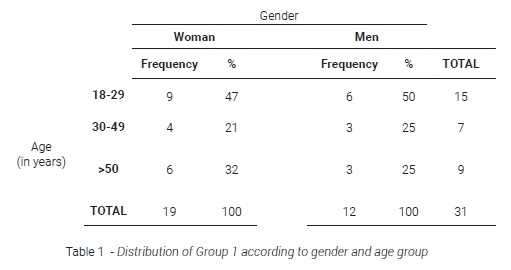
The study sample frame, consisting of 64 Portuguese adults, was constituted through a non-probabilistic convenience sampling process. Taking into account the comparative nature of the study, the experiment was performed in two different environments, which presupposes a division of the sample into two groups. Thus, 31 participants constitute Group 1, whose experience was performed in an offline purchase channel (in a supermarket/ physical store), while the remaining 33 participants, constituents of Group 2, performed the purchase simulation in an online channel. This sample can be characterized by gender and age as shown in Tables I and 2.
]]>
4.4 Data analysis
According to the objectives of this study, it was intended to compare the deviation in relation to the shopping list provided in Groups 1 and 2. For this, it was objected that this deviation was measured through the concept of "unplanned product". Any "purchased" product that meets one of the following criteria was considered as an "unplanned product":
⇒ Being of a different category from those included in the shopping list provided, such as chocolate, tea, water, etc.
⇒ Although it is of a category mentioned in the shopping list, the "purchased" quantity is higher than in the shopping list. An example of this is the acquisition of 3kg of sugar when the shopping list is only 1kg. 2kg of sugar are considered unplanned.
In order to better understand the concept of “unplanned product” and to carry out a comprehensive analysis, 4 variables were analyzed that allowed different perspectives on the same observation - the measure of the deviation from the shopping list provided, which are:
1) Acquisition of Unplanned Products - Number of participants in each group that "acquired" at least one unplanned product. This variable is categorized by the answer "yes" or "no."
2) Type of Unplanned Products - Sum of the number of categories (not mentioned in the shopping list) of unplanned product, regardless the quantity "acquired". For example, individual A "purchased" 1 pack of detergent, 3 chocolate tablets and 1 juice, so the individual "purchased" 3 unplanned products.
]]> 3) Quantity of Unplanned Products - Sum of units of "acquired" unplanned products. For example, individual B "purchased" 1 pack of detergent, 3 chocolate tablets and 1 juice. Then, individual B "purchased" 5 extra products4) Expenses Made on Unplanned Products
On the other hand, it was also compared the difference between groups in the time spent (time variable, measured in minutes) during the shopping experience, which was timed by the observer.
The expenses were also studied, noting not only the expenses made with the products purchased outside the shopping list, as already indicated, but also:
1) Expenses Made on Products from the List - Sum of the expenses made on the products included in the shopping list.
2) Total Expenses - Sum of expenses incurred on all "purchased" products.
Finally, we also studied the difference between groups in terms of the number of products on promotion acquired by the participants. In this category, three variables were analyzed:
1) Products from the List on Promotion - Number of products included in the purchased list acquired on promotion.
2) Unplanned Products on Promotion- Number of unplanned products acquired on promotion
3) Total Products on Promotion - Number of products "purchased" on promotion. It results from the sum of the variables "Products from the List on Promotion" and "Unplanned Products on Promotion".
]]> In order to evaluate the significance of the differences between groups regarding the deviation from the shopping list provided, the expenses made, and the number of products acquired on promotion, a Student's t-test was used. The two assumptions of this statistical method were evaluated - the normality of the distributions and the homogeneity of variance. The distribution normalities were evaluated using the Shapiro-Wilk (SW) test, which is recommended when the group of participants is less than 50 (Maroco, 2011), as it is the case. The homogeneity of variances was assessed with the Levene test based on the mean or median, depending on whether or not the dependent variable had a normal distribution, respectively.Although the dependent variable in some groups does not present normal distribution, the t-student test is considered to be robust to violation of normality when skewness (sk) and kurtosis (ku) values are not very high, that is, with absolute values lower than 3 and 7-10, respectively (Maroco, 2011).
5. Findings
In the shopping experience carried out in an offline purchase channel it was found that 74.2% (23 participants) placed at least one extra product in the shopping cart. As to the experience in online purchase channel, only 14 participants (42.4%) did - an almost half of the above. But is this fact really related to the purchase channel or is it just by chance?
5.1 Difference in the acquisition of “extra products” between each group
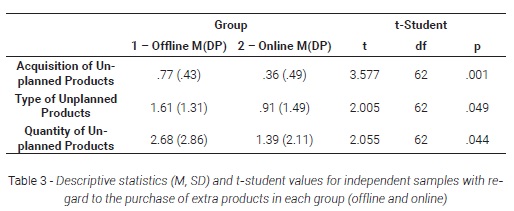
Regarding the effect that the variable group could have on the purchase of unplanned products, here expressed by the variables Acquisition of Unplanned Products, Type of Unplanned Products, and Quantity of Unplanned Products, the following was obtained: there was a statistically significant effect of the Group variable (1-offline and 2-online) on the acquisition/non-acquisition of unplanned products to those mentioned and quantified in the shopping list provided (t (62) = 3.577; p = 0.001), proving that more participants from Group 1 (M = .77, SD = .43) purchased more unplanned products when compared to Group 2 (M = .36, SD = .49), this difference being a consequence of the potential effect of the channel and the group in which participants were inserted. It is considered that this effect is highly significant since p-value is equal to 0.001.
There were also statistically significant differences with respect to the effect of the channel/group variable on the Type of Unplanned Products (t (62) = 2.005; p = 0.049) and Quantity of Unplanned Products (t (62) = 2.055, p = 0.044) variables.
These results indicate that Group 1 (offline) also purchased more types of unplanned products, as well as a greater quantity of these same products when compared to Group 2 (online). In this sense, the first proposed hypothesis is confirmed: “In a grocery shopping situation with resource to a shopping list, the consumer will purchase more unplanned items when buying in an offline purchase channel than in an online purchase channel”.
]]>
5.2 Difference of time spent between each group
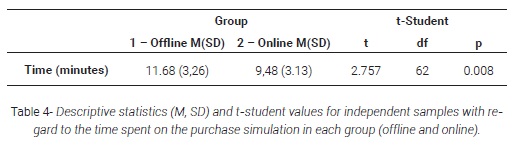
A statistically significant effect of the Group variable (1-offline and 2-online) on the time spent, measured in minutes, was found in the purchase simulation carried out (t (62) = 2.757; p = 0.008). Namely, it was found that Group 1 (M = 11.68, SD = 3.26) took longer to complete the purchase than Group 2 (M = 9.48, SD = 3.13).
5.3 Difference of price sensitivity between each group
During the observation of the purchase experiences that were carried out by the various participants, it was also decided to verify difference of expenses incurred between each group and if the "acquired" products were on promotion in order to assess consumers’ sensitivity to price, in order to confirm the second and last hypothesis proposed: “In a grocery shopping situation with resource to a shopping list, consumers price sensitivity to unplanned purchases varies according to the shopping channel.”.
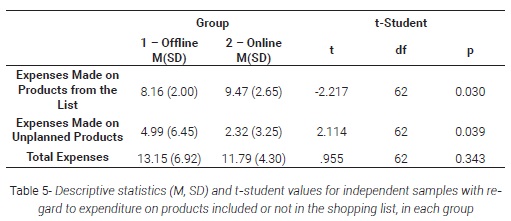
It was also verified a statistically significant effect of the Group variable on the expenses incurred in the products mentioned in the shopping list (t (62) = -2.217; p = .030). By comparing the averages observed in each group, it is perceptible that participants that constituted Group 2 (M = 9.47, SD = 2.65) spend more money on the products included in the shopping list, compared to the participants of Group 1 (M = 8.16, SD = 2.00).
In the case of products purchased that were not included in the purchasing list, the effect of the Group variable was also statistically significant (t (62) = 2.114; p = .039), but in this case, it is the Group 1 (M = 4.99, SD = 6.45) who spent more money (M = 2.32, SD = 3.25). There was no statistically significant effect of the Group variable on the total expenditure of participants in the purchase simulation (t (62) = .955, p = 0.343).
]]>
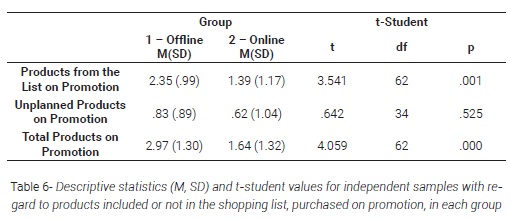
As regards to the total number of products purchased on promotion (planned plus unplanned chosen products), a statistically significant effect of the Group variable was observed (t (62) = 4.059, p <0.001): Group 1 (M = 2.97, SD = 1.30) purchased more products on promotion than Group 2 (M = 1.64, SD = 1.32).
When we observed the occurrences with the products mentioned in the shopping list, the result presented was similar: Group 1 (M = 2.35, SD = .99) also purchased more products on promotion than Group 2 (M = 1.39, SD = 1.17). A statistically significant effect of the Group variable on the number of products included in the shopping list purchased for promotion (t (62) = 3.541; p = .001) was also observed. On the other hand, regarding the products that were not included in the shopping list, but were also on promotion, no statistically significant effect of the Group variable on the acquisition of these products (t (34) = .642; p = .525) was found.
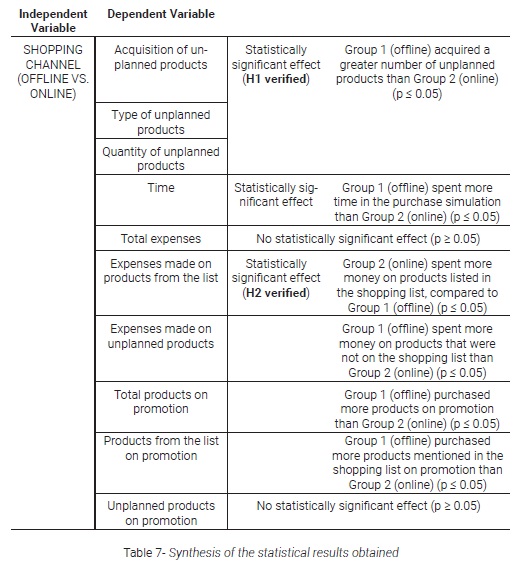
A summary table of the statistical results obtained is presented below (Table 7).
]]>
6. Discussion
With this exploratory study, we aimed to understand in which retail channel (offline versus online) the consumer best complies with the shopping list and in which one he chooses a greater number of unplanned products. Moreover, we wanted to understand if this possible difference in shopping behavior could also be observed in consumer price sensitivity. Therefore, we proposed that in a grocery shopping situation with resource to a shopping list the consumer would purchase more unplanned items when buying in an offline purchase channel than in an online purchase channel (H1), and that consumers price sensitivity to unplanned purchases would vary according to the shopping channel (H2).
According to our data, differences were observed between the two shopping conditions, confirming our hypothesis 1. Specifically, in an offline purchase channel 74.2% (23 participants) placed at least one extra product in the shopping cart, while in a online purchase channel only 14 participants (42.4%) did. Also, Group 1 (offline) purchased more types of extra products, as well as a greater quantity of these same products when compared to Group 2 (online). We then conclude that consumer acquired more unplanned items in an offline purchase channel than in an online purchase channel.
One possible explanation to the obtained findings is the fact that the purchasing process in an online purchase channel allows greater control over the search process through the use of tools such as the search bar, menus or filters (Hoffman & Novak, 1996). This use may allow bigger manipulation of the results presented, restricting the number of products available to the consumer. On the other hand, in the offline purchase channel the stimulation process by the environment and store atmosphere is potentially higher (Degeratu et al., 2000), as there are more products and stimuli visible to the consumer competing for his attention.
Our findings contradict Kacen and Lee (2002) assumption that the Internet is a mean of promoting unplanned and impulsive buying, since it increases and facilitates access to the available products and services. This assumption could be true for hedonism shopping, when consumers may be more open to buy products/services that they initially did not consider. However, based on our findings we suggest that in a goal-oriented condition, consumers would be more resistant to deviate their planned behavior, especially in an online context. In other words, in an offline environment, shoppers are probably more likely subject to more marketing stimuli and consequently they are more likely to make unplanned purchase since the shopping could be less utilitarian than in an online channel.
Moreover, our findings also confirmed that in a grocery-shopping situation, characterized by the use of a shopping list, the time spent in the decision-making process was higher in an offline shopping channel than in an online shopping channel. A finding that is in line with Bell, Corsten and Knox (2011) suggestion that there is a positive relationship between shopping time and unplanned buying, which could explain the previous mentioned observation.
If we consider that the corridors in a physical store correspond to the hierarchical menus in an online store, the time spent in traveling between corridors in an offline channel is higher than when navigating between menus in an online channel, which can contribute to the increase of the time spent in Group 1. This justification is supported by Morganosky and Cude (2000), who, when studying the online channel purchase, verified a decrease in the actual purchase time, which they justified by eliminating the physical shop trips. It is also believed that consumers who prefer to shop on online platforms do so to expedite this task, as the Internet as a market has potentially made it more efficient (Press, 1993), since the consumer manipulates the presented results, reaching its objectives quickly. For this can also contribute the prior knowledge of the platform (site or application) used. Besides, if the number of unplanned items purchased is higher in the offline channel, it is likely that consumers buying through this channel will take more time in the total time spent in the decision process.
It is agreed that the Internet can facilitate access to available products and services. But as a buying channel, its various specificities, such as the possibility of greater control and efficiency in the decision-making process, can make access to products more restricted and less competitive, as it is mainly dependent of previous knowledge, potentially decreasing the number of unplanned purchases.
]]> One other possible explanation to consumers behavior to stick with the planned shopping list in an online context could be related precisely with the fact that the online is an immernsive store full of possibilities, which could suggest that consumers become are more goal-oriented in online purchases than in offline environments as a defense mechanism. Even though consumers like to have choices (Carmon, Wertenbroch, & Zeelenberg, 2003; Shin & Ariely, 2004), people are more likely to make more purchases when offered a limited array of choices rather than a more extensive array of choices (Iyengar & Lepper, 2000). Previous studies have also shown us that participants actually reported greater subsequent satisfaction with their selections and wrote better essays when their original set of options had been limited (Iyengar & Lepper, 2000).Regarding the second hypothesis, it was also confirmed that, in a grocery-shopping situation using a shopping list, consumers seem to be more price sensitive for planned products in an offline purchase channel, as they tend to spend less money on products included in the shopping list and purchase more products on promotion, compared to participants of Group 2. However, it was also found that when it comes to unplanned expenses Group 1 spent more money on products that were not on the shopping list than Group 2.
These findings may suggest that offline buyers may value more the influence of price on their choices, when considering the products previously planned. In line with our findings, for Degeratu et al. (2000) online shopping buyers are less attentive and sensitive to the prices practiced, not becoming this one definitive attribute in the choice of a product. The authors also point out that in traditional stores, the combined effect of price and promotions is stronger when compared to online stores.
However, offline buyers spend more on extra products, which is why we could not verify any effect of the purchasing channel in the total expenditure, since this variable corresponds to the sum of the expenditure on the products of the shopping list and the extra products. The fact that offline consumers chose a larger number of unplanned and more expensive products, along with the greater number of promotional products purchased, may once again indicate an influence of the store environment in traditional shops.
Unlike Group 1, online consumers showed a higher expenditure on the products on the shopping list and did not present relevant data on the purchase of products on promotion. As mentioned before, since the control of results in the shopping research process is different from the offline context, it is expected that online consumers may not have a more comprehensive idea of the total offers, thus price competition being drastically reduced.
7. Conclusions
We exposed participants to one of two conditions (online versus offline shopping) and provided both groups with the same shopping list and budget. At the end of the study, all fictitious purchases in both groups were recorded and compared.
Based on the literature review, we proposed that in a grocery shopping situation with resource to a shopping list the consumer would purchase more unplanned items when buying in an offline purchase channel than in an online purchase channel (H1), and that consumers price sensitivity to unplanned purchases would vary according to the shopping channel (H2).
The findings presented and discussed seem to demonstrate that the purchasing channel used impacts the decision-making process, both in planned and unplanned purchases, confirming H1 and H2, suggesting that the purchasing decision-making process is affected by the specificities of each purchase channel. Accordingly, there are considerable differences in the number of unplanned products purchased, costs incurred, and the products on promotion purchased, which are mainly explained by the structural differences between channels, by type of navigation on the online channel and the strong influence of the store environment on offline channels.
Unexpectedly, our findings also seem to suggest that the shopping channel, which can affect impulsive shopping behavior, could also affect price sensitivity. The more money consumer spends on the shopping list items, the less inclined he will be to spend in impulsive shopping. One the other hand, a consumer more price sensitive allows himself to buy more unplanned products and spend more money on them.
]]> We are aware that there are many other possible factors that can influence shopping behavior, specifically, unplanned purchases. For instance, impulse buying remains affected by consumer personality, as stated by the most literature (Beatty & Ferrell, 1998). Our goal was not to address all of these factors, but rather to focus on the purchase channel by comparing the results from two different environments, so far treated equally by practioners: the online and the offline channel. Future research could expand this study and introduce other factors in order to provide a holistic perspective on the subject.With regard to the implemented methodology, it is realized that the experience produced cannot be considered totally natural, which leads to limitations in the observation. Although the shopping list and the budget have been constructed in order to simulate a regular shopping momentum, this option can bias results through the possible influence on the quantity and type of choice made in the unplanned products, which can lead to obscuring consumer needs and impulses, bypassing the possibility of a fully real-world experience. Also, the fact that participants are aware that this is an academic study can influence the results, making possible a change in their decision-making process. It is also possible that the small number of research participants could limit our conclusions.
Taking into account these limitations mentioned, it is suggested the repetition of the experience by monitoring in a real moment of purchase each participant, taking into account the list of purchases self-elaborated and their own budget (mental or not). This repetition has to be developed in the two channels of purchase in question in order to maintain the comparative character of the study. This research could also be adapted to different categories of products.
Finally, in order to invert the unplanned consumption tendency in online grocery stores, we believe that e-tailers need to focus on a more hedonic consumer experience where the entertainment side of the purchase should be emphasize (Park et al., 2011). Unplanned consumption drivers such as atractive pricing strategies, sales promotions and recommended or related products should be considered. Nonetheless, online grocery consumption is a main goal-oriented activity. In this sense, a successful strategy should also be about an expansion of sensory experiences and the focus on developing the online atmospherics. We recommend a more interactive presentation through the use of tools that provide this possibility, such as chatbots or virtual assistants.
These findings are expected to contribute to the enrichment of academic and scientific knowledge in the fields of Consumer Behavior and Strategic Communication. By reaching a better understanding of the consumer, environment, and decision-making process triangle, it is hoped that the future construction of better and more effective communication strategies will be possible.
REFERENCES
Aydinli, A., Bertine, M., & Lambrecht, A. (2014). Price promotion for emotional impact. Journal of Marketing, 78(4), 80-96. https://doi.org/10.1509/jm.12.0338 [ Links ]
Beatty, S. E., & Ferrell, M. E. (1998). Impulse buying: modeling its precursors. Journal of Retailing, 74(2), 169-191. https://doi.org/10.1016/S0022-4359(99)80092-X [ Links ]
Bell, D. R., Corsten, D., & Knox, G. (2011). From Point of Purchase to Path to Purchase: How Preshopping Factors Drive Unplanned Buying. Journal of Marketing, 75(1), 31-45. https://doi.org/10.1509/jmkg.75.1.31 [ Links ]
Block, L. G., & Morwitz, V. G. (1999). Shopping Lists as an External Memory Aid for Grocery Shopping : Influences on List Writing and List Fulfillment, 8(4), 343-375. https://doi.org/10.1207/s15327663jcp0804_01
Carmon, Z., Wertenbroch, K., & Zeelenberg, M. (2003). Option Attachment: When Deliberating Make Choosing Feel Like Losing. Journal of Consumer Research, 30, 15-29. https://doi.org/10.1086/374701 [ Links ]
Cove, J. F., & Walsh, B. C. (1988). Online text retrieval via browsing. Information Processing and Management, 24(1), 31-37. https://doi.org/10.1016/0306-4573(88)90075-1 [ Links ]
Davis, R., Smith, S. D., & Lang, B. (2017). A comparison of online and offline gender and goal directed shopping online. Journal of Retailing and Consumer Services, 38, 118-125. https://doi.org/10.1016/j.jretconser.2017.02.011 [ Links ]
Degeratu, A. M., Rangaswamy, A., & Wu, J. (2000). Consumer choice behavior in online and traditional supermarkets: The effects of brand name, price, and other search attributes. International Journal of Research in Marketing, 17, 55-78. https://doi.org/10.1016/S0167-8116(00)00005-7 [ Links ]
Dhar, R., & Simonson, I. (1999). Making complementary choices in consumption episodes: highlighting versus balancing. Journal of Marketing Research1, 29-44. http://doi.org/10.2307/3151913 [ Links ]
Heilman, C. M., Nakamoto, K., & Rao, A. G. (2002). Pleasant Surprises: Consumer Response to Unexpected In-Store Coupons. Journal of Marketing Research, 39(2), 242-252. https://doi.org/10.1509/jmkr.39.2.242.19081 [ Links ]
Hoffman, D. L., & Novak, T. P. (1996). A New Marketing Paradigm for Electronic Commerce. The Information Society, 13(1), 43-54. https://dx.doi.org/10.1080/019722497129278 [ Links ]
Huyghe, R., Verstraeten, J., Geuens, M., & Van Kerckhove, A. (2017). Clicks as a Healthy Alternative to Bricks: How Online Grocery Shopping Reduces Vice Purchases. Journal of Marketing Research, 54(1), 61-74. https://doi.org/10.1509/jmr.14.0490 [ Links ]
Iyengar, S. S., & Lepper, M. R. (2000). When choice is demotivating: Can one desire too much of a good thing? Journal of Personality and Social Psychology, 79(6), 995-1006. https://doi.org/10.1037/0022-3514.79.6.995 [ Links ]
Iyer, E. S. (1989). Unplanned Purchasing: Knowledge of Shopping Environment and Time Pressure. Journal of Retailing, 65(1), 40-57. [ Links ]
Kacen, J. J., & Lee, J. A. (2002). The Influence of Culture on Consumer Impulsive Buying Behavior. Journal of Consumer Psychology, 12(2), 163-176. https://doi.org/10.1207/S15327663JCP1202_08 [ Links ]
Kantar Worldpanel, K. (2015). Accelerating the growth of e-Commerce: 2015 Edition. Retrieved from https://www.kantarworldpanel.com/pt/news/Disponibilizamos-online-o-relatrio-Acceleranting-the-growth-of-e-commerce-2015 [ Links ]
Kollat, D. T., & Willet, R. P. (1967). Costumer Impulse Purchasing Behavior. Journal of Marketing Research, 4(1), 21-31. https://doi.org/10.2307/3150160 [ Links ]
Lee, L., & Ariely, D. (2006). Shopping Goals, Goal Concreteness, and Conditional Promotions. Journal of Consumer Research, 33(1), 60-70. https://doi.org/10.1086/504136 [ Links ]
Levin, A. M., Levin, I. P., & Weller, J. A. (2005). A multi-attribute analysis of preferences for online and offline shopping: Differences across products, consumers, and shopping stages. Journal of Eletronic Commerce Research, 6(4), 281. [ Links ]
Maroco, J. (2011). Análise estatistica com utilização do SPSS (2nd ed.). Lisboa: Edições Sílabo. [ Links ]
]]>Morganosky, M. A., & Cude, B. J. (2000). Consumer response to online grocery shopping. International Journal of Retail & Distribution Management, 28(1), 17-26. https://doi.org/10.1108/09590550010306737 [ Links ]
Nielsen. (2017). Consumidores portugueses aderem às compras online. Retrieved February 26, 2017, from http://www.nielsen.com/pt/pt/press-room/2017/portuguese-consumers-join-online-shopping.html [ Links ]
Park, C. W., & Smith, D. C. (1989). The effects of situational factors on in-store grocery shopping behavior: The role of store environment and time available for shopping. Journal of Consumer Research, 15(4), 422-433. https://doi.org/10.1086/209182 [ Links ]
Park, E. J., Kim, E. Y., Funches, V. M., & Foxx, W. (2011). Apparel product attributes, web browsing, and e-impulse buying on shopping websites. Journal of Business Research, 65(11), 1583-1589. https://doi.org/10.1016/j.jbusres.2011.02.043 [ Links ]
Press, L. (1993). The Internet and interactive television. Communications of the ACM, 36(12), 19-23. https://doi.org/10.1145/163298.163352 [ Links ]
Rook, D. W., & Fisher, R. J. (1995). Normative Influences on Impulsive Behavior. Journal of Consumer Research, 22(3), 305-313. https://doi.org/10.1086/209452 [ Links ]
Schmidt, M. (2012). Retail shopping lists: Reassessment and new insights. Journal of Retailing and Consumer Services, 19(1), 36-44. https://doi.org/10.1016/j.jretconser.2011.08.006 [ Links ]
Shin, J., & Ariely, D. (2004). Keeping Doors Open: The Effect of Unavailability on Incentives to Keep Options Viable. Management Science, 50, 575-586. https://doi.org/10.1287/mnsc.1030.0148 [ Links ]
Solomon, Bamossy, G., Askegaard, S., & Hogg, M. K. (2006). Consumer Behaviour: A European Perspective (3rd ed.). Harlow: Pearson Education Limited.
Stilley, K. M., Inman, J. J., & Wakefield, K. L. (2010a). Planning to Make Unplanned Purchases? The Role of In-Store Slack in Budget Deviation. Journal of Consumer Research, 37(2), 264-278. https://doi.org/10.1086/651567
]]> Stilley, K. M., Inman, J. J., & Wakefield, K. L. (2010b). Spending on the Fly: Mental Budgets, Promotions, and Spending Behavior. Journal of Marketing, 74(3), 34-47. https://doi.org/10.1509/jmkg.74.3.34Streicher, M., Büttner, O., & Estes, Z. (2016). Eye Buy: Broad Visual Attention Increases Unplanned Purchases. In P. Moreau & S. Puntoni (Eds.), NA - Advances in Consumer Research Volume 44 (pp. 760-760). Duluth: MN: Association for Consumer Research.
Suher, J., & Hoyer, W. (2015). Shop Different: Impulsivity, Squential Decision Making, and Motivations for Unplanned Purchases. In K. Diehl & C. Yoon (Eds.), NA - Advances in Consumer Research Volume 43 (pp. 705-706). Duluth: MN : Association for Consumer Research.
Thomas, A., & Garland, R. (1993). Supermarket Shopping Lists - their effect on consumer expenditure. International Journal of Retail & Distribution Management, 21(2), 8-14. https://doi.org/10.1108/09590559310028040 [ Links ]
Thomas, A., & Garland, R. (2004). Grocery shopping: list and non-list usage. Marketing Intelligence & Planning, 22(6), 623-635. https://doi.org/10.1108/02634500410559015 [ Links ]
Watkins, T. (1993). Consumer Purchasing of Low involvement Goods: Routine or Impulse? Marketing Intelligence and Planning, 2(2), 51-66. https://doi.org/10.1108/eb045700 [ Links ]
Williams, T. G. (1982). Consumer Behavior. St. Paul, Minnesota: West Publishing Co.
Wolfinbarger, M., & Gilly, M. (2001). Shopping online for freedom, control and fun. California Management Review, 43, 34-55. https://doi.org/10.2307/41166074 [ Links ]
Yan, Q., Wang, L., Chen, W., & Cho, J. (2016). Study on the influencing factors of unplanned consumption in a large online promotion ativity. Electronic Commerce Research, 16(4), 705-706. https://doi.org/10.1007/s10660-016-9215-x [ Links ]
]]> Recebido | Received | Recebido: 2018.08.15
Notas
[1] Statista, “Number of digital buyers worldwide from 2014 to 2021 (in billions)”. In https://www.statista.com/statistics/251666/number-of-digital-buyers-worldwide/
[2] Remarkety, “Global eCommerce Sales, Trends and Statistics 2015”. In https://www.remarkety.com/global-ecommerce-sales-trends-and-statistics-2015
[3] Statista, “U.S. consumers: Online Grocery Shopping - Statistics & Facts”. In https://www.statista.com/topics/1915/us-consumers-online-grocery-shopping/
[4] B!TMagazine “Portugal deverá atingir 3 mil milhões de euros em gastos online até 2018”. In http://www.bit.pt/portugal-devera-atingir-3-mil-milhoes-euros-gastos-online-ate-2018/
Biographical notes
]]> Inês Henriques is a Master in Communication Sciences, in the Strategic Communication, at the Faculdade de Ciências Sociais e Humanas - Universidade Nova de Lisboa.In recent years, she has worked closely with various brands as a project manager in communications departments and advertising agencies. Shows interest in Consumer Marketing and Behavior trends.
Email: ineshenriques73@gmail.com
Address: Instituto de Comunicação da NOVA, Av. de Berna, 26-C - Lisboa 069-061, Portugal
Ana Margarida Barreto holds a PhD degree from New University of Lisbon where she teaches Marketing, Consumer Behavior, and Strategic Communication. She completed a post-doc at Tel Aviv University where she studied attention, perception and memory, and fieldwork as a visiting scholar at University of Texas at Austin, University of Westminster, King’s College of London, and Columbia University. She is also part of the coordination team of ICNOVA and is the founder and coordinator of the research group on Strategic Communication and Decision-Making Processes of that center. Her work has been recognized with many invitations to take part in the review panel of worldwide journals, such as Communications: The European Journal of Communication Research, European Journal of Marketing, Journal of Business Research, Cogent Social Sciences, Information Processing & Management, etc, having received twice in three years the Outstanding Reviewer Award at the Emerald Literati Network Awards for Excellence (2015 and 2017). Ana Margarida Barreto has also worked for five years in communication and advertising, both in Portugal and in Spain.
Email: ambarreto@fcsh.unl.pt
Address: Instituto de Comunicação da NOVA, Av. de Berna, 26-C - Lisboa 069-061, Portugal
]]>