<?xml version="1.0" encoding="ISO-8859-1"?><article xmlns:mml="http://www.w3.org/1998/Math/MathML" xmlns:xlink="http://www.w3.org/1999/xlink" xmlns:xsi="http://www.w3.org/2001/XMLSchema-instance">
<front>
<journal-meta>
<journal-id>2183-5985</journal-id>
<journal-title><![CDATA[Acta Portuguesa de Nutrição]]></journal-title>
<abbrev-journal-title><![CDATA[Acta Port Nutr]]></abbrev-journal-title>
<issn>2183-5985</issn>
<publisher>
<publisher-name><![CDATA[Associação Portuguesa de Nutrição]]></publisher-name>
</publisher>
</journal-meta>
<article-meta>
<article-id>S2183-59852019000400006</article-id>
<article-id pub-id-type="doi">10.21011/apn.2019.1906</article-id>
<title-group>
<article-title xml:lang="en"><![CDATA[Nutrition up 65 educational strategies: health professionals qualification course]]></article-title>
<article-title xml:lang="pt"><![CDATA[Estratégias Educacionais do Projeto Nutrition UP 65: curso de qualificação de profissionais de saúde]]></article-title>
</title-group>
<contrib-group>
<contrib contrib-type="author">
<name>
<surname><![CDATA[Sousa]]></surname>
<given-names><![CDATA[Ana S]]></given-names>
</name>
<xref ref-type="aff" rid="A01"/>
<xref ref-type="aff" rid="A02"/>
<xref ref-type="aff" rid="A03"/>
</contrib>
<contrib contrib-type="author">
<name>
<surname><![CDATA[Guerra]]></surname>
<given-names><![CDATA[Rita S]]></given-names>
</name>
<xref ref-type="aff" rid="A01"/>
<xref ref-type="aff" rid="A02"/>
<xref ref-type="aff" rid="A04"/>
</contrib>
<contrib contrib-type="author">
<name>
<surname><![CDATA[Álvares]]></surname>
<given-names><![CDATA[Luísa]]></given-names>
</name>
<xref ref-type="aff" rid="A01"/>
</contrib>
<contrib contrib-type="author">
<name>
<surname><![CDATA[Valdiviesso]]></surname>
<given-names><![CDATA[Rui]]></given-names>
</name>
<xref ref-type="aff" rid="A01"/>
<xref ref-type="aff" rid="A05"/>
</contrib>
<contrib contrib-type="author">
<name>
<surname><![CDATA[Padrão]]></surname>
<given-names><![CDATA[Patrícia]]></given-names>
</name>
<xref ref-type="aff" rid="A01"/>
<xref ref-type="aff" rid="A06"/>
</contrib>
<contrib contrib-type="author">
<name>
<surname><![CDATA[Borges]]></surname>
<given-names><![CDATA[Nuno]]></given-names>
</name>
<xref ref-type="aff" rid="A01"/>
<xref ref-type="aff" rid="A05"/>
</contrib>
<contrib contrib-type="author">
<name>
<surname><![CDATA[Santos]]></surname>
<given-names><![CDATA[Alejandro]]></given-names>
</name>
<xref ref-type="aff" rid="A01"/>
<xref ref-type="aff" rid="A07"/>
</contrib>
<contrib contrib-type="author">
<name>
<surname><![CDATA[Afonso]]></surname>
<given-names><![CDATA[Cláudia]]></given-names>
</name>
<xref ref-type="aff" rid="A01"/>
<xref ref-type="aff" rid="A06"/>
</contrib>
<contrib contrib-type="author">
<name>
<surname><![CDATA[Martins]]></surname>
<given-names><![CDATA[Cátia]]></given-names>
</name>
<xref ref-type="aff" rid="A08"/>
</contrib>
<contrib contrib-type="author">
<name>
<surname><![CDATA[Ferro]]></surname>
<given-names><![CDATA[Graça]]></given-names>
</name>
<xref ref-type="aff" rid="A09"/>
</contrib>
<contrib contrib-type="author">
<name>
<surname><![CDATA[Moreira]]></surname>
<given-names><![CDATA[Pedro]]></given-names>
</name>
<xref ref-type="aff" rid="A01"/>
<xref ref-type="aff" rid="A06"/>
<xref ref-type="aff" rid="A10"/>
</contrib>
<contrib contrib-type="author">
<name>
<surname><![CDATA[Amaral]]></surname>
<given-names><![CDATA[Teresa F]]></given-names>
</name>
<xref ref-type="aff" rid="A01"/>
<xref ref-type="aff" rid="A04"/>
</contrib>
</contrib-group>
<aff id="A01">
<institution><![CDATA[,Universidade do Porto Faculdade de Ciências da Nutrição e Alimentação ]]></institution>
<addr-line><![CDATA[Porto ]]></addr-line>
<country>Portugal</country>
</aff>
<aff id="A02">
<institution><![CDATA[,Universidade Fernando Pessoa Faculdade de Ciências da Saúde ]]></institution>
<addr-line><![CDATA[Porto ]]></addr-line>
<country>Portugal</country>
</aff>
<aff id="A03">
<institution><![CDATA[,Instituto Politécnico de Leiria Center for Innovative Care and Health Technology ]]></institution>
<addr-line><![CDATA[Leiria ]]></addr-line>
<country>Portugal</country>
</aff>
<aff id="A04">
<institution><![CDATA[,Universidade do Porto Faculdade de Engenharia ]]></institution>
<addr-line><![CDATA[Porto ]]></addr-line>
<country>Portugal</country>
</aff>
<aff id="A05">
<institution><![CDATA[,Centro de Investigação em Tecnologias e Serviços de Saúde  ]]></institution>
<addr-line><![CDATA[Porto ]]></addr-line>
<country>Portugal</country>
</aff>
<aff id="A06">
<institution><![CDATA[,Universidade do Porto Instituto de Saúde Pública ]]></institution>
<addr-line><![CDATA[Porto ]]></addr-line>
<country>Portugal</country>
</aff>
<aff id="A07">
<institution><![CDATA[,Universidade do Porto Instituto de Investigação e Inovação em Saúde ]]></institution>
<addr-line><![CDATA[Porto ]]></addr-line>
<country>Portugal</country>
</aff>
<aff id="A08">
<institution><![CDATA[,Norwegian University of Science and Technology Department of Cancer Research and Molecular Medicine Obesity Research Group]]></institution>
<addr-line><![CDATA[Trondheim ]]></addr-line>
<country>Norway</country>
</aff>
<aff id="A09">
<institution><![CDATA[,Unidade Local de Saúde do Alto Minho  ]]></institution>
<addr-line><![CDATA[Viana do Castelo ]]></addr-line>
<country>Portugal</country>
</aff>
<aff id="A10">
<institution><![CDATA[,Universidade do Porto Centro de Investigação em Atividade Física, Saúde e Lazer ]]></institution>
<addr-line><![CDATA[Porto ]]></addr-line>
<country>Portugal</country>
</aff>
<pub-date pub-type="pub">
<day>31</day>
<month>10</month>
<year>2019</year>
</pub-date>
<pub-date pub-type="epub">
<day>31</day>
<month>10</month>
<year>2019</year>
</pub-date>
<numero>19</numero>
<fpage>30</fpage>
<lpage>34</lpage>
<copyright-statement/>
<copyright-year/>
<self-uri xlink:href="http://scielo.pt/scielo.php?script=sci_arttext&amp;pid=S2183-59852019000400006&amp;lng=en&amp;nrm=iso"></self-uri><self-uri xlink:href="http://scielo.pt/scielo.php?script=sci_abstract&amp;pid=S2183-59852019000400006&amp;lng=en&amp;nrm=iso"></self-uri><self-uri xlink:href="http://scielo.pt/scielo.php?script=sci_pdf&amp;pid=S2183-59852019000400006&amp;lng=en&amp;nrm=iso"></self-uri><abstract abstract-type="short" xml:lang="en"><p><![CDATA[Introduction: Nutrition knowledge among health professionals has a major impact on older adults&#8217; healthcare. However, there is a lack of specialized education offer in this area. Within the Nutrition UP 65 Project, a health professional&#8217;s qualification nutrition course was created and implemented from April 2015 to April 2017. We aim to describe this process here. Methodology: At Faculdade de Ciências da Nutrição e Alimentação da Universidade do Porto, a course of twenty-seven hours was created by six professors. The course comprises eight hours of direct contact and nineteen hours of individual study and was accredited by the University of Porto and credited with one European Credit Transfer System (ECTS). Educational materials and presentations for each session were produced including posters and flyers. A final test was developed to evaluate attendee&#8217;s knowledge. Approximately 10% of national health units were identified, randomly selected in each country regional area (NUTS II - &#8220;Nomenclatura Comum das Unidades Territoriais para Fins Estatísticos&#8221;) and invited to participate. Results: Thirty-five course editions were carried out by twenty-three Porto University accredited instructors for 784 professionals from 241 different health units. Concerning the knowledge evaluation, a 99% approval rate was achieved and the average mark score was of 16.8 out of 20. Course satisfaction survey revealed that 45.7% of the participants classified the course as &#8220;good&#8221; and 41.1% as &#8220;very good&#8221;. Conclusions: The overall balance of this branch of the Nutrition UP 65 project is very positive. The results on health professional&#8217;s adherence demonstrate that the interest in this area of nutrition care is high and that this nutrition course is a good opportunity to expand access to specialized education. This highlights the need for further initiatives promoting educational sessions targeting nutrition topics. These course sessions must be acknowledged as a starting point to a new approach in older adult&#8217;s nutrition knowledge in Portugal.]]></p></abstract>
<abstract abstract-type="short" xml:lang="pt"><p><![CDATA[Introdução: O conhecimento sobre nutrição dos profissionais de saúde tem um grande impacto na saúde dos indivíduos idosos. No entanto, há escassez de oferta de educação especializada nessa área. O Projeto Nutrition UP 65 foi criado e implementado a nível nacional um curso de qualificação em nutrição para profissionais de saúde, que decorreu entre abril de 2015 e abril de 2017. Pretende-se descrever aqui este processo. Metodologia: Na Faculdade de Ciências da Nutrição e Alimentação da Universidade do Porto, seis professores elaboraram um curso de vinte e sete horas. Este curso é composto por oito horas de contacto direto e dezanove horas de estudo individual e foi acreditado e creditado pela Universidade do Porto com um European Credit Transfer System (ECTS). Foram produzidos materiais didáticos e apresentações, bem como cartazes e desdobráveis informativos. Desenvolveu-se uma prova final para avaliar os conhecimentos dos participantes. Cerca de 10% das unidades de saúde nacionais foram identificadas, selecionadas aleatoriamente em cada área regional (NUTS II) e convidadas a participar. Resultados: Realizaram-se 35 edições do curso para 784 profissionais de 241 unidades de saúde diferentes por 23 instrutores credenciados pela Universidade do Porto. No teste de avaliação obteve-se uma taxa de aprovação de 99% e uma pontuação média de 16,8 em 20 valores. 45,7% dos participantes classificaram o curso como &#8220;bom&#8221; e 41,1% como &#8220;muito bom&#8221;. Conclusões: O balanço global desta vertente do Projeto Nutrition UP 65 é muito positivo. Os resultados da adesão dos profissionais de saúde demonstram que o interesse por esta área da intervenção nutricional é elevado e que este curso é uma boa oportunidade para expandir o acesso à formação especializada. Assim, destaca-se a necessidade de outras iniciativas que promovam sessões de formação voltadas para tópicos nutricionais. Estas sessões de formação devem ser reconhecidas como um ponto de partida para uma nova abordagem no conhecimento nutricional dos idosos em Portugal.]]></p></abstract>
<kwd-group>
<kwd lng="en"><![CDATA[Health education]]></kwd>
<kwd lng="en"><![CDATA[Health personnel]]></kwd>
<kwd lng="en"><![CDATA[Health services for the elderly]]></kwd>
<kwd lng="en"><![CDATA[Nutrition]]></kwd>
<kwd lng="pt"><![CDATA[Educação em saúde]]></kwd>
<kwd lng="pt"><![CDATA[Profissionais de saúde]]></kwd>
<kwd lng="pt"><![CDATA[Serviços de saúde para pessoas idosas]]></kwd>
<kwd lng="pt"><![CDATA[Nutrição]]></kwd>
</kwd-group>
</article-meta>
</front><body><![CDATA[ <p align="right"><b>ARTIGO ORIGINAL</b></p>     <p>     <p><strong>Nutrition up 65 educational strategies: health professionals qualification course</strong></p>     <p><strong>Estrat&eacute;gias Educacionais do Projeto Nutrition UP 65: curso de qualifica&ccedil;&atilde;o de profissionais de sa&uacute;de</strong></p>     <p><strong>Ana S Sousa<sup>1-3</sup>; Rita S Guerra<sup>1,2,4</sup>; Lu&iacute;sa &Aacute;lvares<sup>1</sup>; Rui Valdiviesso<sup>1,5</sup>; Patr&iacute;cia Padr&atilde;o<sup>1,6</sup>; Nuno Borges<sup>1,5</sup>; Alejandro Santos<sup>1,7</sup>; Cl&aacute;udia Afonso<sup>1,6</sup>; C&aacute;tia Martins<sup>8</sup>; Gra&ccedil;a Ferro<sup>9</sup>; Pedro Moreira<sup>1,6,10</sup>; Teresa F Amaral<sup>1,4</sup>*</strong></p>     <p><sup>1</sup>Faculdade de Ci&ecirc;ncias da Nutri&ccedil;&atilde;o e Alimenta&ccedil;&atilde;o da Universidade do Porto, Rua Dr. Roberto Frias, 4200-465 Porto, Portugal</p>     <p><sup>2</sup>Faculdade de Ci&ecirc;ncias da Sa&uacute;de da Universidade Fernando Pessoa, Pra&ccedil;a de 9 de Abril, n.&ordm; 349, 4249-004 Porto, Portugal</p>     <p><sup>3</sup>Center for Innovative Care and Health Technology do Instituto Polit&eacute;cnico de Leiria, Rua General Norton de Matos, Apartado 4133, 2411-901 Leiria, Portugal</p>     <p><sup>4</sup>LAETA/INEGI, Faculdade de Engenharia da Universidade do Porto, Rua Dr. Roberto Frias, 4200-465 Porto, Portugal</p>     <p><sup>5</sup>Centro de Investiga&ccedil;&atilde;o em Tecnologias e Servi&ccedil;os de Sa&uacute;de, Rua Dr. Pl&aacute;cido da Costa, 4200-450 Porto, Portugal</p>     ]]></body>
<body><![CDATA[<p><sup>6</sup>EPIUnit, Instituto de Sa&uacute;de P&uacute;blica da Universidade do Porto, Rua das Taipas, n.&deg; 135, 4050-600 Porto, Portugal</p>     <p><sup>7</sup>Instituto de Investiga&ccedil;&atilde;o e Inova&ccedil;&atilde;o em Sa&uacute;de da Universidade do Porto, Rua Alfredo Allen, n.&ordm; 208, 4200-135 Porto, Portugal</p>     <p><sup>8</sup>Obesity Research Group, Department of Cancer Research and Molecular Medicine, Norwegian University of Science and Technology, (NTNU), Trondheim, Norway</p>     <p><sup>9</sup>Unidade Local de Sa&uacute;de do Alto Minho, Estrada de Santa Luzia, 4904-858 Viana do Castelo, Portugal.</p>     <p><sup>10</sup>Centro de Investiga&ccedil;&atilde;o em Atividade F&iacute;sica, Sa&uacute;de e Lazer da Universidade do Porto, Rua Dr. Pl&aacute;cido Costa, n.&ordm; 91, 4200-450 Porto, Portugal</p> <a href="#c0">Endere&#231;o para correspond&#234;ncia</a><a name="topc0"></a></b></p>     <p>&nbsp;</p>     <p><strong>ABSTRACT</strong></p>     <p>Introduction: Nutrition knowledge among health professionals has a major impact on older adults&rsquo; healthcare. However, there is a lack of specialized education offer in this area. Within the Nutrition UP 65 Project, a health professional&rsquo;s qualification nutrition course was created and implemented from April 2015 to April 2017. We aim to describe this process here.</p>     <p>Methodology: At Faculdade de Ci&ecirc;ncias da Nutri&ccedil;&atilde;o e Alimenta&ccedil;&atilde;o da Universidade do Porto, a course of twenty-seven hours was created by six professors. The course comprises eight hours of direct contact and nineteen hours of individual study and was accredited by the University of Porto and credited with one European Credit Transfer System (ECTS). Educational materials and presentations for each session were produced including posters and flyers. A final test was developed to evaluate attendee&rsquo;s knowledge. Approximately 10% of national health units were identified, randomly selected in each country regional area (NUTS II &ndash; &ldquo;Nomenclatura Comum das Unidades Territoriais para Fins Estat&iacute;sticos&rdquo;) and invited to participate.</p>     <p>Results: Thirty-five course editions were carried out by twenty-three Porto University accredited instructors for 784 professionals from 241 different health units. Concerning the knowledge evaluation, a 99% approval rate was achieved and the average mark score was of 16.8 out of 20. Course satisfaction survey revealed that 45.7% of the participants classified the course as &ldquo;good&rdquo; and 41.1% as &ldquo;very good&rdquo;.</p>     ]]></body>
<body><![CDATA[<p>Conclusions: The overall balance of this branch of the Nutrition UP 65 project is very positive. The results on health professional&rsquo;s adherence demonstrate that the interest in this area of nutrition care is high and that this nutrition course is a good opportunity to expand access to specialized education. This highlights the need for further initiatives promoting educational sessions targeting nutrition topics. These course sessions must be acknowledged as a starting point to a new approach in older adult&rsquo;s nutrition knowledge in Portugal.</p>     <p><strong>Keywords</strong></p>     <p>Health education, Health personnel, Health services for the elderly, Nutrition</p>     <p>&nbsp;</p>  <hr>     <p>&nbsp;</p>     <p><strong>RESUMO</strong></p>     <p>Introdu&ccedil;&atilde;o: O conhecimento sobre nutri&ccedil;&atilde;o dos profissionais de sa&uacute;de tem um grande impacto na sa&uacute;de dos indiv&iacute;duos idosos. No entanto, h&aacute; escassez de oferta de educa&ccedil;&atilde;o especializada nessa &aacute;rea. O Projeto Nutrition UP 65 foi criado e implementado a n&iacute;vel nacional um curso de qualifica&ccedil;&atilde;o em nutri&ccedil;&atilde;o para profissionais de sa&uacute;de, que decorreu entre abril de 2015 e abril de 2017. Pretende-se descrever aqui este processo.</p>     <p>Metodologia: Na Faculdade de Ci&ecirc;ncias da Nutri&ccedil;&atilde;o e Alimenta&ccedil;&atilde;o da Universidade do Porto, seis professores elaboraram um curso de vinte e sete horas. Este curso &eacute; composto por oito horas de contacto direto e dezanove horas de estudo individual e foi acreditado e creditado pela Universidade do Porto com um European Credit Transfer System (ECTS). Foram produzidos materiais did&aacute;ticos e apresenta&ccedil;&otilde;es, bem como cartazes e desdobr&aacute;veis informativos. Desenvolveu-se uma prova final para avaliar os conhecimentos dos participantes. Cerca de 10% das unidades de sa&uacute;de nacionais foram identificadas, selecionadas aleatoriamente em cada &aacute;rea regional (NUTS II) e convidadas a participar.</p>     <p>Resultados: Realizaram-se 35 edi&ccedil;&otilde;es do curso para 784 profissionais de 241 unidades de sa&uacute;de diferentes por 23 instrutores credenciados pela Universidade do Porto. No teste de avalia&ccedil;&atilde;o obteve-se uma taxa de aprova&ccedil;&atilde;o de 99% e uma pontua&ccedil;&atilde;o m&eacute;dia de 16,8 em 20 valores. 45,7% dos participantes classificaram o curso como &ldquo;bom&rdquo; e 41,1% como &ldquo;muito bom&rdquo;.</p>     <p>Conclus&otilde;es: O balan&ccedil;o global desta vertente do Projeto Nutrition UP 65 &eacute; muito positivo. Os resultados da ades&atilde;o dos profissionais de sa&uacute;de demonstram que o interesse por esta &aacute;rea da interven&ccedil;&atilde;o nutricional &eacute; elevado e que este curso &eacute; uma boa oportunidade para expandir o acesso &agrave; forma&ccedil;&atilde;o especializada. Assim, destaca-se a necessidade de outras iniciativas que promovam sess&otilde;es de forma&ccedil;&atilde;o voltadas para t&oacute;picos nutricionais. Estas sess&otilde;es de forma&ccedil;&atilde;o devem ser reconhecidas como um ponto de partida para uma nova abordagem no conhecimento nutricional dos idosos em Portugal.</p>     ]]></body>
<body><![CDATA[<p><strong>Palavras-Chave</strong></p>     <p>Educa&ccedil;&atilde;o em sa&uacute;de, Profissionais de sa&uacute;de, Servi&ccedil;os de sa&uacute;de para pessoas idosas, Nutri&ccedil;&atilde;o</p>     <p>&nbsp;</p>  <hr>     <p>&nbsp;</p>     <p><strong>INTRODUCTION</strong></p>     <p>The world population is ageing and the number of individuals aged 60 or more years is expected to double by 2050. In Portugal, older adults represent circa 19% of the population (1). The improvements that were made in health care have resulted in higher longevity of the population (2). However, this successful trend is also a concern and changes are required in order to reduce the burden associated with the diseases affecting this age group (2).</p>     <p>Considering this trend, the healthcare system faces several challenges considering the need to ensure the quality of life and health promotion in this age group which also involves a special attention to nutritional needs. Moreover, changes are required in order to reduce the burden associated with the diseases affecting this age group (2).</p>     <p>Portuguese population is ageing faster than the average European population and nutritional inequalities are a major issue. The lack of nutrition knowledge among health professionals may impact on older adults&rsquo; healthcare and the socio-economic situation in countries which experienced an economic crisis such as Portugal leads us to predict that the prevalence and consequences of nutritional disorders will increase in the forthcoming years (3).</p>     <p>In Portugal, there are few specialized health professionals working with older adults. The first Gerontology courses appeared just a little more than a decade ago (4). Moreover, Portuguese university students appeared to be more interested in working with children than with other age groups (5). Another relevant issue is that only one of the Portuguese medical schools has a compulsory module on nutrition (&ldquo;Nutrition and Metabolism&rdquo;); the others have nutritional knowledge scattered among other disciplines or offer it as an optional discipline. Maybe due to this fact, hospital records usually contain little information about the relevance of evaluating the nutritional status of patients and correctly assessing their nutritional needs (6). Thus, the empowerment on nutrition of health professionals in representative areas of the whole country, including rural areas, has been a pressing need. Moreover, it is described that Portuguese health professionals, particularly physicians, find relevant to have knowledge in clinical nutrition for their practice, but many consider having little knowledge in this field (7).</p>     <p>A health professional&rsquo;s qualification course was created in the scope of the Nutrition UP 65 Project. This Project aims to improve health professionals&rsquo; knowledge regarding clinical nutrition and dietary strategies in older adults. The Nutrition UP 65 Project main goal was to reduce nutritional inequalities among Portuguese older adults. This is expected to result in better nutritional care in Portuguese health units and to reduce the financial impact of disorders related to nutritional status. If health professionals acquire more knowledge, skills and competencies in nutrition, health care units can promote a better nutritional status of their users, which will translate into health gains and lower costs for society.</p>     ]]></body>
<body><![CDATA[<p>We aim to report the results from this relevant branch of the Nutrition UP 65 Project. The analysis of data from the adherence to health professional&rsquo;s qualification course, the success of sessions implementation, health professional&rsquo;s knowledge achievement and overall satisfaction, will allow to evaluate whether this course format is appropriate to transmit the desired knowledge and if it is well accepted by those health professionals. This exercise could serve as an insight into the development of other courses aimed at increasing the knowledge of health professionals regarding the nutrition of the elderly health care setting. The dissemination of these results also intends to motivate the reflection on the relevance in health professionals to have better knowledge in the nutrition of the elderly.</p>     <p><strong>METHODOLOGY</strong></p>     <p><strong>Course Structure</strong></p>     <p>A course of twenty-seven hours was created at Faculdade de Ci&ecirc;ncias da Nutri&ccedil;&atilde;o e Alimenta&ccedil;&atilde;o da Universidade do Porto (FCNAUP) by six professors and project partners who integrated the Nutrition UP 65 Project team. The course was developed based on previous knowledge and experience from FCNAUP on developing continuing education courses for Porto University directed to health professionals and partners experience. The conception of the course took into account the empirical knowledge on the required nutrition topics and also on the ongoing guidelines for continuing education from University of Porto.</p>     <p>This course is composed of eight hours of direct contact and 19 hours of individual study. In order to provide the possibility of health professionals to conciliate this course with their own working activities, the eight hours of contact were organized in two four hour sessions with at least one-week interval. This course was accredited by the University of Porto in October 2015 and credited with one European Credit Transfer System (ECTS).</p>     <p>The course syllabus was composed of the following contents:</p> <ol>     <li>Ageing and nutritional impact.</li>     <li>Nutritional status determinants in older adults.</li>     <li>Nutritional status assessment (screening and diagnosis).</li>     <li>Specific clinical situations, consequences and nutrition therapy: undernutrition, obesity, sarcopenia, frailty, dehydration, and vitamin D deficiency.</li>     ]]></body>
<body><![CDATA[<li>Scientific evidence on the prevention, diagnosis and nutrition therapy of the aforementioned conditions and also on diabetes mellitus, hypertension, dyslipidaemias, gastroenterological diseases, renal disorders, oncology, lung diseases, bone, rheumatic diseases, and dementia.</li>     <li>Food alternatives and nutritional support:</li>     </ol> <ul>     <li>basic adapted food strategies;</li>     <li>artificial enteral and parenteral nutrition: indications, methodology, and formulations.</li>     </ul> <ol start="7">     <li>Final recommendations.</li>     </ol>     <p><strong>Staff Competences</strong></p>     <p>All the 23 instructors were experienced in the clinical setting and were selected by the research team. Two of the instructors were PhD and eight were MSc. Their curricula were approved by the University of Porto Department of Continuous Education. Video call sessions between instructors and the project team were carried out in order to clarify and overcome all the issues related to the course implementation.</p>     ]]></body>
<body><![CDATA[<p><strong>Teaching Methodology, Materials and Resources</strong></p>     <p>Educational materials were produced by the research team and were provided both to instructors and attendees. All the materials, including the sessions slides, textbooks chapters and scientific articles were delivered by e-mail to each participant. The references and bibliography were selected according to the novelty and relevance on the subject. Sessions presentations as well posters and flyers are available at https://nutritionup65.up.pt/recursos/materiais-para-profissionais-de-saude/formacao-profissionais/.</p>     <p><strong>Evaluation Methodology</strong></p>     <p>A final assessment test was developed by the Project team to evaluate attendee&rsquo;s knowledge and skills (available upon request). This assessment test was composed of 20 multiple choice questions including all the contents of the sessions. A satisfaction questionnaire (available upon request) was also provided to attendees through an anonymous questionnaire. The questionnaire items were: syllabus, methods, instructors, organization, global evaluation and comments/suggestions (open text box). Each item was classified using a scoring system from 1 (&ldquo;nothing&rdquo;) to 5 (&ldquo;very much&rdquo;).</p>     <p>A certificate of attendance was issued and mailed to all participants who completed the knowledge assessment test and who provided their name and the civil identification number. Participants with a positive mark (9.5 out 20) on the knowledge assessment test, received by e-mail a certificate of one European Credit Transfer and Accumulation System (ECTS) credit from the University of Porto.</p>     <p><strong>Student Satisfaction Assessment</strong></p>     <p>Each health care unit received a written report of the course outcome, including information on the ratings of the knowledge assessment test completed by their health professionals. They were also informed about the course general satisfaction.</p>     <p>All these actions were conducted from April 2015 to April 2017.</p>     <p><strong>Ethical Aspects</strong></p>     <p>Participants were requested to provide an informed consent regarding authorization for collection / treatment of data from: (1) evaluation tests and (2) questionnaires of health professionals' satisfaction with the aforementioned training. The protocol was submitted to the Ethics Committee of University of Porto (n&ordm; 19 / CEUP / 2016) and a positive opinion was obtained.</p>     ]]></body>
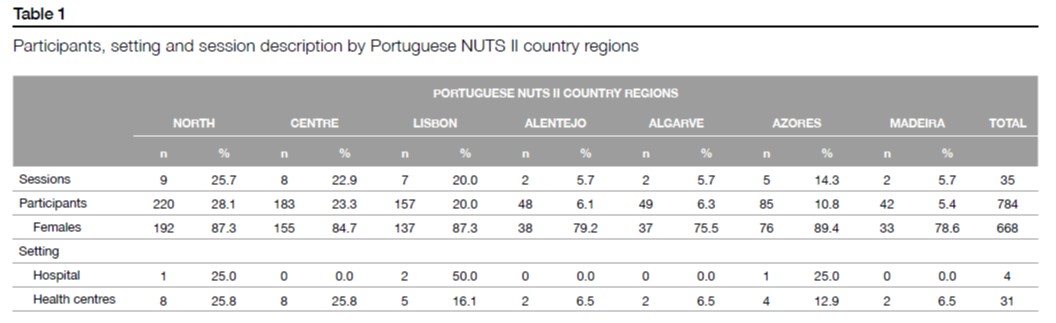
<body><![CDATA[<p>National health units were identified and randomly selected through the website &ldquo;random.org&rdquo; (8). Circa 10% of national health units in each country regional area (NUTS II &ndash; &ldquo;Nomenclatura Comum das Unidades Territoriais para Fins Estat&iacute;sticos&rdquo;) were invited to participate by means of an invitation letter sent by e-mail to health units&rsquo; coordinators. Due to a low response rate, this process was repeated three times.</p>     <p><strong>RESULTS</strong></p>     <p><strong>Sample</strong></p>     <p>A total of 236 invitations were sent and 44 (17%) health units showed interest in receiving this course. The reasons for not accepting were informally pointed out in some answers given by the responsible. The most frequent answer was the lack of human resources to deal with the highly demanding daily service requirements and the consequent impossibility for health professionals to participate in this course.</p>     <p>Sessions were organized in health units strategically chosen by their coordinators. Thirty-five course editions for 784 professionals from 241 different health units attended the sessions that were conducted by twenty-three Porto University accredited instructors. The sessions setting, participants characteristics, and their distribution by country region are displayed in <a href ="/img/revistas/apn/n19/n19a06t1.jpg">Table 1</a>. The mean number of participants per session was 22.4 (standard deviation 11.3).</p>     
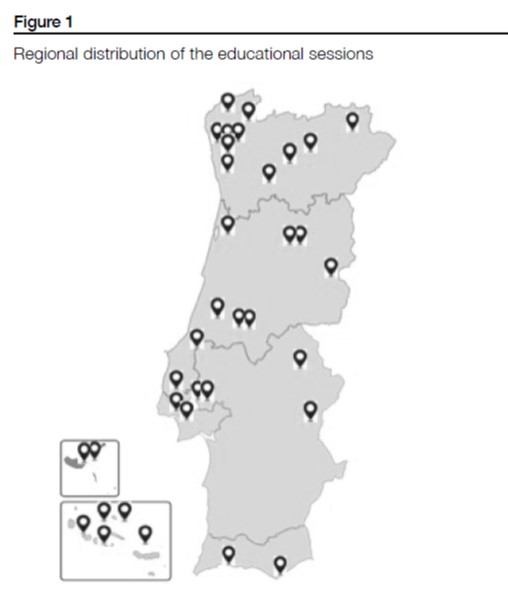
<p>The geographical location of the sessions is represented in <a href ="/img/revistas/apn/n19/n19a06f1.jpg">Figure 1</a>. Nationwide coverage was achieved with seven sessions (20%) taking place in insular regions (Azores and Madeira) and 12 sessions (34%) taking place in rural regions.</p>     
<p><strong>Approval Rate</strong></p>     <p>Concerning the knowledge and skills evaluation test, 546 professionals undertook this assessment but 32 participants did not consent on the analysis of their data. For the remaining 514, a 99% approval rate was achieved and the average mark score was of 16.8 out of 20.0.</p>     <p>The questions with lower score, i.e., with a higher number of participants with a wrong answer were about sarcopenia definition and anthropometric assessment, whereas the questions with a higher score were about nutrition therapy of diabetes and dyslipidemia.</p>     <p><strong>Satisfaction</strong></p>     ]]></body>
<body><![CDATA[<p>Results regarding the course satisfaction survey are only presented for those participants who allowed divulgation of their results (81.8%) (<a href ="/img/revistas/apn/n19/n19a06t2.jpg">Table 2</a>). &gt;From these, 45.7% of the participants classified the course as &ldquo;good&rdquo; and 41.1% as &ldquo;very good&rdquo;. There was an open-ended question for suggestions. The most frequent negative comments were on the disproportion between the length of the sessions and the contents, specifically the extensive syllabus in a short period of time and the need for more practical clinical cases.</p>     
<p>Regarding the evaluation of the instructor (C), the satisfaction survey comprised four items: (8) &ldquo;domain of the subject that was treated&rdquo;; (9) &ldquo;ability for motivation and interest&rdquo;; (10) &ldquo;clarity in the presentation&rdquo;; (11) &ldquo;availability and ease of contact&rdquo;. Results were very good. For item 8, 68.2% of the attendees scored 5 points (&ldquo;very much&rdquo;). Item 9 (ability for motivation and interest) was classified as &ldquo;very much&rdquo; (5 points) by 47.9% of the attendees and only 4 participants (1.0%) scored the item with 1 point (&ldquo;nothing&rdquo;). The item 10, regarding the clarity of the presentation, scored 5 points by 55.0% of the attendees and 1 point by 0.5% participants (n=2). Concerning the instructor availability and ease of contact (item 11), 70.4% attendees scored it with 5 points.</p>     <p><strong>DISCUSSION OF RESULTS</strong></p>     <p>A health professional&rsquo;s nutrition qualification course was created, implemented and assessed in a two years&rsquo; period. Although the participation response by the health units&rsquo; coordinators was lower than initially expected, the overall results were very good. Even though the positive response from the health unit coordinators was low, the adhesion by the health professionals, whenever a session was organized, was very high and a significant number of health professionals attended each session.</p>     <p>The large majority of professionals that were in the sessions undertook the test and the average mark can be considered high, which is an indicator of interest and reflects a good learning outcome. Moreover, a large proportion of health professionals classified the educational course as &ldquo;good&rdquo; or &ldquo;very good&rdquo;. It is also worth noticing that the majority of the sessions occurred in insular and rural areas, which certainly contributed to the Project funders aim of reducing geographical inequalities regarding older adults&rsquo; nutritional assessment and care.</p>     <p>The sessions were designed for health professionals. However, the profession was not recorded on the questionnaires and we are not able to present the results considering the profession of the participants of this course. This can be regarded as a limitation of this study.</p>     <p>Although data analysis from the satisfaction questionnaires reveal a good or very good view on the quality and adequacy of the course, the opinions transmitted by the attendees allowed us to understand that this format may be improved, especially considering the extension of the sessions, as some attendees referred there were too much learning contents to be transmitted in a short period of time, and the importance of including more clinical case studies and practical examples in order to facilitate knowledge acquisition.</p>     <p><strong>CONCLUSIONS</strong></p>     <p>The overall balance of this branch of the Nutrition UP 65 Project is very positive and we consider that, despite the low response rate by health unit coordinators, our aim of reaching a significant number of Portuguese health professionals was fulfilled. Moreover, the results on health professional&rsquo;s adherence demonstrate that the</p>     <p>interest in this area of nutrition care is high, and this type of educational interventions present a host of new opportunities that should be considered to expand the access to specialized education (9). In the future the course could be improved by including educational strategies based on practice and clinical case studies. This highlights the need for further initiatives promoting educational sessions targeting nutrition topics. These course sessions must be viewed as a starting point to a new approach in older adult&rsquo;s nutrition knowledge in Portugal.</p>     ]]></body>
<body><![CDATA[<p><strong>FUNDING</strong></p>     <p>The Nutrition UP 65 project was granted in 85% by the Public Health Initiatives Programme (PT06), financed by EEA Grants Financial Mechanism 2009-2014 and in 15% by Faculdade de Ci&ecirc;ncias da Nutri&ccedil;&atilde;o e Alimenta&ccedil;&atilde;o da Universidade do Porto.</p>     <p>&nbsp;</p>     <p><strong>REFERENCES</strong></p> <ol>     <li>Instituto Nacional de Estat&iacute;stica I.P. Censos 2011 - Resultados Definitivos. Lisboa: Portugal, 2012.</li>     <li>World Health Organization. World report on ageing and health. Geneva, Switzerland: World Health Organization, 2015.</li>     <li>Programa Nacional para a Promo&ccedil;&atilde;o da Alimenta&ccedil;&atilde;o Saud&aacute;vel, Dire&ccedil;&atilde;o de Servi&ccedil;os de Informa&ccedil;&atilde;o e An&aacute;lise. Portugal &ndash; Alimenta&ccedil;&atilde;o Saud&aacute;vel em N&uacute;meros &ndash; 2015. Lisboa: Dire&ccedil;&atilde;o-Geral da Sa&uacute;de, 2016.</li>     <li>Pereira F. Geront&oacute;logo: a constru&ccedil;&atilde;o de uma nova profiss&atilde;o na &aacute;rea da sa&uacute;de. In: Sociedade Portuguesa de Sociologia. Livro de atas do IV Congresso Portugu&ecirc;s de Sociologia. Lisboa, 2008.</li>     <li>Goncalves DC, Guedes J, Fonseca AM, Pinto FC, Martin I, Byrne GJ, et al. Attitudes, knowledge, and interest: preparing university students to work in an aging world. Internacional Psychogeriatrics 2011;23(2):315-21.</li>     <li>Matos L, Teixeira M, Henriques A, Tavares M, &Aacute;lvares L, Antunes A, et al. Men&ccedil;&otilde;es sobre o estado nutricional nos registos cl&iacute;nicos de doentes hospitalizados. Acta M&eacute;dica Portuguesa. 2007;20:7.</li>     ]]></body>
<body><![CDATA[<li>Alvares L, Moreira I, Oliveira A. Relevance of nutrition knowledge on clinical practice: medical opinion survey. Acta Med Port. 2007;20(1):29-35.</li>     <li>Haahr M, Haahr Svend. 1998. Random.Org. Accessed 7 May 2019. [Available from: <a href="https://www.random.org/" target="_blank">https://www.random.org/</a>].</li>     <li>Mundet-Tuduri X , Crespo R, Fernandez-Coll ML et al. Expectations and perceptions of primary healthcare professionals regarding their own continuous education in Catalonia (Spain): a qualitative study. BMC Med Educ. 2017; 17: 212.</li>     </ol>     <p></p>     <p>&nbsp;</p>     <p>  <b><a href="#topc0">Endere&#231;o para correspond&#234;ncia</a><a name="c0"></a></b>     <p>Teresa F Amaral</p>     <p>Faculdade de Ci&ecirc;ncias da Nutri&ccedil;&atilde;o e Alimenta&ccedil;&atilde;o da Universidade do Porto,</p>     <p>Rua Dr. Roberto Frias, 4200-465 Porto, Portugal</p> <a href="mailto:tamaral@fcna.up.pt">tamaral@fcna.up.pt</a></p>     ]]></body>
<body><![CDATA[<p>&nbsp;</p>     <p>Recebido a 7 de maio de 2019</p>     <p>Aceite a 25 de novembro de 2019</p>     <p>&nbsp;</p>      ]]></body><back>
<ref-list>
<ref id="B1">
<label>1</label><nlm-citation citation-type="book">
<collab>Instituto Nacional de Estatística I</collab>
<source><![CDATA[P.Censos 2011 - Resultados Definitivos]]></source>
<year>2012</year>
<publisher-loc><![CDATA[Lisboa ]]></publisher-loc>
<publisher-name><![CDATA[Portugal]]></publisher-name>
</nlm-citation>
</ref>
<ref id="B2">
<label>2</label><nlm-citation citation-type="book">
<collab>World Health Organization</collab>
<source><![CDATA[World report on ageing and health.Geneva,]]></source>
<year>2015</year>
<publisher-loc><![CDATA[Switzerland ]]></publisher-loc>
<publisher-name><![CDATA[World Health Organization]]></publisher-name>
</nlm-citation>
</ref>
<ref id="B3">
<label>3</label><nlm-citation citation-type="book">
<collab>Programa Nacional para a Promoção da Alimentação Saudável.Direção de Serviços de Informação e Análise</collab>
<source><![CDATA[Portugal - Alimentação Saudável em Números - 2015]]></source>
<year>2016</year>
<publisher-loc><![CDATA[Lisboa ]]></publisher-loc>
<publisher-name><![CDATA[Direção-Geral da Saúde]]></publisher-name>
</nlm-citation>
</ref>
<ref id="B4">
<label>4.</label><nlm-citation citation-type="">
<person-group person-group-type="author">
<name>
<surname><![CDATA[Pereira]]></surname>
<given-names><![CDATA[F]]></given-names>
</name>
</person-group>
<article-title xml:lang="pt"><![CDATA[Gerontólogo: a construção de uma nova profissão na área da saúde]]></article-title>
<collab>Sociedade Portuguesa de Sociologia</collab>
<source><![CDATA[Livro de atas do IV Congresso Português de Sociologia]]></source>
<year></year>
</nlm-citation>
</ref>
<ref id="B5">
<label>5</label><nlm-citation citation-type="journal">
<person-group person-group-type="author">
<name>
<surname><![CDATA[Goncalves]]></surname>
<given-names><![CDATA[DC]]></given-names>
</name>
<name>
<surname><![CDATA[Guedes]]></surname>
<given-names><![CDATA[J]]></given-names>
</name>
<name>
<surname><![CDATA[Fonseca]]></surname>
<given-names><![CDATA[AM]]></given-names>
</name>
<name>
<surname><![CDATA[Pinto]]></surname>
<given-names><![CDATA[FC]]></given-names>
</name>
<name>
<surname><![CDATA[Martin]]></surname>
<given-names><![CDATA[I]]></given-names>
</name>
<name>
<surname><![CDATA[Byrne]]></surname>
<given-names><![CDATA[GJ]]></given-names>
</name>
</person-group>
<article-title xml:lang="en"><![CDATA[Attitudes, knowledge, and interest: preparing university students to work in an aging world]]></article-title>
<source><![CDATA[Internacional Psychogeriatrics]]></source>
<year>2011</year>
<volume>23</volume>
<numero>2</numero>
<issue>2</issue>
<page-range>315-21</page-range></nlm-citation>
</ref>
<ref id="B6">
<label>6</label><nlm-citation citation-type="journal">
<person-group person-group-type="author">
<name>
<surname><![CDATA[Matos]]></surname>
<given-names><![CDATA[L]]></given-names>
</name>
<name>
<surname><![CDATA[Teixeira]]></surname>
<given-names><![CDATA[M]]></given-names>
</name>
<name>
<surname><![CDATA[Henriques]]></surname>
<given-names><![CDATA[A]]></given-names>
</name>
<name>
<surname><![CDATA[Tavares]]></surname>
<given-names><![CDATA[M]]></given-names>
</name>
<name>
<surname><![CDATA[Álvares]]></surname>
<given-names><![CDATA[L]]></given-names>
</name>
<name>
<surname><![CDATA[Antunes]]></surname>
<given-names><![CDATA[A]]></given-names>
</name>
</person-group>
<article-title xml:lang="pt"><![CDATA[Menções sobre o estado nutricional nos registos clínicos de doentes hospitalizados]]></article-title>
<source><![CDATA[Acta Médica Portuguesa]]></source>
<year>2007</year>
<volume>20</volume>
<page-range>7</page-range></nlm-citation>
</ref>
<ref id="B7">
<label>7</label><nlm-citation citation-type="journal">
<person-group person-group-type="author">
<name>
<surname><![CDATA[Alvares]]></surname>
<given-names><![CDATA[L]]></given-names>
</name>
<name>
<surname><![CDATA[Moreira]]></surname>
<given-names><![CDATA[I]]></given-names>
</name>
<name>
<surname><![CDATA[Oliveira]]></surname>
<given-names><![CDATA[A]]></given-names>
</name>
</person-group>
<article-title xml:lang="en"><![CDATA[Relevance of nutrition knowledge on clinical practice: medical opinion survey]]></article-title>
<source><![CDATA[Acta Med Port]]></source>
<year>2007</year>
<volume>20</volume>
<numero>1</numero>
<issue>1</issue>
<page-range>29-35</page-range></nlm-citation>
</ref>
<ref id="B8">
<label>8</label><nlm-citation citation-type="">
<person-group person-group-type="author">
<name>
<surname><![CDATA[Haahr]]></surname>
<given-names><![CDATA[M]]></given-names>
</name>
<name>
<surname><![CDATA[Haahr]]></surname>
<given-names><![CDATA[Svend]]></given-names>
</name>
</person-group>
<source><![CDATA[]]></source>
<year>1998</year>
</nlm-citation>
</ref>
<ref id="B9">
<label>9</label><nlm-citation citation-type="journal">
<person-group person-group-type="author">
<name>
<surname><![CDATA[Mundet-Tuduri]]></surname>
<given-names><![CDATA[X]]></given-names>
</name>
<name>
<surname><![CDATA[Crespo]]></surname>
<given-names><![CDATA[R]]></given-names>
</name>
<name>
<surname><![CDATA[Fernandez-Coll]]></surname>
<given-names><![CDATA[ML]]></given-names>
</name>
</person-group>
<article-title xml:lang="en"><![CDATA[Expectations and perceptions of primary healthcare professionals regarding their own continuous education in Catalonia (Spain): a qualitative study]]></article-title>
<source><![CDATA[BMC Med Educ]]></source>
<year>2017</year>
<volume>17</volume>
<page-range>212</page-range></nlm-citation>
</ref>
</ref-list>
</back>
</article>