<?xml version="1.0" encoding="ISO-8859-1"?><article xmlns:mml="http://www.w3.org/1998/Math/MathML" xmlns:xlink="http://www.w3.org/1999/xlink" xmlns:xsi="http://www.w3.org/2001/XMLSchema-instance">
<front>
<journal-meta>
<journal-id>2341-4545</journal-id>
<journal-title><![CDATA[GE-Portuguese Journal of Gastroenterology]]></journal-title>
<abbrev-journal-title><![CDATA[GE Port J Gastroenterol]]></abbrev-journal-title>
<issn>2341-4545</issn>
<publisher>
<publisher-name><![CDATA[Sociedade Portuguesa de Gastrenterologia]]></publisher-name>
</publisher>
</journal-meta>
<article-meta>
<article-id>S2341-45452018000400011</article-id>
<article-id pub-id-type="doi">10.1159/000481288</article-id>
<title-group>
<article-title xml:lang="en"><![CDATA[Colonic Necrosis Induced by Calcium Polystyrene Sulfonate]]></article-title>
<article-title xml:lang="pt"><![CDATA[Necrose do cólon induzida por polistireno sulfonato de cálcio]]></article-title>
</title-group>
<contrib-group>
<contrib contrib-type="author">
<name>
<surname><![CDATA[Ribeiro]]></surname>
<given-names><![CDATA[Helena]]></given-names>
</name>
<xref ref-type="aff" rid="A1"/>
</contrib>
<contrib contrib-type="author">
<name>
<surname><![CDATA[Pereira]]></surname>
<given-names><![CDATA[Eduardo]]></given-names>
</name>
<xref ref-type="aff" rid="A1"/>
</contrib>
<contrib contrib-type="author">
<name>
<surname><![CDATA[Banhudo]]></surname>
<given-names><![CDATA[António]]></given-names>
</name>
<xref ref-type="aff" rid="A1"/>
</contrib>
</contrib-group>
<aff id="AA1">
<institution><![CDATA[,Amato Lusitano Hospital Gastroenterology Department ]]></institution>
<addr-line><![CDATA[Castelo Branco ]]></addr-line>
<country>Portugal</country>
</aff>
<pub-date pub-type="pub">
<day>00</day>
<month>08</month>
<year>2018</year>
</pub-date>
<pub-date pub-type="epub">
<day>00</day>
<month>08</month>
<year>2018</year>
</pub-date>
<volume>25</volume>
<numero>4</numero>
<fpage>205</fpage>
<lpage>207</lpage>
<copyright-statement/>
<copyright-year/>
<self-uri xlink:href="http://scielo.pt/scielo.php?script=sci_arttext&amp;pid=S2341-45452018000400011&amp;lng=en&amp;nrm=iso"></self-uri><self-uri xlink:href="http://scielo.pt/scielo.php?script=sci_abstract&amp;pid=S2341-45452018000400011&amp;lng=en&amp;nrm=iso"></self-uri><self-uri xlink:href="http://scielo.pt/scielo.php?script=sci_pdf&amp;pid=S2341-45452018000400011&amp;lng=en&amp;nrm=iso"></self-uri></article-meta>
</front><body><![CDATA[ <p align=right style='margin-left:35.4pt;text-align:right;text-indent:-35.4pt'><b>IMAGES IN GASTROENTEROLOGY AND HEPATOLOGY</b></p>      <p>&nbsp;</p>      <p><b>Colonic Necrosis Induced by Calcium Polystyrene Sulfonate</b></p>      <p><b>Necrose do cólon induzida por polistireno sulfonato de cálcio</b></p>      <p>&nbsp;</p>      <p><b>Helena Ribeiro, Eduardo Pereira, António Banhudo</b></p>      <p>Gastroenterology Department, Amato Lusitano Hospital, Castelo Branco, Portugal</p>      <p><sup><a href="#0">*</a></sup><a name=top0></a> <b>Corresponding author.</b></p>      <p>&nbsp;</p>      <p><b>Keywords:</b> Calcium polystyrene sulfonate, Colon, Necrosis</p>      ]]></body>
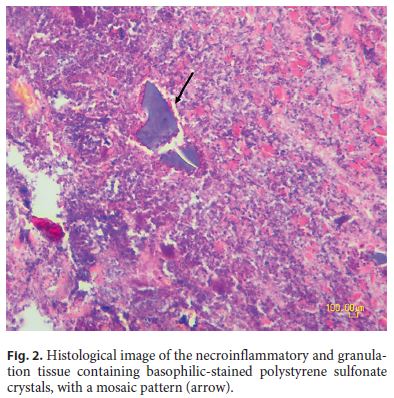
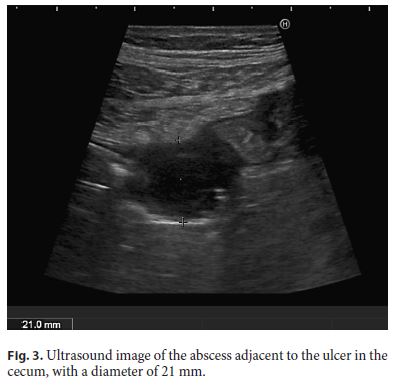
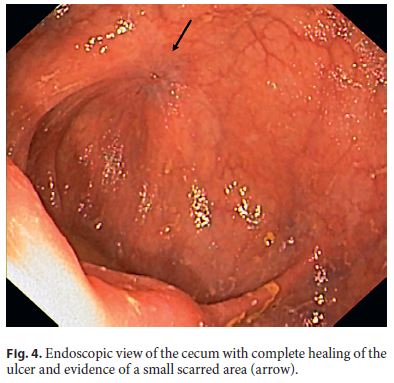
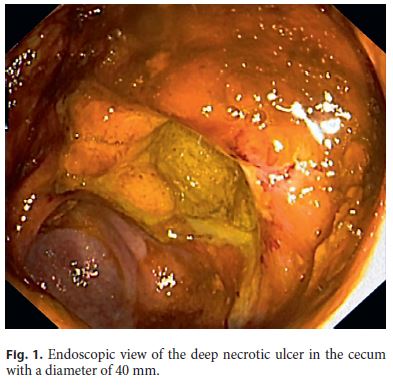
<body><![CDATA[<p><b>Palavras-Chave:</b> Polistireno sulfonato de cálcio, Cólon, Necrose</p>      <p>&nbsp;</p>      <p>A 72-year-old male patient presented to the emergency department with a 4-day history of fever and abdominal pain, without altered bowel habits or hematochezia. He had a past medical history of diabetic end-stage renal disease on hemodialysis, ischemic heart disease, and arterial hypertension. The patient was medicated with oral calcium polystyrene sulfonate (CPS), bisacodyl, carvedilol, acetylsalicylic acid, insulin, amlodipine, and ramipril. He was hemodynamically stable and had a painful abdomen with no signs of peritoneal irritation on examination. Laboratory tests showed an increased C-reactive protein level (183.2 mg/L) with a normal white blood count (9,850 leukocytes/&#956;L), hyponatremia (128 mmol/L), mild decreased serum albumin (3.3 g/dL), and normal serum levels of potassium (4.7 mmol/L) and of lactate dehydrogenase (497 U/L). Abdominal-pelvic computed tomography scan revealed thickening of the right colon wall, no free peritoneal fluid or evidence of pneumoperitoneum. The patient was admitted and 1 day later a colonoscopy was performed, showing a congestive and ulcerated mucosa in the right colon and a deep necrotic ulcer in the cecum, with a diameter of 40 mm (<a href="#f1">Fig. 1</a>). Taking into account these findings, the main differential diagnosis was either ischemic colitis or infectious colitis. The patient started empiric antibiotic therapy and renal function was stabilized. Pathologic and microbiological examinations excluded infectious colitis, namely tuberculosis, cytomegalovirus or <i>Clostridium difficile </i>colitis. Biopsies from the cecal ulcer revealed necroinflammatory and granulation tissue containing basophilic-stained polystyrene sulfonate crystals (<a href="#f2">Fig. 2</a>). Thus, the diagnosis of necrosis of the colon induced by CPS was considered. Six days after the admission, the patient experienced worsening of the abdominal pain. An abdominal ultrasound was performed the following day and revealed an abscess adjacent to the ulcer of the cecum (<a href="#f3">Fig. 3</a>). The abscess may reflect a microperforation of the cecum that could be an iatrogenic event related to the colonoscopy or, less probably, a spontaneous event facilitated by the presence of the large ulcer and transmural necrosis. The microperforation was successfully managed with a single ultrasound-guided needle aspiration of the abscess and with conservative medical treatment. CPS was suspended, the patient started a more restrictive potassium diet, and the hemodialysis was optimized in order to control hyperkalemia. He presented a favorable clinical evolution. Ten weeks later, colonoscopy was normal (<a href="#f4">Fig. 4</a>). </p>      <p>&nbsp;</p> <a name="f1"> <img src="/img/revistas/ges/v25n4/25n4a11f1.jpg">     
<p>&nbsp;</p>  <a name="f2"> <img src="/img/revistas/ges/v25n4/25n4a11f2.jpg">     
<p>&nbsp;</p>  <a name="f3"> <img src="/img/revistas/ges/v25n4/25n4a11f3.jpg">     
<p>&nbsp;</p>  <a name="f4"> <img src="/img/revistas/ges/v25n4/25n4a11f4.jpg">     
<p>&nbsp;</p>      <p>CPS is a cation exchange resin used in hyperkalemia treatment. Colonic lesions have been described as adverse events of CPS; however, they are more often reported following treatments with a similar resin, sodium polystyrene sulfonate, usually mixed with sorbitol [1–3]. Although the mechanism of mucosal injury is unclear, crystal deposit within the intestinal wall may directly damage the mucosa along with vascular risk factors contributing to intestinal ischemia [1, 2]. We report a case of colonic necrosis induced by CPS, complicated by a contained microperfuration of the cecum, a rare but serious adverse event of this drug, with only a few similar cases reported in the literature.</p>      <p>&nbsp;</p>      ]]></body>
<body><![CDATA[<p><b>References</b></p>      <!-- ref --><p>1 Castillo-Cejas MD, de-Torres-Ramírez I, Alonso-Cotoner C: Colonic necrosis due to calcium polystyrene sulfonate (Kalimate) not suspended in sorbitol. Rev Esp Enferm Dig 2013 Apr;105:232–234.    &nbsp;&nbsp;&nbsp;&nbsp;&nbsp;&nbsp;&nbsp;&nbsp;[&#160;<a href="javascript:void(0);" onclick="javascript: window.open('/scielo.php?script=sci_nlinks&ref=1583078&pid=S2341-4545201800040001100001&lng=','','width=640,height=500,resizable=yes,scrollbars=1,menubar=yes,');">Links</a>&#160;]<!-- end-ref --> </p>      <!-- ref --><p>2 Harel Z, Harel S, Shah PS, Wald R, Perl J, Bell CM: Gastrointestinal adverse events with sodium polystyrene sulfonate (Kayexalate) use: a systematic review. Am J Med 2013;126:264.e9–24.    &nbsp;&nbsp;&nbsp;&nbsp;&nbsp;&nbsp;&nbsp;&nbsp;[&#160;<a href="javascript:void(0);" onclick="javascript: window.open('/scielo.php?script=sci_nlinks&ref=1583080&pid=S2341-4545201800040001100002&lng=','','width=640,height=500,resizable=yes,scrollbars=1,menubar=yes,');">Links</a>&#160;]<!-- end-ref --> </p>      <!-- ref --><p>3 Akagun T, Yazici H, Gulluoglu MG, Yegen G, Turkmen A: Colonic necrosis and perforation due to calcium polystyrene sulfonate in a uraemic patient: a case report. NDT Plus 2011;4:402–403.    &nbsp;&nbsp;&nbsp;&nbsp;&nbsp;&nbsp;&nbsp;&nbsp;[&#160;<a href="javascript:void(0);" onclick="javascript: window.open('/scielo.php?script=sci_nlinks&ref=1583082&pid=S2341-4545201800040001100003&lng=','','width=640,height=500,resizable=yes,scrollbars=1,menubar=yes,');">Links</a>&#160;]<!-- end-ref --></p>      <p>&nbsp;</p>      <p><b>Statement of Ethics </b></p>      <p>This study did not require informed consent nor review/approval by the appropriate ethics committee. </p>      ]]></body>
<body><![CDATA[<p><b>Disclosure Statement </b></p>      <p>The authors have no conflicts of interest to declare.</p>      <p>&nbsp;</p>        <p><a name=0></a><sup><a href="#top0">*</a></sup> <b>Corresponding author.</b></p>      <p>Dr. Helena Sofia Brito Ribeiro</p>      <p>Gastroenterology Department, Hospital Amato Lusitano</p>      <p>Avenida Pedro Álvares Cabral</p>      <p>PT–6000-085 Castelo Branco (Portugal)</p>      <p>E-Mail <a href="mailto:helena.britoribeiro@gmail.com">helena.britoribeiro@gmail.com</a></p>      <p>&nbsp;</p>      ]]></body>
<body><![CDATA[<p>Received: May 15, 2017; Accepted after revision: September 6, 2017</p>      <p>&nbsp;</p>      <p><b>Acknowledgements </b></p>      <p>All authors participated in the drafting and critical revision of the article and Dr. António Banhudo was responsible for the final approval of the manuscript.</p>         ]]></body><back>
<ref-list>
<ref id="B1">
<label>1</label><nlm-citation citation-type="journal">
<person-group person-group-type="author">
<name>
<surname><![CDATA[Castillo-Cejas]]></surname>
<given-names><![CDATA[MD]]></given-names>
</name>
<name>
<surname><![CDATA[de-Torres-Ramírez]]></surname>
<given-names><![CDATA[I,]]></given-names>
</name>
<name>
<surname><![CDATA[Alonso-Cotoner]]></surname>
<given-names><![CDATA[C]]></given-names>
</name>
</person-group>
<article-title xml:lang="en"><![CDATA[Colonic necrosis due to calcium polystyrene sulfonate (Kalimate) not suspended in sorbitol]]></article-title>
<source><![CDATA[Rev Esp Enferm Dig]]></source>
<year>2013</year>
<volume>105</volume>
<numero>Apr</numero>
<issue>Apr</issue>
<page-range>232-234</page-range></nlm-citation>
</ref>
<ref id="B2">
<label>2</label><nlm-citation citation-type="journal">
<person-group person-group-type="author">
<name>
<surname><![CDATA[Harel]]></surname>
<given-names><![CDATA[Z]]></given-names>
</name>
<name>
<surname><![CDATA[Harel]]></surname>
<given-names><![CDATA[S]]></given-names>
</name>
<name>
<surname><![CDATA[Shah]]></surname>
<given-names><![CDATA[PS]]></given-names>
</name>
<name>
<surname><![CDATA[Wald]]></surname>
<given-names><![CDATA[R]]></given-names>
</name>
<name>
<surname><![CDATA[Perl]]></surname>
<given-names><![CDATA[J]]></given-names>
</name>
<name>
<surname><![CDATA[Bell]]></surname>
<given-names><![CDATA[CM]]></given-names>
</name>
</person-group>
<article-title xml:lang="en"><![CDATA[Gastrointestinal adverse events with sodium polystyrene sulfonate (Kayexalate) use: a systematic review]]></article-title>
<source><![CDATA[Am J Med]]></source>
<year>2013</year>
<volume>126</volume>
<page-range>264</page-range></nlm-citation>
</ref>
<ref id="B3">
<label>3</label><nlm-citation citation-type="journal">
<person-group person-group-type="author">
<name>
<surname><![CDATA[Akagun]]></surname>
<given-names><![CDATA[T]]></given-names>
</name>
<name>
<surname><![CDATA[Yazici]]></surname>
<given-names><![CDATA[H]]></given-names>
</name>
<name>
<surname><![CDATA[Gulluoglu]]></surname>
<given-names><![CDATA[MG]]></given-names>
</name>
<name>
<surname><![CDATA[Yegen]]></surname>
<given-names><![CDATA[G]]></given-names>
</name>
<name>
<surname><![CDATA[Turkmen]]></surname>
<given-names><![CDATA[A]]></given-names>
</name>
</person-group>
<article-title xml:lang="en"><![CDATA[Colonic necrosis and perforation due to calcium polystyrene sulfonate in a uraemic patient: a case report]]></article-title>
<source><![CDATA[NDT Plus]]></source>
<year>2011</year>
<volume>4</volume>
<page-range>402-403</page-range></nlm-citation>
</ref>
</ref-list>
</back>
</article>