<?xml version="1.0" encoding="ISO-8859-1"?><article xmlns:mml="http://www.w3.org/1998/Math/MathML" xmlns:xlink="http://www.w3.org/1999/xlink" xmlns:xsi="http://www.w3.org/2001/XMLSchema-instance">
<front>
<journal-meta>
<journal-id>2341-4545</journal-id>
<journal-title><![CDATA[GE-Portuguese Journal of Gastroenterology]]></journal-title>
<abbrev-journal-title><![CDATA[GE Port J Gastroenterol]]></abbrev-journal-title>
<issn>2341-4545</issn>
<publisher>
<publisher-name><![CDATA[Sociedade Portuguesa de Gastrenterologia]]></publisher-name>
</publisher>
</journal-meta>
<article-meta>
<article-id>S2341-45452019000200010</article-id>
<article-id pub-id-type="doi">10.1159/000487447</article-id>
<title-group>
<article-title xml:lang="en"><![CDATA[Management of Severe Radiation Proctitis with Radiofrequency Ablation]]></article-title>
<article-title xml:lang="pt"><![CDATA[Abordagem de proctite rádica grave com ablação por radiofrequência]]></article-title>
</title-group>
<contrib-group>
<contrib contrib-type="author">
<name>
<surname><![CDATA[Castela]]></surname>
<given-names><![CDATA[Joana]]></given-names>
</name>
<xref ref-type="aff" rid="A1"/>
</contrib>
<contrib contrib-type="author">
<name>
<surname><![CDATA[Ferro]]></surname>
<given-names><![CDATA[Susana Mão de]]></given-names>
</name>
<xref ref-type="aff" rid="A1"/>
</contrib>
<contrib contrib-type="author">
<name>
<surname><![CDATA[Ferreira]]></surname>
<given-names><![CDATA[Sara]]></given-names>
</name>
<xref ref-type="aff" rid="A1"/>
</contrib>
<contrib contrib-type="author">
<name>
<surname><![CDATA[Pereira]]></surname>
<given-names><![CDATA[António Dias]]></given-names>
</name>
<xref ref-type="aff" rid="A1"/>
</contrib>
</contrib-group>
<aff id="AA1">
<institution><![CDATA[,Instituto Português de Oncologia de Lisboa Francisco Gentil Department of Gastroenterology ]]></institution>
<addr-line><![CDATA[Lisbon ]]></addr-line>
<country>Portugal</country>
</aff>
<pub-date pub-type="pub">
<day>00</day>
<month>04</month>
<year>2019</year>
</pub-date>
<pub-date pub-type="epub">
<day>00</day>
<month>04</month>
<year>2019</year>
</pub-date>
<volume>26</volume>
<numero>2</numero>
<fpage>128</fpage>
<lpage>130</lpage>
<copyright-statement/>
<copyright-year/>
<self-uri xlink:href="http://scielo.pt/scielo.php?script=sci_arttext&amp;pid=S2341-45452019000200010&amp;lng=en&amp;nrm=iso"></self-uri><self-uri xlink:href="http://scielo.pt/scielo.php?script=sci_abstract&amp;pid=S2341-45452019000200010&amp;lng=en&amp;nrm=iso"></self-uri><self-uri xlink:href="http://scielo.pt/scielo.php?script=sci_pdf&amp;pid=S2341-45452019000200010&amp;lng=en&amp;nrm=iso"></self-uri></article-meta>
</front><body><![CDATA[ <p align=right style='margin-left:35.4pt;text-align:right;text-indent:-35.4pt'><b>ENDOSCOPIC SNAPSHOT</b></p>      <p>&nbsp;</p>      <p><b>Management of Severe Radiation Proctitis with Radiofrequency Ablation</b></p>      <p><b>Abordagem de proctite rádica grave com ablação por radiofrequência</b></p>      <p>&nbsp;</p>      <p><b>Joana Castela, Susana Mão de Ferro, Sara Ferreira, António Dias Pereira</b></p>      <p>Department of Gastroenterology, Instituto Português de Oncologia de Lisboa Francisco Gentil, Lisbon, Portugal</p>      <p><sup><a href="#0">*</a></sup><a name=top0></a> <b>Corresponding author.</b></p>      <p>&nbsp;</p>      <p><b>Keywords:</b> Radiation proctitis, Gastrointestinal bleeding, Radiofrequency ablation</p>      ]]></body>
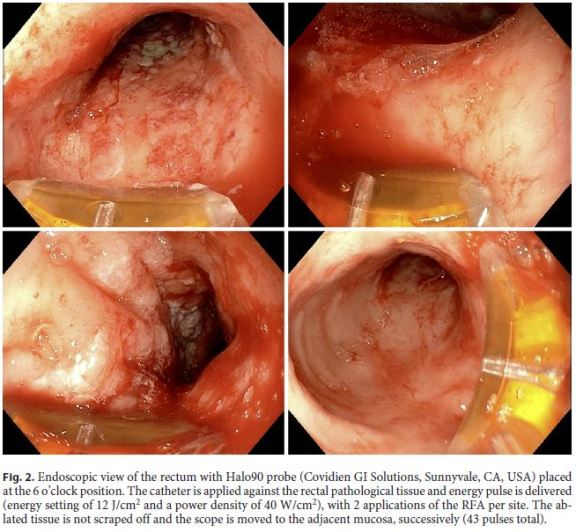
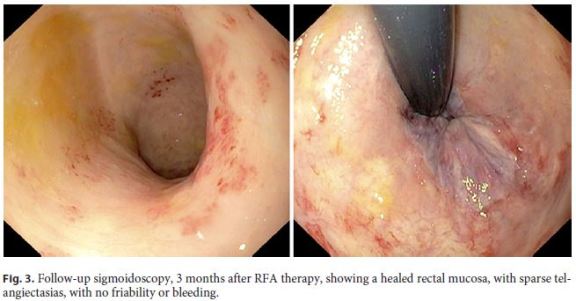
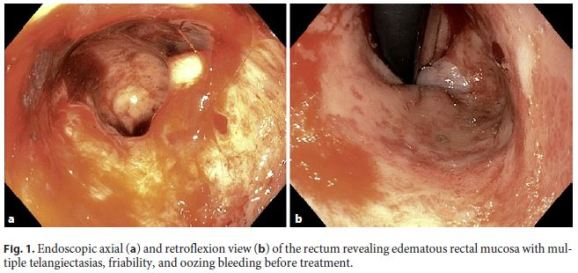
<body><![CDATA[<p><b>Palavras-Chave: </b>Proctite rádica, Hemorragia digestiva, Ablação por radiofrequência</p>      <p>&nbsp;</p>      <p>We report the case of a 74-year-old female with a uterine carcinosarcoma with lung metastasis, who underwent pelvic radiotherapy (RT) followed by chemotherapy. Four months after RT, she presented with multiple episodes of rectal bleeding and anemia, requiring regular transfusions. Upper endoscopy was unremarkable and colonoscopy showed erythema, telangiectasias with coalescing patches, friability, and sparse ulcers, extending from the dentate line to the distal sigmoid colon, consistent with severe radiation proctitis (RP). The patient underwent two sessions of argon plasma coagulation (APC) therapy with clinical inefficacy, and required a total of 27 red blood cell transfusions and intravenous iron.  Chemotherapy was suspended due to clinical deterioration. Six months after RT, she was admitted with profuse rectal bleeding, hypotension, and severe anemia (hemoglobin of 4.2 g/dL), requiring hemodynamic resuscitation. Colonoscopy revealed several telangiectasias, with multiple clots and oozing bleeding (<a href="#f1">Fig. 1</a>). Considering the severity and extension of the disease and the limited efficacy of APC therapy, we performed radiofrequency ablation (RFA). Standard bowel preparation with 4 L of polyethylene glycol was done. After cleaning and aspiration of the blood content, the focal Halo90 catheter (Halo® system, Covidien GI Solutions, Sunnyvale, CA, USA) was placed at the 6 o&rsquo;clock position onto the distal end of the gastroscope (GIF-190, Olympus). The catheter was pressed against the rectal mucosa and 2 energy pulses were applied per site (<a href="#f2">Fig. 2</a>) (energy of 12 J/cm2, power density of 40 W/cm2). The ablated tissue was not removed after the first energy pulse to promote the hemostatic effect. The treatment was repeated from the proximal border of the radiation changes to the lower rectum. The distal rectum was ablated in retroflexion. Full circumference ablation was avoided to minimize the risk of stenosis [1]. Hemostasis was achieved at the end of the procedure and no complications were recorded. Following the procedure, no further rectal bleeding occurred; the patient was discharged and resumed chemotherapy 1 month later. Endoscopic re-evaluation, 3 months after RFA, revealed sparse telangiectasias with no friability or bleeding (<a href="#f3">Fig. 3</a>). At 6 months of follow-up, the patient maintained no rectal bleeding, stable hemoglobin (mean: 10 g/dL) and no further need for blood transfusions.</p>      <p>&nbsp;</p> <a name="f1"> <img src="/img/revistas/ges/v26n2/26n2a10f1.jpg">     
<p>&nbsp;</p>  <a name="f2"> <img src="/img/revistas/ges/v26n2/26n2a10f2.jpg">     
<p>&nbsp;</p>  <a name="f3"> <img src="/img/revistas/ges/v26n2/26n2a10f3.jpg">     
<p>&nbsp;</p>      <p>Chronic RP is a complication of RT for pelvic malignancies, reported in up to 20% of the patients [1, 2]. APC is considered the preferred therapy, with an overall success rate as high as 80% [1, 3]. However, it has been associated with serious complications (e.g., perforation, fistulas, and strictures), and the efficacy is limited in patients with active bleeding, extensive disease and distally located lesions (anorectal junction) [2, 4]. RFA covers a broader area, has a superficial depth of ablation (0.5–1 mm), reducing the potential risk for fibrosis and stricture formation [2, 3], and has emerged as a promising alternative treatment [1]. According to Rustagi et al. [1], who published the largest series of patients managed by RFA (n = 39), this technique showed 96% improvement of the endoscopic severity score, 100% efficacy in stopping bleeding, and 92% of blood transfusion discontinuation, with no major complications [1]. We believe RFA should be contemplated as a treatment option for RP, especially for extensive and severe cases.</p>      <p>&nbsp;</p>      <p><b>References</b></p>      ]]></body>
<body><![CDATA[<!-- ref --><p>1 Rustagi T, Corbett FS, Mashimo H: Treatment of chronic radiation proctopathy with radiofrequency ablation (with video). Gastrointest Endosc 2015;81:428–436.    &nbsp;&nbsp;&nbsp;&nbsp;&nbsp;&nbsp;&nbsp;&nbsp;[&#160;<a href="javascript:void(0);" onclick="javascript: window.open('/scielo.php?script=sci_nlinks&ref=1589042&pid=S2341-4545201900020001000001&lng=','','width=640,height=500,resizable=yes,scrollbars=1,menubar=yes,');">Links</a>&#160;]<!-- end-ref --></p>      <!-- ref --><p>2 Dray X, Battaglia G, Wengrower D, Gonzalez P, Carlino A, Camus M, Adar T, Pérez-Roldán F, Marteau P, Repici A: Radiofrequency ablation for the treatment of radiation proctitis. Endoscopy 2014;46:970–976.    &nbsp;&nbsp;&nbsp;&nbsp;&nbsp;&nbsp;&nbsp;&nbsp;[&#160;<a href="javascript:void(0);" onclick="javascript: window.open('/scielo.php?script=sci_nlinks&ref=1589044&pid=S2341-4545201900020001000002&lng=','','width=640,height=500,resizable=yes,scrollbars=1,menubar=yes,');">Links</a>&#160;]<!-- end-ref --></p>      <!-- ref --><p> 3 Eddi R, Depasquale JR: Radiofrequency ablation for the treatment of radiation proctitis: a case report and review of literature. Therap Adv Gastroenterol 2013;6:69–76.    &nbsp;&nbsp;&nbsp;&nbsp;&nbsp;&nbsp;&nbsp;&nbsp;[&#160;<a href="javascript:void(0);" onclick="javascript: window.open('/scielo.php?script=sci_nlinks&ref=1589046&pid=S2341-4545201900020001000003&lng=','','width=640,height=500,resizable=yes,scrollbars=1,menubar=yes,');">Links</a>&#160;]<!-- end-ref --></p>      <!-- ref --><p>4 Becq A, Camus M, Rahmi G, de Parades V, Marteau P, Dray X: Emerging indications of endoscopic radiofrequency ablation. United European Gastroenterol J 2015;3:313–324.    &nbsp;&nbsp;&nbsp;&nbsp;&nbsp;&nbsp;&nbsp;&nbsp;[&#160;<a href="javascript:void(0);" onclick="javascript: window.open('/scielo.php?script=sci_nlinks&ref=1589048&pid=S2341-4545201900020001000004&lng=','','width=640,height=500,resizable=yes,scrollbars=1,menubar=yes,');">Links</a>&#160;]<!-- end-ref --></p>      <p>&nbsp;</p>      <p><b>Statement of Ethics</b></p>      ]]></body>
<body><![CDATA[<p>This study did not require informed consent nor review/approval by the appropriate ethics committee.</p>      <p><b>Disclosure Statement</b></p>      <p>The authors declare no conflicts of interest.</p>      <p>&nbsp;</p>      <p><a name=0></a><sup><a href="#top0">*</a></sup> <b>Corresponding author.</b></p>      <p>Dr. Joana Raquel Oliveira Castela</p>      <p>Department of Gastroenterology Instituto Português de Oncologia de Lisboa Francisco Gentil</p>      <p>Rua Prof. Lima Basto, PT–1099-023 Lisbon (Portugal)</p>      <p>E-Mail <a href="mailto:joanarocastela@gmail.com">joanarocastela@gmail.com</a></p>      <p>&nbsp;</p>      ]]></body>
<body><![CDATA[<p>Received: January 14, 2018; Accepted after revision: February 1, 2018</p>         ]]></body><back>
<ref-list>
<ref id="B1">
<label>1</label><nlm-citation citation-type="journal">
<person-group person-group-type="author">
<name>
<surname><![CDATA[Rustagi]]></surname>
<given-names><![CDATA[T]]></given-names>
</name>
<name>
<surname><![CDATA[Corbett]]></surname>
<given-names><![CDATA[FS]]></given-names>
</name>
<name>
<surname><![CDATA[Mashimo]]></surname>
<given-names><![CDATA[H]]></given-names>
</name>
</person-group>
<article-title xml:lang="en"><![CDATA[Treatment of chronic radiation proctopathy with radiofrequency ablation (with video)]]></article-title>
<source><![CDATA[Gastrointest Endosc]]></source>
<year>2015</year>
<volume>81</volume>
<page-range>428-436</page-range></nlm-citation>
</ref>
<ref id="B2">
<label>2</label><nlm-citation citation-type="journal">
<person-group person-group-type="author">
<name>
<surname><![CDATA[Dray]]></surname>
<given-names><![CDATA[X]]></given-names>
</name>
<name>
<surname><![CDATA[Battaglia]]></surname>
<given-names><![CDATA[G]]></given-names>
</name>
<name>
<surname><![CDATA[Wengrower]]></surname>
<given-names><![CDATA[D]]></given-names>
</name>
<name>
<surname><![CDATA[Gonzalez]]></surname>
<given-names><![CDATA[P]]></given-names>
</name>
<name>
<surname><![CDATA[Carlino]]></surname>
<given-names><![CDATA[A]]></given-names>
</name>
<name>
<surname><![CDATA[Camus]]></surname>
<given-names><![CDATA[M]]></given-names>
</name>
<name>
<surname><![CDATA[Adar]]></surname>
<given-names><![CDATA[T]]></given-names>
</name>
<name>
<surname><![CDATA[Pérez-Roldán]]></surname>
<given-names><![CDATA[F]]></given-names>
</name>
<name>
<surname><![CDATA[Marteau]]></surname>
<given-names><![CDATA[P]]></given-names>
</name>
<name>
<surname><![CDATA[Repici]]></surname>
<given-names><![CDATA[A]]></given-names>
</name>
</person-group>
<article-title xml:lang="en"><![CDATA[Radiofrequency ablation for the treatment of radiation proctitis]]></article-title>
<source><![CDATA[Endoscopy]]></source>
<year>2014</year>
<volume>46</volume>
<page-range>970-976</page-range></nlm-citation>
</ref>
<ref id="B3">
<label>3</label><nlm-citation citation-type="journal">
<person-group person-group-type="author">
<name>
<surname><![CDATA[Eddi]]></surname>
<given-names><![CDATA[R]]></given-names>
</name>
<name>
<surname><![CDATA[Depasquale]]></surname>
<given-names><![CDATA[JR]]></given-names>
</name>
</person-group>
<article-title xml:lang="en"><![CDATA[Radiofrequency ablation for the treatment of radiation proctitis: a case report and review of literature]]></article-title>
<source><![CDATA[Therap Adv Gastroenterol]]></source>
<year>2013</year>
<volume>6</volume>
<page-range>69-76</page-range></nlm-citation>
</ref>
<ref id="B4">
<label>4</label><nlm-citation citation-type="journal">
<person-group person-group-type="author">
<name>
<surname><![CDATA[Becq]]></surname>
<given-names><![CDATA[A]]></given-names>
</name>
<name>
<surname><![CDATA[Camus]]></surname>
<given-names><![CDATA[M]]></given-names>
</name>
<name>
<surname><![CDATA[Rahmi]]></surname>
<given-names><![CDATA[G]]></given-names>
</name>
<name>
<surname><![CDATA[de Parades]]></surname>
<given-names><![CDATA[V]]></given-names>
</name>
<name>
<surname><![CDATA[Marteau]]></surname>
<given-names><![CDATA[P]]></given-names>
</name>
<name>
<surname><![CDATA[Dray]]></surname>
<given-names><![CDATA[X]]></given-names>
</name>
</person-group>
<article-title xml:lang="en"><![CDATA[Emerging indications of endoscopic radiofrequency ablation]]></article-title>
<source><![CDATA[United European Gastroenterol J]]></source>
<year>2015</year>
<volume>3</volume>
<page-range>313-324</page-range></nlm-citation>
</ref>
</ref-list>
</back>
</article>