<?xml version="1.0" encoding="ISO-8859-1"?><article xmlns:mml="http://www.w3.org/1998/Math/MathML" xmlns:xlink="http://www.w3.org/1999/xlink" xmlns:xsi="http://www.w3.org/2001/XMLSchema-instance">
<front>
<journal-meta>
<journal-id>2341-4545</journal-id>
<journal-title><![CDATA[GE-Portuguese Journal of Gastroenterology]]></journal-title>
<abbrev-journal-title><![CDATA[GE Port J Gastroenterol]]></abbrev-journal-title>
<issn>2341-4545</issn>
<publisher>
<publisher-name><![CDATA[Sociedade Portuguesa de Gastrenterologia]]></publisher-name>
</publisher>
</journal-meta>
<article-meta>
<article-id>S2341-45452019000200011</article-id>
<article-id pub-id-type="doi">10.1159/000487550</article-id>
<title-group>
<article-title xml:lang="en"><![CDATA[Endoscopic Resection of a Rectal Neuroendocrine Tumor: Hybrid Endoscopic Submucosal Dissection]]></article-title>
<article-title xml:lang="pt"><![CDATA[Resseção endoscópica de um tumor neuroendócrino do recto: disseção submucosa endoscópica híbrida]]></article-title>
</title-group>
<contrib-group>
<contrib contrib-type="author">
<name>
<surname><![CDATA[Gravito-Soares]]></surname>
<given-names><![CDATA[Marta]]></given-names>
</name>
<xref ref-type="aff" rid="A1 "/>
</contrib>
<contrib contrib-type="author">
<name>
<surname><![CDATA[Gravito-Soares]]></surname>
<given-names><![CDATA[Elisa]]></given-names>
</name>
<xref ref-type="aff" rid="A1 "/>
</contrib>
<contrib contrib-type="author">
<name>
<surname><![CDATA[Amaro]]></surname>
<given-names><![CDATA[Pedro]]></given-names>
</name>
<xref ref-type="aff" rid="A1"/>
</contrib>
<contrib contrib-type="author">
<name>
<surname><![CDATA[Cunha]]></surname>
<given-names><![CDATA[Inês]]></given-names>
</name>
<xref ref-type="aff" rid="A1"/>
</contrib>
<contrib contrib-type="author">
<name>
<surname><![CDATA[Fraga]]></surname>
<given-names><![CDATA[João]]></given-names>
</name>
<xref ref-type="aff" rid="A2"/>
</contrib>
<contrib contrib-type="author">
<name>
<surname><![CDATA[Tomé]]></surname>
<given-names><![CDATA[Luís]]></given-names>
</name>
<xref ref-type="aff" rid="A1 "/>
</contrib>
</contrib-group>
<aff id="AA1">
<institution><![CDATA[,Centro Hospitalar e Universitário de Coimbra Gastroenterology Department ]]></institution>
<addr-line><![CDATA[Coimbra ]]></addr-line>
<country>Portugal</country>
</aff>
<aff id="AA2">
<institution><![CDATA[,Centro Hospitalar e Universitário de Coimbra Pathology Department ]]></institution>
<addr-line><![CDATA[Coimbra ]]></addr-line>
<country>Portugal</country>
</aff>
<aff id="AA3">
<institution><![CDATA[,University of Coimbra Faculty of Medicine ]]></institution>
<addr-line><![CDATA[Coimbra ]]></addr-line>
<country>Portugal</country>
</aff>
<pub-date pub-type="pub">
<day>00</day>
<month>04</month>
<year>2019</year>
</pub-date>
<pub-date pub-type="epub">
<day>00</day>
<month>04</month>
<year>2019</year>
</pub-date>
<volume>26</volume>
<numero>2</numero>
<fpage>131</fpage>
<lpage>133</lpage>
<copyright-statement/>
<copyright-year/>
<self-uri xlink:href="http://scielo.pt/scielo.php?script=sci_arttext&amp;pid=S2341-45452019000200011&amp;lng=en&amp;nrm=iso"></self-uri><self-uri xlink:href="http://scielo.pt/scielo.php?script=sci_abstract&amp;pid=S2341-45452019000200011&amp;lng=en&amp;nrm=iso"></self-uri><self-uri xlink:href="http://scielo.pt/scielo.php?script=sci_pdf&amp;pid=S2341-45452019000200011&amp;lng=en&amp;nrm=iso"></self-uri></article-meta>
</front><body><![CDATA[ <p align=right style='margin-left:35.4pt;text-align:right;text-indent:-35.4pt'><b>ENDOSCOPIC SNAPSHOT</b></p>      <p>&nbsp;</p>      <p><b>Endoscopic Resection of a Rectal Neuroendocrine Tumor: Hybrid Endoscopic Submucosal Dissection</b></p>      <p><b>Resseção endoscópica de um tumor neuroendócrino do recto: disseção submucosa endoscópica híbrida</b></p>      <p>&nbsp;</p>      <p><b>Marta Gravito-Soares<sup>a,c</sup>, Elisa Gravito-Soares<sup>a,c</sup>, Pedro Amaro<sup>a</sup>, Inês Cunha<sup>a</sup>, João Fraga<sup>b</sup>, Luís Tomé<sup>a,c</sup></b></p>      <p><sup>a</sup>Gastroenterology Department, Centro Hospitalar e Universitário de Coimbra, Coimbra, Portugal; <sup>b</sup>Pathology Department, Centro Hospitalar e Universitário de Coimbra, Coimbra, Portugal; <sup>c</sup>Faculty of Medicine, University of Coimbra, Coimbra, Portugal</p>      <p><sup><a href="#0">*</a></sup><a name=top0></a> <b>Corresponding author.</b></p>      <p>&nbsp;</p>      <p><b>Keywords:</b> Hybrid endoscopic submucosal dissection, Neuroendocrine tumor, Rectum</p>      ]]></body>
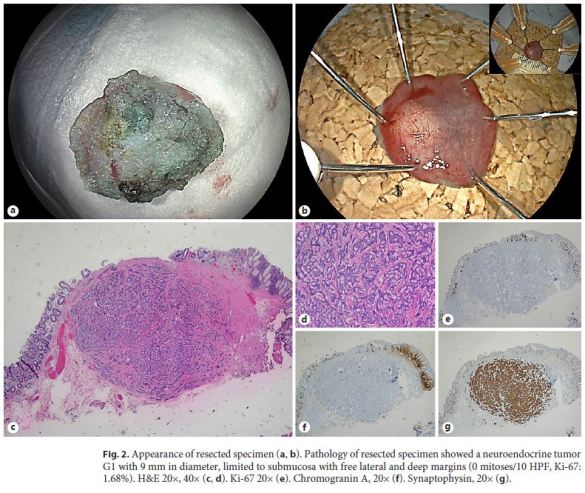
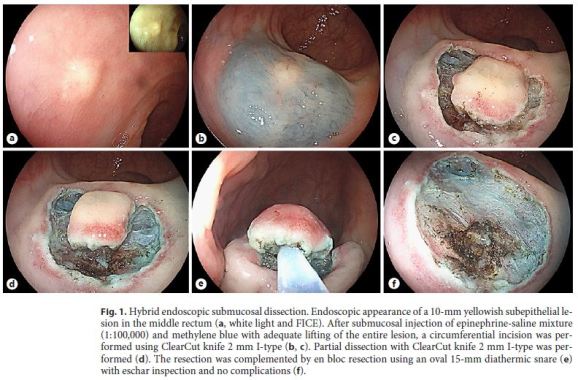
<body><![CDATA[<p><b>Palavras-Chave: </b>Disseção submucosa endoscópica híbrida, Tumor neuroendócrino, Recto</p>      <p>&nbsp;</p>      <p>A 67-year-old man was referred to our institution due to a 10-mm yellowish subepithelial lesion in the middle rectum incidentally diagnosed during screening colonoscopy. Conventional biopsies showed a well-differentiated neuroendocrine tumor (NET). Abdominopelvic computed tomography and endoscopic ultrasound showed limited submucosal invasion and no locoregional/distant metastasis. It was decided to perform a hybrid endoscopic submucosal dissection (ESD) technique. First, submucosal injection was performed using methylene-blue-stained saline containing 1: 100,000 epinephrine with adequate lesion lifting; second, a circumferential incision with a 1–2 mm free margin (ERBE VIO 300D: Endocut I, effect-1) was made using a ClearCut knife 2 mm I-type (Finemedix, South Korea); third, a partial submucosal dissection was done, using the same knife and settings; and fourth, an en bloc resection with an oval 15-mm diathermic snare (Olympus, Spain) was performed (Forced Coag, effect-2 80 W) without complications and resection time of 9 min (<a href="#f1">Fig. 1a–f</a>). Histopathology showed a 9-mm NET G1 (WHO classification, 0 mitoses/10 HPF, Ki-67: 1.8%; pT1a AJCC stage 1), limited to the submucosa with free lateral (1.0 mm) and deep (0.6 mm) resection margins (<a href="#f2">Fig. 2a–g</a>). Considering R0 resection of a &lt; 10-mm rectal NET (R-NET), no followup was scheduled.</p>       <p>&nbsp;</p> <a name="f1"> <img src="/img/revistas/ges/v26n2/26n2a11f1.jpg">     
<p>&nbsp;</p>  <a name="f2"> <img src="/img/revistas/ges/v26n2/26n2a11f2.jpg">     
<p>&nbsp;</p>       <p>Despite the increasing incidence due to the widespread use of screening colonoscopy, R-NET are relatively rare and often well differentiated [1–5]. Endoscopic resection plays a central role in the resection of small well-differentiated R-NET (&lt; 10 mm) and selected cases measuring 10–20 mm, given the low risk of metastasis [2–4]. There is no consensus regarding the best endoscopic resection technique [1, 2, 4, 5], including conventional polypectomy, endoscopic mucosal resection (EMR) or ESD. Conventional polypectomy should be avoided as complete resection is often not achieved [1, 4] and EMR shows a suboptimal complete resection rate (30–70%) due to frequent submucosal involvement affecting mostly the vertical margin [1, 3, 5]. Incomplete resection requires endoscopic retreatment with additional difficulty due to submucosal fibrosis, surgery and/or long-term follow-up. Alternatively, ESD has a higher complete resection rate (80– 100%) with the disadvantage of being a complex and time-consuming procedure and an increased risk of complications [1–4].</p>      <p>Recently, modified EMR (cap- or band ligation-assisted), hybrid EMR/ESD (H-EMR/ESD) techniques, and full-thickness resection [1, 3–5] have been proposed to improve in-depth resection of conventional EMR and decrease ESD drawbacks [3–5]. These techniques have a comparable complete resection rate (70–100%) and similar safety profile as ESD, but with a shorter procedure time [1–4]. H-EMR/ESD has an additional advantage for difficult lesions and tumor size close to 10 mm or larger, reducing recurrence rate related with modified-EMR due to the limited tumor size that can be aspirated [2, 5]. However, there are no randomized trials comparing these different resection techniques.</p>      <p>Although ESD, modified EMR, and H-EMR/ESD could be adequate in this case, considering the pericentimetric endoscopic size of the lesion, the authors opted to perform an H-EMR/ESD in order to secure horizontal free margin. Partial submucosal dissection after complete circumferential incision was additionally performed to provide a deeper submucosal resection and more precise snaring beneath the lesion, theoretically increasing the vertical tumor-free margin without the risk of a full dissection. H-EMR/ESD may be a good treatment choice for small R-NET limited to submucosa, without significantly compromising the completeness, timing, and safety of the procedure.</p>      <p>&nbsp;</p>      ]]></body>
<body><![CDATA[<p><b>References</b></p>      <!-- ref --><p>1 Chablaney S, Zator ZA, Kumta NA: Diagnosis and management of rectal neuroendocrine tumors. Clin Endosc 2017;50:530–536.    &nbsp;&nbsp;&nbsp;&nbsp;&nbsp;&nbsp;&nbsp;&nbsp;[&#160;<a href="javascript:void(0);" onclick="javascript: window.open('/scielo.php?script=sci_nlinks&ref=1589092&pid=S2341-4545201900020001100001&lng=','','width=640,height=500,resizable=yes,scrollbars=1,menubar=yes,');">Links</a>&#160;]<!-- end-ref --></p>      <!-- ref --><p>2 He L, Deng T, Luo H: Efficacy and safety of endoscopic resection therapies for rectal carcinoid tumors: a meta-analysis. Yonsei Med J 2015;56:72–81.    &nbsp;&nbsp;&nbsp;&nbsp;&nbsp;&nbsp;&nbsp;&nbsp;[&#160;<a href="javascript:void(0);" onclick="javascript: window.open('/scielo.php?script=sci_nlinks&ref=1589094&pid=S2341-4545201900020001100002&lng=','','width=640,height=500,resizable=yes,scrollbars=1,menubar=yes,');">Links</a>&#160;]<!-- end-ref --></p>      <!-- ref --><p>3 Park SB, Kim HW, Kang DH, et al: Advantage of endoscopic mucosal resection with a cap for rectal neuroendocrine tumors. World J Gastroenterol 2015;21:9387–9393.    &nbsp;&nbsp;&nbsp;&nbsp;&nbsp;&nbsp;&nbsp;&nbsp;[&#160;<a href="javascript:void(0);" onclick="javascript: window.open('/scielo.php?script=sci_nlinks&ref=1589096&pid=S2341-4545201900020001100003&lng=','','width=640,height=500,resizable=yes,scrollbars=1,menubar=yes,');">Links</a>&#160;]<!-- end-ref --></p>      <!-- ref --><p>4 Bang BW, Park JS, Kim HK, et al: Endoscopic resection for small rectal neuroendocrine tumors: comparison of endoscopic submucosal resection with band ligation and endoscopic submucosal dissection. Gastroenterol Res Pract 2016;2016:6198927.    &nbsp;&nbsp;&nbsp;&nbsp;&nbsp;&nbsp;&nbsp;&nbsp;[&#160;<a href="javascript:void(0);" onclick="javascript: window.open('/scielo.php?script=sci_nlinks&ref=1589098&pid=S2341-4545201900020001100004&lng=','','width=640,height=500,resizable=yes,scrollbars=1,menubar=yes,');">Links</a>&#160;]<!-- end-ref --></p>      <!-- ref --><p>5 Zhang J, Liu M, Li H, et al: Comparison of endoscopic therapies for rectal carcinoid tumors: endoscopic mucosal resection with circumferential incision versus endoscopic submucosal dissection. Clin Res Hepatol Gastroenterol 2018;42:24–30.    &nbsp;&nbsp;&nbsp;&nbsp;&nbsp;&nbsp;&nbsp;&nbsp;[&#160;<a href="javascript:void(0);" onclick="javascript: window.open('/scielo.php?script=sci_nlinks&ref=1589100&pid=S2341-4545201900020001100005&lng=','','width=640,height=500,resizable=yes,scrollbars=1,menubar=yes,');">Links</a>&#160;]<!-- end-ref --></p>      <p>&nbsp;</p>      <p><b>Statement of Ethics</b></p>      <p>Protection of human and animal subjects: The authors declare that no experiments were performed on humans or animals for this study. Confidentiality of data: The authors declare that they have followed the protocols of their work center on the publication of patient data. Right to privacy: The authors declare that no patient data appear in this article. Informed patient consent for publication: Informed consent was obtained for this case report.</p>      <p><b>Disclosure Statement</b></p>      <p>The authors declare no disclosures to report.</p>      <p>&nbsp;</p>      <p><a name=0></a><sup><a href="#top0">*</a></sup> <b>Corresponding author.</b></p>      <p>Dr. Marta Gravito-Soares</p>      <p>Gastroenterology Department, Centro Hospitalar e Universitário de Coimbra</p>      ]]></body>
<body><![CDATA[<p>Praceta Prof. Mota Pinto PT–3000-075 Coimbra (Portugal)</p>      <p>E-Mail <a href="mailto:ms18498@gmail.com">ms18498@gmail.com</a></p>      <p>&nbsp;</p>      <p>Received: December 11, 2017; Accepted after revision: February 7, 2018</p>      <p>&nbsp;</p>      <p><b>Author Contributions</b></p>      <p>Marta Gravito-Soares and Elisa Gravito-Soares contributed equally, writing the manuscript and reviewing the literature. Marta Gravito-Soares is the article guarantor. João Fraga reviewed histologic findings. Pedro Amaro, Inês Cunha, and Luís Tomé contributed to critical revision of the manuscript for important intellectual content.</p>         ]]></body><back>
<ref-list>
<ref id="B1">
<label>1</label><nlm-citation citation-type="journal">
<person-group person-group-type="author">
<name>
<surname><![CDATA[Chablaney]]></surname>
<given-names><![CDATA[S]]></given-names>
</name>
<name>
<surname><![CDATA[Zator]]></surname>
<given-names><![CDATA[ZA]]></given-names>
</name>
<name>
<surname><![CDATA[Kumta]]></surname>
<given-names><![CDATA[NA]]></given-names>
</name>
</person-group>
<article-title xml:lang="en"><![CDATA[Diagnosis and management of rectal neuroendocrine tumors]]></article-title>
<source><![CDATA[Clin Endosc]]></source>
<year>2017</year>
<volume>50</volume>
<page-range>530-536</page-range></nlm-citation>
</ref>
<ref id="B2">
<label>2</label><nlm-citation citation-type="journal">
<person-group person-group-type="author">
<name>
<surname><![CDATA[He]]></surname>
<given-names><![CDATA[L]]></given-names>
</name>
<name>
<surname><![CDATA[Deng]]></surname>
<given-names><![CDATA[T]]></given-names>
</name>
<name>
<surname><![CDATA[Luo]]></surname>
<given-names><![CDATA[H]]></given-names>
</name>
</person-group>
<article-title xml:lang="en"><![CDATA[Efficacy and safety of endoscopic resection therapies for rectal carcinoid tumors: a meta-analysis]]></article-title>
<source><![CDATA[Yonsei Med J]]></source>
<year>2015</year>
<volume>56</volume>
<page-range>72-81</page-range></nlm-citation>
</ref>
<ref id="B3">
<label>3</label><nlm-citation citation-type="journal">
<person-group person-group-type="author">
<name>
<surname><![CDATA[Park]]></surname>
<given-names><![CDATA[SB]]></given-names>
</name>
<name>
<surname><![CDATA[Kim]]></surname>
<given-names><![CDATA[HW]]></given-names>
</name>
<name>
<surname><![CDATA[Kang]]></surname>
<given-names><![CDATA[DH]]></given-names>
</name>
</person-group>
<article-title xml:lang="en"><![CDATA[Advantage of endoscopic mucosal resection with a cap for rectal neuroendocrine tumors]]></article-title>
<source><![CDATA[World J Gastroenterol]]></source>
<year>2015</year>
<volume>21</volume>
<page-range>9387-9393</page-range></nlm-citation>
</ref>
<ref id="B4">
<label>4</label><nlm-citation citation-type="journal">
<person-group person-group-type="author">
<name>
<surname><![CDATA[Bang]]></surname>
<given-names><![CDATA[BW]]></given-names>
</name>
<name>
<surname><![CDATA[Park]]></surname>
<given-names><![CDATA[JS]]></given-names>
</name>
<name>
<surname><![CDATA[Kim]]></surname>
<given-names><![CDATA[HK]]></given-names>
</name>
</person-group>
<article-title xml:lang="en"><![CDATA[Endoscopic resection for small rectal neuroendocrine tumors: comparison of endoscopic submucosal resection with band ligation and endoscopic submucosal dissection]]></article-title>
<source><![CDATA[Gastroenterol Res Pract]]></source>
<year>2016</year>
<volume>2016</volume>
<page-range>6198927</page-range></nlm-citation>
</ref>
<ref id="B5">
<label>5</label><nlm-citation citation-type="journal">
<person-group person-group-type="author">
<name>
<surname><![CDATA[Zhang]]></surname>
<given-names><![CDATA[J]]></given-names>
</name>
<name>
<surname><![CDATA[Liu]]></surname>
<given-names><![CDATA[M]]></given-names>
</name>
<name>
<surname><![CDATA[Li]]></surname>
<given-names><![CDATA[H]]></given-names>
</name>
</person-group>
<article-title xml:lang="en"><![CDATA[Comparison of endoscopic therapies for rectal carcinoid tumors: endoscopic mucosal resection with circumferential incision versus endoscopic submucosal dissection]]></article-title>
<source><![CDATA[Clin Res Hepatol Gastroenterol]]></source>
<year>2018</year>
<volume>42</volume>
<page-range>24-30</page-range></nlm-citation>
</ref>
</ref-list>
</back>
</article>