<?xml version="1.0" encoding="ISO-8859-1"?><article xmlns:mml="http://www.w3.org/1998/Math/MathML" xmlns:xlink="http://www.w3.org/1999/xlink" xmlns:xsi="http://www.w3.org/2001/XMLSchema-instance">
<front>
<journal-meta>
<journal-id>2341-4545</journal-id>
<journal-title><![CDATA[GE-Portuguese Journal of Gastroenterology]]></journal-title>
<abbrev-journal-title><![CDATA[GE Port J Gastroenterol]]></abbrev-journal-title>
<issn>2341-4545</issn>
<publisher>
<publisher-name><![CDATA[Sociedade Portuguesa de Gastrenterologia]]></publisher-name>
</publisher>
</journal-meta>
<article-meta>
<article-id>S2341-45452019000600001</article-id>
<article-id pub-id-type="doi">10.1159/000502984</article-id>
<title-group>
<article-title xml:lang="en"><![CDATA[GE - Portuguese Journal of Gastroenterology in 2020: What’s Next?]]></article-title>
<article-title xml:lang="pt"><![CDATA[GE - Portuguese Journal of Gastroenterology em 2020: O que se segue?]]></article-title>
</title-group>
<contrib-group>
<contrib contrib-type="author">
<name>
<surname><![CDATA[Pimentel-Nunes]]></surname>
<given-names><![CDATA[Pedro]]></given-names>
</name>
<xref ref-type="aff" rid="A1 "/>
<xref ref-type="aff" rid="A A"/>
</contrib>
<contrib contrib-type="author">
<name>
<surname><![CDATA[Marinho]]></surname>
<given-names><![CDATA[Rui Tato]]></given-names>
</name>
<xref ref-type="aff" rid="A4"/>
</contrib>
</contrib-group>
<aff id="AA1">
<institution><![CDATA[,Portuguese Oncology Institute Department of Gastroenterology ]]></institution>
<addr-line><![CDATA[Porto ]]></addr-line>
<country>Portugal</country>
</aff>
<aff id="AA2">
<institution><![CDATA[,Porto Faculty of Medicine Department of Surgery and Physiology ]]></institution>
<addr-line><![CDATA[Porto ]]></addr-line>
<country>Portugal</country>
</aff>
<aff id="AA3">
<institution><![CDATA[,Porto Faculty of Medicine CINTESIS/Biostatistics and Medical Informatics ]]></institution>
<addr-line><![CDATA[Porto ]]></addr-line>
<country>Portugal</country>
</aff>
<aff id="AA4">
<institution><![CDATA[,Centro Hospitalar Lisboa Norte Department of Gastroenterology ]]></institution>
<addr-line><![CDATA[Lisbon ]]></addr-line>
<country>Portugal</country>
</aff>
<pub-date pub-type="pub">
<day>00</day>
<month>12</month>
<year>2019</year>
</pub-date>
<pub-date pub-type="epub">
<day>00</day>
<month>12</month>
<year>2019</year>
</pub-date>
<volume>26</volume>
<numero>6</numero>
<fpage>385</fpage>
<lpage>388</lpage>
<copyright-statement/>
<copyright-year/>
<self-uri xlink:href="http://scielo.pt/scielo.php?script=sci_arttext&amp;pid=S2341-45452019000600001&amp;lng=en&amp;nrm=iso"></self-uri><self-uri xlink:href="http://scielo.pt/scielo.php?script=sci_abstract&amp;pid=S2341-45452019000600001&amp;lng=en&amp;nrm=iso"></self-uri><self-uri xlink:href="http://scielo.pt/scielo.php?script=sci_pdf&amp;pid=S2341-45452019000600001&amp;lng=en&amp;nrm=iso"></self-uri></article-meta>
</front><body><![CDATA[ <p align=right style='margin-left:35.4pt;text-align:right;text-indent:-35.4pt'><b>EDITORIAL</b></p>      <p>&nbsp;</p>      <p><b>GE – Portuguese Journal of Gastroenterology in 2020: What&rsquo;s Next?</b></p>      <p><b>GE – Portuguese Journal of Gastroenterology em 2020: O que se segue?</b></p>      <p>&nbsp;</p>      <p><b>Pedro Pimentel-Nunes<sup>a–c</sup>, Rui Tato Marinho<sup>d</sup></b></p>      <p><sup>a</sup>Department of Gastroenterology, Portuguese Oncology Institute, Porto, Portugal; <sup>b</sup>Department of Surgery  and Physiology, Porto Faculty of Medicine, Porto, Portugal; <sup>c</sup>CINTESIS/Biostatistics and Medical Informatics, Porto Faculty of Medicine, Porto, Portugal; <sup>d</sup>Department of Gastroenterology, Centro Hospitalar Lisboa Norte, Lisbon, Portugal</p>      <p><sup><a href="#0">*</a></sup><a name=top0></a> <b>Corresponding author.</b></p>      <p>&nbsp;</p>      <p><b>Keywords:</b> Editorial, Gastroenterology, Publication</p>      ]]></body>
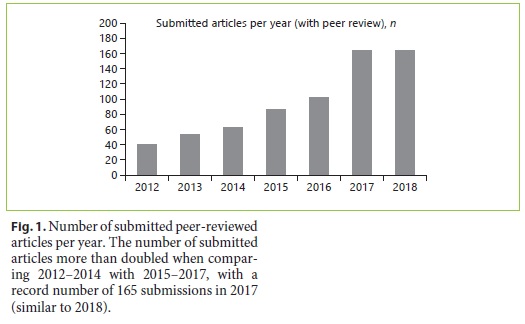
<body><![CDATA[<p><b>Palavras-Chave:</b> Editorial, Gastrenterologia, Publicação</p>      <p>&nbsp;</p>      <p>It has been a long way since this editorial team took over the reins of GE – Portuguese Journal of Gastroenterology [1]. Several goals were accomplished, the most important one to achieve PubMed indexation in 2017 [2, 3]. Of course, with more power come greater responsibilities, and the first year after PubMed indexation was a difficult year. In fact, the number of submissions increased (and so the workload) and the time for publication in PubMed also significantly increased. When the time from article acceptance to PubMed publication almost reached 1 year, we realized that something had to be done in order not to compromise our objectives. It was time to literally grow!</p>      <p>With that in mind, in 2019 we increased the number of pages per issue to 74 pages (444 pages per year), a historical number since the number per issue was never more than 50 pages. This strategy stopped the tendency for delay regarding PubMed publication, which is now 6–9 months.</p>      <p>And what about the other quality indexes? The number of submitted articles per year has never been higher with a 200% increase in submissions when comparing 2017–2019 to 2014–2016 (<a href="#f1">Fig. 1</a>). However, in 2018 the number of submitted articles was not higher than in 2017 (162 and 165 articles submitted, respectively) and, in fact, there is a tendency for a slight decrease in submissions in 2019.</p>      <p>&nbsp;</p> <a name="f1"> <img src="/img/revistas/ges/v26n6/26n6a01f1.jpg">     
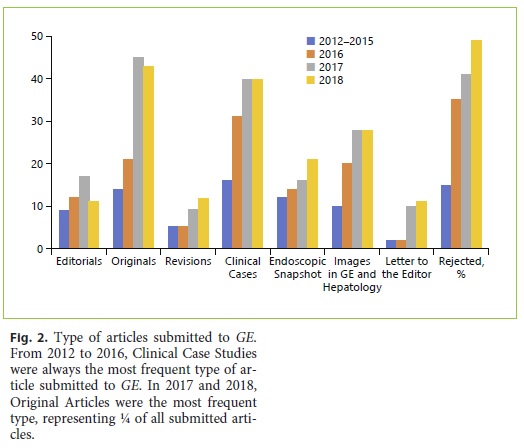
<p>&nbsp;</p>      <p>Regarding the type of submitted articles, all types of articles increased (<a href="#f2">Fig. 2</a>). Furthermore, it was the original articles that increased the most, being the type of article most submitted since 2017 (for the first time in the history of GE overtaking clinical cases) and in 2018 representing one-quarter of all submitted articles. The rejection rate has been progressively increasing and in 2018 it reached 49%.</p>      <p>&nbsp;</p> <a name="f2"> <img src="/img/revistas/ges/v26n6/26n6a01f2.jpg">     
<p>&nbsp;</p>      ]]></body>
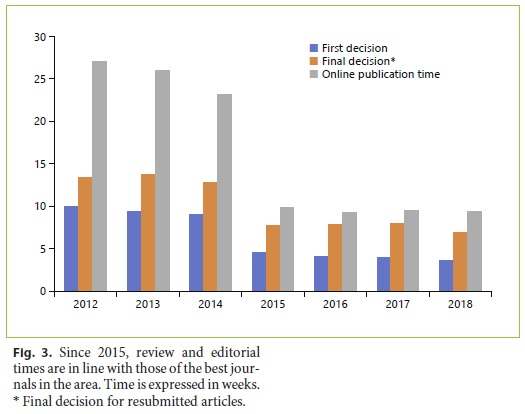
<body><![CDATA[<p>Regarding the review times, even though the workload is more than the double, the amazing work of the editorial team but particularly of the co-editors and of the reviewers allowed us to keep the times in line with those of the most important journals in the area (<a href="#f3">Fig. 3</a>).</p>      <p>&nbsp;</p> <a name="f3"> <img src="/img/revistas/ges/v26n6/26n6a01f3.jpg">     
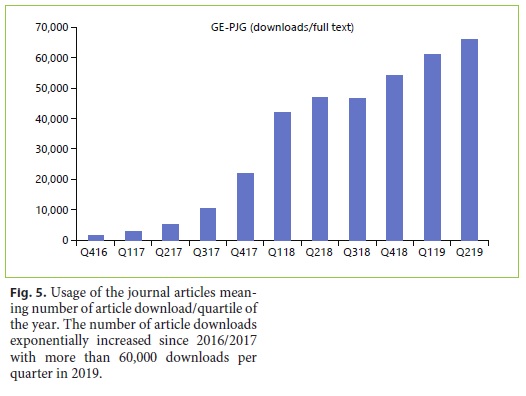
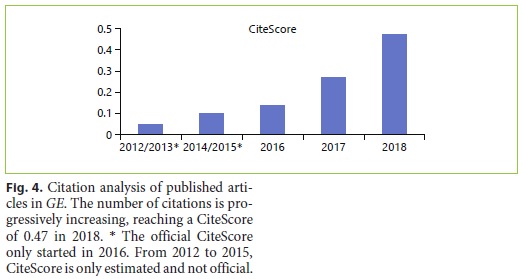
<p>&nbsp;</p>      <p>Since 2016, GE is also indexed in Scopus and citations can be measured using CiteScore (<a href="https://www.scopus.com/sourceid/21100453530" target="_blank">https://www.scopus.com/sourceid/21100453530</a>. As we can see in <a href="#f4">Figure 4</a>, the number of citations has progressively increased and in 2018 it reached 0.47, three times higher than in 2016 and almost double that in 2017. Even though this is not directly comparable to the impact factor (different formula), we estimate that it could correspond to an impact factor between 0.7 and 1. Reflecting the increased interest of the journal for the readers, the &ldquo;usage&rdquo; (number of article downloads/quartile of the year) has significantly increased with a remarkable number of downloads in 2019 (<a href="#f5">Fig. 5</a>). Clearly, the quality of the journal has increased and for the first time in the history of the journal, GE is in the third-quarter of the gastroenterology journals.</p>      <p>&nbsp;</p> <a name="f4"> <img src="/img/revistas/ges/v26n6/26n6a01f4.jpg">     
<p>&nbsp;</p>  <a name="f5"> <img src="/img/revistas/ges/v26n6/26n6a01f5.jpg">     
<p>&nbsp;</p>       <p>But not all is rosy for GE. In fact, since 2017 the number of submitted articles is not significantly increasing, meaning that we are having difficulties reaching different authors (even though the submitted articles from nonPortuguese authors has increased). Moreover, even though submission of original articles has increased, more than 50% of them are rejected (85% rejection rate for non-Portuguese authors). This means that the median quality of the submitted original articles, particularly from non-Portuguese authors, is low (but on the other hand the quality of the accepted and published articles is generally good). And so, if we want to increase our number of citations and obtain an impact factor, then not only the number but the quality of the submitted original articles must increase.</p>      <p>This editorial team has the objective of taking GE further and beyond. We want to achieve Medline and Thomson&rsquo;s and Reuters indexation and to be included in the Web of Science/Journal Citation reports. We want to internationalize our journal. We want to increase the number of our citations. We will continue to bet on GE as our journal, the journal that represents best the Portuguese gastroenterology. However, we realize that, at this stage, these goals do not depend only on the efforts of this editorial team and we will need every one of you if we want to go further. Now is the time to consider publication of our best research in GE. Now is the time to consider GE as our first-priority line for publication of our articles. The Portuguese gastroenterology is, in our opinion, one of the best in the world/Europe: for the last three decades it has been very difficult to be admitted in the official residency of gastroenterology, i.e., only the very best marks (top 5%) can begin the 5 years of residency in gastroenterology. The number of international publications from the Portuguese gastroenterology doctors is more than 1,000 (<a href="https://www.spg.pt/bd-trabalhos/" target="_blank">https://www.spg.pt/bd-trabalhos/</a>. From the year 2002 until 2016, the number of Portuguese publications in international journals has increased from 27 to 185 each year; the number of Portuguese gastroenterologists has increased in international boards, such as UEG (United European Gastroenterology), WGO (World Gastroenterology Organisation), EASL (European Association for the Study of the Liver), ESGE (European Society of Gastrointestinal Endoscopy), and more.</p>      <p>So, we deserve a high-impact journal, it is a win-win process. Publish or Perish in GE – The Portuguese Journal of Gastroenterology.</p>      ]]></body>
<body><![CDATA[<p>So, what can we expect for the future of GE? As Abraham Lincoln once said: &ldquo;The best way to predict the future is to create it&rdquo;. And so, it lies in our hands, in the hands of the Portuguese gastroenterologists, to make GE bigger, bigger than ever before!</p>      <p>&nbsp;</p>      <p><b>References</b></p>      <!-- ref --><p>1 Pimentel Nunes P. GE - A New Path! GE Port J Gastroenterol. 2015 Mar;22(1):1.    &nbsp;&nbsp;&nbsp;&nbsp;&nbsp;&nbsp;&nbsp;&nbsp;[&#160;<a href="javascript:void(0);" onclick="javascript: window.open('/scielo.php?script=sci_nlinks&ref=1594301&pid=S2341-4545201900060000100001&lng=','','width=640,height=500,resizable=yes,scrollbars=1,menubar=yes,');">Links</a>&#160;]<!-- end-ref --></p>      <!-- ref --><p>2 Pimentel-Nunes P. GE - Into the Future. GE Port J Gastroenterol. 2016 May;23(3):123–5.    &nbsp;&nbsp;&nbsp;&nbsp;&nbsp;&nbsp;&nbsp;&nbsp;[&#160;<a href="javascript:void(0);" onclick="javascript: window.open('/scielo.php?script=sci_nlinks&ref=1594303&pid=S2341-4545201900060000100002&lng=','','width=640,height=500,resizable=yes,scrollbars=1,menubar=yes,');">Links</a>&#160;]<!-- end-ref --></p>      <!-- ref --><p>3 Pimentel-Nunes P. The New Road for GE - Portuguese Journal of Gastroenterology: into the Highway! GE Port J Gastroenterol. 2018 Apr;25(3):107–9.    &nbsp;&nbsp;&nbsp;&nbsp;&nbsp;&nbsp;&nbsp;&nbsp;[&#160;<a href="javascript:void(0);" onclick="javascript: window.open('/scielo.php?script=sci_nlinks&ref=1594305&pid=S2341-4545201900060000100003&lng=','','width=640,height=500,resizable=yes,scrollbars=1,menubar=yes,');">Links</a>&#160;]<!-- end-ref --></p>      <p>&nbsp;</p>      ]]></body>
<body><![CDATA[<p><b>Disclosure Statement</b></p>      <p>The authors have no competing interests to declare.</p>      <p>&nbsp;</p>      <p><a name=0></a><sup><a href="#top0">*</a></sup> <b>Corresponding author.</b></p>      <p>Pedro Pimentel-Nunes, MD, PhD</p>      <p>Gastroenterology Department, Instituto Português de Oncologia</p>      <p>Rua Dr. Bernardino de Almeida</p>      <p>PT–4200-072 Porto (Portugal)</p>      <p>E-Mail <a href="mailto:pedronunesml@gmail.com">pedronunesml@gmail.com</a></p>      <p>&nbsp;</p>      ]]></body>
<body><![CDATA[<p>Received: August 21, 2019; Accepted: August 27, 2019</p>         ]]></body><back>
<ref-list>
<ref id="B1">
<label>1</label><nlm-citation citation-type="journal">
<person-group person-group-type="author">
<name>
<surname><![CDATA[Pimentel Nunes]]></surname>
<given-names><![CDATA[P]]></given-names>
</name>
</person-group>
<article-title xml:lang="en"><![CDATA[GE: A New Path]]></article-title>
<source><![CDATA[GE Port J Gastroenterol]]></source>
<year>2015</year>
<month> M</month>
<day>ar</day>
<volume>22</volume>
<numero>1</numero>
<issue>1</issue>
<page-range>1</page-range></nlm-citation>
</ref>
<ref id="B2">
<label>2</label><nlm-citation citation-type="journal">
<person-group person-group-type="author">
<name>
<surname><![CDATA[Pimentel-Nunes]]></surname>
<given-names><![CDATA[P]]></given-names>
</name>
</person-group>
<article-title xml:lang="en"><![CDATA[GE: Into the Future]]></article-title>
<source><![CDATA[GE Port J Gastroenterol]]></source>
<year>2016</year>
<month> M</month>
<day>ay</day>
<volume>23</volume>
<numero>3</numero>
<issue>3</issue>
<page-range>123-5</page-range></nlm-citation>
</ref>
<ref id="B3">
<label>3</label><nlm-citation citation-type="journal">
<person-group person-group-type="author">
<name>
<surname><![CDATA[Pimentel-Nunes]]></surname>
<given-names><![CDATA[P]]></given-names>
</name>
</person-group>
<article-title xml:lang="en"><![CDATA[The New Road for GE: Portuguese Journal of Gastroenterology: into the Highway]]></article-title>
<source><![CDATA[GE Port J Gastroenterol]]></source>
<year>2018</year>
<month> A</month>
<day>pr</day>
<volume>25</volume>
<numero>3</numero>
<issue>3</issue>
<page-range>107-9</page-range></nlm-citation>
</ref>
</ref-list>
</back>
</article>