<?xml version="1.0" encoding="ISO-8859-1"?><article xmlns:mml="http://www.w3.org/1998/Math/MathML" xmlns:xlink="http://www.w3.org/1999/xlink" xmlns:xsi="http://www.w3.org/2001/XMLSchema-instance">
<front>
<journal-meta>
<journal-id>2504-3145</journal-id>
<journal-title><![CDATA[Portuguese Journal of Public Health]]></journal-title>
<abbrev-journal-title><![CDATA[Port J Public Health]]></abbrev-journal-title>
<issn>2504-3145</issn>
<publisher>
<publisher-name><![CDATA[Escola Nacional de Saúde Pública]]></publisher-name>
</publisher>
</journal-meta>
<article-meta>
<article-id>S2504-31452018000100005</article-id>
<article-id pub-id-type="doi">10.1159/000487746</article-id>
<title-group>
<article-title xml:lang="en"><![CDATA[Biological Hazards for Healthcare Workers: Occupational Exposure to Vancomycin-Resistant - Staphylococcus aureus as an Example of a New Challenge]]></article-title>
<article-title xml:lang="pt"><![CDATA[Riscos biológicos emergentes em profissionais de saúde: exposição a Staphylococcus aureus resistente à vancomicina]]></article-title>
</title-group>
<contrib-group>
<contrib contrib-type="author">
<name>
<surname><![CDATA[Sacadura-Leite]]></surname>
<given-names><![CDATA[Ema]]></given-names>
</name>
<xref ref-type="aff" rid="A1 "/>
</contrib>
<contrib contrib-type="author">
<name>
<surname><![CDATA[Mendonça-Galaio]]></surname>
<given-names><![CDATA[Luís]]></given-names>
</name>
<xref ref-type="aff" rid="A1"/>
</contrib>
<contrib contrib-type="author">
<name>
<surname><![CDATA[Shapovalova]]></surname>
<given-names><![CDATA[Olena]]></given-names>
</name>
<xref ref-type="aff" rid="A1"/>
</contrib>
<contrib contrib-type="author">
<name>
<surname><![CDATA[Pereira]]></surname>
<given-names><![CDATA[Isabel]]></given-names>
</name>
<xref ref-type="aff" rid="A1"/>
</contrib>
<contrib contrib-type="author">
<name>
<surname><![CDATA[Rocha]]></surname>
<given-names><![CDATA[Regina]]></given-names>
</name>
<xref ref-type="aff" rid="A1"/>
</contrib>
<contrib contrib-type="author">
<name>
<surname><![CDATA[Sousa-Uva]]></surname>
<given-names><![CDATA[António]]></given-names>
</name>
<xref ref-type="aff" rid="A2"/>
</contrib>
</contrib-group>
<aff id="AA1">
<institution><![CDATA[,Centro Hospitalar Lisboa Norte Department of Occupational Health ]]></institution>
<addr-line><![CDATA[Lisbon ]]></addr-line>
<country>Portugal</country>
</aff>
<aff id="AA2">
<institution><![CDATA[,Universidade NOVA de Lisboa National School of Public Health Department of Occupational and Environmental Health]]></institution>
<addr-line><![CDATA[Lisbon ]]></addr-line>
<country>Portugal</country>
</aff>
<pub-date pub-type="pub">
<day>00</day>
<month>00</month>
<year>2018</year>
</pub-date>
<pub-date pub-type="epub">
<day>00</day>
<month>00</month>
<year>2018</year>
</pub-date>
<volume>36</volume>
<numero>1</numero>
<fpage>1</fpage>
<lpage>6</lpage>
<copyright-statement/>
<copyright-year/>
<self-uri xlink:href="http://scielo.pt/scielo.php?script=sci_arttext&amp;pid=S2504-31452018000100005&amp;lng=en&amp;nrm=iso"></self-uri><self-uri xlink:href="http://scielo.pt/scielo.php?script=sci_abstract&amp;pid=S2504-31452018000100005&amp;lng=en&amp;nrm=iso"></self-uri><self-uri xlink:href="http://scielo.pt/scielo.php?script=sci_pdf&amp;pid=S2504-31452018000100005&amp;lng=en&amp;nrm=iso"></self-uri><abstract abstract-type="short" xml:lang="en"><p><![CDATA[Infections are among the most important occupational risks for healthcare workers. Some infections can be prevented through vaccination but, in other cases, there are no vaccines to prevent them, as happens with infections from antimicrobial-resistant organisms. Precautions related with transmission route and contact isolation or respiratory isolation are very important in order to protect healthcare workers and other patients. In this paper, the authors reviewed biological hazards for healthcare workers and described the procedures undertaken by an occupational health department (OHD) of a Portuguese hospital where vancomycin-resistant Staphylococcus aureus (VRSA) was isolated from a patient, for the first time in Europe. After the VRSA strain isolation, healthcare workers were instructed to adopt contact preventive measures. Nasal swabs were cultured weekly in 33 healthcare workers for several weeks until the patients’ culture changed to negative. In the meantime, OHD prepared actions to adopt in case of VRSA colonization or infection in healthcare workers.]]></p></abstract>
<abstract abstract-type="short" xml:lang="pt"><p><![CDATA[As infeções constituem um importante grupo de riscos de natureza ocupacional para profissionais de saúde. Embora a vacinação seja uma forma eficaz de prevenir muitas infeções, algumas delas não dispõem de vacinas disponíveis. Os autores sintetizam neste artigo as principais vias de transmissão ocupacional de microrganismos a profissionais de saúde, dando enfase à transmissão de microrganismos resistentes a antibióticos que constituem um novo desafio em saúde ocupacional. Neste contexto, descrevem os procedimentos adotados pelo Serviço de Saúde Ocupacional de um hospital universitário português perante uma situação de exposição ocupacional de profissionais de saúde a um doente infetado com Staphylococcus aureus resistente à vancomicina (VRSA), o primeiro caso isolado na Europa. Depois do isolamento do agente, os profissionais foram instruídos para adotar as medidas de prevenção por contacto, efetuou-se a cultura das secreções nasais desses 33 profissionais semanalmente e estabeleceram-se os procedimentos a adotar perante colonização ou infeção dos profissionais de saúde.]]></p></abstract>
<kwd-group>
<kwd lng="en"><![CDATA[Biological hazards]]></kwd>
<kwd lng="en"><![CDATA[Healthcare workers]]></kwd>
<kwd lng="en"><![CDATA[Infections]]></kwd>
<kwd lng="en"><![CDATA[Vancomycin-resistant]]></kwd>
<kwd lng="en"><![CDATA[Staphylococcus aureus]]></kwd>
<kwd lng="en"><![CDATA[Hospitals]]></kwd>
<kwd lng="pt"><![CDATA[Riscos biológicos]]></kwd>
<kwd lng="pt"><![CDATA[Profissionais de saúde]]></kwd>
<kwd lng="pt"><![CDATA[Staphylococcus aureus resistente à vancomicina]]></kwd>
<kwd lng="pt"><![CDATA[Infeções]]></kwd>
<kwd lng="pt"><![CDATA[Hospitais]]></kwd>
</kwd-group>
</article-meta>
</front><body><![CDATA[ <p style="text-align: right;"><b>RESEARCH ARTICLE</b></p>     <p><b>Biological Hazards for Healthcare Workers: Occupational Exposure to Vancomycin-Resistant    - Staphylococcus aureus as an Example of a New Challenge</b></p>     <p><b>Riscos biol&oacute;gicos emergentes em profissionais de sa&uacute;de: exposi&ccedil;&atilde;o    a Staphylococcus aureus resistente &agrave; vancomicina</b></p>     <p>&nbsp;</p>     <p><b>Ema Sacadura-Leite <sup>a<span style="font-size: 14px;">,</span></sup><sup>b</sup>    ,Lu&iacute;s Mendon&ccedil;a-Galaio<sup>a</sup> ,Olena Shapovalova<sup>a</sup>    ,Isabel Pereira<sup>a</sup> , Regina Rocha<sup>a</sup> ,Ant&oacute;nio Sousa-Uva<sup>b</sup>    </b></p>     <p><sup>a</sup> Department of Occupational Health, Centro Hospitalar Lisboa Norte,    Lisbon, Portugal</p>     <p><sup>b</sup> CISP, Public Health Research Center, Department of Occupational    and Environmental Health, National School of Public Health, Universidade NOVA    de Lisboa, Lisbon, Portugal</p>     <p>&nbsp;</p>     <p><b>ABSTRACT</b></p>     <p>Infections are among the most important occupational risks for healthcare workers.    Some infections can be prevented through vaccination but, in other cases, there    are no vaccines to prevent them, as happens with infections from antimicrobial-resistant    organisms. Precautions related with transmission route and contact isolation    or respiratory isolation are very important in order to protect healthcare workers    and other patients. In this paper, the authors reviewed biological hazards for    healthcare workers and described the procedures undertaken by an occupational    health department (OHD) of a Portuguese hospital where vancomycin-resistant    Staphylococcus aureus (VRSA) was isolated from a patient, for the first time    in Europe. After the VRSA strain isolation, healthcare workers were instructed    to adopt contact preventive measures. Nasal swabs were cultured weekly in 33    healthcare workers for several weeks until the patients&rsquo; culture changed    to negative. In the meantime, OHD prepared actions to adopt in case of VRSA    colonization or infection in healthcare workers.</p>     ]]></body>
<body><![CDATA[<p><b>Keywords:</b> Biological hazards Healthcare workers Infections - Vancomycin-resistant    Staphylococcus aureus Hospitals </p>     <p>&nbsp;</p>     <p><b>RESUMO</b></p>     <p>As infe&ccedil;&otilde;es constituem um importante grupo de riscos de natureza    ocupacional para profissionais de sa&uacute;de. Embora a vacina&ccedil;&atilde;o    seja uma forma eficaz de prevenir muitas infe&ccedil;&otilde;es, algumas delas    n&atilde;o disp&otilde;em de vacinas dispon&iacute;veis. Os autores sintetizam    neste artigo as principais vias de transmiss&atilde;o ocupacional de microrganismos    a profissionais de sa&uacute;de, dando enfase &agrave; transmiss&atilde;o de    microrganismos resistentes a antibi&oacute;ticos que constituem um novo desafio    em sa&uacute;de ocupacional. Neste contexto, descrevem os procedimentos adotados    pelo Servi&ccedil;o de Sa&uacute;de Ocupacional de um hospital universit&aacute;rio    portugu&ecirc;s perante uma situa&ccedil;&atilde;o de exposi&ccedil;&atilde;o    ocupacional de profissionais de sa&uacute;de a um doente infetado com <i>Staphylococcus    aureus</i> resistente &agrave; vancomicina (VRSA), o primeiro caso isolado na    Europa. Depois do isolamento do agente, os profissionais foram instru&iacute;dos    para adotar as medidas de preven&ccedil;&atilde;o por contacto, efetuou-se a    cultura das secre&ccedil;&otilde;es nasais desses 33 profissionais semanalmente    e estabeleceram-se os procedimentos a adotar perante coloniza&ccedil;&atilde;o    ou infe&ccedil;&atilde;o dos profissionais de sa&uacute;de.</p>     <p><b>Palavras chave</b>: Riscos biol&oacute;gicos &middot; Profissionais de sa&uacute;de    &middot; Staphylococcus aureus resistente &agrave; vancomicina &middot; Infe&ccedil;&otilde;es    &middot; Hospitais</p>     <p>&nbsp;</p>     <p><b>Introduction</b></p>     <p>In hospitals, healthcare workers do a wide range of tasks, most of them related    with patients&rsquo; care. While performing their work, they are potentially    exposed to many occupational hazards, including physical, chemical, biological,    ergonomic-related, and psychological hazards. They can interact among each other    in a complex way. For example, some health effects caused by biological agents    can be prevented through vaccination, and the immune response can be affected    by chronic stress <sup><a href="#1">1</a></sup><a name="top1"></a>. In some    circumstances, exposures to occupational hazards can be related to occupational    diseases, work-related diseases, or occupational accidents. On the one hand,    it is known that workers in healthcare settings and social workers have the    fourth-highest rate of work-related diseases <sup><a href="#2">2</a></sup><a name="top2"></a>.    On the other hand, exposure to biological occupational hazards seems to be particularly    prevalent in the healthcare sector <sup><a href="#3">3</a></sup><a name="top3"></a>.    In hospitals, infections are among the most important risks for healthcare workers.    Most occupational health departments have well-organized programs, including    vaccination programs, to prevent and to deal with some well-known biological    hazards. Every once in a while, there comes the need to develop an action plan    to deal with a new situation, as happens with infections from antimicrobial-resistant    organisms. In this paper, we synthetize some information related with biological    hazards to healthcare workers and we describe a specific occupational work situation,    with a potential exposure of healthcare workers to vancomycin-resistant Staphylococcus    aureus in a European university hospital.</p>     <p>&nbsp;</p>     <p><b>Biological Hazards in Healthcare Settings</b></p>     ]]></body>
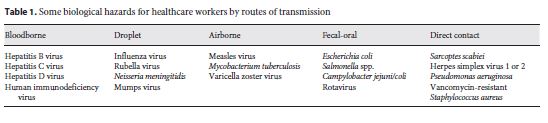
<body><![CDATA[<p>Healthcare workers undertake their jobs in different workplaces in the hospital,    doing a large range of activities. Therefore, they are potentially exposed to    many sources of infection. Laboratory workers are exposed to biological hazards    during collecting or processing biological materials, while physicians and nurses    are especially exposed when they perform surgical or invasive procedures, when    they treat wounds, or when they take body fluid samples. Exposure to biological    hazards is also common when nurses and nurse assistants take care of patients    incapable of looking after themselves or when doctors make clinical examinations.    Doing other activities, such as disinfecting, cleaning, transporting contaminated    equipment, or working in contaminated areas, can also expose nurse assistants    or other hospital workers to biological hazards in healthcare settings ( <sup><a href="#4">4</a></sup><a name="top4"></a>    , <sup><a href="#5">5</a></sup><a name="top5"></a> ).</p>     <p>The essential routes for the transmission of infections in healthcare settings    are bloodborne, droplet, airborne, fecal-oral, and contact routes <sup><a href="#6">6</a></sup><a name="top6"></a>.    The main occupational risk for acquiring a blood pathogen in the healthcare    setting, namely hepatitis B, C, and D viruses or human immunodeficiency virus    (HIV), is a percutaneous sharp injury with a contaminated needle or other sharp    object. Other possible routes of transmission include accidental exposure to    blood or other organic fluids through a worker&rsquo;s broken skin or mucous    membranes. The risk of transmission of bloodborne viruses following a single    percutaneous exposure to blood containing a bloodborne virus depends upon several    factors, but the average risk has been estimated to be the following: hepatitis    B virus 33.3% (1 in 3), hepatitis C virus 3.3% (1 in 30), and HIV 0.31% (1 in    319) <sup><a href="#7">7</a></sup><a name="top7"></a>. A wide range of other    microbiologic agents can be transmitted by percutaneous injury and they have    to be considered if the patient has a known infection. Ebola virus is a very    serious biological hazard transmitted by direct or indirect contact with organic    fluids of infected patients. It is of great concern especially in some densely    populated African regions, where an overlap between human and animal ecosystems    exist, including primates and bats who are Ebola reservoirs. Nevertheless, this    has also been a relevant problem for healthcare workers from Europe or North    America who had worked with patients from countries where the infection is endemic    or during epidemics ( <sup><a href="#4">4</a></sup><a name="top4"></a> , <sup><a href="#5">5</a></sup><a name="top5"></a>    ).</p>     <p>Airborne-transmitted infections include: measles, tuberculosis, chickenpox,    and severe acute respiratory syndrome. Transmission of tuberculosis, caused    by Mycobacterium tuberculosis , is a well-recognized risk to patients and healthcare    workers. Microscopic droplets or droplet nuclei are produced by coughing, sneezing,    and talking from patients with respiratory tuberculosis and they can remain    suspended in the air for long periods and be dragged by air currents. The risk    for healthcare workers is higher when they perform some procedures where there    is an increased exposure to tracheobronchial secretions, such as inducing sputum,    secretion aspiration, bronchoscopies, autopsies, sputum testing, extubating/intubating,    and oral care, among others <sup><a href="#6">6</a></sup><a name="top6"></a>.    Prevention measures and medical monitoring of healthcare workers are useful    to control occupational tuberculosis. The diagnosis of latent tuberculosis,    which can be treated, in this way avoiding its progression to active tuberculosis,    can be made by occupational health departments using tuberculin skin test and,    more recently, interferon gamma release assays <sup><a href="#8">8</a></sup><a name="top8"></a>.    Rubella, measles, mumps, and varicella can be prevented through vaccination    and must be considered an occupational hazard. Workers from pediatric departments    and those working with immunocompromised patients, as in infectious diseases,    hematology, oncology, and posttransplant wards, seem to have a higher risk of    exposure. Meningitis, influenza, and other respiratory infections are spread    through contact of infected respiratory secretions with healthcare workers&rsquo;    mucosae; therefore, the use of a chirurgical mask can significantly reduce the    risk of transmission. Some of those infections, such as flu, can be prevented    through vaccination.</p>     <p>Salmonella spp., Shigella spp., Campylobacter jejuni/coli , Yersinia enterocolitica    , enteropathogenic Escherichia coli , enterohemorrhagic Escherichia coli , rotaviruses,    Clostridium difficile , and Vibrio cholerae are among the most serious agents    that can be transmitted to healthcare workers by the fecal-oral route <sup><a href="#4">4</a></sup><a name="top4"></a>.    Skin infection agents, such as scabies agent or herpes simplex virus 1 or 2,    are transmitted by contact and they often infect healthcare workers. Enterococcus    faecium , Staphylococcus aureus , Klebsiella pneumoniae , Acinetobacter baumannii    , Pseudomonas aeruginosa , and Enterobacter spp. can be transmitted by contact    too, but usually they do not cause infection in healthy people. Nevertheless,    in some circumstances, they can cause serious health problems, namely pneumonia    or infecting wounds. On the other hand, as healthcare workers become colonized    with these agents, they can act as a vehicle for nosocomial dissemination. These    factors are of special concern in healthcare settings, especially if they acquire    resistance to antibiotics (<a href="#t1">Table 1</a> ).</p>     <p>&nbsp;</p> <a name="t1"></a> <img src="/img/revistas/pjph/v36n1/36n1a05t1.jpg">      
<p>&nbsp;</p>     <p><b>Antimicrobial-Resistant Microorganisms as an Example of a New Challenge    for Occupational Health and Safety Departments in Hospitals</b></p>     <p>Bacteria can develop resistance to antimicrobial agents. Antimicrobial-resistant    organisms are one of the most serious health threats in healthcare settings    for patients and for workers <sup><a href="#9">9</a></sup><a name="top9"></a>.    Healthcare workers are more likely exposed to antimicrobial-resistant organisms    when they are taking care of their patients, particularly when patients are    treated with large-spectrum antibiotics for a long period of time and when they    are highly susceptible to infections <sup><a href="#9">9</a></sup><a name="top9"></a>.</p>     <p>As antimicrobial-resistant organisms spread in the same way as antimicrobial-susceptible    ones, some disinfection control practices can prevent cross-contamination between    patients and workers of both types of microorganisms. Those preventive practices    include simple measures, such as washing hands and changing gloves before and    after contact with patients <sup><a href="#9">9</a></sup><a name="top9"></a>,    and other contact preventive measures, such as isolating infected or colonized    patients. The hospital&rsquo;s policy towards a rational use of antibiotics    is also very important.</p>     <p>Most of the time, healthcare workers can be carriers of pathogenic agents,    including antimicrobial-resistant organisms, without developing infections.    Nevertheless, sometimes an active infection may arise, being more susceptible    if they have an existing severe illness, such as chronic renal disease, chronic    respiratory disease among other chronic comorbidities and immunodepressive states.    Other risk factors include recent antibiotherapy agents or healthcare workers    undergoing an invasive procedure <sup><a href="#10">10</a></sup><a name="top10"></a>.    Some examples of antimicrobial-resistant organisms are methicillin/oxacillin-resistant    Staphylococcus aureus (MRSA), vancomycin-resistant Staphylococcus aureus (VRSA),    vancomycin-resistant enterococci (VRE), multi-resistant Escherichia coli and    Salmonella , penicillin-resistant Streptococcus pneumoniae , carbapenem-resistant    Klebsiella pneumoniae , carbapenem-resistant Acinetobacter baumannii, carbapenem-resistant    Pseudomonas aeruginosa , and multidrug-resistant and extensively drug-resistant    tuberculosis <sup><a href="#9">9</a></sup><a name="top9"></a>.</p>     ]]></body>
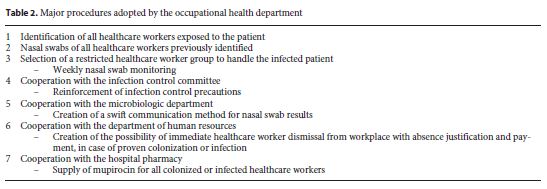
<body><![CDATA[<p>MRSA is a persistent problem in European hospitals, since the bacteria usually    does not respond to the treatment with common antibiotics and it causes a high    incidence of morbidity and mortality. These bacteria are highly resistant to    dry and warm conditions and can survive as biofilms over inorganic environments    (such as surfaces of medical devices) for a long period of time. The route of    their transmission is through direct contact or via droplets. <sup><a href="#6">6</a></sup><a name="top6"></a>.</p>     <p>Vancomycin remains one of the first-line options for the treatment of infections    with MRSA. Therefore, the emergence of vancomycin-resistant Staphylococcus aureus    can create a very serious problem as there is low availability of alternative    treatment and over the last two decades, there has been a significant retraction    of investment towards antimicrobial research and development by the major pharmaceutical    companies. Special concerns about VRSA exist in countries with a high prevalence    of MRSA and VRE, because VRE can act as donors of genetic elements conferring    resistance of MRSA to vancomycin. The first VRSA was identified and isolated    in 2002 in the United States of America <sup><a href="#11">11</a></sup><a name="top11"></a>.    From 2002 to 2006, seven patients with Van-A VRSA were identified, all of them    with a history of enterococcal infection or colonization and MRSA, underlying    conditions, and vancomycin therapy prior to their VRSA infection <sup><a href="#11">11</a></sup><a name="top11"></a>.</p>     <p>&nbsp;</p>     <p><b>Potential Exposure to VRSA of Healthcare Workers in an Occupational Context</b></p>     <p>The first case of VRSA infection identified in Europe was isolated in a central    hospital of Lisbon in May 2013 <sup><a href="#12">12</a></sup><a name="top12"></a>.    A hospitalized 74-year-old female patient with diabetes mellitus type 2, terminal    chronic renal failure requiring hemodialysis, and peripheral vascular disease    underwent amputation of two gangrenous toes. The resistant bacteria were recovered    from pus of the toe amputation wound. At the time, the patient was being treated    with vancomycin and amikacin because Pseudomonas aeruginosa and vancomycin-susceptible    MRSA were previously isolated (March 2013) and she had clear signs of infection    in the wound of the amputation site. Vancomycin-resistant Enterococcus faecalis    and a VRSA strain (vancomycin minimum inhibitory concentration of 1,024 &mu;g/mL,    determined by broth microdilution method according to the Clinical and Laboratory    Standards Institute guidelines) <sup><a href="#13">13</a></sup><a name="top13"></a>    harboring the van A gene were isolated, along with van A-positive vancomycin-resistant    Enterococcus faecalis and Pseudomonas aeruginosa <sup><a href="#14">14</a></sup><a name="top14"></a>.</p>     <p><i>Procedures Adopted in the Hospital</i></p>     <p>After internal report of the situation by the microbiological department of    the hospital, there was the involvement of several departments, including the    occupational health department and the infection control committee. Some of    the procedures immediately adopted included the reinforcement of infection control    precautions and the monitoring of a possible dissemination of the VRSA strain    in the hospital. The patient was initially screened for colonization by culturing    swabs obtained from nares, axillae, perineum, and groin. Subsequently, she was    weekly screened for nasal colonization until discharge from the hospital. Nasal    swabs were also cultured from a total of 53 patients with whom she had close    contact, including household members, 47 healthcare workers, and patients under    hemodialysis in the same room as the index patient <sup><a href="#14">14</a></sup><a name="top14"></a>.</p>     <p><i>Procedures Adopted by the Occupational Health Department</i></p>     <p>The patient was isolated and a restricted number of healthcare workers was    selected and monitored while providing healthcare to the patient with VRSA infection.    It was essential to limit and hold the patient&rsquo;s in-hospital care to the    same healthcare workers throughout her hospital stay. Those healthcare workers    were instructed to follow strict contact preventive measures in this context.</p>     <p>We also produced an internal guideline to help the occupational health department    to manage and to screen healthcare workers exposed to VRSA and having had to    continue treating the patient with VRSA infection. Basically, it included some    actions to be operated in this situation, such as:</p>     ]]></body>
<body><![CDATA[<p>- Collecting weekly nasal swabs until the patient was clinically stable and    cultures from her foot were negative for all the identified pathogens (August    2013);</p>     <p>- Defining the exact procedures to be followed in case of proven colonization:</p>     <p>- Immediate healthcare worker dismissal from workplace with justification of    absences and payment;</p>     <p>- Mupirocin 20 mg/g (nasal ointment), with application t.i.d., for 8 days;</p>     <p>- Search for eventual early signs of infection.</p>     <p>The management of all the procedures in case of colonization included a cooperation    between the occupational health department and other departments, namely the    microbiologic department, the department of human resources, and the hospital    pharmacy (<a href="#t2">Table 2</a> ).</p>     <p>&nbsp;</p> <a name="t2"></a> <img src="/img/revistas/pjph/v36n1/36n1a05t2.jpg">      
<p>&nbsp;</p>     <p><i>Healthcare Workers&rsquo; Nasal Swabs Results</i></p>     <p>From 47 healthcare workers who first had contact with the patient before VRSA    was isolated and who were initially screened from VRSA colonization, we monitored    33 hospital healthcare workers during 3 months (until August). Those monitored    were the healthcare workers who remained providing health care to the patient    until cultures of patient wound showed negative results. VRSA was not isolated    from any of the screened individuals. Nevertheless, we identified 5 healthcare    workers colonized with MRSA and 15 healthcare workers with methicillin-susceptible    Staphylococcus aureus. Despite colonization, none of them showed signs of infection.    We decided not to treat healthcare workers colonized with MRSA, once there was    no evidence of epidemiologic transmission of MRSA.</p>     ]]></body>
<body><![CDATA[<p>&nbsp;</p>     <p><b>Discussion</b></p>     <p>Healthcare workers are potentially exposed to a large number of microorganisms.    Most of those biological hazards are well known and occupational health departments    in hospitals have developed programs to manage the potential occupational risks.    Some examples are the programs to manage accidental exposures to bloodborne    pathogens or to manage Mycobacterium tuberculosis exposure.</p>     <p>Nevertheless, emergent risks have arisen, creating new challenges to occupational    health departments, such as potential exposures to bacteria resistant to antibiotics.</p>     <p>An example of a new challenge presented in this article concerns a situation    of healthcare workers&rsquo; exposure to a patient with VRSA, the first known    case in Europe. Fortunately, and in agreement with the results of the epidemiological    studies conducted following isolation of VRSA strains in the USA ( <sup><a href="#11">11</a></sup><a name="top11"></a>    , <sup><a href="#15">15</a></sup><a name="top15"></a> ), transmission of VRSA    identified in the index patient was not detected in healthcare workers, monitored    during several weeks. The treatment of the patient with amikacin, daptomycin,    and rifampicin during 6 weeks resulted in the nonidentification of the VRSA    strain after 3 weeks. In addition to the positive response to the established    therapy, we believe that the strict compliance with infection control measures    certainly contributed to the nondissemination of the VRSA strain.</p>     <p>&nbsp;</p>     <p><b>REFERENCES</b></p>     <p></p>     <p><Sup><a name="1"></a><a href="#top1">1</a></Sup> Sacadura-Leite E, Sousa-Uva    A: Occupational health departments in hospitals: can they contribute to a positive    occupational psychology? In: Gon&ccedil;alves SP, Neves JG, eds. Occupational    health psychology: from burnout to well-being. Rosemead, CA: Scientific &amp;    Academic Publishing 2011; 1&ndash;16.</p>     <p><Sup><a name="2"></a><a href="#top2">2</a></Sup> Eurostat. Health and safety    at work in Europe (1999&ndash;2007): a statistical portrait. Luxembourg: Publications    Office of the European Union; 2010. Available online: <a href="http://epp.eurostat.ec.europa.eu/cache/ITY_OFFPUB/KS-31-09-290/EN/KS-31-09-290EN.PDF" target="_blank">http://epp.eurostat.ec.europa.eu/cache/ITY_OFFPUB/KS-31-09-290/EN/KS-31-09-290EN.PDF</a>    (accessed on 12.10.2016).</p>     ]]></body>
<body><![CDATA[<!-- ref --><p><Sup><a name="3"></a><a href="#top3">3</a></Sup> Eurofound. Fifth European    Working Conditions Survey. Luxembourg: Publications Office of the European Union,    2012. Available online: <a href="http://www.eurofound.europa.eu/pubdocs/2011/82/en/1/EF1182EN.pdf" target="_blank">http://www.eurofound.europa.eu/pubdocs/2011/82/en/1/EF1182EN.pdf</a>    (accessed on 10.10.2016).    &nbsp;&nbsp;&nbsp;&nbsp;&nbsp;&nbsp;&nbsp;&nbsp;[&#160;<a href="javascript:void(0);" onclick="javascript: window.open('/scielo.php?script=sci_nlinks&ref=2092593&pid=S2504-3145201800010000500003&lng=','','width=640,height=500,resizable=yes,scrollbars=1,menubar=yes,');">Links</a>&#160;]<!-- end-ref --></p>     <p><Sup><a name="4"></a><a href="#top4">4</a></Sup> Sacadura-Leite E, Sousa-Uva    A: Healthcare workers&rsquo; health: old, new and emerging occupational hazards.    In: SHO 2015: Proceedings of the International Symposium on Occupational and    Safety Hygiene, Guimar&atilde;es, Portugal, 12 e 13 de fevereiro de 2015. Guimar&atilde;es:    Sociedade Portuguesa de Seguran&ccedil;a e Higiene Ocupacionais; 2015.</p>     <!-- ref --><p><Sup><a name="5"></a><a href="#top5">5</a></Sup> Cordeiro T, Sousa-Uva A, Sacadura-Leite    E, Pinhal H, Nogueira A: Occupational hazards for healthcare workers in hospitals.    In: Oddone E, ed. Occupational exposure and health risks. New York: Nova Scientce    Publishers 2016, in print.    &nbsp;&nbsp;&nbsp;&nbsp;&nbsp;&nbsp;&nbsp;&nbsp;[&#160;<a href="javascript:void(0);" onclick="javascript: window.open('/scielo.php?script=sci_nlinks&ref=2092596&pid=S2504-3145201800010000500005&lng=','','width=640,height=500,resizable=yes,scrollbars=1,menubar=yes,');">Links</a>&#160;]<!-- end-ref --></p>     <!-- ref --><p><Sup><a name="6"></a><a href="#top6">6</a></Sup> Directorate-General for Employment    Social Affairs and Inclusion: Occupational health and safety risks in the healthcare    sector: guide to prevention and good practice. Luxembourg: Publications Office    of the European Union ; 2011. Available online: <a href="https://osha.europa.eu/en/tools-and-publications/publications/reports/7606488" target="_blank">https://osha.europa.eu/en/tools-and-publications/publications/reports/7606488</a>    (accessed on 10.09.2016).    &nbsp;&nbsp;&nbsp;&nbsp;&nbsp;&nbsp;&nbsp;&nbsp;[&#160;<a href="javascript:void(0);" onclick="javascript: window.open('/scielo.php?script=sci_nlinks&ref=2092598&pid=S2504-3145201800010000500006&lng=','','width=640,height=500,resizable=yes,scrollbars=1,menubar=yes,');">Links</a>&#160;]<!-- end-ref --></p>     <!-- ref --><p><Sup><a name="7"></a><a href="#top7">7</a></Sup> European Agency for Safety    and Health at Work: Current and emerging issues in the healthcare sector, including    home and community care European. Luxembourg: Publications Office of the European    Union; 2014. (Risk Observatory Report).    &nbsp;&nbsp;&nbsp;&nbsp;&nbsp;&nbsp;&nbsp;&nbsp;[&#160;<a href="javascript:void(0);" onclick="javascript: window.open('/scielo.php?script=sci_nlinks&ref=2092600&pid=S2504-3145201800010000500007&lng=','','width=640,height=500,resizable=yes,scrollbars=1,menubar=yes,');">Links</a>&#160;]<!-- end-ref --></p>     <p><Sup><a name="8"></a><a href="#top8">8</a></Sup> Shapovalova O, Sacadura-Leite    E, Galaio LM, Pereira I, Clemente R, Sousa-Uva A: Tuberculose latente em profissionais    de sa&uacute;de: concord&acirc;ncia entre dois testes diagn&oacute;sticos. Rev    Port Sa&uacute;de P&uacute;blica 2016; 34: 3&ndash;10.</p>     ]]></body>
<body><![CDATA[<!-- ref --><p><Sup><a name="9"></a><a href="#top9">9</a></Sup> European Agency for Safety    and Health at Work. Expert forecast on emerging biological risks related to    occupational safety and health. Luxembourg: Publications Office of the European    Union 2007.    &nbsp;&nbsp;&nbsp;&nbsp;&nbsp;&nbsp;&nbsp;&nbsp;[&#160;<a href="javascript:void(0);" onclick="javascript: window.open('/scielo.php?script=sci_nlinks&ref=2092603&pid=S2504-3145201800010000500009&lng=','','width=640,height=500,resizable=yes,scrollbars=1,menubar=yes,');">Links</a>&#160;]<!-- end-ref --></p>     <!-- ref --><p><Sup><a name="10"></a><a href="#top10">10</a></Sup> de Jong T, Bos E, Pawlowska-Cyprysiak    K, Hildt-Ciupinska K, Malinska M, Nicolescu G, et al: Current and emerging issues    in the healthcare sector, including home and community care: European Risk Observatory    report. Luxembourg: Publications Office of the European Union 2014.    &nbsp;&nbsp;&nbsp;&nbsp;&nbsp;&nbsp;&nbsp;&nbsp;[&#160;<a href="javascript:void(0);" onclick="javascript: window.open('/scielo.php?script=sci_nlinks&ref=2092605&pid=S2504-3145201800010000500010&lng=','','width=640,height=500,resizable=yes,scrollbars=1,menubar=yes,');">Links</a>&#160;]<!-- end-ref --></p>     <p><Sup><a name="11"></a><a href="#top11">11</a></Sup> Sievert DM, Rudrik JT,    Patel JB, McDonald LC, Wilkins MJ, Hageman JC: Vancomycin- resistant Staphylococcus    aureus in the United States, 2002&ndash;2006. Clin Infect Diseases 2008; 46:    668&ndash;674.</p>     <!-- ref --><p><Sup><a name="12"></a><a href="#top12">12</a></Sup> Melo-Cristino J.; Resina    C, Manuel V, Lito L, Ramirez M: First case of infection with vancomycin-resistant    Staphylococcus aureus in Europe. Lancet 2013; 382: 205.    &nbsp;&nbsp;&nbsp;&nbsp;&nbsp;&nbsp;&nbsp;&nbsp;[&#160;<a href="javascript:void(0);" onclick="javascript: window.open('/scielo.php?script=sci_nlinks&ref=2092608&pid=S2504-3145201800010000500012&lng=','','width=640,height=500,resizable=yes,scrollbars=1,menubar=yes,');">Links</a>&#160;]<!-- end-ref --></p>     <!-- ref --><p><Sup><a name="13"></a><a href="#top13">13</a></Sup> Clinical and Laboratory    Standards Institute: Performance standards for antimicrobial susceptibility    testing: twenty-third informational supplement. Wayne, PA: Clinical and Laboratory    Standards Institute; 2013. (CLSI Document M100-S23).    &nbsp;&nbsp;&nbsp;&nbsp;&nbsp;&nbsp;&nbsp;&nbsp;[&#160;<a href="javascript:void(0);" onclick="javascript: window.open('/scielo.php?script=sci_nlinks&ref=2092610&pid=S2504-3145201800010000500013&lng=','','width=640,height=500,resizable=yes,scrollbars=1,menubar=yes,');">Links</a>&#160;]<!-- end-ref --></p>     <p><Sup><a name="14"></a><a href="#top14">14</a></Sup> Fri&atilde;es A, Resina    C, Manuel V, Lito L, Ramirez M, Melo-Cristino J: Epidemiological survey of the    first case of vancomycin-resistant Staphylococcus aureus infection in Europe.    Epidemiol Infect 2015; 143: 745&ndash;748.</p>     ]]></body>
<body><![CDATA[<p><Sup><a name="15"></a><a href="#top15">15</a></Sup> Finks J, Wells E, Dyke    TL, Husain N, Plizga L, Heddurshetti R, et al: Vancomycin-resistant Staphylococcus    aureus, Michigan, USA, 2007. Emerg Infect Diseases 2009; 15: 943&ndash;945.</p>     <p>&nbsp;</p>     <p><b>Acknowledgments</b></p>     <p>We thank the Department of Microbiology of the Centro Hospitalar Lisboa Norte,    Lisbon, Portugal. This study did not receive any funding.</p>     <p>&nbsp;</p>     <p><b>Disclosure Statement</b></p>     <p>The authors declare no conflict of interest.</p>     <p>&nbsp;</p>     <p><b>Author Contributions </b></p>     <p>E. Sacadura-Leite wrote the paper, E. Sacadura-Leite, L. Mendon&ccedil;a- Galaio,    O. Shapovalova, R. Rocha, and I. Pereira worked in the procedures implemented    by the occupational health department in the VRSA exposure of healthcare workers.    All authors read and contributed with their knowledge to the writing of the    paper.</p>     ]]></body>
<body><![CDATA[ ]]></body><back>
<ref-list>
<ref id="B1">
<nlm-citation citation-type="book">
<person-group person-group-type="author">
<name>
<surname><![CDATA[Sacadura-Leite]]></surname>
<given-names><![CDATA[E]]></given-names>
</name>
<name>
<surname><![CDATA[Sousa-Uva]]></surname>
<given-names><![CDATA[A]]></given-names>
</name>
</person-group>
<article-title xml:lang="en"><![CDATA[Occupational health departments in hospitals: can they contribute to a positive occupational psychology?]]></article-title>
<person-group person-group-type="editor">
<name>
<surname><![CDATA[Gonçalves]]></surname>
<given-names><![CDATA[SP]]></given-names>
</name>
<name>
<surname><![CDATA[Neves]]></surname>
<given-names><![CDATA[JG]]></given-names>
</name>
</person-group>
<source><![CDATA[Occupational health psychology: from burnout to well-being]]></source>
<year>2011</year>
<page-range>1–16</page-range><publisher-loc><![CDATA[Rosemead^eCA CA]]></publisher-loc>
<publisher-name><![CDATA[Scientific & Academic Publishing]]></publisher-name>
</nlm-citation>
</ref>
<ref id="B2">
<nlm-citation citation-type="book">
<collab>Eurostat</collab>
<source><![CDATA[Health and safety at work in Europe (1999–2007): a statistical portrait]]></source>
<year>2010</year>
<publisher-loc><![CDATA[Luxembourg ]]></publisher-loc>
<publisher-name><![CDATA[Publications Office of the European Union]]></publisher-name>
</nlm-citation>
</ref>
<ref id="B3">
<nlm-citation citation-type="book">
<collab>Eurofound</collab>
<source><![CDATA[Fifth European Working Conditions Survey]]></source>
<year>2012</year>
<publisher-loc><![CDATA[Luxembourg ]]></publisher-loc>
<publisher-name><![CDATA[Publications Office of the European Union]]></publisher-name>
</nlm-citation>
</ref>
<ref id="B4">
<nlm-citation citation-type="book">
<person-group person-group-type="author">
<name>
<surname><![CDATA[Sacadura-Leite]]></surname>
<given-names><![CDATA[E]]></given-names>
</name>
<name>
<surname><![CDATA[Sousa-Uva]]></surname>
<given-names><![CDATA[A]]></given-names>
</name>
</person-group>
<article-title xml:lang="en"><![CDATA[Healthcare workers’ health: old, new and emerging occupational hazards]]></article-title>
<collab>SHO</collab>
<source><![CDATA[2015: Proceedings of the International Symposium on Occupational and Safety Hygiene, Guimarães, Portugal, 12 e 13 de fevereiro de 2015]]></source>
<year>2015</year>
<publisher-loc><![CDATA[Guimarães ]]></publisher-loc>
<publisher-name><![CDATA[Sociedade Portuguesa de Segurança e Higiene Ocupacionais]]></publisher-name>
</nlm-citation>
</ref>
<ref id="B5">
<nlm-citation citation-type="book">
<person-group person-group-type="author">
<name>
<surname><![CDATA[Cordeiro]]></surname>
<given-names><![CDATA[T]]></given-names>
</name>
<name>
<surname><![CDATA[Sousa-Uva]]></surname>
<given-names><![CDATA[A]]></given-names>
</name>
<name>
<surname><![CDATA[Sacadura-Leite]]></surname>
<given-names><![CDATA[E]]></given-names>
</name>
<name>
<surname><![CDATA[Pinhal]]></surname>
<given-names><![CDATA[H]]></given-names>
</name>
<name>
<surname><![CDATA[Nogueira]]></surname>
<given-names><![CDATA[A]]></given-names>
</name>
</person-group>
<article-title xml:lang="en"><![CDATA[Occupational hazards for healthcare workers in hospitals]]></article-title>
<person-group person-group-type="editor">
<name>
<surname><![CDATA[Oddone]]></surname>
<given-names><![CDATA[E]]></given-names>
</name>
</person-group>
<source><![CDATA[Occupational exposure and health risks]]></source>
<year>2016</year>
<publisher-loc><![CDATA[New York ]]></publisher-loc>
<publisher-name><![CDATA[Nova Scientce Publishers]]></publisher-name>
</nlm-citation>
</ref>
<ref id="B6">
<nlm-citation citation-type="book">
<collab>Directorate-General for Employment Social Affairs and Inclusion</collab>
<source><![CDATA[Occupational health and safety risks in the healthcare sector: guide to prevention and good practice]]></source>
<year>2011</year>
<publisher-loc><![CDATA[Luxembourg ]]></publisher-loc>
<publisher-name><![CDATA[Publications Office of the European Union]]></publisher-name>
</nlm-citation>
</ref>
<ref id="B7">
<nlm-citation citation-type="book">
<collab>European Agency for Safety and Health at Work</collab>
<source><![CDATA[Current and emerging issues in the healthcare sector, including home and community care European]]></source>
<year>2014</year>
<publisher-loc><![CDATA[Luxembourg ]]></publisher-loc>
<publisher-name><![CDATA[Publications Office of the European Union]]></publisher-name>
</nlm-citation>
</ref>
<ref id="B8">
<nlm-citation citation-type="journal">
<person-group person-group-type="author">
<name>
<surname><![CDATA[Shapovalova]]></surname>
<given-names><![CDATA[O]]></given-names>
</name>
<name>
<surname><![CDATA[Sacadura-Leite]]></surname>
<given-names><![CDATA[E]]></given-names>
</name>
<name>
<surname><![CDATA[Galaio]]></surname>
<given-names><![CDATA[LM]]></given-names>
</name>
<name>
<surname><![CDATA[Pereira]]></surname>
<given-names><![CDATA[I]]></given-names>
</name>
<name>
<surname><![CDATA[Clemente]]></surname>
<given-names><![CDATA[R]]></given-names>
</name>
<name>
<surname><![CDATA[Sousa-Uva]]></surname>
<given-names><![CDATA[A]]></given-names>
</name>
</person-group>
<article-title xml:lang="pt"><![CDATA[Tuberculose latente em profissionais de saúde: concordância entre dois testes diagnósticos]]></article-title>
<source><![CDATA[Rev Port Saúde Pública]]></source>
<year>2016</year>
<volume>34</volume>
<page-range>3–10</page-range></nlm-citation>
</ref>
<ref id="B9">
<nlm-citation citation-type="book">
<collab>European Agency for Safety and Health at Work</collab>
<source><![CDATA[Expert forecast on emerging biological risks related to occupational safety and health]]></source>
<year>2007</year>
<publisher-loc><![CDATA[Luxembourg ]]></publisher-loc>
<publisher-name><![CDATA[Publications Office of the European Union]]></publisher-name>
</nlm-citation>
</ref>
<ref id="B10">
<nlm-citation citation-type="book">
<person-group person-group-type="author">
<name>
<surname><![CDATA[de Jong]]></surname>
<given-names><![CDATA[T]]></given-names>
</name>
<name>
<surname><![CDATA[Bos]]></surname>
<given-names><![CDATA[E]]></given-names>
</name>
<name>
<surname><![CDATA[Pawlowska-Cyprysiak]]></surname>
<given-names><![CDATA[K]]></given-names>
</name>
<name>
<surname><![CDATA[Hildt-Ciupinska]]></surname>
<given-names><![CDATA[K]]></given-names>
</name>
<name>
<surname><![CDATA[Malinska]]></surname>
<given-names><![CDATA[M]]></given-names>
</name>
<name>
<surname><![CDATA[Nicolescu]]></surname>
<given-names><![CDATA[G]]></given-names>
</name>
</person-group>
<source><![CDATA[Current and emerging issues in the healthcare sector, including home and community care: European Risk Observatory report]]></source>
<year>2014</year>
<publisher-loc><![CDATA[Luxembourg ]]></publisher-loc>
<publisher-name><![CDATA[Publications Office of the European Union]]></publisher-name>
</nlm-citation>
</ref>
<ref id="B11">
<nlm-citation citation-type="journal">
<person-group person-group-type="author">
<name>
<surname><![CDATA[Sievert]]></surname>
<given-names><![CDATA[DM]]></given-names>
</name>
<name>
<surname><![CDATA[Rudrik]]></surname>
<given-names><![CDATA[JT]]></given-names>
</name>
<name>
<surname><![CDATA[Patel]]></surname>
<given-names><![CDATA[JB]]></given-names>
</name>
<name>
<surname><![CDATA[McDonald]]></surname>
<given-names><![CDATA[LC]]></given-names>
</name>
<name>
<surname><![CDATA[Wilkins]]></surname>
<given-names><![CDATA[MJ]]></given-names>
</name>
<name>
<surname><![CDATA[Hageman]]></surname>
<given-names><![CDATA[JC]]></given-names>
</name>
</person-group>
<article-title xml:lang="en"><![CDATA[Vancomycin- resistant Staphylococcus aureus in the United States, 2002–2006]]></article-title>
<source><![CDATA[Clin Infect Diseases]]></source>
<year>2008</year>
<volume>46</volume>
<page-range>668–674</page-range></nlm-citation>
</ref>
<ref id="B12">
<nlm-citation citation-type="journal">
<person-group person-group-type="author">
<name>
<surname><![CDATA[Melo -Cristino]]></surname>
<given-names><![CDATA[J]]></given-names>
</name>
<name>
<surname><![CDATA[Resina]]></surname>
<given-names><![CDATA[C]]></given-names>
</name>
<name>
<surname><![CDATA[Manuel]]></surname>
<given-names><![CDATA[V]]></given-names>
</name>
<name>
<surname><![CDATA[Lito]]></surname>
<given-names><![CDATA[L]]></given-names>
</name>
<name>
<surname><![CDATA[Ramirez]]></surname>
<given-names><![CDATA[M]]></given-names>
</name>
</person-group>
<article-title xml:lang="en"><![CDATA[First case of infection with vancomycin-resistant Staphylococcus aureus in Europe]]></article-title>
<source><![CDATA[Lancet]]></source>
<year>2013</year>
<volume>382</volume>
<numero>205</numero>
<issue>205</issue>
</nlm-citation>
</ref>
<ref id="B13">
<nlm-citation citation-type="book">
<collab>Clinical and Laboratory Standards Institute</collab>
<source><![CDATA[Performance standards for antimicrobial susceptibility testing: twenty-third informational supplement]]></source>
<year>2013</year>
<publisher-loc><![CDATA[Wayne^ePA PA]]></publisher-loc>
<publisher-name><![CDATA[Clinical and Laboratory Standards Institute]]></publisher-name>
</nlm-citation>
</ref>
<ref id="B14">
<nlm-citation citation-type="journal">
<person-group person-group-type="author">
<name>
<surname><![CDATA[Friães]]></surname>
<given-names><![CDATA[A]]></given-names>
</name>
<name>
<surname><![CDATA[Resina]]></surname>
<given-names><![CDATA[C]]></given-names>
</name>
<name>
<surname><![CDATA[Manuel]]></surname>
<given-names><![CDATA[V]]></given-names>
</name>
<name>
<surname><![CDATA[Lito]]></surname>
<given-names><![CDATA[L]]></given-names>
</name>
<name>
<surname><![CDATA[Ramirez]]></surname>
<given-names><![CDATA[M]]></given-names>
</name>
<name>
<surname><![CDATA[Melo-Cristino]]></surname>
<given-names><![CDATA[J]]></given-names>
</name>
</person-group>
<article-title xml:lang="en"><![CDATA[Epidemiological survey of the first case of vancomycin-resistant Staphylococcus aureus infection in Europe]]></article-title>
<source><![CDATA[Epidemiol Infect]]></source>
<year>2015</year>
<volume>143</volume>
<page-range>745–748</page-range></nlm-citation>
</ref>
<ref id="B15">
<nlm-citation citation-type="journal">
<person-group person-group-type="author">
<name>
<surname><![CDATA[Finks]]></surname>
<given-names><![CDATA[J]]></given-names>
</name>
<name>
<surname><![CDATA[Wells]]></surname>
<given-names><![CDATA[E]]></given-names>
</name>
<name>
<surname><![CDATA[Dyke]]></surname>
<given-names><![CDATA[TL]]></given-names>
</name>
<name>
<surname><![CDATA[Husain]]></surname>
<given-names><![CDATA[N]]></given-names>
</name>
<name>
<surname><![CDATA[Plizga]]></surname>
<given-names><![CDATA[L]]></given-names>
</name>
<name>
<surname><![CDATA[Heddurshetti]]></surname>
<given-names><![CDATA[R]]></given-names>
</name>
</person-group>
<article-title xml:lang="en"><![CDATA[Vancomycin-resistant Staphylococcus aureus]]></article-title>
<source><![CDATA[Emerg Infect Diseases]]></source>
<year>2009</year>
<volume>15</volume>
<page-range>943–945</page-range></nlm-citation>
</ref>
</ref-list>
</back>
</article>