<?xml version="1.0" encoding="ISO-8859-1"?><article xmlns:mml="http://www.w3.org/1998/Math/MathML" xmlns:xlink="http://www.w3.org/1999/xlink" xmlns:xsi="http://www.w3.org/2001/XMLSchema-instance">
<front>
<journal-meta>
<journal-id>2504-3145</journal-id>
<journal-title><![CDATA[Portuguese Journal of Public Health]]></journal-title>
<abbrev-journal-title><![CDATA[Port J Public Health]]></abbrev-journal-title>
<issn>2504-3145</issn>
<publisher>
<publisher-name><![CDATA[Escola Nacional de Saúde Pública]]></publisher-name>
</publisher>
</journal-meta>
<article-meta>
<article-id>S2504-31452018000100006</article-id>
<article-id pub-id-type="doi">10.1159/000486014</article-id>
<title-group>
<article-title xml:lang="en"><![CDATA[Trends in Portuguese Adolescents’ Sexual Behavior from 2002 to 2014: HBSC Portuguese Study]]></article-title>
<article-title xml:lang="pt"><![CDATA[Comportamento sexual dos adolescentes portugueses entre 2002 e 2014: estudo de HBSC em português]]></article-title>
</title-group>
<contrib-group>
<contrib contrib-type="author">
<name>
<surname><![CDATA[Reis]]></surname>
<given-names><![CDATA[Marta]]></given-names>
</name>
<xref ref-type="aff" rid="A1 "/>
</contrib>
<contrib contrib-type="author">
<name>
<surname><![CDATA[Ramiro]]></surname>
<given-names><![CDATA[Lúcia]]></given-names>
</name>
<xref ref-type="aff" rid="A1 "/>
</contrib>
<contrib contrib-type="author">
<name>
<surname><![CDATA[Camacho]]></surname>
<given-names><![CDATA[Inês]]></given-names>
</name>
<xref ref-type="aff" rid="A1 "/>
</contrib>
<contrib contrib-type="author">
<name>
<surname><![CDATA[Tomé]]></surname>
<given-names><![CDATA[Gina]]></given-names>
</name>
<xref ref-type="aff" rid="A1 "/>
</contrib>
<contrib contrib-type="author">
<name>
<surname><![CDATA[Matos]]></surname>
<given-names><![CDATA[Margarida Gaspar de]]></given-names>
</name>
<xref ref-type="aff" rid="A1 "/>
<xref ref-type="aff" rid="A A"/>
</contrib>
</contrib-group>
<aff id="AA1">
<institution><![CDATA[,Universidade de Lisboa Faculdade de Motricidade Humana Projeto Aventura Social & Saúde]]></institution>
<addr-line><![CDATA[Lisbon ]]></addr-line>
<country>Portugal</country>
</aff>
<aff id="AA2">
<institution><![CDATA[,Universidade de Lisboa Faculdade de Medicina Instituto de Saúde Ambiental]]></institution>
<addr-line><![CDATA[Lisbon ]]></addr-line>
<country>Portugal</country>
</aff>
<aff id="AA3">
<institution><![CDATA[,Instituto Superior de Psicologia Aplicada William James Research Center ]]></institution>
<addr-line><![CDATA[Lisbon ]]></addr-line>
<country>Portugal</country>
</aff>
<pub-date pub-type="pub">
<day>00</day>
<month>00</month>
<year>2018</year>
</pub-date>
<pub-date pub-type="epub">
<day>00</day>
<month>00</month>
<year>2018</year>
</pub-date>
<volume>36</volume>
<numero>1</numero>
<fpage>1</fpage>
<lpage>7</lpage>
<copyright-statement/>
<copyright-year/>
<self-uri xlink:href="http://scielo.pt/scielo.php?script=sci_arttext&amp;pid=S2504-31452018000100006&amp;lng=en&amp;nrm=iso"></self-uri><self-uri xlink:href="http://scielo.pt/scielo.php?script=sci_abstract&amp;pid=S2504-31452018000100006&amp;lng=en&amp;nrm=iso"></self-uri><self-uri xlink:href="http://scielo.pt/scielo.php?script=sci_pdf&amp;pid=S2504-31452018000100006&amp;lng=en&amp;nrm=iso"></self-uri><abstract abstract-type="short" xml:lang="en"><p><![CDATA[This study examined trends in adolescent sexual behaviors from 2002 to 2014 in Portugal. Data were collected using self-reported questionnaires from 8th and 10th graders in classrooms during 2002, 2006, 2010, and 2014. Overall, the prevalence of sexual intercourse, age of sexual initiation, pill use, and sexual intercourse under the influence of alcohol or drugs decreased in Portugal between 2002 and 2014, while condom use increased. Boys and 10th graders more frequently reported having ever had sexual intercourse, boys and 8th graders more frequently reported having had sexual intercourse under the influence of alcohol or drugs, girls and 10th graders more frequently reported having had their first sexual intercourse at 14 years or older (except in 2014, where boys and girls reported more frequently having initiated at 12–13 years), and girls and 10th graders reported more frequently having used condoms and the pill (except in 2014) at the last sexual intercourse. Eighth graders more frequently reported having had their first sexual experience at 12–13 years (except in 2006).]]></p></abstract>
<abstract abstract-type="short" xml:lang="pt"><p><![CDATA[Este estudo examinou as tendências dos comportamentos sexuais de adolescentes de 2002 a 2014 em Portugal. Os dados foram recolhidos usando questionários de autorrelato nos alunos de 8° e 10° anos de escolaridade, nas salas de aula durante 2002, 2006, 2010 e 2014. Em geral, a prevalência de relações sexuais, a idade de iniciação sexual, o uso da pílula e as relações sexuais sob a influência de álcool ou drogas diminuiu em Portugal entre 2002 e 2014, enquanto o uso de preservativos aumentou. Os rapazes e os alunos do 10° ano referiram mais frequentemente terem tido relações sexuais, os rapazes e os alunos do 8° ano mencionara ter tido, mais frequentemente relações sexuais sob a influência de álcool ou drogas, as raparigas e os alunos do 10° ano relataram mais frequentemente terem tido sua primeira relação sexual aos 14 ou mais (exceto em 2014, onde rapazes e raparigas referiram mais frequentemente ter iniciado às 12–13), e as raparigas e os alunos do 10° ano relataram mais frequentemente ter usado preservativo e pílula (exceto em 2014) na última relação sexual. Os alunos do 8° ano referiram mais frequentemente terem tido sua primeira experiência sexual aos 12–13 (exceto em 2006).]]></p></abstract>
<kwd-group>
<kwd lng="en"><![CDATA[Adolescents]]></kwd>
<kwd lng="en"><![CDATA[Sexual experience]]></kwd>
<kwd lng="en"><![CDATA[Age of sexual initiation]]></kwd>
<kwd lng="en"><![CDATA[Condom use]]></kwd>
<kwd lng="en"><![CDATA[Pill use]]></kwd>
<kwd lng="en"><![CDATA[Sexual intercourse under the influence of alcohol or drugs]]></kwd>
<kwd lng="pt"><![CDATA[Adolescentes]]></kwd>
<kwd lng="pt"><![CDATA[Experiência sexual]]></kwd>
<kwd lng="pt"><![CDATA[Idade de iniciação sexual]]></kwd>
<kwd lng="pt"><![CDATA[Uso de preservativo]]></kwd>
<kwd lng="pt"><![CDATA[Uso da pílula]]></kwd>
<kwd lng="pt"><![CDATA[Relações sexuais sob a influência de álcool ou drogas]]></kwd>
</kwd-group>
</article-meta>
</front><body><![CDATA[ <p style="text-align: right;"><b>RESEARCH ARTICLE</b></p>     <p><b>Trends in Portuguese Adolescents&rsquo; Sexual Behavior from 2002 to 2014:    HBSC Portuguese Study</b></p>     <p><b>Comportamento sexual dos adolescentes portugueses entre 2002 e 2014: estudo    de HBSC em portugu&ecirc;s</b></p>     <p>&nbsp;</p>     <p><b>Marta Reis <sup>a,&nbsp;</sup><sup>b</sup> , L&uacute;cia&nbsp;Ramiro&nbsp;<sup>a</sup>,<sup>b</sup>    , In&ecirc;s Camacho <sup>a,&nbsp;</sup><sup>b&nbsp;</sup>Gina&nbsp;Tom&eacute;    <sup>a,&nbsp;</sup><sup>b</sup> Margarida Gaspar de Matos&nbsp;<sup>a,</sup><sup>b</sup>,<sup>c</sup></b></p>     <p><sup>a</sup> Projeto Aventura Social &amp; Sa&uacute;de, Faculdade de Motricidade    Humana, Universidade de Lisboa, Lisbon, Portugal</p>     <p><sup>b</sup> Instituto de Sa&uacute;de Ambiental (ISAMB), Faculdade de Medicina,    Universidade de Lisboa, Lisbon, Portugal</p>     <p><sup>c</sup> William James Research Center, ISPA &ndash; Instituto Superior    de Psicologia Aplicada, Lisbon, Portugal</p>     <p>&nbsp;</p>     <p><b>ABSTRACT</b></p>     ]]></body>
<body><![CDATA[<p>This study examined trends in adolescent sexual behaviors from 2002 to 2014    in Portugal. Data were collected using self-reported questionnaires from 8th    and 10th graders in classrooms during 2002, 2006, 2010, and 2014. Overall, the    prevalence of sexual intercourse, age of sexual initiation, pill use, and sexual    intercourse under the influence of alcohol or drugs decreased in Portugal between    2002 and 2014, while condom use increased. Boys and 10th graders more frequently    reported having ever had sexual intercourse, boys and 8th graders more frequently    reported having had sexual intercourse under the influence of alcohol or drugs,    girls and 10th graders more frequently reported having had their first sexual    intercourse at 14 years or older (except in 2014, where boys and girls reported    more frequently having initiated at 12&ndash;13 years), and girls and 10th graders    reported more frequently having used condoms and the pill (except in 2014) at    the last sexual intercourse. Eighth graders more frequently reported having    had their first sexual experience at 12&ndash;13 years (except in 2006).</p> <b>Keywods:</b> Adolescents Sexual experience Age of sexual initiation Condom  use Pill use Sexual intercourse under the influence of alcohol or drugs&nbsp;     <p></p>     <p>&nbsp;</p>     <p><b>RESUMO</b></p>     <p>Este estudo examinou as tend&ecirc;ncias dos comportamentos sexuais de adolescentes    de 2002 a 2014 em Portugal. Os dados foram recolhidos usando question&aacute;rios    de autorrelato nos alunos de 8&deg; e 10&deg; anos de escolaridade, nas salas    de aula durante 2002, 2006, 2010 e 2014. Em geral,&nbsp; a preval&ecirc;ncia    de rela&ccedil;&otilde;es sexuais, a idade de inicia&ccedil;&atilde;o&nbsp;sexual,    o uso da p&iacute;lula e as rela&ccedil;&otilde;es sexuais sob a influ&ecirc;ncia    de &aacute;lcool ou drogas diminuiu em Portugal entre 2002 e 2014, enquanto    o uso de preservativos aumentou. Os rapazes e os alunos do 10&deg; ano referiram    mais frequentemente terem tido rela&ccedil;&otilde;es sexuais, os rapazes e    os alunos do 8&deg; ano mencionara ter tido, mais frequentemente rela&ccedil;&otilde;es    sexuais sob a influ&ecirc;ncia de &aacute;lcool ou drogas, as raparigas e os    alunos do 10&deg; ano relataram mais frequentemente terem tido sua primeira    rela&ccedil;&atilde;o sexual aos 14 ou mais (exceto em 2014, onde rapazes e    raparigas referiram mais frequentemente ter iniciado &agrave;s 12&ndash;13),    e as raparigas e os alunos do 10&deg; ano relataram mais frequentemente ter    usado preservativo e p&iacute;lula (exceto em 2014) na &uacute;ltima rela&ccedil;&atilde;o    sexual. Os alunos do 8&deg; ano referiram mais frequentemente terem tido sua    primeira experi&ecirc;ncia sexual aos 12&ndash;13 (exceto em 2006).</p>     <p><b>Palavras chave:</b> Adolescentes &middot; Experi&ecirc;ncia sexual &middot;    Idade de inicia&ccedil;&atilde;o sexual &middot; Uso de preservativo &middot;    Uso da p&iacute;lula &middot; Rela&ccedil;&otilde;es sexuais sob a influ&ecirc;ncia    de &aacute;lcool ou drogas</p>     <p>&nbsp;</p>     <p><b>Introduction</b></p>     <p>Adolescents, unlike adults, may be more prone to engage in risky sexual behavior    due to perceptions of personal invulnerability and their tendency to focus on    the immediate, rather than long-term, consequences of their behavior ( <sup><a href="#1">1</a></sup><a name="top1"></a>    - <sup><a href="#3">3</a></sup><a name="top3"></a> ). The majority of older    adolescents (aged 15 years or older) in Portugal are sexually active, yet many    do not take appropriate precautions to prevent preg nancy or the spread of sexually    transmitted infections (STIs) <sup><a href="#3">3</a></sup><a name="top3"></a>.</p>     <p>Adolescents routinely engage in behaviors that put their health at risk. Risky    sexual behaviors are of particular concern to parents, teachers, and health    professionals in that they can lead to serious consequences both for the adolescents    involved and for any number of unseen partners. Parents, teachers, and health    professionals are faced with 3 challenges: (1) how to understand this behavior,    (2) how to identify risky sexual behavior in the adolescent, and (3) what to    do about it.</p>     ]]></body>
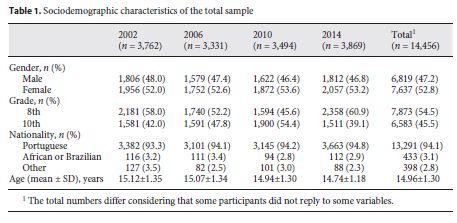
<body><![CDATA[<p>Age of sexual initiation has been decreasing in several industrialized countries    ( <sup><a href="#1">1</a></sup><a name="top1"></a> , <sup><a href="#3">3</a></sup><a name="top3"></a>    , <sup><a href="#4">4</a></sup><a name="top4"></a> ). According to recent Health    Behaviour in School-Aged Children (HBSC) surveys, most sexually active 15-year-olds    reported having had their first sexual intercourse from 14 years of age upwards    ( <sup><a href="#5">5</a></sup><a name="top5"></a> , <sup><a href="#6">6</a></sup><a name="top6"></a>    ). Addressing sexual behavior among very young people is therefore of significant    relevance to public health ( <sup><a href="#7">7</a></sup><a name="top7"></a>    - <sup><a href="#9">9</a></sup><a name="top9"></a> ).</p>     <p>Sexual activity is commonly initiated during adolescence ( <sup><a href="#1">1</a></sup><a name="top1"></a>    - <sup><a href="#3">3</a></sup><a name="top3"></a> ), but while generally accepted    as a normative part of the transition to adulthood, it can have negative consequences    such as infection with HIV and other STIs, unwanted pregnancy, and abortion.    Young people are at higher risk of related negative outcomes than adults, primarily    due to their relative physical, emotional, and cognitive immaturity ( <sup><a href="#10">10</a></sup><a name="top10"></a>    , <sup><a href="#11">11</a></sup><a name="top11"></a> ), and tend to engage    more frequently in risky behaviors such as sexual intercourse without a condom    ( <sup><a href="#2">2</a></sup><a name="top2"></a> , <sup><a href="#12">12</a></sup><a name="top12"></a>    , <sup><a href="#13">13</a></sup><a name="top13"></a> ). Recent data suggest    that among adolescents in Western, Central, and Eastern Europe <sup><a href="#1">1</a></sup><a name="top1"></a>    who have had intercourse, up to 40% had not used condoms during their last sexual    intercourse; thus, many sexually active adolescents remain at risk of infection    by HIV and other STIs. Although there has been a recent decline in HIV infection    among adolescents in industrialized countries, rates of other STIs have increased    ( <sup><a href="#1">1</a></sup><a name="top1"></a> , <sup><a href="#4">4</a></sup><a name="top4"></a>    , <sup><a href="#14">14</a></sup><a name="top14"></a> ).</p>     <p>This paper aims to (1) describe trends in sexual experience, sexual initiation,    condom and pill use at the last sexual intercourse, and sexual intercourse under    the influence of alcohol or drugs among adolescents of the 8th and 10th grades    from 2002 to 2014 in Portugal; and (2) describe variations in these trends over    time in boys and girls and school grades (8th and 10th).</p>     <p>&nbsp;</p>     <p><b>Methods</b></p>     <p>Data were collected through a self-administered questionnaire from the Portuguese    sample of the HBSC study of 2002, 2006, 2010, and 2014 ( <sup><a href="#15">15</a></sup><a name="top15"></a>    - <sup><a href="#16">16</a></sup><a name="top16"></a> ). The study provided    national representative data of 14,456 Portuguese adolescents, randomly chosen    from those attending the 8th and 10th grades of high school and the opportunity    to examine trends in sexual behavior. The sample included 52.8% girls and 47.2%    boys, whose mean age was 14.96 years (SD = 1.30). The majority was of Portuguese    nationality (94.1%); 54.5% attended the 8th grade and 45.5% the 10th grade (<a href="#t1">Table    1</a> ).</p>     <p>&nbsp;</p> <a name="t1"></a> <img src="/img/revistas/pjph/v36n1/36n1a06t1.jpg">      
<p>&nbsp;</p>     <p>The sampling unit used in this survey was the class. The schools in the sample    were randomly selected from the official national list of public schools. In    each school, classes were randomly selected in order to meet the required number    of students for each grade, according to the international research protocol.</p>     <p>This study was approved by a scientific committee, an ethical national committee,    and the national commission for data protection and strictly followed all the    guidelines for human rights protection.</p>     ]]></body>
<body><![CDATA[<p>In the questionnaire, which covered a wide range of questions about behaviors    and lifestyles in adolescence, issues were selected that relate to sociodemographic    characteristics and sexual behavior <sup><a href="#17">17</a></sup><a name="top17"></a>.</p>     <p><i>Measures</i></p>     <p>Sexual Behaviors</p>     <p>Experience of sexual intercourse was assessed by the question &ldquo;Have you    ever had sexual intercourse?&rdquo; (Yes/No); age of first sexual intercourse    by &ldquo;How old were you when you had sexual intercourse for the first time?&rdquo;    (11 or younger/12/13/14/15/16/17 or older; in the 2014 survey the option &ldquo;17    or older&rdquo; was withdrawn and the last option was &ldquo;16 or older&rdquo;).    Responses were dichotomized into &ldquo;11 or younger,&rdquo; &ldquo;12&ndash;13    years,&rdquo; and &ldquo;14 or older.&rdquo; Condom use, pill use, and having    had sexual intercourse under the influence of alcohol or drugs were assessed    by the following questions: &ldquo;The last time you had sexual intercourse,    did you or your partner use a condom?,&rdquo; &ldquo;The last time you had sexual    intercourse, did you or your partner use a pill?,&rdquo; and &ldquo;Have you    ever had sexual intercourse under the influence of alcohol or drugs?&rdquo;    (Yes/No). In the last survey (2014), the question about condom and pill use    had 3 answer options &ndash; Yes/No/I do not know. Those who answered &ldquo;I    do not know&rdquo; to either of the 2 items were coded as not having used a    condom or the pill at the last intercourse, respectively.</p>     <p>Time was included as a ratio variable reflecting the year of study with 2002    as baseline.</p>     <p><i>Statistical Analyses</i></p>     <p>Analyses and statistical procedures were carried out in the Statistical Package    for Social Sciences program (version 22 for Windows). Overall, 14,456 participants    completed structured self-reported questionnaires. The total numbers differed    considering that some participants did not reply to some questions. Descriptive    statistics were performed to characterize the sample and to examine sexual behaviors    according to gender and grade. &chi; <sup>2</sup> analyses were used to examine    sexual behaviors. Upward or downward trends were determined through the comparison    of the module that corresponded to an adjusted residual &ge;|1.9|. The level    for statistical significance was set at p &lt; 0.001.</p>     <p>&nbsp;</p>     <p><b>Results</b></p>     <p><i>Differences between 2002, 2006, 2010, and 2014 for questions about sexual    behaviors</i></p>     ]]></body>
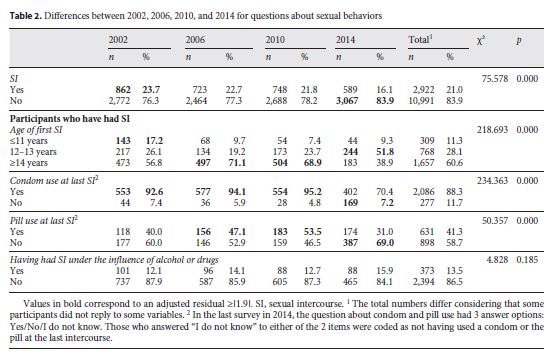
<body><![CDATA[<p><a href="#t2">Table 2</a> shows the trends in sexual behaviors between 2002    and 2014. There was a statistically significant difference in the percentage    of participants reporting ever having had sexual intercourse (&chi; <sup>2</sup>    (3) = 75.578, p &le; 0.001). There was a significant decrease from 2002 to 2014.</p>     <p>&nbsp;</p> <a name="t2"></a> <img src="/img/revistas/pjph/v36n1/36n1a06t2.jpg">      
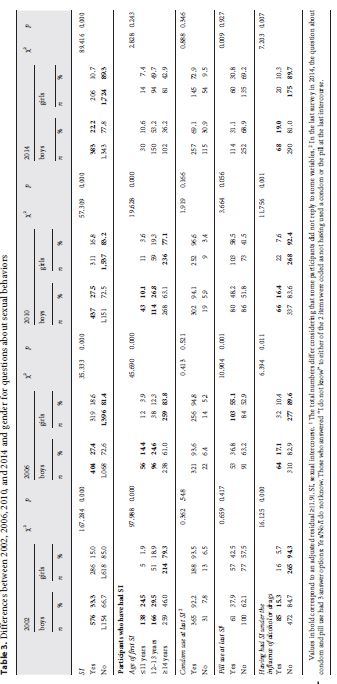
<p>&nbsp;</p>     <p>Among those who were sexually active, regarding the age of first sexual intercourse    of 14 years or older, an overall decrease was observed (&chi; <sup>2</sup> (3)    = 218.693, p &le; 0.001), with rates ranging from 38.9% (2014) to 71.1% (2006).    Moreover, according to the results of the last study, participants most frequently    reported having had sexual intercourse for the first time at the age of 12&ndash;13    years.</p>     <p>Among those who were sexually active, overall, 88.3% reported that they or    their partner had used a condom the last time they had engaged in sexual intercourse,    which means that about 12% are currently at high risk. Considering the 4 cycles    of the study, an increase was observed (&chi; <sup>2</sup> (3) = 234.363, p    &le; 0.001), which was especially strong between 2002, 2006, and 2010, and a    decrease was observed from 2010 to 2014.</p>     <p>Regarding those who were sexually active, overall, only 41.3% reported that    they or their partner had used the pill the last time they had engaged in sexual    intercourse. Considering the 4 cycles of the study, an increase was observed    (&chi; <sup>2</sup> (3) = 50.357, p &le; 0.001), which was especially strong    between 2006 and 2010, and a decrease was observed from 2010 to 2014.</p>     <p>There was no statistically significant difference for having had sexual intercourse    under the influence of alcohol or drugs (&chi; <sup>2</sup> (3) = 4.828, p =    0.185).</p>     <p><i>Differences between 2002, 2006, 2010, and 2014 and Gender for Questions    about Sexual Behaviors</i></p>     <p><a href ="/img/revistas/pjph/v36n1/36n1a06t3.jpg">Table 3</a> shows the trends in sexual behaviors between 2002    and 2014 by gender. There was a statistically significant difference by gender    between participants reporting having ever had sexual intercourse in the 4 cycles    of the study, with boys reporting more frequently having had sexual intercourse    than girls (&chi; <sup>2</sup> (1) = 167.284, p &le; 0.001; &chi; <sup>2</sup>    (1) = 35.333, p &le; 0.001; &chi; <sup>2</sup> (1) = 57.309, p &le; 0.001; &chi;    <sup>2</sup> (1) = 89.416, p &le; 0.001). In addition, results suggested that    there was a significant decrease in the rate of boys who reported having had    sexual intercourse from 2002 to 2014.</p>      
<p>Among those who were sexually active, an overall increase was observed regarding    age of first sexual intercourse between boys and girls, especially in 2002,    2006, and 2010 (&chi; <sup>2</sup> (1) = 97.988, p &le; 0.001; &chi; <sup>2</sup>    (1) = 45.690, p &le; 0.001; &chi; <sup>2</sup> (1) = 19.628, p &le; 0.001),    peaking in 2006, with girls mentioning more frequently than boys to have had    sexual intercourse at the age of 14 years or older. There was no statistically    significant difference between gender and the age of first sexual intercourse    in 2014. Nevertheless, results showed that both boys and girls more frequently    reported having had their first sexual intercourse at the age of 12&ndash;13    years, particularly boys.</p>     ]]></body>
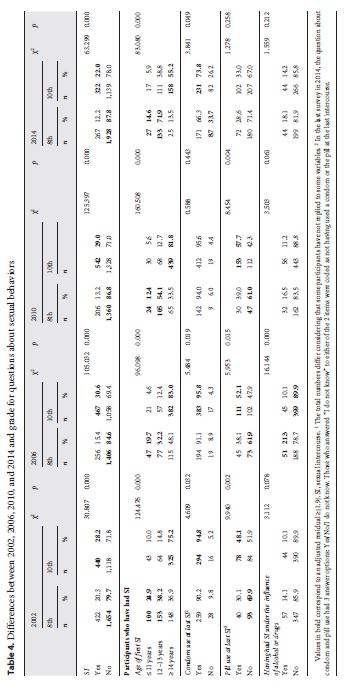
<body><![CDATA[<p>There was no statistically significant difference between boys and girls as    for the use of a condom the last time they had engaged in sexual intercourse    for the 4 cycles of the study and for the use of the pill in 3 cycles of the    study (2002, 2010, and 2014). In 2006, girls reported more frequently having    used the pill the last time they had engaged in sexual intercourse. Although    not representing statistically significant differences, overall results showed    that girls more often than boys reported having used a condom and the pill at    the last sexual intercourse.</p>     <p>Regarding those who were sexually active, statistically significant differences    were observed between boys and girls, which showed an increasing trend with    boys reporting more often having had sexual intercourse under the influence    of alcohol or drugs in the 4 cycles of the study (&chi; <sup>2</sup> (1) = 16.125,    p &le; 0.001; &chi; <sup>2</sup> (1) = 6.394, p &le; 0.050; &chi; <sup>2</sup>    (1) = 11.756, p &le; 0.001; &chi; <sup>2</sup> (1) = 7.203, p &le; 0.010).</p> <i>Differences between 2002, 2006, 2010, and 2014 and Grade for Questions about  Sexual Behaviors</i>      <p><a href ="/img/revistas/pjph/v36n1/36n1a06t4.jpg">Table 4</a> shows the trends in sexual behaviors between 2002    and 2014 by grade. There was a statistically significant difference between    8th and 10th graders who reported having ever had sexual intercourse in the    4 cycles of the study, with the students of the 10th grade reporting more frequently    having had sexual intercourse. In addition, the number of 8th graders who reported    having ever had sexual intercourse decreased from 2002 to 2014 (&chi; <sup>2</sup>    (1) = 30.807, p &le; 0.001; &chi; <sup>2</sup> (1) = 105.032, p &le; 0.001;    &chi; <sup>2</sup> (1) = 125.397, p &le; 0.001; &chi; <sup>2</sup> (1) = 63.299,    p &le; 0.001); therefore, a decreasing trend is noticeable.</p>      
<p>Among those who were sexually active, an overall increase was observed in age    of first sexual intercourse among 10th graders who reported having had sexual    intercourse at the age of 14 years or older, from 2002 to 2010, peaking in 2006;    whereas in 2014, a decrease was noticeable (&chi; <sup>2</sup> (1) = 124.476,    p &le; 0.001; &chi; <sup>2</sup> (1) = 96.098, p &le; 0.001; &chi; <sup>2</sup>    (1) = 160.508, p &le; 0.001; &chi; <sup>2</sup> (1) = 83.080, p &le; 0.001).    There were statistically significant differences for 3 cycles of the study (2002,    2006, and 2014) between 8th and 10th graders reporting the use of a condom the    last time they had engaged in sexual intercourse, with the students of the 10th    grade reporting using a condom more frequently than the students of the 8th    grade (&chi; <sup>2</sup> (1) = 4.609, p &le; 0.050; &chi; <sup>2</sup> (1)    = 5.484, p &le; 0.050; &chi; <sup>2</sup> (1) = 3.841, p &le; 0.050). There    was no statistically significant difference between grade and the use of a condom    the last time participants had engaged in sexual intercourse in 2010.</p>     <p>Among those who were sexually active, statistically significant differences    between grades were observed regarding the use of the pill at the last sexual    intercourse for 3 cycles of the study (2002, 2006, and 2010), with the students    of the 10th grade reporting an overall increase in comparison to the students    of the 8th grade (&chi; <sup>2</sup> (1) = 9.940, p &le; 0.010; &chi; <sup>2</sup>    (1) = 5.953, p &le; 0.050; &chi; <sup>2</sup> (1) = 8.454, p &le; 0.010). There    was no statistically significant difference between grades and the use of the    pill at the last sexual intercourse in 2014. In 2014, both 8th and 10th graders&rsquo;    pill use at the last sexual intercourse decreased.</p>     <p>Regarding those who were sexually active and reported having had sexual intercourse    under the influence of alcohol or drugs, statistically significant differences    were observed between grades only in 2006, with the students of the 8th grade    reporting to have had sexual intercourse under the influence of alcohol or drugs    more frequently than the students of the 10th grade (&chi; <sup>2</sup> (1)    = 16.144, p &le; 0.001). There were no statistically significant differences    for having had sexual intercourse under the influence of alcohol or drugs between    grades in 2002, 2010, and 2014. It was also noticeable that both 8th and 10th    graders reported more frequently having had sexual intercourse under the influence    of alcohol or drugs in 2014.</p>     <p>&nbsp;</p>     <p><b>Discussion</b></p>     <p>The goal of this study was to document recent trends in preventive sexual behaviors    in Portuguese adolescents and assessing whether they have changed and how they    have changed from 2002 to 2014.</p>     <p>Comparing the data from the 2002, 2006, 2010, and 2014 surveys, results showed    an increasing trend regarding the percentage of participants reporting their    first sexual intercourse at 14 years or older (except in 2014) and condom use    at the last sexual intercourse (except in 2014) as well as a stabilized trend    concerning having had sexual intercourse, pill use at the last intercourse (except    in 2014), and having had intercourse under the influence of alcohol or drugs.</p>     ]]></body>
<body><![CDATA[<p>Overall, in terms of differences between gender and grade, results showed that    boys and older adolescents (10th graders) more often stated having had sexual    intercourse. Girls and 8th graders more often reported having had their first    sexual intercourse at 14 years or older, and 10th graders more often reported    having used a condom and/or the pill during their last sexual intercourse. Condom    use among sexually active adolescents has been increasing over the same period,    especially so among girls.</p>     <p>In terms of the latest survey, specifically, on the one hand, there was an    improvement in sexual reproductive health because some preventive behaviors    have either increased (having ever had sexual intercourse) or stabilized (having    had sexual intercourse under the influence of alcohol or drugs). On the other    hand, some results suggested that some sexual risk behaviors may be increasing    since the age of first sexual intercourse may be decreasing to 12&ndash;13 years,    and condom and pill use at the last sexual intercourse may be decreasing.</p>     <p>Although these results may seem significant, they must be interpreted with    caution. They may suggest an inversion of the trends from 2002 to 2010, but    it is not possible to attest to it yet. It would be of great interest to compare    these results with those of other HBSC countries. They may be the result of    the reduction of investment that has been put into sexual education since the    2010 survey, when the Ministry of Education stopped putting schools under pressure    concerning sexual education; they may be due to the latest scientific developments    concerning AIDS; or they may reflect innumerous reasons not accounted for in    this paper.</p>     <p>Regardless of potentially worrisome results, the authors must recall that the    2014 survey results are overall positive in terms of sexual health, suggesting    that the majority of those who attend the 8th and 10th grades do have protective    behaviors.</p>     <p>Nevertheless, in addition to overall protective results (including 2014), a    significant minority of adolescents is involved in risk behaviors such as not    having used a condom at the last sexual intercourse and having had sex at 13    years or younger, behaviors that can bring major negative outcomes individually    and in terms of public health ( <sup><a href="#3">3</a></sup><a name="top3"></a>    , <sup><a href="#8">8</a></sup><a name="top8"></a> , <sup><a href="#9">9</a></sup><a name="top9"></a>    , <sup><a href="#18">18</a></sup><a name="top18"></a> ).</p>     <p>Past analyses (from 2002 to 2010) suggested that formal sexual education in    the school context promoted protective sexual behaviors <sup><a href="#19">19</a></sup><a name="top19"></a>;    therefore, it must be determined whether sexual education has been modified    or interrupted. In other words, sexual education in the school context should    be evaluated.</p>     <p>In 2013, an evaluation about the implementation of the law No. 60/2009 (6th    August) <sup><a href="#20">20</a></sup><a name="top20"></a> on sexual education    in schools was carried out. The results showed that the law was being fulfilled    and, in general, the schools organized an office that provided information and    support for students and managed its functioning. In addition, school principals    and teachers emphasized that schools were making a huge effort to implement    the law. However, some of them questioned their ability to continue this process    due to the economic restrictions at the time. Principals and teachers reported    the need to &ldquo;revitalize&rdquo; this area, underlining the need to maintain    the law and one annual &ldquo;Call&rdquo; from which the Ministry of Education    and Science received proposals for funding schools for projects in the area    of health promotion as well as teacher training <sup><a href="#21">21</a></sup><a name="top21"></a>.</p>     <p>It is crucial to understand if and why prevention strategies have not been    as successful overall as they seemed to have been in the past.</p>     <p>In conclusion, it is important to highlight adolescents&rsquo; reported adoption    of preventive behaviors, but also how these have been changing from 2002 to    2014, which demands for careful monitoring.</p>     <p>&nbsp;</p>     ]]></body>
<body><![CDATA[<p><b>NOTES</b></p>     <p><Sup><a name="1"></a><a href="#top1">1</a></Sup> Avery L, Lazdane G: What do    we know about sexual and reproductive health of adolescents in Europe? Eur J    Contracept Reprod Health Care 2010; 15:S54&ndash;S66.</p>     <!-- ref --><p><Sup><a name="2"></a><a href="#top2">2</a></Sup> WHO: A Snapshot of the Health    of Young People in Europe. Copenhagen, WHO Regional Office for Europe, 2011.    &nbsp;&nbsp;&nbsp;&nbsp;&nbsp;&nbsp;&nbsp;&nbsp;[&#160;<a href="javascript:void(0);" onclick="javascript: window.open('/scielo.php?script=sci_nlinks&ref=2092714&pid=S2504-3145201800010000600002&lng=','','width=640,height=500,resizable=yes,scrollbars=1,menubar=yes,');">Links</a>&#160;]<!-- end-ref --></p>     <p><Sup><a name="3"></a><a href="#top3">3</a></Sup> Ramiro L, Windlin B, Reis    M, Gabhainn SN, Jovic S, Matos MG, et al: Trends in very early sex and condom    use in 20 European countries from 2002 to 2010. Eur J Public Health 2015; 25(suppl    2):65&ndash;68.</p>     <p><Sup><a name="4"></a><a href="#top4">4</a></Sup> Wellings K, Collumbien M,    Slaymaker E, Susheela S, Hodges Z, Patel D, et al: Sexual behaviour in context:    a global perspective. Lancet 2006; 368: 1706&ndash;1728.</p>     <p><Sup><a name="5"></a><a href="#top5">5</a></Sup> Nic Gabhainn S, Baban A, Boyce    W, Godeau E; HBSC Sexual Health Focus Group: How well protected are sexually    active 15-year olds? Cross-national patterns in condom and contraceptive pill    use 2002&ndash;2006. Int J Public Health 2009; 54(suppl 2):209&ndash;215.</p>     <!-- ref --><p><Sup><a name="6"></a><a href="#top6">6</a></Sup> Currie C, Zanotti C, Morgan    A, Currie D, de Looze M, Roberts C, et al: Social determinants of health and    well-being among young people; in WHO: Health Behaviour in School-Aged Children    (HBSC) Study: International Report from the 2009/2010 Survey. Copenhagen, WHO    Regional Office for Europe, 2012.    &nbsp;&nbsp;&nbsp;&nbsp;&nbsp;&nbsp;&nbsp;&nbsp;[&#160;<a href="javascript:void(0);" onclick="javascript: window.open('/scielo.php?script=sci_nlinks&ref=2092719&pid=S2504-3145201800010000600006&lng=','','width=640,height=500,resizable=yes,scrollbars=1,menubar=yes,');">Links</a>&#160;]<!-- end-ref --></p>     <p><Sup><a name="7"></a><a href="#top7">7</a></Sup> Kaestle CE, Halpern CT, Miller    WC, Ford CA: Young age at first sexual intercourse and sexually transmitted    infections in adolescents and young adults. Am J Epidemiol 2005; 161: 774&ndash;780.</p>     ]]></body>
<body><![CDATA[<p><Sup><a name="8"></a><a href="#top8">8</a></Sup> Santelli JS, Lindberg LD,    Finer LB, Singh S: Explaining recent declines in adolescent pregnancy in the    United States: the contribution of abstinence and improved contraceptive use.    Am J Public Health 2007; 97: 150&ndash;156.</p>     <p><Sup><a name="9"></a><a href="#top9">9</a></Sup> Anderson JE, Santelli JS,    Morrow B: Trends in adolescent contraceptive use, unprotected and poorly protected    sex, 1991&ndash;2003. J Adolesc Health 2006; 38: 734&ndash;739.</p>     <!-- ref --><p><Sup><a name="10"></a><a href="#top10">10</a></Sup> UNAIDS: Joint United Nations    Programme on HIV/AIDS: Global AIDS Update 2016. Geneva, Joint United Nations    Programme on HIV/AIDS, UNAIDS, 2016.    &nbsp;&nbsp;&nbsp;&nbsp;&nbsp;&nbsp;&nbsp;&nbsp;[&#160;<a href="javascript:void(0);" onclick="javascript: window.open('/scielo.php?script=sci_nlinks&ref=2092724&pid=S2504-3145201800010000600010&lng=','','width=640,height=500,resizable=yes,scrollbars=1,menubar=yes,');">Links</a>&#160;]<!-- end-ref --></p>     <p><Sup><a name="11"></a><a href="#top11">11</a></Sup> Godeau E, Vignes C, Duclos    M, Navarro F, Cayla F, Grandjean H: Facteurs associ&eacute;s &agrave; une initiation    sexuelle pr&eacute;coce chez les filles: donn&eacute;es Fran&ccedil;aises de    l&rsquo;enqu&ecirc;te internationale Health Behaviour in School-Aged Children    (HBSC)/OMS. Gynecol Obstet Fertil 2008; 36: 176&ndash;182.</p>     <!-- ref --><p><Sup><a name="12"></a><a href="#top12">12</a></Sup> UNAIDS: Global Report:    UNAIDS Report on the Global AIDS Epidemic 2010. Geneva, Joint United Nations    Programme on HIV/AIDS, UNAIDS, 2010.    &nbsp;&nbsp;&nbsp;&nbsp;&nbsp;&nbsp;&nbsp;&nbsp;[&#160;<a href="javascript:void(0);" onclick="javascript: window.open('/scielo.php?script=sci_nlinks&ref=2092727&pid=S2504-3145201800010000600012&lng=','','width=640,height=500,resizable=yes,scrollbars=1,menubar=yes,');">Links</a>&#160;]<!-- end-ref --></p>     <!-- ref --><p><Sup><a name="13"></a><a href="#top13">13</a></Sup> UNAIDS: Report on the Global    HIV/AIDS Epidemic 2008. Geneva, Joint United Nations Programme on HIV/AIDS,    UNAIDS, 2008.    &nbsp;&nbsp;&nbsp;&nbsp;&nbsp;&nbsp;&nbsp;&nbsp;[&#160;<a href="javascript:void(0);" onclick="javascript: window.open('/scielo.php?script=sci_nlinks&ref=2092729&pid=S2504-3145201800010000600013&lng=','','width=640,height=500,resizable=yes,scrollbars=1,menubar=yes,');">Links</a>&#160;]<!-- end-ref --></p>     <p><Sup><a name="14"></a><a href="#top14">14</a></Sup> Fenton KA, Lowndes CM;    the European Surveillance of Sexually Transmitted Infections (ESSSTI) Network:    Recent trends in the epidemiology of sexually transmitted infections in the    European Union. Sex Transm Infect 2004; 80: 255&ndash;263.</p>     ]]></body>
<body><![CDATA[<p><Sup><a name="15"></a><a href="#top15">15</a></Sup> Matos MG, Sim&otilde;es    C, Tom&eacute; G, Camacho I, Ferreira M, Ramiro L, et al: A sa&uacute;de dos    adolescentes portugueses: Relat&oacute;rio do Estudo HBSC 2010. ACS/FMH/UTL/CMDT-UNL,    2011.</p>     <!-- ref --><p><Sup><a name="16"></a><a href="#top16">16</a></Sup> Matos MG, Sim&otilde;es    C, Camacho I, Reis M; Equipa Aventura Social: A sa&uacute;de dos adolescentes    portugueses em tempos de recess&atilde;o: dados nacionais de 2014: Relat&oacute;rio    final do Estudo HBSC 2014. Lisbon, Centro Mal&aacute;ria e Outras Doen&ccedil;as    Tropicais, IHMT, UNL, FMH, Universidade de Lisboan 2015.    &nbsp;&nbsp;&nbsp;&nbsp;&nbsp;&nbsp;&nbsp;&nbsp;[&#160;<a href="javascript:void(0);" onclick="javascript: window.open('/scielo.php?script=sci_nlinks&ref=2092733&pid=S2504-3145201800010000600015&lng=','','width=640,height=500,resizable=yes,scrollbars=1,menubar=yes,');">Links</a>&#160;]<!-- end-ref --></p>     <p><Sup><a name="17"></a><a href="#top17">17</a></Sup> Roberts C, Currie C, Samdal    O, Currie D, Smith R, Maes L: Measuring the health and health behaviours of    adolescents through cross-national survey research: recent developments in the    Health Behaviour in School-aged Children (HBSC) study. J Public Health 2007;    15: 179&ndash;186.</p>     <p><Sup><a name="18"></a><a href="#top18">18</a></Sup> Wellings K, Nanchahal K,    Macdowell W, McManus S, Erens B, Mercer C, et al: Sexual behaviour in Britain:    Early heterosexual experience. Lancet 2001; 358: 1843&ndash;1850.</p>     <p><Sup><a name="19"></a><a href="#top19">19</a></Sup> Ramiro L, Reis M, Matos    MG, Diniz JA: Sex education among Portuguese adolescent students. Procedia Soc    Behav Sci 2011; 29: 493&ndash;502.</p>     <p><Sup><a name="20"></a><a href="#top20">20</a></Sup> Lei n&deg; 60/2009. D.R.    I S&eacute;rie. 151 (2009/08/06) 5097&ndash;5098.</p>     <p><Sup><a name="21"></a><a href="#top21">21</a></Sup>Matos MG, Reis M, Ramiro    L, Ribeiro JLP, Leal I: Sexual education in schools in Portugal: evaluation    of a 3 years period. Creat Educ 2014; 5: 1353&ndash;1362.</p>     <p>&nbsp;</p>     <p><b>Acknowledgements</b></p>     ]]></body>
<body><![CDATA[<p>The authors are grateful to the Team Social Adventure, Faculty of Human Kinetics,    University of Lisbon, to all participants, and to the Foundation for Science    and Technology, Ministry of Science and Higher Education.</p>      ]]></body><back>
<ref-list>
<ref id="B1">
<nlm-citation citation-type="journal">
<person-group person-group-type="author">
<name>
<surname><![CDATA[Avery]]></surname>
<given-names><![CDATA[L]]></given-names>
</name>
<name>
<surname><![CDATA[Lazdane]]></surname>
<given-names><![CDATA[G]]></given-names>
</name>
</person-group>
<article-title xml:lang="en"><![CDATA[What do we know about sexual and reproductive health of adolescents in Europe?]]></article-title>
<source><![CDATA[Eur J Contracept Reprod Health Care]]></source>
<year>2010</year>
<volume>15</volume>
<page-range>S54–S66</page-range></nlm-citation>
</ref>
<ref id="B2">
<nlm-citation citation-type="book">
<collab>WHO</collab>
<source><![CDATA[A Snapshot of the Health of Young People in Europe]]></source>
<year>2011</year>
<publisher-loc><![CDATA[Copenhagen ]]></publisher-loc>
<publisher-name><![CDATA[WHO Regional Office for Europe]]></publisher-name>
</nlm-citation>
</ref>
<ref id="B3">
<nlm-citation citation-type="journal">
<person-group person-group-type="author">
<name>
<surname><![CDATA[Ramiro]]></surname>
<given-names><![CDATA[L]]></given-names>
</name>
<name>
<surname><![CDATA[Windlin]]></surname>
<given-names><![CDATA[B]]></given-names>
</name>
<name>
<surname><![CDATA[Reis]]></surname>
<given-names><![CDATA[M]]></given-names>
</name>
<name>
<surname><![CDATA[Gabhainn]]></surname>
<given-names><![CDATA[SN]]></given-names>
</name>
<name>
<surname><![CDATA[Jovic]]></surname>
<given-names><![CDATA[S]]></given-names>
</name>
<name>
<surname><![CDATA[Matos]]></surname>
<given-names><![CDATA[MG]]></given-names>
</name>
</person-group>
<article-title xml:lang="en"><![CDATA[Trends in very early sex and condom use in 20 European countries from 2002 to 2010]]></article-title>
<source><![CDATA[Eur J Public Health]]></source>
<year>2015</year>
<volume>25</volume>
<numero>^s2</numero>
<issue>^s2</issue>
<supplement>2</supplement>
<page-range>65–68</page-range></nlm-citation>
</ref>
<ref id="B4">
<nlm-citation citation-type="journal">
<person-group person-group-type="author">
<name>
<surname><![CDATA[Wellings]]></surname>
<given-names><![CDATA[K]]></given-names>
</name>
<name>
<surname><![CDATA[Collumbien]]></surname>
<given-names><![CDATA[M]]></given-names>
</name>
<name>
<surname><![CDATA[Slaymaker]]></surname>
<given-names><![CDATA[E]]></given-names>
</name>
<name>
<surname><![CDATA[Susheela]]></surname>
<given-names><![CDATA[S]]></given-names>
</name>
<name>
<surname><![CDATA[Hodges]]></surname>
<given-names><![CDATA[Z]]></given-names>
</name>
<name>
<surname><![CDATA[Patel]]></surname>
<given-names><![CDATA[D]]></given-names>
</name>
</person-group>
<article-title xml:lang="en"><![CDATA[Sexual behaviour in context: a global perspective]]></article-title>
<source><![CDATA[Lancet]]></source>
<year>2006</year>
<volume>368</volume>
<page-range>1706–1728</page-range></nlm-citation>
</ref>
<ref id="B5">
<nlm-citation citation-type="journal">
<person-group person-group-type="author">
<name>
<surname><![CDATA[Nic Gabhainn]]></surname>
<given-names><![CDATA[S]]></given-names>
</name>
<name>
<surname><![CDATA[Baban]]></surname>
<given-names><![CDATA[A]]></given-names>
</name>
<name>
<surname><![CDATA[Boyce]]></surname>
<given-names><![CDATA[W]]></given-names>
</name>
<name>
<surname><![CDATA[Godeau]]></surname>
<given-names><![CDATA[E]]></given-names>
</name>
</person-group>
<article-title xml:lang="en"><![CDATA[HBSC Sexual Health Focus Group: How well protected are sexually active 15-year olds? Cross-national patterns in condom and contraceptive pill use 2002–2006]]></article-title>
<source><![CDATA[Int J Public Health]]></source>
<year>2009</year>
<volume>54</volume>
<numero>^s2</numero>
<issue>^s2</issue>
<supplement>2</supplement>
<page-range>209–215</page-range></nlm-citation>
</ref>
<ref id="B6">
<nlm-citation citation-type="book">
<person-group person-group-type="author">
<name>
<surname><![CDATA[Currie]]></surname>
<given-names><![CDATA[C]]></given-names>
</name>
<name>
<surname><![CDATA[Zanotti]]></surname>
<given-names><![CDATA[C]]></given-names>
</name>
<name>
<surname><![CDATA[Morgan]]></surname>
<given-names><![CDATA[A]]></given-names>
</name>
<name>
<surname><![CDATA[Currie]]></surname>
<given-names><![CDATA[D]]></given-names>
</name>
<name>
<surname><![CDATA[de Looze]]></surname>
<given-names><![CDATA[M]]></given-names>
</name>
<name>
<surname><![CDATA[Roberts]]></surname>
<given-names><![CDATA[C]]></given-names>
</name>
</person-group>
<article-title xml:lang="en"><![CDATA[Social determinants of health and well-being among young people]]></article-title>
<collab>WHO</collab>
<source><![CDATA[Health Behaviour in School-Aged Children (HBSC) Study: International Report from the 2009/2010 Survey]]></source>
<year>2012</year>
<publisher-loc><![CDATA[Copenhagen ]]></publisher-loc>
<publisher-name><![CDATA[WHO Regional Office for Europe]]></publisher-name>
</nlm-citation>
</ref>
<ref id="B7">
<nlm-citation citation-type="journal">
<person-group person-group-type="author">
<name>
<surname><![CDATA[Kaestle]]></surname>
<given-names><![CDATA[CE]]></given-names>
</name>
<name>
<surname><![CDATA[Halpern]]></surname>
<given-names><![CDATA[CT]]></given-names>
</name>
<name>
<surname><![CDATA[Miller]]></surname>
<given-names><![CDATA[WC]]></given-names>
</name>
<name>
<surname><![CDATA[Ford]]></surname>
<given-names><![CDATA[CA]]></given-names>
</name>
</person-group>
<article-title xml:lang="en"><![CDATA[Young age at first sexual intercourse and sexually transmitted infections in adolescents and young adults]]></article-title>
<source><![CDATA[Am J Epidemiol]]></source>
<year>2005</year>
<volume>161</volume>
<page-range>774–780</page-range></nlm-citation>
</ref>
<ref id="B8">
<nlm-citation citation-type="journal">
<person-group person-group-type="author">
<name>
<surname><![CDATA[Santelli]]></surname>
<given-names><![CDATA[JS]]></given-names>
</name>
<name>
<surname><![CDATA[Lindberg]]></surname>
<given-names><![CDATA[LD]]></given-names>
</name>
<name>
<surname><![CDATA[Finer]]></surname>
<given-names><![CDATA[LB]]></given-names>
</name>
<name>
<surname><![CDATA[Singh]]></surname>
<given-names><![CDATA[S]]></given-names>
</name>
</person-group>
<article-title xml:lang="en"><![CDATA[Explaining recent declines in adolescent pregnancy in the United States: the contribution of abstinence and improved contraceptive use]]></article-title>
<source><![CDATA[Am J Public Health]]></source>
<year>2007</year>
<volume>97</volume>
<page-range>150–156</page-range></nlm-citation>
</ref>
<ref id="B9">
<nlm-citation citation-type="journal">
<person-group person-group-type="author">
<name>
<surname><![CDATA[Anderson]]></surname>
<given-names><![CDATA[JE]]></given-names>
</name>
<name>
<surname><![CDATA[Santelli]]></surname>
<given-names><![CDATA[JS]]></given-names>
</name>
<name>
<surname><![CDATA[Morrow]]></surname>
<given-names><![CDATA[B]]></given-names>
</name>
</person-group>
<article-title xml:lang="en"><![CDATA[Trends in adolescent contraceptive use, unprotected and poorly protected sex, 1991–2003]]></article-title>
<source><![CDATA[J Adolesc Health]]></source>
<year>2006</year>
<volume>38</volume>
<page-range>734–739</page-range></nlm-citation>
</ref>
<ref id="B10">
<nlm-citation citation-type="book">
<collab>UNAIDS</collab>
<source><![CDATA[Joint United Nations Programme on HIV/AIDS: Global AIDS Update 2016. Geneva, Joint United Nations Programme on HIV/AIDS]]></source>
<year>2016</year>
<publisher-name><![CDATA[UNAIDS]]></publisher-name>
</nlm-citation>
</ref>
<ref id="B11">
<nlm-citation citation-type="journal">
<person-group person-group-type="author">
<name>
<surname><![CDATA[Godeau]]></surname>
<given-names><![CDATA[E]]></given-names>
</name>
<name>
<surname><![CDATA[Vignes]]></surname>
<given-names><![CDATA[C]]></given-names>
</name>
<name>
<surname><![CDATA[Duclos]]></surname>
<given-names><![CDATA[M]]></given-names>
</name>
<name>
<surname><![CDATA[Navarro]]></surname>
<given-names><![CDATA[F]]></given-names>
</name>
<name>
<surname><![CDATA[Cayla]]></surname>
<given-names><![CDATA[F]]></given-names>
</name>
<name>
<surname><![CDATA[Grandjean]]></surname>
<given-names><![CDATA[H]]></given-names>
</name>
</person-group>
<article-title xml:lang="fr"><![CDATA[Facteurs associés à une initiation sexuelle précoce chez les filles: données Françaises de l’enquête internationale Health Behaviour in School-Aged Children (HBSC)/OMS]]></article-title>
<source><![CDATA[Gynecol Obstet Fertil]]></source>
<year>2008</year>
<volume>36</volume>
<page-range>176–182</page-range></nlm-citation>
</ref>
<ref id="B12">
<nlm-citation citation-type="book">
<collab>UNAIDS</collab>
<source><![CDATA[Global Report: UNAIDS Report on the Global AIDS Epidemic 2010]]></source>
<year>2010</year>
<publisher-loc><![CDATA[Geneva ]]></publisher-loc>
<publisher-name><![CDATA[Joint United Nations Programme on HIV/AIDS, UNAIDS]]></publisher-name>
</nlm-citation>
</ref>
<ref id="B13">
<nlm-citation citation-type="book">
<collab>UNAIDS</collab>
<source><![CDATA[Report on the Global HIV/AIDS Epidemic 2008]]></source>
<year>2008</year>
<publisher-loc><![CDATA[Geneva ]]></publisher-loc>
<publisher-name><![CDATA[Joint United Nations Programme on HIV/AIDS, UNAIDS]]></publisher-name>
</nlm-citation>
</ref>
<ref id="B14">
<nlm-citation citation-type="journal">
<person-group person-group-type="author">
<name>
<surname><![CDATA[Fenton]]></surname>
<given-names><![CDATA[KA]]></given-names>
</name>
<name>
<surname><![CDATA[Lowndes]]></surname>
<given-names><![CDATA[CM]]></given-names>
</name>
</person-group>
<article-title xml:lang="en"><![CDATA[the European Surveillance of Sexually Transmitted Infections (ESSSTI) Network: Recent trends in the epidemiology of sexually transmitted infections in the European Union]]></article-title>
<source><![CDATA[Sex Transm Infect]]></source>
<year>2004</year>
<volume>80</volume>
<page-range>255–263</page-range></nlm-citation>
</ref>
<ref id="B15">
<nlm-citation citation-type="book">
<person-group person-group-type="author">
<name>
<surname><![CDATA[Matos]]></surname>
<given-names><![CDATA[MG]]></given-names>
</name>
<name>
<surname><![CDATA[Simões]]></surname>
<given-names><![CDATA[C]]></given-names>
</name>
<name>
<surname><![CDATA[Camacho]]></surname>
<given-names><![CDATA[I]]></given-names>
</name>
<name>
<surname><![CDATA[Reis]]></surname>
<given-names><![CDATA[M]]></given-names>
</name>
</person-group>
<source><![CDATA[Equipa Aventura Social: A saúde dos adolescentes portugueses em tempos de recessão: dados nacionais de 2014: Relatório final do Estudo HBSC 2014]]></source>
<year>2015</year>
<publisher-loc><![CDATA[Lisbon ]]></publisher-loc>
<publisher-name><![CDATA[Centro Malária e Outras Doenças Tropicais, IHMT, UNL, FMH, Universidade de Lisboan]]></publisher-name>
</nlm-citation>
</ref>
<ref id="B16">
<nlm-citation citation-type="journal">
<person-group person-group-type="author">
<name>
<surname><![CDATA[Roberts]]></surname>
<given-names><![CDATA[C]]></given-names>
</name>
<name>
<surname><![CDATA[Currie]]></surname>
<given-names><![CDATA[C]]></given-names>
</name>
<name>
<surname><![CDATA[Samdal]]></surname>
<given-names><![CDATA[O]]></given-names>
</name>
<name>
<surname><![CDATA[Currie]]></surname>
<given-names><![CDATA[D]]></given-names>
</name>
<name>
<surname><![CDATA[Smith]]></surname>
<given-names><![CDATA[R]]></given-names>
</name>
<name>
<surname><![CDATA[Maes]]></surname>
<given-names><![CDATA[L]]></given-names>
</name>
</person-group>
<article-title xml:lang="en"><![CDATA[Measuring the health and health behaviours of adolescents through cross-national survey research: recent developments in the Health Behaviour in School-aged Children (HBSC) study]]></article-title>
<source><![CDATA[J Public Health]]></source>
<year>2007</year>
<volume>15</volume>
<page-range>179–186</page-range></nlm-citation>
</ref>
<ref id="B17">
<nlm-citation citation-type="journal">
<person-group person-group-type="author">
<name>
<surname><![CDATA[Wellings]]></surname>
<given-names><![CDATA[K]]></given-names>
</name>
<name>
<surname><![CDATA[Nanchahal]]></surname>
<given-names><![CDATA[K]]></given-names>
</name>
<name>
<surname><![CDATA[Macdowell]]></surname>
<given-names><![CDATA[W]]></given-names>
</name>
<name>
<surname><![CDATA[McManus]]></surname>
<given-names><![CDATA[S]]></given-names>
</name>
<name>
<surname><![CDATA[Erens]]></surname>
<given-names><![CDATA[B]]></given-names>
</name>
<name>
<surname><![CDATA[Mercer]]></surname>
<given-names><![CDATA[C]]></given-names>
</name>
</person-group>
<article-title xml:lang="en"><![CDATA[Sexual behaviour in Britain: Early heterosexual experience]]></article-title>
<source><![CDATA[Lancet]]></source>
<year>2001</year>
<volume>358</volume>
<page-range>1843–1850</page-range></nlm-citation>
</ref>
<ref id="B18">
<nlm-citation citation-type="journal">
<person-group person-group-type="author">
<name>
<surname><![CDATA[Ramiro]]></surname>
<given-names><![CDATA[L]]></given-names>
</name>
<name>
<surname><![CDATA[Reis]]></surname>
<given-names><![CDATA[M]]></given-names>
</name>
<name>
<surname><![CDATA[Matos]]></surname>
<given-names><![CDATA[MG]]></given-names>
</name>
<name>
<surname><![CDATA[Diniz]]></surname>
<given-names><![CDATA[JA]]></given-names>
</name>
</person-group>
<article-title xml:lang="en"><![CDATA[Sex education among Portuguese adolescent students]]></article-title>
<source><![CDATA[Procedia Soc Behav Sci]]></source>
<year>2011</year>
<volume>29</volume>
<page-range>493–502</page-range></nlm-citation>
</ref>
<ref id="B19">
<nlm-citation citation-type="journal">
<person-group person-group-type="author">
<name>
<surname><![CDATA[Matos]]></surname>
<given-names><![CDATA[MG]]></given-names>
</name>
<name>
<surname><![CDATA[Reis]]></surname>
<given-names><![CDATA[M]]></given-names>
</name>
<name>
<surname><![CDATA[Ramiro]]></surname>
<given-names><![CDATA[L]]></given-names>
</name>
<name>
<surname><![CDATA[Ribeiro]]></surname>
<given-names><![CDATA[JLP]]></given-names>
</name>
<name>
<surname><![CDATA[Leal]]></surname>
<given-names><![CDATA[I]]></given-names>
</name>
</person-group>
<article-title xml:lang="en"><![CDATA[Sexual education in schools in Portugal: evaluation of a 3 years period]]></article-title>
<source><![CDATA[Creat Educ]]></source>
<year>2014</year>
<volume>5</volume>
<page-range>1353–1362</page-range></nlm-citation>
</ref>
</ref-list>
</back>
</article>