<?xml version="1.0" encoding="ISO-8859-1"?><article xmlns:mml="http://www.w3.org/1998/Math/MathML" xmlns:xlink="http://www.w3.org/1999/xlink" xmlns:xsi="http://www.w3.org/2001/XMLSchema-instance">
<front>
<journal-meta>
<journal-id>2504-3145</journal-id>
<journal-title><![CDATA[Portuguese Journal of Public Health]]></journal-title>
<abbrev-journal-title><![CDATA[Port J Public Health]]></abbrev-journal-title>
<issn>2504-3145</issn>
<publisher>
<publisher-name><![CDATA[Escola Nacional de Saúde Pública]]></publisher-name>
</publisher>
</journal-meta>
<article-meta>
<article-id>S2504-31452018000200003</article-id>
<article-id pub-id-type="doi">10.1159/000492084</article-id>
<title-group>
<article-title xml:lang="en"><![CDATA[Measuring Empowerment in Patients with Chronic Disease: Psychometric Qualities of the Portuguese Rheumatic Disease Empowerment Scale]]></article-title>
<article-title xml:lang="pt"><![CDATA[Avaliação do empowerment em pacientes com doença crónica: Qualidades psicométricas da Escala Portuguesa de Empowerment na Doença Reumática]]></article-title>
</title-group>
<contrib-group>
<contrib contrib-type="author">
<name>
<surname><![CDATA[Alves]]></surname>
<given-names><![CDATA[Marta Pereira]]></given-names>
</name>
<xref ref-type="aff" rid="A1 "/>
</contrib>
<contrib contrib-type="author">
<name>
<surname><![CDATA[Cunha]]></surname>
<given-names><![CDATA[Ana Isabel]]></given-names>
</name>
<xref ref-type="aff" rid="A2"/>
</contrib>
<contrib contrib-type="author">
<name>
<surname><![CDATA[Lopes]]></surname>
<given-names><![CDATA[Tatiana]]></given-names>
</name>
<xref ref-type="aff" rid="A2"/>
</contrib>
<contrib contrib-type="author">
<name>
<surname><![CDATA[Abreu]]></surname>
<given-names><![CDATA[Pedro]]></given-names>
</name>
<xref ref-type="aff" rid="A3"/>
</contrib>
<contrib contrib-type="author">
<name>
<surname><![CDATA[Vaz]]></surname>
<given-names><![CDATA[Cláudia]]></given-names>
</name>
<xref ref-type="aff" rid="A4"/>
</contrib>
</contrib-group>
<aff id="AA1">
<institution><![CDATA[,University of Beira Interior Research Center in Business Sciences ]]></institution>
<addr-line><![CDATA[ ]]></addr-line>
</aff>
<aff id="AA2">
<institution><![CDATA[,Universidade da Beira Interior Departamento de Psicologia e Educação ]]></institution>
<addr-line><![CDATA[Covilhã ]]></addr-line>
<country>Portugal</country>
</aff>
<aff id="AA3">
<institution><![CDATA[,Unidade Local de Saúde de Castelo Branco Unidade de Reumatologia ]]></institution>
<addr-line><![CDATA[Castelo Branco ]]></addr-line>
<country>Portugal</country>
</aff>
<aff id="AA4">
<institution><![CDATA[,Unidade Local de Saúde da Guarda Serviço de Reumatologia ]]></institution>
<addr-line><![CDATA[Guarda ]]></addr-line>
<country>Portugal</country>
</aff>
<pub-date pub-type="pub">
<day>00</day>
<month>00</month>
<year>2018</year>
</pub-date>
<pub-date pub-type="epub">
<day>00</day>
<month>00</month>
<year>2018</year>
</pub-date>
<volume>36</volume>
<numero>2</numero>
<fpage>66</fpage>
<lpage>71</lpage>
<copyright-statement/>
<copyright-year/>
<self-uri xlink:href="http://scielo.pt/scielo.php?script=sci_arttext&amp;pid=S2504-31452018000200003&amp;lng=en&amp;nrm=iso"></self-uri><self-uri xlink:href="http://scielo.pt/scielo.php?script=sci_abstract&amp;pid=S2504-31452018000200003&amp;lng=en&amp;nrm=iso"></self-uri><self-uri xlink:href="http://scielo.pt/scielo.php?script=sci_pdf&amp;pid=S2504-31452018000200003&amp;lng=en&amp;nrm=iso"></self-uri><abstract abstract-type="short" xml:lang="en"><p><![CDATA[Empowerment is usually defined as a process of promoting the sense of competence and control as a means of capacitating individuals to improve their life conditions. The aim of this study was to describe the psychometric qualities of the Portuguese Rheumatic Disease Empowerment Scale (P-RES-8), an 8-item measure of empowerment for patients with rheumatic disease. The study enrolled 81 patients with rheumatic diseases. Participants filled in the P-RES-8, the Portuguese validated version of the Medical Outcomes Survey Short Form-36 (MOS SF-36), and a questionnaire including sociodemographic data and disease-related variables. To evaluate the dimensionality of the P-RES-8 scale, an exploratory factor analysis was conducted, and its reliability was assessed by Cronbach’s a. The validity of this measure was assessed by analyzing the correlations between empowerment, quality of life, and other relevant variables (education level and illness duration). The P-RES-8 proved to be a reliable 1-dimensional measure of empowerment in patients with rheumatic disease (Cronbach’s a = 0.94). Empowerment was positively related to quality of life. Particularly, the findings showed positive associations between empowerment, assessed by the P-RES-8, and each of the 8 domains of the MOS SF-36. The associations were stronger for mental health and general health perception. The results also revealed that empowerment is positively associated with a higher education and more years after the diagnosis. The findings provide support for the adequacy of the P-RES-8 as a measure of empowerment in patients with rheumatic disease. Moreover, empowerment showed to be an important variable in the assessment of patients’ quality of life.]]></p></abstract>
<abstract abstract-type="short" xml:lang="pt"><p><![CDATA[O empowerment é geralmente definido como um processo de promoção da perceção de competência e de controlo como forma de capacitar os indivíduos para melhorar suas condições de vida. O estudo teve como objetivo analisar as qualidades psicométricas da Escala Portuguesa de Empowerment na Doença Reumática (P-RES-8), uma medida constituída por 8 itens destinada a pacientes com doença reumática. O estudo envolveu 81 sujeitos com doenças reumáticas. Os participantes preencheram o PRES- 8, a versão validada em português do Medical Outcomes Survey Short Form-36 (MOS SF-36) e um questionário de avaliação de dados sociodemográficos e variáveis relacionadas com a doença. Para avaliar a estrutura dimensional da escala P-RES-8, foi realizada uma análise fatorial exploratória, e a sua consistência foi avaliada através do cálculo do alfa de Cronbach. A validade desta medida foi avaliada através da análise das correlações entre empowerment, qualidade de vida e outras variáveis relevantes (nível de escolaridade e tempo de duração da doença). A P-RES-8 mostrou ser uma medida unidimensional de empowerment em indivíduos com doença reumática com elevada consistência interna (alfa de Cronbach = 0.94). O empowerment mostrou estar positivamente relacionado com o nível percecionado de qualidade de vida. Em particular, os resultados revelaram associações positivas entre o empowerment, avaliado pelo PRES- 8, e cada um dos oito domínios do MOS SF-36. As associações foram de maior magnitude para a saúde mental e a perceção geral da saúde. Os resultados também revelaram que o empowerment se encontra positivamente associado com o nível de escolaridade dos doentes e com o número de anos após o diagnóstico. Os resultados forneceram suporte à adequação do P-RES-8 como medida de empowerment em pacientes com doença reumática, que revelou ser uma variável importante na avaliação da qualidade de vida dos pacientes.]]></p></abstract>
<kwd-group>
<kwd lng="en"><![CDATA[Chronic disease empowerment]]></kwd>
<kwd lng="en"><![CDATA[Rheumatic diseases]]></kwd>
<kwd lng="en"><![CDATA[Psychometrics]]></kwd>
<kwd lng="en"><![CDATA[Quality of life Health psychology]]></kwd>
<kwd lng="pt"><![CDATA[Empowerment na doença crónica]]></kwd>
<kwd lng="pt"><![CDATA[Doenças reumáticas]]></kwd>
<kwd lng="pt"><![CDATA[Psicometria]]></kwd>
<kwd lng="pt"><![CDATA[Qualidade de vida]]></kwd>
<kwd lng="pt"><![CDATA[Psicologia da saúde]]></kwd>
</kwd-group>
</article-meta>
</front><body><![CDATA[ <p style="text-align: right;"><b>RESEARCH ARTICLE</b></p>     <p><b>Measuring Empowerment in Patients with Chronic Disease: Psychometric Qualities    of the Portuguese Rheumatic Disease Empowerment Scale </b></p>     <p><b>Avalia&ccedil;&atilde;o do empowerment em pacientes com doen&ccedil;a cr&oacute;nica:    Qualidades psicom&eacute;tricas da Escala Portuguesa de Empowerment na Doen&ccedil;a    Reum&aacute;tica</b></p>     <p>&nbsp;</p>     <p><b>Marta Pereira Alves <sup>a</sup>&nbsp;Ana Isabel Cunha <sup>b</sup>&nbsp;Tatiana    Lopes <sup>b</sup>&nbsp;Pedro Abreu&nbsp;<sup>c</sup>&nbsp;Cláudia Vaz&nbsp;<sup>d</sup>    </b></p>     <p><sup>a</sup> Research Center in Business Sciences (NECE-UBI)/Departamento de    Psicologia e Educa&ccedil;&atilde;o, Universidade da Beira Interior, Covilh&atilde;,    Portugal</p>     <p><sup>b</sup> Departamento de Psicologia e Educa&ccedil;&atilde;o, Universidade    da Beira Interior, Covilh&atilde;, Portugal</p>     <p><sup>c</sup> Unidade Local de Sa&uacute;de de Castelo Branco, E.P.E., Unidade    de Reumatologia, Castelo Branco, Portugal</p>     <p><sup>d</sup> Unidade Local de Sa&uacute;de da Guarda, E.P.E., Servi&ccedil;o    de Reumatologia, Guarda, Portugal -&nbsp;</p>     <p>&nbsp;</p>     ]]></body>
<body><![CDATA[<p><b>ABSTRACT</b></p>     <p>Empowerment is usually defined as a process of promoting the sense of competence    and control as a means of capacitating individuals to improve their life conditions.    The aim of this study was to describe the psychometric qualities of the Portuguese    Rheumatic Disease Empowerment Scale (P-RES-8), an 8-item measure of empowerment    for patients with rheumatic disease. The study enrolled 81 patients with rheumatic    diseases. Participants filled in the P-RES-8, the Portuguese validated version    of the Medical Outcomes Survey Short Form-36 (MOS SF-36), and a questionnaire    including sociodemographic data and disease-related variables. To evaluate the    dimensionality of the P-RES-8 scale, an exploratory factor analysis was conducted,    and its reliability was assessed by Cronbach&rsquo;s &alpha;. The validity of    this measure was assessed by analyzing the correlations between empowerment,    quality of life, and other relevant variables (education level and illness duration).    The P-RES-8 proved to be a reliable 1-dimensional measure of empowerment in    patients with rheumatic disease (Cronbach&rsquo;s &alpha; = 0.94). Empowerment    was positively related to quality of life. Particularly, the findings showed    positive associations between empowerment, assessed by the P-RES-8, and each    of the 8 domains of the MOS SF-36. The associations were stronger for mental    health and general health perception. The results also revealed that empowerment    is positively associated with a higher education and more years after the diagnosis.    The findings provide support for the adequacy of the P-RES-8 as a measure of    empowerment in patients with rheumatic disease. Moreover, empowerment showed    to be an important variable in the assessment of patients&rsquo; quality of    life.</p>     <p><b>Keywords:</b> Chronic disease empowerment Rheumatic diseases Psychometrics    Quality of life Health psychology -</p>     <p>&nbsp;</p>     <p><b>RESUMO</b></p>     <p>O empowerment &eacute; geralmente definido como um processo de promo&ccedil;&atilde;o    da perce&ccedil;&atilde;o de compet&ecirc;ncia e de controlo como forma de capacitar    os indiv&iacute;duos para melhorar suas condi&ccedil;&otilde;es de vida. O estudo    teve como objetivo analisar as qualidades psicom&eacute;tricas da Escala Portuguesa    de Empowerment na Doen&ccedil;a Reum&aacute;tica (P-RES-8), uma medida constitu&iacute;da    por 8 itens destinada a pacientes com doen&ccedil;a reum&aacute;tica. O estudo    envolveu 81 sujeitos com doen&ccedil;as reum&aacute;ticas. Os participantes    preencheram o PRES- 8, a vers&atilde;o validada em portugu&ecirc;s do Medical    Outcomes Survey Short Form-36 (MOS SF-36) e um question&aacute;rio de avalia&ccedil;&atilde;o    de dados sociodemogr&aacute;ficos e vari&aacute;veis relacionadas com a doen&ccedil;a.    Para avaliar a estrutura dimensional da escala P-RES-8, foi realizada uma an&aacute;lise    fatorial explorat&oacute;ria, e a sua consist&ecirc;ncia foi avaliada atrav&eacute;s    do c&aacute;lculo do alfa de Cronbach. A validade desta medida foi avaliada    atrav&eacute;s da an&aacute;lise das correla&ccedil;&otilde;es entre empowerment,    qualidade de vida e outras vari&aacute;veis relevantes (n&iacute;vel de escolaridade    e tempo de dura&ccedil;&atilde;o da doen&ccedil;a). A P-RES-8 mostrou ser uma    medida unidimensional de empowerment em indiv&iacute;duos com doen&ccedil;a    reum&aacute;tica com elevada consist&ecirc;ncia interna (alfa de Cronbach =    0.94). O empowerment mostrou estar positivamente relacionado com o n&iacute;vel    percecionado de qualidade de vida. Em particular, os resultados revelaram associa&ccedil;&otilde;es    positivas entre o empowerment, avaliado pelo PRES- 8, e cada um dos oito dom&iacute;nios    do MOS SF-36. As associa&ccedil;&otilde;es foram de maior magnitude para a sa&uacute;de    mental e a perce&ccedil;&atilde;o geral da sa&uacute;de. Os resultados tamb&eacute;m    revelaram que o empowerment se encontra positivamente associado com o n&iacute;vel    de escolaridade dos doentes e com o n&uacute;mero de anos ap&oacute;s o diagn&oacute;stico.    Os resultados forneceram suporte &agrave; adequa&ccedil;&atilde;o do P-RES-8    como medida de empowerment em pacientes com doen&ccedil;a reum&aacute;tica,    que revelou ser uma vari&aacute;vel importante na avalia&ccedil;&atilde;o da    qualidade de vida dos pacientes.</p>     <p><b>Palavras-chave</b>:&nbsp;Empowerment na doen&ccedil;a cr&oacute;nica &middot;    Doen&ccedil;as reum&aacute;ticas &middot; Psicometria &middot; Qualidade de    vida &middot; Psicologia da sa&uacute;de</p>     <p>&nbsp;</p>     <p><b>Introduction</b></p>     <p>Empowerment is a widely used concept in many disciplines. Empowerment is defined    as &ldquo;a process, a mechanism by which people, organizations, and communities    gain mastery over their affairs&rdquo; <sup><a href="#1">1</a></sup><a name="top1"></a>.    One of the most fundamental dimensions of empowerment is self-efficacy which    comprises the ideas of a sense of self-worth and believe in one&rsquo;s capacities    to manage and influence personal life situations ( <sup><a href="#2">2</a></sup><a name="top2"></a>    , <sup><a href="#3">3</a></sup><a name="top3"></a> ). In fact, in health promotion,    it is described as a process through which people get more control over decisions    and actions that affect their health <sup><a href="#4">4</a></sup><a name="top4"></a>.    For a successful chronic disease management, patients need to make choices in    order to accomplish their personal and health-related goals <sup><a href="#5">5</a></sup><a name="top5"></a>.    The empowerment approach highlights the importance of helping patients to think    critically and make autonomous and informed decisions about their condition    by self-management <sup><a href="#6">6</a></sup><a name="top6"></a>. Patients&rsquo;    self-management implies being able to manage the symptoms, treatment, and physical    and psychosocial consequences or lifestyle changes related to the chronic condition    <sup><a href="#7">7</a></sup><a name="top7"></a>. An empowerment approach is    particularly appropriate in diseases such as diabetes <sup><a href="#6">6</a></sup><a name="top6"></a>,    but also in rheumatic diseases, which can have a significant impact on patients&rsquo;    physical, mental, and social life ( <sup><a href="#8">8</a></sup><a name="top8"></a>    <sup><a href="#12">12</a></sup><a name="top12"></a> ). In rheumatology care,    patient education is considered to be one way to reduce disability and to attain    a better quality of life <sup><a href="#13">13</a></sup><a name="top13"></a>.    Hence, the goal of education is to empower patients so that they can manage    their lives and their symptoms and live as independently as they can <sup><a href="#14">14</a></sup><a name="top14"></a>.</p>     ]]></body>
<body><![CDATA[<p>In recent years, a range of measures have been developed to assess health-related    empowerment ( <sup><a href="#15">15</a></sup><a name="top15"></a> <sup><a href="#16">16</a></sup><a name="top16"></a>    <sup><a href="#17">17</a></sup><a name="top17"></a> ). Based on an earlier work    in diabetes education, Anderson et al. <sup><a href="#18">18</a></sup><a name="top18"></a>    developed the Diabetes Empowerment Scale (DES) in order to assess the psychosocial    self-efficacy of patients with diabetes. The pilot version of the DES was a    37-item Likert-type questionnaire representing 8 conceptual dimensions: assessing    the need for change, developing a plan, overcoming barriers, asking for support,    supporting oneself, coping with emotion, motivating oneself, and making diabetes    care choices appropriate for circumstances. This self-assessment questionnaire    was then reduced to 28 items containing 3 subscales: (1) managing the psychosocial    aspects of diabetes; (2) assessing dissatisfaction and readiness to change;    and (3) setting and achieving diabetes goals <sup><a href="#18">18</a></sup><a name="top18"></a>.    Later, an 8-item short form of the DES (DES-SF) was created to briefly assess    patients&rsquo; self-efficacy <sup><a href="#19">19</a></sup><a name="top19"></a>.    The authors chose the item with the highest item-to-subscale dimension correlation    from each of the 8 original conceptual dimensions. This version demonstrated    good evidence for reliability (&alpha; = 0.84) and validity <sup><a href="#19">19</a></sup><a name="top19"></a>.    In 2013, the DES-SF was translated and adapted to Portuguese and then applied    to a sample of diabetic patients <sup><a href="#20">20</a></sup><a name="top20"></a>.    Cronbach&rsquo;s &alpha; coefficient was found to be 0.87, and test-retest reliability    ranged from 0.93 to 1.00.</p>     <p>Although created as an empowerment measure in diabetes care, the DES has been    translated into different languages and used in patients with other chronic    conditions (e.g., end-stage renal disease <sup><a href="#21">21</a></sup><a name="top21"></a>),    including rheumatic diseases <sup><a href="#22">22</a></sup><a name="top22"></a>.    A modified version of the DES-SF was created in Korea (Health Empowerment Scale    &ndash; K-HES), replacing the term &ldquo;diabetes&rdquo; by &ldquo;health problems&rdquo;    and expanding the items to cover all kinds of health conditions that affect    the elderly <sup><a href="#23">23</a></sup><a name="top23"></a>. We did not    find any study that has adapted the DES-SF to rheumatic patients.</p>     <p>Considering the lack of a Portuguese empowerment instrument for patients with    rheumatic diseases, we developed the Portuguese Rheumatic Disease Empowerment    Scale (P-RES-8), based on the already existing Portuguese version of the DES-SF.    Therefore, this study aims to determine the psychometric qualities of the P-RES-8,    such as reliability and validity. First, to analyze construct validity of the    instrument, an exploratory factor analysis was conducted to assess the scale&rsquo;s    dimensionality. The internal consistency of the measure was analyzed in order    to determine its reliability. Then, the associations between empowerment and    self-perceived health status (Medical Outcomes Survey Short Form-36; MOS SF-36)    were calculated to analyze the validity of the P-RES-8. Finally, the correlation    between empowerment and other variables (education and illness duration) was    examined to verify the criterion validity of the measure in patients with rheumatic    disease.</p>     <p>&nbsp;</p>     <p><b>Materials and Methods</b></p>     <p><i>Participants and Procedures</i></p>     <p>A total of 81 patients attending the Rheumatology Department at 2 public Portuguese    hospitals were recruited for this cross-sectional study. Eligible patients included    those diagnosed with a rheumatic disease, over 18 years old, able to understand    and answer self-report questionnaires, and willing to participate in this study.    The study protocol received the approval of both hospitals&rsquo; Ethics Committees,    and written informed consent was obtained from patients who agreed to participate.    All patients were diagnosed by a specialist and met the American College of    Rheumatology criteria for classification of a rheumatic disease.</p>     <p><i>Measures</i></p>     <p>Written permission was obtained from the authors of the original and Portuguese    versions of the DES-SF to adapt the instrument to rheumatic disease. The original    scale was altered by changing the word &ldquo;diabetes&rdquo; to &ldquo;rheumatic    disease&rdquo; in all items. The P-RES-8 is an 8-item Likert-type scale ranging    from 1 (totally disagree) to 5 (totally agree), and it is scored by averaging    the scores of all completed items. Higher scores suggest a greater level of    perception of empowerment. According to previous research <sup><a href="#22">22</a></sup><a name="top22"></a>,    we reasoned that self-efficacy and control over the disease should be positively    related to perceived quality of life. So, to establish validity and test correlations    between P-RES-8 scores and patients&rsquo; self-perceived health status, the    Portuguese validated version of the MOS SF-36 <sup><a href="#24">24</a></sup><a name="top24"></a>    questionnaire was used. This instrument measures the quality of life of the    general population, and it is also applicable to patients with chronic diseases,    since it evaluates the subjective perception concerning the impact of an underlying    illness. Evidence has shown the MOS SF-36 to be a psychometrically valid measure    to assess the quality of life in patients with rheumatic diseases ( <sup><a href="#24">24</a></sup><a name="top24"></a>    , <sup><a href="#25">25</a></sup><a name="top25"></a> ). It includes 36 items    covering the following 8 domains: physical functioning, physical performance,    bodily pain, general health, social functioning, emotional well-being, mental    health, and energy/fatigue. The scores obtained in each domain range from 0    to 100 with higher scores corresponding to higher levels of quality of life.    Patients also filled in a questionnaire that included sociodemographic data    and disease-related variables.</p>     <p><i>Statistics</i></p>     ]]></body>
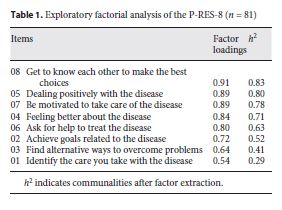
<body><![CDATA[<p>All statistical analyses were calculated using SPSS software (IBM SPSS Statistics    23.0). To test the dimensionality of the P-RES-8, an exploratory factor analysis    was conducted. Kolmogorov-Smirnov test results for each variable showed that    normality of data was not assured ( p &lt; 0.000). As a result, nonparametric    correlation tests (Spearman rank order correlation) were used for all analyses.    Statistical significance was considered as a p value of &lt; 0.05.</p>     <p>&nbsp;</p>     <p><b>Results</b></p>     <p>Patients had a mean age of 59.7 years (standard deviation (SD) 12.24), ranging    from 31 to 79 years, and 77.8% were women ( n = 63). The majority were married    or in a registered partnership (71.3%), 15% were widowed, and the remaining    were either single or divorced. Most had less than 9 years of education (62%),    and 16.5% had graduated. Nearly half of the participants were retired (44.4%),    27.2% were employed full time, and 14.8% were unemployed. Rheumatic diagnoses    were combined into the following groups, as proposed by the American Rheumatism    Association Nomenclature and Classification of Arthritis and Rheumatism (1983)    <sup><a href="#26">26</a></sup><a name="top26"></a>: diffuse connective tissue    diseases (50.6%), extraarticular disorders (24.7%, of which 22.2% were fibromyalgia),    spondyloarthritis (11.1%), osteoarthritis (9.9%), neurovascular disorders (2.5%),    and bone and cartilage disorders (1.2%). The mean illness duration of all patients    was 8.67 years (SD 9.24).</p>     <p>Regarding the exploratory factor analysis results of the P-RES-8, the Kaiser-Mayer-Olkin    index was 0.89, and Bartlett&rsquo;s sphericity test was significant, &chi;    <sup>2</sup> (28) = 499.64, p &lt; 0.001, indicating the adequacy of the data    for factor analytic procedures. The factorial free-extraction method was used,    and a 1-factor solution was suggested by application of the Scree test criterion.    The 8-item scale of the measure, which comprised only 1 factor (eigenvalue =    4.96), explained 62.04% of the total variance. Factor loadings and item communalities,    after the exploratory factor analysis, are presented in <a href="#t1">Table    1</a> .</p>     <p>&nbsp;</p> <a name="t1"></a> <img src="/img/revistas/pjph/v36n2/36n2a03t1.jpg">      
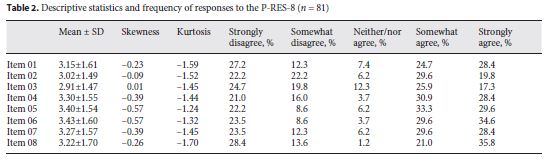
<p>&nbsp;</p>     <p>All the factor loadings obtained are higher than 0.50, and the communalities    are also satisfactory for all the 8 items of the scale. Internal consistency    was high (Cronbach&rsquo;s &alpha; = 0.94). Cronbach&rsquo;s &alpha; values,    if the item was deleted, varied between 0.91 (item 08) and 0.93 (item 01). All    inter-item correlations were significant ( p &lt; 0.001) and varied between    0.36 and 0.83. The frequencies and descriptive statistics (mean, SD, skewness,    and kurtosis) of the responses to each of the items of the P-RES-8 are presented    in <a href="#t2">Table 2</a> . The results show an acceptable variability of    response distribution to the scale items.</p>     <p>&nbsp;</p> <a name="t2"></a> <img src="/img/revistas/pjph/v36n2/36n2a03t2.jpg">      
<p>&nbsp;</p>     ]]></body>
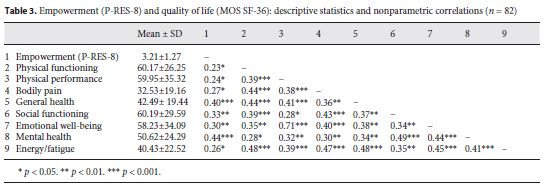
<body><![CDATA[<p><a href="#t3">Table 3</a> exhibits the means, SDs, and intercorrelation matrix    for empowerment and MOS SF-36 dimensions. The mean scores of the MOS SF-36 are    below 65% for all domains of this instrument. Therefore, the quality of life    assessed by the MOS SF-36 is revealed to be relatively low, in particular in    the bodily pain domain (mean 32.63). The empowerment measure P-RES-8 is positively    and significantly related to all the domains of quality of life, and all the    correlations are above 0.25. Particularly, the associations are stronger for    mental health ( r -<sub> s </sub> = 0.44, p &lt; 0.001) and general health perception    ( r -<sub> s </sub> = 0.40, p &lt; 0.001). Considering the correlations between    MOS SF-36 dimensions, the results show weak to moderate, significant and positive    associations between all variables, as expected by the authors of the Portuguese    version of the instrument <sup><a href="#27">27</a></sup><a name="top27"></a>.    Moreover, significant positive associations were also obtained between empowerment    and component summary scores of mental ( r -<sub> s </sub> = 0.36, p = 0.001)    and physical functioning ( r -<sub> s </sub> = 0.23, p = 0.043). Finally, associations    between empowerment and individual variables (patients&rsquo; education and    years after diagnosis) were analyzed. Results showed that empowerment is positively    associated with years of education ( r -<sub> s </sub> = 0.29, p = 0.009) and    years after diagnosis ( r -<sub> s </sub> = 0.29, p = 0.009).</p>     <p>&nbsp;</p> <a name="t3"></a> <img src="/img/revistas/pjph/v36n2/36n2a03t3.jpg">      
<p>&nbsp;</p>     <p><b>Discussion</b></p>     <p>The main purpose of this study was to provide support for the psychometric    qualities of an empowerment measure for patients with rheumatic diseases. Participants    in this study were mostly women, middle-aged, married, and with a low level    of education. The obtained results showed relatively low scores for all the    domains of the MOS SF-36, and pain was considered the most important domain    limiting quality of life, as suggested by previous research <sup><a href="#28">28</a></sup><a name="top28"></a>.</p>     <p>The construct validity of the P-RES-8 was confirmed because the 1-factor structure    of the P-RES-8 scale was obtained, in accordance with previous studies using    this health-related empowerment measure ( <sup><a href="#19">19</a></sup><a name="top19"></a>    , <sup><a href="#20">20</a></sup><a name="top20"></a> , <sup><a href="#23">23</a></sup><a name="top23"></a>    ). Moreover, internal consistency of the instrument was high. The criterion    validity of the P-RES-8 was supported by the direction and significance of the    associations found between patient empowerment and quality of life, also described    in other studies with patients with rheumatic disease <sup><a href="#22">22</a></sup><a name="top22"></a>.    In fact, empowerment was positively associated with all dimensions of patients&rsquo;    quality of life, which means that, as the sense of control in disease management    increases, so does patients&rsquo; perception of their quality of life. Particularly,    patients&rsquo; empowerment was moderately associated with the domains of mental    health and general health. This result highlights the importance of patients&rsquo;    perception of their own power and control over the disease in the appraisal    of general health and psychological state.</p>     <p>Additional evidence for the validity of the P-RES-8 is sustained by the correlations    between empowerment and other relevant variables. Specifically, higher levels    of empowerment were reported by patients with a higher education, which was    also found in the study by Anderson et al. <sup><a href="#18">18</a></sup><a name="top18"></a>    on patients with diabetes. Moreover, empowerment levels were positively correlated    with the duration of the disease. This finding may be explained by the increasing    use of more adaptive illness-related coping strategies over time, which contributes    to a perception of greater control over the disease.</p>     <p>This study has some limitations that should be taken into consideration when    interpreting the results. First, this is a cross-sectional and correlational    study which allows us to draw conclusions from the associations between variables    but not concerning cause-effect relations. Also, the representativeness of the    sample can be questioned due to its size, type (convenience sample), recruitment    hospitals, and demographic characteristics (e.g., gender, age, and education).    Finally, the sample comprises several rheumatic diagnoses with different symptoms    and impacts on patients&rsquo; quality of life. Nonetheless, to minimize the    disadvantages of using small samples in scale development, we intended to maximize    the sample size, particularly to ensure the variance of data conditions <sup><a href="#29">29</a></sup><a name="top29"></a>.    Further studies with other groups of rheumatic diseases, including 1-disease    samples, are required to confirm the factor structure and reliability of the    scale. Also, future studies should consider analyzing test-retest reliability    to assess how constant scores remain from one occasion to another <sup><a href="#29">29</a></sup><a name="top29"></a>.    Despite these limitations, as previously stated, the main purpose of this research    was to study the psychometric qualities of the P-RES-8, and the results are    adequate to conclude on the validity and fidelity of this measure. Furthermore,    the results obtained are consistent with other empirical findings reinforcing    the validity of the P-RES-8 scale in assessing the sense of empowerment in rheumatic    patients.</p>     <p>&nbsp;</p>     <p><b>Conclusion</b></p>     ]]></body>
<body><![CDATA[<p>Empowerment is recognized as a significant outcome of effective health-care    interventions in chronic disease ( <sup><a href="#17">17</a></sup><a name="top17"></a>    , <sup><a href="#30">30</a></sup><a name="top30"></a> , <sup><a href="#31">31</a></sup><a name="top31"></a>    ) as well as an important indicator of patients&rsquo; self-management and adjustment    to disease. This study provides preliminary support for the validity and reliability    of the P-RES-8 as a measure of perception of empowerment in patients with rheumatic    diseases. Further studies are needed to ensure that the instrument is appropriate    to assess the efficacy of health education programs.</p>     <p>&nbsp;</p>     <p><b>REFERENCES</b></p>     <p><Sup><a name="1"></a><a href="#top1">1</a></Sup> Rappaport J: Terms of empowerment/exemplars    of prevention: toward a theory for community psychology. Am J Community Psychol    1987; 15: 121&ndash;148. p. 122. </p>     <p><Sup><a name="2"></a><a href="#top2">2</a></Sup> Rogers ES, Chamberlin J, Ellison    ML, Crean T: A consumer-constructed scale to measure empowerment among users    of mental health services. Psychiatr Serv 1997; 48: 1042&ndash;1047. </p>     <p><Sup><a name="3"></a><a href="#top3">3</a></Sup> Rogers ES, Ralph RO, Salzer    MS: Validating the empowerment scale with a multisite sample of consumers of    mental health services. Psychiatr Serv 2010; 61: 933&ndash;936. </p>     <!-- ref --><p><Sup><a name="4"></a><a href="#top4">4</a></Sup> WHO: Health Promotion Glossary.    Geneva, World Health Organization, 1998. <a href="http://www.who.int/healthpromotion/about/HPR%20Glossary%201998.pdf" target="_blank">http://www.who.int/healthpromotion/about/HPR%20Glossary%201998.pdf</a>    (accessed July 26, 2016).    &nbsp;&nbsp;&nbsp;&nbsp;&nbsp;&nbsp;&nbsp;&nbsp;[&#160;<a href="javascript:void(0);" onclick="javascript: window.open('/scielo.php?script=sci_nlinks&ref=2093359&pid=S2504-3145201800020000300004&lng=','','width=640,height=500,resizable=yes,scrollbars=1,menubar=yes,');">Links</a>&#160;]<!-- end-ref --> </p>     <p><Sup><a name="5"></a><a href="#top5">5</a></Sup> Feste C, Anderson RM: Empowerment:    from philosophy to practice. Patient Educ Couns 1995; 26: 139&ndash;144. </p>     <p><Sup><a name="6"></a><a href="#top6">6</a></Sup> Anderson RM, Funnell MM: Patient    empowerment: myths and misconceptions. Patient Educ Couns 2010; 79: 277&ndash;282.  </p>     ]]></body>
<body><![CDATA[<p><Sup><a name="7"></a><a href="#top7">7</a></Sup> Barlow J, Wright C, Sheasby    J, Turner A, Hainsworth J: Self-management approaches for people with chronic    conditions: a review. Patient Educ Couns 2002; 48: 177&ndash;187. </p>     <p><Sup><a name="8"></a><a href="#top8">8</a></Sup> Gettings L: Psychological    well-being in rheumatoid arthritis: a review of the literature. Musculoskeletal    Care 2010; 8: 99&ndash;106. </p>     <p><Sup><a name="9"></a><a href="#top9">9</a></Sup> Anyfanti P, Gavriilaki E,    Pyrpasopoulou A, Triantafyllou G, Triantafyllou A, Chatzimichailidou S, et al:    Depression, anxiety, and quality of life in a large cohort of patients with    rheumatic diseases: common, yet undertreated. Clin Rheumatol 2016; 35: 733&ndash;739.  </p>     <p><Sup><a name="10"></a><a href="#top10">10</a></Sup> Duarte C, Abreu P, Couto    M, Vaz C, Malcata A, In&ecirc;s L: Health related quality of life in Portuguese    SLE patients: an outcome measure independent of disease activity and cumulative    damage. Acta Reumatol Port 2010; 35: 30&ndash;35. </p>     <p><Sup><a name="11"></a><a href="#top11">11</a></Sup> Kool MB, Geenen R: Loneliness    in patients with rheumatic diseases: the significance of invalidation and lack    of social support. J Psychol 2012; 146: 229&ndash;241. </p>     <p><Sup><a name="12"></a><a href="#top12">12</a></Sup> Lessinck ML, Burdorf A,    Boonen A, Gignac MA, Hazes JM, Luime JJ: Consequences of inflammatory arthritis    for workplace productivity loss and sick leave: a systematic review. Ann Rheum    Dis 2013; 72: 493&ndash;505. </p>     <p><Sup><a name="13"></a><a href="#top13">13</a></Sup> Ramos-Remus C, Salcedo-Rocha    AL, Prieto RE, Galvan-Villegas F: How important is patient education? Best Pract    Res Clin Rheumatol 2000; 14: 689&ndash;703. </p>     <p><Sup><a name="14"></a><a href="#top14">14</a></Sup> Hill J: An overview of    education for patients with rheumatic diseases. Nurs Times 2003; 99: 26&ndash;27.  </p>     <!-- ref --><p><Sup><a name="15"></a><a href="#top15">15</a></Sup> Barr PJ, Scholl I, Bravo    P, Faber MJ, Elwyn G, McAllister M: Assessment of patient empowerment: a systematic    review of measures. PLoS One 2015; 10:e0126553.    &nbsp;&nbsp;&nbsp;&nbsp;&nbsp;&nbsp;&nbsp;&nbsp;[&#160;<a href="javascript:void(0);" onclick="javascript: window.open('/scielo.php?script=sci_nlinks&ref=2093371&pid=S2504-3145201800020000300015&lng=','','width=640,height=500,resizable=yes,scrollbars=1,menubar=yes,');">Links</a>&#160;]<!-- end-ref --> </p>     ]]></body>
<body><![CDATA[<p><Sup><a name="16"></a><a href="#top16">16</a></Sup> Herbert RJ, Gagnon AJ,    Rennick JE, O&rsquo;Loughlin JL: A systematic review of questionnaires measuring    health-related empowerment. Res Theory Nurs Pract 2009; 23: 107&ndash;132. </p>     <!-- ref --><p><Sup><a name="17"></a><a href="#top17">17</a></Sup> McAllister M, Dunn G, Payne    K, Davies L, Todd C: Patient empowerment: the need to consider it as a measurable    patient-reported outcome for chronic conditions. BMC Health Serv Res 2012; 12:    157.    &nbsp;&nbsp;&nbsp;&nbsp;&nbsp;&nbsp;&nbsp;&nbsp;[&#160;<a href="javascript:void(0);" onclick="javascript: window.open('/scielo.php?script=sci_nlinks&ref=2093374&pid=S2504-3145201800020000300017&lng=','','width=640,height=500,resizable=yes,scrollbars=1,menubar=yes,');">Links</a>&#160;]<!-- end-ref --> </p>     <p><Sup><a name="18"></a><a href="#top18">18</a></Sup> Anderson RM, Funnell MM,    Fitzgerald JT, Marrero DG: The Diabetes Empowerment Scale: a measure of psychosocial    self-efficacy. Diabetes Care 2000; 23: 739&ndash;743. </p>     <p><Sup><a name="19"></a><a href="#top19">19</a></Sup> Anderson RM, Fitzgerald    JT, Gruppen LD, Funnel MM, Oh MS: The Diabetes Empowerment Scale-Short Form    (DES-SF). Diabetes Care 2003; 26: 1641&ndash;1642. </p>     <p><Sup><a name="20"></a><a href="#top20">20</a></Sup> Aveiro M, Santiago LM,    Ferreira PL, Sim&otilde;es JA: Fiability study of Diabetes Empowerment Scale:    short version (in Portuguese). Acta Med Port 2015; 28: 177&ndash;181. </p>     <p><Sup><a name="21"></a><a href="#top21">21</a></Sup> Tsay SL, Hung LO: Empowerment    of patients with end-stage renal disease: a randomized controlled trial. Int    J Nurs Stud 2004; 41: 59&ndash;65. </p>     <p><Sup><a name="22"></a><a href="#top22">22</a></Sup> Arvidsson S, Bergman S,    Arvidsson B, Fridlund B, Tingsr&ouml;m P: Psychometric properties of the Swedish    Rheumatic Disease Empowerment Scale, SWE-RES-23. Musculoskeletal Care 2012;    10: 101&ndash;109. </p>     <p><Sup><a name="23"></a><a href="#top23">23</a></Sup> Park C, Park YH: Validity    and reliability of Korean version of health empowerment scale (K-HES) for older    adults. Asian Nurs Res 2013; 7: 142&ndash;148. </p>     <p><Sup><a name="24"></a><a href="#top24">24</a></Sup> Baba S, Katsumata Y, Okamoto    Y, Kawaguchi Y, Hanaoka M, Kawasumi H, et al: Reliability of the SF-36 in Japanese    patients with systemic lupus erythematosus and its associations with disease    activity and damage: a two-consecutive year prospective study. Lupus 2018; 27:    407&ndash;416. </p>     ]]></body>
<body><![CDATA[<!-- ref --><p><Sup><a name="25"></a><a href="#top25">25</a></Sup> Klooster PM, Vonkema HE,    Taal E, Siemons L, Hendriks L, Jong AJ, et al: Performance of the Dutch SF-36    version 2 as a measure of health-related quality of life in patients with rheumatoid    arthritis. Health Qual Life Outcomes 2013; 11: 77.    &nbsp;&nbsp;&nbsp;&nbsp;&nbsp;&nbsp;&nbsp;&nbsp;[&#160;<a href="javascript:void(0);" onclick="javascript: window.open('/scielo.php?script=sci_nlinks&ref=2093383&pid=S2504-3145201800020000300025&lng=','','width=640,height=500,resizable=yes,scrollbars=1,menubar=yes,');">Links</a>&#160;]<!-- end-ref --> </p>     <p><Sup><a name="26"></a><a href="#top26">26</a></Sup> Decker JL: American Rheumatism    Association nomenclature and classification of arthritis and rheumatism (1983).    Arthritis Rheum 1983; 26: 1029&ndash;1032. </p>     <p><Sup><a name="27"></a><a href="#top27">27</a></Sup> Ferreira PL: Development    of the Portuguese version of MOS SF-36. Part I. Cultural and linguistic adaptation.    Acta Med Port 2000; 13: 55&ndash;66. </p>     <p><Sup><a name="28"></a><a href="#top28">28</a></Sup> Leino-Kilpi H, Maenpaa    I, Katajisto J: Nursing study of the significance of rheumatoid arthritis as    perceived by patients using the concept of empowerment. J Orthop Nurs 1999;    3: 138&ndash;145. </p>     <!-- ref --><p><Sup><a name="29"></a><a href="#top29">29</a></Sup> DeVellis FR: Scale Development:    Theory and Applications, ed 4. Thousand Oaks, Sage, 2016.    &nbsp;&nbsp;&nbsp;&nbsp;&nbsp;&nbsp;&nbsp;&nbsp;[&#160;<a href="javascript:void(0);" onclick="javascript: window.open('/scielo.php?script=sci_nlinks&ref=2093388&pid=S2504-3145201800020000300029&lng=','','width=640,height=500,resizable=yes,scrollbars=1,menubar=yes,');">Links</a>&#160;]<!-- end-ref --> </p>     <p><Sup><a name="30"></a><a href="#top30">30</a></Sup> Evers AW, Zautra A, Thieme    K: Stress and resilience in rheumatic diseases: a review and glimpse into the    future. Nat Rev Rheumatol 2011; 7: 409&ndash;415. </p>     <p><Sup><a name="31"></a><a href="#top31">31</a></Sup> Anderson RM, Funnel MM,    Butler PM, Arnold MS, Fitzgerald JT, Feste CC: Patient empowerment: results    of a randomized controlled trial. Diabetes Care 1995; 18: 943&ndash;949.algorithms.</p>     <p>&nbsp;</p>     ]]></body>
<body><![CDATA[<p>Received: January 24, 2018. Accepted: June 5, 2018</p>      ]]></body><back>
<ref-list>
<ref id="B1">
<nlm-citation citation-type="journal">
<person-group person-group-type="author">
<name>
<surname><![CDATA[Rappaport]]></surname>
<given-names><![CDATA[J]]></given-names>
</name>
</person-group>
<article-title xml:lang="en"><![CDATA[Terms of empowerment/exemplars of prevention: toward a theory for community psychology]]></article-title>
<source><![CDATA[Am J Community Psychol]]></source>
<year>1987</year>
<volume>15</volume>
<numero>121–148</numero>
<issue>121–148</issue>
<page-range>122</page-range></nlm-citation>
</ref>
<ref id="B2">
<nlm-citation citation-type="journal">
<person-group person-group-type="author">
<name>
<surname><![CDATA[Rogers]]></surname>
<given-names><![CDATA[ES]]></given-names>
</name>
<name>
<surname><![CDATA[Chamberlin]]></surname>
<given-names><![CDATA[J]]></given-names>
</name>
<name>
<surname><![CDATA[Ellison]]></surname>
<given-names><![CDATA[ML]]></given-names>
</name>
<name>
<surname><![CDATA[Crean]]></surname>
<given-names><![CDATA[T]]></given-names>
</name>
</person-group>
<article-title xml:lang="en"><![CDATA[A consumer-constructed scale to measure empowerment among users of mental health services]]></article-title>
<source><![CDATA[Psychiatr Serv]]></source>
<year>1997</year>
<volume>48</volume>
<page-range>1042–1047</page-range></nlm-citation>
</ref>
<ref id="B3">
<nlm-citation citation-type="journal">
<person-group person-group-type="author">
<name>
<surname><![CDATA[Rogers]]></surname>
<given-names><![CDATA[ES]]></given-names>
</name>
<name>
<surname><![CDATA[Ralph]]></surname>
<given-names><![CDATA[RO]]></given-names>
</name>
<name>
<surname><![CDATA[Salzer]]></surname>
<given-names><![CDATA[MS]]></given-names>
</name>
</person-group>
<article-title xml:lang="en"><![CDATA[Validating the empowerment scale with a multisite sample of consumers of mental health services]]></article-title>
<source><![CDATA[Psychiatr Serv]]></source>
<year>2010</year>
<volume>61</volume>
<page-range>933–936</page-range></nlm-citation>
</ref>
<ref id="B4">
<nlm-citation citation-type="book">
<collab>WHO</collab>
<source><![CDATA[Health Promotion Glossary]]></source>
<year>1998</year>
<publisher-loc><![CDATA[Geneva ]]></publisher-loc>
<publisher-name><![CDATA[World Health Organization]]></publisher-name>
</nlm-citation>
</ref>
<ref id="B5">
<nlm-citation citation-type="journal">
<person-group person-group-type="author">
<name>
<surname><![CDATA[Feste]]></surname>
<given-names><![CDATA[C]]></given-names>
</name>
<name>
<surname><![CDATA[Anderson]]></surname>
<given-names><![CDATA[RM]]></given-names>
</name>
</person-group>
<article-title xml:lang="en"><![CDATA[Empowerment: from philosophy to practice]]></article-title>
<source><![CDATA[Patient Educ Couns]]></source>
<year>1995</year>
<volume>26</volume>
<page-range>139–144</page-range></nlm-citation>
</ref>
<ref id="B6">
<nlm-citation citation-type="journal">
<person-group person-group-type="author">
<name>
<surname><![CDATA[Anderson]]></surname>
<given-names><![CDATA[RM]]></given-names>
</name>
<name>
<surname><![CDATA[Funnell]]></surname>
<given-names><![CDATA[MM]]></given-names>
</name>
</person-group>
<article-title xml:lang="en"><![CDATA[Patient empowerment: myths and misconceptions]]></article-title>
<source><![CDATA[Patient Educ Couns]]></source>
<year>2010</year>
<volume>79</volume>
<page-range>277–282</page-range></nlm-citation>
</ref>
<ref id="B7">
<nlm-citation citation-type="journal">
<person-group person-group-type="author">
<name>
<surname><![CDATA[Barlow]]></surname>
<given-names><![CDATA[J]]></given-names>
</name>
<name>
<surname><![CDATA[Wright]]></surname>
<given-names><![CDATA[C]]></given-names>
</name>
<name>
<surname><![CDATA[Sheasby]]></surname>
<given-names><![CDATA[J]]></given-names>
</name>
<name>
<surname><![CDATA[Turner]]></surname>
<given-names><![CDATA[A]]></given-names>
</name>
<name>
<surname><![CDATA[Hainsworth]]></surname>
<given-names><![CDATA[J]]></given-names>
</name>
</person-group>
<article-title xml:lang="en"><![CDATA[Self-management approaches for people with chronic conditions: a review]]></article-title>
<source><![CDATA[Patient Educ Couns]]></source>
<year>2002</year>
<volume>48</volume>
<page-range>177–187</page-range></nlm-citation>
</ref>
<ref id="B8">
<nlm-citation citation-type="journal">
<person-group person-group-type="author">
<name>
<surname><![CDATA[Gettings]]></surname>
<given-names><![CDATA[L]]></given-names>
</name>
</person-group>
<article-title xml:lang="en"><![CDATA[Psychological well-being in rheumatoid arthritis: a review of the literature]]></article-title>
<source><![CDATA[Musculoskeletal Care]]></source>
<year>2010</year>
<volume>8</volume>
<page-range>99–106</page-range></nlm-citation>
</ref>
<ref id="B9">
<nlm-citation citation-type="journal">
<person-group person-group-type="author">
<name>
<surname><![CDATA[Anyfanti]]></surname>
<given-names><![CDATA[P]]></given-names>
</name>
<name>
<surname><![CDATA[Gavriilaki]]></surname>
<given-names><![CDATA[E]]></given-names>
</name>
<name>
<surname><![CDATA[Pyrpasopoulou]]></surname>
<given-names><![CDATA[A]]></given-names>
</name>
<name>
<surname><![CDATA[Triantafyllou]]></surname>
<given-names><![CDATA[G]]></given-names>
</name>
<name>
<surname><![CDATA[Triantafyllou]]></surname>
<given-names><![CDATA[A]]></given-names>
</name>
<name>
<surname><![CDATA[Chatzimichailidou]]></surname>
<given-names><![CDATA[S]]></given-names>
</name>
</person-group>
<article-title xml:lang="en"><![CDATA[Depression, anxiety, and quality of life in a large cohort of patients with rheumatic diseases: common, yet undertreated]]></article-title>
<source><![CDATA[Clin Rheumatol]]></source>
<year>2016</year>
<volume>35</volume>
<page-range>733–739</page-range></nlm-citation>
</ref>
<ref id="B10">
<nlm-citation citation-type="journal">
<person-group person-group-type="author">
<name>
<surname><![CDATA[Duarte]]></surname>
<given-names><![CDATA[C]]></given-names>
</name>
<name>
<surname><![CDATA[Abreu]]></surname>
<given-names><![CDATA[P]]></given-names>
</name>
<name>
<surname><![CDATA[Couto]]></surname>
<given-names><![CDATA[M]]></given-names>
</name>
<name>
<surname><![CDATA[Vaz]]></surname>
<given-names><![CDATA[C]]></given-names>
</name>
<name>
<surname><![CDATA[Malcata]]></surname>
<given-names><![CDATA[A]]></given-names>
</name>
<name>
<surname><![CDATA[Inês]]></surname>
<given-names><![CDATA[L]]></given-names>
</name>
</person-group>
<article-title xml:lang="en"><![CDATA[Health related quality of life in Portuguese SLE patients: an outcome measure independent of disease activity and cumulative damage]]></article-title>
<source><![CDATA[Acta Reumatol Port]]></source>
<year>2010</year>
<volume>35</volume>
<page-range>30–35</page-range></nlm-citation>
</ref>
<ref id="B11">
<nlm-citation citation-type="journal">
<person-group person-group-type="author">
<name>
<surname><![CDATA[Kool]]></surname>
<given-names><![CDATA[MB]]></given-names>
</name>
<name>
<surname><![CDATA[Geenen]]></surname>
<given-names><![CDATA[R]]></given-names>
</name>
</person-group>
<article-title xml:lang="en"><![CDATA[Loneliness in patients with rheumatic diseases: the significance of invalidation and lack of social support]]></article-title>
<source><![CDATA[J Psychol]]></source>
<year>2012</year>
<volume>146</volume>
<page-range>229–241</page-range></nlm-citation>
</ref>
<ref id="B12">
<nlm-citation citation-type="journal">
<person-group person-group-type="author">
<name>
<surname><![CDATA[Lessinck]]></surname>
<given-names><![CDATA[ML]]></given-names>
</name>
<name>
<surname><![CDATA[Burdorf]]></surname>
<given-names><![CDATA[A]]></given-names>
</name>
<name>
<surname><![CDATA[Boonen]]></surname>
<given-names><![CDATA[A]]></given-names>
</name>
<name>
<surname><![CDATA[Gignac]]></surname>
<given-names><![CDATA[MA]]></given-names>
</name>
<name>
<surname><![CDATA[Hazes]]></surname>
<given-names><![CDATA[JM]]></given-names>
</name>
<name>
<surname><![CDATA[Luime]]></surname>
<given-names><![CDATA[JJ]]></given-names>
</name>
</person-group>
<article-title xml:lang="en"><![CDATA[Consequences of inflammatory arthritis for workplace productivity loss and sick leave: a systematic review]]></article-title>
<source><![CDATA[Ann Rheum Dis]]></source>
<year>2013</year>
<volume>72</volume>
<page-range>493–505</page-range></nlm-citation>
</ref>
<ref id="B13">
<nlm-citation citation-type="journal">
<person-group person-group-type="author">
<name>
<surname><![CDATA[Ramos-Remus]]></surname>
<given-names><![CDATA[C]]></given-names>
</name>
<name>
<surname><![CDATA[Salcedo-Rocha]]></surname>
<given-names><![CDATA[AL]]></given-names>
</name>
<name>
<surname><![CDATA[Prieto]]></surname>
<given-names><![CDATA[RE]]></given-names>
</name>
<name>
<surname><![CDATA[Galvan-Villegas]]></surname>
<given-names><![CDATA[F]]></given-names>
</name>
</person-group>
<article-title xml:lang="en"><![CDATA[How important is patient education?]]></article-title>
<source><![CDATA[Best Pract Res Clin Rheumatol]]></source>
<year>2000</year>
<volume>14</volume>
<page-range>689–703</page-range></nlm-citation>
</ref>
<ref id="B14">
<nlm-citation citation-type="journal">
<person-group person-group-type="author">
<name>
<surname><![CDATA[Hill]]></surname>
<given-names><![CDATA[J]]></given-names>
</name>
</person-group>
<article-title xml:lang="en"><![CDATA[An overview of education for patients with rheumatic diseases]]></article-title>
<source><![CDATA[Nurs Times]]></source>
<year>2003</year>
<volume>99</volume>
<page-range>26–27</page-range></nlm-citation>
</ref>
<ref id="B15">
<nlm-citation citation-type="journal">
<person-group person-group-type="author">
<name>
<surname><![CDATA[Barr]]></surname>
<given-names><![CDATA[PJ]]></given-names>
</name>
<name>
<surname><![CDATA[Scholl]]></surname>
<given-names><![CDATA[I]]></given-names>
</name>
<name>
<surname><![CDATA[Bravo]]></surname>
<given-names><![CDATA[P]]></given-names>
</name>
<name>
<surname><![CDATA[Faber]]></surname>
<given-names><![CDATA[MJ]]></given-names>
</name>
<name>
<surname><![CDATA[Elwyn]]></surname>
<given-names><![CDATA[G]]></given-names>
</name>
<name>
<surname><![CDATA[McAllister]]></surname>
<given-names><![CDATA[M]]></given-names>
</name>
</person-group>
<article-title xml:lang="en"><![CDATA[Assessment of patient empowerment: a systematic review of measures]]></article-title>
<source><![CDATA[PLoS One]]></source>
<year>2015</year>
</nlm-citation>
</ref>
<ref id="B16">
<nlm-citation citation-type="journal">
<person-group person-group-type="author">
<name>
<surname><![CDATA[Herbert]]></surname>
<given-names><![CDATA[RJ]]></given-names>
</name>
<name>
<surname><![CDATA[Gagnon]]></surname>
<given-names><![CDATA[AJ]]></given-names>
</name>
<name>
<surname><![CDATA[Rennick]]></surname>
<given-names><![CDATA[JE]]></given-names>
</name>
<name>
<surname><![CDATA[O’Loughlin]]></surname>
<given-names><![CDATA[JL]]></given-names>
</name>
</person-group>
<article-title xml:lang="en"><![CDATA[A systematic review of questionnaires measuring health-related empowerment]]></article-title>
<source><![CDATA[Res Theory Nurs Pract]]></source>
<year>2009</year>
<volume>23</volume>
<page-range>107–132</page-range></nlm-citation>
</ref>
<ref id="B17">
<nlm-citation citation-type="journal">
<person-group person-group-type="author">
<name>
<surname><![CDATA[McAllister]]></surname>
<given-names><![CDATA[M]]></given-names>
</name>
<name>
<surname><![CDATA[Dunn]]></surname>
<given-names><![CDATA[G]]></given-names>
</name>
<name>
<surname><![CDATA[Payne]]></surname>
<given-names><![CDATA[K]]></given-names>
</name>
<name>
<surname><![CDATA[Davies]]></surname>
<given-names><![CDATA[L]]></given-names>
</name>
<name>
<surname><![CDATA[Todd]]></surname>
<given-names><![CDATA[C]]></given-names>
</name>
</person-group>
<article-title xml:lang="en"><![CDATA[Patient empowerment: the need to consider it as a measurable patient-reported outcome for chronic conditions]]></article-title>
<source><![CDATA[BMC Health Serv Res]]></source>
<year>2012</year>
<volume>12</volume>
<numero>157</numero>
<issue>157</issue>
</nlm-citation>
</ref>
<ref id="B18">
<nlm-citation citation-type="journal">
<person-group person-group-type="author">
<name>
<surname><![CDATA[Anderson]]></surname>
<given-names><![CDATA[RM]]></given-names>
</name>
<name>
<surname><![CDATA[Funnell]]></surname>
<given-names><![CDATA[MM]]></given-names>
</name>
<name>
<surname><![CDATA[Fitzgerald]]></surname>
<given-names><![CDATA[JT]]></given-names>
</name>
<name>
<surname><![CDATA[Marrero]]></surname>
<given-names><![CDATA[DG]]></given-names>
</name>
</person-group>
<article-title xml:lang="en"><![CDATA[The Diabetes Empowerment Scale: a measure of psychosocial self-efficacy]]></article-title>
<source><![CDATA[Diabetes Care]]></source>
<year>2000</year>
<volume>23</volume>
<page-range>739–743</page-range></nlm-citation>
</ref>
<ref id="B19">
<nlm-citation citation-type="journal">
<person-group person-group-type="author">
<name>
<surname><![CDATA[Anderson]]></surname>
<given-names><![CDATA[RM]]></given-names>
</name>
<name>
<surname><![CDATA[Fitzgerald]]></surname>
<given-names><![CDATA[JT]]></given-names>
</name>
<name>
<surname><![CDATA[Gruppen]]></surname>
<given-names><![CDATA[LD]]></given-names>
</name>
<name>
<surname><![CDATA[Funnel]]></surname>
<given-names><![CDATA[MM]]></given-names>
</name>
<name>
<surname><![CDATA[Oh]]></surname>
<given-names><![CDATA[MS]]></given-names>
</name>
</person-group>
<article-title xml:lang="en"><![CDATA[The Diabetes Empowerment Scale-Short Form (DES-SF)]]></article-title>
<source><![CDATA[Diabetes Care]]></source>
<year>2003</year>
<volume>26</volume>
<page-range>1641–1642</page-range></nlm-citation>
</ref>
<ref id="B20">
<nlm-citation citation-type="journal">
<person-group person-group-type="author">
<name>
<surname><![CDATA[Aveiro]]></surname>
<given-names><![CDATA[M]]></given-names>
</name>
<name>
<surname><![CDATA[Santiago]]></surname>
<given-names><![CDATA[LM]]></given-names>
</name>
<name>
<surname><![CDATA[Ferreira]]></surname>
<given-names><![CDATA[PL]]></given-names>
</name>
<name>
<surname><![CDATA[Simões]]></surname>
<given-names><![CDATA[JA]]></given-names>
</name>
</person-group>
<article-title xml:lang="en"><![CDATA[Fiability study of Diabetes Empowerment Scale: short version (in Portuguese)]]></article-title>
<source><![CDATA[Acta Med Port]]></source>
<year>2015</year>
<volume>28</volume>
<page-range>177–181</page-range></nlm-citation>
</ref>
<ref id="B21">
<nlm-citation citation-type="journal">
<person-group person-group-type="author">
<name>
<surname><![CDATA[Tsay]]></surname>
<given-names><![CDATA[SL]]></given-names>
</name>
<name>
<surname><![CDATA[Hung]]></surname>
<given-names><![CDATA[LO]]></given-names>
</name>
</person-group>
<article-title xml:lang="en"><![CDATA[Empowerment of patients with end-stage renal disease: a randomized controlled trial]]></article-title>
<source><![CDATA[Int J Nurs Stud]]></source>
<year>2004</year>
<volume>41</volume>
<page-range>59–65</page-range></nlm-citation>
</ref>
<ref id="B22">
<nlm-citation citation-type="journal">
<person-group person-group-type="author">
<name>
<surname><![CDATA[Arvidsson]]></surname>
<given-names><![CDATA[S]]></given-names>
</name>
<name>
<surname><![CDATA[Bergman]]></surname>
<given-names><![CDATA[S]]></given-names>
</name>
<name>
<surname><![CDATA[Arvidsson]]></surname>
<given-names><![CDATA[B]]></given-names>
</name>
<name>
<surname><![CDATA[Fridlund]]></surname>
<given-names><![CDATA[B]]></given-names>
</name>
<name>
<surname><![CDATA[Tingsröm]]></surname>
<given-names><![CDATA[P]]></given-names>
</name>
</person-group>
<article-title xml:lang="en"><![CDATA[Psychometric properties of the Swedish Rheumatic Disease Empowerment Scale, SWE-RES-23]]></article-title>
<source><![CDATA[Musculoskeletal Care]]></source>
<year>2012</year>
<volume>10</volume>
<page-range>101–109</page-range></nlm-citation>
</ref>
<ref id="B23">
<nlm-citation citation-type="journal">
<person-group person-group-type="author">
<name>
<surname><![CDATA[Park]]></surname>
<given-names><![CDATA[C,]]></given-names>
</name>
<name>
<surname><![CDATA[Park]]></surname>
<given-names><![CDATA[YH]]></given-names>
</name>
</person-group>
<article-title xml:lang="en"><![CDATA[Validity and reliability of Korean version of health empowerment scale (K-HES) for older adults]]></article-title>
<source><![CDATA[Asian Nurs Res]]></source>
<year>2013</year>
<volume>7</volume>
<page-range>142–148</page-range></nlm-citation>
</ref>
<ref id="B24">
<nlm-citation citation-type="journal">
<person-group person-group-type="author">
<name>
<surname><![CDATA[Baba]]></surname>
<given-names><![CDATA[S]]></given-names>
</name>
<name>
<surname><![CDATA[Katsumata]]></surname>
<given-names><![CDATA[Y]]></given-names>
</name>
<name>
<surname><![CDATA[Okamoto]]></surname>
<given-names><![CDATA[Y]]></given-names>
</name>
<name>
<surname><![CDATA[Kawaguchi]]></surname>
<given-names><![CDATA[Y]]></given-names>
</name>
<name>
<surname><![CDATA[Hanaoka]]></surname>
<given-names><![CDATA[M]]></given-names>
</name>
<name>
<surname><![CDATA[Kawasumi]]></surname>
<given-names><![CDATA[H]]></given-names>
</name>
</person-group>
<article-title xml:lang="en"><![CDATA[Reliability of the SF-36 in Japanese patients with systemic lupus erythematosus and its associations with disease activity and damage: a two-consecutive year prospective study]]></article-title>
<source><![CDATA[Lupus]]></source>
<year>2018</year>
<volume>27</volume>
<page-range>407–416</page-range></nlm-citation>
</ref>
<ref id="B25">
<nlm-citation citation-type="journal">
<person-group person-group-type="author">
<name>
<surname><![CDATA[Klooster]]></surname>
<given-names><![CDATA[PM]]></given-names>
</name>
<name>
<surname><![CDATA[Vonkema]]></surname>
<given-names><![CDATA[HE]]></given-names>
</name>
<name>
<surname><![CDATA[Taal]]></surname>
<given-names><![CDATA[E]]></given-names>
</name>
<name>
<surname><![CDATA[Siemons]]></surname>
<given-names><![CDATA[L]]></given-names>
</name>
<name>
<surname><![CDATA[Hendriks]]></surname>
<given-names><![CDATA[L]]></given-names>
</name>
<name>
<surname><![CDATA[Jong]]></surname>
<given-names><![CDATA[AJ]]></given-names>
</name>
</person-group>
<article-title xml:lang="en"><![CDATA[Performance of the Dutch SF-36 version 2 as a measure of health-related quality of life in patients with rheumatoid arthritis]]></article-title>
<source><![CDATA[Health Qual Life Outcomes]]></source>
<year>2013</year>
<volume>11</volume>
<numero>77</numero>
<issue>77</issue>
</nlm-citation>
</ref>
<ref id="B26">
<nlm-citation citation-type="journal">
<person-group person-group-type="author">
<name>
<surname><![CDATA[Decker]]></surname>
<given-names><![CDATA[JL]]></given-names>
</name>
</person-group>
<article-title xml:lang="en"><![CDATA[American Rheumatism Association nomenclature and classification of arthritis and rheumatism (1983)]]></article-title>
<source><![CDATA[Arthritis Rheum]]></source>
<year>1983</year>
<volume>26</volume>
<page-range>1029–1032</page-range></nlm-citation>
</ref>
<ref id="B27">
<nlm-citation citation-type="journal">
<person-group person-group-type="author">
<name>
<surname><![CDATA[Ferreira]]></surname>
<given-names><![CDATA[PL]]></given-names>
</name>
</person-group>
<article-title xml:lang="en"><![CDATA[Development of the Portuguese version of MOS SF-36. Part I. Cultural and linguistic adaptation]]></article-title>
<source><![CDATA[Acta Med Port]]></source>
<year>2000</year>
<volume>13</volume>
<page-range>55–66</page-range></nlm-citation>
</ref>
<ref id="B28">
<nlm-citation citation-type="journal">
<person-group person-group-type="author">
<name>
<surname><![CDATA[Leino-Kilpi]]></surname>
<given-names><![CDATA[H]]></given-names>
</name>
<name>
<surname><![CDATA[Maenpaa]]></surname>
<given-names><![CDATA[I]]></given-names>
</name>
<name>
<surname><![CDATA[Katajisto]]></surname>
<given-names><![CDATA[J]]></given-names>
</name>
</person-group>
<article-title xml:lang="en"><![CDATA[Nursing study of the significance of rheumatoid arthritis as perceived by patients using the concept of empowerment]]></article-title>
<source><![CDATA[J Orthop Nurs]]></source>
<year>1999</year>
<volume>3</volume>
<page-range>138–145</page-range></nlm-citation>
</ref>
<ref id="B29">
<nlm-citation citation-type="book">
<person-group person-group-type="author">
<name>
<surname><![CDATA[DeVellis]]></surname>
<given-names><![CDATA[FR]]></given-names>
</name>
</person-group>
<source><![CDATA[Scale Development: Theory and Applications]]></source>
<year>2016</year>
<edition>4</edition>
<publisher-loc><![CDATA[Thousand Oaks ]]></publisher-loc>
<publisher-name><![CDATA[Sage]]></publisher-name>
</nlm-citation>
</ref>
<ref id="B30">
<nlm-citation citation-type="journal">
<person-group person-group-type="author">
<name>
<surname><![CDATA[Evers]]></surname>
<given-names><![CDATA[AW]]></given-names>
</name>
<name>
<surname><![CDATA[Zautra]]></surname>
<given-names><![CDATA[A]]></given-names>
</name>
<name>
<surname><![CDATA[Thieme]]></surname>
<given-names><![CDATA[K]]></given-names>
</name>
</person-group>
<article-title xml:lang="en"><![CDATA[Stress and resilience in rheumatic diseases: a review and glimpse into the future]]></article-title>
<source><![CDATA[Nat Rev Rheumatol]]></source>
<year>2011</year>
<volume>7</volume>
<page-range>409–415</page-range></nlm-citation>
</ref>
<ref id="B31">
<nlm-citation citation-type="journal">
<person-group person-group-type="author">
<name>
<surname><![CDATA[Anderson]]></surname>
<given-names><![CDATA[RM]]></given-names>
</name>
<name>
<surname><![CDATA[Funnel]]></surname>
<given-names><![CDATA[MM]]></given-names>
</name>
<name>
<surname><![CDATA[Butler]]></surname>
<given-names><![CDATA[PM]]></given-names>
</name>
<name>
<surname><![CDATA[Arnold]]></surname>
<given-names><![CDATA[MS]]></given-names>
</name>
<name>
<surname><![CDATA[Fitzgerald]]></surname>
<given-names><![CDATA[JT]]></given-names>
</name>
<name>
<surname><![CDATA[Feste]]></surname>
<given-names><![CDATA[CC]]></given-names>
</name>
</person-group>
<article-title xml:lang="en"><![CDATA[Patient empowerment: results of a randomized controlled trial]]></article-title>
<source><![CDATA[Diabetes Care]]></source>
<year>1995</year>
<volume>18</volume>
<page-range>943–949</page-range></nlm-citation>
</ref>
</ref-list>
</back>
</article>