<?xml version="1.0" encoding="ISO-8859-1"?><article xmlns:mml="http://www.w3.org/1998/Math/MathML" xmlns:xlink="http://www.w3.org/1999/xlink" xmlns:xsi="http://www.w3.org/2001/XMLSchema-instance">
<front>
<journal-meta>
<journal-id>2504-3145</journal-id>
<journal-title><![CDATA[Portuguese Journal of Public Health]]></journal-title>
<abbrev-journal-title><![CDATA[Port J Public Health]]></abbrev-journal-title>
<issn>2504-3145</issn>
<publisher>
<publisher-name><![CDATA[Escola Nacional de Saúde Pública]]></publisher-name>
</publisher>
</journal-meta>
<article-meta>
<article-id>S2504-31452018000300002</article-id>
<article-id pub-id-type="doi">10.1159/000495803</article-id>
<title-group>
<article-title xml:lang="en"><![CDATA[Mediterranean Diet Index (KIDMED) Adherence, Socioeconomic Determinants, and Nutritional Status of Portuguese Children: The Eat Mediterranean Program]]></article-title>
<article-title xml:lang="pt"><![CDATA[Adesão à Dieta Mediterrânica (índice KIDMED), determinantes socioeconómicos e estado nutricional das crianças Portuguesas: Programa Eat Mediterranean]]></article-title>
</title-group>
<contrib-group>
<contrib contrib-type="author">
<name>
<surname><![CDATA[Rito]]></surname>
<given-names><![CDATA[Ana Isabel]]></given-names>
</name>
<xref ref-type="aff" rid="A1 "/>
</contrib>
<contrib contrib-type="author">
<name>
<surname><![CDATA[Dinis]]></surname>
<given-names><![CDATA[Ana]]></given-names>
</name>
<xref ref-type="aff" rid="A3"/>
</contrib>
<contrib contrib-type="author">
<name>
<surname><![CDATA[Rascôa]]></surname>
<given-names><![CDATA[Carla]]></given-names>
</name>
<xref ref-type="aff" rid="A3"/>
</contrib>
<contrib contrib-type="author">
<name>
<surname><![CDATA[Maia]]></surname>
<given-names><![CDATA[António]]></given-names>
</name>
<xref ref-type="aff" rid="A3"/>
</contrib>
<contrib contrib-type="author">
<name>
<surname><![CDATA[Mendes]]></surname>
<given-names><![CDATA[Sofia]]></given-names>
</name>
<xref ref-type="aff" rid="A2"/>
</contrib>
<contrib contrib-type="author">
<name>
<surname><![CDATA[Novais]]></surname>
<given-names><![CDATA[Camila Stein]]></given-names>
</name>
<xref ref-type="aff" rid="A3"/>
</contrib>
<contrib contrib-type="author">
<name>
<surname><![CDATA[Lima]]></surname>
<given-names><![CDATA[João]]></given-names>
</name>
<xref ref-type="aff" rid="A3"/>
</contrib>
</contrib-group>
<aff id="AA1">
<institution><![CDATA[,Instituto Nacional de Saúde Dr. Ricardo Jorge Departamento de Alimentação e Nutrição ]]></institution>
<addr-line><![CDATA[Lisbon ]]></addr-line>
<country>Portugal</country>
</aff>
<aff id="AA2">
<institution><![CDATA[,Centro de Estudos e Investigação em Dinâmicas Sociais e Saúde  ]]></institution>
<addr-line><![CDATA[Oeiras ]]></addr-line>
<country>Portugal</country>
</aff>
<aff id="AA3">
<institution><![CDATA[,Administração Regional de Saúde de Lisboa e Vale do Tejo  ]]></institution>
<addr-line><![CDATA[Lisbon ]]></addr-line>
<country>Portugal</country>
</aff>
<pub-date pub-type="pub">
<day>00</day>
<month>00</month>
<year>2018</year>
</pub-date>
<pub-date pub-type="epub">
<day>00</day>
<month>00</month>
<year>2018</year>
</pub-date>
<volume>36</volume>
<numero>3</numero>
<fpage>1</fpage>
<lpage>9</lpage>
<copyright-statement/>
<copyright-year/>
<self-uri xlink:href="http://scielo.pt/scielo.php?script=sci_arttext&amp;pid=S2504-31452018000300002&amp;lng=en&amp;nrm=iso"></self-uri><self-uri xlink:href="http://scielo.pt/scielo.php?script=sci_abstract&amp;pid=S2504-31452018000300002&amp;lng=en&amp;nrm=iso"></self-uri><self-uri xlink:href="http://scielo.pt/scielo.php?script=sci_pdf&amp;pid=S2504-31452018000300002&amp;lng=en&amp;nrm=iso"></self-uri><abstract abstract-type="short" xml:lang="en"><p><![CDATA[Background: Despite its health benefits, adherence to the Mediterranean diet (MD) has been decreasing, particularly in young generations and in Mediterranean regions, including Portugal. Socioeconomic and lifestyle factors have been shown to influence children and adolescents’ eating habits. This study aimed to assess the association between socioeconomic factors and children’s nutritional status with the MD adherence using the Eat Mediterranean (EM) program. Methods: Participant’s BMI and adherence to the MD diet was assessed at baseline and after the intervention. Data regarding socioeconomic status and KIDMED Index were collected using a family record form. The intervention consisted of various educational sessions addressing the principles and promoting a Mediterranean dietary pattern in schools belonging to two municipalities in the central area of Portugal. A total of 1,772 participants (from preschool to secondary school) met the inclusion criteria for the study. Results: At the end of the program, the adherence to the MD diet improved significantly with participants increasing their adherence to an optimal diet by 17.6%. Daily intake of foods belonging to the MD diet also increased significantly, and the intake of high energy density foods decreased. Mother’s educational level and household income were significantly (p < 0.0001) associated with optimal MD adherence by participants, in both stages. Nutritional status was not associated with the KIDMED Index. Discussion: The EM program showed to be effective in increasing MD adherence in this study population since optimal MD adherence was reported in most participants at the end of the EM program. Household income and mother’s educational level were positively associated with the diet quality of the children and adolescents.]]></p></abstract>
<abstract abstract-type="short" xml:lang="pt"><p><![CDATA[Introdução: Embora sejam reconhecidos os benefícios para a saúde decorrentes da Dieta Mediterrânica (DM), temse verificado um decréscimo na adesão a este padrão alimentar, particularmente em idades mais jovens e em regiões Mediterrânicas, Portugal incluído. Estilos de vida e fatores socioeconómicos têm demonstrado influenciar os hábitos alimentares de crianças e adolescentes. Este estudo tem como objetivo analisar a associação entre os fatores socioeconómicos, o estado nutricional e a adesão à DM através do programa Eat Mediterranean. Metodologia: O IMC e a adesão à DM dos participantes foram aferidos no início do programa e após a intervenção do mesmo. Informação relativa ao estatuto socioeconómico e o índice KIDMED foram recolhidos através dum questionário dirigido à família. A intervenção do programa consistiu em diversas sessões de educação alimentar, em 2 municípios da região Centro de Portugal, onde foram abordados os princípios da DM e a sua promoção. 1,772 participantes (do préescolar ao ensino secundário) apresentaram os critérios de inclusão no estudo. Resultados: No final do programa, a adesão à DM melhorou significativamente com um aumento de 17.6% para uma ótima adesão à DM. O consumo diário de alimentos incluídos na DM aumentou também significativamente enquanto o consumo de alimentos de elevada densidade energética diminuiu. O nível de educação da mãe e o rendimento familiar mostraram estar significativamente (p < 0.0001) associados a uma ótima adesão à DM pelos participantes em ambas as fases. Entre o estado nutricional e o índice KIDMED não foi encontrada associação. Discussão: O programa Eat Mediterranean demonstrou ser eficaz no aumento da adesão à DM por parte dos participantes uma vez que foi reportada pela maioria dos estudantes no final do programa uma ótima adesão à DM. O rendimento familiar e o nível de educação da mãe foram positivamente associados à qualidade da dieta das crianças e adolescentes participantes.]]></p></abstract>
<kwd-group>
<kwd lng="en"><![CDATA[Mediterranean diet]]></kwd>
<kwd lng="en"><![CDATA[Public health]]></kwd>
<kwd lng="en"><![CDATA[Dietary habits]]></kwd>
<kwd lng="en"><![CDATA[Socioeconomic determinants]]></kwd>
<kwd lng="en"><![CDATA[KIDMED index]]></kwd>
<kwd lng="pt"><![CDATA[Dieta Mediterrânica]]></kwd>
<kwd lng="pt"><![CDATA[Saúde Publica]]></kwd>
<kwd lng="pt"><![CDATA[Hábitos alimentares]]></kwd>
<kwd lng="pt"><![CDATA[Índice KIDMED]]></kwd>
<kwd lng="pt"><![CDATA[Determinantes socioeconómicos]]></kwd>
</kwd-group>
</article-meta>
</front><body><![CDATA[ <p style="text-align: right;"><b>RESEARCH ARTICLE</b></p>     <p>&nbsp;</p>     <p><b>Mediterranean Diet Index (KIDMED) Adherence, Socioeconomic Determinants,    and Nutritional Status of Portuguese Children: The Eat Mediterranean Program</b></p>     <p><b>Ades&atilde;o &agrave; Dieta Mediterr&acirc;nica (&iacute;ndice KIDMED),    determinantes socioecon&oacute;micos e estado nutricional das crian&ccedil;as    Portuguesas. Programa Eat Mediterranean</b></p>     <p>&nbsp;</p>     <p><b>Ana Isabel Rito <sup>a</sup>&nbsp;<sup>b</sup> Ana&nbsp;Dinis&nbsp;<sup>c</sup>&nbsp;Carla    Rasc&ocirc;a <sup>c</sup>&nbsp;Ant&oacute;nio Maia <sup>c</sup>&nbsp;Sofia&nbsp;Mendes&nbsp;<sup>b</sup>&nbsp;Camila&nbsp    Stein Novais <sup>c</sup>&nbsp;Jo&atilde;o Lima <sup>c</sup> </b></p>     <p><sup>a</sup> Departamento de Alimenta&ccedil;&atilde;o e Nutri&ccedil;&atilde;o,    Instituto Nacional de Sa&uacute;de Dr. Ricardo Jorge (INSA, IP), Lisbon, Portugal</p>     <p><sup>b</sup> Centro de Estudos e Investiga&ccedil;&atilde;o em Din&acirc;micas    Sociais e Sa&uacute;de (CEIDSS), Oeiras, Portugal</p>     <p><sup>c</sup> Administra&ccedil;&atilde;o Regional de Sa&uacute;de de Lisboa    e Vale do Tejo, I.P. (ARSLVT), Lisbon, Portugal</p>     <p>&nbsp;</p>     ]]></body>
<body><![CDATA[<p><b>ABSTRACT</b></p>     <p>Background: Despite its health benefits, adherence to the Mediterranean diet    (MD) has been decreasing, particularly in young generations and in Mediterranean    regions, including Portugal. Socioeconomic and lifestyle factors have been shown    to influence children and adolescents&rsquo; eating habits. This study aimed    to assess the association between socioeconomic factors and children&rsquo;s    nutritional status with the MD adherence using the Eat Mediterranean (EM) program.    Methods: Participant&rsquo;s BMI and adherence to the MD diet was assessed at    baseline and after the intervention. Data regarding socioeconomic status and    KIDMED Index were collected using a family record form. The intervention consisted    of various educational sessions addressing the principles and promoting a Mediterranean    dietary pattern in schools belonging to two municipalities in the central area    of Portugal. A total of 1,772 participants (from preschool to secondary school)    met the inclusion criteria for the study. Results: At the end of the program,    the adherence to the MD diet improved significantly with participants increasing    their adherence to an optimal diet by 17.6%. Daily intake of foods belonging    to the MD diet also increased significantly, and the intake of high energy density    foods decreased. Mother&rsquo;s educational level and household income were    significantly (p &lt; 0.0001) associated with optimal MD adherence by participants,    in both stages. Nutritional status was not associated with the KIDMED Index.    Discussion: The EM program showed to be effective in increasing MD adherence    in this study population since optimal MD adherence was reported in most participants    at the end of the EM program. Household income and mother&rsquo;s educational    level were positively associated with the diet quality of the children and adolescents.</p>     <p><b>Keywords</b>: Mediterranean diet Public health Dietary habits Socioeconomic    determinants KIDMED index&nbsp;</p>     <p>&nbsp;</p>     <p><b>RESUMO</b></p>     <p>Introdu&ccedil;&atilde;o: Embora sejam reconhecidos os benef&iacute;cios para    a sa&uacute;de decorrentes da Dieta Mediterr&acirc;nica (DM), temse verificado    um decr&eacute;scimo na ades&atilde;o a este padr&atilde;o alimentar, particularmente    em idades mais jovens e em regi&otilde;es Mediterr&acirc;nicas, Portugal inclu&iacute;do.    Estilos de vida e fatores socioecon&oacute;micos t&ecirc;m demonstrado influenciar    os h&aacute;bitos alimentares de crian&ccedil;as e adolescentes. Este estudo    tem como objetivo analisar a associa&ccedil;&atilde;o entre os fatores socioecon&oacute;micos,    o estado nutricional e a ades&atilde;o &agrave; DM atrav&eacute;s do programa    Eat Mediterranean. Metodologia: O IMC e a ades&atilde;o &agrave; DM dos participantes    foram aferidos no in&iacute;cio do programa e ap&oacute;s a interven&ccedil;&atilde;o    do mesmo. Informa&ccedil;&atilde;o relativa ao estatuto socioecon&oacute;mico    e o &iacute;ndice KIDMED foram recolhidos atrav&eacute;s dum question&aacute;rio    dirigido &agrave; fam&iacute;lia. A interven&ccedil;&atilde;o do programa consistiu    em diversas sess&otilde;es de educa&ccedil;&atilde;o alimentar, em 2 munic&iacute;pios    da regi&atilde;o Centro de Portugal, onde foram abordados os princ&iacute;pios    da DM e a sua promo&ccedil;&atilde;o. 1,772 participantes (do pr&eacute;escolar    ao ensino secund&aacute;rio) apresentaram os crit&eacute;rios de inclus&atilde;o    no estudo. Resultados: No final do programa, a ades&atilde;o &agrave; DM melhorou    significativamente com um aumento de 17.6% para uma &oacute;tima ades&atilde;o    &agrave; DM. O consumo di&aacute;rio de alimentos inclu&iacute;dos na DM aumentou    tamb&eacute;m significativamente enquanto o consumo de alimentos de elevada    densidade energ&eacute;tica diminuiu. O n&iacute;vel de educa&ccedil;&atilde;o    da m&atilde;e e o rendimento familiar mostraram estar significativamente (p    &lt; 0.0001) associados a uma &oacute;tima ades&atilde;o &agrave; DM pelos participantes    em ambas as fases. Entre o estado nutricional e o &iacute;ndice KIDMED n&atilde;o    foi encontrada associa&ccedil;&atilde;o. Discuss&atilde;o: O programa Eat Mediterranean    demonstrou ser eficaz no aumento da ades&atilde;o &agrave; DM por parte dos    participantes uma vez que foi reportada pela maioria dos estudantes no final    do programa uma &oacute;tima ades&atilde;o &agrave; DM. O rendimento familiar    e o n&iacute;vel de educa&ccedil;&atilde;o da m&atilde;e foram positivamente    associados &agrave; qualidade da dieta das crian&ccedil;as e adolescentes participantes.</p>     <p><b>Palavras chave:</b>&nbsp;Dieta Mediterr&acirc;nica &middot; Sa&uacute;de    Publica &middot; H&aacute;bitos alimentares &middot; &Iacute;ndice KIDMED &middot;    Determinantes socioecon&oacute;micos</p>     <p>&nbsp;</p>     <p><b>Introduction</b></p>     <p>It has been widely recognized that the Mediterranean diet (MD) represents a    complete and nutritionally balanced dietary pattern. Overall, current research    has been suggesting an association between a greater adherence to the MD, a    reduced risk of mortality, and the incidence of chronic diseases such as cancer,    diabetes mellitus type 2, metabolic syndrome, obesity, neuropsychological diseases    and cardiovascular diseases, by decreasing its risk factors, resulting in a    positive impact on health and quality of life (<sup><a href="#1">1</a></sup><a name="top1"></a>,    <sup><a href="#3">3</a></sup><a name="top3"></a>, <sup><a href="#4">4</a></sup><a name="top4"></a>    <sup><a href="#4">4</a></sup><a name="top4"></a> ). It is originally from the    countries surrounding the Mediterranean Basin or that were influenced by it,    as it is seen with Portugal <sup><a href="#5">5</a></sup><a name="top5"></a>.    Although there are regional differences, the MD is characterized by a substantial    intake of fruits, vegetables, bread and cereals (primarily wholegrain), pulses,    nuts, a regular intake of fish, a moderate intake of dairy and a small intake    of red meat (<sup><a href="#2">2</a></sup><a name="top2"></a> , <sup><a href="#6">6</a></sup><a name="top6"></a>    ). Regardless of the broad evidence concerning the health benefits of this diet,    recent data indicate that adherence to this eating pattern is decreasing in    the Mediterranean regions, particularly among younger populations (<sup><a href="#7">7</a></sup><a name="top7"></a>    <sup><a href="#9">9</a></sup><a name="top9"></a> ). In Portugal, this deviation    from the Mediterranean pattern is also occurring <sup><a href="#10">10</a></sup><a name="top10"></a>.</p>     ]]></body>
<body><![CDATA[<p>Among children and adolescents, epidemiological evidence suggests that dietary    patterns in the Mediterranean countries are changing rapidly, with an increased    consumption of animal products and saturated fat and a decline in intake of    basic vegetablebased foodstuffs (<sup><a href="#10">10</a></sup><a name="top10"></a>    <sup><a href="#12">12</a></sup><a name="top12"></a> ). Recent nutritional surveys    carried out in Portugal also suggest that individuals are moving away from the    traditional MD towards a Western dietary pattern, mainly in young generations    (<sup><a href="#13">13</a></sup><a name="top13"></a> , <sup><a href="#14">14</a></sup><a name="top14"></a>    ).</p>     <p>Furthermore, a poor dietary pattern is strongly associated with a higher prevalence    of childhood obesity, which has been evidently shown in southern European countries,    particularly the Mediterranean ones <sup><a href="#12">12</a></sup><a name="top12"></a>.    Although it seems that childhood obesity has plateaued in Europe in recent years    <sup><a href="#15">15</a></sup><a name="top15"></a>, Greece, Italy, Spain, Malta,    and Portugal have been consistently the countries with the highest prevalence    of childhood overweight and obesity <sup><a href="#16">16</a></sup><a name="top16"></a>.    According to the Childhood Obesity Surveillance Initiative (COSI) in Portugal    (<sup><a href="#17">17</a></sup><a name="top17"></a>, <sup><a href="#18">18</a></sup><a name="top18"></a>    <sup><a href="#19">19</a></sup><a name="top19"></a> ), data from the last 10    years have shown a prevalence of overweight above 30% in children from 6 to    8 years old, of which 11.7% were obese in 2016. In terms of overweight or obesity    prevalence in adolescents, up to 30% of boys and 21% of girls among 11yearolds    were overweight, according to the 2014 Health Behavior in Schoolaged Children    (HBSC) survey <sup><a href="#20">20</a></sup><a name="top20"></a>. Among 13yearolds,    the corresponding figures were 28% for boys and 24% for girls, and among 15yearolds,    21 and 16%, respectively <sup><a href="#20">20</a></sup><a name="top20"></a>.    The vast literature has demonstrated that children and adolescents&rsquo; eating    habits are strongly influenced by several factors in which socioeconomic and    lifestyle factors (parental occupational status, maternal level of education,    income) strongly influence eating habits in children and adolescents (<sup><a href="#21">21</a></sup><a name="top21"></a>,    <sup><a href="#23">23</a></sup><a name="top23"></a> <sup><a href="#24">24</a></sup><a name="top24"></a>    ). Children belonging to families that do not have adequate resources are more    likely to be obese, have a poor dietary pattern, and face a greater burden of    illhealth than children who grow up in families that are better off <sup><a href="#25">25</a></sup><a name="top25"></a>.    Addressing these important issues is, therefore, a priority for children.</p>     <p>There is evidence that tracking nutritional behaviours and promoting a change    towards a healthier lifestyle from younger ages into adulthood is beneficial    and represents great health gains (<sup><a href="#11">11</a></sup><a name="top11"></a>    , <sup><a href="#22">22</a></sup><a name="top22"></a> ).</p>     <p>Moreover, adopting the MD principles is simple and achievable as it promotes    the consumption of healthy, local, cultural, seasonal, traditionally cooked,    and affordable food items <sup><a href="#13">13</a></sup><a name="top13"></a>.</p>     <p>&ldquo;Eat Mediterranean (EM) &ndash; a program for Eliminating Dietary Inequalities    in Schools&rdquo; was developed to address these and other issues, in Portugal,    in 2016. EM was a communitybased intervention which followed the public health    intervention strategy recommended by the World Health Organization (WHO) incorporated    in the National Health Plan <sup><a href="#26">26</a></sup><a name="top26"></a>.    The program&rsquo;s goal was to reduce nutritional inequalities in school children    through the promotion of the MD, giving priority to the school environment as    a means to achieve this goal. The efforts were promoted by the educational community    where a network of partnerships aligned in the sectors of health, education,    and municipalities. The EM program involved a comprehensive approach both at    the individual level &ndash; child and family, but also at the group/community    level (nutritional education sessions at school).</p>     <p>The aim of this study was to assess the children&rsquo;s MD compliance and    its association with socioeconomic determinants, as well as participant&rsquo;s    nutritional status, before and after the intervention of the EM program.</p>     <p>&nbsp;</p>     <p><b>Methods</b></P>     <p><i>Participants</i></P>     <p>The EM program was developed during the 2015/2016 school year (first stage    &ndash; Diagnosis) to 2016/2017 (second stage &ndash; Intervention and Evaluation).    The Program targeted 3 Public Schools Groupings with an initial estimated number    of 5,773 students in 25 schools (including Preschools, Primary schools and Secondary    schools) and 257 classes in Santar&eacute;m and Alpiar&ccedil;a Municipalities.</p>     ]]></body>
<body><![CDATA[<p>From the 5,773 students initially selected and invited to participate, 3,965    children in the first stage and 3,894 in the second stage agreed to be part    of the program. For the present study, participants were considered eligible    if they met the following criteria: (a) participation in both stages; (b) having    valid answers to the 16 items of the Mediterranean Diet Quality Index (KIDMED).    This study includes 1,772 children and adolescents from preschool to secondary    school (927 girls and 845 boys) aged 2&ndash;21 years old (mean age of 11.9    &plusmn; 3.5 years).</p>     <p><i>Data Collection</i></p>     <p>Nutritional Status</p>     <p>Nutritional status was assessed by 20 trained field examiners (of a total of    164 trained Health and Education Professionals), with informed consent given    by parents or guardians (letter) and by students (verbal consent), prior to    evaluation. Anthropometric measurements (weight and stature) were performed    according to a standardized protocol drawn up by EM, based on WHO Guidelines    <sup><a href="#27">27</a></sup><a name="top27"></a>. Anthropometric measurements    were carried out in both stages, and the instruments used were calibrated digital    scales SECA&reg; 813 as well as portable stadiometers SECA&reg; 217. Students&rsquo;    weight was measured in kilograms, to the nearest 100gram unit (0.1 kg), and    stature was measured to the nearest millimeter. Body mass index (BMI) was calculated    using the formula weight (kg)/(height (m) <sup>2</sup>), where height was the    mean of the two height measurements performed in every child. Nutritional Status    of the children and adolescents used the sexspecific BMIforage references from    WHO 2007 Growth Reference <sup><a href="#28">28</a></sup><a name="top28"></a>    which defines thinness, preobesity and obesity as a BMI (kg/m <sup>2</sup>)forage    &lt;&ndash;2 standard deviation (SD), +1 +2 SD (equivalent to a BMI of 30 at    19 years), respectively. Above 18 years old, the WHO criteria for adults <sup><a href="#29">29</a></sup><a name="top29"></a>    was considered (thinness: BMI &lt; 18.5; overweigh: BMI &ge;25; obesity: BMI    &ge;30).</p>     <p>KIDMED and Socioeconomic Variables</p>     <p>Using the family record form, data regarding parental socioeconomic position    and the Mediterranean Diet Quality Index for children and adolescents (KIDMED)    were collected in both stages (baseline values were collected in the first stage    and postintervention values in the second).</p>     <p>The KIDMED index has been previously described elsewhere <sup><a href="#30">30</a></sup><a name="top30"></a>    and is based on principles sustaining Mediterranean dietary patterns as well    as those that undermine it <sup><a href="#30">30</a></sup><a name="top30"></a>.    The index ranges from 0 to 12 and is based on 16 questions. Questions denoting    a negative connotation with respect to the MD are assigned a value of &ndash;1,    and those with a positive aspect, a score of +1. The sums of the values from    the test are classified into three levels: scores &ge;8 are considered &ldquo;optimal    MD,&rdquo; 4&ndash;7 as &ldquo;average MD adherence, improvement needed to adjust    intake to Mediterranean patterns,&rdquo; and &le;3 as &ldquo;very low diet quality&rdquo;    <sup><a href="#30">30</a></sup><a name="top30"></a>.</p>     <p>The EM Family questionnaire, which included sociodemographic parameters, was    adapted from validated questionnaires, namely the ones used in COSI Portugal    study <sup><a href="#17">17</a></sup><a name="top17"></a> and the HBSC survey    <sup><a href="#20">20</a></sup><a name="top20"></a>. Socioeconomic status was    set according to two indicators: maternal educational level and monthly household    income level, as these have been the ones most frequently used in association    with childhood obesity prevalence studies <sup><a href="#21">21</a></sup><a name="top21"></a>.    Maternal education referred to the highest level of education that had been    completed by the child&rsquo;s mother. This variable was regrouped into four    answer options: primary school (grade 1&ndash;9), secondary school (grade 10&ndash;12),    undergraduate/Bachelor&rsquo;s degree, and Master&rsquo;s degree or higher.    Monthly household income was reported using three income groups: (1) up to EUR    1,500 defined as low income; (2) from EUR 1,500 to 2,500, defined as middle    income; and (3) over EUR 2,500, defined as high income.</p>     <p><i>Intervention Procedures</i></p>     <p>The intervention period consisted of nutritional education sessions, divided    into 4 themes, towards all students, and held in the classrooms. The content    of these thematic sessions was previously prepared, discussed, and translated    into practical sessions by the scientific group and by all nutritionists (9    in total) involved in the project. A very welldescribed session guide/manual    was produced in order for the trained nutritionists to apply the same methodology    with the same educational materials according to the education level for which    these had been prepared. The sessions took place in the period between February    and October 2016, except for grade 12 students who finished high school in June    2016. In order to be possible to address all 4 themes, the sessions had to be    adjusted according to the school schedule and teachers&rsquo; availability.    In total, 971 sessions of 45&ndash;50 min each were carried out, and 190 teachers    as well as 257 classes were involved. Teachers had an important role in the    planning of the sessions by helping the nutritionists from the EM program to    adjust the sessions&rsquo; content and approach to the students&rsquo; different    education levels (from preschool to secondary). The different thematic sessions    focused on the topic of &ldquo;Breakfast&rdquo; (the first), the second was    about &ldquo;Morning and afternoon snacks,&rdquo; the third was about &ldquo;Soup&rdquo;    and the last focused on a &ldquo;Mediterranean day.&rdquo; Following the descriptive    session guide/manual stepbystep procedures, the methodology followed was based    on the active involvement and empowerment of every student by encouraging their    participation and allowing them to be the main actors of the intervention. All    sessions included the theoretical/educational part; application of education    materials (cooking workshops, taste tests, games, activity sheets, and other    ludic materials) encouraging the development of students&rsquo; skills and behaviours,    and quizzes or simple questionnaires to assess the impact of the session (acquiring    knowledge, attitude regarding each theme).</p>     ]]></body>
<body><![CDATA[<p>The first session focused on the topic of &ldquo;Breakfast,&rdquo; addressing    the composition of a nutritionally balanced and healthy first and important    meal of the day. The second session theme &ldquo;Morning and afternoon snacks&rdquo;    reinforced the importance of being an autonomous child/adolescent in making    better food choices for healthy, practical, and affordable snacks. The session    regarding &ldquo;Soup&rdquo; explored the benefits of including a vegetable    soup in the everyday eating habits. The children and adolescents were invited    to prepare a soup in the classroom and taste it. In the last session, entitled    &ldquo;Mediterranean day,&rdquo; all the previous themes were revised and reinforced    with additional promotion of healthy lifestyle activities related to the &ldquo;Mediterranean    food wheel.&rdquo; These included an emphasis on the MD concept and principles    promoting a valuable and balanced lifestyle with a diverse dietary pattern which    promotes tradition, costumes, and celebrates conviviality around the table as    well as other aspects such as the promotion of higher levels of physical activity    and sleep.</p>     <p><i>Statistical Analysis</i></p>     <p>Analysis was performed using the SPSS statistical software package version    24.0 (SPSS Inc., Chicago, IL, USA). To determine the differences between the    answers of the KIDMED test in the two stages, the McNemar test was used. To    evaluate the participants&rsquo; KIDMED index according to gender, age groups,    mother&rsquo;s educational level, monthly income of the household, and nutritional    status, the &chi; <sup>2</sup> test was used. Differences were considered statistically    significant when p &lt; 0.05.</p>     <p>&nbsp;</p>     <p><b>Results</b></p>     <p><a href="#t1">Table 1</a> shows the results of children and adolescents&rsquo;    MD adherence (KIDMED) in the first and second stage of the EM program.</p>     <p>&nbsp;</p> <a name="t1"></a> <img src="/img/revistas/pjph/v36n3/36n3a02t1.jpg">      
<p>&nbsp;</p>     <p>Between the two stages there was a significant decrease in the proportion of    students who had a low diet quality from 1.9% in the first stage to 0.5% in    the second (p &lt; 0.0001). A decrease was also observed in the category of    average MD adherence, where the proportion was 39.7% in the first stage and    changed to 23.5% in the second, resulting in a difference of &ndash;16.2%. Regarding    the proportion of students with an optimal MD, an increase of 17.6% from the    first stage (58.4%) to the second (76.0%), was observed. The differences in    the KIDMED index between the two stages were statistically significant (p &lt;    0.0001).</p>     <p>With regard to the answers given in both stages to each question of the KIDMED    test, a significant increase in intake was found, from stage 1 to stage 2, concerning    the &ldquo;intake of a second serving of fruit daily&rdquo; (p = 0.001), the    &ldquo;daily intake of fresh or cooked vegetables&rdquo; (p &lt; 0.0001), &ldquo;regular    fish consumption&rdquo; (p &lt; 0.003), the &ldquo;intake of pulses and nuts&rdquo;    (p &lt; 0.0001), the &ldquo;intake of cereals or cereal products&rdquo; (p &lt;    0.0001), and the &ldquo;daily intake of dairy, namely yoghurts and cheese&rdquo;    (p = 0.042). A decrease in the intake of &ldquo;commercially baked goods or    pastries for breakfast&rdquo; and of &ldquo;sweets and candy&rdquo; was observed    with statistically significant differences (p &lt; 0.0001) between the two stages.</p>     ]]></body>
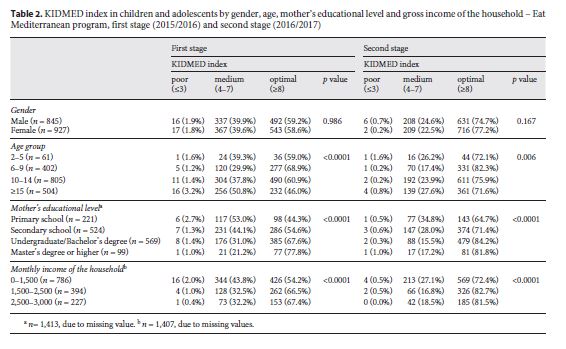
<body><![CDATA[<p><a href="#t2">Tables 2</a> and <a href="#t3">3</a> reflect the influence of    sex, age, mother&rsquo;s educational level, monthly income of the household    and nutritional status on the MD index. There were no significant differences    between sex and MD index. In contrast, significant differences were observed    between the four age groups and the KIDMED index. In both stages, 6 to 9yearold    children presented the most positive values as 68.9% of the participants in    the first stage and 82.3% in the second stage showed to have an optimal MD.    The lowest adherence to optimal diet was found in adolescents and older participants    (15&ndash;21 years old) in the first stage (46.0%); nevertheless, this group    almost doubled (71.6%) their MD adherence from the first stage to the second.</p>     <p>&nbsp;</p> <a name="t2"></a> <img src="/img/revistas/pjph/v36n3/36n3a02t2.jpg">      
<p>&nbsp;</p> <a name="t3"></a> <img src="/img/revistas/pjph/v36n3/36n3a02t3.jpg">      
<p>&nbsp;</p>     <p>As for socioeconomic variables and the MD index, mother&rsquo;s educational    level was positively and significantly (p &lt; 0.0001) associated with optimal    MD adherence by children and adolescent, in both stages. Children and adolescents    whose mothers had higher educational levels (undergraduate or higher) showed    a higher KIDMEX index.</p>     <p>Similarly, regarding income of the household, the percentage of the participants    with an optimal MD (&gt; 66% first stage, &gt; 81% second stage) was higher    in the categories of higher income (EUR &gt; 1,501/month) versus 54.2% (first    stage) and 72.4% (second stage) in the lower income group (</p>     <p>According to <a href="#t3">Table 3</a> , no significant variation between participants&rsquo;    nutritional status and MD adherence was seen in the first stage. From stage    1 to stage 2, the prevalence of obesity (from 10.7 to 9.0%) and preobesity (from    21.2 to 20.1%) decreased, increasing the proportion of individuals in the normal    weight category from 67 to 69.6%. All of the categories of nutritional status    improved their adherence to MD from stage 1 (from 55 to 63.9%) to stage 2 (from    72.8 to 85.7%).</p>     <p>&nbsp;</p>     <p><b>Discussion</b></p>     <p>Since countries around the Mediterranean basin have consistently shown higher    overweight and obesity prevalence in children, the promotion of healthy lifestyles    using the MD principles has increased in popularity among the scientific community    <sup><a href="#31">31</a></sup><a name="top31"></a>. In previous studies, the    adherence to the MD using KIDMED has shown poor results among children and adolescents    (<sup><a href="#8">8</a></sup><a name="top8"></a> , <sup><a href="#32">32</a></sup><a name="top32"></a>    ), reinforcing the need to intervene in these age groups.</p>     ]]></body>
<body><![CDATA[<p>At baseline of the EM program, KIDMED index results showed that only about    half of the participants had &ldquo;optimal MD&rdquo; (58.4%) adherence. Similar    findings were shown by Portuguese colleagues in children aged 11&ndash;16 years    from Algarve, where 52.5% also had an &ldquo;optimal MD&rdquo; KIDMED index    <sup><a href="#13">13</a></sup><a name="top13"></a>.</p>     <p>Successful results were achieved after the intervention and implementation    of the EM program. There was a 17.6% increase in the adherence to an optimal    MD, meaning that 312 children improved their dietary habits, over a period of    1 year. According to the KIDMED test, the significant increase in the intake    of fruit, vegetables, fish, pulses, nuts, cereals or cereal products, and dairy    led to the improvement of the diet quality from the first stage to the second.    On the other hand, the significant decrease in the intake of commercially baked    goods or pastries and of sweets and candy also contributed to the high proportion    of participants with an optimal diet quality, suggesting that the program was    well received, and the format and messages incorporated in the nutrition education    session were well perceived.</p>     <p>Comparing the results of &ldquo;optimal MD&rdquo; adherence obtained in these    Portuguese studies with additional studies from other southern European countries,    some differences can be noted. Except for Spain where children and adolescents    showed an &ldquo;optimal MD&rdquo; adherence of over 40% <sup><a href="#30">30</a></sup><a name="top30"></a>,    studies from Turkey (age 12&ndash;14 years: 22.9%) <sup><a href="#6">6</a></sup><a name="top6"></a>,    Italy (mean age 16.8 years: 16.5%) <sup><a href="#32">32</a></sup><a name="top32"></a>,    Cyprus (mean age 10.7 years: 6.7%) <sup><a href="#33">33</a></sup><a name="top33"></a>,    and Greece showed lower rates of MD adherence for this category. In fact, the    Greek study conducted at the national level showed that only 4.3% of the children    had an optimal KIDMED score, while nearly half were classified as having a &ldquo;very    low diet quality&rdquo; (46.8%) <sup><a href="#8">8</a></sup><a name="top8"></a>.    Findings from the &ldquo;Identification and Prevention of Dietary and LifestyleInduced    Health Effects in Children and Infants (IDEFICS)&rdquo; study, conducted not    only in Southern Europe (Italy, Spain and Cyprus) but also in Northern (Sweden    and Estonia) and Central Europe (Hungary, Belgium, and Germany), supported that    a Mediterraneanlike dietary pattern is not necessarily a feature of the Mediterranean    countries since children from Southern European countries, except from Italy,    showed even lower adherence than their peers living in Central and Northern    European countries (<sup><a href="#34">34</a></sup><a name="top34"></a> , <sup><a href="#35">35</a></sup><a name="top35"></a>    ).</p>     <p>As previously stated, parental educational level and socioeconomic status have    an effect on children and adolescents&rsquo; dietary habits. Results of this    study showed a positive association with statistical significance between the    mother&rsquo;s educational level and the KIDMED index, showing that a higher    KIDMED index was linked to higher educational levels. Similar findings in previous    studies conducted in countries such as Spain (<sup><a href="#11">11</a></sup><a name="top11"></a>    , <sup><a href="#30">30</a></sup><a name="top30"></a> ) and Turkey <sup><a href="#6">6</a></sup><a name="top6"></a>    also showed that a predictor of adherence to the MD was the mother&rsquo;s education.    Regarding the socioeconomic aspect, our results support the findings of previous    Spanish studies (<sup><a href="#11">11</a></sup><a name="top11"></a> , <sup><a href="#22">22</a></sup><a name="top22"></a>    , <sup><a href="#30">30</a></sup><a name="top30"></a> ) since the proportion    of participants with mediumtohigh incomes that reported an optimal MD was greater    than the proportion amongst individuals with low incomes. Also, in Italy, particularly    in the southern region, one of the major predictors of high adherence to Mediterranean    dietary pattern was high socioeconomic status <sup><a href="#36">36</a></sup><a name="top36"></a>.    On the other hand, findings from the IDEFICS study showed that generally higher    adherence to the MD was associated with higher income but not consistently across    countries, as income was not determinant in Sweden (<sup><a href="#34">34</a></sup><a name="top34"></a>    , <sup><a href="#35">35</a></sup><a name="top35"></a> ), suggesting that in    southern European countries socioeconomic factors are major determinants of    adherence to the MD but not in all European countries.</p>     <p>In agreement with findings from other countries, namely Spain (<sup><a href="#22">22</a></sup><a name="top22"></a>    , <sup><a href="#30">30</a></sup><a name="top30"></a> ) and Turkey <sup><a href="#6">6</a></sup><a name="top6"></a>,    no statistically significant differences between sex and the KIDMED index were    observed in this study.</p>     <p>Although no statistically significant association was found between an impaired    nutritional status, according to BMI, and the KIDMED index, the vast literature    has shown that low parental education, particularly maternal education, is associated    with children&rsquo;s malnutrition <sup><a href="#21">21</a></sup><a name="top21"></a>.    This combined with low socioeconomic status represents a challenge to be addressed.</p>     <p>Clearly, this program that promoted on continuous ground a healthy lifestyle    pattern in children and adolescents, improved the nutritional status of the    participants. EM proved to have a positive effect on the participants overweight    prevalence, since from stage 1 to stage 2, the prevalence of obesity and preobesity    decreased from 10.7 to 9.0% and from 21.2 to 20.1%, respectively. Moreover,    all of the categories of nutritional status improved their adherence to MD over    the EM program period.</p>     <p>Additionally, as for the association between malnutrition and the KIDMED index,    controversial results have been found in the literature. While some studies    observed an inverse association between the Mediterranean dietary pattern and    BMI (<sup><a href="#33">33</a></sup><a name="top33"></a> , <sup><a href="#37">37</a></sup><a name="top37"></a>    , <sup><a href="#38">38</a></sup><a name="top38"></a> ), others found no relationship    between BMI and the KIDMED index <sup><a href="#8">8</a></sup><a name="top8"></a>.</p>     <p>It is important to point out that this study is based on a program that consisted    of a very intensive and comprehensive nutritional intervention, and at the end    of it there was an improvement not only in the nutritional status of the participants    but also in the overall dietary habits and, therefore, closer to the MD pattern.</p>     <p>&nbsp;</p>     ]]></body>
<body><![CDATA[<p><b>Conclusion</b></p>     <p>The results in this study indicate that there was a positive effect on the    adherence to the MD since 76.0% of the participants reported an optimal MD at    the end of the EM program.</p>     <p>Factors such as higher socioeconomic status and mother&rsquo;s educational    level had a positive impact on the diet quality of the children and adolescents;    however, a relationship between other factors, namely the nutritional status    and the KIDMED index was not observed, but as the literature has shown controversial    results, more research is needed on this issue.</p>     <p>The EM program proved to be successful in changing the children&rsquo;s and    adolescents&rsquo; dietary patterns, supporting that comprehensive schoolbased    nutritional programs can be an effective policy measure towards a healthier    living among children and adolescents.</p>     <p>&nbsp;</p>     <p><b>REFERENCES</b></p>     <!-- ref --><p><Sup><a name="1"></a><a href="#top1">1</a></Sup> Trichopoulou A , Bamia C ,    Trichopoulos D. Anatomy of health effects of Mediterranean diet: greek EPIC    prospective cohort study. BMJ. 2009 Jun ; 338 jun23 2 : b2337.    &nbsp;&nbsp;&nbsp;&nbsp;&nbsp;&nbsp;&nbsp;&nbsp;[&#160;<a href="javascript:void(0);" onclick="javascript: window.open('/scielo.php?script=sci_nlinks&ref=2094274&pid=S2504-3145201800030000200001&lng=','','width=640,height=500,resizable=yes,scrollbars=1,menubar=yes,');">Links</a>&#160;]<!-- end-ref --> </p>     <p><Sup><a name="2"></a><a href="#top2">2</a></Sup> Serra-Majem L , Trichopoulou    A , Ngo de la Cruz J , Cervera P , Garc&iacute;a Alvarez A , La Vecchia C ,    et al. ; International Task Force on the Mediterranean Diet. Does the definition    of the Mediterranean diet need to be updated? Public Health Nutr. 2004 Oct ;    7 (7): 927 &ndash; 9. </p>     <p><Sup><a name="3"></a><a href="#top3">3</a></Sup> Sofi F , Abbate R , Gensini    GF , Casini A. Accruing evidence on benefits of adherence to the Mediterranean    diet on health: an updated systematic review and metaanalysis. Am J Clin Nutr.    2010 Nov ; 92 (5): 1189 &ndash; 96. </p>     ]]></body>
<body><![CDATA[<p><Sup><a name="4"></a><a href="#top4">4</a></Sup> Romaguera D , Norat T , Vergnaud    AC , Mouw T , May AM , Agudo A , et al. Mediterranean dietary patterns and prospective    weight change in participants of the EPICPANACEA project. Am J Clin Nutr. 2010    Oct ; 92 (4): 912 &ndash; 21. </p>     <p><Sup><a name="5"></a><a href="#top5">5</a></Sup> Dur&atilde;o CR , Oliveira    JF , de Almeida MD. Portugal e o padr&atilde;o alimentar mediterr&acirc;nico.    Alimenta&ccedil;&atilde;o Humana. 2008 ; 14 : 115 &ndash; 28. </p>     <p><Sup><a name="6"></a><a href="#top6">6</a></Sup> Sahingoz SA , Sanlier N. Compliance    with Mediterranean Diet Quality Index (KIDMED) and nutrition knowledge levels    in adolescents. A case study from Turkey. Appetite. 2011 Aug ; 57 (1): 272 &ndash;    7. </p>     <p><Sup><a name="7"></a><a href="#top7">7</a></Sup> Garc&iacute;a Cabrera S ,    Herrera Fern&aacute;ndez N , Rodr&iacute;guez Hern&aacute;ndez C , Nissensohn    M , Rom&aacute;nVi&ntilde;as B , SerraMajem L. KIDMED test; prevalence of low    adherence to the Mediterranean Diet in children and young: a systematic review.    Nutr Hosp. 2015 Dec ; 32 (6): 2390 &ndash; 9. </p>     <p><Sup><a name="8"></a><a href="#top8">8</a></Sup> Farajian P , Risvas G , Karasouli    K , Pounis GD , Kastorini CM , Panagiotakos DB , et al. Very high childhood    obesity prevalence and low adherence rates to the Mediterranean diet in Greek    children: the GRECO study. Atherosclerosis. 2011 Aug ; 217 (2): 525 &ndash;    30. </p>     <p><Sup><a name="9"></a><a href="#top9">9</a></Sup> Hebestreit A , Ahrens W. Relationship    between dietary behaviours and obesity in European children. Int J Pediatr Obes.    2010 ; Suppl 1 : 45 &ndash; 7. </p>     <p><Sup><a name="10"></a><a href="#top10">10</a></Sup> Rodrigues SS , Caraher    M , Trichopoulou A , de Almeida MD. Portuguese households&rsquo; diet quality    (adherence to Mediterranean food pattern and compliance with WHO population    dietary goals): trends, regional disparities and socioeconomic determinants.    Eur J Clin Nutr. 2008 Nov ; 62 (11): 1263 &ndash; 72. </p>     <p><Sup><a name="11"></a><a href="#top11">11</a></Sup> Bibiloni MM , Mart&iacute;nez    E , Llull R , Pons A , Tur JA. Western and Mediterranean dietary patterns among    Balearic Islands&rsquo; adolescents: socioeconomic and lifestyle determinants.    Public Health Nutr. 2012 Apr ; 15 (4): 683 &ndash; 92. </p>     <p><Sup><a name="12"></a><a href="#top12">12</a></Sup> B&ouml;rnhorst C , Wijnhoven    TM , Kune&scaron;ov&aacute; M , Yngve A , Rito AI , Lissner L , et al. WHO European    Childhood Obesity Surveillance Initiative: associations between sleep duration,    screen time and food consumption frequencies. BMC Public Health. 2015 Apr ;    15 (1): 442. </p>     <p><Sup><a name="13"></a><a href="#top13">13</a></Sup> Mateus MP , Gra&ccedil;a    P. Ades&atilde;o ao padr&atilde;o alimentar mediterr&acirc;nico em jovens no    Algarve. Porto: Faculdade de Ci&ecirc;ncias da Nutri&ccedil;&atilde;o e Alimenta&ccedil;&atilde;o.    Universidade do Porto; 2014. Doutoramento em Ci&ecirc;ncias do Consumo Alimentar    e Nutri&ccedil;&atilde;o. Accessed 2017.12.21. Avaible from: <a href="http://hdl.handle.net/10216/66678" target="_blank">http://hdl.handle.net/10216/66678</a>  </p>     ]]></body>
<body><![CDATA[<!-- ref --><p><Sup><a name="14"></a><a href="#top14">14</a></Sup> Lopes C , Torres D , Oliveira    A , Severo M , Alarc&atilde;o V , Guiomar S , et al. Inqu&eacute;rito Alimentar    Nacional e de Atividade F&iacute;sica: IANAF 20152016. Porto: Departamento de    Epidemiologia Cl&iacute;nica, Medicina Preditiva e Sa&uacute;de P&uacute;blica.    Faculdade de Medicina. Universidade do Porto; 2017. Accessed 2017.02.15. Available    from: <a href="https://ianaf.up.pt/resultados" target="_blank">https://ianaf.up.pt/resultados</a>  &nbsp;&nbsp;&nbsp;&nbsp;&nbsp;&nbsp;&nbsp;&nbsp;[&#160;<a href="javascript:void(0);" onclick="javascript: window.open('/scielo.php?script=sci_nlinks&ref=2094288&pid=S2504-3145201800030000200013&lng=','','width=640,height=500,resizable=yes,scrollbars=1,menubar=yes,');">Links</a>&#160;]<!-- end-ref --><p><Sup><a name="15"></a><a href="#top15">15</a></Sup> Abarca-Gómez L, Abdeen    Z, Hamid Z, Abu- Rmeileh N, Acosta-Cazares B, Acuin C, et al.; NCD Risk Factor    Collaboration (NCDRisC). Worldwide trends in bodymass index, underweight, overweight,    and obesity from 1975 to 2016: a pooled analysis of 2416 populationbased measurement    studies in 128&middot;9 million children, adolescents, and adults. Lancet. 2017    Dec ; 390 (10113): 2627 &ndash; 42. </p>     <!-- ref --><p><Sup><a name="16"></a><a href="#top16">16</a></Sup> Wijnhoven TM , van Raaij    JM , Spinelli A , Starc G , Hassapidou M , Spiroski I , et al. WHO European    Childhood Obesity Surveillance Initiative: body mass index and level of overweight    among 69yearold children from school year 2007/2008 to school year 2009/2010.    BMC Public Health. 2014 Aug ; 14 (1): 806.    &nbsp;&nbsp;&nbsp;&nbsp;&nbsp;&nbsp;&nbsp;&nbsp;[&#160;<a href="javascript:void(0);" onclick="javascript: window.open('/scielo.php?script=sci_nlinks&ref=2094290&pid=S2504-3145201800030000200015&lng=','','width=640,height=500,resizable=yes,scrollbars=1,menubar=yes,');">Links</a>&#160;]<!-- end-ref --> </p>     <!-- ref --><p><Sup><a name="17"></a><a href="#top17">17</a></Sup> Rito AI , Cruz de Sousa    R , Mendes S , Gra&ccedil;a P. Childhood Obesity Surveillance Initiative: COSI    Portugal 2016. Lisboa: Instituto Nacional de Sa&uacute;de Dr. Ricardo Jorge;    2017. (DAN Relat&oacute;rios cient&iacute;ficos e t&eacute;cnicos). Accessed    2017. 12.15. Available from: <a href="http://hdl.handle.net/10400.18/4857" target="_blank">http://hdl.handle.net/10400.18/4857</a>  &nbsp;&nbsp;&nbsp;&nbsp;&nbsp;&nbsp;&nbsp;&nbsp;[&#160;<a href="javascript:void(0);" onclick="javascript: window.open('/scielo.php?script=sci_nlinks&ref=2094292&pid=S2504-3145201800030000200016&lng=','','width=640,height=500,resizable=yes,scrollbars=1,menubar=yes,');">Links</a>&#160;]<!-- end-ref --><!-- ref --><p><Sup><a name="18"></a><a href="#top18">18</a></Sup> Rito AI , Gra&ccedil;a    P. Childhood Obesity Surveillance Initiative: COSI Portugal 2013. Lisboa: Instituto    Nacional de Sa&uacute;de Dr. Ricardo Jorge; 2015. Accessed 2017. 11.15.Accessed    Available from: <a href="http://hdl.handle.net/10400.18/3108" target="_blank">http://hdl.handle.net/10400.18/3108</a>  &nbsp;&nbsp;&nbsp;&nbsp;&nbsp;&nbsp;&nbsp;&nbsp;[&#160;<a href="javascript:void(0);" onclick="javascript: window.open('/scielo.php?script=sci_nlinks&ref=2094293&pid=S2504-3145201800030000200017&lng=','','width=640,height=500,resizable=yes,scrollbars=1,menubar=yes,');">Links</a>&#160;]<!-- end-ref --><!-- ref --><p><Sup><a name="19"></a><a href="#top19">19</a></Sup> Rito AI , Paix&atilde;o    E , Carvalho MA , et al. Childhood Obesity Surveillance Iniciative COSI Portugal    2008. 2 Lisboa: Instituto Nacional de Sa&uacute;de Dr. Ricardo Jorge; 2011.    Accessed 2017. 10.15. Available from: <a href="http://hdl.handle.net/10400.18/142" target="_blank">http://hdl.handle.net/10400.18/142</a>  &nbsp;&nbsp;&nbsp;&nbsp;&nbsp;&nbsp;&nbsp;&nbsp;[&#160;<a href="javascript:void(0);" onclick="javascript: window.open('/scielo.php?script=sci_nlinks&ref=2094294&pid=S2504-3145201800030000200018&lng=','','width=640,height=500,resizable=yes,scrollbars=1,menubar=yes,');">Links</a>&#160;]<!-- end-ref --><p><Sup><a name="20"></a><a href="#top20">20</a></Sup> World Health Organization.    Regional Office for Europe. Growing up unequal: gender and socioeconomic differences    in young people&rsquo;s health and wellbeing: Health Behaviour in SchoolAged    Children (HBSC) Study: international report from the 2013/2014 survey. Copenhagen:    Regional Office for Europe. World Health Organization; 2016. Accessed 2017.12.05.    Available from: <a href="http://www.euro.who.int/__data/assets/pdf_file/0003/303438/HSBCNo.7GrowingupunequalFullReport.pdf?ua=1" target="_blank">http://www.euro.who.int/__data/assets/pdf_file/0003/303438/HSBCNo.7GrowingupunequalFullReport.pdf?ua=1</a>  </p>     <p><Sup><a name="21"></a><a href="#top21">21</a></Sup> Lissner L , Wijnhoven TM    , Mehlig K , Sj&ouml;berg A , Kunesova M , Yngve A , et al. Socioeconomic inequalities    in childhood overweight: heterogeneity across five countries in the WHO European    Childhood Obesity Surveillance Initiative (COSI2008). Int J Obes. 2016 May ;    40 (5): 796 &ndash; 802. </p>     <p><Sup><a name="22"></a><a href="#top22">22</a></Sup> Arriscado D , Muros JJ    , Zabala M , Dalmau JM. Factors associated with low adherence to a Mediterranean    diet in healthy children in northern Spain. Appetite. 2014 Sep ; 80 : 28 &ndash;    34. </p>     ]]></body>
<body><![CDATA[<!-- ref --><p><Sup><a name="23"></a><a href="#top23">23</a></Sup> Taylor JP , Evers S , Mckenna    M. Determinants of healthy eating in children and youth. Can J Public Health    2005 ;96: Suppl 3:S206, S229.    &nbsp;&nbsp;&nbsp;&nbsp;&nbsp;&nbsp;&nbsp;&nbsp;[&#160;<a href="javascript:void(0);" onclick="javascript: window.open('/scielo.php?script=sci_nlinks&ref=2094298&pid=S2504-3145201800030000200022&lng=','','width=640,height=500,resizable=yes,scrollbars=1,menubar=yes,');">Links</a>&#160;]<!-- end-ref --> </p>     <p><Sup><a name="24"></a><a href="#top24">24</a></Sup> Fauquet J , Sofi F , L&oacute;pez-Guimer&agrave;    G , Leiva D , Shal&agrave; A , Punt&iacute; J , et al. Mediterranean diet adherence    among Catalonian adolescents: socioeconomic and lifestyle factors. Nutr Hosp.    2016 Nov ; 33 (6): 1283 &ndash; 90. </p>     <!-- ref --><p><Sup><a name="25"></a><a href="#top25">25</a></Sup> Barnes S. Reducing childhood    obesity in Ontario through a health equity lens. Toronto, CA: Wellesley Institute.    2012. Accessed 2017.12.22. Available from: <a href="http://www.wellesleyinstitute.com/publications/reducingchildhoodobesityinontariothroughahealthequitylens/" target="_blank">http://www.wellesleyinstitute.com/publications/reducingchildhoodobesityinontariothroughahealthequitylens/</a>  &nbsp;&nbsp;&nbsp;&nbsp;&nbsp;&nbsp;&nbsp;&nbsp;[&#160;<a href="javascript:void(0);" onclick="javascript: window.open('/scielo.php?script=sci_nlinks&ref=2094301&pid=S2504-3145201800030000200024&lng=','','width=640,height=500,resizable=yes,scrollbars=1,menubar=yes,');">Links</a>&#160;]<!-- end-ref --><!-- ref --><p><Sup><a name="26"></a><a href="#top26">26</a></Sup> Portugal. Minist&eacute;rio    da Sa&uacute;de. Dire&ccedil;&atilde;oGeral da Sa&uacute;de. Plano Nacional    de Sa&uacute;de: revis&atilde;o e extens&atilde;o a 2020. Lisboa: Direc&ccedil;&atilde;o    Geral da Sa&uacute;de; 2015. Accessed 2017.11.12. Available from: <a href="http://pns.dgs.pt/files/2015/06/PlanoNacionaldeSaudeRevisaoeExtensaoa2020.pdf" target="_blank">http://pns.dgs.pt/files/2015/06/PlanoNacionaldeSaudeRevisaoeExtensaoa2020.pdf</a>  &nbsp;&nbsp;&nbsp;&nbsp;&nbsp;&nbsp;&nbsp;&nbsp;[&#160;<a href="javascript:void(0);" onclick="javascript: window.open('/scielo.php?script=sci_nlinks&ref=2094302&pid=S2504-3145201800030000200025&lng=','','width=640,height=500,resizable=yes,scrollbars=1,menubar=yes,');">Links</a>&#160;]<!-- end-ref --><!-- ref --><p><Sup><a name="27"></a><a href="#top27">27</a></Sup> World Health Organization,    Regional Office for Europe. Childhood Obesity Surveillance Initiative (COSI):    data collectin procedures. Copenhagen: Regional Office for Europe. World Health    Organization; 2016. Accessed 2017.06.12. Available from: <a href="http://www.euro.who.int/en/healthtopics/diseaseprevention/nutrition/publications/2017/childhoodobesitysurveillanceinitiativecosidatacollectionprocedures2016" target="_blank">http://www.euro.who.int/en/healthtopics/diseaseprevention/nutrition/publications/2017/childhoodobesitysurveillanceinitiativecosidatacollectionprocedures2016</a>  &nbsp;&nbsp;&nbsp;&nbsp;&nbsp;&nbsp;&nbsp;&nbsp;[&#160;<a href="javascript:void(0);" onclick="javascript: window.open('/scielo.php?script=sci_nlinks&ref=2094303&pid=S2504-3145201800030000200026&lng=','','width=640,height=500,resizable=yes,scrollbars=1,menubar=yes,');">Links</a>&#160;]<!-- end-ref --><p><Sup><a name="28"></a><a href="#top28">28</a></Sup> Rito A , Wijnhoven TM ,    Rutter H , Carvalho MA , Paix&atilde;o E , Ramos C , et al. Prevalence of obesity    among Portuguese children (68 years old) using three definition criteria: COSI    Portugal, 2008. Pediatr Obes. 2012 Dec ; 7 (6): 413 &ndash; 22. </p>     <!-- ref --><p><Sup><a name="29"></a><a href="#top29">29</a></Sup> World Health Organization.    Global Database on Body Mass Index. Copenhagen: Regional Office for Europe.    World Health Organization; 2004. Accessed 2017.10.02. Available from: <a href="http://www.who.int/nutrition/databases/en/" target="_blank">http://www.who.int/nutrition/databases/en/</a>  &nbsp;&nbsp;&nbsp;&nbsp;&nbsp;&nbsp;&nbsp;&nbsp;[&#160;<a href="javascript:void(0);" onclick="javascript: window.open('/scielo.php?script=sci_nlinks&ref=2094305&pid=S2504-3145201800030000200028&lng=','','width=640,height=500,resizable=yes,scrollbars=1,menubar=yes,');">Links</a>&#160;]<!-- end-ref --><!-- ref --><p><Sup><a name="30"></a><a href="#top30">30</a></Sup> Serra-Majem L, Ribas L,    Ngo J, Ortega RM, García A, Pérez-Rodrigo C, et al. Food, youth and the Mediterranean    diet in Spain. Development of KIDMED, Mediterranean Diet Quality Index in children    and adolescents. Public Health Nutr. 2004 Oct; 7(7): 931–5.    &nbsp;&nbsp;&nbsp;&nbsp;&nbsp;&nbsp;&nbsp;&nbsp;[&#160;<a href="javascript:void(0);" onclick="javascript: window.open('/scielo.php?script=sci_nlinks&ref=2094306&pid=S2504-3145201800030000200029&lng=','','width=640,height=500,resizable=yes,scrollbars=1,menubar=yes,');">Links</a>&#160;]<!-- end-ref --> </p>     ]]></body>
<body><![CDATA[<!-- ref --><p><Sup><a name="31"></a><a href="#top31">31</a></Sup> Pereira-da-Silva L, Rêgo    C, Pietrobelli A. The diet of preschool children in the Mediterranean countries    of the European Union: a systematic review. Int J Environ Res Public Health.    2016 Jun; 13(6): 572.    &nbsp;&nbsp;&nbsp;&nbsp;&nbsp;&nbsp;&nbsp;&nbsp;[&#160;<a href="javascript:void(0);" onclick="javascript: window.open('/scielo.php?script=sci_nlinks&ref=2094308&pid=S2504-3145201800030000200030&lng=','','width=640,height=500,resizable=yes,scrollbars=1,menubar=yes,');">Links</a>&#160;]<!-- end-ref --> </p>     <p><Sup><a name="32"></a><a href="#top32">32</a></Sup> Santomauro F , Lorini C    , Tanini T , Indiani L , Lastrucci V , Comodo N , et al. Adherence to Mediterranean    diet in a sample of Tuscan adolescents. Nutrition. 2014 NovDec ; 30 (1112):    1379 &ndash; 83. </p>     <p><Sup><a name="33"></a><a href="#top33">33</a></Sup> Lazarou C , Panagiotakos    DB , Matalas AL. Physical activity mediates the protective effect of the Mediterranean    diet on children&rsquo;s obesity status: the CYKIDS study. Nutrition. 2010 Jan    ; 26 (1): 61 &ndash; 7. </p>     <p><Sup><a name="34"></a><a href="#top34">34</a></Sup> Tognon G , Moreno LA ,    Mouratidou T , Veidebaum T , Moln&aacute;r D , Russo P , et al. ; IDEFICS consortium.    Adherence to a Mediterraneanlike dietary pattern in children from eight European    countries. The IDEFICS study. Int J Obes. 2014 Sep ; 38 (S2 Suppl 2): S108 &ndash;    14. </p>     <p><Sup><a name="35"></a><a href="#top35">35</a></Sup> Grosso G , Galvano F. Mediterranean    diet adherence in children and adolescents in southern European countries. NFS    Journal. 2016 ; 3 : 13 &ndash; 9. </p>     <p><Sup><a name="36"></a><a href="#top36">36</a></Sup> Grosso G , Marventano S    , Buscemi S , Scuderi A , Matalone M , Platania A , et al. Factors associated    with adherence to the Mediterranean diet among adolescents living in Sicily,    Southern Italy. Nutrients. 2013 Dec ; 5 (12): 4908 &ndash; 23. </p>     <p><Sup><a name="37"></a><a href="#top37">37</a></Sup> Tsartsali PK , Thompson    JL , Jago R. Increased knowledge predicts greater adherence to the Mediterranean    diet in Greek adolescents. Public Health Nutr. 2009 Feb ; 12 (2): 208 &ndash;    13. </p>     <p> <Sup><a name="38"></a><a href="#top38">38</a></Sup> Kontogianni MD , Vidra    N , Farmaki AE , Koinaki S , Belogianni K , Sofrona S , et al. Adherence rates    to the Mediterranean diet are low in a representative sample of Greek children    and adolescents. J Nutr. 2008Oct ; 138 (10): 1951 &ndash; 6. </p>     <p>&nbsp;</p>     ]]></body>
<body><![CDATA[<p>Received: April 18, 2016. Accepted: April 13, 2018</p>     <p>&nbsp;</p>     <p>Ethical approval for this study was obtained from the Regional Health Administration    of Lisbon and Tagus Valley Ethics Committee.</p>     <p>&nbsp;</p>     <p>The authors declare that they have no conflicts of interest.</p>     <p>&nbsp;</p>     <p><b>Acknowledgements</b></p>     <p>The authors wish to acknowledge all the nutritionists, psychologists and other    health professionals, children, parents, educators, teachers, school cooking    staff, and municipality technicians for their contribution to the field work,    as well as the following Institutions for their partnership and support: Agrupamentos    de Escolas Dr. Ginestal Machado, S&aacute; da Bandeira e de Jos&eacute; Relvas;    Hospital Distrital de Santar&eacute;m; CEIDSS &ndash; Centro de Estudos e Investiga&ccedil;&atilde;o    em Din&acirc;micas Sociais e Sa&uacute;de; ISCTEIUL &ndash; Instituto Universit&aacute;rio    de Lisboa; Municipalities of Alpiar&ccedil;a and Santar&eacute;m and Instituto    Nacional de Sa&uacute;de Doutor Ricardo Jorge.</p>      ]]></body><back>
<ref-list>
<ref id="B1">
<nlm-citation citation-type="journal">
<person-group person-group-type="author">
<name>
<surname><![CDATA[Trichopoulou]]></surname>
<given-names><![CDATA[A]]></given-names>
</name>
<name>
<surname><![CDATA[Bamia]]></surname>
<given-names><![CDATA[C]]></given-names>
</name>
<name>
<surname><![CDATA[Trichopoulos]]></surname>
<given-names><![CDATA[D]]></given-names>
</name>
</person-group>
<article-title xml:lang="en"><![CDATA[Anatomy of health effects of Mediterranean diet: greek EPIC prospective cohort study]]></article-title>
<source><![CDATA[BMJ]]></source>
<year>2009</year>
<month> J</month>
<day>un</day>
<volume>338</volume>
<numero>2</numero>
<issue>2</issue>
<page-range>b2337</page-range></nlm-citation>
</ref>
<ref id="B2">
<nlm-citation citation-type="journal">
<person-group person-group-type="author">
<name>
<surname><![CDATA[SerraMajem]]></surname>
<given-names><![CDATA[L]]></given-names>
</name>
<name>
<surname><![CDATA[Trichopoulou]]></surname>
<given-names><![CDATA[A]]></given-names>
</name>
<name>
<surname><![CDATA[Ngo de la Cruz]]></surname>
<given-names><![CDATA[J]]></given-names>
</name>
<name>
<surname><![CDATA[Cervera]]></surname>
<given-names><![CDATA[P]]></given-names>
</name>
<name>
<surname><![CDATA[García Alvarez]]></surname>
<given-names><![CDATA[A]]></given-names>
</name>
<name>
<surname><![CDATA[La Vecchia]]></surname>
<given-names><![CDATA[C]]></given-names>
</name>
</person-group>
<article-title xml:lang="en"><![CDATA[International Task Force on the Mediterranean Diet . Does the definition of the Mediterranean diet need to be updated?]]></article-title>
<source><![CDATA[Public Health Nutr]]></source>
<year>2004</year>
<volume>7</volume>
<numero>7</numero>
<issue>7</issue>
<page-range>927 - 9</page-range></nlm-citation>
</ref>
<ref id="B3">
<nlm-citation citation-type="journal">
<person-group person-group-type="author">
<name>
<surname><![CDATA[Sofi]]></surname>
<given-names><![CDATA[F]]></given-names>
</name>
<name>
<surname><![CDATA[Abbate]]></surname>
<given-names><![CDATA[R]]></given-names>
</name>
<name>
<surname><![CDATA[Gensini]]></surname>
<given-names><![CDATA[GF]]></given-names>
</name>
<name>
<surname><![CDATA[Casini]]></surname>
<given-names><![CDATA[A]]></given-names>
</name>
</person-group>
<article-title xml:lang="en"><![CDATA[Accruing evidence on benefits of adherence to the Mediterranean diet on health: an updated systematic review and metaanalysis]]></article-title>
<source><![CDATA[Am J Clin Nutr]]></source>
<year>2010</year>
<volume>92</volume>
<numero>5</numero>
<issue>5</issue>
<page-range>1189 - 96</page-range></nlm-citation>
</ref>
<ref id="B4">
<nlm-citation citation-type="journal">
<person-group person-group-type="author">
<name>
<surname><![CDATA[Romaguera]]></surname>
<given-names><![CDATA[D]]></given-names>
</name>
<name>
<surname><![CDATA[Norat]]></surname>
<given-names><![CDATA[T]]></given-names>
</name>
<name>
<surname><![CDATA[Vergnaud]]></surname>
<given-names><![CDATA[AC]]></given-names>
</name>
<name>
<surname><![CDATA[Mouw]]></surname>
<given-names><![CDATA[T]]></given-names>
</name>
<name>
<surname><![CDATA[May]]></surname>
<given-names><![CDATA[AM]]></given-names>
</name>
<name>
<surname><![CDATA[Agudo]]></surname>
<given-names><![CDATA[A]]></given-names>
</name>
</person-group>
<article-title xml:lang="en"><![CDATA[Mediterranean dietary patterns and prospective weight change in participants of the EPICPANACEA project]]></article-title>
<source><![CDATA[Am J Clin Nutr]]></source>
<year>2010</year>
<volume>92</volume>
<numero>4</numero>
<issue>4</issue>
<page-range>912 - 21</page-range></nlm-citation>
</ref>
<ref id="B5">
<nlm-citation citation-type="journal">
<person-group person-group-type="author">
<name>
<surname><![CDATA[Durão]]></surname>
<given-names><![CDATA[CR]]></given-names>
</name>
<name>
<surname><![CDATA[Oliveira]]></surname>
<given-names><![CDATA[JF]]></given-names>
</name>
<name>
<surname><![CDATA[de Almeida]]></surname>
<given-names><![CDATA[MD]]></given-names>
</name>
</person-group>
<article-title xml:lang="pt"><![CDATA[Portugal e o padrão alimentar mediterrânico]]></article-title>
<source><![CDATA[Alimentação Humana]]></source>
<year>2008</year>
<volume>14</volume>
<page-range>115 - 28</page-range></nlm-citation>
</ref>
<ref id="B6">
<nlm-citation citation-type="journal">
<person-group person-group-type="author">
<name>
<surname><![CDATA[Sahingoz]]></surname>
<given-names><![CDATA[SA]]></given-names>
</name>
<name>
<surname><![CDATA[Sanlier]]></surname>
<given-names><![CDATA[N]]></given-names>
</name>
</person-group>
<article-title xml:lang="en"><![CDATA[Compliance with Mediterranean Diet Quality Index (KIDMED) and nutrition knowledge levels in adolescents. A case study from Turkey]]></article-title>
<source><![CDATA[Appetite]]></source>
<year>2011</year>
<volume>57</volume>
<numero>1</numero>
<issue>1</issue>
<page-range>272 - 7</page-range></nlm-citation>
</ref>
<ref id="B7">
<nlm-citation citation-type="journal">
<person-group person-group-type="author">
<name>
<surname><![CDATA[García Cabrera]]></surname>
<given-names><![CDATA[S]]></given-names>
</name>
<name>
<surname><![CDATA[Herrera Fernández]]></surname>
<given-names><![CDATA[N]]></given-names>
</name>
<name>
<surname><![CDATA[Rodríguez Hernández]]></surname>
<given-names><![CDATA[C]]></given-names>
</name>
<name>
<surname><![CDATA[Nissensohn]]></surname>
<given-names><![CDATA[M]]></given-names>
</name>
<name>
<surname><![CDATA[SerraMajem]]></surname>
<given-names><![CDATA[L]]></given-names>
</name>
<name>
<surname><![CDATA[KIDMED]]></surname>
<given-names><![CDATA[test]]></given-names>
</name>
</person-group>
<article-title xml:lang="en"><![CDATA[prevalence of low adherence to the Mediterranean Diet in children and young: a systematic review]]></article-title>
<source><![CDATA[Nutr Hosp]]></source>
<year>2015</year>
<volume>32</volume>
<numero>6</numero>
<issue>6</issue>
<page-range>2390 - 9</page-range></nlm-citation>
</ref>
<ref id="B8">
<nlm-citation citation-type="journal">
<person-group person-group-type="author">
<name>
<surname><![CDATA[Farajian]]></surname>
<given-names><![CDATA[P]]></given-names>
</name>
<name>
<surname><![CDATA[Risvas]]></surname>
<given-names><![CDATA[G]]></given-names>
</name>
<name>
<surname><![CDATA[Karasouli]]></surname>
<given-names><![CDATA[K]]></given-names>
</name>
<name>
<surname><![CDATA[Pounis]]></surname>
<given-names><![CDATA[GD]]></given-names>
</name>
<name>
<surname><![CDATA[Kastorini]]></surname>
<given-names><![CDATA[CM]]></given-names>
</name>
<name>
<surname><![CDATA[Panagiotakos]]></surname>
<given-names><![CDATA[DB]]></given-names>
</name>
</person-group>
<article-title xml:lang="en"><![CDATA[Very high childhood obesity prevalence and low adherence rates to the Mediterranean diet in Greek children: the GRECO study]]></article-title>
<source><![CDATA[Atherosclerosis]]></source>
<year>2011</year>
<volume>217</volume>
<numero>2</numero>
<issue>2</issue>
<page-range>525 - 30</page-range></nlm-citation>
</ref>
<ref id="B9">
<nlm-citation citation-type="journal">
<person-group person-group-type="author">
<name>
<surname><![CDATA[Hebestreit]]></surname>
<given-names><![CDATA[A]]></given-names>
</name>
<name>
<surname><![CDATA[Ahrens]]></surname>
<given-names><![CDATA[W]]></given-names>
</name>
</person-group>
<article-title xml:lang="en"><![CDATA[Relationship between dietary behaviours and obesity in European children]]></article-title>
<source><![CDATA[Int J Pediatr Obes]]></source>
<year>2010</year>
<numero>^s1</numero>
<issue>^s1</issue>
<supplement>1</supplement>
<page-range>45 - 7</page-range></nlm-citation>
</ref>
<ref id="B10">
<nlm-citation citation-type="journal">
<person-group person-group-type="author">
<name>
<surname><![CDATA[Rodrigues]]></surname>
<given-names><![CDATA[SS]]></given-names>
</name>
<name>
<surname><![CDATA[Caraher]]></surname>
<given-names><![CDATA[M]]></given-names>
</name>
<name>
<surname><![CDATA[Trichopoulou]]></surname>
<given-names><![CDATA[A]]></given-names>
</name>
<name>
<surname><![CDATA[de Almeida]]></surname>
<given-names><![CDATA[MD]]></given-names>
</name>
</person-group>
<article-title xml:lang="en"><![CDATA[Portuguese households’ diet quality (adherence to Mediterranean food pattern and compliance with WHO population dietary goals): trends, regional disparities and socioeconomic determinants]]></article-title>
<source><![CDATA[Eur J Clin Nutr]]></source>
<year>2008</year>
<volume>62</volume>
<numero>11</numero>
<issue>11</issue>
<page-range>1263 - 72</page-range></nlm-citation>
</ref>
<ref id="B11">
<nlm-citation citation-type="journal">
<person-group person-group-type="author">
<name>
<surname><![CDATA[Bibiloni]]></surname>
<given-names><![CDATA[MM]]></given-names>
</name>
<name>
<surname><![CDATA[Martínez]]></surname>
<given-names><![CDATA[E]]></given-names>
</name>
<name>
<surname><![CDATA[Llull]]></surname>
<given-names><![CDATA[R]]></given-names>
</name>
<name>
<surname><![CDATA[Pons]]></surname>
<given-names><![CDATA[A]]></given-names>
</name>
<name>
<surname><![CDATA[Tur]]></surname>
<given-names><![CDATA[JA]]></given-names>
</name>
</person-group>
<article-title xml:lang="en"><![CDATA[Western and Mediterranean dietary patterns among Balearic Islands’ adolescents: socioeconomic and lifestyle determinants]]></article-title>
<source><![CDATA[Public Health Nutr]]></source>
<year>2012</year>
<volume>15</volume>
<numero>4</numero>
<issue>4</issue>
<page-range>683 - 92</page-range></nlm-citation>
</ref>
<ref id="B12">
<nlm-citation citation-type="journal">
<person-group person-group-type="author">
<name>
<surname><![CDATA[Börnhorst]]></surname>
<given-names><![CDATA[C]]></given-names>
</name>
<name>
<surname><![CDATA[Wijnhoven]]></surname>
<given-names><![CDATA[TM]]></given-names>
</name>
<name>
<surname><![CDATA[Kunešová]]></surname>
<given-names><![CDATA[M]]></given-names>
</name>
<name>
<surname><![CDATA[Yngve]]></surname>
<given-names><![CDATA[A]]></given-names>
</name>
<name>
<surname><![CDATA[Rito]]></surname>
<given-names><![CDATA[AI]]></given-names>
</name>
<name>
<surname><![CDATA[Lissner]]></surname>
<given-names><![CDATA[L]]></given-names>
</name>
</person-group>
<article-title xml:lang="en"><![CDATA[WHO European Childhood Obesity Surveillance Initiative: associations between sleep duration, screen time and food consumption frequencies]]></article-title>
<source><![CDATA[BMC Public Health]]></source>
<year>2015</year>
<volume>15</volume>
<numero>1</numero>
<issue>1</issue>
<page-range>442</page-range></nlm-citation>
</ref>
<ref id="B13">
<nlm-citation citation-type="book">
<person-group person-group-type="author">
<name>
<surname><![CDATA[Lopes]]></surname>
<given-names><![CDATA[C]]></given-names>
</name>
<name>
<surname><![CDATA[Torres]]></surname>
<given-names><![CDATA[D]]></given-names>
</name>
<name>
<surname><![CDATA[Oliveira]]></surname>
<given-names><![CDATA[A]]></given-names>
</name>
<name>
<surname><![CDATA[Severo]]></surname>
<given-names><![CDATA[M]]></given-names>
</name>
<name>
<surname><![CDATA[Alarcão]]></surname>
<given-names><![CDATA[V]]></given-names>
</name>
<name>
<surname><![CDATA[Guiomar]]></surname>
<given-names><![CDATA[S]]></given-names>
</name>
</person-group>
<source><![CDATA[Inquérito Alimentar Nacional e de Atividade Física: IANAF 20152016]]></source>
<year>2017</year>
<publisher-loc><![CDATA[Porto ]]></publisher-loc>
<publisher-name><![CDATA[Departamento de Epidemiologia Clínica, Medicina Preditiva e Saúde Pública. Faculdade de Medicina. Universidade do Porto]]></publisher-name>
</nlm-citation>
</ref>
<ref id="B14">
<nlm-citation citation-type="journal">
<person-group person-group-type="author">
<name>
<surname><![CDATA[AbarcaGómez]]></surname>
<given-names><![CDATA[L]]></given-names>
</name>
<name>
<surname><![CDATA[Abdeen]]></surname>
<given-names><![CDATA[Z]]></given-names>
</name>
<name>
<surname><![CDATA[Hamid]]></surname>
<given-names><![CDATA[Z]]></given-names>
</name>
<name>
<surname><![CDATA[AbuRmeileh]]></surname>
<given-names><![CDATA[N]]></given-names>
</name>
<name>
<surname><![CDATA[AcostaCazares]]></surname>
<given-names><![CDATA[B]]></given-names>
</name>
<name>
<surname><![CDATA[Acuin]]></surname>
<given-names><![CDATA[C]]></given-names>
</name>
</person-group>
<article-title xml:lang="en"><![CDATA[NCD Risk Factor Collaboration (NCDRisC) . Worldwide trends in bodymass index, underweight, overweight, and obesity from 1975 to 2016: a pooled analysis of 2416 populationbased measurement studies in 128·9 million children, adolescents, and adults]]></article-title>
<source><![CDATA[Lancet]]></source>
<year>2017</year>
<volume>390</volume>
<numero>10113</numero>
<issue>10113</issue>
<page-range>2627 - 42</page-range></nlm-citation>
</ref>
<ref id="B15">
<nlm-citation citation-type="journal">
<person-group person-group-type="author">
<name>
<surname><![CDATA[Wijnhoven]]></surname>
<given-names><![CDATA[TM]]></given-names>
</name>
<name>
<surname><![CDATA[van Raaij]]></surname>
<given-names><![CDATA[JM]]></given-names>
</name>
<name>
<surname><![CDATA[Spinelli]]></surname>
<given-names><![CDATA[A]]></given-names>
</name>
<name>
<surname><![CDATA[Starc]]></surname>
<given-names><![CDATA[G]]></given-names>
</name>
<name>
<surname><![CDATA[Hassapidou]]></surname>
<given-names><![CDATA[M]]></given-names>
</name>
<name>
<surname><![CDATA[Spiroski]]></surname>
<given-names><![CDATA[I]]></given-names>
</name>
</person-group>
<article-title xml:lang="en"><![CDATA[WHO European Childhood Obesity Surveillance Initiative: body mass index and level of overweight among 69yearold children from school year 2007/2008 to school year 2009/2010]]></article-title>
<source><![CDATA[BMC Public Health]]></source>
<year>2014</year>
<volume>14</volume>
<numero>1</numero>
<issue>1</issue>
<page-range>806</page-range></nlm-citation>
</ref>
<ref id="B16">
<nlm-citation citation-type="book">
<person-group person-group-type="author">
<name>
<surname><![CDATA[Rito]]></surname>
<given-names><![CDATA[AI]]></given-names>
</name>
<name>
<surname><![CDATA[Cruz de Sousa]]></surname>
<given-names><![CDATA[R]]></given-names>
</name>
<name>
<surname><![CDATA[Mendes]]></surname>
<given-names><![CDATA[S]]></given-names>
</name>
<name>
<surname><![CDATA[Graça]]></surname>
<given-names><![CDATA[P]]></given-names>
</name>
</person-group>
<source><![CDATA[Childhood Obesity Surveillance Initiative: COSI Portugal 2016]]></source>
<year></year>
<publisher-loc><![CDATA[Lisboa ]]></publisher-loc>
<publisher-name><![CDATA[Instituto Nacional de Saúde Dr. Ricardo Jorge]]></publisher-name>
</nlm-citation>
</ref>
<ref id="B17">
<nlm-citation citation-type="">
<person-group person-group-type="author">
<name>
<surname><![CDATA[Rito]]></surname>
<given-names><![CDATA[AI]]></given-names>
</name>
<name>
<surname><![CDATA[Graça]]></surname>
<given-names><![CDATA[P]]></given-names>
</name>
</person-group>
<source><![CDATA[Childhood Obesity Surveillance Initiative: COSI Portugal 2013. Lisboa: Instituto Nacional de Saúde Dr. Ricardo Jorge]]></source>
<year>2015</year>
</nlm-citation>
</ref>
<ref id="B18">
<nlm-citation citation-type="book">
<person-group person-group-type="author">
<name>
<surname><![CDATA[Rito]]></surname>
<given-names><![CDATA[AI]]></given-names>
</name>
<name>
<surname><![CDATA[Paixão]]></surname>
<given-names><![CDATA[E]]></given-names>
</name>
<name>
<surname><![CDATA[Carvalho]]></surname>
<given-names><![CDATA[MA]]></given-names>
</name>
</person-group>
<source><![CDATA[Childhood Obesity Surveillance Iniciative COSI Portugal 2008]]></source>
<year>2011</year>
<publisher-loc><![CDATA[Lisboa ]]></publisher-loc>
<publisher-name><![CDATA[Instituto Nacional de Saúde Dr. Ricardo Jorge]]></publisher-name>
</nlm-citation>
</ref>
<ref id="B19">
<nlm-citation citation-type="book">
<collab>World Health Organization^dRegional Office for Europe</collab>
<source><![CDATA[Growing up unequal: gender and socioeconomic differences in young people’s health and wellbeing: Health Behaviour in SchoolAged Children (HBSC) Study: international report from the 2013/2014 survey]]></source>
<year>2016</year>
<publisher-loc><![CDATA[Copenhagen ]]></publisher-loc>
<publisher-name><![CDATA[Regional Office for Europe. World Health Organization]]></publisher-name>
</nlm-citation>
</ref>
<ref id="B20">
<nlm-citation citation-type="journal">
<person-group person-group-type="author">
<name>
<surname><![CDATA[Lissner]]></surname>
<given-names><![CDATA[L]]></given-names>
</name>
<name>
<surname><![CDATA[Wijnhoven]]></surname>
<given-names><![CDATA[TM]]></given-names>
</name>
<name>
<surname><![CDATA[Mehlig]]></surname>
<given-names><![CDATA[K]]></given-names>
</name>
<name>
<surname><![CDATA[Sjöberg]]></surname>
<given-names><![CDATA[A]]></given-names>
</name>
<name>
<surname><![CDATA[Kunesova]]></surname>
<given-names><![CDATA[M]]></given-names>
</name>
<name>
<surname><![CDATA[Yngve]]></surname>
<given-names><![CDATA[A]]></given-names>
</name>
</person-group>
<article-title xml:lang="en"><![CDATA[Socioeconomic inequalities in childhood overweight: heterogeneity across five countries in the WHO European Childhood Obesity Surveillance Initiative (COSI2008)]]></article-title>
<source><![CDATA[Int J Obes]]></source>
<year>2016</year>
<volume>40</volume>
<numero>5</numero>
<issue>5</issue>
<page-range>796 – 802</page-range></nlm-citation>
</ref>
<ref id="B21">
<nlm-citation citation-type="journal">
<person-group person-group-type="author">
<name>
<surname><![CDATA[Arriscado]]></surname>
<given-names><![CDATA[D]]></given-names>
</name>
<name>
<surname><![CDATA[Muros]]></surname>
<given-names><![CDATA[JJ]]></given-names>
</name>
<name>
<surname><![CDATA[Zabala]]></surname>
<given-names><![CDATA[M]]></given-names>
</name>
<name>
<surname><![CDATA[Dalmau]]></surname>
<given-names><![CDATA[JM]]></given-names>
</name>
</person-group>
<article-title xml:lang="en"><![CDATA[Factors associated with low adherence to a Mediterranean diet in healthy children in northern Spain]]></article-title>
<source><![CDATA[Appetite]]></source>
<year>2014</year>
<volume>80</volume>
<page-range>28 - 34</page-range></nlm-citation>
</ref>
<ref id="B22">
<nlm-citation citation-type="journal">
<person-group person-group-type="author">
<name>
<surname><![CDATA[Taylor]]></surname>
<given-names><![CDATA[JP]]></given-names>
</name>
<name>
<surname><![CDATA[Evers]]></surname>
<given-names><![CDATA[S]]></given-names>
</name>
<name>
<surname><![CDATA[Mckenna]]></surname>
<given-names><![CDATA[M]]></given-names>
</name>
</person-group>
<article-title xml:lang="en"><![CDATA[Determinants of healthy eating in children and youth]]></article-title>
<source><![CDATA[Can J Public Health]]></source>
<year>2005</year>
<volume>96</volume>
<numero>^s3</numero>
<issue>^s3</issue>
<supplement>3</supplement>
<page-range>S206, S229</page-range></nlm-citation>
</ref>
<ref id="B23">
<nlm-citation citation-type="journal">
<person-group person-group-type="author">
<name>
<surname><![CDATA[Fauquet]]></surname>
<given-names><![CDATA[J]]></given-names>
</name>
<name>
<surname><![CDATA[Sofi]]></surname>
<given-names><![CDATA[F]]></given-names>
</name>
<name>
<surname><![CDATA[LópezGuimerà]]></surname>
<given-names><![CDATA[G]]></given-names>
</name>
<name>
<surname><![CDATA[Leiva]]></surname>
<given-names><![CDATA[D]]></given-names>
</name>
<name>
<surname><![CDATA[Shalà]]></surname>
<given-names><![CDATA[A]]></given-names>
</name>
<name>
<surname><![CDATA[Puntí]]></surname>
<given-names><![CDATA[J]]></given-names>
</name>
</person-group>
<article-title xml:lang="en"><![CDATA[Mediterranean diet adherence among Catalonian adolescents: socioeconomic and lifestyle factors]]></article-title>
<source><![CDATA[Nutr Hosp]]></source>
<year>2016</year>
<volume>33</volume>
<numero>6</numero>
<issue>6</issue>
<page-range>1283 – 90</page-range></nlm-citation>
</ref>
<ref id="B24">
<nlm-citation citation-type="book">
<person-group person-group-type="author">
<name>
<surname><![CDATA[Barnes]]></surname>
<given-names><![CDATA[S]]></given-names>
</name>
</person-group>
<source><![CDATA[Reducing childhood obesity in Ontario through a health equity lens]]></source>
<year>2012</year>
<publisher-loc><![CDATA[Toronto^eCA CA]]></publisher-loc>
<publisher-name><![CDATA[Wellesley Institute]]></publisher-name>
</nlm-citation>
</ref>
<ref id="B25">
<nlm-citation citation-type="book">
<collab>Ministério da Saúde^dDireção Geral da Saúde</collab>
<source><![CDATA[Plano Nacional de Saúde: revisão e extensão a 2020]]></source>
<year>2015</year>
<publisher-loc><![CDATA[Lisboa ]]></publisher-loc>
<publisher-name><![CDATA[Direcção Geral da Saúde]]></publisher-name>
</nlm-citation>
</ref>
<ref id="B26">
<nlm-citation citation-type="book">
<collab>World Health Organization^dRegional Office for Europe</collab>
<source><![CDATA[Childhood Obesity Surveillance Initiative (COSI): data collectin procedures]]></source>
<year></year>
<publisher-loc><![CDATA[Copenhagen ]]></publisher-loc>
<publisher-name><![CDATA[Regional Office for Europe. World Health Organization]]></publisher-name>
</nlm-citation>
</ref>
<ref id="B27">
<nlm-citation citation-type="journal">
<person-group person-group-type="author">
<name>
<surname><![CDATA[Rito]]></surname>
<given-names><![CDATA[A]]></given-names>
</name>
<name>
<surname><![CDATA[Wijnhoven]]></surname>
<given-names><![CDATA[TM]]></given-names>
</name>
<name>
<surname><![CDATA[Rutter]]></surname>
<given-names><![CDATA[H]]></given-names>
</name>
<name>
<surname><![CDATA[Carvalho]]></surname>
<given-names><![CDATA[MA]]></given-names>
</name>
<name>
<surname><![CDATA[Paixão]]></surname>
<given-names><![CDATA[E]]></given-names>
</name>
<name>
<surname><![CDATA[Ramos]]></surname>
<given-names><![CDATA[C]]></given-names>
</name>
</person-group>
<article-title xml:lang="en"><![CDATA[Prevalence of obesity among Portuguese children (68 years old) using three definition criteria: COSI Portugal, 2008]]></article-title>
<source><![CDATA[Pediatr Obes]]></source>
<year>2012</year>
<volume>7</volume>
<numero>6</numero>
<issue>6</issue>
<page-range>413 – 22</page-range></nlm-citation>
</ref>
<ref id="B28">
<nlm-citation citation-type="book">
<collab>World Health Organization</collab>
<source><![CDATA[Global Database on Body Mass Index]]></source>
<year>2004</year>
<publisher-loc><![CDATA[Copenhagen ]]></publisher-loc>
<publisher-name><![CDATA[Regional Office for Europe. World Health Organization]]></publisher-name>
</nlm-citation>
</ref>
<ref id="B29">
<nlm-citation citation-type="journal">
<person-group person-group-type="author">
<name>
<surname><![CDATA[Serra Majem]]></surname>
<given-names><![CDATA[L]]></given-names>
</name>
<name>
<surname><![CDATA[Ribas]]></surname>
<given-names><![CDATA[L]]></given-names>
</name>
<name>
<surname><![CDATA[Ngo]]></surname>
<given-names><![CDATA[J]]></given-names>
</name>
<name>
<surname><![CDATA[Ortega]]></surname>
<given-names><![CDATA[RM]]></given-names>
</name>
<name>
<surname><![CDATA[García]]></surname>
<given-names><![CDATA[A]]></given-names>
</name>
<name>
<surname><![CDATA[Pérez Rodrigo]]></surname>
<given-names><![CDATA[C]]></given-names>
</name>
</person-group>
<article-title xml:lang="en"><![CDATA[Food, youth and the Mediterranean diet in Spain. Development of KIDMED, Mediterranean Diet Quality Index in children and adolescents]]></article-title>
<source><![CDATA[Public Health Nutr]]></source>
<year>2004</year>
<volume>7</volume>
<numero>7</numero>
<issue>7</issue>
<page-range>931 – 5</page-range></nlm-citation>
</ref>
<ref id="B30">
<nlm-citation citation-type="journal">
<person-group person-group-type="author">
<name>
<surname><![CDATA[Pereira da Silva]]></surname>
<given-names><![CDATA[L]]></given-names>
</name>
<name>
<surname><![CDATA[Rêgo]]></surname>
<given-names><![CDATA[C]]></given-names>
</name>
<name>
<surname><![CDATA[Pietrobelli]]></surname>
<given-names><![CDATA[A]]></given-names>
</name>
</person-group>
<article-title xml:lang="en"><![CDATA[The diet of preschool children in the Mediterranean countries of the European Union: a systematic review]]></article-title>
<source><![CDATA[Int J Environ Res Public Health]]></source>
<year>2016</year>
<volume>13</volume>
<numero>6</numero>
<issue>6</issue>
<page-range>572</page-range></nlm-citation>
</ref>
<ref id="B31">
<nlm-citation citation-type="journal">
<person-group person-group-type="author">
<name>
<surname><![CDATA[Santomauro]]></surname>
<given-names><![CDATA[F]]></given-names>
</name>
<name>
<surname><![CDATA[Lorini]]></surname>
<given-names><![CDATA[C]]></given-names>
</name>
<name>
<surname><![CDATA[Tanini]]></surname>
<given-names><![CDATA[T]]></given-names>
</name>
<name>
<surname><![CDATA[Indiani]]></surname>
<given-names><![CDATA[L]]></given-names>
</name>
<name>
<surname><![CDATA[Lastrucci]]></surname>
<given-names><![CDATA[V]]></given-names>
</name>
<name>
<surname><![CDATA[Comodo]]></surname>
<given-names><![CDATA[N]]></given-names>
</name>
</person-group>
<article-title xml:lang="en"><![CDATA[Adherence to Mediterranean diet in a sample of Tuscan adolescents]]></article-title>
<source><![CDATA[Nutrition]]></source>
<year>2014</year>
<volume>30</volume>
<numero>1112</numero>
<issue>1112</issue>
<page-range>1379 - 83</page-range></nlm-citation>
</ref>
<ref id="B32">
<nlm-citation citation-type="journal">
<person-group person-group-type="author">
<name>
<surname><![CDATA[Lazarou]]></surname>
<given-names><![CDATA[C]]></given-names>
</name>
<name>
<surname><![CDATA[Panagiotakos]]></surname>
<given-names><![CDATA[DB]]></given-names>
</name>
<name>
<surname><![CDATA[Matalas]]></surname>
<given-names><![CDATA[AL]]></given-names>
</name>
</person-group>
<article-title xml:lang="en"><![CDATA[Physical activity mediates the protective effect of the Mediterranean diet on children’s obesity status: the CYKIDS study]]></article-title>
<source><![CDATA[Nutrition]]></source>
<year>2010</year>
<volume>26</volume>
<numero>1</numero>
<issue>1</issue>
<page-range>61 – 7</page-range></nlm-citation>
</ref>
<ref id="B33">
<nlm-citation citation-type="journal">
<person-group person-group-type="author">
<name>
<surname><![CDATA[Tognon]]></surname>
<given-names><![CDATA[G]]></given-names>
</name>
<name>
<surname><![CDATA[Moreno]]></surname>
<given-names><![CDATA[LA]]></given-names>
</name>
<name>
<surname><![CDATA[Mouratidou]]></surname>
<given-names><![CDATA[T]]></given-names>
</name>
<name>
<surname><![CDATA[Veidebaum]]></surname>
<given-names><![CDATA[T]]></given-names>
</name>
<name>
<surname><![CDATA[Molnár]]></surname>
<given-names><![CDATA[D]]></given-names>
</name>
<name>
<surname><![CDATA[Russo]]></surname>
<given-names><![CDATA[P]]></given-names>
</name>
</person-group>
<article-title xml:lang="en"><![CDATA[IDEFICS consortium . Adherence to a Mediterraneanlike dietary pattern in children from eight European countries. The IDEFICS study]]></article-title>
<source><![CDATA[Int J Obes]]></source>
<year>2014</year>
<volume>38</volume>
<numero>^s2</numero>
<issue>^s2</issue>
<supplement>2</supplement>
<page-range>S108 - 14</page-range></nlm-citation>
</ref>
<ref id="B34">
<nlm-citation citation-type="journal">
<person-group person-group-type="author">
<name>
<surname><![CDATA[Grosso]]></surname>
<given-names><![CDATA[G]]></given-names>
</name>
<name>
<surname><![CDATA[Galvano]]></surname>
<given-names><![CDATA[F]]></given-names>
</name>
</person-group>
<article-title xml:lang="en"><![CDATA[Mediterranean diet adherence in children and adolescents in southern European countries]]></article-title>
<source><![CDATA[NFS Journal]]></source>
<year>2016</year>
<volume>3</volume>
<page-range>13 - 9</page-range></nlm-citation>
</ref>
<ref id="B35">
<nlm-citation citation-type="journal">
<person-group person-group-type="author">
<name>
<surname><![CDATA[Grosso]]></surname>
<given-names><![CDATA[G]]></given-names>
</name>
<name>
<surname><![CDATA[Marventano]]></surname>
<given-names><![CDATA[S]]></given-names>
</name>
<name>
<surname><![CDATA[Buscemi]]></surname>
<given-names><![CDATA[S]]></given-names>
</name>
<name>
<surname><![CDATA[Scuderi]]></surname>
<given-names><![CDATA[A]]></given-names>
</name>
<name>
<surname><![CDATA[Matalone]]></surname>
<given-names><![CDATA[M]]></given-names>
</name>
<name>
<surname><![CDATA[Platania]]></surname>
<given-names><![CDATA[A]]></given-names>
</name>
</person-group>
<article-title xml:lang="en"><![CDATA[Factors associated with adherence to the Mediterranean diet among adolescents living in Sicily, Southern Italy]]></article-title>
<source><![CDATA[Nutrients]]></source>
<year>2013</year>
<volume>5</volume>
<numero>12</numero>
<issue>12</issue>
<page-range>4908 – 23</page-range></nlm-citation>
</ref>
<ref id="B36">
<nlm-citation citation-type="journal">
<person-group person-group-type="author">
<name>
<surname><![CDATA[Tsartsali]]></surname>
<given-names><![CDATA[PK]]></given-names>
</name>
<name>
<surname><![CDATA[Thompson]]></surname>
<given-names><![CDATA[JL]]></given-names>
</name>
<name>
<surname><![CDATA[Jago]]></surname>
<given-names><![CDATA[R]]></given-names>
</name>
</person-group>
<article-title xml:lang="en"><![CDATA[Increased knowledge predicts greater adherence to the Mediterranean diet in Greek adolescents]]></article-title>
<source><![CDATA[Public Health Nutr]]></source>
<year>2009</year>
<volume>12</volume>
<numero>2</numero>
<issue>2</issue>
<page-range>208 - 13</page-range></nlm-citation>
</ref>
<ref id="B37">
<nlm-citation citation-type="journal">
<person-group person-group-type="author">
<name>
<surname><![CDATA[Kontogianni]]></surname>
<given-names><![CDATA[MD]]></given-names>
</name>
<name>
<surname><![CDATA[Vidra]]></surname>
<given-names><![CDATA[N]]></given-names>
</name>
<name>
<surname><![CDATA[Farmaki]]></surname>
<given-names><![CDATA[AE]]></given-names>
</name>
<name>
<surname><![CDATA[Koinaki]]></surname>
<given-names><![CDATA[S]]></given-names>
</name>
<name>
<surname><![CDATA[Belogianni]]></surname>
<given-names><![CDATA[K]]></given-names>
</name>
<name>
<surname><![CDATA[Sofrona]]></surname>
<given-names><![CDATA[S]]></given-names>
</name>
</person-group>
<article-title xml:lang="en"><![CDATA[Adherence rates to the Mediterranean diet are low in a representative sample of Greek children and adolescents]]></article-title>
<source><![CDATA[J Nutr]]></source>
<year></year>
<volume>138</volume>
<numero>10</numero>
<issue>10</issue>
<page-range>1951 - 6</page-range></nlm-citation>
</ref>
</ref-list>
</back>
</article>