<?xml version="1.0" encoding="ISO-8859-1"?><article xmlns:mml="http://www.w3.org/1998/Math/MathML" xmlns:xlink="http://www.w3.org/1999/xlink" xmlns:xsi="http://www.w3.org/2001/XMLSchema-instance">
<front>
<journal-meta>
<journal-id>2504-3145</journal-id>
<journal-title><![CDATA[Portuguese Journal of Public Health]]></journal-title>
<abbrev-journal-title><![CDATA[Port J Public Health]]></abbrev-journal-title>
<issn>2504-3145</issn>
<publisher>
<publisher-name><![CDATA[Escola Nacional de Saúde Pública]]></publisher-name>
</publisher>
</journal-meta>
<article-meta>
<article-id>S2504-31452018000300003</article-id>
<article-id pub-id-type="doi">10.1159/000496299</article-id>
<title-group>
<article-title xml:lang="en"><![CDATA[Reprocessing of Single-Use Medical Devices: Clinical and Financial Results]]></article-title>
<article-title xml:lang="pt"><![CDATA[Reprocessamento de Dispositivos Médicos de Uso Único: Resultados Clínicos e Financeiros]]></article-title>
</title-group>
<contrib-group>
<contrib contrib-type="author">
<name>
<surname><![CDATA[Martins]]></surname>
<given-names><![CDATA[Bruno de Sousa]]></given-names>
</name>
<xref ref-type="aff" rid="A1"/>
</contrib>
<contrib contrib-type="author">
<name>
<surname><![CDATA[Melo]]></surname>
<given-names><![CDATA[João Queiroz e]]></given-names>
</name>
<xref ref-type="aff" rid="A2"/>
</contrib>
<contrib contrib-type="author">
<name>
<surname><![CDATA[Monteiro]]></surname>
<given-names><![CDATA[João Logarinho]]></given-names>
</name>
<xref ref-type="aff" rid="A3"/>
</contrib>
<contrib contrib-type="author">
<name>
<surname><![CDATA[Rente]]></surname>
<given-names><![CDATA[Graça]]></given-names>
</name>
<xref ref-type="aff" rid="A4"/>
</contrib>
<contrib contrib-type="author">
<name>
<surname><![CDATA[Bastos]]></surname>
<given-names><![CDATA[Pedro Teixeira]]></given-names>
</name>
<xref ref-type="aff" rid="A4"/>
</contrib>
</contrib-group>
<aff id="AA1">
<institution><![CDATA[,Associação de Politécnicos do Norte Escola de Saúde do Porto ]]></institution>
<addr-line><![CDATA[Porto ]]></addr-line>
<country>Portugal</country>
</aff>
<aff id="AA2">
<institution><![CDATA[,Ecotlon – Economia na Saúde  ]]></institution>
<addr-line><![CDATA[Lisboa ]]></addr-line>
<country>Portugal</country>
</aff>
<aff id="AA3">
<institution><![CDATA[,Associação Portuguesa de Administradores Hospitalares  ]]></institution>
<addr-line><![CDATA[Lisboa ]]></addr-line>
<country>Portugal</country>
</aff>
<aff id="AA4">
<institution><![CDATA[,Centro Hospitalar de São João Hospital de São João ]]></institution>
<addr-line><![CDATA[Porto ]]></addr-line>
<country>Portugal</country>
</aff>
<pub-date pub-type="pub">
<day>00</day>
<month>00</month>
<year>2018</year>
</pub-date>
<pub-date pub-type="epub">
<day>00</day>
<month>00</month>
<year>2018</year>
</pub-date>
<volume>36</volume>
<numero>3</numero>
<fpage>1</fpage>
<lpage>9</lpage>
<copyright-statement/>
<copyright-year/>
<self-uri xlink:href="http://scielo.pt/scielo.php?script=sci_arttext&amp;pid=S2504-31452018000300003&amp;lng=en&amp;nrm=iso"></self-uri><self-uri xlink:href="http://scielo.pt/scielo.php?script=sci_abstract&amp;pid=S2504-31452018000300003&amp;lng=en&amp;nrm=iso"></self-uri><self-uri xlink:href="http://scielo.pt/scielo.php?script=sci_pdf&amp;pid=S2504-31452018000300003&amp;lng=en&amp;nrm=iso"></self-uri><abstract abstract-type="short" xml:lang="en"><p><![CDATA[Introduction: Excellent results regarding clinical efficacy and cost reduction are achieved by using certified reprocessed Single-Use medical devices (SUMDs). This explains why this practice is common in most hospitals across the USA and Germany. However, this is not a common practice at a national level and there are no reports regarding its use in Portugal. We present our experience using these methods at Centro Hospitalar de São João (CHSJ) in Porto. Objective: The aim of this study was to compare the clinical results and the financial impact of the use of 2 SUMDs, original and reprocessed, namely the linear suture machine GIA CovidienTM and Harmonic ACE® scissors. Method: A group of 733 patients operated in 2014 was evaluated. Of these patients, 316 were operated on with reprocessed SUMDs and 417 with original SUMDs. Variables referring to the clinical and financial results were analyzed through clinical and management information provided by Unidade de Gestão Autónoma de Cirurgia. A comparison between groups was performed using the ?2 test and the MannWhitney test. Results: Indicators related to clinical efficacy show that the use of these SUMDs, professionally reprocessed, did not represent any added risk in comparison to the use of original devices. Regarding costs, there is a very significant difference between the use of a new medical device and that of a reprocessed one. In the case of the Harmonic ACE® scissors and of the linear suture machine GIA CovidienTM, savings were up to 50% per device. Conclusion: This study, the first in Portugal, confirms the economic advantages of reprocessing these 2 devices. The financial benefit was obtained with maintenance of the same clinical results as the ones achieved using original devices. These results are in line with the published literature, proving the validity of using SUMDs after professionally certified reprocessing.]]></p></abstract>
<abstract abstract-type="short" xml:lang="pt"><p><![CDATA[Introdução: Os excelentes resultados da eficácia clínica e da redução de custos, obtidos com o reprocessamento certificado dos Dispositivos Médicos de Uso Único (DMUU) justificam que seja prática corrente na maior parte dos hospitais, nos Estados Unidos da América e na Alemanha. No entanto, a nível Nacional ainda não é prática comum, não existindo bibliografia sobre a experiência nacional. Apresentamos os resultados obtidos com esta prática no Centro Hospitalar de São João (CHSJ), Porto. Objetivo: Comparar os resultados clínicos e o impacto financeiro da reutilização de dispositivos médicos de uso único, reprocessados profissionalmente. Foram utilizados dois dispositivos de “uso único,” a máquina de sutura linear GIA CovidienTM e a tesoura Harmonic ACE®. Método: Analisamos um grupo de 733 doentes operados em 2014 que inclui todos os doentes operados no referido período e em que foram utilizados estes dispositivos. Destes doentes 316 foram operados com DMUU reprocessados, e 417 com DMUU originais. As variáveis referentes aos resultados clínicos e financeiros foram analisadas através dos respetivos registos clínicos e da informação de gestão fornecida pela Unidade de Gestão Autónoma de Cirurgia. A comparação entre grupos foi realizada pela aplicação dos testes de Quiquadrado e MannWhitney. Resultados: Os indicadores relativos à eficácia clínica, comprovaram que o uso destes DMUU reprocessados profissionalmente utilizados nas intervenções cirúrgicas não representou qualquer risco acrescido em comparação com os dispositivos originais. Em termos financeiros, há uma diferença muito significativa entre a aquisição de um dispositivo médico novo ou reprocessado. A diferença no caso da tesoura Harmonic ACE® e na máquina de sutura linear GIA CovidienTM acarretou poupanças cerca de 50%. Conclusão: Este primeiro estudo, realizado em Portugal, confirma as vantagens económicas do reprocessamento destes dois dispositivos. O benefício financeiro foi obtido com manutenção da mesma qualidade clínica que se obteve com os dispositivos originais. Os resultados obtidos estão em conformidade com os publicados na literatura, o que confirma que a utilização de alguns dispositivos médicos de uso único após reprocessamento profissional é um método eficiente.]]></p></abstract>
<kwd-group>
<kwd lng="en"><![CDATA[Certified reprocessing]]></kwd>
<kwd lng="en"><![CDATA[Device reuse]]></kwd>
<kwd lng="en"><![CDATA[Single-Use medical device]]></kwd>
<kwd lng="en"><![CDATA[Clinical efficiency]]></kwd>
<kwd lng="en"><![CDATA[Cost reduction]]></kwd>
<kwd lng="pt"><![CDATA[Reprocessamento certificado]]></kwd>
<kwd lng="pt"><![CDATA[Reutilização]]></kwd>
<kwd lng="pt"><![CDATA[Dispositivo médico de uso único]]></kwd>
<kwd lng="pt"><![CDATA[Eficiência clínica]]></kwd>
<kwd lng="pt"><![CDATA[Redução de custos]]></kwd>
</kwd-group>
</article-meta>
</front><body><![CDATA[ <p style="text-align: right;"><b>RESEARCH ARTICLE</b></p>     <p>&nbsp;</p>     <p><b>Reprocessing of Single-Use Medical Devices: Clinical and Financial Results</b></p>     <p><b>Reprocessamento de Dispositivos M&eacute;dicos de Uso &Uacute;nico: Resultados    Cl&iacute;nicos e Financeiros</b></p>     <p>&nbsp;</p>     <p><b>Bruno&nbsp;de Sousa Martins&nbsp;<sup>a</sup> &nbsp; Jo&atilde;o Queiroz    e Melo&nbsp;<sup>b</sup>&nbsp;Jo&atilde;o&nbsp;Logarinho Monteiro &nbsp;<sup>c</sup>&nbsp;Gra&ccedil;a    Rente&nbsp;<sup>d</sup>&nbsp;Pedro&nbsp;Teixeira Bastos &nbsp;<sup>d</sup> </b></p>     <p><sup>a</sup> Escola de Sa&uacute;de do Porto, Associa&ccedil;&atilde;o de Polit&eacute;cnicos    do Norte, Porto, Portugal</p>     <p><sup>b</sup> Ecotlon &ndash; Economia na Sa&uacute;de, Lisboa, Portugal</p>     <p><sup>c</sup> Associa&ccedil;&atilde;o Portuguesa de Administradores Hospitalares,    Lisboa, Portugal</p>     <p><sup>d</sup> Hospital de S&atilde;o Jo&atilde;o, Centro Hospitalar de S&atilde;o    Jo&atilde;o, Porto, Portugal&nbsp;</p>     ]]></body>
<body><![CDATA[<p>      <p>&nbsp;</p>     <p><b>ABSTRACT</b></p>     <p>Introduction: Excellent results regarding clinical efficacy and cost reduction    are achieved by using certified reprocessed Single-Use medical devices (SUMDs).    This explains why this practice is common in most hospitals across the USA and    Germany. However, this is not a common practice at a national level and there    are no reports regarding its use in Portugal. We present our experience using    these methods at Centro Hospitalar de S&atilde;o Jo&atilde;o (CHSJ) in Porto.    Objective: The aim of this study was to compare the clinical results and the    financial impact of the use of 2 SUMDs, original and reprocessed, namely the    linear suture machine GIA Covidien<sup>TM</sup> and Harmonic ACE&reg; scissors.    Method: A group of 733 patients operated in 2014 was evaluated. Of these patients,    316 were operated on with reprocessed SUMDs and 417 with original SUMDs. Variables    referring to the clinical and financial results were analyzed through clinical    and management information provided by Unidade de Gest&atilde;o Aut&oacute;noma    de Cirurgia. A comparison between groups was performed using the &chi;<sup>2</sup>    test and the MannWhitney test. Results: Indicators related to clinical efficacy    show that the use of these SUMDs, professionally reprocessed, did not represent    any added risk in comparison to the use of original devices. Regarding costs,    there is a very significant difference between the use of a new medical device    and that of a reprocessed one. In the case of the Harmonic ACE&reg; scissors    and of the linear suture machine GIA Covidien<sup>TM</sup>, savings were up    to 50% per device. Conclusion: This study, the first in Portugal, confirms the    economic advantages of reprocessing these 2 devices. The financial benefit was    obtained with maintenance of the same clinical results as the ones achieved    using original devices. These results are in line with the published literature,    proving the validity of using SUMDs after professionally certified reprocessing.</p> <b>Keywords:</b> Certified reprocessing Device reuse Single-Use medical device  Clinical efficiency Cost reduction&nbsp;     <p></p>     <p>      <p>&nbsp;</p>     <p><b>RESUMO</b></p>     <p>Introdu&ccedil;&atilde;o: Os excelentes resultados da efic&aacute;cia cl&iacute;nica    e da redu&ccedil;&atilde;o de custos, obtidos com o reprocessamento certificado    dos Dispositivos M&eacute;dicos de Uso &Uacute;nico (DMUU) justificam que seja    pr&aacute;tica corrente na maior parte dos hospitais, nos Estados Unidos da    Am&eacute;rica e na Alemanha. No entanto, a n&iacute;vel Nacional ainda n&atilde;o    &eacute; pr&aacute;tica comum, n&atilde;o existindo bibliografia sobre a experi&ecirc;ncia    nacional. Apresentamos os resultados obtidos com esta pr&aacute;tica no Centro    Hospitalar de S&atilde;o Jo&atilde;o (CHSJ), Porto. Objetivo: Comparar os resultados    cl&iacute;nicos e o impacto financeiro da reutiliza&ccedil;&atilde;o de dispositivos    m&eacute;dicos de uso &uacute;nico, reprocessados profissionalmente. Foram utilizados    dois dispositivos de &ldquo;uso &uacute;nico,&rdquo; a m&aacute;quina de sutura    linear GIA CovidienTM e a tesoura Harmonic ACE&reg;. M&eacute;todo: Analisamos    um grupo de 733 doentes operados em 2014 que inclui todos os doentes operados    no referido per&iacute;odo e em que foram utilizados estes dispositivos. Destes    doentes 316 foram operados com DMUU reprocessados, e 417 com DMUU originais.    As vari&aacute;veis referentes aos resultados cl&iacute;nicos e financeiros    foram analisadas atrav&eacute;s dos respetivos registos cl&iacute;nicos e da    informa&ccedil;&atilde;o de gest&atilde;o fornecida pela Unidade de Gest&atilde;o    Aut&oacute;noma de Cirurgia. A compara&ccedil;&atilde;o entre grupos foi realizada    pela aplica&ccedil;&atilde;o dos testes de Quiquadrado e MannWhitney. Resultados:    Os indicadores relativos &agrave; efic&aacute;cia cl&iacute;nica, comprovaram    que o uso destes DMUU reprocessados profissionalmente utilizados nas interven&ccedil;&otilde;es    cir&uacute;rgicas n&atilde;o representou qualquer risco acrescido em compara&ccedil;&atilde;o    com os dispositivos originais. Em termos financeiros, h&aacute; uma diferen&ccedil;a    muito significativa entre a aquisi&ccedil;&atilde;o de um dispositivo m&eacute;dico    novo ou reprocessado. A diferen&ccedil;a no caso da tesoura Harmonic ACE&reg;    e na m&aacute;quina de sutura linear GIA CovidienTM acarretou poupan&ccedil;as    cerca de 50%. Conclus&atilde;o: Este primeiro estudo, realizado em Portugal,    confirma as vantagens econ&oacute;micas do reprocessamento destes dois dispositivos.    O benef&iacute;cio financeiro foi obtido com manuten&ccedil;&atilde;o da mesma    qualidade cl&iacute;nica que se obteve com os dispositivos originais. Os resultados    obtidos est&atilde;o em conformidade com os publicados na literatura, o que    confirma que a utiliza&ccedil;&atilde;o de alguns dispositivos m&eacute;dicos    de uso &uacute;nico ap&oacute;s reprocessamento profissional &eacute; um m&eacute;todo    eficiente.</p>     <p><b>Palavras-chave</b>:&nbsp;Reprocessamento certificado &middot; Reutiliza&ccedil;&atilde;o    &middot; Dispositivo m&eacute;dico de uso &uacute;nico &middot; Efici&ecirc;ncia    cl&iacute;nica &middot; Redu&ccedil;&atilde;o de custos</p>     ]]></body>
<body><![CDATA[<p>&nbsp;</p>     <p><b>Introduction</b></p>     <p>For many years, healthcare units have been facing significant challenges regarding    the ideal management of financial resources. New sustainability solutions cannot    put at risk the safety of the patients, allowing professionals the use of appropriate    resources to provide proper care. Within these boundaries, the use of certified    professionally reprocessed Single-Use medical devices (SUMDs) is considered    (<sup><a href="#1">1</a></sup><a name="top1"></a> , <sup><a href="#2">2</a></sup><a name="top2"></a>    ).</p>     <p>In Portugal, SUMDs are defined according to the law decree number 145/2009    from the 17th of June (article 3, item r) as &ldquo;(...) a device used for    a single time on a single patient&rdquo; <sup><a href="#3">3</a></sup><a name="top3"></a>.    Reprocessing is a certified procedure that allows that some SUMDs can be used    again after their first usage. European and national legislation (<sup><a href="#4">4</a></sup><a name="top4"></a>,    <sup><a href="#5">5</a></sup><a name="top5"></a>, <sup><a href="#6">6</a></sup><a name="top6"></a>    ) support this approach. This approach implies rigorous cleaning procedures,    disinfection, and sterilization, as well as tests and the restoration of technical    and functional safety of the used device (<sup><a href="#7">7</a></sup><a name="top7"></a>    , <sup><a href="#8">8</a></sup><a name="top8"></a> ).</p>     <p>This practice was initiated in the USA around 20 years ago and in the last    15 years in Germany <sup><a href="#1">1</a></sup><a name="top1"></a>. The excellent    results regarding cost reduction and clinical efficiency promote it as an example    of good clinical practice and reinforce that some SUMDs, after adequate professional    handling, may be used again, especially in the areas of cardiology and electrophysiology,    ophthalmology, endoscopy, and laparoscopy <sup><a href="#8">8</a></sup><a name="top8"></a>.</p>     <p>Since 2012, Centro Hospitalar de S&atilde;o Jo&atilde;o (CHSJ) has been using    2 reprocessed SUMDs (linear suture machine GIA Covidien <sup>TM</sup> and the    Harmonic ACE&reg; scissors), reprocessed by a certified reprocessor duly accredited    <sup><a href="#9">9</a></sup><a name="top9"></a>. Two studies evaluated the    safety and performance of reprocessed Harmonic ACE&reg; scissors as compared    to new ones. In the first study, scenarios were developed in which the reprocessed    device was subject to contamination (storage, transportation, and cleaning)    followed by a 2year accelerated aging process. No signs of visible contamination    were detected, with insignificant levels of protein and hemoglobin <sup><a href="#10">10</a></sup><a name="top10"></a>.    In the second study, performance was compared assessing in vivo dissection characteristics    and postcut shaft temperatures in Harmonic ACE&reg; scissors and its counterpart    <sup><a href="#11">11</a></sup><a name="top11"></a>. In both studies, it was    verified that the performance and safety of reprocessed Harmonic ACE&reg; scissors    are equivalent to the original (<sup><a href="#10">10</a></sup><a name="top10"></a>    , <sup><a href="#11">11</a></sup><a name="top11"></a> ).</p>     <p>The objective of our study was to evaluate the clinical and financial consequences    of the use of certified reprocessed SUMDs.</p>     <p>&nbsp;</p>     <p><b>Materials and Methods</b></p>     <p>Information was provided by the Unidade Aut&oacute;noma de Gest&atilde;o de    Cirurgia do CHSJ. Data collection was done using the management reports from    the CHSJ in 2014 and the grouping of encrypted diagnosisrelated groups (DRGs).</p>     ]]></body>
<body><![CDATA[<p>We selected all surgical interventions performed in 2014 in which Harmonic    ACE&reg; scissors curves (5 mm/36 cm C/rod) and the linear suture machine GIA    Covidien <sup>TM</sup> with cut and anastomosis (No. 55/603.8, No. 75/803.8,    and No. 75/804.8) were used, either original or reprocessed devices. The hospital    selected these 2 devices due to original cost and/or large consumption number.</p>     <p>The populations under study are described using their demographic characteristics.    Clinical efficacy is described by data on duration of surgical intervention,    postoperative infection incidence, antibiotic consumption (using the daily dose    defined (DDD)), reoperations, length of hospital stay, inhospital mortality,    and rehospitalization rate (complications 30 days after surgical intervention).    Cost analysis was based on the cost difference between the acquisition of unique    SUMDs as compared to the costs of these SUMDs professionally reprocessed.</p>     <p><i>Statistical Analysis</i></p>     <p>A comparison between the groups regarding clinical effectiveness was performed    using the &chi; <sup>2</sup> test to verify if there were significant differences    between categorical variables. The MannWhitney test was used to analyze the    significant differences between numerical variables. A p value of &lt; 0.05    was considered statistically significant. For the cost analysis, the comparison    between groups was based on the cost of purchasing SUMDs from the manufacturer    compared to the costs of the reprocessing of the same SUMDs. Acquisition of    refills for the linear suture machine GIA Covidien <sup>TM</sup> was also considered    in the analysis.</p>     <p><i>Sample</i></p>     <p>Surgical interventions were identified for each DRG in which SUMDs were used,    regardless of those devices being original or reprocessed. Two groups were defined.    Patients either operated on with original medical devices (nonreprocessed (NR)    group) or with reprocessed medical devices (R group). A total of 733 surgical    interventions were analyzed, during which 316 patients were treated with reprocessed    SUMDs and 417 with nonreprocessed SUMDs.</p>     <p>The DRGs, referring to the surgical interventions analyzed, are shown in <a href="#t1">Table    1</a>.</p>     <p>&nbsp;</p> <a name="t1"></a> <img src="/img/revistas/pjph/v36n3/36n3a03t1.jpg">      
<p>&nbsp;</p>     <p><b>Results</b></p>     ]]></body>
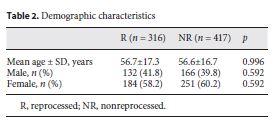
<body><![CDATA[<p><i>Clinical Outcomes</i></p>     <p>The mean age in the R group was 56.7 &plusmn; 17.3 years and in the NR group    56.6 &plusmn; 16.7 years. In both groups, females were predominant (<a href="#t2">Table    2</a>).</p>     <p>&nbsp;</p> <a name="t2"></a> <img src="/img/revistas/pjph/v36n3/36n3a03t2.jpg">      
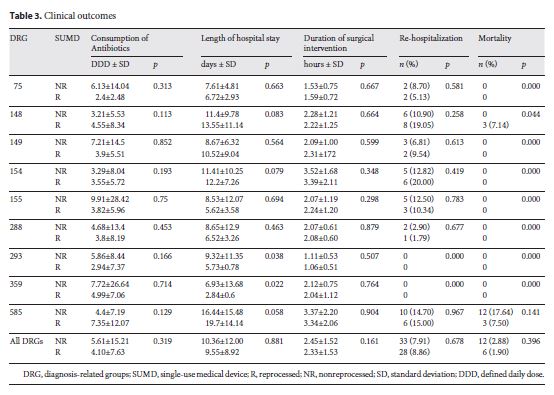
<p>&nbsp;</p>     <p>The postoperative infection rate was on average 12.9%, being 12.3% for the    R group and 13.4% for the NR group. There was a wide range of differences in    the rate of postoperative infections in each DRG group, depending on the type    of surgery and the severity of the preoperative condition. Still, there were    no differences between the 2 groups (p = 0.664).</p>     <p><a href="#t3">Table 3</a> describes the consumption of antibiotics (as DDD),    length of hospital stay, time of surgery, readmission rate, and inhospital mortality.    A comparison of the consumption of antibiotics (DDD) between the R and NR groups    and for all DRG subgroups showed no significant differences (p = 0.319).</p>     <p>&nbsp;</p> <a name="t3"></a> <img src="/img/revistas/pjph/v36n3/36n3a03t3.jpg">      
<p>&nbsp;</p>     <p>The duration of the surgical intervention was on average 2 h and 23 min (p    = 0.161), and length of hospital stay was approximately 10 days in both groups    (p = 0.881). Rehospitalization was required for 28 patients in the R group and    for 33 patients in the NR group (p = 0.678).</p>     <p>Hospital mortality in the R group was 1.90%, resulting in 6 deaths, and it    was 2.88% (12 deaths) in interventions in which new devices were used (NR group).    Mortality was different in patients in DRGs 148 and 585. These interventions    were mostly lifesaving procedures in extremely sick patients, with 11&ndash;36    patients having a secondary diagnosis, including cardiogenic shock and renal    failure. The reasons for death were not related to the use of either reprocessed    or nonreprocessed devices. There were no reoperations in either groups.</p>     ]]></body>
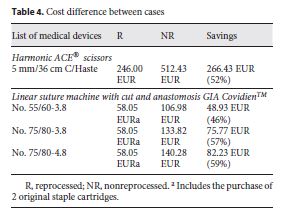
<body><![CDATA[<p><i>Cost Analysis</i></p>     <p>Data in <a href="#t4">Table 4</a> show the costs of purchasing new devices    as compared to the reprocessing costs of these SUMDs after use. Acquisition    costs were obtained by the manufacturer company catalog that supplies the SUMDs    to the CHSJ. Values for reprocessing were established between the CHSJ and the    reprocessing company by protocol. The reprocessing costs of the devices include    the evaluation and validation of the entire 7step reprocessing cycle, from collection    to delivery back to the hospital, with no additional costs.</p>     <p>&nbsp;</p> <a name="t4"></a> <img src="/img/revistas/pjph/v36n3/36n3a03t4.jpg">      
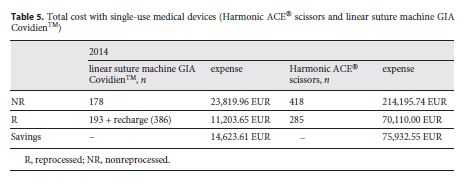
<p>&nbsp;</p>     <p>The acquisition costs of the new Harmonic ACE&reg; scissors and those of reprocessed    ones differed by 52% per device. In the case of the linear suture machine GIA    Covidien <sup>TM</sup> , the difference was less, due to the need to buy additional    original staple cartridges.</p>     <p><a href="#t5">Table 5</a> shows the total of devices used as well as the costs    with each of the options for the year 2014. Savings in <a href="#t5">Table 5</a>    were calculated based on the difference between buying all SUMDs new without    reprocessing and purchasing/reprocessing the SUMDs by the CHSJ. A total of 193    linear suturing machines GIA Covidien <sup>TM</sup> were reprocessed, saving    EUR 14,623.61. These devices use staples that need to be originals and must    be purchased separately. In each procedure, an average of 2 new cartridges was    used. For this study, the value of EUR 7.5 was used for each recharge, corresponding    to an expense of EUR 2,895. Of the Harmonic ACE&reg; scissors, 285 were reprocessed,    corresponding to savings of EUR 75,932.55.</p>     <p>&nbsp;</p> <a name="t5"></a> <img src="/img/revistas/pjph/v36n3/36n3a03t5.jpg">      
<p>&nbsp;</p>     <p><b>Discussion</b></p>     <p>Several authors have documented a cost reduction of around 50% due to the use    of reprocessed SUMDs (<sup><a href="#12">12</a></sup><a name="top12"></a>, <sup><a href="#13">13</a></sup><a name="top13"></a>,    <sup><a href="#14">14</a></sup><a name="top14"></a>, <sup><a href="#15">15</a></sup><a name="top15"></a>    ). Because of the strict requirements for a correct reprocessing, many hospitals    use certified thirdparty outside bodies to reprocess their devices (<sup><a href="#16">16</a></sup><a name="top16"></a>    <sup><a href="#19">19</a></sup><a name="top19"></a> ). In addition to the economic    advantages, reprocessing is now considered as one of the most efficient measures    for hospitals to immediately reduce some of their negative environmental impact    (<sup><a href="#20">20</a></sup><a name="top20"></a> , <sup><a href="#21">21</a></sup><a name="top21"></a>    ). Approximately 10 million medical devices have been reprocessed in the German    market with strict quality standards for reprocessing approved by the national    regulatory boards, and there were no complaints concerning this activity <sup><a href="#16">16</a></sup><a name="top16"></a>.</p>     ]]></body>
<body><![CDATA[<p>In our study, the groups submitted to surgical intervention with reprocessed    and nonreprocessed SUMDs were comparable with respect to their demographic characteristics.    The incidence of infection was similar in both groups. We measured this incidence    using the postoperative infection rate and an analysis of the consumption of    antibiotics, which is a more differentiated method of tracing the eventual occurrence    of infectious complications, which would lead to an increase in the consumption    of antibiotics. If this had happened, it might have been due to the use of the    reprocessed devices <sup><a href="#10">10</a></sup><a name="top10"></a>. The    duration of the surgical intervention and the length of hospital stay were similar    in both groups, which confirms the scientific evidence found internationally    <sup><a href="#11">11</a></sup><a name="top11"></a>.</p>     <p>There were no significant differences between the use of new and reprocessed    devices regarding the incidence of rehospitalization and hospital mortality.    The analysis by DRG subgroups showed a difference in mortality in DRGs 148 and    585. Out of the 18 patients who died in these 2 groups, 6 were operated on using    reprocessed devices and the other 12 using original devices. It has to be emphasized    that these DRGs refer to pathologies of the gastrointestinal system in patients    who, at the time of surgery, already suffered from established severe complications,    such as sepsis, severe bleeding, pulmonary embolism, and shock. The reason for    death was not related to the use of the devices in any case. There was no need    for reoperations in either group.</p>     <p>As a result, no increased risk was revealed with regard to the use of reprocessed    SUMDs compared to the use of original SUMDs, and, therefore, reprocessed SUMDs    do not compromise patient safety. Our experience shows that the concerns pronounced    by several entities, which point out eventual risks associated with patient    safety as an argument for not using reprocessed SUMDs, are not justified, and    it confirms published data about the safety of using properly reprocessed SUMDs    (<sup><a href="#16">16</a></sup><a name="top16"></a> , <sup><a href="#17">17</a></sup><a name="top17"></a>,    <sup><a href="#18">18</a></sup><a name="top18"></a> , <sup><a href="#22">22</a></sup><a name="top22"></a>    ).</p>     <p>With regard to the economic analysis indicators, there is a huge difference    between the cost of acquiring a new SUMD and a reprocessed device, and this    difference in the case of the Harmonic ACE&reg; scissors and the linear suture    machine GIA Covidien <sup>TM</sup> comprises a saving around 50% per device,    confirming the results obtained in international studies (<sup><a href="#15">15</a></sup><a name="top15"></a>    , <sup><a href="#16">16</a></sup><a name="top16"></a> , <sup><a href="#23">23</a></sup><a name="top23"></a>    , <sup><a href="#24">24</a></sup><a name="top24"></a> ). This practice allowed    for a yearly saving of EUR 90,556.16 just for the 2 devices.</p>     <p>Each medical device analyzed here can be reprocessed up to 2 times, which means    that each new medical device purchased can be used 2 more times after professional    treatment. To perform a fourth surgery, a new medical device needs to be purchased.    A total of 596 new devices were purchased; 478 went through 1 reprocessing cycle,    so by the year 2014 the stock of new devices was sufficient.</p>     <p>Our data are consistent with the fact that the certified reprocessing process    requires a rigorous inspection, obeying demanding criteria and guidelines specific    to each device. These stringent criteria allow the detection of any type of    anomaly, which is not the case in original medical devices whose quality control    is done by sampling (<sup><a href="#19">19</a></sup><a name="top19"></a> , <sup><a href="#25">25</a></sup><a name="top25"></a>    , <sup><a href="#26">26</a></sup><a name="top26"></a> ).</p>     <p>It is important to emphasize that not all SUMDs are reprocessable. Before they    are accepted for clinical use, the methods of reprocessing, specific for each    device, are validated and approved by the regulatory agencies, as was done with    the devices our hospital had chosen to use <sup><a href="#19">19</a></sup><a name="top19"></a>.</p>     <p>Over the years, CHSJ has increased the use of reprocessed SUMDs. If this growth    continues, it is expected that the optimum number of uses of these 2 devices    can be reached. This approach allows a better use of resources, leading to an    improvement in hospital sustainability.</p>     <p>&nbsp;</p>     <p><b>Conclusion</b></p>     ]]></body>
<body><![CDATA[<p>Our study is the first analysis in Portugal of clinical and financial results    obtained for patients undergoing surgical procedures using certified professionally    reprocessed SUMDs (Harmonic ACE&reg; scissors and linear suture machine). To    assess clinical efficacy, a comparison was made with a similar group of patients    undergoing surgical intervention with original devices in the same time period.    Clinical results of patients operated on with reprocessed devices were the same    as those of patients in which original medical devices were used.</p>     <p>Financially, the economic benefits of reprocessing are evident, contributing    to fostering a culture of economic sustainability of hospitals by reducing costs    while maintaining quality of care. We conclude that certified reprocessing of    SUMDs has proved to be a safe and effective process, leading to better hospital    sustainability.</p>     <p>&nbsp;</p>     <p><b>REFERENCES</b></p> <Sup><a name="1"></a><a href="#top1">1</a></Sup> Popp W , Rasslan O , Unahalekhaka  A , Brenner P , Fischnaller E , Fathy M , et al. What is the use? An international  look at reuse of Single-Use medical devices. Int J Hyg Environ Health. 2010 Jul  ; 213 (4): 302 &ndash; 7.      <p></p>     <!-- ref --><p><Sup><a name="2"></a><a href="#top2">2</a></Sup> Ko W. Special report: reprocessing    in an era of health care reform. New York, NY: DOTmed; 2014. (Cited 21032018).    Available from: <a href="https://www.dotmed.com/news/story/22661?p_begin=1" target="_blank">https://www.dotmed.com/news/story/22661?p_begin=1</a>  &nbsp;&nbsp;&nbsp;&nbsp;&nbsp;&nbsp;&nbsp;&nbsp;[&#160;<a href="javascript:void(0);" onclick="javascript: window.open('/scielo.php?script=sci_nlinks&ref=2092612&pid=S2504-3145201800030000300002&lng=','','width=640,height=500,resizable=yes,scrollbars=1,menubar=yes,');">Links</a>&#160;]<!-- end-ref --><p><Sup><a name="3"></a><a href="#top3">3</a></Sup> Decreto-Lei 145/2009. Diário    da República. 115. Iª Série. (2009-6-17): 3707–7765. Available from: <a href="https://dre.pt/pesquisa/-/ search/494558/details/maximized" target="_blank">https://dre.pt/pesquisa/-/ search/494558/details/maximized</a>  </p>     <!-- ref --><p><Sup><a name="4"></a><a href="#top4">4</a></Sup> Ecotlon. Dispositivo m&eacute;dico    de uso &uacute;nico: enquadramento Legal. Lisboa: Ecotlon Economia na Sa&uacute;de;    2018. (Cited 21032018). Available from: <a href="http://www.ecotlon.com/pt/dmuu/enquadramentolegal/" target="_blank">http://www.ecotlon.com/pt/dmuu/enquadramentolegal/</a>  &nbsp;&nbsp;&nbsp;&nbsp;&nbsp;&nbsp;&nbsp;&nbsp;[&#160;<a href="javascript:void(0);" onclick="javascript: window.open('/scielo.php?script=sci_nlinks&ref=2092614&pid=S2504-3145201800030000300003&lng=','','width=640,height=500,resizable=yes,scrollbars=1,menubar=yes,');">Links</a>&#160;]<!-- end-ref --><p><Sup><a name="5"></a><a href="#top5">5</a></Sup> Diretiva 93/42/CEE. Jornal    Oficial das Comunidades Europeias. L 169 (1993-7-12): 1-60. </p>     <p><Sup><a name="6"></a><a href="#top6">6</a></Sup> Diretiva 2007/47 /CEE. Jornal    Oficial da Uni&atilde;o Europeia. L 247 (2007-11-05): 21-55. </p>     ]]></body>
<body><![CDATA[<p><Sup><a name="7"></a><a href="#top7">7</a></Sup> Day P. What is the evidence    on the safety and effectiveness of the reuse of medical devices labelled as    Single-Use only? Nzhta Tech Brief Series. 2004 ; 3 (2): 1 &ndash; 53. </p>     <!-- ref --><p><Sup><a name="8"></a><a href="#top8">8</a></Sup> FDA. Processing/reprocessing    medical devices in health care settings: validation methods and labeling. Silver    Spring (MA) : Food and Drug Administration ; 2011.    &nbsp;&nbsp;&nbsp;&nbsp;&nbsp;&nbsp;&nbsp;&nbsp;[&#160;<a href="javascript:void(0);" onclick="javascript: window.open('/scielo.php?script=sci_nlinks&ref=2092618&pid=S2504-3145201800030000300005&lng=','','width=640,height=500,resizable=yes,scrollbars=1,menubar=yes,');">Links</a>&#160;]<!-- end-ref --> </p>     <!-- ref --><p><Sup><a name="9"></a><a href="#top9">9</a></Sup> Ethicon. Especialidades e    procedimentos: solu&ccedil;&otilde;es Ethicon para especialidades e procedimentos.    S&atilde;o Paulo, SP: Ethicon. Johnson &amp; Johnson; 2016. (Cited 21072018).    Available from: <a href="https://www.ethicon.com/latam/pt" target="_blank">https://www.ethicon.com/latam/pt</a>  &nbsp;&nbsp;&nbsp;&nbsp;&nbsp;&nbsp;&nbsp;&nbsp;[&#160;<a href="javascript:void(0);" onclick="javascript: window.open('/scielo.php?script=sci_nlinks&ref=2092620&pid=S2504-3145201800030000300006&lng=','','width=640,height=500,resizable=yes,scrollbars=1,menubar=yes,');">Links</a>&#160;]<!-- end-ref --><!-- ref --><p><Sup><a name="10"></a><a href="#top10">10</a></Sup> Carungi R , Simon I. Safety    and performance evaluation of remanufactured harmonic scalpels. Washington (DC)    : Association of Medical Device Reprocessors ; 2010.(Cited 21032018), Available    from <a href="http://www.amdr.org/wpcontent/uploads/2010/09/WhitePaperSafetyandPerformanceEvalofRemfdHarmonicScalpels.pdf" target="_blank">http://www.amdr.org/wpcontent/uploads/2010/09/WhitePaperSafetyandPerformanceEvalofRemfdHarmonicScalpels.pdf</a>  &nbsp;&nbsp;&nbsp;&nbsp;&nbsp;&nbsp;&nbsp;&nbsp;[&#160;<a href="javascript:void(0);" onclick="javascript: window.open('/scielo.php?script=sci_nlinks&ref=2092621&pid=S2504-3145201800030000300007&lng=','','width=640,height=500,resizable=yes,scrollbars=1,menubar=yes,');">Links</a>&#160;]<!-- end-ref --><p><Sup><a name="11"></a><a href="#top11">11</a></Sup> Lester BR , Miller K ,    Boers A , Harris DC , Gamble WG. Comparison of in vivo clinical performance    and shaft temperature and in vitro tissue temperature and transection times    between new and reprocessed harmonic scalpels. Surg Laparosc Endosc Percutan    Tech. 2010 Oct ; 20 (5): e150 &ndash; 9. </p>     <p><Sup><a name="12"></a><a href="#top12">12</a></Sup> Renton D , Denk P , Varban    O. Reprocessed Single-Use devices in laparoscopy: assessment of cost, environmental    impact, and patient safety. Surg Endosc. 2018 Oct ; 32 (10): 4310 &ndash; 3.  </p>     <p><Sup><a name="13"></a><a href="#top13">13</a></Sup> Jacobs P , Polisena J ,    Hailey D , Lafferty S. Economic analysis of reprocessing Single-Use medical    devices: a systematic literature review. Infect Control Hosp Epidemiol. 2008    Apr ; 29 (4): 297 &ndash; 301. </p>     <p><Sup><a name="14"></a><a href="#top14">14</a></Sup> Garay OU , Elorrio EG ,    Rodr&iacute;guez V , Spira C , Augustovski F , Pichon-Riviere A. Single-Use    devices in Argentina: cost comparison analysis of a &ldquo;reuse&rdquo; versus    a &ldquo;Single-Use&rdquo; policy for trocars, endocutters, linear cutters,    and harmonic scalpels. Value Health Reg Issues. 2017 Dec ; 14 : 89 &ndash; 95.  </p>     <p><Sup><a name="15"></a><a href="#top15">15</a></Sup> Association of Surgeons    of Great Britain and Ireland : Consensus statement on costeffective and sustainable    surgery ; 2012. </p>     ]]></body>
<body><![CDATA[<p><Sup><a name="16"></a><a href="#top16">16</a></Sup> Bracklo M , Marczak U ,    Chergui S. Reprocessing cardiology devices: reviewing 15 years of experience    in Germany. Eur Cardiol. 2012 ; 8 (2): 82 &ndash; 3. </p>     <p><Sup><a name="17"></a><a href="#top17">17</a></Sup> Dunnigan A , Roberts C    , McNamara M , Benson DW Jr , Benditt DG. Success of reuse of cardiac electrode    catheters. Am J Cardiol. 1987 Oct ; 60 (10): 807 &ndash; 10. </p>     <p><Sup><a name="18"></a><a href="#top18">18</a></Sup> Tessarolo F , Disertori    M , Caola I , Guarrera GM , Favaretti C , Nollo G. Health technology assessment    on reprocessing Single-Use catheters for cardiac electrophysiology: results    of a threeyears study. Conf Proc IEEE Eng Med Biol Soc. 2007 ; 2007 : 1758 &ndash;    61. </p>     <!-- ref --><p><Sup><a name="19"></a><a href="#top19">19</a></Sup> Kr&uuml;ger CM. Processing    Single-Use medical devices for use in surgery importance, status quo and potential.    GMS Krankenhhyg Interdiszip. 2008 Sep ; 3 (3): Doc21.    &nbsp;&nbsp;&nbsp;&nbsp;&nbsp;&nbsp;&nbsp;&nbsp;[&#160;<a href="javascript:void(0);" onclick="javascript: window.open('/scielo.php?script=sci_nlinks&ref=2092630&pid=S2504-3145201800030000300014&lng=','','width=640,height=500,resizable=yes,scrollbars=1,menubar=yes,');">Links</a>&#160;]<!-- end-ref --> </p>     <p><Sup><a name="20"></a><a href="#top20">20</a></Sup> Kwakye G , Pronovost PJ    , Makary MA. Commentary: a call to go green in health care by reprocessing medical    equipment. Acad Med. 2010 Mar ; 85 (3): 398 &ndash; 400. </p>     <p><Sup><a name="21"></a><a href="#top21">21</a></Sup> DiConsiglio J. Reprocessing    SUDs reduces waste, costs. Mater Manag Health Care. 2008 Sep ; 17 (9): 40 &ndash;    2. </p>     <!-- ref --><p><Sup><a name="22"></a><a href="#top22">22</a></Sup> GAO. GAO report: reprocessed    Single-Use medical devices: FDA oversight has increased, and available information    does not indicate that use presents an elevated health risk. Washington (DC)    : U.S. General Accounting Office ; 2008.    &nbsp;&nbsp;&nbsp;&nbsp;&nbsp;&nbsp;&nbsp;&nbsp;[&#160;<a href="javascript:void(0);" onclick="javascript: window.open('/scielo.php?script=sci_nlinks&ref=2092634&pid=S2504-3145201800030000300017&lng=','','width=640,height=500,resizable=yes,scrollbars=1,menubar=yes,');">Links</a>&#160;]<!-- end-ref --> </p>     <!-- ref --><p><Sup><a name="23"></a><a href="#top23">23</a></Sup> AMDR. Reduce, reuse, recycle    reprocessing medical devices. Washington, DC: Association of Medical Device    Reprocessors; 2016. (Cited 19032018). Available from: <a href="http://www.hospitalmanagement.net/features/feature80981/" target="_blank">http://www.hospitalmanagement.net/features/feature80981/</a>  &nbsp;&nbsp;&nbsp;&nbsp;&nbsp;&nbsp;&nbsp;&nbsp;[&#160;<a href="javascript:void(0);" onclick="javascript: window.open('/scielo.php?script=sci_nlinks&ref=2092636&pid=S2504-3145201800030000300018&lng=','','width=640,height=500,resizable=yes,scrollbars=1,menubar=yes,');">Links</a>&#160;]<!-- end-ref --><p><Sup><a name="24"></a><a href="#top24">24</a></Sup> Sloan TW. Safetycost tradeoffs    in medical device reuse: a Markov decision process model. Health Care Manage    Sci. 2007 Feb ; 10 (1): 81 &ndash; 93. </p>     <!-- ref --><p><Sup><a name="25"></a><a href="#top25">25</a></Sup> U.S. Department of Health    and Human Services. Guidance for industry and for FDA staff: enforcement priorities    for single use devices reprocessed by third parties and hospitals. Washington    (DC) : U.S. Department of Health and Human Services ; 2000.    &nbsp;&nbsp;&nbsp;&nbsp;&nbsp;&nbsp;&nbsp;&nbsp;[&#160;<a href="javascript:void(0);" onclick="javascript: window.open('/scielo.php?script=sci_nlinks&ref=2092638&pid=S2504-3145201800030000300020&lng=','','width=640,height=500,resizable=yes,scrollbars=1,menubar=yes,');">Links</a>&#160;]<!-- end-ref --> </p>     <p><Sup><a name="26"></a><a href="#top26">26</a></Sup> Uni&atilde;o Europeia :    Relat&oacute;rio sobre a quest&atilde;o do reprocessamento de dispositivos m&eacute;dicos    na Uni&atilde;o Europeia de acordo com o artigo 12A da diretiva 93/42/CEE. Bruxelas:    Uni&atilde;o Europeia; 2010.</p>     <p>&nbsp;</p>     <p>Received: January 24, 2018. Accepted: June 5, 2018</p>      ]]></body><back>
<ref-list>
<ref id="B1">
<nlm-citation citation-type="journal">
<person-group person-group-type="author">
<name>
<surname><![CDATA[Popp]]></surname>
<given-names><![CDATA[W]]></given-names>
</name>
<name>
<surname><![CDATA[Rasslan]]></surname>
<given-names><![CDATA[O]]></given-names>
</name>
<name>
<surname><![CDATA[Unahalekhaka]]></surname>
<given-names><![CDATA[A]]></given-names>
</name>
<name>
<surname><![CDATA[Brenner]]></surname>
<given-names><![CDATA[P]]></given-names>
</name>
<name>
<surname><![CDATA[Fischnaller]]></surname>
<given-names><![CDATA[E]]></given-names>
</name>
<name>
<surname><![CDATA[Fathy]]></surname>
<given-names><![CDATA[M]]></given-names>
</name>
</person-group>
<article-title xml:lang="en"><![CDATA[What is the use? An international look at reuse of Single-Use medical devices]]></article-title>
<source><![CDATA[Int J Hyg Environ Health]]></source>
<year>2010</year>
<volume>213</volume>
<numero>4</numero>
<issue>4</issue>
<page-range>302 – 7</page-range></nlm-citation>
</ref>
<ref id="B2">
<nlm-citation citation-type="book">
<person-group person-group-type="author">
<name>
<surname><![CDATA[Ko]]></surname>
<given-names><![CDATA[W]]></given-names>
</name>
</person-group>
<source><![CDATA[Special report: reprocessing in an era of health care reform]]></source>
<year>2014</year>
<publisher-loc><![CDATA[New York^eNY NY]]></publisher-loc>
<publisher-name><![CDATA[DOTmed]]></publisher-name>
</nlm-citation>
</ref>
<ref id="B3">
<nlm-citation citation-type="book">
<collab>Ecotlon</collab>
<source><![CDATA[Dispositivo médico de uso único: enquadramento Legal]]></source>
<year>2018</year>
<publisher-loc><![CDATA[Lisboa ]]></publisher-loc>
<publisher-name><![CDATA[Ecotlon Economia na Saúde]]></publisher-name>
</nlm-citation>
</ref>
<ref id="B4">
<nlm-citation citation-type="journal">
<person-group person-group-type="author">
<name>
<surname><![CDATA[Day]]></surname>
<given-names><![CDATA[P]]></given-names>
</name>
</person-group>
<article-title xml:lang="en"><![CDATA[What is the evidence on the safety and effectiveness of the reuse of medical devices labelled as Single-Use only?]]></article-title>
<source><![CDATA[Nzhta Tech Brief Series]]></source>
<year>2004</year>
<volume>3</volume>
<numero>2</numero>
<issue>2</issue>
<page-range>1 – 53</page-range></nlm-citation>
</ref>
<ref id="B5">
<nlm-citation citation-type="book">
<collab>FDA</collab>
<source><![CDATA[Processing/reprocessing medical devices in health care settings: validation methods and labeling]]></source>
<year>2011</year>
<publisher-name><![CDATA[Silver Spring (MA) : Food and Drug Administration]]></publisher-name>
</nlm-citation>
</ref>
<ref id="B6">
<nlm-citation citation-type="book">
<collab>Ethicon</collab>
<source><![CDATA[Especialidades e procedimentos: soluções Ethicon para especialidades e procedimentos]]></source>
<year>2016</year>
<publisher-loc><![CDATA[São Paulo^eSP SP]]></publisher-loc>
<publisher-name><![CDATA[Ethicon. Johnson & Johnson]]></publisher-name>
</nlm-citation>
</ref>
<ref id="B7">
<nlm-citation citation-type="book">
<person-group person-group-type="author">
<name>
<surname><![CDATA[Carungi]]></surname>
<given-names><![CDATA[R]]></given-names>
</name>
<name>
<surname><![CDATA[Simon]]></surname>
<given-names><![CDATA[I]]></given-names>
</name>
</person-group>
<source><![CDATA[Safety and performance evaluation of remanufactured harmonic scalpels]]></source>
<year>2010</year>
<publisher-loc><![CDATA[Washington^eDC DC]]></publisher-loc>
<publisher-name><![CDATA[Association of Medical Device Reprocessors]]></publisher-name>
</nlm-citation>
</ref>
<ref id="B8">
<nlm-citation citation-type="journal">
<person-group person-group-type="author">
<name>
<surname><![CDATA[Lester]]></surname>
<given-names><![CDATA[BR]]></given-names>
</name>
<name>
<surname><![CDATA[Miller]]></surname>
<given-names><![CDATA[K]]></given-names>
</name>
<name>
<surname><![CDATA[Boers]]></surname>
<given-names><![CDATA[A]]></given-names>
</name>
<name>
<surname><![CDATA[Harris]]></surname>
<given-names><![CDATA[DC]]></given-names>
</name>
<name>
<surname><![CDATA[Gamble]]></surname>
<given-names><![CDATA[WG]]></given-names>
</name>
</person-group>
<article-title xml:lang="en"><![CDATA[Comparison of in vivo clinical performance and shaft temperature and in vitro tissue temperature and transection times between new and reprocessed harmonic scalpels]]></article-title>
<source><![CDATA[Surg Laparosc Endosc Percutan Tech]]></source>
<year>2010</year>
<volume>20</volume>
<numero>5</numero>
<issue>5</issue>
<page-range>e150 – 9</page-range></nlm-citation>
</ref>
<ref id="B9">
<nlm-citation citation-type="journal">
<person-group person-group-type="author">
<name>
<surname><![CDATA[Renton]]></surname>
<given-names><![CDATA[D]]></given-names>
</name>
<name>
<surname><![CDATA[Denk]]></surname>
<given-names><![CDATA[P]]></given-names>
</name>
<name>
<surname><![CDATA[Varban]]></surname>
<given-names><![CDATA[O]]></given-names>
</name>
</person-group>
<article-title xml:lang="en"><![CDATA[Reprocessed Single-Use devices in laparoscopy: assessment of cost, environmental impact, and patient safety]]></article-title>
<source><![CDATA[Surg Endosc]]></source>
<year>2018</year>
<volume>32</volume>
<numero>10</numero>
<issue>10</issue>
<page-range>4310 – 3</page-range></nlm-citation>
</ref>
<ref id="B10">
<nlm-citation citation-type="journal">
<person-group person-group-type="author">
<name>
<surname><![CDATA[Jacobs]]></surname>
<given-names><![CDATA[P]]></given-names>
</name>
<name>
<surname><![CDATA[Polisena]]></surname>
<given-names><![CDATA[J]]></given-names>
</name>
<name>
<surname><![CDATA[Hailey]]></surname>
<given-names><![CDATA[D]]></given-names>
</name>
<name>
<surname><![CDATA[Lafferty]]></surname>
<given-names><![CDATA[S]]></given-names>
</name>
</person-group>
<article-title xml:lang="en"><![CDATA[Economic analysis of reprocessing Single-Use medical devices: a systematic literature review]]></article-title>
<source><![CDATA[Infect Control Hosp Epidemiol]]></source>
<year>2008</year>
<volume>29</volume>
<numero>4</numero>
<issue>4</issue>
<page-range>297 – 301</page-range></nlm-citation>
</ref>
<ref id="B11">
<nlm-citation citation-type="journal">
<person-group person-group-type="author">
<name>
<surname><![CDATA[Garay]]></surname>
<given-names><![CDATA[OU]]></given-names>
</name>
<name>
<surname><![CDATA[Elorrio]]></surname>
<given-names><![CDATA[EG]]></given-names>
</name>
<name>
<surname><![CDATA[Rodríguez]]></surname>
<given-names><![CDATA[V]]></given-names>
</name>
<name>
<surname><![CDATA[Spira]]></surname>
<given-names><![CDATA[C]]></given-names>
</name>
<name>
<surname><![CDATA[Augustovski]]></surname>
<given-names><![CDATA[F]]></given-names>
</name>
<name>
<surname><![CDATA[PichonRiviere]]></surname>
<given-names><![CDATA[A]]></given-names>
</name>
</person-group>
<article-title xml:lang="en"><![CDATA[Single-Use devices in Argentina: cost comparison analysis of a “reuse” versus a “Single-Use” policy for trocars, endocutters, linear cutters, and harmonic scalpels]]></article-title>
<source><![CDATA[Value Health Reg Issues]]></source>
<year>2017</year>
<volume>14</volume>
<page-range>89 – 95</page-range></nlm-citation>
</ref>
<ref id="B12">
<nlm-citation citation-type="journal">
<person-group person-group-type="author">
<name>
<surname><![CDATA[Bracklo]]></surname>
<given-names><![CDATA[M]]></given-names>
</name>
<name>
<surname><![CDATA[Marczak]]></surname>
<given-names><![CDATA[U]]></given-names>
</name>
<name>
<surname><![CDATA[Chergui]]></surname>
<given-names><![CDATA[S]]></given-names>
</name>
</person-group>
<article-title xml:lang="en"><![CDATA[Reprocessing cardiology devices: reviewing 15 years of experience in Germany]]></article-title>
<source><![CDATA[Eur Cardiol]]></source>
<year>2012</year>
<volume>8</volume>
<numero>2</numero>
<issue>2</issue>
<page-range>82 – 3</page-range></nlm-citation>
</ref>
<ref id="B13">
<nlm-citation citation-type="journal">
<person-group person-group-type="author">
<name>
<surname><![CDATA[Dunnigan]]></surname>
<given-names><![CDATA[A]]></given-names>
</name>
<name>
<surname><![CDATA[Roberts]]></surname>
<given-names><![CDATA[C]]></given-names>
</name>
<name>
<surname><![CDATA[McNamara]]></surname>
<given-names><![CDATA[M]]></given-names>
</name>
<name>
<surname><![CDATA[Benson]]></surname>
<given-names><![CDATA[DW Jr]]></given-names>
</name>
<name>
<surname><![CDATA[Benditt]]></surname>
<given-names><![CDATA[DG]]></given-names>
</name>
</person-group>
<article-title xml:lang="en"><![CDATA[Success of reuse of cardiac electrode catheters]]></article-title>
<source><![CDATA[Am J Cardiol]]></source>
<year>1987</year>
<volume>60</volume>
<numero>10</numero>
<issue>10</issue>
<page-range>807 – 10</page-range></nlm-citation>
</ref>
<ref id="B14">
<nlm-citation citation-type="journal">
<person-group person-group-type="author">
<name>
<surname><![CDATA[Krüger]]></surname>
<given-names><![CDATA[CM]]></given-names>
</name>
</person-group>
<article-title xml:lang="en"><![CDATA[Processing Single-Use medical devices for use in surgery importance, status quo and potential]]></article-title>
<source><![CDATA[GMS Krankenhhyg Interdiszip]]></source>
<year>2008</year>
<volume>3</volume>
<numero>3</numero>
<issue>3</issue>
<page-range>Doc21</page-range></nlm-citation>
</ref>
<ref id="B15">
<nlm-citation citation-type="journal">
<person-group person-group-type="author">
<name>
<surname><![CDATA[Kwakye]]></surname>
<given-names><![CDATA[G]]></given-names>
</name>
<name>
<surname><![CDATA[Pronovost]]></surname>
<given-names><![CDATA[PJ]]></given-names>
</name>
<name>
<surname><![CDATA[Makary]]></surname>
<given-names><![CDATA[MA]]></given-names>
</name>
</person-group>
<article-title xml:lang="en"><![CDATA[Commentary: a call to go green in health care by reprocessing medical equipment]]></article-title>
<source><![CDATA[Acad Med]]></source>
<year>2010</year>
<volume>85</volume>
<numero>3</numero>
<issue>3</issue>
<page-range>398 – 400</page-range></nlm-citation>
</ref>
<ref id="B16">
<nlm-citation citation-type="journal">
<person-group person-group-type="author">
<name>
<surname><![CDATA[DiConsiglio]]></surname>
<given-names><![CDATA[J]]></given-names>
</name>
</person-group>
<article-title xml:lang="en"><![CDATA[Reprocessing SUDs reduces waste, costs]]></article-title>
<source><![CDATA[Mater Manag Health Care]]></source>
<year>2008</year>
<volume>17</volume>
<numero>9</numero>
<issue>9</issue>
<page-range>40 – 2</page-range></nlm-citation>
</ref>
<ref id="B17">
<nlm-citation citation-type="book">
<collab>GAO</collab>
<source><![CDATA[GAO report: reprocessed Single-Use medical devices: FDA oversight has increased, and available information does not indicate that use presents an elevated health risk]]></source>
<year>2008</year>
<publisher-loc><![CDATA[Washington^eDC DC]]></publisher-loc>
<publisher-name><![CDATA[U.S. General Accounting Office]]></publisher-name>
</nlm-citation>
</ref>
<ref id="B18">
<nlm-citation citation-type="book">
<collab>AMDR</collab>
<source><![CDATA[Reduce, reuse, recycle reprocessing medical devices]]></source>
<year>2016</year>
<publisher-loc><![CDATA[Washington^eDC DC]]></publisher-loc>
<publisher-name><![CDATA[Association of Medical Device Reprocessors]]></publisher-name>
</nlm-citation>
</ref>
<ref id="B19">
<nlm-citation citation-type="journal">
<person-group person-group-type="author">
<name>
<surname><![CDATA[Sloan]]></surname>
<given-names><![CDATA[TW]]></given-names>
</name>
</person-group>
<article-title xml:lang="en"><![CDATA[Safetycost tradeoffs in medical device reuse: a Markov decision process model]]></article-title>
<source><![CDATA[Health Care Manage Sci]]></source>
<year>2007</year>
<volume>10</volume>
<numero>1</numero>
<issue>1</issue>
<page-range>81 – 93</page-range></nlm-citation>
</ref>
<ref id="B20">
<nlm-citation citation-type="book">
<collab>U.S. Department of Health and Human Services</collab>
<source><![CDATA[Guidance for industry and for FDA staff: enforcement priorities for single use devices reprocessed by third parties and hospitals]]></source>
<year>2000</year>
<publisher-loc><![CDATA[Washington^eDC DC]]></publisher-loc>
<publisher-name><![CDATA[U.S. Department of Health and Human Services]]></publisher-name>
</nlm-citation>
</ref>
</ref-list>
</back>
</article>