<?xml version="1.0" encoding="ISO-8859-1"?><article xmlns:mml="http://www.w3.org/1998/Math/MathML" xmlns:xlink="http://www.w3.org/1999/xlink" xmlns:xsi="http://www.w3.org/2001/XMLSchema-instance">
<front>
<journal-meta>
<journal-id>2504-3145</journal-id>
<journal-title><![CDATA[Portuguese Journal of Public Health]]></journal-title>
<abbrev-journal-title><![CDATA[Port J Public Health]]></abbrev-journal-title>
<issn>2504-3145</issn>
<publisher>
<publisher-name><![CDATA[Escola Nacional de Saúde Pública]]></publisher-name>
</publisher>
</journal-meta>
<article-meta>
<article-id>S2504-31452018000300005</article-id>
<article-id pub-id-type="doi">10.1159/000497073</article-id>
<title-group>
<article-title xml:lang="en"><![CDATA[Health Literacy: The Reality of a Community in Alto Minho]]></article-title>
<article-title xml:lang="pt"><![CDATA[Literacia em saúde: a realidade de uma comunidade do Alto Minho]]></article-title>
</title-group>
<contrib-group>
<contrib contrib-type="author">
<name>
<surname><![CDATA[Alves]]></surname>
<given-names><![CDATA[Odete Maria Azevedo]]></given-names>
</name>
<xref ref-type="aff" rid="A1 "/>
<xref ref-type="aff" rid="A A"/>
</contrib>
<contrib contrib-type="author">
<name>
<surname><![CDATA[Morais]]></surname>
<given-names><![CDATA[Maria Carminda Soares]]></given-names>
</name>
<xref ref-type="aff" rid="A2 "/>
</contrib>
<contrib contrib-type="author">
<name>
<surname><![CDATA[Cruz]]></surname>
<given-names><![CDATA[Marisa de Jesus Gomes]]></given-names>
</name>
<xref ref-type="aff" rid="A2 "/>
</contrib>
<contrib contrib-type="author">
<name>
<surname><![CDATA[Lima]]></surname>
<given-names><![CDATA[Ana Maria Damião Lopes]]></given-names>
</name>
<xref ref-type="aff" rid="A2 "/>
</contrib>
</contrib-group>
<aff id="AA1">
<institution><![CDATA[,Universidade do Porto Instituto de Ciências Biomédicas de Abel Salazar ]]></institution>
<addr-line><![CDATA[Porto ]]></addr-line>
<country>Portugal</country>
</aff>
<aff id="AA2">
<institution><![CDATA[,Instituto Politécnico de Viana do Castelo Escola Superior de Saúde de Viana do Castelo ]]></institution>
<addr-line><![CDATA[Viana do Castelo ]]></addr-line>
<country>Portugal</country>
</aff>
<aff id="AA3">
<institution><![CDATA[,Unidade Local de Saúde do Alto Minho, EPE  ]]></institution>
<addr-line><![CDATA[Viana do Castelo ]]></addr-line>
<country>Portugal</country>
</aff>
<aff id="AA4">
<institution><![CDATA[,Universidade de Coimbra Centro de Estudos e Investigação em Saúde ]]></institution>
<addr-line><![CDATA[Coimbra ]]></addr-line>
<country>Portugal</country>
</aff>
<pub-date pub-type="pub">
<day>00</day>
<month>00</month>
<year>2018</year>
</pub-date>
<pub-date pub-type="epub">
<day>00</day>
<month>00</month>
<year>2018</year>
</pub-date>
<volume>36</volume>
<numero>3</numero>
<fpage>1</fpage>
<lpage>9</lpage>
<copyright-statement/>
<copyright-year/>
<self-uri xlink:href="http://scielo.pt/scielo.php?script=sci_arttext&amp;pid=S2504-31452018000300005&amp;lng=en&amp;nrm=iso"></self-uri><self-uri xlink:href="http://scielo.pt/scielo.php?script=sci_abstract&amp;pid=S2504-31452018000300005&amp;lng=en&amp;nrm=iso"></self-uri><self-uri xlink:href="http://scielo.pt/scielo.php?script=sci_pdf&amp;pid=S2504-31452018000300005&amp;lng=en&amp;nrm=iso"></self-uri><abstract abstract-type="short" xml:lang="en"><p><![CDATA[Background: Limited health literacy makes decisionmaking difficult and has implications for individual health, costs, and the organization of health systems in general, and therefore must be studied in different communities, allowing an adequate response to the specificities, particularities, and potentialities of each local situation. Methods: To evaluate the level of health literacy and relate it to sociodemographic variables (sex, age group, education, and employment situation), this study was carried out in a population of 3,927 individuals from a parish of Alto Minho with a random probabilistic sample of 351 individuals, stratified by age and sex, with a sampling error of 5%. This is a quantitative, observational, and crosssectional study. Results: The majority of respondents were female (54.1%), with a mean age (±SD) of 44.94 ± 19.048 years, had higher education qualifications (74.0%), and were professionally active (61.0%). The health literacy of this community is limited (66.1%) in its different domains. In all of them, individuals assume easy and very easy activities that do not involve critical analysis and interpretation, and reveal greater difficulty in those that require this ability. Statistically significant relationships were found between the level of health literacy and schooling (?2 = 33.552 and p = 0.001). Conclusion: This study allowed us to recognize that the health literacy level of this Alto Minho community is limited. Also, the fact that it is related to certain sociodemographic variables sheds light on the health literacy level of the people of this community and on the challenges of promoting it.]]></p></abstract>
<abstract abstract-type="short" xml:lang="pt"><p><![CDATA[Introdução: A Literacia em Saúde limitada condiciona os indivíduos nas suas decisões e acarreta implicações na saúde individual, nos custos e na organização dos sistemas de saúde em geral, pelo que urge o seu estudo em diferentes comunidades permitindo uma resposta adequada às especificidades, particularidades e potencialidades de cada realidade. Métodos: Com o objetivo de avaliar o nível de Literacia em Saúde e relacionálo com as variáveis sociodemográficas (sexo, grupo etário, escolaridade e situação face ao emprego), realizouse este estudo numa população de 3,927 indivíduos de uma freguesia do Alto Minho com amostra probabilística aleatória, de 351 indivíduos, estratificada por idade e sexo, com um erro amostral de 5%. Tratase de um estudo quantitativo, observacional analítico e transversal. Resultados: A maioria dos inquiridos é do sexo feminino (54.1%), com idade média ± desvio padrão de 44.94 ± 19.048 anos, possui habilitações literárias superiores à escolaridade obrigatória (74.0%) e encontrase em situação profissionalmente ativa (61.0%). A Literacia em Saúde desta comunidade é limitada (66.1%) nos seus diferentes domínios. Em todos eles os indivíduos assumem como fácil e muito fácil atividades que não envolvem análise crítica e interpretação e revelam maior dificuldade nas que exigem essa capacidade. Foi encontrada relação estatisticamente significativa do nível de Literacia em Saúde com a escolaridade (?2 = 33.552 e p = 0.001). Conclusão: Este estudo permitiu conhecer o nível de LS desta comunidade do Alto Minho que se caracteriza como limitado. Também o facto de estar ou não relacionada com determinadas variáveis sociodemográficas permitiu a reflexão sobre a LS das pessoas desta comunidade e sobre os desafios da promoção da mesma.]]></p></abstract>
<kwd-group>
<kwd lng="en"><![CDATA[Health promotion]]></kwd>
<kwd lng="en"><![CDATA[Health literacy]]></kwd>
<kwd lng="en"><![CDATA[Knowledge and empowerment]]></kwd>
<kwd lng="pt"><![CDATA[Promoção da Saúde]]></kwd>
<kwd lng="pt"><![CDATA[Literacia em Saúde]]></kwd>
<kwd lng="pt"><![CDATA[Alfabetização em Saúde e Capacitação]]></kwd>
</kwd-group>
</article-meta>
</front><body><![CDATA[ <p style="text-align: right;"><b>RESEARCH ARTICLE</b></p>     <p>&nbsp;</p>     <p><b> Health Literacy: The Reality of a Community in Alto Minho</b></p>     <p><b>Literacia em sa&uacute;de: a realidade de uma comunidade do Alto Minho</b></p>     <p>&nbsp;</p>     <p><b>Odete Maria Azevedo Alves&nbsp;&nbsp;<sup>a</sup> <sup>b</sup> <sup>c</sup>    Maria Carminda Soares Morais&nbsp;<sup>b</sup> <sup>d</sup>&nbsp;Catarina Carvalhido    Barreiras <sup>b</sup> <sup>c</sup>&nbsp;Marisa de Jesus Gomes Cruz <sup>b</sup>    <sup>c</sup>&nbsp;Ana Maria Dami&atilde;o Lopes Lima <sup>b</sup> <sup>c</sup>    </b></p>     <p><sup>a</sup> Instituto de Ci&ecirc;ncias Biom&eacute;dicas de Abel Salazar,    Universidade do Porto, Porto, Portugal</p>     <p><sup>b</sup> Escola Superior de Sa&uacute;de de Viana do Castelo, Instituto    Polit&eacute;cnico de Viana do Castelo, Viana do Castelo, Portugal</p>     <p><sup>c</sup> Unidade Local de Sa&uacute;de do Alto Minho, EPE, Viana do Castelo,    Portugal</p>     <p><sup>d</sup> Centro de Estudos e Investiga&ccedil;&atilde;o em Sa&uacute;de    da Universidade de Coimbra, Coimbra, Portugal&nbsp;</p>     ]]></body>
<body><![CDATA[<p>&nbsp;</p>     <p><b>ABSTRACT</b></p>     <p>Background: Limited health literacy makes decisionmaking difficult and has    implications for individual health, costs, and the organization of health systems    in general, and therefore must be studied in different communities, allowing    an adequate response to the specificities, particularities, and potentialities    of each local situation. Methods: To evaluate the level of health literacy and    relate it to sociodemographic variables (sex, age group, education, and employment    situation), this study was carried out in a population of 3,927 individuals    from a parish of Alto Minho with a random probabilistic sample of 351 individuals,    stratified by age and sex, with a sampling error of 5%. This is a quantitative,    observational, and crosssectional study. Results: The majority of respondents    were female (54.1%), with a mean age (&plusmn;SD) of 44.94 &plusmn; 19.048 years,    had higher education qualifications (74.0%), and were professionally active    (61.0%). The health literacy of this community is limited (66.1%) in its different    domains. In all of them, individuals assume easy and very easy activities that    do not involve critical analysis and interpretation, and reveal greater difficulty    in those that require this ability. Statistically significant relationships    were found between the level of health literacy and schooling (&chi;<sup>2</sup>    = 33.552 and p &le; 0.001). Conclusion: This study allowed us to recognize that    the health literacy level of this Alto Minho community is limited. Also, the    fact that it is related to certain sociodemographic variables sheds light on    the health literacy level of the people of this community and on the challenges    of promoting it.</p> <b>Keywords:</b> Health promotion Health literacy Knowledge and empowerment&nbsp;     <p></p>     <p>&nbsp;</p>     <p><b>RESUMO</b></p>     <p>Introdu&ccedil;&atilde;o: A Literacia em Sa&uacute;de limitada condiciona os    indiv&iacute;duos nas suas decis&otilde;es e acarreta implica&ccedil;&otilde;es    na sa&uacute;de individual, nos custos e na organiza&ccedil;&atilde;o dos sistemas    de sa&uacute;de em geral, pelo que urge o seu estudo em diferentes comunidades    permitindo uma resposta adequada &agrave;s especificidades, particularidades    e potencialidades de cada realidade. M&eacute;todos: Com o objetivo de avaliar    o n&iacute;vel de Literacia em Sa&uacute;de e relacion&aacute;lo com as vari&aacute;veis    sociodemogr&aacute;ficas (sexo, grupo et&aacute;rio, escolaridade e situa&ccedil;&atilde;o    face ao emprego), realizouse este estudo numa popula&ccedil;&atilde;o de 3,927    indiv&iacute;duos de uma freguesia do Alto Minho com amostra probabil&iacute;stica    aleat&oacute;ria, de 351 indiv&iacute;duos, estratificada por idade e sexo,    com um erro amostral de 5%. Tratase de um estudo quantitativo, observacional    anal&iacute;tico e transversal. Resultados: A maioria dos inquiridos &eacute;    do sexo feminino (54.1%), com idade m&eacute;dia &plusmn; desvio padr&atilde;o    de 44.94 &plusmn; 19.048 anos, possui habilita&ccedil;&otilde;es liter&aacute;rias    superiores &agrave; escolaridade obrigat&oacute;ria (74.0%) e encontrase em    situa&ccedil;&atilde;o profissionalmente ativa (61.0%). A Literacia em Sa&uacute;de    desta comunidade &eacute; limitada (66.1%) nos seus diferentes dom&iacute;nios.    Em todos eles os indiv&iacute;duos assumem como f&aacute;cil e muito f&aacute;cil    atividades que n&atilde;o envolvem an&aacute;lise cr&iacute;tica e interpreta&ccedil;&atilde;o    e revelam maior dificuldade nas que exigem essa capacidade. Foi encontrada rela&ccedil;&atilde;o    estatisticamente significativa do n&iacute;vel de Literacia em Sa&uacute;de    com a escolaridade (&chi;2 = 33.552 e p &le; 0.001). Conclus&atilde;o: Este    estudo permitiu conhecer o n&iacute;vel de LS desta comunidade do Alto Minho    que se caracteriza como limitado. Tamb&eacute;m o facto de estar ou n&atilde;o    relacionada com determinadas vari&aacute;veis sociodemogr&aacute;ficas permitiu    a reflex&atilde;o sobre a LS das pessoas desta comunidade e sobre os desafios    da promo&ccedil;&atilde;o da mesma.</p>     <p><b>Palavras-chave</b>:&nbsp;Promo&ccedil;&atilde;o da Sa&uacute;de &middot;    Literacia em Sa&uacute;de &middot; Alfabetiza&ccedil;&atilde;o em Sa&uacute;de    e Capacita&ccedil;&atilde;o</p>     <p>&nbsp;</p>     <p><b>Introduction</b></p>     ]]></body>
<body><![CDATA[<p>People&rsquo;s empowerment in relation to their own health is now one of the    central goals in health at the European level <sup><a href="#1">1</a></sup><a name="top1"></a>,    and in Portugal this is framed through strategies delimited in the National    Health Plan <sup><a href="#2">2</a></sup><a name="top2"></a> and in the Literacy    Program in Health and Care Integration <sup><a href="#3">3</a></sup><a name="top3"></a>,    materialized through the SNS + Proximity Project <sup><a href="#4">4</a></sup><a name="top4"></a>,    among others. In these two programs the purpose is to promote the literacy and    empowerment of citizens, making them more autonomous and responsible in relation    to their own health and that of those who depend on them.</p>     <p>Studies of health literacy (HL) have been carried out in different countries,    including in Portugal (<sup><a href="#5">5</a></sup><a name="top5"></a> ,<sup><a href="#6">6</a></sup><a name="top6"></a>    , <sup><a href="#7">7</a></sup><a name="top7"></a> ). Nevertheless, it is important    to study this in different smaller communities so that indepth knowledge can    enable health professionals to carry out interventions that are more adjusted    to their local specificities. HL is understood as the &ldquo;set of cognitive    and social skills and the ability of individuals to understand and use information    in order to promote and maintain good health&rdquo; <sup><a href="#8">8</a></sup><a name="top8"></a>.</p>     <p>According to Nutbeam <sup><a href="#9">9</a></sup><a name="top9"></a> HL can    be functional, interactive, or critical. The level of functional HL is characterized    by the presence of basic reading and writing abilities. The interactive aspect    involves social capacities that allow the active participation and autonomous    and preventive use of health care (HC). Finally, the critical HL level relates    to the capacity for critical analysis of relevant information.</p>     <p>According to several studies (<sup><a href="#5">5</a></sup><a name="top5"></a>    , <sup><a href="#10">10</a></sup><a name="top10"></a> ), a limited level of    HL conditions individuals to make appropriate decisions. This limitation leads    to a lower capacity for managing chronic diseases and low adherence to therapy,    which will be reflected in an increase in hospitalization and rehospitalization    rates, an increased morbidity rate, and premature death <sup><a href="#9">9</a></sup><a name="top9"></a>,    with implications for the costs and organization of health and social systems    <sup><a href="#11">11</a></sup><a name="top11"></a>.</p>     <p>Evidence of the costeffectiveness of interventions to improve HL levels lacks    research. A systematic review in 2009 showed that additional costs associated    with limited HL levels can be substantial (3-5% of the total cost of HC) <sup><a href="#11">11</a></sup><a name="top11"></a>,    but on the other hand it emphasized that some studies are inconclusive.</p>     <p>It is also urgent to investigate the influence of these determinants in different    communities, in order to respond to the specificities, particularities, and    potentialities of each community for an intervention adjusted to these realities.    Here, health professionals with community intervention play a crucial role in    empowering the individual to make conscious decisions about their habits, which    generates autonomy for the continuous improvement of their health <sup><a href="#12">12</a></sup><a name="top12"></a>.</p>     <p>&nbsp;</p>     <p><b>HL: Context</b></p>     <p>The World Health Organization <sup><a href="#10">10</a></sup><a name="top10"></a>,    and some authors (<sup><a href="#13">13</a></sup><a name="top13"></a> , <sup><a href="#14">14</a></sup><a name="top14"></a>    <sup><a href="#15">15</a></sup><a name="top15"></a> ), present HL in different    domains in the health context, focusing on access to HC, disease prevention    (DP), and health promotion (HP). In turn, healthrelated information can be processed    at the levels of access, understanding, evaluation, and its use/application.    The present study followed these conceptual assumptions.</P>     <p>At the intersection of the different domains and levels of information processing,    we utilized a matrix with a total of 12 subdimensions for HL <sup><a href="#16">16</a></sup><a name="top16"></a>    (<a href="#t1">Table 1</a>). Each domain comprises a number of questions that    are converted into an index, with a standardized scale ranging from 0 to 50    (minimum and maximum of HL), using the following formula: index = (mean - 1)    &times; (50/3), where &ldquo;index&rdquo; represents the calculated specific    index, &ldquo;mean&rdquo; is the average of all the items marked by each individual    in the different questions, &ldquo;1&rdquo; is the average minimum possible    value, &ldquo;3&rdquo; is the average range, and &ldquo;50&rdquo; is chosen    from the new metric <sup><a href="#15">15</a></sup><a name="top15"></a>.</p>     ]]></body>
<body><![CDATA[<p>&nbsp;</p> <a name="t1"></a> <img src="/img/revistas/pjph/v36n3/36n3a05t1.jpg">      
<p>&nbsp;</p>     <P>After the analysis of the indexes, HL was categorized, according to the points    obtained, into four levels: inadequate (0-25), problematic (26-33), sufficient    (34-42), and excellent (43-50) (<sup><a href="#10">10</a></sup><a name="top10"></a>    , <sup><a href="#13">13</a></sup><a name="top13"></a>, <sup><a href="#14">14</a></sup><a name="top14"></a>    , <sup><a href="#15">15</a></sup><a name="top15"></a> ). After this categorization,    the inadequate and problematic levels were grouped into a single level, designated    limited <sup><a href="#15">15</a></sup><a name="top15"></a>.</p>     <p>Fawcett et al. <sup><a href="#17">17</a></sup><a name="top17"></a> identified    some determinants of HL, namely education, personal skills, early child development,    aging, living and working conditions, gender, culture, and language. In an Australian    study, it was concluded that 59% of the population aged between 15 and 74 years    has a level of HL that does not allow them to respond to the demands of their    daily lives <sup><a href="#16">16</a></sup><a name="top16"></a>, with emphasis    on elderly people of nonEnglish origin (within an Englishspeaking society) and    people with low literacy as groups of greater vulnerability.</p>     <p>In the study by Pedro et al. <sup><a href="#6">6</a></sup><a name="top6"></a>    on the translation and validation of the European Health Literacy Survey (HLS-EU)    for the Portuguese population, a sample of 1,004 individuals was taken at national    level, including individuals with limited HL. The subgroups with lower HL levels    were: the elderly, the less educated, the unemployed, and the retired, all of    which are considered vulnerable groups. The recognition of these groups is of    enormous importance for health professionals, since knowing the HL level of    subjects will enable them to adapt any and all interventions so that they are    positioned and involved in the whole process.</p>     <p><i>Objectives</i></p>     <p>The present study was developed in the parish of Alto Minho and had the following    objectives: (1) to assess the level of HL in this community, and (2) relate    the HL level to sociodemographic variables (sex, age group, education, and employment    situation).</p>     <p>&nbsp;</p>     <p><b>Methods</b></p>     <p>This is a quantitative, observational, and crosssectional study. The population    selected for this study was 3,927 inhabitants in total, including 1,874 males    and 2,053 females, representing a gender distribution that is identical to the    Portuguese population <sup><a href="#18">18</a></sup><a name="top18"></a>. Accordingly,    respecting a fair population distribution, the sample was randomly probabilistically    stratified by age and sex, through the sample size calculator da Raosoft&reg;,    with a maximum sampling error of 5%, obtaining a total sample of 351 individuals    (161 males and 190 females), aged 15 years or older. Individuals with sensorycognitive    and mental deficits that precluded communication were excluded. Interview by    questionnaire was the methodology used to collect data via a random itinerary    in the choice of street, building, and building floor, providing a random selection    of addresses <sup><a href="#5">5</a></sup><a name="top5"></a>.</p>     ]]></body>
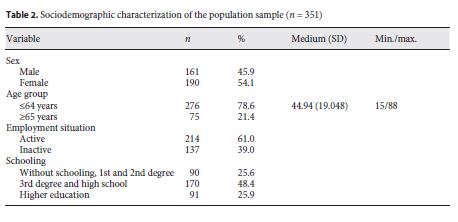
<body><![CDATA[<p><i>Measure</i></p>     <p>The data collection instrument selected was the adapted version of the HLS-EU    for the Portuguese population, of the National School of Public Health at the    New University of Lisbon <sup><a href="#5">5</a></sup><a name="top5"></a>. This    questionnaire consists of 5 modules that evaluate: information and communication    techniques and health, literacy, individual and family health perception, practices    and attitudes in the field of HL, and sociodemographic characterization. Only    two of these modules were used in the present study, namely module 5 (sociodemographic    characterization) and module 1, which has a Cronbach alpha of 0.96 on the 47issues    scale (representing very good internal consistency, since it is higher than    0.920) <sup><a href="#19">19</a></sup><a name="top19"></a> that assesses the    complexity of the HL competencies of individuals, including users in need of    HC, individuals at risk who are involved in prevention services, and citizens    seeking to promote their health. The formula (see above) is used both for the    general index (covering the 47 questions) and for the different subindices:    HC index (question 1-16), DP index (question 17-31), and HP index (question    32-47) <sup><a href="#15">15</a></sup><a name="top15"></a>.</p>     <p>After data collection, statistical analysis was performed using SPSS software    version 24.0. The sociodemographic characterization of the sample was undertaken    through descriptive statistics, using absolute numbers and relative frequencies,    means, and standard deviation (SD). The &chi; <sup>2</sup> test was used to    evaluate the effect of sociodemographic variables on the different HL indexes,    considering degrees of freedom and level of significance (p = 0.05).</p>     <p>Although we observed a significant effect of age group factors (&chi; <sup>2</sup>    = 8.228; p = 0.016) and schooling (&chi; <sup>2</sup> = 33.552; p &le; 0.001)    in the dependent variable, it was not possible to confirm the logistic regression    model. A larger sample and greater variability of the data would have allowed    for more significant results.      <p>&nbsp;</p>     <p><b>Results</b></p>     <p>The surveyed population had a predominant female profile (54.1%), aged between    15 and 88 years. The mean age (&plusmn;SD) was 44.94 &plusmn; 19.048 years and    the majority (61%) were professionally active (<a href="#t2">Table 2</a>). Regarding    HL, the internal consistency of the instrument in this sample assumed a behavior    similar to that evidenced in the HL report in Portugal <sup><a href="#12">12</a></sup><a name="top12"></a>,    with a Cronbach alpha of 0.97.</p>     <p>&nbsp;</p> <a name="t2"></a> <img src="/img/revistas/pjph/v36n3/36n3a05t2.jpg">      
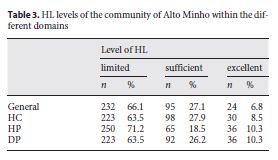
<p>&nbsp;</p>     <p>The parish of Alto Minho has a limited level of HL (66.1%), transverse to all    subdimensions. In the HP subcategory, the proportion of individuals with limited    HL was still higher (71.2%) and only 6.8% of individuals presented excellent    HL (<a href="#t3">Table 3</a>).</p>     ]]></body>
<body><![CDATA[<p>&nbsp;</p> <a name="t3"></a> <img src="/img/revistas/pjph/v36n3/36n3a05t3.jpg">      
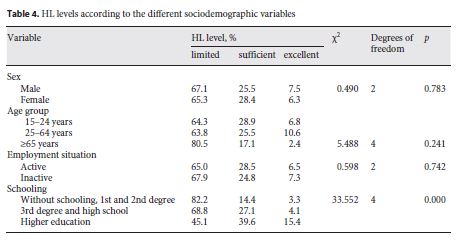
<p>&nbsp;</p>     <p>In the critical analysis of the 47 questions, it could be verified that the    task considered the easiest by most respondents was &ldquo;call an ambulance    in case of emergency,&rdquo; which represented 46.6% of answers.</p>     <p>In the access to HC field, more than 91% of respondents stated that &ldquo;following    instructions&rdquo; (prescribed medication and medical or pharmaceutical indications)    and the difficulty in evaluating &ldquo;whether information on the disease in    the media is reliable&rdquo; (46.4%) are easy tasks. In the DP domain, the task    considered the easiest was &ldquo;understand why you need to do routine medical    exams&rdquo; (96.8%), and the most difficult was the &ldquo;reliability assessment    of information on health risks transmitted by the media of communication&rdquo;    (45.3%).</p>     <p>In HP, the easiest task was to &ldquo;evaluate how housing conditions help    you stay healthy&rdquo; (88.7%). &ldquo;Know more about changes in policies    that may affect your health&rdquo; (13.2%) was considered the most difficult    in this area (and also in the overall index).</p>     <p>In relation to the sociodemographic variables with HL, it was verified that    there is no statistical evidence to support the existence of a significant relationship    between HL and gender, as well as the situation with regard to employment (<a href="#t4">Table    4</a>).</p>     <p>&nbsp;</p> <a name="t4"></a> <img src="/img/revistas/pjph/v36n3/36n3a05t4.jpg">      
<p>&nbsp;</p>     <p>In this community, HL does not seem to be influenced by age. The only determinant    that seems to influence HL is schooling (p &lt; 0.01). However, there remains    a significant percentage of individuals with limited HL (11.7%; <a href="#t4">Table    4</a>). We included the family income of the respondents as an indicator to    determine whether or not it has a relationship with HL. However, a high percentage    of respondents omitted this response and therefore it was not considered in    the present analysis.</p>     <p>&nbsp;</p>     ]]></body>
<body><![CDATA[<p><b>Discussion</b></p>     <p>A predominance of females is evident in national (<sup><a href="#6">6</a></sup><a name="top6"></a>    , <sup><a href="#20">20</a></sup><a name="top20"></a> , <sup><a href="#21">21</a></sup><a name="top21"></a>    ) and international studies (<sup><a href="#13">13</a></sup><a name="top13"></a>    , <sup><a href="#21">21</a></sup><a name="top21"></a> , <sup><a href="#22">22</a></sup><a name="top22"></a>    ). Therefore, the greater number of females can be justified in our study by    the fact that in the municipality where the study was conducted women represent    more than 50% of the total population <sup><a href="#23">23</a></sup><a name="top23"></a>.    The age profile of this sample is compatible with international studies <sup><a href="#11">11</a></sup><a name="top11"></a>    and is in agreement with the 66% of the population of this county aged between    15 and 64 years <sup><a href="#24">24</a></sup><a name="top24"></a>.</p>     <p>More than 74% of the sample has a literacy higher than compulsory schooling,    which is in line with the 30.4% of the county&rsquo;s population with secondary    and higher education, although 10% are illiterate <sup><a href="#23">23</a></sup><a name="top23"></a>.    The limited level of HL (66.1%) in this parish is consistent with the findings    of national studies (<sup><a href="#5">5</a></sup><a name="top5"></a> , <sup><a href="#7">7</a></sup><a name="top7"></a>    , <sup><a href="#10">10</a></sup><a name="top10"></a> , <sup><a href="#15">15</a></sup><a name="top15"></a>    , <sup><a href="#25">25</a></sup><a name="top25"></a> , <sup><a href="#26">26</a></sup><a name="top26"></a>    ), with Portugal being below the European average according to the HL report    in Portugal <sup><a href="#5">5</a></sup><a name="top5"></a>.</p>     <p>In all domains, individuals assume easy and very easy activities that incorporate    functional HL, not involving critical analysis and interpretation of activity,    and reveal greater difficulty in activities that require this capability. These    results, according to the HL <sup><a href="#5">5</a></sup><a name="top5"></a>    report, should be read with caution, since considering a difficult or very difficult    activity may manifest problems of literacy or greater attention and awareness    of a certain difficulty given its complexity. This limitation will require professionals    to readapt the way they work to create equal opportunities regardless of the    individual&rsquo;s HL level. If an individual has greater difficulty in analyzing    and interpreting, it will be necessary to create simple strategies to transmit    the information and to promote health.</p>     <p>The relationship between HL and employment still lacks research. The active    population (employees and students), which interacts actively with systems,    has higher HL levels than those who are not active (retired, unemployed, and    domestic). These results are similar to those found in the HL report for Portugal    <sup><a href="#5">5</a></sup><a name="top5"></a>.</p>     <p>This finding should be evaluated with special attention because inactive people    are more likely to have comorbidities as they age. Thus, those who use the health    system more often have a limited HL level, which may be a barrier to professional    intervention (<sup><a href="#27">27</a></sup><a name="top27"></a> , <sup><a href="#28">28</a></sup><a name="top28"></a>    ).</p>     <p>As far as gender is concerned, there is no agreement with the results obtained    in several studies. Some Portuguese (<sup><a href="#15">15</a></sup><a name="top15"></a>    , <sup><a href="#24">24</a></sup><a name="top24"></a> , <sup><a href="#29">29</a></sup><a name="top29"></a>    ) and European studies <sup><a href="#22">22</a></sup><a name="top22"></a> show    that sex does not influence HL. On the one hand, in the comparative study of    HL in eight European countries <sup><a href="#13">13</a></sup><a name="top13"></a>,    a higher HL was observed in female subjects. Similar data were found in an eLiteracy    study in youths/adolescents carried out in the city of Leiria <sup><a href="#30">30</a></sup><a name="top30"></a>.    On the other hand, in a study by Serr&atilde;o et al. <sup><a href="#25">25</a></sup><a name="top25"></a>    involving 433 elderly Portuguese, male participants had higher levels of HL    when compared to females.</p>     <p>The difference between studies with young people and studies with the elderly    highlights the evolution of society. Today, contrary to the situation a few    decades ago, women have equal access to education, which may explain the inexistence    of a relationship between the gender and HL in this community of Alto Minho.</p>     <p>Although in the present study there was no statistically significant relationship    between HL and age, this has been demonstrated in several national (<sup><a href="#5">5</a></sup><a name="top5"></a>    , <sup><a href="#15">15</a></sup><a name="top15"></a> , <sup><a href="#29">29</a></sup><a name="top29"></a>    , <sup><a href="#30">30</a></sup><a name="top30"></a> ) and international studies    (<sup><a href="#13">13</a></sup><a name="top13"></a> , <sup><a href="#22">22</a></sup><a name="top22"></a>    , <sup><a href="#31">31</a></sup><a name="top31"></a> ). In the HL report <sup><a href="#5">5</a></sup><a name="top5"></a>,    it is highlighted that &ldquo;in all domains there is a transversal relation    between the increase of the age of the individuals and the increase of the limitations    in the accomplishment of tasks related to the HL.&rdquo; However, we highlight    the study by Marques <sup><a href="#14">14</a></sup><a name="top14"></a>, in    which there is no relationship between HL and age. With increasing age a smaller    percentage of individuals with sufficient and excellent HL can be observed.    This is a relevant fact, since it is with the advancement of years that many    chronic diseases arise and there is evidence that limited HL is associated with    worse health outcomes and also an inadequate use of health services <sup><a href="#11">11</a></sup><a name="top11"></a>.</p>     <p>HL also seems to be influenced by education, with individuals with higher levels    of schooling having the highest levels of HL; however, a significant percentage    (11.7%) of individuals with limited HL cannot be neglected. Although this finding    has been corroborated by several authors (<sup><a href="#5">5</a></sup><a name="top5"></a>    , <sup><a href="#13">13</a></sup><a name="top13"></a> , <sup><a href="#29">29</a></sup><a name="top29"></a>    ), there are also studies in which there is no relationship between these variables    <sup><a href="#5">5</a></sup><a name="top5"></a>.</p>     ]]></body>
<body><![CDATA[<p>In a district where 10.7% of the population is illiterate, 75.6% have 9th grade    and 14.2% higher education (there has been a 98% increase in people with this    school level in last decade) <sup><a href="#23">23</a></sup><a name="top23"></a>.    Thus, the greater weight of the population has a level of schooling to which    a smaller percentage of limited HL should correspond.</p>     <p>&nbsp;</p>     <p><b>Conclusion</b></p>     <p>With this work we intend to offer a small and innovative contribution in the    understanding of what is understood and encompasses HL. Although they cannot    be extrapolated to the general population, the results of this study allowed    us to determine the HL level of this Alto Minho community, which is characterized    as limited. Also, the fact that it is related to certain sociodemographic variables    has shed light upon the HL of the people of this community and on the challenges    of promoting it, which together can be proposed for the development of good    practices, namely access to information and lifelong learning opportunities.</p>     <p>Faced with a community with limited HL, it is necessary to carry out new studies    that analyze the existence of a relationship between socioeconomic variables    and HL in different communities, with a view to the intervention of health teams    in individual, social, and cultural contexts, in the direction of its promotion.</p>     <p>&nbsp;</p>     <p><b>REFERENCES</b></p> <Sup><a name="1"></a><a href="#top1">1</a></Sup> World Health Organization. 7th  Global Conference on Health Promotion, Nairobi, 2630 October 2009, Nairobi, Kenya:  Promoting health and development: closing the implementation gap. Geneva: WHO,  2009.      <p></p>     <p><Sup><a name="2"></a><a href="#top2">2</a></Sup> Portugal, Minist&eacute;rio    da Sa&uacute;de, Dire&ccedil;&atilde;o-Geral de Sa&uacute;de: Plano Nacional    de Sa&uacute;de: revis&atilde;o e extens&atilde;o a 2020. Lisboa, Dire&ccedil;&atilde;o-Geral    de Sa&uacute;de, 2015. </p>     <p><Sup><a name="3"></a><a href="#top3">3</a></Sup> Despacho n&ordm; 6429/ 2017.    Di&aacute;rio da Rep&uacute;blica. 2&ordf; S&eacute;rie. n&ordm;. 142 (2017.07.25):    15406-15406. Determina o programa &ldquo;Literacia em sa&uacute;de e integra&ccedil;&atilde;o    de cuidados&rdquo;. </p>     ]]></body>
<body><![CDATA[<p><Sup><a name="4"></a><a href="#top4">4</a></Sup> Portugal, Minist&eacute;rio    da Sa&uacute;de: Servi&ccedil;o Nacional de Sa&uacute;de: SNS + Proximidade    - Integra&ccedil;&atilde;o de Cuidados e Literacia em Sa&uacute;de. Lisboa,    Servi&ccedil;os Partilhados do Minist&eacute;rio da Sa&uacute;de, 2017. </p>     <!-- ref --><p><Sup><a name="5"></a><a href="#top5">5</a></Sup> Espanha R , &Aacute;vila P    , Mendes RV. Literacia em Sa&uacute;de em Portugal. Lisboa : Funda&ccedil;&atilde;o    Calouste Gulbenkian ; 2016.    &nbsp;&nbsp;&nbsp;&nbsp;&nbsp;&nbsp;&nbsp;&nbsp;[&#160;<a href="javascript:void(0);" onclick="javascript: window.open('/scielo.php?script=sci_nlinks&ref=2094841&pid=S2504-3145201800030000500001&lng=','','width=640,height=500,resizable=yes,scrollbars=1,menubar=yes,');">Links</a>&#160;]<!-- end-ref --> </p>     <!-- ref --><p><Sup><a name="6"></a><a href="#top6">6</a></Sup> Pedro AR , Amaral O , Escoval    A. Literacia em sa&uacute;de, dos dados &agrave; ac&ccedil;&atilde;o: tradu&ccedil;&atilde;o,    valida&ccedil;&atilde;o e aplica&ccedil;&atilde;o do European Health Literacy    Survey em Portugal. Rev Port Saude Publica. 2016 ; 34 (3): 259 - 75.    &nbsp;&nbsp;&nbsp;&nbsp;&nbsp;&nbsp;&nbsp;&nbsp;[&#160;<a href="javascript:void(0);" onclick="javascript: window.open('/scielo.php?script=sci_nlinks&ref=2094843&pid=S2504-3145201800030000500002&lng=','','width=640,height=500,resizable=yes,scrollbars=1,menubar=yes,');">Links</a>&#160;]<!-- end-ref --> </p>     <!-- ref --><p><Sup><a name="7"></a><a href="#top7">7</a></Sup> Saboga-Nunes L , Sorensen    K , Pelikan JM. Hermen&ecirc;utica da literacia em sa&uacute;de e sua avalia&ccedil;&atilde;o    em Portugal (HLS-EU-PT). &Eacute;vora : Universidade de &Eacute;vora ; 2014.    &nbsp;&nbsp;&nbsp;&nbsp;&nbsp;&nbsp;&nbsp;&nbsp;[&#160;<a href="javascript:void(0);" onclick="javascript: window.open('/scielo.php?script=sci_nlinks&ref=2094845&pid=S2504-3145201800030000500003&lng=','','width=640,height=500,resizable=yes,scrollbars=1,menubar=yes,');">Links</a>&#160;]<!-- end-ref -->  </p>     <!-- ref --><p><Sup><a name="8"></a><a href="#top8">8</a></Sup> World Health Organization.    Health promotion glossary. Geneva : WHO ; 1998.    &nbsp;&nbsp;&nbsp;&nbsp;&nbsp;&nbsp;&nbsp;&nbsp;[&#160;<a href="javascript:void(0);" onclick="javascript: window.open('/scielo.php?script=sci_nlinks&ref=2094847&pid=S2504-3145201800030000500004&lng=','','width=640,height=500,resizable=yes,scrollbars=1,menubar=yes,');">Links</a>&#160;]<!-- end-ref --> </p>     <!-- ref --><p><Sup><a name="9"></a><a href="#top9">9</a></Sup> Nutbeam D. Health literacy    as a public health goal: a challenge for contemporary health education and communication    strategies into the 21st century. Oxford : Oxford University Press ; 2000.    &nbsp;&nbsp;&nbsp;&nbsp;&nbsp;&nbsp;&nbsp;&nbsp;[&#160;<a href="javascript:void(0);" onclick="javascript: window.open('/scielo.php?script=sci_nlinks&ref=2094849&pid=S2504-3145201800030000500005&lng=','','width=640,height=500,resizable=yes,scrollbars=1,menubar=yes,');">Links</a>&#160;]<!-- end-ref --> </p>     <!-- ref --><p><Sup><a name="10"></a><a href="#top10">10</a></Sup> World Health Organization.    Health literacy: the solid facts. Copenhagen, World Health Organization. Regional    Office for Europe, 2013.    &nbsp;&nbsp;&nbsp;&nbsp;&nbsp;&nbsp;&nbsp;&nbsp;[&#160;<a href="javascript:void(0);" onclick="javascript: window.open('/scielo.php?script=sci_nlinks&ref=2094851&pid=S2504-3145201800030000500006&lng=','','width=640,height=500,resizable=yes,scrollbars=1,menubar=yes,');">Links</a>&#160;]<!-- end-ref --> </p>     <!-- ref --><p><Sup><a name="11"></a><a href="#top11">11</a></Sup> Eichler K , Wieser S ,    Br&uuml;gger U. The costs of limited health literacy: a systematic review. Int    J Public Health. 2009 ; 54 (5): 313 - 24.    &nbsp;&nbsp;&nbsp;&nbsp;&nbsp;&nbsp;&nbsp;&nbsp;[&#160;<a href="javascript:void(0);" onclick="javascript: window.open('/scielo.php?script=sci_nlinks&ref=2094853&pid=S2504-3145201800030000500007&lng=','','width=640,height=500,resizable=yes,scrollbars=1,menubar=yes,');">Links</a>&#160;]<!-- end-ref --> </p>     <!-- ref --><p><Sup><a name="12"></a><a href="#top12">12</a></Sup> Loureiro I , Miranda N.    Promover a sa&uacute;de: dos fundamentos &agrave; a&ccedil;&atilde;o. Coimbra    : Edi&ccedil;&otilde;es Almedina ; 2010.    &nbsp;&nbsp;&nbsp;&nbsp;&nbsp;&nbsp;&nbsp;&nbsp;[&#160;<a href="javascript:void(0);" onclick="javascript: window.open('/scielo.php?script=sci_nlinks&ref=2094855&pid=S2504-3145201800030000500008&lng=','','width=640,height=500,resizable=yes,scrollbars=1,menubar=yes,');">Links</a>&#160;]<!-- end-ref --> </p>     <!-- ref --><p><Sup><a name="13"></a><a href="#top13">13</a></Sup> S&oslash;rensen K , Pelikan    JM , R&ouml;thlin F , Ganahl K , Slonska Z , Doyle G , et al. ; HLS-EU Consortium.    Health literacy in Europe: comparative results of the European health literacy    survey (HLS-EU). Eur J Public Health. 2015 Dec ; 25 (6): 1053 - 8.    &nbsp;&nbsp;&nbsp;&nbsp;&nbsp;&nbsp;&nbsp;&nbsp;[&#160;<a href="javascript:void(0);" onclick="javascript: window.open('/scielo.php?script=sci_nlinks&ref=2094857&pid=S2504-3145201800030000500009&lng=','','width=640,height=500,resizable=yes,scrollbars=1,menubar=yes,');">Links</a>&#160;]<!-- end-ref --> </p>     <p><Sup><a name="14"></a><a href="#top14">14</a></Sup> Marques JPD : Literacia    em sa&uacute;de: avalia&ccedil;&atilde;o atrav&eacute;s do European Health Literacy    Survey em portugu&ecirc;s num servi&ccedil;o de internamento hospitalar. Lisboa,    Instituto Universit&aacute;rio de Lisboa; 2015 ; Disserta&ccedil;&atilde;o de    Mestrado em Gest&atilde;o dos Servi&ccedil;os de Sa&uacute;de. Instituto Superior    das Ci&ecirc;ncias do Trabalho e da Empresa. </p>     ]]></body>
<body><![CDATA[<p><Sup><a name="15"></a><a href="#top15">15</a></Sup> Gon&ccedil;alves AM : Literacia    em sa&uacute;de e utiliza&ccedil;&atilde;o dos servi&ccedil;os de sa&uacute;de.    Porto, Instituto Polit&eacute;cnico do Porto, Associa&ccedil;&atilde;o de Polit&eacute;cnicos    do Norte; 2015 ; Disserta&ccedil;&atilde;o de Mestrado em Gest&atilde;o das    Organiza&ccedil;&otilde;es, Ramo de Unidades de Sa&uacute;de. </p>     <!-- ref --><p><Sup><a name="16"></a><a href="#top16">16</a></Sup> S&oslash;rensen K , Van    den Broucke S , Fullam J , Doyle G , Pelikan J , Slonska Z , et al. ; (HLS-EU)    Consortium Health Literacy Project European. Health literacy and public health:    a systematic review and integration of definitions and models. BMC Public Health.    2012 Jan ; 12 (1): 80.    &nbsp;&nbsp;&nbsp;&nbsp;&nbsp;&nbsp;&nbsp;&nbsp;[&#160;<a href="javascript:void(0);" onclick="javascript: window.open('/scielo.php?script=sci_nlinks&ref=2094861&pid=S2504-3145201800030000500010&lng=','','width=640,height=500,resizable=yes,scrollbars=1,menubar=yes,');">Links</a>&#160;]<!-- end-ref --> </p>     <p><Sup><a name="17"></a><a href="#top17">17</a></Sup> Fawcett SB , Abeykoon P    , Arora M , Munodawafa D. Constructing an action agenda for community empowerment    at the 7th Global Conference on Health Promotion in Nairobi. Nairobi, Global    Health Promotion, 2010. </p>     <p><Sup><a name="18"></a><a href="#top18">18</a></Sup> Instituto Nacional de Estat&iacute;stica    (Web page) INE, 2011 (updated 2011; cited 2017 24 Mar&ccedil; 2017). Available    from: <a href="http://www.ine.pt" target="_blank">http://www.ine.pt</a> </p>     <!-- ref --><p><Sup><a name="19"></a><a href="#top19">19</a></Sup> Pestana MH , Gageiro JN.    An&aacute;lise de dados para as ci&ecirc;ncias sociais: a complementaridade    do SPSS. 6th ed. Lisboa : Edi&ccedil;&otilde;es S&iacute;labo ; 2014.    &nbsp;&nbsp;&nbsp;&nbsp;&nbsp;&nbsp;&nbsp;&nbsp;[&#160;<a href="javascript:void(0);" onclick="javascript: window.open('/scielo.php?script=sci_nlinks&ref=2094865&pid=S2504-3145201800030000500011&lng=','','width=640,height=500,resizable=yes,scrollbars=1,menubar=yes,');">Links</a>&#160;]<!-- end-ref --> </p>     <p><Sup><a name="20"></a><a href="#top20">20</a></Sup> Amorim JC. Literacia e    autocontrolo da dtipo 2 no Hospital de Santa Luzia. Viana do Castelo: Escola    Superior de Sa&uacute;de, Instituto Polit&eacute;cnico de Viana do Castelo,    2015. Disserta&ccedil;&atilde;o de Mestrado. </p>     <!-- ref --><p><Sup><a name="21"></a><a href="#top21">21</a></Sup> Berkman ND , Sheridan SL    , Donahue KE , Halpern DJ , Crotty K. Low health literacy and health outcomes:    an updated systematic review. Ann Intern Med. 2011 Jul ; 155 (2): 97 - 107.    &nbsp;&nbsp;&nbsp;&nbsp;&nbsp;&nbsp;&nbsp;&nbsp;[&#160;<a href="javascript:void(0);" onclick="javascript: window.open('/scielo.php?script=sci_nlinks&ref=2094868&pid=S2504-3145201800030000500012&lng=','','width=640,height=500,resizable=yes,scrollbars=1,menubar=yes,');">Links</a>&#160;]<!-- end-ref -->  </p>     ]]></body>
<body><![CDATA[<!-- ref --><p><Sup><a name="22"></a><a href="#top22">22</a></Sup> Kondilis BK , Magoulas    C , Ionnidis E , Agrafiotis D. The European Health Literacy Survey: Greece.    Athens : Executive Agency for Health and Consumers ; 2012.    &nbsp;&nbsp;&nbsp;&nbsp;&nbsp;&nbsp;&nbsp;&nbsp;[&#160;<a href="javascript:void(0);" onclick="javascript: window.open('/scielo.php?script=sci_nlinks&ref=2094870&pid=S2504-3145201800030000500013&lng=','','width=640,height=500,resizable=yes,scrollbars=1,menubar=yes,');">Links</a>&#160;]<!-- end-ref --> </p>     <!-- ref --><p><Sup><a name="23"></a><a href="#top23">23</a></Sup> Silva AM , Rosas M. Diagn&oacute;stico    social de Viana do Castelo 2013: Relat&oacute;rio final. Viana do Castelo :    Conselho Local de A&ccedil;&atilde;o Social ; 2013.    &nbsp;&nbsp;&nbsp;&nbsp;&nbsp;&nbsp;&nbsp;&nbsp;[&#160;<a href="javascript:void(0);" onclick="javascript: window.open('/scielo.php?script=sci_nlinks&ref=2094872&pid=S2504-3145201800030000500014&lng=','','width=640,height=500,resizable=yes,scrollbars=1,menubar=yes,');">Links</a>&#160;]<!-- end-ref --> </p>     <p><Sup><a name="24"></a><a href="#top24">24</a></Sup> Lu&iacute;s LFS : Literacia    em sa&uacute;de e alimenta&ccedil;&atilde;o saud&aacute;vel: os novos produtos    e a escolha dos alimentos. Lisboa, Escola Nacional de Sa&uacute;de P&uacute;blica,    Universidade Nova de Lisboa; 2010 ; Tese de Doutoramento em Sa&uacute;de P&uacute;blica.  </p>     <!-- ref --><p><Sup><a name="25"></a><a href="#top25">25</a></Sup> Serr&atilde;o C , Veiga    S , Vieira I. Literacia em sa&uacute;de: resultados obtidos a partir de uma    amostra de pessoas idosas portuguesas. Rev Port Enferm Saude Mental. 2015 ;    2 Spe. 2 : 33 - 8.    &nbsp;&nbsp;&nbsp;&nbsp;&nbsp;&nbsp;&nbsp;&nbsp;[&#160;<a href="javascript:void(0);" onclick="javascript: window.open('/scielo.php?script=sci_nlinks&ref=2094875&pid=S2504-3145201800030000500015&lng=','','width=640,height=500,resizable=yes,scrollbars=1,menubar=yes,');">Links</a>&#160;]<!-- end-ref --> </p>     <!-- ref --><p><Sup><a name="26"></a><a href="#top26">26</a></Sup> Fernandes P. Literacia    em sa&uacute;de: contribui&ccedil;&atilde;o para o estudo de adapta&ccedil;&atilde;o    e valida&ccedil;&atilde;o do NVS-Newest Vital Sign. Lisboa : Instituto Universit&aacute;rio    de Ci&ecirc;ncias Psicol&oacute;gicas, Sociais e da Vida ; 2012.    &nbsp;&nbsp;&nbsp;&nbsp;&nbsp;&nbsp;&nbsp;&nbsp;[&#160;<a href="javascript:void(0);" onclick="javascript: window.open('/scielo.php?script=sci_nlinks&ref=2094877&pid=S2504-3145201800030000500016&lng=','','width=640,height=500,resizable=yes,scrollbars=1,menubar=yes,');">Links</a>&#160;]<!-- end-ref --> </p>     <!-- ref --><p><Sup><a name="27"></a><a href="#top27">27</a></Sup> World Health Organization.    Innovative care for chronic conditions: meeting report. Geneva : WHO ; 2001.    &nbsp;&nbsp;&nbsp;&nbsp;&nbsp;&nbsp;&nbsp;&nbsp;[&#160;<a href="javascript:void(0);" onclick="javascript: window.open('/scielo.php?script=sci_nlinks&ref=2094879&pid=S2504-3145201800030000500017&lng=','','width=640,height=500,resizable=yes,scrollbars=1,menubar=yes,');">Links</a>&#160;]<!-- end-ref -->  </p>     <!-- ref --><p><Sup><a name="28"></a><a href="#top28">28</a></Sup> Santos O. O papel da literacia    em sa&uacute;de: capacitando a pessoa com excesso de peso para o controlo e    redu&ccedil;&atilde;o da carga ponderal. Rev Endo. Diab e Obesidade. 2010 ;    4 : 127 - 34.    &nbsp;&nbsp;&nbsp;&nbsp;&nbsp;&nbsp;&nbsp;&nbsp;[&#160;<a href="javascript:void(0);" onclick="javascript: window.open('/scielo.php?script=sci_nlinks&ref=2094881&pid=S2504-3145201800030000500018&lng=','','width=640,height=500,resizable=yes,scrollbars=1,menubar=yes,');">Links</a>&#160;]<!-- end-ref --> </p>     <p><Sup><a name="29"></a><a href="#top29">29</a></Sup> Cruz DM : Literacia em    ehealth dos Portugueses: estudo explorat&oacute;rio. Covilh&atilde;, Faculdade    de Ci&ecirc;ncias Sociais e Humanas, Universidade da Beira Interior; 2013 ;    Disserta&ccedil;&atilde;o de Mestrado em Gest&atilde;o de Unidades de Sa&uacute;de.  </p>     <p><Sup><a name="30"></a><a href="#top30">30</a></Sup> Tom&aacute;s CC : Literacia    em sa&uacute;de na adolesc&ecirc;ncia. Porto, Instituto de Ci&ecirc;ncias Biom&eacute;dicas    Abel Salazar, Universidade do Porto; 2014 ; Tese de Doutoramento em Ci&ecirc;ncias    de Enfermagem. </p>     <!-- ref --><p><Sup><a name="31"></a><a href="#top31">31</a></Sup> To&ccedil;i E , Burazeri    G , S&oslash;rensen K , Kamberi H , Brand H. Concurrent validation of two key    health literacy instruments in a South Eastern European population. Eur J Public    Health. 2015Jun ; 25 (3): 482 - 6.    &nbsp;&nbsp;&nbsp;&nbsp;&nbsp;&nbsp;&nbsp;&nbsp;[&#160;<a href="javascript:void(0);" onclick="javascript: window.open('/scielo.php?script=sci_nlinks&ref=2094885&pid=S2504-3145201800030000500019&lng=','','width=640,height=500,resizable=yes,scrollbars=1,menubar=yes,');">Links</a>&#160;]<!-- end-ref --> </p>     <p>&nbsp;</p>     <p>Received: July 24, 2018. Accepted: September 15, 2018</p>     <p>&nbsp;</p>     ]]></body>
<body><![CDATA[<p>We would like to thank C&aacute;tia Barbosa, Celsa Ferros, and Susana Evangelista    for their help in the design of and data collection for the present study, and    the entire population of Alto Minho for their receptivity and collaboration.</p>     <p>&nbsp;</p>     <p>All ethical requirements were met for this study.</p>     <p>&nbsp;</p>     <p>The authors declare no conflicts of interest.</p>      ]]></body><back>
<ref-list>
<ref id="B1">
<nlm-citation citation-type="book">
<person-group person-group-type="author">
<name>
<surname><![CDATA[Espanha]]></surname>
<given-names><![CDATA[R]]></given-names>
</name>
<name>
<surname><![CDATA[Ávila]]></surname>
<given-names><![CDATA[P]]></given-names>
</name>
<name>
<surname><![CDATA[Mendes]]></surname>
<given-names><![CDATA[RV]]></given-names>
</name>
</person-group>
<source><![CDATA[Literacia em Saúde em Portugal]]></source>
<year>2016</year>
<publisher-loc><![CDATA[Lisboa ]]></publisher-loc>
<publisher-name><![CDATA[Fundação Calouste Gulbenkian]]></publisher-name>
</nlm-citation>
</ref>
<ref id="B2">
<nlm-citation citation-type="journal">
<person-group person-group-type="author">
<name>
<surname><![CDATA[Pedro]]></surname>
<given-names><![CDATA[AR]]></given-names>
</name>
</person-group>
<source><![CDATA[Rev Port Saude Publica]]></source>
<year>2016</year>
<volume>34</volume>
<numero>3</numero>
<issue>3</issue>
<page-range>259 – 75</page-range></nlm-citation>
</ref>
<ref id="B3">
<nlm-citation citation-type="book">
<person-group person-group-type="author">
<name>
<surname><![CDATA[Saboga Nunes]]></surname>
<given-names><![CDATA[L]]></given-names>
</name>
<name>
<surname><![CDATA[Sorensen]]></surname>
<given-names><![CDATA[K]]></given-names>
</name>
<name>
<surname><![CDATA[Pelikan]]></surname>
<given-names><![CDATA[JM]]></given-names>
</name>
</person-group>
<source><![CDATA[Hermenêutica da literacia em saúde e sua avaliação em Portugal (HLSEUPT)]]></source>
<year>2014</year>
<publisher-loc><![CDATA[Évora ]]></publisher-loc>
<publisher-name><![CDATA[Universidade de Évora]]></publisher-name>
</nlm-citation>
</ref>
<ref id="B4">
<nlm-citation citation-type="book">
<collab>World Health Organization</collab>
<source><![CDATA[Health promotion glossary]]></source>
<year>1998</year>
<publisher-loc><![CDATA[Geneva ]]></publisher-loc>
<publisher-name><![CDATA[WHO]]></publisher-name>
</nlm-citation>
</ref>
<ref id="B5">
<nlm-citation citation-type="book">
<person-group person-group-type="author">
<name>
<surname><![CDATA[Nutbeam]]></surname>
<given-names><![CDATA[D.]]></given-names>
</name>
</person-group>
<source><![CDATA[Health literacy as a public health goal: a challenge for contemporary health education and communication strategies into the 21st century]]></source>
<year>2000</year>
<publisher-loc><![CDATA[Oxford ]]></publisher-loc>
<publisher-name><![CDATA[Oxford University Press]]></publisher-name>
</nlm-citation>
</ref>
<ref id="B6">
<nlm-citation citation-type="book">
<collab>World Health Organization</collab>
<source><![CDATA[Health literacy: the solid facts]]></source>
<year>2013</year>
<publisher-loc><![CDATA[Copenhagen ]]></publisher-loc>
<publisher-name><![CDATA[World Health Organization. Regional Office for Europe]]></publisher-name>
</nlm-citation>
</ref>
<ref id="B7">
<nlm-citation citation-type="journal">
<person-group person-group-type="author">
<name>
<surname><![CDATA[Eichler]]></surname>
<given-names><![CDATA[K]]></given-names>
</name>
<name>
<surname><![CDATA[Wieser]]></surname>
<given-names><![CDATA[S]]></given-names>
</name>
<name>
<surname><![CDATA[Brügger]]></surname>
<given-names><![CDATA[U]]></given-names>
</name>
</person-group>
<article-title xml:lang="en"><![CDATA[The costs of limited health literacy: a systematic review]]></article-title>
<source><![CDATA[Int J Public Health]]></source>
<year>2009</year>
<volume>54</volume>
<numero>5</numero>
<issue>5</issue>
<page-range>313 – 24</page-range></nlm-citation>
</ref>
<ref id="B8">
<nlm-citation citation-type="book">
<person-group person-group-type="author">
<name>
<surname><![CDATA[Loureiro]]></surname>
<given-names><![CDATA[I]]></given-names>
</name>
<name>
<surname><![CDATA[Miranda]]></surname>
<given-names><![CDATA[N]]></given-names>
</name>
</person-group>
<source><![CDATA[Promover a saúde: dos fundamentos à ação]]></source>
<year>2010</year>
<publisher-loc><![CDATA[Coimbra ]]></publisher-loc>
<publisher-name><![CDATA[Edições Almedina]]></publisher-name>
</nlm-citation>
</ref>
<ref id="B9">
<nlm-citation citation-type="journal">
<person-group person-group-type="author">
<name>
<surname><![CDATA[Sørensen]]></surname>
<given-names><![CDATA[K]]></given-names>
</name>
<name>
<surname><![CDATA[Pelikan]]></surname>
<given-names><![CDATA[JM]]></given-names>
</name>
<name>
<surname><![CDATA[Röthlin]]></surname>
<given-names><![CDATA[F]]></given-names>
</name>
<name>
<surname><![CDATA[Ganahl]]></surname>
<given-names><![CDATA[K]]></given-names>
</name>
<name>
<surname><![CDATA[Slonska]]></surname>
<given-names><![CDATA[Z]]></given-names>
</name>
<name>
<surname><![CDATA[Doyle]]></surname>
<given-names><![CDATA[G]]></given-names>
</name>
</person-group>
<article-title xml:lang="en"><![CDATA[HLSEU Consortium. Health literacy in Europe: comparative results of the European health literacy survey (HLSEU)]]></article-title>
<source><![CDATA[Eur J Public Health]]></source>
<year>2015</year>
<volume>25</volume>
<numero>6</numero>
<issue>6</issue>
<page-range>1053 – 8</page-range></nlm-citation>
</ref>
<ref id="B10">
<nlm-citation citation-type="journal">
<person-group person-group-type="author">
<name>
<surname><![CDATA[Sørensen]]></surname>
<given-names><![CDATA[K]]></given-names>
</name>
<name>
<surname><![CDATA[Van den Broucke]]></surname>
<given-names><![CDATA[S]]></given-names>
</name>
<name>
<surname><![CDATA[Fullam]]></surname>
<given-names><![CDATA[J]]></given-names>
</name>
<name>
<surname><![CDATA[Doyle]]></surname>
<given-names><![CDATA[G]]></given-names>
</name>
<name>
<surname><![CDATA[Pelikan]]></surname>
<given-names><![CDATA[J]]></given-names>
</name>
<name>
<surname><![CDATA[Slonska]]></surname>
<given-names><![CDATA[Z]]></given-names>
</name>
</person-group>
<article-title xml:lang="en"><![CDATA[(HLSEU) Consortium Health Literacy Project European. Health literacy and public health: a systematic review and integration of definitions and models]]></article-title>
<source><![CDATA[BMC Public Health]]></source>
<year>2012</year>
<volume>12</volume>
<numero>1</numero>
<issue>1</issue>
<page-range>80</page-range></nlm-citation>
</ref>
<ref id="B11">
<nlm-citation citation-type="book">
<person-group person-group-type="author">
<name>
<surname><![CDATA[Pestana]]></surname>
<given-names><![CDATA[MH]]></given-names>
</name>
<name>
<surname><![CDATA[Gageiro]]></surname>
<given-names><![CDATA[JN]]></given-names>
</name>
</person-group>
<source><![CDATA[Análise de dados para as ciências sociais: a complementaridade do SPSS]]></source>
<year>2014</year>
<edition>6</edition>
<publisher-loc><![CDATA[Lisboa ]]></publisher-loc>
<publisher-name><![CDATA[Edições Sílabo]]></publisher-name>
</nlm-citation>
</ref>
<ref id="B12">
<nlm-citation citation-type="journal">
<person-group person-group-type="author">
<name>
<surname><![CDATA[Berkman]]></surname>
<given-names><![CDATA[ND]]></given-names>
</name>
<name>
<surname><![CDATA[Sheridan]]></surname>
<given-names><![CDATA[SL]]></given-names>
</name>
<name>
<surname><![CDATA[Donahue]]></surname>
<given-names><![CDATA[KE]]></given-names>
</name>
<name>
<surname><![CDATA[Halpern]]></surname>
<given-names><![CDATA[DJ]]></given-names>
</name>
<name>
<surname><![CDATA[Crotty]]></surname>
<given-names><![CDATA[K]]></given-names>
</name>
</person-group>
<article-title xml:lang="en"><![CDATA[Low health literacy and health outcomes: an updated systematic review]]></article-title>
<source><![CDATA[Ann Intern Med]]></source>
<year>2011</year>
<volume>155</volume>
<numero>2</numero>
<issue>2</issue>
<page-range>97 – 107</page-range></nlm-citation>
</ref>
<ref id="B13">
<nlm-citation citation-type="book">
<person-group person-group-type="author">
<name>
<surname><![CDATA[Kondilis]]></surname>
<given-names><![CDATA[BK]]></given-names>
</name>
<name>
<surname><![CDATA[Magoulas]]></surname>
<given-names><![CDATA[C]]></given-names>
</name>
<name>
<surname><![CDATA[Ionnidis]]></surname>
<given-names><![CDATA[E]]></given-names>
</name>
<name>
<surname><![CDATA[Agrafiotis]]></surname>
<given-names><![CDATA[D]]></given-names>
</name>
</person-group>
<source><![CDATA[The European Health Literacy Survey]]></source>
<year>2012</year>
<publisher-loc><![CDATA[Greece ]]></publisher-loc>
<publisher-name><![CDATA[Executive Agency for Health and Consumers]]></publisher-name>
</nlm-citation>
</ref>
<ref id="B14">
<nlm-citation citation-type="book">
<person-group person-group-type="author">
<name>
<surname><![CDATA[Silva]]></surname>
<given-names><![CDATA[AM]]></given-names>
</name>
<name>
<surname><![CDATA[Rosas]]></surname>
<given-names><![CDATA[M.]]></given-names>
</name>
</person-group>
<source><![CDATA[Diagnóstico social de Viana do Castelo 2013: Relatório final]]></source>
<year>2013</year>
<publisher-loc><![CDATA[Viana do Castelo ]]></publisher-loc>
<publisher-name><![CDATA[Conselho Local de Ação Social]]></publisher-name>
</nlm-citation>
</ref>
<ref id="B15">
<nlm-citation citation-type="journal">
<person-group person-group-type="author">
<name>
<surname><![CDATA[Serrão]]></surname>
<given-names><![CDATA[C]]></given-names>
</name>
<name>
<surname><![CDATA[Veiga]]></surname>
<given-names><![CDATA[S]]></given-names>
</name>
<name>
<surname><![CDATA[Vieira]]></surname>
<given-names><![CDATA[I.]]></given-names>
</name>
</person-group>
<article-title xml:lang="pt"><![CDATA[Literacia em saúde: resultados obtidos a partir de uma amostra de pessoas idosas portuguesas]]></article-title>
<source><![CDATA[Rev Port Enferm Saude Mental]]></source>
<year>2015</year>
<volume>2</volume>
<numero>2</numero>
<issue>2</issue>
<page-range>33 – 8</page-range></nlm-citation>
</ref>
<ref id="B16">
<nlm-citation citation-type="book">
<person-group person-group-type="author">
<name>
<surname><![CDATA[Fernandes]]></surname>
<given-names><![CDATA[P.]]></given-names>
</name>
</person-group>
<source><![CDATA[Literacia em saúde: contribuição para o estudo de adaptação e validação do NVSNewest Vital Sign]]></source>
<year>201</year>
<publisher-loc><![CDATA[Lisboa ]]></publisher-loc>
<publisher-name><![CDATA[Instituto Universitário de Ciências Psicológicas, Sociais e da Vida]]></publisher-name>
</nlm-citation>
</ref>
<ref id="B17">
<nlm-citation citation-type="book">
<collab>World Health Organization</collab>
<source><![CDATA[Innovative care for chronic conditions: meeting report]]></source>
<year>2001</year>
<publisher-loc><![CDATA[Geneva ]]></publisher-loc>
<publisher-name><![CDATA[WHO]]></publisher-name>
</nlm-citation>
</ref>
<ref id="B18">
<nlm-citation citation-type="journal">
<person-group person-group-type="author">
<name>
<surname><![CDATA[Santos]]></surname>
<given-names><![CDATA[O.]]></given-names>
</name>
</person-group>
<article-title xml:lang="pt"><![CDATA[O papel da literacia em saúde: capacitando a pessoa com excesso de peso para o controlo e redução da carga ponderal]]></article-title>
<source><![CDATA[Rev Endo. Diab e Obesidade]]></source>
<year>2010</year>
<volume>4</volume>
<page-range>127 – 34</page-range></nlm-citation>
</ref>
<ref id="B19">
<nlm-citation citation-type="journal">
<person-group person-group-type="author">
<name>
<surname><![CDATA[Toçi]]></surname>
<given-names><![CDATA[E]]></given-names>
</name>
<name>
<surname><![CDATA[Burazeri]]></surname>
<given-names><![CDATA[G]]></given-names>
</name>
<name>
<surname><![CDATA[Sørensen]]></surname>
<given-names><![CDATA[K]]></given-names>
</name>
<name>
<surname><![CDATA[Kamberi]]></surname>
<given-names><![CDATA[H]]></given-names>
</name>
<name>
<surname><![CDATA[Brand]]></surname>
<given-names><![CDATA[H]]></given-names>
</name>
</person-group>
<article-title xml:lang="en"><![CDATA[Concurrent validation of two key health literacy instruments in a South Eastern European population]]></article-title>
<source><![CDATA[Eur J Public Health]]></source>
<year>2015</year>
<month>Ju</month>
<day>n</day>
<volume>25</volume>
<numero>3</numero>
<issue>3</issue>
<page-range>482 – 6</page-range></nlm-citation>
</ref>
</ref-list>
</back>
</article>