Nuclear Imaging Exams Authorized by the Brazilian Health Care System and Nuclear Imaging Equipment Distribution in the State of Rio Grande do Sul
Exames de imagiologia nuclear autorizados pelo sistema brasileiro de saúde e distribuição de equipamentos de imagiologia nuclear no estado do Rio Grande do Sul
Patrícia Silva da Silva,a Roger dos Santos Rosa,b Ronaldo Bordin c
a Vigilância em Saúde, Prefeitura Municipal de Gravataí, Gravataí, Brazil;
b Instituto de Psicologia, Universidade Federal do Rio Grande do Sul, Porto Alegre, Brazil;
c Departamento de Medicina Social, Universidade Federal do Rio Grande do Sul, Porto Alegre, Brazil
]]> ABSTRACT
Introduction: For nuclear imaging exams to be funded by the Brazilian public health care system (Sistema Único de Saúde, SUS), the institution must be first authorized by the National Nuclear Energy Commission (Comissão Nacional de Energia Nuclear, CNEN) to secure the safe use of radiation. - Objective: To describe the distribution of equipment used in nuclear imaging exams and the quantity of exams funded by the SUS according to the macroregions defined by Rio Grande do Sul Health Department from 2013 to 2015. To check the consistency of data from the Department of Informatics of the Ministry of Health (Departamento de Informática do Sistema Único de Saúde, DATASUS) and the CNEN in November 2015. - Methods: Secondary data from DATASUS and the CNEN were used. The region of health, the macroregion, and its respective estimated population were obtained from the Brazilian Institute of Geography and Statistics. - Results: The Porto Alegre metropolitan area showed the largest concentration of gamma cameras. The number of exams was higher in philanthropic institutions with a valid register at the Brazilian Ministry of Health and federal funded organizations. Some regions had less CNEN-authorized institutions than SUS-authorized ones. - Conclusion: The distribution of equipment and exams was uneven in the state.
Keywords: Diagnostic imaging Statistics Numerical data Nuclear medicine Public management
RESUMO
Introdução: Para que os exames de imagem de medicina nuclear sejam financiados pelo Sistema Único de Saúde (SUS), a instituição deve ser primeiro autorizada pela Comissão Nacional de Energia Nuclear (CNEN) para garantir o seguro uso de radiação. Objetivo: Descrever a distribuição dos equipamentos utilizados nos exames de imagem de medicina nuclear e a quantidade de exames financiados pelo SUS de acordo com as macrorregiões definidas pelo Departamento de Saúde do Rio Grande do Sul, no período de 2013 a 2015; e verificar a consistência dos dados do Departamento de Informática do Ministério da Saúde (DATASUS) e da CNEN em novembro de 2015. Métodos: Foram utilizados dados secundários do DATASUS e da CNEN. A região de saúde, a macrorregião e sua respectiva população estimada foram obtidas no Instituto Brasileiro de Geografia e Estatística. Resultados: A área metropolitana de Porto Alegre apresentou a maior concentração de gama câmaras. O número de exames foi maior em instituições filantrópicas com registro válido no Ministério da Saúde, e em organizações públicas federais. Algumas regiões tinham menos instituições autorizadas pelo CNEN do que as utilizadas pelo SUS. Conclusão: A distribuição de equipamentos e exames foi desigual no estado.
Palavras Chave: Imagiologia · Estatística · Dados numéricos · Medicina nuclear · Gestão pública
Introduction
Nuclear medicine is a medical specialty whose main feature is the use of emitters of ionizing radiation in the unsealed form. These must be linked to molecules of biological interest, called radiopharmaceuticals, which are administered to patients for diagnosis or therapy. If the radionuclide used is an emitter of electromagnetic radiation (gamma) or positron, it is possible to map the distribution of the substance within the patient’s body using an external detector called scintillation chamber (gamma camera) or a positron emission tomograph. Furthermore, if the radionuclide used is a particle emitter (such as iodine-131, a beta particle emitter), it can be used for tumor therapy as well as for diagnosis 1.
]]> The growth of nuclear medicine in Brazil is observed through the increased number of services accredited by the National Nuclear Energy Commission (Comissão Nacional de Energia Nuclear, CNEN), the rising number of professionals working and specializing in this field (radiopharmacists, nuclear medicine physicians, and physicists), the establishment in Brazil of new national and multinational radiopharmaceutical, radioprotection, and equipment maintenance companies, the dissemination of positron emission tomography (PET) devices throughout the country, and the incorporation of the exam into the payment system of the Brazilian public health system (Sistema Único de Saúde, SUS) 2.The field of this study was the increase in health technologies used, specifically nuclear medicine, which simultaneously has both beneficial and harmful effects on the population, and the weaknesses of regulation in the public sector in Brazil.
Understanding the context of imaging equipment and imaging of nuclear medicine in the state of Rio Grande do Sul is relevant. Ultimately, it is intended to collaborate to implement public policies in this area, ensuring the quality and effectiveness of services provided and minimizing the risks that may be offered to the life and health of the population.
This study aimed to describe the distribution (absolute, relative, and units/million inhabitants) of nuclear imaging systems in the state of Rio Grande do Sul from 2013 to 2015. The study also aimed to describe the distribution of nuclear medicine exams (absolute, relative, and exams/1,000 inhabitants) of out- and inpatient exams performed through the SUS in the state of Rio Grande do Sul (2013–2015) and to compare the data from the Department of Informatics of the Ministry of Health (Departamento de Informática do Sistema Único de Saúde, DATASUS) and those of the CNEN of the Ministry of Science, Technology, and Innovation in November 2015.
Materials and Methods
This is an observational and cross-sectional descriptive study in Rio Grande do Sul, the southernmost state of Brazil. Variables collected from 2013 to 2015 were: the average number of monthly chambers available, used and available to the SUS; quantities of outpatient and hospital procedures with nuclear medicine images approved by the SUS; positron emission tomographs located in Rio Grande do Sul and authorized by the CNEN of the Ministry of Science, Technology, and Innovation in November 2015; and population by region in the year 2014 (chosen as the midpoint of the period). Research was carried out on the distribution of these procedures in relation to the type of service provider (federal, state, municipal, private for-profit, private profit-making, private non-profit, and philanthropic with valid by National Registry of Health Facilities) (Cadastro Nacional de Estabelecimentos de Saúde, CNES).
Data from DATASUS as well as the registry of establishments authorized by the CNEN were used. The resident population for the region of health and the macroregion of health of the State Department of Health (Secretaria Estadual da Saúde, SES) were obtained from the Brazilian Institute of Geography and Statistics.
The territory covered is the state of Rio Grande do Sul, located in the southern region of Brazil (total area of 281,731 km 2 ). Its total population is 10,693,929 inhabitants 3 distributed in 497 municipalities. The capital of the state is the municipality of Porto Alegre. The monthly per capita nominal household income of the resident population in the state is BRL 1,554 or approximately USD 491 4. Infant mortality rate is 10.56/1,000 live births and the fertility rate is 1.58 children/woman 5.
The SES of Rio Grande do Sul is administratively divided in a decentralized manner into 30 health regions, which are contained in seven macroregions of health. Population coefficients per million inhabitants were calculated and descriptive statistics were drawn up with absolute and relative frequencies 6.
]]> Data referring to outpatient and hospital procedures of nuclear medicine were obtained from two SUS information systems: the Sistema de Informações Ambulatoriais do SUS (SIA/SUS) (Outpatient Information System at the SUS) and the Sistema de Informações Hospitalares do SUS (SIH/SUS) (Hospital Information System at the SUS). All procedures of the subgroup “0208 Diagnosis by nuclear medicine in vivo” related to scintigraphy (codes 0208010017 to 0208090037) were selected. From the subgroup “0206 Computed tomography,” only the procedures under the code 0206010095 – PET were selected. In the SIH/SUS no procedures of the subgroup “0208 Diagnosis by in vivo nuclear medicine” or the procedure 0206010095 of subgroup “0206 Computed tomography,” all typically ambulatory and therefore registered in the SIA/SUS, were found.Data from the SIA/SUS and the SIH/SUS were obtained through the TabWin and TabNET applications provided by the Ministry of Health/DATASUS. These data fed a spreadsheet, calculating the mean of the simple arithmetic and the standard deviation of the quantitative variables.
Results
In Rio Grande do Sul, the average annual range of existing (scintigraphic) cameras stood at 56.3 ± 2.1 (mean ± standard deviation) in the period 2013–2015. Of these, on average 53.5 (95%) and 24.2 (43%) were in use and available to the SUS annually, respectively. The concentrations of scintigraphy chambers in use and available to the SUS in the state were 4.8 and 2.2 equipments/million inhabitants, respectively.
It can be stated, according to table 1 , that the metropolitan macroregion had the highest concentration of scintigraphy chambers, with an annual mean of 29.8 (53%, 6.1/million inhabitants), of which 29.7 (99.7%) were in use (55.5%, 6.1/million inhabitants) and 11.4 (38.3%) were available to the SUS (47.1%, 2.3/million inhabitants).
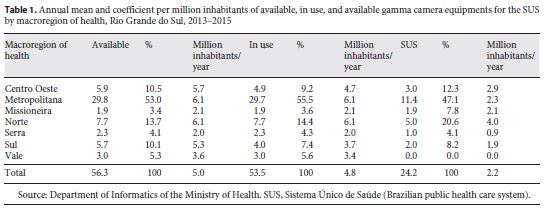
Comparing the coefficient per million inhabitants of gamma chambers existing and in use in the population by macroregion of health of Rio Grande do Sul, the metropolitan macroregion and the North macroregion presented 6.1 equipments/million inhabitants, a coefficient greater than that of Rio Grande do Sul (4.8/million inhabitants). The North macroregion had the highest coefficient considering use in the SUS (4.0 appliances/million inhabitants), higher than the state (2.2/million inhabitants) (table 1 ).
The averages of existing devices in use and available to the SUS were higher in the city of Porto Alegre, state capital of Rio Grande do Sul – 20.1 (35.7%), 20.0 (37.4%), and 6.0 (24.8%) appliances, respectively (table 2 ) – when analyzing the distribution of the scintigraphic chambers by municipalities in the state of Rio Grande do Sul that had the equipment in the period from 2013 to 2015.
]]>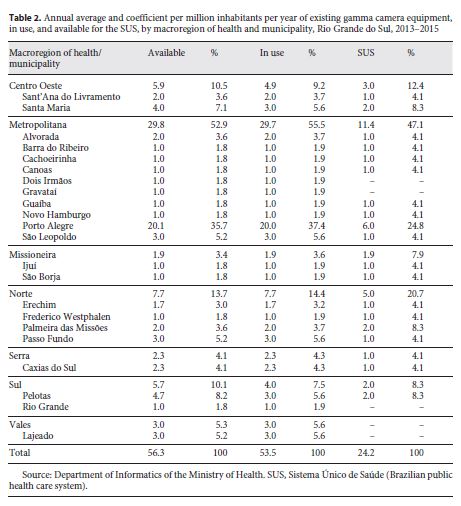
The municipality of Pelotas had 4.7 (8.2%) appliances, having the second largest average of existing cameras (table 2 ). It was followed by Santa Maria with 4.0 (7.1%) handsets. These two cities had the same average of equipment in use (3.0 [5.6%]) and available to the SUS (2.0 [8.3%]).
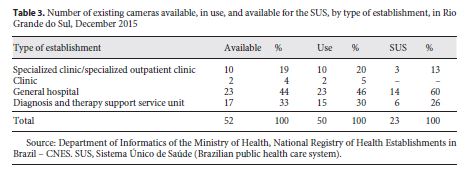
In the last month of the study period (December 2015) there were 52 cameras in the state of Rio Grande do Sul. Of these, 23 (44%) were located in general hospital type establishments, 17 (33%) in a diagnosis and therapy support service unit, 10 (19%) in specialized clinics/specialized outpatient clinics, and 2 (4%) in offices. There were 50 apparatuses in use in the same month. Of the 17 existing devices in diagnostic and therapy support service units, 2 (11.8%) were not in use. Among the equipment used by the SUS, 14 (60%) were installed in a general hospital, 6 (26%) in a diagnosis and therapy support service unit, and 3 (13%) in specialized clinics/specialized outpatient clinics (table 3 ).
Scanners were distributed in 35 health facilities in the state. According to the legal nature of the establishments, they were divided into 3 municipal foundations, 18 private associations, 2 limited business partnerships, 1 limited business partnership and limited partnership, 3 private foundations, 1 mixed-capital company, 1 public company, 1 federal autarchy, 4 simple limited companies, and 1 municipal autarchy and public association.
Ambulatory diagnostic procedures for in vivo nuclear medicine summed 100,313 and for PET 1,195 approved by the SUS, totaling 101,508 exams between 2013 and 2015. The ratio of procedures/1,000 inhabitants/year was 2.9 and 0.04, respectively.
PET exam had its inclusion in the arsenal of technologies offered by the public health system to the population on October 23, 2014. However, DATASUS started to cover data related to the respective outpatient production in the SUS only in February 2015. Therefore, the production presented is equivalent to the period from February to December 2015.
A discrepancy was observed in the total of procedures studied related to the total of exams approved by health region and by type of service provider. There were 6,217 (6.1%) exams less than the 101,508 procedures (5,967 scintigraphy and 250 PET). This difference is probably due to coding inadequacies of the type of service provider in the official database, making it difficult to properly operate the tabular application.
]]> The Capital/Metropolitan health region showed the highest concentration of outpatient diagnostic procedures for nuclear medicine in vivo and PET (47,401 [50.2%] and 749 [79.2%], respectively). It was followed by the Campos Verdes region, which for in vivo nuclear medicine reached 8,427 (8.9%) procedures, and the Vale dos Sinos region, which for PET reached 103 (10.9%) (table 4 ).Production from two types of establishments predominated in the Capital/Metropolitan health region and in the state of Rio Grande do Sul: philanthropic with valid CNES and federal public. A total of 22,216 (46.9%) nuclear medicine procedures were performed in vivo, 445 (59.4%) PET in the Capital/Metropolitan health region, and 47,839 (50.7%) nuclear medicine exams and 548 (58%) PET in the state of Rio Grande do Sul, by philanthropic establishments with valid CNES. They were followed by federal public establishments, of which 20,869 (44.2%) were nuclear medicine exams, 295 (39.4%) PET in the Capital/Metropolitan health region, and 21,558 (22.8%) nuclear medicine and 295 (31.2%) PET in the state (table 4 ).
The highest number of exams were performed in a federal public hospital, general and university, located in the city of Porto Alegre, state capital of Rio Grande do Sul, when the total production by CNES was observed, both for in vivo nuclear medicine procedure and for PET in the state of Rio Grande do Sul. A total of 12,273 (13%) and 295 (31.2%) procedures were performed, respectively.
When comparing by health regions, the amount of equipment in use and available to the SUS with number of establishments authorized and certified by the CNEN and nuclear medicine and PET-CT procedures, in 0.6% for the state, Vinhedos e Basalto (0.5%), Jacuí Centro (0.8%), and Vale do Rio Pardo (1.4%) had an outpatient SUS for these procedures. However, according to the DATASUS data, there was no equipment in use or available to the SUS (table 5 ).
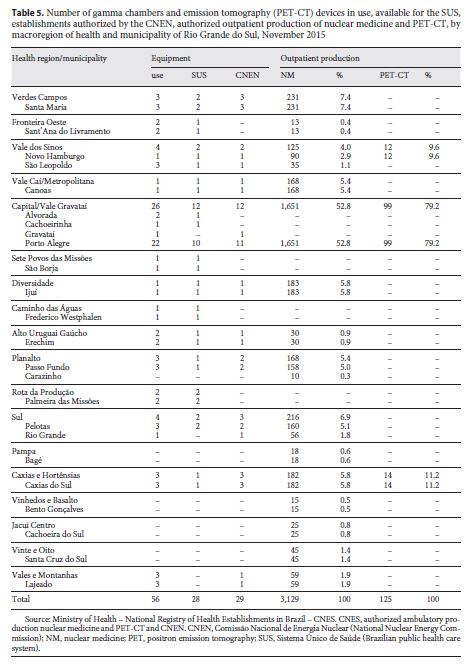
There were no establishments authorized by the CNEN to purchase radioactive material for in vivo exams, but there was equipment in use, and it was available to the SUS, in the regions of Fronteira Oeste, Rota da Produção, Sete Povos das Missões, and Caminho das Águas. The Fronteira Oeste health region (0.4%) even had outpatient production authorized by the SUS (table 5 ).
For some health regions the number of establishments authorized by the CNEN is higher than those registered in the SUS, these being Campos, Planalto, Sul and Caxias e Hortênsias (table 5 ). The Vales e Montanhas region had an establishment authorized by the CNEN and none available to the SUS, despite having outpatient production authorized by the SUS (1.9%) in November 2015.
Discussion
]]> The annual average range of existing chambers was 56.3, of which 53.5 were in use in Rio Grande do Sul from 2013 to 2015. A study by Pozzo et al. 1 found that there were 875 scintillation chambers, with 834 being used in Brazil from 2008 to 2012. It should be noted that the percentage of equipment in use, when compared to the number of existing ones, is the same both in the state of Rio Grande do Sul as in Brazil, i.e., it represents 95% of the total range of cameras.The main concern in the country is focused on the purchase of equipment; however, because of a cultural issue, operation and maintenance are neglected. This situation results in poor quality of services, delays in installation, and interruptions in the operation of equipment 7.
Amorim et al. 8 pointed out that there are no reports on the perception by the National Health Surveillance Agency or the Ministry of Health that these establishments should transfer data from their equipment to a national “management” system or to the CNES, an issue that demonstrates the disarticulation between the organs and internal areas of the Ministry of Health in relation to the actions related to the installed medical-hospital equipment. Except for the CNES, there are no computerized systems that evaluate the situation of the equipment installed in both public and private networks.
An interesting experience on the information system is that of Mozambique, an African country that, faced with a scenario of lack of maintenance of equipment, scarce resources (physical and material), adoption processes, and use of inappropriate technologies, implemented a system aiming at obtaining indicators related to the inventory and maintenance of equipment installed in the country 9. Our data allowed to affirm that the great urban centers concentrate the offer of nuclear medicine services in the state of Rio Grande do Sul. The metropolitan and North macroregions presented the highest density of gamma cameras (6.1 equipments/million inhabitants), higher than the coefficient of Rio Grande do Sul, which reached 4.8/million inhabitants. The North macroregion had the highest coefficient when in use by the SUS, i.e., 4.0/million inhabitants, also higher than the state (2.2/million inhabitants).
Due to the concentration of the supply of these services in urban centers, Leite et al. 10 argue for the need for coordinated action at all three levels of government with a view to equitable redistribution. For these authors, it is the responsibility of the state manager to manage the policy of high complexity and its regulation in its administrative scope, articulated with the national policy. Law 8080/90 defines that it is the responsibility of the SES to monitor, control, and evaluate SUS hierarchical networks. In addition, the SES is responsible for the management of public systems of high complexity, of state and regional reference 11. To guarantee access to specialized care, it is necessary to qualify the regulation, guaranteeing adequate flows to all levels of technological complexity of services 12.
In Brazil, 49.7% of the equipment in use were located in nuclear medicine establishments, while the other 50% were located in dental or radiological clinics between 2008 and 2012 1. However, the data may not express the reality of the distribution. In Rio Grande do Sul, in December 2015, there were 50 scintigraphy chambers, 46% in general hospitals, 30% in diagnosis and therapy support service units, 20% in specialized clinics/specialized outpatient clinics, and 5% in clinics. As for nuclear medicine procedures located in clinics, the results of both surveys pointed out that such procedures are not performed in these types of establishments. Therefore, the data may not express the reality of the distribution of equipment even if collected in DATASUS.
The scintigraphers were distributed in 35 health facilities in Rio Grande do Sul, predominantly services under public administration (24 [69%] establishments). Regarding the types of legal nature, private associations presented themselves in greater number (18 [51%] services). A survey found that there was a 43% increase in the number of cameras in private network (423 handsets to 603) as well as public ones (89 to 127 handsets) in Brazil from 2005 to 2013 8.
The ratio of outpatient nuclear medicine procedures in vivo and PET/1,000 inhabitants in Rio Grande do Sul was 2.9 and 0.04, respectively. The study by Pozzo et al. 1 showed that the concentration of nuclear medicine procedures in Brazil was in the more developed and densely populated regions, i.e., the Southeast, followed by the Northeast and South. Even if the South was in third position in relation to the absolute number, its relation of procedures/1,000 inhabitants was superior to that of the Northeast, i.e., 2.3 in the Southeast, 1.7 in the South, and 1.4 in the Northeast.
Both in the health region with the highest production of nuclear medicine and PET-CT, the Capital/Metropolitan Region, and in the state of Rio Grande do Sul, this occurred by philanthropic establishments with valid CNES and federal public. For Pozzo et al. 1, Rio Grande do Sul and São Paulo showed a significant increase in production by non-profit private establishments in 2011. There were 126 establishments and 2,491 procedures performed, and in 2012 they reached 7,611 and 66,413, respectively, representing an increase of approximately 60 and 26 times.
In the Canadian health system, outsourcing of the management of medical-hospital equipment is not common 13. This phenomenon is very different in Brazil, since outsourcing of services can be carried out as long as there is no legal impediment. This must be made through a formal contract, not exempting health care-contracting establishments from liability before the sanitary authority 14. In this case, control must be more rigid as potential conflicts of interest are identifiable.
]]> According to Testa 15 “… health technology is imposed on the consumer, but he has little to do or say, except accept what is decided in the centers of power.” This imposition of technology can generate, in the long term, a cultural transformation in the population by creating a pattern of consumption, strengthening its use, thus explaining the abuse occurring in exams such as ultrasounds and many others. The health care team deals with the technology and controls its application on the user. The management of health technology is an important source of power for dominant users; in the case of physicians, the more modern and sophisticated the equipment, the greater the power and status of the physician 15.When comparing the number of nuclear medicine equipment with establishments authorized and certified by the CNEN, a discrepancy was noted. There were health regions in Rio Grande do Sul that had a smaller number of establishments authorized by the CNEN than those available to the SUS and vice versa. In Brazil, there were establishments authorized by the CNEN in a smaller number than those registered in the SUS from 2008 to 2012. This was the case of the Northeast, Southeast, and South regions, led by the latter. Santa Catarina was the state with the highest number of services not authorized by the CNEN, although registered to the SUS, with 17, followed by Rio Grande do Sul with 14, and Minas Gerais with 121.
Conclusions
From our research, it was possible to identify that the distribution of nuclear medicine equipment and procedures from 2013 to 2015 was unequal in the health regions of the state of Rio Grande do Sul. It is competence of the state to manage the responsibility for the coordination of the regionalization process, especially the policy of high complexity and its regulation within the respective federative unit.
Considering that the DATASUS data update is done by the health managers of the municipal, state, and federal spheres, it is essential that they be provided correctly. In addition, it is necessary to elaborate a system that crosses information about nuclear medicine from the SUS databases with those of the CNEN.
We agree with the requirement of legislation that institutions, to perform procedures of nuclear medicine by the SUS, have prior authorization from the CNEN to operate, aiming at the radiological protection in the registered institutions in order to guarantee the safe use of the radiation sources used for the benefit of the population in nuclear medicine.
References
1 Pozzo L, Coura Filho G, Osso Júnior JA, Squair PL. SUS in nuclear medicine in Brazil: analysis and comparison of data provided by Datasus and CNEN. Radiol Bras. 2014 May– Jun; 47(3): 141–8. [ Links ]
2 Jesus RS. Um campo aberto de oportunidades. Medicina Nuclear Rev. 2014; 1: 14–7. [ Links ]
3 Instituto Brasileiro de Geografia e Estatística. Censo demográfico 2010. Rio de Janeiro: IBGE; 2010. [ Links ]
4 Instituto Brasileiro de Geografia e Estatística. Censo demográfico 2016. Rio de Janeiro: IBGE; 2016. [ Links ]
5 Instituto Brasileiro de Geografia e Estatística. Indicadores sociodemográficos e de saúde no Brasil. Rio de Janeiro: IBGE; 2009. [ Links ]
6 Secretaria Estadual da Saúde do Estado do Rio Grande do Sul. Coordenadorias Regionais de Saúde. Porto Alegre: Secretaria Estadual da Saúde do Estado do Rio Grande do Sul; 2016. Available from: https://saude.rs.gov.br/crs (cited February 7, 2020).
]]> 7 Guimarães JM, Gondim GM. O papel da politécnica na formação profissional de técnicos de nível médio envolvidos na área de manutenção predial e de equipamentos em Estabelecimentos Assistenciais de Saúde (EAS). In: IX Congresso Brasileiro de Saúde Coletiva, 31 de outubro a 4 de novembro de 2009, Recife, Pernambuco. Compromisso da ciência, tecnologia e inovação com direito à saúde. Recife, PE: Abrasco; 2009.8 Amorim AS, Junior VL, Shimizu HE. O desafio da gestão de equipamentos médico-hospitalares no Sistema Único de Saúde. Saúde Debate. 2015; 39(105): 350–62. [ Links ]
9 Nunziata E, Sumalgy M. Clinical engineering in Mozambique. In: Dyro JF, editor. The clinical engineering handbook. Elsevier; 2004. p. 93–6. [ Links ]
10 Leite JMS, Almeida MAS, Carvalho MC, Coelho SM, Sardinha CG. Situação dos serviços de saúde de alta complexidade no Estado do Maranhão no ano de 2002. Rev Hos Universitário/UFMA. 2003; 1(3): 106–15. [ Links ]
11 Lei nº 8080, de 19 de setembro de 1990. Diário Oficial da União, Brasil, Brasília, DF, 20 de setembro de 1990.
12 Pursai OJ. Sistema de saúde no Brasil. In: Duncan BB, Schimidt MI, Giugliani ER, editors. Medicina ambulatorial: condutas de atenção primária baseadas em evidencias. 3rd ed. Porto Alegre: Artmed; 2004. [ Links ]
]]>13 Gentles WM. Clinical engineering in Canada. In: Dyro JF, editor. The clinical engineering handbook. Elsevier; 2004. p. 62–4. [ Links ]
14 Ministério da Ciência Tecnologia e Inovação. Comissão Nacional de Energia Nuclear. Quem somos. Brasília: Ministério da Ciência Tecnologia e Inovação; 2016. Available from: www.cnen.gov.br/quem-somos (cited May 30, 2016). [ Links ]
15 Testa M. Pensar em saúde. Porto Alegre: Artes Médicas; 1992. [ Links ]
]]>