




 Inglês (pdf)
 Artigo em XML
 Referências do artigo
 Tradução automática
 Enviar este artigo por email
 Citado por SciELO
  Similares em
SciELO
Similares em
SciELO 
 Permalink

1. Introduction
The Eurovision Song Contest (ESC) stands as one of the most iconic and lasting cultural phenomena in Europe and beyond (Pajala, 2022). Since its beginning in 1956, the contest has captivated audiences with its diverse blend of music, spectacle, and international harmony (Mourão da Silva, 2022; West, 2017). Indeed, what began as a modest competition among seven Western European countries in the post-World War II era has evolved into a Festival that unites nations from across the continent (and beyond) in a celebration of diversity and creativity through music.
Over eight decades, Eurovision has not only provided an international platform for artists to demonstrate their skills but has also encouraged important social and political protests together with racial and ethnic vindications (e.g., Gluhovic, 2013; Ortiz-Montero, 2017; Panea & Pérez-Rufí, 2024). With iconic performances that have challenged societal norms and pushed the boundaries of artistic expression to moments of unity and solidarity in the face of adversity (such as the recent win of Ukraine in 2022), Eurovision has played a pivotal role in promoting diversity and inclusion. However, the Festival is not free of criticism, especially when it comes to the role of politics in it. A clear example is the participation of Israel in the 2024 ESC (as well as its classification to the grand final), which has sparked intense debate around the country’s policies, particularly regarding the Israeli part in the genocide of Palestinians in the Gaza Strip. Critics argue that Israel’s involvement in Eurovision serves to “whitewash” or distract from human rights violations and injustices perpetrated against Palestinians (Durán-Rodríguez, 2024), while proponents maintain that the contest should remain apolitical arguing that excluding Israel from the competition based on political grounds sets a dangerous precedent (although this was already set when Russia was banned-and continues to be-from participating in 2022; European Broadcasting Union, 2022).
On another note, the debate surrounding the use of languages at Eurovision is deeply rooted in the competition’s history and evolution over time. Since its beginning in 1956, Eurovision has been a platform for cultural exchange and celebration of diversity, with each participating country given the opportunity to show its unique musical heritage (Ortiz-Montero, 2017). In the early years of the contest, “there was no [written] rule on what language a country could perform in, and until 1965 every country used its national language” (Wetherbee, 2023, p. 8). However, Sweden became the first country to break that norm in 1965 by singing in English, which led the European Broadcasting Union (generally known as EBU, it is an alliance of public service media bodies in charge of the organisation of the ESC; European Broadcasting Union, n. d.) to establish a rule mandating performances in one of the national languages of each participating country. Such a rule reflected the Festival’s emphasis on cultural representation and linguistic diversity. However, as Eurovision expanded beyond its original Western European roots and welcomed new member countries from inside and outside the continent, the dynamics of language use began to change. Indeed, in 1999, the EBU decided to abolish the aforementioned language rule, allowing countries to use whatever language they wanted in their songs (Eurovision, 2005). This marked a significant turning point in Eurovision history, following heated discussions around the increasing dominance of English in the Festival within the ESC community (Molyneaux, 2015).
Regarding the possibility of using languages other than a country’s national language/s in a song, there have always been varied opinions. Proponents of the freedom to choose the singing language argue that allowing performers to sing in any language would enhance artistic freedom and offer them more professional opportunities on the international stage (JohntheGo, 2018). Conversely, critics express concerns that the language rule change would dilute cultural authenticity and erode the linguistic diversity that had long been appreciated as a hallmark of the contest (Busow, 2023).
As a result of the language rule change in 1999, English has become the primary singing language at Eurovision (Molyneaux, 2015; Motschenbacher, 2017). In fact, its extended use has increased popular debates on whether singing in this modern lingua franca rather than in the country’s national language or languages may result in better chances of winning this annual song contest. In this line, various analyzes have demonstrated that nearly half of the winning songs during the history of the Festival have been partially or entirely performed in English (Wetherbee, 2023). However, amidst the English-centric trend, instances of non-English entries winning the contest have served as significant exceptions, demonstrating the continuing power of linguistic diversity. Indeed, memorable victories, such as Serbia’s unique win in 2007 with Marija Šerifović’s “Molitva” in Serbian, Ukraine’s triumph in 2016 with 1944 sung in Crimean Tatar by Jamala, Portugal’s win in 2017 with Salvador Sobral’s “Amar pelos dois” in Portuguese, and Italy’s rock song “Zitti e buoni” performed in Italian by Måneskin in 2022, emphasise the emotion and authenticity that native languages can bring to a performance. These exceptions to the English-dominated landscape of the Festival suggest that linguistic diversity remains a compelling and even advantageous aspect of Eurovision entries. Beyond merely being a medium for lyrical expression, the language choice can evoke cultural pride, storytelling depth, and emotional connections with audiences across Europe and beyond (Baker, 2019; Jay, 2023; Zaroulia, 2013).
However, up to the researchers’ knowledge, the scientific literature is still scarce when analysing linguistic diversity in all the songs that have taken part in Eurovision throughout its history and the relationship between language or languages used and position in the contest. Considering this situation, this paper aims to bridge such a gap to gain insights into the importance of languages in such a popular contest.
2. Materials and method
2.1. Objectives and hypotheses
This study aimed to achieve two main objectives. On the one hand, it intended to examine the languages used in the participating songs in Eurovision from its beginning in 1956 until its last edition in 2024. On the other hand, it aimed to analyse the relationship between languages used in the participating songs and their position in the contest.
Table 1 presents the study hypotheses and their motivation:
Table 1: Hypotheses of the study and motivations.
| Hypotheses | Motivation |
|---|---|
| Hypothesis 1 (H1). The majority of songs that have participated in Eurovision have used English either totally or partially. | This hypothesis is formulated considering the findings of previous studies that have shown that English has become the main singing language at Eurovision (Molyneaux, 2015; Motschenbacher, 2017; Wetherbee, 2023). |
| Hypothesis 2 (H2). English is not the official language of most countries that use this language in their participating songs. | This hypothesis is formulated considering that English is an official language in only three European countries (i.e., Ireland, the United Kingdom, Malta and Australia; The World Factbook, s.d.). |
| Hypothesis 3 (H3). The majority of songs that have placed from first to fifth in Eurovision have used English either totally or partially. | This hypothesis is formulated considering the findings of previous studies that have shown that using English in their entry songs gives countries more opportunities to win Eurovision (Wetherbee, 2023). |
Source: prepared by the author.
2.2. Research design
This study followed a quantitative research approach and a descriptive and correlational method to identify the languages used in the songs that have participated in Eurovision from its beginning. To do so, EurovisionWorld (n. d.) was used as the central database of the study, considering its relevance in the ESC fan community. The webpage of EurovisionWorld provides information regarding all the participating songs in the different editions of the contest (even the one celebrated in 2020, which was cancelled because of COVID-19), including lyrics, languages, performers, position and obtained points, as well as plenty of information and curiosities about the contest. This database was used to obtain the primary information regarding the songs (and their lyrics) participating each year; however, although EurovisionWorld offers information about the languages used in each song, the researchers decided to specifically check the lyrics to get the languages used correctly.
The sample of the study was composed of 1721 songs that had participated from 1956 to 2024 (the songs from 2020 were not analysed as the contest was not celebrated that year) either in the grand final or the semi-finals (considering that since 2004 a semi-final is celebrated -two semi-finals since 2008- to reduce the number of performances in the grand final; Eurovision, 2005). Specific information was gathered about the following variables: year, title of the song, singer/band, position, number of points obtained, country, role of English as an official language of the country, language or languages used, and participation in a semi-final and/or the grand final. Nevertheless, for the present study, the title of the song and the singer/band, the number of points obtained, the country, and participation in a semi-final and/or the grand final were not considered.
2.3. Procedure and data analysis
The data were obtained from the EurovisionWorld webpage (n. d.) and then tabulated into a Microsoft Excel spreadsheet to facilitate its organization and analysis. Once all the data were collected, they were analysed using SPSS 28.0 for MacOS. Simple statistical tests were applied in order to obtain information about the distribution of languages used in the different editions of Eurovision, the use of English throughout the years, and the use of English in the 68 winning songs.
3. Results
3.1. Language diversity in the ESC
Figure 1 shows a graphical representation of the languages used in the history of Eurovision:
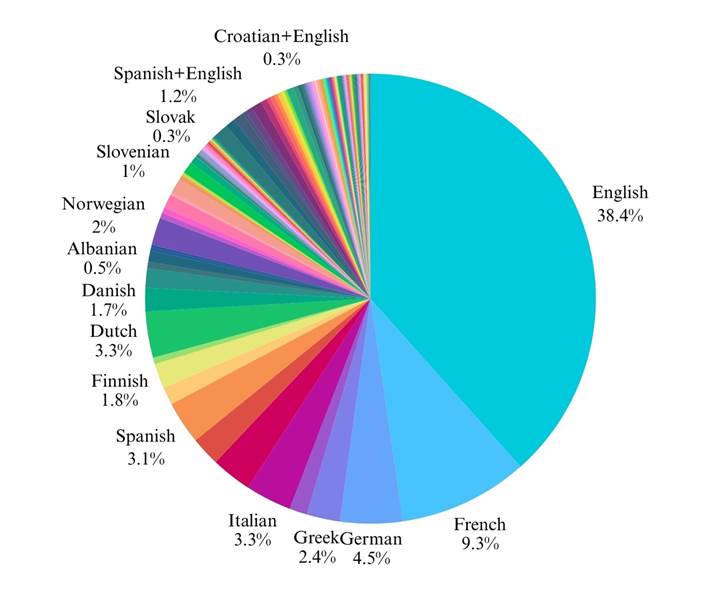
A total of 131 language combinations have been used in the contest up to 2024. Such combinations include 50 languages (including imaginary languages) that have been used solely in songs, 68 combinations of two languages, and 13 combinations of three or more languages. Considering the high number of songs that have taken part in the ESC, Table 2 shows the language combinations that have been used 10 or more times, including both the number of times and the percentage:
Table 2: Language combinations used 10 or more times in Eurovision.
| Language combination | N | % |
|---|---|---|
| English | 661 | 38.4 |
| French | 160 | 9.3 |
| German | 77 | 4.5 |
| Italian | 57 | 3.3 |
| Dutch | 57 | 3.3 |
| Spanish | 53 | 3.1 |
| Portuguese | 50 | 2.9 |
| Greek | 41 | 2.4 |
| Swedish | 36 | 2.1 |
| Norwegian | 34 | 2.0 |
| Finnish | 31 | 1.8 |
| Danish | 29 | 1.7 |
| Croatian | 24 | 1.4 |
| Hebrew | 22 | 1.3 |
| Turkish | 22 | 1.3 |
| Spanish and English | 20 | 1.2 |
| Slovenian | 18 | 1.0 |
| Serbian | 17 | 1.0 |
| Icelandic | 15 | 0.9 |
| Bosnian | 14 | 0.8 |
| Hebrew and English | 13 | 0.8 |
| French and English | 13 | 0.8 |
| Italian and English | 12 | 0.7 |
Note. N = number of times, % = percentage.
Source: prepared by the author.
As Table 2 shows, English has been the most used language, followed by French and German. Moreover, combinations of English and another language have also been frequent in the contest, with Spanish and English, Hebrew and English, and French and English the most repeated language combinations.
Likewise, Table 3 presents the language combinations that have been employed between five and nine times, also including frequency and percentage:
Table 3: Language combinations used between 5 and 9 times in Eurovision.
| Language combination | N | % |
|---|---|---|
| Hungarian | 9 | 0.5 |
| German and English | 9 | 0.5 |
| Estonian | 8 | 0.5 |
| Albanian | 8 | 0.5 |
| More than 3 languages | 8 | 0.5 |
| Greek and English | 8 | 0.5 |
| Polish | 7 | 0.4 |
| Macedonian | 7 | 0.4 |
| Turkish and English | 6 | 0.3 |
| Croatian and English | 6 | 0.3 |
| Russian | 5 | 0.3 |
| Slovak | 5 | 0.3 |
| Romanian and English | 5 | 0.3 |
| Turkish and English | 6 | 0.3 |
| Croatian and English | 6 | 0.3 |
Note. N = number of times, % = percentage.
Source: prepared by the author.
Similarly to what is seen in Table 2, combinations of English with other languages have also been frequent in Eurovision, including combinations with German, Greek, Turkish, Croatian, and Romanian, as shown in Table 3.
3.2. Use of English and English as an official language in the ESC
Regarding the use of English in the participating songs, this language has been employed a total of 835 times, which represents 48.52% of all the entries in the contest. Out of them, songs have been entirely in English in 661 cases (38.41% of all the participating songs), whereas English has been used partially1 in 174 songs (10.11% of the total entries).
Of all the cases in which English has been employed, only in 156 cases (9.06% of all the songs that have participated in the ESC) was it the official language of the performing countries2. Figure 2 offers a graphical representation of the use of English in songs as compared to the cases when this has had the status of official language:
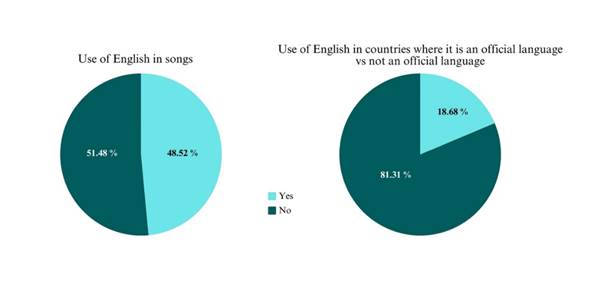
Figure 2: Use of English in Eurovision and English in Eurovision entries from countries with official-language status.
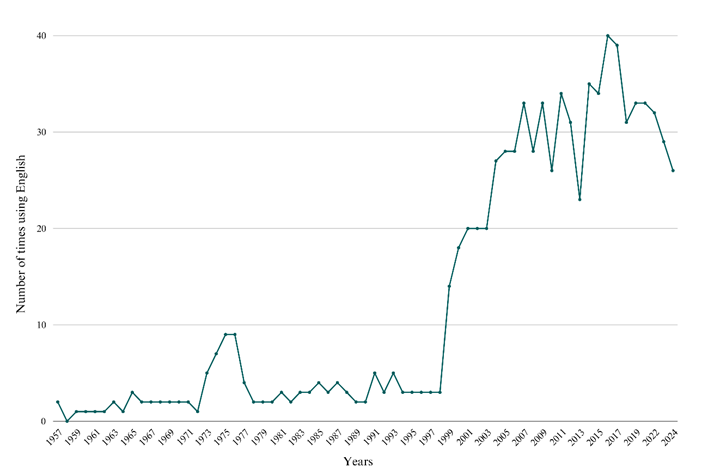
The use of English, however, has changed over time. Figure 3 shows how the use of this language in the different editions of the contest:
3.3. Languages and their position in the contest
A variety of language combinations have been found in songs’ positions throughout the history of Eurovision. Considering the number of editions and language combinations, Table 4 displays the language combinations used in the songs that have placed from first to third position throughout the history of the ESC.
Table 4: Language combinations used in the songs that have placed in first, second and third positions in Eurovision.
| Language combination | N | % | Language combination | N | % | Language combination | N | % |
|---|---|---|---|---|---|---|---|---|
| English | 33 | 46.5 | English | 35 | 43.8 | English | 21 | 31.8 |
| French | 14 | 19.7 | French | 15 | 18.8 | French | 16 | 24.2 |
| Dutch | 3 | 4.2 | German | 6 | 7.5 | Italian | 5 | 7.6 |
| Italian | 3 | 4.2 | Spanish | 4 | 5.0 | German | 4 | 6.1 |
| Hebrew | 2 | 2.8 | Italian | 3 | 3.8 | Swedish | 4 | 6.1 |
| Spanish | 2 | 2.8 | Dutch | 2 | 2.5 | Danish | 3 | 4.5 |
| Swedish | 2 | 2.8 | Hebrew | 2 | 2.5 | Spanish and English | 3 | 4.5 |
| Norwegian | 2 | 2.8 | Imaginary | 1 | 1.3 | Bosnian | 1 | 1.5 |
| Croatian | 1 | 1.4 | Norwegian | 1 | 1.3 | Hebrew | 1 | 1.5 |
| Danish | 1 | 1.4 | Polish | 1 | 1.3 | Norwegian | 1 | 1.5 |
| German | 1 | 1.4 | Serbian | 1 | 1.3 | Russian | 1 | 1.5 |
| Portuguese | 1 | 1.4 | Swedish | 1 | 1.3 | Serbian | 1 | 1.5 |
| Serbian | 1 | 1.4 | German and English | 1 | 1.3 | Turkish | 1 | 1.5 |
| Ukrainian | 1 | 1.4 | German and Italian | 1 | 1.3 | Greek and English | 1 | 1.5 |
| Crimean Tatar and English | 1 | 1.4 | Italian and Arabic | 1 | 1.3 | Ukrainian and English | 1 | 1.5 |
| German and French | 1 | 1.4 | Italian and English | 1 | 1.3 | German, Turkish and English | 1 | 1.5 |
| Spanish and Hebrew | 1 | 1.4 | Spanish and English | 1 | 1.3 | Spanish, Hebrew and English | 1 | 1.5 |
| Ukrainian and English | 1 | 1.4 | Spanish and Finnish | 1 | 1.3 | |||
| Udmurt and English | 1 | 1.3 | ||||||
| More than 3 languages | 1 | 1.3 | ||||||
| Total of songs in 1st position | 713 | 100 | Total of songs in 2nd position | 80 | 100 | Total of songs in 3rd position | 66 | 100 |
Note. N = number of times, % = percentage.
As shown in Table 4, English is the most employed language in the lyrics of the entries that have won the contest or placed second or third are the same. Likewise, French, German, Hebrew, and Italian are the second, third, fourth and fifth most common languages in the songs that have made it to the top 3.
In terms of songs’ position in the different editions of the Festival, the presence of English is also diverse. Out of the total 357 songs that have placed in the top 5 in the different editions of the Festival, 162 of them (45,28%) have been written either totally or partially in English, as compared to 195 other songs (54,62%) written in other languages. In this light, Table 5 presents the distribution of positions of songs that have used English in the ESC, in which this language has tended to be present in the songs that have placed either first, second or third in Eurovision:
Table 5: Distribution of positions of songs using English in Eurovision.
| Position | N | % | Position | N | % |
|---|---|---|---|---|---|
| Position 1 | 35 | 4.2 | Position 23 | 13 | 1.6 |
| Position 2 | 40 | 4.8 | Position 24 | 22 | 2.6 |
| Position 3 | 28 | 3.3 | Position 25 | 16 | 1.9 |
| Position 4 | 33 | 3.9 | Position 26 | 17 | 2.0 |
| Position 5 | 26 | 3.1 | Position 27 | 15 | 1.8 |
| Position 6 | 24 | 2.9 | Position 28 | 15 | 1.8 |
| Position 7 | 34 | 4.1 | Position 29 | 14 | 1.7 |
| Position 8 | 25 | 3.0 | Position 30 | 17 | 2.0 |
| Position 9 | 30 | 3.6 | Position 31 | 17 | 2.0 |
| Position 10 | 28 | 3.3 | Position 32 | 16 | 1.9 |
| Position 11 | 25 | 3.0 | Position 33 | 16 | 1.9 |
| Position 12 | 25 | 3.0 | Position 34 | 16 | 1.9 |
| Position 13 | 18 | 2.2 | Position 35 | 16 | 1.9 |
| Position 14 | 22 | 2.6 | Position 36 | 16 | 1.9 |
| Position 15 | 20 | 2.4 | Position 37 | 14 | 1.7 |
| Position 16 | 22 | 2.6 | Position 38 | 10 | 1.2 |
| Position 17 | 19 | 2.3 | Position 39 | 12 | 1.4 |
| Position 18 | 23 | 2.7 | Position 40 | 8 | 1.0 |
| Position 19 | 19 | 2.3 | Position 41 | 7 | 0.8 |
| Position 20 | 19 | 2.3 | Position 42 | 5 | 0.6 |
| Position 21 | 15 | 1.8 | Position 43 | 2 | 0.2 |
| Position 22 | 20 | 2.4 | Other4 | 3 | 0.4 |
Note. N = number of times, % = percentage.
Finally, when comparing the position that songs have placed depending on whether they are written entirely and partially in English, a series of differences can be observed, as presented in Figure 4:
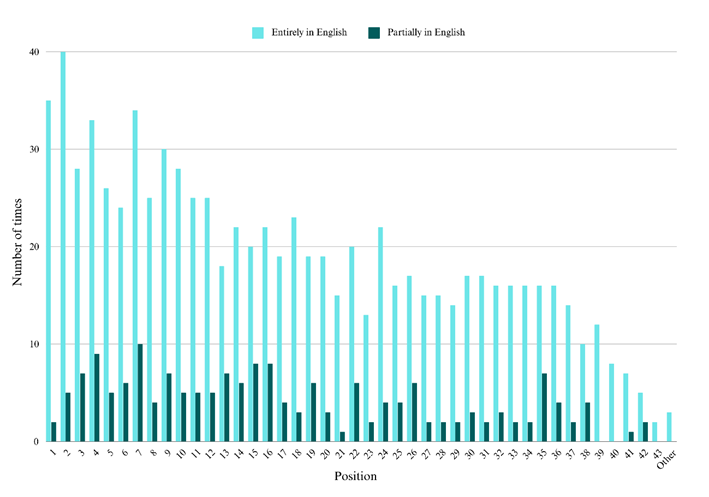
As shown in Figure 4, songs that have placed in the top 10 more than 20 times have been written entirely in English, being the first and second positions the most commonly reached in these situations (35 and 40 times, respectively). Conversely, songs partially written in English have generally tended to place in the top 10 less than 10 times during the history of the Festival, only with the exception of the seventh position, in which songs partially written in English have reached in 10 occasions.
4. Discussion and conclusion
The ESC, considered a renowned international music competition and among the most widely viewed non-sporting events worldwide (Abudy et al., 2022), has served since the 1950s as a platform for the convergence of cultures, languages, and talents from and beyond Europe (Raykoff & Tobin, 2007). Music and performances at the Festival are used not only to represent national identity, but also to play a role in the broader processes of nation-building (Alpatova, 2022). In fact, international music competitions, such as Eurovision, offer states the chance to engage in political discourse within a non-political framework (Meijer, 2013). This “peaceful competition” enables nations to position themselves as leaders of European values, acting as a catalyst for progressive developments that intertwine gender and sexuality with cultural, ethnic, and religious identities in contemporary Europe. As language is a fundamental element of any identity and culture, performing Eurovision songs in individuals’ native language(s) plays a key role in preserving cultural identities, encapsulating peoples’ history, traditions, and distinctive nuances (Busow, 2023). Moreover, by singing in their main language(s), artists can express profound emotions and communicate the essence of their culture to a global audience, conveying authentic narratives and experiences, as well as offering a powerful representation of the cultural diversity that Europe seeks to celebrate and uphold in the ESC.
This study aimed to achieve two main objectives:
(i) to examine the languages used in the participating songs in Eurovision from its beginning in 1956 until its last edition in 2024, and
(ii) to analyse the relationship between languages used in the participating songs and their position in the contest. At this point, it seems relevant to address the hypotheses that guided this study to determine whether they are corroborated or refuted in this research.
Concerning H1 (The majority of songs that have participated in Eurovision have used English either totally or partially), we can affirm that English is the predominant language in the ESC, employed up to 2024 on 835 occasions (48.52%). It must be noted that 661 songs (38.41%) have been sung entirely in English, whereas this language has been used partially in 174 songs (10.11%). This confirms what previous studies pointed out: English has become the main singing language at Eurovision, effectively a lingua franca (Molyneaux, 2015; Motschenbacher, 2017; Wetherbee, 2023). This dominance exemplifies Bourdieu’s concept of linguistic capital (Bourdieu, 1991), where English functions as a high-prestige resource granting broader access and perceived legitimacy within the international arena of the contest. Its prevalence also reflects aspects of cultural hegemony (Gramsci, 1971), where the global influence of Anglophone media establishes English as the default mode for reaching mass audiences, potentially marginalizing other languages.
All this, as pointed out by Busow (2023), may be a sign of the loss of linguistic diversity that initially characterized the contest. Despite this dominance, linguistic diversity is still a hallmark of ESC, as up to 2024 a total of 131 language combinations have been used in the 1721 songs analysed (68 editions of the Festival). Such combinations include 50 languages (including imaginary languages) that have been used solely in songs, 68 combinations of two languages, and 13 combinations of three or more languages.
In this line, H2 (English is not the official language of most countries that use this language in their participating songs) is also confirmed, as only 92 songs in English (5.35% of all the songs that have participated in the ESC) were presented by countries in which English was a national official language. This situation started in the 1970s, as until 1973 the repertoire of the contest participants was dominated by songs in French. Then, English gained a dominant role, contributing to a certain unification of the Festival and, accordingly, to the consolidation of the “euro-pop” standard (Alpatova, 2022). The strategic adoption of English by non-Anglophone nations underscores the pursuit of linguistic prestige and symbolic capital (Bourdieu, 1991). Delegations leverage English, perceived as a language of modernity and global reach, aiming to enhance their entry's competitiveness and international appeal, consciously trading linguistic authenticity for potential competitive gain. One of the reasons behind the use of a language other than the national official language may have been the attempt to offer performers more professional opportunities on the international stage, as suggested by JohntheGo (2018). Despite this, this use of English as a common language is also seen nowadays as a key element that contributes to “cultural struggle” in the ESC:
After the (linguistic) rule of the contest was changed, letting the contestant to join the contest with the language that they would prefer to, the “language issue” has taken into account by the organizers of the contest because the change was carrying political and ideological meanings that were much beyond being a simple amendment. (Şivgin, 2015, p. 208)
Finally, H3 (The majority of songs that have placed from first to fifth in Eurovision have used English either totally or partially) is also corroborated, as English is the most employed language in the lyrics of the entries that have won the contest (46.5%), or placed second (43.8%) or third (31.8%). Previous studies have mentioned the role of English in getting a top position in the Festival, which has led some countries to choose English instead of their official languages despite intense national debates (Şivgin, 2015). The correlation between English use and higher placements reinforces its linguistic capital and perceived prestige within the contest’s evaluative framework (juries and televoters). Success in English reinforces its hegemonic position, validating the strategic choice for delegations seeking competitive advantage through enhanced comprehensibility and marketability.
In a song context where national identities are displayed, performing in a language other than one’s own poses a challenge for countries that may have a strong bond to their traditions. The dilemma of choosing between reaching a wider audience through an English-language song (and getting a higher position) or connecting with a more limited audience in the native language is still there, and the Festival has experienced a slight change of tendency in the last few years with a decrease in the number of songs in English. This shift may reflect a growing audience appreciation for authenticity and cultural distinctiveness, alongside potential strategic decisions by delegations to leverage national identity for competitive advantage; political factors, such as heightened cultural diplomacy or expressions of solidarity (e.g., Ukraine in 2022 and 2023), can also influence language choices, though the primary drivers appear artistic and strategic.
These findings contribute to the existing literature by demonstrating the role that the English language has played in the ESC during its 68 editions until 2024. Crucially, this comprehensive analysis of all 1721 entries (1956-2024) provides robust empirical validation for the initial hypotheses: H1 is confirmed by English’s dominance (48.52% overall usage), H2 by the strategic adoption of English in non-Anglophone contexts (92.8% of entries written in English), and H3 by its prevalence among top placements (46.5% of winner songs written in English, 43.8% of second places for songs written in English). Nevertheless, several studies had noted that language could influence the position of the songs in the Festival, being songs in English those with higher positions in the finals and with more appearances in the top 3. That is, this study differs from the existing literature because it has analysed the use of languages in all the songs in the period 1956-2024. In this light, it is time to go back to the question in the title of the paper (Do songs in English do better?): our answer is “yes”, primarily due to enhanced comprehensibility and relatability for the pan-European audience, facilitating immediate emotional connection and memorability. This linguistic advantage, coupled with the frequent association of English with contemporary, high-production-value pop music favored by juries and televoters, creates a competitive edge. Certainly, this analysis confirms that this trend persists despite recent shifts towards linguistic diversity. This enduring tension between linguistic pragmatism and cultural authenticity underscores Eurovision’s significance as a microcosm of Europe’s ongoing cultural negotiations-where strategic language choices both reflect and shape contemporary expressions of national identity within a shared pan-European space. In any case, linguistic diversity still seems to be an asset in Eurovision.

