




 Inglês (pdf)
 Artigo em XML
 Referências do artigo
 Tradução automática
 Enviar este artigo por email
 Citado por SciELO
  Similares em
SciELO
Similares em
SciELO 
 Permalink

1. Introduction
In the inner region of Alentejo and leeward Algarve, in southern Portugal, brick vaulted buildings, most of the time made by anonymous builders for the past centuries, can be found today still inhabited and in use. It is surprising how such complex constructive systems and diverse geometries were employed as roof of floor structure at current houses in fishing villages, rural farmhouses or countryside urban centers. These typologies of buildings are characterised by having vaulted roofs and floors built using brick vaults' constructive systems, between the 17th and mid-20th century. These buildings range from residential to religious or military, with more or less erudite or popular backgrounds, being an example of vernacular and bioclimatic architecture (Pacheco and Conceição, 2024).
The Portuguese vernacular vaulted buildings were firstly mentioned, even though sporadically, in the National Survey to the Portuguese Rural Architecture carried out during the 1950s by the Sindicato Nacional de Arquitectos and published in 1961 as Arquitectura Popular em Portugal (Amaral, 1961). Research on the field of Art History, focusing on religious buildings in Portugal and particularly in Alentejo, stated the existence of vaults in churches, chapels and convents (Silva, 1989; Reis and Chicó, 1989), among them some buildings with a more vernacular character called Portuguese Plain Style (Kubler, 1972).
Despite these publications and a few occasional, scientific and local studies in the last decades (Costa, 2024; Rosado, 2022; Pacheco, 2018; Caldas, 2007), a deeper, embracing and systematic study about vernacular vaults’ constructive systems and their geographical dispersion and contrasts is still lacking. Once this gap was identified, and with aim of filling it, between 2021 and 2023, the project Vaulted South - Vernacular Vaulted houses in the south of Portugal carried out a set of fieldwork campaigns in the south regions of Alentejo and Algarve. Particularly, religious heritage in this area has been studied mostly in the fields of history, history of art and architecture, by focusing on the material-built values, leaving the deepening of constructive techniques, comprising tangible and intangible components, for a further stage.
Previous studies, focusing on this region, have approached mostly the religious heritage at an architectural and landscape scale, with the support of GIS methodologies. For the study of these collected data, the spatialization and Geographic Information System (GIS) analysis are some of the most proficient methods. When deciding what to map, Brown (2020) addresses the importance of two aspects: bringing new data that has not been mapped by others, and to have sufficient sources to create a digital map. Taking into account the anonymity of the majority of the vernacular vaulted structures that were built in a popular context, the database thus establishes the basis for a broad study of vaults construction. Digital spatial techniques, when utilized in the study of architectural history, can contribute to review and renew old concepts usually assimilated and few questioned, such as “style”, “influence” or “diffusion”. How to map, including collecting and organizing data, how to georeference spatial information, and how to analyse the results are decisions to take in consideration when creating a new digital cartography (Joyeux-Prunel, 2020). The use of GIS to organize, visualize and analyse the list of surveyed data, and to make available these distribution and synchronized maps and the precise descriptions of the places represented, permits the visualization and enables users to situate data in the places, or to examine where certain data are present, in which kind of elements and all groups that have been collected, also provides a better understanding of certain developments (Joyeux-Prunel, 2020).
This paper aims to fill in this gap by surveying, studying and displaying vaulted systems in religious buildings, considering them as part of a built heritage network and stretching their meaning for the local development of peripheral areas. It starts from the hypothesis that knowledge about constructive techniques has been transferred between cultured contexts of highlighted buildings - such as churches, convents and monasteries -, and popular contexts - such as current urban and rural chapels.
This research hence focuses on the vernacular vaulted religious buildings located in the Baixo Alentejo region with vaulted ceilings and floors with a variety of geometric types, constructive systems and finishing decorations, identified during “Vaulted South”. It aims to characterize vaults within religious buildings addressing their current state of conservation, to promote a coeval reading throughout the use of Digital Humanities tools.
Taking advantage of one of the project goals - to explore the Digital Humanities tools in favor of the History of Architecture research -, a study of itineraries on vaulted buildings was carried out, supported with optimization of paths by ESRI ArcGIS Pro Network Analyst module. It intended to reflect on the way these studies can contribute to emphasizing the relevance of religious buildings for local stakeholders and heritage strategies facing restoration, rehabilitation and reuse challenges. At the same time, it sought to promote their understanding, dissemination and exploration among general public and academic audiences.
This article is structured in five sections, starting with an introduction, where the scope of the research on vernacular vaults, religious buildings and its challenges, through the use of Digital Humanities tools, is presented. In the second section, “Vaulted religious buildings in Baixo Alentejo”, the vaults’ constructive system is explained, through the characterization of 36 different types of buildings according to the use, scale, location and context, the challenges and potentials they currently face in the cultural and social spheres. Next, “Formal tendencies of the vaulted religious buildings” presents the geographical and architectural trends resulting from a statistical analysis of the 36 buildings’ parameters in a GIS environment. The fourth section, “Thematic itineraries as a way to promote vaulted religious buildings”, addresses the generation of optimized itineraries in a GIS environment, applied to the municipality of Moura, as a way to promote the knowledge about vernacular-built heritage. Finally, the conclusion summarizes main findings and how they can foster sustainable territorial development.
2. Vaulted religious buildings in Baixo Alentejo
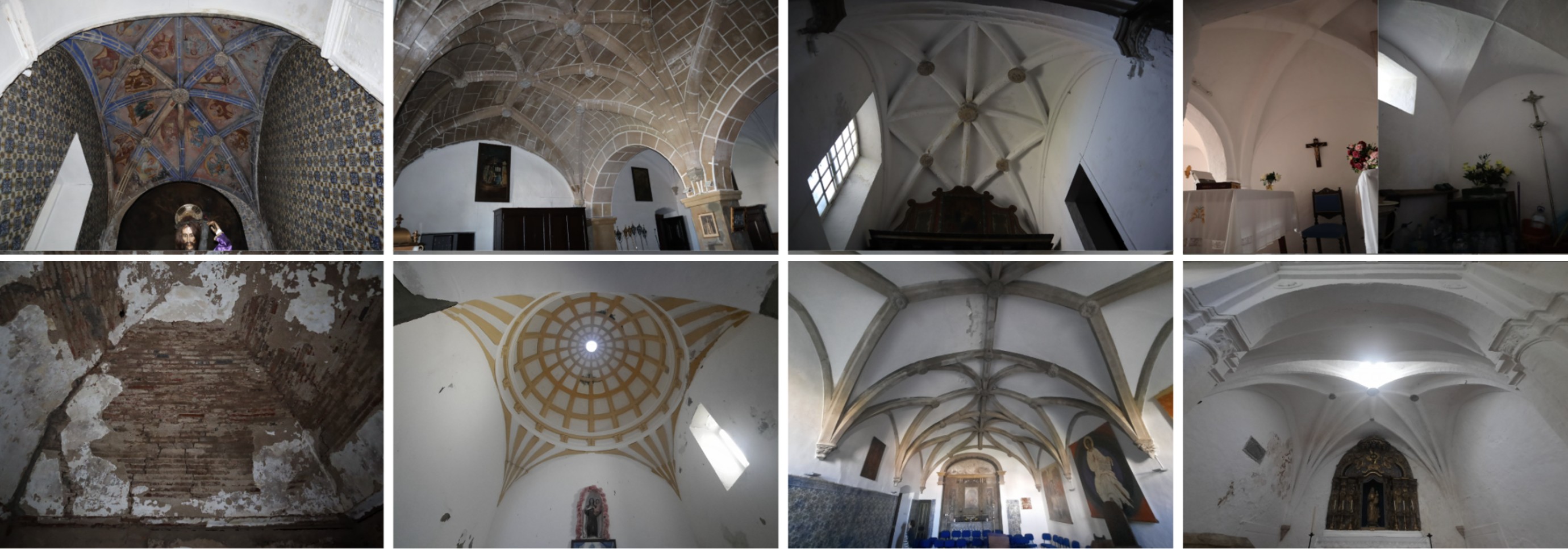
Religious buildings in Baixo Alentejo present a variety of vaults that perform the structural function of floor and roof. Indeed, in the south of Portugal, vaults are a vernacular constructive technique that uses bricks assembled in a particular way with a lime or plaster-based mortar by processes that do not require the use of centering. In these brick vaults, built without formwork, the rows of bricks are inclined over the top wall and the bricks are placed with the stretcher face showing (called “ao cutelo”). The inclination is given by the placement of the bricks, more accentuated at the base than at the top, which causes a curvature that increases stability and prevents the sliding effect. The building process of vaults without formwork can be used in the construction of a range of types of geometries, from the simple ones - like barrel and lowered barrel, sail and dome -, to the composed ones - like the groin, rib and domical. Their use is applied in residential, military, commercial and religious constructions and their complexity level can be associated with either more erudite and cultured or popular contexts (Figure 1).
Authors, 2024
Figure 1 Vaults in religious buildings with different scales and contexts, more erudite or popular, with different geometries, materials and finishings in the sub-region Baixo Alentejo
Data, collected during the fieldwork campaigns, were treated, standardized, categorized, uploaded and curated into a georeferenced and linked open database, the “Vaulted South Platform”1, developed in the open source Omeka-S. Each item was described according to specific categories (e.g., use, context, access, owner, vaults’ types, rooms’ number, etc.), allowing data sorting and statistical analysis. The Vaulted South Platform was developed to enable research of the items coming from two types of data - collected and generated data. Collected data includes the ones coming from the transcription of written documents and from drawings and photographs of the surveyed buildings, treated in a digital way. The generated data comprise the ones created directly by digital methods and software, like the drawings of the buildings and three-dimensional models of vaults (Pacheco et al., 2025).
The items were linked to 10 types of vaults included in the Glossary that has been specifically elaborated in the scope of the project - and made available on the platform - and curated in four different collections (or item sets): Written Elements, Built Elements, Drawn Elements, and 3D Elements. The Built Elements collection is composed of 190 items: 142 civil buildings, 1 military and 47 religious buildings (36 in Alentejo region and 11 in Algarve region), comprehending 20 churches, 17 chapels, 8 convents, 1 hospital, and 1 infrastructure. For this study, a provisional collection was created, Religious Elements, to enable the visualization and analysis of these particular case studies, available at “Vaulted South - Elementos Religiosos”2.
The corpus of the vernacular vaults’ knowledge on the platform is a result of observations, analysis and reflections about the history, architectural and constructive features of the vaulted buildings and resulting scientific knowledge. Among these, the collection of the religious vaulted buildings calls for our attention due to its richness in geometries, volumetry and decoration and, in several cases, the bad or ruinous state of conservation mostly related to the small rural chapels. The urge to deepen this set arises in order to claim attention for this heritage at risk.
The technical drawings of the case studies were made in a Computer-Aided Design (CAD) software (AutoCAD Autodesk 2024) and three-dimensional digital models in a BIM (Building Information Modeling) software (Revit Autodesk 2024). Each building item was georeferenced and characterized by a set of metadata attributes, defined at an Omeka Resource Model tailor-made, gathering location, coordinates, use, category, dates, vault types, materials, systems, details, and historical sources.
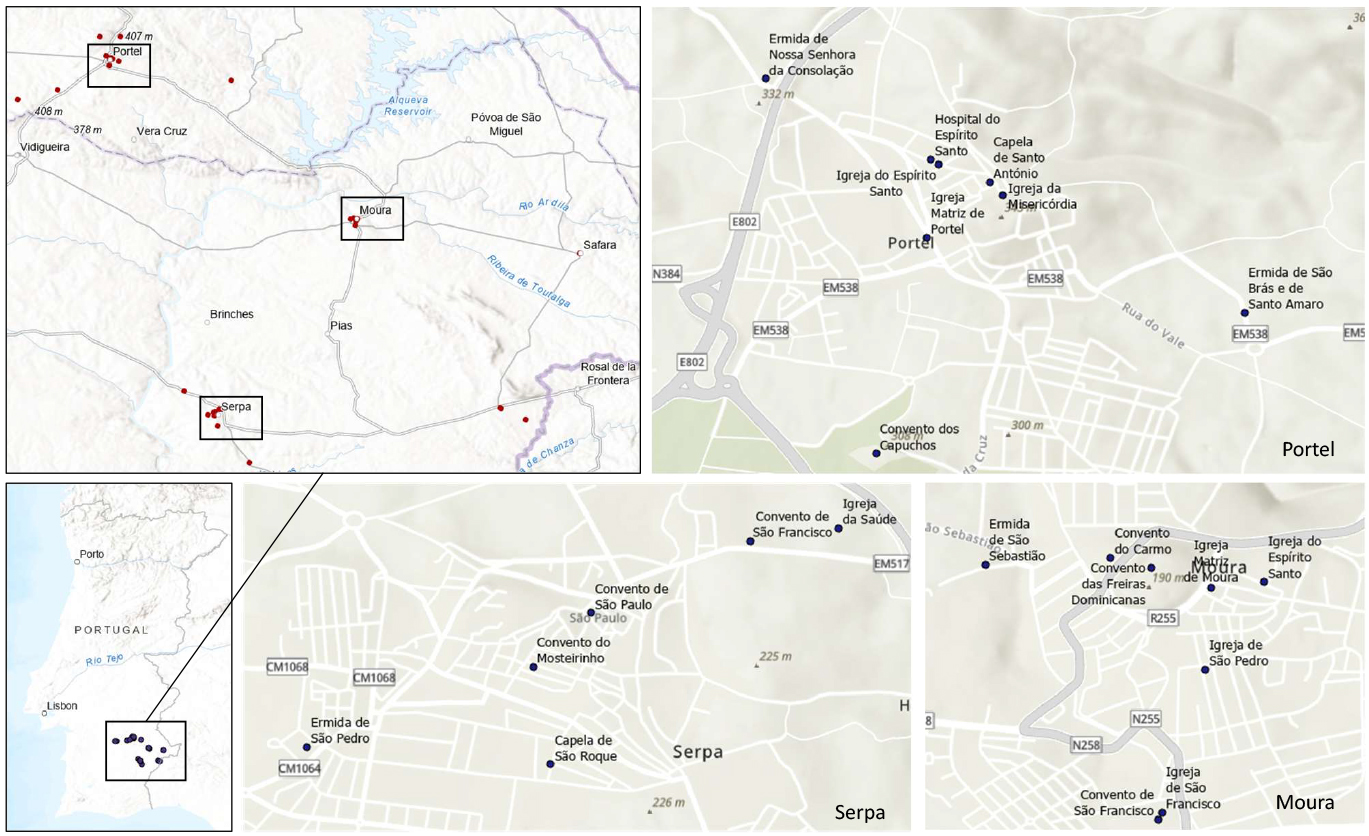
In Alentejo, 36 religious Christian buildings were surveyed, mainly located in Alvito, Amieira, Moura, Portel, Safara, Santana, Serpa, and Vila Verde de Ficalho (Figure 2). These are part of a sample of 113, including an additional 77 residential buildings that share constructive techniques, materials and geometries of the vaults.
Authors, 2024
Figure 2 Location of the vernacular religious buildings with vaults in the Baixo Alentejo region
The carried-out analysis revealed the existence of similarities between these two categories, when buildings are settled nearby. Also, a parallelism could be established related to the building (both erudite or popular) and the complexity of vaults’ geometries: manor houses and churches tend to have composed geometries and higher height and area, tridimensional and constructively more complex, while common houses and chapels might have simple volumetries and smaller dimensions. In this sense, for this paper, a deeper study of the religious constructions was set to identify geographical tendencies and similarities.
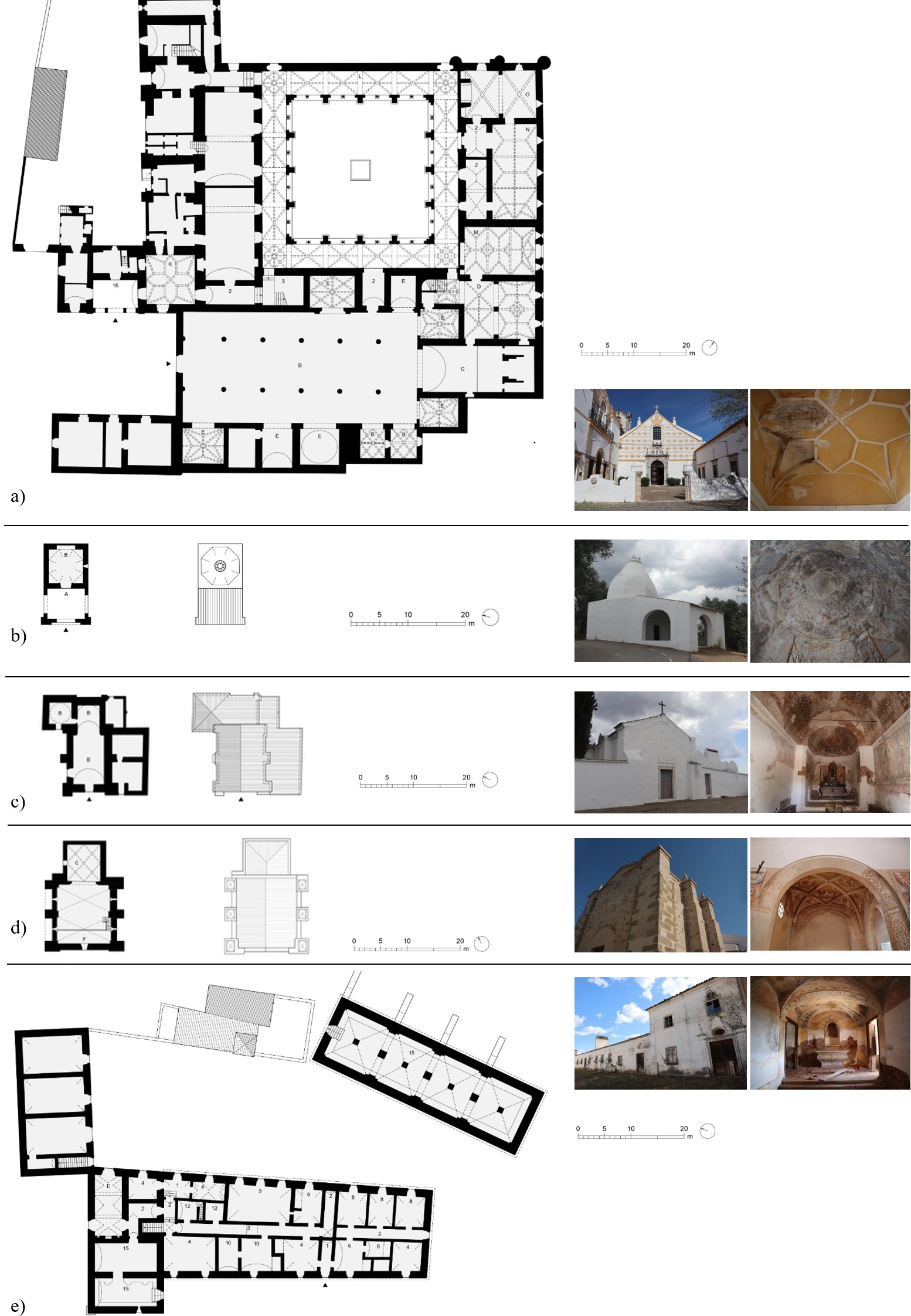
Religious buildings were organised into five categories: convents, churches, chapels, house chapels, and hospitals. Convento do Carmo is one of the oldest, built in the periphery of Moura urban core (Matos, 2008). Although the first stone dates back to 1251, the standing buildings result from the 16th century renovations. The construction was promoted by the Military Order of São João de Jerusalém, and it is classified as Property of Public Interest. It is composed of a church and the conventual dependencies organized around a cloister, most of them abandoned and in a bad state of conservation. The dependencies have a variety and complexity of geometries of vaults built with bricks, such as lowered barrel, groin, rib, sail and reticulated, with some vaults with corbels and keystone carved in stone, finishing the bricks elements (Figure 3a). In the convent's category, Convento de São Francisco, in Serpa, was built in 1463, promoted by Infant D. Fernando, Duke of Viseu. This religious complex is composed of a church next to the convent rooms organized around a cloister. It is classified as a National Monument and was adapted to a nursing home of Santa Casa da Misericórdia de Serpa. The rooms have different and complex geometries of brick vaults such as barrel, groin, rib, domical and lunette, with some vaults with corbels and keystone carved in stone, complemented by bricks. The variety of vaults’ geometries typologies, constructive details and materials testify to the erudite character of these two convents. The 16th century convents complex Convento das Freiras Dominicanas, in Moura, and Convento dos Capuchos, in Portel, and the 17th century Convento de São Paulo, in Serpa, are other examples with a complex set of rooms built with an erudite type of construction. On the other hand, the 16th century Convento do Mosteirinho, in Serpa, nowadays converted into the Museum of Clock, presents groin and rib vaults with low height.
Ermidas (rural vaulted chapels, located in the surroundings of towns) are related to pilgrimage, transhumance and cattle blessing ceremonies. They stand out by their simple composition usually with a single nave, chancel and sacristy. The set can be complemented by a narthex, side chapels, niches, pulpit, bell tower and cross landmark. The 16th century ermidas of Santa Luzia, in Alvito (Figure 3b), and São Brás (Figure 3c) in Portel, are examples with a popular character expressed in the dome and barrel vaults that cover the nave, decorated by frescoes paintings and the exterior whitewashed façades and domes’ extrados. Others are located in Portel surroundings, from 17th century - composed by the ermidas of Nossa Senhora da Serra, São Pedro and Nossa Senhora da Consolação -, in Serpa surroundings, from 16th century - the ermidas of Santana, São Pedro, Nossa Senhora de Guadalupe, Santa Iria and, in Vila Verde de Ficalho surroundings, Nossa Senhora das Pazes. Two exceptions of chapels are located in an urban context, one stands due to an erudite drawing with a high-height dome and rich decoration with frescos and tiles, the chapel of Santo António built in the 16th century, in Portel, and the other one, with popular features, the chapel of São Roque, in Serpa, with a low-height ribbed vaulted chancel. A particular type of rural vaulted chapel is integrated in farmhouses. Although they are private, they are used to celebrate public ceremonies. The residential chapel of Monte da Balsa, in Santana, with groin vaults decorated with frescos, is an example (Figure 3e).
The vaulted churches located in urban centers, mainly in Moura, Portel and Serpa, tend to have an erudite character expressed in the variety of complex geometries such as groin, rib and domical vaults and domes, in addition to the barrel vaults, covering naves, aisles and chancels, with corbels, keystones and lunettes, and surfaces with decorative motifs and frescoes paintings. The main churches (“Igreja Matriz”) of Alvito, Moura, Portel, Safara, Santana, Vila Verde de Ficalho and the churches of São Francisco de Moura, Espírito Santo de Moura (Figure 3d), São Pedro de Moura, Misericórdia de Portel, Espírito Santo de Portel and Saúde de Serpa, are included in this set, dated between the 15th and 18th centuries.
Over the centuries, religious buildings have been centres of knowledge creation and laboratories of application of this know-how. Beyond spiritual values, religious heritage carries technological values which, once studied, could be the trigger for territorial sustainable development. Constructive techniques and, specifically, vaulted systems are just one example of these creative and cultural hubs. The understanding of the vaulted systems, within religious heritage, could promote the understanding of the motion of knowledge over time and the way it is transferred to less erudite buildings (including also parish churches and chapels).
3. Formal tendencies of the vaulted religious buildings
The erudite and popular religious buildings carry material and immaterial values related to traditional craftsmanship and built knowledge. For a better grasp of the influences between these socio-cultural contexts, a cross lecture based on attributes of collected data was performed concerning the following parameters, handled into a GIS environment: location, vaults’ types, vaults’ details and the genesis of the context. The 36 religious buildings surveyed in the Alentejo region are distributed in the following categories: 16 chapels, 12 churches, 6 convents, 1 hospital and 1 farmhouse chapel. From the 36 cases, 10 are located in Portel, 8 in Moura, 2 in Alvito, 9 in Serpa, 3 in Vila Verde de Ficalho, 2 in Santana, 1 in Safara, and 1 in Amieira. In terms of the nature of construction, 19 can be attributed to an erudite context and 17 to a more popular one, while 25 have public access and 11 private access.
The amount of vaulted systems within a specific building ranges from one, in the small-sized and rural chapels (e.g., Ermidas de Santa Luzia in Alvito or São Pedro in Portel), to around 20 in the conventual complexes (e.g., Convento do Carmo in Moura or Convento dos Capuchos in Portel).
In terms of the vaults’ variety, conventual complexes have a diversified range, with 5 different typologies. Indeed, interior areas of Convento do Carmo de Moura are covered by lowered barrel, groin, ribs, sail and reticulated vaults. Moreover, Convento de São Francisco in Serpa is covered by barrel, groin, ribs, domical and lunette vaults. Regarding vault materials, all the case studies are constructed with bricks with a lime or plaster-based mortar by processes that do not require the use of centering. The internal coating is in ⅓ of the cases plastered and whitewashed (sometimes with decorative stucco), or mainly, in ⅔ of the cases, plastered and painted with decorative motifs.
To understand the built tendencies and the spatial distribution of the surveyed vaults and their characteristics, a clustering analysis has been done using ArcGIS Pro software (ESRI, Portugal). This technique is used to group similar data points or objects into clusters. The primary objective of clustering is to divide a dataset into distinct subsets or "clusters," ensuring that the data points within each cluster are more similar to one another than to those in other clusters. The K-means clustering method was selected to split the dataset into a predefined number of clusters, by minimizing the variance within clusters (Wang and Wang, 2016).
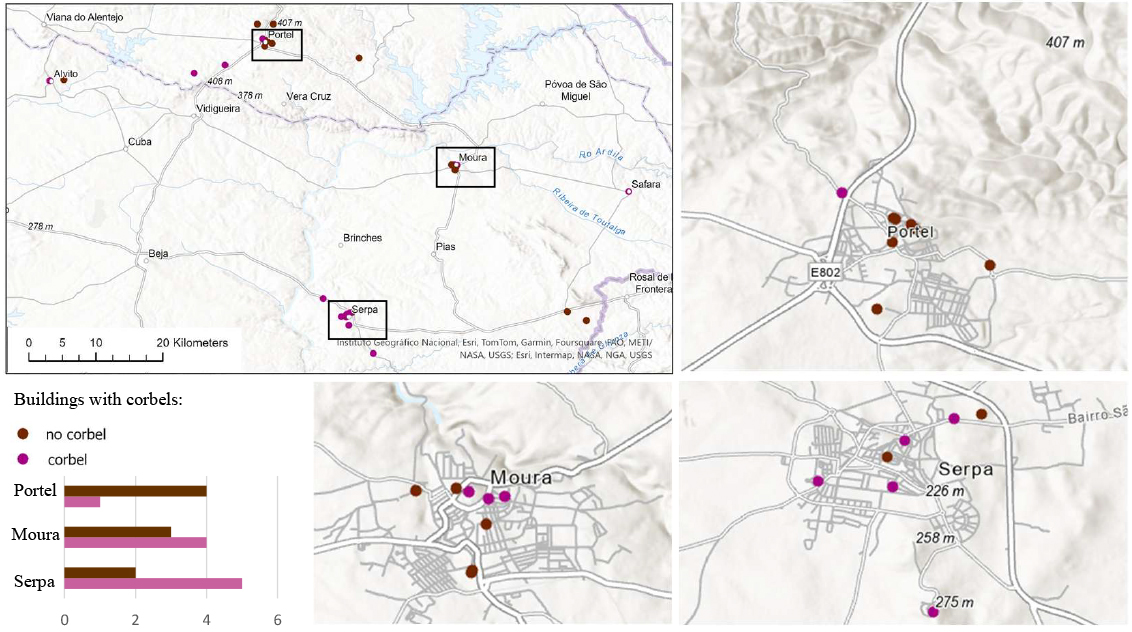
One aspect that characterizes a more complex building technique, and thus an erudite source of knowledge, is the use of stone structural elements in the brick vaults. Usually these elements, like the corbels and sometimes keystones, are carved with decorative motifs, such as geometrics, naturalists or zoomorphics. Its presence is related to the rib vaults, and it is more frequent if we travel south, mainly in Serpa, in the popular chapels (ermidas) that date back to the 16th century. This fact can be related to the presence of noble families and manor houses in Serpa - particularly the Ficalho Palace, house of the counts and marquises of Ficalho - but also to the strategic location of Serpa on the way between Lisbon and the Spanish town of Seville (Figure 4).
Authors, 2024
Figure 4 Spatial distribution of religious buildings with brick vaults composed of stone structural elements (i.e. corbels)
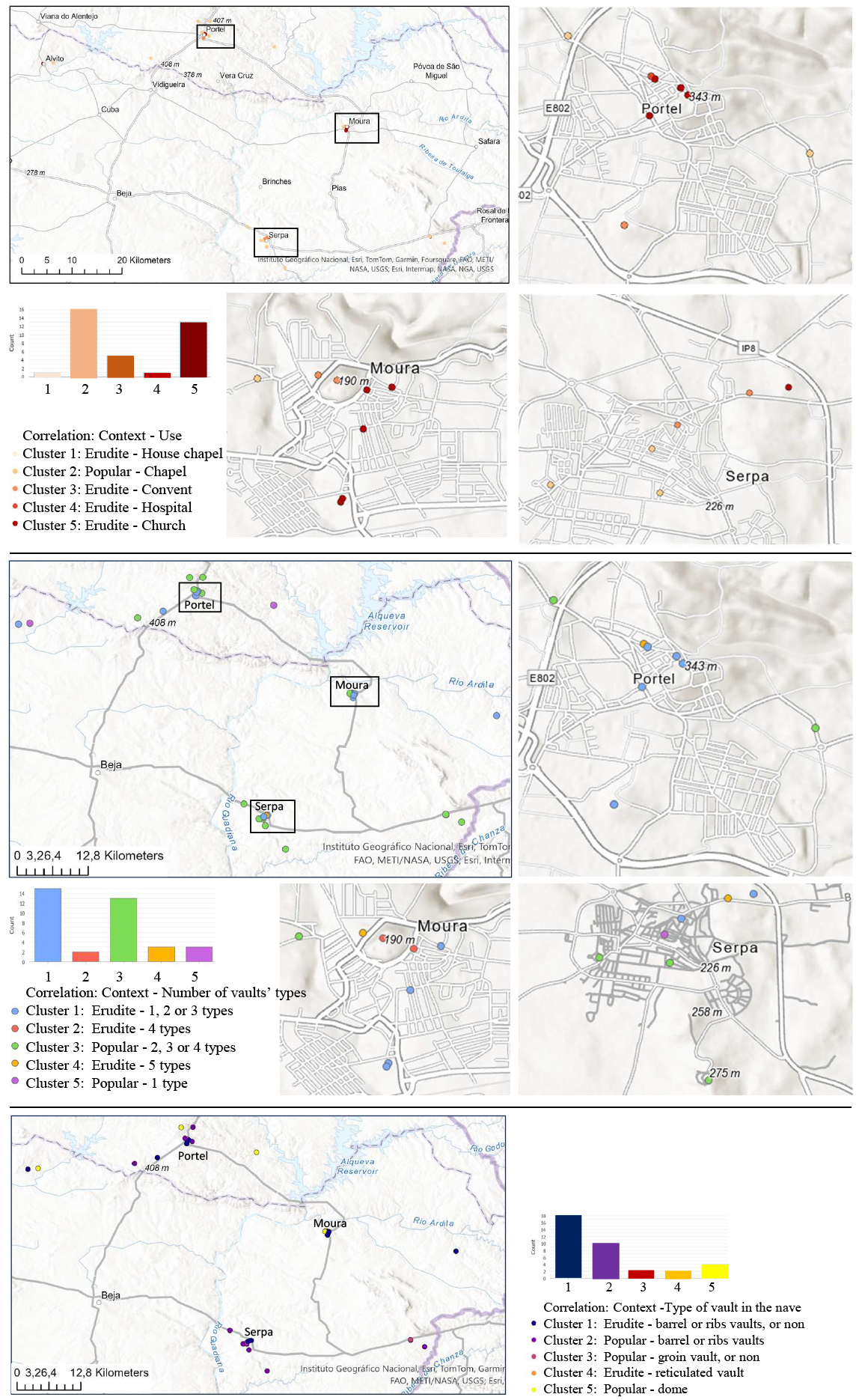
The richness of the vaults’ constructive techniques is present in the different types and geometries of vaults that cover different rooms of the religious buildings, according to their use, scale, socio-cultural context and territorial location. When analysing the correlation between the use of the religious buildings with their building context, i.e., whether they serve as chapel, church, convent or farmhouse chapel, and split between a more erudite or popular socio-cultural context, we observe the prevalence of vaulted churches, convents and hospitals with erudite context towards the north, in Portel and Moura areas. In the south, in the Serpa region, popular chapels are dominant in the town, although, in general, popular chapels are settled in the peripheries (Figure 5a), which is in line with the results of the analysis of the distribution of religious brick vaults with stone elements (Figure 4).
As the vault is a system to cover individual rooms, different types of vaults can be found in just a single building, with a higher number of rooms tending to correspond to a higher number of types, usually with more complex geometries (Figure 5b). This fact is verified regardless of location (urban, peripheral or rural). Two particular groups stand out when examining the correlation between building use and the number of vault types: the popular building with just one type, particularly in the north, in a rural area and isolated (cluster 5 of Figure 5b), and the erudite building with 4 or five different types located in town (clusters 2 and 4 of Figure 5b). Paying attention to the nave, the main space in a religious building that is usually vaulted, and analysing the spatial distribution of the correlation between the socio-cultural context and the type of vault in this space (Figure 5c) we see that both erudite and popular contexts present barrel and rib vaults to cover the liturgical space. In fact, the technique, in terms of type of vaults, is the same, although there is a difference in height and span dimensions of the vaults: nave vaults in popular buildings tend to have lower spans and heights, opposite to the erudite ones. The main finding when analysing this correlation is the dome type covering the main liturgical space found more to the north, in the Portel area, where popular chapels are settled in rural areas.
All these data, once collected, analysed and made available, can be used for research purposes (among scholars from various geographical and scientific areas) but also to enhance the buildings (and, consequently, the territory) through the newly acquired knowledge and the following sharing among a non-academic public for a more conscious enjoyment of a possible local tourism product, towards a universal access to religious complex heritage sites (Volzone et al., 2022).
4. Thematic itineraries as a way to promote vaulted religious buildings - The Moura case study
Thematic itineraries play an increasingly important role in cultural preservation and tourism, promoting the understanding of cultural heritage by visitors and the local community. Europe boasts a diverse array of cultural tourism itineraries. Through the promotion of these itineraries, the European Commission seeks to foster awareness of a new approach to tourism - one that respects the environment, preserves natural and cultural heritage, and honours local traditions (European Commission, 2022).
The Council of Europe recognizes religious heritage as a significant component of Europe's cultural legacy, encompassing both tangible and intangible elements, with more than 500,000 buildings - including churches, chapels, synagogues, mosques, cathedrals, monasteries and convents (Council of Europe, n.d.). Religious heritage sites are incorporated into thematic itineraries, and they appeal to diverse audiences, including pilgrims, history enthusiasts, and casual tourists: Via Francigena, Saint Martin of Tours, The Al-Andalus Route, The Saint James’ Ways, Transromanica, St. Olav Ways are just some examples. Such initiatives underline the importance of sustainable tourism practices, emphasizing the value of cultural exchange and preservation as highlighted by Smith (2009) and Richards (2018).
These strategies can go against the paradigmatic conversion of religious heritage sites into hotel units, thus impoverishing the possibilities of turning them into heritage cultural and tourism attractions accessible to visitors and residents alike (Volzone et al., 2022), promoting a better understanding and sustainable management of cultural heritage, when cultural itineraries are organized around heritage values (Bogacz-Wojtanowska and Góral, 2018), and based on the coordinated relationship with the historical, environmental and social context. Cultural heritage itineraries can be a response to the need to protect and preserve both tangible and intangible components of religious heritage, and a good practice for a sustainable regeneration or development of rural and small settlements (UNESCO, Meishan, Republic of China, 2019) for the present and the future: urban regeneration, economic growth and cultural development are all linked.
Linking vaulted systems to religious heritage within thematic itineraries can drive economic development while fostering local community engagement. Within the Vaulted South geographical scope, the municipality of Moura, in Baixo Alentejo, provides some of the most exemplary case studies of vaulted buildings with a variety of uses, ranging from housing, commercial, administrative, cultural to religious. Moura is located in an urban settlement on the left bank of the Guadiana River, called “Além-Guadiana”, a natural feature that otherwise marks the century-old border between Portugal and Spain, and was a highly contested territory during the centuries of Christian Reconquista and the formation of the Portuguese state and Restoration War (1640-1668). From the socio-economic point of view, the population density is gradually decreasing, due to the urban migration and an aging population (a typical phenomenon of the hinterland of Portugal). The economic development of Moura is predominantly centred around agriculture, agro-industry, and renewable energy sectors, needing economic diversification. Cultural heritage, in this geographical area, represents a challenge (mostly for its management) and an opportunity to regenerate the buildings, but also the traditional know-how and constructive techniques at risk of disappearing, and the whole territory.
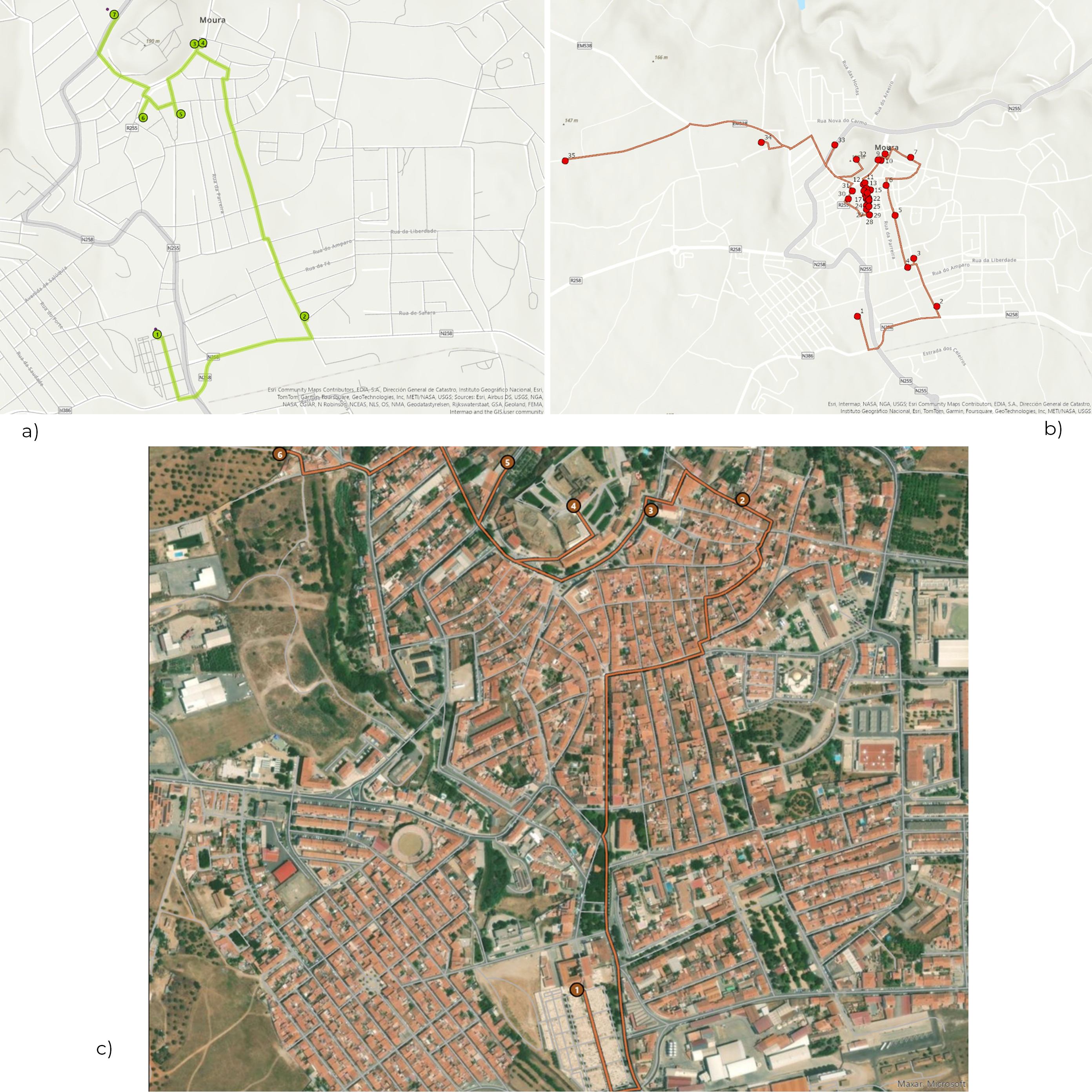
In the scope of a public presentation of [omitted for anonymity], it was understood that one of the ways to promote and disseminate built vaulted heritage knowledge would be through the proposal of thematic itineraries. Thanks to the support of GIS tools to define itineraries for the promotion of architectural knowledge (De Fino et al., 2022), and Web-GIS itineraries to fight over tourism in tourist attractions (Fauzi et al., 2022), a religious vaults itinerary of Moura has been developed (both in the urban and peri-urban area), including the eight identified ones: three convents (Convento do Carmo, Convento de São Francisco, Convento das Freiras Dominicanas), four churches (Igreja Matriz de Moura, Igreja de São Francisco, Igreja do Espírito Santo, and Igreja de São Pedro), and one chapel (Ermida de São Sebastião).
From the technical point of view, in its development, the road network database was provided by Moura municipality, and this itinerary was generated using the Network Analyst module, from ESRI ArcGIS Pro software, considering the Dijkstra algorithm and the Euclidean distance as a cost function. For that purpose, five spatial operations have been carried out. First, a road network topology has been developed, by adding nodes at the intersections and connections to define the layout of the road axis network. Second, features, geometric and non-geometric characteristics of churches, chapels and convents have been selected from the OMEKA database, concerning the Moura city centre. These have been converted into a point shapefile format, by displaying the features by coordinates. Third, graph-based representation, on which roads are edges and points are nodes, has been generated. Fourth, distances as cost function to each edge have been allocated. Finally, the least-cost path Dijkstra algorithm has been applied to generate the optimal itinerary.
The distance of the generated itinerary is 2,503 m, with 8 stops corresponding to the identified religious buildings. With the same workflow, other itineraries have been generated: i) Moura’s vaults itinerary, that include all the buildings in Moura city, in a total distance of 3,260 m, with 35 stops. Informative bullets detail building uses; ii) Vaults’ typologies itinerary, to enhance the discovery of the variety of vaults’ types and geometries by visiting buildings with more than three different types of vaults along 2,254 m, with 8 stops; iii) Most vaulted buildings’ itinerary, promoting a short visit to buildings with more than 10 vaults, with a distance of 1,450 m (Figure 6). These are just a few examples of this methodology’s potential which, in the future, hopes to develop in a Do It Yourself (DIY) way, so that, based on specific parameters and variables, the visitors themselves can generate new itineraries on their own.
5. Conclusions
This paper focuses on the study of vernacular vaulted ceilings and floors inside religious buildings such as churches, chapels and convents, located in Baixo Alentejo, showing a rich variety of geometric types, constructive systems and finishing decorations, identified during the Vaulted South Project.
Religious buildings and the corresponding types of vaults and geometries, use, scale, socio-cultural context and location have been characterized in order to investigate the possible correlations between parameters and territorial distribution, using statistical analysis. Findings allowed us to correlate the socio-cultural context of the buildings with their location, more to the north or south, more urban or rural, and the types of uses and scale, from chapels to churches and convents or hospitals. In general, popular chapels are settled in the periphery of towns or isolated in the rural areas. Conversely, vaulted churches with erudite socio-cultural context, with complex programmatic use, like convents and hospitals, prevail in towns. Another trend identified in the area of Portel is the presence of popular chapels with a dome, settled in rural areas, related to pilgrimage and cattle blessing ceremonies.
The hypothesis of an erudite building working as an influencer and a promoter of a certain level of erudition and complexity in terms of construction technique has been proved, particularly in the town of Serpa, with the Ficalho Palace and the Convento de São Francisco and a set of satellite chapels in which the use of stone carved elements to compose the brick vaults is frequent.
Addressing the current use of vaulted buildings and their constructive and geometrical richness, the town of Moura was selected to carry out a study and analysis on GIS environment to generate thematic itineraries, like the one that goes by all vaulted buildings, an alternative one with selected buildings with more types of vaults, or the one circumscribed to religious buildings. These materials supported the development of graphical elements to promote a coeval reading, understanding and visit.
This study highlights challenges related to geospatial data interoperability. Limitations and opportunities in the integration of data between OMEKA and ArcGIS emerged, as well as the handling and correlating metadata parameters. Moreover, the lack of robust topological base networks (such as road networks) across the case studies in Alentejo presented another challenge, hindering the chance to broaden this approach to other municipalities and to a regional scale.
By establishing a solid topological base, this research lays the foundations for a "Do It Yourself itinerary" approach in the future. In doing so, individuals (including also locals) are invited to create customized journeys, by providing travellers with tools and maps to chart paths, based on their own interests. This approximation to the vaulted system can generate a sense of belonging and pride, and foster awareness of these neglected components, inspiring the correct maintenance and protection of this heritage. Indeed, while physical structures are at risk, so is the constructive technique itself, due to the lack of intergenerational learning. Religious built heritage, in particular the vaulted one, carries material and immaterial values related to traditional craftsmanship, knowledge transmission and religious practices and it has the potential to be enjoyed by local people and visitors.
These results promoted a deeper knowledge about vaulted buildings and the creation, transfer and discussion of their potential knowledge and values. They intended to reflect about the way these studies can contribute to emphasize the relevance of traditional constructive techniques for local stakeholders and heritage strategies facing restoration, rehabilitation and reuse challenges. At the same time, to promote their understanding, dissemination and exploration among general public and academic audiences.
Future studies will consider the application of this methodology to larger areas, extending the case studies typologies beyond religious ones.

