




 Inglês (pdf)
 Artigo em XML
 Referências do artigo
 Tradução automática
 Enviar este artigo por email
 Citado por SciELO
  Similares em
SciELO
Similares em
SciELO 
 Permalink

1. Introduction
The urgency of environmental issues and the need for sustainable practices are themes that are increasingly present in all spheres of society, including higher education. The University, by raising students' awareness of these issues, will contribute to forming citizens committed to sustainability, preparing them to face global challenges. In the field of design and arts in general, this responsibility can acquire a practical and creative dimension, challenging students to rethink and transform materials and production processes, adopting more conscious and sustainable practices.
As part of the Erasmus+ Blended Intensive Program (BIP), under the theme "The Unequal City", a chalcography workshop was held during the 2023/2024 academic year at the Escola d'Art i Superior de Disseny de Castelló (EASD), with the collaboration of the Instituto Superior Miguel Torga, from Coimbra, and the Accademia di Belle Arti di Catania, brought together students and teachers from Portugal, Spain and Italy. The workshop aimed to explore sustainable printmaking techniques promoting the creative reuse of waste, such as Tetra Pak packaging.
Methodologically, this article adopts a qualitative approach, focusing on the analysis of the workshop as a case study. It describes the practical steps - from the preparation of Tetra Pak matrices to printing using the drypoint technique - and analyses the educational and artistic impact of the experience. The Tetra Pak matrix engraving technique represents a practical solution for transforming waste into creative resources, encouraging students to adopt practices that contribute to waste reduction and sustainable innovation. By integrating the printing technique with environmental concerns, the study aligns with the Sustainable Development Goals (SDGs), in particular with SDG 12 (Sustainable Consumption and Production) and SDG 13 (Climate Action).
Furthermore, this study highlights the importance of pedagogical methodologies that integrate design education with sustainability principles, broadening students' perspectives and preparing them to become agents of change in their professional fields. By promoting approaches aligned with circular economy principles and sustainable development, universities establish themselves as key drivers of social transformation (Barth et al., 2007; König & Evans, 2013).
2. Theoretical Framework
2.1. The Role of Universities in Building a Socially Responsible World
Universities play a central role in educating responsible citizens who are aware of contemporary global challenges. Beyond transmitting knowledge, they contribute to fostering ethical, social, and environmental values, actively preparing students to participate in the construction of a more equitable and sustainable society. According toShek and Hollister (2017), University Social Responsibility (USR) encompasses various missions, from community engagement to the promotion of inclusive and ethical practices that enhance public well-being. These initiatives also extend to environmental sustainability, aiming to reduce ecological impact and support sustainable development.
The Bologna Process significantly reshaped higher education, reinforcing universities' role in addressing societal needs. As highlighted byVasilescu et al. (2010), European universities are now committed to fostering civic engagement, preparing students to tackle pressing issues such as climate change, environmental protection, and global inequalities. The Talloires Declaration (1990) further reinforces the responsibility of universities in reversing harmful environmental and social trends, emphasizing their transformative potential.
Incorporating sustainability principles into design education is crucial for developing critical and socially engaged professionals. According toBarth et al. (2007), higher education institutions should integrate experiential and interdisciplinary learning methodologies to create a more comprehensive educational approach. Similarly,König and Evans (2013) propose “living laboratories” as a model for innovative pedagogy, where university spaces serve as hubs for sustainability experiments. These initiatives bridge theory and practice, encouraging students to engage in real-world environmental challenges.
International academic collaborations, such as Erasmus+ programs, play a key role in expanding students’ global awareness and intercultural competencies. As noted byEvans et al. (2015), collaborative projects and mobility experiences expose students to diverse perspectives on sustainability, reinforcing their role as proactive agents of change. By embracing interdisciplinary and participatory educational models, universities strengthen their impact as catalysts for a more sustainable future.
2.2. From disposal to regeneration
The mounting evidence of climate change, resource competition, and increasing environmental awareness highlights the unsustainability of the prevailing linear production and consumption model, which is based on extraction, production, and disposal. While this model has historically driven economic growth, it has also led to excessive raw material extraction, low recycling rates, and significant environmental impacts, including greenhouse gas emissions and biodiversity loss (Riesener et al., 2023).
The circular economy offers a transformative alternative by reintegrating resources into the production cycle, minimizing waste, and reducing dependence on new raw materials. Through reuse, recycling, and regenerative design, it seeks to extend product lifecycles, decoupling economic growth from resource depletion and environmental degradation (Geissdoerfer et al., 2017).
In March 2022, the European Commission proposed ecodesign regulations, embedding sustainability principles into product development to optimize resource use and mitigate environmental impact (European Commission, 2024). As 80% of a product’s environmental footprint is determined during the design phase, incorporating durability, reparability, and efficiency into design education is crucial to preparing professionals who align with circular economy principles (European Parliamentary Research Service, 2024). Design and education serve as key catalysts in fostering sustainability, embedding sustainable values from training to societal integration. Practical activities, ecological design projects, and case studies enable students to understand the impact of their consumption choices and appreciate sustainable solutions.
A core principle of the circular economy is keeping products and materials in circulation, preventing their disposal after use. According to the Ellen MacArthur Foundation (2017), circular design promotes "eco-effectiveness" by transforming waste into new products, reducing reliance on natural resources. Key approaches include upcycling (enhancing waste value), downcycling (reprocessing materials into lower-value products), and both closed-loop and open-loop recycling. The circular economy is a major driver of the transition to sustainable production, improving resource efficiency and waste reduction. This approach aligns with the Sustainable Development Goals, particularly SDG 12, which advocates responsible consumption and production.
Growing concern over the environmental impact of packaging has spurred innovative approaches to material reuse. The design sector plays a critical role in this transformation, promoting initiatives that merge sustainability with innovation. Examples include artistic projects using recycled packaging and collaborations between designers and companies to create furniture and objects from waste materials (Tetra Pak, 2023).
2.2.1 Ecal and Tetra Pak packaging - collecting and recycling
Cardboard Packaging for Food (ECAL), which includes aseptic packaging in Tetra Pak, is produced with several layers: 75% duplex paper (long fibre) that provides support and allows printing on the packaging, 20% plastic (polyethylene of low-density) which protects the moisture content and 5% aluminium which preserves the flavour and nutritional values of the food contained inside, protecting them from external agents, such as oxygen and light, prolonging storage time and reducing the need for refrigeration, Karaboyaci et al (2017). Once its function as a container is exhausted, the Tetra Pak becomes waste.
The composition of these packaging, with 3 different materials, made recycling them a complex process. Some paper mills have adapted methods to extract and recover paper fibers from packaging, through a high consistency disintegration process, discarding plastic and aluminium (which resulted in a new polymer-aluminium product, or Poly-Al, which needed to be sent to other institutions for reuse).
Tetra Pak has worked to achieve solutions that meet the objectives of the Global Biodiversity Framework and the Sustainable Development Goals (SDGs), recognizing the urgency of protecting the environment and the importance of recycling and reuse. Therefore, in 2023 they implemented quantitative objectives, which meet 4 pillars: upstream, downstream, operations and transformation. Tetra Pak has committed to achieving 70% packaging recycling, with the ambition of achieving 90% packaging collection and recycling by 2030.
Regarding the material coming from selective collection, according to Agência Portuguesa do Ambiente (2023), only 11% represents composite materials, such as ECAL of which Tetra Pak packaging is a part. In 2023, Portugal recorded 10,800 tons of cardboard packaging for drinks, collected for recycling. This is an increase of 3,5% compared to 2022. According to Directive (EU) 2018/852, of the European Parliament and of the Council, by December 31, 2025, at least 65% of all packaging waste must be recycled by weight, increasing to 70% by December 31, 2030. The success of this Directive will depend on education and involvement of the population, both in the selective collection of products to be recycled and in waste prevention, to raise awareness for a better and more sustainable future.
3. Methodology
The BIP was structured in two complementary phases: an online phase, focused on theoretical reflection and the construction of concepts, and an in-person phase, dedicated to practical experimentation.
The online phase followed a project-based design approach, which encouraged students to reflect on the issues affecting contemporary cities, in particular urban sustainability, responsible consumption and the role of design in this process. Various projects were presented that implemented sustainable solutions, with special emphasis on recycling initiatives, the reuse of materials and sustainable design, exploring innovative ways of reducing the environmental impact in urban areas. Based on these reflections, the students had the opportunity to develop their own concept of the city, through the creation of visual concepts and graphic narratives, accompanied by a critical reflection on how cities can become more sustainable, inclusive and resilient.
The in-person component continued the reflections developed in the online phase, providing a practical workshop on material exploration using the dry point engraving technique on Tetra Pak matrices. This approach allowed the students to reinterpret the concepts of sustainability and responsible consumption, testing the creative reuse of materials as a design strategy. The exercise challenged participants to rethink the life cycle of products and graphic production processes, reinforcing the link between design, alternative materials and environmental impact.
The methodological approach adopted makes it possible to understand how the articulation between theory and practice in design teaching can sensitise students to more sustainable strategies applicable to the urban context, encouraging critical reflection on creative reuse and responsible production processes.
4. Case Study: Printmaking with Tetra Pak
4.1. Workshop structure and activities
In the in-person phase, as a first step, the students were presented with various possibilities for upcycling with Tetra Pak, demonstrating its potential beyond engraving, including sustainable applications in the urban context. This framework encouraged a more reflective approach to the creative reuse of waste and its integration into sustainable practices in both design and the urban environment.
With this framework, the workshop challenged students to explore alternative chalcography printing methods. The workshop’s main objective was to raise awareness about the importance of sustainability in both artistic and design production processes. The focus was particularly directed towards the drypoint engraving technique using Tetra Pak as a matrix. This material, due to its characteristics and the difficulty of being recycled, is ideal for reuse processes, reflecting the commitment to sustainable reuse practices.
The use of Tetra Pak as a matrix, with non-toxic process, inks and chalcography technique, was created by María Angélica Mirauda, in 2006, in her project Grabado Verde (Pohlmann & Tavares, 2021), allowing us to consider the potentiality of unusual materials to regain a new purpose before being discarded or recycled. Also, Zahrawaan (2022) states that Tetra Pak printing adds value in the ecological mission by reusing materials from daily consumption products, that can be easily adapted as an educational medium, safer for young participants, non-toxic, practical and more economical.
The idea of using waste, recycling it and using it as a functional printing matrix was exciting for the students in the BIP laboratory. This activity was designed to stimulate participants' creativity while allowing them to experiment with techniques that could be integrated into reproducible design works. The practice also made it possible to encourage reflections on the intersection between printmaking, design, art and sustainable production methods, highlighting the potential of small-scale printed editions as a tool for both artistic expression and responsible design practices, as this technique allows the creation of limited editions (between 10 to 20 copies), reinforcing the connection between experimental printmaking and sustainable production methods in design.
In addition to its value as a graphic exercise, the use of Tetra Pak in the workshop encouraged a broader reflection on the reuse of materials and their integration into sustainable practices. The experience demonstrated how waste can be transformed into new visual and functional resources, promoting design thinking that values reuse and sustainability in design.
4.1.1. Workshop Process
Once Tetra Pak cartons have been emptied and cleaned, they can be opened, cut into the desired shape to create the plate and the silvery inner side composed of aluminium and polyethylene easily incised with a steel burin, Fig.1. Students transfer the created drawing to the Tetra Pak matrix, with a decal sheet, to facilitate the engraving process, Fig. 2.
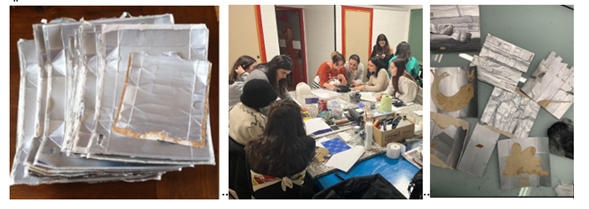
Figs. 1, 2 and 3. Opened Tetra Pak packages, ready to use. Drawing on decal sheet to transfer to Tetra Pak matrix. Engraved matrices in drypoint technique.
A material that is simple for the novice to engrave, Tetra Pak provides an ideal way of approaching the use of direct techniques of intaglio. In this case the drypoint technique was selected. This takes its name from the tool used to engrave the plate, a shaft of tempered steel with a very sharp point and a conical shape that allows the creation of lines without the aid of acid or a chemical mordant, making the printing non-toxic and ecofriendly. The tool is used as if it were a pencil, scratching the surface of the plate and creating furrows in it, Fig. 3. In the same way as a plough digs into the ground, it is moved with varying pressure over the plate, cutting a groove and making sure that the plate forms ‘burrs’, i.e. lines of metal shavings that are detectable by tact. In the printing phase the ink is held in the groove, leaving a blurred and velvety line on the paper that is characteristic of this technique.
Naturally a soft material such as Tetra Pack requires less effort to cut into, making it possible to obtain a freer and more fluent line, exploring forms of registration. Being such a fragile material, it results in lines getting rapidly deformed and squashed under the pressure of the press, the printing stage requires particular attention during the process of inking and impressing and does not allow the production of long runs.
For the printing we used traditional intaglio inks, applied cold (without the use of a hot plate, as is normally done when working with metal matrices) and adopting a smoother and more fluid ink. The ink was spread on the plates with a spatula made of soft polyurethane rubber so as not to damage the engraved surface, Fig. 4 and 5.
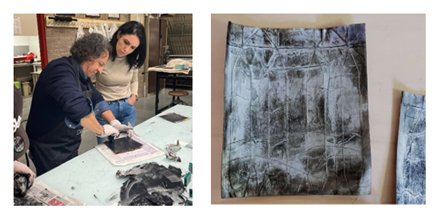
Once this was done, a tarlatan rag (made of heavily starched cheesecloth) was used to begin removing the ink delicately, until the engraved lines could be seen. The cleaning was then completed with tissue paper.
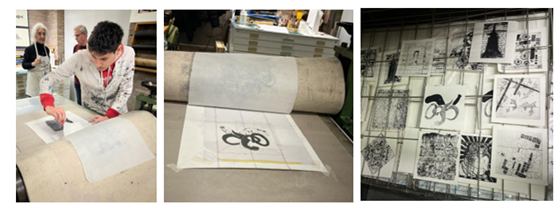
At the conclusion of this procedure, the Tetra Pak plates were ready for printing. Once the type of paper and size of the sheet to be used for printing had been established and it had been dampened to give it the right degree of humidity and make it soft, it was time to run it through the printing press, Fig. 6 and 7.
5. Results
For the students who took part in this project, the technical process of chalcography printing with Tetra Pak plates did not have the sole objective of creating an art print on a particular theme. Rather, it served as a platform for both artistic and design experimentation, emphasizing the potential of reproducible printmaking techniques in sustainable design. This project provided an opportunity for artistic and technical experimentation while also highlighting aspects connected with environmental sustainability and material innovation. It encouraged students to explore alternative substrates for print production, broadening their perspective on material choices in both artistic and design contexts, Fig. 8.
The positive impact of upcycling lies in reducing immediate waste and raising awareness of alternatives that challenge traditional practices. Tetra Pak is transformed from beverage containers, to engraving matrices, and after its use, to being recycled. By repurposing a commonly discarded material, the project reinforced the value of circular design approaches, where materials are given extended life cycles beyond their intended use. It is a vision that not only transforms waste into creative resources but also integrates sustainability into design methodologies, encouraging more responsible material selection in future projects.
The works produced during the workshop not only promoted Tetra Pak as an artistic material, it became the medium and support in which a thought and an artistic concept were expressed, but also demonstrated its potential for small-scale print editions, reinforcing the relevance of sustainable practices in contemporary design.
Although not measurable, the collaboration between the three universities increased the diversity of experiences due to the students coming from different areas (arts and design). While some participants developed works of a more artistic nature, exploring the expressiveness of the technique, others adopted a more project-oriented approach, oriented towards the structuring and functionality of the design. This complementarity resulted in compositions that reflected both the graphic freedom provided by the medium and a more structured thinking about the application and impact of the reused material. The phased structure of the workshop minimised technical and methodological difficulties, guaranteeing a progressive workflow. The biggest challenge encountered was communication, since English was the common language among the participants, which required greater attention when sharing ideas and instructions.
6. Conclusion
Waste production has become one of today's biggest environmental concerns. As consumption increases, so does waste production, affecting cities worldwide. Tetra Pak material has been widely reused in sustainable practices, promoting upcycling (creative reuse) and transforming used packaging into new products, such as pieces of art, urban equipment, and accessories. By repurposing materials, this approach reduces waste and highlights the value of merging creativity with sustainability.
The workshop on alternative chalcography printing methods using Tetra Pak as a matrix provided students with the opportunity to transform waste into creative resources while reinforcing the university's commitment to social responsibility. Promoting these types of practices is essential to train committed citizens and professionals who understand the urgency of adopting sustainable solutions and can lead significant changes. At the same time, it demonstrated how these printmaking techniques could be applied in small-scale graphic production, reinforcing the role of sustainable materials in responsible design. This commitment to sustainability and education positions universities as agents of transformation, actively contributing to a more equitable and sustainable future through ongoing dialogue with cities and citizens.
The works created during the workshop, in the context of BIP, were not only artistic expressions but also manifestos that challenge us to reconsider the role of universities, designers, and our shared responsibility in preserving the planet. Beyond their artistic dimension, these works reinforced the importance of sustainability in design, encouraging students to think beyond visual creation and to consider the lifecycle of the materials they use. The challenge of integrating sustainability into graphic production is not only about choosing environmentally friendly materials but also about managing them responsibly after use. Incorporating creative reuse, the workshop also stimulated students to consider its relevance in broader sustainable solutions, including the urban environment. In this sense, design is not only a communication tool but also a key driver for promoting structural change towards a more sustainable future.

