



 Inglês (pdf)
 Artigo em XML
 Referências do artigo

 Tradução automática
 Enviar este artigo por email
 Citado por SciELO
 Similares em
SciELO

 Permalink


Scholars analyzing 16th-century Christian missions attempts in China frequently engage with the hagiographical accounts surrounding the death of St. Francis Xavier, regarded by Catholic historians as the founding father of the evangelization of Asia. In early November 1552, the Spanish Jesuit awaited the arrival of a Chinese merchant junk that was negotiated for his journey to the pivotal port of Canton - an expectation that ultimately went unfulfilled. Since the last days of August of that year, Xavier had been stationed on Shangchuan Island (Sanchoão and São João in Portuguese sources; Sancián in Spanish documents) with three companions amidst a large group of Portuguese merchants conducting profitable trade with Chinese merchants from the Guangdong and Fujian provinces.
Following his missionary expeditions in Malacca, Ambon, Moro, Ternate, and Japan, Xavier harbored a fervent ambition to penetrate China and initiate its Catholic evangelization. As the days stretched on without the promised Chinese junk - bartered in exchange for jars of pepper - Xavier’s spirits waned. His health began to decline, and by November 21, he was grappling with a severe illness. The next day, he embarked on a small vessel with intentions to return to the Santa Cruz, a ship owned by his friend and ally, the rich merchant Diogo Pereira. At this juncture, he complained of a profound sensation of starvation. On the morning of November 23, still convalescent and feverish, Xavier expressed a desire to return to the Chinese island. He was taken to a humble hut serving as temporary accommodation for Portuguese traders.
Throughout his illness, he underwent phlebotomy on two occasions, displayed symptoms of faintness, suffered significant appetite loss, and was administered purgatives, yet his fever stubbornly persisted and worsened. By November 26, Xavier had lost the ability to speak and failed to recognize his devoted companion, António, a Jesuit of Chinese heritage educated in Goa. Per António's recollections, Xavier experienced moments of fleeting clarity on December 1; however, his health continued to deteriorate rapidly, culminating in his death on December 2. This date is notably celebrated in his hagiographical accounts, purportedly coinciding with the tenth anniversary of his arrival in India, inaugurating extensive missionary travels in Southeast Asia and Japan1.
The religious mobilization initiated by St. Francis Xavier during his travels in Asia faced significant challenges within a complex social and cultural landscape. Despite the mass conversion of many Paravas, a community of pearl fishers along India’s southeastern coast (Manso, 2009, p. 85-87; Schurhammer, 1992, II, p. 363-450), local and Christian communities in various Southeast Asian enclaves and fortresses under Portuguese control largely resisted the Catholic faith during Xavier's arduous evangelization efforts. His passionate drive for Catholic proselytization and stringent moral directives often encountered skepticism from merchant groups and Portuguese authorities, who prioritized practical alliances between European and Asian traders and aimed to avoid the potential pitfalls of overt religious zeal. Remarkably, Xavier was laid to rest on the remote island of Shangchuan in relative obscurity, often overlooked or even scorned by Portuguese traders, their servants, and slaves. His body remained unburied from the day of his death on Tuesday until Sunday, August 7. Only António, pilot Francisco de Aguiar, and two African slaves who carried the coffin accompanied the Jesuit to his grave (Sousa, 2006, p. 65).
During Xavier's lifetime, his role as a Jesuit elicited a mix of fear (Strasser, 2020, p. 79-112), distrust and pious respect from Portuguese merchants reestablishing trade through the smuggling routes of Southeast Asia and the many islands of the South China Sea near the grand Pearl River delta. Some of these merchants perceived Xavier's religious activities as threats to their commercial interests and established relationships.
Despite the complex social dynamics at play, historiography surrounding Catholic evangelization in Portuguese-held Asian coastal enclaves often adopts only the documentary perspectives and apologetic narratives from Jesuit sources, namely letters, relations and chronicles. This dominant approach tends to view Xavier’s death in 1552 on the brink of China as an inspirational moment and holly justification for the Jesuit mission in the Chinese empire which, as we know, would only materialize from 1583 when Matteo Ricci and Michele Ruggieri were allowed to settle in Zhaoqing.
Interestingly, existing scholarly discourse frequently neglects the Portuguese mercantile community surrounding Xavier during his later years. This community, well-acquainted with trade dynamics, demonstrated a notable disinterest in spiritual matters and was often reproached by Xavier for mercantile practices that diverged from the ideals of charity and mercy. In hindsight, it is ironically significant that while these merchants and their economic activities played a crucial role in establishing Portuguese influence in Macau from 1557 - a context that set the stage for the territorial institutionalization of Catholicism - prevailing religious historiography largely ignores or marginalizes these traders’ astonishing economic and social achievements. Instead, it frames Xavier's death as an emblem of martyrdom, presenting it as a critical event for Catholic evangelization finally aimed to reach the Chinese imperial society (Duteil, 1994, p. 12).
In contrast, a comprehensive analysis of Xavier's writings and spiritual endeavors raises significant questions about his own representation as a “missionary”. A closer examination shows that he did not explicitly identify himself or his activities in missionary terms, neither in his writings nor in his various religious and social engagements. Xavier’s evangelization efforts were notably impeded by the demands of extended and hazardous maritime journeys, which he undertook while negotiating with local Asian merchants and shipowners. These interactions were further complicated by the fact that his religious messages often clashed with deeply rooted local religious beliefs spread among Southeast Asian huge ethnic-linguist mosaic.
Additionally, he faced considerable challenges in organizing local pastoral initiatives, with his catechetical efforts and liturgical participation drawing interest mostly from marginalized groups such as women, children, and slaves. The Jesuit attributed these obstacles to various factors of cultural distance, namely the "incivility" of local populations that was not addressed due to the shortage of fellow Jesuits, and insufficient support from Portuguese authorities. His mission also involved frequent contentious disputes with Portuguese officials and military personnel, as highlighted by the tensions in Malacca shortly before his death. In the end, while Xavier’s fervent advocacy undoubtedly inspired a degree of religious enthusiasm, there is limited evidence of a systematic or sustained missionary framework arising from his activities. Even his attempts to disseminate catechetical texts in local languages seem more focused on laying the groundwork for future educational efforts aimed at Eurasian descendants and forcibly converted individuals-groups that were crucial in addressing the demographic and staffing shortages faced by the Portuguese colonial presence in various Asian coastal enclaves during the 16th century (Marcocci, 2014, p. 473-494; Nawani, 2013, p. 703-708; Sá, 1956, IV; Villiers, 1985).
In one word, the Jesuits’ relations, memoirs and subsequent chronicles predominantly present Eurocentric narratives of the Catholic missionary endeavors in Asia during the 16th century. Central to these accounts become the veneration of Francis Xavier as a saint canonized on March 12, 1622 by Pope Gregory XV, alongside his friend and spiritual leader Ignacio de Loyola. Xavier’s cult prioritized his uncorrupted corporeal sanctity over the substantive religious and sociocultural ramifications of his missionary efforts.
This sanctity was largely articulated through the establishment of sanctuaries, the veneration of relics, and the formation of cults, which served to entrench a minority Catholic presence in key Asian trade enclaves, from Goa to Macau (Brockey, 2015, p. 41-64). This spatial presence was predicated on an essentialist notion of "Western" Catholic holiness that depicted martyrdom and a supposed religious superiority as pivotal to converting an "Orient" perceived as mired in paganism and incivility. In consequence, following Xavier's death and progressive cult production, religious chronicles elevated him to the status of a patron saint, instrumental for legitimizing the Portuguese "Padroado of the Orient" and the consecration of sacred spaces, mainly Jesuit churches and chapels transformed in shrines. This involved an aggressive proliferation of relics, ex-votos, images, and medals reaching in the 17th century rich private oratories, some still surviving nowadays among old Portuguese and Eurasian families of Macau (Bruce, 1983, p. 204-207).
It is worth stressing that the notoriety surrounding Xavier's incorrupt body - which was exhumed roughly two and a half months post-mortem from its burial site in Sangchuan - is related with the meticulous transfer to the Cathedral of Malacca to be subsequently enshrined within the Jesuit Church of Jesus in Goa, turning the temple in an important sanctuary. This phenomenon of sanctification embodied a significant socio-devotional gift, fostering dynamics of reciprocity and mobilization among the faithful and neophytes. Some of Xavier's Jesuit contemporaries, perhaps naively optimistic, speculated that his sanctified death represented a divine endowment intended for the Chinese populace, anticipating an inevitable retributive reciprocity.
Therefore, in a pivotal 1554 correspondence to Ignacio de Loyola, written in Spanish, the Portuguese Jesuit Belchior Nunes Barreto articulated a strategic directive for the Society’s mission in China, contending that Francis's holiness should galvanize missionary endeavors: “good soldiers must help where their captain died, and continue the victory begun"2. This idea of soldiers (soldados) based on the milites Christi Jesuit ideology is congruent with a thorough examination of the documentation produced by Xavier and the first Jesuits active in India, Southeast Asia and Japan throughout the 16th century that reveals a conspicuous absence of any conceptualization of a “mission” or the use of the category of “missionary”. These religious and social almost evident constructs of mission and missionary were notably absent from the cognitive language employed by Xavier and his early Jesuit counterparts in their Asian missions writing firstly in Portuguese, Spanish and Latin, later in Italian and in French, in this case from early 17th century onwards. In these various languages and sources, both official and private, extensive research cannot find any documentation that uses the words "mission" or "missionary."
On Time - historiography and the vocabulary of St. Francis Xavier
A considerable segment of traditional Catholic religious historiography is, perhaps congenitally, affected still today by that original sin of history condemned by Lucien Febvre: anachronism3. The historiography on the life of St. Francis Xavier and the first generation of Jesuits operating in the Portuguese maritime enclaves of Asia during the 16th century is weighed down by the use of ideas, concepts, and terminology that do not align with their historical period and cultural context (Ross, 1994)4. To illustrate this point, let us first examine those most prominent, recurrent, and definitive terms, “mission” and “missionary.” We will investigate whether these terms actually appear in the letters and other writings penned by St. Francis Xavier during his travels through various Asian ports. If we find them entirely absent, then rigorous historical research should endeavor to reconstruct the specific concepts - words, phrases, vocabulary, and ideas - that the Navarrese Jesuit used in his documents and correspondence to categorize his religious actions and objectives.
Currently, there are 138 extant writings by Xavier, of which 33 are original works. Among these, only eight are autograph documents. The majority of the remaining texts were dictated, primarily to other Jesuits, and are mostly concluded with the simple signature "Francisco." This collection includes 108 letters, while the remainder consists of instructions, reports, catechetical writings, and various pieces that are more challenging to classify. Of these texts, 92 are in Portuguese, while the others are in Spanish. Notably, no writings have been found in Latin or any Asian languages - such as Tamil, Malay, and Japanese - despite Xavier's reputed proficiency in these idioms (Romo, 2000, p. 95-101).
Although Xavier was fully bilingual, he preferred Portuguese for his work in colonial enclaves and strongholds across Asia and even encouraged fellow Jesuits in these regions to learn the language, emphasizing his preference for the Portuguese identification of Xavier over his Spanish birth name of Javier. In parallel, the fact that most letters and some other documents were dictated and have survived in later copies presents several critical challenges, ranging from heuristic considerations to morphosyntactic and formal regimes; however, these aspects are not our primary focus, as we aim to analyze the cultural content of these texts.
In his initial letter from Asia, written in Spanish from Goa on September 20, 1542, Xavier articulated his aspirations for religious efforts alongside a specific request: "I hope the Lord will grant me insight into the method I intend to employ here to convert them to his holy faith." This "conversion" initiative, as described in Xavier’s own stringent words, entailed "planting the faith among the Gentiles" and required the mobilization of "several workers (“obreros”)" (Javier, 1996, p. 92)5. On the same date, in a separate correspondence to Ignacio de Loyola, Xavier reiterated his appeal for additional members of the Society of Jesus to assist with "confessions, administering the sacraments, and converting the Gentiles" (Javier, 1996, p. 96)6. Two years later, on January 15, 1544, he penned a letter from Cochin addressed to the Jesuits in Rome, posing a rhetorical question about “how many thousands of Gentiles might embrace Christianity if there were enough workers (“operários”) devoted to prioritizing the interests of Jesus Christ over their own” (Javier, 1996, p. 111)7.
St. Francis Xavier's correspondence with the Portuguese Crown offers valuable insights into these linguistic and conceptual preferences. In one of his eleven letters to King João III, dated January 20, 1545, from Cochin, the Jesuit expresses his frustration regarding the "abundant benefits that come from here to enrich the royal treasury, only a small portion of which Your Highness allocates to addressing the serious spiritual needs in these regions." He follows this by emphasizing "the state of the business of the salvation of souls among these peoples of India, which, by virtue of your position, you are obliged to attend to" (Javier, 1996, p. 157)8. A few days later, in another crucial normative letter addressed to Ignacio de Loyola on January 1545, Xavier critically reflects on this "business of the salvation of souls," noting:
“Individuals who may lack the talent for confessing, preaching, or engaging in activities related to the Society, after completing their Exercises and serving in humble positions for a few months, could be of great service in these regions if they possess both physical and spiritual strength. In these areas of non-believers, formal education is less important; what is essential is teaching prayers and making visits, as well as baptizing children at birth. Many die without baptism due to the absence of someone to carry out this sacred duty, as we are unable to reach all the places. Hence, those who may not fit the Company but show a willingness to travel from place to place to baptize and teach the prayers should be sent, for they will serve God our Lord greatly here” (Javier, 1996, p. 162)9.
This text discusses a significant religious activity - teaching prayers and baptizing - primarily in Portuguese enclaves with Catholic populations, including neophytes. The letter does not require highly educated Jesuits, despite the pressing need for ongoing debate with various religious faiths and the widespread Islamic proselytism in Southeast Asia. On May 10, 1546, in a letter written from Ambon (Amboíno to the Portuguese), Xavier emphasized the qualities needed in the Company's "workers" for the Southeast Asian territories, particularly to counter Islam. He expressed exaggerated optimism, stating, "Those who lack the education and talent to be members of the Society would have plenty of knowledge and skill for these regions if they were willing to come to live and die with these people. If a dozen of these individuals came every year, this evil sect of Muhammad would be destroyed in a short time, and everyone would become Christians" (Javier, 1996, p. 193)10. Earlier, in a letter to Simão Rodrigues dated February 2, 1546, dictated in Cochin, he reiterated that "many letters are not necessary for the conversion of the Gentiles, since the people in these parts are very barbaric and ignorant. With average education and great virtue and strength, they can provide magnificent service to God our Lord" (Javier, 1996, p. 294)11.
Three years later, upon returning to India, Xavier wrote another letter to Ignacio de Loyola from Cochin in early 1549, renewing his appeal for the mobilization of Jesuits who only needed to be young and strong. He noted, "Some members of the Society who have no talent for writing or preaching, which are not needed here, would serve God better if they were very mortified and possessed much experience along with other virtues required to assist among these infidels. Above all, they should be very chaste and have the age and physical strength to carry out significant tasks in these regions” (Javier, 1996, p. 271).
The importance of physical strength was directly related to the capacity for sacrifices and mortification, with chastity being as expected a central requirement. In a letter dated January 14, 1549, also addressed to Ignacio de Loyola, Xavier reiterated the major significance of chastity, stating, "For those who need to interact with the infidels and attend to their conversion, many letters are not necessary, but many virtues are required: obedience, humility, perseverance, patience, love of neighbor, and great chastity due to the many occasions to sin. Additionally, they need good judgment and bodies fit for work" (Javier, 1996, p. 275)12.
In these fair and simple physical and moral demands congruent with the category of “obreros or, in Portuguese, operários”, there are still very few of the pastoral and spiritual characteristics typically associated with later missionary work and the establishment of Catholic missions, which involved creating churches, catechesis, schools, permanent community activities and managing a liturgical calendar that included some of the most important Catholic festivals.
In further refining his definition of the Jesuits to be recruited for religious endeavors in the Asian world, Francisco Xavier underscores the concept of "preachers" (pregadores) in several of his letters. On May 16, 1546, from Ambon, he wrote to King D. João III, emphasizing the pressing "need that India has for preachers, as the absence of such figures has severely impacted our holy faith among the Portuguese" (Romo, 2000, p. 466; Javier, 1996, p. 201). The religious and moral formation of Catholic minorities residing in Portuguese enclaves and various other areas of Euro-Asian trade appears to be one of the main motivations for mobilizing Jesuit clergy able to preach, to produce sermons and to educate the local populations. In another letter from Cochin, in 1548, addressed to Father Simão Rodrigues, he reiterates the need for preachers: "work to send some preachers from our Company, as there is a great demand for them in India" (Javier, 1996, p. 240). It is important to highlight here the term "some," as specific preachers were needed alongside numerous “workers”. The former required a more advanced religious and theological education, while the latter needed only youth, physical strength, and determination. In any case, none of Xavier's letters or writings mention the words "mission" and "missionary", which are universally found in modern editions and historical interpretations of his writings.
If we were to systematically broaden our research to include the entire body of documentary and epistolary texts produced by the early generations of Jesuits engaged in religious activities outside Europe, we would likely discover a lack of materials that portray their efforts as a mission successfully accomplished by missionaries. In fact, the terms “mission” and “missionary” are notably absent from the formal written tradition of the Jesuits who navigated India, Southeast Asia, Japan and China during the 16th century and the first half of the 17th century.
A particularly telling title comes to mind. In 1615, the French Jesuit Nicolas Trigault published Matteo Ricci's journals, which he had brought from Macau to Europe in 1613, under the Latin title De christiana Expeditione apud Sinas suscepta a Societate Jesu (Ricci, 1615). Upon examining this pivotal text concerning the early history of Jesuit activity in China, one notes that the words “missionis” and “missionarius” are conspicuously absent. Instead, the text employs the term “expeditione” rather than “missionis”, and refers to the Jesuits, including Ricci himself, as “pater” and “sacerdos” in the sense of priest, or simply as “frater/fratres”. In several instances, they are described as “bonus Pater” (Ricci, 1615, p. 160, 197, 254, 330-31, 562, 570, 597), while in other passages, they are referred to as “nostri/noster sacerdos” (Ricci, 1615, p. 518, 658, 666) or, more frequently, “nostri/noster frater” (Ricci, 1615, p. 447-48, 474, 515, 553-54, 562-63, 565, 578, 581-82, 588-89, 603-04, 606, 608, 616, 669, 671, 685, 699). Matteo Ricci, Nicolas Trigault, and their fellow Jesuits were not defined as “missionaries” engaged in a “mission.” These categories simply do not exist in Jesuit texts and documents in Latin or any other vernacular European language of this period.
Although the foundational documents of the Jesuits operating in Asia do not explicitly employ the terms "mission" and "missionary", we can still conduct a brief examination of insights drawn from the gradual dissemination of printed dictionaries to uncover these concepts. A preliminary exploration of the typographic landscape of these dictionaries reveals a notable trend of re-evaluating academic pursuits from the late 15th to early 16th centuries. During this period, many of Europe’s most esteemed humanists were passionately committed to the revival of classical Latin, engaging in rigorous philological and historical studies. Among these masters of Renaissance humanism, one name stands out, along with one significant work that profoundly influenced and was widely read by Iberian intellectuals, professors, and students: the grammatical and lexicographical contributions of Elio Antonio de Nebrija. In his extensively studied and repeatedly edited Latin Dictionary, the eminent Spanish humanist provided the educated public, particularly literate clerics and religious friars, with an exceptionally precise and succinct definition of the Latin term "missionis," which is literally translated into Spanish as "the work of sending" (la obra de enviar) (Nebrija, 1516).
Within the Lusitanian typographic cultural sphere, the principal Latin-Portuguese dictionary compiled by Jerónimo Cardoso also opted to adopt this definition, systematically translating "missionis" simply as "ho enviar" (sending) in the 1570 edition of his Dictionarium Latino-Lusitanicum and later reeditions (Cardoso, 1570, p. 129v). Furthermore, an investigation into the translations from vernacular to Latin in other languages uncovers similar vocabulary definitions. In 1573, for example, the Dictionaire François-Latin by Jean Nicot also translates the French envoy (sending) as another Latin missionis (Nicot, 1573, p. 170).
In a different geography, published in 1596 for Italian teachers and students, Filippo Cortona suggests in the same semantic context, but using a different word, by translating the term “mandate” (mandato) precisely as “missionis” (Cortona, 1596, p. 39). Which is not even exclusive to European neo-Latin languages since, in 1552, the Abcedarium anglico latinum organized by Richard Huloet translates “sending” exactly as “missionis” (Huelot, 1552, p. 338). This general categorization is consistently found in nearly all Western European lexicons until mid-17th century.
The terms "mission" and "missionary", as we understand them today, originate from French, embodying a significant political and ecclesiastical innovation that dramatically transformed the landscape of Catholic mission work in Southeast Asia and China. In 1658 and 1659, with the endorsement of King Louis XIV, the Sacred Congregation for the Propagation of Faith, known as Propaganda Fide, officially sanctioned the establishment of the Société des Missions Etrangères de Paris (Society of Foreign Missions of Paris), initiating support for its missionary overseas endeavors.
On July 29, 1658, the Society's principal founders were consecrated as bishops: François Pallu, appointed as Bishop of Heliopolis in Augustamnica and Vicar Apostolic of Tonkin, and Lambert de la Motte, the newly appointed Bishop of Berytus and Vicar Apostolic of Cochinchina. Subsequently, on September 9, 1659, Pope Alexander VII issued the papal bull Super cathedram principis apostolorum, delineating the administrative territories for both bishops: Pallu was assigned Tonkin, Laos, and five provinces in southern China (Yunnan, Guizhou, Huguang, Sichuan, and Guangxi), while Lambert de la Motte was designated oversight of Cochinchina and five southeastern Chinese provinces (Zhejiang, Fujian, Guangdong, Jiangxi, and Hainan). In 1660, Ignace Cotolendi, the Society's third founder, was appointed Bishop of Metellopolis and Vicar Apostolic of Nanjing, with responsibilities extending to Beijing, Shanxi, Shandong, Korea, and Tartary (Launay, 1894, p. 36-51).
This new Catholic religious society effectively dismantled the longstanding monopolistic authority of the Portuguese Patronage of the East, which had constrained religious orders to depart from Lisbon under royal consent for their voyages to Asia. Despite significant pushback, particularly from the bishop and clergy in Macau, the Society of Foreign Missions of Paris firmly entrenched itself in Macau by 1773, establishing a procuratorate and seminary that functioned until 1842, when procurator Father Pierre-Louis Legrégois opted to relocate all operations to Hong Kong (Sousa, 2022, p. 71).
The novel French congregation possessed a clear understanding of "mission" and designated its members as "apostolic missionaries". The term "mission" was employed with precision, specifically referring to the evangelization of non-Christian populations in Southeast Asia, China and the Indian Ocean through the establishment and support of local churches led by indigenous clergy. The primary focus of this mission was the training of local priests, culminating in the creation of a vital structure known as the seminary (Patary, 2009, p. 9-11). This initiative distinguished itself significantly from the prevailing colleges of the Jesuits and the convents of other religious orders operating in Southeast Asia and China mainly via Macau. The arrival of the Society in Southeast Asia, bolstered by the Vatican and the influential Roi Soleil, quickly established a competitive dynamic against the Jesuits, who had sought to monopolize the evangelization of China. The apostolic missionaries of the Paris Foreign Mission Society soon formed alliances with Dominicans and Franciscans, who criticized the Jesuits’ missionary strategies in China - most notably, their acceptance of converts who continued ancestor worship and honored Confucian rituals. In this debate known as the quarrel of Chinese Rites the Paris Society played a pivotal role, ultimately contributing to the isolation of the Jesuits13. In 1762, the Jesuits were expelled from Macau, and in 1773, Pope Clement XIV officially abolished the Society of Jesus.
Beginning in this period, the prominent dictionaries of the 18th century across Europe started incorporating the terms "mission" and "missionary," following and expanding on ideas initially propagated by the Society of Foreign Missions of Paris. With papal endorsement, these concepts became nearly canonical. For instance, in the extensive volumes of Raphael Bluteau's reference work "Vocabulario Portugez e Latino" (Portuguese and Latin Vocabulary), the fifth volume, published in 1716 and covering entries from K to N, defines "Mission" (Missão) as follows:
“Mission - conducted by apostolic figures, evangelical preachers dispatched by the Pope, Bishops, and the Generals of Religious Orders for the purpose of converting heretics and gentiles or for instructing the faith. Additionally, mission can refer to the specific land, province, or kingdom where missionaries are engaged in spreading the faith and nurturing the Lord's vineyard, such as the Malabar Mission in Asia, the Maranhão Mission in America, and the Congo Mission in Africa, etc.” (Bluteau, 1716, V, p. 512).
Immediately following, and in harmonious agreement yet still reflecting the “obrero or operário” notion expressed in St. Francis Xavier's letters, Bluteau's extensive vocabulary articulates that a missionary is defined as “an evangelical worker (operário) sent to convert infidels, instruct heretics, or educate peoples unfamiliar with the doctrine essential for salvation” (Bluteau, 1716, V, p. 512). These concepts appear well-established, even in their Latin translations. In the dramatic year of 1755, the Lisbon presses of Miguel Manescal da Silva published the Portuguese and Latin Dictionary, authored by Carlos Folqman. In this work, he skillfully translated the term "missionary" into Latin as "Apostolicus Evangelii praeco" (apostolic preacher of the Gospel) (Folqman, 1755; p. 272). Years later, in widely used and affordable dictionaries, the terms "missão" and "missionário" are commonly paired together; for instance, in Bernardo de Lima’s Dictionary, published in 1783, "missão, missionário" is understood simply as the "action of sending forth the Word of God" (Lima, 1783, p. 443).
It can be argued that the religious endeavors of St. Francis Xavier and the early generations of Jesuits represent an enduring mission, embodying an evangelical and missionary effort reminiscent of the first apostolic communities of the Christian Church in the first century, thereby establishing a continuous sacred legacy. This faith-driven perspective, rather than a solely historical one, allowed Catholic historiography - and indeed, the very editions of texts and letters from the early Jesuits - to be enriched with interpolations, annotations, and titles that prominently feature the terms "mission" and "missionary" as defining characteristics. However, it is crucial to assert, with thorough historiographical rigor, that the terms "mission" and "missionary" were not part of the lexicon employed by St. Francis Xavier and the earliest Jesuits active in India, Southeast Asia, Japan and China. Their activities were neither framed nor organized within these concepts, nor were they rooted in the modern understanding of "mission" that began to emerge from the late 17th century onward. Thus, it is essential to embark once again on a journey alongside the great Navarrese Jesuit to gain a deeper understanding of the foundational meanings and challenges of his religious work within its specific historical, cultural and territorial contexts. Let us reconsider this through the texts of St. Francis Xavier himself.
On Space - traveling, preaching and teaching in Southeast Asia
The second major challenge that hinders the qualification of a considerable segment of traditional European religious historiography is the difficulty of incorporating spatial considerations into research strategies and conceptual frameworks. The inclination to impose "our" spatial understanding and mental maps onto other social and cultural landscapes-shaped by different constructions and perceptions of space-restricts the examination of the dissemination of Catholic religious discourse in contexts enriched by other foundational belief systems. The religious endeavors of St. Francis Xavier soon encounter these spaces shaped by distinctly different cultural and religious practices. It is especially intriguing to examine the efforts of this Navarrese figure within the diverse "regional world" that has only recently, since the mid-20th century, been referred to as Southeast Asia (Sousa, 2003, p. 147).
In a first stage, toward the end of 1545, the Jesuit spent approximately four months in the port of Malacca, where he engaged in a variety of pastoral and spiritual activities alongside the small Christian community. This community comprised soldiers, some adventurers married to local women known as “casados” (married), their Eurasian descents, servants and slaves who had been more or less forcibly converted to Christianity (Schurhammer, 1992, II, p. 767-828).
On January 1, 1546, Xavier departed from Malacca for Ambon, where he welcomed eight Portuguese ships carrying survivors from the ill-fated Spanish expedition led by Ruy López de Villalobos to the Philippines from 1542. This expedition, echoing Fernão de Magalhães's great journey, had crossed the Pacific and reignited Iberian competition for the lucrative spice islands of Eastern Indonesia (Andrews, 2024, p. 1-18). In Ambon, Francisco Xavier dedicated himself to caring for the Spanish and Portuguese Christians until May, encouraging them to confess and undertake acts of penance. In March, he visited the nearby islands of Waranula and Nusa Laut, before traveling to Ternate in late June, where he spent three months actively catechizing women in the Portuguese fortress. Many of these women shared their lives with the same husband, and he focused on educating the children resulting from their unions with Portuguese adventurers and traders (Schurhammer, 1992, II, p. 949-969).
In one of the rare religious experiences undertaken outside the safety of Portuguese fortresses, the Spanish Jesuit made an unsuccessful attempt to conduct three months of evangelization on the Moro Islands, located northeast of Halmahera. He soon described the island's inhabitants as "people" who were very "full of treachery, due to the significant poison they present in their food and drink” (Javier, 1996, p. 191), rendering evangelization and conversion virtually impossible. Therefore, in mid-April 1547, Xavier traveled back to Ambon with the intention of arriving in Malacca by early July. He remained in the Portuguese enclave until September, during which he became aware of Ignacio de Loyola's establishment of the Jesuit province of Portugal and its overseas possessions, led by Father Simão Rodrigues. After two years of arduous travel, Xavier returned to Cochin in 1548 (Schurhammer, 1992, II, p. 970-1025).
He rejoined Southeast Asia for a second phase of his religious work, embarking on his famous journey to Japan from Malacca on April 15, 1549 (Schurhammer, 1992, IV, p. 1-31). As recounted in numerous historical texts and devotional essays, upon arriving in Kagoshima, Xavier experienced some success in proselytizing in Hirado and Yamaguchi (Boxer, 1967; O’Malley, 1974, p. 477-480; Üçerler, 2022). After spending two years in Japan, in 1551, the Jesuit traveled again, passing through Singapore straits and taking a brief three-day respite in Malacca. During this time, he received a letter appointing him as the superior of the province of India, which at that moment consisted of no more than thirty Jesuits (Schurhammer, 1992, II, p. 949-969).
In a third phase, starting in May 1552, St. Francis Xavier established his residence in Malacca as he prepared for his momentous venture into China. This period was characterized by a contentious disagreement with the city's captain, Álvaro de Ataide da Gama, particularly concerning issues of obedience and the projected embassy to China. The concept of religious obedience was a crucial disciplinary foundation for the Society of Jesus, significantly shaping the dynamics of social control and moral oversight of the local Christian community.
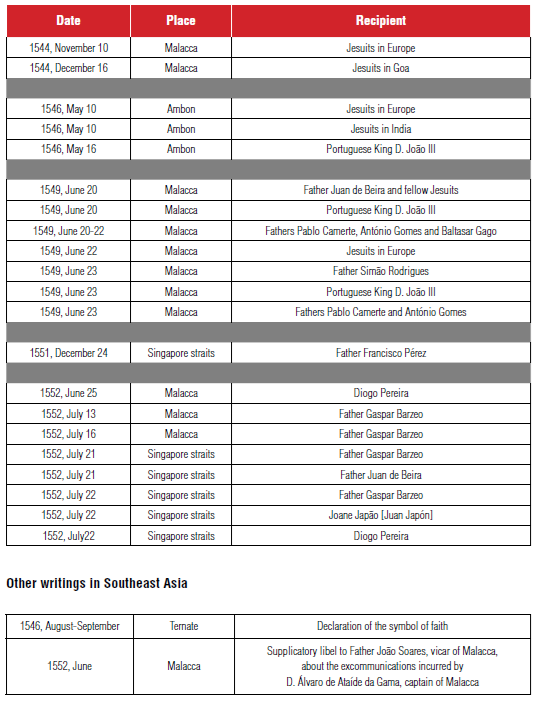
Furthermore, Xavier's religious plans for reaching Canton were perceived as a potential threat to the valuable trade relations established with merchants in the islands of southern China, further complicating the conflict (Schurhammer, 1992, IV, p. 729-772). Between July 21 and 22, Xavier composed five important letters from the Straits of Singapore (Schurhammer, 1992, IV, p. 783-793) and by the end of August, he arrived in Sangchuan, where he would enter a period of isolation and personal prayer from late November until his death on December 2, 1552 - signifying a dramatic conclusion to his life.
Despite the brief duration of St. Francis Xavier's three journeys through Southeast Asia, his letters and other writings offer a significant representation of some island territories and populations within the Eastern areas of the Malay-Indonesian archipelago. Since the mid-16th century, these regions received both Portuguese textual and cartographic identities, often referred to as “India Oriental” or, later, in a more scholarly context, as “Insulindia” (literally, islands of India) (Oliveira, 2018, p. 546-566).
The vast maritime expanse of these areas, the perils associated with their navigation, their political diversity, and the circulation of various religions - especially the dominant Islam - are all evident from Xavier's initial voyage to these areas. He vividly recounts this experience: "Amid many dangers, I found myself on this journey from Cabo de Comorin to Malacca and the Moluccas, facing sea storms and hostile encounters" (Javier, 1996, p. 191). This conception of a space spanning "from Malacca to the Moluccas"14 also reflected in the Portuguese chronicles and official documents of the era, is a recurring theme throughout Xavier’s correspondence written in Southeast Asia. It serves to highlight the specificities of Portuguese political and commercial activities, with Malacca as a central hub. The Spanish Jesuit characterizes it as follows:
“A city situated on a vast body of water, where public activities abound: every Sunday, I preach at sea, and although I do not derive much satisfaction from my sermons, I am grateful for those who exhibit the patience to listen. Each day, I dedicate at least an hour or more to teaching our children to pray. I spend time in the hospital, caring for the sick and sharing my compassion with them. I am so overwhelmed with confessions that it is impossible to attend to everyone” (Javier, 1996, p, 179).
At the far end of the space described by the Jesuit, the other nodes of the Portuguese maritime and commercial network were established in the Moluccas, particularly around the fortress of Ternate (Maluku), built in 1522. This sought to organize the lucrative trade of cloves, nutmeg, and other local spices that were in high demand throughout Asia, ensuring substantial profits when they reached European markets. The sparse letters that Xavier wrote from this region portray a different world - one that is profoundly insular and divided, characterized by considerable challenges in the religious and cultural penetration of a Catholicism that remained confined to the small minorities sheltered within Portuguese fortresses:
“In these parts of Moluccas, there are only islands, none of which have yet revealed solid ground. There are so numerous these islands that they cannot be counted, and almost all of them are populated. Due to the absence of those who seek to convert them to Christianity, they remain unconverted. If there were a house of our order in Maluku, many people would embrace Christianity. My goal is to establish a house in this end of the world of Maluku for the great service that God Our Lord would provide” (Javier, 1996, p. 192).
These invaluable yet rare epistolary texts by Francis Xavier offer profound insights into the challenges faced in Catholic religious work. These challenges stemmed not only from a scarcity of personnel and resources but also from significant difficulties in understanding local cultural identities. Such complexities were often overshadowed by a Eurocentric perspective that highlighted the perceived superiority of the "Christian city". The rich cultural and religious fabric of the Malayan-Indonesian regions, along with their unique social characteristics, were not fully appreciated through Xavier's religious efforts, which primarily unfolded in the vicinity of Portuguese fortresses and their surroundings. Consequently, as we will explore further, the Jesuit frequently referred to local populations using outdated terms such as "gentiles" and "Moors." The latter were to be subdued through military force, while the former were approached with the intent of conversion through persuasive discourse:
“The Gentiles in these parts of Maluku are more numerous than the Moors. The animosity between the Gentiles and Moors is palpable. The Moors seek either the conversion of the Gentiles to their faith or their capture, while the Gentiles adamantly resist becoming Moors, let alone being taken captive. If only someone would preach the truth to them, they would all embrace Christianity, for the Gentiles yearn to adopt the faith more than any desire to become Moors. Over the past 70 years, they have increasingly converted to Islam, though they were once all Gentiles. A few alfaquis who arrived from Mecca - regarded by the Moors as the burial place of Mohammed - played a significant role in converting many Gentiles to the sect of Mohammed. It is worth noting that these Moors lack a true understanding of their misguided beliefs. Absent someone to impart the truth to them, these Moors have drifted away from Christianity” (Javier, 1996, p. 192-193).
The attention given to initiatives aimed at converting the populations of what is now Eastern Indonesia, at a time when they had not yet fully embraced Islam, energized St. Francis Xavier's religious aspirations from his earliest days in Malacca. In fact, in his first known letter written from the prominent Malay port on November 10, 1545, Xavier expresses his strong personal interest in traveling to Makassar. He summarizes the somewhat vague information he had gathered about local cultures and religions, noting “that it is a land ripe for producing many Christians, as they possess no idol houses and lack individuals who lead them toward paganism. They worship the sun when it is visible, and there is no other pagan religion among them. They are a people who are constantly at war with one another” (Javier, 1996, p. 178-179).
Despite these critical perspectives we will examine later, it seems that the Jesuit made sincere and concerted efforts to learn or at least employ indigenous Southeast Asian languages. This theme played a significant role in the beatification process that commenced in 1556. Testimonies from that era highlight Xavier's remarkable linguistic abilities: "Wherever Master Francis arrived, he learned and spoke the local language in just a few days, as he did in Malacca, the Moluccas, and Japan" (Monumenta Xaveriana…, 1912, II, p. 418).
Although no existing documents authored by Xavier are found in Asian languages, and he relied on interpreters during his missions in the Moluccas and Japan, his correspondence includes some topographic and utilitarian “orientalisms” and emphasizes the Malay language as a useful lingua franca among merchants trading across various islands in Southeast Asia (Romo, 2000, p. 75-77). Xavier noted the region's linguistic diversity and the unifying role of Malay, stating, "Each of these islands has its own language, and there is an island in which almost every place has a different language. The Malay language, which is spoken in Malacca, is very common in these parts" (Javier, 1996, p. 195).
Consequently, in his earliest letters from Malacca in 1546, he expressed, "My greatest task is to extract Latin sentences in a language that can be understood in Macassar. It is very difficult not to know the language." This translation effort, likely supported by local collaborators, appears to have led to the creation of a catechism in Malay. Within six months, Xavier elaborated on this catechetical textbook, stating:
“In this Malay language (during my time in Malacca), I produced the Creed, a Declaration on the articles, the General Confession, the Pater Noster, the Ave Maria, the Salve Regina, and the Commandments of the Law, so that they may understand me when I speak on important matters” (Javier, 1996, p. 195).
Several witnesses have emphasized these Xavier's exceptional language skills. Following his death, King João III of Portugal issued a royal decree on March 28, 1556, instructing the Governor of India, Francisco Barreto, to gather authentic testimonies about the miraculous works and edifying events attributed to the Jesuit. This directive was executed in Goa, and later in Baçaim (Vasai), Cochin, and Malacca. In Baçaim, an important testimony was recorded from Rui Dias Pereira, a nobleman who had accompanied Xavier to Ambon and made several travels to the Moluccas. Pereira recounted that during their voyage, Xavier preached to numerous Malay sailors in their native language. He solemnly stated, “I had embarked with Father Master Francisco on a ship bound for Banda, where I witnessed him converting many to Christianity and preaching to them in their language” (Monumenta Xaveriana…, 1912, II, p. 385).
Another significant testimony came from Gaspar Lopes, a scribe from Cananor (Kannur) who lived with Xavier in Ternate. He asserted that “the father understood them as the blacks understood him, which greatly astonished them” (Monumenta Xaveriana…, 1912, II, p. 223-226). It is confirmed by the earliest manuscript biography of Xavier, written by the Spanish Jesuit Francisco Pérez in 1579 in S. Tomé (Mylapore), stating that Xavier in Ternate "taught them every day, once or twice, the doctrine in the language of the land of the Moluccas and in Portuguese" (Monumenta Xaveriana…, 1912, II, p. 866).
Assessing Xavier's true proficiency in local Malay and other languages is difficult. Nonetheless, his fervent delivery and commendable life experiences likely played pivotal roles in ensuring that his audiences heeded his words. A key element of Xavier's apostolic mission involved developing a strategy centered on moral and social exemplary behavior, primarily aimed at the (re)evangelization of Christian communities within Portuguese fortresses, factories, and enclaves throughout Southeast Asia.
During his inaugural visit to Malacca from September to December 1545, Xavier encountered a small Portuguese community comprising approximately sixty to seventy married couples (“casados”) with extensive households, around two hundred soldiers stationed at the fortress, and numerous servants and slaves who had been coerced into adopting Christianity (Thomaz, 1991, p. 68-79). This situation starkly contrasted with the local population, particularly around Upeh, where the Malay inhabitants numbered over twenty thousand. In his correspondence, Xavier depicted the sociocultural environment of Portuguese Malacca as notably lax, with Christian moral principles frequently overshadowed by local customs characterized by widespread polygamous male practices, clientelism, corruption and illicit trade.
Early Jesuit accounts underscored a persistent deficiency in catechetical instruction and public preaching amid the diverse social interactions reflecting a variety of cultural behaviors. This disconnect presented a significant opportunity to cultivate a domain for religious intervention aimed at affirming the moral superiority of Christian fidelity. In response to the social resistance generated by his fervent religious efforts, Xavier proposed a renewed strategy of communal exemplarity in Malacca, a strategy he had previously employed in Goa.
This strategy juxtaposes the negative moral portrayal of the Christian communities within the Portuguese enclaves and fortresses of Southeast Asia with the exemplary religious preaching, piety, charity, and strict moral life exemplified by St. Francis Xavier. It establishes a model of evangelization that can be observed in all of the Jesuit's subsequent missions to the Moluccas, Japan, and even to the maritime borders of China at Sangchuan Island. This approach often disrupted the networks of Portuguese and Eurasian traders and adventurers, for whom the Jesuit evangelization was frequently an embarrassment to their profitable commerce and social interactions, including family alliances through local marriages or even multi-marriages. This dynamic is evident during the nearly six months our Jesuit spent in the fortresses of Ambon and Ternate, once again embracing the small Christian communities overseen by affluent Eurasian traders who were largely detached from Catholic ethics and teachings. Xavier expresses his concerns about this situation in a letter sent from Ambon on May 10, 1546, stating:
“I had so many things to accomplish in the three months I was here - preaching, hearing confessions, visiting the sick, and helping them to die well, which is very difficult to do with people who do not live in accordance with the law of God” (Javier, 1996, p. 190).
The apostolic initiatives of the Navarrese Jesuit, within the Portuguese domains extending from Malacca to the Moluccas, were characterized by a multifaceted approach involving catechesis, preaching, and the practice of the Works of Mercy. These included providing Christian burial rites, caring for the sick in hospitals, and assisting prisoners who lacked any state support. Xavier’s catechetical efforts primarily focused on children, particularly those of Portuguese descent, as well as the Christianization of female wives, servants, and domestic slaves of Asian origin. His mnemonic pedagogical approach encouraged children to orally rehearse twenty key doctrinal terms each day - “teaching a little every day, twenty words that they can memorize well” (Monumenta Xaveriana…, 1912, I, p. 53). This method was based on his own catechisms, complemented by simple verses, songs, dialogues, and contextual teachings that frequently drew upon the religious imagery found in the decor of churches and chapels. Xavier’s codification of essential prayers - including the Pater Noster, Ave Maria, and Credo - in Malay reflects a structured pedagogical approach aimed at clarifying the foundational tenets of Christian doctrine for children and women. Documentation from May 10, 1546, detailing his activities in Ambon, underscores the pivotal role of children as active participants in his teachings:
“I did not lack spiritual occupations, both in preaching on Sundays and holidays, as well as in hearing the confessions of many people, both the sick in the hospital where I stayed and others in good health. During this time, I taught children and newly converted Christians; with God’s grace, we achieved peace between the soldiers and the city’s inhabitants. At night, I traversed the city with a small bell, entrusting souls in purgatory and bringing along many children I was instructing in Christian doctrine” (Javier, 1996, p. 189).
In addition to their catechetical efforts, Francis Xavier and his early Jesuit companions participated in a wide range of pastoral and ecclesial activities. Often, they were the only priests present in the Southeast Asian enclaves controlled by Portuguese political power and commercial interests. As a result, they assumed numerous sacramental duties, including conducting daily and Sunday Masses, leading prayers, and officiating at funerals and other religious ceremonies. Their ministry spanned a variety of celebrations in the liturgical calendar, with a particular focus on the Easter and Christmas cycles, which were central to the spirituality of the Society of Jesus, embodying the concept of milites Christi.
Xavier prioritized baptism, primarily targeting newborns and infants, and he baptized many children just days old, often before they succumbed to illness or starvation. This highlights the concerning neonatal mortality rate in the 16th-century Malay-Indonesian archipelago, where communities relied heavily on nature's blessings for the consistent production and distribution of rice, the cornerstone of the rural economy for most people. Even urban coastal areas, densely populated and benefiting from the spice trade, saw many inhabitants living in poverty (Meilink-Roelofsz, 1962, p. 216). A letter from Xavier, written in Ternate on May 10, 1546, reveals the predicament dramatically:
“On this island, I discovered seven Christian settlements. I baptized the children I found eligible, many of whom died shortly after baptism; and it appears that Our Lord God safeguarded them until they were on the path to salvation” (Javier, 1996, p. 189-190).
It is important to clarify that the emphasis on these external religious, pastoral, and ecclesial work refers only to the social and public aspects of Francis Xavier's complex spiritual endeavors. This focus on organizing catechesis and priestly activities among small Christian communities in the remote islands of the Malay-Indonesian archipelago largely stems from his own opportunities for correspondence, his communication style, and the didactic rules he followed within specific timeframes. Notably, during his decade of arduous work in Asia, Xavier received only five letters from Rome and two additional letters from Portugal (Léon-Dufour, 1997, p. 243). He quickly realized that as he moved farther from the Portuguese strongholds in India, it became increasingly challenging to communicate about his actions, problems, and decisions. Specifically, his journeys in Southeast Asia resulted in only 21 letters and two handwritten documents, indicating that time and interest for writing was limited by huge communication challenges. In that letter sent from Cochin to the Jesuits in Roma in 1648, Xavier explains the difficult and lengthy maritime circulation of regional and transcontinental communication:
“To illustrate how physically separated we are from one another, consider this: when, by virtue of holy obedience, you send messages from Rome to those in Maluku or to those who have gone to Japan, you cannot expect a response for at least three years and nine months. Here’s the breakdown: When you write to us in Rome regarding India, it takes eight months for us to receive your letters in India. Once we receive your letters, we must wait another eight months before the ships leave India for Maluku. The journey of the ship from India to Maluku and back takes an additional twenty-one months, assuming the weather is very good. After the reply is sent from India, it again takes eight months to reach Rome. This timeline is based on optimal conditions; if there are any conflicts or issues, the voyage can be prolonged by more than a year.; and so that you may know that it is as I say, I give you the reason. When you write to us in Rome for India, before we receive your letters in India, eight months pass; and after we receive your letters, before ships leave India for Maluku, eight months pass waiting; and the ship that leaves India for Maluku to go and return to India takes twenty-one months, and this in very good weather; and from India before a reply reaches Rome, eight months pass; and this is understood when they sail in very good weather, because if any conflict occurs, they often extend the voyage by more than a year” (Javier, 1996, p. 227).
When Xavier did write, his letters reveal a strategic intent, as he aimed to explore -sometimes merely experimenting with - the conditions, themes, and directives of the Society's work emerging in Asia. He also often sought to adapt his messages for European audiences, particularly Roman Jesuits and royalty, often overlooking how the challenges of living in diverse cultural contexts influenced him, affecting everything from his mental tools to his spiritual exercises. Despite these difficulties, some personal clues in his writings help outline the program of spirituality that Xavier aimed to cultivate amid the often intense cultural clashes, as he tried to preach the superiority of Catholicism in a world enriched by diverse beliefs, which he often perceived as steeped in paganism and sin.
The vast array of cultural and social practices among local Christian networks heightened the sense of "loneliness" that characterized Francis Xavier's travels in Southeast Asia and his limited epistolary production. He frequently found himself isolated, with limited communication, often facing challenges posed by Portuguese captains and merchants. In many remote areas, he was practically the only priest available to perform even the most basic liturgical and ritual activities.
In his efforts to reconcile these numerous difficulties and diversities, Xavier consistently sought to transform significant religious and social challenges into opportunities for personal spiritual growth. During his final stay in Malacca, he faced harsh criticism from Portuguese Captain Álvaro de Ataide da Gama. In response, Xavier chose to convert his public "tribulations" into a personal spiritual retreat, which he conducted aboard the ship of his protector, Diogo Pereira, for almost the entire month of June 1552. He prayed intensely for his greater mission to reach China and begin its evangelization. It is possible that this spiritual retreat allowed Xavier to complete the spiritual exercises of the first thirty days - or at least the first week - which he knew by heart, despite never having had the chance to read that original text of Ignacio de Loyola's major work on spiritual exercises, published in Latin in Rome in 1548 (Loyola, 1548).
His expressions of internal lamentation reflect not only the comfort found in spiritual exercises but also draw us closer to the complex boundaries of his mysticism that still require study. This is especially evident when he meditates, possibly in the context of a final ars moriendi lesson, on his arduous maritime journey from Malacca back to Cochin at the end of 1547, which was marred by a terrible storm:
“In the midst of the greatest storm, I entrusted myself to God our Lord. I began by taking as my supporters all those in the blessed Society of Jesus, along with all its devotees. With such fervor and support, I dedicated myself entirely to the most devout prayers of the Spouse of Jesus Christ, who is the Holy Mother Church. She is continually heard in heaven, even while on earth. I also sought the support of all the saints in paradise, starting first with those who were members of the holy Society of Jesus during their lives. I particularly took the blessed soul of Father Fabro as my advocate, along with all the others who were part of the Society. I could never fully express the consolations I experience when I commend myself to God our Lord for the sake of those in the Society, both the living and those who reign in heaven. I surrendered myself, completely vulnerable, to all the angels, recognizing their nine orders, and I also turned to all the patriarchs, prophets, apostles, evangelists, martyrs, confessors, virgins, and all the saints in heaven. For greater assurance in obtaining forgiveness for my countless sins, I chose the glorious Virgin Mary as my guarantor, for everything God our Lord asks of her is granted in heaven. Finally, placing all my hope in the infinite merits of the death and passion of Jesus Christ, our Redeemer and Lord, I found myself so consoled in this storm - perhaps even more than I felt after being freed from it. As a very great sinner to find tears of joy and consolation amidst such tribulation brings me a deep sense of confusion when I reflect on it” (Javier, 1996, p. 225-226).
Catechesis, pastoral ministry, ecclesial responsibilities, and intense preaching were further enriched by a profound devotion to the fourteen works of mercy, comprising seven corporal and seven spiritual acts. In the Portuguese Asian cities, enclaves, and fortresses where he fervently spread his Catholic message, St. Francis Xavier aimed to promote Christian social and spiritual morals through these primary Works of Mercy. He resolved conflicts and rivalries, assisted prisoners, heard the confessions of the condemned, comforted the dying, organized Christian funerals, welcomed the poor, protected the vulnerable, and provided shelter for prostitutes and marginalized women.
Nevertheless, these notable demonstrations of mercy, which integrated spiritual fervor, penance, charity, and communal Christian responsibility, did not represent a groundbreaking facet of Xavier’s religious endeavors in Portuguese Asian enclaves between 1542 and 1552. While this theme remains a significant aspect of the early testimonies related to his beatification process, as recorded by numerous witnesses in Goa, Cochin, Baçaim, and Malacca during the hearings organized by royal decree in 1556 and 1557, the doctrine and practice of corporal and spiritual works of mercy in pursuit of a renewed vision of a "city of God" emerged from the brotherhood that Xavier supported and engaged with throughout his religious work in Portuguese territories in India and Southeast Asia: the Holy Houses of Mercy, known as "Misericórdias," which served as essential institutions within the Portuguese overseas colonial societies, spanning from Brazil to Macau.
On Societies - social morality, children, merchants, captains and “Misericórdias”
The 138 surviving writings of Xavier - including that small number of autographs, numerous dictated letters, and a significantly greater quantity of copies than originals - do not know the word "society," with one notable exception. On January 20, 1548, in Cochin, he signed a letter to his fellow Jesuits in Rome as "Minimus servus servorum Societatis nominis Jesu, Franciscus" (Monumenta Xaveriana…, 1912, I, p. 438). While his letters contain certain biblical Latin quotations, particularly from the Gospels, Latin is not utilized in his surviving documents. One might assume that the term "societatis" refers solely to his religious order, the Society of Jesus. However, in his correspondence, Xavier consistently refers to the Jesuit "society" always as a “Company” (Companhia/Compañia - 239 references). Notably absent are also other concepts that align with our contemporary understanding of society as a network of social relations. Xavier employs the term "state" (estado) nine times in both Portuguese and Spanish, yet not in a clear sociological sense. He predominantly uses it within religious, ecclesiastical, or general political contexts.
For instance, in one of his most widely read letters, sent from Cochin on January 15, 1544, to the Jesuits in Rome, Xavier discusses the “ecclesiastical state” (estado eclesiástico). Later in the same letter, he refers to the “state of innocence” (estado de inocência) of the newborns he had baptized. Additionally, in a letter written from Malacca in 1552, addressed to his friend Diogo Pereira, Xavier notes the King of Portugal's interest in sending an embassy to China, emphasizing that “the king commissions it for his honor and the growth of his state (crescimento do seu estado)”.
A more detailed examination of Xavier’s preserved writings reveals that the noun he most frequently uses in general social contexts is "mundo (world)" which appears 58 times, along with "mumdo" six times and "mundus" once. This distinction highlights Xavier's conceptualization of society. For the Jesuit, the term "world" (mundo) refers to all individuals outside of religious orders or ecclesiastical standings, as well as the entire social sphere inhabited and engaged by laypeople. In a poignant letter to his companions in Rome in 1544, Xavier asks the thought-provoking question: "What can the world discern about us?" The answer he offers suggests that the world represents a temptation and a divide, symbolizing a perilous boundary that religious individuals should avoid crossing. Instead, they should confront it with humility and spirituality, making the “world” a reflection of the Jesuit's commitment to exemplifying sound Catholic morals.
In the Catechism he authored shortly after arriving in Goa in 1542, Xavier explicitly identifies "the enemies of the soul are three: the world, the flesh, and the devil" (Romo, 2000, p. 441-442). There is no need to present extensive excerpts from Xavier's letters and writings to illustrate that the world signifies temptation and sin, which Jesuit members must consistently resist in all circumstances. Many of the letters and instructions Xavier penned to fellow Jesuits - whether aimed at groups or individuals - are replete with warnings about the world, particularly when he was distanced from his companions. A clear example can be found in a letter dated November 5, 1549, sent from Kagoshima, Japan, to his fellow residents in Goa, wherein he poses a cautionary question: “Brothers, in revealing yourselves to the world, which is fundamentally evil, how will you withstand its temptations if you do not practice profound humility?” (Javier, 1996, p. 361).
Humility was essential in the lawless and audacious environment of the Portuguese colonial enclaves in India and Southeast Asia. As Xavier noted in a letter written in 1549, the situation in these territories was such that "the Portuguese in these parts only lord over the sea and the places along the coast; on dry land, they are not lords except in the locations where they reside” (Javier, 1996, p. 268). In this context, as seen before, Xavier expressed a deep skepticism toward the small communities of Portuguese and Eurasian Christians residing and trading within the Portuguese fortresses, which stretched from Malacca to the Moluccas. His wariness extended even to the handling of sacred items. In a letter dated May 10, 1546, from Ambon, Xavier advised his colleagues in India: "Upon arriving in these regions, each of you must bring all the necessary items for celebrating Mass; however, chalices should be made of copper - a more durable metal than silver for those of us navigating among these unholy people" (Javier, 1996, p. 199).
A few days later, on May 16, in a letter to King João III, drawing from the lessons of his challenging experiences in the fortresses of Ternate and Ambon, Xavier used the term "mestizo" in what could be considered its nearly original form. He confessed that "the wives of married men born in the land, along with their mestizo sons and daughters, are content to claim they are Portuguese by birth rather than by law" (Javier, 1996, p. 201). This revelation underscored the pressing need for preachers, prompting him to seek strong support from the king. Moreover, Xavier quickly added, "a second necessity for those living in India is for Your Highness to send the Holy Inquisition, because there are many who adhere to the Mosaic law and the Moorish faith without any fear of God or shame before the world. Given their large numbers and dispersed presence throughout the fortresses, the Holy Inquisition and numerous preachers are essential" (Javier, 1996, p. 201-202).
Recalling the letter addressed to Ignacio de Loyola in early 1549, Xavier articulates his concerns regarding the Portuguese residing in the fortresses between Malacca and the Moluccas. He notes that these individuals maintain multiple wives within their households, along with numerous female servants and slaves, engage in open concubinage, and demonstrate a disregard for the sanctity of marriage by fathering countless children outside of wedlock. He characterizes their lives as being dominated by "abominable sins of lust", which he admits are hard to believe and hesitates to detail, thus concluding that "they do not know God, nor do they adhere to reason due to their deep-seated habits of sin" (Javier, 1996, p. 268). Therefore, in his Declaration of the Symbol of Faith - a catechetical text he compiled in Ternate between August and September 1546 - Xavier asserts that "God granted Adam only one wife. It is clear that the Moors, gentiles, and bad Christians have many wives against God; and it is also true that those who are in concubinage live against God" (Javier, 1996, p. 204). However, he acknowledges the considerable challenge in confronting these entrenched social practices, which were vital for forging local social and trade alliances.
Furthermore, in an April 1549 letter to Father Gaspar Barzeo, Xavier cautions his fellow Jesuits to exercise extreme discretion when critiquing the moral conduct of influential captains and merchants in the Portuguese territories: "Be particularly careful in sermons to avoid reprimanding individuals or those who hold power in the land. Whether these admonitions occur privately in their homes or during confession, these men are quite dangerous; rather than improving, they tend to become more entrenched in their ways when publicly chastised" (Javier, 1996, p. 306).
In summary, Xavier harbored a deep mistrust of the adult men, both Portuguese and Eurasian, who lived and mingled as Christians within the enclaves of the "Estado da Índia." Thus, in a significant letter penned in Cochin at the beginning of January 1544, Xavier conveyed that he only placed his trust in the children he was instructing in the Portuguese enclaves and fortresses. He expressed, "I have faith in God, our Lord, that the boys will grow to become better men than their fathers. They exhibit remarkable zeal and dedication to our faith, adeptly learning the prayers and sharing them with others".
Moreover, Xavier empowered the children to denounce the sins and idolatries of their parents: "They bring accusations to me, relaying the idolatry they witness outside. When they inform me of these transgressions, I gather all the boys and accompany them to the locations of the idols. The disavowal that the boys express towards these idols is far greater than the honor their parents bestow upon them through their worship. For the children seize the idols, reducing them to mere ashes, and then they spit on them and trample them underfoot. To confront such boldness from those who would demand their parents worship them is indeed an honor for the boys” (Javier, 1996, p. 109).
In the writings of Francis Xavier, which encompass his letters, instructions, and catechisms, there is a natural reference to various social, generational, and gender contexts. The references include attorneys (13), bishops (69), boys (41), brothers [Jesuits] (225), children (17), councilors (8), daughters (11), freed slaves (8), girls (5), husbands (16), "línguas" [jurubaças; topaz] (27), men (68), nobles (9), officers (8), overseers (10), pilots (3), preachers (31), priests (488), sailors (7), servants (26), slaves (15), soldiers (3), sons (62), the poor (47), the rich (10), vicars (60), and women (65). As expected, references to religious and ecclesiastical roles dominate in terms of quantity, while mentions of broader societal contexts ("mundo") are relatively limited, often described in general terms such as persons (33), people (81), or "gentes" (97). Furthermore, the Xaverian texts do not categorize these references into distinct "social groups," with the exception of two categories: merchants (34 references) and captains (39 references).
Merchants were a group that required careful approach, especially those engaged in lucrative trade and smuggling operations across Southeast Asia and the South China Seas. In a letter dated April 2, 1548, sent from Goa to his friend Diogo Pereira - an affluent merchant already influential in the trade activities of the Pearl River Delta islands - Xavier cautions him about "this commodity known as soul consciousness. It is so relatively unfamiliar in those regions that all merchants fear they will face ruin if they attempt to utilize it" (Javier, 1996, p. 248).
In a letter from mid-1549, Xavier provides specific instructions to his fellow Jesuits regarding the confession of merchants: “When you confess, be very careful to ask how they earn their living through their businesses. If you discern any usury in their dealings, do not trust those who claim, ‘my conscience does not accuse me of anything to be repaid,’ because many do not feel guilt simply because they lack a conscience or possess a very feeble one” (Javier, 1996, p. 307). Nevertheless, the Jesuit recognized the importance of securing support and funding from Portuguese and Eurasian merchants who managed both official and private trade networks in Southeast Asia. In a letter dated January 20, 1548, from Cochin to King João III, Xavier endorses eight Portuguese individuals who distinguished themselves during the Achene attack on Malacca on August 22, 1547, and subsequently pursued the enemy armada until its complete destruction. He first recommends his friend, financier, and affluent merchant Diogo Pereira; followed by the captain, trader and shipowner Afonso Gentil; the merchant João Rodrigues de Carvalho, who suffered a loss of farms due to a shipwreck in China; Henrique de Sousa, another struggling merchant for whom he requests support for a voyage to the Maluku Islands; and António Rodrigues Gamboa, another wealthy merchant.
Additionally, he recommends António Cardoso, a personal friend and former secretary of the captaincy of Malacca; Manuel Lobo, a soldier who lost a leg in the Battle of Diu on November 11, 1546; and lastly Cosme Anes, the secretary to João de Castro, the 13th governor and 4th viceroy of the Portuguese State of India, during the years 1547 to 1548 (Javier, 1996, p. 237-238). If these recommendations largely highlight the impact of prominent Portuguese and Eurasian merchants who were increasingly involved in clandestine trade with China, in contrast, a second letter of recommendations, also signed by Xavier, presents a different focus. Dated October 28, 1548, this letter was crafted by Xavier in collaboration with Father Pedro Fernandes Sardinha, the Vicar General of Cochin, and Franciscan Fr. António do Casal, a military chaplain. It is addressed again to King João III and predominantly praises various military officers and fortress captains within the "Estado da Índia".
The letter recommends Manuel de Sousa Sepúlveda, who had formerly served as captain of Diu; Francisco da Cunha, captain of Chaul from 1542 to 1545; Francisco de Lima, a military captain recognized for his defense of Malacca; Vasco da Cunha, a nobleman from the royal household with significant military experience in Hormuz, Malabar, Vasai, Diu, and Malacca; Diogo de Almeida, who was captain of Goa from 1545 to 1548; and António Pessoa, a former factor of Vasai and captain in Ceylon (Javier, 1996, p. 263-264).
Xavier's religious work, particularly within the Portuguese strongholds of Southeast Asia, was heavily dependent on the support and decisions of this small elite composed of territorial, military and sea captains seeking ennoblement for his achievements and services overseas. He came to realize this dramatically from May 1552 onward, particularly during his conflict with D. Álvaro Ataíde da Gama, the captain of Malacca and captain-major of the sea, regarding his embassy to China. Perhaps due to his steadfast support for these authorities, Xavier instructed the Jesuits in a letter dated early April 1549, stating, "You must obey the captain in a significant manner, humbling yourselves profoundly before him; do not sever ties with him for any reason, even if you witness him behaving poorly" (Javier, 1996, p. 263-264). All these historical and contemporary figures - fortress captains, ship captains, military officers, overseers, and prominent colonial administrators - formed a loosely organized social segment that Xavier referred to as "captains." Their authority should always be upheld and respected.
In early 1552, a third and final letter of recommendation was penned, bringing together captains, merchants, and some religious figures. Addressed, as always, to King João III, Xavier appeals for royal favors on behalf of the following individuals: he re-commissions the same Manuel de Sousa Sepúlveda and Vasco da Cunha; Francisco Borges, Gaspar Mendes, and Mateus de Brito, single merchants who invested "much of their wealth" during the 1551 siege of Malacca; Manuel Rodrigues Coutinho, a two-time captain of Tuticorin; Lobo Vaz Coutinho, a nobleman and ship captain; Jorge de Castro, who served as captain of Ternate from 1539 to 1544; Francisco Barreto, captain of Vasai from 1549 to 1552, later governor of the “State of India”; the wealthy merchant brothers Fernando Mendes, Álvaro Mendes, and António Mendes; Diogo Pereira and his brother Guilherme Pereira, influential merchants engaged in trade with China; Father Pedro Gonçalves, vicar of Cochin, along with his namesake nephew, who served “in the navies”; Father João Álvares, dean of the cathedral of Goa; Pedro Velho, another affluent merchant with interests in China; António Correia and João Pereira, both pepper merchants; Diogo Borges, mayor of Ternate; Pedro de Mesquita, merchant and ship captain; Luís Álvares, both pilot and merchant; Father Álvaro Fernandes, vicar in Kollam (Coulão); Álvaro Fogaça, a nobleman of the royal house; Mateus Gonçalves, merchant of Cochin; and António Pereira, clerk in Kollam (Javier, 1996, p. 413-418).
From these groups of captains and prominent merchants emerged the elite who controlled the two primary colonial institutions of the time: the municipal councils and the “Misericórdias”. Xavier quickly recognized that the “Misericórdias,” with their influential members and their ecclesiastical and welfare centers, represented a key strategic opportunity for evangelizing the communities within the Portuguese Asian enclaves. This is evident in the Jesuit's travels through the fortresses of Southeast Asia. Although there is a lack of comprehensive documentation detailing St. Francis Xavier's relationship with the "Misericórdia" of Malacca during his initial visit to the city in 1544, we do gain valuable insight into the directives he provided to his fellow Jesuits who were assigned to the Portuguese enclave. In a letter dated May 28, 1548, the only two Jesuits present in Malacca at that time, Fathers Francisco Pérez and Roque de Oliveira, informed Xavier of their arrival and noted the warm reception they received from the Provider and members of the “Misericórdia”.
Within its church, they focused on catechizing the children of Portuguese traders, several servants and enslaved women, and some Christianized indigenous peoples (Schurhammer, 1992, IV, p. 5-6). Although the “Misericórdia” was established during the early years of the conquest of the grand Malay harbor city - likely between 1512 and 1517 - these early Jesuit accounts indicate that it had a somewhat limited staff. It lacked the chaplains typically required by the statutes of such brotherhoods, which necessitated Father Francisco Pérez to serve as the principal priest of the institution. He celebrated Mass in the church every Wednesday and led weekly services at the hospital, tending to the sick and administering communion, reflecting the exemplary activities initiated by St. Francis Xavier during his first stay in Malacca. Years later, on May 31, 1549, Xavier returned to the Malay port accompanied by several fellow Jesuits. He was warmly welcomed by the fortress captain, Pedro da Silva, and a significant portion of the city's Christian population. The presence of the brothers of the “Misericórdia” was especially notable, with their black habits and banners of the Virgin of the Mantle, along with the heartfelt chorus of children who attended catechism classes in the brotherhood, joyfully calling out for the "holy father" (Schurhammer, 1992, IV, p. 5-6; Sousa, 2005, p. 114).
Elucidating the significance of the “Misericórdia” within the public religious circuits and devotional practices in Malacca, a letter authored by Xavier from the city, dated between June 20 and 22, 1549, notes that his fellow Jesuit, Afonso de Castro, had been ordained a priest in Goa but celebrated his first Mass at the Malayan port. This milestone was marked by a grand procession that transported the new priest from the Church of the “Misericórdia” to the Cathedral, garnering a substantial gathering of pious donations (Javier, 1996, p. 325). Xavier expressed his intention to allocate all the alms received to the “Misericórdia”, ensuring “their distribution among the poor” (Javier, 1996, p. 326; Schurhammer, 1992, IV, p. 8). In the same correspondence, the Jesuit highlights Father Pérez’s commitment to catechism, as he taught Christian doctrine to the children at the “Misericórdia” daily. He also advised Pérez to fulfill his role within the brotherhood as chaplain, in accordance with its statutes (Javier, 1996, p. 330-331).
A subsequent letter from Francisco Pérez, dated 1550, corroborates the ongoing daily activities at the “Misericórdia” of Malacca and emphasizes the church's pivotal role in the city’s processional traditions (Sá, 1955, II, p. 8). This emphasis was echoed by the same Jesuit priest in a document finalized on November 24, 1551, which announced that, in response to another siege of the Portuguese enclave, the city’s political authorities and Catholic diocesan leaders had resolved to organize a significant procession accompanied by a solemn Mass at the brotherhood's church (Sá, 1955, II, p. 8).
In the Portuguese enclave of Ternate, in the Eastern Moluccas, the “Misericórdia” emerged as a significant institution under the leadership of Captain António Galvão in the late 1530s. It included its own chapel dedicated to the veneration of the “Mother of God” and a small hospital (Sousa, 2005, p. 118). However, Jesuit accounts often present St. Francis Xavier's visit to the Portuguese fortress in 1549 as the key founding moment of the local Holy House of Mercy. In reality, the “Misericórdia” was already in operation during Xavier's stay, and he utilized the brotherhood in his efforts to evangelize the small Christian population he believed was suffering from moral failings. Jesuit historical sources consistently depict Xavier's religious activities within a redemptive framework, portraying the "depraved" Portuguese enclaves of Southeast Asia as transformed into restored "Christian cities" through the Jesuit preaching and saintly example.
This narrative applies to Ternate, where late 16th-century Jesuit memoirs indicate that, due to Xavier's preaching and exemplary conduct, "the restitutions made were so extensive that, despite uncertainties, the House of Holy Mercy became one of the wealthiest in all of India" (Gonçalves, 1957, I, p. 220). Subsequent letters from Xavier, following his visit to Ternate, reveal that the local “Misericórdia” actively promoted various public religious devotions, particularly processions and prayers for the souls in Purgatory. According to French historian Jacques Le Goff, the notion of Purgatory as a realm for atonement was developed in the 12th and 13th centuries to aid in the salvation of the emerging commercial bourgeoisie, who engaged in capital, usury, and profits often at odds with prevailing Christian morality (Le Goff, 1981). The promotion of such devotions became a mandate for the “Misericórdias” after the printed publication of their statutes in Lisbon in 1516, which subsequently spread to brotherhoods throughout the kingdom and the Portuguese overseas territories, from Brazil to Macau. In a letter dated January 20, 1548, sent from Cochin to the Jesuits in Rome, St. Francis Xavier underscored the significance of devotion to the souls in Purgatory that he witnessed in Ternate, while positioning himself as a promoter of this devotional celebration:
“During my time in Ternate, I ordered that each night, the souls in purgatory be remembered in the squares, along with all those who live in mortal sin. This practice inspired great devotion and perseverance among the good, while instilling fear and terror in the bad. As a result, the city appointed a man, dressed in the garments of the “Misericórdia”, who would walk through the squares each night with a lantern in one hand and a bell in the other. Occasionally, he would pause to pray aloud for the souls of faithful Christians in purgatory, followed by prayers for those who persist in mortal sins without seeking redemption” (Javier, 1996, p. 220; Sá, 1954, I, p. 540; Jacobs, 1974, II, p. 39).
The strategic religious, moral, and social communication established between the “Misericórdias” and the Jesuits upon their arrival in the Portuguese enclaves of Asia laid the groundwork for the evangelization efforts led by St. Francis Xavier. During his initial stay in Goa, from May to September 1542, the Jesuit became an active participant in the influential “Misericórdia,” supporting its charitable initiatives. He attended to the confessions of the ill and impoverished within the brotherhood's hospital, co-celebrated services in its church, and visited prisoners in collaboration with members of the confraternity. At that time, approximately 30 to 40 detainees were living in appalling sanitary conditions, deprived of adequate food, clothing, and legal protection, relying solely on the “Misericórdia” for assistance and nourishment.
Additionally, St. Francis Xavier observed in 1542 that the Portuguese viceroy had entrusted the management of the city’s royal hospital to the “Misericórdia” of Goa, a decision that was similarly implemented in Cochin and later extended to other fortresses within the "State of India" (Schurhammer, 1992, II, p. 492). This effectively solidified the "monopoly" of Christian charity held by the “Misericórdias,” which actively sought papal endorsement. In fact, in one of St. Francis Xavier's earliest letters from Goa to Ignacio de Loyola, dated September 20, 1542, he makes significant observations regarding the local “Misericórdia” and endorses the request for papal indulgences put forth by the Portuguese governor of India:
“In this region, within most Christian communities, there exists a commendable brotherhood dedicated to aiding those in need, including both indigenous Christians and recent converts. This confraternity, primarily comprised of Portuguese men, is known as “Misericórdia”. It is truly admirable to witness the service these individuals render to the Divine by assisting the less fortunate. To enhance the piety of these members, the Governor has petitioned His Holiness to grant all participants of this “Misericórdia” the privilege of obtaining a plenary indulgence through annual confession and communion. This concession would encourage a more fervent practice of their faith for the afterlife, as favored by the papacy. Furthermore, since many of these men are married, the Governor requests that their spouses be granted the same grace” (Javier, 1996, p. 100; Schurhammer, 1992, II, p. 266).
At this point, it is important to highlight that the teachings and practices concerning the works of mercy are largely absent from the Spiritual Exercises of Ignacio de Loyola. In the original Formula established in 1540, the doctrine of pious works occupies a limited role. It was not until nearly a decade later, with the expanded version of the Exercises printed in 1548, that the Jesuits were encouraged to teach about the works of mercy, particularly emphasizing one of the seven spiritual mercies: “forgiving offenses and injuries”. Xavier is much more thoughtful and generous. In his Short Catechism, which he compiled upon his arrival in Goa in May 1542, he begins by addressing sins and then outlines the seven corporal works of mercy: "The first is to visit the sick; the second is to feed the hungry; the third is to give drink to the thirsty; the fourth is to redeem captives; the fifth is to clothe the naked; the sixth is to provide lodging for pilgrims; and the seventh is to bury the dead".
Following this, he lists and teaches the seven spiritual works of mercy: "The first is to teach the uneducated; the second is to offer good counsel to those in need; the third is to correct those who require discipline; the fourth is to comfort the sorrowful and distressed; the fifth is to forgive those who have wronged us; the sixth is to endure injuries with patience; and the seventh is to pray to God for the living, that He may protect them from mortal sins, and for the dead, that He may deliver them from the sufferings of purgatory and bring them to paradise" (Romo, 2000, p. 441).
The catechetical text elucidates and organizes the profound connection between Xavier and the “Misericórdias,” which operated within the Portuguese enclaves of India and Southeast Asia, supported by wealthy merchants and various “captains.” This relationship transcended a mere practical alliance; it was grounded in a deep-seated conviction. The Jesuit was firmly convinced that in a world rife with temptation, populated by Christian sinners and threatened by numerous “gentiles,” salvation could only be achieved through God’s Mercy. This belief carried significant repercussions for non-Christians, particularly for those who opposed Catholic evangelization. For them, mercy, compassion, and assistance from the “Misericórdias” were nonexistent; instead, they faced a stark cultural divide and hostility. The statutes of the “Misericórdias” explicitly barred the entry of confreres who were not Catholic, and prohibited any form of assistance - from hospitals to cemeteries and prisons - to those outside the Christian faith. This monopoly on charity played a crucial role in preserving Portuguese Christian colonial societies.
On Cultural Distance - barbarism, violence and anthropophagy
Similar to the term "society," Xavier is entirely unfamiliar with the word "culture." The closest approximation to a Eurocentric notion of refined culture, which is closely tied to the supremacy of "Letters", appears to be the highly polysemous term "knowledge," which is repeated 33 times and often contrasted with ignorance. According to Xavier, knowledge is a gift from God, while ignorance is rooted in the devil and sin.
Furthermore, knowledge transcends mere divine gift; it is viewed as an act of mercy. In a letter dated November 1549, written from Kagoshima to his fellow Jesuits in Goa, Xavier asserts, “It is also necessary for us to account for other goods that God bestows upon us, of which knowledge is granted through His mercy, so that you may help us to always give thanks to God for these” (Monumenta Xaveriana…, 1912, I, p. 82). Thus, the concept of knowledge once again highlights the supremacy of the principle of mercy, the sole relational force capable of counteracting sin and overcoming error. This idea resurfaces in one of his final letters, dated October 25, 1552, from Sanchuang, where he states, “unless there is sufficient penance and an understanding of error, which are the only means to attain mercy” (Monumenta Xaveriana…, 1912, I, p. 794) a crucial condition “to escape the kind of ignorance that leads to unfaithfulness without a true recognition of the Creator and Lord” (Monumenta Xaveriana…, 1912, I, p. 20).
A closer examination of the epistolary writings compiled by St. Francis Xavier in various enclaves under Portuguese influence, ranging from Malacca to the Moluccas, confirms again a notable absence of genuine cultural appreciation. Instead, these documents consistently portray a world that, as we have previously emphasized, appears almost savage, inhabited by "barbaric" and "treacherous" peoples who are depicted as incapable of receiving God's mercy. This representation often overshadows the rich cultural and regional diversity of these communities, perpetuating an image of Southeast Asian populations as mere exemplars of singular "barbarism," "incivility", and perceived backwardness. By early 1544, Xavier asserts that "all the Gentiles in these parts know very little of letters; however, they are well acquainted with evil" (Javier, 1996, p. 113).
The Jesuit sought to leverage his religious initiatives as a genuine pathway for "civilization," aiming to transform insular "gentiles" into Christian "humanity." Inspired by nearly "triumphant" reports from António Paiva, a Portuguese merchant with extensive experience living and trading in South Sulawesi during the 1540s, which detailed the conversions of elite groups on the island - referred to as Celebes by the Portuguese (Baker, 2005, p. 61-85; Pelras, 1977, p. 227-260) - Xavier wrote from Cochin in 1545:
“In another land very far away, almost 500 leagues from where I am, three great Christian lords were held for eight months, along with many others. These lords sent representatives to the fortresses of the King of Portugal, requesting religious individuals to teach and indoctrinate them in the law of God. Until now, they have lived like brute animals, but they wish to transform their lives and live as men, knowing and serving God” (Javier, 1996, p. 168).
Xavier’s negative portrayal of the social and cultural landscape of the Indonesian archipelago is unequivocal in a letter dated January 1548: "These islands are very dangerous due to the numerous wars that take place among them. The people are barbaric, lacking literacy and unable to read or write. They are individuals who administer poison to those who wish them harm, resulting in many deaths" (Javier, 1996, p. 217). Later, in early 1549, Xavier wrote a letter to Ignacio de Loyola summarizing his experiences between Malacca and the Moluccas. In this correspondence, he employs an authoritative assertion - "I saw" - to underline his claim that "the indigenous people of these regions are, as far as I have observed, generally very barbaric." This assertion, despite its generalizing caveat, is reinforced later when he states, "the indigenous people of this land, both Moors and gentiles, are all very ignorant, all those I have encountered thus far" (Javier, 1996, p. 266).
Even when a hint of potential for ethnographic discovery appears, the same negative characterizations quickly resurface. For instance, in a text from 1548 regarding the "Tavaros" -the Tabaru ethno-linguistic group on the northwest coast of Halmahera - Xavier swiftly clarifies that "they are gentiles who find all their happiness in killing whoever they can, and they claim that they often kill their children or wives when they cannot find anyone else to kill" (Javier, 1996, p. 217-218).
The accumulation of increasingly violent and morbid labels ultimately culminated in a grave and fabricated accusation of cannibalism - an accusation that represented the most severe cultural and moral condemnation of that era, driving certain populations into realms considered subhuman. This theme garnered widespread recognition, as evidenced by the correspondence of missionaries and travelers active in sixteenth-century colonial Brazil, and gained notoriety through the writings of the German mercenary Hans Staden, published in 1557 with engravings by Theodóre de Bry (Staden, 1557). However, this concept appeared almost alien in the descriptions of island societies in present-day Eastern Indonesia. In António Galvão's seminal work, Treaty of the Maluku Islands, completed around 1544 and encompassing all the islands and peoples of the Moluccas, there is no mention of cannibalistic practices (Galvão, 1989).
In stark contrast, a letter sent from Ambon to his fellow Jesuits in Europe in 1546 depicted a deliberately exaggerated and alarming portrayal of the inhabitants of Moro (or Sugibawah) Island. Xavier’s narrative delved into the unthinkable, urging educated and religious European readers to confront, with a mixture of voyeurism and indignation, the intolerable exotic violent and macabre barbarities of distant island societies situated on the fringes of the Indian and Pacific Oceans:
“The people of these islands are very barbaric and full of treachery. They are more cunning than black, an extremely ungrateful people. There are islands in these parts where they eat one another; this is when they go to war with one another and kill each other in battle, and not in any other way. When they die of illness, they make a great banquet of their hands and heels to eat. These people are so barbaric that there are islands where one neighbor (when he wants to hold a large feast) demands from another his father, if he is very old, a loan for food, promising to give him his own when he is old and wants to hold a banquet” (Javier, 1996, p. 194).
Fortunately, to enhance the rigor of ethnographic description and bridge the substantial cultural gap present in Xavier's portrayals of the populations of Moro Islands that he “saw”, his immediate disciples and successors recognized the necessity of gaining a deeper understanding of Southeast Asian cultures. Among the first Jesuits to establish a presence in Macau in 1563 was the Portuguese Jesuit Manuel Teixeira, who joined Father Francisco Pérez, Xavier's close companion and provincial successor. Teixeira undertook a focused effort to critically reassess his master's portrayal of cannibalism.
In a letter dated December 8, 1584, sent from Goa to Father Pedro de Ribadeneira, the author of a Latin biography of Ignacio de Loyola (Ribadeneira, 1572), Teixeira indicated that he had completed a biography of Xavier, thoroughly outlining his journeys and preaching across India, Southeast Asia, and Japan. Upon reviewing Ribadeneira's recently translated Spanish edition of Loyola’s biography (Ribadeneira, 1583) which arrived at his Jesuit convent in Goa in 1584, Teixeira felt compelled to rectify several inaccuracies in the sections pertaining to Xavier. Among these corrections, Manuel Teixeira included the following:
“As for what is said about the ferocity of the people of Moro Island, and that they ate human flesh, we do not know here in India that human flesh was eaten on Moro Island, nor are the people of that island more barbaric and ferocious than the people of the other islands of Maluku, but similar to them, according to what our Fathers of the Company who came from there and other Portuguese people who stayed on some other islands of that archipelago tell us. It is said that human flesh is eaten far from these, but there is no record of Father Master Francisco going to them. Therefore, it seems that what is said about these islands was attributed to those of Moro Island; and thus it seems that what is said there about the ferocity of Moro Island can be excused (since it is domestic like the others), and in particular, it seems that what is said there is that the parents kill and eat their children, and the children their parents, and the wives their husbands; and that children, seeing their parents old, kill them and eat them, and invite each other with the flesh of their parents, etc.; because this is not even known here in India by any nation, nor will it be believed by anyone who has not seen it, because it is so against human nature” (Monumenta Xaveriana…, 1912, II, p. 802).
Thoroughly debunked and dismantled, Francis Xavier's negative portrayal of the inhabitants of Moro can only survive ad contrario, through a counter-narrative. In recent decades, numerous historians and anthropologists have examined a reverse form of cultural cannibalism, reinterpreting the European historical literature on the anthropophagy of "savage" peoples as a clear example of colonial intellectual conjuring. Investigating the profound effects of cultural distance within the framework of European overseas colonialism since the 16th century reveals that the long-term process of colonial domination has functioned as a regime of cultural anthropophagy (Barker, Hulme & Iversen, 1998; Herman, 2019; Motohashi, 1999, p. 83-99).
From this perspective, the failure to acknowledge the "other" served to undermine their cultural and human dignity, thereby justifying oppression and economic exploitation under the guise of cultural civilization and religious evangelization - acts that were fundamentally anthropophagic toward local cultures: colonial powers consumed and devoured these cultures until they were left as complete prey, irrespective of their purportedly pious and "civilized" intentions. Therefore, we cannot genuinely express gratitude to Saint Francis Xavier for his contributions to the discovery, appreciation, and respect for cultural diversity, particularly in the Eastern Indonesian islands. His writings do not demonstrate any real understanding of cultural diversity or recognition of any cultures beyond Catholic doctrines and morals. This is evident in his fundamental letter written in 1544 to his fellow Jesuits in Rome, where he indicated no need for "culture," but rather a desire to teach the creed and impose the faith upon Portuguese and Eurasian Christians and Asian "gentiles":
“On Sundays, I would gather all the people from the area, both men and women, young and old, to offer prayers in their own languages. They showed great enthusiasm and came with immense joy. We would start with a confession of the one God, both triune and singular, and they would loudly recite the Creed in their native tongues. As I spoke, they would respond in unison. After finishing the Creed, I would repeat it alone, reflecting on each of the twelve articles, urging them to understand that being a Christian means firmly believing without any doubt in these twelve articles, as they identified themselves as Christians. I would then ask them if they truly believed in each of the twelve articles. In response, all, both men and women, young and old, would answer affirmatively to each article, placing their arms across their chests in the form of a cross. I made it a point to have them recite the Creed more frequently than any other prayer, for it is through belief in these twelve articles that one is recognized as a Christian. After the Creed, I would teach them the commandments, explaining that Christians follow a singular commandment, and a Christian is deemed good if they adhere to it as God instructs. Conversely, those who do not follow the commandments are considered poor Christians. Both Christians and Gentiles are often astonished to see how holy the law of Jesus Christ is and how it aligns with natural reason” (Monumenta Xaveriana…, 1912, I, p. 25).