




 Inglês (pdf)
 Artigo em XML
 Referências do artigo
 Tradução automática
 Enviar este artigo por email
 Citado por SciELO
  Similares em
SciELO
Similares em
SciELO 
 Permalink

Introduction
The war in Ukraine, which began in 2022, brought a geopolitical turn in the world order, and, more specifically in the case of the European Union (EU), the urgency in reviewing its foreign policy towards its borders. Geographically close to the EU, the Eastern neighbours have been on the EU’s radar in its search for cooperation or development-promotion initiatives, and the Union has been engaged in supporting their development since the transition towards democracy. Concomitantly, the region is also under Russia’s attention, and demographic issues stem from the reorganisation at the end of the Cold War, as the Russian diaspora living on the borders of new countries founded as liberal democracies oriented toward EU influence. Ukraine and the Republic of Moldova are two multiethnic countries having unsolved separatism issues and that have recently become a focus of territory disputes, even before the invasion of Ukraine by Russia.
The Union has proactively had policies to engage and relate with countries outside its borders, especially in the East and South. Considering the limits of EU enlargement, as well as the lack of projections for the membership of several third countries, the EU’s external governance can be noted from EU efforts to generate actions and promote its norms abroad, reinforcing European values of democracy, liberal economy and democratic institutions. Policies for the neighbourhood were important strategies to maintain a radius of institutional security and cooperation with the region seen as a zone of Russian influence, with more or less proximity to the European liberal model. The war in Ukraine brought a geopolitical crisis, emerging as a ‘critical juncture’ that required a change of strategy towards the Eastern borders. New situations of uncertainty required choices in a short time, with a few unanticipated consequences with no return.2
In this article, we consider one of the most relevant characteristics of the concept of a critical juncture, which is the fact it ‘may involve a relatively brief period in which one direction or another is taken or an extended period of reorientation’. EU political authorities have made choices that affect ‘the outcome of interests, and should have lasting effects’.3 In short, the choice for creating differentiated accession negotiation appeared as a new trajectory in the EU history of candidacies.
Ukraine and Moldova are two of the EU’s neighbours that hold frozen conflicts, influencing internal political stability, which could be a reason for blocking their candidacies.4 Although there is no clear term for Ukraine and Moldova to meet the Copenhagen Criteria for EU accession, the European Council of June 2022 has decided to grant Ukraine and Moldova candidate status, just a few months after the start of the war. Why and how did the European Council conduct it? Has the EU created new criteria for accepting membership applications? Or should we consider the accession negotiations period as a new strategy for EU influence by granting pre-accession benefits without any rigorous pressure to speed up compliance with the sectors and chapters of the negotiations?
In examining the dynamics of membership within the EU, the focus on the ‘uniqueness’ of membership conditions, or the ‘unitary status’ of Member States was contested. There is diversity and, to some extent, differentiation in conditions that can be analysed around four aspects of the ‘tensions facing the concept of a unitary and formal EU membership’,5 what we see as complementary to the concept of membership itself.
Since the classical contributions on Differentiated Integration (DI),6 there has been an academic debate on DI associated with the defense of diversity, or the combination of political, geographic and geopolitical particularities by states that would not like to be tied to EU-level measures or policies.7 Historical examples of DI are the optouts accepted by some members regarding adopting the euro or entry into the Schengen Area. The categorisation of DI, as the risks and benefits of it are valuable reflections about the current and future EU scenario conducted by a diversity of policy implementation.8 Despite the inspiring and current debate on DI, the article proposes there is a novelty concerning the function and status of candidacies without a deadline for their completion. This article argues that these new candidacies of Eastern countries, former members of the Union of Soviet Socialist Republics (USSR), are part of a strategy to bring countries that hold frozen conflicts within its territory closer to the EU and farther away from Russia.9
This paper is divided into four parts. Firstly, we highlight the importance of the neighbourhood policies to the EU. Next, we substantiate our research on Europeanization literature and explain how the phenomenon of Europeanization can also refer to countries outside the Union. The new geopolitical juncture affected the Eastern Partnership Policy (EaP), which was once launched to make the six neighbouring countries (Armenia, Azerbaijan, Belarus, Georgia, The Republic of Moldova and Ukraine) closer to the EU. New candidacies to EU membership and the rise in intentions from others appeared as a non-anticipated consequence of the war in Ukraine. In this research, we focus on the cases of Moldova and Ukraine, both of which were granted their candidatures shortly after the start of the war while simultaneously being countries directly affected by it.10 Thirdly, the paper aims at enlightening the internal socio-political complexity in Ukraine and Moldova, which has affected its interaction with the EU since the beginning of the EaP and the meaning of the change of status of the countries when they become candidates for membership in the EU. Following that, we analyse the shift from neighbourhood Europeanization relationship to candidate status and accession countries, conceptualizing the war event as a critical juncture for the change. The final section presents the preliminary findings of this research agenda. It draws on possibilities for the paths these candidacy processes might take, considering the limits of the research due to the developments so far.
The neighbourhood has always mattered - europeanization then and now
Not only did membership become an instrument of EU influence, but other mechanisms of Europeanization and specific policies for the EU’s eastern borders gained prominence from the 2000s onwards. As European integration advanced, the EU developed a special interest in influencing and creating a governance model for its Member States, but also for third countries close to it.
In addition to the EU’s eastward expansion, since 2004, the former Soviet Republics have been challenged by the influences of two different models of institutions and norms. A historical example is the Baltic Republics, which, upon joining the EU in 2004, became part of the North Atlantic Treaty Organization (NATO), consolidating their adherence to the political model and international coalitions that distanced the countries from Russia after the end of the USSR.
There is a broad debate on the EU’s effects and influence on its Member States and vice versa impacting research design and causal analysis in European integration by acknowledging Europeanization as a subfield to be considered.11 The concept of Europeanization was introduced by Robert Ladrech, in 1994.12 Since then, new approaches propose new research models that go beyond the neoinstitutionalist account of the EU’s policy/norm transfer to Member/non-Member States.13 The concept, however, is still irreplaceable in describing how the EU and its Member States influence each other, as well as subnational actors and third countries, whether through interests, practices, or adaptations required by the interaction between norms and values, or by the need for policy coordination.
The EU aspired to create a ring of well governed, stable, democratic and prosperous states in the neighbourhood, while avoiding talks over EU accession for countries like Ukraine or Moldova. The European Neighbourhood Policy (ENP) is an instrument the EU has for developing countries in its neighbourhood who are willing to be closer to the European model of institutions and economy. Under the ENP umbrella, the Union proposes to its neighbours a strengthened political partnership.
We can consider three distinct phases and dimensions of Europeanization exploration, each new dimension drawing on and adding to the previous one. These are Membership Europeanization (the impact of the EU on Member States); Enlargement Europeanization (the impact of the EU on countries with a clear EU-membership perspective); and Neighbourhood Europeanization (the impact of the EU on ‘outsiders’, countries with no immediate accession perspective).14
This enlargement context changed the geopolitical dynamics in the region, when many of the recent democratic Eastern European countries from the former Soviet Union joined the integrated region, creating new foreign policy objectives for the EU. A new EU foreign policy toward its borders included the ENP as an EU programme for the EU’s South and Eastern neighbours to foster development, political stability, and democracy, which was launched in 2004. Soon after, the EaP appeared as a pragmatic EU foreign policy orientation for a region in geopolitical struggle between European and Russian influence.15 Greater market integration under the ENP and enhanced political dialogue with the EU was seen by Eastern neighbours as a positive alternative for partnerships and cooperation.
Understanding Moldova and Ukraine asnear abroadcountries
Both Ukraine and Moldova are non-EU member countries in Eastern Europe that retain part of their population culturally and ethnically aligned with Russia. They have been known asnear abroadcountries, a term regularly used to indicate the border zone, in designation of countries located in a sphere of influence relevant to guaranteeing security and achieving conditions for implementing European community policy.16 The EU’s incentives policies, trade concessions and aid fornear abroadcountries are usually conditional on progress towards democratic consolidation and protection of human rights, as well as the establishment of a free trade system and standards aligned with the liberal democratic model. Nonetheless, the concept was first coined to refer to the foreign policy of the USSR, seeking to describe the Soviet position on its geographic neighbourhood, considered a priority for security and key sectors of domestic policy, and not just for its foreign policy.17
The two countries have not represented a firm or stable economy since their formation. Ukraine is one of the top three grain exporters in the world.18 Geographically, it guards the passage from the Black Sea to the Azov Sea, with an exit to the Mediterranean (through the Bosporus and Dardanelles straits), reasons why we have seen historical disputed events in the region since before the Russian imperial period. On its turn, Moldova’s economy has struggled since its independence - its Gross Domestic Product (GDP) has fallen by over 70% within a decade, and the country lacks domestic sources of energy.19
As different national projects in Ukraine had to coexist since its foundation in 1991, political leaders alternated between pro-Russian and pro-EU governments. In 2014, a sequence of tensions and domestic events that had already extended for about a decade, since the Orange Revolution of 2004, culminated into a territorial split with regional and global consequences.20 This Revolution, which took place in the same year as the Eastern enlargement of the EU, once understood in its complexity, contributes to grasping the motivators and consequences of the Revolution of February 2014, designated as Euromaidan Revolution. Both of Ukraine’s recent revolutions have been marked by social divisions and political alignments by the contending influences of Russia and the West, initially more represented by the rapprochement with Europe than with the United States of America.
Although the 2014 Revolution culminated in the electoral victory of Petro Poroschenko from the party European Solidarity, it left a legacy of territorial conflicts with the annexation of Crimea by Russia and self-proclamation of autonomous Russian republics in the east of the country. In 2016, a new EU Global Strategy was launched, replacing the former 2003 Security Strategy. Among other issues, the document remarked on the EU-Russia relations in the context of a weaker balance among interests, interdependence, and ambitions to influence countries by its borders. Incompatible interests became clear, and an escalation of tensions culminated in conflicts in Ukraine and, finally, the invasion of the country in February 2022.21
Meanwhile, Moldova also faced internal contradictions on its national project, with a frozen conflict to date. Moldova declared independence in 1991 while facing internal conflicts in the left bank areas and south of the country. With cultural and ethnic foundations, opinions diverged between an approximation to the West and Romania and the identification with Russia. From the civil war emerged a division in the country, with the Transnistria region governed as the Pridnestrovian Moldavian Republic (PMR) and keeping close ties with Russia since the ceasefire in 1992.22
The Republic of Moldova has alternated governments that are more aligned with the West and with Russia. The country has maintained its neutral position, as provisioned in its 1994 Constitution. The breakout of the war in Ukraine also laid out risks for the neighbouring country with its unsolved internal issues. Russia’s full-scale invasion of Ukraine has increased concerns about the possibility of neighbouring Moldova being next on the Kremlin’s incursion, fuelling Transnistria’s expectation and highlighting the country’s potential vulnerability to Moscow. Since the beginning of the war, Moldova has also faced national elections and a referendum about its future membership in the EU. In this sense, we understand Moldova and Ukraine are both in a peculiar condition under the new geopolitical scenario, hence our interest in focusing on these cases. Moldova’s internal conditions can be seen as opportunities for Russia to strengthen its influence and undermine its possible EU integration.23 In another parallel to Ukraine, the EU decided to open accession negotiations with Moldova in December 2023. So far both countries have advanced at a similar pace on this membership path. The figures below summarise the main milestones in this path, where it is possible to identify parallels between the two countries.
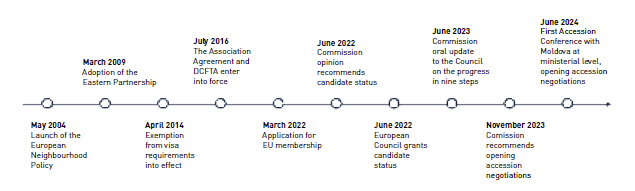
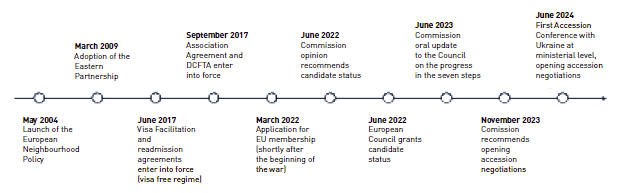
Since 2022, Ukraine and Moldova have opened exceptional conditions for candidacy and accession negotiations. This is because the criteria for fulfilling reforms in sectors and chapters of the accession negotiations are not expected to be met without the war’s end. The figures above show the timeline of the steps completed for the start of receiving pre-accession benefits, but there is no progress on fulfilling fundamental criteria for EU membership.
Critical junctures and responses
Arguments about the concept of critical junctures have played an increasingly relevant role in foreign policy studies. The use of the concept can vary in comparative studies, and it is useful for tracing choices and different trajectories and consequences.24 The EU has answered a few critical junctures over the last years, which helps explain the exceptionalities this article introduces.
The EU Commission President, Ursula von der Leyen, launched a value-based strategy in December 2021 entitled the ‘Global Gateway’ (GG), when the Covid-19 pandemic represented a critical juncture for the configuration of the geopolitical background. Under that scenario, the overall objectives of the GG were to maintain and expand political and economic cooperation, support partners, and improve infrastructure and connectivity in regional and international contexts undergoing a green and digital transition. Among other instruments designed to meet the objectives of the GG was the new Neighbourhood, Development and International Cooperation Instrument (NDICI-Global Europe). The NDICI-Global Europe was also launched to contribute to achieving the international commitments of the 2030 Agenda and the Paris Agreement. According to the Commission, the NDICI-Global Europe ‘is based on the ENP objectives and priorities outlined in the regional strategies, such as the renewed Eastern Partnership and the new Agenda for the Mediterranean’.25
The war in Ukraine in 2022 appeared as a new critical juncture impacting EU external actions and policies bringing a new dilemma to be accommodated under the NDICI-Global Europe. Initially expecting a quicker war, discussions on the candidacy of EaP countries led European leaders to recalculate their ability and urgency to have more influence on Ukraine’s current and future political status, which has been followed by the candidacy requests of Moldova and Georgia.
In order to become an EU member, countries must submit a membership application to the Council of the EU for the yearly review and be granted candidate status, with the agreement of all Member States, as to begin formal negotiations for the accession. Then, membership negotiations start, in a process where the country prepares to adapt its internal functioning and implement EU laws and regulations. The negotiations follow chapters to implement theacquis communautairein six thematic clusters: the first being ‘fundamentals’, which requires accomplishing economic criteria, the functioning of democratic institutions, and public administration reforms. Negotiations on each cluster open as a whole; however, ‘progress under the “Fundamentals’ cluster” determines the overall pace of negotiations’ as shown in Figure 3.26 The others are considered associated with internal market, competitiveness and inclusive growth, green agenda and sustainable connectivity, resources, agriculture and cohesion, and external relations. Ukraine and Moldova were granted candidate status in June 2022 and received the recommendation to open accession negotiations in November 2023. It has marked a record pace on moving forwards on negotiations when compared with the existing cases where on average it took nine years overall and the beginning of negotiations on average three years to start.27 However, Figure 3 illustrates how far the countries’ candidacy status are to accomplish, in a predictable period of time, the four fundamental (the opening and the last to be closed) criteria for accession negotiation.
In line with the reflection on the need to expand and introduce different experiences of EU membership, the exceptional consideration of admitting countries previously outside the association forecast leads us to examine which kind of status will be revealed by the condition of being candidate without clear previsions for accomplishing the following stages of association: to complete formal negotiations and implement reforms to meet the EU criteria for a full membership. There are advanced debates on DI, due to divergences in policies between Member States, recognizing the conditions and capacities of countries to coordinate with regional standards. The coordination of non-supranational standards is an ongoing effort that occurs in parallel with the construction of European law. The impacts of differentiation in the Union on the previous membership paths have been considered by the literature.28 However, it is expected that the exceptions we see in the case of new members from the East may worsen the problems of DI.
The EU’s opening statement at the Ministerial meeting on the first the Intergovernmental Conference on the Accession of the Republic of Moldova and Ukraine states the negotiations aim at both countries ‘integrally adopting the EUacquisand ensuring its full implementation and enforcement’ with a revised enlargement methodology and
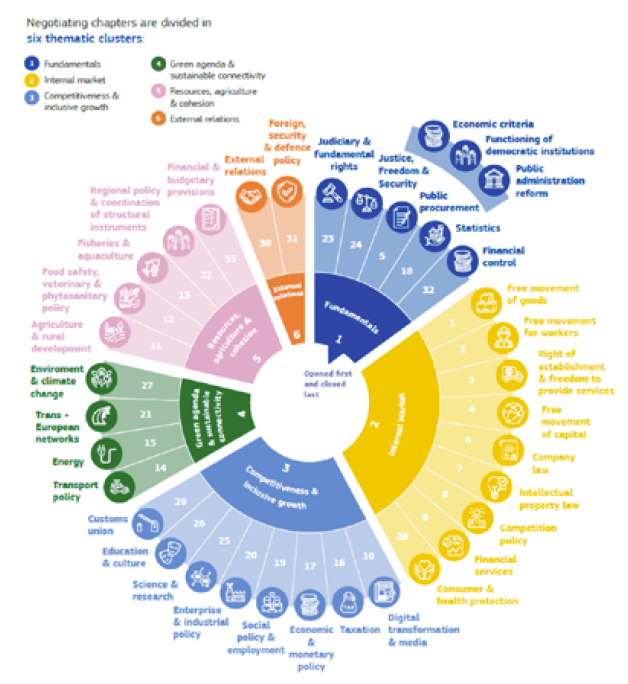
Figure 3 >Sectors and chapters of accession negotiations. Source: ‘EU accession process step by step’. EU Neighbourseast.29
focusing ‘on the fundamental reforms’.30 At the current stage, it is expected that Moldova and Ukraine start to prepare to implement EU laws and standards, in terms of judiciary and fundamental rights, justice, freedom and security, public procurement, financial control, and statistics.
Considering the average time to complete the membership process so far has been nine years, and for countries without active or frozen conflicts, it is not expected Moldova’s and Ukraine’s membership process to take less time. The swift advance from candidate status to the start of accession negotiations does not necessarily indicates a change in EU methodology - it is on the accession process that the candidate countries need to align with theacquis communautaireby implementing changes in their laws and regulations as to align with the EU, as well as to achieve minimum economy thresholds. However, the accession process can be understood as not purely technical, but also political.31 Depending on how the negotiations unfold, the current situation of Moldova and Ukraine can be considered a new EU strategy for Europeanization. This enlargement process is not comparable to neither other candidacy experiences nor norms exports dynamics, although it signals a different degree of approximation with EU norms and values.
Final considerations: From neighbourhood europeanization to accession
There are many different ways in which EU values, norms, institutions, policies, and ideas might spread within and outside of the Union’s borders. Within the framework of the ENP, Europeanization concerns the ability of the EU to use its ‘normative’ clout as a way to promote stability and development in target countries of its interest.32 The EU’s concern to develop a neighbourhood of democratic countries around its borders to the East and South as well as the geopolitical condition of Moldova and Ukraine, located between EU and Russia, motivated the increase of EU’s interest in these countries. The inclusion of Moldova in the ENP in 2003 and the EU-Moldova Action Plan (AP) from 2005 can be considered evidence of the EU aim to invest in countries with separatist and demographic issues.33 These initiatives were further developed with the EaP policies from 2009 and coming to the signature of an Association Agreement and a Deep and Comprehensive Free Trade Area (DCFTA). Of the six EaP countries, only Moldova, Georgia and Ukraine have such type agreements with the EU. Since the establishment of dedicated policies, EU relationship with both Ukraine and Moldova has deepened and widened in scope even though there were periods in which the political leadership were less aligned with the West.34 Despite how closer both countries were with the EU, the relationship was one mainly of cooperation. With actions and funds invested to align regulatory frameworks, commercial standards and to approximate Moldova and Ukraine to the EU’s minimal standards and promote cooperation in security and home affairs, the relationship followed a track of foreign policy under the ENP and EaP policies, which have been revisited over time to adapt to this evolving relationship.
However, membership was not on the table for either. Both countries faced a delicate political stability scenario. There has been a constant dispute of influences in the region, alternating periods of more significant Russian or European influence. The period from 2014 to 2019, despite the annexation of Crimea by Russia, was marked by oscillations among actions of cooperation and tensions between Western supporters in Ukraine and pro-Russia politics and defenders of a closer alignment of the country with Putin’s Administration and protection. The status of frozen conflicts regarding territorial rights in Ukraine, to the South and East, and diplomatic relations between the EU and Russia may have impacted the political stability in Ukraine. As for Moldova, in addition to the maintenance of the Transnistria region frozen conflict situation, the country faced internal political issues related to corruption and bank fraud that went public.35
With the breakout of the war in Ukraine in 2022, the geopolitical scenario completely changed: the EU then had an active conflict, a war at its borders. This change has made the importance of both countries as the Union’s areas of influence to significantly increase, more than ever before. We understand this shift was the critical juncture that granted these countries, with no previous membership perspective, the opportunity to advance steps on the candidacy process and be granted candidate country status in June 2022.
Since 2022 and with no prospects for the end of the war in Ukraine, the debate on accession negotiations for previously blocked candidates, such as some Western Balkan countries, has been reopened and the enlargement reached the top of the EU agenda, as it is expected to be discussed new paths for accession negotiations. As a result of the new European agenda on enlargement, motivated by the decision of the European Council to grant Ukraine and Moldova candidate status, a report entitledFit for 35? Reforming the Politics and Institutions of the EU for an Enlarged Unionwas published after bringing together some of the leading European researchers on European integration, who reflect on Europeanization and DI and inspired by the debates within the framework of the European Council in Granada in 2023.36
The article contributes with a complementary reflection about differentiation in the EU. In addition to a possible and expected DI, the cases under study can be seen as a new status of candidacy, which fulfills a new type of objective to grant candidacy and illustrates the role of the access path as a stage of European influence or Europeanization, with unprecedented characteristics. Neither the literature on DI, nor on Europeanization, sufficiently addresses an analytical model for the case of candidacies and the impacts of the accession negotiations period that the cases of Ukraine and Moldova represent and require reflection based on new categories. This signals a potentially new niche in Europeanization studies, which we aim to further investigate.

